



Abstract
Understanding how news media frame disability is critical for building inclusive public narratives, yet cross-national, longitudinal evidence remains limited. Building on previous framing research, this study applied a ternary framework of Masculinity, Physicality, and Sexuality (MPS) to 8,124 Paralympic news items from the U.K., Canada, and China (2012-2024). Using manual coding, supervised machine learning, and autoregressive modeling, we traced MPS frames across time, countries, and hosting contexts. Findings showed both stability and dynamics: journalists drew on established framing routines, yet emphasized different frames over time. Masculine and heroic portrayals (Masculinity) were highly visible and persistent, while impairment features (Physicality) and gender/sexual minorities (Sexuality) did not have a clear time trend. All frames appeared more frequently in the U.K. and Canada than in China, linking with distinct orientations between individualism and collectivism. Hosting the Paralympics did not temporarily boost any framing strategy, Masculinity decreased immediately after hosting the event, this decrease did not recover even after the game ended. By extending framing theory with a replicable framework and an automated method, this study shows how disability coverage follows path-dependent routines while being shaped by media ownership and regulation.
Introduction
The disability community is large with an estimated 1.3 billion (16%) of the global population (WHO, 2024), yet it remains under-represented and biased in journalism discourse (Kolotouchkina et al., 2021). In this study, disability refers to “body or mind (impairment) conditions that make it more difficult to do certain activities” (CDC, 2024). Framing theory (Entman, 1993) posits the double-edged effect of journalism framing: news outlets can raise short-term awareness and construct lasting images of the disabled group (Lenskyj, 2008) to help them navigate exclusion, but they can also widen the visibility gap and set off a spiral of negative bias which reinforces undesired economic and social consequences such as unemployment and GDP loss (Buckup, 2009).
Research on disability framing increased in the past two decades (Jefferies et al., 2012), yet most studies found that journalists adhere to a “traditional paradigm”, framing the disabled groups as incapable, dependent, and isolated that primarily satisfy the upper-class, able-bodied expectations of heroism (Auslander and Gold, 1999). Scholars have been calling for a paradigm shift to position the disabled population outside the inherited hierarchies of privilege and power, but this transition is slow and difficult (Donnelly, 1996).
Sports journalism can offer solutions in shifting this paradigm. Sport is a microcosm of society and a stage that highlights physical strength and capability (Guttmann, 2004), elements that “classify” the disabled groups from the “abled-bodies”. Sports journalists also demonstrate distinct emotional strategies, such as self-censorship and assessing athletes beyond sporting behavior (Sinclair et al., 2025). Empirically, current framing analyses on disability representation in sport journalism are dominated by qualitative case studies within Western countries. To advance toward a dynamic, global disability visibility, we need to develop and identify a comprehensive, scalable, and reliable framework for analyzing how to frame the disabled group.
The Paralympics Game is a persuasive candidate for developing such a framework, conducting comparative analysis across time and country, and observing whether disability framing reinforce stereotypes or foster inclusion. The Paralympics is a strictly disabled athletes-only media event held regularly with global viewership, it fosters a celebratory environment to merit athletic achievements, empower the disabled, and motivate persistence regardless of restrictive norms around body, gender, and culture (Rojas-Torrijos and Ramon, 2021).
This study combines a cross-national comparative design (including U.K., Canada, and China) with automated framing analysis, covering the Summer and Winter Paralympic Games from 2012 to 2024. The study first aims to propose a generalizable framework for disability framing based on previous works (DePauw, 1997), leading to answer (1) the distribution of disability framing in Paralympic news coverage, (2) their persistence and dynamics by year and country, and (3) if hosting status influences the dynamic fragment. This moves beyond single-nation and single-game case studies toward broader generalizable journalism research, situating disability coverage as a matter of journalism practices rather than purely sports reporting. Tackling these questions can support the “paradigm shift” of representing disability in sports journalism, and suggest how contextual factors (individualism versus collectivism, hosting status) are potentially associated with this shift (van den Heijkant et al., 2024).
Theoretical framework
Framing theory and framing disability
Framing theory explains how media outlets purposefully select and emphasize certain elements of reality to organize meaning (Goffman, 1974), and is one of the most fundamental and prominent theories in journalism research. However, a central challenge remains in conceptualizing, operationalizing frames and measuring frame salience (Entman, 1993), especially in journalistic representation of disability. Because our goal is to capture how disability is framed in sport journalism rather than fit them into existing generic frames (such as Semetko and Valkenburg, 2000), we aim for an issue-specific, emphasis framing approach where the frames can be analyzed and compared across years and countries (De Vreese, 2005).
Issue-specific frames are of wide prevalence in political (Iyengar, 1990), social (Kroon et al., 2017), and economic (De Vreese, 2010) sectors, but no widely accepted, comprehensive, and cross-national comparable framework exists for disability framing in mainstream (sports) news. For example, Maika (2014) inductively introduced six analytical frames (e.g., athletic, medical/patient, etc.), but overlooked gender and sexual inequalities that recent research agenda identified to be central to disability representation. For another, Lin et al. (2024) developed issue-specific frames from People’s Daily news since 1946 (e.g., heroes, role models, free riders). However, it situated itself with limited transferability in the historic Chinese context, so cross-national, English comparisons could not be conducted. Similar to the Chinese work, Rondal et al. (2001) introduced five social representations about disability, but cannot fully guide global news research as it was developed and measured in French.
These limitations guide us to develop a parsimonious, transferable framing framework for disability. We draw on the broader field of marginalization, and evaluate its transferability based on the existing but incomplete criteria provided by previous studies. We use DePauw (1997)’s framework for framing marginality as the umbrella term, and synthesize prior disability research as second-order indicators as operationalization. Because this framework was developed in the context of disability rights and sport (Beacom et al., 2016), it stayed theoretically congruent with sport journalism studies.
The original framework that DePauw (1997) proposed consisted of Masculinity, Physicality, and Sexuality. We refer to this as the MPS framework. The MPS framework offers a conceptualization for disability framing because it corresponds to different aspects of disability representation in media (elaborated below), yet stays parsimonious and compatible across years and media systems (DePauw et al., 1993). Moreover, the MPS framework offers a meso-level lens that bridges micro-level textual indicators (e.g., Maika, 2014; Rondal et al., 2001) and macro-level debates about disability representation, producing results that inform both journalism studies and broader discussions of inclusion. In the next section, we introduce how and why this trichotomy captures the key dimensions of disability framing in contemporary sports journalism.
The masculinity frame (M)
Sport games are historically tied to elite, able-bodied masculinity (Kane, 1988). Therefore, the Masculinity frame describes the disabled group under conventional masculine standards, such as being outstanding, heroic, and having smoothly transitioned into elite social statuses after their sporting career, often referred to as “supercrip” (McGillivray et al., 2021).
Sport news commonly evaluate athletes through achievement-oriented and heroism narratives that emphasize courage, independence, and how they developed a “successful” career defined by an abled-body. Further, studies have identified frequent mentions of winning medals or setting records (Scott et al., 2018), demonstrating teamwork (Rees et al., 2019), and achieving societal recognition (Schantz and Gilbert, 2001). These align with social expectations of a masculine individual, thereby emphasizing the Masculinity frame.
The physicality frame (P)
The Physicality frame, by its name, centers the “disability” element (both medically and socially) over athleticism. This is relevant because bodily difference is a primary distinguishing feature of disability news (DePauw, 1997). The Physicality frame shifts attention to impairment features, bodily differences, treatments, assistive devices, and the social consequences corresponding to Physicality.
Medically, sport journalism often includes causes and treatments of disability (e.g., injuries, diagnosis, prognosis, medical staff or assistive devices; Maika, 2014), and adaptive technologies or tools (cyborgs) to enhance physical performance in sporting events (Stein, 2017) to their news. Socially, sports journalism negatively compares and affiliates the disabled in a non-disabled perspective (Linton, 1998), resulting in an ableism hierarchy that rejects, ignores, and excludes the disabled group (Rondal et al., 2001). While some studies claim that the Physicality frame can help the disabled group by highlighting the financial, infrastructural, and governmental support for a better career (Thomas, 2008; Titchkosky, 2003), these elements are still neither a part of sporting achievement, nor covered in able-bodied representation of sport journalism.
The sexuality frame (S)
The Sexuality frame portrays gender and sexual minorities, which covers two aspects: the biological gender (male/female) minority, and the sexual orientation minority (e.g., LGBTQ + athletes; Colpitts and Gahagan, 2016). A discursive example is inclusion of hetero-normative cues, heterosexual attractiveness, gender debates, and sexuality discussions (Macková et al., 2024).
Research on disability sport journalism has shown that gender and sexuality are crucial yet omitted in coverage (Cooky et al., 2015; Magrath, 2020; Quinn and Yoshida, 2016). Gender is especially important for sport journalism, as it strongly relates to perceptions of athletic power and achievement. The differences between male and female in terms of capacity and eligibility have long been a heated debate, one salient example is the eligibility of South African athlete Semenya. Similarly, representation of the disabled sexual minorities came into the spotlight in the past years. Sport journalism was a demonstration of their increased volume (Humayun, 2025).
However, gender and sexuality minorities are marginalized in Paralympic news reports in three ways (Tamari, 2017). First, they are less covered in journalistic reports (Pullen et al., 2025). Second, they are represented in a one-dimensional and demeaning manner (McInroy and Craig, 2017), further depicted through a stark narrative contrast between exciting, amplified delivery of men to the often dull, matter-of-fact delivery of women (Cooky et al., 2015). Third, gender and sexuality minorities are reported in correlation with their traits that have nothing to do with sports. For example, women Paralympians were reported when they got proposed (BBC, 2024), or how they balanced career while being a heroic mother (Oxley, 2020). In the MPS framework, we conceptualize the Sexuality frame to capture the visibility of gendered/sexuality traits, rather than the invisibility of this issue.
Given the conceptualization of the MPS framework, our first research question probes into the descriptive and distribution of the MPS framework.
The three frames are not mutually exclusive: a single news story may invoke multiple frames concurrently (for example, an article might highlight both an athlete’s sporting achievements and the challenges due to their impairment). We acknowledge this potential overlap by treating each frame’s presence as an independent variable, each news item can be labeled with none, one, or multiple frames. This choice aligns with emphasis framing background that we defined in the first place.
Mapping a static-dynamic interchange of MPS frame distribution
In journalism studies, frames function not only as a cause (for emphasizing certain voices), but also as an effect (as a product of journalistic routines, organizational constraints, and external pressures). This dual nature creates two analytically separable properties relevant to our design: (a) a “stable” tendency toward routine, path-dependent reuse of familiar news templates, and (b) a “dynamic” responsiveness to events, norms, and actors (Umbricht and Esser, 2016; van den Heijkant et al., 2024), which we both aim to catch. With the MPS framework, DePauw (1997) highlighted that it conveyed dynamic and contextual elements, yet publication routines and story templates are often stylistically consistent from one Paralympic cycle to the next. Thus, the study aims to map both stabilities and dynamics through interpreting the temporal, country, and hosting factors that influence the (in)variance of frame presence.
Stability: Journalism routines
News frames are not re-designed each year, but rather intimately tied with institutional forces, editorial routines, organizational norms, and external pressures. Previous studies have confirmed consistent framing as a part of news packaging (Gamson and Modigliani, 1989), and is evident regardless of media system traits (either commercial or state-aligned). In empirical means, this stability is considered a “norm” and often overlooked in journalism studies. Many studies (e.g., Buysse and Borcherding, 2010) analyzed pooled framing distributions without discerning the time variance inside. Our first hypothesis thus aims to map this static path dependence.
Dynamics: Temporal trends
We address three dimensions of MPS frame dynamics, covering time, country, and hosting. Previous studies have identified significant but mixed trends, and little exists in proving/counteracting these trends. Based on the comparable MPS framework, this study is able to test these variations, but the trends remain unhypothesized as Research Questions due to gaps in quantified and consistent directions of variation.
For Masculinity, McGillivray et al. (2021) conducted a qualitative content analysis on the media representation of the disabled group during the Rio 2016 Paralympics, and identified increased use of the “supercrip” framing (falling into Masculinity). Regardless of this empirical finding, studies argued that while this narrative seemed to be a positive portrayal, they were actually reinforcing a toxic societal expectation that the disabled people must adapt and overcome their disability to become equal (Goodley, 2011), ignoring the real needs and difficulties (Purdue and Howe, 2012). This skepticism was supported by The Portrayal Guidelines Policy issued by the International Olympic Committee (IOC, 2024) in avoiding portrayals on “hyper-masculine traits such as courage, independence, and fearlessness”, a signal of decreased Masculinity framing. Synthesizing the mixed trends between empirical results and industrial guidelines, the study proposes.
The proportion of the Physicality was observed to increase and decrease in different studies. Kim et al. (2017) conducted a framing analysis on 283 U.S. television news transcripts from 1988 to 2012, and concluded that Paralympic news reports increasingly adopted an episodic, medicalized perspective that highlighted their physical limitations instead of achievements, an increasing trend of Physicality. Contrarily, Antunovic and Bundon (2022)’s statement of a bright future in sports journalism highlighted how journalists and professionals had realized their responsibilities in meriting sporting behavior over impairment stereotypes, a decreasing trend of Physicality. Similarly, Kolotouchkina et al. (2021) analyzed Spanish Paralympic television news programs from 2014 to 2018 and concluded decreasing Physicality framing in the successive years. Based on these evidences, we propose.
For the proportion of Sexuality, Pullen et al. (2025); Toffoletti (2018) both suggested an increase: female Paralympians can trigger sexual subjectification (Gill, 2003), which is achieved through gendered/sexual autonomy and self-empowerment. Further, there are increasing efforts of framing women (Macková et al., 2024) and minority sexual orientations (Magrath, 2020) as equals as stated in previous studies. Outside academia, we are also thrilled to witness women and sexual minorities prosper with diversity, respect, and inclusion (Ramirez and Wotipka, 2001). BBC’s LGBT Sport Podcast had actively produced over 300 episodes since their launch in 2018 (BBC, 2023b), and a record-breaking number of LGBTQ + athletes participated with their true identity in the 2024 Paris Paralympics. As documentations of transgender women athletes being banned due to reduced testosterone level requirements (BBC, 2023a; Sanchez, 2015), the study assesses whether, with the succession of time, women and sexual minorities may be framed with increasing volume, and with an objective, unbiased tone of voice (Isard and Melton, 2022). We propose RQ2c.
Dynamics: Country variances
Disability framing can vary across cultural contexts. Hofstede (2001) suggests that countries differ in correlative tendencies toward greater individualism or collectivism. Considering Hofstede's (2001) individualism scores, the U.K. (89) and Canada (80) ranked higher on individualism, whereas China (20) ranked higher on collectivism. In sport journalism of disability, this cultural difference may influence how often news stories highlight personal achievement and use overcoming narratives (Masculinity), and how often they include personal gender or sexuality identities (Sexuality).
Existing research already identified cross-country framing differences, especially for Sexuality. Chrif et al. (2024) and Smith and Thomas (2005) found an under-representation of disabled women in France and U.K., but an over-representation in Tunis and Australia. These differences can relate to athletic performance (Cheong et al., 2021) and geographical variances (Lee, 2013). Given the mixed evidence and our limited number of Asian outlets, we treat cross-national differences as an open research question.
Dynamics: Hosting statuses
Hosting a globally renowned mega sporting event like the Paralympic Games is linked with national pride and global image (Hayashi et al., 2016). It creates opportunities to raise the nation’s political standing (Billings, 2008), and to demonstrate advancements in sports, economics, welfare, and education in a favorable way (Wang and Wang, 2007). To fully make use of this spotlight, newsrooms have been incentivized to link sporting success with social progress and governance excellence (Hayashi et al., 2016). Therefore, home-country journalists often adopt more celebratory storylines that foster national pride and soft power (Billings and Eastman, 2003; Nye, 1990). In this sense, hosting is a theoretically grounded explanatory element for framing dynamics.
In the long term, the effects of hosting a game are not limited to the specific year, but elongates deeply into various sectors of politics and society. Preuss (2004) has shown that the 7-year preparation period for hosting a game brings benefits that would otherwise take decades to achieve. If such changes influence media routines, they may appear as gradual frame choice shifts, rather than immediate one-time spikes. For this reason, we also examine the dynamics of hosting in a long-term, persistent manner.
The above-mentioned effects of hosting are well documented in the Olympics, but to what extent does this pattern transfer to disability sport journalism is unclear. Therefore, this study aims to investigate and test hosting status as a pioneer trial. In the current design, U.K. in 2012 and China in 2022 hosted a Paralympic Game. We aim to map how hosting status may change MPS framing, considered both short-term (the host year), and long-term (post-host).
Methods
Data
This study was approved by the UvA Ethics Review Board (FMG-UvA). Article texts were retrieved from three English news outlets, BBC News (U.K.), CBC News (Canada), and China Daily (China). We chose these outlets because (1) they were mainstream national outlets with high visibility and stable, searchable online archives across multiple Paralympic cycles, and (2) they allowed a cross-national comparison between two individualism-leaning contexts (U.K., Canada) and a collective-leaning context (China). All articles were retrieved through Selenium and Beautiful Soup in Python. The unit of analysis was the title and full body text, excluding multimedia elements. The search query was “Paralympic” between January 1st, 2012 to December 31st, 2024.
After retrieval, we filtered out unusable and irrelevant pages using rule-based cleaning. This included unretrieved (empty text cells due to history loss, exceptional HTML structures, etc.), duplicates (we kept the first entry), and mis-retrieved (Paralympic not in the unit of analysis; e.g., in sidebars and navigation widgets). The researchers manually confirmed the removing rule through a stratified subsample. The final dataset included 8,124 news items, of which U.K. had the most coverage (n = 4,585; 56.4%), followed by China (n = 2,186; 26.9%) and Canada (n = 1,353; 16.70%).
Supervised machine learning
Manual coding procedure
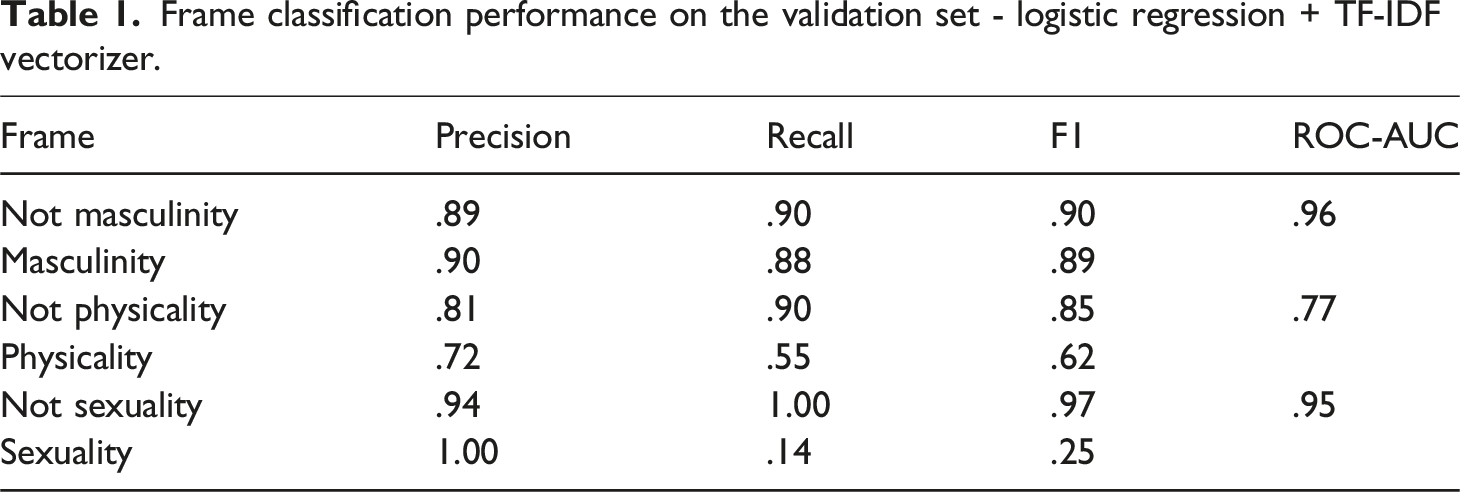
This study used supervised machine learning (SML) to classify news frames (Kroon et al., 2022). Two coders majoring in Communication Science first manually coded a training subset based on a codebook (Kananovich, 2018). The codebook (see Appendix A) consisted of nine yes-or-no indicator questions, three for each frame. The frames were labeled present as long as one of the three indicator questions were coded “yes”, and were non-mutually exclusive, so every article could receive zero, single, or multiple frame labels.
The coders completed three training sessions and two reliability rounds (50 random items per round), each round reached consensus before the next. Inter-coder reliability for the MPS frames met the common threshold in terms of Krippendorff’s Alpha (Krippendorff, 2022) (Masculinity = 0.95, Physicality = 0.82, Sexuality = 1.0, see Appendix B).
Automated classification
Frame classification performance on the validation set - logistic regression + TF-IDF vectorizer.
(Lagged) Dependent variables
For each frame, the dependent variable was the share of news articles in a given year and country that used the frame. This transformed the dependent variable into a continuous variable, independent of the potential impacts of unequal article counts across outlets. The lagged dependent variable took the value of frame presence in the previous year.
Independent variable and interactions
Year was standardized and coded as the ordinal distance from the baseline year (2012). The 1-year interval reflected the 4-year Paralympic cycle, and ensured sufficient articles in each cell to stabilize variance.
Country was a categorical predictor with three categories (U.K., Canada, and China), with China as the reference group. We used China as the reference group because (1) it ranked further from U.K. and Canada in the Individualism index (IDV) (Hofstede, 2001), and (2) this choice statistically avoided collinearity with the baseline year (2012).
Host year represented the Paralympic year in which a country hosted (UK = 2012, China = 2022; Canada with no hosting role during the study period). Post-host slope was defined as the additional yearly trend after Paralympic hosting, coded as 0 for all years in Canada and 0 before and during the host year in the U.K. and China, then increasing by 1 in each subsequent year after hosting.
Hypothesis testing
This study conducted a panel regression with a 1-year lag of the dependent variable to test the RQs and Hypothesis (Box et al., 2015). The final formula was:
Each frame was modeled independently in separate regressions; correlations among frame shares were not included in the same model, c represented a certain country, t represented a time/year.
We added the predictors step by step:
Results
Overall distribution and model performance
The word embedding model (Word2Vec) validated that the MPS frames successfully took up distinct vector spaces, justifying that our proposed framework captured different aspects of disability representations in sports journalism (see Appendices C-F). RQ1 asked about the MPS frame distribution for the labeled 8,124 articles. Results showed that Masculinity was the most frequent (n = 4,613; 56.78%), followed by Physicality (n = 2,442; 30.06%), and then Sexuality (n = 89; 1.10%).
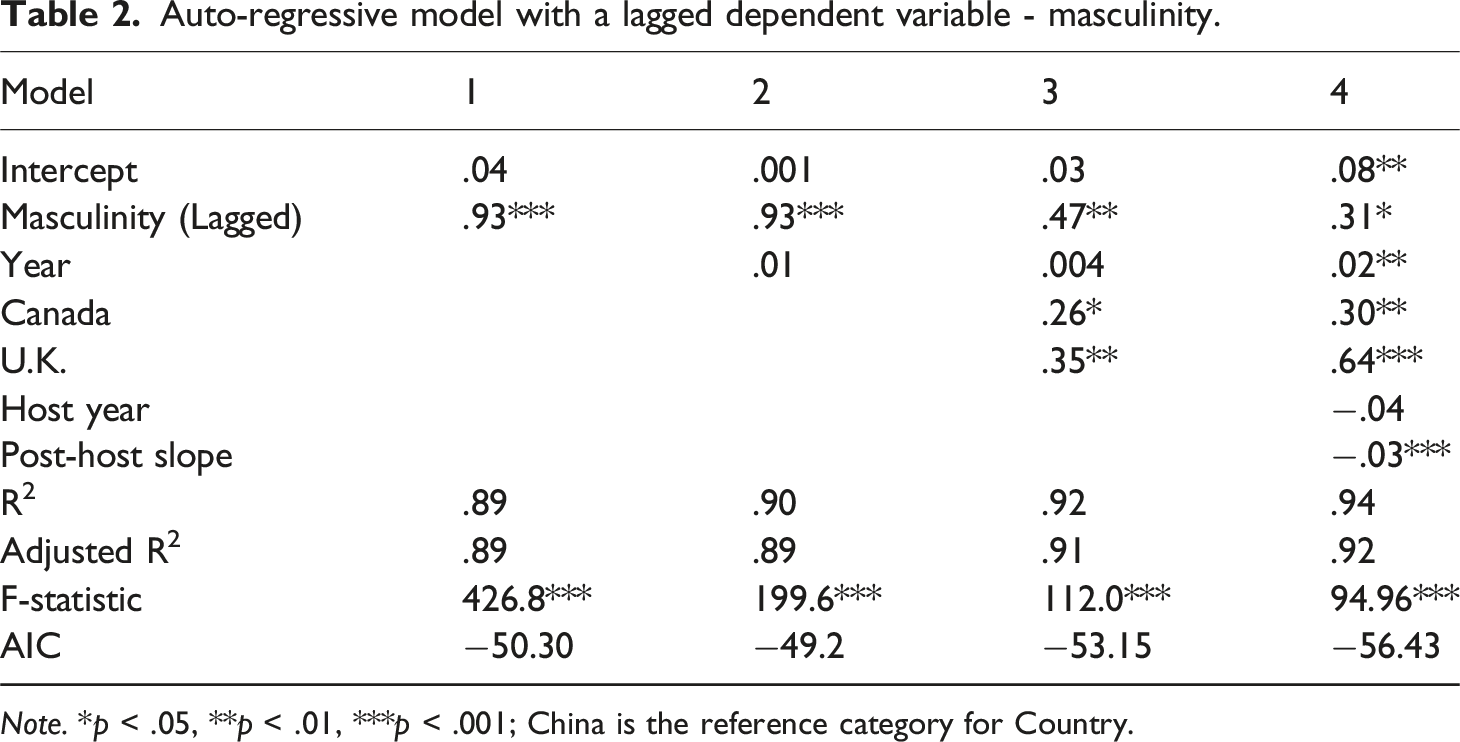
Auto-regressive model with a lagged dependent variable - masculinity.
Note. *p < .05, **p < .01, ***p < .001; China is the reference category for Country.
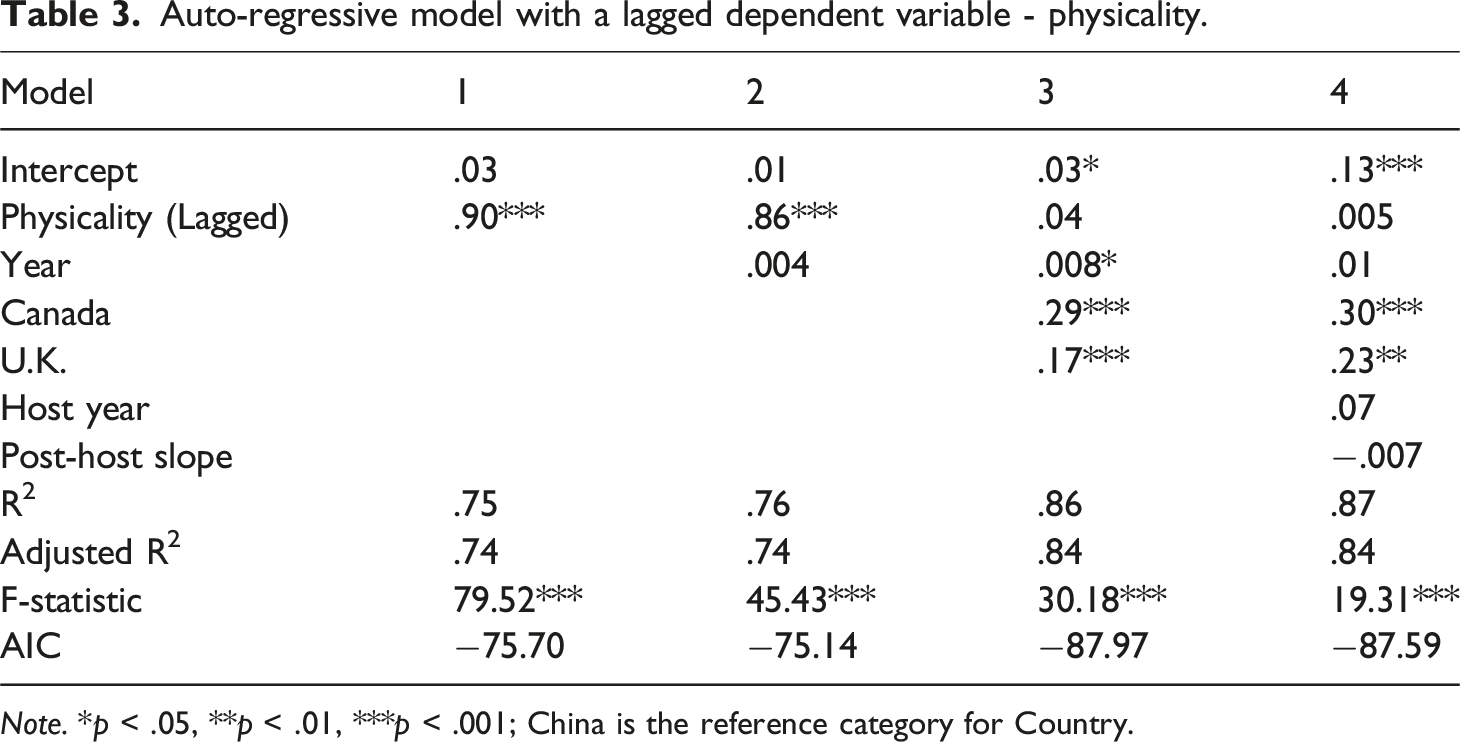
Auto-regressive model with a lagged dependent variable - physicality.
Note. *p < .05, **p < .01, ***p < .001; China is the reference category for Country.
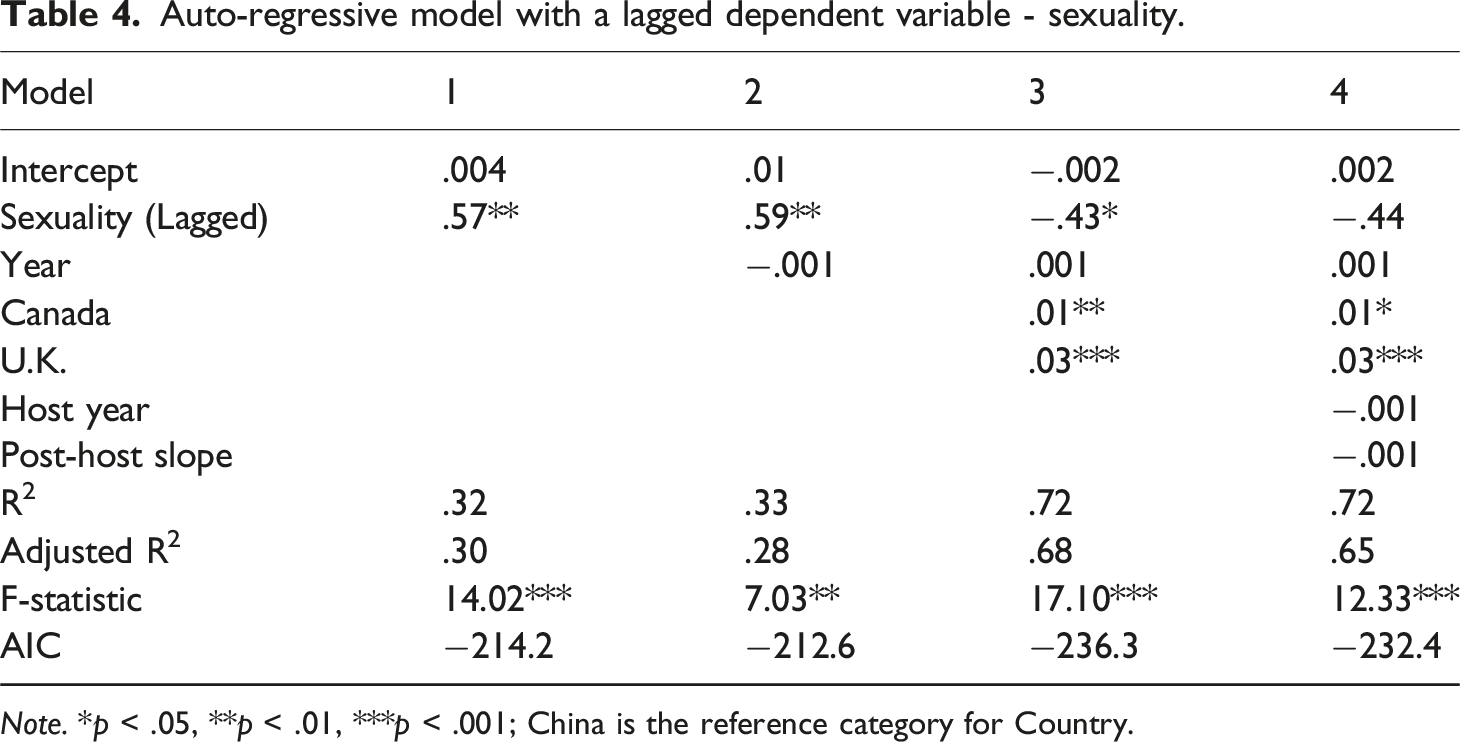
Auto-regressive model with a lagged dependent variable - sexuality.
Note. *p < .05, **p < .01, ***p < .001; China is the reference category for Country.
Temporal trends
For the carry-over effects proposed in H1, Model 1 showed that frame presences were largely dependent on previous framing strategies for Masculinity (β = 0.93, p < .001) and Physicality (β = 0.90, p < .001), and moderately for Sexuality (β = 0.57, p < .01). However, this persistence changed once country (Model 3) and hosting status (Model 4) were controlled: Masculinity shrank but remained positive (β = 0.31, p < .05, Model 4); Physicality became insignificant; and Sexuality changed from positive to negative (β = −0.43, p < .05, Model 3), eventually becoming insignificant in the final model. H1 was only supported with the simple auto-regressive models (Models 1 and 2), but became partial once country and hosting were accounted for, rejecting H1.
For the temporal dynamics raised by RQ2abc, Masculinity only showed a slight increase over time when all independent variables were added (β = 0.02, p < .01, Model 4); Physicality showed a small positive trend only in model 3 (β = 0.008, p < .05, Model 3), but was absorbed when hosting status was controlled; Sexuality showed no significant time trend among all models.
Country variances
To probe RQ3, we added country dummies into the regression. Results revealed significant cross-national differences, which absorbed much of the serial dependencies observed in the simpler models. In model 4, both U.K. and Canada had higher overall frame percentages compared with China, but the percentage-leadership role was not symmetric across frames: For Masculinity, U.K. took the highest share (β = 0.64, p < .001), followed by Canada (β = 0.30, p < .01). For Physicality, Canada showed the highest frame use (β = 0.30, p < .001), followed closely by U.K. (β = 0.23, p < .01). For Sexuality, both U.K. and Canada were only slightly but significantly more frequent than China (U.K.: β = 0.03, p < .001; Canada: β = 0.01, p < .05).
Hosting statuses
Hosting showed no significant main effect at the host year for any MPS frames (Model 4). However, in the long term, Masculinity declined slightly after a country hosted (β = −0.03, p < .001). By contrast, the global year trend was positive (β = 0.02, p < .01). Taken together, U.K. after 2012 and China after 2022's net Masculinity yearly change after hosting was about −.01 per year, despite the general global increase. Physicality and Sexuality showed no significant long-term trends after hosting the game. Thus, RQ4 found no immediate host year shift. However, it did detect a small post-host decline for Masculinity, but no reliable hosting pattern for Physicality or Sexuality.
Discussion
This study focused on disability framing in Paralympic news across three international media outlets over a 12-year period. Building on DePauw (1997)’s framework of Masculinity, Physicality, and Sexuality (MPS), we operationalized the MPS framework with a reliable and replicable codebook for disability representation, and bridged micro-level word choices and macro-level national agenda with a meso-level lens. Further, we labeled and analyzed 8,124 news articles utilizing SML content analysis and panel regression, identifying both stable and dynamic patterns of disability framing. First, Masculinity dominated the frame distribution, followed by Physicality, while Sexuality was less witnessed; Second, the MPS framing choice reflects stable journalism routines through time, regardless of game cycles or hosting statuses; Third, framing distribution by country reflects structural cultural differences between individualism and collectivism orientations. With automated methods, we scale up journalistic framing analysis from descriptive discourses to data-driven patterns. We discuss our insights in the following paragraphs.
Rethinking the disability framing framework
In this study, Masculinity was the dominant frame. Across countries and years, athletes with disabilities were framed as heroic, exceptional figures who overcame adversity and challenge. This pattern is consistent with prior works that critique how sport journalism centers disability achievement and heroism in ways that narrow the issue itself (e.g., Antunovic and Bundon, 2022; Kim et al., 2017). Moreover, we found that athletes were highly connected with terms such as talent, elite, and advanced, suggesting that Masculinity in our current sample has stepped from pure gendered speech into a governance-related issue about how and who are socially legitimate and acknowledged. Here, Masculinity depicts an ideal image of a citizen-athlete, characterized by resilience, national honor, and personal sacrifice, or previously named as the supercrip (McGillivray et al., 2021). Disabled identities that are politically inconvenient (i.e., not heroic, striving, grateful) are excluded. This is further supported by the time trend: Masculinity was even slightly increasing over 12 years across three countries. High-achievement heroism remains the most common framing strategy used to arouse disability attention and (potentially) acceptance, even as scholars and advocates urge more inclusive storytelling (Antunovic and Bundon, 2022; Kim et al., 2017).
Physicality was also widely framed in sports journalism. Our study shows that Physicality did not increase in a straightforward way over time. The increasing trend was insignificant once hosting was accounted for. Since Physicality, framed around deficiencies, impairments, medicalization aspects, is often linked with negative emotions such as pity (Jang and Kwak, 2025), the future key question for journalists is not whether the Physicality frame should be used, but how to use it: applied strategically, Physicality framing can highlight structural barriers, promote social awareness, and advance disability justice; applied only as impairments and deficiencies, however, it risks reducing disability to a symbol of tragedy or a source of able-bodied inspiration (Jang and Kwak, 2025).
Lastly, Sexuality framing was consistently rare across years and countries. If the MP frames demonstrated what were shown, the under-representation of Sexuality reflected frame suppression (Entman, 1993), a strategic journalistic silence in gender and sexual minorities. Sports journalism has not yet shifted from its heroic, achievement-centered focus toward a more varied and inclusive framing that emphasizes impairment challenges or athletes’ personal identities. Toffoletti (2018) concluded that women athletes were often framed with aesthetics, sexuality, or “softness”, but our study observed an opposite pattern. Instead of sexualizing athletes, disability in sport journalism is nearly invisible. The public expects (and only expects) the athletes to perform well, with little attention to them as women or as LGBTQ + athletes.
Journalism routines and objectifying the disabled group
The study showed that framing strategies were strongly predicted by the last year’s distribution, a path dependence in journalism routines. Routines can minimize cognitive costs and reputation risks (Bélair-Gagnon et al., 2024). Once the newsroom establishes an “equilibrium” in framing the disabled group, the storyline reproduces through templates, editorial requirements, training. This instrumentalizes disabled athletes as an institutional object than a living individual: sports journalism simply fills these disabled athletes into the template, but misses digging out how their personal traits and experiences differs and makes them significant.
Our cross-country comparison revealed fundamental differences between individualism and collectivism journalistic contexts. Compared to China, the U.K. and Canada more frequently emphasized Masculinity and Physicality, and also slightly more frequently mentioned Sexuality. This framing preference reflects editorial norm differences shaped by individualism and collectivism. Heroic, individualist topics are likely more attractive in high individualism ranking countries. This was also observed in the superhumans narrative in the British Channel 4 (Pullen et al., 2020). National identity and unity are emphasized over individual hero-making for China under higher collectivism ideology, this makes Chinese outlets further cautious about gender or sexual discourse (Stockmann, 2013). This is also a depiction of how the disabled groups are objectified: before a disabled athlete (or any journalism object) is even made visible, the cultural context guides newsroom decisions on which aspects of that athlete best serve the country context, in terms of individualist inspiration and national harmony (Lopez-Mugica et al., 2024).
Lastly, hosting mega-events like the Paralympics did not show the significant nation-branding effect as hypothesized (Grix and Houlihan, 2014). In fact, the only significant pattern was a mild post-event increase to Masculinity framing. The absence of an immediate hosting effect further supports that the MPS framing in sport journalism is dominated by the equilibrium of stable newsroom templates. The misaligned results from Olympics to the Paralympics further indicate that hosting status is a less influential variable in the disabled context.
Limitations and future research
The study is not without limitations that enlighten future research. Media coverage about disability in sport journalism consists both written and visual contents. Images and videos are especially important for how disability and Paralympic athletes are framed in sport journalism, since disability features sometimes rely on these forms of representation. In recent years, visual framing has received increasing scholarly attention. Due to analysis capacity of the current study, it would be valuable to build on the MPS framework and investigate disability framing as a multi-modal process. Further, our findings explicitly show what is missing and what is reliant. These suppressed and routinized framing strategies are exactly points of advancement. Practically, the underrepresentation of Sexuality flags journalists to recognize gender and sexual minorities in current news coverage; the path-dependent MPS frame distribution alerts both news producers and regulators to emphasize more diverse and inclusive narratives rather than rely on past experiences. The disability issue should never be a tool for fulfilling journalism routines, nor should it be used to elicit sympathy or inspire able-bodied individuals (Pullen and Silk, 2020). A more equitable journalism practice with less stereotypical narratives and diverse voices remains urgent in all journalism practices.
Supplemental material
Supplemental material - Framing disability in sport journalism: A cross-national automated framing analysis of Paralympic news (2012-2024)
Supplemental material for Framing disability in sport journalism: A cross-national automated framing analysis of Paralympic news (2012-2024) by Wenwen Guo and Anne C. Kroon in Journalism
Footnotes
Acknowledgements
We gratefully acknowledge Jade van Dorth for serving as the content analysis coder and for her careful, reliable contributions to this study. No third-party writing or editing assistance was used, and the submission was made directly by the author(s).
Declaration of conflicting interests
The authors declared no potential conflicts of interest with respect to the research, authorship, and/or publication of this article.
Funding
The authors disclosed receipt of the following financial support for the research, authorship, and/or publication of this article: This study is funded by the Digital Communication Methods Lab at the University of Amsterdam (UvA), under Grant number: TF 24.09.
Ethical considerations
This study has been pre-registered, and received the ethic approval from the UvA Ethics Review Board (FMG-UvA).

Data Availability Statement
Data underlying this article are available from the author(s) upon reasonable request.
Supplemental material
Supplemental material is available online.