



Abstract
This study explores the role of TikTok as a platform-based crisis information source, focusing on how users engaged in collective sensemaking during the 2020 Port of Beirut explosion. Using a mixed-methods approach, the research analyzes multimodal content, including video, comments, hashtags, and transcripts, to understand how users’ holistic information experience influenced sensemaking around the crisis event. Drawing on Dervin’s conceptualization of sensemaking, the study investigates how visual, auditory, and textual elements of TikTok videos facilitate dynamic, iterative information behaviors such as information seeking, sharing, and negotiation. The findings stress how the platform’s recommendation system influences crisis sensemaking and the implications specifically for Middle Eastern crises. Our analysis revealed intersemiotic dissonance—the tension arising from clashing semiotic meanings—highlighting the risk of presenting crisis discourse multimodally.
Introduction
Following a disaster, individuals, governments, and non-profit agencies engage in crisis practices that are increasingly digital. Social media are well-cited and known to be instrumental in global, contemporary crisis communication (Palen & Anderson, 2016; Palen & Liu, 2007). Applications used to share outfits of the day and life milestones are also used to discuss rising death tolls in disasters overseas. In their practical use for crisis information dissemination comes biased perspectives that influence the perception of disaster impact (Soden & Lord, 2018). This overwhelming amount of muddled information encourages the dissection of the crisis information shared on popular social media applications, including TikTok. TikTok first started primarily for entertainment purposes but its use skyrocketed during the COVID-19 pandemic as the world was facing indoor isolation and seeking enjoyment (Kaye et al., 2022). Now, this application with over 1 billion users has become the space for activism and e-commerce, and acts as a major information hub (Li et al., 2021).
Although many studies have already examined TikTok in a crisis space (e.g. Divon & Eriksson Krutrök, 2024; Marino, 2024), there is an opportunity to examine the implications of using the application’s multimodal format for crisis sensemaking. Obreja’s (2024) examination of TikTok’s legitimatization of algorithmic sensemaking reveals the connection between TikTok users and institutional actors in sensemaking, and motivates further investigation of user and sensemaking in an empirically specific, sensitive context. How an individual makes sense of a crisis event influences not only how the crisis is culturally understood but also how well different communities can respond to meet the needs of impacted people and land. By leveraging Dervin’s encapsulation of sensemaking and a mixed-methods approach, this study reveals the systematic influence of TikTok on the sensemaking of the 2020 Port of Beirut explosion. Specifically, this study leverages visual social semiotic analysis (VSSA), content analysis, statistical analysis, named entity recognition (NER), and co-occurrence networks to investigate sensemaking of the blast on TikTok.
To investigate crisis sensemaking on TikTok, the research question “How do the uses of TikTok contribute to collective sensemaking during a crisis?” drives our study.
Social Media Platforms During Times of Crisis
The role of social media in crisis communication and social transformation is multifaceted, encompassing behavioral, technological, and sociopolitical dimensions. Literature demonstrates how social media platforms not only enable individual and collective action but also shape the very architecture of public discourse in crisis contexts. Velasquez and LaRose (2015) highlight how social media political efficacy—users’ confidence in leveraging social media for political goals—emerges as a key psychological driver of activism, especially among student-led movements. Their findings suggest that social media activism is nurtured through iterative digital engagement and personal validation, thus creating new avenues for grassroots mobilization.
Complementing this, Oh et al. (2015) investigate the Egyptian Revolution to theorize how collective sensemaking is dynamically constructed on Twitter through hashtags, user interaction, and semantic clustering. Their work illustrates how these digital signifiers allowed dispersed individuals to form a coherent narrative and respond in real time to the unfolding political crisis. Meanwhile, Aouragh (2016) offers a critical Marxist lens, arguing that social media should be understood within the structural conditions of neoliberalism, colonial histories, and authoritarian governance. Her analysis is particularly salient in understanding crises like the Beirut explosion, where both the digital terrain and the sociopolitical landscape are deeply intertwined. She warns against technological determinism and emphasizes the inseparability of online mobilization from offline material realities.
These theoretical perspectives are reinforced by empirical observations of platform-specific behaviors during crises. For example, Twitter stands out for its creative linguistic practices such as hashtags and emojis, often used to facilitate rapid information sharing and emotional signaling (Starbird & Palen, 2011). Facebook, by contrast, supports richer interactional formats, from organizing events and volunteer efforts to fostering emotional support networks through groups and tagging (Nandy, 2022; Silver & Matthews, 2017). YouTube provides a visual narrative space where users upload videos summarizing events, offering gratitude, or sharing eyewitness accounts (Cui & Chu, 2021; Varghese & Yadukrishnan, 2019). Instagram, with its emphasis on images and ephemeral stories, humanizes crises by showing personal well-being updates and infographics that synthesize complex events into digestible visuals (Elgammal, 2021; Kim & Lim, 2020). This article enriches our understanding of TikTok uses during times of crisis, which provides a point of comparison across highly researched social media platforms.
TikTok
TikTok is a video-sharing social media platform that has experienced a rapid rise in use since its Chinese parent company, ByteDance, released it in 2016 (Bhandari & Bimo, 2020). Although the application had steady downloads in its initial years, the COVID-19 pandemic was the catalyst of application adoption as the world was facing indoor isolation and seeking entertainment (Kaye et al., 2022). TikTok is built around short-form video content, which prioritizes quick, engaging videos that are curated for a user’s For You Page (FYP). The FYP is molded by TikTok’s recommendation algorithm, which analyzes the user’s behaviors to curate their feed, which includes what the algorithm thinks the user prefers and popular/trending content. Users’ feeds, or FYPs, are tailored to their preferences, encouraging frequent engagement to allow for a hyper-personalized TikTok experience.
TikTok’s unique communicative logic and participatory design have made it fertile ground for studying identity, resistance, and meaning-making. Karizat et al. (2021) demonstrate how users engage in algorithmic resistance by developing folk theories to navigate the opaque workings of the recommendation system. These behaviors are not only about increasing reach but also about asserting identity and co-producing knowledge in digital spaces. Zulli and Zulli (2022) further this idea by conceptualizing TikTok as a platform that fosters “imitation publics” through technological mimesis, where meaning circulates via repeated audiovisual templates. These imitation patterns create a collective visual language that users mobilize for humor, solidarity, or activism.
Building on these insights, Mendelson (2024) shows that sensemaking on TikTok often fosters public intimacy, as viewers interpret emotionally resonant content in ways that influence their offline relationships. Similarly, Schellewald (2021) uses digital ethnography to illustrate how TikTok’s cultural remixing and vernacular visual forms allow users to narrate complex experiences, including crisis events. This perspective highlights how TikTok’s participatory affordances enable both individual expression and collective storytelling, making it a critical site for studying multimodal sensemaking during crises.
In the context of crisis communication, these studies underscore the importance of examining how platform features such as algorithmic visibility, video format constraints, and trends shape the way information is produced, circulated, and interpreted. This project contributes to that body of work by focusing on how TikTok’s infrastructure and cultural practices influence collective sensemaking of a major non-Western crisis, the 2020 Beirut explosion.
Dervin’s Sensemaking
Sensemaking focuses on information seeking and use in constructing knowledge or an understanding when faced with a cognitive gap in the world (Dervin, 1998). As illustrated in Figure 1, individuals construct meaning from internal and external sources such as their knowledge, morals, other people, or media (Naumer et al., 2008). During sensemaking, individuals try to cognitively bridge a “gappy reality”; this “gap” represents the tension between what is known and what must be known to proceed, often emerging in moments of crisis, uncertainty, or disruption. Individuals respond to this gap by engaging in micro-practices such as questioning, interpreting, sharing, or creatively reframing information drawn from internal (e.g. memory, values) and external (e.g. media, peers) sources (Naumer et al., 2008). These micro-practices are not only cognitive but also social and performative, particularly on platforms like TikTok, where users publicly process experiences through storytelling, commentary, and engagement with trends. Thus, when multiple individuals undergo sensemaking, each in their own way, we see this phenomenon—collective sensemaking—as social interactions among multiple participants wanting to bridge their gappy realities. This includes exchanging information and providing support for consensus building to reach an agreement that helps unblur the fuzzy, uncertain reality (Umapathy, 2010).
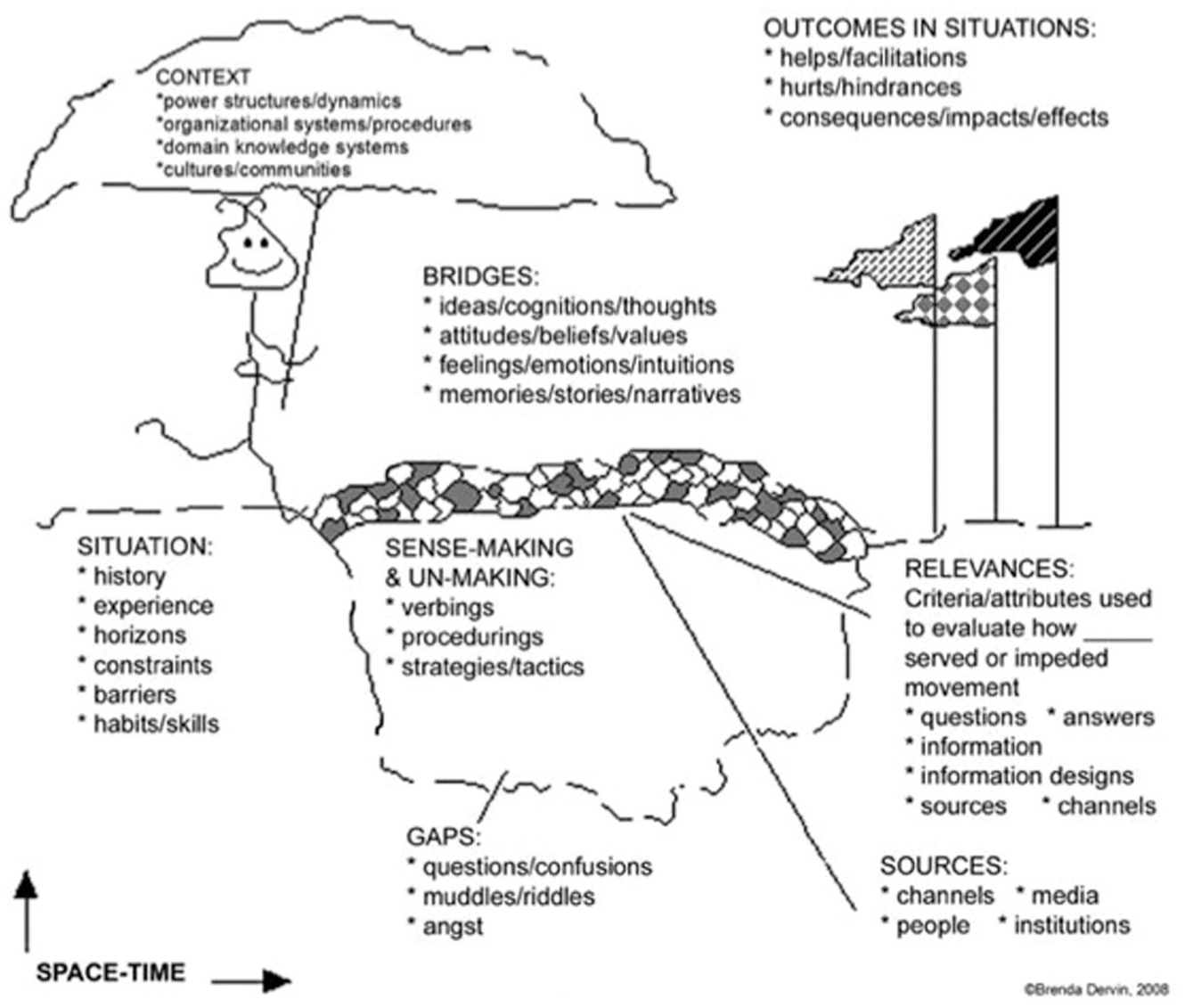
Dervin’s sensemaking theory illustrated (Dervin, 1998).
Dervin’s conceptualization of sensemaking focuses on action-oriented behaviors (e.g. information seeking), which aligns with the phenomenon of social media-supported crisis communication examined in this study. Dervin additionally views sensemaking as an ongoing process rather than a fixed outcome, which is ideal for studying how users interact with crisis information dynamically on TikTok, as information behaviors are fluid and iterative. Her model is especially well-suited to analyzing crisis communication on TikTok, where users’ meaning-making unfolds dynamically, in response to new information and evolving emotional landscapes. This nuance highlights how individual micro-practices, shaped by diverse positionalities, contribute to a shifting collective narrative that attempts to bridge shared uncertainties. Her conceptualization addresses the role of situational and contextual factors in sensemaking, fitting the unique cultural, social, and technological context of this study. In addition, her model captures key aspects of sensemaking, such as the flux between certainty and uncertainty and the role of individuals in shaping their information landscapes, making it well-suited for this research.
The August 4, 2020 Beirut Blast
On 4 August 2020, a warehouse in the Port of Beirut exploded, caused by a detonation of approximately 2750 tons of ammonium nitrate. This explosion killed over 200 people, injured thousands, and severely damaged the capital city (“They Killed Us from the Inside,” 2021). Damage was estimated at $15 billion, affecting homes, businesses, and Lebanon’s already fragile economy. Ultimately, the source of this explosion was government mismanagement of the ammonium nitrate, as it had been sitting in the port for 6 years prior. The reason for the detonation is still not formally confirmed, as opinions on the source of the issue are subjective and reflect an individual’s politics. However, the event became a symbol of systematic corruption and mismanagement as evidence revealed multiple ignored warnings about the ammonium nitrate. Despite the devastation, Lebanese people rallied to clean up neighborhoods, support victims, and rebuild the city in the absence of effective government assistance.
As the event was unfolding, there were a series of smaller explosions drawing attention to the area, prompting users to record initial fires until the final fatal explosion (Rigby et al., 2020). These videos were posted on TikTok, Twitter/X, Facebook, and other prominent platforms often used for crisis information dissemination (Lujain et al., 2020; Ramadan et al., 2022; Rigby et al., 2020). Given how graphic the explosion was, the visceral and visual content related to the explosion captured the world as stories of the lives impacted were shared.
Methodology
Data Collection
The first author created a new TikTok account in an incognito browser to minimize curated (FYP) bias and observed commonly used hashtags and keywords related to the Beirut explosion. Hashtags like #prayforlebanon, انفجاربيروت# (beirut explosion in Arabic), and #beirutexplosion were used to identify relevant videos. Beyond the use of hashtags, inclusion criteria required that videos explicitly referenced the explosion or its aftermath, either visually or through audio narration. Videos were selected to reflect a variety of creators, perspectives (e.g. eyewitness accounts, informational updates), and linguistic representation (Arabic and English).
A total of 30 videos, their transcripts, and 21,494 comments were collected. Audio from both English and Arabic videos was transcribed, with Arabic translated to English for analysis. Data collection occurred between May and December 2022, with some iterations due to data loss (e.g. videos made private after initial collection). Videos and transcripts were collected manually, while comments were gathered using a web scraping tool, which has since become defunct as of 2024.
Data Analysis
Given TikTok’s multimodal format, this study employed a mixed-methods approach to analyze its visual, auditory, and textual elements—videos, sounds, captions, comments, and on-screen text—within the app’s structured dissemination. This layered approach accounts for how crisis information is received and interpreted. While beyond this study’s scope, it is important to note TikTok’s reliance on audio and visuals limits accessibility for those with hearing or visual impairments. Five main analysis techniques were used: VSSA, Content Analysis, Statistical Analysis, Co-occurrence Networks, and NER.
To accurately consider how information on the application is consumed, the videos’ visual, auditory, and textual elements were examined. Videos were analyzed through VSSA, which affords a systematic dissection of how users visually understand digital content (Harrison, 2003). The analysis created frequencies of visual codes, which were statistically analyzed to understand the significance of visual signals to sensemaking. While the referenced VSSA framework includes more processes and elements, this article only elaborates on features or cues more relevant to the findings and discussion; these are explained in Table 1.
Components of VSSA (Partially Listed) (Harrison, 2003).

For example, one TikTok video shows a young woman standing in front of rubble, looking directly at the camera. This image functions as a narrative (actional) representation, with her body and setting implying aftermath. Her direct gaze creates a demand, drawing viewer engagement, while the close personal distance (head and shoulders) adds intimacy. The frontal angle increases involvement, and her central placement and foregrounding enhance salience.
Comments were classified using an adapted version of Heverin and Zach’s (2012) collective sensemaking codebook, with classification performed through the Bidirectional Encoder Representations from Transformers (BERT) language model (Grimmer & Stewart, 2013). While other models (e.g. Naive Bayes, Support Vector Machine) were tested, BERT outperformed them. Statistical analyses, including chi-square and Fisher’s exact tests, were employed to examine relationships between video characteristics (e.g. Vertical Perspective) and comment types (e.g. Information Seeking). Fisher’s exact test was used for frequencies below 5, while chi-square was used otherwise. VSSA, content analysis, and statistical tests served as the primary methods for this study.
Co-occurrence networks and NER were also used to enrich and/or triangulate the primary findings. Co-occurrence networks are built based on the frequency or occurrence of items (such as words) appearing together within a certain context (Hemsley et al., 2020). These networks have been used in previous literature to reveal patterns in text or language (Jussila et al., 2013; Rieder, 2012). Hashtags were predominantly present in video captions and not in comments; thus, network analysis was only conducted on caption hashtags, which allowed for insight into video-to-video discourse connections. These network graphs triangulated findings from the statistical, content, and visual analyses as they revealed emerging themes of discourse for each crisis event. In addition, centrality metrics were calculated to understand which hashtags were the most effective in information dissemination.
NER processes documents and identifies expressions related to people, places, organizations, dates, and events (Mansouri et al., 2008). Using the spacy package in Python, named entities were extracted from the comment and transcript data to identify which entities are mentioned as users collect information about the explosion and economic crisis. Identifying these entities informed the analysis of each event’s discourse to see which entities were mentioned as resources to understand the explosion and/or adapt to the current economic situation. We used the spacy package for NER due to its strong English entity recognition, multilingual support, and balance between accuracy and computational efficiency. While tools like Stanford NER or BERT-based models were considered, spacy was best suited to our dataset. We acknowledge that translating Arabic transcripts into English before NER may introduce semantic shifts, especially with culturally specific terms. To address this, the first author—culturally fluent in the region—reviewed all translations and NER outputs for accuracy.
To further enrich the above methods, additional methods were coded including if the creator of the video was of Middle Eastern origin, whether original audio was kept or if a TikTok sound was added to the video, and any “extra” feature regarding stitching, greenscreens, or filters.
A high-level diagram demonstrating overall analysis methods is seen in Figure 2. In summary, VSSA allows researchers to interpret visual representations and patterns that inform us on how users construct meaning from information presented in the videos. Content analysis provided a systematic way to analyze textual content (comments), and the statistical analysis helped determine the statistical independence between the visual representations and sensemaking that occurred in comments. Finally, the co-occurrence analysis and NER help us discover any thematic areas of discourse and identify entities, people, and other topics referenced during the sensemaking process. Altogether, the five main analysis methods inform the findings of the research question by permitting an analytical understanding of the multimodal crisis information experience on TikTok.

Analysis conducted per data mode.
Findings
Elements of Visual Analysis
Together, the VSSA features suggest that crisis-oriented TikToks rely heavily on visual storytelling that encourages viewer empathy and engagement—particularly when creators use narrative structures and intimate, emotionally expressive imagery. The representational metafunction concerns the people, places, and objects in an image, called represented participants (RPs) (Harrison, 2003). Narrative images create a sense of motion and storytelling, while conceptual images present abstract representations. In this dataset, 93% of Port of Beirut explosion videos had narrative structures, using people, objects, and the explosion itself to convey the event dynamically. The remaining 7% used classificatory or analytical approaches for a more indirect retelling.
The interpersonal metafunction examines how visuals engage viewers (Harrison, 2003), captured through four features: image act and gaze, social distance, horizontal angle, and vertical angle. Among videos with human RPs (50%), 40% featured a demand gaze (direct eye contact), fostering strong engagement, while 60% used an offer gaze (looking away), encouraging reflection or contemplation. Though the offer feature is less engaging, many RPs focused on the explosion, thus still creating engagement with the main narrative of the video. Social distance varied: 40% showed heads and shoulders, while 53% depicted torsos among others, leading to inconsistent closeness.
The horizontal perspective affects involvement: a frontal angle suggests connection (“one of us”), while an oblique angle implies detachment (“one of them”). The dataset was nearly split (60% frontal, 40% oblique), indicating no strong preference. The vertical perspective conveys power dynamics; 85% of videos had a horizontal eye level, suggesting equal power, meaning vertical positioning did not significantly shape meaning.
The compositional metafunction integrates representational and interpersonal elements (Harrison, 2003) through information value and salience. Information value depends on RP placement: the left side conveys familiar knowledge (13%), while the right side introduces new information (17%). Most RPs appeared in the center, acting as a focal point. In terms of salience, RPs dominated visual space: 14% occupied a small portion, 43% a medium portion, and 43% a large portion, reinforcing their prominence in the TikTok videos.
Distribution of Sensemaking Behaviors
Comments were classified in a mutually exclusive fashion for the purpose of analytical simplicity. The codebook is above, in Table 2, which specifies if the comment code type contributes to collective sensemaking (CTCS). This reflects how human behaviors can both contribute to and hinder resilience. Following Dervin’s line of thought regarding sensemaking, actions that may be intended to contribute to sensemaking may do the opposite. The column “Source” for the table above notes if the code was adopted from Heverin and Zach’s (H&Z) codebook or if it was originally created.
Sensemaking Codebook.

Training the BERT model began with creating a gold label dataset as the ground truth for classification. A 10% subset of comments was annotated using the Collective Sensemaking codebook. After finalizing six classes, two coders independently labeled 200 comments, achieving an intercoder reliability of .68. Through adjudication, coding was refined, leading to an improved reliability of .83 after a second round and .88 after a third. This was deemed acceptable for independent annotation of the remaining ~1500 comments, with a final review by the first researcher, who had deeper cultural competency.
With the gold label data, BERT training began by tokenizing text and formatting it for the model. Two researchers iteratively adjusted hyperparameters (learning rate, batch size, epochs) for optimization. Google Colab Pro facilitated collaborative training. Model performance was assessed using accuracy, precision, recall, and F1 score, with F1 being crucial as it balances precision and recall. F1 Macro averages scores across classes, useful for evaluating class consistency, while F1 Micro aggregates overall performance, accounting for class imbalance (Devlin et al., 2019).
After several iterations with fine-tuning hyperparameters and adjusting the data based on an error matrix, we conducted a final evaluation using a separate test set to confirm that the model achieved acceptable metrics. The model performed best at classifying the classes “Information Appreciation,” “Information Sharing,” “Information Negotiation,” and “Information Seeking,” but was less effective at classifying “Talking Cure” and “Other” classes. The distribution of the classes are compared in Figure 3. In the end, we were able to obtain the following metrics, as seen in the Table 3 below.

Distribution of sensemaking information behaviors.
BERT Classification Model Performance Metrics.

Information Sharing
Information sharing comment examples include:
“we are corrupted, not at war”
“Donate to the red Cross—they are not corrupted”
“commenting for the algorithm”
Information sharing had the highest frequency of collective sensemaking tags, given the popular behavior of exchanging information generally pertaining to the crisis. Comments of this type contribute to collective sensemaking as individuals post information about the crisis, or replied to inquiries posted by other users. These comments helped fill the cognitive gap to build a collective picture of what occurred.
Information Negotiation
Information negotiation comment examples include:
“Why did you choose this song?”
“Why the world peace hashtag, it was a leak . . .”
In Heverin and Zach’s (2012) research, Information Negotiation comments reflected the more contentious nature of discourse as users questioned contributed information, asked for clarification, or stated they had the correct information. Heverin and Zach’s definition of “Information Negotiation” was adjusted to reflect the multimodality of information on TikTok. It is in this category of collective sensemaking comments that we see the flexibility of information mediums, as users interpreted information not only from comments but also from the semiotic elements of the video.
Information Seeking
Information seeking comment examples include:
“Why did it blow up?”
“Is your family and you ok? 
 ”
”
Comments of type Information Seeking are more straightforward in nature. Typically using who, what, where, why, and how language, individuals seek information to help fill cognitive gaps. Information seeking comments thus contribute to collective sensemaking.
Talking Cure
Talking cure comment examples include:
“Praying for Lebanon from Cambodia  ”
”
“astaghfirullah ya Allah . . . save me always . . . #prayforlebanon”
Crisis communication can also include discourse that comes from the personal, cathartic perspective of the individual. Individuals posting comments about their overall sentiment towards the event are not necessarily providing a response but instead care about expressing prayers, thoughts, or an otherwise emotional utterance. Popular across crisis communication are individuals stating their “thoughts and prayers” are with the impacted community, which can spark debate among those who demand mobilization.
Information Appreciation
Information appreciation comment examples include:
“As a Lebanese, thanks for using your platform to help share.”
“Yes! Someone spreading awareness about Lebanon on TikTok!!!  .”
.”
A new code, “Information Appreciation,” was added to Heverin and Zach’s codebook to capture gratitude expressed toward those sharing explosion-related videos. Many commenters self-identified as Lebanese or inferred their motivations, highlighting awareness of how Middle Eastern crises are often overlooked by mainstream media. When prominent TikTok accounts shared information, Lebanese users responded with appreciation, subtly contributing to collective sensemaking by signaling past marginalization and reinforcing community awareness.
Other
Other comment examples include:
“you shouldn’t joke about this. . .”
“Who is from Bulgaria?”
Finally, in the codebook are comments that did not fit any previously stated comment category. Intuitively, comments in this category are widespread contextually and linguistically. Generally, comments in the “Other” category do not contribute to collective sensemaking.
Significance of Video Elements
Statistical analysis was used on the inductive codes applied on the videos to see if there was statistical independence between the visual elements in videos and corresponding comments displaying sensemaking or resilience information behaviors. The findings of the statistical analysis are summarized by the three main categories of the VSSA metafunctions: representational, interpersonal, and compositional.
Overall, we see TikTok videos with a reactional representation of the RP encouraging more collective sensemaking behaviors than action representation. However, the exception is with Information Negotiation; there was significantly more negotiation behavior in comments for videos with action compared to reactional representation. This indicates that when the narrative of a crisis is built with human entities rather than eyelines between non-physical entities, users are more susceptible to negotiate the narrative.
Image Act and Gaze, Social Distance, Horizontal Angle Perspective, and Vertical Angle Perspective were statistically significant visual features. Video creators with an offer gaze stimulated more collective sensemaking discourse than those with a demand gaze. This is counterintuitive, as demand generally causes the viewer to feel a stronger engagement with the RP. However when considering the context of the videos, this means that the RP is looking beyond the frame and typically at the explosion itself. Instead of watching the explosion itself, we watch the reaction—often emotional and physical—providing a visceral documentation of someone impacted by the disaster. Therefore, it is plausible to state that in a crisis context, it can be as or even more engaging for viewers to have an offer gaze even if they are not looking directly at the viewer. Those sharing their emotional documentation contributed to the collective understanding of the crisis event. Similarly, social distance captures the proximity of the RP and thus indicates the feelings of intimacy felt by a viewer as demonstrated in Figure 4.

Proportions of collective sensemaking behaviors by social distance.
As seen in the figure above, an intimate distance of a RP showing only their head and face resulted in more Information Appreciation, Information Seeking, Information Sharing, Other, and Talking Cure comments. With the exception of Other comments, this behavior contributes to collective sensemaking, alluding that intimate proximity in visual crisis discourse yields more effective communication. This could be due to the amplified social cues, as viewers are more easily observing facial expressions which cue urgency of the disaster.
A frontal horizontal angle promotes stronger viewer involvement, encouraging active participation in crisis discourse, while an oblique angle creates detachment. The frontal angle more effectively facilitated collective sensemaking behaviors related to the Port of Beirut explosion.
As demonstrated by Figure 5, information value and salience, particularly through placement, were significant visual elements. Right placement, signaling new information, prompted Information Negotiation, Sharing, and Talking Cure behaviors. Center placement, as the “nucleus of information,” fostered Information Negotiation and Seeking. Left and bottom placements had less impact on collective sensemaking behaviors.

Proportions of collective sensemaking behaviors by information value.
In addition, salience—or the ability of the RP to capture the viewer’s attention—had statistically significant visual elements. Other than Information Sharing, which had a somewhat even presence across RP sizes, large RP sizes were most prominent in encouraging collective sensemaking discourse. In addition, other than Information Appreciation type comments, RPs presented in the foreground of videos were more effective in encouraging collective sensemaking discourse. Thus, creators who employed salience through large size and foreground placement more effectively encouraged collective sensemaking behaviors.
Connections Emerged Via Co-Occurrence Network
Hashtag co-occurrence networks reveal how topics connect and how information spreads across communities on social media (Bloch et al., 2021). In this network illustrated in Figure 6, nodes represent hashtags, and edges indicate co-occurrence within the same TikTok video (e.g. #beirutexplosion → #prayforlebanon). The hashtag networks were created based off all hashtags in the videos, and therefore allowed us to explore the broader semantic and affective landscape in which the explosion was discussed on TikTok.
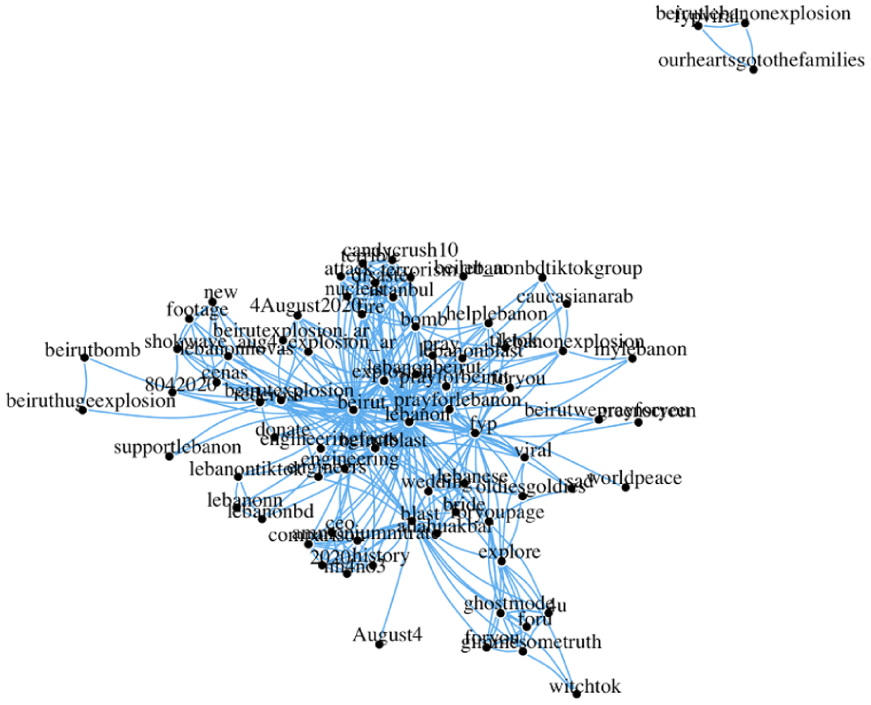
Co-occurrence network of all hashtags.
The network revealed a dense central cluster of closely linked hashtags, such as #beirutexplosion and #prayforlebanon, reflecting core event-related discussions. In contrast, peripheral hashtags (e.g. #ourheartsgotothefamilies) appear in more isolated contexts. Overall, the network blends localized (Lebanon-specific) and global (solidarity-driven) hashtags, illustrating both event documentation and emotional support.
Moreover, degree centrality measures the number of edges or ties of a node, which gives insight into the popularity of the node. Below in Figure 7 is the same network as above, but with only the nodes of a high centrality labeled.
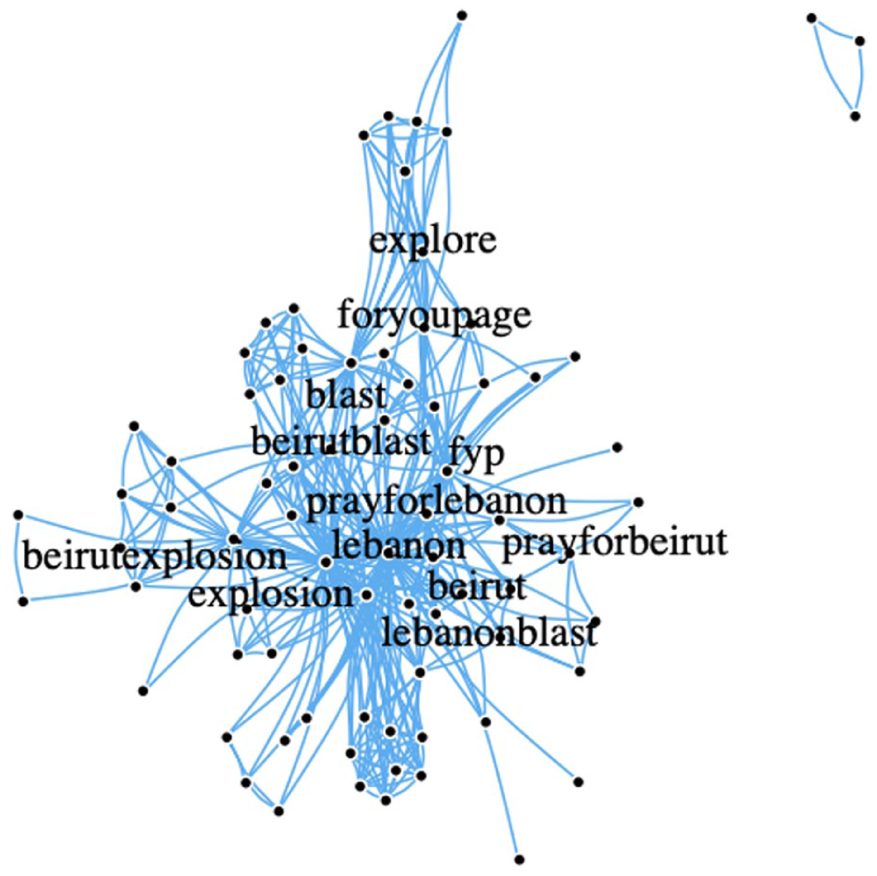
Co-occurrence network with only high centrality nodes labeled.
The hashtags with the highest degree centrality were lebanon, beirut, explosion, fyp, prayforlebanon, blast, beirutexplosion, and lebanonblast. In addition, betweenness centrality measures the importance of a node in connecting other nodes in the network; nodes with a high betweenness centrality mark themselves as salient to information flow (Bloch et al., 2021). The hashtags with the highest betweenness centrality were lebanon, beirut, fyp, blast, explosion, and foryoupage.
The most effective hashtags for information dissemination were clear, intuitive keywords related to the crisis, aligning with “information sharing” sensemaking behaviors. In contrast, low-centrality hashtags (e.g. candycrush10, oldiesgoldies, caucasianarab, donate, beirutweprayforyou, worldpeace) were either creator-specific or expressed sentiment, aligning more with “talking cure” or “other” behaviors. Broad, relevant hashtags like beirut or lebanon were more effective than niche ones like nh4no3. In addition, high-centrality hashtags averaged 8 characters, compared to 12.2 for low-centrality ones, reinforcing that brevity enhances clarity and shareability—consistent with Twitter research (Bruns & Burgess, 2011).
Entities of Discussion
NER identifies key entities in text, offering insights into public sentiment, sociopolitical discourse, and cultural expressions. In this study, NER complemented content, visual, and network analyses, helping to contextualize narratives surrounding the Beirut explosion. Since NER is more accurate for English, Arabic video transcripts were translated for analysis.
Comments revealed a multilingual response—English, Spanish, Portuguese, French, Greek, and Arabic—illustrating the global emotional and political impact of the explosion. PERSON entities reflected grief and faith, with phrases like “ya rab” (Oh Lord), “Allah yerhamon” (May God have mercy on them), and “RIP.” Martyrdom and national identity (الموطن لبنان, homeland Lebanon) were recurring themes, while viral stories of victims like George and Sahar deeply resonated across the region. Religious diversity was also evident, with mentions of Allah, Jesus, and God, underscoring Lebanon’s pluralistic faith landscape.
NORP entities (nationalities, religious, and political groups) highlighted the explosion’s entanglement with regional politics. Nationalities—American, Russian, Egyptian, Israeli, Canadian—surfaced in discussions about blame, information sharing, and solidarity (e.g. “As a Canadian, I feel with you”). Broader identities such as Arab Christians, Syrians, Palestinians, Zionists, and Kurds reflected Lebanon’s complex sectarian and geopolitical discourse, as comments revealed contested narratives on responsibility. Manual content analysis further contextualized these entities, exposing the polarized blame dynamics.
Unlike comments, transcripts yielded fewer insights, as many videos lacked human voiceovers. This underscores the importance of comment sections for sensemaking, as text often conveys more than audible content alone. Where transcripts were informative, CARDINAL and GPE entities captured the evolving nature of information: creators cited inconsistent fatality counts (“at least 70,” “hundreds,” “at least 200”), while geographical references mapped the explosion’s shockwave. ORG entities, such as the Lebanese Red Cross, appeared in calls for aid and fundraising efforts.
Discussion
TikTok’s Agency in Sensemaking—Expanding Dervin’s Theory of Sensemaking
Dervin’s sensemaking has been used across disciplines both theoretically and methodologically, as the approach focuses on understanding the ways people make sense of information toward the goal of developing better ICTs (Naumer et al., 2008). In the field of communication and information science, the model is credited with influencing a more user-centered shift by asserting that messages—or information—are constructions tied to specific times, places, and perspectives of their creators (Foreman-Wernet, 2003). Dervin’s (1998) sensemaking is typically explained in the example of an individual in a context-laden situation, bounded in time-space, wanting to cross a “gappy reality” through inputs and other activities. Through empirical analysis of TikTok videos about the Port of Beirut explosion, this study expands Dervin’s conceptualization by applying it to sensemaking on a multimodal platform with distinct communication norms.
Through Dervin’s (2008) theoretical encapsulation of sensemaking, we understand that there are multiple hallmarks of sensemaking including the flux between the state of certainty and uncertainty, power as a core concept, humans as theorists, and the focus of verbs over nouns. This study supports these hallmarks; for instance, the sensemaking codebook incorporated the idea of flux, recognizing that some behaviors intended to foster understanding can instead introduce uncertainty and hinder collective sensemaking. Although humans, in attempt to cross their gappy reality, act habitually in patterns, practices, or behaviors that intend to fill in the cognitive gap, there is an understanding that the opposite may happen. The codebook reflected this flux, as users participating in Information Negotiation would negatively impact sensemaking—this is further discussed later on.
Karizat et al. (2021) describe how users develop “algorithmic folk theories” to interpret and influence what appears on their FYP, aligning with Dervin’s view of humans as theorists navigating uncertainty through constructed meaning. This mirrors how some creators in this study used semiotic cues, like solemn music or camera angles, to shape how their content might circulate. By human as theorists, Dervin posits that human understanding is tacit, unarticulated, and that people engage in multiple ways to sensemake. The multiple codes included in this study’s codebook refines this notion by focusing on the verb-action—or the information behaviors—that humans conducted to make sense of the explosion on TikTok. By situating the study in a multimodal platform that delivers information visually, auditorily, and textually, the findings offer a new dimension to this theoretical understanding by considering the semiotic impact of different forms of media. While reinforcing that humans do indeed make sense of crisis information in their own ways, which included using tacit knowledge and background information that influences how they negotiate with new information, this study also emphasizes the power of the sender of the message—the video creator—in prompting the flux between certainty and uncertainty. It did so by its mixed-methods design that examined both the visual social semiotic elements that influence sensemaking and the corresponding discourse that resulted, therefore taking into consideration humans as information designers.
Intrinsic to the way Dervin (1999) conceptualizes information is the implication that it can be readily distributed from time to time, place to place, and person to person. Conceptually, information imposes order on a chaotic reality and varies from culture, person, time, and space. She adds that information is a tool designed by human beings to make sense of a reality assumed to be both chaotic and orderly (Dervin, 1999). This quote provokes a thought experiment: how does TikTok, as a space where sensemaking occurs, fit? First, consider TikTok as an orderly space—where human users act as information designers, constructing meaning within the platform’s constraints. The application, like other platforms, has its design, structure, and affordances that mold users’ communication norms. It additionally has the FYP, which ontologically and hegemonically implicates how the system curates information for its users.
This, in turn, creates chaos in an information system intending to bucket, organize, and order who sees what information depending on patterns deemed relevant to the algorithm. The FYP is in constant change, with new trends that users have to stay up to date with to adapt to the fleeting social norm. Chaos ensues as each scroll results in video that can contextually have a completely different purpose that the one before; a user may come across crisis information, cooking recipes, beauty secrets, cryptocurrency education, and an advertisement for Amazon within the span of 15 s. Given that, by default, the FYP is where most TikTok users “live,” this sporadic information provided by accounts they generally do not follow, or using Granovetter’s (1973) language of “weak ties,” means that the algorithm provides more novel information than not.
What does this mean for collective sensemaking and TikTok? Well, TikTok’s structure of delivering content encourages Dervin’s reconceptualization of information not binarily living in order or chaos but both. Humans individually and collectively design the sense, or create the information, that allows them to cross their gappy reality in inherently messy way—especially on TikTok! Reality will always be incomplete; however, the premise of the sensemaking model is to attempt to understand the highly abstract way people make sense of their chaos in an orderly way. In the same way that users are engaging with their FYP to cognitively build bridges across several intellectual gaps, the FYP in turn is sensemaking on its own. The negotiation between the user as information designer and algorithm as information designer creates a tangled network of human sensemaking and sense-unmaking.
In regard to a crisis informatics perspective, TikTok then is exercising its power in constraining or facilitating sensemaking depending on its own tacit logic. Who is being exposed to what crisis information is dependent on the brokering between user and technology; while some users are particularly aware of the algorithm and may use TikTok affordances to “push” crisis content onto FYPs, this requires a heightened level of information literacy and labor. Sensemaking, then, on TikTok, is dependent not only on the semiotic decisions made by video creators, but also on the constant negotiation between human and non-human information designers that construct the realities of a crisis event. The implications of this are the incredibly subjective ways that TikTok can act as a sensemaking tool. Depending on the algorithm’s sense of the user’s “self,” the user’s sensemaking of a crisis event is completely based on what the algorithm pushes what it “thinks” you should see based on what it “thinks” you already know. The power is handed to the FYP and thus to balance the hegemonic imbalance, users must leverage other data inputs that Dervin discusses such as other media, history, and their intuition. Blatant trust in a sole media source is never advised, and is especially true for the case of TikTok.
Crisis as Spectacle
Outlets like TikTok can help combat the marginalization and inaccurate portrayals of international crisis events by Western media. Both Lebanese and non-Lebanese chose to engage with information about the explosion for various reasons. Although the bounds of this study do not allow us to point to the motivations of the creators of the videos, we can say that information diffusion was an important part of engaging with the crises. This included creators spreading awareness about relief efforts, citizens of Beirut sharing the devastation firsthand, and others sharing educational content about financial alternatives.
However, the sensemaking discourse that occurred on the application was mostly surface level as context was stripped from each crisis event. The algorithm’s temporal element follows and enforces virality, as TikTok prioritizes videos in the FYP during their “peak” time. Years after the explosion, the Lebanese community is still actively discoursing and investigating the circumstances and offenders of the explosion. Lebanese have broadened their cultural understanding of the circumstances that led up to the event, and the global community has shifted its attention elsewhere. This situation is not unique, as communities worldwide seek attention from the global community for recognition and awareness of their country’s dilemmas. Therefore, an application catered to a demographic with increasingly shorter attention spans curates a feed with quick videos of various topics. Research has shown consistent short-form video consumption results in decreased durations of focus, decreased enjoyment of longer content such as lectures or books, and difficulty in recalling information (Asif & Kazi, 2024).
Although one benefit of having a “one stop shop” platform with various topics is allowing diverse users to engage in content and connect with others with similar interests, there is a corresponding consequence when contextualizing TikTok as a space for crisis communication. Gail Mason’s (2001) Spectacle of Violence refers to the ways in which violence is represented, mediated, and consumed in contemporary culture. In the book, Mason critiques how violence is glamorized in media, entertainment, and public life, as they examine how the spectacle of violence—in the book’s context, homophobia—can desensitize viewers, manipulate public opinion, and even serve ideological or political purposes.
The specific contexts of the Port of Beirut explosion and ongoing economic crisis represent a larger issue around the resulting detachment that occurs from repeated exposure to a disaster. For example, footage of the blast is directly followed by videos about a new restaurant menu item, a prank on college campus, and then a clip of a celebrity interview. Acts of violence have been detached from their real-world impact, but it is especially the case in TikTok which allows people to record and repackage footage of crisis events into short, engaging clips. The fleeting nature of TikTok encourages scrolling through crises as the visceral footages are typically stripped of context, turning traumatic experiences into something to be watched passively. The glamorization or aestheticization of trauma is further afforded by the application, as adding trending music or filters increases the likelihood of virality. Thus, user’s stylistic choices not only increase the chances of intersemiotic dissonance—discussed further in the next section—which impedes sensemaking, but also sanction a desensitization between violence and viewer.
Mason further argues for the importance of thinking about violence as part of a larger, systemic context that includes core issues such as gender and race. In the case of crises in the Middle East, TikTok’s ability to make spectacle of violence is especially harmful to orientalist perspectives that normalize Middle Eastern tragedies. Orientalism, as defined by Edward Said (1977), refers to the Western tendency to portray the “Orient” —particularly the Middle East—as a monolithic, static, and inferior “Other” to the West. The short, snappy format of content consumption on TikTok encourages creators to present simplified, often distorted narratives of events, reducing complex geopolitical situations to bite-sized, palatable videos that ignore root causes of colonial legacies or political corruption. Thus, the intersection of Orientalism and Spectacle of Violence creates representational harms by reinforcing distorted, dehumanizing, and reductive portrayals of non-Western societies. These frameworks mutually reinforce each other, creating a feedback loop where violence in Lebanon and other Middle Eastern regions is simultaneously aestheticized and emphasized as a defining characteristic of the people involved. Stories of food insecurity, broken shards of glass, destructed buildings, and murdered, innocent civilians are scrolled by, only potentially catching the attention of the viewer if the video effectively made spectacle.
Furthermore, an orientalist lens via the exotification of the Middle East further exasperates the spectacle of violence. In discussions of hyperinflation and the increasing struggle to repair a wounded Lebanon, some users exotified the struggle that sensationalized or romanticized the Middle East. This would happen as tourists took opportunity to share their experiences with the crises; although their intention may have been spreading awareness, the crisis tourism aesthetic likely appealed to the audience’s sense of the exotic and reinforced the idea that these crises are happening in an inherently “alien” or much different world than their own. At times, exotification would happen very literally. Videos about the economic crisis or blast had comments, categorized as “Other” in the codebooks, that would objectify Lebanese women and fetishize human struggle.
Mendelson (2024) offers the concept of “public intimacy,” showing how TikTok videos facilitate emotional resonance and offline relational reflection. This complements our findings that emotional proximity, facial expression, and eye contact increased viewer engagement and collective sensemaking in the comments. The dramatization or theatrics of the crises, although potentially helpful to gain traction across more FYPs, turned real-life violence and trauma into a spectacle that was consumed and is continually consumed aesthetically, detached from the underlying historical, political, and human realities. This is especially detrimental to Lebanese crisis discourse, as this reinforces Orientalist stereotypes and permits users to engage with these struggles in a superficial, desensitized, and passive manner. Although this discussion focused on TikTok, this is a systemic, societal issue; the perpetual victim narrative on social media has been pertinent as the media reinforces the region as fundamentally broken where crises are inevitable.
In addition, the aestheticization of trauma on TikTok raises critical ethical questions about platform responsibility and beneficiaries of crisis spectacle. While platforms like TikTok profit from increased engagement—including content that sensationalizes trauma—the affected communities rarely benefit from this commodification of their suffering. The platform’s algorithm incentivizes viral content, potentially rewarding creators who aestheticize crisis footage with increased visibility and monetization opportunities. This creates perverse incentives where trauma becomes a pathway to platform success. Lebanese creators appreciated when prominent accounts shared awareness, yet this appreciation was complicated by instances where non-Lebanese creators gained followers by aestheticizing Lebanese suffering. Platform responsibility extends beyond content moderation to include algorithmic design choices that either amplify or suppress crisis discourse. Our findings suggest platforms should consider implementing crisis-specific algorithmic adjustments that prioritize informational content over viral aesthetics during humanitarian crises.
Intersemiotic Dissonance
Although the additional flairs afforded by TikTok were available to creators, most did not employ them. However, there were at times repercussions to sensemaking when creators did employ affordances that did not align with the subliminal norms of crisis communication on the application. Intersemiotic dissonance occurs when elements diverge semiotically rather than merge to inform a unified meaning (Yu, 2021). This study extends Yu’s encapsulation of intersemiotic dissonance, which was situated in multimodal comic strips, to multimodal crisis information discourse. Each affordance available by TikTok video creation represents an instance of a signal that could or could not contribute semiotically to sensemaking. If creators chose to include contradictory or hypocritical elements that somehow caused tension with other elements, viewers of the content could experience tension in their sensemaking process. Examples of this include a creator’s explosion footage including audio that does not align with the emotional sentiment (e.g. Electronic Dance Music (EDM) or a large, distracting watermark with their username across the screen).
Videos with questionable multimodal elements such as these would have comments that were filled with criticism of the author’s choices, which sparked debate and additional commentary that visually drove down relevant crisis discourse such as how to participate in relief efforts. In contrast, videos that used the original audio of the footage, solemn music, and/or text that only related to crisis information had comments that more clearly contributed to collective sensemaking. Comments with high engagement (e.g. high likes or replies) were visually prioritized to the top of the comment list; thus, if multiple people were engaging in debate against a creator’s video choices, other crisis information comments would be pushed down. These findings reveal how poorly aligned multimodal choices can create intersemiotic dissonance, obscuring crisis discourse and undermining collective sensemaking. Not only does this highlight a risk of communicating crisis information in a multimodal format, but additionally alludes to the latent expectations users have of how to deliver crisis information.
Limitations and Future Research Directions
This research contributes valuable insights into crisis informatics but has several limitations. Studying a rapidly evolving platform like TikTok means engaging with a moving target. As data collection occurred between 2022 and 2024—after the Port of Beirut explosion and during Lebanon’s economic crisis—some TikTok data were inevitably outdated. The platform’s frequent design changes also make it difficult to fully capture users’ evolving content consumption experiences. Instead, this study leverages visual content from specific moments that align with crisis discourse.
A larger dataset of videos and comments would enhance future research. However, ByteDance restricts data access, even through its API, limiting large-scale collection. Future work would benefit from greater platform transparency. In response, this study employed qualitative methods to provide deep insights despite data constraints.
Conclusion
This study extends Dervin’s sensemaking by situating sensemaking within TikTok’s user experience and considering the role of both human and algorithmic actors. It highlights how the platform’s recommendation system influences crisis understanding. In addition, it introduces intersemiotic dissonance as a key factor in multimodal crisis discourse. The study employs a mixed-methods approach, integrating qualitative and quantitative analyses of TikTok’s visual, auditory, and textual data. This study challenges the perception of short-form platforms as purely entertainment-focused, demonstrating their role in fostering emotional support, information dissemination, and potentially harmful perpetuations of stereotypes.
Footnotes
Acknowledgements
Thank you to the reviewers for their thoughtful feedback.

Consent to Participate
The author’s institutional review board determined an exemption from regulations for the study, as per IRB # 24-071.
Author contributions
Author 1 (Christy Khoury): Conceptualization, Investigation, Methodology, Data Collection, Formal Analysis, Writing—Original Draft, Project Administration.
Author 2 (Jeff Hemsley): Writing—Reviewing & Editing, Supervision, Resources.
Funding
The authors received no financial support for the research, authorship, and/or publication of this article.
Declaration of conflicting interests
The authors declared no potential conflicts of interest with respect to the research, authorship, and/or publication of this article.
Data availability statement
Due to the sensitive nature of the data and the crisis context in which it was collected, the dataset supporting this study is not publicly available. Given the ethical considerations, privacy concerns, and potential risks to individuals or communities involved, data access is restricted. Researchers with specific inquiries about the data may contact the corresponding author for further discussion on potential avenues for secure, ethical collaboration, subject to appropriate approvals.