




Abstract
The Dating Wrapped trend on TikTok takes inspiration from Spotify’s annual Wrapped event where Spotify users are presented with their year-end listening statistics. Dating Wrapped repackages fundamental components of Spotify’s Wrapped—a focus on aesthetics, PowerPoint-like presentation of information, and quantification of personal experiences—but does so in the context of interpersonal relationships as a dating year-in-review video on TikTok. This article applies a content analysis and critical thematic analysis to 54 TikTok videos with the hashtag DatingWrapped as a way to understand how sensemaking about sexual and romantic relationships occurs when individuals create content centered around self-disclosures of intimate experiences. Ultimately, we argue that trends such as Dating Wrapped provide opportunities for personal expression among emerging adults who use TikTok, the efficacy of which is enhanced by attention to data visualization within its presentation format. Second, TikTok trends centered around interpersonal relationships may influence the formation of sexual and romantic identities through processes of mediated learning about relationships.
The popularity of TikTok among emerging adults (60% of the platform’s users are estimated to be between 13 and 24 years of age; Muliadi, 2020) alongside specific affordances of the application (e.g., the “For You” page) facilitate mediated intimate publics that connect users through shared sounds, hashtags, and trends (Karizat et al., 2021; Zulli & Zulli, 2022). Individuals who have garnered large followings, as well as those who amassed large numbers of views on their videos by going viral, serve as “internet celebrities” for others on the platform (Abidin, 2020, p. 79). The effects of internet celebrities can be seen through buying trends, political alignment, and public knowledge about current events among different age groups (Abidin, 2020). However, influencers not only create content surrounding politics or fashion trends, but also intimately discuss their interpersonal experiences online (Schellewald, 2021). During this influencing process, the boundaries between what is considered public information and one’s personal life erode (Dobson et al., 2018; Donath & boyd, 2004), and as this occurs, individuals are encouraged to disclose information that would formerly be considered private (e.g., stories about their recent sexual and romantic encounters) to build connections with others within mediated spaces (Andreassen, 2017; Dobson et al., 2018; Salter, 2018).
One example of a recent trend on TikTok where users are encouraged to disclose personal information are the videos under the hashtag DatingWrapped, which models itself off Spotify Wrapped, also known as just Wrapped. Wrapped is Spotify’s method of sharing end-of-year listening statistics with its users and is presented in a way that encourages users to share their information on social media to compare their listening statistics with others. On TikTok, Dating Wrapped models Spotify’s quantification of personal data as users share their dating year-in-review statistics through aesthetic PowerPoint presentations.
Previous research has demonstrated the extent to which media consumption informs an individual’s understanding of romantic relationships (Fox & Frampton, 2023; Hefner & Wilson, 2013) and sexual communication (Jozkowski et al., 2019), as well as the role peers play in understanding one’s identity (DeLuca Bishop, 2021; Morgan & Korobov, 2012; Sugimura et al., 2022). Given these findings, as well as research that has forwarded how emerging adults use TikTok to contest gender norms (Wynne et al., 2021) and make sense of their own interpersonal relationships (Mendelson, 2023), we hypothesize that TikTok is a generative medium for users on the app to also sensemake about dating, sex, and romance. Second, we understand that the incentive to participate in trends such as Dating Wrapped is generated, in part, by the desire to acquire “intimacy capital” (Dobson et al., 2018, p. 19), whereas disclosing one’s personal information can elevate social standings online and the attention received from other users (e.g., likes and follows), as well as help generate mediated forms of connection.
In this article, we analyze Dating Wrapped videos to investigate the extent to which participating in trends on TikTok may constitute processes of sexual learning about oneself through content creation in adherence to the trend, as well as viewing other videos within the trend’s intimate public. In addition, we analyze how Dating Wrapped’s combination of personal disclosure, data visualization, and trend status on TikTok offers insights into how pre-existing platform visualization, such as Spotify Wrapped, serves as loose templates for how individuals make sense of themselves through data. Ultimately, we argue that trends such as Dating Wrapped provide opportunities for individuals, specifically emerging adults, to discuss aspects of intimate relationships online. These discussions that occur through content creation, commenting, and/or viewing facilitate the formation of sexual and romantic identities through processes of relational learning when participating in the trend, whether that learning is done intentionally or subconsciously.
What is Dating Wrapped?
Dating Wrapped emerges from Spotify’s annual Wrapped event, where Spotify presents users with their year-end listening statistics. These statistics include a user’s top artists listened to, top songs, and listening genres, as some examples. Wrapped is presented in a slideshow-like format on the Spotify app with a new aesthetic each year. Figure 1 presents an example slide from Spotify’s overall wrapped.
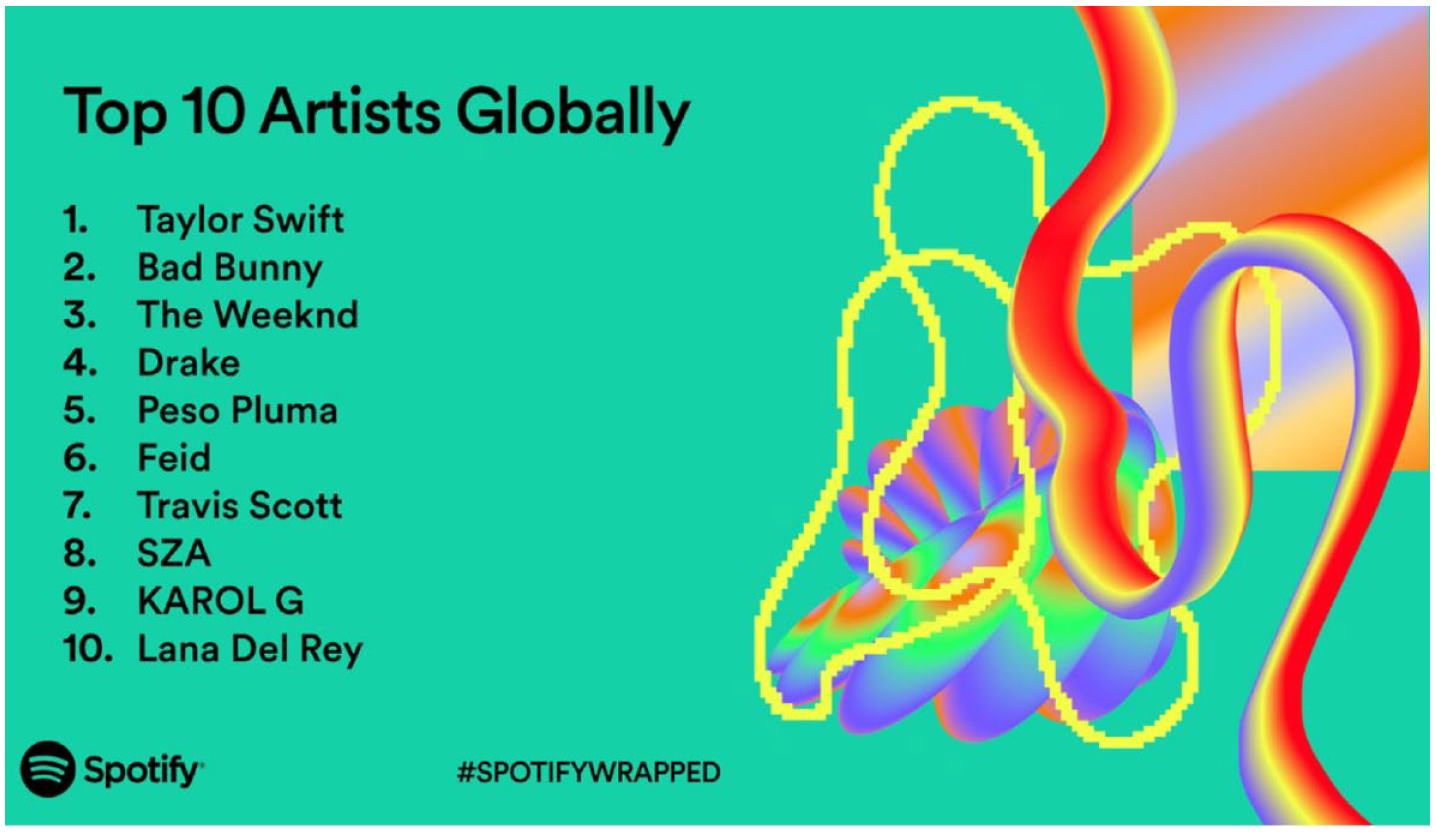
2023 Spotify wrapped slide with overall user data (Spotify Newsroom, 2023).
Wrapped simultaneously quantifies user data and aesthetically visualizes data, encouraging users to share their statistics on their own social media platforms. Individuals are motivated to share their Wrapped results to connect with others within their digital networks or otherwise risk missing out on the ephemeral moments of connection that can occur through sharing that information (Kofoed, 2017; Yoga et al., 2022).
Dating Wrapped repackages fundamental components of Wrapped—a focus on aesthetics, PowerPoint-like presentation of information, and quantification of personal experiences—in the context of interpersonal relationships as a dating year-in-review on TikTok. Users present their statistics while holding a laptop that faces the camera so that viewers can see the creator’s face and slides while the creator presents their PowerPoint. The categories individuals use to present their Dating Wrapped vary but may include the occupation of individuals they went on dates with, the number of dates they went on with each person, and how they met other people to go on dates with. Figure 2 provides a hypothetical example of a Dating Wrapped slide that could be used to display the information from a “How did we meet?” category.

Hypothetical example of dating wrapped slide.
When uploading videos to participate in the Dating Wrapped trend, users hashtag their videos with #DatingWrapped to network themselves within the TikTok trend. Some users also use the hashtag #QueerWrapped alongside #DatingWrapped to (a) signify their sexualities and (b) network themselves within a subdivision of the larger Dating Wrapped video format that centralizes queer dating experiences.
Because TikTok algorithmically connects users by shared interests, geographic locations, and sounds (Karizat et al., 2021; Schellewald, 2021; Zulli & Zulli, 2022), it may be difficult for users to be in community with others they desire. For example, previous research has found that transfeminine creators may express that their videos landed on the “wrong side” (DeVito, 2022, p. 14) of TikTok if their content is pushed to transphobic individuals instead of LGBTQ+ friendly viewers. However, utilizing specific hashtags associated with video trends allows individuals to foster sociality with others in a more direct, traceable way than if otherwise left up to the algorithm’s determination of who to push content to. To this end, the use of #DatingWrapped and #QueerWrapped in the captions of videos that adhere to the trend is an intentional strategy to connect with others who do the same.
Mediated Intimacy on TikTok
Dating Wrapped is reminiscent of “PowerPoint nights” popularized by emerging adults during the first two years of the COVID-19 pandemic, where friends would gather and present comedic slideshows about popular culture, their lives, and their friend groups. Although understudied in the literature, the affective connections created during PowerPoint nights were a way to maintain social connections online despite a lack of in-person contact. In fact, technologically mediated forms of intimacy were paramount during the COVID-19 pandemic for adolescents to stay connected with one another (Salzano et al., 2021), and social networking applications such as Snapchat provide pivotal relational development experiences for younger generations (Kofoed, 2017). The disclosure of personal, private information facilitates interpersonal connections by generating “intimacy capital” (Lambert, 2016, p. 2572) as “social media institutionalise[s] practices of public intimacy” (Dobson et al., 2018, p. 22). Because of the potential social and economic benefits of well-performing videos (Abidin, 2020), individuals may be incentivized to garner intimacy capital by participating in trends such as Dating Wrapped.
Data are itself intimate, and the sharing and experiencing of data constructs intimacy. As Berlant (1998) describes, intimacy involves “an aspiration for a narrative about something shared, as about both oneself and others that will turn out in a particular way” (p. 281). In an age of biometrics and big data, data are not only used to extract value but also to construct a narrative about our experiences and subjectivity, what Lupton (2017) calls our “data sense” (p. 1603). For example, health data are aggregated and visualized by peripherals such as an Apple Watch so that we can be more intimate with our own bodies. Sex-tracking applications such as “Emjoy, Rosy, Lioness and Sex Keeper” (Saunders, 2024, p. 2009) quantify sexual experiences and induce a neoliberal logic of sexual self-improvement. Visualization of data thus functions to translate that quantification into an intimate narrative, often by platforms with a financial incentive. Nevertheless, data intimacy can be a source of connection and affirmation, as Rentschler and Nothwehr (2024) highlight in the context of Type 1 diabetics sharing continuous glucose monitor (CGM) visualizations on Reddit. For Rentschler and Nothwehr (2024), the sharing of CGM data forwards “the emotional dimensions of seeing data” (p. 14, citing Kennedy & Hill, 2018, p. 844) and produces “shared forms of recognition, validation, and support among diabetics about how they experience changes in their blood sugars” (p. 16). Dating Wrapped potentially serves a similar function by allowing TikTok users to communicate and commiserate about the contemporary dating scene.
On TikTok, the presence of hashtags, shared sounds, and common interests coalesce individuals into networked publics (boyd, 2010). Networked publics are the “imagined collective that emerges as a result of the intersection of people, technology, and practice” (p. 1). Previously identified networks on TikTok have been found to foster empowerment for marginalized communities (Vizcaíno-Verdú & Aguaded, 2022) and demonstrate solidarity between generations (Nouwen & Duflos, 2023), for example. Within networked publics, previous research has demonstrated that teenagers develop a sense of identity (boyd, 2014), negotiate privacy (Marwick & boyd, 2014), and imagine the audiences who are the receivers of their content (Marwick & boyd, 2011). In these instances, networked publics overlap with intimate publics (Berlant, 2008), which are constructed by strangers who consume common texts and ideas.
The concept of intimate publics “lends itself to analysing mediated social intimacy” (Hamm, 2020, p. 56) and the online political connectivity that occurs within them. Subsequently, mediated intimate publics on TikTok may serve as pivotal sites for emerging adults to foster in-person and online interpersonal relationships and redefine relationship standards at a larger scale (Dredge & Schreurs, 2020; Poell et al., 2019). For example, in a case study of the “couch guy” trend, Mendelson (2023) argues that the mimetic derivatives of the original video, comments, and duets demonstrate discursive moments of sensemaking, where individuals collectively formulate opinions about “what behaviors are expected and acceptable” within romantic relationships (p. 6). This discourse occurs through different communicative layers through which users interact, which include (a) posting, (b) imitation and replication through derivatives of the video/trend, and (c) commenting and duetting the video, as well as “lurking” by watching videos within the larger intimate public (Mendelson, 2023, p. 15). These communicative avenues thus make possible the ability for not just moments of mediated intimacy but also the formation of social publics with the power to consensus-build.
Sexual and Romantic Identity Formation In-Person and Online
Conversations with peers are pivotal developmental moments in the formation of one’s sexuality (Galliher & Kerpelman, 2012; Morgan & Korobov, 2012; Pariera & Abraham, 2020). For example, a diary study of 96 U.S. college women found that women spoke to one another about sex an average of 13 times a week (Pariera & Abraham, 2020). These conversations did not just serve as gossip, but rather, served as an opportunity to exchange opinions about experiences with romantic and sexual partners (Pariera & Abraham, 2020). A second study found that conversations with peers about romantic relationships between college-aged women in Japan were used as incremental moments of identity development (Sugimura et al., 2022), which allowed for gradual learning about romantic relationships.
Previous research has also demonstrated how digital media influence beliefs about romantic relationships (Hefner & Wilson, 2013) and sexual scripts, such as consent communication (Rodgers et al., 2023). For example, in a study where college-aged students were asked to view music videos with objectifying content of women, both men and women who adhered more strongly to traditional sexual scripts (i.e., felt as though the objectification of the women in the videos was reasonable, acceptable, and/or necessary) had lower expectancies to adhere to a partner’s consent (Rodgers et al., 2023). In this case, digital media can reaffirm traditional gendered stereotypes through processes like objectification, but may also be able to subvert sexist relationship stereotypes individuals hold. Accordingly, if individuals are exposed to a myriad of relationship content on their TikTok feed created by others who are similar in age, such as Dating Wrapped videos, these series of parasocial interactions (Hartmann, 2017) may mirror peer conversations about sexual and romantic relationships and catalyze moments of identity formation. Subsequently, social networking sites are likely to play a larger role in the sexual development of emerging adults than currently recognized, and mediated intimate publics on TikTok may function as novel spaces for education and relationship building with others.
Method
Data Collection
Videos were identified through the DatingWrapped hashtag on TikTok as of March 2023. The researchers created new TikTok accounts on private browsers that were used only to search for this hashtag. This was done to ensure that the most popular results were presented with as little interference from additional user data as possible. Next, video URLs were collected from the first 100 videos under #DatingWrapped that were both savable and shareable, which are permissions set by creators that allow TikTok users to share and save a specific video. As such, data were only collected from videos that were not limited by privacy boundaries set by creators. After collecting video URLs, the PyTok package for R was used to collect the metadata about each video, including account usernames and the number of comments, shares, and views a video had received at the time of data collection.
Videos were excluded if their content did not fit the nature of the original trend to provide a presentation of romantic and sexual activity despite using the Dating Wrapped format. For example, videos providing reviews of gym activity for the year and videos whose content did not adhere to the PowerPoint format were excluded. Videos that were in languages other than English were also excluded. After exclusion, the final dataset included 54 videos (N = 54). Because videos within hashtagged trends are inherently derivative of one another (Zulli & Zulli, 2022), the researchers found this number of videos sufficient to quickly reach saturation of key themes and categories. This data-collection process was granted exempt status as not human subjects research from the institutional review board of the first author’s institution.
Analysis
Two methods of analysis were utilized to make sense of the data: content analysis (Krippendorff, 2013) and critical thematic analysis (Braun & Clarke, 2022; Terry & Braun, 2013). First, a content analysis (Krippendorff, 2013) was performed to understand the specific categories individuals presented within their videos. Because not all creators named categories using exactly the same label, researchers aggregated these categories based on their content. For example, the “employment” and “occupation” of individuals represent the same information despite small differences in naming. This method was to understand broad characteristics that individuals decided to share about their romantic dates and sexual partners.
Second, a critical thematic analysis (Braun & Clarke, 2022; Terry & Braun, 2013) was used by the researchers to “examine the sense-making tools people use” and “tell a rich story about a given dataset, as well as identifying and drawing out specific discursive features of interest” (Terry, in Braun & Clark, 2022, p. 255). A critical thematic analysis combines reflexive thematic analysis (Braun & Clarke, 2021) with second-level discursive analysis techniques such that researchers can interrogate “more fine-grained details of language and discourse” (Terry, in Braun & Clark, 2022, p. 255). Accordingly, a critical thematic analysis was performed in this study to isolate aspects of communication within videos beyond the categories used to review romantic interactions. In this way, the researchers were also able to isolate specific statements made by creators for deeper analysis to interrogate how sensemaking occurs for individuals in the context of the Dating Wrapped trend.
Following Braun and Clarke’s (2021, 2022) reflexive thematic analysis, the researchers used codes to identify patterned meaning across the dataset in accordance with RQ1:
How do individuals participating in the Dating Wrapped trend communicate their romantic and sexual experiences?
There are six phases of reflexive thematic analysis: data familiarization, coding, generating initial themes, reviewing themes, defining and refining themes, and writing up results (Braun & Clarke, 2022). For the first phase, both authors watched through each video collected for analysis. Coding, the second phase, was an inductive approach that started by generating both semantic and latent codes while watching the 54 videos retained. For the third phase, researchers developed initial themes independently, and in Phases 4 and 5, they reviewed and refined themes in collaboration with one another. For example, the preliminary themes of “sensemaking” and “observations” were refined to “self-reflections of the dating experience.” The researchers decided on four final themes that address larger content trends within videos in accordance with RQ, collapsing similar content areas to enhance the parsimony of results. During this process, the researchers also isolated specific messages and phrasing creators utilized in their videos to better understand how individuals are presenting information within the categories they chose to review. This was done to engage in the “critical” portion of the critical thematic analysis and answer RQ2:
What messages about sex and dating are present within the Dating Wrapped trend?
The final stage, writing up results, is given below.
Results
On average, videos in the dataset received 449,546 views, 52,785 likes, and 514 comments, and were shared 1,616 times at the time of data collection. Because many individuals did not disclose their sexual, racial, and gender identity on neither their profiles nor their videos, we did not aggregate identity-level information to prevent misgendering or other false identity attributions. The categories that creators used within their Dating Wrapped videos resemble four major themes: descriptions of partner attributes, the dating experience, sexual activities, and moments of self-reflection. Below, videos are discussed in the context of each theme.
Physical and Social Descriptions of Dating and Sexual Partners
Over two-thirds (n = 41, 75.93%) of the videos in the dataset included information about dates’ physical and social attributes. These categories were used to describe how attractive others were, their education levels, and their occupations. For example, categories such as “hotness vs. dateability” and “attractiveness vs. dateability” were used to rate individuals based on their physical features compared to their qualities as romantic partners. Notably, only individuals who self-identified as queer or as participating in the “queer edition” of Dating Wrapped categorized their dates’ gender identities and gender presentations, as well as their zodiac signs. For example, only queer individuals used categories such as “Femme, Stem, Masc, Non-Binary,” and “gender identity,” as well as “astrology bingo.” In these cases, the representation of queer individuals within Dating Wrapped helps demonstrate nuanced understandings of the intersections between sexuality and gender, as well as affirm queer experiences as positive for identity development. For example, one user remarked, “The genders? We’ve got a range of genders here! Five men, three women, and one person who identifies as non-binary, which is a new experience for me and we LOVE new experiences.” This creator utilized an opportunity within their Dating Wrapped to affirm sexual and romantic experiences outside of cis-heterosexuality. The positive connotation of doing so—not just identifying that dating a non-binary individual was a new experience for them, but that new experiences like this are joyful—may allow viewers to reflect on their own romantic identities and explore their sexualities in a more expansive, inclusive way that they may not have previously considered.
The Dating Experience: Formation, Dissolution, and Process
Relational Formation
Relational formation describes how participants met romantic partners. This information was most often presented using the category “how did we meet,” and its variations, which was present in 81.48% (n = 44) of the videos within the data set. This category was often paired with graphs and imagery showing whether the user had found most of their dates through applications, such as Bumble or Tinder, or in real life, often termed the “wild” (see Figure 2). Creators also reflected on their experiences on specific dating apps, as well as about other users on those apps. For example, one creator described how men from Hinge tended to be the most “toxic” out of all the applications, while others remarked that Hinge was their most “successful” application. Multiple creators quantified their information from dating apps such as their likes, matches, and dates from each dating application. One participant in the trend even broke down “who messaged first” on Tinder and the “text-to-date conversion rate” for those messages.
Relational Dissolution
Descriptions of dissolution included the four categories of a) who ended it (where “it” is the dating relationship), b) why and how it ended, c) how long it lasted, and d) the number of individuals that made the creator cry. Discussions of dissolution were common, with 85.19% (n = 46) of videos including at least one category related to dissolution. The question of “who ended it” was often separated by the number of romantic encounters that were ended by each member of the interpersonal dyad, and how many were mutual. The “why did it end” category allowed users to explain the processes leading up to their decisions to terminate relationships. “How long it lasted,” while an essential element for dissolution, provided a slightly different framework for discussion. Oftentimes, this category was used to show how few first dates actually transitioned to even a second date, thus highlighting the attrition rate that individuals actively seeking relationships experienced. Finally, the emotional toll of dating was evident, as 31.48% of creators referenced the number of times they cried over one of their intimate partners.
Interestingly, one of the most common discussions within dissolution was the topic of ghosting, which is when someone ceases all communication without further explanation (Thomas & Dubar, 2021). This discussion took many forms, such as creators who counted the number of individuals that ghosted them, as well as a pie chart that highlighted the number of times that an individual ghosted others, the amount they were ghosted, and the amount of mutual ghosting. Ghosting was often discussed matter-of-factly without moral condemnation of the action of ghosting, which is often noted as a very controversial relationship dynamic (Thomas & Dubar, 2021). However, others directly referenced their frustration with the prevalence of ghosting as a normalized action within the contemporary dating scene. One creator, for example, declared they do not ghost others because they “have adult communication skills.” In addition, feminine-presenting creators appeared to be more neutral regarding the practice, while masculine-presenting creators demonstrated a higher level of resentment toward others ghosting them. This finding is in line with previous research, which has found that although there are negative psychological effects to being ghosted, individuals often ghost others as a form of self-protection (Coyle, 2021; Thomas & Dubar, 2021). Increased male resentment may be reflective of the much larger degree to which college-aged women, especially queer women, experience sexual violence than men (Ford & Shefner, 2023), and as such, may more frequently engage in ghosting as a method of self-protection that those being ghosted are not cognizant of.
The Dating Process
Dating Wrapped offered participants the opportunity to describe their dating experience in broad terms. Understanding the dating process was the largest and most common aspect of presentations, which was present in all of the videos in the dataset. Categories referred to aspects of the dating process such as “number of dates,” “types of dates,” actions performed by their dates (e.g., “number who bought me flowers”), and explanations of specific “standout” individuals who they dated.
Sexual Activities and Sexual Health
Creators used their Dating Wrapped videos to review their sexual experiences, indicate the amount of casual sexual encounters that were a result of their dates, and in some cases, report information related to their own sexual health. For example, one creator used the categories “did I orgasm,” “protected vs. not,” “pregnancy scares,” and “how many crossed my boundaries” in relation to their sexual experiences with dates over the past year. Just this user’s categories speak to the perceived quality of the sexual experience (i.e., the presence of an orgasm), questions of sexual health (i.e., using protection and pregnancy scares), and the potential for sexual harm to occur (i.e., crossing boundaries).
Creators also spoke with an openness about sexual experiences, including specific kinks, with categories such as “number of men who have asked to be in an ANR [breast feeding kink] with me” and “number of men asked to be pegged.” These categories discussed less-common sexual preferences, but messages are mixed as to whether these preferences are stigmatized or normalized within videos. In addition, although sexual health discussions were beneficial to inform viewers about getting tested, using protection, and consent, some individuals utilized messaging that dissuaded others from taking precautions. For example, when presenting the category “number of positive STI tests,” a creator stated, “none, because you can’t be positive if you don’t get tested.” Instead of encouraging testing to as a way to be informed of one’s sexual health status, this message reinforces fear and stigma toward getting tested. However, the willingness to discuss sexual experiences appears to represent an increased level of sexual openness among current emerging adults, reinforcing the breakdown of boundaries between private and public information online.
Self-Reflections of the Dating Experience
Self-reflection on the dating experience is essential to the Dating Wrapped trend. In a sense, the creation of a Dating Wrapped video necessitates an individual to reflect their dating experiences to appropriately categorize individuals for their presentation. Subsequently, self-reflection occurred prior to and throughout the videos, thus allowing for the presentations to serve cathartic and reflective purposes to both the creators and viewers while engaging in processes of relational sensemaking.
Within the dataset, 26 out of the 54 videos (48.15%) included at least one category that was directly self-reflective in nature, such as “current relational status,” “amount of money spent,” “lessons learned,” and “current perceptions” on the people they dated. Categories that were directly self-reflective in nature were often limited to one or two presentation slides. Instead, self-reflection usually occurred between or within categories during a Dating Wrapped video. Moments of reflection were frequently concluding statements based on the information shared in earlier slides and potentially acquired through making the video itself. In addition, the creation of a Dating Wrapped video may denote a reflective ethos on an individual’s experience of dating as a whole.
Creators expressed reflection in varied fashions. In many videos, creators highlighted how dating was “exhausting” with “little result from the countless first dates” they went on. One creator, for instance, described “How many times I said I’m done with/I hate men” due to their experiences in dating. This connection between dating and feeling burnt out with dating men that feminine-presenting creators often lamented spoke to the way that creators used these categories as moments of self-reflection to vent their frustrations with the dating experience. Multiple other creators tallied the financial cost of their year of dating, as dating is not merely an emotional and time investment but is also a financial investment. This allowed creators to accurately quantify the dating experience along multiple different metrics. In this sense, the reflective categories served as moments where creators could not only make sense of their experience and the costs of dating but also translate the other categories into takeaways that their audience could learn from.
How Does Dating Wrapped Inform Emerging Adults’ Sensemaking Processes About Sex and Dating?
Dating Wrapped represents an intersection of ongoing developments in influencer culture, quantification, platformization, and intimacy capital. As platforms continue to expand to new industries and capitalize on emerging spaces of sociality and intimacy, the models of social organization and quantification that platforms proffer have become normative frameworks in which users come to understand their own experiences. Dating Wrapped, emerging as a playful rendition of Spotify Wrapped, can be understood as one such example wherein industry models became apertures through which users build intimacy capital (Lambert, 2016) by sharing their dating experiences through quantified and platformized videos. In addition, Dating Wrapped allows emerging adults to redefine more equitable relationship expectations and utilize the trend to sensemake about relational and sexual identities.
Dating Wrapped as Platformization
Platformization, understood by Poell and colleagues (2019) as the “penetration of the infrastructures, economic processes, and governmental frameworks of platforms in different economic sectors and spheres of life” (p. 5–6), manifests in all aspects of social life. In a sense, Dating Wrapped shows how public-facing forms of data visualization (e.g., Spotify Wrapped) become models through which emerging adult members make sense of their dating lives and build intimacy capital by sharing their experiences with others. These apertures reveal “platform intimacies” (Rambukkana & Matthews, 2024, p. 1), wherein data become a process of socialization and sensemaking through the formation of data intimacies. These processes are by no means new, as dating applications already use data to construct frameworks of intimacy, but Dating Wrapped offers both the possibility of reworking those frameworks of data intimacy to exist on the terms of their participants or to reify toxic tropes proffered by hegemonic forms of intimacy. Dating Wrapped, then, serves as an intermediary of intimacy wherein data visualization quantifies the aggregated experience of dating into a shared recognition of intimacy habits. Although this quantification might often imply a logic of neoliberal self-improvement, our analysis highlights the nuanced ways that users come to understand their own sexual experiences and themselves through the introspective process.
Furthermore, Dating Wrapped provides insights into the emic categories that creators use to narrate their own experiences. Although the Dating Wrapped trend shares the quantitative ethos of data visualization with Spotify Wrapped, Dating Wrapped requires creators to pick and choose their own categories to describe their experience, compared to Spotify’s algorithmically determined criteria. Some of these categories are stable across many different videos—number of dates, ages, date activities—while others are unique categories created by individual content creators to express their own experiences which may never be used again, such as “number that have a strange nickname my boss refers to them as” or “how many girls had me in my feelings listening to Take Care.” This key difference forms the basis of important insights about how users make sense of their own experiences and make categories that uniquely explore their own situation, while setting up space for them to produce content surrounding it. Although Spotify Wrapped requires universal metrics that can explore a litany of different experiences and exists on its own terms without an accompanying explanation, Dating Wrapped videos are built with the understanding that other users’ video categories serve as inspiration to explore and share one’s own romantic experiences and build intimacy capital via this sharing process.
Dating Wrapped as Redefining Relationship Expectations
Many creators used their videos to describe particular attributes of individuals to participate in processes of expectation redefinition by using categories that may seem unusual when reflecting on a year of dates. Categories such as “number who bought me flowers” are reflective of a larger trend of emerging adults’ online participation, which is the ability of networked intimate publics to build consensus about relationship standards and dating norms (Mendelson, 2023). For example, TikTok’s viral “couch guy” video (Zarras, 2021) and “wife strike” (Flood, 2021) movement have previously served as ways for millions of individuals to determine appropriate behavior in partnered romantic relationships. For the former, individuals within the “couch guy” networked public redefined expectations for reactions that romantic partners should have when surprised by a long-distance significant other. For the latter, married women refused to participate in household chores to illuminate the unfair division of domestic labor between themselves and their husbands. In many cases, “wife strikes” were so effective in illuminating these labor disparities that women were encouraged to leave their husbands, and a number of women did. Within Dating Wrapped, creators use their videos to negotiate sexual expectations, such as the desire for a partner to achieve orgasm, their communicative expectations of others, and to indicate thoughtful gestures during the dating process.
Dating Wrapped as Identity Formation and Relational Learning
The process of creating one’s own Dating Wrapped presentation requires an individual to reflect on a year of past dating experiences, categorize others, and create their own online content in adherence to the larger viral trend. Subsequently, participation in Dating Wrapped serves as an instance of socialization about dating and romantic identities for individuals who choose to participate in a variety of ways. First, when creators describe new romantic experiences as enjoyable, they assign a positive connotation to that previous experience and affirm their relational exploration. Second, when individuals specifically identify their video as #QueerWrapped, the replacement of “Dating” with “Queer” in the hashtag communicates one’s identity in alignment with a broader queer community. Third, reflecting on one’s own communication patterns, such as whether or not they ghosted others or were ghosted by others, allows individuals to analyze potential trends in their own relationship habits and whether they were beneficial to the development of relationships. These examples are just some of the ways that both identity formation—such as identifying as “queer” in a public-facing video—and relational learning occur through the video-creation process.
Viewers on TikTok who are networked into the Dating Wrapped intimate public may, in part, understand their own interpersonal relationships as reflective of or discordant to these videos. Given the examples above, viewers may be encouraged to engage in new sexual experiences, explore identities within the queer community, and learn more about the effects that communication patterns have on others. However, if creators reinforce stigmatizing and stereotypical beliefs about sex, identity characteristics of others, and gender roles, this expansive relational development may be stifled. In either case, viewers are still participating in relational learning; the question becomes whether this learning occurs through the exposure to new ideas or the reinforcement of what has been previously taught.
Although participation in Dating Wrapped may not be intrinsically motivated by the desire to understand one’s romantic life, results demonstrate that individuals understand their sexual and romantic experiences in the community with others. While the desire to obtain intimacy capital encourages individuals to share intimate details of their private lives online to form social connections (Gibson & Talaie, 2018), Dating Wrapped demonstrates how social media trends motivate this sharing by providing a communicative format to do so. Sexual and romantic selves are formed not only through in-person conversations (Morgan & Korobov, 2012) but also through participation in trends that mobilize networked publics between individuals who may not know one another offline (Mendelson, 2023).
Conclusion
Participation on social networking sites is a method of socialization that fosters the creation of sexual and romantic identities for emerging adults, particularly as it occurs on TikTok. During this process, specific messages may increase sexual and romantic openness, such as expanding one’s worldview beyond traditional heterosexual scripts, while other messages may reinforce stigmatizing beliefs toward deviant sexualities and other personal attributes. Through discussions of physical partner attributes, sexual experiences, and the dating process, the Dating Wrapped trend is not just a relational learning process for viewers, it also allows users to sensemake about their past experiences when deciding how to share their personal information to participate in the trend.
Because the researchers were unable to faithfully aggregate identity-level information, future research would benefit from a distinct focus on how gender, race, and sexuality shape participation in mediated intimate publics online from the perspectives of both content creation and audience interaction. There are three possible contexts in which this may be particularly important. First, future research may examine how content creation, as opposed to content viewing, allows individuals to engage in identity development about sexuality and relationships. Creating TikTok videos, for example, may represent a form of public diaries that individuals utilize not just for their own learning and reflection but also to obtain a sense of community through sharing experiences with others. Second, future research should seek to better understand the motivations behind participation in internet trends that are designed for users to share more information about themselves. Although self-exploration may be one motivation, the ability to acquire intimacy capital as a way to potentially rise to influencer status may also be a strong predictor for online behavior. Third, closer attention should be paid to the nuances between queer and straight representations of online trends, such as how communication varies between when #DatingWrapped is presented by straight individuals and when creators intentionally use #QueerWrapped to indicate their participation. Although previous research has found that marginalized individuals are able to use TikTok for community-building (Vizcaíno-Verdú & Aguaded, 2022), the specific change in hashtag from #QueerWrapped to #DatingWrapped represents an interesting rhetorical shift where networked publics intersect, potentially allowing more individuals to be exposed to sexual and romantic identities they would not normally be aware of otherwise.
Taken altogether, social networking sites should be taken seriously as avenues for relational and sexual education as generations continue to foster relationships with peers on mediated platforms and engage in trends online such as Dating Wrapped. Doing so will allow researchers to better understand new developments in how sexual identities are formed and how mediated intimate publics influence the interpersonal relationships of emerging adults on social media.
Footnotes
Declaration of Conflicting Interests
The author(s) declared no potential conflicts of interest with respect to the research, authorship, and/or publication of this article.
Funding
The author(s) received no financial support for the research, authorship, and/or publication of this article.
