



Abstract
This study investigates the communication dynamics within Kenyan religious institutions during the COVID-19 pandemic. It explores the role of diverse social media platforms, such as YouTube and Facebook, in offering emotional and spiritual support in Christian and Islamic institutions. Using a survey and resilience lens, the study analyzes social media usage, utility variations, and the influence of religious institutions on information sharing during lockdowns and pandemic easing. Descriptive statistics and analysis of variance (ANOVA) highlight the significant role of these platforms in crisis communication. This research addresses a gap in the limited literature on the role of social media in crisis communication within religious contexts during the COVID-19 era.
Introduction
The COVID-19 pandemic catalyzed a significant transformation in how religious organizations engaged with their members worldwide, mainly through social media platforms (Chen et al., 2020). As countries entered lockdown, both leadership and followers turned to virtual spaces for connection and community. Campbell (2020) emphasizes that this shift primarily occurred on popular social media platforms, such as YouTube and Facebook, showcasing the remarkable adaptability of religious institutions. This trend also spread in Africa as religious groups leveraged social media, demonstrating resilience during unprecedented times. While religious institutions are considered beneficiaries of social media, the extent to which they utilized these platforms during the pandemic, and as restrictions eased in early 2022, to sustain and enhance communication remains unclear. Therefore, this study examines the types of social media tools used and the use of patterns between clergy and their followers during this unprecedented moment.
Although misinformation existed, social media carried both opportunities and risks for public health (Chou et al., 2021; Stewart et al., 2022). Despite their previous limited use of such technologies, many American congregations quickly adopted these social media platforms, as observed by Chou et al., 2021. Throughout the pandemic, social media became essential for both religious communities and the broader public to access and share vital information about the virus, despite posing both benefits and challenges to public health (Gagliardone et al., 2021; Osuagwu et al., 2021; Stewart et al., 2022). This digital shift led many congregations to create virtual worship spaces, reflecting the evolution of religious experiences during the early months of the pandemic. During the onset of the COVID-19 pandemic, religious institutions such as mosques and churches quickly established robust online communities, which had a significant impact on their followers (Okonkwo et al., 2015; Verschoor-Kirss, 2012). Murumba and Omuya (2017) and Chen et al. (2020) observed that these communities utilized social media to provide spiritual, mental, and social support, thereby mitigating the harmful effects of the pandemic.
In response to the inquiry, the researchers addressed the following questions:
RQ1. What social media platforms did you use?
RQ2. To what extent do religious leaders use social media platforms for different interaction purposes?
RQ3. How useful did the religious leaders feel the social media platforms were for each of the interaction purposes?
RQ4. Were there significant differences in the perceived usefulness of social media platforms for each interaction purpose?
RQ5. How extensively did religious leaders utilize social media platforms to disseminate information during the COVID-19 pandemic?
RQ6. To what extent did an institution’s operational status during the COVID-19 pandemic influence the breadth of topics shared on social media platforms?
The rest of this article is organized as follows. First, there is a discussion on using social media as an alternative interactive tool during crises, such as the COVID-19 pandemic, in general and more specifically in Kenya. Second, the important role that social media played in fostering connections among Kenyan Christian and Muslim populations during the COVID-19 pandemic is explained. Third, resilience theory offers a framework for understanding how systems adapt and maintain functionality in the face of adversity. This is followed by a description of the methodology, a report of the findings, a discussion, and finally, the conclusion.
COVID-19 Impact and Social Media Use Worldwide
During the COVID-19 outbreak, the Kenyan government implemented strategic measures to protect the public by reducing the spread and transmission of the virus. These measures included lockdowns, the closure of institutions, remote work, social distancing, quarantine, business closures, and other preventive actions (Centers for Disease Control and Prevention [CDC], 2021; Kithiia et al., 2020; Wangari et al., 2021; Camara & Mwamzandi, 2023). While these interventions were necessary to control the pandemic, they had profound and long-lasting effects on social interactions and communication (David & Roberts, 2021; Vinkers et al., 2020; Wong et al., 2020). The restrictions limited daily life, resulting in loneliness, fear, confusion, and uncertainty. These emotional responses increased stress levels and, in some cases, contributed to harmful behaviors such as emotional distress and self-harm (Bertelli et al., 2022; David & Roberts, 2021).
However, communication remained crucial for managing stress, maintaining balance, and alleviating panic, fear, and uncertainty during the crisis (Vinkers et al., 2020; Wangari et al., 2021). Scholars argue that access to timely and accurate information is critical during crises like COVID-19, particularly for institutions providing essential services (Hanna et al., 2005). Chen et al. (2020) highlighted the importance of interaction between governments and citizens for understanding policies and ensuring adaptability in crisis response. In Kenya, in-person communication was significantly hindered by the government’s mitigation measures (Kithiia et al., 2020). As a result, individuals, government agencies, non-governmental organizations (NGOs), and religious institutions increasingly turned to social media as an alternative for meetings and information dissemination (Campbell, 2020; Gagliardone et al., 2021; Wangari et al., 2021; Wong et al., 2020).
According to Power (2014), social media utilizes mobile and web-based technologies to create highly interactive platforms that facilitate communication, sharing, collaboration, and modifying user-generated content, enabling real-time virtual interactions. Research highlights that media now permeate individuals, communities, and organizations (Kołodziejska et al., 2023). As previously mentioned, individuals, groups, and corporate entities, including religious institutions, have increasingly migrated to these digital spaces, digitizing various functions, such as announcements and songs (Campbell, 2020). Furthermore, studies have shown a significant rise in global social media use (Safko, 2010). For instance, in 2019, reports indicated that 3.2 billion people (42% of the global population) were social media users. Today, over 4.5 billion people use the internet, underscoring the growing dominance of social media in everyday life.
Moreover, scholars suggest that these figures surged during the emotionally charged periods of the COVID-19 pandemic (Cho et al., 2023). A 2022 study found that social media use increased by 20% during the pandemic compared to previous years. This rise likely occurred as people sought urgent connections with others or government sources for updates on COVID-19 mitigation practices and to cope with their anxieties and emotional distress (Kemp, 2020; Koulouris et al., 2020). Over 4.7 billion people use social media today, representing approximately 60% of the global population. In addition, reports highlight the growing use of social media by governments to engage with the public on policy matters, especially during times of crisis, such as the COVID-19 pandemic.
Religious institutions underwent a notable shift, as they adopted social media platforms to maintain their communities and offer spiritual guidance. Globally, a significant increase in social media use was observed during this challenging period (Bin-Nashwan & Al-Daihani, 2021). A detailed study by Campbell (2020) examined how the Seventh-Day Adventist Church and Orthodox Churches in Poland and the United Kingdom engaged with social media spaces. This research, which included interviews with media professionals from these churches, highlighted the strategic integration of social media by religious institutions. The findings underscore the role of social media in supporting institutional goals and reshaping religious services amid the technological shift.
Statista (2024) website reports a significant increase in social media usage across Africa in recent years, driven by the widespread adoption of mobile technology and improved internet connectivity. The report highlights that Africa’s social media user base has surpassed 384 million. Northern and Southern African countries lead in usage, with nearly half of Northern Africa’s population (49%) actively using social media, while Southern Africa follows closely with a 41.3% participation rate. In contrast, Central Africa lags, with only about 7% of the population on social media, a figure well below regional and global averages. Insights from Kemp (2020) and Koulouris et al. (2020) indicate that the COVID-19 pandemic further accelerated this growth. Social media became a crucial tool for maintaining connections with family, friends, and institutions during lockdowns and restrictions on in-person interactions, emphasizing its vital role as a communication bridge under challenging times.
Social Media in Kenya
Kenya, situated in Africa, has experienced significant development in its media landscape over the past two decades, as noted by various scholars (Gathaiga, n.d.; Okonkwo et al., 2015; Owiny et al., 2014; Silver et al., 2019). This transformation is especially evident in the rise of new media, the widespread adoption of the internet, and the increasing penetration of mobile phones. For instance, in 2010, mobile subscriptions surged by 12%, increasing from 22.3 million to 24.96 million, marking a substantial period of growth. During the same period, approximately 8.69 million Kenyans gained access to the internet (Gathaiga, n.d.). A recent report from the Communications Authority of Kenya (CA) (CA, 2024) indicates that mobile phone connections have increased significantly, with 689 million devices connected to mobile networks, corresponding to a penetration rate of 133.7% by end of June 2024. Broadband usage has also increased dramatically, with subscriptions rising from 18,626 in 2010 to 84,726 in 2011 (Internet World Statistics, 2012; Owiny et al., 2014; Silver et al., 2019). Furthermore, Kenya’s progress in smartphone accessibility has been remarkable in recent years (Namunwa, 2019; Silver & Johnson, 2019).
The advent of new media, coupled with the widespread availability of mobile phones and the internet, has profoundly empowered Kenyan citizens, enabling them to leverage various social media platforms. Tools like Google, Facebook, Twitter, YouTube, LinkedIn, and emerging platforms such as WeChat and Badoo have become vital channels for individuals to connect, express themselves, and share their perspectives locally and globally (Okonkwo et al., 2015; Silver & Johnson, 2019). These platforms facilitate the effortless exchange of text, images, audio, video, and other electronic content, fostering dynamic online communities that transcend geographical and social boundaries (Owiny et al., 2014). The transformative impact of social media in Kenya highlights a fundamental shift in communication, promoting better connectivity, collaboration, and the exchange of ideas on an unprecedented scale while offering a powerful lens into ongoing societal transformations.
The CAK has reported remarkable growth in the Information and Communication Technology (ICT) sector over the past decade. By 2018, internet subscriptions in Kenya soared to an impressive 45.7 million, primarily driven by the rising popularity of social media. Cowling (2024) notes that the number of social media users has reached 10.5 million, representing a threefold increase compared to previous years. A collaborative study by the SIME Lab and USIU-Africa University explored the country’s complex social media usage patterns. The “Consumption of Social Media in Kenya” research revealed that platforms such as WhatsApp, Facebook, YouTube, LinkedIn, and Snapchat are extensively used for entertainment, education, professional networking, and social interaction. The study also highlighted a significant surge in social media engagement during the COVID-19 pandemic, as restrictions prompted more Kenyans to turn to these platforms for communication and connection.
The rapid expansion and widespread use of social media in Kenya have significantly influenced the country’s political, religious, and economic landscapes (Adeboye, 2012; Murugesan, 2013). During the COVID-19 pandemic, the use of these platforms surged, primarily due to government measures that restricted in-person interactions. These restrictions disrupted communication and education, amplifying the population’s fears, anxieties, and isolation (Mbutitia et al., 2023). As a result, many people have turned to social media as a vital tool for maintaining connections, as communication is essential (Chen et al., 2020). Religious institutions, which play a crucial role in the social fabric, also embraced these platforms during this period.
Religious Groups in Kenya
Kenya has a diverse population comprising individuals with diverse spiritual beliefs and values. According to the Cultural Atlas (2023), various faiths are practiced in Kenya, including Christianity, Islam, Buddhism, Hinduism, Judaism, traditional African religions, and those without a formal affiliation. Statistics indicate that most of the country’s population identifies as Christian (82.1%). Within the Christian population, 47.7% identify as Protestant, 23.4% identify as Catholic, and 11.9% identify with another branch of Christianity. Of the remaining population, 11.2% identify as Muslim, 1.7% identify as traditionalists, 1.6% identify as “other,” 2.4% identify with no religion, and 0.2% did not specify their religious affiliation (p. 1). This study primarily focused on two major religious institutions, Christians and Muslims, due to their significant presence in the country.
Traditionally, these religious groups met at their places of worship for teaching and counseling, and performed other spiritual and emotional support activities before the COVID-19 pandemic. Although other means of communication, such as Facebook and YouTube, were incorporated into their communication systems, in some religious groups, resistance and fear overwhelmed both the leadership and the members due to the unethical content on the platforms (Okonkwo et al., 2015). However, the COVID-19 pandemic challenged this position, compelling the leadership of the institutions to make unprecedented resolutions for the continuity of services, such as teaching, counseling, announcements, and any other spiritual and emotional support (Chen et al., 2020).
Religious Institutions and Social Media Use
UNESCO (2023) describes religious institutions as mosques, churches, and other places of worship, as well as institutions that support and manage the practice of specific religious beliefs. WHO (2020) recognizes these institutions as the primary source of support, comfort, guidance, and direct health care and social services for individuals and communities (Murumba & Omuya, 2017; Uyehara, 2006). They can share health information that is more likely to be accepted than any other source, thereby protecting their members and the communities they serve.
Research shows that religious institutions in Kenya initially hesitated to use social media, fearing it could expose their congregations to unethical or antisocial content (Dyikuk et al., 2021; Murumba & Omuya, 2017). As a result, these institutions relied on traditional communication methods, such as pamphlets, church newspapers, word of mouth, and loudspeakers mounted at worship centers. However, this approach gradually changed due to the growing need for modernized worship and communication practices (Okonkwo et al., 2015). The onset of COVID-19 further accelerated this shift, as restrictions imposed by the Kenyan government to limit physical interaction made online platforms essential.
Religious institutions have turned to social media platforms to maintain connections and reduce the risk of COVID-19 transmission, leveraging the widespread accessibility of the internet during the crisis. This shift in communication demonstrated the resilience of these institutions in the face of calamity (Baraza et al., 2022; Jurgens & Helsloot, 2018; Mavrodieva & Shaw, 2021). Today, social media is fully integrated into religious services, serving as a vital communication tool between clergy and members (Atuahene, 2022; Bwalya, 2021). According to Murumba and Omuya (2017) and Ogibi (2015), social media has reshaped religious practices, ushering in a new era of enhanced services. Furthermore, Lim and Putnam (2010) argue that social networks have a significant influence on social participation within religious communities, which in turn impacts life satisfaction.
Social media, while serving as an integral communication tool within religious institutions, has also been criticized by scholars for facilitating the spread of disinformation (Ceron et al., 2021; Gisondi et al., 2022). This phenomenon has been observed globally. For instance, Sule et al. (2023) found that popular social media platforms in the United States played a key role in disseminating misinformation about COVID-19 vaccines, treatments, and masks, reaching vast audiences due to the large followings of those spreading false information. Similarly, Stewart et al. (2022) and Obi-Ani et al. (2020) highlight how social media has become a vehicle for spreading misinformation about the virus and its treatment in Africa, intensifying the challenge of mitigating its effects. In regions with high social media usage, such as Kenya, the dual threats of misinformation and COVID-19 pose significant risks to both lives and livelihoods (Kauffer, 2020; Magut & Guto, 2024; Munene & Oloo, 2024; Ogweno et al., 2021).
Despite the surge of misinformation, social media has proven to be a vital tool for fostering connections and bridging the physical distancing gap. As previously discussed, religious communities have built strong, cohesive online networks, enabling them to exchange information and offer mutual support throughout the pandemic (Airo et al., 2024 a,b). Ikiba (2024) underscores that this transition highlighted the resilience of these communities in maintaining communication and service delivery between clergy and followers, an essential focus of this study. This research adopts Resilience Theory as a guiding framework for the analysis.
Theoretical Framework: Resilience Theory
Individuals, institutions, and governments tend to adopt specific behaviors in response to crises to ensure the continuity of life. During the pandemic, efforts by individuals and institutions to maintain communication underscored the fundamental principles of resilience theory, demonstrating how systems adapt and sustain their functionality in the face of adversity. Norris et al. (2008), and Luthar et al. (2000) define resilience as the ability to adapt positively to adversity. They highlight two critical components of resilience: first, recognizing a hardship, and second, an individual’s capacity to adapt effectively within that challenging context. Resilience is crucial in managing stress and maintaining balance (Christina et al., 2020). Although scholars have debated the exact definition of resilience (Luthar et al., 2000; Vanderbilt-Adriance & Shaw, 2008), most agree that this description captures its essence. Goldstein and Brooks (2006) argue that resilience should not be uniformly conceptualized across different cultures and contexts. As a result, researchers worldwide have explored why and how specific individuals adapt positively to adversity. Consequently, several limitations have been identified in resilience research, including cultural bias (Panter-Brick, 2014), measurement challenges stemming from the absence of standardized tools (Windle, 2011), an overemphasis on individual traits (Ungar, 2008), and the debate between viewing resilience as a static versus dynamic construct (Rutter, 2012), as well as a general neglect of long-term outcomes. Nevertheless, this study highlights specific critical considerations in response to the inquiry, particularly the assumption that resilience is universally positive and desirable. The flexibility afforded by the lack of standardized measurement tools allows researchers to develop context-specific instruments tailored to particular regions, such as Kenya. This study adopts the definition of positive adaptation to adversity. At the onset of the COVID-19 pandemic, governments, including Kenya, recognized the imminent risk of the virus’s spread and implemented measures to curb its transmission. These measures included lockdowns of regions, towns, and institutions, as well as mask mandates and social distancing protocols. In this context, the pandemic disrupted in-person communication between clergy and their congregations in Kenya’s religious institutions. Traditionally, such institutions communicate with their communities to share vital information, offer guidance, or provide spiritual counsel. Before the pandemic, this was facilitated through regular gatherings in various spaces (González-Padilla & Tortolero-Blanco, 2020). Moreover, religious adherents relied on these physical meetings for worship and spiritual sustenance. The restrictions, however, created a gap in this communication chain, compelling religious, governmental, and non-governmental institutions to adopt alternative means of communication.
The outbreak of COVID-19 marked a significant turning point for many Kenyans and institutions. While the internet, smartphones, and digital technologies were already available before the pandemic, their use increased significantly during the crisis (González-Padilla & Tortolero-Blanco, 2020). This study aimed to investigate how social media platforms were utilized within the religious community during the pandemic and explore any changes in platform usage as restrictions eased.
Methodology
This study enhances the quantitative approach by employing a survey as the primary data collection tool for purposively identified Muslim and Christian religious leaders. A 27-question survey was designed to guide the data-gathering process. To ensure reliability, a pilot test was conducted using the test–retest method, where the same survey was administered to the same group at two different intervals. Five individuals, not part of the main study, participated in the pilot over 2 weeks. The comparison of their responses revealed a 90% consistency rate, indicating that the survey reliably measured the intended constructs.
To gather relevant data, the researcher conducted a survey of clergy members in Kenya. The study’s sample comprised 125 clergy members from churches and mosques in Kenya’s Coastal region, recruited by two research assistants. Eligibility criteria included leading a congregation of at least 50 members and having access to a phone, tablet, or computer with internet connectivity. Gender was not a factor in the selection process. Participants received a survey link via phone or email, designed to take approximately 30 min to complete. The researcher encouraged prompt responses, and participants were welcome to reach out with any questions for clarification. In addition, the research assistants conducted follow-ups to ensure the timely completion of the survey.
Ethical Issues
Several key considerations were implemented to adhere to the ethical standards of this study. First, all participants were treated with respect and courtesy throughout the research process. An informed consent approach was employed, ensuring that participants fully understood the study’s purpose and methods before deciding to participate. The confidentiality and anonymity of all respondents were rigorously maintained. Participants retained the right to withdraw from the study at any time without negatively impacting their relationship with the researcher.
Data Collection
Upon providing consent, participants were given a link to complete the survey. Research assistants followed up with participants twice to ensure the survey was completed. The first call was made to confirm whether the participant had completed the survey. If the survey was completed, no further follow-up was required. However, if it was not, the research assistant reminded the participant and waited approximately 3 days before making a second call to confirm completion. The entire data collection process spanned about 1 month before the analysis began.
Data Analysis
The researcher developed an Excel database and performed comprehensive data cleaning, correcting inaccuracies and removing erroneous entries. The researchers also identified and addressed incomplete, incorrect, and irrelevant data, simplifying complex descriptions to ensure consistency. As a result, the cleaned data sets became uniform and error-free, minimizing the risk of issues during analysis. The refined data were then exported to SPSS for further analysis, where descriptive statistics and analysis of variance (ANOVA) were applied to compare means.
Findings
This segment presents the study’s findings, encompassing outcomes and demographic insights, as well as an evaluation of the types and efficacy of sharing content on social media platforms. The analysis involves comparing means and patterns, utilizing frequencies, and analyzing variance with post hoc tests where relevant. The results are structured into three key categories: demographics, interactions, and content sharing, effectively addressing the five research questions.
Demographics
The data illustrate the numerical values, age, and role of the participants in the study (see Table 1).
Age, Gender, and Role of Participants.

Table 1 presents data on 125 individuals who met the recruitment criteria and participated in the study. The participants ranged in age from 18 to 65 years and were categorized into six age groups, as shown in the table. This broad age distribution suggests that leadership within religious institutions spans a wide range of ages. The data also indicate that gender is not a significant factor, although the proportion of women is smaller than that of men (see Table 1). It is important to note that not all participants hold the same clerical rank; some serve as clergy, while others act as assistants. These assistants were deemed to have sufficient knowledge relevant to the study. They were asked to represent the clergy, as many clergy members were occupied with parallel responsibilities during the study.
Social Media Platforms
RQ1. What Social Media Platforms Did the Religious Leaders Use?
This question aimed to obtain a visual representation of the social media platforms used by clergy when engaging with their followers during the COVID-19 pandemic (see Table 2). The table highlights both the types of platforms utilized and the extent of their usage, presented in terms of the number of clergy and corresponding percentages.
Types of Social Media Used in the Clergy During COVID-19.

A total of 122 participants responded to this question. It is important to note that each respondent selected all applicable social media platforms they used to interact with their followers. Consequently, each clergy member identified more than one platform (see Table 2). Therefore, the percentages presented reflect the proportion of respondents using each specific platform out of the total 122 participants. The findings indicate that multiple social media platforms were utilized; however, Facebook, YouTube, and WhatsApp emerged as the most prominently used by the clergy in the region during the crisis.
Interaction Purpose
RQ2. To What Extent Do Religious Leaders Use Social Media for Interaction Purposes?
Communication is essential, particularly in times of crisis, such as the COVID-19 pandemic. As previously noted, the pandemic caused widespread disruptions in communication, limiting physical interactions and isolating individuals from social contact. According to Bertelli et al. (2022) and David and Roberts (2021), this isolation led to emotional distress, fear, and uncertainty. However, adapting to this new reality was crucial. Demonstrating resilience, individuals and institutions turned to alternative channels for essential communication (Chen et al., 2020). Table 3 highlights the number and percentage of religious leaders who reported using social media platforms during the pandemic for forms of interaction.
Number of Religious Leaders Engaged in Each Type of Interaction Purpose.
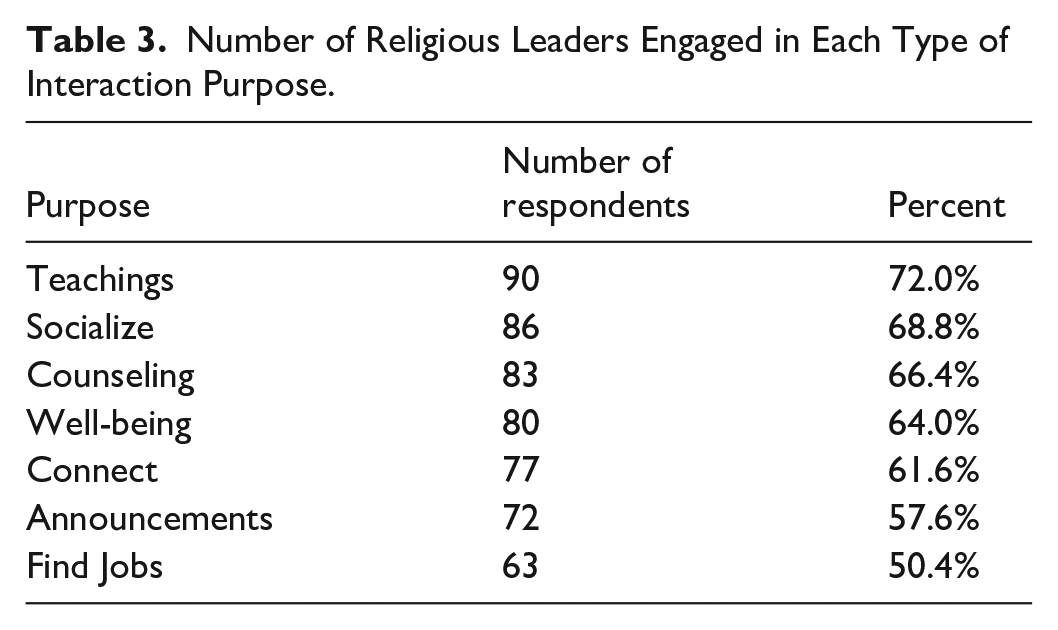
Table 3 highlights the primary purposes of communication between religious leaders and their followers. The number of respondents indicates the frequency with which each construct was engaged during these interactions, resulting in percentage variations (see Table 3). These differences reflect the elements that religious leaders may prioritize when communicating with their members during the pandemic, as highlighted by Okonkwo et al. (2015). As shown in Table 3, teaching (72%), socialization (68.8%), and counseling (66.4%) are important aspects of religious institutions, in that order.
RQ3. How Useful Did the Religious Leaders Feel the Social Media Platforms Were for Each of the Interaction Purposes?
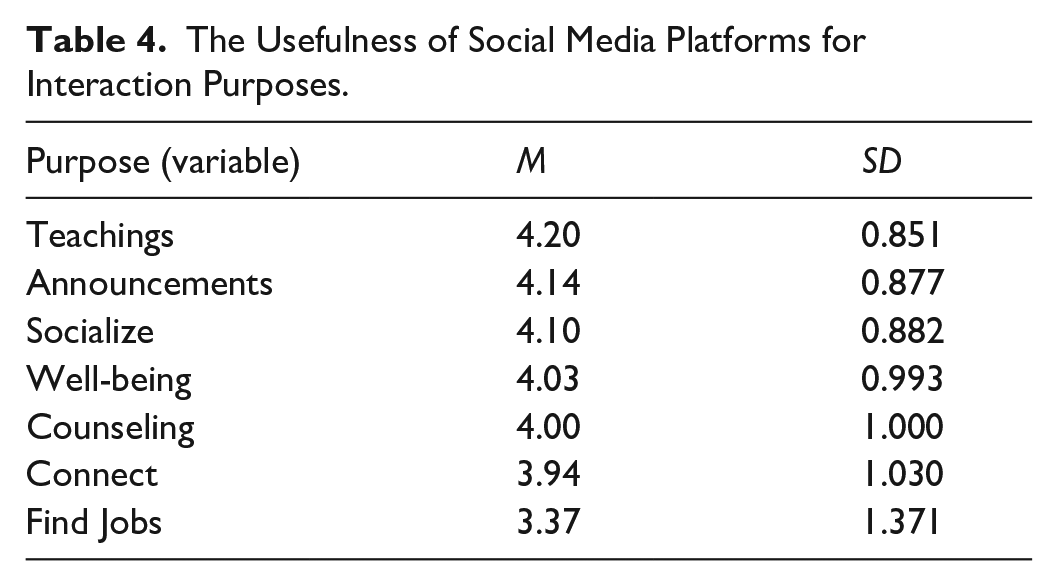
A key focus of the study was to determine whether religious leaders found social media helpful for various interaction purposes. Respondents rated this on a 5-point scale, ranging from not at all useful (1) to extremely useful (5). The mean scores were calculated to evaluate the perceived usefulness. As shown in Table 4, the results indicate that for specific interaction topics during the pandemic, five out of the seven categories scored 4.0 or higher, indicating that religious leaders found social media platforms to be very useful (4) to extremely useful (5) for these interactions. The clergy’s increased use of social media likely enhanced their communication resilience (Baraza et al., 2022; Jurgens), especially on essential topics, as illustrated in Table 4.
The Usefulness of Social Media Platforms for Interaction Purposes.
RQ4. Were There Significant Differences in the Perceived Usefulness of Social Media Platforms for Each Interaction Purpose?
The research aimed to identify significant differences in the perceived usefulness of social media across various types of interactions between the clergy and the followers. A one-way ANOVA was conducted to examine these differences, and Levene’s test for homogeneity of variances was insignificant, F(6, 554) = 6.16, p < .001. Welch’s F-test, F(6, 235) = 3.41, p = .003, was employed due to unequal variances, followed by a Games–Howell post hoc test to identify specific significant differences, detailed in Table 5. The results reveal significant differences between the “Find Jobs” interaction and the other variables, “counsel,” “teach,” “socialize,” “announce,” and “well-being,” but not with “connect.” Notably, “Connect” and “Find Jobs” were the only variables with average ratings below four. The two variables may have underperformed because individuals primarily focused on seeking information to address their challenges, as Chen et al. (2020) stated, rather than exclusively on networking or job-seeking (see Table 5).
Significant Differences in Usefulness of Social Media Platforms: Find Jobs Versus Other Interaction Purposes.

Statistically significant difference from Find Jobs.
RQ5. To What Extent Did Religious Leaders Use Social Media Platforms to Share Various Types of Content?
Table 6 presents the number and percentage of religious leaders sharing the seven identified content types. The research question examined how religious leaders utilized social media to disseminate diverse content. The variables are listed in descending order of frequency, from low to high. The findings show that over half of the respondents shared teachings, while less than 50% of the leaders cited the other content types. Although most content types had lower citation rates, each was actively engaged, highlighting their significance in alleviating emotional and physical stress during the pandemic, as noted by Bertelli et al. (2022) and David and Roberts (2021). The ongoing sharing of content, even in smaller quantities, symbolized the resilience of the parties in overcoming the challenges posed by the pandemic.
Type of Shared Content.

RQ6. Did an Institution’s Open/Closed Status During COVID-19 Impact the Range of Shared Topics on Social Media Platforms?
The research question examined the impact of shared topics on social media platforms regarding an institution’s open or closed status during the COVID-19 pandemic, ranging from fully closed to fully open. Table 7 presents the results. Levene’s test for homogeneity of variances was conducted to assess whether there were significant differences, yielding a significant result, F(3, 850) = 10.8, p < .001. As a result, we applied Welch’s ANOVA instead of the traditional ANOVA. Welch’s ANOVA indicated no statistically significant difference, F(3, 227) = .512, p = .674. Therefore, the findings suggest that there is no significant relationship between an institution’s COVID-19 status and the number of topics shared on social media platforms.
Opening Status During COVID and Number of Shared Topics.

Discussion
This section discusses the findings regarding how religious leaders utilized social media platforms for various forms of interaction, assessing their perceptions of the platforms’ practicality for different purposes during the COVID-19 pandemic. It highlights notable differences in perceived usefulness depending on the interaction type. Furthermore, it examines the types of content shared by religious leaders and considers whether the status of their institutions affected the topics discussed during the COVID-19 pandemic. Table 3 outlines the number of clergies participating in online interactions, with teaching being the most frequent and job-seeking being the least. The findings indicate that clergy primarily utilize social media platforms to support their congregations by sharing content that alleviates fear, reduces suffering, and promotes mental well-being. This aligns with the perspective of David and Roberts (2021) on human behavior during times of crisis. These shifts in social media usage highlight the adaptability and resilience (Jurgens & Helsloot, 2018; Mavrodieva & Shaw, 2021) demonstrated by clergy and followers as they strive to cultivate meaningful connections through intentional and purpose-driven interactions.
The clergy emphasized the importance of social media in their communication efforts during the pandemic (see Table 3). The findings revealed that social media platforms were crucial for disseminating salient messages to congregations. Similarly, other studies have highlighted the effectiveness of social media across various fields (Khan et al., 2021). For instance, frontline health care professionals relied on timely updates via social media to carry out their duties during the pandemic (Murri et al., 2020). Likewise, Thomas et al. (2023) demonstrated that social media platforms played a pivotal role in educating and supporting individuals with diabetes during the global pandemic. The clergy’s experience mirrored these findings, as they underscored the significance of social media for teachings, announcements, social interactions, well-being, and counseling (see Table 4), hence revealing resilience. Moreover, the focus on education through teaching (see Table 5) highlights the clergy’s commitment to informing their communities amid widespread misinformation during the pandemic. Although the data do not specify the precise content of these teachings, it is plausible that some efforts were aimed at addressing false narratives, as suggested by Schiuma et al. (2021) and Biles (2022). This likely inspired the clergy to consistently provide accurate and reliable information through accessible platforms, thereby protecting their followers from the pandemic and combating the spread of unchecked misinformation. This behavior exemplifies resilience by protecting members from harm, even in times of crisis.
Notably, significant differences were observed in the content shared by the clergy (see Table 5). These variations reflect the clergy’s priorities in addressing the community’s critical needs. Compounding this is that clergy members are also social media consumers. As they navigated these platforms, they identified topics relevant to their congregants, shaping their teachings according to a hierarchy of needs (Gobel & Miyamoto, 2024), including education, counseling, socialization, well-being, and announcements. Alternatively, these content differences may have been driven by the demands of their members. As Koronis and Ponis (2018) suggest, this adaptability illustrates resilience in crisis response, showcasing the clergy’s ability to adapt, learn, and manage crises effectively.
In addition to teachings, prayers played a pivotal role as spiritual support (see Table 6). Prayers can be viewed as a form of spiritual therapy (Farah & McColl, 2008; Safara & Bhatia, 2009), particularly within religious communities, where spiritual therapy is often offered through prayer. For instance, Eilami et al. (2019) argue that prayer is a therapeutic tool for patients in pain and near death. Similarly, Sadeghimoghaddam et al. (2019) describe prayer as an innate human response that connects individuals to the source of life. During the pandemic, marked by life-and-death uncertainties, many sought comfort and guidance through prayer from their spiritual leaders. For example, Dutra and Rocha (2021) explain that individuals facing emotional and mental distress during the pandemic received prayer services from their priests, pastors, rabbis, or Imams. This underscores the human tendency to recognize their vulnerabilities, weaknesses, and need for connection in moments of crisis. From a psychological standpoint, individuals often turn to prayer when they feel a loss of control over their circumstances (Cekiera, 2020). This behavior of consistently seeking spiritual therapy through social media platforms illustrates the resilience and adaptability that emerge during times of crisis, enabling individuals to overcome challenges in the absence of conventional means of communication.
Another important factor revealed by the findings is the role of announcements (Table 6). These are crucial for keeping people informed during a crisis, offering warnings or preventive measures (DiClemente & Jackson, 2016). Just as frontline health professionals required constant updates on their efforts during the pandemic (Murri et al., 2020), religious communities also needed timely information. Announcements serve as a vital source of new data, much like their role in the equity market (Bonsall et al., 2020). The clergy’s commitment to delivering announcements to their members highlights their perseverance in ensuring people remained aware of safety protocols and mental health well-being, thereby keeping the audience informed and prepared.
According to the results, counseling was valued as a crucial support component during the pandemic (see Table 6). The American Counseling Association (ACA) highlights that the primary goal of crisis counseling is to help individuals regain control and restore normal functioning after a crisis (Biles, 2022). Indeed, people needed to regain control of themselves as they navigated through the harsh times of the pandemic. In Kenya, the clergy steered the way by providing members with emotional support through social media platforms. Scholars also highlight the importance of seeking counseling after a crisis to alleviate pain and suffering and strengthen community resilience (Golan, 1998; Molebatsi et al., 2021; Nguse & Wassenaar, 2021). The ongoing efforts to offer counseling through social media demonstrate the resilience and adaptability of church communities in the face of challenging times.
Despite social media’s widespread engagement and utility in fostering communication and learning environments, the findings reveal minimal differences in content sharing, regardless of whether religious institutions are open or closed. This trend highlights the clergy’s unwavering commitment and strategic use of social media platforms to share content, ensuring that information and services reach their followers, regardless of the institution’s operational status.
Conclusion
The study highlights the crucial role of social media in shaping the communication environment during a pandemic. The widespread accessibility of social platforms empowered clergy to overcome barriers imposed by global lockdowns, which restricted physical interactions. As the data reveals, clergy frequently shared valuable information to educate their congregations and dispel misinformation, fostering a stronger connection and engagement between themselves and their followers. This persistent communication demonstrates remarkable resilience. Despite the challenges and costs, religious leaders remained undeterred, adapting to new platforms to continue reaching their members.
Similarly, the data show that the clergy prioritized sharing various types of content with their followers, with teachings, prayer, and counseling taking precedence, and finding employment resources being the least prioritized. This focus suggests that the clergy aimed to address the fear, pain, and loss of life during the pandemic while providing emotional support during these unprecedented times, helping their members to find jobs. Although certain types of content were ranked higher in frequency, all shared information was vital. For instance, while job-related content was less frequent, it was crucial in helping people find employment online, as many had lost their jobs due to the pandemic.
Finally, it is worth noting that the study did not examine the specifics of the shared content or the time spent on individual social media platforms, which could have provided more detailed data and insights. The rationale for exploring these variables is that religious leaders may have favored certain platforms over others for specific reasons. In addition, they may have shared more detailed information on their topics to assist their members better. These aspects will be investigated in future studies.
Footnotes

Funding
The authors received no financial support for the research, authorship, and/or publication of this article.
Declaration of conflicting interests
The authors declared no potential conflicts of interest with respect to the research, authorship, and/or publication of this article.