




Abstract
This study investigates how affective fandom publics construct transcultural mourning communities following Kobe Bryant’s death. Drawing on 5 years of data from Reddit and Baidu Tieba, it examines how digital grief evolves across platforms and cultures. The analysis integrates theories of affective publics, fandom, and online mourning to conceptualize these publics as emotionally durable collectives shaped by cultural values and platform rituals. Findings reveal distinct mourning modes: Western discourse emphasizes personal storytelling and emotional immediacy, while Chinese discourse highlights ritual and symbolic continuity. Over time, both shift from public spectacle to sustained emotional practice, transforming grief into identity-making and collective memory work. This study contributes to affect theory, digital mourning research, and sports communication by revealing how mourning unfolds not only across platforms but also through time and culture.
Introduction
On 26 January 2020, basketball legend Kobe Bryant tragically died in a helicopter crash, sending shockwaves around the world. From NBA players to everyday fans, countless individuals flooded social media in the immediate aftermath, expressing grief and sharing remembrance through their screens. Yet this wave of mourning did not fade with time—it gradually evolved into a form of everyday commemoration and spiritual continuity, forming a digital memory landscape that transcended cultural and platform boundaries. Five years on, references to the “Mamba Mentality” continue to circulate online, through updated content, tribute rituals, and emotional reflections. This phenomenon suggests that fan mourning is not merely a fleeting emotional response, but a sustained process of affective construction and public engagement.
Although recent scholarship has paid increasing attention to affective publics (Papacharissi, 2015) and fandom publics (Zhang, 2016), the intersection of these two—what some have termed affective fandom publics—has yet to be systematically theorized. Giaxoglou (2019, 2020) introduced the term in the context of mourning musical icons such as David Bowie, highlighting fan expressions of grief and community interaction. However, her work primarily focused on single-platform, single-culture settings and did not fully unpack the structural features or cross-cultural dynamics of this emerging public form. At the same time, digital mourning studies have largely emphasized individual emotional expression and the public affordances of social media (Brubaker et al., 2013; Walter, 2015), without offering comparative insight into how mourning is shaped by cultural norms, platform architectures, and fandom identities. This theoretical gap calls for cross-cultural investigations of affective fandom publics, raising key questions: How are celebrity figures continuously memorialized within different cultural contexts? And how do fans transform mourning into meaning and identity?
To address these questions, this study analyzes 5 years of online mourning discourse surrounding Kobe Bryant across two culturally distinct platforms: Reddit and Baidu Tieba. Using structural topic modeling (STM), the study seeks to examine: (1) What themes structure the online mourning practices of affective fandom publics? (2) How do these themes differ across cultural contexts? (3) How do mourning narratives evolve over time? By combining theoretical synthesis and empirical exploration, this study extends the concept of affective fandom publics within digital environments and contributes a cross-cultural perspective to ongoing debates on online mourning and sports celebrity communication.
Literature Review
Affective Publics, Fandom Publics, and Affective Fandom Publics
The rise of digital media has made imagined publics more diffuse yet more influential. However, not all individuals online form a “public.” As Price (1992) notes, fragmented individuals with opinions remain merely a mass audience unless they engage in collective deliberation on shared issues. With the penetration of networked logic, publics are increasingly conceptualized as relational formations contingent upon the specific conditions of network society (Emirbayer & Sheller, 1998), and, through the process of mediatization, acquire the potential to organize dispersed individuals and mobilize collective agency (Zhang, 2016). Papacharissi (2015) innovatively introduced the concept of “affective publics,” defining them as networked publics mobilized and connected (or disconnected) through expressions of sentiment, as these expressions of sentiment materialize discursively through the medium of Twitter. Rather than emerging as a new type of public, affective publics represent a reinterpretation of existing public forms—such as subcultural communities—centered on emotional intensity. Formed through emotional, irrational, and networked modes of expression (Papacharissi, 2015), affective publics rely on digital platforms to facilitate emotional alignment and shared resonance. In this framework, emotion becomes a primary means for interpreting the world and affiliating with others (Lünenborg, 2019). The emergence of affective publics has enabled marginalized topics to gain visibility and participatory momentum, thereby entering mainstream discourse (Papacharissi & Oliveira, 2012; Reilly, 2016). Their connective, rather than collective, nature allows for the construction of affective support networks through retweets, hashtags, and other forms of networked interaction (Papacharissi, 2015; Reilly, 2016). It should be acknowledged, however, that most discussions of affective publics have focused on radical activism or political discourses (Shahin & Ng, 2022; Wang & Tan, 2023). As Vicari (2021) argues, current public sphere scholarship often overlooks mundane discursive interactions grounded in shared interests and values on social platforms. Giaxoglou and Döveling (2018) highlight how diverse affective flows—such as digital mourning practices—also offer a valuable entry point into the study of affective publics. For instance, Papailias (2016) observes that in today’s participatory online culture, “anyone” can partake in viral memorial moments, turning mourning into both a public performance of grief and a collective communicative event. Building on this perspective, Klastrup’s (2018) analysis of Vin Diesel’s public mourning of Paul Walker and his interaction with fans reveals the affordances of social media in shaping what she terms “affective fandom publics.” This emerging formation—affective fandom publics—is the key lens through which the present study seeks to explore the intersections of emotion, fandom, and mediated public expression.
Building on the foundation of affective publics, Zhang (2016) identified the emergence of a form of public that, while seemingly removed from overt political engagement, nonetheless possesses significant social agency—namely, fandom publics. These publics are not merely engaged in emotional expression but are deeply involved in long-term processes of cultural construction. Fandom practices often intersect with aesthetic ethics, cultural sovereignty, and negotiations of identity, thereby exceeding the bounds of mere emotional resonance. In China, fan communities have demonstrated civic consciousness while upholding their identity as fans. They have played unique roles in advancing philanthropic causes and promoting public health campaigns (Wong et al., 2021; Yang et al., 2024). Similarly, a study of K-pop fandoms in Latin America highlights the mobilizing potential of fandom publics: in response to idol suicides, fans spontaneously organized mourning rituals and suicide prevention campaigns. These acts served not only to resist societal pressures but also to expand public understanding of the fan community as a socially responsive collective (Jang, 2022). Giaxoglou (2019, 2020) has used the term “affective fandom publics” to articulate a hybrid framework that merges affective publics and fandom publics. Analyzing the mourning practices of fans of celebrities such as David Bowie, Giaxoglou demonstrated how social media platforms reconfigure structures of emotional expression and public engagement. Particularly in the context of celebrity death or sudden crises, fans generate emotionally intense “shared mourning communities” through networked, ritualized engagement.
Although “affective fandom publics” have yet to be systematically theorized, existing studies already delineate their contours: fans, through their distinctive forms of emotional investment, collective identification, and media performance, contribute to the construction of public memory and social resonance in response to idol-related events. This article proposes the concept of affective fandom publics as a new analytic lens to understand the intersection of cultural identity and public action in platform-mediated contexts. In contrast to affective publics, which are typically organized around ephemeral, event-driven participation (Papacharissi, 2022; Papacharissi et al., 2023), and fandom publics, which center on cultural creativity, affective fandom publics are rooted in fan identity and characterized by sustained emotional and participatory engagement surrounding specific idol conditions—such as death, retirement, or prolonged absence. Rather than emerging solely in response to transient issues (Just & Petersen, 2023), these publics articulate a sense of “ongoing presence” through platformed, ritualized, and rhythmic expressions. As such, they offer a valuable entry point for examining how digital mourning of celebrity figures unfolds and is maintained over time.
Online Mourning and Sports Celebrities
Online mourning, also referred to as digital mourning, denotes mourning practices that take place on new media platforms (Babis, 2021). A defining feature of such practices is their foundation in internet-based platforms that enable users to autonomously produce mourning content. This democratization of mourning grants individuals outside the deceased’s immediate family the power to publicly grieve (Walter, 2015). The origins of online mourning can be traced back to the 1990s, where practices were more closely aligned with Eastern cultural traditions that integrated grief into daily life (Chang & Sofka, 2006). Roberts and Vidal (2000), for instance, examined four online memorial websites that included static obituaries as well as dynamic guestbooks allowing visitors to leave messages. Many of these messages came from individuals who had personal relationships with the deceased (Roberts, 2004; Roberts & Schall, 2005). Walter (2015) has drawn a historical parallel between online mourning and the communal grieving typical of pre-industrial societies, where small-scale communities of fewer than hundred people collectively experienced and shared the sorrow of death. In such contexts, mourning behaviors, emotions, and responses were deeply intertwined and publicly visible—everyone could see the mourners, everyone could hear the funeral bell. However, unlike pre-modern communities, online mourning enables connections across fragmented social circles. Social media platforms create potential networks of association, bringing together even those who had never met the deceased to share in collective grief (Pennington, 2013), sometimes forming mourning communities that persist for months (Roberts, 2004).
Online mourning is characterized by both everydayness and publicness. From the perspective of everydayness, social media platforms facilitate the expression of mourning emotions at virtually any time and place (Brubaker et al., 2013). They also allow for the extension, continuation, and reconfiguration of relationships between the living and the deceased within digital environments (Sandvik & Christensen, 2013). Willis and Ferrucci (2017), for example, analyzed the Facebook profiles of deceased users and found that their friends and relatives frequently posted messages of remembrance and grief, creating a transboundary connection between life and death. Compared to early online memorial websites, social media offer persistent visibility of a deceased user’s past activity, making death more present in everyday life and integrating mourning into the digital fabric of daily life (Walter, 2015). Moreover, online mourning demonstrates a marked publicness (Bingaman, 2020; Giaxoglou et al., 2017; Klastrup, 2015), as platforms render previously private grief visible to broader audiences. Previous studies have examined comments on the profiles of deceased MySpace users, arguing that social media create online spaces for public grief, extending mourning beyond familial circles into broader, technologically mediated social networks (Brubaker et al., 2013).
Amid the diverse forms of online mourning, the death of sports celebrities represents a distinct phenomenon—one that remains underexplored in academic literature (English, 2015). On the one hand, similar to other public figures, the passing of a sports celebrity often becomes a highly mediatized public event (Burgess et al., 2018). For example, the death of Kobe Bryant sparked widespread mourning across social media platforms, generating long-term parasocial grief and emotional engagement (Bingaman, 2020). On the other hand, compared to other types of celebrities, sports figures are more likely to be constructed as national “heroes” rather than merely as athletes, due in part to the close ties between sports and nationalism (Billings & Eastman, 2003; Zhang et al., 2025). This heroic framing is particularly salient in the commemorations of deceased athletes, where controversies and moral failings are often overshadowed by their athletic legacies. In the case of Kobe Bryant, media coverage largely focused on his perseverance and resilience in the face of adversity, while omitting references to past sexual assault allegations (Chen et al., 2021). Similarly, a study on the online mourning of Slovak ice hockey player Pavol Demitra revealed a mythologizing process wherein he was repeatedly portrayed as a successful athlete and charitable father. Certain life narratives and idealized character traits were selectively emphasized and reiterated (Mikuláš & Tejkalova, 2025). As McElroy (2013) aptly noted, obituaries often end up reproducing complex themes and histories into oversimplified frames. Given the public and nationalistic dimensions of sports figures, their deaths tend to mobilize the very forms of affective fandom publics central to this study. These publics coalesce around shared emotional investment, ritualized mourning practices, and digitally mediated remembrance. As such, the online mourning of sports celebrities warrants deeper investigation—not only as a media event but also as an emergent cultural form that provides empirical insight into the dynamics of sports communication, collective memory, and mediated public grief.
Online Mourning in Different Cultural Contexts
While much of the scholarship on affective publics and fandom-based mourning has focused on the emotional, networked, and participatory dimensions of grief, less attention has been paid to how such affective expressions are shaped by the broader cultural schemas of mourning. Yet, as affective fandom publics increasingly form around global figures like sports celebrities, their commemorative practices often intersect with deeply embedded cultural norms surrounding death, grief, and memory. To understand the variations in these practices, it is essential to explore how mourning is situated within distinct cultural frameworks. Drawing on Rosenblatt’s (2001) multidimensional framework of mourning, this section reviews the cultural contexts of online mourning in both Chinese and Western social media.
In terms of the conception of death, Chinese culture—deeply influenced by Confucianism, Buddhism, and Daoism—commonly views death as a continuation of life rather than a definitive end. This perspective emphasizes the immortality of the soul and ancestral reverence, often embedding a strong supernatural element in mourning practices (Chan et al., 2005; Von Falkenhausen, 2010). Expressions such as “may you find peace in another world” (愿在另一个世界安好) and “in the Nine Springs” (九泉之下) are frequently used, reflecting a belief in spiritual transition and ongoing connection. Under this view, the deceased are not considered entirely gone; instead, the living maintain a spiritual co-presence with them through language, ritual, and media-mediated acts. This ongoing bond facilitates self-healing and emotional continuity (Hu & Jiang, 2025). By contrast, in Western societies—particularly those rooted in Christian traditions—the view of death is shaped by dualistic soul-body concepts and the doctrine of soteriology. Death is often conceptualized as the termination of physical life and the elevation of the soul. Accordingly, mourning expressions commonly include phrases such as “Rest in Peace” and “He is in a better place,” emphasizing closure, rest, and transcendence (Cacciatore & DeFrain, 2015). Although online platforms may provide opportunities for symbolic continuity, the focus in Western mourning discourse tends to lie more heavily on emotional restoration and reconstruction of life after loss (Ummel et al., 2022).
Second, with regard to mortuary rituals, traditional Chinese mourning practices are deeply rooted in historical customs and are often elaborate, involving acts such as burning joss paper and holding vigils (Chen, 2012). These traditional elements have undergone digital transformation in the online mourning context. Practices such as cloud-based memorial services and virtual flower offerings have gained popularity, and the social media profiles of deceased individuals are frequently imbued with symbolic meaning, functioning as “digital memorial altars” for emotional connection. For instance, Ai et al. (2025) have highlighted the ritualistic dimension of self-mourning behaviors on Chinese social media. In contrast, Western societies place greater emphasis on institutionalized and structured digital commemoration mechanisms, such as Facebook’s memorial account feature. These systems aim to construct coherent life narratives and enable emotional closure through staged remembrance (Aragno, 2007). Dedicated online memorial websites such as MuchLoved and Keeper often allow users to set specific expiration dates or transition the site into a “read-only” state.
Third, in terms of emotional expression, Chinese mourning culture tends to favor restraint and subtlety, reflecting a broader cultural emphasis on decorum and ritual propriety. Public expressions of grief often adopt poetic or indirect language. A common condolence phrase, jieaishunbian (节哀顺变), literally meaning “restrain your sorrow and accept change,” underscores emotional moderation and acceptance (Chan et al., 2005). Group mourning in Chinese digital contexts is frequently intertwined with Confucian values such as filial piety (孝), righteousness (义), and human ethics (人伦), often reinforcing implicit social norms. Previous studies have also noted an increasing collectivist orientation in Chinese digital mourning practices over time (Ai et al., 2024). Conversely, Western mourning discourse is typically marked by individualized and explicit emotional expression, including personal tributes, photo sharing, and storytelling. Many platforms offer support groups and access to psychological resources, facilitating the formation of a social support system for grief. Giaxoglou (2020) observed that mourning on Western social media often takes the form of micro-narratives—short personal stories that articulate emotional memories and foster affective connection with the deceased.
Across both Eastern and Western contexts, online mourning practices increasingly reflect a global trend toward emotional publicness. Mourning is no longer confined to the private or familial sphere; rather, it is emerging as a socially participatory activity facilitated by social media platforms. These practices carry sociocultural significance that extends beyond traditional grief expression, and they hold potential for collective mobilization and identity construction (Wagoner & Luna, 2021). Uwalaka (2023a) has proposed the concept of connected mourning, which further elucidates the social dimensions of digital grief. This concept emphasizes that even individuals who had no personal relationship with the deceased may participate in mourning due to shared emotional experiences, ideological identification, or social events, forming emotionally resonant communities through grief (Uwalaka, 2023b).
In sum, while online mourning reflects a global trend of emotional publicness, its expressions remain deeply shaped by cultural values, ritual vocabularies, and platform affordances. Understanding these differences is key to examining how affective fandom publics mobilize grief not just emotionally, but as a culturally mediated practice. Variations in death perception, ritual forms, and emotional expression shape how grief is enacted online and how affective publics navigate loss and identity across cultures. Against this backdrop, the following analysis compares Reddit and Baidu Tieba to explore how transcultural mourning takes shape in practice.
Research Questions
This study examines the commemorative practices of affective fandom publics on two culturally distinct social media platforms: Baidu Tieba (China) and Reddit (primarily English-speaking countries). By analyzing 5 years of online discussions related to Kobe Bryant, the study aims to construct a time-based spectrum of online mourning, with a focus on how shared fandom contributes to sustained emotional expressions and the formation of public memory around a sports celebrity. The research addresses the following questions:
RQ1. What themes characterize the online mourning of Kobe Bryant among affective fandom publics on social media platforms?
This question focuses on identifying the discursive and emotional patterns through which fans articulate their grief and construct meaning around the celebrity’s death.
RQ2. Are there thematic differences in online mourning between Reddit and Baidu Tieba?
Given the strong cultural specificity of mourning practices, this question explores how affective fandom publics in Western and Eastern contexts vary in their commemorative expressions, symbolic references, and emotional registers.
RQ3. How do temporal dynamics shape the patterns of online mourning across Reddit and Baidu Tieba?
Building on prior research emphasizing the temporal dimension of affective publics and digital mourning (e.g., Mikuláš & Tejkalova, 2025; Wang & Tan, 2023), this study incorporates time as a key analytical axis. Ural (2023) notes that the formation of affective publics often unfolds as a diachronic process involving emotional transitions. Accordingly, this study seeks to uncover temporal fluctuations in thematic salience and intensity across both platforms over time.
Method
Data
This study selects Kobe Bryant as the focal subject. As a globally renowned sports figure, Kobe’s influence transcended cultural boundaries (Wright, 2025). His passing elicited a profound sense of grief across diverse cultural contexts. This research centers on the discourse surrounding Kobe on social media in the aftermath of his death. Specifically, the study examines Reddit, a widely used platform in Western culture, and Baidu Tieba, a functionally similar platform prominent in Chinese culture. The analysis focuses on discussion groups dedicated to Kobe, namely, r/KobeBryant24 on Reddit and the Kobe Bar (科比吧) on Tieba. Both platforms have been extensively utilized in prior research as critical entry points for analyzing social media discourse (Zhang, 2024; Zhang & Li, 2025).
Using a custom Python script in conjunction with the official APIs of the respective platforms, this study collected a dataset comprising 2042 posts and 9058 comments from Reddit, and 7011 posts and 51,134 comments from Tieba. The data collection spanned from 26 January 2020 to 26 January 2025, thus capturing 5 years of public discourse following Kobe’s death. The posting frequency is illustrated in Figure 1. In accordance with established methods in prior studies, the content of each thread was aggregated into a single document to be included in the dataset. To facilitate cross-cultural comparison, the Chinese content from Tieba was translated into English using the Google Translate API. A summary of the dataset is presented in Table 1.

Time distribution of threads on Reddit and Tieba (2020–2025).
Descriptive Data of Two Corpus.

Analytical Approach
To address the study’s three research questions, Structural Topic Modeling (STM) was employed. STM conceptualizes each document as a mixture of latent topics based on a prior distribution framework (Roberts et al., 2019). This method enables the estimation of hidden thematic structures (RQ1) and allows for the identification of underlying distinctions and commonalities among texts. Furthermore, by incorporating metadata as covariates, STM facilitates an examination of the statistical association between identified topics and their respective platforms (Maier et al., 2018), thereby addressing RQ2. In this study, time (in months) and thread length (in English word count) were incorporated into the model as control variables. The STM package in R was utilized to construct and estimate the model (Roberts et al., 2019).
To further address RQ3, the topic distribution (γ values) for each document was extracted from the STM results. For each time point (month), all documents posted during that period were grouped by platform and topic. The average topic prevalence per group was then calculated using the following formula:

where
Findings
As an unsupervised modeling approach, STM requires researchers to determine the number of topics prior to model estimation. This study evaluated multiple diagnostic criteria—including held-out likelihood, residuals, and semantic coherence—to identify the optimal number of topics (see Supplementary Material A). After comparing STM outputs for models with 7 to 9 topics, the study ultimately selected an 8-topic solution for each of the two online mourning datasets related to Kobe Bryant. STM generates a set of keywords with the highest exclusivity weights for each topic, which assists researchers in interpreting thematic content (Roberts et al., 2019). The key terms associated with each topic are presented in Table 2.
Topic With Keywords.
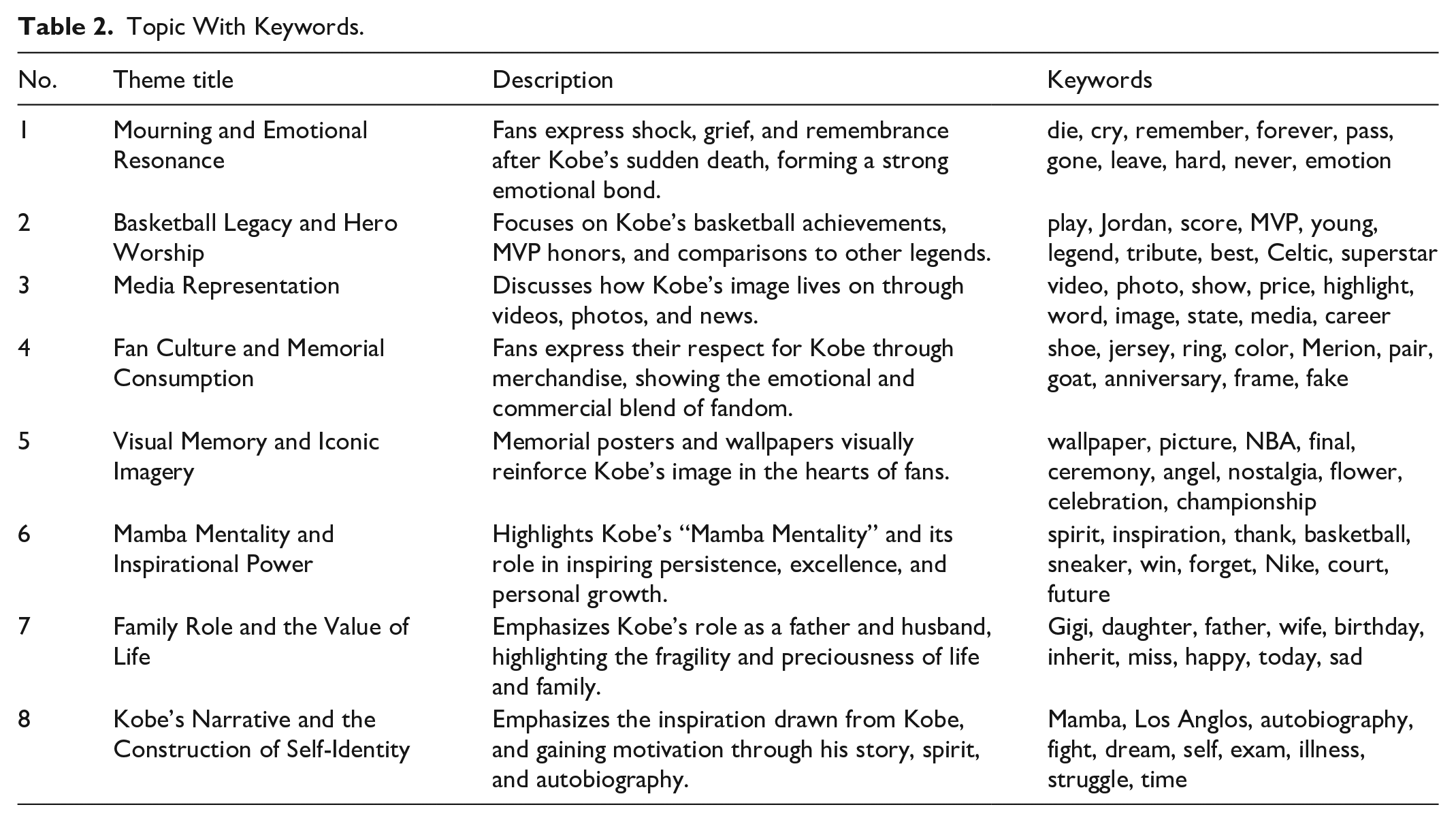
Specifically, the thematic analysis of online mourning discourses related to Kobe Bryant yielded eight topics, which can be further categorized into three overarching thematic domains: Emotional Expression (Topic 1), Media Commemoration (Topics 2, 3, 4, 5), and Spiritual Legacy (Topics 6, 7, 8). First, the Emotional Expression category highlights fans’ collective grief and shock following Kobe’s sudden passing. This category is characterized by emotionally charged language such as “cry,” “forever,” and “miss.” In particular, posts referencing the dual tragedy involving Kobe and his daughter Gigi often contain expressions such as “unbearable loss” and “lost my whole world overnight,” revealing an intense sense of communal mourning. Second, the Media Commemoration domain underscores the role of visual and symbolic media in constructing public memory. Fans frequently revisit key moments in Kobe’s career—such as his five NBA championships, the 81-point game, and comparisons with Michael Jordan—and post images of memorabilia, including jerseys, limited-edition sneakers, and autographed basketballs. In addition, personalized wallpapers and fan-made visual artworks serve as both aesthetic tributes and emotional connectors. Finally, the Spiritual Legacy category reflects the enduring influence of Kobe’s “Mamba Mentality.” Users regularly share motivational quotes and interview excerpts (e.g., “Mamba mentality is about never giving up”), portraying Kobe as a symbolic figure for perseverance and self-discipline. This form of digital heroism constructs the sports celebrity as a cultural icon whose influence extends beyond the basketball court. Collectively, these three categories demonstrate how digital mourning practices facilitate public engagement with emotional expression, cultural transmission, and identity construction through fan participation in online spaces.
To address RQ2, the STM incorporated the platform as a covariate to explore how mourning discourse differs across cultural contexts. The results are presented in Figure 2. From a convergence perspective, themes such as Mourning and Emotional Resonance (β < 0.001, p = .84) and Basketball Legacy and Hero Worship (β = 0.001, p = .54) appeared with similar prevalence across Reddit and Tieba, indicating the existence of cross-cultural resonance in the online mourning of Kobe Bryant. From a divergence perspective, four themes—Media Representation (β = 0.01, p < .001), Fan Culture and Memorial Consumption (β = 0.02, p < .001), Mamba Mentality and Inspirational Power (β = 0.02, p < .001), and Kobe’s Narrative and the Construction of Self-Identity (β = 0.01, p < .001)—were more prevalent on Reddit. Conversely, Visual Memory and Iconic Imagery (β = −0.03, p < .001) and Family Role and the Value of Life (β = −0.03, p < .001) emerged more prominently on Tieba, reflecting cultural distinctions in mourning expression.

Forest plots showing topics in the two platforms.
Furthermore, this study examined the temporal dynamics of cross-platform themes (see Figure 3). Each point in the figure represents the average topic prevalence (gamma) for a given month, with shaded areas indicating 95% confidence intervals. The findings reveal a clear shift in dominant mourning themes over time. In the early phase, discourse was primarily dominated by Mourning and Emotional Resonance, signaling the collective emotional response during the immediate aftermath of Kobe’s death. Over time, themes such as Mamba Mentality and Inspirational Power and Kobe’s Narrative and the Construction of Self-Identity gained prominence, illustrating a discursive transition from grief to value affirmation and spiritual continuation. Some topics displayed cyclical patterns. For example, Family Role and the Value of Life peaked around Kobe’s death anniversaries and related news events, indicating periodic surges in collective remembrance. In contrast, themes related to Spiritual Legacy, particularly Mamba Mentality and Inspirational Power and Kobe’s Narrative and the Construction of Self-Identity, exhibited a more sustained and routine presence, becoming integrated into fans’ everyday expressions of self-motivation and personal values. Simultaneously, commemorative practices centered on media and merchandise displayed distinct platform differences. On Reddit, Fan Culture and Memorial Consumption was consistently active, with users regularly sharing sneakers, jerseys, and collectible items. In contrast, Tieba users tended to concentrate such expressions around specific commemorative moments, resulting in more ritualized and emotionally concentrated patterns of engagement.

Topic trends over time within two platforms.
Discussion
Having identified the core themes, platform distinctions, and temporal dynamics of online mourning discourse, the following discussion interprets these findings in light of existing theories on affective publics, fandom participation, and cross-cultural memorial practices.
First, using STM, this study identifies eight dominant themes in the online mourning of Kobe Bryant, which are organized into three overarching dimensions: emotional expression, media commemoration, and spiritual legacy. This thematic structure not only reflects how affective publics mobilize collective emotions in the digital age (Papacharissi, 2015) but also illustrates how fandom publics emotionalize, memorialize, and collectively re-signify celebrity figures (Zhang, 2016). Among these, themes related to emotional expression were especially prominent in the early phases, echoing Bingaman’s (2020) account of affect contagion in “parasocial mourning.” Unlike politically activated affective publics, these fandom-based publics demonstrate sustained and personalized emotional engagement, forming what may be termed an “emotionally networked fan community.” Moreover, media-centric mourning practices—such as sharing merchandise, wallpapers, and tribute videos—reveal how fans actively participate in the creation of commemorative meaning through material and visual means. This aligns with Papailias’s (2016) notion of “database mourning,” in which digital mourning is not just expressive but archival, and deeply intertwined with identity reconstruction. New forms of cultural products—such as collectible sports cards and signature sneakers—function as affective vessels (Parrott, 2025), embedding emotional meaning into physical objects. Over time, the emergence of themes such as “Mamba Mentality” and “Kobe’s Personal Narrative” indicates a transition from grief to value transformation. Fans repeatedly cite Kobe’s words and deeds concerning perseverance, discipline, family, and faith, elevating him into a symbolic template for aspirational living. This process represents a form of re-mythologization (Mikuláš & Tejkalova, 2025), demonstrating that affective fandom publics possess the capacity to transform personal loss into culturally shared identity practices.
Second, the thematic differences across platforms underscore how affective fandom publics express grief differently in distinct cultural contexts. While core topics like “shock” and “basketball achievements” appear on both Reddit and Baidu Tieba, notable divergences arise in the use of media, narrative structures, and representations of family. These differences align with Rosenblatt’s (2001) framework on cultural variations in mourning. On Reddit, mourning tends toward individualized and narrative-driven expressions, where users frequently recount personal growth stories, collection histories, and motivational reflections tied to Kobe’s legacy. This exemplifies what Giaxoglou (2020) refers to as “narrativized mourning,” grounded in Western notions of grief as a personal life-storying process, emphasizing emotional disclosure and self-healing (Ummel et al., 2022). In contrast, Tieba exhibits ritualistic and collectivist patterns, with themes such as “family role” and “visual memorials” peaking on specific dates (e.g., death anniversaries, birthdays), reflecting a cyclical rhythm akin to traditional mourning practices. Phrases such as “May you rest well in another world” illustrate the cultural underpinnings of the Chinese soul continuity belief (Chan et al., 2005; Hu & Jiang, 2025). Moreover, Chinese mourning culture also emphasizes concern for the deceased’s family, which explains the frequent mentions of Kobe’s family members and his role as a father and husband (Chan et al., 2005). Thus, cultural codes deeply mediate the semiotics and social logic of digital mourning.
Third, the temporal dynamics of online mourning show that affective discourse is not static but unfolds through distinct phases and cultural rhythms. While earlier work has highlighted the emotional intensity of digital mourning (Klastrup, 2018; Papailias, 2016), few have explored how affect evolves rhythmically over time. This study, following Ural (2023), treats temporality not merely as context but as an analytic axis—a structuring condition for affective publics. Ural conceptualizes affective mobilization as a staged media ritual, a framework this study supports empirically. In the immediate aftermath of Kobe’s death (early 2020), both Reddit and Tieba were saturated with emotionally charged expressions of shock and grief, echoing Klastrup’s (2018) idea of a “mourning peak,” and, as DeGroot and Leith (2015) note, a moment of amplified and at times excessive affect. This early phase bore the hallmark of a media event (Dayan & Katz, 1992), defined by broad public participation, narrative dramatization, and temporally concentrated attention. However, over time, this initial spectacle gradually shifted into a community-centered mode of remembrance, marked by recurring rituals, symbolic practices, and fandom-specific expressions. This transition from public issue to community issue underscores how media events may evolve into sustained fan cultures through emotional and symbolic labor. In later years (2022–2025), themes such as “Mamba Mentality” and “personal motivation” gained prominence, reflecting a shift from grief to the internalization of Kobe’s values. On Reddit, this took the form of motivational quotes and personal stories; on Tieba, it aligned with ritualized patterns such as annual tribute posts and commemorative wallpaper updates—illustrating what Walter (2015) calls “ritual reactivation.” This evolution suggests that affective fandom publics mourn not only in time, but through time—processing memory, reshaping emotion, and building what may be termed emotionally rhythmic communities. In doing so, they transform mourning from a transient event into a sustained emotional infrastructure.
Implications
This study offers both theoretical and practical contributions through a 5-year longitudinal analysis of online mourning discourse across culturally distinct platforms following Kobe Bryant’s death. It advances the concept of affective fandom publics and broadens research on digital mourning and sports celebrity communication.
First, building on Giaxoglou’s (2019, 2020) initial use of affective fandom publics, which remains largely descriptive, this study refines the concept by integrating Papacharissi’s (2015) affective publics and Zhang’s (2016) fandom publics. It reconceptualizes affective fandom publics as durable, emotionally invested collectives shaped by platform-specific rituals. Unlike transient affective publics, these communities exhibit rhythmic engagement, symbolic mediation, and sustained emotional intensity. Mourning unfolds through annual tributes, commemorative artifacts, and fan vernaculars, enabling identity transformation by internalizing the values of the idolized figure. This framework answers Vicari’s (2021) call to explore non-radical affective publics and offers a structural, conceptual, and cross-cultural model for how affect shapes collective identity in digital fan communities.
Second, the study highlights cultural variations in digital mourning—an underexplored area. Whereas most research focuses on individual grief and public expression via social media (Brubaker et al., 2013; Walter, 2015), this study compared Reddit and Baidu Tieba, revealing that Chinese discourse emphasizes ritual, collectivity, and indirectness, while Western discourse favors emotional directness and personal storytelling. These patterns support Rosenblatt’s (2001) theory of cross-cultural mourning and extend it into the digital realm. Moreover, by incorporating temporality, the study shows how mourning evolves from emotional outburst to material commemoration to spiritual transformation, echoing Ural’s (2023) model of ritual periodicity in affective publics. It also reveals a broader transformation from media events to affective communities, suggesting that digital mourning is not only rhythmic, but also structurally transitional—from collective spectacle to personalized ritual.
Third, in the context of sports celebrity communication, the study moves beyond the traditional focus on national identity (Billings & Eastman, 2003). It shows how digital memorialization reconfigures athletes like Kobe into aspirational figures and emotional symbols. The idea of the “Mamba Mentality” illustrates how fan discourse transforms a sports icon into a transnational motivational archetype, integrating his legacy into everyday value systems.
Finally, the findings have practical implications. Recognizing the cyclical nature of grief among affective fandom publics, platforms could implement emotion-sensitive design features—such as tribute prompts, memorial walls, or support tools—during commemorative periods. In addition, the identification of culturally specific mourning styles provides strategic insights for brands and institutions to design culturally resonant memorial campaigns and fan engagement strategies across global markets.
Limitations and Future Research
While this study provides valuable theoretical and empirical insights, several limitations remain. First, it focuses on Reddit and Tieba, which, though culturally significant, do not capture visual-oriented platforms like Instagram, Weibo, or TikTok. Future research should adopt a multi-platform approach to better understand how different media environments shape mourning practices. Second, this study does not account for user-level variables such as gender, age, or location, which may influence emotional expression. Incorporating demographic data and mixed methods could enhance understanding of how identity interacts with platform structures. Third, the focus on Kobe Bryant, while illustrative, limits generalizability. Future studies should examine diverse celebrity cases and event types to explore how affective fandom publics respond across contexts. Finally, although the study adopts the framework of affective fandom publics, its empirical analysis operates at the discursive rather than the user-interaction level. As such, it captures affective patterns through textual expressions rather than interpersonal dynamics. This may limit the extent to which the formation of publics as emotional networks can be inferred. Future work could address this by combining text-based analysis with user engagement data or ethnographic methods to explore the lived formation of affective communities.
Conclusion
This study demonstrates that online mourning for Kobe Bryant has evolved into a sustained, culturally mediated practice through which affective fandom publics construct emotional continuity and collective memory. By examining Reddit and Baidu Tieba, it highlights both shared and divergent mourning rituals shaped by cultural values and platform logics. The reconceptualization of affective fandom publics offers a new framework for understanding long-term digital grief, while also illuminating how sports celebrity death catalyzes identity transformation and social bonding. These findings broaden current discussions on digital mourning, emotional publics, and transnational fan engagement in platform societies.
Supplemental Material
sj-docx-1-sms-10.1177_20563051251369801 – Supplemental material for Screens of Sorrow, Echoes of Spirit: Transcultural Mourning and Affective Fandom Publics Across Chinese and Western Platforms Over 5 Years
Supplemental material, sj-docx-1-sms-10.1177_20563051251369801 for Screens of Sorrow, Echoes of Spirit: Transcultural Mourning and Affective Fandom Publics Across Chinese and Western Platforms Over 5 Years by Zizhong Zhang, Haoyu Huang, Haixin Mu, Puxin Guo, Ke He and Tianping He in Social Media + Society
Footnotes

Funding
The author(s) received no financial support for the research, authorship, and/or publication of this article.
Declaration of conflicting interests
The author(s) declared no potential conflicts of interest with respect to the research, authorship, and/or publication of this article.
Data availability statement
The datasets generated for this study are available on request.
Supplemental material
Supplemental material for this article is available online.
Author biographies
References
Supplementary Material
Please find the following supplemental material available below.
For Open Access articles published under a Creative Commons License, all supplemental material carries the same license as the article it is associated with.
For non-Open Access articles published, all supplemental material carries a non-exclusive license, and permission requests for re-use of supplemental material or any part of supplemental material shall be sent directly to the copyright owner as specified in the copyright notice associated with the article.
