




Abstract
This study explores how Nigerians used social media platforms to mourn and memorialize protesters who were killed during the 2020 EndSARS protests in Nigeria. Data for this study are from tweets (N = 67,678) that were scraped from the hashtags, “#EndSARSMemorial2” and “LekkiMassacre” and online semi-structured interviews (N = 30) with digital activists in Nigeria. Results show that the most frequently tweeted words were “rest in peace,” “heroes,” “who gave the order,” and “#EndSARSMemorial2.” Five themes emerged from the interview data, and they include anger and sympathy, mourning and remembering, connecting in the shared humanity of the deceased, and pledges to be better humans and citizens. The paper shows that high centrality, high density of reciprocity, and low modularity illustrate online mourners’ ability to stimulate commonality through decentralized and loose networks that allow for solidarity building during mourning and the personalization of mourning. Evoking some aspects of crisis network effects theory, this study concludes that when collective mourning occurs, individuals have more reciprocal relationships on a dyadic level and that the network has low modularity as such a network effect occurs when there is a shock that creates uncertainty in the system.
Keywords
Introduction
On October 7, 2020, protests broke out in the streets of Nigeria against police brutality. During the protests, Nigerians called for the dissolution of the Special Anti-Robbery Squad (SARS). SARS is a special unit of the Nigerian Police Force that achieved notoriety with a long record of abuses (Omeni, 2022; Uwalaka, 2022). Long before 2020, Nigerians had complained about the crudity with which SARS handled cases. The police unit was founded by former Commissioner of Police, Simeon Danladi in 1992 (Oyosoro et al., 2022). Mr. Danladi added the word, “special” to Anti-Robbery Squad that was already in existence. This tweak in their name brought about the SARS and introduced SARS into the vocabularies of the Nigerian police and the Nigerian public (Ogbette et al., 2018; Omeni, 2022; Uwalaka & Nwala, 2023).
However, due to the abrasive and highhanded nature of SARS, people started to see them as bullies and oppressors. It has been alleged that SARS tortures people, extorts, beats, jails, and kills those who are not forthcoming with their demands (Ogbette et al., 2018). Police in general are perceived negatively in Nigeria. For example, a study found that Nigerians have lost confidence in the police force because of several antecedents of bribery and corruption (Akinyetun, 2021; Okpo et al., 2012). With all these, Nigerian youths did not pursue the disbanding of SARS. This stance changed when a video emerged on October 3, 2020, revealing some SARS officers fleeing a scene in a white vehicle that allegedly belonged to an unnamed man they had shot in front of the Wetland hotel in Ughelli, Delta State (Dambo et al., 2022a; Uwalaka, 2023). The reaction that followed the circulation of the video was substantial as many Nigerians took to the streets of Nigeria and many other cities around the world, protesting and asking for the disbandment of the police unit (Adeniyi, 2022; Lawal & Olanrewaju, 2020; Uwalaka, 2021).
The video exposed the highhandedness of SARS officers as it showed the lifeless body of their victim and a paucity of empathy shown to the dying man by the fleeing SARS officers (Aniche & Iwuoha, 2022; Uwalaka & Nwala, 2022). Following the incident, enraged youths protested across the country. In the majority of the states in Nigeria, the protests were fierce, with enormous attendance and enthusiasm unseen in previous protests. After a sustained protest for 4 days, the Nigerian Police Force declared the disbandment of the SARS unit (Aubyn & Frimpong, 2022). The announcement was received widely with joy. It was then reported that instead of ending SARS, President Buhari is rebranding them into Special Weapons and Tactics (SWAT). The protesters’ delight turned to disenchantment and the protests returned with more vigor and anger (Omeni, 2022; Uwalaka & Nwala, 2023).
On October 20, 2020, armed men from the Nigerian Army arrived at one of the protest venues in Lekki Toll Gate, Lagos State. It was then reported that the Nigerian Army Officers shot and killed several protesters at the Lekki Tollgate in Lagos State. The action of the Nigerian military further incensed the youths as protesters launched retaliatory attacks against the military and police. They also burnt government-owned buildings and police stations (Adeniyi, 2022). At the end of the protests, many civilians and some security operatives lost their lives. According to the news report, among those that lost their lives were 51 civilians, 11 police officers, and 7 soldiers (Adegbilero-Iwari et al., 2021; Adekoya, 2021). Thus, the killing of protesters gave birth to the memorial protests every October 20. The first memorial protests were observed in 2021 where protesters and digital activists showed solidarity and mourned their departed colleagues. The 2022 #EndSARSMemorial2 is the identity marker used to categorize talk about and mark the second anniversary of the Lekki tollgate killings.
Like in 2021, on October 20, 2022, Nigerians again engaged in a peaceful protest and a day of mourning to observe the 2-year anniversary of the shooting of protesters in Lekki tollgate in Lagos during the 2020 #EndSARS protests (Ojigho & Arinze-Onyia, 2022). The protesters carried many placards with inscriptions such as “we will never forget,” and “always in our mind.” The protesters waved the Nigerian flag and solemnly walked down the streets singing and chanting the names of protesters who were killed during the protests in 2020 (Uwalaka, 2023). The mourning on social media platforms such as Twitter was immense. From the forgoing survey of the literature, studies have examined the importance of digital technology and media platforms in the organization of the protests as well as the solidarity appeals of social media in conducting further protests (Dambo et al., 2022a, 2022b; Uwalaka, 2022). What is lacking in the literature is a study that interrogates how digital activists memorialize murdered colleagues. This is an attempt at bridging the gap between digital activism and mourning literature.
Mourning is usually preceded by the death of individuals so dear, related, or known by some members of the society. Collective mourning occurs when many people grief the loss of an individual simultaneously in each social milieu. Studies in digital mourning (Cao et al., 2022; Cherasia, 2022; Erll, 2022; Hoskins, 2016; Jiwani, 2022; McCammon, 2022; Wertsch & Roediger, 2022) have outlined how digital affordances of persistence, replicability, scalability, and searchability created suitable spaces for online remembering and memorializing of the dead (Cherasia, 2022; Jiwani, 2022). Little, however, has been written about how mourners mourn and memorialize the deceased particularly, when the decease is not a family member or related to the mourner.
Understanding the nature and typologies of mourning will extend our current understanding and knowledge around collective mourning in the literature. Such insight will help scholars identify typologies of mourning and the logic behind these mourning practices. While there are studies that looked at online collective mourning and other types of mourning that are based on blood relationship with the dead, there is little or no study that evaluated mourning conducted solely online by people who do not know or related to the deceased. Also, studies have not looked at crisis network effect theory as it concerns uncertainty caused by shock in a system because of an abrupt crisis as was the case during the shooting of protesters in Nigeria in 2020. This study will extend our knowledge around mourning by examining how people mourn those that they do not have blood ties to or related to online. The study also enhances the scholarship around the reciprocal relationship (or lack thereof) on a dyadic level and the network modularity of mourners during the crisis. Using the data that we collected from Twitter and online semi-structured interviews with digital activists in Nigeria, this paper explores how Nigerians are using Twitter to mourn and memorialize protesters who were killed during the 2020 #EndSARS protests in Nigeria.
To achieve the above-stated aim, this paper sought to answer the following research questions:
What are the themes that emerged from tweets and replies from Twitter users in Nigeria during the 2022 EndSARS memorial protests? What do the diameter, density, reciprocity, centrality, and modularity measures reveal about the conversations around the 2022 EndSARS memorial protests in Nigeria? How did digital activists mourn and memorialize those that were killed during the 2020 EndSARS protests in Nigeria?
Online Activism as Discursive Politics
Online media and protest movement literature have offered different ways digital media influence the organization of collective action. Some of the ways include helping protesters to join political causes, providing channels and data that help in the coordination of protest actions and creating deliberative space for the people (Bennett & Segerberg, 2012; Segerberg & Bennett, 2011) as well as spreading excitement which facilitates emotional contagion (Gerbaudo, 2016). It has been argued that online protest movements are conceived, planned, and organized via digital networks. Majority of such cases entails countering the mainstream posture and preventing the hegemonic and bourgeois cultures that the protesters believe to be oppressive (Castells, 2012). Such was the case for the 2020 EndSARS protests in Nigeria.
The affordances of digital media platforms are leading to improved communication among the citizens. This improved communicability is helping hold those in authority accountable. As digital media become a communication norm, its effects on discursive politics, particularly during contentious elections, is still under debate. The increase in the number of protest movements around the world is raising questions about the influence of digital media platforms as catalysts for dissent, protests, and other forms of contentious politics.
Only a handful of studies are skeptical and dismissive of digital media platforms as a vehicle for political change (Fenton & Barassi, 2011; Gladwell, 2010; Gladwell, 2011; Morozov, 2009a, 2009c, 2012, 2014). These studies argue that digital media platforms breed lazy and ineffective activism. The studies contend that the absence of ideological frame in activism mobilized through digital networks are usually weak and unable to achieve their goals. However, other studies are optimistic as they see digital media platforms as essential for modern political activism (Castells, 2012; Tufekci & Wilson, 2012). For example, the diffusion of digital media corresponded with protests around the world. Some of these protests include the Indignados, the Arab Spring, the Occupy Wall Street, and the Occupy Nigeria protests.
The planning and organization of these protest movements were unconventional. This compelled researchers to conduct studies that assessed the role that digital media platforms play in influencing these protest movements and many of the results are positive (Castells, 2012; Tufekci & Wilson, 2012). Findings of some of these studies demonstrate that protest networks used digital media to engage with protesters during the 2009 G-20 protests in London (Bennett & Segerberg, 2011; Bennett et al., 2014; Walgrave et al., 2011). Scholars assert that digital media platforms and other media platforms, such as satellite television, contributed to the success of the social movements during the 2011 protests in Egypt (Eltantawy & Wiest, 2011). It has also been noted that digital media platforms such as Twitter, played a key role in amplifying and spreading timely information across the globe during the Tunisian and Egyptian revolutions (Lotan et al., 2011).
Results from some recent studies have maintained the status quo as they show that digital media platforms used for political purposes correlate with protest participation. Findings reveal that the political use of digital media platforms related to how young people evaluated the Umbrella Movement in Hong Kong (Lee et al., 2020). The researchers illustrated that digital media platforms helped maintain protest potential even at a time when social mobilization is generally frail (Lee et al., 2020). Findings from other parts of Asia have affirmed that digital networks contributed to the mobilization of protest movements. For example, it has been established that the #FreeYouth protests in Thailand were loosely connected clusters of weak ties on Twitter and that Twitter and other social media platforms helped enliven and revitalize the protest (Sinpeng, 2021). Intriguingly, scholars have also demonstrated that participating in protests increases citizen's political use of digital media platforms (Chang & Park, 2021). This indicates that the more people join and participate in protests, the more they use digital media platforms for political purposes. This is magnified during dueling protests such as the 2016–2017 presidential corruption scandal in South Korea (Chang & Park, 2021).
Majority of protest movement research in Nigeria reflects those of Africa and even the globe. The literature details how the socio-economic and political issues discussed by online protesters motivated offline protesters during the 2012 Occupy Nigeria protests (Ibrahim, 2013; Uwalaka & Watkins, 2018). Evidence from previous studies further show that social media platforms are used during protests as a result of eroded trust in the mainstream media, and that social media was a driver for the 2012 Occupy Nigeria protests (Hari, 2014; Kombol, 2014; Uwalaka et al., 2018). The appropriation of social media enhanced Nigerian youths’ ability to challenge dominant power groups while making it difficult for the power groups to clamp down protesters (Uwalaka, 2019).
Social media Platforms as Sites of Mourning
Mourning is usually preceded by the death of individuals so dear, related, or known by some members of the society. People mourn when their loved ones die. Mourning is a means through which such persons display sorrow for permanently losing a relative to death (Gerrish & Bailey, 2020). Due to the way some people perceive death and dying, mourning the dead could take different forms and levels. Consequently, variegated types of meanings could be deduced for the death of the person (Fernandez et al., 2011). Another thing that gives rise to mourning is the way an individual lived his or her life. When the dead person was alive, he or she could be adjudged either as a good or a bad person depending on the person's actions. These suppositions reflect how such a person will be mourned when they pass (Stevenson et al., 2016).
Mourning has been described as “violent deaths and disappearances” (Robben, 2023, p. 133). Some see it as either “understanding grief following loss” (Fernandez et al., 2011, p. 143) or “identification and validation of grief” (Marín-Cortés et al., 2023, p. 1). Mourning has also been defined as a “severe and long-term painful situation that occurs after a loss” (Özel & Özkan, 2020, p. 353). Mourning could be seen as a behavioral, emotional, and cognitive reaction of individuals who are confronted with loss of a valued and loved person (Emre, 2017; Gizir, 2006; Özel & Özkan, 2020, p. 353). Scholars have looked at meanings ascribed to mourning. According to Neimeyer et al. (2002) at a macro level, communal rituals are discursive practices used to integrate the significance of loss for survivors and regulating the emotional chaos of bereavement. This description was based on the argument that the central theme in the accounts that they studied was that of meaning of loss as espoused in both individuals and collective attempts at adaptation after a loss. The researchers also noted that at an intrapersonal or interpersonal (micro) levels, survivors struggle to assimilate the loss into their existing self-narrative which are sometimes profoundly challenged by traumatic bereavement (Neimeyer et al., 2002, p. 235). These were in some ways based on Bowlby's tripartite model of mourning (Bowlby, 1963, 1973, 1980).
When people die in many parts of the world, members of their community collectively mourn their passing. Collective mourning could be the case of many people weeping the death of the individuals simultaneously in a social environment (Beland, 2009). The death of loved ones is often associated with collective mourning. This is because people understand the need to collectively mourning their people who die before the burial rites for the deceased are conducted (Wiederhold, 2017). Collective mourning could depict show of respect for the deceased. Besides an instant response to the nature of death, collective mourning also buttresses respect and honor to the deceased by many persons in the community (Wiederhold, 2017). Collective mourning could also be extended to those who died from certain disasters. Collective mourning ensues as a means of showing certain support to the deceased families for their loss (Bovero et al., 2020). This is even more so with the diffusion of social media platforms.
As social media innovate and diffuse, online mourning practices are increasingly becoming popular. Online collective mourning brings people from different geographical locations and cultures together in mourning a loved one. This could be “hidden protests expressed through multi-semantic mourning” (Cao et al., 2022, p. 159). Social media platforms such as Twitter, Instagram, YouTube, and Facebook allow affective expressions of grief—underpinning a “networked sociality and articulating politics of opposition from the group-up” (Jiwani, 2022, p. 1). The increasingly normative, ubiquity, and affordances of these social media platforms allow an increased expression of individualistic performances grounded in looser networks affinity, whether they are primordial or situationally constructed in nature (Gotved, 2014; Jiwani, 2022). These platforms “enable and empower those marginalized by traditional forms of grief to stay connected to the deceased” (Carroll & Landry, 2010, p. 1130). Through these networks, the mourners form a collective memorial landscape, which is then built into a collection of enduring digital memories (Pennington, 2013; Veale, 2004). Hoskins (2011) employed the concept of “connective memory” as a sensitizing tool to highlight the moment of connection. It has been noted that social media platforms create “a connective compulsion dependency” and “an algorithmic narrowing of information, knowledge and life” (Hoskins & Halstead, 2021, p. 675).
Foundational studies around crisis network effects (Coleman, 1957; Danowski, 1982; Danowski & Edison-Swift, 1985) have evaluated the impact of crises such as natural disasters, sociopolitical upheavals such as assassinations, community controversies, and individual's information seeking and psychological function (Coleman, 1957; Danowski, 1982; Rogers & Sood, 1981; Schram, 1971). Results have revealed that the “amount of communication increases” during a crisis (Danowski & Edison-Swift, 1985, p. 251). They further noted that during crisis and uncertainty, messages became shorter, individual-levels networks became less interlocking, and that one large group was formed. This foregoing shows that people email others that they have not emailed before a crisis. This connection helps the people to overcome the psychological traumatic experience.
In a similar vein, connective memory has offered and expanded the view of memory that sees “remembering and forgetting the outcome of interactional trajectory of experiences, both emergent and predisposed” (Hoskins, 2016, p. 348). Digital mourning has been argued to facilitate “benevolent grief,” which is the use of grief for reintegration and recognition of the “other” as part of “us” (Morse, 2023, p. 1302). This means that digital mourning rituals that are collectively and synergically performed by the media and state advocate the recognition of the marginalized Others as belonging to the broader communities and as worthy of security and solidarity, despite the differences that regularly outcast these Others (Morse, 2023). Digital mourning helps mourners to identify and validate grief in their online communities. The deceased's popularity is measured by the size of those following their death via social media buttons such as likes and emojis (Cherasia, 2022; Marín-Cortés et al., 2023; McCammon, 2022).
While many of these studies looked at mourning from accidents, depression, natural causes, terrorism, and COVID-19, this study examines mourning that was occasioned by a state's repressive technique to quell a protest movement in Nigeria. This study extends the mourning literature by adding insights from a mourning typology that was based on connection rather than blood ties or filial relationship.
Method
This study adopted a mix-method data collection approach. First, the study content-analyzed tweets about the protests and second, thematically discussed results from an online semi-structured interview on how online activists mourned their murdered colleagues during the 2020 #EndSARS protests in Nigeria.
This paper adopted a qualitative content analysis technique and specifically utilized social media network analytics. Using Netlytic (Malik et al., 2022; Meneses, 2019), the study analyzed tweets and retweets from the hashtag “#EndSARSMemorial2” to determine the nature of conversations and crowds that used the hashtag, the number of tweets and retweets and the themes that emerged from the tweets on how digital activists in Nigeria mourned their colleagues that died during the 2020 #EndSARS protesters. In this context, social media platforms offer many opportunities to conduct research on a wide range of topics and analysis of its content during protest movements and mourning. It provides valuable insights regardless of the researchers’ geographical location. Thus, this enables scholars to access data in diverse locations where field research could prove improbable. Also, Facebook and Twitter are found to be two of the promising sites for analyzing global debates on key issues due to the open environment of their data. While hashtags have been questioned as a sampling approach in big data analytics (Rafail, 2018), they are still one of the most used techniques to capture topic-specific data in social media, particularly Twitter and Facebook (Uwalaka, 2022).
The objective of this study is to appraise the themes that emerged from the tweets of digital activists during the 2022 #EndSARSMemorial2 protests in Nigeria.
As shown in Figure 1, this study analyzed 67,691 tweets, and retweets from the hashtag #EndSARSMemorial2. These tweets were collected between October 19, 2022 and October 26, 2022. Tweets were scraped and some parts were analyzed using Netlytic. In this analysis, keywords were highlighted. Also, network properties were identified, analyzed and visualizations were observed and discussed. For the social network visualization, the study used the Distributive Recursive Layout (DrL) which is a “forced-directed graph layout, effective for visualizing large networks” (Meneses, 2019, p. 355; Pascual-Ferrá et al., 2022; Uwalaka, 2023). In this layout, long edges are hidden to highlight clusters or communities of conversation. Clusters are groups of nodes that share a particular characteristic (Pascual-Ferrá et al., 2022). These communities appear on the graph as round or oval shapes (Santarossa et al., 2022; Suhaimi et al., 2021).
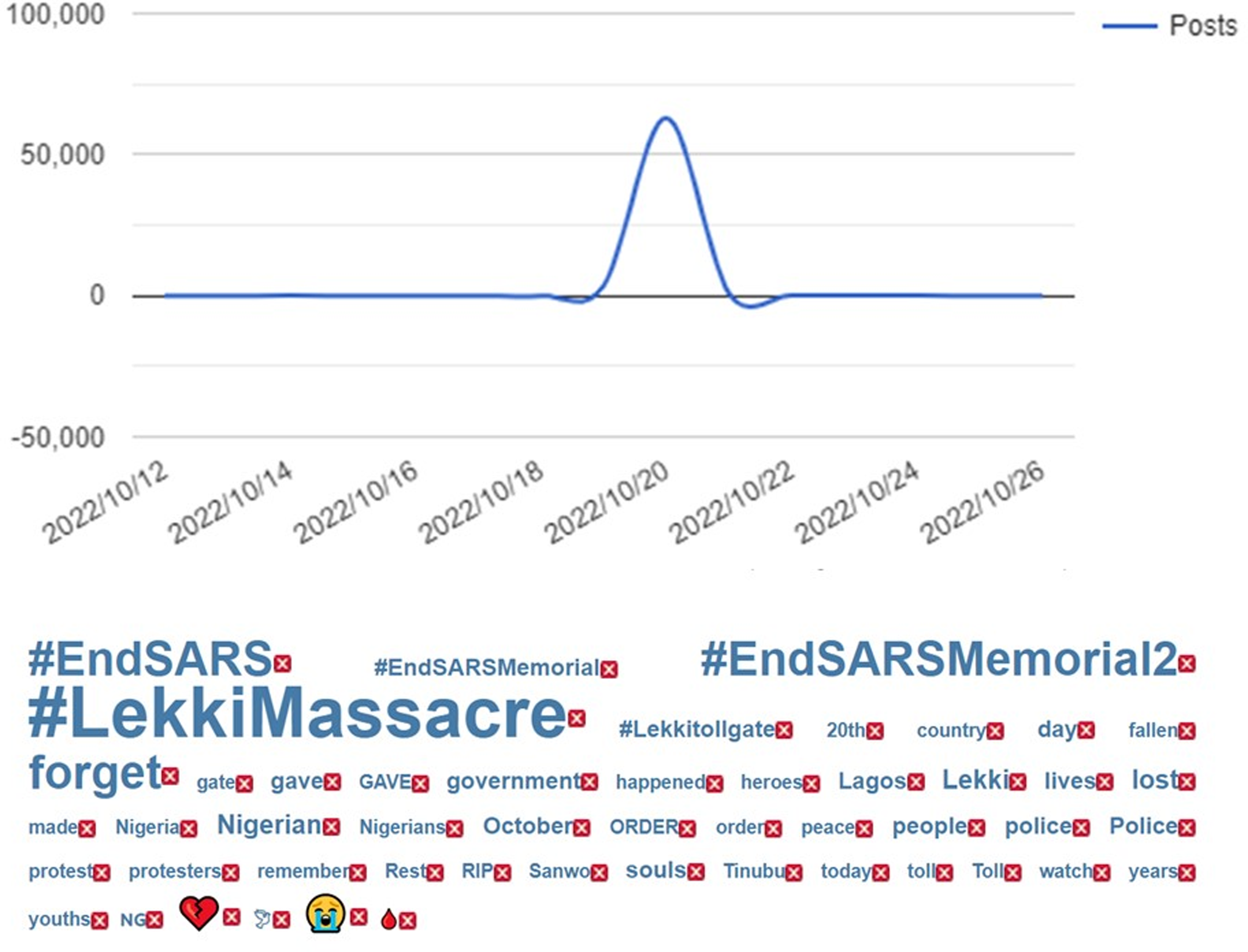
Word cloud and data collection dates.
After analyzing the tweets on Netlytic, the scraped tweets and replies were downloaded from Netlytic and stored as CVS. The downloaded and stored dataset were then exported to Leximancer 4.5 (Schäfer et al., 2023; Setiyorini et al., 2023; Thompson et al., 2023) and analyzed. The aim here was to evaluate the themes that emerged from these tweets about the second anniversary of the killing of protesters in Lekki Tollgate, Lagos, Nigeria during the 2020 #EndSARS protests. Concepts emerged based on their frequency of occurrence as the most prominent concept emerges as the theme of the cluster (Anouti et al., 2023; Dambo et al., 2022a; Samkin, 2023). Leximancer allows the user to rename themes. This feature was used in this study to appropriately summarize the concepts within clusters.
We evaluated diameter, density, reciprocity, centralization, and modularity to understand the typology of the network. We also examined who was mentioned the most, who posted the most, and who retweeted the most to assess influence. In examining these different network properties, we were able to adjudge which among these network properties might affect the successful dissemination of mourning messages during the EndSARS memorial protests in Nigeria. The diameter measures the longest distance between two users in the network, counted in the number of nodes or unique Twitter user accounts (@name), that it takes to get from one participant to the other (Pascual-Ferra et al., 2022). Density is another network property. It measures how close nodes are in a network. Reciprocity measures how much nodes are talking to each other (Uwalaka, 2023). Centralization measures the extent to which few nodes dominate the conversation. Each node has a centrality measure: “indegree (based on times it has been mentioned or replied to),” “outdegree (based on times it has mentioned or replied to others),” and “total degree (the sum of both)” (Pascual-Ferra et al., 2022, p. 563). The final network property is modularity. This measures the fragmentation of a network into distinct communities. For all these measures, values range from 0 (lowest) to 1 (highest). This means that a modularity value that is close to 1 indicates “clear division between communities” whereas, values less than 0.5 suggest that “the communities overlap more; the network is more likely to consist of a core group of nodes” (Pascual-Ferra et al., 2022, p. 563).
In the second phase, the inquiry reports on online semi-structured qualitative interviews of 30 digital activists in Nigeria. The interviews were conducted via Zoom after participants registered interest to be interviewed. The semi-structured interviews were conducted in English and the interviews were audio recorded with the consent of the participants. All interviewees were asked demographic questions such as age, identifying gender, and social media use. Digital activists were asked to describe how they felt about the killing of protesters and why they were still very active on the memorial two years on.
The researchers adopted a snowball sampling approach in which activists were recruited through online referrals or sharing and forwarding the flyers, etc (Bryman, 2016). In this study, activists were encouraged to share the link of the online flyers to their colleagues for the study. Utilizing snowball sampling was important in this study as digital activists are active online and are comfortable with innovative technologies. Also, digital activists are indeed apposite participants based on the aim of the study. We de-identified the activists and used, instead, their interview number, gender, and age to attribute comments to the interviewees.
The interviews were transcribed verbatim. After proofreading the transcripts, the data were moved into NVivo. The software then helped the researchers to retrieve code and build a conceptual network that was handy at the theme development and meaning condensation stages (Phillips & Lu, 2018). The codes drawn from the data were large in number. Consequently, the researchers submitted the codes to some form of analysis that would consolidate meaning. The researchers adopted thematic and meaning condensation approaches to make sense of the data (Crowley et al., 2002; Hilal & Alabri, 2013). The meaning condensation approach entails “an abridgement of the meanings expressed by the interviewees into shorter formulations” (Kvale, 1996, p. 192). At its essence, the approach rephrases what is said by participants into just few words of a more succinct nature, but in which the meaning is not lost. Meaning condensation starts with meaning categorization, narrative structure, and meaning interpretation. Its purpose is to allow the researcher to go “beyond what is directly said to work out structures and relations of meaning not immediately apparent in a text” (Kvale, 1996, p. 201). In a nutshell, it allowed the researcher to add subjective interpretations based on what the meaning is perceived to be from the experience undergone during the interview.
Our interview participants comprised of 18 male and 12 female online protesters in Nigeria. Our examination of the responses from our interview participants yielded four broad themes: (a) anger, somber posture, and sympathy; (b) mourning and remembering of those that were killed; (c) connecting in their shared humanity with the deceased; and (d) pledge to be better humans and citizens.
Results from Content Analysis and Social Networking Analysis
Contents from Twitter (tweets, replies, and retweets) concerning the 2022 #EndSARSMemorial2 protests were examined to understand key themes that emerged from the tweets and retweets by online activists during the 2022 memorial protests. Figure 2 highlights 10 keywords that were prominent in the tweets and replies from digital mourners in Nigeria. The keyword that was most used in tweets is “#LekkiMassacre.” This is followed by, “#EndSARSMemorial2,” “#EndSARS,” “forget,” “Lekki,” “police,” a broken heart emoji, “gave,” “order,” and “Lekkitollgate.” The “forget” keyword refers to how the protesters will never forget the sacrifices of those that were killed in 2020. It was more of a mourning sentence to stand with those that were killed. Other keywords such as “rest” and “peace” were words that were decoupled by Netlytic. What the protesters were really saying was “rest in peace.” This was a mourning and tribute-paying word that was meant for those killed in 2020. Those who were killed were constantly referred to as heroes. This shows how much digital mourners in Nigeria respect and honor the murdered protesters.
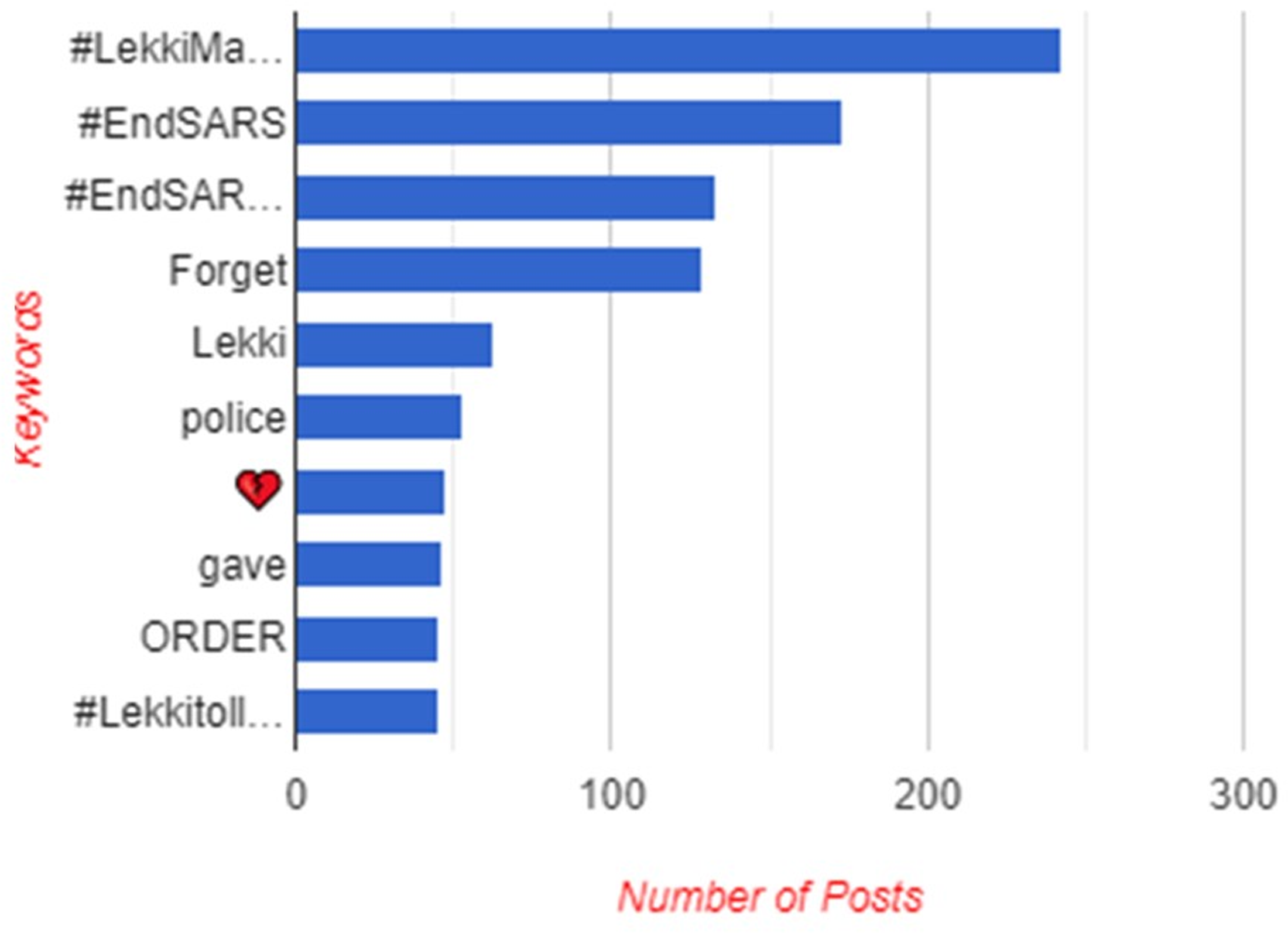
Ten most frequently used keywords.
Furthermore, Figure 3 shows the top 10 posters (indegree and outdegree) during the 2022 #EndSARSMemorial2 protests on Twitter. In the outdegree section, that is the Tweeters that tweeted about #EndSARSMemorial2 the most, Twitter user @DarasimiElijah posted 140 times and that accounted for 15.7% of the total number of postings on the Memorial Day. He was followed by @Darlingtonworld_1 with 99 (11.1%) postings. This was followed by @emmanue74112786 with a total of 95 (10.7%) postings. Others that made the top 10 include @Bode_Bankz with 91 (10.2%) postings, @Descolonizadora with 82 (9.2%) postings, @matthiannaji with 80 (9%) postings among others. In the indegree section, that is Tweeters who were retweeted, quoted, and replied the most, @DrPenking had the highest number of inward-directed tweets about the protests. He was followed by @isexcel, @savvyrinu, @yungcardi4, etc. Figure 3 reveals Twitter users who were the most engaged on issues relating to the protests.
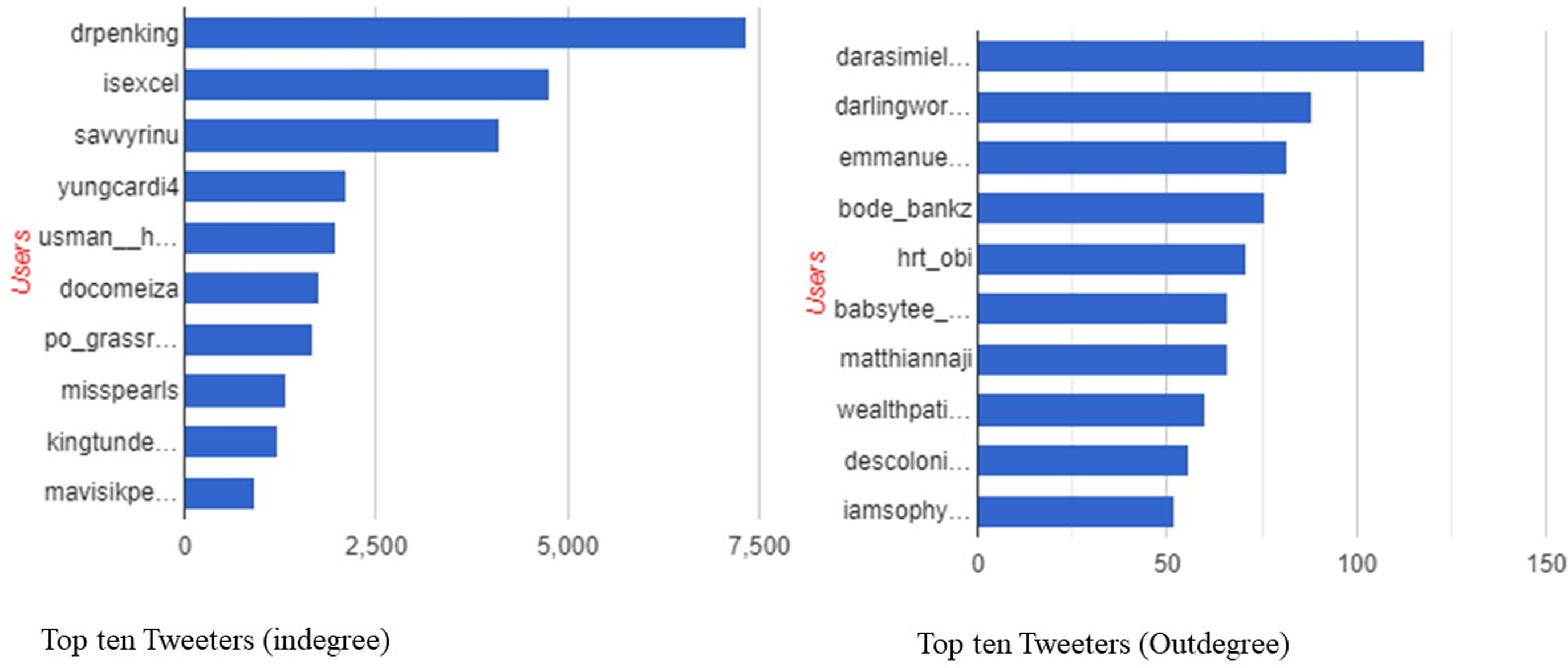
Top 10 Tweeters (indegree and outdegree).
A Twitter user tweeted, “are these people even learning? Are we still under slavery? Peaceful protest you shoot, killed, and arrested unarmed citizens, a peaceful memorial walk you are harassing and arresting your citizens? Are we being ruled by tyrant?” This tweet like many others, revealed how angry the activist was against Nigeria's leadership for not doing enough to alleviate the pains of the people. In an unmistakable term, what this tweet and tweets of this nature demonstrate is that the government has not reformed the police enough to enable the security agency to competently carry out their duties. Furthermore, the tweets indicate that justice has not been served in the killing of protesters during the 2020 protests. This inaction and lack of movement on the part of the government frustrated many of the mourners online. This frustration surfaced in a somber mood in tweets. “Still can’t believe some people insist that nobody died during the #EndSARS protest. A boy that I know, and firstborn of his father died. Shot in the back. It was a painful experience for everyone. Very painful” is one of such tweets.
Tweets such as “I could not post this yesterday because of bad network. 20.10.20 We Will Not Forget,” “I remember dressing up like I was going to the office so I could attend the #EndSars protest. I got tear gas and water cannons shot at me that day. I remember spending half of 20/10/20 searching police stations for arrested protesters. I will never forget!” and “the bullets, the blood, and tears. We will never forget” demonstrate the reverence that online mourners have for their colleagues who were killed during the protests. These tweets illuminate the love and respect that the protesters have for the dead and show how the protesters have sustained the mourning and memory of the dead. A protester tweeted, “my heart goes out to the families that lost a loved one during the #EndSARSProtest, they didn’t deserve such treatment” and “the memory of the #EndSARS social movement remains fresh in the mind of young Nigerians.” These protesters were tweeting mourning words to grief their fallen colleagues.
In Figure 4, the diameter is 11. In network properties, this means that the longest distance between two users in the network is 11. This is counted in the number of nodes or unique Twitter user accounts that it takes to get from one participant to another. Density measures how close nodes are in the network. In this figure, the density is .8, reciprocity = .75, centralization = .79, and modularity = 0.4329. Reciprocity measures two-way communication or how much nodes are talking to each other. Centralization measures the extent to which a few nodes dominate the conversations. Each node has a centrality measure—indegree (based on times it has been mentioned or replied to) and outdegree (based on the number of times it has mentioned or replied to others). The sum of both is labeled “total degree.” Modularity measures fragmentation of networks into distinct communities. For all these measures, values range from 0 (lowest) to 1 (highest). Based on this, the modularity of the graph is less than 0.5. This suggests that the communities “overlap more; the network is more likely to consist of a great core group of nodes” (Pascual-Ferrá et al., 2022, p. 563). Figures 4 and 5 show that the conversation in Figures 4 and 5 are centralized, have high reciprocity—meaning that participants were talking amongst themselves and is a close-knit and homophilous network. This is because of the low value of the diameter and the high density of the conversations. This further means that the discussions that the digital activists were having was impactful as majority of the participants were almost in agreement with what was discussed.
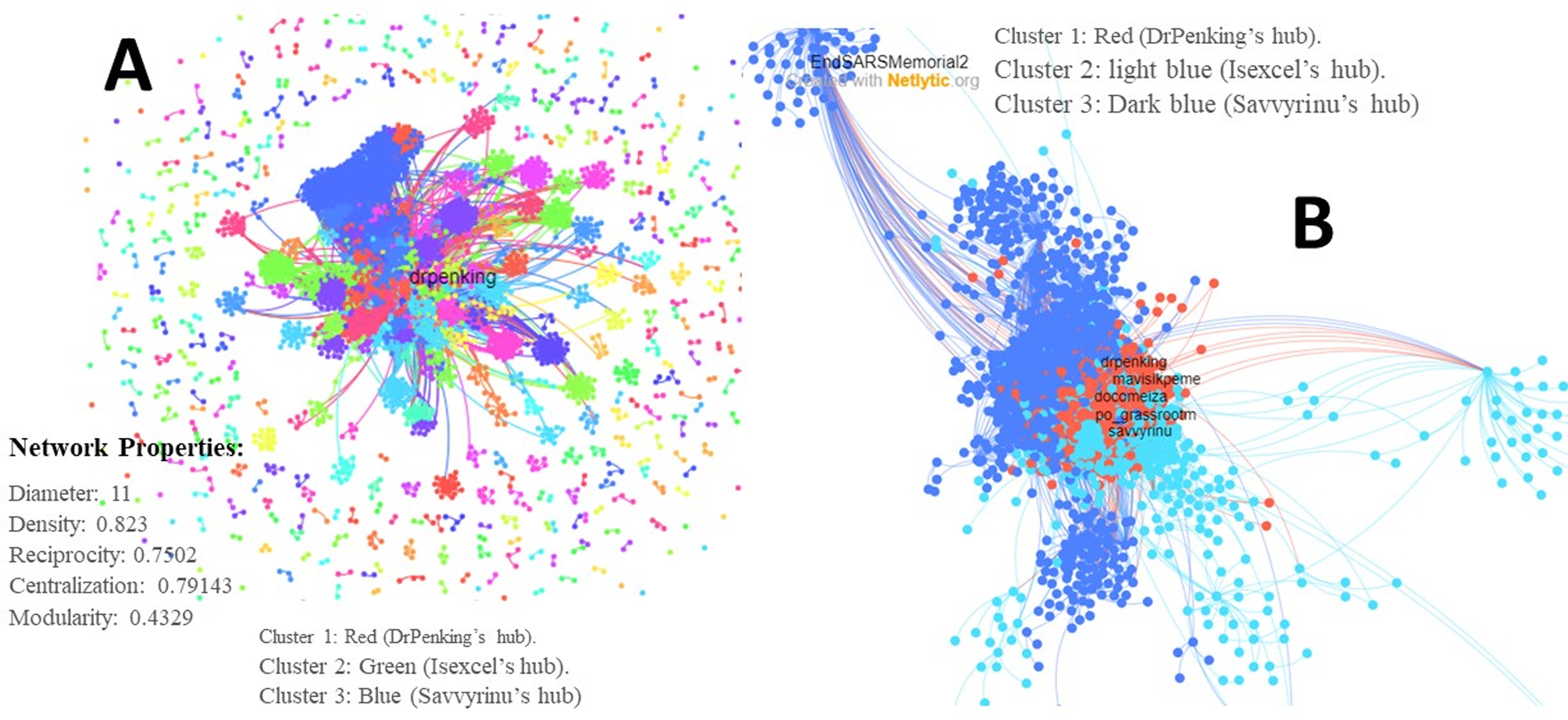
Network visualization.
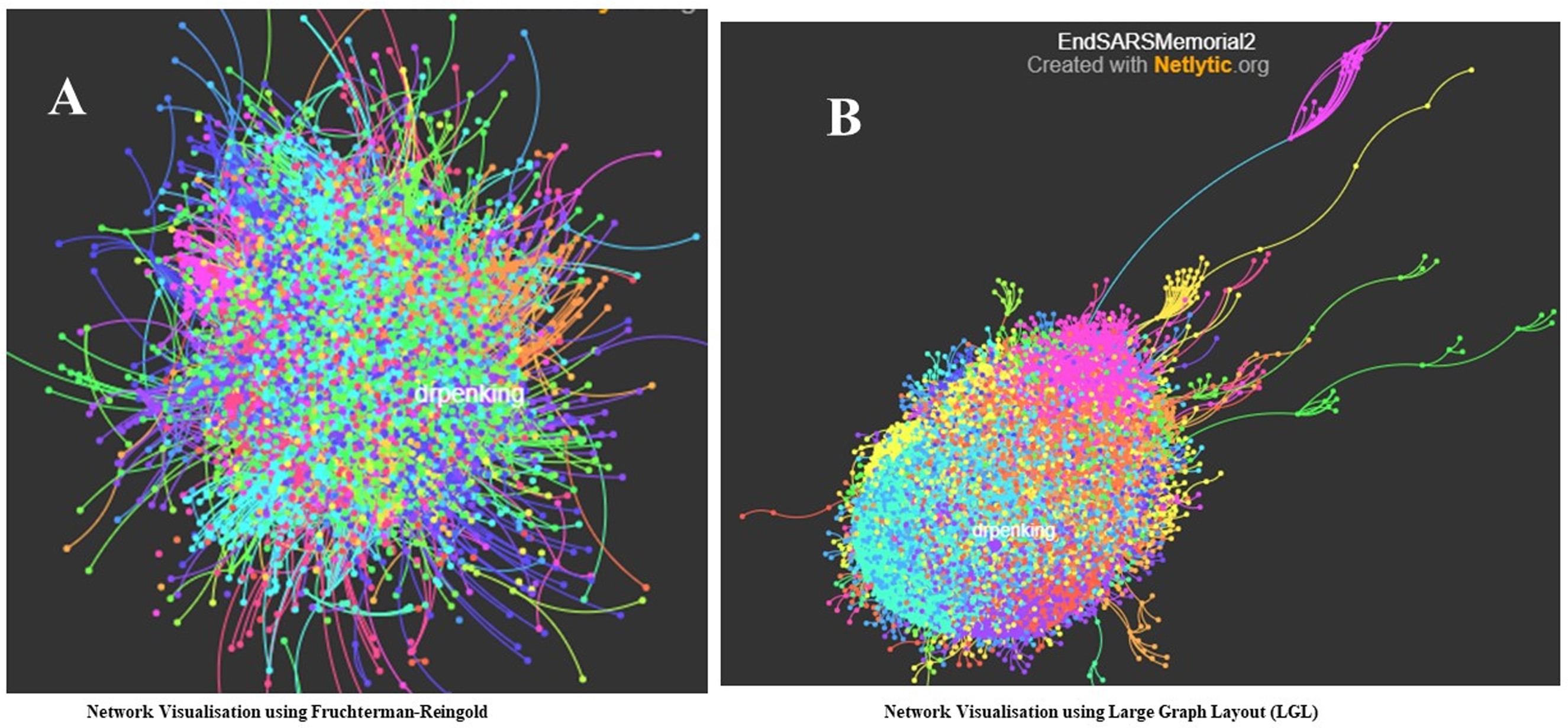
Network visualization (Fruchterman-Reingold and LGL).
The network pattern is alike when we visualize the network outputs in all layouts. Figure 4 is DrL outputs while Figure 5 shows the outputs Fruchterman-Reingold, a popular forced-based algorithm that works best when networks have 1000 or less nodes (Fruchterman & Reingold, 1991), and Large Graph Layout (LGL), which is used to visualize large networks while avoiding hairballs (Adai et al., 2004).
One of the most influential network actors during the 2022 #EndSARSMemoral protests is a Twitter user @Drpenking. A look at Figures 4 and 5 reveals that @Drpenking, who is the originator of cluster 1 as well as the red color in the network analyses, @Isexcel, who is in green and cluster 2 in Figure 5 and chart “A” of Figure 4, and light blue in chart “B” of Figure 4; and @Savyrinu, who is dark blue in Figures 4 and 5 occupied cluster 3 and was also influential in the network. These figures show the building of networks from these network actors and their connections to others based on some common form of interaction (“ties”). The charts in Figures 4 and 5 show that as online activists mourn their comrades who were killed in 2020, that they developed on an individual level, more reciprocal relationships. This reciprocal relationship on a dyadic level, which also is demonstrated with the networks low modularity, occurs when there is a shock that creates uncertainty in the system.
Results from the Semi-Structured Interview
Those interviewed reported that they use digital media platforms for professional and personal need. The popular social media platforms that digital activists engage with include Facebook, Twitter, Instagram, and YouTube. Table 1 shows the themes that emerged from our analysis of the interviews. These themes include anger, somber posture, sympathy, mourning and remembering those that were killed, connecting in the shared humanity of the deceased, and pledges to be better humans and citizens in Nigeria.
Broad Themes and Sample Comments from the Semi-Structured Interviews.
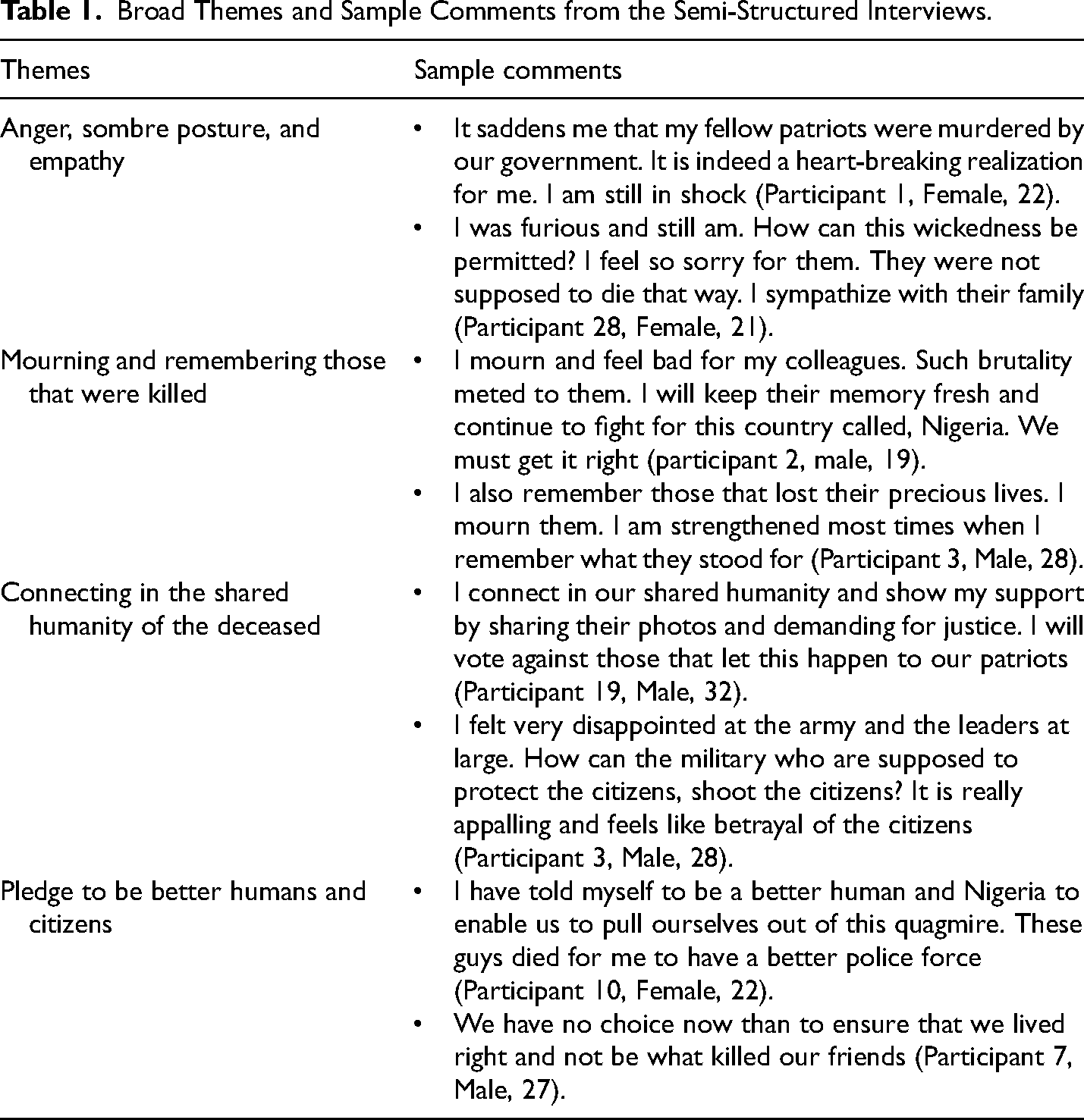
The theme anger, somber posture, and sympathy illustrates the posture of the interviewees during the interviews. The participants commented about their sadness over the killing of their colleagues and expressed their sympathies to the deceased and their loved ones. These digital activists disclosed how furious they were about the killing of protesters in Nigeria during the 2020 #EndSARS protests. For example, Participant 7 noted, “I felt terrible, weak, and depressed, I felt pity for those that died and was irritated with the attitude of the government.” Similarly, a participant expressed how “heartbroken and sad” she was when she heard of those that were killed during the protests. She further explained “I sympathized with those that were killed during the protests via my social media posts. I shared my disgusts and commented on posts, tweets and videos remembering our friends.” These comments show that our interview participants, while angry, maintained somber postures and indeed sympathized with both the deceased and their families.
Furthermore, the theme of mourning and remembrance was evident. This theme shows the mourning and remembrance of those killed in Lekki tollgate in Lagos, Nigeria. Participants expressed how they mourn the deceased and efforts that they are putting in to ensure that the legacy of their deceased colleagues is maintained. Participant 29 noted how he “mourned, felt pity and cried uncontrollably for those that died.” On her part, Participant 30 said that she “mourned those that were killed and continues to sue for justice for them.” Participant 10 discussed that he feels “sad, mourns the dead and frustrated that justice has not been served.” Additionally, he noted that he would continue to join in the memorial protests as a way of “showing his gratitude to the dead and to remember the good that they stood for.” Other participants noted, “I mourned that day and continue to mourn. I mean human lives were lost that day” (Participant 11, Female, 22), “I use my social media posts to mourn the dead and also to show solidarity” (Participant 12, Male, 30), and “I feel perturbed that human lives could be destroyed that way. I use my tweets to remember and mourn my comrades” (Participant 15, Female, 26). These comments show that digital activists in Nigeria mourned and remembered those that were killed during the 2020 #EndSARS protests in Nigeria.
Connecting in the shared humanity of the deceased is another theme that emerged on how our participants mourned and memorialized their deceased friends. This theme describes why the participants still engage in the memorial protests. Our participants talked about how they clinch on the memory of their compatriots who were killed. The interview participants noted how their online presence such as liking, sharing, reposting, “hearting,” pictures of the deceased or leaving comments on posts that talk about the deceased help the online activists to connect in their shared humanity with those who were killed. According to them, “tweeting, posting, and sharing posts about comrades who were callously murdered, help me connect to them and their families” (Participant 25, male, 32). Participant 12 narrated how he commented on posts honoring the sacrifices of the deceased protesters as “a way to share in their humanity and to respect these comrades who paid the ultimate price.” Some of our interviewees discussed how they see themselves in those that were killed. For example, Participant 13 recounted: I was at the Port Harcourt protests in 2020. Those who were shot in Lekki could easily have been me. So, I post about them and join the procession in remembrance of their good deeds and love for Nigeria… I see myself in them and posting these contents online shows that my fate is intertwine with theirs.
The last theme that emerged from the interview data is a pledge by the participants to be better humans and citizens in Nigeria. Participants spoke glowingly about those who fearlessly stood their ground as the military shot at the protesters. According to our participants, these “heroes” have set a standard for them. Participant 1, for example, pledged to “live a better life to honor these heroes. Our participants also pledged to electorally punish in the 2023 national elections, those who perpetrated.” Participant 25 explained, “the only way to achieve justice for our brothers and sisters is to vote out the perpetrators of this dastardly act.” Participant 3 expressed how they will “vote the right people into power and retire these evil leaders in the next election.” These comments show that the protesters were willing to change their ways as means to honor those that were killed during the protests.
Discussion
This study demonstrates that online mourners on Twitter were in anguish leading to a somber mood during the 2022 #EndSARSMemorial2 protests in Nigeria. The study further revealed that the protesters were angry, in a mourning mood, imprecating the leaders and showed reverence to their fallen colleagues in a form of remembrance. They showed great solidarity spirit even at the risk of arrests. The study reveals that mourners had already planned how they would punish Nigerian leaders in the next national elections. They are doing this by calling on Nigerians to pick up their Permanent Voters Cards. This reflects other findings where protest participation or anger led to emotional contagion which then increased political engagement and efficacy (Uwalaka, 2021; Wasserman et al., 2018).
A broad look and interrogation of the coordinated way digital activists in Nigeria have tried to sustain the mourning and to press home their demands has opened a new window into how scholars can begin to study and appreciate the empowering nature of social media platforms, particularly in an uneven mainstream media access environment such as Nigeria. Digital activists have long been criticized for embarking on what critics labeled feel-good activism or lazy type of activism that allegedly does not bring much change (Gladwell, 2010; Morozov, 2009b, 2012, 2013). Scholars have also viewed connective action as a flash in the pan that lacks the robust levers of the more traditional social movements. However, after studying the #EndSARS protests, this connective mourning has sustained the disgust and passion while still fighting for the issues that led to the protests in the first place.
The network visualization in Figures 4 and 5 shows a tight crowd, interconnected by issue that the online mourners are deliberating. This shows that the group is neither polarized nor in an echo chamber. However, what this illustrates is that digital mourners in Nigeria who support the #EndSARS movements are switched on and engage with one another in a substantive way. A closer look at what they are deliberating online, shows topics ranging from police brutality, mourning the protesters that were killed during the protests to corruption in Nigeria. The valence of the tweets is critical and robust. The tweets and replies have kept the issues on a front burner. This insistence and continuous prodding have not only sustained the mourning but also has piled pressure on the government to both seek solutions to the grievances of the people and justice for those that were killed during the 2020 protests. The closeness and interconnectedness of the networks show that this was not a polarized crowd but a tight crowd where all participants were talking to one another and engaging in substantive topics—mourning those that were killed, police brutality and corruption in Nigeria, justices for those killed and reform of the police force (Adamic & Glance, 2005).
This study demonstrates that decentralized technologies result in loosely inter-connected, interpersonal networks which create outcomes that resemble collective mourning, yet without having solid ties with the deceased. Finding from this study confirms the result of Bennett et al. (2008) which uncovered that personal networks’ diversity provided a far stronger explanation for the predominant reliance on digital media than simple associations with organization sponsoring the protests. This study reveals that digital media's affordances, replicability, scalability, and searchability created apt digital environment for mourning, remembering, and memorializing those that were killed during the 2020 #EndSARS protests in Nigeria. This means that beyond this realm of relatedness to mourn those that were killed, there is a large hidden world of connective mourning, where one mourns those they do not have ties to or are unrelated to but memorialized due to shared beliefs and connective repertoires. The study further shows that digital mourners are embracing more expressive styles of mourning defined around social media and peer content sharing. Connective mourning such as the 2022 #EndSARSMemorial2 protests show that there are growing opportunities to have a shared grief in the society even for people who are unrelated to the deceased by blood, family, or country. However, the mourner is connected with the deceased via their shared humanity.
This study uncovers that those grieving online during the 2022 #EndSARSMemorial2 protest acted as mediators within the mourning community as they mourned on an individual basis during the memorial and yet, contributed toward the collective mourning goals. Although these mourners acted on an individual basis, the common concern of seeking justice for the protesters that were killed and police reform brought them together. This togetherness of grief was not built through blood ties or strong and thick relations, but through anger and common concern. However, because the grief was situated around a common concern (police brutality and justice), this stimulated feeling of collective grief or “benevolent grief” and connective memory which provided a form of collective memorial landscape, helped to build an enduring memory of the deceased (Hoskins, 2011, 2016; Morse, 2023; Pennington, 2013). Digital mourners’ ability to stimulate commonality via decentralized and loose networks while allowing for solidarity building during mourning demonstrates the personalization of mourning and online connectedness of humanity. These networks help identify and validate grief in online groups such as the 2022 #EndSARSMemorial protests (Marín-Cortés et al., 2023).
Beside the emergence of the themes, this study also showed the networked relationship among digital mourners in Nigeria. Figures 4 and 5 above showed a tight crowd where information dissemination revolves around a few visible participants who then are placed in an opinion leadership position. The nature of this network showed that the topic under discussion was important and interesting. This demonstrates that protesters used the organizing tools of social media platforms to sustain protests and to continue to demand what was due to the people of Nigeria. The high centrality, high density of reciprocity, and low modularity lead to fast diffusion of information and promise to encourage widespread adoption of the communique proposed by the mourners in Nigeria.
This study reveals that when collective mourning occurs online, individuals have more reciprocal relationships on a dyadic level and that the network has low modularity. Such a network effect occurs when there is a shock that creates uncertainty in the system. This is related to Danowski and Edison-Swift (1985) “crisis network effects” findings. Danowski and his colleague noticed that people emailed others that they have not emailed before during a crisis and that the messages were shorter and “one large user group formed” (Danowski & Edison-Swift, 1985, p. 251). This is akin to the network visualization in Figures 4 and 5 where the mourning communities were tight-knitted and appeared to be grieving together. It shows that when a community experiences collective mourning, individuals may seek out others, who are also affected by the loss for comfort, understanding, and emotional support. This process can lead to the forming of new relationships or strengthening existing ones, resulting in a more interconnected and reciprocal network at the dyadic level. The crisis network effects theory suggests that a similar pattern occurs with crises of different kinds (Coleman, 1957; Danowski, 1982; Rogers & Sood, 1981). Connective mourning creates a sense of shared vulnerability, like when other crises occur, leading individuals to empathize with others who are also grieving. This empathy may encourage people to reach out to others they have not frequently communicated with before the crisis or shocking incident, thus fostering new connections and reducing network modularity.
Limitations of the Study
This study has some limitations. Although the data for this study were from 67,678 tweets and replies about the 2022 #EndSARSMemorial protests, we acknowledge that the study is limited in the number of tweets that were collected. Also, the categories that both Netlytic and Leximancer showed were in single-word format that needed a human subjective compilation. The categories used in the qualitative study were chosen by the authors and not validated by previous studies. Having said all these, the authors took steps such as using a multiple study, and multiple analytic approaches to ameliorate these limitations.
Conclusion
The study illustrates that digital media acts as mourning and solidarity platforms where mourners plan, coordinate, and mourn their fallen friends during a protest action. Results show that mourners in Nigeria communicated their anguish and agony, remembered their fallen friends, reviled, cursed the authorities, and called for action against the political class. The study further shows that social media platforms help mourners to organize memorials to not only sustain the protests but also to ensure that their demands are met. In the 2022 #EndSARSMemorial2 protest, activists continued to use the memorials to remind government to seek justice for their departed colleagues.
This study demonstrates that in times of crisis or uncertainty, people search for information to make sense of the situation and reduce feelings of confusion or helplessness. This can lead individuals to connect with others who may possess relevant knowledge or experiences even if this is the first time they have communicated with them. This explains why the network becomes less modular. The findings from this study suggest that when a community experiences a shock that creates uncertainty, such as the shooting of protesters, its members may band together to cope and rebuild their sense of security. This collective coping fosters new connections and strengthens existing ones as individuals work together to make sense of the uncertain environment and reduce stress.
A higher-order construct encompassing the phenomena in this study is an emotional disturbance producing a significant increase in negative emotions. Emotional disturbances can result from various crises, including police brutality as was the case in this study or other traumatic events, leading to heightened stress levels. To reestablish baseline functioning, individuals need to alleviate this stress. One effective way to reduce this type of stress is through the sharing of emotions openly and without filters. Connecting with new digital activists facilitated a deeper sharing of emotional responses. Established social relationships might not be optimized for unbridled emotional expression, as it can threaten perceived social acceptance and may not provide the support needed in times of crisis. This is why there was a preference for connective engagement as the activists were able to share high vulnerability more readily with strangers or less familiar contacts. Sharing intense emotions with new connections can lead to more of a sense of release and shared relaxation response, ultimately proving more effective in coping with emotional disturbances.
The study shows that stress reduces the ability to think, limiting the development of a good working model, along with the need to reduce the physical stress response, motivates communication because normal coping mechanisms are not effective. Consequently, the network crisis effect model submits that the need for stress reduction and emotional support drives individuals to reach out to new contacts, leading to more reciprocal relationships at the dyadic level and decreased network modularity.
Footnotes
Declaration of Conflicting Interests
The author(s) declared no potential conflicts of interest with respect to the research, authorship, and/or publication of this article.
Funding
The author(s) received no financial support for the research, authorship, and/or publication of this article.
