



Abstract
Popular discourse around race tends to categorize people in static ethnic and racial categories, overlooking the complexity of people with multi-ethnicities. To understand how ethnic communities resist the described practice, this article explores how Hoa communities in English-speaking countries use TikTok for identity work purposes. Using an inductive approach to qualitative content analysis, we identified two prominent themes: hybridization of a multi-ethnic identity and counter-hegemonic identity. Although the findings are particular to the Hoa community, we believe they merit attention from scholars interested in studying intra-ethnic populations and their social media usage for identity work.
Keywords
Introduction
Social media often functions as a tool for resisting dominant discourses around the topic of race and ethnicity through the practice of identity work (e.g. Jackson & Foucault Welles, 2015; Kuo, 2018). As people engage in content creation, they choose different modes (e.g. language, images) of cultural representation to highlight their identity, which brings meaning and shapes how people understand their reality across environments (Hall, 1997). However, for intra-ethnic 1 communities, such as Hoa people, a.k.a. Vietnamese people of Chinese descents, the practice of identity work in digital space could look different. Their identity work is unique in some ways compared to those that are mono-ethnic Vietnamese or Chinese, as they are more likely to experience “exist[ing] marginally within multiple worlds” (Trieu, 2013, p. 393). Social media could be used as a tool to navigate feelings of multi-dimensional marginalization and exclusion through online connectivity (Hall, 1997; Nakamura, 2002).
While social media has been criticized for the “hardwiring” of racial and ethnic stereotypes (Nakamura, 2002) and for amplifying racist speech toward racial minorities, it can also be a productive outlet for minoritized populations to counteract discrimination and exclusion, influencing perceptions of specific races (e.g. Agudelo and Olbrych, 2022; Jackson & Foucault Welles, 2015; Kuo, 2018). Hence, this study explores Hoa creators utilizing TikTok as a gateway for representing themselves, particularly as they grapple with dominant perceptions of their intersecting racial and ethnic identities, asking: how do Hoa content creators in English-speaking countries use TikTok to perform identity work?
TikTok has evolved into a platform that affects our general understanding of how racial minorities and other minority groups represent themselves (e.g. Civila & Jaramillo-Dent, 2022; King-O’Riain, 2022). TikTok permits individuals to connect their identities through the digital realm with “its own conventions, expectations, and interaction orders” (King-O’Riain, 2022). A unique characteristic of TikTok is that the act of posting videos enables users to foster a communicative environment with “shared cultural contexts” as well as “meaningful self-expression and sense-making of others and otherness” (Schellewald, 2021, p. 1451). This understanding indicates that the Hoa community’s experience of interacting with social media platforms in comparison with a mono-ethnic group (i.e. either Viet or Chinese) could have different outcomes, as their family’s social and cultural practices are a result of “the new structures, objects, and practices” (Civila & Jaramillo-Dent, 2022) from two or more ethnicities.
To explore how Hoa TikTok creators perform identity work, we conducted a thematic analysis of 71 TikTok videos in which Hoa creators share reflections on their intra-ethnic identity. Our findings showcase how Hoa creators utilize TikTok’s social and creative affordances, a platform for entertainment to emphasize the multiplicity of their ethnoracial worlds. Specifically, we observed two forms of identity work performed by Hoa creators: hybridization of a multi-ethnic identity and counter-hegemonic identity. The identified themes reflect how the Hoa community utilize TikTok as a tool for (1) establishing solidarities (e.g. sense of belonging in the existence of intra-ethnic community) and (2) coping with the experience of marginalization (e.g. the repressed feelings of being denied self-identified ethnic identity). Thus, this work has two main implications. First, the nature of TikTok allows intra-ethnic individuals to build a community across geographic distance. Second, TikTok enables intra-ethnic individuals to freely identify themselves that resonates with their lived experiences.
Ethnoracial hegemony and the Hoa community
Understanding the Hoa community’s experience of otherness requires a reflection on the intersecting implication of race and ethnicity as “an artifice of the mind than biological fact” (Ifekwunigwe, 2004). The early conceptualization of race was rooted in the idea of “whiteness of a different color,” that is, ethnicity, to develop an understanding of different European immigrants’ social identities and status (Omi & Winant, 2014, p. 29). Gradually, race emerged as a means of establishing a social hierarchy that positioned not only White European people as superior but also created a system of privilege and oppression based on perceived racial differences (Omi & Winant, 2014) as “the dichotomy [tiers] between White and non-White” (Ifekwunigwe, 2004). Such understanding would offer a plausible explanation of how White Americans perceived Asian American communities, resulting in more discriminatory harm than good (e.g. Crenshaw et al., 1995). At the intersecting level of mixed racial identity, the Vietnamese Amerasian children were the forgotten children that faced “ostracism from Vietnam’s physically homogeneous society [such as obtaining higher education],” especially if they grew up in a fatherless family (Root, 1992, p. 144). At an intra-ethnic level, the Hoa community faced similar marginalization from the dominant group in Vietnam (Chan, 2017; National Geographic Education, n.d.). To further understand the impact of Hoa’s marginalization experience, we applied the concept of hegemony (Adkin, 2022; Gramsci, 1971).
Hegemony was first popularized to describe how a more powerful social and economic group came to dominate less powerful groups by spreading and popularizing ideas of the ruling class that are subsequently accepted and internalized (Gramsci, 1971). While hegemony may imply control through force, it mostly entails rule by consent of those with political, moral, and intellectual leadership. Consent is organized through state control and diffused across institutions such as the church, the family, the school, and the media, where social and political identities are constructed (Carroll & Ratner, 1994, pp. 5–6). How hegemony appeared in the Hoa community could date back to the ways they were treated by the Vietnamese government from the 1960s to 1980s (Chan, 2017). For example, Chinese individuals living in Vietnam were indirectly encouraged to adopt a Vietnamese identity (e.g. name citizenship) to access more opportunities, but the underlying reason was associated with the political tension between Vietnam and China (Chan, 2017; Porter, 1980). In 1978, Hoa individuals faced another period of rejection, which ultimately pushed them to flee Vietnam for better economic and social freedom (National Geographic Education, n.d.). Uniquely, Hoa descendants in foreign countries such as the U.S. self-identify ethnicity as more aligned with, for example, the language their family uses at home (see Trieu, 2013). Thus, in the context of this article, those identified as having Hoa heritage represent the non-dominant group. Likewise, the presented understanding concerning the complexity of Hoa individuals’ lived experiences cannot be disregarded, especially in the digital age.
Identity work in the age of TikTok
Social media platforms extend hegemonic power by reinforcing beliefs about what identities are deemed normal or ideal (e.g. Lai & Cai, 2023; Thai et al., 2024). Moreover, Nakamura (2002) argued that racial discrimination and stereotypes in our physical world are found and reinforced in the digital spaces. Simultaneously, the internet can be used by racial minorities to promote solidarity movements and resist traditional stereotypes (Nakamura, 2002). This understanding highlights the way social media platforms are not a “neutral tool,” instead, but “active agents” shaping social norms and behavior on- and offline (Van Dijck, 2013). To understand the social media practices of Hoa individuals’ living in English-speaking countries and how these contribute to their identity construction, we draw on the concept of identity work—the activities of weaving together signs, rules, and conventions to give meaning to their identity at the individual level and in connection with others (Brown, 2022; Schwalbe & Mason-Schrock, 1996). As people navigate the demands of different social contexts, power relations also shape which identities are deemed situationally relevant and, thus, activated or reconciled with one another (Atewologun et al., 2020). Identity work, then, is an ongoing deliberate, often strategic, action to cultivate, present, and maintain a legible image of oneself (Brown, 2022; Hall, 1997; Schwalbe & Mason-Schrock, 1996) but also validate an individual’s interpretation of who they understand themselves to be (King-O’Riain, 2022; Lee & Lee, 2023; Snow & Anderson, 1987). And identity is a dynamic concept resulting from an individual’s active negotiation of their positions within a relevant temporal and social context (Brown, 2022), including sense-making of receiving feedback on identity performances from heterogeneous audiences (Marwick & Boyd, 2010; Vitak & Kim, 2014). Drawing on this understanding, identity work in the context of social media can be achieved through publishing content, which is influenced by real and imagined audiences from different spheres of individuals’ lives (Marwick & Boyd, 2010), including unknown audiences (Litt & Hargittai, 2016). This so-called context collapse presents challenges in determining which facets of identity, and how and when they should be invoked (Abidin, 2015; Duffy, 2017; Marwick, 2013), especially when thinking about it in the context of TikTok.
TikTok, as a platform that prioritizes imaginative interaction (Zulli & Zulli, 2020), is known for its algorithmically curated home page—the “For You” page (FYP; Barta & Andalibi, 2021; Bhandari & Bimo, 2022; Schellewald, 2023). FYP is populated primarily by the creators that users do not follow or know personally (Barta & Andalibi, 2021).The platform’s algorithm not only shaped users perceived social connectedness (Taylor & Chen, 2024), but also contributes to their perceptions of TikTok content as more authentic and relatable (Barta & Andalibi, 2021) and, therefore, relevant to their understanding of self (Ionescu & Licu, 2023; Karizat et al., 2021; Schellewald, 2023). Functionalities like such helped afford the interaction by enabling users to engage with a wide range of niche content tailored to their interests (Barta & Andalibi, 2021) that also bring visibility to the lived experiences of the community that the creators are part of (e.g. Karizat et al., 2021; Lee & Lee, 2023; Simpson & Semaan, 2021). In addition, TikTok exhibits ephemerality, where content lasts only a limited time has implications for self-presentation (e.g. impression management is less of a concern; Choi et al., 2020). Such understanding shapes our perception of TikTok affordances as the platform features that enable the Hoa community to perform their identity work without context collapsing their self-identified ethnic identity.
While it is essential to acknowledge the negative impacts of TikTok on identity work (e.g. Karizat et al., 2021), previous scholarship demonstrates how TikTok affordances give people the agency to reclaim the multiplicity and fluidities of identity. In this study, we are focused on two types of affordances: social and creative. In this context, social affordances refer to the features that allow users to participate in the platform actively (e.g. stitching and trend participation); creative affordances speak to the use of, for example, segments of sounds and emojis (Civila & Jaramillo-Dent, 2022), including other TikTok features such as greenscreen or content creation practices (e.g. lip-syncing). These affordances have been suggested to help different (marginalized) communities to foster visibility and a sense of belonging that they do not always feel in offline spaces from both creator and consumer standpoints (e.g. Barta & Andalibi, 2021; Karizat et al., 2021; Lee & Lee, 2023; Milton et al., 2023; Simpson & Semaan, 2021). However, few studies have examined the identity practices of minority groups such as the Hoa community that have specific ethnoracial histories and migration patterns on TikTok. The complexities of navigating multiple dimensions of marginalization as an intra-ethnic diasporic community can add further nuance to existing discussions of identity work on social media. Hence, this article focuses on how content creators actively negotiate the internalization of what an ideal Hoa should look or sound like to be deemed as “normal.” This then suggests that social media content is what Carroll and Ratner (1994) call the “disorganization of consent.” The active negotiation could be understood as an outcome of the constant projection from the dominant group of how Hoa individuals should look and/or sound. Thus, like moral and intellectual institutions, we look at how TikTok is a site for Hoa communities to maintain or challenge hegemony.
Method
With this study, we aimed to understand how smaller enclaves within ethnic communities use TikTok for identity work, our focus emphasized (a) the possibility of how these videos bring joy and a sense of community and relatedness to their in-group member and out-group members (e.g. non-Hoa ethnic), using To et al.’s (2023) design for flourishing framework, and (b) the meaning of an object (e.g. a picture) to dive deeper into the message of a video. All collected TikToks were publicly accessible, and the authors’ institution exempted this study. Echoing Schaadhardt et al. (2023), we recognize the importance of how our work could potentially bring unwanted attention to the creators. Thus, we focused on elaborating selective videos from the sample that best represented the data by providing contextual information through textual data.
The data collection process occurred between April 2023 and June 2024. First, the first author (A1) identified six hashtags relevant to the study, based on Ruiz et al.’s (2023) report and personal observations (To et al., 2023). We first utilized TikTok’s Creative Center (TTCC) 2 and the Google search engine as the primary data collection tools. While TTCC was leveraged to help identify adjacent hashtags, Google provided videos that might have been limited by the TTCC.
We first explored the TTCC to gain insights on the type of information that will return (e.g. likes and geographic locations) using the hashtags we pre-identified. Afterward, we decided to focus on gathering the top 10 hashtags that were returned from the TTCC, as we noticed the returned results after the top 10 were often redundant and irrelevant to our study. 3 We repeated the same process for the five remaining pre-defined hashtags, yielding us a set of 29 hashtags. We then searched for these 29 hashtags via Google to identify any videos that spoke to Hoa community’s lived experiences. Google search results provided links to TikTok Discovery Pages, which list videos that mentioned the search terms in their video captions. For example, searching for “#vietnamese-chinese tiktok” would return results for videos including “#vietnamese” or “#chinese” in the captions. Afterward, we manually reviewed only the top five results for each Google search and reviewed all the videos included for each Discovery page. We then filtered through the identified videos and determined the final sample (N = 71) for data analysis (see Figure 1 for more details).
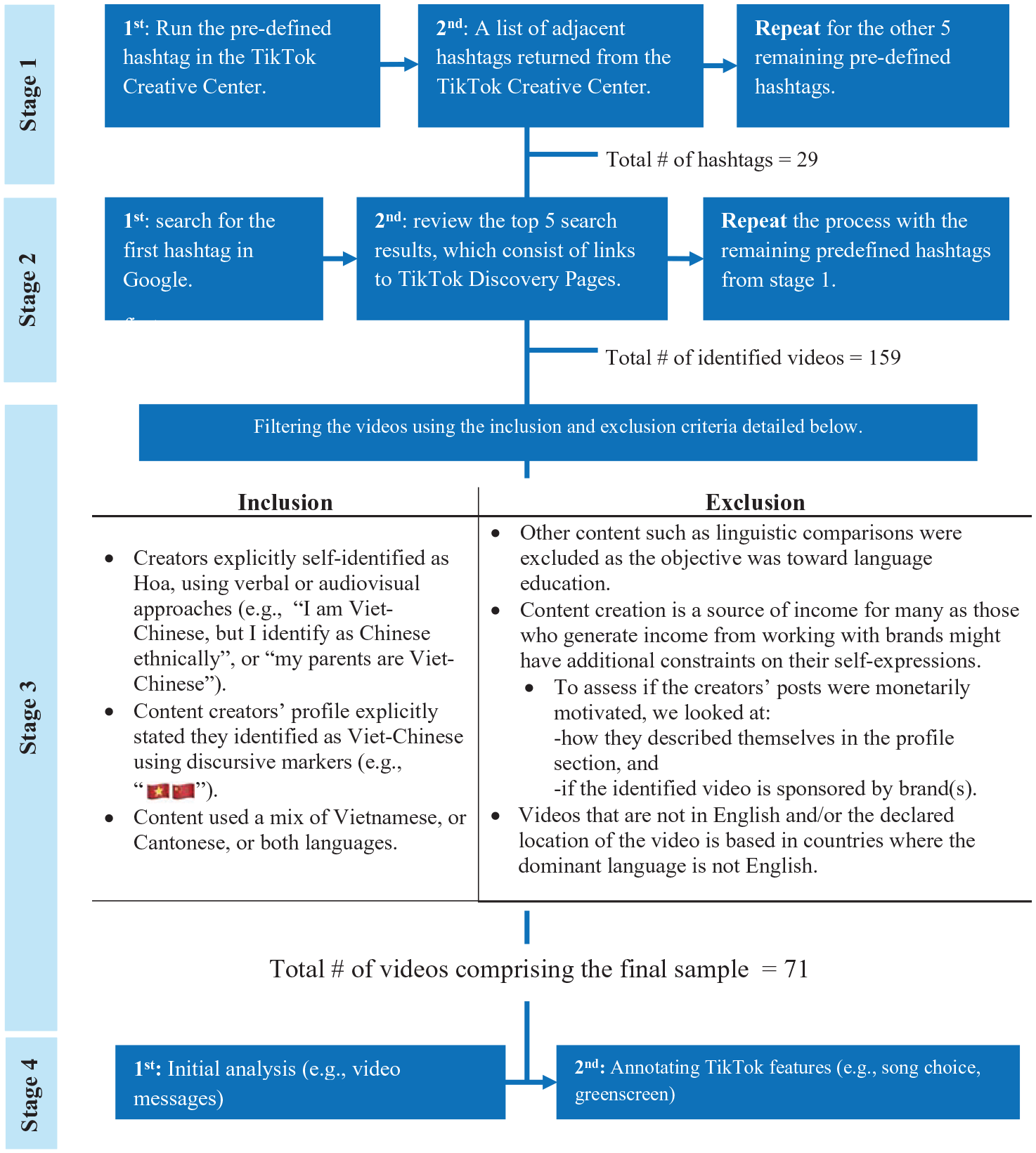
A diagram that reflects the process of how we identified relevant content, including data analysis.
In brief, the included videos are often a (re-)enactment of a dialogue or monologue mixed with popular background sounds to illustrate the creators’ feelings about their lived experiences. In this context, lived experiences speak to how Hoa creators’ self-identified themselves ethnically are tied closely to their everyday experiences at home (e.g. linguistic usage) and the dominant group dismissing their self-identified ethnic identity. The included videos also reflect mono-ethnic Vietnamese and Chinese individuals’ experiences, as identity is a blending process of different and fragmented versions of self (Brown, 2022) “that [could] give way to said identities and their implications, which expand future possibilities of modifying culture and politics” (Civila & Jaramillo-Dent, 2022, p.2). This is particularly true for the Hoa community, as being either Viet or Chinese is a part of who they are. Therefore, when referring to Hoa TikTok creators in the findings section, our observations may also reflect the experiences of mono-ethnic Viet and Chinese.
We treated the analysis process similarly to qualitative content analysis, using an inductive approach. A1 manually downloaded all the videos. Other content posted by TikTok creators of the videos that were downloaded was viewed by A1 to gather more contextual clues and understand the intention behind the identified videos. She then recorded observations for each video, particularly noting variations in characteristics like visuals, audio, and memetic elements, including the symbolic meanings of each gesture and culturally significant objects (e.g. traditional clothing). Afterward, A1 reviewed and flagged each sample with ambiguous or subtle messages for discussion. Meetings with team members were held to review the preliminary analysis and discuss the emergent themes. Sample videos are classified into two major themes with five subthemes as detailed in Table 1.
Associations of Major Themes with Subthemes Described and Counted in the Sample.

Note. Given the uniqueness of this study, some videos fall into more than one category.
Positionality
As a group of researchers embodying a range of socio-cultural and economic backgrounds based in the United States, each of us processes various areas of expertise in community-oriented research. A1 identifies as a person of Vietnamese background who interacted with the Hoa community and understands both Chinese and Vietnamese. Her background enables her to interpret the cultural meaning of certain household items in relation to the context of the videos. One of the authors identifies as Chinese Singaporean, which both provides her with an understanding of Chinese Diaspora experiences yet also limits her understanding of other Southeast Asian Chinese experiences (given that the ethnic majority in Singapore is of Chinese heritage), which has often been tied to state and state-sanctioned erasure and violence. Another author identifies with a Filipino American upbringing, grounded in anti-imperial and decolonial epistemologies in the deliberation of Southeast Asian diasporic discourse. The last author identifies as a White woman of European descent with no Asian ancestry or heritage.
Results
The hybridization of a multi-ethnic identity
In the videos we analyzed, some Hoa creators leaned toward either Viet or Chinese traits as an outcome of familial cultural practices (e.g. the dialect they speak at home), while some embraced their ethnic identities equally. In some cases, our analysis is consistent with Trieu’s (2013) observation of the relationship between Viet and Hoa Americans with the language their parents speak shaping their tendency to embrace one ethnic trait over the other. These observations extend Civila and Jaramillo-Dent’s (2022, p. 6) concept of performative hybridization, which suggests among couples, there is a “fluid integration of two cultures and the pervading visual and narrative components [that] reflect the dominance of one set of identity traits over the other.” We extend this concept to capture the hybridization of a multi-ethnic identity, which reflects the interaction between multiple ethnic cultures with which an individual identifies. Particularly, we attended to how creators in our sample endorsed their identities when discussing a lived experience. Therefore, the hybridization of intra-ethnic identity theme speaks to how Hoa individuals navigate the complexity of their ethnic identity in an English-speaking country, especially as someone that might not necessarily identify with either mono-ethnic Viet or Chinese. In the following sub-sections, we described the three types of identity work we observed under this theme.
Identity reconciliation
Videos categorized under this subtheme depicted how TikTok creators came to terms with different facets of their intra-ethnic identity. This subtheme reflected how Hoa creators accepted (or reconciled) a distanced relationship with their heritage (e.g. not knowing their heritage language), specifically the cultural traits or practices they saw their parents perform. To illustrate:
IR1: In response to a comment regarding how the creator’s Vietnamese pronunciation “is so good,” the second-generation Hoa American created a video with a monologue acknowledging their limited knowledge of Vietnamese through reflecting on their family migration history. The video then transitions to the creator sending a message to the Hoa community about normalizing the complex relationship they had with their ethnic identity and parents by encouraging other in-group members to put themselves in their parents’ shoes, as their parents were once them. They did so by drawing a parallel between (a) their situation (Hoa American) and their parents (Hoa individuals also moved to the United States with a limited understanding of English) and (b) their parents (Hoa in Vietnam) and grandparents (Chinese ethnics who lived in Vietnam). As this video seems to showcase the creator’s endeavor to negotiate their relationship with their ethnic identity and mental health struggle through family history, it also suggests there is a generational trauma that comes from being a child of an immigrant family.
Videos like IR1 hinted at the complexity of Hoa individuals’ lived experiences that may not easily align with the mono-ethnic Vietnamese individuals’ migration experience. For these creators, their families mediate their understanding of “Viet-Chinese-ness” as much as, if not more than, through the broader cultural meaning of products, practices, and traits. Other videos also showed how Hoa creators have come to terms with the fact that they identify with one facet of their intra-ethnic identity over another because of their parents’ decisions (e.g. not teaching them Vietnamese) in a sarcastic sense. To illustrate:
IR2: The creator used a combination of facial expressions (feeling sorry and panicked), audiovisual texts (to convey the video’s central message is about the disconnection they felt when someone spoke Viet to them), and lip-synced along a lyric from Drake’s Too Good (“I don’t know how to talk to you”) with “Speak Vietnamese” emerging at the end of the video to reinforce the feeling of disconnection. This video depicted how the creator, a Hoa descendant, experienced a sense of solace toward Vietnamese speakers who tried to converse with them, as they could not understand Vietnamese since they only knew Cantonese from their family.
Similarly, IR3 further demonstrated how the multiplicity of Hoa identity can complicate any effort to categorize them as solely Vietnamese or Chinese.
IR3: The creator used audiovisual texts and emojis to narrate their perplexity about their ethnic identity, and facial expression (feeling confused, and thinking), and a segment of the Carnaval Del Barrio audio from the In the Heights movie:
“Um . . . My mom is Dominican-Cuban. My dad is from Chile and P.R., which means I’m Chile-Domini-Curican . . . But I always say I’m from Queens!”
to amplify their feelings about the situation. The creator also seems to intentionally align the “or am I just Chinese?” statement with the “But I always say I’m from Queens!” lyric as a reference to Queens—a space defined by hybrid ethnicities, where Hispanic and Asian individuals predominate as of 2021 (Census Profile: Queens County, NY, n.d.), as shorthand for their complex background. The shorthand signifies how people like the creator do not conform to singular social categories describe their background sometimes might feel the need to flatten their identity at the convenience of others who might not understand the hybridity of their ethnicities.
As these videos concisely express the challenges the intra-ethnic communities encountered when discussing their identity and lived experiences, they also depict a sense of loss. That is, for the Hoa descendants, the aspects of their intra-ethnic identity exist only in the vestiges of their ancestry that they have been unable to embrace fully.
Normalizing complexity
Videos grouped under this subtheme reflected how creators use a mix of audiovisual texts and/or audio (e.g. original sound) narratives, along with cultural artifacts (e.g. clothes and language) to showcase how they understand themselves as part of the Hoa ethnic community that grew up outside of Vietnam. The focus of this theme is oriented around the notion of celebrating one’s intra-ethnicity. For instance:
N1: Using only a background song by Jason Derulo and Jawsh 685, the creator transitions from wearing their everyday clothes to áo dài, a traditional Vietnamese dress, and a baby version 旗袍, a traditional Chinese dress for women. Here, the creator relied on cultural products from both Vietnam and China to portray her twice intra-national ethnic background in the video, granting equal attention to both facets of her identity, while using a pop-culture artist to highlight their American identity. This gesture represents the fluidity of her identities by depicting together items that reflect her Vietnamese and Chinese heritage at different stages of their life, given no specific cultural items can fully depict the creator’s intra-ethnic background. In addition, the baby version 旗袍 suggests that she may have a closer affiliation to that identity when she was younger, demonstrating the dynamic relationship with different ethnic identities.
Using multi-lingual captions and languages suggests the hybridity and identity flexibility among Hoa creators, N2 and N3 show that language is a tool to stay connected with their family culture through activities like learning a family recipe as much as it is a tool to convey information. With language as a tool for connecting with family culture, the creator makes multi-lingual communication meaningful and central to presenting the complexity of their heritage.
N2: The creator combined a sped-up version of their grandma narrating the “thịt nướng” (seasoned meat for grilling) recipe in Cantonese and Vietnamese with the background sound that seems to insinuate silliness behind their family food practices. The creator also provided an English transcription of their grandma’s audio and used AI-generated audio to interject their reactions to the process and what happened during the recording instead of directly engaging with their grandma.
N3: Using text and emojis (cnvn to convey what’s “Canto-Viet”) to introduce the central message of the video (the everyday life of an intra-ethnic family), the creator then proceeds to reenact two different dialogues that they had with their family about mundane topics, that is, what to eat tonight in Cantonese, and when their parents asked them to help find something at home. The video also revealed how their family members respond with a mix of Cantonese and Vietnamese languages, especially in the context of foods, and critique their inability to find something (e.g. “trời ơi,” = oh my god). As the verbal dialogue played in Cantonese, an English translation was included in the audiovisual text format. Noteworthily, this creator established their platform by recounting their lived experiences as a Hoa English speaker in a predominantly White neighborhood through humor. They often use a greenscreen feature to highlight the context of where the conversation took place, and emojis ( ) to emphasize the multiplicity of their identities that instill a sense of authenticity, yet nostalgic for those grew up multi-lingual households.
The use of different languages might not make sense to audience members who are only familiar with the language as a mono-ethnic, suggesting that hybridity and diversity are central to how such content is made to exist and circulate on the platform. Possibly, this may also reflect an attempt to relate to audiences who also grew up with multi-lingual and/or immigrant parents. Furthermore, these videos demonstrated that instead of flattening their identity or only concentrating on one facet of their identities to appeal to a broader audience, the creators focused on preserving the complex multiplicity of their identities using cultural artifacts. Likewise, this theme reveals how racial categorizations and official demographic counts can fail to capture such fluidity and multiplicity of mixed heritages, especially within particular physical contexts.
Identity appreciation
Videos grouped under this category reflect Hoa creators using TikTok to express the uncertain aspects of their identity that cannot be settled with external cues (e.g. physical appearance and social identity labels) and their acceptance of this. Other videos identified with this theme include TikTok creators using the platform to embark on their identity quest journey (e.g. seeking clarity related to specific aspects of their identity as depicted in the examples below):
I1: A monologue of the creator seeks input from the Hoa community on what makes their Cantonese sound Vietnamese influenced as according to mono-ethnic Chinese speakers, it is evident that their words and intonation are very different from theirs. The video then proceeds with the creators introducing themselves in Cantonese.
I2: The creator replies to I1 using the stitch feature, the ability to bring other people’s videos into theirs, to continue the conversation, and to insert personal observations as a Hoa individual who also speaks Cantonese. The creator proceeds to describe main characteristics that appear common among Hoa speakers.
I3: A monologue of the creator sitting in their living room by themselves. They started to introduce their self-identified ethnic background as Chinese with cultural influence from Vietnam through discussing their family migration patterns. As the video progressed, they also expressed their regret over the inability to communicate in Vietnamese when they visited Vietnam and how that is an outcome of the lack of exposure to it at home.
While I1 and I2 presented how Hoa creators appreciate the uniqueness of their identities through interaction, I3’s approach of appreciating their ethnic identity brought visibility to the community from the viewpoint of how an individual’s family migration history influences their understanding of self and behaviors. As identity appreciation existed in many forms, these videos invoked a sense of authenticity that could have a potential effect on the Hoa community’s sense of solidarity, as Nakamura (2002, p. 20) described the impact of perceived authenticity.
Counter-hegemonic identity work
Counter-hegemony “refers to [as] the efforts of social movements and political forces that resist a hegemonic order and seek to reform or replace it” (Adkin, 2022, p. 148). The concept of counter-hegemonic identity work then elucidates how Hoa content creators turn to TikTok to reclaim their self-identified intra-ethnic identity in the face of stereotypes and assumed beliefs about their ethnoracial characteristics. Videos coded under this theme record the (1) awareness about stereotypes against Hoa people posed by dominant Asian or Western groups and (2) Hoa creators’ use of TikTok creative affordances (e.g. song choice, picture) to bring visibility to the marginalization they experienced in everyday life. Hence, the counter-hegemonic identity work theme refers to their re-enactment to the subtle attributes of the situations that Hoa individuals have encountered regarding their ethnic identity, and their attempt to resist dominant identity labels through storytelling.
Hegemonic identity perception of Hoa community
Videos coded in this theme highlighted what we presumed to be stereotypical viewpoints that the dominant group has of Hoa, most visible in their lumping of multi-ethnic individuals into specific racial, ethnic, or nationality categories. For example:
H1: The creator created a new video, in response to someone’s comment, “you must be Viet if you chose pharmacy” by reenacting a similar moment that happened before, using both audiovisual text and verbal narration to highlight their feelings (e.g. capitalized words—“REALLY”) and reinforcing the important aspect of their identity (e.g. capitalized words of ethnic status; intentional use of Cantonese and English). The creator explains how they felt about this specific comment, also identifying themselves as Chinese through invoking family migration patterns and regional histories. Despite their emphasis, the person responded, “I love your language.” The video ends with the phrase “trời ơi” to emphasize their frustration.
In H1, we see how TikTok allows intra-ethnic creators to share frustration or outrage over the marginalization of their lived experiences by the dominant group. Similar to H1, H2 reflected the obliviousness of other communities’ perceptions of Hoa characteristics and their own narrow views of what constitutes identity and race (e.g. chosen career path; cultural trait reflecting in one’s last name).
H2: The creator used a segment of an American country music and stock images with watermarks of White people to depict typical encounters with White people, while using audiovisual texts to recount the situation. The video started with the creator introducing themselves as “I am Chinese and Viet!” and followed with a series of responses from the non-Asian group appear that cast stereotypes and failed to understand the complexity of Hoa identity (e.g. “Do you know the Nguyens? Are you happened to be related to them? I know them!” or “I know my nail tech is good because they are Vietnamese”).
This video connects the use of stock photos of White people with the kinds of comments made about Asian Americans that suggest the racial stereotype that “all Asians are the same” (Nguyen, 2018). As a counter-hegemonic strategy, H2 seems to symbolically cast a homogenizing gaze back upon dominant groups who would reduce intra-ethnic identities to Asian stereotypes, in the use of stock photos with watermarks. Here, the genericness of stock photos communicates a sense that interactions with White people as a Hoa person unfold in predictable ways that speak to cultural ignorance and racial bias.
The above videos portray how Hoa TikTok creators attempted to normalize the complexity of their identity and come to terms with their mixed heritages. On the contrary, the dominant groups fail to reckon with their lineages and multiple communities of belonging. Rather, they continue to perpetuate certain stereotypes of other Asian communities or reemphasize one ethnic or national identity over another in ways that Hoa creators are unhappy with, as illustrated across all three examples. The videos demonstrate a form of counter-hegemonic discourse that seems to parallel Yang’s concept of diffused contention (Yang, 2013)—people use the internet to share their thoughts and feelings about particular events that are contentious. In other words, Hoa turned to TikTok to share their interactions with non-Hoa people, and the responses received from them to some extent, challenged the validity of people who identified as such.
Racial and ethnic common-sense assumptions
Videos grouped under this subtheme are the reflection of dominant groups’ perception of Hoa as merely non-existing, including the dominant groups’ perception of mono-ethnic Viet and Chinese relying on particular social cues (e.g. the association of last name and a nation). In addition, these creators creatively use different TikTok features to critique this reductive view and engage in counter-hegemonic practices.
RE1: The creator began the video with the audiovisual texts while verbally narrating: “Sh*t comments people made when I openly said, ‘I am actually Chinese!’ after knowing my last name.” The video then shows an interaction in which the other person responded, “Well, you LOOK Viet, so you must be Viet,” while using the “Monkeys Spinning Monkeys” TikTok sound—a popular tune widely used to portray silly, mischievous, and/or mundane content. The video ends with an awkward laugh and small head nod, with no comments, which is reflected through the “. . .” caption.
In RE1, the use of profanity (“Sh*t”) and capitalization of the word “LOOK” seem to emphasize that this is not the first time the creator received appearance-based comments about their ethnic identity, especially after they had openly expressed their self-identified ethnicity to friends and strangers they first met.
RE2: This video presents an encounter with a stranger who starts a conversation with Chinese, Japanese, and Korean greetings at the grocery market. When the creator tried to understand the stranger’s intention in how they initiated the conversation, the stranger said in panic, “No, no, I’m attempting to greet you in your language.” The dialogue continues to fixate on the creator’s ethnic identity (e.g. “No, no, no, but where are you from?”; “Where are you originally from from?”) as if the stranger was searching for specific answers. This video ends with how infuriating the situation might have been to the creator, with her explicitly stating, “I’m going to Lucy Liu your a**.”
To resist dominant group-projected stereotypes, RE2’s creator drew a reference to Lucy Liu, an Asian American celebrity who portrayed Asian women with outspoken, independent traits, contrasting with stereotypical assumptions about Asian women (e.g. submissive; Azhar et al., 2021). The phrase “Lucy Liu your a**” reflects RE2’s view that she will not just tolerate the stranger’s discourteous attitude of continuously trying to guess her ethnicity but also reflects the creator’s infuriated feeling with the situation.
As this category contemplates ethnic reclamation, these videos showcase the racialized absurdity that Hoa individuals face when openly expressing their self-identified ethnic identity or trying to live their lives (e.g. grocery shopping), including the dominant groups’ behavior (i.e. the persistent use of phenotypes and perceived cultural traits to categorize the Hoa community). These assumptions about the Hoa ethnic group, including refuting an individual claim of self-identified ethnicity, show how easy it is to diminish the complexity of intra-ethnicities. The potential for counter-hegemony here is not by further insisting on their Hoa identity. Instead, Hoa individuals raise awareness about such oblivions and reclaim their self-identified ethnic identity that best resonated with their experiences, using creativity that reflects in their content creation styles and choice of TikTok features (e.g. popular sound on TikTok that convey humor and irony, pop-culture references).
Conclusion
Through the lens of performing identity work and hegemony, the TikTok content posted by the Hoa suggests the practical implications of TikTok’s social and creative affordances toward using it to challenge the view of othering non-White community (Daniel, 2010; Omi & Winant, 2014). Like other digital spaces that enable resistance toward traditional stereotypes (Nakamura, 2002), TikTok appears to have a similar effect, including users’ sense of self, echoing existing studies on TikTok and identity construction (e.g. King-O’Riain, 2022).
In our case, Hoa creators used a mix of verbal narration and/or audiovisual texts along with various content creation styles (e.g. monologue) to highlight how an aspect of their identities, as an outcome of familial cultural practice, influences their interpretation of self. Similarly, the use of verbal narration and/or audiovisual texts amplified a more nuanced view of how society tends to overlook the complexity of the intra-ethnic community in two ways. First, language is a “signifying practice” (Hall, 1997) that plays a vital role in identity construction for the Hoa community, giving them a sense of belongingness. This understanding further reinforces Ifekwunigwe’s (2004) argument that while race might link to an individual’s ethnicity, the elements (e.g. language practice at home) that shape ethnicity are more complex and dynamic than assuming ethnicity follows unilaterally from race (e.g. Hall, 1997; Ifekwunigwe, 2004). Second, the Hoa creators we observed resist the practice of “passing,” where marginalized groups temporarily or permanently downplay or conceal aspects of their identity to align with a more dominant group (Daniel, 2010), through examples such as appreciating their mixed-ethnic Chinese and Vietnamese through various forms of identity work (e.g. identity appreciation). In general, these videos suggest there is an attempt to challenge the blurriness between our sociotechnical system and the topic of race (Nakamura, 2002) by bringing visibility to how dominant groups defined Hoa identity and lived experiences should be like.
TikTok could be another attractive platform for identity work because of its social and creative affordances that afford Hoa community to reenact their experiences in a satirical way that brings visibility and solidarity. We observed how the TikTok’s social affordances (e.g. stitching, answer comments through video, and trend partaking) enable Hoa individuals gain the opportunity in developing a deeper understanding of their identity (e.g. I1 and I2) as well as building solidarity. To cultivate solidarity, Hoa individuals hyper-emphasizing the impact of people dismissing their voices or learning more about their identity that instilled a sense of relatedness (e.g. RE1 and RE2), instead of appealing to the imagine audiences (Litt & Hargittai, 2016). This type of interaction became possible could be a direct result of how TikTok’s FYP was designed, which prioritizes the experience of introducing users to content that resonates with their identity and suggested to have an impact on users perceived social connectedness (Taylor & Chen, 2024). On the contrary, TikTok’s creative affordances (e.g. song choice and green screen) are perceived to have a more influential impact on achieving the visibility effect, which unfolded through counter-hegemonic practice in a lighthearted manner.
While counter-hegemonic practices give people the ability to challenge oppression and propose alternative ways of living (Adkin, 2022), it is not a clear-cut solution to dismantling hegemonic structures of racial and ethnic biases. Previous scholarship on performing identity work and TikTok revealed how content creation could increase visibility toward multi-racial and -ethnic community but can also ironically reinforce dominant structures in the digital spheres (e.g. Civila & Jaramillo-Dent, 2022; Jiang, 2024). Hence, we considered counter-hegemonic practice as an approach that Hoa individuals mobilized to counter harmful stereotypes and minimize the negative impacts of the typecasting behaviors that were projected by the dominant groups. Drawing on this knowledge, Hoa users’ practice of counter-hegemony in content creation reflected through their use of TikTok’s creative affordances (e.g. lip-syncing to of a pop-culture song and replacing certain part with audiovisual text) and non-digital artifacts (e.g. language).
This study has three limitations. First, the identified emergent themes reflected our interpretations, as researchers with diverse backgrounds based in the United States, constructed in the absence of the creators’ direct confirmation of the information they communicated on TikTok (e.g. the intention of videos). In addition, we recognized the existing literature that we drew on concerning how people of color are racialized within the United States, lacking the generalizability to people of color’s lived experiences in other countries, such as Australia. Second, we acknowledge the potential for a “visibility bias” in our sample data shaped by TTCC and Google search engine algorithms. It is possible that our sample overrepresented more popular content from Hoa creators, potentially shaping the patterns we observed in our analysis. Third, we acknowledge our study presented only a subset of the Hoa community and does not necessarily generalize to the larger group. Future work should consider exploring how Hoa individuals’ engagement with TikTok social and creative affordances from the viewpoint of content consumption, and how it enables them to cultivate a sense of community in ways that physical environments might have limited them to do so.
Supplemental Material
sj-docx-1-sms-10.1177_20563051251363215 – Supplemental material for TikTok as a Tool for Identity Work Among the Hoa Ethnic Community
Supplemental material, sj-docx-1-sms-10.1177_20563051251363215 for TikTok as a Tool for Identity Work Among the Hoa Ethnic Community by Sarah Tran, Cindy Lin, Bryan Dosono and Kelley Cotter in Social Media + Society
Footnotes
Acknowledgements
Not applicable.

Ethical approval and informed consent statements
This study does not meet the definition of human subject research; therefore, IRB review and approval was not required (ID#: STUDY00022657).
Author contributions
All individuals listed as authors met the criteria for authorship.
Funding
The author(s) received no financial support for the research, authorship, and/or publication of this article.
Declaration of conflicting interests
The author(s) declared no potential conflicts of interest with respect to the research, authorship, and/or publication of this article.
Data availability statement
The data sets generated during and/or analyzed during the current study are not publicly available because the analyzed data are publicly accessible in nature, given this is a discourse analysis of social media content. More importantly, we recognized the importance of protecting the privacy of the TikTok creators, whose content was included in the analysis process to avoid the possibility of bringing unwanted attention to the posts. Therefore, data such as the list of hashtags are available from the corresponding author upon reasonable request.
Supplemental material
Supplemental material for this article is available online.
Notes
Author biographies
References
Supplementary Material
Please find the following supplemental material available below.
For Open Access articles published under a Creative Commons License, all supplemental material carries the same license as the article it is associated with.
For non-Open Access articles published, all supplemental material carries a non-exclusive license, and permission requests for re-use of supplemental material or any part of supplemental material shall be sent directly to the copyright owner as specified in the copyright notice associated with the article.
