



Abstract
This article examines Douyin’s gamified features to investigate whether and how they facilitate online sociality. Drawing on literature on online sociality and gamification, this study demonstrates how Douyin’s gaming elements introduce a playful dimension to social interactions and examines the implications of transforming sociality into a game. Using a mixed-method approach comprising the walkthrough method and diary-interview technique, the study finds that gamified features—such as friendship badges, quantified levels, and virtual pets—can encourage social behavior and strengthen interpersonal bonds. However, these effects are primarily confined to small, strong-tie friendship groups and do not extend to larger, weak-tie networks. The findings suggest that Douyin users often display heightened awareness of how algorithms exploit their social behaviors, prompting them to adopt cautious and critical digital practices. The article makes both empirical and methodological contributions by offering a case study of gamification in socialization and demonstrating the utility of the diary-interview approach for analyzing user interactions.
Introduction
While social networking platforms emphasize sharing and displaying social connections, such practices are also prominent on video-sharing services and particularly significant on short-video platforms like Douyin. However, academic research on sharing behavior on Douyin remains limited. Existing scholarship tends to focus on Douyin’s economic functions, particularly regarding e-commerce development and algorithmic personalisation. Similarly, while various terminologies have been used to describe Douyin 1 or TikTok—such as a “video-streaming platform” (Abidin, 2020), a “live streaming platform” (Zhang et al., 2019), a “short video platform” (Kaye et al., 2021), or a “video-sharing platform” (Bhandari & Bimo, 2022)—these definitions predominantly emphasize its video presentation function and algorithmically recommended content over the platform’s social features. This results in a significant gap in our understanding of Douyin, as developing personal connections is often a key motivation and gratification for its users.
This article focuses on the role of Douyin in the configuration of online interpersonal sociality and personal connections. Specifically, it examines the platform’s gamified features within the broader context of its visual affordances and algorithmic personalisation. Previous scholarship has demonstrated that principles of social networking sites (SNSs) have been found to not only facilitate but often create sociality (Bucher, 2013) and, with various degrees of user agency, to structure the principles of our friendships and intimacy (Antheunis et al., 2015; Ellison et al., 2014; Miller et al., 2019). However, while SNSs use social features as their main function (i.e., to enable sharing and interaction), Douyin encourages sharing by implementing gaming elements to the platform’s mechanism and interface.
Since the platform was initially released in 2016, communication on Douyin has become increasingly gamified, 2 including features such as points, rewards, and competitive challenges. For instance, public visibility of levels and badges on Douyin has transformed the time users spend socializing into a calculated measure of one’s engagement (Figure 1): the more interactions users have, the more levels they achieve and the more diverse badges they can earn. These features are illustrative of a process through which social activities are structured within the mechanics and feel of an interactive game. As such, our aim in this study is to see how the concept of gamification, mainly discussed in business and management studies (M. Fuchs & Fizek, 2014), extends to users’ interactions with and within digital media platforms. By analyzing gamification in the context of Douyin, we examine how sociality has been reconstructed by the platforms’ technological features. Specifically, we explore how Douyin integrates playful social elements with algorithmic systems to influence users’ social behavior and what the implications of this are for interpersonal connections and online friendships.

The number represents the consecutive days users have interacted with their friends.
The article has two main aims. First, it seeks to critically examine individuals’ social practices when engaging with Douyin’s gamified features, with a particular focus on how these interactions shape socialization on and through the platform. Second, it explores how users navigate the balance between the social benefits and the potentially exploitative aspects of these features. We begin by reviewing the literature on online sociality, digital intimacies, and gamification to map the existing scholarly understanding and contemporary debates. Following that, we outline our mixed-method methodological approach, highlighting the advantages of our innovative video-diary method. Finally, we present our findings, detailing how users socialize through Douyin’s gamified features, and discuss the role of gamification on sociality within the algorithm-driven platform, particularly through differences in social interaction structures between strong and weak-tie networks.
Literature review
Sociality and friendship on digital platforms
Existing studies have examined the nature of relationships on social networking platforms, highlighting how non-human actors actively contribute to the formation and facilitation of online friendships. Taina Bucher (2013) introduced the concept of “algorithmic friendship,” emphasizing how the technological designs of social networking platforms engineer social interactions. Consequently, online friendship emerges as a socio-technical hybrid, where non-human actors assist users in deciding whom to befriend and how to interact. Similarly, Deborah Chambers (2016) explored how messaging apps like WhatsApp reshape friendships through algorithmic design. Drawing on the concept of “scalable sociality” (Miller et al., 2019), Chambers examined how platforms enable users to manage group sizes and privacy levels within a polymedia environment. These studies highlighted discourses of disclosure and reciprocity, where technological affordances encourage users to share personal information.
The rhetoric of sharing has given rise to a new kind of “sharing citizen”—a digitally socialized individual whose actions serve the interests of media companies (van Dijck & Poell, 2013). While discussions around sharing tend to focus on the exchange of personal information through self-disclosure, the dynamic raises critical privacy concerns, as individuals may feel pressured to trade personal data to sustain social connections (Trepte, 2015; Zuboff, 2015). Moreover, sharing practices extend beyond self-disclosure to include third-party content (e.g., news links) and information about others, such as comments, jokes, and photo tags, further entrenching social media users within complex, data-driven networks of content exchange (Brandtzæg et al., 2010; Papacharissi & Gibson, 2011; Quinn & Papacharissi, 2014).
On the surface, sharing behavior on Douyin appears to bypass the paradox of disclosing personal information to develop intimacy. Unlike older social networking platforms, Douyin facilitates sharing through algorithmically recommended content, enabling users to engage in interactive social behaviors with less overt exposure of personal data. Ignacio Siles and colleagues (2024) suggested that users enjoy sharing TikTok videos, perceiving algorithmically recommended content as worth passing along to others. Similarly, Andreas Schellewald (2024) explored how individuals use TikTok’s “For You” page as a resource to facilitate and “activate” social relationships both at a distance and in contexts of physical co-presence. While these studies provided a valuable look into users’ sharing activities on the platform, there is a pressing need to move beyond video sharing and examine how platforms like TikTok and Douyin facilitate diverse forms of sociality, including interpersonal communication and voice/video calls.
Here, examining sociality on Douyin offers valuable insight into how converged media forms shape interpersonal connections. Previous research has conceptualized sociality through “the visible articulation of connections,” where representations of users’ social networks appear “inescapably flat” and hold seemingly equal value from the user’s perspective (Quinn & Papacharissi, 2014, p. 192). However, scholars have long recognized that while shared interests may foster weak social ties, converting them into strong ties is rare and often requires interactions beyond the platform and the integration of additional media (Baym & Ledbetter, 2009). Furthermore, users are well aware that not all social media connections are of the same kind. Despite interfaces that present all connections uniformly as “friends,” people distinguish between strong and weak ties. Even early social media platforms facilitated such distinctions: for instance, “Top 8” on MySpace, Facebook’s friend lists, and Google Plus’s connection tiers (Ellison & boyd, 2013).
However, the gamified features on Douyin mark a significant departure from these earlier models. On Douyin, users are explicitly encouraged to engage in sharing activities and virtual games that actively shape their relationships, producing direct cause-and-effect consequences. Features such as the color of the Flame, numerical levels, and achievement badges serve as visual indicators of relationship dynamics, quantifying social interactions based on frequency and duration. While the role of these aesthetic and quantifiable elements remains underexplored by scholarship, understanding how Douyin’s gamified features influence socialization is crucial, as these features not only enhance user engagement but, more importantly, shape interactions in ways that are both visually and algorithmically mediated.
This is particularly significant given the trend of mobile media platforms integrating social features, even when they are not traditionally SNSs. The implications extend beyond individual relationships to wider social structures and digital solidarity: as Danny Kaplan (2021, p. 602) argues, “It is only by focusing on the public presentation of relationships (. . .) that we can begin to explore how interpersonal bonds extend to wider social circles.” As such, the link between Douyin’s gamification strategies and user sociality ties into the evolving dynamics of digital interaction and the ongoing interplay between technology and wider social practices.
Gamifying social interactions
While gamification originates from the video game industry (M. Fuchs & Fizek, 2014), its applicability in non-game contexts has blurred the boundary between games and non-games, framing gameplay as an experience rather than a system of objects (Philippette, 2014). Initially launched as a video-sharing platform, Douyin incorporates gaming elements to encourage social behaviors outside traditional gaming contexts (Deterding, 2014; Woodcock & Johnson, 2018). By employing challenges and rewards for socialization, the platform adopts the objective-challenge-reward loop, which is a core component of macro-gameplay design (Philippette, 2014).
Building on this, this article conceptualizes gamification as the integration of game-like, playful, and instrumental systems (such as reward, competition, and punishment mechanisms) that shape user behavior in social contexts. This approach embraces a broad understanding of gamification as the design of game-like experiences through motivational affordances (Deterding, 2014), rather than simply as the addition of game mechanics with predetermined effects in non-game settings (Deterding et al., 2011).
Beyond game studies, gamification has been frequently linked to adoption of digital gaming principles by marketing and business actors. For example, Hofacker et al. (2016) examined how gamification influences mobile marketing outcomes, while Schrape (2014) highlighted that gamification tools, such as public status visibility and loyalty rewards, reshape consumer engagement with brands. Schrape’s study also illustrates how tools like NikeFuel employ gamification to monitor, regulate, and exploit users’ activities by introducing tasks measured through automated feedback systems. In online education, Dikcius et al. (2021) discussed the role of gamification in marketing of Massive Open Online Courses (MOOCs) and its impact on learners’ social interactions. Similarly, Jacobides et al. (2024) explored the connection between gamification and business value, arguing that gamified features, like virtualisation, social comparison, and tangible rewards, impact customer retention and audience perception.
While much research on gamification has focused on business and marketing, some studies have explored its role on social media platforms. Lampe (2014) investigated how the evolution of social media features has enabled new forms of interaction in computer-supported environments. Writing about Uber, Vasudevan and Chan (2022) analyzed how drivers use platform features to challenge gamification and control. They argued that despite acts of resistance, workers have little choice but to comply with Uber’s labor conditions, which are enforced through surveillance systems. Exploring user interactions with gamified features, then, emerges as crucial for understanding how users make sense of, adopt, and potentially resist platform-driven elements of gamification in a social context.
Although gamification can explain how behaviors are shaped by feature design, research on its impact on sociality and interpersonal connections remains limited. Existing scholarship has highlighted the role of gamification in fostering friendships and interpersonal bonds, but it has largely focused on Snapchat, a platform designed for peer interaction, leaving the gamified features of other social media platforms underexplored. For instance, Hristova et al. (2022) investigated Snapchat streaks, demonstrating how gamification aids in relationship maintenance on social media, while van Essen and van Ouytsel (2023) examined how problematic smartphone use and fear of missing out influence engagement with Snapchat streaks. Carr and Rosaen (2024) found that when Streaks were exchanged primarily for entertainment purposes, they tended to be impersonal and were associated with lower levels of relational closeness.
Unlike platforms such as Snapchat, which rely on personal disclosures to maintain social connections (Baym, 2015; Light & Cassidy, 2014; Van Dijck, 2013), Douyin enables users to socialize and maintain relationships through alternative means, such as sharing algorithmically recommended videos. Originally a user-generated video platform, Douyin integrates video consumption with social interactions through gamified features, strategically managing multisided markets in the platformization era (cf. Nieborg et al., 2020). These gamified elements encourage users to complete social tasks, such as sharing videos, while simultaneously generating user engagement data to optimize future content recommendations. Despite the prevalence of such practices, so far, they have received limited academic attention.
As such, this article seeks to examine users’ social practices through Douyin’s gamified elements, investigating how people socialize through them, and exploring the impact of gamification on sociality and personal relationships. By focusing on how gamified mechanisms encourage specific types of engagement, the study positions gamification as a potentially transformative force in the development of online social bonds, establishing new dynamics of intimacy and mediated interaction within the context of algorithmically-driven platform governance.
Methodology
To investigate this, we conducted a mixed-method study. First, we employed the walkthrough method (Light et al., 2018) to examine how Douyin is designed to shape users’ social interactions. This involved step-by-step observation and documentation of the platform’s features, activity flows, and interaction patterns. In addition, we reviewed Douyin’s terms of service, privacy policies, and product information, which were collected from the official website and App Store description.
To further understand how users socialize, which gamified features they adopt, and their motivations, we employed a diary-interview approach with 31 participants. Participants were recruited based on the following criteria: (1) they were 18 years old or older; and (2) they engaged with social features on Douyin. Recruitment advertisements were posted on five most popular social media platforms in China: Douyin, WeChat, Xiaohongshu, Weibo, and QQ. The data-collection process utilized an innovative video-diary method, where participants recorded their Douyin screens while using the app, capturing real-time interactions. Unlike free-from video diaries (Bates, 2013; Cashmore et al., 2010), where participants create videos with commentary, our approach required participants to record all of their Douyin usage over a period of 7 days. For additional context, participants were asked to take photos of their surroundings while using the app. Upon completion of the video diaries, participants took part in individual, semi-structured online interviews (Ritchie & Lewis, 2003).
The rationale for such research design is twofold. First, we adopted qualitative media diaries to conceptualize users as “diffused audiences” (Abercrombie & Longhurst, 1998), recognizing the diversity of audience engagement with mobile media. Unlike studies focused on domestic settings, we employed a mobile ethnographic perspective (Pink et al., 2016; Wagner & Gentzel, 2022) to track Douyin use across different environments throughout the day. As Berg and Düvel (2012) suggest, mobile ethnography moves beyond site-specific ethnographic approaches, capturing the ubiquity of digital media in everyday life. This approach allowed us to observe the complexity of Douyin use across diverse social and physical contexts.
Certainly, some researchers have employed video recordings to capture user behaviors in motion. For example, Licoppe and Figeac (2017) used smartphone screen recordings to examine how location-aware mobile technologies influence users’ perceptions of public space and social connectivity, while Figeac and Chaulet (2018) studied Facebook users’ socialization practices during commutes through screen-recorded video diaries. Building on these approaches, we extended their application to an algorithmic platform, focusing on how users interact with gamified features. As algorithmic platforms are shaped by user interactions (Siles, 2023), our video diaries allowed us to document both user behaviors and the platform’s algorithmic curation in specific sociocultural contexts. By incorporating participants’ shared video content, we observed how algorithmic recommendations evolved in response to sharing practices and explored users’ perceptions of algorithmically-driven social interactions.
Second, acknowledging the limitations of self-reporting in audience research, we combined media diaries with semi-structured interviews to generate richer insights into why users engage with gamified features for social interaction. While previous diary-based studies on algorithmic platforms (Lupinacci, 2021; Siles et al., 2024) have largely relied on self-reported behaviors and perceptions, we set out to mitigate these limitations by using video-diary recordings in the process. This approach allowed us to capture nuanced textual and visual elements often overlooked in self-reports, such as shared video content, communication texts and exchanges, the social context of interactions, and user engagement with gamified features across different social circles.
Overall, 31 participants aged 21–30 years (average age = 26) were recruited, resulting in over 53 hours of screen recordings collected. The data were analyzed using thematic analysis (Boyatzis, 1998) through an iterative process of sense-making. The combination of the methods allowed us to observe platform features and affordances in action, as well as to document users’ strategies and reflections on their app usage. By integrating video diaries, communication texts, shared content, and interviews, the study aimed to provide a detailed account of user engagement with Douyin’s gamified features, going beyond self-reported data. Notably, the dual diary-interview approach enabled us to observe users’ sharing behaviors and learn how they use algorithmically recommended videos to develop and curate interpersonal connections.
Findings
This section explores how Douyin’s gamified features influenced social interactions of participants in our study. Our analysis of video-diary data identified three primary modes of social engagement on the platform: earning badges, maintaining continuous sharing streaks, and raising virtual pets together. These behaviors are examined in three following sub-sections: the role of friendship badges, the quantification of social interactions through flame levels, and participation in interactive virtual games. Each section highlights how gamified elements shape users’ social practices on Douyin.
Friendship badges: pathways to sociality through gamification
Friendship badges exemplify gamification in which users “play” for social purposes in seemingly non-gaming contexts. Through the walkthrough method we found that Douyin incorporates various friendship badges to encourage and reward social interaction. These badges, represented by icons such as “ ” in Douyin’s chat interface, are awarded based on specific social activities.
Douyin offers six distinct types of friendship badges, each representing a different level of friendship (Figure 2). These include badges like Chat Spark (聊天火花) or Best Chat Partner (最佳拍档), among others. Users earn these badges by engaging in specific social interactions. For example, Chat Spark is awarded after users mutually exchange messages at least one time for three consecutive days, while Best Chat Partner requires users to share videos or pictures.
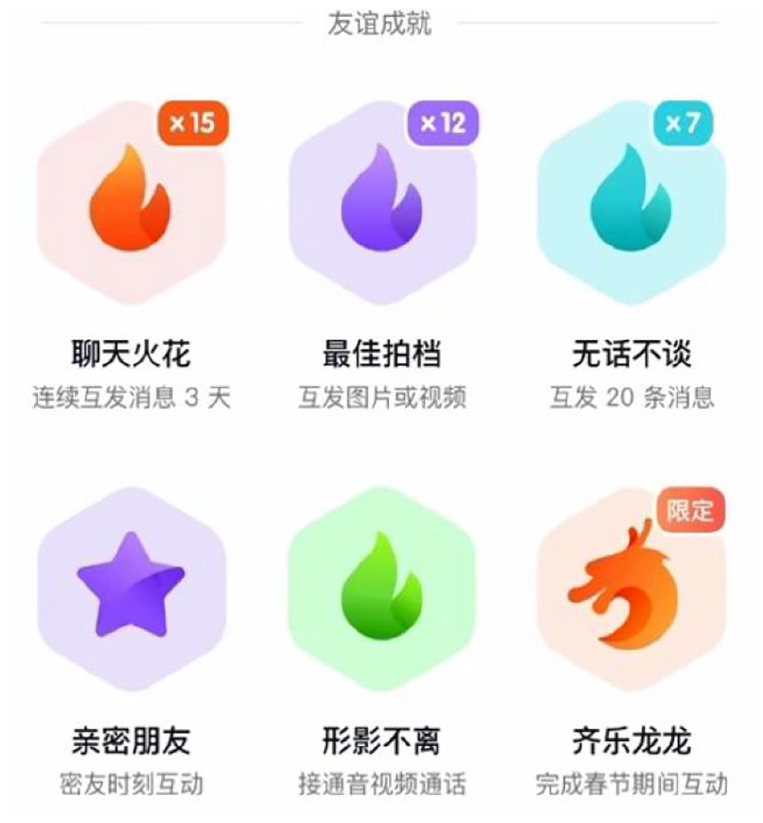
Types of friendship badges.
Our respondents expressed strong interest in Douyin’s “playful” features for developing social connections. Their screen recordings revealed a variety of badges representing different levels of social interactions. Drawn to these features, many respondents admitted they had shifted their social activities from other platforms (such as WeChat) to Douyin. Some participants even invited their offline friends to join Douyin purely to engage in playful, badge-oriented social interactions: I added close friends on Douyin after we had already followed each other on WeChat. We shifted our social behaviour from WeChat to Douyin when we chitchat because [Douyin] has many playful features, such as flame badges, which is more interesting than WeChat, and motivates us to share. (Wei,
3
male, 25). At first, me and my boyfriend didn’t know how to start a conversation on WeChat. You know, asking “are you there” (在吗) is so awkward. So, I added him as a friend on Douyin and shared videos to break the ice. Our common interest to earn the badges increased the frequency of our interactions, which helped us develop our relationship. (Ruoxi, female, 27)
The aforementioned quotes demonstrate how gamification features attract users to socialize on Douyin in place of alternatives like WeChat. Compared to other social networking platforms, Douyin employs a variety of gamified features to motivate sociality, encouraging users to transfer interactions from other platforms. This highlights the role of gamification in enhancing user experiences and providing intrinsic motivations for social engagement (Hamari et al., 2020). As such, while our participants adopted polymedia practices and engaged across multiple platforms in a networked media ecology (cf. Madianou & Miller, 2013), they consistently chose Douyin for social interactions. This finding contrasts with Schellewald’s (2024) discussion of sharing activities on TikTok where users often relied on other apps, such as WhatsApp, to share videos despite TikTok’s build-in messaging function. In our study, participants predominantly shared Douyin algorithmically-recommended videos directly within the app rather than across external platforms.
To earn playful badges, respondents reported deliberately engaging in certain social interactions. Although the badges held little tangible value, the sense of accomplishment associated with achieving “friendship milestones” influenced how and how frequently participants socialized on Douyin: To earn the Green Flame badge, I invited my friend to a video call on Douyin. However, normally we conduct video calls on WeChat instead of Douyin (Lele, female, 26).
Similarly, Ting (female, 26) explained: I’ve already earned all of these badges except for the purple star because I don’t know how to access “real-time moments.”
4
I am interested in collecting the badges, so I looked up user-generated tutorials online and completed the required social tasks.
These quotes illustrate how gamified badges encouraged participants to engage in online social interactions and maintain social bonds, often deliberately adjusting their behavior to earn rewards. Here, as Woodcock and Johnson (2018) discussed, gamification emerges as a form of behavior management, prompting users to engage more frequently and for longer periods. In this context, users can be seen as digital laborers, sacrificing their intended social interactions for virtual rewards (cf. Caplan & Gillespie, 2020; C. Fuchs, 2014).
The gamification of social features on Douyin blurs the boundary between “playing” for social purposes and “socialising” for playful purposes. Users not only socialize to earn badges but also deliberately adapt their interactions to conform to the platform’s expectations. This duality muddles the distinction between playful gaming environments and serious social interactions (cf. de Souza e Silva & Hjorth, 2009). As a result, Douyin’s playful design commodifies user labor under the guise of entertainment, enticing individuals to re-focus their behaviors toward the pursuit of virtual achievements.
Flame levels: quantification and visibility of online interactions
Flame levels are another Douyin feature that quantifies social behaviors, converting interaction frequency into visible numerical indicators. These levels are displayed alongside flame badges, such as “ My friends on Douyin are my closest friends, and we frequently share videos and discuss them. Sometimes, we share morning or evening greetings just to keep the flame levels up. When we see it go higher, we are eager to see what happens, if the level reaches 100. So, we keep sharing and interacting—for socialising, and for the badge (Juzi, female, 26).52,” making the frequency of interactions between two users publicly visible. Similarly to Snapchat’s “Snap Streaks” discussed earlier, Douyin’s Flame Levels show the number of consecutive days two users have shared videos and interacted. Th badge is visible not only within the communication interface but also as a notification when users open Douyin (Figure 3b). The feature incentives regular interactions: the more frequently users share content and chat, the brighter the flame and higher the number. Many (15) participants admitted that the feature motivated them to maintain consistent communication with their friends. For example, Figure 3a shows a screenshot by Juzi, one of our diary respondents. Her Flame badge, which displayed a 52-day streak, was one of the highest among all participants, visibly highlighting the history of Juzi’s sustained interaction with her friend. When asked why she kept the sharing streak with this particular friend, Juzi explained:
As noted, participants like Juzi maintained interactions with friends to boost their flame levels. In addition to sharing videos and chatting, participants often exchanged routine, or in their words, “meaningless” content (such as greeting stickers) solely to preserve their streaks (Figure 4).
5
For instance, Xixi (female, 23) explained: Sometimes we send stickers like “good morning” or memes just to keep the flame going and increase the score, but the communication feels pointless.
By quantifying and displaying a visible history of interactions, this feature gamifies social connections so that they are measured, tracked, and fed into computational models (cf. Schrape, 2014). Friendships are no longer solely rooted in belonging or emotional bonds but are also influenced by a system of “winning” and “levelling-up.” For instance, Hua (female, 26) believed that a higher flame count reflected a closer relationship, and this belief motivated her to boost interactions with close friends to increase their flame levels. These findings suggest that badges with visible numerical indicators of social relationships not only motivate users to engage but also reframe social connections within a competitive, points-based conceptualization of sociality.

(a) A screenshot from Juzi’s video diary. (b) A screenshot from Wei’s video diary. When Wei’s friend is online, the flame level is visible in the notification.
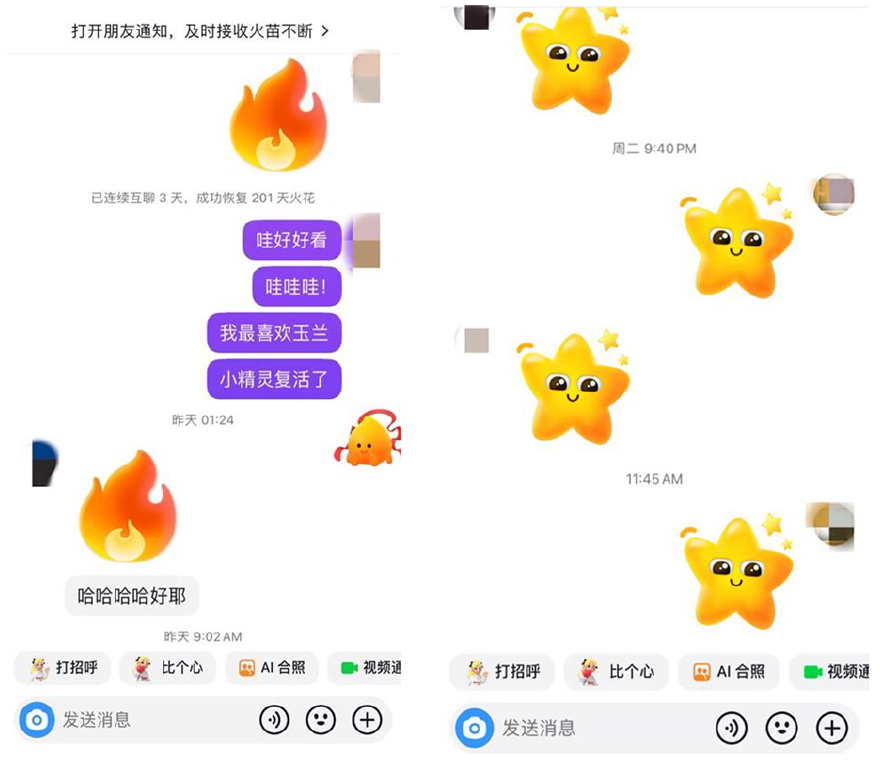
Screen recordings from participants showing they sent stickers solely to maintain the Flame.
However, rather than being entirely driven by the digital tools, users also actively harness playful social features to serve their individual purposes (cf. Simon et al., 2009). Participants used Douyin strategically, often reserving gamified connections for close friends. For example, Kun (male, 25) explained that after entering a romantic relationship, he adjusted his interactions with female friends to “put out the flame,” concerned that the visible flame levels (which indicate closeness) might cause misunderstandings with his girlfriend. Similarly, seven other participants demonstrated nuanced friending and unfriending behaviors in their video diaries. Unfriending was particularly common when participants felt their relationship with the friend had grown distant. This aligns with Costa’s (2018) findings that Facebook users actively adapt their use of technology to manage distinct social spheres. However, our study extends this by revealing that participants selectively strengthened connections with certain friends while distancing others, thereby limiting the influence of gamified features to their close, intimate circles. This distinction underscores the unique role of video-sharing platforms like Douyin in fostering digital intimacy, contrasting with SNSs that typically promote the formation of broader, more loosely connected networks.
The badge system, like many video games, includes punishment mechanisms. If a user stops interacting with a friend for 24 hours, the badge is deactivated, and the accumulated quantitative records are reset. If chatting ceases, the flame turns gray and the badges disappear. This mechanism incentivises interaction and sharing much like a “behaviourist stimulus-response-reinforcement process” (Philippette, 2014, p. 188). One respondent, Min (female, 26), described her disappointment when she failed to share videos for 3 days and saw her flame badge disappear: When I first shared videos with my friends, I used the chat function on Douyin. After keeping our messages going for three days, I noticed there was a flame badge on my chat interface. That made our socialisation on Douyin entertaining because WeChat doesn’t have that feature. However, the flame disappeared after we stopped sharing videos. I felt a little disappointed. Since then, I have been conscious about maintaining flames with my friends and I started adding my close friends to Douyin.
When asked if she added friends on Douyin before discovering this feature, Min responded: No. After learning about the badges, I noticed the Douyin chat interface has lots of features that make social interactions feel like playing games with friends, which is fun but also helps me maintain friendships. But I only add very close friends on the platform.
This quote illustrates how Douyin’s features enable users to strengthen their social bonds through play. At the same time, the mechanisms adapt online social behaviors to the logic of capitalisation (Woodcock & Johnson, 2018), requiring users to constantly provide data. Disguised as entertainment, the features serve as tools to motivate sharing and socializing practices, in turn generating value for the platform owner (Woodcock & Johnson, 2018). In the words of Srnicek (2017, p. 30), “the more numerous the users who use a platform, the more valuable that platform becomes for everyone else.” By leveraging these visible, gamified features, Douyin effectively maintain user engagement while manipulating their social participation for data collection. This reflects a mode of “governmentality” (Schrape, 2014), where users behaviors are regulated under the guise of entertainment. Here, Douyin embodies what Bogost (2011) terms “exploitationware” using gamified socialization to obscure the commodification of online interactions.
Virtual pets: anthropomorphising social relationships
Douyin also features interactive social games, such as virtual pets, to encourage sharing behavior. One prominent example is the “Virtual Fire Spirit” which users can nurture by adding each other as close friends and sharing videos for more than 6 days (see Figures 5–7). This feature humanizes the virtual being through rhetorical techniques, such as calling its instructional manual a “little fire man growing guide” (小火人成长攻略). To encourage user interaction, Douyin launched an official Fire Spirit account in December 2024, employing personified storytelling (Figure 5) and various related activities, including lucky draw events and public welfare campaigns (Figure 6). The Fire Spirit is further anthropomorphised through design choices, with the character displaying various facial expressions and health statuses that reflect the frequency of user interactions. This combination creates an illusion of intimacy—a parasocial dynamic that obscures the programmed nature of the mechanism.

(a) Douyin’s official Fire Spirit account: “Fire Spirit and its Friends.” (b) A tutorial video from the official account demonstrating how to “revive” a grayed-out Fire Spirit. The character conveys emotional distress (“If we don’t chat today, I’ll turn gray . . .”), while the video encourages users to bring it back to health by sending messages.

(a) A promotional announcement: “If you successfully raise a virtual pet with your friends, you can get limited edition gifts from Lego, Pop Mart or Douyin.” (b) Douyin’s 2025 initiative to enhance gamified social engagement with philanthropy. Users can earn “sunshine points” through daily social interactions, and these points can be donated to support various causes.

Screenshots from participants’ video diaries about their interactions with virtual pets.
Participants’ video diaries often revealed their engagement with the virtual pet as a way to reinforce relationships with close friends and partners. For example, Mu (female, 23) referred to her Fire Spirit as her son. She further described: I invited my boyfriend to raise a virtual Fire Spirit together. One time we forgot to interact on Douyin, and the Fire Spirit was “sad.” I ended up calling my boyfriend to tell him to interact with me on Douyin in order to heal it.
Several participants shared similar experiences, admitting having deliberately contacted friends to ensure interactions on Douyin for the sake of the virtual pet. Such actions illustrate how Douyin’s social games motivate users to engage in specific behaviors. To care for the virtual character, users must perform prescribed social actions, such as “sending messages every day” and “sending more than ten messages daily” (Douyin official website, 2024). Failure to interact within 24 hours results in the virtual pet appearing gray and lethargic (see Figure 7).
Notably, Mu was not the only participant to describe the virtual character as their child. In a semi-structured interview, Maomao similarly stated: I raised it with my close friend. The health of our virtual child reflects our social relationship, showing that we frequently and consistently socialise.
In this context, the humanized virtual character symbolizes users’ expectations for their social connections and friendships. Certainly, several previous studies demonstrated that integrating human-like characteristics into robots or other non-human entities can foster user engagement, elicit responses akin to human-human interactions, and deepen emotional connections (Blut et al., 2021; Qiu & Benbasat, 2009). However, as our respondents demonstrated, social interactions on Douyin were rooted in pre-existing relationships, with social games primarily serving to maintain existing social bonds with close friends rather than to form new connections. While participants may have occasionally performed routine or “meaningless” actions for the sake of the game, their deliberate social interactions to raise virtual pets were driven by the symbolic representation of friendships these pets embodied. In short, users cared for virtual pets because they cared about their social relationships—and each other (cf. Byron, 2021).
Many participants (14) noted that features such as raising virtual pets with close friends helped sustain their friendships despite physical distance. For instance, Qing (female, 23) explained: After graduating from college, my close friends were far apart and had few common topics. We rarely interacted with each other. However, the emergence of features like flame badges and virtual pets allowed us to keep socialising and strengthen our relationships in playful ways. We have the same goal: to look after the virtual pet.
This quote demonstrates how gamified features facilitate the maintenance of pre-existing, intimate social bonds to overcome the challenges of geographic separation. The process cleverly combines two mechanisms: developing social bonds by working toward a shared, in-game goal, and encouraging interaction through a sense of responsibility for a cute, anthropomorphised virtual pet.
Negotiating tensions between sociality and algorithmic manipulation
Building on the previous discussion of how Douyin’s gamified features affect social interactions, this section focuses on the role of algorithms. Algorithms play a pivotal function in selecting and prioritizing information, shaping how users perceive and engage with content (Bhandari & Bimo, 2022; Gillespie, 2022; Just & Latzer, 2017). By determining what information is deemed relevant, algorithms effectively create reality for users through coproduction and allocation (Just & Latzer, 2017). Participants in our study were certainly aware of algorithms’ involvement in constructing their online experience and commodifying social interactions. Many offered commentary on how their interactions with friends were tracked, categorized, and used for personalisation and monetisation. One such participant, Yu (male, 26), explained: One of my friends frequently shares game videos with me so we can discuss computer-generated imagery. However, the system detects our behaviour and, as a result, increases the number of game-related video recommendations on my For You page, including ads for game equipment and new game promotions. This tells me that the system is monitoring our shared content to customise commercial suggestions.
Yu’s comment shows how users notice algorithmic tracking when recommendations deviate from their personal preferences and instead reflect content shared with friends. Several respondents noted how interactions with friends, such as discussing restaurant choices, increased recommended content about food, mukbang and restaurant-related advertisements. In the words of Maomao (female, 21): My friend told me about a delicious ice cream shop. I expressed my interest and soon after I started seeing more nearby restaurant ads and food recommendations.
Although participants were aware of how their social interactions were exploited, they remained willing to interact on Douyin to sustain friendships. Our analysis of semi-structured interviews revealed that participants often added their real-life friends on Douyin because algorithmically recommended videos provided conversation topics that helped maintain and strengthen interpersonal connections. In addition, video-diary entries showed that respondents frequently shared influencer videos with friends for entertainment, using Douyin’s communication interface for discussion. Here, users often resigned to the fact that to develop and maintain social bonds through gamified features, they must sacrifice their engagement data to the platform (cf. Kant, 2020).
However, participants also demonstrated resistance to algorithmic interventions in their sharing behavior. For instance, the selective addition of only close friends on Douyin demonstrated effort made to avoid unwanted algorithmic “interruptions” in participants’ personal feeds. Here, users were aware that Douyin’s For You page operates similarly to other recommender systems by connecting users with content they are likely to consume, while privileging videos shared by friends. If users ignore the shared content, Douyin will prioritize the videos in their personal feeds, effectively “forcing” the content onto them.
Users can also actively recommend videos to friends via the “recommend this video” function. One respondent, Yang (female, 27), shared a story in her video diary which illustrated the tension between sociality and personalisation. While consuming history-related videos on Douyin, Yang was recommended a video tagged with “this video is recommended by X (her friend).” Noticing the video was about entertainment news (content she disliked), Yang unfollowed the friend. She explained this behavior in the interview: I initially added her as a friend after interacting with her in the comment section. However, she frequently shared videos I disliked, and the system incorporated them into my personal feed because of our connection. I prefer not to see low-quality entertainment news in my recommendations, so I eventually unfollowed her and used the dislike button to adjust my feed.
Ultimately, the algorithm logic made users more cautious when adding friends, as the shared content could influence the quality of personal recommendations. This somewhat contrasts with Schellewald’s (2024) finding that personalized content facilitates sharing by intertwining users’ self-identity with their close social ties. Our study suggests that such algorithmic personalisation often triggers resistance, limiting some social interactions and activities on the platform. Thus, while Douyin can help users maintain and strengthen friendships, this effect is largely confined to a small, close-knit friend group and rarely extends to broader social circles.
Discussion: amid a spectacle of friendship
So far, we have discussed how Douyin’s gamified features encourage users to socialize online and strengthen social bonds with close friends. Unlike platforms such as Facebook, whose features prioritize self-disclosure and broad public connections (Bucher, 2013; Van Dijck, 2013), Douyin’s gamified features encourage sharing content in predefined forms. As such, we argue that algorithm-driven platforms such as Douyin not only activate relationships but also become an integral part of them. As we have seen in previous sections, algorithmically recommended videos generate conversation topics while gamified features provide a framework for structured interactions between users. These features encourage deliberate, specific behaviors, such as making video or voice calls through Douyin or exchanging a minimum number of messages daily.
More importantly, these features go beyond “just” facilitating sociality to reframing it, as they influence not just how users engage but also who they engage with, fostering a tendency to limit friendships to small, close-knit circles. Interactions with gamified features highlight the co-evolving link between the platform and social practice. On the one hand, gamified social features facilitate social interactions between friends and shape the ways they engage with each other. On the other hand, participants’ tendency to limit who they friend can foster a stronger sense of intimacy and potentially lead to enhanced friendship ties. The latter dynamic is, however, less intuitive for users on Douyin and, presumably, on other platforms primarily driven by algorithmic video recommendations.
While previous research has highlighted the negative impact of gamified features on communication, such as the increased frequency of superficial “nonsense” interactions (i.e., blank or greeting messages) to maintain streaks (Hristova et al., 2020, 2022), our findings show that Douyin users benefit from these features by sustaining meaningful (for them) communication with close friends. As Carr and Rosaen (2024) found, frequent superficial interactions may slightly diminish relational closeness but this does not outweigh the sense of connection fostered by consistent interaction. Similarly, while our participants occasionally engaged in “routine” social behaviors, such as daily greetings to maintain Flame Levels, they perceived these interactions worthwhile from a social standpoint, if done with close friends. This is also because social connections on Douyin are developed based on shared, algorithmically recommended content rather than on disclosing personal data. The care users showed for gamified metrics reflected their care for the relationships those metrics symbolized.
At the same time, Douyin’s gamified features provide an insightful case study to understand platform capitalism and data exploitation. These features are designed to aggregate user engagement, collect data, and generate revenue through metrics (Ørmen & Gregersen, 2023; Gerlitz & Helmond, 2013; van Dijck et al., 2018; van Dijck & Poell, 2013). In this sense, gamified social features go beyond merely facilitating social interactions; Douyin embodies “exploitationware” (Bogost, 2011) where users engage in seemingly voluntary, playful interactions which are subtly shaped by profit-driven mechanisms. Through “compulsion loops” driven by variable-rate reinforcement (Deibert, 2019), users are drawn into repetitive social activities under the guise of entertainment.
Thus, we argue that video-sharing platforms exploit users as free labor through gamified features that encourage social interactions. The platform not only monetises user engagement but also capitalizes on social relationships and interactive behaviors. By tracking these social behaviors, the platform can more easily categorize and commodify users through their shared data (Crawford, 2021) while gaining insight into users’ interests to deliver targeted recommendations for commercial purposes (Gillespie, 2014). Cloaked in the guise of gamified features, the exploitation of users’ social behaviors often feels like entertainment, seamlessly blending into routine leisure activities (cf. C. Fuchs, 2014).
Are users not exploited because they receive rewards for their work on the platform, such as the satisfaction of contributing to a virtual mechanism they believe enhances mutual communication? In our study, participants adopted gamified features to reinforce their social ties and friendships, deriving gratifications from these engagements. However, unlike other forms of user labor that may yield benefits (such as increased social reputation or a larger digital network), engagement with gamified features on Douyin earns only virtual badges: essentially, representations of passive engagement in the spectacle (cf. Debord, 1994). In this context, social relations are reduced to simulations while reciprocal exchanges lose much of their intended meaning.
Yet, as we discussed, participants in this study demonstrated a high awareness of how Douyin algorithms exploit their social behaviors, which led them to adopt cautious and critical digital practices. Users understood that being indiscriminate in adding acquaintances could disrupt their personalized feeds. While such recommendation logic has proven effective for platform stakeholders in other contexts, we argue that it is less successful on entertainment-focused platforms, where diverse tastes among weak-tied social connections can result in frustration, resistance, and disengagement. Casual social relationships do not guarantee shared preferences or interests, and the algorithmic prioritization of friends’ recommendations can lead to “digital irritation” (Ytre-Arne & Moe, 2021). As such, and in contrast to prior studies highlighting the potential of social media platforms to support the maintenance of weak ties (Donath, 2007), our findings suggest that while video-sharing platforms facilitate sociality through gamified features, they are less effective in sustaining weak-tie relationships.
Consequently, we argue that Douyin enables users to reinforce social bonds within tight-knit groups but fails to facilitate wider, networked public connections. On algorithm-driven video-streaming platforms like Douyin, cautious behavior is not merely a preference but a protective strategy to safeguard personalisation from unwanted influences. In other words, unlike unfriending practices on SNSs, which stem from feelings of judgment, competition, or lack of belonging (Saukko et al., 2024) or message overload (Jorge et al., 2023; Mannell, 2018), Douyin users limit friending to avoid algorithmic disruption. Among all this, Douyin’s gamified features highlight the tension between fostering intimacy and exploiting user engagement: platforms embrace trust-based recommendation logics tailored to different content categories to balance personalisation and curation of social relationships with profit-driven social engagement.
Conclusion
This article has argued that the application of gamification on Douyin motivates users to engage in particular social behaviors. While these behaviors may not appear “playful” on the surface, features like friendship badges, interaction levels, and anthropomorphised virtual pets are designed to make users’ digital activities effectively playful and gamified. These mechanisms facilitate the strengthening of social bonds but simultaneously commodify and regulate users’ social relationships. Gamified features, while encouraging certain social practices, mask manipulative dynamics with a playful framework of sharing and socializing. By adapting online social behaviors to the logic of capitalisation, the platform ensures continuous data generation for commercial exploitation.
This finding contrasts with earlier (but still prevalent) characterisations of TikTok as detached from users’ real-world networks, in other words as “a social network that has nothing to do with one’s social network” (Tolentino, 2019). We have suggested that Douyin fosters socialization through a complex set of gamification mechanisms, and that a nuanced examination of the platform’s social functions is needed to understand its influence on interpersonal relationships. On this, we have argued that while Douyin may facilitate the strengthening of social bonds, its impact is largely limited to close-knit circles of friends.
This article also underscores the value of the qualitative video-diary method in understanding how users engage with interactive elements on digital platforms. It pioneers a hybrid video-diary approach that integrates screen recordings with follow-up interviews, offering an innovative and mobile method to trace real-time user interactions with algorithms across diverse sociocultural and spatial settings. This approach not only documents user practices but also captures “on-screen” algorithmic responses in situ, wherever and whenever users engage with their devices. By refining the video-diary methodology to include screen recordings, our participants documented their real-time interactions on Douyin, bridging the gap between self-reported accounts and directly observed practices. Unlike traditional interviews or report-based diary methods, screen-recording diaries offer a unique means of approaching behavioral authenticity while enriching the empirical data collected. This method enables researchers to analyze user interactions with platform features, examine responses to algorithmic recommendations in specific contexts, and conduct cross-platform comparative studies by documenting user behaviors across multiple smartphone applications. Further studies could complement this qualitative approach with quantitative methods to explore the relationship between demographic factors and patterns of use. For instance, our analysis suggests potential gender differences in interactions with gamified features on Douyin, which merit further investigation.
Although this analysis focuses on Douyin, the findings may extend to other video-sharing platforms incorporating gamification to drive user engagement. As mobile applications increasingly integrate gaming elements, future research should explore their role in across other, diverse contexts, such as mobile reading or fitness platforms, and within varied regional and cultural settings. In addition, large-scale quantitative surveys or behavioral analytics could further assess the prevalence of these interactions across different user demographics and usage contexts. Given the fluid and mobile nature of audiences, a broader examination of participant demographics could offer deeper insights into user engagement across different socio-spatial conditions.
Footnotes
Acknowledgements
We extend our sincere gratitude to the special issue editors, Zoetanya Sujon, Harry T. Dyer, and Felipe Bonow Soares for their constructive suggestions and invaluable guidance during the revision process of this article. We are also profoundly thankful to the three anonymous reviewers whose insightful comments significantly enhanced the quality of the article.

Declaration of conflicting interests
The author(s) declared no potential conflicts of interest with respect to the research, authorship, and/or publication of this article.
Funding
The author(s) received no financial support for the research, authorship, and/or publication of this article.