



Abstract
On Douyin, China's domestic version of TikTok, straight users are being recommended queer content, and videos created by straight men are being recommended to queer viewers. As Douyin recommends videos based on users’ online activities (e.g., liking, sharing, or spending time watching a video) and networks (e.g., connections made on the platform), sexuality comes to be algorithmically interpreted and defined. This process differs from an understanding of gender and sexuality as more or less fixed classifications that are the result of what people register when entering a platform concerning their gender and sexual identifications. This article analyzes viewers’ and creators’ experiences and reflections on the algorithmic grouping of sexual orientation and erotic curiosity through the relational lens of configurations. Using two years of online observational data and in-depth interviews with 18 Douyin users, both straight and same-sex orientated, we found that a language-centered, semiotic approach alone cannot assist in capturing the reconfiguration of sexual identifications presently occurring in China, and most likely elsewhere. Sexual identifications are the result of a relational process in which desires (regardless of sexual orientation) and intimacy, content creation and consumption, platform vernaculars and affordances, and data and algorithms converge and clash. This process allows for an erotic curiosity that has not yet been named or normalized in language systems and therefore reconfigures how sexual identity or orientation come to be understood in relation to the ever-increasing presence of computational power.
Introduction
Since 2019, the phrase “big data see through you” (da shu ju hen dong ni) has become a trending hashtag among users on Douyin, the Chinese version of TikTok. Videos associated with this hashtag feature very particular semi-erotic performances, such as intimate (but not sexual) interactions between two men, or the display of individual men's muscle-flexing, feet, legs, basketball sneakers, and socks. These performances may hardly seem erotic to other audiences, but in the Chinese context with its forceful censoring system that bans any hint of erotic content, glimpses of nudity and fetishized footwear have become titillating displays. This type of content can be analyzed as gender according to algorithmic logic (Cheney-Lippold, 2017) as well as gender performance in a heterosexual matrix that declares same-sex as indicative of homosexuality (Butler, 1999 [1990]). We argue that the sexual identification that algorithms make in correlating content/creators with viewers also demonstrates something else. It indicates a shift as captured in the phrase “big data see through you.” That is, if a viewer engages with videos created by one particular gender, or someone in the viewer's online networks has shown traces of such behavior, the platform's algorithms will pick up on it and recommend same-sex videos to the viewer. Our study indicates that this not only happens with queer users, on the contrary, many straight users are also recommended queer content. Consequently, recommendation algorithms aggregate a queer niche audience on Douyin through these gendered connections and networks emerging from watching short videos by both queer and straight people.
Users’ behavioral and interaction data are pivotal to the Douyin's recommendation system, which is comprised of multiple algorithms that work together to feed viewers with videos that reflect their interests and preferences. To this end, users’ online activities, such as searches, the amount of time spent watching a video, liking, commenting, sharing, saving, and browsing the comment thread after viewing a video, are tracked and translated into data points that can be aggregated, correlated, and interpreted by the platform to establish a spectrum of users’ interests (Cheney-Lippold, 2017). This process is performed by both human and computational agents: human content labelers categorize videos with tags, according to a set of rules known as the content classifier system. Algorithm engineers then use these examples to train the recommendation system to learn users’ social networks and their content preferences in order to enable automatic recommendations (see also, for example, Southerton et al., 2021). The work by human content labelers translates interests and preferences into categories, or—more to the point—hashtags. This means that the translation of behavior into intelligible categories is dependent on norms and values yet, as we argue, at the same time has the potential to escape normative social structures. In our study, hashtags such as “good-looking men”/“hotties” (shuai ge), “muscles” (ji rou), and “sporty students” (ti yu sheng) indicate queer sexuality. Focusing on queer content on Douyin, we show how algorithms significantly reshape the presentation and interpretation of sexual identification.
This article analyzes how people make sense of algorithmic encounters in relation to their sexual orientation and erotic curiosity. Rather than looking at normative power as a predetermined and structuring set of norms and values influencing queer possibilities, and sexual classifications as a predetermined language for self-identifications, this article focuses on how people relate and give meaning to the way their sexual orientation and erotic curiosity are grouped, sometimes unexpectedly, by algorithms. Therefore, the term “sexual identification” is used to encompass two layered dimensions. On the one hand, it emphasizes conceptualizing the processual nature of what is usually labelled sexual identity as a relational process in which desires (regardless of sexual orientation) and intimacy, content creation and consumption, platform vernaculars and affordances, and data and algorithms converge and clash. On the other hand, it points to the process of how algorithmic configurations of erotic curiosity come about.
Sexuality is usually understood as the ritualized repetition of performative acts of gender that enable the recognition of gendered expressions informed by the normative presumption of heterosexuality (Butler, 1999 [1990]). In the analyses of social media platforms, sexuality is usually understood as formed, or created, by content classifiers that are norm-producing technologies reproducing heteronormativity (Southerton et al., 2021). In the online world, however, behavioral data speak for a person, instead of a person speaking for him/herself (Cheney-Lippold, 2017). This means users’ erotic interests and sexual orientations are mainly interpreted according to gendered relations and networks that feed algorithms (Wang, 2023). While people get interpellated in algorithmic systems, that is, how heteronormativity constitutes the very nature of individual subjects’ identities through the process of “hailing” them in social interactions, this study observed an emerging variability beyond the logics of heteronormativity.
Following a constructivist perspective, we trace online behavior to capture how erotic desire and same-sex orientation come to be (re)configured alongside discursive constructions of sexuality, and against the backdrop of algorithms emerging as a knowledge apparatus of increasing importance (Gillespie, 2016). From a technical standpoint, algorithms involve processing behavioral and interactional data inputs to generate configurations based on those inputs. In our case, algorithms represent a complex process of configuring sexual identification that is processual. It emerges through users’ online activities, depending on what data related to sexual desires have been extracted at specific moments. “Configuration” serves as a theoretical tool to account for this process (Suchman, 2012). It illuminates the ways in which algorithms materialize sexual curiosity in the intersection of online materialities and imaginaries. In a digital context, the concept of configuration attends to how technological artifacts such as the algorithm “holds the material and the semiotic together in ways that become naturalized over time (Suchman, 2012: 49). This requires researchers to unpack these processes to recover its constituent elements and we propose to see online sexuality as a process of reconfiguration in relation to data input and output in algorithmic processes.
Following Cheney-Lippold (2017: 5), who writes that “who we are in the face of algorithmic interpretation [is] who we are computationally calculated to be,” we propose to begin our analysis by following behavioral data to see how people experience their sexual encounter with the output based on their behavioral data. Our case investigates how straight users unintentionally get content intended for same-sex users by way of Douyin's recommendation system; how straight creators produce same-sex–oriented content for visibility, and how neither of these is considered problematic by users observed. By focusing on these algorithmic sexual encounters, we analyze how sexual identification comes to be understood in relation to the ever-increasing presence of computational power.
Research design
This study employs qualitative research methods, specifically ethnography-inspired processes that include online observations and semi-structured, in-depth interviews with both Douyin users and employees. On 8 February 2021, we published a recruitment post via GaySpot, a queer-focused public account on the social media network WeChat. In total, 37 people reached out. Between April and July 2021, 18 people (for detailed information, see Table 1) were successfully interviewed through voice calls, due to the Covid-19 travel restrictions in China at the time. Two of our interviewees identified as heterosexual men, one who identified as a bisexual man, and 16 who said they are “into men” or “like men,” and sometimes identify as “homosexual” and “gay.” After distinguishing recurring patterns of interviewees’ encounters with content that they considered “homosexual,” we stopped soliciting new interviews. All the interviews started with a standard fixed script of consent. 15 interviews were recorded (with a length ranging from 15 minutes to 59 minutes) and transcribed. Three were conducted through text messages via WeChat.
List of participants.
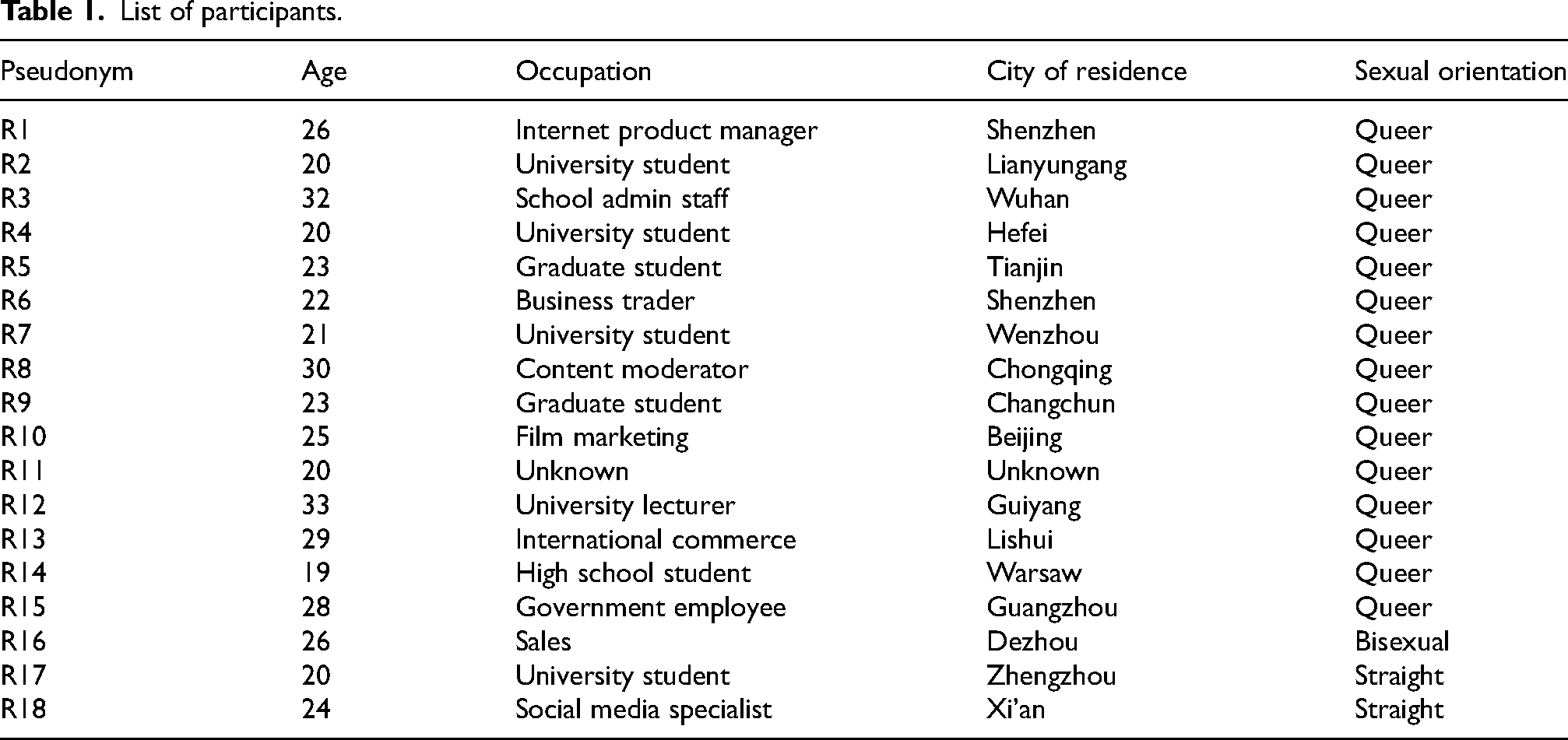
In February 2021, three employees working at Douyin were recruited from the first author's personal contacts. These people work as product manager, content labeler, and user growth specialist. The interviews were conducted face to face in Beijing. After obtaining their consent, the interviews were recorded and transcribed (length ranging from 60 minutes to 90 minutes). These interviews were aimed to gain a glimpse into how the platform labels and correlates content with user interests and preferences to facilitate user growth and retention.
However, we still lacked insights from straight people, as shown in the table, only two straight were recruited. To get more information about how straight users encountered and engaged queer content, we conducted ethnography-inspired online observations from February 2021 to February 2023. We followed strategies of “algorithmic ethnography” (Christin, 2020) and “digital snowball sampling” (Wang, 2023) by enlisting algorithms in the collection of ethnographic data. According to these methods, algorithms can refer researchers to the content that falls under the scope of the study because of algorithms’ tendency to generate homogenous content for a user. The algorithmic strategies in ethnographic studies, therefore, ask researchers to purposefully harness the generative and networking capacities of recommendation algorithms by interacting with (e.g., liking) a targeted content category, which, in our case, is straight users encountering and engaging queer content.
In this spirit, we watched and liked videos of straight creators encountering and engaging queer content with the aim to have the algorithm recommend more videos of this category. Our observation protocols follow Dawson (2020: 274), who argues that qualitative observation “does not follow a set, pre-defined procedure and can, instead, be open, unstructured, flexible and diverse.” Our emphases were placed on the hashtags used in these videos, interactions between straight creators and queer viewers, and response videos by straight creators. In this process, we took screenshots and notes whenever relevant research data appeared. This included instances of male creators displaying graphs illustrating the gender divide among their followers, with men being the majority. We also documented viewer comments expressing queer desires to straight creators using slang and subcultural languages, which often turned into hashtags used by creators to facilitate algorithmic recommendations. Additionally, we documented the different ways straight creators responded to their growing popularity among queer viewers. It is important to note that we only included data that exhibited recurring patterns—practices consistently observed among creators and viewers—into our analyses. This was done to emphasize the shared experiences of algorithmic erotic encounters on Douyin. These observational data provided a significant supplement to the interview data, aiding us in understanding how people of varying sexual identification interact with queer content in Douyin's algorithmic systems. Together, we analyze how algorithms reconfigure people's erotic encounters on Douyin, how queer people make sense of these encounters, and how queer and straight creators play with algorithms (i.e., hinting at or faking a same-sex orientation) to garner attention in a system where same-sex content is topical.
Following behavioral data: algorithmic configurations of sexuality
The concept of heterosexuality, and its counterpart homosexuality, is a recent cultural and historical development. In its narrow sense, sexuality is nothing but the invention of 19th-century European sexology, which gave rise to the supposedly deviant category of the “homosexual” and, only later, to its supposedly normal categorical mirror, the “heterosexual” (Foucault, 1978). The distinction between sexual practices and identities is, therefore, the articulation of a particular cultural history that has become hegemonic over time (Wekker, 2006; Rubin, 2007).
In gender and sexuality studies 1 , language is seen as fundamental to processes of normative power, as expressed through two developments. First, queer sexualities have come to be understood as an expanding field of identities, as expressed in the term “LGB+” (lesbian, gay, bisexual, and so on). In other words, the multiplicity of sexual desire and curiosity is understood in terms of the importance of sexual identity and its accompanying labeling (Hennessy, 2017). Second, sexuality is seen as discursively enabled and hence regulated through language in the exclusionary matrix that delegitimates minority-gendered and sexual practices under heteronormativity (Butler, 1999 [1990], 2011 [1993]).
In the digital context, where gender and sexuality become based less on vocabulary, self-identification, and physical performance and are rather constituted through the interplay between users and algorithmic knowledge-making processes (Cheney-Lippold, 2017), a shift takes place. Data extracted from profiling Internet users and their online activities usher in “a form of fundamental appropriation” that gives rise to a new condition of human life in which people and things are attached to the infrastructures of connection offered by digital platforms (Couldry and Mejias, 2019: 338). In this process of appropriation, people and their representations (e.g., content and interactions) come to be converted into data streams, on the basis of which datafied, digital selves are “put into systematic/mathematical relationships with each other” (Gillespie, 2016: 22). In this light, a person's behavioral data, their online social connections, and the algorithmic outputs based on their behavioral data and social networks come to signify a person's sexual interests. In a digital context, algorithmically produced erotic hashtags, or signifiers, may diverge from sexual categories and increasingly substitute the language of LGBT + in representing a person's gender and sexuality (Cheney-Lippold, 2017: xiii). This is not the case of course in online environments where queer persons meet and converse in the Anglo-Saxon language prioritizing particular understandings of LGBT + classifications or other classifications articulating the importance of self-identity.
We are not suggesting that the algorithmic construction of sexualities is completely new and independent of existing gender and sexual discourses. On the contrary, algorithms are embedded in, as much as they are operationalized by, specific social, cultural, and political contexts (Kotliar, 2020; Simpson and Semaan, 2020; Wang, 2023). What is new is that algorithms have the potential to create a novel way of sorting, defining, and correlating gendered content and interactions. We follow Gillespie (2016: 25–26), who defines algorithms as “the insertion of procedure into human knowledge and social experience. More specifically, what makes something algorithmic is that it is produced by or related to an information system committed (both functionally and ideologically) to the computational generation of knowledge or decisions.” In this sense, algorithms serve as “the name for a particular kind of sociotechnical ensemble,” that is, knowledge production and decision-making (Gillespie, 2016: 22).
As such, algorithms operate as a knowledge apparatus in constructing an erotic and gendered reality by, first, translating human activities into technical data clusters, and second, correlating these undefined data clusters in order to identify social patterns and cultural meanings (Kitchin, 2017; Kotliar, 2020; Willson, 2017). In algorithmic systems, therefore, sexual identifications emerge from the correlations of users, content, and engagements. In other words, every “like,” “share,” the time spent on a site or platform, or other behavioral data, on sexually related content but not necessarily as, for instance, fashion is also central, come to speak for users’ sexual interests and erotic curiosity.
Algorithms thus enable human-machine interactions with real-time user activity data that are constantly fluctuating, and the components of algorithmic criteria are themselves variables whose calculations are always changing based on contextual differences (van Doorn, 2020). While gender and sexuality are usually fixed labels that are mostly registered to access social media platforms as part of personal data registration, in online realities and following the temporal gender and sexual identifications, sexuality appears to be less predefined but always emerging in a process of algorithmic collecting, processing, and correlating. In practice, user data are collected and processed mostly according to the audience market, or “who we are computationally calculated to be,” as articulated by Cheney-Lippold (2017: 5; see also Kotliar, 2020). Given that online data are collected in real time and are subject to changes in a person's online behaviors, temporality becomes a defining quality of the datafied digital self. Data and algorithms make the stable, singular truth of identity “a relic of the past,” on the one hand; they also make gender and sexual identifications a profitable convenience, on the other (Cheney-Lippold, 2017: 6–7).
From a historical perspective, sexuality acquired its institutional forms of homosexuality and heterosexuality as a consequence of emerging scientific development and the industrialization of Western societies in which population mobility to cities engendered new sexual spaces and cultures (D’Emilio, 2007; Foucault, 1978). Data-based economic transformations have been argued as the latest development of capitalism under the rubric of surveillance capitalism: behavioral data extracted from the human use of digital platforms provide free raw material as a proprietary behavioral surplus for predicting purchase preferences (Zuboff, 2019). Such historical shifts indicate that rather than looking for a sexual truth of same-sex sexuality (cf. Weeks, 2002), the question is what forces interfere in what is usually considered central to one's self, one's sexual orientation or sexual identity. Scholarship has shown the problematic ways in which algorithms misrepresent realities and reproduce and reinforce inequalities on the basis of gender, race, and class (Broussard, 2023; Noble, 2018). Our aim is a different one. In order to capture the complexities that cannot be fully apprehended by a dichotomic framework focusing on equality and inequality; suppression and empowerment (Moore 1994; 2012), the concept of “configuration” by Suchman (2012, 49–50) is important.
Configuration addresses the complex ways in which humans and machines are figured together—or configured—in technological discourses and practices, and how they might be reconfigured differently along the way. This reconfiguration is ongoing in the sense that is it an incomplete process, a fragmentary and open-ended flow depending on how people understand and shape their (sexual and erotic) encounters into meaningful existence. As we will show, sexual and erotic encounters on Douyin are ever in flux, depending on what is trending in the larger (social and online) world. And as the phrase “big data see through you,” indicates, people are very aware of the forces of algorithms and therefore we are not only interested in what algorithms do but also how people reflect back on their doings.
This study enriches existing scholarship by showing how algorithmic grouping of sexual orientation and erotic curiosity not only reinforces heteronormativity, but how a more complex process emerges where people both comply and defy heteronormativity. Reinforced by technology, that is, the constant emergence of new hashtags and so on, gender and sexual identifications are not only configured by algorithmic grouping but are also reconfigured in an ongoing process.
The Chinese context
We follow as much as possible our interlocutors’ phrases and words, and the majority used English and Chinese phrases interchangeably, including “gay,” “homosexuality,” tong xing (same-sex), tongzhi (literally comrade, the term for same-sex identity in Chinese), but most often men said “I am a man and I like men” or “I am into men.” When referring to themselves, male same-sex–oriented persons tended to use “I like boys” (wo xi huan nan sheng) and sometimes “gay”; both of these are used by younger people. For example, when referring to a collective group or the idea of community, the terms “rainbow” (cai hong) or “homosexuality” (txl) were used. When people referred to digital content, a nonhuman subject, they used “same-sex/gender” (tong xing), such as in the phrase “the video is about same-sex”—meaning the video is about two men, or two women. What is important to note here is that there is quite some variety of queer ways of being in China: from the cosmopolitan, globally oriented, urban youth who recognize themselves in the global queer discourse, to more customarily oriented queer women and men known as tongzhi (Bao, 2018; Kong, 2011; Rofel, 2007). The diversity among these groups also ranges across the country. In general, however, the articulation of sexual identity is not significant in their non-normative lives (Engebretsen, 2014; Huang, 2015). Despite using terms such as tongzhi, gay, lala, or lesbian, they have appropriated—as people have elsewhere in the world—the terms but not their (Euro-American) logic (Aggleton et al., 2012; Hossain, 2017; Oloruntoba-Oju, 2021).
In digital cultures, Chinese people constantly invent a variety of terms to refer to and make sense of their attraction to the same sex; these inventions may be derived from a social event or a news item, or deployed as a way to avoid detection by content-moderation filters. A good example is the expression “telephone book” (tong xun lu or dian hua ben) that appeared as a new term used by same-sex-oriented men to refer to their sexual orientation. Because “tongzhi” and “homosexuality” are sometimes filtered by Douyin's automatic content-moderation system (the platform warns creators about “content containing sensitive words”), users come up with work-arounds to circumvent the platform's censorship. “Telephone book” emerged because the abbreviation of homosexuality in Chinese is “txl,” which is the same as the phrase “telephone book.” Thus, we found, in videos showing queer men tantalizing straight friends, or queer men performing overtly sexually suggestive acts, that people commented, “Telephone books, please don’t be so absurd,” to express their slight disapproval, not in a strong way as such a comment is also meant as fun.
This is an ongoing process, contingent on the next event, with terms used as memes, stickers/emojis, and hashtags. We have observed that some terms appeared more at random, while other ones are more consistently used in certain contexts. On social media, Chinese young people tend to eschew the words common to the global LGBT + discourse, as they find them increasingly less relatable in the face of the ever-emerging gender and sexual cultures or because such terms invite Internet censorship. For instance, one of the interviewees said he did not use LGBT language because of the political baggage that it carries. Instead, he used phrases like “I want to find a boyfriend” or “I like men” to communicate his sexual orientation. People immediately get the message and some female friends responded, “Me too!” On Douyin, when men find a male creator attractive, they might ask, “Do you have a gender preference?” (ni ka xing bie ma?), which can be translated as “Do you preclude certain genders for dating?” For analytical purposes, we use the term queer as a conceptual term to indicate this field of non-normative genders, desires, and practices where same-sex and straight desires and acts are not mutually exclusive (Spronk and Nyeck, 2021).
In China, understandings of sexuality articulated by and produced in LGBT + terminology, as well as the global discourse of “queer,” have been highly politicized and classified as sensitive. In this context, the Chinese male queer hook-up apps Blued and Aloha, despite their phenomenal market success, were forced to rebrand their apps as “the world's leading interest-based, social, and health education network” (Blued) and “man-to-man dating app” (Aloha). These euphemistic reformulations articulate the current political environment. Following government orders, non-normative sexualities and expressions were put under platform censorship (Wang and Bao, 2023). Words such as “gay” and “tongzhi” have been replaced, although some terms survive in the product descriptions on Blued's English-language website. Following the purge of terms of non-normative expressions and identifications, their live-streaming service, which constitutes the largest revenue stream for Blued, expanded censorship to same-sex intimate content. The apps no longer allow content that includes kissing, muscle flexing, topless images, or see-through and bulging-crotch clothing, all content at the heart of the live streaming's success in its initial stage.
As a result, this new ruling has inspired various forms of creative erotic and sexual expressions across different digital platforms, with queer men performing borderline erotic content that pushes the edge in terms of acceptability. This is why videos showing very particular semi-erotic performances such as the display of individual men's muscle-flexing, feet, legs, basketball sneakers, and socks, have become erotic content in China. These expressions are profoundly shaped by platform vernaculars and affordances based on the material qualities of a given social media: the interface, layout, content flows, and data and algorithmic architecture. Douyin stands out from other social media platforms with its algorithm-driven design, which is the most significant affordance of the app. As such, users’ gender and sexual identifications depend less on the information they submit to the app in the registration stage and more on what is inferred through their interaction with content on the app. Because of the real-time data feedback loop, the algorithmically configured erotic and sexual classifications are nascent and in constant flux. Moreover, in large part due to user data being a moving and changing target, algorithms operate in a fluid fashion to facilitate the erotic curiosity of people without actually naming or settling on a fixed sexual identity or category. These qualities create spaces for data-based queer cultures in an open-ended manner.
Algorithmic systems have therefore emerged as a fertile site where sexual identifications both are materialized and contested. The used terms serve more to relay sexual orientation rather than declaring one's identification. In this way, queer people emphasize sexual experiences, encounters, and practices. Oftentimes, playful and sometimes self-mocking slang is invented, such as “socialite” (mingyuan, queer men deemed to be attention-seeking and promiscuous) to refer to a specific sexual practice, lifestyle, or social presentation. Creative sub-cultures and networks have thus emerged, alongside longer histories of queer lives as well as censored sexual expressions in media.
Algorithmic sexual groupings and encounters on Douyin
According to our interviews with Douyin employees, A/B testing is one of the most employed algorithms to establish preferences by continuously feeding users a pair of content options, to identify which will activate user engagement (e.g., finish watching, liking, following, or sharing). For Douyin, this technique has not only been used to learn users’ initial preferences, it has also been used to continuously learn users’ interests as they shift over time. As such, users’ sexual identifications are not predetermined but are put in a state of being ready to be defined in the algorithmic system, with temporality as a key quality.
When they open Douyin, users are put under constant profiling, with each swipe, click, and engagement time used to configure their tastes, habits, erotic curiosity, and sexual preferences. This profiling process simultaneously unfolds in the web of social networks. That is, in addition to tracking the analytics of the content that engages users, Douyin also looks into the connections that users have made on the platform, including the accounts they have followed, and the accounts followed by their followers, to generate their social networks for analysis. This greatly expands what is defined as a user's sexual interests and thus connects them to new content they may not have thought to visit themselves.
Our interviewees’ same-sex encounters on Douyin often took place within a very short time after began using the service. In retrospect, the interviewees attributed the increase of same-sex videos in their feeds to their engagement behavior of liking, following, comment browsing, saving, sharing, commenting, searching, and time spent on a video. On top of these engagement metrics, three interviewees (R8, R9, and R15) surmised that Douyin captures keywords in their conversations with friends through speech-recognition technologies embedded in smartphones. They also suspected that Douyin tracks their activities on other social media platforms, although the interviewees did not have evidence to prove their suspicions.
According to our interviews with employees of Douyin, the company does surveil users’ conversations in order to extract more preference data, even when they are not using the app. China's lightly regulated data privacy policies create a grey area for user surveillance practices. Due to the undefined scale and the lack of transparency in data collection, seldom could the interviewees pin down at which point, or with which engagement behavior, they had “given away” their erotic curiosity and/or sexual orientation. Many considered it an outcome of their multiple, divergent behavior of social media. For instance: I think all apps in my phone are interconnected. For example, I follow men's OOTD (shorten for “outfit of the day”) trend and men's fitness content on Little Red Book (a Chinese social media and e-commerce platform). I shared fun gay videos with friends on WeChat. On Douyin, I liked many rainbow videos (meaning videos he considers “homosexual”). All together, these activities make my video feed filled with gay stuff on Douyin. (R15, 28, queer man, government employee, Guangzhou)
But even within a single app, algorithms “break down” sexual interests and erotic curiosity in dimensions that go beyond differences in straight and queer content. In R1's words: Douyin's recommendation algorithms are scandalously precise. This means that the platform bases its recommendations not only on broad, cursory categories such as gender (xing bie), but on very fine-grained subdivisions, such as age range and body types, and even their [people of these body types] personalities and hobbies. These subdivisions exist in each category, and help target your [sexual] preferences precisely.
According to our observations, same-sex videos on Douyin can be loosely divided into seven categories: good-looking men; muscle flexing; everyday life of a same-sex couple (often without revealing the faces of creators); men displaying feet and legs (often wearing socks and sneakers, which are considered sexually titillating); outfit of the day (including images from before and after the fashion makeover); comedies (often involving feminine men); and tutorials about men's skincare. Only on a few occasions were terms like “gay” and “tongzhi” found in these videos, and that was usually when creators commented on non-normative erotic phenomena. Although these videos can be perceived as a form of gender performance when they come to be processed in algorithmic systems, the sexual correlations that algorithms produce make them less about gender performativity but more a datafied configuration of erotic curiosity that is in constant flux. In other words, sexual identifications emerge in a process subject to real-time data feedback loop, as opposed to identity as a fixed signifier.
For same-sex couples, creators tended to use hashtags indicating interpersonal relations, such as “husband & husband,” “roommate,” or “man & man” to indicate their romantically involved relationships. Individual creators used hashtags such as “rainbow” (including both the word and emoji), “sports students,” “six-pack abs,” “1”/“0”/“0.5” (1 denotes “top”, 0 “bottom”, and 0.5 “versatile”), “hot guys,” “s”/ “m” (“s” is shortened for “sadist” and “m” for “masochist”), “white socks,” and “grey sweatpants” (a man's crotch bulge is visible in sweatpants), and most recently “telephone book.” While some of these hashtags, such as “top” and “bottom,” still articulate a male–female gender divide in the linguistic system (Cao, 2023), new hashtags without direct references to gender constantly emerge for self-identification between queer creators and audiences on Douyin. This makes algorithmic configuration of sexual identifications distinct from the verbal expression of erotic desire. The emerging hashtags are indicative of how language evolves on the spot in online worlds rather than being a direct representation of the daily political-economic and cultural context. As far as sexual identifications are concerned, this process indicates the dynamic production of sexual knowledge that enables new configurations, partly challenging existing discursive constructions of sexuality while also reinforcing them (the analysis of which goes beyond this article). We unpack this in the next two sections.
“The secrets to viewing traffic” and playing with sexuality
For straight creators, the spike in male followers and their engagement resulted in a remarkably disproportionate gender divide among their followers (e.g., 96% men and 4% women). Interestingly, it is not uncommon for straight male creators to share graphs showcasing this gender gap with their followers (a functionality offered by Douyin) to make fun of the fact that they have been placed in a same-sex–interested category in the algorithmic system. That said, most of them seem to have come to terms with it and even made the best use of it to grow their influence. The algorithmically structured erotic encounters between straight creators and queer audiences put the heterosexual status quo in a new light. As an example, one interviewee told us this story: It's a happenstance. I published a video of me patting my belly during a class. It lasted only six or seven seconds. But for no reason it was viewed more than 16,000 times. Many rainbow viewers flocked into the comment area, and I received a lot of private messages from them. I have no idea why Douyin recommended this video to gay people. So I made a video saying that I was not gay. However, the video became viral in a way that I’ve never expected. It brought me nearly 2000 new followers. As a result, not only have I failed to clear the misunderstanding surrounding my sexuality, but my account seemed to be settled as a “gay” channel (R17, 20, straight man, university student, Zhengzhou).
In the course of 2022, he has been monetizing his influence among queer viewers by making videos with brands. To generate ideas to make his content more algorithmically recognizable, R17 even created a fan chat group with nearly 700 members, in which queer men account for 90% of members and straight men and women make up the other 10%. These fans talk about queer sexual topics, which inspired R17 to make trending content. What we see here is an interesting configuration between economic forces, that is, the creator interested in monetization, while at the same time creating space for queer audiences. It specifies the convergence of forces that is more complex than analyzing platform capitalism as being exploitative (Srnicek, 2017). In this case, it has an unexpected empowering twist: the (re)configuring of gender and sexual identification.
Usually, the phenomenon of which R17 is an example, is seen as queer-baiting. And indeed, a majority of R17's videos show him holding hands with his male dormmates, touching the inside thigh of his male classmates in class, talking with his dormmates in a sexually intimate manner, and putting his legs on top of his classmate's legs in public. Although R17 was concerned that his friends may misunderstand him as a queer man, his viral status came to be more important. At the time of the interview, in April 2021, R17 had set a goal of reaching 100,000 followers. By the time of writing in November 2022, he had accumulated 228,000 followers and more than six million likes. Since then he has started to monetize his followers through Douyin's influencer advertising platform, in which he is grouped in the category of “drama & comedy,” with a specialization in branding social networking and entertainment apps.
R17's followers are very well aware of this logic. In fact, queer viewers described straight men engaging in man-on-man intimate actions as “straight men's little tricks” (xiao ba xi), a hashtag that has been widely circulating in the comments under these videos. Using this expression is a successful tool to increase viewing traffic. For example, the hashtag “straight men's little tricks” emerged as a viral challenge on Douyin in late 2019, prompting massive participation from both same-sex and straight male creators: The challenge is about a straight man (zhi nan) flirting with another straight man. I imitated the action and added more intimate interactions in my challenge video. It was a theme that everyone can participate in. So I don’t think it is necessary to declare my relationship with my partner. What really matters is what imaginations the video can conjure up. I think it works better if our relationship remains vague. It could be quite boring and even undercut viewer engagement if everything is made crystal clear. If I’m not forthcoming about our same-sex relationship (tong xing guan xi), viewers will repeatedly ask about it. This fosters good conversations with viewers. (R1, 26, queer man, Internet product manager, Shenzhen)
For our creator interviewees, “viewing traffic” does not have a sexual preference: “visibility is visibility.” In this sense, recommendation algorithms process users’ expressions of erotic curiosity and sexual preferences equally to other expressions of interest, such as in food, pets, travel, or beauty. Viewed from this perspective, sexual identity does not carry a political quality in the system. It works similarly to other content types in its classifier system to aggregate users who have shown interest. However, this does not dismiss the queer potentials of algorithms, on the contrary, it calls for an analysis of sexual categorizations in association with people's other media consumption. People's desires continuously develop and as it can happen, the consumed content may not be perceived as sexual at first sight. Analyses focusing on suppressive heteronormative forces may fall short here. Our interviewees’ sexual interests and preferences are inevitably influenced by existing social and cultural norms. At the same time, the content-classification system also expands the scope of people's gendered and sexual experiences beyond dominant cultural discourses.
R1's explanation: “What really matters is what imaginations the video can conjure up”—is a fascinating statement. Algorithms’ queer affordances generate queer realities in which the clear demarcation between heterosexuality and homosexuality does not constitute the precondition to enjoy queer possibilities. For R1, sexual orientation is not the only reference point in his media consumption. For many of our interviewees, sexual interests and encounters can be drawn from a variety of content such as fashion or travel. R1 recognizes the broader context of social media content streams in which sexuality intersects with many things, of which entertainment and monetization are two cases in point. The loosening of heteronormative logics may very well be a generational matter, and particularly a generation whose lives unfold to a large extent in online realities, and requires further investigation.
Repurposing and reconfiguring (hetero)sexuality
One possible explanation for why straight viewers were recommended queer content is that someone in their Douyin networks—the creators they follow or people who follow them—may have liked this type of video. As a result of “collaborative filtering,” the algorithms predict that queer content could be one of their shared interests. Concurrently, Douyin's recommendation systems push many straight creators towards queer audiences because their videos are well received in this group. The self-learning algorithms in turn categorize these creators into same-sex interested groups. Our observations suggest, despite their making videos clarifying that they are “straight men,” others added to their bios “not a rainbow” (using the rainbow emoji) or “a man as straight as steel/concrete” (gang tie zhi nan or gang tie hun ning tu zhi nan), such efforts have generated counter-effects, as their view counts continue to grow among queer male users. These statements are an interesting development because straight people do not usually need to publicly announce their sexual orientation as the Chinese digital space is arguably considered heterosexual (Wang and Bao, 2023). Queer people, on the other hand, somehow feel obliged to disclose their sexual orientation to avoid misunderstanding in social interactions. Interestingly, these “straight” statements have prompted queer audiences to repurpose them for their own benefit.
Another interesting example of an unexpected twist of sexuality creating space for queer experiences through its popular following is the hashtag “#convert to straight by traditional Chinese medicine.” This hashtag has a particular history. It refers to certain explanations by queer people that “I used to be homosexual, but I am now cured by traditional Chinese medicine,” a claim that is not uncommon. It also refers to the forceful governance by the state: the Chinese government has been increasing investment in traditional Chinese medicine in competing with Western clinical medicine. The government goes so far as to outlaw the criticism of traditional Chinese medicine (Collins, 2020). In combination with responding to a public discourse that homosexuality can be cured, the hashtag sarcastically criticizes two powerful forces: it sows skepticism of the efficacy of traditional Chinese medicine, as well as criticizes the influence of the state in people's personal lives. In other words, it serves as a communicative medium to play with and defy heteronormative but also, and maybe even more, the forceful institutional practices, an almost near impossible thing to do in the current context.
Such examples demonstrate that algorithms do not only operate as norm-producing technologies to hinder and/or produce particular LGBT + citizens in the face of heteronormativity (Southerton et al., 2021). Algorithms simultaneously transform norms they have produced with real-time counter-norm data input, as demonstrated in hashtags of “straight man” becoming an indicator for queer audiences of what they consider interesting content, being it originally straight or not. Analyses of algorithms focusing on normative and antinormative indications, that is, on the exploitative forces of power, tend to overlook the complex interplay between computational power and people's interest and agency. Such negligence has also been registered in scholarship of queer media representations and the proposed remedy was to increase queer elements in the heteronormative media environment. However, this approach has proven to be unproductive because queer people do not always identify with these presumed queer representations (Shaw, 2014). What is empirically at stake is, rather, how and when queer people find performative notions of sexual identifications relevant in their media consumption. In the words of R8 (queer man), a 30-year-old content moderator working for ByteDance, the parent company of Douyin: It's not like that I will watch the whole thing simply because they are about same-sex (tong xing). The content has to be interesting in the first place, otherwise I wouldn’t watch it. … I know some creators are acting like a same-sex couple (tong xing qing lv), but I can tell immediately through their eye contact, their interactions. It's not a big deal as long as they are spontaneous, create a romantic vibe like a normal couple. I don’t like videos that dramatize the hardship of same-sex relationships and the social disapproval to make their relationship about life or death. Probably because I am 30 already, at this age I’m more into depicting the ordinariness, mundane details of same-sex couples. I don’t like people using the harsh social conditions for attention.
Seldom did our interviewees see problems in the way their erotic interests wandered via big data analytics that involve both straight and queer people. On the contrary, they played with these algorithmic encounters to satisfy their erotic desires, regardless of the sexual orientations of the creators. For queer users, the algorithmic sexual identifications have given rise to a unique activity commonly known as “nurturing accounts” (yang hao), in which queer male users purposely engage content created by or about men that they find attractive to feed the platform's recommendation algorithms. Part of our digital ethnography followed this strategy. Once Douyin's algorithms identify these sexual interests and start to make related video recommendations, such users deem an account to be “fully trained” (lian cheng le).
These human-machine interactive practices demonstrate that queer users understand their sexual encounters as meaningful experiences that need to be explained beyond resorting to the notion of a more or less fixed sexual identity. In the process of algorithms becoming a primary means of erotic encounters and sexual expressions for both queer and straight creators, algorithms emerge as a new field of power in which sexual classifications are (re)configured in ongoing and fragmentary ways. Even at the time of completing this article, new hashtags and their associated specific content constantly appear and broaden how sexual orientation and erotic curiosity come to be construed, received, and most importantly, (re)configured in algorithms that figure technological materiality and meanings together.
Conclusion
Our study of same-sex identifications in the context of social media challenges certain analyses of how heteronormative power works. In China, short videos stand out from other social media platforms with their algorithm-driven design that plays a crucial role in unexpected queer possibilities. As LGBT + politics are forbidden, the intricately interlinked power relations of the market forces, state-imposed Internet censorship, and imaginative creators and users, also create queer possibilities (Bao, 2021; Wang, 2020).
Social media collect and process user and content data mostly according to the market. Given that online data are collected in real time and are subject to changes in a person's online behaviors, temporality becomes a defining quality of the datafied digital self. In other words, people's spectrum of interest is not defined by their accounts’ content tags that are suggested and employed when users first interact with the app. Rather, their interests are collected, analyzed, and correlated in the moment, when they engage with videos. Sexual identifications are the result of a relational process in which desires (regardless of sexual orientation) and intimacy, content creation and consumption, platform vernaculars and affordances, and data and algorithms converge and clash. Based on users’ unique social networks and interaction habits, erotic interests and what we usually understand as sexual identity or orientation, come to be configured and reconfigured according to real-time changes captured by the data system.
In our analysis, gender and sexuality are not only lucrative but also expose an instability of “sexuality” where the cultural-historical development of the heterosexual matrix has discursively led to a particular emphasis on (the idea of) sexual identity. This is particularly important in contexts where erotic desire is not framed by (hegemonic) global understandings of sexuality. Non-normative or same-sex desire is not always understood as sexual identity in China (Engebretsen, 2014; Wang, 2021), and this is a global phenomenon (Aggleton et al., 2012; Ruberg and Ruelos, 2020; Southerton et al., 2021; Spronk and Nyeck, 2021; Wekker, 1999). Moreover, in China, the global discourse on queer sexuality is classified as sensitive and hence is censored. In response to state repression, online expressions of queer desire and curiosity articulate a creative field that also attracts straight people, as such content is fed by algorithms. While the discourse of LGBT + travels globally, it is not always the dominant form of self-identification and this implies that same-sex and opposite-sex erotic desires and gendered subjectivities are much more variably operational.
For these reasons, we have argued that algorithms enable an emergent way of thinking about the formation of erotic interest, one in which sexual identifications come to be informed by personal data and driven by algorithms. As such, the increasing presence of algorithms uncovers intriguing possibilities to rethink “sexuality.” Processes of identification can be grasped through the lens of reconfigurations that uncovers relational dynamics that lead to unexpected results. As social media become integral to everyday lives, data extracted from users’ online activities have produced unpredicted sexual identifications, alongside the discursive forms of sexuality people are more familiar with. Sexual classifications are (re)configured in ongoing and fragmentary ways following people's erotic curiosities that expand the scope of “sexuality.”
Footnotes
Acknowledgments
We would like to thank the reviewers and Jeroen de Kloet for their constructive criticisms on this article.
Declaration of conflicting interests
The author(s) declare no potential conflicts of interest with respect to the research, authorship, and/or publication of this article.
Funding
This work was supported by a seed grant from Global Digital Cultures, the Research Priority Area of the University of Amsterdam, under the project “The Algorithmic Configurations of Sexuality on Social Media”.
