



Abstract
Social media provide unprecedented opportunities for public deliberation. However, a growing number of users perceive negativity in political debate taking place in those venues and are increasingly frustrated when discussing politics with those they disagree with. In this article, we test the proposition that perceiving online discussions as healthier (i.e. more polite and civil) than offline discussions invigorates online political participation. We rely on an online survey fielded in 17 European countries on more than 28,000 individuals. Our findings indicate that being embedded in healthier discussions on social media is more of an important predictor of online participation for those respondents reporting higher political discussion fatigue and less so for those perceiving online discussions as fun. Overall, our study offers cross-national evidence of why and for whom exposure to healthy political discussions online might be mobilizing.
Deliberative theorists posit that healthy political discussions (i.e. civil, calm, and respectful social interactions) can have mobilizing effects (Habermas, 1984). Political discussions where individuals treat each other as equals, and where different viewpoints are listened to and respectfully challenged, pose less sanctions to speak up and encourage learning and political action (Price et al., 2002).
Prior research has argued that the online domain and its platforms’ affordances provide unprecedented opportunities for public deliberation (Rowe, 2015). However, recent survey research shows that users feel that the tone of the political debate on social media has become more negative over the years (Anderson & Auxier, 2020). Many individuals say that they become stressed and frustrated when discussing about politics with those they disagree with, and research shows that toxic language can demobilize and even marginalize some individuals from political discussions (Hinduja & Patchin, 2007), which can have harmful consequences for their representation in online discussions—and broader—for deliberative democracy.
In this article, we aim at uncovering why and for whom online (un)civil political conversations are mobilizing. We posit that how one perceives the tone of political debate on social media affects one’s inclination to engage politically online, an increasingly important democratic behavior. In particular, we test the proposition that perceiving online discussions as healthier than offline discussions increases one’s likelihood to engage in online political participation (posting, commenting, sharing political content, and own opinions). We argue that witnessing online healthy discussions—that is, polite and civil social interactions—encourages citizens to take action by prompting them to speak their mind, exchanging and learning different viewpoints, and by making them feel heard. We also posit that the mobilizing role of witnessing healthy discussions is contingent on the degree to which one is worn-out by the kind of political expression and discussion encountered in one’s online environments. For individuals perceiving those online discussion environments to be fun and enjoyable, as well as for those whose social networks echo their political views and are more receptive to emotionally arising expressions against outgroups, we expect the positive relationship between perceived discussion healthiness and participation to be downplayed.
To put these expectations to a test, we build on a cross-national design, as most research on the implications for political participation of interpersonal communication and incivility in online discussions to date are case studies on single countries (Hopmann et al., 2015, but see Theocharis et al., 2016 for an exception). Nor are more recent contributions on the impact of witnessing online incivility on willingness to comment, discuss, or participate in politics resorting to cross-national data. Virtually all of the studies we reviewed focus on the US case, except for Frischlich et al. (2021) and Yu et al. (2022) that resort to German and Spanish survey samples. We hence rely on a unique online survey fielded in 17 mostly European countries (Austria, Belgium, Denmark, France, Germany, Greece, Hungary, Israel, Italy, the Netherlands, Norway, Poland, Romania, Spain, Sweden, Switzerland, and the United Kingdom) in December 2019. A total of 28,317 respondents completed the survey.
Our findings show that, on average, the healthier one perceives online political discussions to be, the higher the tendency to participate online. However, this relationship is not the same for all respondents. Rather, it is moderated by respondents’ political discussion fatigue and to what extent individuals perceive online discussions as fun. Contrary to our expectation, however, we find only partial support that discussion healthiness is less of an important predictor of online political engagement for those in like-minded social media environments, as the moderating effect of like-minded social networks is not robust to different model specifications. In sum, for those who (a) show high levels of discussion fatigue and are weary of political discussions on social media and (b) perceive them to be no fun, it is especially important that the online domain is not angrier, more uncivil, and less respectful than the offline domain. Overall, our study offers much-needed cross-national evidence of why and for whom online civility might be mobilizing. The findings lend themselves to important and context-sensitive theory-building on the (de)mobilizing role of incivility in the online domain and are discussed in conclusion.
Healthy political discussions and participation
Among those approaching democratic theory from a deliberative perspective, political discussion has traditionally been deemed a cornerstone of democratic societies (Dryzek, 2002; Rowe, 2015). Political conversation is considered a glue that ties together members of society to one another, since it fosters people’s “capacity of listening, understanding and mediating affection, identities, and individuals to build communities and negotiate conflict” (Rossini, 2020, p. 3), thereby making citizens more tolerant to one another (Barber, 2003).
Engaging in political conversations can hence help their participants learn about different perspectives and viewpoints. Comparing and contrasting diverse political views triggers learning and information processing. Studies in the domain of political reasoning show that deliberation within heterogeneous social networks encourages people to seek out new information ahead of future interactions (Eveland, 2004), helps them in differentiating and integrating diverse and correlated political attitudes and beliefs (Gastil & Dillard, 1999), and, in turn, makes them more confident their views are well-understood and well-founded (Festinger, 1954). These benefits of political discussion explain why it is not only in and of itself a manifestation of participation in public life (Scheufele et al., 2001), but political conversations are also an important antecedent of “more sophisticated forms of political engagement” (Rossini, 2020, p. 3). In fact, researchers have found that talking about politics online is associated with other forms of political participation, both online and offline, such as contributing to a political campaign or attending a public hearing (Gil de Zúñiga et al., 2014; Valenzuela et al., 2012; Valeriani & Vaccari, 2018).
Not all political discussions lead to positive democratic outcomes such as individual political involvement, however. Previous authors argue that it is civil and respectful interactions that are potentially engaging, since they pose less sanctions to speak up (Coe et al., 2014; Han & Brazeal, 2015; Jamieson et al., 2017; Kluck & Krämer, 2022; Papacharissi, 2004; Rossini, 2020; but see Borah, 2014; Frischlich et al., 2021). Deliberative environments that are open to the exchange and free flow of ideas (McKeown & Ladegaard, 2020) and where viewpoints are respectfully challenged can enhance the necessary mutual understanding and political learning for informed problem-solving and political compromise to take place (Rowe, 2015).
In this article, we focus on such healthy discussions, which we define as calm, respectful, and civil social interactions. We deem healthy political discussions as social exchanges with a level of mutual respect and courtesy high enough as to lessen conflict and signify that deliberation is still “worthwhile” (Sude & Dvir-Gvirsman, 2023, p. 2). Healthy conversations are, furthermore, civil, to the extent that they not only observe norms of respect and etiquette but also consider “the democratic consequences of impolite behavior” (Papacharissi, 2004, p. 267). In this vein, healthy discussions do not promote the silencing, marginalization, or derogation of alternative viewpoints by participants but are sensitive to different perspectives and political memberships (Jaidka et al., 2019; Papacharissi, 2004; Theocharis et al., 2016; for a review of definitions of civility—see Coe et al., 2014; Jamieson et al., 2017).
In this study, we are first and foremost interested in exploring if the extent to which one perceives the tone of political debate on social media as more or less uncivil affects one’s inclination to engage politically online. Our interest in online participation is not only motivated by the fact that online incivility and moderating perceptions about social media and political discussions might have more direct implications for those forms of political participation occurring in the online domain but also stems from the realization that online political participation is an increasingly important democratic behavior. As noted by Theocharis et al. (2023), citizens’ understanding of what it means to participate in politics has evolved over time, especially since the internet and social media have expanded the range of opportunities for political action. Myriad options provided in the online realm to engage in more expressive forms of political participation have brought about an expansion of what it means to participate in public life for many citizens, from more traditional notions of political participation as actions with a direct potential to influence policy making (e.g. Verba et al., 1995) to new ways for individuals to express their political identities and preferences in the online domain, which will be the focus of our study.
As previous empirical research shows, engaging in and witnessing polite and civil discussions can indeed enhance online (and also offline) political participation. Gil de Zúñiga et al. (2014), for example, showed that social media interactions where individuals express themselves freely can make them feel that they have a say and their voices are being heard and, in turn, encourage them to take action. An experiment by Han and Brazeal (2015) found a similar positive relationship between exposure to civil discourse and participatory intentions and further showed that experimental participants who spoke out about the perceived incivility of the conversations they were embedded in encouraged others and themselves to engage in more civil political interactions.
In fact, social psychology research argues that civility in social interactions fosters an “appreciation for the speaker” (Frimer & Skitka, 2018, p. 1) and that warmth and civility can help speakers enhance their reputation and elicit a sense of belonging among those on the receiver’s end (Frimer & Skitka, 2018). In reverse, being uncivil in online discussions can diminish individuals’ credibility and social approval and generate a hostile social environment that discourages political participation (Ng & Detenber, 2005). Indeed, participating or witnessing uncivil and low-quality conversations or debates has been shown to be detrimental to one’s will to participate in public life. First, previous research showed that being the target of, or even witnessing someone receiving, uncivil remarks can be distracting and reduces effective cognitive processing and performance (Porath & Erez, 2009; Rafaeli et al., 2012). Decreased ability to make sense of the political context and feelings that one is dealing with a very complex and overwhelming matter can depress people’s willingness to engage in political action (Walton, 1969; Wojcieszak, 2015). Second, exposure to incivility has been associated with negative affect, that is, feelings of anxiety, fear, and a negative mood (Zhou et al., 2015). Witnessing and perceiving political discussions as uncivil and disrespectful can hence make people feel unhappy, thereby triggering avoidance motivations that inhibit political action (Gotlieb et al., n.d.; Ulbig & Funk, 1999).
In sum, we expect that being embedded in healthy discussions will increase one’s likelihood to engage politically online (H1 healthy discussions hypothesis) by posing less sanctions to speak up, eliciting one’s perception that one has a say on issues being discussed, and increasing both actual and perceived learning about different political viewpoints and the formation of well-founded opinions. All together, these mechanisms should add to people’s confidence in their political views and encourage them to take action.
Discussion fatigue, fun discussions, and like-minded networks in the online domain
Since the inception of the internet, many have argued that the online domain and its platforms’ affordances provide unprecedented opportunities for public deliberation (Rowe, 2015). An important body of literature highlights the potential that the internet has for reviving political debate and mobilizing constituencies that otherwise would be physically distant or that would not normally engage in face-to-face political conversations (Mitra, 1997; Papacharissi, 2004; Sachs, 1995; Stromer-Galley, 2002). Online platforms may furthermore provide opportunities for users to engage in cross-cutting, or non-likeminded discussions, as they facilitate communication by manifold actors across political differences (Anspach, 2017). Accordingly, most optimistic views about online interpersonal communication see it as a communication mode that brings “new voices into the public sphere” (Stromer-Galley, 2002, p. 23) and people closer together (Papacharissi, 2004).
However, the internet, and especially social media, has not lived up to those optimistic expectations. Increasingly segmented, “nonsensical, and enraged discussion” (Papacharissi, 2004, p. 260) has compromised the potential of the internet of becoming an online public sphere where individuals with different views interact and challenge each other in meaningful and respectful ways. Content analyses of online political discussions occurring either on social media or on news websites show that incivility is spreading across media, including social networking sites, such as Facebook and Twitter (now X) (Rowe, 2015; Szabo et al., 2021; Theocharis et al., 2016). Also, the Pew Research Center has documented the rising incidence of incivility in interactions occurring in social networks. For example, in a survey fielded in 2014, around 70% of online adults in the United States reported witnessing someone being harassed “in some way online,” while 40% personally experienced it (Duggan, 2014). As more recent surveys show (Anderson & Auxier, 2020), negative perceptions on social media interactions may be generating political discussion fatigue. Many individuals are tired because of the amount of political content they see on social media, and they are worn-out by the kind of political posts and discussions they witness. As much as 70% of respondents surveyed in the United States in 2020 found “stressful and frustrating to talk about politics on social media with people they disagree with,” whereas in 2016, around 60% expressed such an opinion (Anderson & Auxier, 2020). Indeed, a recent study (Lane et al., 2024) identified high levels of politics fatigue on social media (especially for those scoring low in political interest) by use of an index tapping both affective responses to politics on social media (feeling worn-out or tired) and more cognitive ones (wishing there was less politics on social media). The authors found increased political fatigue associated with more negative perceptions of social media and lower levels of political engagement on social media over the course of the 2020 US Presidential election.
Several reasons explain such growing negative perceptions toward the online domain in general and social media in particular. The internet has become a safe space for those who enjoy engaging in heated and flaming encounters. Those individuals’ disinhibited behaviors are fueled by greater anonymity, a sense of impunity, and little to no moderation on most social platforms (Mutz, 2015; Rowe, 2015; Sude & Dvir-Gvirsman, 2023). Greater physical distance and lesser social accountability pressures than those one encounters in face-to-face conversations make it easier for individuals to engage in more confrontational, angrier, and vitriolic forms of communication (Jamieson et al., 2017; Rossini, 2020; Sobieraj & Berry, 2011; Szabo et al., 2021).
Several studies attest to people withdrawing from online political discussions because of their high levels of incivility or because of an overall perception of increased incivility in political interactions in the online domain (e.g. Han & Brazeal, 2015; Kluck & Krämer, 2022). On the receiver end, being the target of uncivil attacks may not only decrease one’s cognitive ability to process information, as outlined above (Rafaeli et al., 2012) but can also elicit emotional responses such as fear and anxiety and trigger avoidance motivations (Gotlieb et al., n.d.; Ulbig & Funk, 1999). Experiencing verbal aggressiveness or online harassment can make people feel intimidated, which in the long run deters them from joining discussions (Mitra, 1997). The reason is that such fears can increase one’s risk aversion (Lerner & Keltner, 2001), conflict avoidance, and political ambivalence (Jang et al., 2014). Risk aversion, conflict avoidance, or political ambivalence is important antecedents of political discussion and engagement (Castro-Herrero & Hopmann, 2018; Mutz, 2015; Sydnor, 2019; Ulbig & Funk, 1999). In the online domain, these attitudes can lead to behaviors from “lurking” (engaging in conversations passively without participating) to withdrawing from online discussions and leaving social networks altogether (Antoci et al., 2016; Tucker et al., 2018). These mechanisms lead us to expect that the extent to which perceived healthy discussions increase one’s likelihood to be politically active online (online political participation) is contingent on their degree of political discussion fatigue, that is, the extent to which they are worn-out by the kind of political expression and discussion encountered in their online environments (H2 discussion fatigue hypothesis). In other words, for those experiencing a sense of exhaustion from seeing posts and political conversations online, it is especially important that the online domain is not angrier, more uncivil, and less respectful than it is offline.
By the same token, for those who are not particularly bothered by increasing unrestrained online communication environments but actually enjoy them and find them entertaining, it might be less important that the online domain is a healthy environment, that is, not angrier, more uncivil, and less respectful than the offline domain. We therefore anticipate that healthy discussions will be less mobilizing for individuals who find online discussions to be fun, as compared to their offline encounters (H3 online-is-fun hypothesis). In other words, for those feeling amused by online (heated) conversations, healthiness might not be engaging but actually less politically mobilizing. Indeed, incivility has been shown to be entertaining for some individuals who are less conflict-avoidant (Mutz & Reeves, 2005; Sydnor, 2019), as well as for those who watch and enjoy heated discussions, as incivility can raise their attention and awareness and help recall arguments (Mutz, 2015). It may furthermore lead to more uncivil reactions, boost engagement in online comments (Borah et al., 2015; Coe et al., 2014) and increased interest in politics (Edgerly et al., 2013; Kosmidis & Theocharis, 2020).
Relatedly, Kosmidis & Theocharis (2020) found that incivility can also be engaging when the sender of politically charged messages is a like-minded individual. In their experimental study, the authors found that uncivil expert comments elicited increased respondents’ enthusiasm toward such comments only when they were in line with the respondents’ views. Their results are in accordance with those shown by Berry and Sobieraj (2013), who found that audiences are entertained by programs riddled with personal attacks and uncivil debates, if those audiences agree with the people featured in these shows. For individuals exposed to like-minded information and located in congruent social networks, we also assume that heated and outraged expressions that attack and diminish the legitimacy of non-like-minded or out-group others might also be mobilizing, since they signal that something important is at stake and worth fighting for (Gervais, 2015; Schuck et al., 2016). Employing Zaller’s analogy, for those in like-minded social media environments, incivility might be attention grabbing since it rings a burglar alarm that alerts in-group individuals that their worldviews could be compromised and threatened by non-like-minded others. Overall, like-minded uncivil encounters have been shown to elicit emotions such as enthusiasm or anger, which are mobilizing and enhance political learning and participation (Gervais, 2015; Mason, 2018; Nabi, 2002). Conversely, more respectful, quieter, and civil information exchanges might be less persuasive and emotionally arousing among those within like-minded social media environments. We hence anticipate that frequent exposure to like-minded social networks downplays the positive association between perceived discussion healthiness and online participation (H4, like-minded networks hypothesis).
Data and methods
To investigate our hypotheses, we relied on data collected through an online survey fielded in 17 mostly European countries (Austria, Belgium, Denmark, France, Germany, Greece, Hungary, Israel, Italy, the Netherlands, Norway, Poland, Romania, Spain, Sweden, Switzerland, and the United Kingdom) in December 2019. The fieldwork was conducted by the polling firm Dynata in December 2019. Quotas were used for age, gender, and metropolitan region. A total of 28,317 respondents completed the online survey questionnaire (sample sizes per country are reported in Table A1 in the Supplemental Appendix). The questionnaire was translated from English to relevant languages and revised by experts in each country considered. Limitations from relying on and ways to prevent fraud by online survey respondents are well documented (Bell & Gift, 2023; Goodrich et al., 2023). To prevent said shortcomings, a quality check was applied to filter out participants who did not carefully read the questions attentively, and speeders were removed from our samples.
The sample in each country is representative of the population at large, although lower-educated and older citizens are underrepresented in a few countries. However, the cross-national design provides generalizability to our results by discounting unique country patterns. Also, in all our models, we control for age and education. In addition, we conducted further analyses using weights to correct for the underrepresented samples (see Tables A2 and A6 in the Supplemental Appendix).
Our analytical strategy draws on random-intercept regression models using maximum likelihood, as multilevel models allow to account for the hierarchical structure of our data by decomposing individual and country-level variances.
Measurements
Dependent variable
To measure online participation, we built an average index composed of five items measured on a 4-point scale (never, rarely, from time to time, often). Respondents were asked how often they had done any of the following over the past 12 months: “Posted your own political opinion on social media; Commented on a political post on social media; Shared a political post on social media; Followed a political party, a candidate or a politician on social media; Changed your profile picture on social media to support a social cause or in response to a current event” (Cronbach’s α = .882). Responses range from 1 to 4 (see Theocharis et al. (2022) for a similar measurement approach to online political participation across different polities and Table A2 in the Supplemental Appendix for main descriptive statistics for each variable used in our analyses).
Independent variable
Healthy online political discussions (H1) are constructed as an index composed of three items. Respondents were inquired about their perception of their online discussions being less, about the same, or more (a) civil; (b) respectful; and (c) angry (reverse coding) than discussions outside the internet (3-point scale). The Cronbach’s α for the index was .829. 1
Moderator variables
Discussion fatigue (H2) was measured through a mean index where higher values indicate individuals do not like “seeing lots of political posts and discussions” and are “worn-out” by how many of them they see on social media and “feel strongly about those posts and discussions one way or another” (responses range from strongly disagree [1] to strongly agree [7]). The Cronbach’s α for the index was .5208, M = 4.037 SD = 1.167. We used the question wording of the American Trends Panel (ATP) survey (Pew Research Center, 2020). 2
Second, we accounted for how “fun” online discussions are perceived (H3). It was measured as perceptions of having less, same, and more fun as compared to offline discussions.
Finally, to operationalize like-minded networks (H4), we inquired respondents about “how often do you come across information about politics posted/shared by people sharing political information and messages in line with your political views, when using social media” (6-point scale, answers ranging from [5] Daily, 5–6 days a week, 3–4 days a week, 1–2 days a week, Less often, [0] Never).
Interactions of healthiness of online discussions and (a) political discussion fatigue, (b) perceptions of online discussions as being more/less fun than offline political discussions, as well as (c) frequent exposure to like-minded social networks were included in the regression models to provide support for the assumed moderation patterns outlined above (H2–H4).
Control variables
In our regression models, we included further attitudinal and socio-demographic controls, and we also accounted for situational factors, in order to shed light on how further features of interpersonal communication, above and beyond perceived healthiness or like-mindedness of such networks, could affect participation patterns. Most specifically, we considered items capturing how often individuals would come across information shared by close friends/family and journalists and politicians (6-point scale, from Daily to Never). This was in order to discount further heuristics (close ties, network expertise, popularity cues) that might be at play when individuals interact and engage with their online environments. We also accounted for cross-cuttingness of social networks (how often respondents come across political information shared by non-like-minded others when using social media), since previous research showed mixed findings on the likelihood of individuals embedded in cross-cutting and uncivil networks to participate online (Kosmidis & Theocharis, 2020; Liang & Zhang, 2021; Yu et al., 2022). We considered traditional attitudinal and cognitive predictors of political participation, such as subjective political interest (1 = not all interested, 7 = very interested) and political knowledge. 3 Age, gender, and education 4 were also included in our models.
Results
Figure 1 shows average levels of perceived healthiness in online discussions per country. These levels range generally between 1.5 and 2 on a 3-point scale, meaning people tend to deem online discussions as less or equally civil, respectful, and angry, compared to those they witness or engage in offline. As the figure also reveals, however, there is variation across countries, with mean values ranging from 1.5 (SD = .55) in Hungary to 2.1 in Romania (SD = .68) on the 1–3 scale. In total, 44% of Hungarian respondents report the lowest level of perceived healthiness (1), while the same percentage amounts to 15% for Romanians. About 22% of the German, 24% of the Greek, and 21% of the Swedish samples also report the lowest levels in perceived healthiness, whereas the highest percentage of respondents are found in Switzerland (36%) and Italy and Belgium (both 41%). Further descriptive statistics and a correlation matrix of the variables used in the analyses can be found in Tables A3 and A4 in the Supplemental Appendix.
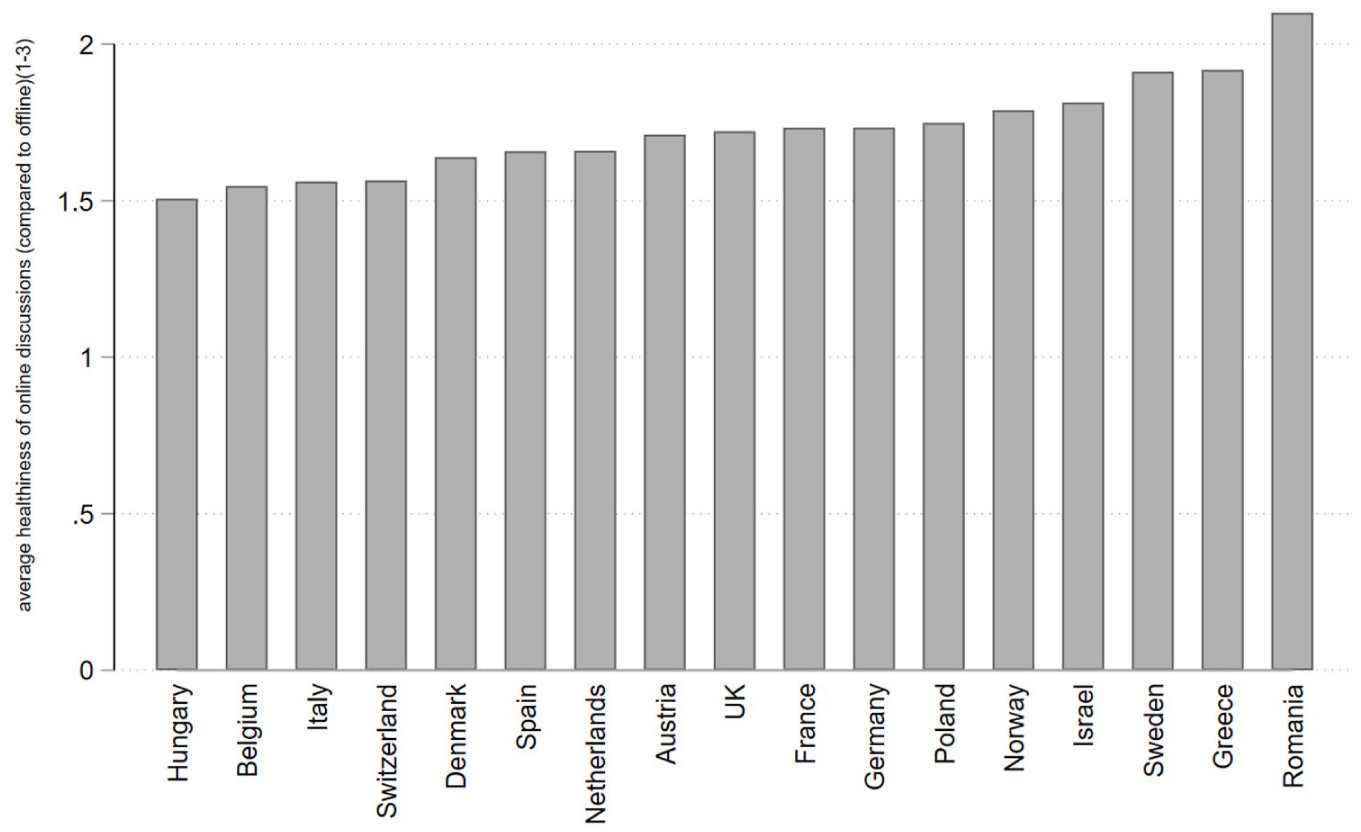
Perceived healthiness of online compared to offline discussions per country.
Turning to our hypothesis testing, results of a series of multilevel regression models with online political participation as the dependent variable provide support for the expectation that perceiving online discussions as healthier than offline discussions makes people more likely to participate online (H1, healthy discussions hypothesis). Table 1 shows unstandardized coefficients from a null model with no predictors (Model 1) and a second model with our main independent variable (healthiness in online discussions) plus further individual-level controls. 5 The fixed “healthy discussions” effect is significant and with the expected sign in Model 2. Model 3 includes an interaction term between healthiness and discussion fatigue to test H2 (i.e. that the association between perceived healthiness of discussions one witnesses online and participation is amplified by political discussion fatigue). The coefficient of the interaction term indicates that, for each unit increase in discussion fatigue, the positive effect of healthy discussions on participation increases by 0.027. This amplifying effect remains with the inclusion of further stand-alone variables and interactions on Model 6. Overall, Table 1 provides consistent support for our hypotheses across different model specifications, albeit the magnitude of such associations varies across countries, as we discuss below. Standardized estimates in Table A5 in the Supplemental Appendix show that the effect size of healthy discussions (β = .033) or their interaction with discussion fatigue (β = .025) is similar to that of age, gender, or education. Political discussion fatigue alone is strongly and negatively correlated to online political participation (β = −.136), compared to the strength of the relationships found for other independent variables.
Random-Intercept Regression Models of Online Participation by Perceived Healthy Discussions.

Note. Table reports unstandardized coefficients from random-intercept regression models.
p < .05; **p < .01; ***p < .001 (two-tailed).
The sign and size of the moderation played by political discussion fatigue are better illustrated in Figure 2. Figure 2 plots different regression slopes of healthy discussions on online participation for different levels of discussion fatigue. As the degree of discussion fatigue increases, the regression slopes are steeper and in the direction expected (increasingly positive). 6
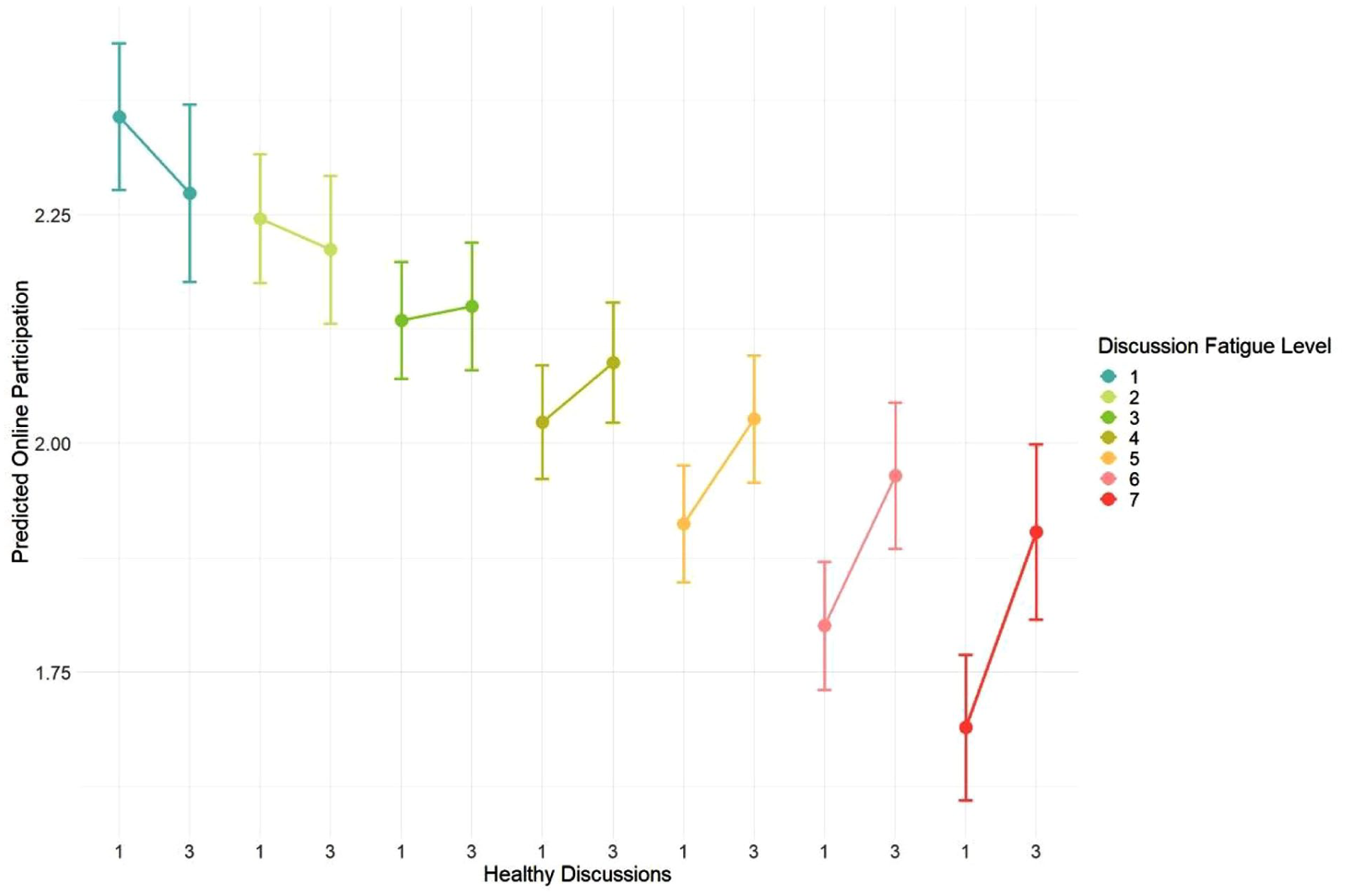
Healthy discussions on online participation by political discussion fatigue.
As for H3 (healthy discussions on online participation downplayed by how fun individuals perceive online discussions to be), Models 4 and 6 in Table 1 and Figure 3 show that perceived fun decreases the positive role of discussion healthiness in levels of individual online participation.

Healthy discussions on online participation by perception of online discussions as fun.
For those scoring the highest in “fun discussions,” healthy discussions play no role in one’s likelihood to participate online. In Models 5 and 6, we added an interaction term between healthy discussions and being frequently exposed to like-minded information online to address H4 (like-minded networks hypothesis). As one would anticipate, the coefficient of such interaction remains negative in both models, and regression slopes are steeper and more negative when we plot the impact of healthy discussions on online participation by like-minded social networks’ exposure (not shown, available from the authors). The interaction term is only significant in one of the two models (Model 5), however. Therefore, our analyses do not provide conclusive evidence that the ideological slant of information one is exposed to through social media plays a role in the extent to which individuals find healthy discussions mobilizing.
In addition, we also find that further features of one’s online social networks are positively associated with levels of online political participation. For example, in all our models, those social media users who frequently come across information about politics posted or shared by family or friends (close ties) or journalists and politicians are more likely to be politically engaged online. This result is in line with previous findings showing the important role of network expertise (Huckfeldt, 2001) or close surroundings and most trusted others in people’s processing of political information and political involvement (Klofstad et al., 2009). A further variable accounting for the extent to which individuals come across information shared or posted by people with opposed views to those of the respondent (cross-cutting in Table 1) shows a positive relationship with online political engagement, which is also consistent with previous research showing a positive correlation of both cross-cutting and like-minded exposure to political content with political interest (Garrett, 2009). However, further analyses using cross-cutting as an interaction with healthy discussions show it makes perceived healthy discussions no more or less mobilizing, also in line with Kosmidis and Theocharis (2020), who found incivility to encourage political action only among like-minded individuals (but see Liang & Zhang, 2021).
Finally, additional analyses showed that the association between perceived healthy discussions and participation lacks statistical significance when assigning a greater weight to less educated and older populations in certain countries where they were underrepresented compared to the census population (see Table A6 in the Appendix). Stemming from the variables included in the most restrictive Model 6 on Table 1 (with all interactions of theoretical interest), we also ran regression models by country (shown in Table A7 in the Supplemental Appendix). Albeit the variance of the country intercepts in Table 1 is not high, it is nevertheless statistically significant, which indicates some differences across countries worth exploring. A closer examination of our models by country revealed that the relationships were similar in size and direction in many countries considered but non-significant in a number of them. While discussion healthiness is associated with increases in online participation in the multilevel models (H1), it is not the case in all countries, and the relationship is negative and significant in Austria. Discussion fatigue typically amplifies the relationship between healthy discussions and participation (H2), but we also found that discussion fatigue downplayed such relationship in Belgium, Greece, Italy and Norway. Perceived fun decreases the positive impact of discussion healthiness on online participation (H3) in countries including Greece, the Netherlands and Sweden, but the overall effect is negligible in many of the remaining countries.
Discussion
In this article, we heeded the call for large-scale cross-national empirical evidence of why and for whom online (in)civility is mobilizing (Hopmann et al., 2015). Whereas some scholars have praised the online domain for providing unprecedented opportunities to revive and bring new voices into the public debate (Rowe, 2015), recent studies show that social media platforms are facilitating the spread of unrestrained and oftentimes inflammatory content, and that the internet, and social networks in particular, are increasingly being seen as fora where negative and uncivil political exchanges take place (Anderson & Auxier, 2020). Against this backdrop, in this study, we shed light on the extent to which such user perceptions are affecting levels of online political engagement across 17 countries. We found that perceiving one’s online discussions as healthy (compared to those encountered offline) tends to increase one’s likelihood to be politically active online, but that this relationship is affected by what we label as political discussion fatigue. For those experiencing discussion fatigue, that is, a sense of exhaustion triggered by the amount and the kind of political content they see on social media, it is particularly important that their online environment is no more uncivil and angrier than their offline interpersonal encounters. In other words, whereas for the least fatigued, the healthiness of online political discussions plays no role in their likelihood to participate online, for those scoring high in discussion fatigue, healthy discussions are important drivers of mobilization. In reverse, for those who are not worn-out by online political discussions but actually enjoy them and find them fun, we found that discussion healthiness is not associated with online political participation.
Our findings have several implications for and resonate with research on deliberative theory, the role of emotions in political engagement, and political and motivated reasoning theorizing. First, that perceived healthy discussions are positively associated with political participation squares well with previous normative and empirical approaches to deliberative democracy, which highlight the benefits of respectful and inclusive political conversation for people’s political awareness and civic participation (Habermas, 1984; Price et al., 2002). However, in our study, we also find that healthy discussions are not mobilizing for everyone and theorize that several psychological triggers might explain a great deal of such heterogeneous effects. While our study cannot test further underlying emotional mechanisms behind the mobilizing potential of healthy discussions, our results suggest that incivility in political discussions could elicit paralyzing emotions such as anxiety or fear among those experiencing high levels of political discussion fatigue, whereas mobilizing emotions such as anger or enthusiasm may be at play and reinforce previous political predispositions among those in like-minded social media environments, in line with previous experimental research in the political psychology literature. This emotional arousal could help explain why we find that being embedded in like-minded social networks encourages online participation and that it partially moderates the effect of conversation healthiness on participation, as theories of motivated reasoning posit. Future longitudinal and experimental research may better uncover the role of both emotional factors (anxiety, enthusiasm) and situational triggers such as discussions’ ideological homogeneity on the ability of online spaces to create discussions that are perceived as healthy and encourage political action.
Our study further addresses an important gap in the literature. To date, there is barely any cross-national study dealing with (perceived or actual) political incivility on social media, impoliteness, and their consequences (but see Otto et al., 2019 and Theocharis et al., 2016 for notable exceptions). Even less is known about potential moderators or mediators that can speak to the long-term mobilizing effects of exposure to online incivility, such as increased levels of political discussion fatigue in the online domain, as only a handful of US-based studies resorting to cross-sectional data analyzed these or related phenomena (i.e. Anderson & Auxier, 2020; Lane et al., 2024). Neglecting contextual factors that may favor more (or less) confrontational political interactions online limits the generalizability of research findings.
Hence, future research should delve into specific country-level determinants and include them in their research designs, as there are good reasons to expect that, for example, highly polarized settings or power-concentrating political systems (two-party, majoritarian systems and presidential systems) can provide favorable discursive opportunity structures (Eisinger, 1973; Koopmans & Statham, 1999) for online incivility to flourish (Castro & Nir, 2020; Rossini, 2020), as well as potentially explain some of the country differences uncovered in our study. In a similar vein, only very recently have scholars begun to explore uncivil behavior among US users of different social media platforms allowing for different levels of user anonymity or interactivity (see Sude & Dvir-Gvirsman, 2023). Further comparative studies should explore the role of various affordances or architectures in facilitating or constraining public debate and coming across uncivil rhetoric (Neubaum & Weeks, 2023) and also delve into underlying self-selection dynamics that explain various levels of discussion fatigue and perceived online incivility among users of different social media platforms, as such self-selection patterns have shown to affect political expression and participation in meaningful ways (Theocharis et al., 2023).
Our study is not without limitations. A caveat of our study is that it puts forth a rather minimalist definition of healthy discussion, in which we do not consider aspects adding to conversations’ deliberative quality such as how goal-oriented or substantive those political discussions are (Friess et al., 2021; Jaidka et al., 2019; Wessler & Rinke, 2014). Further measures of conversational health might provide a more comprehensive picture of the quality and deliberative performance of social media platforms. Second, we measure subjective online participation by relying on self-reported survey answers about the degree to which people post, comment, or share political information on social media. Reliance on online behavioral data (had that been an option) would have provided a more accurate prediction of people’s likelihood to participate on social media, since previous research shows that, for example, survey self-reports correlate with observed political posting online but overestimate levels of online political engagement for more politically interested individuals (Prior, 2009). Also, our results are generally robust to different model specifications, but we observe weaker associations between healthy discussions and online participation when we give a greater weight to older (albeit less representative of the online population) individuals. Finally, the use of cross-sectional data does not allow to rule out reverse causality. Further longitudinal studies with more balanced samples may help uncover both causal mechanisms and the stability of the patterns found in this study.
Overall, our study provides large-scale cross-national evidence of the mobilizing potential of healthy online political discussions, in a time when negative perceptions of social media as fora of deliberation are growing and discouraging citizens from engaging in public life.
Supplemental Material
sj-docx-1-sms-10.1177_20563051251350978 – Supplemental material for How do Healthy Political Discussions Invigorate Online Participation? Evidence from 17 European Countries
Supplemental material, sj-docx-1-sms-10.1177_20563051251350978 for How do Healthy Political Discussions Invigorate Online Participation? Evidence from 17 European Countries by Laia Castro, Yannis Theocharis, Agnieszka Stępińska, David Nicolas Hopmann, Christian Schemer, Toril Aalberg, Ana Sofia Cardenal, Nicoleta Corbu, Claes de Vreese, Frank Esser, Karolina Koc-Michalska, Jörg Matthes, Tamir Sheafer, Sergio Splendore, James Stanyer, Jesper Strömbäck, Václav Štětka, Peter Van Aelst and Alon Zoizner in Social Media + Society
Footnotes
Acknowledgements
The authors thank the editor and anonymous reviewers for improving this manuscript. The authors are also grateful to Alejandro de la Fuente for his valuable assistance. The authors also thank attendees at presentations at the International Communication Association for advice and suggestions on a previous version of this paper.
Funding
The authors disclosed receipt of the following financial support for the research, authorship, and/or publication of this article: This project was financially supported by the Network of European Political Communication Scholars (NEPOCS). Data collection in Denmark was supported by the University of Southern Denmark. The collection of data in Hungary and Poland was supported by the Economic and Social Research Council (ES/S01019X/1). The collection of the data in France was supported by an Audencia Foundation grant. The collection of data in Sweden was supported by the research project “Knowledge resistance: causes, consequences, cures,” funded by Riksbankens Jubileumsfond. Y.T. would like to acknowledge the support of the ZeMKI Lenkungskreis, which generously contributed to funding this research.
Declaration of conflicting interests
The authors declared no potential conflicts of interest with respect to the research, authorship, and/or publication of this article.
Supplemental material
Supplemental material for this article is available online.
Notes
Author biographies
 )
)
References
Supplementary Material
Please find the following supplemental material available below.
For Open Access articles published under a Creative Commons License, all supplemental material carries the same license as the article it is associated with.
For non-Open Access articles published, all supplemental material carries a non-exclusive license, and permission requests for re-use of supplemental material or any part of supplemental material shall be sent directly to the copyright owner as specified in the copyright notice associated with the article.
