



Abstract
Despite incivility in online discussions being linked to various negative effects, less is known about the mechanisms of how incivility works. So far, explanations by social perception have been neglected. Therefore, drawing on the multiple inference model, this study employs an attribution theoretical approach to examine whether the motives and traits that people attribute to senders of uncivil or opposing comments affect their intentions to join a discussion. Employing a 2 (incivility vs. no incivility) × 2 (like-minded vs. opposing stance) between-subjects design, data from an online experiment (N = 452) were analyzed applying a path model (SPSS AMOS). Results revealed that participants attributed more aggressive and less nonaggressive motives to senders of uncivil messages. The attribution of aggressive motives consequently increased hostile inferences about the target. A similar pattern occurred when individuals were exposed to an opposing stance. In result, hostile inferences about the sender’s traits decreased participants’ willingness to discuss.
Keywords
Introduction
Exchanging opinions and ideas in a respectful and constructive manner is an essential part of our democracy (Herbst, 2010). Although the Internet has the potential to foster the public discourse by connecting citizens with different views, scholars noticed that the online political exchange has become increasingly uncivil (e.g. Coe et al., 2014). Therefore, incivility in online political discussions has received increasing scientific attention. Scholarship has demonstrated that the exposure to incivility fosters negative emotions, increases disagreement, and decreases open-mindedness toward opposing stances (Chen and Lu, 2017; Hwang et al., 2018). Moreover, incivility was found to discourage users from participating in online discussions (Han and Brazeal, 2015) and, consequently, threatens diversity in political online debates. Although this is a very serious effect, little is known about the underlying mechanisms of how incivility discourages individuals from joining discussions. While there is scholarly consensus on the subjective nature of incivility (Chen et al., 2019), it is usually treated as a distinct attribute of messages or discussions. This perspective, however, overshadows that social perception directs how people explain others’ behavior. Considering that online discussions are characterized by the social exchange between citizens, we assume that people do not refrain from discussing with others because they simply see an uncivil message. Rather, we assume that the negative assessment about the sender of an uncivil message drives this decision. In other words, people do not want to discuss with others they consider to be “idiots.” The question is however, how do people come to such an assessment?
In this vein, attribution theories are helpful to understand how people assess incivility from an interpersonal perspective. Put broadly, these theories describe how individuals explain others’ behavior by making casual attributions and/or by forming impressions about the actors. Based on these assumptions, the multiple inference model (Reeder, 2009; Reeder et al., 2002) was developed to approach attribution processes from the perspective of social perception. The model suggests that perceivers make inferences about traits and motives within others to understand their reasons for acting. These judgments can determine whether people classify the observed action as hostile and drive their reaction (Anderson and Bushman, 2002). Thus, the attributions recipients make about senders of uncivil messages is important because they influence whether people expect this behavior to persist.
However, it is unlikely that people will be assessed solely on the wording they use in their comments. In online discussions, individuals are often confronted with opposing views. Research indicates that the stances represented in discussion comments influences how people feel about and react to uncivil messages (Chen and Lu, 2017; Gervais, 2017). In this respect, the self-categorization theory (Turner et al., 1987) states that people favor individuals from social groups with whom they share certain similarities and discriminate against individuals with whom they do not identify. This basic human tendency has been shown to bias attribution processes in favor of like-minded individuals (Reeder et al., 2005). Hence, we expect that the sender’s stance represented in a comment is of importance for how messages are construed by the recipients.
Based on the assumptions of the multiple inference model (Reeder, 2009), we conducted an online experiment to investigate whether individuals attribute more aggressive motives and hostile traits to a sender of an uncivil message compared with a sender of a civil message. Following the self-categorization theory (Turner et al., 1987), we further examined the impact of the comment’s represented stance on this process. We also investigated how the resulting assessment influences recipients’ willingness to join the discussion. As social perception is affected by individuals’ own attributes, the influence of perceivers’ personality was examined, too. In doing so, we focused on peoples’ “dark side” of personality since incivility is considered as anti-normative behavior.
Literature review
Incivility in online public discourse
On a basic level, incivility has been conceptualized as the violation of social norms of interaction (Jamieson and Hardy, 2012). Therefore, research has often focused on the use of disrespectful or insulting language to conceptualize uncivil online behavior. For instance, Coe et al. (2014: 600) defined incivility as “features of discussion that convey an unnecessarily disrespectful tone toward the discussion forum, its participants, or its members.” However, the concept of incivility is subjective by nature (Herbst, 2010). In this vein, Chen et al. (2019) suggested that incivility should be assessed by its outcomes rather than being based on the usage of particular words or phrases. However, the underlying mechanisms of how incivility affects individuals own behavior are not yet sufficiently researched.
Following the general aggression model (Anderson and Bushman, 2002), an integrative framework that explains aggressive behavior, humans develop different knowledge structures based on their experiences, including beliefs, attitudes, schemata, and behavioral scripts. These structures form an individual’s personality and guide how social events are appraised. The model proposes that person characteristics and situation-based factors influence an individual’s affect, cognitions, and feelings of arousal. These, in turn, impact how the individual appraises a social event by drawing inferences about the actor and the situational aspects. As a result, individuals decide on how to respond—that is, either in an aggressive way or not. In line with these assumptions, Rösner et al. (2016) found that uncivil comments can increase hostile cognitions. Other scholars showed that uncivil user discussions can affect feelings of anger, anxiety, or enthusiasm (Gervais, 2017; Hutchens et al., 2019). Moreover, it was demonstrated that incivility increases recipients’ own use of incivility (Chen and Lu, 2017; Gervais, 2017; Ziegele et al., 2018), their willingness to participate politically online apart from the discussion (e.g. Chen and Lu, 2017), and the likelihood of expressing disagreement (Hwang et al., 2018). Even more, Han and Brazeal (2015) found that people were less likely to join an online discussion when it was uncivil.
Nevertheless, the processes that mediate the relationship between individuals’ emotions and cognitions after exposure to incivility, as well as their behavioral intentions, remain largely unexplored. Here, the general aggression model provides a promising framework to explain the intersection between internal states and behavioral intentions.
Processing incivility from the perspective of attribution theories
To describe how individuals appraise other people’s behavior, attribution theories are usually accounted by social psychologists. These theories suggest that people rely on certain attributions about others’ traits and/or situation-related aspects when they want to understand others’ behavior. Reeder (2009), however, argues that behavior that is thought to be under the actor’s control is assessed differently from behavior that is thought to be performed against the actor’s will (e.g. stumbling or sweating). He states that only unintentional behavior is assessed by making single inferences drawn from the situation or the actor. In terms of intentional behavior, he postulates a multiple inference model suggesting that perceivers also search for the actor’s underlying motives under consideration of situational cues and combine them with trait inferences. In doing so, individuals obtain a comprehensive picture to explain others’ behavior, helping them to appraise a social situation (Reeder, 2009). This being said, it is very unlikely that individuals think that others accidentally write user comments. Moreover, there is robust evidence that people have a general tendency to overestimate the influence of dispositional factors like personality traits or attitudes as explanation for others’ behavior (i.e. fundamental attribution error; Ross, 1977). Therefore, writing uncivil comments is likely to be seen as a reflection of more stable characteristics of the sender and not as the result of situation-specific aspects that are only temporary.
In this respect, Reeder et al. (2002) demonstrated that people attribute more negative motives and traits to individuals who behave instrumentally aggressive compared with individuals who react to provocations. As incivility is associated with hostile cognitions (Rösner et al., 2016) and negative affect (Chen and Lu, 2017; Gervais, 2017), people presumably attribute aggressive motives to senders of uncivil messages, and nonaggressive motives to senders of messages not containing incivility. Therefore, we expect that (H1) compared with civil user comments, uncivil comments will (a) positively impact the attribution of aggressive discussion motives and (b) negatively impact the attribution of nonaggressive discussion motives.
Consequently, attributions of motives should also determine which traits are inferred about senders of uncivil comments (Reeder, 2009). Whereas the attributions of motives depend on people’s context-dependent behavior, traits are more stable inferences, helping individuals to predict others’ future behavioral patterns (Fiske, 1980). Thus, since individuals attribute more aggressive motives to others who comment in an uncivil way, they may have increased hostile thoughts regarding the commenter, leading to more hostile trait inferences. Accordingly, we assume that (H2) compared with civil comments, uncivil comments will positively impact the extent of hostile trait inferences through the indirect pathway of attributed motives.
The role of a comment’s stance
Although incivility within a comment assumably guides which motives and traits recipients attribute to its sender, the literature provides evidence that people process comments differently based on the stance represented therein. Chen and Lu (2017) found that comments arouse negative emotions and aggressive intentions if they directly disagree with the recipient’s viewpoints. Likewise, Gervais (2015, 2017) found that compared with like-minded incivility, uncivil disagreement induces feelings of anger and increases aversion toward the sender.
The self-categorization theory (Turner et al., 1987), postulates that people favor individuals from social groups to which they feel to belong (i.e. in-groups) and discriminate against individuals they regard as dissimilar (i.e. out-groups). Perceptions of boundaries between specific social groups and their members can depend on the specific situation and on which social identity is salient. In this vein, attitude (dis)similarity can trigger intergroup differentiation, which can in turn bias attribution processes insofar as people make more unfavorable attributions to individuals with an opposing stance (Kenworthy and Miller, 2002). Moreover, it was found that people attribute more negative motives and dispositions to individuals with dissimilar attitudes than to like-minded individuals (Reeder et al., 2005). When others challenge their views, people can have increased feelings of cognitive dissonance (Festinger, 1957). In such cases, individuals seem to misattribute the resulting unpleasant feelings to the presence of individuals from an out-group, and cope with dissonance by derogating the “others” (Cooper and Mackie, 1983). Consequently, we assume that (H3) compared with like-minded comments, comments representing an opposing stance will positively influence the attribution of aggressive motives for commenting and (b) negatively influence the attribution of nonaggressive motives.
In line with our aforementioned assumptions, we expect that (H4) compared with comments which support the recipient’s stance, comments which oppose the recipient’s stance will positively impact the extent of hostile trait inferences through the indirect pathway of attributed motives.
It remains inconclusive whether effects of incivility are dependent on the sender’s stance. Chen and Lu (2017) indicated that both civil and uncivil disagreement increased negative affect and aggressive intentions. In contrast, Gervais (2017) found that incivility only increases feelings of anger when advocating an opposing stance. Likewise, Hutchens et al. (2019) found an interaction effect of group identity and incivility.
For feelings of enthusiasm, it did not matter whether comments from in-group members were uncivil or civil. However, compared with uncivil comments, participants reported higher enthusiasm when exposed to civil comments from out-group members. Gervais (2017) argued that, compared with offensive like-minded incivility, like-minded incivility that highlights emotionality might be accepted more by individuals than uncivil disagreement. However, since there is no stable empirical foundation upon which to derive how the stance affects the processing of uncivil comments, we ask (RQ1): Is the attribution process proposed in H1 and H2 affected by the comment sender’s stance?
The impact of attributions on discussion behavior
As argued by the general aggression model (Anderson and Bushman, 2002) people’s appraisal of a situation results in more or less thoughtful actions. When enough mental resources are available and the behavior is regarded as important, people are more likely to act thoughtfully and the probability of responding aggressively decreases. Regarding online discussions, it was indeed demonstrated that individuals are less satisfied with the discussion and are less willing to participate therein when it is uncivil (Han and Brazeal, 2015). In this respect, individuals are generally less willing to write comments when they perceive low discussion standards (Springer et al., 2015). Accordingly, we expect that hostile trait inferences will decrease recipients’ willingness to join a discussion, because people do not expect an exchange with hostilely assessed individuals to be constructive. Therefore, we assume that (H5) hostile trait inferences will negatively predict recipients’ willingness to participate in a discussion.
Moreover, uncivil statements are more likely to result in uncivil responses than civil statements (Chen and Lu, 2017; Gervais, 2017; Ziegele et al., 2018) which is driven by individuals’ experienced anger (Gervais, 2017). We assume that this is the result of hostile trait inferences and therefore hypothesize that (H6) hostile trait inferences will positively predict recipients’ likelihood of uncivil commenting.
Gervais (2015) argued that criticizing uncivil commenters is a manifestation of aversion, as only unacceptable behavior is criticized. Although such critique can also be expressed in an uncivil manner, it does not necessarily have to be uncivil. When expressed in a civil manner, people might reappraise the situation and, as a result, act in more thoughtful ways (Anderson and Bushman, 2002). Consequently, we also expect that (H7) the extent of hostile traits that is inferred about the sender of a comment will positively predict recipients’ likelihood of expressing critique.
Impact of “dark” personality traits
So far, we have focused on comment characteristics to explain how people assess its sender. However, the perceiver’s personality is important, too. Stable personal characteristics reflect which knowledge structures individuals will consistently use (Anderson and Bushman, 2002). For instance, the dark triad personality traits, a personality model including narcissism (i.e. exaggerated feelings of grandiosity), psychopathy (i.e. lack of affect, self-control, and empathy) and Machiavellianism (i.e. increased tendency to manipulate others for personal gain), have often been found to correlate with various online antisocial behaviors such as cyber-aggression (Moor and Anderson, 2019). Yet, it is largely unclear how these traits influence the appraisal process of antisocial behavior. People high in psychopathy and Machiavellianism have repeatedly been found to lack social cognitive abilities such as empathy (Ali and Chamorro-Premuzic, 2010). Moreover, individuals high in psychopathy were found to have deficits in identifying interpersonal threats (Brankley and Rule, 2014). Notably, the latter study did not find that Machiavellianism affected the perception of threats. However, since Machiavellianism and psychopathy are highly intercorrelated (Ali and Chamorro-Premuzic, 2010), we assume that (H8) people scoring high both on (a) psychopathy and (b) Machiavellianism will be less likely to attribute aggressive motives for sending uncivil comments compared with people with low levels of these traits.
In contrast, narcissists are especially vulnerable to negative feedback (i.e. ego-threatening situations), which can result in extreme negative emotions (Li et al., 2016). Therefore, it is likely that individuals high in narcissism attribute more aggressive motives to others whose comments oppose their own stance, because this challenges their ego. Accordingly, it is expected that (H9) people high in narcissism will be more likely to attribute aggressive motives for sending comments with an opposing stance compared with people with low levels of narcissism.
Method
Within an online experiment, participants were exposed to a comment on Twitter that either did or did not include incivility and either opposed or corresponded to participants’ own stance. The survey was conducted from 16 August to 16 October 2019 and addressed a German-speaking population. All analyses were conducted using IBM SPSS 26 and IBM SPSS AMOS 26.
Sample
Participants were mostly recruited on Facebook via groups related to political discussions and via surveycircle.com (n = 215), an online platform for scientific surveys. Gift cards from an online retail store were offered as an incentive to take part in the study. In total, 469 individuals completed the survey, of which 17 participants were excluded based on unrealistic completion times and/or due to suspicious rating behavior. The final sample therefore included 452 individuals (254 females, one unspecified, four non-binary) aged between 14 and 78 years (M = 33.10, SD = 11.89). The majority stated that they had a university degree (61%) and most individuals were students (43%) or employees (39%). Participants located themselves rather on the left-leaning political spectrum: M = 35.10 (from 0 = far left to 100 = far right). Thirty-four percent of participants indicated that they commented on news on social media or posts of other users at least once a week.
Procedure and stimulus material
After a briefing, participants indicated their general position toward different social issues on a 7-point semantic differential (con—pro). This enabled participants to be allocated to like-minded or opposing comments. Participants who indicated being neither pro nor con regarding the relevant issue were not further surveyed as they could not be assigned to a condition relating to a comment’s stance. Remaining participants were randomly assigned to the experimental conditions and were exposed to a mock-up Tweet including one user response. The Tweet was sent from a mock-up Twitter profile which asked recipients for their opinion about a socially relevant issue. The user profile was labeled with a German unisex name and as profile picture a sunset was chosen. Since incivility can have differential effects according to the topic being discussed (Wang and Silva, 2017), we used two different issues to enhance the generalizability of the results. One topic addressed the legalization of marijuana (n = 227), while the other addressed the introduction of compulsory military service (n = 225). The accompanying user comment either supported or opposed the issue. Moreover, since Gervais (2017) argued that different forms of incivility (i.e. offending or emotional incivility) can trigger different reactions, the uncivil comment included either name-calling as an offending form of incivility or vulgarity as an emotional form of incivility, as these forms are the most common (Coe et al., 2014). However, the two forms of incivility were merged into a single factor as they were perceived similarly, resulting in a 2 × 2 between-subjects design for the main analyses. The control group was not confronted with any incivility. Depending on the experimental condition, participants were allocated to an uncivil or a civil comment that corresponded with the participant’s stance or opposed it (see Table 1 for details).
User comments employed in the study.
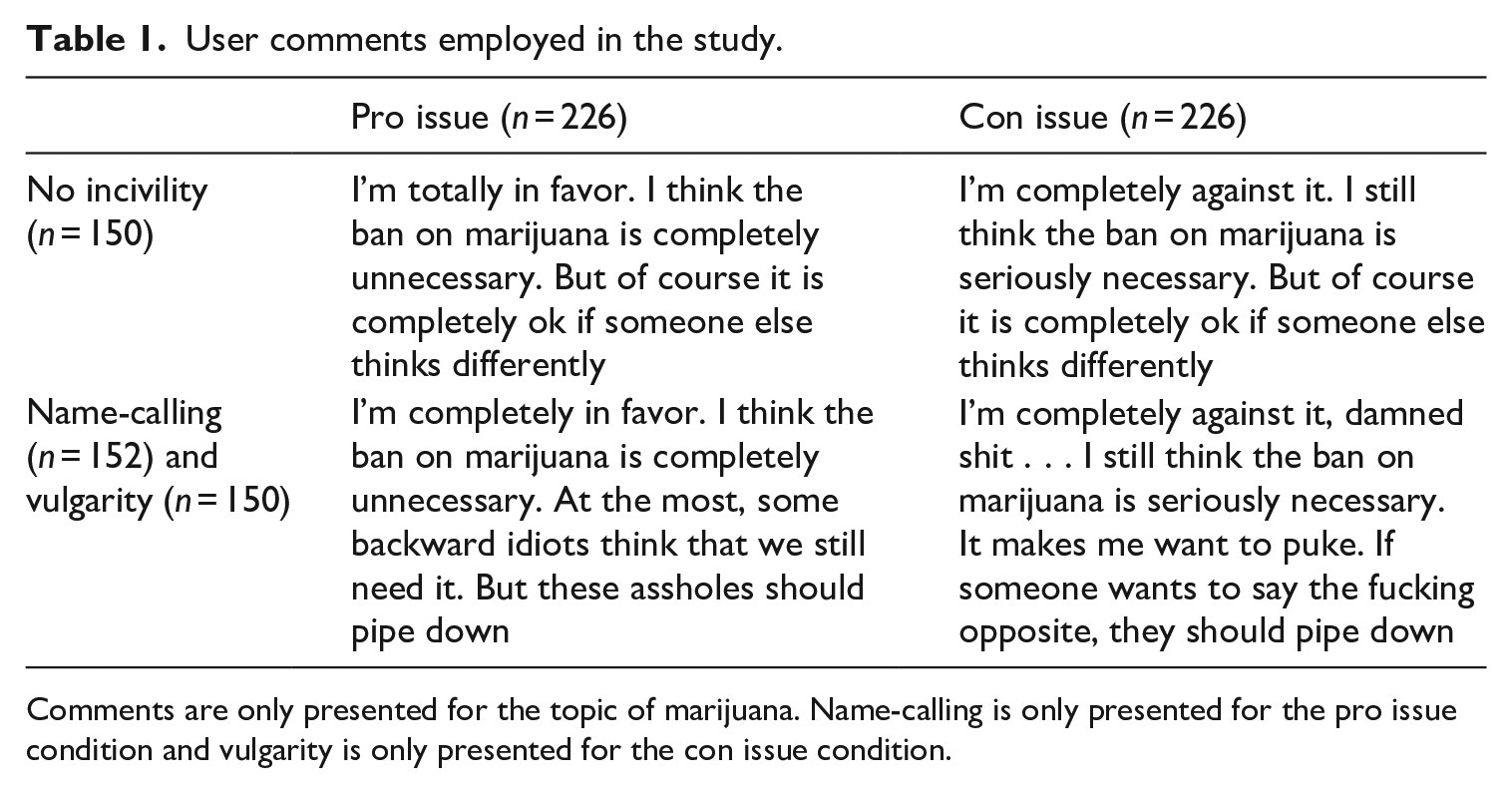
Comments are only presented for the topic of marijuana. Name-calling is only presented for the pro issue condition and vulgarity is only presented for the con issue condition.
After participants indicated whether they would participate in the discussion, they were requested to write a comment of their own. Then, in random order, participants assessed the manipulated comment according to the sender’s potential motives for writing the comment, the sender’s traits, and, as a control, the perceived incivility of the comment. Subsequently, participants rated the dark triad personality traits, and provided information about their social media use behavior and sociodemographic characteristics (gender, age, profession, and level of education). In addition, participants rated the relevance of the topic, the sender’s perceived intention when writing the comment, and the acceptability of incivility. However, since these variables were not relevant for our hypotheses, they were omitted from the present analyses.
Measures
When conducting confirmatory factor analyses (CFAs), items with factor loadings smaller than. 50 and/or residual covariances greater than .40 were removed (Kline, 2016). The model fit was assessed by common indices from the literature (Byrne, 2010; Hu and Bentler, 1999). Reliability was measured using Cronbach’s α.
Attributed motives
Since no measurements exist that operationalize attributed discussion motives, we constructed our own scale based on an explorative approach. To capture nonaggressive motives, we draw on items which were originally developed by Springer et al. (2015) to measure motives related to comment writing. However, the original items were designed for self-assessment. Therefore, we only selected items that we regarded to be transferable to third-person perception and modified them accordingly. Moreover, we only chose items that either focus the goal to discursively exchange with others (seven items from the interactivity dimensions) or on the goal to generate knowledge from the discussion (six items from the cognitive motives dimension) because these motives correspond to an interest in a constructive discussion with others.
To capture aggressive motives, we relied on the motivation aggression questionnaire (Ohlsson and Ireland, 2011). However, as the scale was neither developed for third-person perception nor for the online discussion context, items were selectively chosen and were modified, too. Again, we focused on items we considered to be transferable to others. As the distinction between proactive aggression and reactive aggression is emphasized in the literature (Ohlsson and Ireland, 2011), we constructed items that either addressed motives corresponding to aggression that is instrumental and planned (eight items) or addressed motives corresponding to aggression that is triggered by preceding provocation or threats (seven items).
Importantly, although we have built on existing measurements in the selection of the items, it was a self-constructed scale. Therefore, we used comprehensive statistical analyses to reliably identify distinct factors. An exploratory factor analysis (EFA) with principal component analysis and varimax rotation indicated a four-factor solution, which was confirmed by Horn’s (1965) parallel analysis. Based on EFAs with principal axis analysis and promax rotation for a fixed number of four factors, four items with low loadings on the main factor (< .50) and/or high loadings on other factors (> .20) were removed progressively. Based on the CFA, two items with small factor loadings and 13 items with high standardized residual covariances were removed. This led to a three-factor solution with a good model fit (χ² (24) = 41.395, p = .015, χ²/df = 1.73, CFI = .99 TLI = .99, RMSEA = .04 (90% CI = [.02, .06]), SRMR = .02). Four items loaded on the factor Aggression (e.g. “To disrupt the discussion”; α = .88), which was further employed as the aggressive dimension of motives. Three items loaded on the factor Interest (e.g. “To better understand others” or “because she or he is curious”; α = .87) and two items loaded on the factor Counteraction (e.g. “To counteract inappropriate comments”). As the latter factor only includes two items, we employed the Spearman-Brown coefficient as reliability check indicating a good reliability, too (ρ = .79). Motives related to interest and counteraction were employed as nonaggressive motives in the analyses because both can be considered as norm-conforming behavior indicating sincere willingness to discuss with others. Surprisingly, no factor emerged that captured motives related to interpersonal exchange (e.g. “to discuss with others”). However, as the comment used did not ask a question or addressed another comment, participants probably did not consider such motives as pivotal. All items used for the scale construction are presented in Supplemental Appendix 1 (see Table A1).
Hostile trait inferences
Hostile trait inferences were operationalized by the derogation subscale of the hostile automatic thoughts scale (Snyder, 1997), which measures hostile thoughts about others including different hostile trait assessments. However, the scale is not limited to trait-related thoughts, but also measures other kinds of hostile thoughts. Given that the multiple inference model (Reeder, 2009) exclusively addresses trait inferences, we only employed five items in the analysis that explicitly refer to traits 1 (e.g. “what an idiot!”), providing a good reliability (α = .92). Moreover, the scale correlated strongly (r = .91, p < .001) with the other five items (α = .90).
Willingness to comment
Participants’ willingness to comment in the discussion was measured with two items, both rated on a 7-point Likert-type scale. One item asked: “How likely would you be to enter into the shown discussion to express your opinion?” (from 1 = highly unlikely to 7 = highly likely). The other item asked: “If you had the possibility, how likely would you be to write a comment on this post?” (from 1 = highly unlikely to 7 = highly likely). The scale showed a good reliability (Spearman–Brown’s ρ = .87).
Uncivil commenting and critique expression
Participants were requested to write a comment regardless of their actual intention to join the discussion. To measure incivility and expressions of critique, a content analysis was performed. Incivility was coded based on conceptualizations commonly employed in the incivility literature (Coe et al., 2014; Stryker et al., 2016). To code expressions of critiques, we relied on Gervais’ (2015: 18) conceptualization of “posts in which specific personal qualities, behavior, and traits of the [comment writer] were negatively assessed.” A second rater, who was unaware of the hypotheses, coded 25% (n = 113) of participants’ answers, leading to an intercoder agreement of 98% (Krippendorff’s α = .88) regarding uncivil comments and 95% (Krippendorff’s α = .80) regarding expressions of critiques. Overall, 27 responses were coded as uncivil and 67 were coded as critique expression.
Dark triad
The dark triad traits were assessed based on the German adaptation of the short dark triad personality measure (Malesza et al., 2017), which measures each trait with nine items. Items were rated on a 7-point Likert-type scale (from 1 = I do not agree at all to 7 = I totally agree). Example items are “Most people can be manipulated” (for Machiavellianism; α = .80), “People see me as a natural leader” (for narcissism; α = .71), and “People often say I’m out of control” (for psychopathy; α = .72).
Perceived incivility
As a control, participants rated the comment regarding 21 adjective pairs on a 7-point semantic differential. The adjectives were adapted from the incivility literature (Chen and Ng, 2016; Kenski et al., 2017), but we also added items asking about how stimulating the comment is perceived to be (e.g. “motivating—demotivating”) and the perceived discussion value of the user comment (“constructive—destructive”) to obtain a comprehensive control measure. An EFA with principal component analysis and varimax rotation indicated a two-factor solution. However, we relied on Horn’s (1965) parallel analysis, which indicated a one-factor solution. Based on the CFA, one item with a small factor loading and 13 items with high standardized residual covariances were removed. The model with the remaining seven items provided a good model fit (χ² (62) = 35.701, p = .001, χ²/df = 2.62, CFI = 1.00 TLI = .99, RMSEA = .06 (90% CI = [.04, .08]), SRMR = .01). The final scale included the adjective pairs: “appropriate—inappropriate,” “polite—impolite,” “nice—mean,” “hostile—friendly,” “respectful—disrespectful,” “objective—subjective,” “cooperative—uncooperative.” The scale showed a very good reliability (α = .97).
Results
Preliminary analysis
To check whether people perceived the manipulation in the desired direction and to assess whether there are differences in the perception of name-calling and vulgarity, we conducted an ANOVA including the between-subject variables type of incivility and sender’s stance as independent variables and the perceived incivility as dependent variable. A significant effect of type of incivility on the perceived incivility was revealed (F(2, 446) = 569.66, p < .001, η² = .719). Bonferroni-corrected post hoc tests indicated that participants perceived comments including name-calling (M = 44.45, SD = .55) and vulgarity (M = 42.14, SD = .55) as significantly more uncivil than civil comments (M = 21.16, SD = .55, both p < .001). Although the difference between name-calling and vulgarity was also significant (p = .003, d = 4.2), the effect was relatively small. Moreover, there was no interaction effect between incivility and comment stance (F(2, 446) = .99, p = .372, η² = .004), implying that participants did not perceive vulgarity and name-calling differently based on the sender’s stance.
Attribution process
To test H1—H5 and our research question (RQ1), a path analysis with manifest variables and maximum likelihood estimation was conducted. The indirect effects were tested by using bias-corrected bootstrapping with 5000 resamples (95% confidence interval). To determine the model fit, common indices were employed. Since extent of incivility and expressions of critique in participants’ response comments were coded dichotomously, we additionally computed binary logistic regression models.
As preliminary analyses revealed only minor differences between the perception of name-calling and vulgarity, and no interaction between sender’s stance and the different forms of incivility was expected, comments including name-calling and comments including vulgarity were merged into one factor representing uncivil comments. Relying on contrast coding, cases in which participants were exposed to civil comments were coded as ‒1 and cases in which comments included name-calling or vulgarity were coded as .50. The model was well-fitting: χ² (6) = 11.230, p = .082, χ²/df = 1.87, CFI = .996, TLI = .983, RMSEA = .044 (90% CI = [.00, .08]), SRMR = .02. The complete model is visualized in Figure 1.
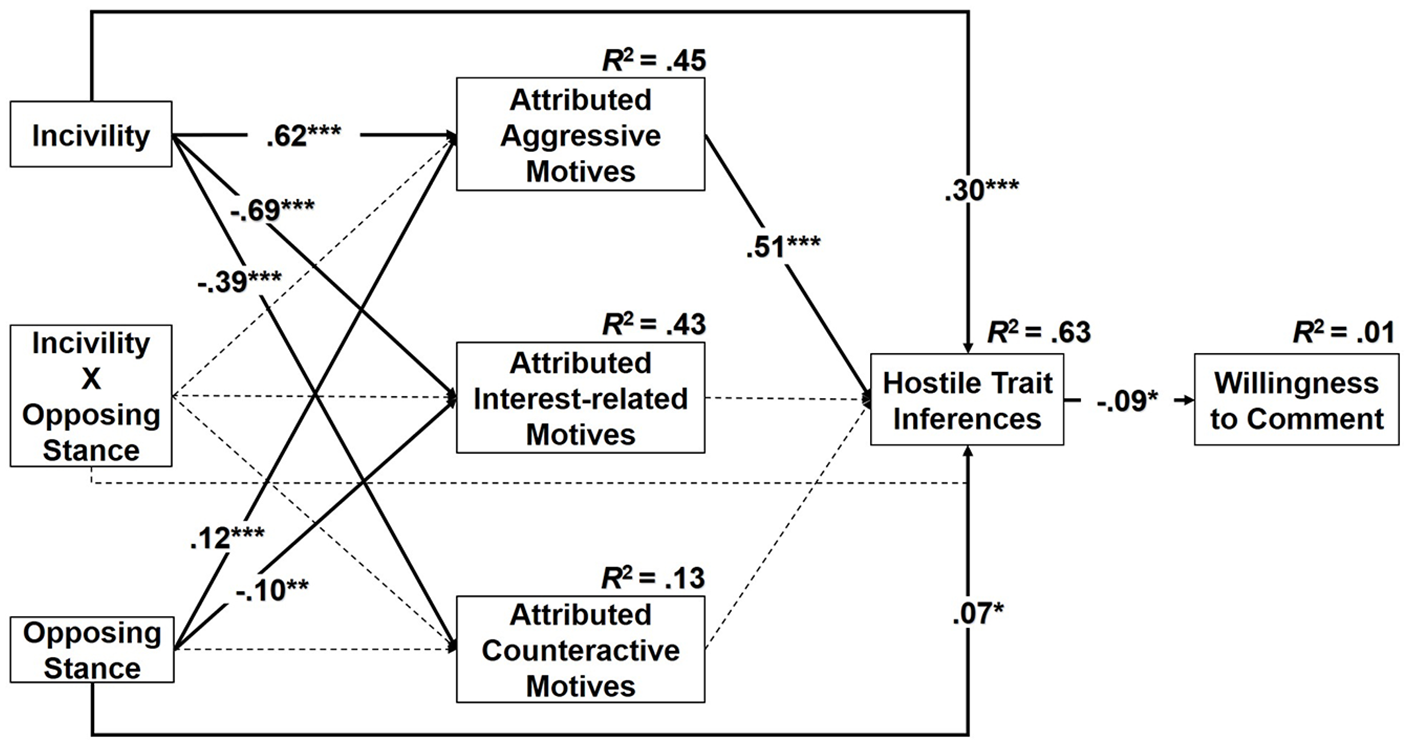
Path model (N = 452). Significant effects with standardized effect sizes are reported. Model fit indices: χ² (6) = 11.230, p = .082, χ²/df = 1.87, CFI = .996, TLI = .983, RMSEA = .044, SRMR = .02. Coding of incivility: vulgarity = .50, name-calling = .50, and no incivility = –1. Coding of stance: opposing stance = 1 and like-minded stance = 0. *p < .05; **p < .01; ***p < .001.
We assumed that uncivil comments would positively influence the attribution of aggressive motives and negatively influence the attribution of nonaggressive motives (H1a/b). Indeed, comments including incivility positively affected the attribution of aggressive motives (β = .62, p < .001) and negatively influenced the attribution of interest-centered motives (β = –.69, p < .001) and counteractive motives (β = –.39, p < .001). We also hypothesized that uncivil comments would positively impact hostile trait inferences through the pathway of attributed motives (H2). Supporting this assumption, aggressive motives positively affected hostile trait inferences (β = .51, p < .001), and we found a positive indirect effect of uncivil comments on hostile trait inferences (β = .36, p < .001, CI = [.29, .44]). Notably, neither the attribution of interest-centered motives (β = –.03, p = .415) nor the attribution of counteractive motives (β = –.06, p = .076) affected hostile trait inferences, indicating that the indirect effect is mediated by aggressive motives. Moreover, uncivil comments still had a positive influence on hostile trait inferences (β = .30, p < .001).
Furthermore, we expected that comments representing an opposing stance would positively affect the attribution of aggressive motives and negatively affect the attribution of nonaggressive motives (H3a/b). Indeed, we found that comments with an opposing stance (compared with a like-minded stance) positively affected the attribution of aggressive motives (β = .12, p < .001) and negatively predicted the attribution of interest-centered motives (β = –.10, p = .005). Stance did not affect participants’ likelihood of attributing counteractive motives (β = –.04, p = .405).
Again, we assumed that the comment’s represented stance influences the extent of hostile trait inferences indirectly through the attributed motives (H4). The hypothesis was supported, as comments with an opposing stance (compared with a like-minded stance) had an indirect negative influence on hostile trait inferences (β = .07, p < .001, CI = [.03, .11]). We also found a direct effect (β = .07, p = .012).
We additionally investigated whether there is an interaction effect between the comment’s stance and incivility (RQ1). However, the interaction of the experimental conditions neither affected the motives attributed to the sender (aggressive motives: β = .05, p = .286, interest-centered motives: β = .07, p = .161, and counteractive motives: β = .05, p = .440) nor the making of hostile trait inferences (β = .01, p = .856). Overall, 45% of the variance in aggressive motives, 43% of the variance in interest-centered motives, 13% of the variance in counteractive motives, and 63% of the variance in hostile trait inferences was explained.
H5 hypothesized that the result of the attribution process would affect people’s willingness to join the discussion. As expected, hostile trait inferences negatively predicted participants’ willingness to leave a comment in the discussion (β = –.09, p = .047), explaining 1% of the variance. 2 To test whether hostile trait inferences positively affect the usage of incivility (H6) and critique expressions (H7), for each endogenous variable, a binary logistic regression model was calculated. However, when including uncivil expressions as dependent variable, the overall model was not significant (χ(1) = 2.06, p = .151, Nagelkerke’s R2 = .01). Consequently, hostile trait inferences did not increase the likelihood of using uncivil expressions (b = .03, odds = 1.03, p = .159, CI = [.99, 1.07]). By contrast, when adding critique expressions as dependent variable, the overall model was significant (χ(1) = 21.637, p < .001, Nagelkerke’s R2 = .08). The data revealed an increased likelihood of expressing critique based on inferred hostile traits (b = .06, odds = 1.06, p < .001, CI = [1.03, 1.09]). It should be noted that Nagelkerke’s R2 was small, indicating a low explanatory power.
Moderation hypotheses
To calculate the hypothesized moderation effects, we employed the PROCESS macro (model 1) developed by Hayes (2018). Again, civil comments were coded as ‒1 and comments that included name-calling or vulgarity were coded as .50. Mean-centered construction of products was employed.
H8a/b assumed that persons who score high on psychopathy and Machiavellianism are less likely to attribute aggressive motives for sending uncivil comments. Supporting H8a, when psychopathy was included as a moderator, the overall moderation model was significant (F(3,448) = 124.15, p < .001, R2 = .45). Uncivil comments (b = 6.35, t(448) = 18.70, p < .001, CI = [5.68, 7.02]) as well as psychopathy (b = .07, t(448) = 2.26, p = .024, CI = [.01, .12]) predicted the attribution of aggressive motives. Likewise, the interaction of the variables had a significant effect on the attribution of aggressive motives (b = –.13, t(448) = –3.26, p = .001, CI = [–.21, –.05]). The 1% increase in explained variance was statistically significant (F(1,448) = 10.63, p = .001, ΔR2 = .01). Using the Johnson–Neyman technique, the data revealed that comments including incivility affected attributions of aggressive motives in 99.8% of cases (p ⩽ .05). However, when individuals had high scores on psychopathy (scores > 29.57), the effect was no longer significant.
H8b was not confirmed: Although the overall model was significant (F(3,448) = 115.75, p < .001, R2 = .44), only uncivil comments predicted the attribution of aggressive motives (b = 6.36, t(448) = 18.42, p < .001, CI = [5.69, 7.04]), whereas Machiavellianism did not affect the criterion (b = .04, t(448) = 1.39, p = .164, CI = [–.02, .09]). Likewise, no significant interaction emerged (b = –.02, t(448) = –.56, p = .573, CI = [–.09, .05]).
H9 claimed that high levels of narcissism would foster the attribution of aggressive motives when people are exposed to a comment representing an opposing stance. The overall model was significant (F(3,448) = 4.40, p = .005, R2 = .03). Comments opposing the participant’s stance (b = 1.68, t(448) = 2.63, p = .009, CI = [.42, 2.93]), and narcissism (b = .09, t(448) = 2.37, p = .018, CI = [.02, .17]), positively predicted the attribution of aggressive motives. However, the interaction of the predictors was not significant (b = .07, t(448) = .92, p = .361, CI = [–.08, .22]); H9 was therefore rejected.
Discussion
The purpose of the current study was to gain knowledge about how people process uncivil discussion comments as social perceivers and how this process affects recipients’ communication behavior. As expected (H1–H4), we found that, compared with a civil comment, an uncivil comment substantially increased the attribution of aggressive discussion motives and decreased the attribution of nonaggressive motives (i.e. interest-related motives and counteractive motives). Likewise, an opposing comment significantly increased the attribution of aggressive motives and decreased the attribution of nonaggressive motives (i.e. interest-related motives), though the effects were smaller. Moreover, incivility and an opposing stance significantly increased the extent of hostile trait inferences people make about the comment’s sender which was also indirectly affected through the pathway of attributed aggressive motives. Again, these effects were considerably stronger for incivility. In turn, hostile trait inferences had a small but significant effect on participants’ willingness to write a comment (H5). Furthermore, individuals were more likely to express critique when making higher hostile trait inferences (H6). Against our expectations, individuals were not more likely to comment uncivilly themselves when making increased hostile trait inferences (H7).
The finding that individuals attribute more aggressive motives to others’ uncivil behavior is probably triggered by an aversive internal state. Such comments increase recipients’ negative emotions and cognitions (see also Chen and Lu, 2017; Gervais, 2017; Rösner et al., 2016), likely leading to more hostile inferences about the sender. Thus, this study demonstrated that uncivil discussion comments crucially guide how people assess its sender. Noteworthily, the comment’s stance influenced inferences about the sender’s motives and traits regardless of the level of incivility. A potential explanation could be that, due to cognitive dissonance, dissent within a discussion causes negative feelings, which are misattributed to individuals who disagree with one’s own stance (i.e. the out-group) to resolve the arising dissonance (Cooper and Mackie, 1983).
The data also revealed that incivility negatively affects the attribution of nonaggressive motives such as interest-based motives (i.e. interest in others opinion and curiousness) and counteractive motives (i.e. countering inappropriate comments). Likewise, the attribution of interest-based motives decreased when the comment included an opposing stance. Thus, comments that are like-minded and civil are probably more likely to cause a positive internal state (e.g. enthusiasm; Hutchens et al., 2019). Interestingly, only incivility affected the attribution of counteractive motives, while the stance did not. Assumably, people expect that individuals who write civil comments aim to prevent subsequent comments from being written in an uncivil manner. However, neither the attribution of interest-related motives nor the attribution of counteractive motives decreased hostile trait inferences. One potential explanation for this tendency is the negativity bias which suggests that people give more weight to unpleasant experiences (e.g. uncivil comments) because negative impressions are quicker to form (Baumeister et al., 2001). Therefore, the attribution of aggressive motives may weigh heavier when making trait inferences than the attribution of nonaggressive motives. However, as we did not test such effects, further research is necessary to understand why only aggressive motives affect hostile trait inferences.
We also explored whether there is an interaction effect between a comment’s represented stance and the presence of incivility (RQ1). Although both manipulations significantly influenced the attribution process, the interaction neither affected hostile trait inferences nor the attribution of commenting motives. This contrasts with previous findings (cf. Gervais, 2017; Hutchens et al., 2019). However, these studies manipulated the partisan identification and not, as in the present study, the identification based on participants’ opinion toward a socially relevant issue. Disagreement with a topic alone does not seem to affect which attributions individuals make about the senders of uncivil comments. Consistently, Chen and Lu (2017) found that topic-specific disagreement induces negative emotions and aggressive intentions regardless of whether being civil or uncivil. Thus, future studies should be aware that an opposing partisanship is possibly more likely to alter the effects of incivility than issue-specific disagreement.
We further expected that the outcome of the attribution process (i.e. hostile trait inferences) would affect recipients’ own communication behavior (H5–H7). Indeed, participants were less willing to participate in the discussion when inferring higher levels of hostile traits about the sender of the comment. Probably individuals expect the discussion to be less valuable if the discussion partner was assessed hostilely. As people have the tendency to overestimate personality traits or attitudes as reasons for others’ behavior (Ross, 1977), they probably consider that the messages might change during the discussion but not the sender. Although this effect was small, given the range of potential factors that can influence whether individuals are willing to participate in a discussion or not, the effect is still significant. Moreover, this finding supports the idea that the attributional perspective can help to explain effects of incivility on its recipients. However, this approach might be especially helpful when investigating outcome variables that are directly related to the comment such as its persuasiveness. Noteworthily, in the current study, participants were only exposed to a single comment whereas, in reality, individuals are usually confronted with several comments simultaneously. Nevertheless, as a first approximation, it is important to understand the effects of a single comment.
The finding that hostile trait inferences only increase the likelihood of expressing critique and not of responding in an uncivil manner gives reason for optimism. From the perspective of the general aggression model (Anderson and Bushman, 2002), participants may have been more prone to make a reappraisal, resulting in a more thoughtful action. Notably, the proportion of participants who frequently comment in online discussions was relatively high in our sample (34%). As such, participants were presumably more likely to consider commenting to be a relevant behavior.
All in all, the findings demonstrate that in online political discussions people do not appraise comments detached from the sender and that both incivility and the stance of a comment can guide how the sender is assessed. People who write uncivil comments online should be aware that they might be assessed by others in an undesired way, including those who are holding the same opinion. Social media and discussion board providers therefore should educate users about these potential consequences. More concerning however is that, although to a lower degree, people also tend to attribute aggressive motives to senders of an opposing stance, no matter whether it is civil or uncivil. Such a tendency is likely to have negative effects on a culture of discussion that should be conducted at eye level. This is all the more important as we found a small but significant negative effect from hostile trait inferences on individuals’ willingness to discuss.
We also assumed that individuals who score high on psychopathy and Machiavellianism would attribute less aggressive motives to senders of uncivil comments (H8a/b). Indeed, the higher the participants’ extent of psychopathy, the less likely they were to attribute aggressive motives to the sender of the comment. Due to psychopaths’ lack of empathy, they are probably unaware that uncivil commenting can have negative effects on others, and thus do not consider it as aggressive behavior. An alternative interpretation is that people with high levels of psychopathy see themselves as superior and, therefore, see others as generally less threatening (Brankley and Rule, 2014). In the context of online discussions, psychopathy might cause individuals to consider others’ opinions as irrelevant, regardless of whether or not they are expressed in an uncivil manner. Thus, individuals high in psychopathy seemingly assess incivility differently than people who scored low on this trait. Considering the subsequent effects found in this study, this tendency could also lead to individuals with high levels of psychopathy being more likely to participate in uncivil discussions.
Contrary to our assumption, Machiavellianism did not affect the relationship between uncivil comments and the attribution of aggressive motives. Since people high in Machiavellianism tend to manipulate others for their own personal gain, they might have an enhanced ability to empathize when confronted with personal threats. However, it is largely unknown in which contexts people high in Machiavellianism accurately infer mental states about others and in which contexts they lack this ability (Ali and Chamorro-Premuzic, 2010). This study demonstrated that in the context of discussion incivility, people with high levels of Machiavellianism do not attribute significantly different motives to senders of uncivil messages than individuals low in Machiavellianism and, therefore, differs from individuals high in psychopathy. Further research is needed to understand the role of Machiavellianism in processing uncivil comments.
Furthermore, the effect of comment’s stance on the attribution of aggressive motives was not moderated by narcissism (H9). However, narcissism alone predicted the attribution of aggressive motives. In this regard, narcissists tend to anticipate future threats to the ego and are hypervigilant to ambiguous cues of potential threat (Martinez et al., 2008). Therefore, in online discussions, narcissists might expect that others will disagree with them regarding details of the issue or simply interpret comments as disagreeable when they do not exactly reflect their opinion.
The present study gives rise to some practical and theoretical implications. The results suggest that attribution theories (e.g. the multiple inference model; Reeder, 2009) are a promising supplement to the general aggression model (Anderson and Bushman, 2002), helping to explain how people appraise a social situation. Furthermore, the multiple inference model is not only helpful to understand how people explain others’ behavior but can also help to predict how people themselves behave (Reeder, 2009). Thus, the behavioral component should be accounted for within the model.
From a practical standpoint, as uncivil comments have the potential to bias attribution processes, senders of uncivil messages should be educated that uncivil commenting in discussions can lead to undesired impression making. A possible approach could be to employ auto-detection interventions. For instance, when using certain words or phrases, people could get informed about the potential effect of incivility on impression making and the recipients’ subsequent behavioral intentions. However, it has to be examined how effective such interventions are. Second, to mitigate potential negative effects of incivility and disagreement, that are the result of attribution processes, recipients of discussion comments should be beware that their impressions of others can be biased. Especially in the case of disagreement people should be more strongly sensitized for this. This could be realized by general guidelines such as netiquettes or by sporadically appearing advices embedded in discussion feeds. Moreover, if automatic detection identifies uncivil language in an initial comment, subsequent commenters could be advised to reconsider their attributions to diminish potential negative reactions.
Limitations and further directions
The generalizability of the findings is limited as the sample is not representative. Participants selected themselves for the study, resulting in a disproportionately high number of young, female and highly educated individuals. However, on a positive note, compared with previous findings (cf. Springer et al., 2015), we succeeded in recruiting a large number of participants who regularly comment online. Furthermore, we did not examine all possible motives and traits that can be attributed to senders of uncivil messages. Likewise, based on the current approach, other outcome variables like perceivers’ open-mindedness or perceived polarization could be examined. Moreover, the validity of the self-constructed measurement of attributed motives was not examined. However, this study provides first insights of which motives are attributed to discussion comments. Based on these explorative findings, future studies should refine the operationalization. Likewise, as the scale that measured perceived incivility showed a very high reliability, future research could further explore which items best capture the construct. Moreover, we only employed name-calling and vulgarity as types of incivility in the stimulus material. However, the umbrella of incivility compasses a range of other antisocial behaviors which probably cause different effects. Noteworthily, since participants wrote a comment regardless of their actual intention to do so, some individuals may have written a comment they would not write in reality. Likewise, although online surveys warrant a high degree of anonymity, individuals may have been more willing to respond in a civil manner than in a naturalistic setting due to social desirability bias.
Conclusion
This study has demonstrated that incivility can guide how its sender is assessed. Thus, incivility should not be considered as a simple characteristic of a discussion but rather as social act. Our results indicate that using incivility can crucially bias perceivers’ attribution of motives and traits. This is all the more important as the resulting trait inferences significantly influenced individuals’ willingness to join the discussion, albeit this effect was small. The same is true for individuals who hold another view than the recipient, though to a smaller extent. People seemingly still have to internalize that stating an opposing opinion in online discussions is not per se aggressively motivated. The results of the study give, however, also cause for optimism: People were not more likely to comment uncivilly themselves when making hostile trait inferences. Rather, they tended to criticize the person or the comment. Nevertheless, as these attributions partly explain why people are discouraged to discuss with others, it should be avoided that people come to such inferences. True to the motto: “Don’t be an idiot.”
Supplemental Material
sj-pdf-1-nms-10.1177_14614448211000666 – Supplemental material for “What an idiot!” – How the appraisal of the writer of an uncivil comment impacts discussion behavior
Supplemental material, sj-pdf-1-nms-10.1177_14614448211000666 for “What an idiot!” – How the appraisal of the writer of an uncivil comment impacts discussion behavior by Jan P Kluck and Nicole C Krämer in New Media & Society
Footnotes
Acknowledgements
The authors would like to thank the anonymous reviewers for their constructive and helpful feedback.
Declaration of conflicting interests
The author(s) declared no potential conflicts of interest with respect to the research, authorship, and/or publication of this article.
Note on submission
This manuscript describes original work that has not been published previously and is not under consideration by any other journal. All authors have agreed to the submission.
Funding
The author(s) disclosed receipt of the following financial support for the research, authorship, and/or publication of this article: This research was funded by the Digital Society research program funded by the Ministry of Culture and Science of the German State of North Rhine–Westphalia.

Supplemental material
Supplemental material for this article is available online.
Notes
Author biographies
References
Supplementary Material
Please find the following supplemental material available below.
For Open Access articles published under a Creative Commons License, all supplemental material carries the same license as the article it is associated with.
For non-Open Access articles published, all supplemental material carries a non-exclusive license, and permission requests for re-use of supplemental material or any part of supplemental material shall be sent directly to the copyright owner as specified in the copyright notice associated with the article.
