




Abstract
This research uses artificial intelligence and manual content-analysis to examine the diffusion of incivility against political leaders on Twitter during the 2022 Italian election campaign. Using a mixed approach (artificial intelligence and manual content analysis), we examined 22,465 uncivil tweets posted in the 4 weeks before the vote. Results show that hostility toward leaders increases as voting approaches and as candidates’ public visibility grows, and that it affects frontrunner leaders the most. Furthermore, the analysis of the different forms of incivility showed that it changes depending on the target it hits, revealing unexpected aspects: contrary to expectations, incivility against the only female leader (Giorgia Meloni) are not “sexist attacks” but forms of demonization (i.e., association with figures/symbols concerning totalitarian regimes); while against Giuseppe Conte, accusations of “illegality,” lies and “misinformation” prevail, that is, the same kind of incivility that he and his party use against opponents. Finally, we found that the authors of uncivil attacks are mainly ordinary/sporadic users, with all the consequences that this implies in terms of a normalization of incivility in public debate.
Keywords
Introduction
It is widely recognized by both observers and scholars that electoral campaigns have become inordinately dirty, ugly, and, above all, uncivil. This awareness confirms a global tendency of candidates and parties to increasingly engage in divisive, aggressive, and negative campaign strategies (Klinger et al., 2022; Nai, 2020; Nai et al., 2022). The 2022 Italian Parliamentary Elections appear to conform to this trend: a clear majority of citizens (80.7%) defined it, without hesitation, as “uncivil” (Bentivegna et al., 2024). To understand the reasons behind these evaluations, it is important to note that both the electoral campaign and the result of the vote were influenced by unprecedented factors. The election marked a historical shift in Italy’s post-war political landscape, with Fratelli d’Italia (FdI; Brothers of Italy), a party with neo-fascist roots led by Giorgia Meloni, winning a clear victory for the first time. This result was achieved against a backdrop of record low voter turnout, suggesting significant disengagement from the political process on the part of the electorate. The election also produced a gender landmark, as Meloni became Italy’s first female Prime Minister. The campaign took place, unusually, during the summer, over a short, well-defined timeframe of four weeks, and with a strong favorite to win (Giorgia Meloni). Moreover, the political discourse was strongly conditioned by a continuing economic and energy crisis, further complicating the electoral dynamics. These interrelated factors created a unique electoral environment that challenged traditional Italian political models and voting behavior. It is likely that the combination of a result favoring the far right and nationalist and conservative populism, a low turnout, and pressing economic concerns, led to a heightened perception of incivility in the election campaign. This complex scenario makes the 2022 Italian general election a particularly significant event in the country’s contemporary political history, providing a rich case study for examining the manifestation and perception of incivility in modern political campaigns.
This study focuses on citizens, investigating their potential contribution—as Twitter users 1 (now X)—to the “spectacle of incivility” fueled and/or reported by themselves. We examine the use of incivility by citizens in their Twitter discussions about political leaders. Ample research has demonstrated a prevalence of uncivil behaviors by citizens (Theocharis et al., 2020; Trifiro et al., 2021) in conversations with politicians on the platform. Thus, although social media (SM) is a vital habitat for the communicative agency of “affective publics” (Papacharissi, 2016), the presence of uncivil behaviors seems to hinder progress toward a more inclusive, open, and deliberative public sphere. The presence of incivility within political discourse on SM—documented by extensive literature (Coe et al., 2014; Theocharis et al., 2020; Trifiro et al., 2021; Ward & McLoughlin, 2020)—undermines SM as an arena for political discussion and dialogue.
Aiming to identify the factors influencing the spread of incivility, we analyzed this phenomenon on several levels: the temporal level (the extent and pattern of uncivil attacks during four weeks of campaigning), the targets of uncivil behavior, the types of incivility employed, and the authors of the uncivil posts. The following pages illustrate the theoretical framework and research hypotheses, specify the methodology employed, and present and discuss the results.
Overview of Dirty and Uncivil Campaigns
In recent years, concerns regarding the presence of offensive and uncivil language within online political discussions have given rise to systematic and continuous research (Gorrell et al., 2020). While criticism, conflict, and sharp judgments have always featured in politics, recent studies show that citizens’ use of SM to address political representatives often goes well beyond the expression of dissatisfaction or criticism (Ward & McLoughlin, 2020). The intent is often to publicly offend and delegitimize politicians with attacks based on personal, physical, or racial characteristics (gender incivility, racial discrimination, etc.), demonizing their image, accusing them of falsehoods, and deceiving the public. At times, the intention is even to incite physical violence against them (e.g., hate speech forms; Hua et al., 2020; Rheault et al., 2019; Ward & McLoughlin, 2020).
Apart from creating a toxic environment, exposure to incivility online is associated with an increase in polarization (Anderson et al., 2014) and a reduction in open-mindedness (Borah, 2014). Regarding the expressions of incivility among politicians, there has been an increase in citizens’ distrust and dissatisfaction with political institutions, representatives, and parties (Brooks & Geer, 2007; Cappella & Jamieson, 1997). As for uncivil interactions between citizens and politicians, it has been observed that harassment, aggressiveness, and offensive language from ordinary users primarily target political representatives who use SM to interact with users, extending beyond the exclusive publication of content (Theocharis et al., 2016). This provides justification for politicians who refrain from interaction to avoid hostility and aggression (Tromble, 2018).
Incivility and Online Political Discussion: Diffusion Dynamics and Propagation Factors
Scholars tend to agree that incivility is a slippery concept because it is “in the eye of the beholder” (Herbst, 2010, p. 3) and situated in a given time and space (Strachan & Wolf, 2012). The search for a more precise definition has been ongoing since Stryker et al. (2016) described political incivility as a three-dimensional construct of “Utterance Incivility, Discursive Incivility, and Deception” (Stryker et al., 2016, p. 547), and Muddiman (2017) introduced the distinction between personal incivility (impoliteness) and public incivility (lack of deliberativeness and reciprocity). Since then, the multidimensionality of the concept has been widely accepted among scholars (Bentivegna & Rega, 2024a, 2024b; Bormann et al., 2022; Hopp, 2019; Muddiman, 2019; Rossini, 2019; Stryker et al., 2016, 2024).
In this study we consider incivility as “a lack of respect for the social and cultural norms that govern personal interactions and the functioning of democratic systems” (Bentivegna & Rega, 2022, p. 4). We focus on its use against political leaders by citizens, who may thus violate the above-mentioned norms. Starting from this definition of the concept and taking into account the literature that considers not only the most traditional dimension, that of impoliteness, but also those that threaten “the collective traditions of democracy” (Papacharissi, 2004), we have identified the following types of political incivility: (a) discursive incivility, which refers to a lack of communicative reciprocity (Bormann et al., 2022; Hopp, 2019; Stryker et al., 2016); (b) vulgar incivility, which concerns the use of vulgar language (Coe et al., 2014; Kenski et al., 2018, 2020; Massaro & Stryker, 2012) against opponents; (c) informational incivility, which involves spreading false or inaccurate news to strengthen one’s own position, the use of persuasive deception, or slander (Hopp, 2019; Kenski et al., 2018, 2020; Stryker et al., 2016); (d) violent incivility, which implies the use of physical violence during a discussions in institutional venues or the threat to use force against people with whom one disagrees (Bormann et al., 2021, 2022), and (e) discriminatory incivility, which concerns the stigmatization of subjects/groups (immigrants, LGBTQ+, religious minorities, etc.), and the use of racist, sexist or religious epithets (Papacharissi, 2004; Rossini, 2019, 2020). The combination of these types constitutes political incivility in a multidimensional sense.
Alongside these dimensions, we also considered other specific types of incivility concerning citizens’ attacks on political subjects, including attacks on a leader’s competence and ability to perform the role of prime minister (Collignon & Rüdig 2021; Southern & Harmer, 2021) and insults aimed at politicians concerning illegal behavior (“thief,” “crook,” “convicted criminal”).
Against this background, the first level of analysis considered in this study is the temporal one: Theocharis et al. (2020) have shown that increases in incivility are usually driven by events and occur when public discussion is most heated. Ward and McLoughlin (2020) provide further evidence, demonstrating that peaks in incivility on Twitter directed toward UK politicians coincide with high-profile political events such as votes in the House of Commons and Prime Minister’s Questions.
Similarly, political scandals may provoke citizen incivility, in the form of sporadic expressions of frustration toward politicians (Theocharis et al., 2020). Election campaigns are critical for the concentration of uncivil messages against and between politicians (Gorrell et al., 2020; Theocharis et al., 2020; Ward & McLoughlin, 2020). The increase in aggression as the election approaches can be attributed to several interrelated factors. As noted by Garzia and Ferreira da Silva (2022), the approach of polling day often intensifies feelings of negative voting and hostility toward out-groups among voters. Gorrell et al. (2020) describe how uncivil attacks on candidates escalate close to election day, notably in association with appearances on television. This is attributable to the heightened stakes and enhanced media attention typical of the final stages of a campaign. Our first hypothesis is, therefore:
H1. The use of incivility to attack leaders increases as election day approaches and in the presence of more heated and mediatized moments of the public debate (candidates’ TV appearances, political scandals, etc.).
Regarding the second level of analysis (the targets of incivility), the literature shows that hostile behaviors are typically directed against politicians with the highest public profile (Gorrell et al., 2020; Theocharis et al., 2020). Ward and McLoughlin’s (2020) study highlights that being the leader of one of the two major parties (Labor or Tory) increases the likelihood of receiving insults and harassment. Focusing on the election campaign period, however, we must also consider the role of polls in increasing the visibility and public profile of candidates perceived as frontrunners. From this perspective, “negative campaign” research provides additional insights, showing that candidates leading in the polls are not only more likely to be attacked, but also more violently, due to their perceived strong position in the electoral competition (Auter & Fine, 2016). Attacking the frontrunner can be a strategic move to undermine their support and erode their lead in the polls (Klinger et al., 2022). In our view, this strategy can apply to both politicians and voters engaging in online discussions, as both are interested in weakening rival candidates. Hence, our second hypothesis:
H2. Citizens’ incivility predominantly targets frontrunner candidates.
Furthermore, extensive, mainly Anglo-Saxon, literature highlights the role of factors like gender, race, and ethnicity in predicting the targets of citizens’ uncivil attacks. In a study on British MPs, Gorrell et al. (2019) demonstrate that ethnic minority parliamentarians receive not only more racist abuse but also more gender-biased harassment, and that women are more susceptible to sexist attacks. While women are generally more frequently subjected to incivility than men (Southern & Harmer, 2019), the situation worsens when women hold high-profile positions in politics or journalism (Harmer & Southern, 2021; Post & Kepplinger, 2019; Rheault et al., 2019). Ward and McLoughlin (2020) report that female politicians attract more hate speech than men, and Trifiro et al. (2021) highlight that during the 2020 Democratic primaries, most uncivil conversations targeted Elizabeth Warren, the only female candidate in their survey. Finally, Gorrell et al. (2020) note that, in the 2019 UK election campaign, male candidates received more “political abuse,” but women received more “sexist abuse.”
Against this background, we should consider that incivility can be used to attack different subjects and takes specific forms depending on the characteristics of the target. Since we focus on an Italian political context still largely characterized by the limited presence of ethnic/racial minorities, we believe that the incivility used by citizens differs according to the gender of the target (it is more pronounced toward female candidates) and the political–ideological traits of each leader.
Therefore, our third hypothesis is:
H3. Incivility takes specific forms against different leaders and is more used against female candidates.
Moving on to the third level of analysis, we are interested in whether uncivil user interventions are systematic/coordinated or the result of occasional commentators. Coe et al. (2014) have shown that online forum incivility is the prerogative of frequent or sporadic commentators, and the latter tend to be more uncivil. Similarly, Ward and McLoughlin’s (2020) study on British representatives shows that hostile tweets are distributed among many users and are not the product of “serial transgressors” or organized groups. Furthermore, the longitudinal study by Theocharis et al. (2020) on tweets addressed to US Congress Members reveals that, contrary to a common journalistic and academic perception, incivility is not predominantly the result of the coordinated actions of “professional trolls.” More frequently, it is ordinary users’ posting activities that spread incivility online, with all the negative consequences of a tendency to normalize the phenomenon. In this sense, platform affordances help make Twitter ideal for sporadic interventions by users, targeting someone or adopting uncivil “hit and run” type behaviors. Such behavior would be encouraged by the disinhibition experienced when operating within impersonal digital environments lacking the social references and constraints of face-to-face communication.
These considerations underlie our final hypothesis:
H4. Uncivil tweets directed at leaders are carried out by various users who occasionally intervene.
Data and Methods
The research examined tweets published from Monday, 29 August, to Sunday, 25 September (4 weeks) containing at least one reference (mention, reply, hashtag, last name) to the following leaders: Giorgia Meloni (618,271) (Fratelli d’Italia, FdI [Brothers of Italy]), Giuseppe Conte (495,775) (Movimento 5 Stelle, M5S [Five Star Movement]), Matteo Salvini (318,361) (Lega [League]), Carlo Calenda (177,978) (Azione [Action]), Enrico Letta (256,327) (Partito Democratico, PD [Democratic Party]). Tweets published on voting day, which theoretically should be characterized by electoral silence, were included, because such silence was not observed on Twitter, and many candidates posted content relevant to our analysis. 2 Out of a total of 1,866,712 tweets, 276,670 were found to be uncivil (14.8%). The identification of uncivil tweets was carried out using an algorithm trained following manual categorization by analysts.
Automatic Detection of Incivility
For this study, we adopted the Italian version of BERT, pre-trained on a corpus based on Wikipedia, consisting of 2,050,057,573 tokens (“bert-base-italian-cased” by Hugging Face). For fine-tuning, we used the PyTorch environment and the TextClassificationPipeline from the Transformers package (AutoTokenizer and AutoModelFor Sequence Classification were also used). Based on the dataset manually analyzed for binary classification (used for algorithm training), the best-performing model was created by setting the learning rate to 2e-5 and the weight decay to 0.01. Evaluation was conducted at each epoch for a total of 10 runs. The best model achieved an accuracy of approximately 85% and identified 276,670 uncivil tweets (14.8%). From this dataset, random samples of tweets were extracted (10% according to a stratified proportional sampling defined with respect to weeks and leaders), which were manually examined by 6 coders through a content analysis sheet. The removal of false positives and manual verification of the algorithm’s output led to the identification (and coding) of 22,465 tweets, 9,300 containing references to Giorgia Meloni, 6,072 referring to Giuseppe Conte, 3,512 to Matteo Salvini, 1,851 to Carlo Calenda, and 1,730 to Enrico Letta.
Content Analysis
Manual analysis of the tweets aimed to identify: (1) purpose (attack and/or defense), (2) target of attack and/or defense, (3) type of incivility. To operationalize incivility, based on existing literature, we coded tweets as “uncivil” if they included one of the types described in Table 1.
Types of Incivility.

Regression Models
To identify the role of variables (such as types of incivility and the week in which it was posted) in favoring the likelihood of leaders receiving uncivil tweets from users, several binary logistic regression models were constructed. So, we first filtered only those attack tweets against leaders classified as uncivil, in their exclusively or mixed mode—resulting in a subset of 13,026 tweets. Then, we identified the key dependent variable for each leader specifically, considered one at a time (Y = 1) compared with all other leaders (Y = 0). For our analysis, besides the forms of incivility, we also considered the week of tweet publication. Both were recoded as dummies. However, unlike the weeks for which the last 7 days of the election campaign were chosen as the reference mode, for the forms of incivility, all dummies were included in the models as these were defined as a multiple-response set.
Metrics for Coordinated Tweeting Activities
To determine whether uncivil tweets were produced by a small group of very active users or a larger number of users who sporadically participated in the electoral debate, we used the Gini coefficient, a traditional metric for detecting the degree of concentration/equidistribution. Following the studies by Steinert-Threlkeld (2017) and Theocharis et al. (2020), we calculated the degree of inequality in the distribution of user interventions and graphically presented these results through the usual Lorenz curve. Furthermore, to better appreciate the differences recorded in this regard among different leaders, we calculated the Gini coefficient for each subset.
Results
Political Discussion on Twitter: How Much Incivility and With What Timing?
Before examining the results of the investigation and addressing the research questions, some contextual data can facilitate a better understanding of the presence of incivility during the 2022 campaign. The analysis of interactions between citizens and candidates revealed that 14.8% of tweets containing at least one reference to one of the five leaders under examination are characterized by the presence of incivility. This seems to be in partial discontinuity with previous research conducted in the United States, which showed higher percentages. For example, Trifiro et al. (2021) found that the average of uncivil tweets directed at the three Democratic primary candidates in 2020 was 22.5%. Similarly, in the study by Theocharis et al. (2020), the daily average of uncivil tweets responding to or mentioning members of Congress was 25%. However, in the United Kingdom, the percentages decreased significantly; for instance, in the study by Southern and Harmer (2021), the average of uncivil tweets was 9.8%. This demonstrates that the analytical context, alongside other factors (e.g., research design, 3 methodology, operationalization of incivility), plays a pivotal role.
As for the goals behind the use of incivility, it is not surprising to find that most uncivil tweets referencing the five leaders are intended to “attack” the target (16,557), while another portion of tweets includes both attack and defense objectives (5,812 mixed tweets). Of the uncivil interventions solely for attack purposes (16,557), 70.9% target the leader and/or their coalition, while just under a third (29.1%) are directed at other subjects (other parties, journalists/celebrities, citizens). Furthermore, among the mixed tweets (5,812), those defending the leader number 3,639 (62.6%), and within this subgroup, Giuseppe Conte is the most defended leader (59.8%), followed by a considerable margin by Giorgia Meloni (28%), Matteo Salvini (6.7%), Carlo Calenda (4.2%), and Enrico Letta (1.3%).
Regarding the temporal level of the analysis (Figure 1), the data suggest a trend of uncivil attacks during the four weeks of the election campaign, with the highest concentration of such attacks during the final week. This could indicate, in line with our first hypothesis (H1), that as election day nears there is a growth in hostility on the part of both political leaders and citizens. However, it is important to note that this trend could partly reflect a general increase in political engagement as the election approaches, with politicians on the one hand, and citizens on the other, becoming more active in political discussions. The results also show a weekly trend, with spikes in uncivil tweets on weekends, possibly due to increased activity on SM during leisure time. Here also we may be witnessing a general increase in political communication, including uncivil messages. Further analysis would be needed to disentangle these different influences and confirm the specific relationship between proximity to elections and incivility.

Tweets against leaders by day: line chart.
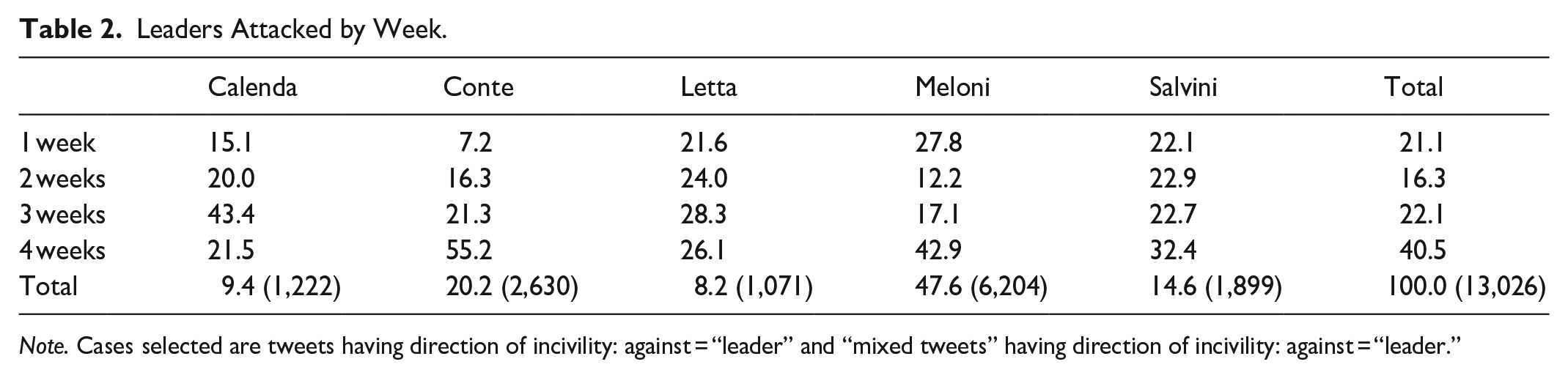
While this discussion concerns the dynamics of incivility against the leaders considered collectively, it becomes interesting to see what happens in relation to each of them individually (see Table 2). Starting with Carlo Calenda, it emerges that, as we expected, almost half of the uncivil interventions against him occurred during the third week when a sexual scandal involving the president of his party erupted, confirming how campaign scandals act as trigger-events (Boydstun, 2013).
Leaders Attacked by Week.
Note. Cases selected are tweets having direction of incivility: against = “leader” and “mixed tweets” having direction of incivility: against = “leader.”
In addition to the trigger events, we must also consider moments of public visibility of political figures related, for example, to their television appearances and participation in highly publicized events/rallies. If we consider leaders’ appearances in prime-time talk-shows we can see that Conte attracted the highest number of uncivil attacks (55.2%) in the fourth week of the campaign (during which he was a guest on five TV programs). However, it is also true that Conte’s increased public visibility was progressive and concurrent with an unexpected regaining of popularity. The leader, in parallel with the campaign’s progress, consolidated more prominent positions in the polls and consequently increased media attention. Therefore, uncivil attacks against him constantly increased, from the first week (only 7.2%) to the second (16.3%) and the third (21.3%), culminating in the last week when, in addition to the talk-shows, the success of the campaign’s closing rally contributed to amplifying Conte’s visibility (it is noteworthy that in the first week, Conte was the only leader absent from all talk-shows).
As for Letta, hostility toward him was concentrated especially in the last two weeks (Table 2), during which his presence on talk-shows also increased (Dataset purchased from Osservatorio di Pavia, 2022). In other cases, the role of television appearances seems marginal: Salvini was more attacked in the last week when his TV presence decreased, while the peaks of incivility against Meloni were recorded especially in the first (one TV appearance) and the last week (two appearances).
Which Leaders Are the Principal Targets of Uncivil Attacks?
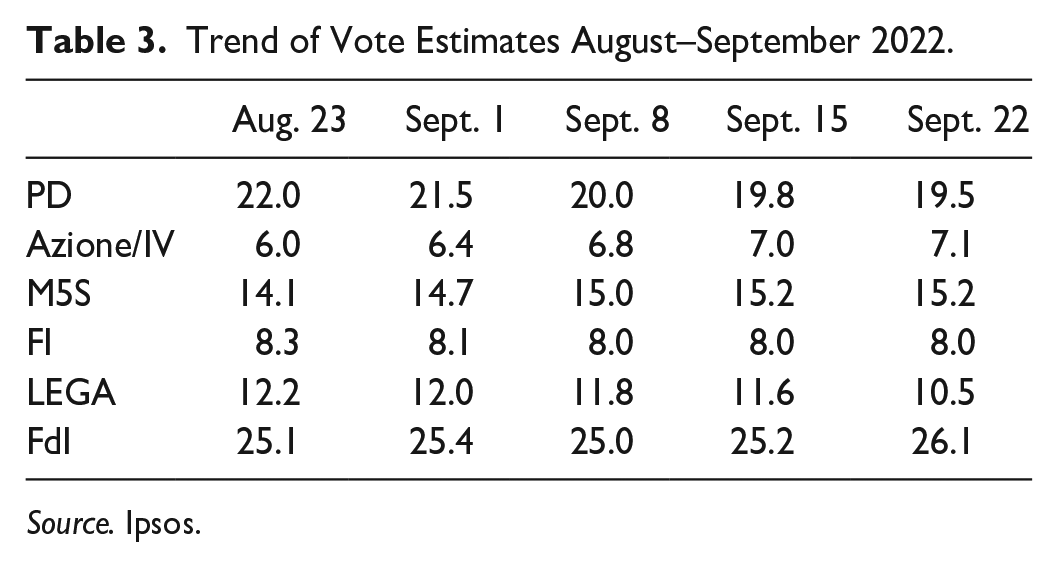
As for the second level of investigation concerning the leader-targets of hostile behaviors by citizens, the data confirm the validity of our hypothesis about the greater frequency of uncivil attacks against front-runner candidates. Observing Table 3, which reports the polling estimates between August 23 and September 22, it is immediately evident that FdI is the leading party in the polls throughout the campaign, making its leader the favored candidate and the preferred target of uncivil attacks.
Trend of Vote Estimates August–September 2022.
Source. Ipsos.
As confirmation of H2, it emerges that the highest number of uncivil attacks is directed against Meloni (Table 2): out of 13,026 uncivil tweets aimed at offending/attacking the leaders, a significant 6,204 target the female candidate-premier. At a considerable distance, we find Conte (2,630 tweets), Salvini (1,899), Calenda (1,222), and Letta (1,071).
Furthermore, regarding the target, we also assumed that forms of incivility change in relation to different leaders, and female candidates are more frequently subject to uncivil attacks (H3). Concerning the latter, in our research the only female candidate is Meloni, who, as we have seen, has also emerged as the front-runner throughout the electoral campaign. This makes it challenging to understand the validity of the gender variable’s effect—namely, was she targeted more because she was the favored candidate in the polls or because she was a woman? To help us address this, it is useful to examine the forms of incivility used against her, considering that female candidates are usually subject to sexist attacks and gender stereotyping (Gorrell et al., 2020; Harmer & Southern, 2021).
How Do Forms of Incivility Change in Relation to Different Leaders?
In Table 4, we present various forms of incivility adopted by citizens to attack the leaders. Besides the fact that insults and name-calling are the most common methods of attack for all candidates, some specificities are worth highlighting. Regarding the leader of FdI, demonization stands out as the most prevalent form of incivility, with 53.1% of the tweets attacking Meloni, followed by position attacks (22.4%), disinformation (16.6%), and so forth. In other words, when Twitter users attack Meloni, rather than resorting to gender-based incivility they highlight her perceived fascist roots (associated with figures/symbols related to totalitarian regimes) and her lack of respect for individual and minority rights. Sexist attacks were practically non-existent, a modality that we had initially anticipated in our content analysis. This does not imply the absence of violent attacks against her, instead, such violence was directed toward undermining and delegitimizing the leader because of her conservative and reactionary positions rather than solely because she is a woman (e.g., #BenitaMeloni, #ducetta).
Forms of Incivility by Leader Attacked (%).

Note. Cases selected are tweets having direction of incivility: against = “leader” and “mixed tweets” having direction of incivility: against = “leader.” Percentages are based on respondents; multiple response sets.
H3 seems to be supported by the data which shows a variation in the types of incivility used to attack different leaders. For example, as regards Conte (Table 4), after name-calling, disinformation is the method most used to attack him (32%), involving accusations of falsehood, lying, and deceiving citizens. Often referred to as “Pinocchio Conte,” the M5S leader is accused of being a “serial liar,” a “braggart,” and a “charlatan” who “lies while knowing he is lying.” Moreover, while frequent attacks on the leader portray him as incompetent (position: 19.8%), accusations of illegality (14.8%) are also notable. Conte is referred to as a “fraudster,” “criminal,” “corrupt,” and is often accused of using “mafia-like language,” especially concerning the “invitation” to Matteo Renzi to visit Sicily without a security escort. His case also includes fairly frequent forms of stigmatization and discrimination (14.5%), often used not only to discredit the leader but also to attack the entire M5S: @GarauSilvana There’s no point in explaining, you wouldn’t be able to grasp it, you of the M5S sect are mentally disabled, that explains how you follow #conte and that other clown who raised you by dint of “fuck you,” That’s all you are worth and all you can grasp!
As for Salvini, there is a certain affinity with what has been seen regarding Meloni. Demonization plays a substantial role here (38%), but the totalitarian imagery associated with the leader differs, primarily involving Russian (“pro-Putin,” “Russophile,” “aligned with the Kremlin”) and Nazi imagery concerning positions taken on immigration. For example (. . .) “[Salvini’s] way of portraying immigration is reminiscent of the worst Nazi propaganda.” Regarding Calenda and Letta, the forms of incivility used to target them are more evenly distributed.
To verify the consistency of the patterns of diffusion of uncivil attacks and the role played by different variables in favoring the likelihood of leaders receiving uncivil tweets, we conducted binary logistic regressions (Table 5). The independent variables, that is, the predictive factors included in the models, comprise the various forms of incivility, the week of tweet publication and the weekend variable, while the dependent variables indicate the presence or absence of an attack tweet directed at the considered leader (Y = 1) rather than at one of the other four leaders under comparison (Y = 0). Looking at the Exp(B) values, we find confirmation of some trends previously outlined and, at the same time, gain further insights into the phenomenon. First of all, the results show that the weekend variable takes an active role, particularly in relation to Calenda, followed by Conte and Meloni, while the association is negative for Letta and especially Salvini. This indicates that for the first three of these leaders, the probability of receiving uncivil tweets during the last 4 weeks of the election campaign was higher on weekends compared with the rest of the week.
Probability of Leaders Being Attacked: Binary Logistic Regression Models.

Note. Cases selected are tweets having direction of incivility: against = “leader” and “mixed tweets” having direction of incivility: against = “leader.” Calenda: Chi-square 597.99****, −2 Log likelihood 7,511.24, Cox & Snell R-square 0.05, Nagelkerke R-square 0.10, Percentage of correct classification 90.62. Conte: Chi-square 1,418.05****, −2 Log likelihood 11,686.90, Cox & Snell R-square 0.10, Nagelkerke R-square 0.16, Percentage of correct classification 79.76. Letta: Chi-square 628.30****, −2 Log likelihood 6,774.60, Cox & Snell R-square 0.05, Nagelkerke R-square 0.11, Percentage of correct classification 91.78. Meloni: Chi-square 1,826.17****, −2 Log likelihood 16.202.37, Cox & Snell R-square 0.13, Nagelkerke R-square 0.18, Percentage of correct classification 65.82. Salvini: Chi-square 391.34****, −2 Log likelihood 10,428.79, Cox & Snell R-square 0.03, Nagelkerke R-square 0.05, Percentage of correct classification 85.42.
p < .10; **p < .05; ***p < .01; ****p < .001.
Regarding the forms of incivility used to attack the leaders, it is confirmed that the presence of allegations of illegality (2.37) is strongly associated with attacks targeting Conte, while demonization (2.91) is associated with attacks against Meloni. As for Conte, however, the significance of disinformation (2.04) is evident, along with violent forms (2.03) and stigmatization (1.67). Notably, violence represents the most significant probability ratio, which is consistent with the information discussed earlier regarding Conte’s “mafioso” language against Renzi and his overall belligerent statements, almost inciting violence, during his campaign (e.g., #Conte: “Anyone who knowingly cancels the Rdc takes responsibility for igniting the fire and fomenting a social clash of epic proportions.” To me, these seem very serious statements, bordering on subversion). Indeed, violence represents a form of incivility that has been attracting increasing attention among researchers in recent years (cfr. Bormann et al., 2022; Muddiman, 2019).
Concerning demonization forms, their presence is negatively associated with messages attacking Conte (0.40), indicating that unlike the FdI rival, Conte is not perceived as a subject aligned with totalitarian figures/regimes. In terms of temporality, all 3 weeks have values lower than 1 because it is the last week (used as a reference mode) that is most associated with uncivil attacks against him, confirming what has been discussed regarding the temporal dynamics of incivility targeting him.
Moving on to Meloni, we find the odds ratios to be positive and fully significant for position (1.65), confirming that another recurring form of attack highlights her incompetency (among the most prevalent hashtags: #INCOMPETENTE_come_una_MELONI). On the contrary, the probability ratios are negative for violence (0.42), illegality (0.65), name-calling (0.70), and disinformation (0.78). This suggests that these types of incivility are less frequently found in tweets attacking Meloni, compared with those attacking the other four leaders. Concerning temporality, the first week is most associated with attacks against her (in addition to the last week). As for the Lega leader, hostility toward him is more likely to be expressed through violence (1.70) and name-calling (1.58). Notably, the latter, even though it was the most frequently used form of attack against all leaders, reaches significantly higher probability values in the case of Salvini (some commonly used name-calling examples: #SalviniPagliaccio, #SalviniNutellaro, #pupazzoprezzolato). Finally, regarding Letta and Calenda, no particular positive associations with forms of incivility are observed. However, we can observe the presence of interesting negative associations. The presence of demonization (0.23), position (0.42), stigmatization (0.55), and illegality (0.71) somehow exclude attacks against Letta. As for Calenda, however, the presence of position (0.48), demonization (0.54), illegality (0.61), violence (0.72), and disinformation (0.82) makes it more likely that attacks are directed against other leaders rather than against him. In terms of temporality, the third week is confirmed as most associated with the presence of uncivil attacks for Calenda (4.28), while for Letta, it is the second week (2.33).
Incivility Against Leaders: Ordinary User Spontaneity or Planned Disruptive Campaigns?
The last level of analysis focuses on the examination of users who post uncivil tweets, with the aim of better understanding whether manifestations of incivility result from coordinated campaigns and/or bots, or rather from occasional commentators. Following the approach of Theocharis et al. (2020), we calculated the Gini coefficient, which captures coordination dynamics among users based on their levels of activity during the examined period (Steinert-Threlkeld, 2017). While in Theocharis et al. (2020), the hypothesis of organized campaigns by users and/or bots was dismissed when the coefficient value reached 0.77, we can affirm that the emerging picture here is considerably more balanced (0.38). Out of a total of 12,701 unique users, indeed, a significant 9,316 posted only one tweet (73.3%), and their tweets account for 41.5% of the total uncivil tweets (22,465). On average, each user in our sample posted less than two tweets (Table 6). Further confirmation of the equilibrium in the distribution of uncivil tweets in our sample is provided by the Lorenz curve, 4 which shows the degree of inequality in user intervention distribution. Observing this curve (Figure 2), we notice that the number of tweets attributable to the top 1% of the most active accounts corresponds to 12.6% of the total dataset, and even when considering the first quartile (25%) of users by tweet count, the percentage of affected records remains below 59% (in Theocharis et al., it was noted that 69% of the total tweets were produced by 10% of users).
Distribution of Uncivil Tweets by Users: Means and Gini Coefficients.

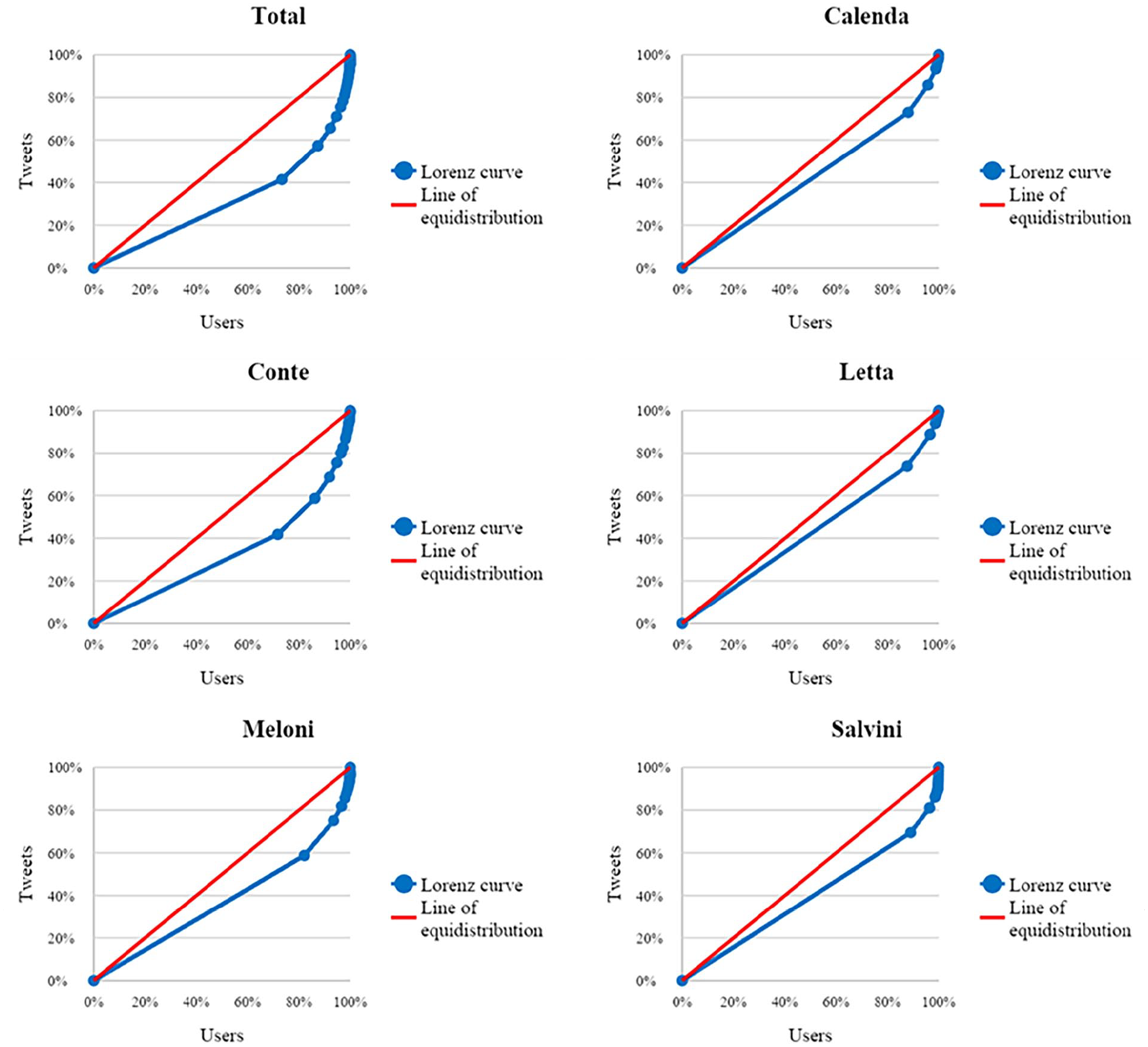
Distribution of uncivil tweets by users: Lorenz curves.
These findings, in line with H4, therefore seem to exclude the notion of orchestrated “shitstorm” campaigns fueled by bots or small, more active and aggressive groups. This lends further support to previous studies concurring in highlighting that expressions of incivility often result from the involvement of sporadic users, driven by indignation or even anger, who intervene in response to specific episodes involving political representatives (statements and/or remarks by leaders, scandals, etc.; Coe et al., 2014; Theocharis et al., 2020; Ward & McLoughlin, 2020).
Despite this, we can still observe some differences among the various leaders (Figure 2). For instance, in the case of Conte, there is a higher concentration of more active accounts: users who posted at least 5 uncivil tweets correspond to 5.2%, and their tweets constitute nearly a quarter of the subtotal of tweets (24.6%). In the case of Meloni, these percentages decrease to 2.1% for users and 14.4% for tweets. Finally, for the other three leaders, users who authored at least 5 uncivil tweets directed at them do not even reach 1%.
Conclusion
This study examined the conversational dynamics associated with incivility directed at political leaders during the 2022 campaign. With the aim of identifying factors influencing the spread of incivility, we analyzed the phenomenon on differ levels: the temporal level, the targets of uncivil behaviors and forms of incivility employed, and the authors of uncivil posts.
From a temporal perspective, our analysis suggests that hostility toward political leaders increases during the run-up to polling day, in accordance with our first hypothesis, based on existing literature. This is in line with the idea that as political discourse intensifies and politicians escalate their attacks on each other, users become more aggressive and hostile in their online communications. The mimetic process discussed by Gervais (2017) may be at play here, although our study did not directly measure this effect. Furthermore, we showed that scandals and controversies involving candidates can catalyze citizen outrage, often resulting in peaks of hateful messages against politicians. In addition, our analysis indicates potential links between increases in incivility and specific campaign events and moments. In the light of previous research findings, these results were not unexpected. Nevertheless, they represent the first empirical evidence of these phenomena in a specifically Italian context and suggest that their theoretical bases may also be applicable to the Italian political landscape. Overall, our findings may provide insights into how, when, and why incivility manifests during an election period, potentially contributing to a more granular understanding of the dynamics of online political discourse in Italy.
Regarding the second level of investigation (candidates targeted by hostility), we observed that the increase in incivility is not uniform across all political leaders, suggesting that individual factors and political positioning can influence the quantity and quality of incivility received. In particular, we have shown that incivility is primarily directed against candidates favored in the polls, with the possible intent of weakening and undermining their lead. The FdI candidate, who was projected as the election winner throughout the entire campaign, represented the privileged target of uncivil attacks. Nevertheless, the second interesting aspect is that the attacks against her were not characterized by sexist and/or misogynistic language, as we had hypothesized. The examination of tweets revealed that gender bias incivility was nearly absent, and for the only female candidate, “demonization” prevailed. These findings challenge common assumptions regarding the treatment of female politicians online and underline the complexity of the interaction between a politician’s gender, their political positioning, and the public’s perception of their background and qualifications. Meloni’s case implies that voters’ knowledge of a politician’s origins and career can impact considerably the nature of uncivil discourse directed at them. In this instance, Meloni’s long history as an actor in Italian politics and her strong ideological positioning may have outweighed gender issues in the thinking of those participating in uncivil discourse. This result is not only anomalous in comparison to previous research, in which sexist and misogynistic attacks against women are predominant (Harmer & Southern, 2021; Southern & Harmer, 2019), it also highlights the importance of considering factors other than gender when analyzing the nature of online incivility against political figures. Furthermore, this finding indicates that although gender may significantly influence the character of uncivil attacks, its impact may be attenuated or even outweighed by other aspects of a politician’s public persona and political history. In this regard, it is useful to remember that Meloni built her identity along the lines of post-fascism and that FdI can be considered a radical right-wing party (Bobba & McDonnell, 2016) characterized by anti-pluralistic and intolerant rhetoric toward target groups. This explains why hostility toward her has often taken the form of attacks aimed at delegitimization, associating her with figures/symbols related to totalitarian regimes, and highlighting her lack of respect for minority rights. Meloni was not attacked because she is a woman, but because she espouses a conservative and reactionary vision on issues such as migrant rights, LGBTQIA+ communities, and even women’s rights (see her statements on abortion).
Regarding the specificities emerging among leaders with respect to the forms of incivility used to attack them, it is remarkable that Conte primarily faced accusations of illegality, lying, and disinformation. The M5S approach has always included strong attacks toward the “establishment” (corrupt politicians) and perceived partisan journalists allied with political and economic elites (Wettstein et al., 2018). The type of incivility Conte was subjected to was, in fact, very similar to that used by himself and his supporters to attack political rivals and the press.
Overall, the study showed how the nature of incivility changes in relation to each leader, moving from generic forms to more personalized and targeted attacks. This result highlights the need for nuanced and context-specific approaches when analyzing online incivility in political discourse. Future research could build on these findings by exploring other contexts (to clarify whether we are dealing with specifically Italian phenomena) and examining how voters’ familiarity with politicians’ backgrounds interacts with other factors to influence the nature and intensity of online incivility.
Moving to the third level of investigation, the results show that the often-held belief that incivility spreads through the organized action of small groups of more active and coordinated users is mistaken. Political discussions on Twitter have shown that users expressing uncivil remarks are occasional commentators who participated sporadically throughout the campaign. It appears, therefore, that incivility is not always solely the result of bot intervention, “professional trolls,” or “professional transgressors” who engage in coordinated and disruptive actions (as already noted by Theocharis et al., 2020 and Ward & McLoughlin, 2020). In fact, it is more frequently an expression of angry or indignant ordinary users resorting to insults, vulgarity, or other forms of incivility, on an occasional and impromptu basis. The implications of these findings, however, are not entirely reassuring as they highlight the progressive normalization of the phenomenon, with all the negative consequences this implies for the quality of our democracies.
To conclude, we should acknowledge some limitations of this study, which can serve as a foundation for future research. First, we did not engage in a comparative analysis of different SM platforms (such as Twitter, Facebook, and Instagram) to assess whether platforms’ inherent characteristics, rules, and norms impact the civility of discussions. Second, the research presented here provides the snapshot of a specific moment in a particular context, namely, the 2022 Italian elections. It is essential to extend this investigation longitudinally and potentially employ a comparative approach to assess the stability of the observed patterns. It is plausible that the differences discerned among various political leaders are produced by the unique Italian political landscape scrutinized in this study. Therefore, the following step should encompass a comparative study that takes into consideration different platforms and countries. This will enable a comprehensive evaluation of the influence of systemic factors, including the party, media, and electoral systems. In addition, it will facilitate the validation of our findings on an international scale.
Despite these limitations, the study shows important theoretical implications. The results clearly highlight that, beyond the candidates’ intentions to worsen the tone and forms of political confrontation during the campaign, citizens themselves strategically resort to incivility, drawing on different forms and types depending on the leader targeted. It emerges, then, that when engaging in political debate, citizens tend to employ forms of incivility (insults and vulgarity, but also forms of violence, stigmatization, demonization, etc.) against political representatives, thus contributing to the pollution of public discourse. Although expressions of intolerance can be seen as more serious than insults and rudeness (Rossini, 2020), it does not mean that they do not affect constructive political exchange and the quality of public debate. Finally, this scenario appears to be exacerbated by the fact that these bottom–up uncivil behaviors are not the result of coordinated and organized campaigns, but the sporadic interventions of ordinary users, which contribute to the normalization of the phenomenon.
Footnotes
Declaration of Conflicting Interests
The author(s) declared no potential conflicts of interest with respect to the research, authorship, and/or publication of this article.
Funding
The author(s) disclosed receipt of the following financial support for the research, authorship, and/or publication of this article: The author(s) disclosed receipt of the following financial support for the research by the F-CUR fund allocated to finance “Curiosity-driven” projects—2022. Grant code: 2272-2022-RR-CONRICMIUR_PC-FCUR2022_002, Political Incivility in Public Debate: uses, motivations and awareness of Politicians and Journalists” (IP-PG).

Data Availability Statement
The data that support the findings of this study are available from the corresponding author (R.R.) upon reasonable request.