




Abstract
Sharing memes has emerged as a prevalent form of social grooming behavior on digital platforms, yet research has largely focused on the content of internet memes rather than the behavior of sharing them. This study explores whether sharing memes with different humor styles (affiliative, self-enhancing, aggressive, and self-defeating humor styles) relates to subjective well-being through the mediating roles of online bonding and bridging social capital. Using survey data from a representative sample of 1000 participants in the United States, the findings showed that affiliative and aggressive meme-sharing were positively associated with psychological well-being and positive feelings via enhanced online bonding social capital. The findings could contribute to a deeper understanding of social and psychological implications of engaging with memes in online communication.
In the digital age, internet memes have become an integral part of people’s online communication landscape. These bite-sized nuggets of humor, often combining images with witty text, have exploded in popularity with the rise of social media, spreading more rapidly and extensively than any other type of online content (Beskow et al., 2020; Shifman & Thelwall, 2009). The prevalence of meme-sharing not only reflects a current trend but also serves as a vehicle for understanding participatory digital culture (Shifman, 2014). As memes propagate from person to person, their role extends beyond mere entertainment; they become a unique medium through which individuals express identities, convey emotions, and forge connections in the digital realm (Brody & Cullen, 2023; Miltner, 2014; Wiggins & Bowers, 2014).
Previous research on memes has predominantly analyzed their content through political, cultural, or semiotic lenses (e.g., Newton et al., 2022; Nissenbaum & Shifman, 2017). Little attention, however, has been given to the user behavior of meme-sharing as a specific social grooming activity online. From the perspective of signaling theory (Donath, 2008), the act of sharing memes—not just the content of memes themselves—functions as a signal that communicates one’s identity, values, and group affiliations. This signaling behavior may have profound implications for interpersonal relationships and psychological outcomes given the growing weight of social media platforms in people’s lives (Zhang & Jung, 2022). Unlike other forms of social grooming which may require more effort or self-disclosure (J. H. Lin, 2019), meme-sharing may offer a low-cost yet potentially high-reward mechanism for building and maintaining social bonds online, potentially contributing to the accumulation of online social capital—the resources embedded in one’s online social networks (N. Lin, 2001).
As highlighted by previous studies, online social capital plays a crucial mediating role that links social media use to well-being outcomes (e.g., Chan, 2015; Chen & Li, 2017). According to this mediation model, various forms of online activities can contribute to the formation of either close, emotionally supportive relationships (online bonding social capital) or loose, informationally diverse connections (online bridging social capital) on the internet, which in turn can positively relate to the sense of happiness and life satisfaction. As meme-sharing is a prevalent form of social media activity, it is logical to extend this model to explore whether meme-sharing could similarly contribute to subjective well-being through the development of online bonding and bridging social capital.
Memes carry diverse messages and stances, potentially relating to social connections and well-being in different patterns. Although memes may cover a wide range of topics, humor serves as their primary ingredient (Miltner, 2014). To capture this nuance, we classify memes based on their humor component following the humor style model (Martin et al., 2003). This model categorizes humor into four distinct styles: affiliative, self-enhancing, aggressive, and self-defeating. By applying the humor style model to memes (Taecharungroj & Nueangjamnong, 2015), our study aims to investigate whether meme-sharing with the four humor styles may relate to well-being via the enhancement or erosion of online bonding and bridging social capital in different patterns. The findings may provide interdisciplinary insights into how specific forms of digital communication could contribute to social capital and well-being, expanding both humor theories and social capital frameworks into the digital domain.
Meme-sharing
The concept of meme was introduced by Richard Dawkins, an evolutionary biologist, in his book The Selfish Gene. Dawkins (1976) derived the term from the Greek word “mimema,” meaning “something imitated,” which he later condensed to the same rhyme with “gene” to describe cultural units such as jokes, ideas, and practices that can be copied and passed down like genes across a culture. Since the Web 2.0 era, the term “meme” has taken on new life to describe ideas and jokes spreading across the internet (Shifman, 2014). Shifman (2014) conceptualized internet memes as “(a) a group of digital items sharing common characteristics of content, form, and/or stance, which (b) were created with awareness of each other, and (c) were circulated, imitated, and/or transformed via the internet by many users” (p. 41). Image macros (images with superimposed texts) have emerged as the dominant form of internet memes (Beskow et al., 2020).
The intertextual and participatory nature of internet memes could contribute to their enduring popularity, as users continuously modify and share them within their networks (Shifman, 2014). The act of sharing memes can be understood as a form of social grooming behavior in the digital context. According to Donath (2008), social grooming refers to behaviors that help individuals build and maintain social connections. Engaging in online discussions, posting content, and liking others’ posts are all forms of social grooming facilitated by social media, helping individuals strengthen their social networks in ways that may ultimately benefit them (e.g., companionship, emotional support, and information accessibility; Donath, 2008).
Meme-sharing operates within this framework, as sharing humorous content can evoke smiles and laughter, potentially fostering social ties. Indeed, humor is a defining characteristic of successful memes (that users are more likely to share) as seen in the widespread memetic videos on YouTube (Shifman, 2011). Thus, we focus on the humor component within memes to understand the potential outcomes of sharing memes as a social grooming behavior.
Humor styles of memes
Humor, as conveyed by meme creators or senders during the sharing process, could reflect the stance of a meme—the sharers’ positioning in relation to the content (Shifman, 2014). To understand the complexity of humor in memes, it is valuable to consider foundational humor theories. Classical approaches include superiority theory, which posits that humor arises from a sense of triumph over others or one’s former self (Hobbes, 1650/1992); incongruity theory, suggesting that humor emerges from violations of expectations and the discrepancy between perception and reality (Kant, 1790/2008); and relief theory, which views humor as a release from psychological tension (Freud, 1905/1960; Spencer, 1875). Freud (1905/1960) further distinguished humor based on its purpose: non-tendentious jokes that are “innocent” (p. 90) without a particular aim, and tendentious jokes that serve a particular purpose and thus “run the risk of meeting with people who do not want to listen to them” (p. 90). Each of these theories explains different and complementary aspects of humor’s mechanisms.
Building on these foundational perspectives, Martin and colleagues (2003) developed a humor styles model to capture individual differences in everyday humor use. Although originally conceptualized as personality traits, Taecharungroj and Nueangjamnong (2015) later applied this model to memes and stated that the psychological states of meme creators could manifest in the stance of memes, thus endowing each meme with distinct humor styles. The humor styles model categorizes humor into four styles based on two axes: psychosocial focus—whether it enhances the self (intrapsychic) or relationships with others (interpersonal)—and potential adaptiveness—whether the humor is relatively “benign and benevolent,” or potentially “detrimental or injurious” (Martin et al., 2003, p. 52).
First, affiliative humor style is characterized by the use of jokes and witty comments to amuse others and strengthen social connections, reflecting an interpersonal focus with an adaptive nature. This style aligns most closely with Freud’s (1905/1960) concept of non-tendentious humor, as it aims primarily at innocent amusement in social settings without underlying hostility. Second, self-enhancing humor captures the tendency to maintain a humorous perspective in challenging situations, serving as an intrapsychic adaptive coping mechanism. Third, by contrast, aggressive humor involves making others the target of jokes to enhance the self at the expense of one’s relations with others without concern for their feelings, indicating an intrapsychic focus and maladaptive desire for superiority. This style exemplifies the tendentious humor and the core mechanism of superiority theory, as it masks belittlement under the guise of playfulness, such as in sexist or racist humor. Finally, self-defeating humor is where individuals make themselves the butt of jokes in a disparaging manner to gain social acceptance or avoid criticism. This style focuses on enhancing interpersonal relationships but at one’s own expense. It is noted that while the four humor styles are relatively independent, they may overlap to some extent, and it could be impossible to disentangle the humor styles completely (Martin et al., 2003). Figure 1 provides examples of memes employing each humor style.

Memes with four humor styles.
By classifying memes into these four styles, Taecharungroj and Nueangjamnong (2015) revealed that the specific humor of a meme could influence its reception and spread. Their study found that memes with affiliative and aggressive humor were the most prevalent on Facebook, while those with self-defeating humor garnered the most likes and shares. These findings suggest that sharing memes with different humor styles may serve distinct communicative functions, potentially relating to varied interpersonal and psychological outcomes. Previous research on meme engagement has primarily focused on memes related to specific topics such as pandemics (Myrick et al., 2022) and politics (Halversen & Weeks, 2023). Indeed, people’s daily communication with memes can cover a wide range of aspects. What remains constant is the humor embedded in these memes. We therefore explore whether sharing memes with the four humor styles could relate to individuals’ accumulation of online social resources and consequently their subjective well-being in different patterns.
Meme-sharing and subjective well-being
Subjective well-being refers to the subjective assessment of one’s life quality, encompassing the cognitive and emotional components (Diener, Scollon, & Lucas, 2009). The cognitive aspect is closely linked to life satisfaction, reflecting one’s overall evaluation of their life, often measured through psychological well-being. The emotional dimension captures the general emotional experiences of individuals, namely the presence and strength of positive and negative effects.
Humor theories have explained how the use of humor may influence aspects of subjective well-being. Freud (1905/1960) conceptualized humor as a defense mechanism, providing emotional distance from distress by redirecting psychic energy toward a search for pleasure. Later scholars developed this foundation both theoretically and empirically, positioning humor as a stress buffer through mechanisms of appraisal-focused, emotion-focused, and problem-focused coping (Martin, 1989; Martin et al., 1993). Memes, as vessels of humor, may function similarly. Indeed, empirical studies have found that engaging with memes is associated with improved positive emotions and lower levels of stress (e.g., Akram et al., 2021; Myrick et al., 2022). However, the linkage between meme engagement and subjective well-being may not be uniformly positive. The content and context of memes play crucial roles in determining their relationship. For example, memes depicting depression experiences could elicit negative moods such as sadness and worthlessness (Akil et al., 2022).
This variability may be systematically explained by the humor styles that a meme employs. Those depression memes typically employ self-defeating humor (Akil et al., 2022), which may account for their negative psychological impact. Also, the positive association between humor and well-being explained in the above-mentioned theoretical accounts primarily align with self-enhancing humor, which describes the kind of humor that provides psychological relief in the face of difficulties. This pattern is consistent with empirical evidence using the humor styles model to capture individual differences. Studies consistently showed that adaptive humor styles (i.e., affiliative and self-enhancing) were positively correlated with cognitive and affective well-being (e.g., Jovanović, 2011; Martin et al., 2003). On the other hand, maladaptive humor styles (i.e., aggressive and self-defeating) yielded mixed findings, with some studies showing negative associations for both styles (e.g., Jovanović, 2011), and others finding no significant relationship for aggressive humor (e.g., Martin et al., 2003).
These distinctions in individual humor use may also apply to memes. Examining memes as a whole may oversimplify their potential differing relationships with psychological outcomes. Moreover, previous research has primarily centered on viewing memes (e.g., Akram et al., 2021; Myrick et al., 2022), with little attention paid to the act of sharing memes as a social grooming behavior on social media, which may have distinct implications for well-being (J. H. Lin, 2019). We thereby ask the following research question:
Meme-sharing and online social capital
The concept of social capital has been explored across various academic disciplines, yielding multifaceted interpretations. Bourdieu (1986) linked access to social capital with social status and group identity, Coleman (1988) emphasized social capital’s role as public good, and Putnam (2000) highlighted the expectation of reciprocity in its accumulation. Despite these varying theoretical orientations, the core premise of social capital remains consistent: an individual’s social interactions provide embedded resources that can be accessed and utilized, akin to an investment in social relationships with anticipated future benefits (N. Lin, 2001).
Putnam (2000) specified two types of social capital: bonding and bridging social capital. Bonding social capital arises from strong ties that can provide deep emotional or substantive support that may not be easily obtained elsewhere. These connections are often homogeneous, such as close friends who share similar interests. Bridging social capital is built through weak ties that usually span diverse backgrounds. These connections can usually provide access to new information and perspectives but may lack emotional depth.
At the same time, the accumulation of social capital functions differently online and offline. Some researchers argued that digital communication technologies primarily facilitated the growth of weak-tie networks, as platforms allowed users to connect beyond geographical constraints (e.g., Hampton, 2003; Donath & Boyd, 2004). Others suggested that virtual communities are more effective in fostering bonding social capital due to shared interests in the group (e.g., Mandelli, 2002; Preece, 1999). Ellison and colleagues (2007) found that rather than using the internet to meet new people, many individuals rely on online tools to maintain existing offline relationships, such as keeping in touch with classmates. To examine the specific outcomes of social capital gained from online interactions, Williams (2006) extended Putnam’s (2000) framework by distinguishing between offline and online bonding and bridging social capital. As meme-sharing is inherently an online activity, we focus specifically on its relationship with individuals’ online bonding and bridging social capital.
Meme-sharing on social media could represent a form of social grooming behavior that may cultivate online social capital. Drawing from signaling theory (Donath, 2008), individuals’ social grooming online serves as signals that communicate their identity, which may represent recognition of group membership in digital communities. Sharing a meme that both parties understand could function as such a signal in online cultures, requiring a degree of subcultural literacy to comprehend and thus distinguishing community members from outsiders (Miltner, 2014; Nissenbaum & Shifman, 2017). This type of in-group signaling might primarily foster online bonding social capital by strengthening homogeneous connections through shared subcultural references. Julien (2014) argued that internet memes could represent a novel form of digital social capital. The sharing of a certain taste of memes acknowledges the collective habitus it represents, thereby strengthening bonds among members of the same habitus. This notion could be supported by Newton and colleagues (2022), who demonstrated that memes created and shared by donor-conceived individuals could promote stronger ties among those who identified with the shared values of this social group.
Despite this bonding effect, when memes transcend particular group interests and become widely recognizable cultural artifacts, the sharing of memes could also contribute to online bridging social capital. As suggested by Ng (2020), humans tend to perform large-group cooperation through sharing content on social media platforms, which could especially benefit online bridging social capital. Meme-sharing may help build bridges widely through universally appealing humor, representing a signal of building and maintaining relationships with other social media users from different backgrounds.
The extent to which meme-sharing contributes to online bonding or bridging social capital may depend on the humor style embedded in the meme. J. H. Lin (2019) and J. H. Lin and colleagues (2024) identified different social grooming styles of individuals that distinctly link to their social capital. For example, while “image managers” who groom strategically had both high bonding and bridging social capital, “social butterflies” who actively self-disclose online perceived themselves as having considerable bridging social capital but lower bonding social capital, and “maintainers” who primarily use digital platforms to sustain existing relationships reported lower perceived bridging social capital (J. H. Lin, 2019).
In a similar vein, sharing memes with specific humor styles may relate to the building of tight and loose online ties in different patterns. Affiliative humor style, with its benevolent nature aiming at enhancing relationships with others (Martin et al., 2003), might contribute to both online bonding capital (through strengthening existing relationships) and bridging capital (through establishing new connections with broadly appealing content). Self-defeating humor might primarily enhance online bonding social capital by making oneself relatable to similar others, although potentially at personal cost (Ask & Abidin, 2018). In contrast, self-enhancing and aggressive humor styles serve the self, with aggressive humor potentially harming interpersonal relations (Martin et al., 2003). Memes with these humor styles may thus contribute less to, or negatively relate to, an individual’s online bonding and bridging social capital. It is important to note that these theoretical connections are largely derived from research on humor styles as individual traits rather than specific meme-sharing behaviors. The extension of humor styles to meme-sharing represents a novel application that may not perfectly mirror findings from individual difference research. Given the limited empirical research directly examining how different humor styles in meme-sharing relate to online social capital, we ask the following research question:
The mediating role of online social capital
The potential link between meme-sharing and online social capital may open up a pathway to subjective well-being, since there is a well-established positive linkage between social capital and well-being. For instance, Munzel and colleagues (2018) unveiled that both bonding and bridging social capital contribute to well-being. Neira and colleagues (2018) found that various facets of social capital, from trust and social networks to civic engagement, are associated with enhanced subjective well-being. These findings suggest that online social capital may act as a mediator through which meme-sharing may relate to well-being.
Different from prior studies on the effect of viewing memes, the act of sharing memes as a form of social grooming inherently involves interactions with other users. Some studies have found evidence supporting the mediating role of social capital in the associations between various forms of social media usage and well-being. For example, Chen and Li (2017) demonstrated that self-disclosure and communicative use of social media positively relate to psychological well-being via bonding and bridging social capital. Zhang and Jung (2022) conducted a longitudinal study and discovered that WeChat affordances for dyadic interaction and association (e.g., likes and comments) fostered bonding social capital, which, in turn, positively affected users’ sense of happiness and life satisfaction. More broadly, the general mobile phone use for online communication was positively related to psychological well-being through the accumulation of both bonding and bridging social capital (Chan, 2015). These established models further point to the potential of a similar mediating mechanism regarding meme-sharing as a specific social media activity relating to well-being via online social capital.
Different humor styles within memes may link to well-being via online social capital in varied patterns. Dyck and Holtzman (2013) revealed that while greater availability of social support explained the positive relationship between affiliative and self-enhancing humor styles (as individual traits) and well-being, a contrasting pattern emerged for self-defeating humor. The use of self-defeating humor was negatively associated with well-being through lowered social support. For aggressive humor use, social support did not exhibit a mediating effect. Given these nuanced differences, it is important to investigate whether the potential enhancement or erosion of online social capital could explain the possible positive or negative link between users’ varied types of sharing memes and their well-being.
Method
Participants and procedures
A total of 1000 participants were recruited for this survey study using Prolific (https://www.prolific.com/), an online data-collection platform for research. The sample of this study was designed to be representative of the United States population. Prolific offers a feature allowing for the division of the sample based on census data from the US Census Bureau (Prolific, 2024). Prolific claimed that the sample’s distribution closely matched that of the US population in terms of age, sex, and ethnicity.
Prolific was chosen due to its reputation for providing high-quality data and its advantages over other platforms. According to Péer and colleagues (2021), participants on Prolific were more attentive, understood instructions better, responded more carefully, and showed more honesty compared to other platforms with or without data quality filters (approval ratings). Douglas and colleagues (2023) compared the five popular collection platforms, including MTurk, CloudResearch, Prolific, Qualtrics, and SONA. They found that the data quality on Prolific and CloudResearch was higher, evidenced by participants’ success in passing attention checks, possessing unique IP addresses, giving meaningful answers, and completing the survey at a reasonable pace.
This study was described as a survey about meme-sharing behavior on social media, interpersonal relations, and well-being. Interested individuals were directed to an online survey hosted on QuestionPro. The study information sheet introduced the contemporary definition of memes as “A cultural item in the form of an image, video, phrase, etc., that is spread via the internet and often altered in a creative or humorous way” (Dictionary.com, n.d.). In addition, three examples of popular internet memes (Gil, 2022; QuotesBae, 2018; Suresh, 2018), Success Kid, Leonardo Dicaprio Cheers, and Condescending Wonka, were included for reference. Participants proceeded with the survey after agreeing to the informed consent and confirming they were over the age of 18. This study was approved by the research ethics committee of the authors’ university.
To ensure attentiveness, one question was asked to identify careless responses (i.e., “Please select ‘Strongly agree’ to show that you are paying attention to this question.”). Nineteen respondents failed to answer this question correctly. These individuals were terminated from the survey and excluded from the final participant count. Upon completing the 8- to 10-min questionnaire, participants received £1.25 in return. The questions were presented in random order, consisting of the following measures. The data were collected in February 2024. Data and supplementary material (online appendices) are available online at https://osf.io/hejkv/files/osfstorage?view_only=dd20cc21ff744ce39323826ec0492f3d
Measures
Meme-sharing
To assess meme-sharing on social media, the structure of questions used for sharing political memes on Facebook was adopted (Halversen & Weeks, 2023) and modified as: “On social media during the past four weeks, how often have you shared memes that . . .?” Participants were instructed to respond on a 5-point Likert-type scale ranging from 1 (never) to 5 (always). Building upon the work of Taecharungroj and Nueangjamnong (2015), who categorized Facebook memes using Martin and colleagues’ (2003) four humor styles (affiliative, self-enhancing, aggressive, and self-defeating humor styles), our study extended the analysis to meme-sharing on social media. Each humor style was assessed with four items adapted from Taecharungroj and Nueangjamnong’s (2015) content analysis coding scheme and Martin and colleagues’ (2003) humor styles questionnaire. The four items for each subscale were averaged to obtain a score, with higher scores reflecting a higher frequency of sharing memes with the corresponding humor styles on social media. A qualitative pilot study was conducted to assess the face and content validity of the 16 items. For additional information regarding the development of this measure, see Supplemental Appendix A.
To determine whether the four-factor model (with four items for each factor) fits the data adequately, a confirmatory factor analysis was performed on the 16 items. 1 The Maximum Likelihood estimation method was used to estimate the model. Apart from the chi-square test, model fit was assessed based on the comparative fit index (CFI), the standardized root mean square residual (SRMR), and the root mean square error of approximation (RMSEA). Based on the recommendations of Schermelleh-Engel and colleagues (2003), a good fit is indicated by CFI above .97, SRMR below .05, and RMSEA below .05. An acceptable fit is demonstrated when CFI falls between .95 and .97, SRMR ranges from .05 to .10, and RMSEA is between .05 and .08. Hu and Bentler (1999) suggested that the cutoff criteria for a relatively good fit are CFI above .95, SRMR below .08, and RMSEA below .06. Taking these indices and guidelines into consideration, the model showed an acceptable fit: χ2 (98) = 790.84, p < .001, CFI = .95, SRMR = .06, RMSEA = .08 (95% CI = [.08, .09]). The standardized factor loadings of all items on the latent variables were significant, p < .001 (see Supplemental Appendix Figure 1).
Social capital
Building upon the internet social capital scale (Williams, 2006), a short version (J. H. Lin, 2019) was adopted to assess bonding and bridging social capital in online and offline contexts for three items within each subscale. Participants rated their agreement level on a 5-point scale ranging from 1 (strongly disagree) to 5 (strongly agree). A confirmatory factor analysis was conducted on four components of the 12 social capital items. The results indicated a generally good fit of the model: χ2 (48) = 308.21, p < .001, CFI = .95, SRMR = .04, RMSEA = .07. In this study, we focused on online bonding and bridging social capital.
Psychological and emotional well-being
To evaluate the cognitive component of participants’ subjective well-being, an eight-item measure of psychological well-being developed by Diener, Wirtz, et al. (2009) was adopted in this study. Participants rated their level of agreement from 1 (strongly disagree) to 7 (strongly agree). The scores were summed to create an index of psychological well-being. To assess the emotional component of subjective well-being, respondents were asked to report the frequency of their positive emotions (e.g., happiness, joy) and negative emotions (e.g., fear, anger) experienced over the past 4 weeks, using the scale of positive and negative experience (SPANE, Diener, Wirtz, et al., 2009) ranging from 1 (never) to 5 (always). The measure of positive feelings (SPANE-P) was calculated by adding up the scores of the corresponding six items, while the measure of negative feelings (SPANE-N) was formed by summing the six items related to negative emotions. The measure of affect balance (SPANE-B) was then obtained by subtracting the scores for negative feelings from positive feelings.
Covariates
Drawing upon previous research on the associations between social media use, social capital, and well-being (Chan, 2015; Chen & Li, 2017), this study considered the frequency of social media use and demographic factors as covariates. The demographic factors included gender (male = 0, non-binary = 0.5, female = 1), age, and educational background (1 = primary school or below, 5 = graduate degree or above). The frequency of social media use was assessed by asking participants about the average time they spent on social media platforms in a typical day, ranging from 1 (less than 30 min per day) to 7 (more than 5 hr). To provide a descriptive overview of the commonly used platforms for meme-sharing, participants were asked to select the social media platforms they primarily used for sharing memes. Table 1 displays the demographic frequencies.
Frequency of Demographics.

Participants can select more than one platform.
The finalized items are included in Supplemental Appendix: Measurement Items. The descriptive statistics for the main variables are presented in Table 2. Pearson correlations among the variables are presented in Supplemental Appendix Table 1. The four measures of meme-sharing showed positive correlations with online bonding and bridging social capital, rs = .16–.33, ps < .001; and psychological well-being, positive feelings, and balanced affect, rs = .07–.20, ps < .05; except for the aggressive meme-sharing–psychological well-being, self-enhancing meme-sharing–balanced affect, and self-defeating meme-sharing–balanced affect associations, rs < .05, ps > .05. Online bonding and bridging social capital were positively correlated with psychological well-being, positive feelings, and balanced affect, rs = .09–.17, ps < .01; except for the online bridging social capital–balanced affect relation, r = .03, p > .05.
Cronbach’s αs, Means, SDs, Minimums, and Maximums of Measures.
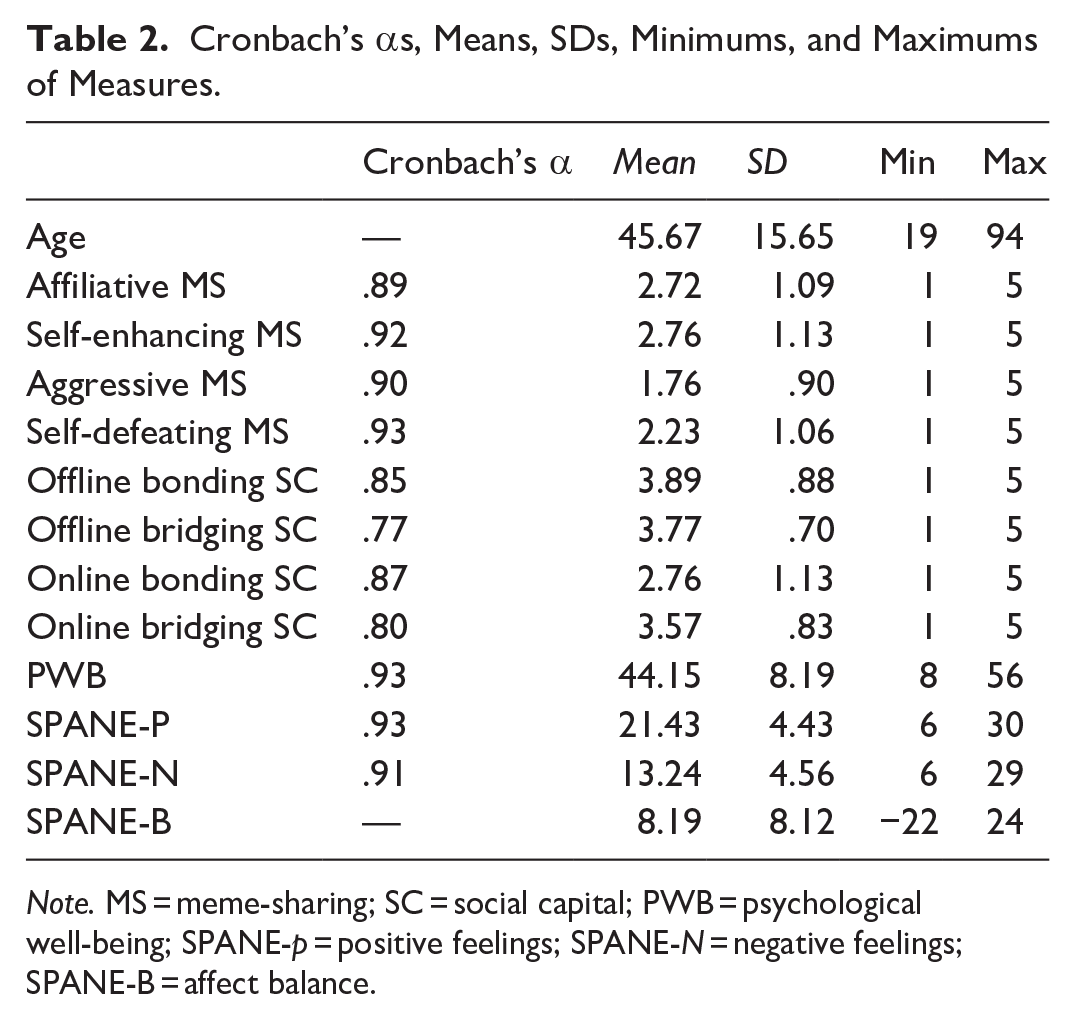
Note. MS = meme-sharing; SC = social capital; PWB = psychological well-being; SPANE-p = positive feelings; SPANE-N = negative feelings; SPANE-B = affect balance.
Data analysis
Statistical analyses were performed using the JASP Version 0.18.3 and SPSS Version 29. Hayes Process v.4.3 model 4 with two mediators (Hayes, 2022) was used, with 5000 bootstrap samples and 95% confidence intervals. The four meme-sharing variables were treated as predictors. The two online social capital variables served as parallel mediators, while psychological well-being, positive feelings, and affect balance served as dependent variables. Gender, age, education, and frequency of social media use were entered as covariates. All estimates were standardized.
Results
RQ1 asked whether sharing memes with four humor styles is related to cognitive and emotional aspects of subjective well-being. The four meme-sharing variables, two online social capital variables, and control variables (gender, age, education, and frequency of social media use) served as the predictors to predict psychological well-being, R2 = .15, F(10, 989) = 16.85, p < .001; positive feelings, R2 = .12, F(10, 989) = 13.39, p < .001; and affect balance, R2 = .10, F(10, 989) = 10.54, p < .001 (see Table 3). 2 The results revealed that affiliative meme-sharing was a significant positive predictor of psychological well-being, β = .26, p < .001; positive feelings, β = .31, p < .001; and affect balance, β = .23, p < .001. Aggressive meme-sharing positively predicted positive feelings, β = .13, p = .003. Sharing memes of other humor styles did not significantly predict well-being.
Regression Analysis Predicting PWB, SPANE-P, and SPANE-B.

Note. SMU = frequency of social media use; MS = meme-sharing; SC = social capital; PWB = psychological well-being; SPANE-p = positive feelings; SPANE-B = affect balance.
In addition, both online bonding (β = .12, p < .001) and bridging social capital (β = .12, p < .001) were the positive predictors of psychological well-being. Online bonding social capital positively predicted positive affect (β = .10, p = .005) and affect balance (β = .12, p < .001).
To address RQ2 regarding the relationship between sharing memes with the four humor styles and online social capital, regression analyses were conducted for the four meme-sharing variables predicting online bonding social capital, R2 = .16, F(8, 991) = 23.03, p < .001, and online bridging social capital, R2 = .11, F(8, 991) = 14.87, p < .001, controlling for gender, age, education, and frequency of social media use (see Table 4). Affiliative meme-sharing (β = .28, p < .001) and aggressive meme-sharing (β = .11, p = .006) positively predicted online bonding social capital. While for online bridging social capital, only affiliative meme-sharing (β = .15, p = .034) was a significant positive predictor.
Regression Analysis Predicting Online Bonding and Bridging Social Capital.

Note. SMU = frequency of social media use; MS = meme-sharing; SC = social capital.
RQ3 addressed whether online bonding and bridging social capital mediate the relationship between sharing affiliative, self-enhancing, aggressive, and self-defeating memes and subjective well-being. Results showed significant indirect effects of affiliative meme-sharing on psychological well-being (a1b1 = .03, p = .007), positive feelings (a1b1 = .03, p = .019), and affect balance (a1b1 = .03, p = .009) via online bonding social capital. Although no significant direct effects were found for aggressive meme-sharing on psychological well-being or affect balance, significant indirect effects were observed through online bonding social capital on psychological well-being (a1b1 = .01, p = .029), positive feelings (a1b1 = .01, p = .047), and affect balance (a1b1 = .01, p = .033; see Table 5). 3
Indirect Effects on PWB, SPANE-P, and SPANE-B via Online Bonding (a1b1) and Bridging (a2b2) Social Capital.

Note. PWB = psychological well-being; SPANE-p = positive feelings; SPANE-B = affect balance. CI = confidence interval. Bootstrap samples for CI = 5000. Paths in bold are significant.
Discussion
This study explored the mediating roles of online bonding and bridging social capital in the relationships between meme-sharing with the four humor styles (affiliative, self-enhancing, aggressive, and self-defeating humor styles) and subjective well-being (cognitive and emotional well-being). First, the findings revealed that among the four humor styles of memes, only sharing affiliative memes showed a positive association with both enhanced psychological and emotional well-being. This aligns with previous research demonstrating beneficial psychological outcomes of affiliative humor use, such as increased self-esteem, cheerfulness, and overall psychological well-being (Martin et al., 2003).
Interestingly, while sharing aggressive memes did not relate to overall psychological well-being, it was associated with higher levels of positive affect. This finding offers insights into the existing literature, as a meta-analysis indicated that aggressive humor is unrelated to mental health (Schneider et al., 2018). Our results might be explained by the superiority theory of humor, which posits that pleasant feelings can arise from joking about others’ misfortune (Lintott, 2016). This resonates with the essence of aggressive humor, which often involves self-elevation at the expense of others. Torres-Marín and colleagues’ (2022) study may also support this effect, suggesting that individuals preferring aggressive humor styles tend to perceive public health crises as less threatening. By sharing memes that make light of others’ adverse situations, individuals may experience an enhanced sense of self and improved mood.
Second, the results yielded a positive relationship between affiliative meme-sharing and both online bonding and bridging social capital. The concept of affiliative humor closely resonates with this finding, capturing the use of kind-hearted jokes to strengthen social relationships. Research has demonstrated that affiliative humor is positively associated with social intimacy (Martin et al., 2003) and relationship satisfaction (Hall, 2013). Sharing affiliative memes may facilitate the conveyance of emotions and subtle feelings during communication (Brody & Cullen, 2023). Accordingly, online bonding social capital can be cultivated by promoting a more harmonious and intimate atmosphere with strong relations like close friends who can provide emotional support and groom each other. The sharing of affiliative memes also contributes to a looser and more diverse network. Drawing from Blackmore’s (1999) memetic theory of altruism, Ng (2016) contended that altruistic internet memes are more likely to spread widely and gain popularity. The prosocial nature of affiliative memes may thus foster the development of online bridging social capital by engaging in strategic social grooming with other online users from different backgrounds.
We also found that aggressive meme-sharing was related to greater online bonding social capital, despite previous studies finding no significant relationship between aggressive humor style and social intimacy (Martin et al., 2003) nor relationship satisfaction (Hall, 2013). This discrepancy may be explained by the nature of aggressive memes in online communication. The sharing of memes containing hostile or hateful content often functions as a distinct form of social grooming that signals one’s in-group identity by targeting out-groups or individuals outside one’s social circle. Often shared within a certain social circle, these memes sometimes require a certain level of subcultural knowledge so that only in-group members can interpret their specific verbal and visual cues (Nissenbaum & Shifman, 2017; Schmid, 2025). Sharing aggressive memes could thus reinforce the bonding of “us” by creating a shared sense of superiority toward “others” (Gal, 2019). Orthaber (2019) exemplified this phenomenon, demonstrating that aggressive humor on social media can effectively express customer dissatisfaction by uniting those who echo the sentiment.
This bonding effect extends beyond real-life ties such as family and friends, as online bonding social capital can be gained through online networks such as like-minded community members, often accompanied by antagonism toward out-groups (Putnam, 2000). The findings highlight the distinct social grooming functions of sharing memes with different styles of humor: affiliative memes could foster both intimacy and widespread connections, offering a more inclusive approach to social capital building; while aggressive memes may boost in-group cohesion at the potential cost of out-group exclusion.
Finally, our study revealed that online bonding social capital served as a mediator in the relationships between affiliative and aggressive meme-sharing and cognitive and emotional well-being. The findings expand on previous research that has established models illustrating how different social media usages could nurture well-being via social capital (e.g., Chan, 2015; Chen & Li, 2017). Our study contributes to this body of knowledge by focusing specifically on meme-sharing on social media, an academically understudied phenomenon.
Although affiliative meme-sharing also relates to the development of weaker and broader online social networks (online bridging social capital), it is specifically the sharing within an emotionally close circle of online friends (online bonding social capital) that appears to positively link to well-being. Then, it is noteworthy that sharing aggressive memes is not directly linked to psychological well-being, unless it follows an indirect path of strengthening online bonding social capital, such as when aggressive memes are shared within online communities that share similar interests or perspectives.
Regarding meme-sharing using self-enhancing humor, we found no significant relationship with online social capital and subjective well-being. Self-enhancing humor, primarily functioning as an adaptive ego defense mechanism (Freud, 1928; Martin et al., 2003), allows individuals to maintain a humorous outlook on life even during challenging times. This humor style, as an individual trait, may reflect personal resilience. However, its translation into meme-sharing involves interaction with others rather than solely serving as self-encouragement. The sharing of these memes, therefore, may not necessarily facilitate connections with others that are essential for cultivating online social capital and thus improving well-being.
Our results also showed no significant relationship between sharing self-defeating memes and online social capital or well-being. This finding presents an interesting contrast with existing literature. In our literature review, we noted that self-defeating humor, despite being potentially damaging to oneself, aims to enhance relationships with others (Martin et al., 2003). However, other studies found self-defeating humor style to be associated with negative social and psychological outcomes (e.g., Dyck & Holtzman, 2013; Jovanović, 2011). Unlike direct self-deprecation in face-to-face interaction, memes, by nature, are replicable and generally applicable across various online contexts, often not specific to personal experiences. When sharing a self-defeating meme, individuals are not necessarily making themselves the exclusive target of humor but rather participating in a collective acknowledgment of shared human experiences or flaws. As such, sharing self-defeating memes may not genuinely diminish one’s self-regard in the way that habitual self-deprecation might. Instead, it may be perceived as a relatable, playful act of cultural participation. This distinction helps explain why, contrary to some predictions derived from individual humor style research, self-defeating meme-sharing neither harms nor benefits one’s online relationship building or well-being in our study.
Our study contributes to internet meme research by offering an interdisciplinary theoretical perspective and establishing groundwork for future explorations. First, we applied Martin and colleagues’ (2003) individual humor styles framework to internet meme-sharing and validated a corresponding scale. This approach allows a more specific examination of the social and psychological outcomes of sharing different types of memes, rather than treating meme-sharing as a uniform activity. Our findings demonstrate that humor styles in meme-sharing function similarly to, yet distinctly from, humor styles as individual traits, particularly in how they relate to online social capital and well-being. Future research could build upon this framework to identify patterns in how people share a combination of different styles of memes, classifying users based on their sharing habits and, more precisely, examining corresponding outcomes (J. H. Lin, 2019). For instance, some users might actively share both affiliative and aggressive memes, while others might exclusively engage in self-defeating meme-sharing—different habits potentially yielding different social and psychological outcomes.
Second, we expand understanding of the linkages between social media use, social capital, and well-being by conceptualizing meme-sharing as a specific form of social grooming behavior in digital environments. Just as physical grooming serves bonding functions in primates, digital social grooming through content sharing helps establish and maintain social connections online (J. H. Lin, 2019). Meme-sharing represents a particularly efficient form of social grooming as it combines humor, cultural references, and emotional expression in easily digestible packages that require minimal effort to transmit yet potentially yield significant social returns. Through signaling theory (Donath, 2008), different humor styles in memes function as distinct signaling strategies that communicate aspects of one’s identity and social alignment, helping to explain why certain styles of meme-sharing relate to online social capital while others do not.
Third, our study enriches the theoretical understanding of how social capital operates in online contexts. While social capital has been extensively explored in terms of its cultivation via social media and its contribution to well-being, our findings highlight the specific role of online bonding social capital as a critical mediator between digital communication behaviors (i.e., meme-sharing) and psychological outcomes. In contrast with early research that emphasized the development of weak ties (bridging social capital) through digital interactions (e.g., Donath & Boyd, 2004; Hampton, 2003), our findings suggest that the emotional depth characteristic of online bonding social capital appears crucial for translating digital interactions like meme-sharing into psychological benefits, regardless of whether such interactions employ benign or aggressive humor.
In practice, mental health professionals could consider our findings when developing digital mental health intervention. Encouraging meme-sharing with affiliative humor or mildly aggressive humor in online interactions may serve as an innovative strategy to strengthen individuals’ social connections, particularly the sharing within close social circles. This may ultimately help enhance individuals’ sense of happiness and life satisfaction.
Nevertheless, there are several limitations to address. First, the cross-sectional design of this study limits the establishment of causality. For example, individuals with solid social connections may be more likely to share aggressive memes, rather than the sharing of aggressive memes bolstering their online social capital. Future research could employ a longitudinal approach to trace causal pathways over time.
Second, our study was based on a representative sample of the US population. Indeed, humor is culturally embedded (Martin, 2007). Different cultures may have diverging humor preferences that could affect the results. Cross-cultural comparisons in future work could help further validate the findings.
Third, while we identified Facebook and Instagram as the two most commonly used social media platforms for sharing memes, potential variations in meme-sharing patterns due to different affordances of platforms were not considered. Future research could conduct comparative analyses across multiple platforms.
Fourth, our study treated “sharing” as a generic online activity without differentiating between public broadcasting (e.g., posting on public profiles or forums) and private sharing (e.g., direct messaging to specific individuals or closed groups) (Lampinen, 2015). This distinction may impact how meme-sharing relates to different forms of social capital—private sharing might primarily enhance bonding social capital, while public sharing could contribute more to bridging social capital. Future research should distinguish between these sharing contexts and the corresponding social and psychological outcomes.
To conclude, our findings underscore that the humor element of a meme plays a crucial role in the associations with social media users’ accumulation of online social capital and well-being when sharing memes. We have unraveled the mediating role of online bonding social capital explaining the linkage between sharing affiliative and aggressive memes and psychological and emotional well-being. Our study not only glimpses into the popular meme-sharing culture, but also offers insights into the use of different styles of humor in digital interactions relating to enhanced social connections and improved mental health.
Supplemental Material
sj-docx-1-sms-10.1177_20563051251348922 – Supplemental material for Exploring the Mediating Role of Online Social Capital in the Association Between Sharing Memes Using Four Humor Styles and Subjective Well-Being
Supplemental material, sj-docx-1-sms-10.1177_20563051251348922 for Exploring the Mediating Role of Online Social Capital in the Association Between Sharing Memes Using Four Humor Styles and Subjective Well-Being by Yueming Luo and Yu-Leung Ng in Social Media + Society
Footnotes
Authors’ Note
This article was adapted from the first author’s undergraduate honors project in data and media communication.

Ethical Considerations
This study was approved by the research ethics committee of the authors’ university. Participants proceeded with the survey after agreeing to the informed consent and confirming they were over the age of 18.
Author Contributions
Funding
The author(s) disclosed receipt of the following financial support for the research, authorship, and/or publication of this article: This study was supported by the Hong Kong Baptist University.
Declaration of Conflicting Interests
The author(s) declared no potential conflicts of interest with respect to the research, authorship, and/or publication of this article.
Supplemental Material
Supplemental material for this article is available online.
Notes
Author biographies
References
Supplementary Material
Please find the following supplemental material available below.
For Open Access articles published under a Creative Commons License, all supplemental material carries the same license as the article it is associated with.
For non-Open Access articles published, all supplemental material carries a non-exclusive license, and permission requests for re-use of supplemental material or any part of supplemental material shall be sent directly to the copyright owner as specified in the copyright notice associated with the article.
