



Abstract
Despite the popularity of social media influencers (SMIs), little is known about how their content reflects and conveys certain values, leaving a gap in understanding their role as value intermediaries. This content analysis examined the representation of Schwartz values in the Instagram profiles of 59 of the most followed Western SMIs, celebrities, and athletes. Relying on 1256 posts and 2936 stories, the study documented the prevalence of values, modalities of representations (multimodal complexity and post-caption congruence), and differences between SMIs, athletes, and celebrities. Results revealed that 60.3% of the content portrayed at least one value, with achievement, benevolence, and hedonism being the most frequent. Multilevel analyses indicated that SMIs and athletes were more likely to post hedonism and benevolence, while celebrities were more likely to share universalism than SMIs. Most values were represented through low to medium levels of multimodal complexity, and only 15.3% showed post-caption congruence. These findings underscore the need to document how global digital platforms and actors mediate value representation, as they have the potential to shape audience values and cultural norms.
Recently, the recurring public scrutiny surrounding the potentially harmful values conveyed by celebrities has extended to social media influencers (SMIs) (Stein, 2021). Through sharing their stories on social media platforms like Instagram, SMIs serve as “ideological intermediaries” (Arnesson, 2022), disseminating content that resonates with their followers and exemplifies the values they cultivate (Devos et al., 2022). Values are principles that guide the desirable conduct of individuals and collectives and play a significant role in guiding behavior at both levels (Schwartz, 1992). While individuals’ values are relatively stable, research suggests that media representations may facilitate value change through automatic and effortful processes (Bardi & Goodwin, 2011). Considering that SMIs are often regarded as role models by their young audiences (Hammond et al., 2022), the values they promote may affect the value systems of their audience. Despite the centrality of values in individuals’ self-concept and decision-making (Schwartz, 1992), a systematic understanding of how influential digital figures like SMIs represent values on visual and popular social media, such as Instagram, remains lacking. To address this gap, this study systematically explored how values are represented in the Instagram posts and stories of Western SMIs. Instagram was chosen due to its widespread popularity across various ages (Rideout et al., 2022), its visual-centric nature, and its prominent use by SMIs.
Moreover, prior studies have overlooked the complex multimodality of social media platforms like Instagram, where users can share their lives through visual and verbal content combinations. As research hints at distinct information processes and effects depending on whether the information is presented visually or textually (Powell et al., 2019), this study explored how often values are represented through visual and textual means and examined the congruence of value representation between the visual and textual content in a post/story. In addition, this study took a comparative approach by analyzing and contrasting value representations among SMIs, celebrities, and athletes on Instagram. These objectives align with recommendations for future research from recent systematic literature reviews, which stress the need to investigate message characteristics (Hudders et al., 2021) and potential differences among different SMI types (Vrontis et al., 2021). To that end, this research employed quantitative content analysis to contribute to the broader effort of understanding value expression on social media, focusing on individual-level value expression as opposed to cultural or platform levels (see Hallinan et al., 2022).
Basic human values theory
Values—broadly understood as guiding beliefs about what is desirable (see Hofstede, 2003; Inglehart, 1971)—have been examined through various analytical lenses, including the individual perspective in psychology and the collective within sociology. Theoretical contributions from scholars such as Hofstede and Inglehart have been particularly influential in advancing the understanding of cultural values. For instance, Hofstede’s (2003) model distinguishes national cultures along key dimensions, notably individualism-collectivism.
At the level of individual value systems, the Schwartz (1992) circumplex model of Basic Human Values is the most theoretically founded and empirically validated conceptualization (see Schwartz et al., 2012). Accordingly, this article primarily draws on Schwartz’s theory, where values are defined as “trans-situational goals, varying in importance, that serve as guiding principles in the life of a person or group” (Schwartz, 1992; Schwartz et al., 2012, p. 3). They are relatively stable standards central to the self-concept and are ordered by relative importance (Schwartz, 1992). Based on a series of cross-cultural studies (e.g., Schwartz, 1992), 10 motivationally distinct value types that are universally recognized across societies have been identified: Universalism, Benevolence, Tradition, Conformity, Security, Power, Achievement, Hedonism, Stimulation, and Self-direction (Table 1). Rather than discrete entities, these ten values exist on a continuum (Schwartz, 1992; Schwartz et al., 2012) and are structured into four higher-order value types arranged along two orthogonal dimensions: openness-to-change versus conservation values and self-transcendence versus self-enhancement values. Within those orthogonal dimensions, values are categorized according to their focus on personal versus social outcomes and their orientation toward growth/anxiety-free goals versus protection/anxiety-avoidance goals. Values play a significant role in guiding people’s perceptions, attitudes, and behavior (see Roccas & Sagiv, 2017), including their involvement in the political sphere (Schwartz et al., 2014).
Schwartz Values and Definitions.
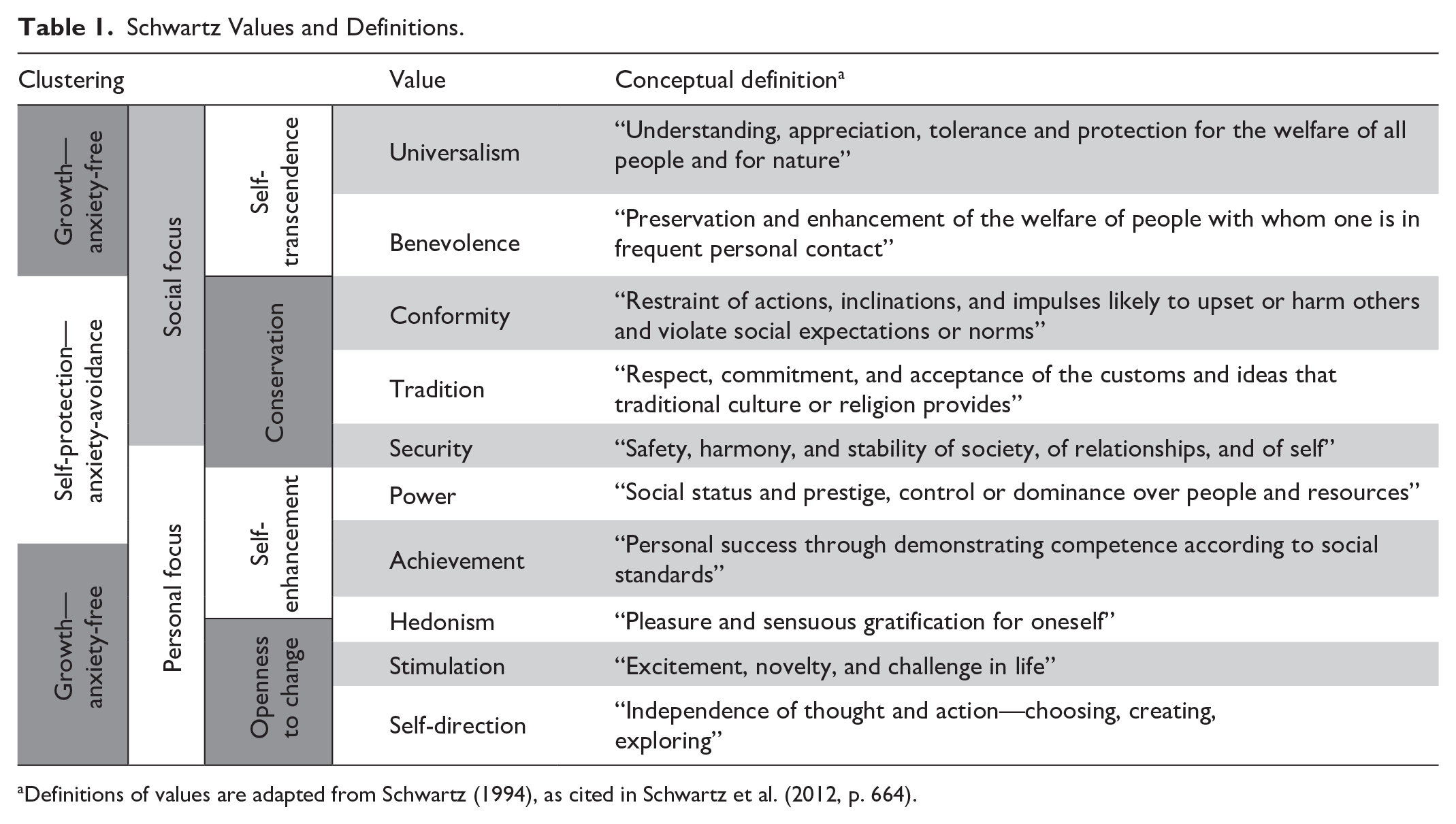

Definitions of values are adapted from Schwartz (1994), as cited in Schwartz et al. (2012, p. 664).
The Dual Route to Value-Change model (Bardi & Goodwin, 2011) provides a theoretical framework for understanding how individuals may change their values in response to environmental cues through automatic and effortful processes. Value-related environmental cues may automatically prime value-related cognitive schemas consistent with those in the environmental cue. Such activation of the automatic route happens when an individual does not realize he or she is being exposed to a prime, and he or she automatically processes the cue. The effortful route is triggered when a value-related environmental cue evokes thinking about a value, for instance, by challenging the individuals’ existing values. Although environmental value cues stemming from various socializing factors (Schwartz, 1992), such as the media, can influence individual values, there is limited understanding of the value cues in individuals’ (media) environments.
Social media representations as value sources
While Schwartz and his colleagues have advanced the understanding of individual values, their framework does not address how values are represented in everyday communication, like social media content. Indeed, individuals’ values are assumed to manifest through their user-generated content (Hallinan et al., 2022). Computational methods have attempted to estimate users’ values from textual posts on Facebook or Twitter (Kumar et al., 2018; Sun et al., 2014), but these approaches are more effective for some values than others (Kumar et al., 2018) and fail to inform about the representation of values on visual platforms.
Recent qualitative studies provide compelling evidence that social media platforms, particularly Instagram, function as spaces for visualizing abstract concepts like values (see Trillò et al., 2021). Through their analysis of value-related hashtags (e.g., #freedom), Trilló et al. (2021) revealed that such content emphasized self-oriented over other-oriented values, with most values being apolitical or overtly commercial, reflecting the platform’s broader commercial logic where self-presentation and self-commodification are central (Trilló et al., 2021). These results align with Hallinan et al. (2023), who observed a prominence of self-improvement and self-acceptance values in New Year’s resolution content and that socially acceptable values like effort, the self, the body, and relational values were more frequently portrayed than values like pleasure, money, recognition, or transcendence. Through interviews, Trilló et al. (2023) further identified that values are embedded in various social media portrait genres, with luxury lifestyle portraits symbolizing wealth and fame, public protest portraits signaling justice, and graduation portraits reflecting achievement. Finally, Välimäki’s (2020) content analysis of Western brands’ Instagram posts found high frequencies of hedonism, self-direction, achievement, universalism, benevolence, tradition, and conformity values.
Despite growing interest in the representation of values on social media, this research area faces several limitations: First, while user-generated and brand-driven content has been explored, the role of SMIs as cultural producers remains underexplored (Khamis et al., 2017). Second, most studies, except for Trilló and Shifman’s (2021) analysis of Schwartz’s values in far-right memes, have not employed established value theories through deductive, quantitative methods, limiting cross-study comparisons. This study addresses these gaps by analyzing the portrayal of values in popular social media messages using Schwartz’s values theory.
SMIs as value intermediaries
In recent years, SMIs have emerged as new cultural products and intermediaries. SMIs have gained fame primarily through self-presentation and content creation on social media platforms, building a substantial follower network, and exerting influence through consistent user-generated content, brand partnerships, thematic expertise, and active audience engagement (Abidin et al., 2021; Enke & Borchers, 2019; Khamis et al., 2017). While SMIs often portray themselves as ordinary people (Schouten et al., 2020) and strategically brand themselves through manufactured authentic self-presentations (Hearn & Schoenhoff, 2016; Khamis et al., 2017; Piehler et al., 2022), their characteristics vary depending on the size of their audience. The smaller their audience, the more SMIs benefit from perceived authenticity and accessibility, and the more they can maintain intimate and trustworthy relationships with their followers (Hearn & Schoenhoff, 2016). The larger their audience, the more they are perceived as experts and possess cultural capital (Campbell & Farrell, 2020). Regardless of their acquired (micro-)celebrity status, SMIs share commonalities such as being strategic communicators who are knowledgeable about their audience’s and organizational partners’ needs, skilled content creators who can create compelling content that resonates with their followers, and community managers who, alongside their editorial teams, can amplify the engagement with and reach of their content (Campbell & Farrell, 2020). These traits allow them to sell their online persona as a brand, blending everyday personal content with native advertising and explicit marketing communications (Abidin, 2018; Campbell & Grimm, 2019).
Despite the tendency to view SMIs as a relatively homogeneous group (e.g., Piehler et al., 2022), SMIs differ concerning their demographics, niche topic, content type, financial vulnerability, and target audience. These differences can trigger divergences in the values SMIs portray and those that resonate with their followers. As cultural intermediaries, SMIs often curate content and promote specific products, lifestyles, and practices (Arnesson, 2022) that may be associated with particular values. Such representations may influence how their followers think, act, and perceive the world around them and lead to normalizing certain values and marginalizing others. Indeed, Arnesson (2022) highlighted that the potential of SMIs might stem from their role as “‘ideological intermediaries’ who promote a lifestyle to be inspired by, and aspire to” (p. 1).
While the influence of SMIs on their audience’s attitudes, beliefs, and behaviors is increasingly studied (e.g., Hudders et al., 2021), only a few studies have focused on the values SMIs exemplify in their everyday content. Tirocchi’s (2024) focus groups revealed that Generation Z associates SMIs with values such as sustainability, sexuality, LGBTQ+ (Lesbian, Gay, Bisexual, Transgender, Queer) issues, authenticity, travel, nature, entertainment, and personal growth. These values align with Schwartz’s universalism, hedonism, and self-direction dimensions. Similarly, Devos et al.’s (2022) content analysis revealed that female beauty and lifestyle SMIs featured the “superwoman ideal” cross-culturally, reflecting values like achievement. However, these studies did not rely on validated theories of values. Instead, they identified values from participants’ interpretations (Tirocchi, 2024) and inductive content analysis (Devos et al., 2022), which limits their comparability across studies and their applicability to future effect studies grounded in established value frameworks.
Given that culture influences value preferences (Schwartz, 1992), popular figures’ values likely align with those supported by their cultural context. In the Western context, people tend to place more importance on individualistic dimensions such as self-enhancement and openness to change and less on conservation than the pan-cultural norm (Hofstede, 2003; Schwartz, 1994; Schwartz & Bardi, 2001). This may translate into Western SMIs posting especially about their achievements (e.g., being listed as “Forbes 30 under 30”) and hedonistic pursuits (e.g., attending parties and drinking alcohol). Moreover, given (Western) SMIs’ embeddedness in consumerist culture, such values are likely prevalent in their content in the shape of, for instance, shopping hauls and trendy dinner posts. Besides culture, SMIs’ perceived authenticity and entrepreneurial spirit (Khamis et al., 2017) may further translate into posts covering self-direction values (e.g., a story encouraging them to be true to themselves). Finally, SMIs share moments from their family lives (Devos et al., 2022) and political views (Arnesson, 2022). Such posts likely communicate values like benevolence and universalism (e.g., showing benevolence in a picture by hugging one’s child and universalism by attending a social justice protest).
Instagram platform politics and vernaculars
The values SMIs portray on Instagram are shaped by cultural context and platform logic. The popularity and global reach of Western English-speaking SMIs reflect broader globalization processes and the role of English as the internet’s lingua franca (Danet & Herring, 2007). U.S.-based cultural dominance is perpetuated and potentially amplified in social media spaces, with Western SMIs serving as key agents in these processes. As key nodes in Instagram’s content creation economy, they shape platform norms (Trillò & Green, 2024) and influence content creators worldwide (Richter & Ye, 2024). Even when national and linguistic differences exist, Instagram’s globalized, market-oriented nature encourages convergence in how values are portrayed (Trillò et al., 2021; Trillò & Green, 2024). This aligns with Richter and Ye’s (2024) findings, who observed homogenization in influencer practices across industries and geolocations on Instagram.
Algorithmic culture—how algorithms shape the production, distribution, and valuation of cultural content on digital platforms (Gillespie, 2016)—also shapes these values. Cultural producers like SMIs operate within a system where their agency is constrained by the business models and normative frameworks established by platform companies (Poell et al., 2024). Platforms prioritize commercially profitable, hegemonic, and normatively acceptable content, such as material success, beauty, or status, while marginalizing content deemed less profitable or non-conforming (Bishop, 2018). Thus, as the values promoted by SMIs on social media may be the representatives of a global digital culture and have the power to influence audiences’ values yet have never been systematically studied, we asked:
RQ1. How prevalent are the basic values in the Instagram posts and stories of popular Western SMIs?
Multimodal representations of values on Instagram
Values can be conveyed through visual (e.g., Trillò et al., 2021) and textual (e.g., Kumar et al., 2018) means. Unique in SMIs’ Instagram communications is the multimodality of their messages, including both textual and visual cues, potentially leading to more complex value representations than studied before in social media value studies (e.g., Sun et al., 2014). Instagram, one of the most popular social media platforms among youth (Rideout et al., 2022), has evolved from a primarily image-based platform to a multimodal platform allowing the use of different modes of expression, including verbal (i.e., posts’ captions, hashtags, text-in-image) and visual (i.e., still and moving images) modes (Leaver et al., 2020). Combining these modes creates multi-layered communications within permanent posts or ephemeral stories. Beyond their temporality, stories offer diverse built-in structures and options, such as text, emojis, stickers, gifs, music, and links with or without images or videos (Leaver et al., 2020). Posts prioritize the visual element and limit text to captions, although users can also upload text-as-images or text-in-images to surpass the platform’s limitations. Captions incorporate verbal elements (e.g., hashtags, text, and tags) and visual elements (e.g., emojis), and both components can connect either implicitly, explicitly, or not at all (Välimäki, 2020). Together, multimodality is present in the different platform features on Instagram, allowing the presentation of different content and aesthetics. Exploring the modality of value representation is important, as prior research has shown that (brand) values are predominantly reflected in captions rather than visual posts (Välimäki, 2020). Moreover, certain values are more likely to be conveyed through text (e.g., self-transcendence), while others are primarily expressed visually (e.g., self-enhancement) (Trillò et al., 2021). Therefore, we asked:
RQ2a: To what extent are basic values represented multimodally in the posts and stories (multimodal complexity)?
In addition, Välimäki (2020) reported that generally, the images exemplified the values developed through the caption, and the caption either interpreted or complemented the images through implicit associations and explicit references. If such congruence between captions and images also occurs among the posts and stories of SMIs, these value messages may be particularly impactful. As theorized by dual information processing models (e.g., Petty & Cacioppo, 1986), visuals are often more automatically processed, whereas texts require a more controlled cognitive processing, often leading to different effects in media users (Powell et al., 2019). In line with the dual route to value-change model (Bardi & Goodwin, 2011), visual representations of values might automatically prime specific values within users, while the elaboration in-text might lead to more effortful processing. Following existing theories on the importance of image-text congruency (e.g., dual-coding theory; Paivio, 1986), the greatest effect might emerge when textual and visual elements emphasize the same value. As such, we asked:
RQ2b: How often is the same basic value represented in text and the visual of the same post (congruence)?
Comparing SMIs with celebrities and athletes
To better comprehend the values represented by SMIs on social media, this study warrants a comparative examination of the value representations of other famous personae, such as celebrities and athletes. Such a comparative approach allows for identifying shared versus unique aspects of SMIs’ value representations. Previous studies have often conceptualized SMIs as distinct from celebrities (including athletes) (e.g., Piehler et al., 2022). Celebrities and athletes, unlike SMIs, achieve fame primarily through professional offline accomplishments in entertainment, sports, or the arts (Khamis et al., 2017; Piehler et al., 2022). Their fame is conferred through traditional mainstream media, such as television or film, and they later extend their visibility to social media platforms, where they leverage their pre-existing status to engage with online audiences (Piehler et al., 2022). Athletes and SMIs depend more on sponsors than celebrities (Bishop, 2021; Smith & Sanderson, 2015). Moreover, SMIs sometimes differ from celebrities and athletes in self-presentation: Celebrities and athletes are more reluctant to share their private lives (Hearn & Schoenhoff, 2016) than SMIs and are less accessible (Campbell & Farrell, 2020). Although all actors incorporate (native) advertising in their posts (Campbell & Grimm, 2019), SMIs more strongly depend on their social media appearances for income and are, therefore, more skilled content creators, contributors, and audience managers (Enke & Borchers, 2019). SMIs, athletes, and celebrities also share similarities, such as their role as strategic communicators (Enke & Borchers, 2019), their audience reach (Hearn & Schoenhoff, 2016), and their subsequent potential to shape beliefs and cultural trends (Arnesson, 2022; Fraser & Brown, 2002). They are also similarly regarded as role models by their young audiences (Hammond et al., 2022) and likely disseminate the values most important to them in their content (Devos et al., 2022; Fraser & Brown, 2002).
However, the distinction between SMIs and celebrities is increasingly ambiguous due to their convergence in media practices (see Abidin, 2018). Some scholars argue that SMIs with large followings achieve “celebrity status” through legacy media exposure (Abidin, 2018) and attending celebrity-centric events like red carpets (Enke & Borchers, 2019). Conversely, celebrities and athletes adopt influencer strategies, such as self-disclosure, audience engagement, and personal brand promotion (Hearn & Schoenhoff, 2016). Despite these overlaps, SMIs remain distinct from celebrities (Abidin, 2018) due to the unique social dynamics involved in gaining their status, which may lead them to prioritize different values. Thus, we asked:
RQ3: How do SMIs’ representations of basic values differ from those of celebrities and athletes?
Method
Sample
As part of the larger European project MIMIc, a manual quantitative content analysis was conducted to analyze Instagram posts and stories of influencers, celebrities, and athletes. 1 A total of 60 Instagram accounts, comprising 20 influencers, 20 celebrities, and 20 athletes, were selected with an equivalent gender ratio. These accounts were identified using online ranking websites as the most popular in Western countries during the data collection (see sample description—including national origins and places of residence—and sampling strategy on the Open Science Framework; OSF). 2 To be included, profiles had to belong to the 10 most followed accounts in their categories (i.e., celebrities, influencers, sports), be primarily English-speaking (i.e., bilingual accounts like Lionel Messi were retained due to their bilingual captions and Instagram’s translation tool), and have a global follower base predominantly in the Global North (e.g., Indian personalities were excluded). This ensured that the sample aligned with our focus on value representations from personalities with comparable cultural contexts and audience consumption patterns. One female athlete was excluded from the sample due to inactivity during the data collection period, resulting in 59 accounts that were followed daily.
The influencers were, on average, 34.13 years old (SD = 8.35, range = 17–56) and were predominantly Caucasian, with 32 White/Caucasian, 10 Black/African American, 9 Latino/Hispanic, 6 with a combination of different ethnicities, 1 Asian, and 1 Middle Eastern. They had an average of 63.48 million followers (SD = 67.07M, range = 4.1M–245M) on Instagram and followed around 654.22 users (SD = 620.47, range = 0–3305) themselves. During the data collection period, they posted an average of 21.29 posts (SD = 20.59) and shared 49.76 ephemeral stories (SD = 54.64). The total number of posts on their profiles ranged from 73 to 13,833 (M = 33, SD = 3101.73).
Individual posts and stories were used as units of analysis. Permanent posts consisted of a written caption accompanied by a picture or video (or multiple media items for carousel posts). To avoid potential assumptions about the relationship between the caption and the visual aspect of the post, we coded these two components separately, as Smith and Sanderson (2015) recommended. The sample consisted of the posts of influencers, celebrities, and athletes published between October 1 and 31, 2020, and their stories from October 1 to 15, 2020. This resulted in a sample of 1256 posts and 2936 stories (N = 4192) that were manually collected and coded. Data were gathered twice daily at fixed times using a dedicated social media account to address the ephemeral nature of stories. At each interval, the researcher visited all profiles to save URLs of new permanent posts and record new ephemeral stories. All materials in this study (codebook, sample, ICR, data, syntax, supplementary tables) are available on OSF.
Coding procedure
For this study, we developed a coding framework (see OSF) divided into a first section related to the profile and a second dedicated to the post/story level. The “post” section was divided into two subsections dedicated to the visual level and another to the caption. The data were coded as described below.
The
Analytical strategy
After undergoing extensive training, two coders carried out the content analysis. Following feedback loops, the inter-coder reliability indexes (ICR) showed Cohen’s kappa ranging from 0.99 to 1.00 for all variables at the caption and visual levels. Descriptive statistics and crosstabs answered RQ1 (prevalence of basic values) and RQ2a and b (multimodal complexity and level of congruence). For the profile level, a ratio score was calculated for each account by dividing the number of posts/stories with a value by the total number of their posts/stories. This ratio score considers the differences within each SMI. Due to the nested posts and stories within the Instagram accounts, a multilevel approach addressed RQ3 (celebrity type differences). Estimating the Intra-class Correlation Coefficients (ICCs) indicated a good fit, as ICCs ranged from 0.10 to 0.89. Multilevel binomial logistic regressions were conducted for each value as the dependent variable and celebrity type as the independent variable using the lme4 package in R4.1.1. Platform feature was added as a control variable, as it can influence the type of content (i.e., values) posted. Inter-rater reliability coefficients and descriptive results were calculated with SPSS-28. Supplementary Tables 3–11 provide an overview of all results.
Results
Frequency of basic values (RQ1)
Posts and stories level
Of the 4192 data points observed, 2528 (60.3%) featured at least one value. Representations of achievement (n = 1060, 25.3%), benevolence (n = 921, 22%), and hedonism (n = 845, 20.2%) were the most frequently present, followed by stimulation (n = 210, 5.0%), conformity (n = 196, 4.7%), self-direction (n = 134, 3.2%), universalism (n = 92, 2.2%), power (n = 75, 1.8%), tradition (n = 55, 1.3%), and security (n = 7, 0.2%) (Supplementary Table 3).
Detailed illustrations, recurrent themes, and representations for each value are summarized in Supplementary Tables 1 and 2.
A correlation matrix of phi coefficients examined the relationships between the values and revealed multiple significant associations ranging from negligible to moderate strengths. The strongest association was observed between benevolence and hedonism (ϕ = .383, p < .001). This mostly looked like personalities engaging in playful activities with their child or eating a tasty meal with an alcoholic drink with their friends while expressing how much they appreciate them. Furthermore, achievement showed a weak negative correlation with benevolence (ϕ = −.142, p < .001) and with hedonism (ϕ = −.113, p < .001) and a weak positive correlation with stimulation (ϕ = .158, p < .001). The negative correlation between achievement and benevolence highlights the conflict between self-transcending and self-enhancing values and the conflict between the social versus personal focus. Achievements were mostly centered around individual successes and personal gains. On the contrary, expressions of benevolence had a strong social focus in which the self was secondary. Regarding stimulation and achievement, this was co-portrayed through narratives of challenge and exciting successes, for example, in posts promoting one’s new “exciting” project, which was “finally launched.” Additional weak correlations can be found in Supplementary Table 4.
Profiles level
At the profile level, all famous personae (N = 59, 100.0%) shared a post or story representing a Schwartz value at least once. They referenced a value on average 60.93 times in the studied period (SD = 61.90). Proportionally, within each profile, three out of five permanent posts (66.7%, SD = 22.26, range = 0–100) and five out of ten ephemeral stories (53.3%, SD = 24.62, range = 0–100) portrayed a value.
On average, the famous figures featured 6.19 (SD = 1.89, range = 2–10) values in their content. More precisely, 98.3% of profiles represented hedonism at least once (n = 58/59), 94.9% achievement (n = 56), 93.2% benevolence (n = 55), 78.0% conformity (n = 46), 71.2% stimulation (n = 42), 59.3% universalism (n = 35), 54.2% self-direction (n = 32), 35.6% power (n = 21), 25.4% tradition (n = 15), and 8.5% security (n = 5). All values co-occurred at least twice in the same profiles; achievement-hedonism co-occurred the most often (n = 55), followed by benevolence-hedonism (n = 54) and achievement-benevolence (n = 52). Phi coefficients evaluated correlations between the values within the profiles. Self-direction correlated with power (ϕ = .257, p = .049), benevolence (ϕ = .294, p = .024), and stimulation (ϕ = .542, p < .001); stimulation with power (ϕ = .317, p = .015), benevolence (ϕ = .275, p = .035), and conformity (ϕ = .294, p = .024); and universalism with achievement (ϕ = .280, p = .032) and conformity (ϕ = .559, p < .001).
Multimodal complexity (RQ2a) and caption-post congruence (RQ2b)
The values were mainly represented through medium (n = 1252, 49.5%; e.g., a post featuring an athlete’s TV show and the show’s name) and low (n = 1203/2528, 47.6%; e.g., a story with a written poll) levels of multimodal complexity, followed by high levels (n = 69, 2.7%; e.g., a video of a celebrity-brand partnership mixing moving and still images with text and hashtags shared in a story). Photos and a combination of video and text were the most popular modes of expression (Supplementary Table 5). Out of the 825 permanent posts representing at least one value, 39.4% (n = 325) represented the value in the post only, 21.2% (n = 175) in the caption only, and 39.4% (n = 325) in both the post and the caption. Examples with URLs are provided in Supplementary Table 6.
Regarding congruence, 60.6% (n = 500) of the posts were incongruent (i.e., the value was represented in the post or the caption). For instance, a celebrity shows herself getting into her luxury car with no caption. For the remaining 325 posts, 126 (15.3%) were congruent (i.e., the post and caption represented the same value), and 199 (24.1%) did not show any connection between the caption and the post (i.e., both represented values, but not the same ones) (Supplementary Table 7). Congruence looked like a post of a celebrity enjoying a luxurious island vacation, paired with a descriptive caption or a photo with a loved one expressing appreciation. Separate (yet often non-conflictual) values were portrayed, for example, as a family picture captioned “God is amazing . . . #Harts #4” (benevolence-tradition).
Celebrity type differences (RQ3)
Celebrity type did not significantly predict the representation of values in general. However, subsequent analyses showed that it significantly predicted benevolence (p < .05) and hedonism (p < .05). Specifically, the multilevel analyses revealed that SMIs were 2.5 times less likely to portray universalism than celebrities (exp(−0.93) = odds ratio [OR] = .40, 95% confidence interval [CI] = [0.16, 0.97]). Furthermore, athletes and SMIs were, respectively, 1.84 and 2.11 times more likely than celebrities to portray benevolence (expathletes(0.61) = OR = 1.84, 95% CI = [1.03, 3.30]; expSMIs(0.75) = OR = 2.11, 95% CI = [1.19, 3.75]), and 1.68 and 1.94 times more likely to portray hedonism than celebrities (expathletes(0.52) = OR = 1.68, 95% CI = [1.03, 2.75]; expSMIs(0.66) = OR = 1.94, 95% CI = [1.20, 3.14]) (Supplementary Tables 8–11). 3
Discussion
This study on Instagram posts and stories of SMIs revealed that approximately seven in ten posts and six in ten stories featured at least one value, with achievement, benevolence, and hedonism being the most frequently portrayed values. The study offers the first empirical evidence that values are prevalent in popular SMI content and closely align with and reflect platform and societal norms. This is particularly relevant for audience attitudes and behaviors, as exposure to these values can influence followers through automatic and effortful processes. Finally, the study underscores the importance of modalities of representation and content characteristics on social media, such as visual-textual congruency and multimodal complexity.
First, the preponderance of achievement, hedonism, and benevolence aligns with previous research on social media’s emphasis on commercially profitable, hegemonic, and normatively acceptable content (Bishop, 2018). The prevalence of achievement values—through portrayals of promotional content and professional successes where brand creation and partnerships are presented as significant accomplishments—reflects the entrepreneurial imperative calling SMIs to showcase success to strategically self-promote (Duffy & Pooley, 2019). These representations often embodied a meritocratic narrative of hard work and deservingness. In addition, hedonism was prominently reflected in SMIs’ aspirational lifestyles, centered on personal gratification and enjoyment, showcased through (sponsored) shopping hauls, trendy dinners, and brand placements, and highlighting their embeddedness within a consumerist culture (Hughes et al., 2019). The representations of benevolence through expressions of love, support, and inspirational messages highlight empathy and attentiveness as central to their public personas and align with studies reporting that SMIs frequently share personal moments with family (see Devos et al., 2022). Such self-disclosures may contribute to the audience’s perceived authenticity of SMIs (Schouten et al., 2020). Such authenticity beliefs partly differentiate SMIs from other famous individuals (Khamis et al., 2017). Relatedly, we found that SMIs and athletes portrayed hedonism and benevolence more frequently than celebrities. This finding substantiates that celebrities maintain more distance and privacy regarding their personal lives (Hearn & Schoenhoff, 2016). SMIs were also less likely to represent universalism than celebrities, which is interesting given universalism’s strong association with political activism (Vecchione et al., 2015). The lack of differences regarding the portrayal of power—visually represented through indicators of economic, cultural, and social capital, as well as through demonstrations of physical dominance and, at times, sexual subjectification—suggests that luxury experiences and markers of status are no longer exclusive to traditional celebrities and points to the increasing convergence between the celebrity types (Abidin, 2018).
The co-occurrence of values such as hedonism, achievement, benevolence, and stimulation in influencers’ profiles underscores the multifaceted nature of their self-branding, balancing enjoyment, success narratives, care for loved ones, and challenges. While conformity and universalism appear less frequently, their presence reflects SMIs’ embeddedness in societal norms, including normative behaviors like civic engagement and health awareness, crafting an aspirational yet relatable image—successful, fun, caring, and socially responsible. However, these representations are predominantly self-oriented, with even benevolent content often tied to self-presentation and branding, echoing the “self-consumer” dimension identified by Trilló et al. (2021). In line with Trilló et al. (2021), SMIs’ content emphasizes consumption over citizenship and aligns with Instagram’s broader commercial logic, where self-presentation and commodification of the self are central.
These findings are further consistent with the existing value priorities in Western culture, as values related to self-enhancement (e.g., achievement) and openness to change (e.g., hedonism and stimulation) are dominant in this culture (Schwartz, 1994; Schwartz & Bardi, 2001). Conservation is less dominant in Western culture (Schwartz, 1994; Schwartz & Bardi, 2001). Accordingly, tradition and security occurred less frequently across SMIs except for a few SMIs who appeared to be more traditional or oriented toward security. One example was the celebrity Justin Bieber, who frequently mentioned “God bless you” and shared other inspirational religious quotes. As such, our findings highlight SMIs and celebrities’ role in perpetuating Western cultural ideals of individualism and consumerism (Trillò et al., 2021).
It should be noted that while Schwartz’s values are considered relatively stable psychological constructs, platform norms, and value representations online are subject to change due to societal events and social media trends. A longitudinal content analysis would allow future research to capture how the salience of certain values fluctuates with such trends.
Second, the differential representations of values in SMIs’ content may have implications for the value priorities of social media users. Our content analysis does not allow us to test for such effects, yet the Dual Route to Value-Change model (Bardi & Goodwin, 2011) offers valuable insights into this view. First, implicit and explicit priming can temporarily alter the accessibility of values (Roccas & Sagiv, 2017). Consequently, and speculatively, (repeated) exposure to SMIs’ social media messages may induce temporary and more permanent value changes. This is relevant considering the documented links between values, political behavior, and attitudes. Prior studies have noted that the level of endorsement of values such as hedonism and stimulation, which occurred frequently, differed between non-voters and voters (Caprara et al., 2012). The higher prevalence of hedonism, achievement, and benevolence is especially relevant in light of research on core political values, which found associations between the endorsement of these values and support for military intervention and equality (Schwartz et al., 2014). As central schemas, values can influence distinct yet connected attitudes and behaviors (Schwartz, 1992). For instance, attaching importance to achievement can underpin political attitudes transcending different contexts, like endorsing meritocratic beliefs. Holding such attitudes helps attain or preserve the underlying values (Vecchione et al., 2015). As such, future research should investigate how the prevalence of hedonism, achievement, and benevolence in SMIs’ content may promote corresponding political values within their audiences.
Second, the Dual Route to Value-Change model assumes that SMIs’ posts may strengthen existing values (i.e., automatic route) and result in value change through the effortful route (Bardi & Goodwin, 2011). This process implies that SMIs may create a highly homogeneous value system in their loyal followers. The assumptions of the value-change model imply that identification with a person can affect how strongly individuals endorse values after value exposure through both the automatic and effortful routes (Bardi & Goodwin, 2011). This assumption holds particular relevance for SMIs, as their predominantly young audience often identifies with them (Hammond et al., 2022). As perceived role models (Hammond et al., 2022), SMIs may present particular values as highly desirable traits, and followers may strive to achieve similar values due to their identification with SMIs; future effect research is necessary to explore these assumptions. Together, these findings hint that SMIs’ promotion of different values may, through different routes, lead to a particular type of value endorsement that has implications for various areas. Future studies should link content analysis with survey data to verify the assumptions of the value-change model.
Finally, values were predominantly represented with low and medium levels of multimodal complexity: visuals only and combinations of visuals and text were the most popular modes of expressing values on social media posts. This pattern of combined modes of expression centered around visuals is intertwined with Instagram’s built-in features and corresponds to Trilló et al.’s (2021) concept of aesthetic consumption. Such media-rich expression modes of values can increase post engagement among social media users (de Vries et al., 2012). Visuals typically provide vivid exemplars of the covered values. Considering the assumptions of dual models of information processing (Bardi & Goodwin, 2011; Petty & Cacioppo, 1986), visual representations of values may, in particular, automatically prime values among social media users, while an in-text elaboration of a value may especially lead to more effortful processing. Most (permanent) posts covered values in the visual (39%), and a minority covered visuals in the caption (21%). Note that 15% of the value-laden posts were congruent, meaning the visual and text in the caption covered the same value. Such double-dose exposure to a value (see the principles of Bardi & Goodwin, 2011) may be the most impactful. Interestingly, although not hypothesized, the control variable “platform feature” proved to have an effect—with benevolence, self-direction, stimulation, and hedonism being more portrayed in posts and conformity in stories—and should receive more attention in the future.
Limitations and conclusion
Several limitations were present. First, while Instagram remains one of the most popular social media among various age groups (Rideout et al., 2022), the focus on a single-platform rather than a multi-platform comparison may limit the generalizability of the results. Further studies could assess how the specific cultures, affordances, and vernaculars of platforms like TikTok and Snapchat could influence SMIs’ value representations. Second, by concentrating on Western and English-speaking accounts, we excluded localized value expressions and cultural nuances, such as differences between collectivistic and individualistic value systems (Hofstede, 2003), contributing to the Anglocentrism prevalent in communication research. Nevertheless, prior research indicates that Instagram’s globalized, market-oriented nature encourages convergence in how values are portrayed (Trillò & Green, 2024). Third, while the current study benefits from a large sample size of posts and stories, its temporal scope remains limited (i.e., 1 month for posts and 2 weeks for stories). This short-term focus may restrict a comprehensive understanding of the temporal trends and fluctuations in the values expressed within the accounts of celebrities, athletes, and influencers. Future research could adopt a longitudinal approach to address this limitation.
This study provides valuable insights into the prevalence and interrelationships of Schwartz values in famous individuals’ social media content, with significant implications for content-focused effects research. The values portrayed are heavily aligned with individualistic values (Hofstede, 2003; Schwartz, 1992), emphasizing self-orientation and positioning individuals as consumers rather than citizens (Trillò et al., 2021). Instances of values associated with citizenship and a focus on others were often intertwined with the promotional politics of influencers (Arnesson, 2022) or their efforts to self-brand. These dynamics may shape audiences’ attitudes and have downstream effects on political participation, as repeated exposure to particular values could influence political behavior (Caprara et al., 2012). These findings highlight the need for social media literacy programs to inform youth about the biases in SMIs’ persuasive content. Policymakers should also address how such values may shape societal norms that privilege consumerism and individualism over collective engagement.
Supplemental Material
sj-pdf-1-sms-10.1177_20563051251339035 – Supplemental material for The Values of Fame: Exploring the Visual and Textual Representations of Basic Values in Influencers’ Instagram Content
Supplemental material, sj-pdf-1-sms-10.1177_20563051251339035 for The Values of Fame: Exploring the Visual and Textual Representations of Basic Values in Influencers’ Instagram Content by Anaëlle J. Gonzalez, Isra Irmak Akgün and Laura Vandenbosch in Social Media + Society
Footnotes

Funding
The author(s) disclosed receipt of the following financial support for the research, authorship, and/or publication of this article: This work was supported by the European Research Council (ERC) starting grant (grant agreement 852317).
Declaration of conflicting interests
The author(s) declared no potential conflicts of interest with respect to the research, authorship, and/or publication of this article.
Supplemental material
Supplemental material for this article is available online.
Notes
Author biographies
References
Supplementary Material
Please find the following supplemental material available below.
For Open Access articles published under a Creative Commons License, all supplemental material carries the same license as the article it is associated with.
For non-Open Access articles published, all supplemental material carries a non-exclusive license, and permission requests for re-use of supplemental material or any part of supplemental material shall be sent directly to the copyright owner as specified in the copyright notice associated with the article.
