




Abstract
Recent interest in online political influencers has resulted in an array of competing definitions of who counts as a political influencer. Contending the value of a more porous and resilient definition able to recognise a spectrum of online political influence, we interrogate scholarship on opinion leadership, influentials, micro-celebrities, and social media influencer studies to reveal a range of identifying traits that can characterise different types of political influencers. Introducing a new approach to categorising these varied manifestations, we discuss six key attributes: personalised communication, compensation, audience size, political topical focus, control, and formal political role. Showing how this approach can be deployed to capture different manifestations of political influencers, we aim to build understanding that is resilient to change over time and that can support comparative empirical work.
Introduction
Online content creators sharing political messages, sometimes called political influencers, are one of the latest innovations in politics. Globally, the power of influencers is ‘increasingly recognized by political actors, both in the context of elections as well as by politicians seeking to increase their popularity among a younger audience’ (Peter and Muth, 2023: 164). There is a huge variety of online personalities who might be classified as political influencers: content creators whose brand is entirely political, lifestyle influencers who only talk about politics during an election, residents who dedicate their online presence to local issues, accounts explicitly paid to make political posts, and politicians who got their start online. Academics have sought to document and define this recent trend (Rothut, 2025), using terms such as ‘social media influencers’ (Bause, 2021; Sehl and Schützeneder, 2023; Suuronen et al., 2022), ‘political relational influencers’ (Goodwin et al., 2023) ‘digital opinion leaders’ (Casero-Ripollés, 2020) and ‘political social media influencers’ (von Sikorski et al., 2025) to offer boundaries around who or what counts. But they do so differently, relying on different theoretical underpinnings and at times coming to contradictory conclusions. There is accordingly no consensus as to who counts.
In this paper we argue for a broad and porous conceptualisation of political influencers able to reflect insights from a range of scholarly traditions about how political influence is manifest. We review scholarship on political opinion leadership, influentials, (micro)celebrities and influencers which lays the foundation for current understanding of political influencers. Noting variation in how political influencers are defined and measured, we highlight six key attributes of political influencers, selected for showcasing tensions and contradictions evident in existing definitions. Embracing the fuzzy boundaries between kinds of political actors that exist in a hybrid media system where tools and tactics of communication are often shared (Chadwick, 2011), we contribute an alternative means of conceptualising political influencers. Rather than imposing fixed boundaries to differentiate these actors as a discrete phenomenon, we propose an expansive and more adaptive approach that can be used to understand and reflect a range of possible definitional parameters.
This conceptual approach is, we argue, valuable because it enables scholars to compare across studies examining political influencers by making it possible to recognise how these online personalities differ. This approach is also more resilient to change than many emerging definitions as it can account for shifts in actors’ status (i.e. moving from a politician to a commercially funded online personality or vice versa), and changes in digital affordances and norms (i.e. in norms around the audience size required to be recognised as an influencer) that may occur over time.
Presenting these ideas, we seek to illustrate this alternative mode of conceptualisation and encourage other scholars to build upon and integrate additional identifying attributes into our framework to allow us to understand diverse types of political influencer behaviour and how this changes over time.
From political opinion leaders, to influentials, to micro-celebrities and influencers
To understand who counts as a political influencer, we begin by considering the breadth of existing literature shaping ideas about who or what is influential, tracing understandings of political influence within scholarship on opinion leadership, influentials, (micro)celebrities and influencer studies. In the next section, we re-examine these traditions and consider additional political science literature to pinpoint tensions and potentially different manifestations of political influencers. Incorporating these ideas into a more expansive conceptual approach we go onto show how political influencers’ attributes can vary.
Political opinion leaders
We start with Katz and Lazarsfeld’s (1955) opinion leadership, first introduced by Lazarsfeld et al. (1944), which is routinely evoked to explain how and why political influencers impact the opinions, attitudes and behaviours of their audiences (Bause, 2021; Casero-Ripollés, 2020; Rothut, 2025; Soares et al., 2018). This work aimed to show how information and influence flowed from mainstream news media to certain members of the public, dubbed ‘opinion leaders’, in the first of the two-step flow of communication. In the second step, opinion leaders choose which ideas from news media to share with their less engaged associates. In this tradition, political opinion leaders are above-average consumers of political information and news, and personally influence their social circle (Katz and Lazarsfeld, 1955). This influence relies on the ability of an opinion leader to apply social pressure (encourage or discourage particular behaviour) and social support (encourage alignment with their social group) to their associates, who are motivated to maintain their relationships and be accepted as a member of the opinion leaders’ social circle (Katz and Lazarsfeld, 1955). This interpersonal influence is possible because opinion leaders are familiar with their associates’ interests, have shared experiences, are often seen as experts, and have opportunities to engage in interpersonal communication (Katz and Lazarsfeld, 1955). Distinct from journalists, politicians, or celebrities, whose influence relies on status, popularity, and official roles (Weimann, 1982), opinion leaders can bridge the gap between political elites and the general public with social pressure and support (Bucy and D’Angelo, 2004).
As the Internet became ingrained in daily life, researchers sought to understand how people engaged in politics online and examined opinion leadership in online contexts. Some found opinion leadership was replicated in digital media environments (Norris and Curtice, 2008), and some suggested the availability of more and different information changed the flow, reinforcing the notions of multiple steps (Weimann, 1982) and reverse flows of influence (Robinson, 1976). Others suggested microtargeting and personalization algorithms created a one-step flow wherein opinion leaders were less essential (Bennett and Manheim, 2006).
While the ideas have been tested, challenged, and adapted over time, Katz and Lazarsfeld’s work has offered two relevant contributions: (1) opinion leaders are a conduit of information; and, (2) interpersonal relationships matter. As a conduit, opinion leaders create a bridge between one group and another, such as mainstream news, a political party, or a brand, and members of the public. Underscoring the value of interpersonal relationships, Katz and Lazarsfeld (1955) argue social pressure and social support are essential for opinion leaders’ influence over peoples’ opinions, attitudes, and behaviours. They rely on shared experiences, knowledge of their associates’ interests and needs, and personal relationships as they choose what, when and how to share information (Katz and Lazarsfeld, 1955). Recently, Harff et al. (2025) articulated a variation they call proximal opinion leadership, wherein social media influencers use ‘personalized communication’ strategies, including self-disclosure and reciprocity, to reach self-built public networks. This focus offers a way to think about how social media influencers might maintain interpersonal-like relationships. In short, while the number of people an opinion leader can reach is relevant, it is essential to consider their relationships to understand how they influence the opinions, attitudes and behaviours of their associates.
Influentials
A related area of research focused on the study of ‘influentials’. While an established term (Weimann, 1991), this idea became particularly associated with studies of highly popular social media accounts. Re-emerging in 2007 to 2010 when social media trace data was relatively easy to collect, studies often used social network analysis techniques to understand which accounts were most central and effective at spreading information in online political communication networks (Watts and Dodds, 2007). Subsequent studies have used similar techniques to identify online influencers in political networks (Soares et al., 2018), with more recent work looking at political influence in a range of online contexts (Acharoui et al., 2020; Fischer et al., 2022; Weismueller et al., 2022).
Studies of influentials often referenced Katz and Lazarsfeld’s work to offer theoretical grounding, but their operationalization reflected only certain facets of influence (removed for review). Their focus was almost entirely on opinion leaders as a conduit for information, considering how many other accounts they could reach, and not their use of interpersonal influence. Accounts most commonly identified as influentials were typically those of individuals popular in offline contexts such as news media personalities, news organisations, political parties and politicians, or more rarely accounts which gained popularity online such as well-known bloggers, and prolific social media users who did not hold formal political roles (Leavitt et al., 2009). Their commonality was their ability to reach wider audiences due to their central role in their chosen online communities (Xu et al., 2014). The fact that people holding formal political roles could be identified as influentials within this line of study is noteworthy considering opinion leaders were explicitly not political elites or celebrities in the Katz and Lazarsfeld tradition.
(Micro)celebrities
In parallel to studies of influentials, another body of scholarship examined (micro)celebrity on social media which is a ‘mindset and set of practices in which the audience is constructed as a fan base, popularity is maintained through ongoing fan management, and self-presentation is carefully assembled to be consumed by others’ (Marwick, 2015: 337). Focusing on how digital media allows individuals to gain an audience, this work highlighted how some individuals online were treated like celebrities by their followers, affording them influence as followers often wanted to emulate them. Others argued true celebrity influence is about being in awe of someone you cannot reach, in contrast with the relationship to social media influencers that is more about feeling like the influencer and seeing yourself in them (Arriagada and Bishop, 2021).
Drawing on the concept of (micro)celebrities, scholars have explored how this tactic has been deployed to promote political ends (Lewis, 2020). One body of scholarship examines celebrities whose fame has been garnered entirely online (Harff and Schmuck, 2023). As Ruiz Gómez (2019) highlights, there has been an explosive growth in ‘new idols who owe their fame to social media and are better known as social media influencers’ (p. 10.), also described as ‘micro-celebrities’, ‘instafamous’ or ‘internet famous’. These individuals present a ‘public persona to be consumed by others’ (Marwick, 2015: 333). Another body of work, building on a long-standing literature on celebrity endorsements in politics, directs attention to established celebrities voicing support for political goals online (Atkinson and DeWitt, 2016). Shmargad (2022) has distinguished between these approaches by differentiating between ‘influential politicians’ and ‘politicised influencers’.
What is common to both approaches is the mobilisation of different forms of celebrity or status to advance political goals or share political information. Individual studies explore different types of celebrity, with scholars in both traditions looking at actors who have gained celebrity status for non-political activities (Arthurs and Shaw, 2016), or whose celebrity is associated directly with politics (Marsh et al., 2010). While this focus on influencer status helps differentiate those who do and do not have an audience, focusing on celebrity status alone misses non-famous actors who can exert influence in these online spaces; a possibility captured by scholarship on nano and micro-influencers (Alampi, 2019; Goodwin et al., 2020) as well as opinion leadership which relies on interpersonal relationships.
Influencers
Influencer studies emerged around 2015 with studies of mommy bloggers and scholars like Senft (2013), Abidin (2015), Marwick (2015), Duffy and Hund (2015), and Bishop (2021) breaking ground using digital anthropological methods to understand how people develop and maintain relationships with online followings. Building from the notion of (micro)celebrity, concepts like (trans)parasocial relationships and authenticity (described below) emerged from this work as core to understanding how popular accounts online might influence the opinions and behaviours of their followers. These studies rarely examined electoral contexts and were typically not overtly about politics, but social issues and advocacy efforts have sometimes been covered.
The notion of parasocial relationships wherein audience members perceive kinship between themselves and celebrities, based on feelings of similarity and friendship and on the perception of frequent interactions and personal disclosures (Conde and Casais, 2023), was first developed to explain the connection audience members have with TV personalities (Horton and Richard Wohl, 1956) and has been used to describe influencers’ relationships to their audiences. Followers feel a social connection to the influencer despite not knowing them personally or having a reciprocal relationship (Naderer, 2022). A modified view emerged arguing the follower-influencer relationship is more of a trans-parasocial one, being collectively reciprocal, with followers acknowledging the presence of some reciprocity and accommodation of collective demands; (a)synchronously interactive, to a much greater extent than in parasocial relationships; and co-created, with followers playing an active role in the shaping of this relationship and affecting the influencer’s content (Lou, 2022). Others note that an influencer might have different kinds of relationships with different followers at different points in time, or that their relationship to their followers evolves as their audience grows (Conde and Casais, 2023). Common to these ideas is the principle that understanding the relationship between an online figure and their audience/followers is key to understanding if and how an online figure can have sway or ‘influence’ over the preferences of their audience.
To explain how individuals online develop and maintain their relationships to their audiences, scholars began to point to authenticity (Bause, 2021; Goodwin et al., 2023), defined as acting ‘in accord with one’s values, preferences and needs’ (Kapitan et al., 2021: 343). This is connected to the idea of an influencer having a personal brand or persona (Duffy et al., 2017), the version of themselves presented online and which may not actually accurately reflect their personal life and identity (Cornwell and Katz, 2020). This brand identity has become increasingly important as the industry has evolved away from influencers acting primarily on a single platform to having presence across multiple social media platforms and other tools (Glatt, 2022).
As influencers became more embedded in people’s online experiences and media diets, the marketing industry developed social media influencer marketing, whereby brands seek to capitalise on the wide reach and perceived intimate connection influencers have with their followers (De Veirman et al., 2017). Influencer marketing often involves a marketing agency which represents an influencer and facilitates partnerships with brands/organisations (Haenlein et al., 2020). Marketing agencies typically apply some level of control over influencers as they decide who to represent and often ‘need to spend a certain amount of time to brief influencers and immerse them into the brands they are supposed to advocate’ (Haenlein et al., 2020: 10).
As the influencer industry evolved, some research has examined professionalisation, labour and aspirational labour, and payment as key aspects of the phenomenon (Bishop, 2021; Duffy et al., 2017). Others have pointed to informal partnerships, gifts, and other ways brands and influencers might work together, but there is disagreement as to whether an influencer account must be monetized (Abidin, 2015; cf. Goodwin et al., 2023). While social media influencer marketing began in the commercial sphere, it has extended to political campaigns (Arriagada and Bishop, 2021) with political agencies emerging (Goodwin et al., 2020).
Ultimately, like opinion leadership work, influencer studies reinforce the importance of considering relationships between the influencer and their followers beyond audience size. Influencer studies also point to the relevance of compensation for assessing who counts as an influencer, something not addressed in opinion leadership or studies of influentials.
Defining political influencers
Evidently, there are many ways influencers have been conceptualised, with the different theoretical traditions summarised above suggesting that different people ‘count’ as political influencers. This has made defining political influencers complex and a recent systematic review confirms there are a range of different definitions for political social media influencers (Rothut, 2025). Consider four examples.
First, Suuronen et al. (2022) explore when ‘social media influencers’ go political, identifying these actors as ‘opinion leaders who (1) intensively use social media in their communication practices, (2) collaborate with corporations to monetise their opinion leader status, (3) establish regular two-way interactions with their followers that often lead to parasocial relationships, and (4) engage in self-branding strategies to curate a consistent public persona’ (pp. 302–303).
Second, Bause (2021) defines political social media influencers as ‘users who became well known in social media and, as self-created personal brands, regularly distribute self-produced political content with which they reach and potentially influence a dispersed audience’ (p. 296).
Third, von Sikorski et al. (2025) focus on social media influencers who ‘act as opinion leaders (De Gregorio and Goanta, 2022), have no institutional background (like journalists and politicians), and “whose notoriety and fame is platform-built” (Riedl et al., 2023: 2)’ (p. 4).
Finally, in a special issue of Social Media + Society, Riedl et al. (2023) define political influencers as ‘content creators that endorse a political position, social cause, or candidate through media that they produce and/or share on a given social media platform’ (p. 2). They go on to explain that the term can encompass politicians using influencer strategies, influencers who become politicians, and influencers who act as opinion leaders, with the focus of their work on the latter.
These definitions offer subtly different definitions of who ‘counts’ as a political influencer, including or excluding different actors – such as politicians and journalists – with their chosen criteria. While such approaches help establish analytical boundaries, the diverse terminology and differing foci create two problems. First, it results in an array of different – and potentially competing – definitions of who this term applies to, and second, it can lead to narrow conceptualisations which are unable to account for examples which lie just beyond the conceptual boundaries imposed – such as politicians who use influencer strategies, or local people who display influencer practices without having a dispersed audience. These actors, we argue, reflect the fuzzy boundaries between what some have (inconsistently) deemed ‘political influencers’ and other kinds of political actors. Understanding the ways these kinds of actors, and especially those which straddle the bounds of types of actors, are similar or different is useful for examining their roles and impacts in politics as well as for developing regulations and media literacy initiatives which help maintain the integrity of elections and equip the population with the information they need.
For this reason we draw from Arnesson and Reinikainen’s (2024) idea of ‘influencer politics’, which states that political influencers can be those who ‘engage in politics in different ways; can include politicians or political parties who adopt influencer strategies and genre-specific practices, and adapt them to a political context; as well as the politicisation of influencer content’ (p. 7). We therefore contend that while there are certain baseline features that can help us to differentiate political influencers from others (such as the promotion of political goals or ideas, the presence of some level of audience, and the use of digital media to communicate their messages), these individuals are not defined as a certain type of actor, but are distinguished by the presence of certain practices of influence that can appear in different configurations. In the remainder of this article we outline several identifying traits, illustrating an alternative approach to the conceptualisation of political influencers.
A conceptual tool for political influencer research
In advancing this conceptual approach we recognise challenges in theoretically pinpointing political influencers and developing sound methodological practices for identification. In this section, we tackle these by outlining an attributes-based approach to evaluating who counts as a political influencer. Our approach extracts ideas from literature on political influencers and additional work from political science to identify indicative traits. Our purpose is not to offer a comprehensive account of the range of different attributes that could define political influencers. Rather we inductively identified six attributes that are particularly valuable for our purposes because each can be interpreted in contrasting ways, resulting in alternative possible indicators of political influencers. Our six attributes are communication relationship, audience size, compensation, what counts as political, formal political role, and autonomy/control. Mapping these, we seek to open up definitional boundaries, highlighting a range of attributes (and combinations therein) that could be considered indicative of an influencer.
Mapping attributes
Discussing our six attributes in turn, we treat each as a spectrum upon which different ideas about political influencers can be mapped. Describing these different possibilities below, we argue it is possible to capture the combinations of attributes each political influencer exhibits – enabling comparative analysis. In operationalising measurement of each attribute, we do not prescribe fixed rules because we recognise studies of political influencers vary widely in terms of scale, scope and context that necessitate different means of measurement. 1 Rather we highlight the need for researchers to make sure choices themselves about the measurement of these attributes and call for such choices to be transparently disclosed in order to promote comparisons across studies. Our aim is, therefore, to introduce an approach to conceptualisation that can be adapted, tailored, and operationalised by other researchers to suit their specific contexts of study.
Personalised Communication: The relationship between influencer and audience and their communication are often core considerations in trying to understand who counts and how that influence is enacted. Yet there are contested views. Early opinion leadership work emphasises interpersonal communication with people one knows well (Katz and Lazarsfeld, 1955). Harff et al. (2025) articulated ‘personalized communication’ as a way social media influencers strategically exert personal influence. Conversely, influencer studies tend to focus on parasocial relationships (Conde and Casais, 2023; Weismueller et al., 2022: 8) and trans-parasocial relationships (Lou, 2022). Still others explore impersonal communication (which assumes a lack of close relationship) through the lens of celebrity studies and considering so-called ‘mega influencers’ with huge followings (Conde and Casais, 2023).
Recognising political influencers may use different modes of communication, we conceptualise personalised and non-personalised communication as equally valid indicators of political influence (Harff et al., 2025). For example, an account advocating for better local biking infrastructure might use interpersonal appeals and personalise their communication with their relatively small but engaged audience, while a nationally popular news account might blend impersonal voiceovers of news articles with personalised replies in the comments on their post. Between these two extremes, a range of alternatives exist, which can be distinguished by granularity (e.g. post-by-post variation) and temporality (e.g. evolving over an election cycle) when deciding how to assess the personalization of communication.
Compensation: Early work on opinion leaders and influentials rarely considers compensation as a defining feature, but both influencer and marketing studies do sometimes see compensation or payment as a core criterion (Riedl et al., 2021) and recent scholarship has articulated the value of understanding influencers in elections through a political economy lens (Gaw et al., 2025). Some scholars acknowledge payment is not always monetary, and there can be non-monetary incentives such as social recognition or intrinsic motivation, including an individual’s own political activism (Goodwin et al., 2020; Ma, 2023), or rewards such as access, information or free samples (López et al., 2022). Further, wider scholarship from political science has shown how political considerations can affect the type of compensation on offer. This is particularly relevant in the context of elections, where laws and regulations related to spending may vary depending on whether it is done in or outside of an election period (Farrell and Webb, 2000). Acknowledging constraints on spending, scholars point to the presence of political influence without monetary compensation, citing unpaid celebrity endorsements or testimonials from local figures as influential (Veer et al., 2010) as well as voluntary activity among members of the public.
Ultimately, compensation may come in varied forms and may or may not be core to why an influencer chooses to post political content. When categorising influencers by this attribute different approaches could be taken looking, for example, at the extent of compensation (i.e. for all or some activity) or duration. While insightful, given the challenge of publicly accessing information about compensation provided, we suggest operationalising this criterion by looking at the type of payment. Therefore, we differentiate between ‘traditional’ compensation, which we see as payment or in-kind compensation, ‘alternative’ compensation which describes the use of special access without traditional payment, and no compensation. For example, consider reports that in Kenya influencers were paid to post specific forms of content during the 2022 election (Goodman, 2022), counting as traditional compensation. Meanwhile, a well-known influencer, Carlos Eduardo Espina exemplifies alternative compensation as he was one of 200 influencers invited to attend the 2024 Democratic National Convention, given access not even journalists received (McHugh, 2024), and offered an endorsement speech which gained wide attention.
Audience Size: While audience size is central across the literature we reviewed, how it is measured and what it means to have a large or small audience varies substantially. In opinion leadership studies audiences were necessarily small enough to be reachable via interpersonal communication (Katz and Lazarsfeld, 1955), while studies of influentials examined not just size of audience but how far through a network information could flow, which often meant the largest follower count did not equate to the greatest reach (Watts and Dodds, 2007). Yet, in influencer marketing, audience size is often a main classifier using labels like nano, micro, macro, and mega influencers. However, as Table 1 shows, those labels are operationalised in different ways, leading to inconsistency in categorization (Haenlein et al., 2020), such as different follower cut-offs. Some consider a single platform, and others cross-platform audience size (Borges-Tiago et al., 2023). Differences in what is considered a large or small following across platforms or over time are rarely addressed. Further, follower count may not be the best metric in all cases: ‘likes’ may be more useful on a platform like TikTok where it is less essential to follow accounts to receive their content. Notably, when relying on these categorization schemes, some refer only to audience size, but others make assumptions about the characteristics of different audiences. For example, smaller audiences are often associated with tight knit communities, a niche area of influence, and interpersonal connections to their audiences (Conde and Casais, 2023). This conflates variables and should be avoided with explicit conceptual and operational distinctions.
A few operationalisations of audience size.
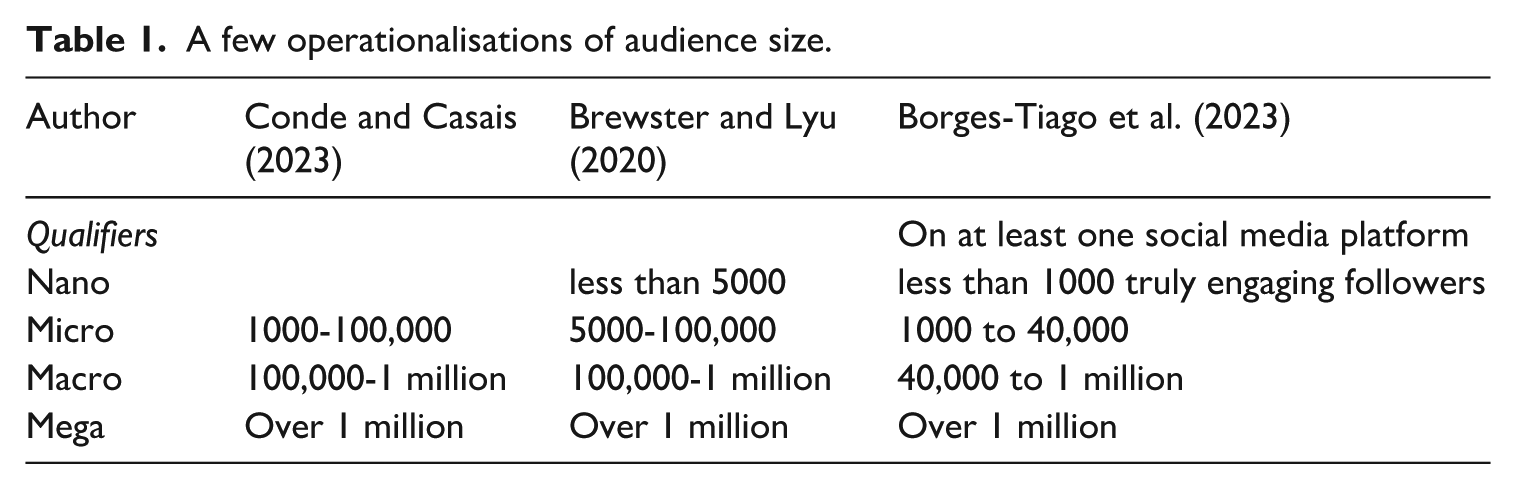
We conceptualise audience size on a spectrum (small-medium-large) and prompt researchers to determine the specific threshold of each term in line with their specific study, considering platform(s), time-period, language, geography, and so on. The decision-making process here should be made explicit and be contextualised.
Definition of what counts as political: There is also ambiguity about what the term ‘political’ encapsulates and who counts as a political influencer (Riedl et al., 2023). In some work politics is understood in a broad sense. Harff and Schmuck (2023), for example, refer to the way in which influencers not only endorse products and brands, but also engage with political topics, ‘discussing climate change, COVID-19, or gender politics’ (Harff and Schmuck 2023: 147). Many scholars conceive politics in a broad manner, focusing on social issues, awareness raising, and engagement with current affairs and news as indicative of politics (Cheng et al., 2024; Harff, 2022; Peres-Neto, 2022). This conceptualisation is not, however, consistent (Suuronen et al., 2022: 303–304). Some have focused on politics in a more institutional or process-based way, examining political influence more squarely within the context of elections and campaigns (Naderer, 2022). Jackson and Darrow (2005), for example, examine the influence of celebrity endorsements on young adults' political opinions on US policy. Different types of politics can therefore count.
Decades of political science literature has shown that drawing simple definitions of types of politics is not straightforward (Leftwich, 2015) and as such we focus not on identifying the form of politics, but rather the extent to which an actor posts political content. However, labelling an account as political or not is challenging because some accounts may be more or less political at different points in time, and accounts may strategically obfuscate political content to avoid de-prioritisation algorithms or other negative repercussions of sharing political content (Noble, 2018). For these reasons we differentiate between accounts that are ‘very or frequently political’, ‘sometimes political’, or ‘rarely political’.
Returning to the example of Carlos Eduardo Espina, who self-describes as an immigrant’s rights activist on his profiles and posts primarily political content across his social media accounts, he would be categorised as ‘very or frequently political’. In contrast, online personalities whose brand is not primarily political, for example, a beauty vlogger or gaming streamer, might be ‘rarely political’, only sharing get out the vote messages on election day. Other frameworks could be paired with our approach to later assess the extent and type of political content, for example, von Sikorski et al. (2025) offer a typology based on density, style and proximity of political content.
Formal political role: In early work, opinion leaders were explicitly not people who also had established political roles (Katz and Lazarsfeld, 1955), while in studies of influentials an account’s political roles were often used as descriptions rather than inclusion criteria (removed for review). Within work on political influencers there are different approaches to this question (Harff and Schmuck, 2023), with disagreement over whether people who are established as other kinds of political actors (e.g. political candidate, journalist, lobbyist) should also be considered as an influencer or not. Ashley and Rasmussen’s (2021) analysis describes the campaign activity of US Representative Ocasio-Cortez as indicative of ‘influencer strategies’, suggesting politicians can take on this role. Elsewhere Fischer et al. (2022), document the rise of ‘new’ political influencers on YouTube, focusing not on professional news media, politicians and parties, but on individuals affiliated to a party or new digital news organisations (p. 261). Others focus their attention on journalists (Peres-Neto, 2022) or online friends (Harff, 2022), or draw from opinion leadership research to intentionally look only at accounts which are not otherwise established political actors (Bause, 2021; Harff and Schmuck, 2023). Some focus on when and where popularity is built (Riedl et al., 2021). However, the same authors argue any political actor could be a political influencer (Riedl et al., 2023), suggesting that very different types of individuals can ‘count’. Vallström and Törnberg (2025) use a case study of a Swedish politician who first gained popularity online and continues to use her YouTube channel to build solidarity and community within climate change activism. She relies on her insider position to highlight her access to knowledge within her online posting, which the authors argue is a different mechanism of influence than what most current political influencer studies focus on (Vallström and Törnberg, 2025).
Rather than focusing on certain kinds of actors and excluding others, we differentiate between actors with ‘a formal political role’ (e.g. a politician, political journalist, lobbyist, etc.) or ‘no formal political role’ (a YouTube makeup tutorial star) as contrasting yet equally valid attributes. We also acknowledge the possibility of political influencers having ‘some formal political role’, such as a TikToker known to be a party member. Brazilian politician Kim Kataguiri is an interesting example because he began his political engagement as a gaming streamer with no formal role, but over time became an activist, then a politician and elected representative, formalising his role. This points to the fact that political roles can change over time and even in nature.
Control: A further attribute inconsistently present in discussions of influencers is control. There is a rich tradition of study within political science on the degree of autonomy or control actors have within campaigns (Wilson, 1973), which has been echoed in some influencer studies. Borchers (2025), for example, examines political parties’ use of influencers and their concerns about a ‘lack of control of influencer conduct’ and their attempts to ‘control influencer conduct during collaboration’ (p. 3; p. 7; see also Goodwin et al., 2023). This mirrors marketing studies debates. While some have asserted the need for brand managers to loosen control and focus on facilitation (Christodoulides, 2009: 143), others have identified ‘control techniques’ (Borchers, 2025: 11; Haenlein et al., 2020; Leung et al., 2022) through which control can be retained.
Recognising these alternatives, we argue there is a case for thinking about the degree to which political influencers are controlled or given autonomy. One possibility is actors who are ‘autonomous/not controlled at all’, some are ‘somewhat controlled’ and others are ‘completely autonomous’. Complete control might look like an account created by or run entirely by a given political party, whereas autonomy might be an account choosing to post political content without any incentivization from a political entity – something observed with the ‘Milifandom’ trend in the United Kingdom (Dean, 2017).
It is important to recognise that the form of control can vary depending on the actor under consideration and may even be intentionally obfuscated, as in the case of influence campaigns (Gaw et al., 2025). As such, researchers should attempt to specify the mechanisms of control in evidence to aid comparison. Other considerations reflect variations in control evident within the time-period (as more or less control can be evident in different periods), and variation between political and non-political content.
Summary
We do not argue these are the only attributes that could be indicative of a political influencer; a systematic review would serve to identify other considerations that can help to develop this approach. Our contribution here is to offer an alternative mode to conceptualisation able to capture the different ways political influencers might show up. In doing so we allow scholars (and practitioners) to think about different types of political influencers and to compare and contrast the practices of different online personalities making use of influencer tactics. A gaming streamer turned politician looks very different from a micro influencer paid to post about a candidate who looks very different from a beauty influencer telling people why they hope their followers will go vote. Yet all might helpfully be described as political influencers, and all can be mapped against our attributes.
Our intentionally broad approach is notably different to other recent attempts to impose precise boundaries around who counts as a political influencer. For example, von Sikorski et al. (2025) create a typology of political influencers by focusing on influencers defined by three specific attributes, specifying criteria for ‘SMIs who act as opinion leaders (De Gregorio and Goanta, 2022), have no institutional background (like journalists and politicians), and “whose notoriety and fame is platform-built” (Riedl et al., 2023: 2)’. Similarly, Schwemmer and Riedl (2025) offer guidelines for conceptualising political influencers, drawing largely on understandings of influencers through the lens of marketing and their commercial role, that are then developed to offer precise guidelines for operationalization and measurement. In both cases specific versions of who counts as an influencer are asserted and a framework for analysis is then offered.
In contrast our approach does not seek to impose single definitional boundaries and does not provide specific guidance on how to sample and measure the indicative features of political influencers (c.f. Schwemmer and Riedl, 2025). Our objective is to advance an alternative way of thinking about how political influencers might manifest which recognises the potential for very different combinations of attributes to count, and notes the importance of the particular research question at hand in determining the most appropriate means of measurement. Our work might be seen as a precursor step in the conceptualisation and operationalization process with these other two frameworks being useful once a series of decisions about who counts as an influencer are made.
To illustrate our approach, it is helpful to briefly consider possible critiques. First, it could be argued that by failing to exclude politicians, journalists or other political elites from categorization as political influencers we render the term too expansive. In response we argue that an exclusionary approach, while tempting, is unable to detect the fluidity of the online media environment and the grey zones between influencers and other political actors. For example, there are online influencers who become politicians and maintain their influencer presence online who would be excluded by such an approach. Of course, this does not mean all politicians should be considered political influencers, there are boundaries that need to be put in place, but we argue that these should be determined by the research questions driving particular studies rather than definitional constraints. Scholars simply need to be transparent about their choices.
Second, it could be argued that our approach fails to distinguish between an influencer and an ordinary person. Many studies tackle this problem by specifying a required audience size, often establishing minimum follower counts in their sampling criteria. Yet this approach risks overlooking online personalities with small organic audiences, who are paid by a political campaign to ‘become’ an influencer within a specific target community (Kausar et al., 2021), or instances of ‘wannabe’ influencers and astroturfing efforts exemplified by accounts with little to no pre-existing audience who adopt the tropes of influencers, like posting engaging political content. It is helpful to think about personal versus private networks to distinguish between ordinary people and influencers (Harff et al., 2025), but operationalization is difficult and context dependent. We suggest that researchers applying our framework need to set their own minimum criteria for when an online personality moves from ordinary person to influencer and that future studies might test options for distinguishing between personal and public networks/audiences.
While we understand the logic driving alternative modes of conceptualisation and recognise their utility for examining specific kinds of political influencers and their roles, we believe our approach is valuable in helping scholars understand the breadth of online personalities who could be considered political influencers. Such an approach is more resilient to change in digital media platforms and online practices which can render current definitional strict boundaries redundant or uninformative. Ultimately, our approach guides researchers to study the varied ways political influencers can show up, providing a mechanism researchers can adapt and use to observe and describe different manifestations of political influencers.
Conclusion
The study of political influencers has produced a plurality of, at times, contradictory conceptualizations that have limited scholars’ abilities to build from each other’s work and conduct comparative analysis, undermining its utility for technology platform policy and public policy development. Offering strict definitional parameters these interventions have raised challenges for attempts to classify actors who change status (i.e. an influencer becoming a politician) or who lack an established online audience but exhibit influencer practices (i.e. a politician using influencer tropes to attempt to spread their message online).
As the manifestations of political influencers evolves, we suggest the need for an approach that is not tied to certain actors but rather acknowledges that a variety of actors exhibit political influencer tactics. Offering a new approach to conceptualisation, illustrated through the identification of six considerations derived from existing literature, we acknowledge the complex array of ways influence can be manifested and provide a way of recognising the different kinds of political influencers.
While we could have prescribed specific measures for each of our attributes, such an approach would have reinforced the rigidity we criticise in pre-existing schemes. As political influencers can be studied on different platforms, over different timescales, with different research questions, researchers need to specify their own parameters for studying and classifying different forms of political influence, for example, determining their own measure of audience and indicators of control. We argue future studies of political influencers should be explicit and transparent in how and what they are studying, providing their own operational framework for each of the attributes. By rendering the metrics and scope of study transparent we suggest it is possible to not only differentiate between various types of political influencer, but also to compare across studies of political influencers.
Offering our framework as a solution to these challenges, we note some limitations and call for future scholarship to develop and operationalise our ideas. In providing markers for the attributes of influencers, we do not claim to have captured all possible identifiers. Our focus on areas of contradiction discerned within existing literature has concentrated on key points of divergence, but there may be other considerations that others want to integrate, and a systematic review would be helpful in identifying other possible criteria. We also acknowledge our indicators can be operationalised in different ways. In noting these possibilities, our approach explicitly seeks to encourage greater transparency and discussion of the choices made at each stage. However, we acknowledge there remain different factors reflecting particular research questions that other scholars may wish to capture in their operationalisation of these ideas. In particular, we call for further research to consider how different methods such as interviews, content analysis and surveys can be deployed to generate more insights on these dimensions.
Footnotes
Acknowledgements
Thank you to our Research Assistants, Dr. Louise Stahl, Michelle Bartleman and Nathan Kazmir Poklar.
Data availability statement
No dataset related to make available
Ethical approval and informed consent statements
No ethics approval required.
Funding
The authors received financial support for the research through a grant from the Social Sciences and Humanities Research Council of Canada (435-2025-0483).
Notes
Author biographies
