



Abstract
In the void left by struggling local media, localized social media systems have proliferated on the web as key avenues for the exchange of location-specific information. Yet, as local ecosystems shift, there is a need to understand the types of audiences localized social media spaces attract, and whether these spaces can foster healthy communities. This article presents the results of a multi-national, longitudinal user survey of participants (N = 2789) on the social media platform Reddit. We show, for the first time, that people who join localized social media spaces also report higher community attachment and political participation intent than users who join other social media spaces. We find evidence that these pro-community attitudes are stronger for longer-term members of localized social media and those who actively contribute through posts and comments. Surprisingly, we also identify that new residents to an area are more likely to belong to a localized social media forum than long-time residents. This article provides context for how the affordances of technology platforms influence the audiences, behaviors, and community impacts of localized social networks.
Introduction
For over a century, healthy local media ecosystems have been recognized as vital to democracy (de Tocqueville, 1835/1945). Yet today, we face a broad decline in healthy local media ecosystems (Abernathy, 2020; Pew Research Center, 2021). The loss of local newspapers leaves communities less informed about local politics and encourages patterns of voter behavior that reflect a national identity rather than localized concerns (Hayes & Lawless, 2017; Hopkins, 2018). Globally, even historically robust local media institutions struggle to adapt to the changing landscape, threatening to weaken connections between citizens and local communities (European University Institute, 2024; P. A. Gulyas, 2020; Negreira-Rey et al., 2023; Nygren et al., 2018).
Amid these struggles, the rise of user-driven online local spaces presents a potential avenue to sustain and cultivate civic interest and attachment to local communities. Already in 2019, 59% of Americans stated they access local news via online forums or discussion groups (Pew Research Center, 2019). Recent work explored the potential for locally-oriented social media—platforms like place-based subreddits or neighborhood Facebook groups—to facilitate critical local discussions and foster community connections, especially in times of need (Aubin Le Quéré et al., 2022; C. A. López & Butler, 2013). The socially engaged aspect of contributing to local content has also been explored, and recent research suggests engaging audiences can positively impact people’s perception of local news (Stroud & Van Duyn, 2023).
Given this digital shift, it becomes increasingly critical to understand the function of localized social media (LSM) within local information ecosystems to assess the suitability of these systems to attract audiences in ways that nurture community capital and spark local engagement. We adopt Kwon et al.’s (2021) definition of online geographically bound content broadly as LSM, which are “social media services that facilitate local news sharing, local social connections, and community participation.” Beyond simply filling the gap left by declining local media systems, LSMs have the potential to engage different or new audiences traditionally excluded by local journalistic institutions, such as younger people and people of color (Delli Carpini et al., 2018; Duchovnay & Masullo, 2021). In addition, there is the open need to understand whether LSMs can support local political engagement and participation in ways traditionally driven by local news exposure (Fioroni & Knight Foundation, 2022). Our study addresses this gap by examining who engages in LSM forums, how they participate, and the relationship between participation in these locally-focused online spaces and offline pro-community attitudes. Understanding these dynamics has the potential to inform the marketing and communication strategies of local politicians, journalists, and activists who seek to better engage their communities.
In this article, we present findings from a large (N = 2789) international study of Reddit users. We analyze longitudinal survey and trace data to compare members of city-based (LSM) and non-place-based (non-LSM) subreddits with respect to local community attachment and political participation intention (PPI). Our results indicate that membership in city-based subreddits is associated with these pro-community attitudes, an effect that is more pronounced for longer-term members. Notably, we find that city-based subreddits may hold particular appeal for new residents to a city, potentially helping them to get “up to speed” faster by providing an accessible space for encountering community resources. We find mixed evidence regarding the relationship between active (vs. passive) participation and the formation of pro-community attitudes, hinting at a complex relationship between engagement type and civic attitudes. These findings highlight the role LSMs play in modern local media ecologies in sustaining pro-community attachment and engagement.
Literature review
To motivate this work, we review existing theories around how media fosters community attachment and political behavioral intent and present evidence that LSM use may bolster similar individual-level attitudes. We also introduce our theoretical model for how LSMs tie into active/passive theories of social media use.
Local media use and pro-community attitudes
A strong local media presence is linked to positive individual-level pro-community attitudes, driving not only cultural and community benefits, but also outcomes related to political participation and the health of local democracies. At its core, the goal of local media is to meet a set of community “information needs,” which revolve around informing populations about locally pertinent developments, to foster culture, and to equip citizens with the facts needed to make informed civic choices (Delli Carpini et al., 2018; Waldman, 2011). Local media can also be crucial in scenarios involving heightened information needs, such as providing warnings about weather or health emergencies (Shearer, 2020). Local journalists also serve as watchdogs, operating as a local presence that keeps powers to account and reduces corruption within communities (Campante & Do, 2014; Huang et al., 2024).
Media scholars have identified a consistent relationship between individual local news use and feelings of attachment and interest toward a community. The concept of community attachment has been defined as “identification with a community combined with an affective tie” (Rothenbuhler et al., 1996). Beyond fostering a sense of personal connection to the community, high community attachment among individuals can lead to pro-community attitudes; people who report high attachment within their local communities, for example, are more likely to take participatory actions, such as attending public meetings or organizing efforts (Theodori, 2004). Janowitz (1967) proposed a positive relationship between local news use and feelings of community attachment, and later operationalized the construct with sentiment-based and interest-based survey items (Kasarda & Janowitz, 1974). A 2024 Pew survey explicitly found that Americans who feel very attached to their communities also show interest in local laws and policies (Wang et al., 2024). More recently, scholars have suggested that the loss of local community newspapers could decrease feelings of local attachment (Mathews, 2022; Park et al., 2021). Attempts to establish a causal relationship between local news use and attachment, however, have not yielded definitive results (Hoffman & Eveland, 2010). Thus, an open question remains as to whether individuals with high local attachment seek out local media, or whether engagement with local media fosters community attachment and interest over time.
Local news also has the potential to benefit communities by inspiring local political action, as demonstrated by studies at both community and individual levels. Several prior correlational studies have demonstrated that areas with a weaker local press tend to have lower rates of election participation and to vote in a more polarized fashion (Angelucci et al., 2021; Moskowitz, 2021; Shaker, 2014). Darr et al. (2018) matched pairs of counties that were similar, except for the closure of a local newspaper, to provide causal evidence that shutting a local newspaper decreases split-ticket voting. Hayes and Lawless (2017) used a longitudinal study to show that the closure of local news outlets can be directly linked to decreased political engagement. At the individual level, a survey exploring the political correlates of local media use in Seattle found that reading local newspapers, but not watching local television news, was associated with higher levels of political participation (Moy et al., 2004).
Drawing on prior work, we explore the relationships between individual use of LSMs and key pro-community attitudes: local community attachment and PPI.
LSM use and pro-community attitudes
To an increasing degree, audiences turn to online sources to stay up-to-date with key local developments. A 2018 Pew study reported that 37% of Americans cite the internet as their preferred way to get access to local news, nearly as many as prefer local television news, and 81% say they get at least some local news online (Pew Research, 2019). A more recent 2022 Gallup/Knight poll described more traditional local news use as being “eclipsed by social media” as a tool for learning about and getting involved with political action (Fioroni & Knight Foundation, 2022).
LSM spaces, in particular, emerged as appealing places for sharing and receiving local information. Speaking of local media ecologies, Nygren (2019) stated that “social media [is] taking the lead” over other forms of local media consumption. Already in 2018, 12% of Americans reported they “often” got local news from discussion forums (Pew Research, 2019). Examples of these types of online place-based discussion forums include Facebook neighborhood groups and Nextdoor, the geography-based social networking platform (Kristian, 2019; Nextdoor, 2021). Characteristics of the participants in LSMs often reflect aspects of their offline counterparts; for example, richer neighborhoods also stand a greater chance at producing sustainable online communities, more trusting localities place fewer restrictions on memberships, and socioeconomic differences between neighborhoods impact online content types (Choksi et al., 2024; Herdağdelen et al., 2023; C. López et al., 2017).
There is no simple definition or operationalization of “local” (Ali, 2017). Previous works on local media have defined the term “local” in a variety of ways spanning a news organizations’ strategic audience (A. Gulyas & Baines, 2020), audience perceptions of local (Weber & Mathews, 2024), audience geographic spread (Hagar et al., 2020), differentiated news topics (McCombs & Winter, 1981), and more. In an increasingly digital landscape, Hess (2013) argues that the term “local” should be thought of as “geo-social,” a term that combines the concept of place-based content and brings in the broad social milieu within which online information providers operate today. These studies highlight the vast diversity of what localness can mean, and many emphasize that the term is highly contextual, and may have different meanings for different audiences and geographies (Usher, 2019). Despite divergent definitions, scholars seeking to analyze localness at scale, as we do in this study, must adhere to one operationalization. We align ourselves with Kwon et al. (2021), who specifically define LSMs as “uses of social media embedded in community contexts,” which includes “both place-based contents and place-based spaces.”
Despite their increasing importance, the demographic makeup of LSMs has received relatively little attention. Our first research question (RQ) concerns the demographics of those who frequent online communities:
RQ. What demographic factors are associated with membership in LSM forums?
From a theoretical perspective, communication theorists have begun to wrestle with the roles that LSMs might play within local communities and the extent to which these might overlap with traditional news media. LSMs can be considered a type of public sphere, a domain in society where public opinion is formed through rational discussion and debate (Habermas, 1991; Rauchfleisch & Kovic, 2016). Scholarship in this area has established the local public sphere as a critical arena for neighborhood information exchange (Friedland et al., 2007). These public spheres are supported by a communication infrastructures that operate at multiple levels, including macro (e.g., media), meso (e.g., local organizations), and micro (e.g., interpersonal network) levels; this infrastructure can serve to construct and foster a sense of shared community and belonging (Ball-Rokeach et al., 2001). The design of LSMs can serve to collapse these various parts of the communication infrastructure, enabling a variety of actors to participate in the construction of news, narrative, and community within a single medium (Kligler-Vilenchik & Tenenboim, 2024). De Cindio and Peraboni (2011) argue that networked local public spheres have a better chance to enact change within local communities than other types of public spheres.
There are reasons to believe that LSM use may be tied to local community attachment and PPI. Multiple studies highlight these groups can be crucial in conveying timely information about local emergencies (Aubin Le Quéré et al., 2022; Starbird & Palen, 2011; Van Koevering et al., 2022). If LSMs are conceptualized as a form of public space for communities, healthy discussions in these groups could reasonably be expected to lead to increased bonds; think, for example, of studies that showed increasing greenery in local squares also fosters strong intra-neighborhood ties (Kuo et al., 1998). Dating back to the early web, scholars frequently posited that extending local discussions to the online sphere could strengthen place-based community (Foth, 2003; Hampton, 2002). Indeed, in an early natural experiment termed “NetVille,” residents of a Toronto suburb were given access to high-speed internet and a local discussion forum, which was found to increase local engagement and contact with weaker ties (Hampton & Wellman, 2003). Since the survey study compared homes with and without internet however, the effect of a local discussion group on individuals was not isolated. A few studies have focused on specific localities and described how efforts to foster local political engagements have been bolstered by engaging communities online (Firmstone & Coleman, 2015; Lev-On & Steinfeld, 2015).
Recent studies specifically explored the relationship between LSM use and pro-community attitudes. In a national survey of US adults, Nah et al. (2021) found that community-oriented social media use is positively associated with civic participation, particularly in rural communities. Kwon et al. (2021) identified that LSM use impacts civic participation by increasing community organizational trust, which in turn promotes offline participation. Gil de Zúñiga et al. (2012) found that the use of social networking services specifically for engaging with news predicted online and offline political participation, including with local issues. These findings provide the first empirical evidence that LSM use is associated with important pro-community attitudes toward members’ offline communities. We take up their call for further research into communities of space in this study, through exploring related civic concepts, and incorporating trace data into our analysis.
On Reddit, users can move freely among online communities, enabling participation in both locally-focused and non-local communities. In this context, we expect that users who choose to frequent local communities will have stronger pro-community attitudes toward their geographic communities. We thus hypothesize:
Hypothesis 1A (H1A). Members of LSM forums will report stronger
Hypothesis 1B (H1B). Members of LSM forums will report stronger
Impacts of membership on pro-community attitudes over time
Prior studies exploring the relationship between self-reported incidental exposure to online news and pro-community attitudes over time have yielded mixed results. A survey study by Tewksbury et al. (2001) found partial support for a relationship between self-reported “accidental” online news exposure and current affairs knowledge. Research by Kim et al. (2013) finds that self-reported incidental online news exposure is positively correlated with online and offline political participation. A more recent study by Shahin et al. (2021) found that self-reported incidental news exposure predicts online, but not offline participation. Even these survey studies indicating a positive relationship do not identify a causal direction. A longitudinal panel survey study by Cronin et al. (2023) found no impact of local news exposure on political knowledge and participation. Experimental studies which experimentally varied exposure to online news found no causal relationship between news exposure and pro-community attitudes, such as political knowledge, participation, or community attachment (Aubin Le Quéré et al., 2024; Wojcieszak et al., 2022).
Nonetheless, research on online communities generally has demonstrated that intentional and sustained participation within these spaces can foster attachment and commitment. Prior studies of online communities have found that membership duration is strongly associated with the formation of attachments to both other community members (Kraut et al., 2008) and the community as a whole (Kairam et al., 2022). Other work has illustrated how membership plays an important moderating role in the relationship between community activity and outcomes. The “content capital” of an online community, or the value of the content exchanged by members, is meaningfully related to community attachment, but only for members with longer tenure in the community (Lee & Park, 2019). In the context of online health communities, observed relationships between receiving communications and measures of community attachment are stronger for members with longer tenure (Yang et al., 2017).
LSMs have the potential to engage members in a pattern of intentional and sustained participation around local news and issues; we suspect that users who engage with LSMs for longer will demonstrate stronger pro-community attitudes. Specifically, we hypothesize:
Hypothesis 2A (H2A). Differences in
Hypothesis 2B (H2B). Differences in
Like the other articles we cite, the present work is an observational study where we do not causally link trace data to attitudes. However, since we surveyed people over time, we do measure the longitudinal effects of following a local online group.
Hypothesis 3A (H3A). Members of LSM forums will report greater increases in
Hypothesis 3B (H3B). Members of LSM forums will report greater increases in
Impacts of active participation on pro-community attitudes
Social media systems are defined by their ability to involve users in discussion rather than simply consuming content, and impacts on civic engagement may differ substantially depending on whether users participate actively. A randomized field study which encouraged journalists at some news outlets to engage more intentionally with their audience (e.g., soliciting and answering questions) found that these practices led to over-time growth in newspaper subscriptions (Stroud & Van Duyn, 2023). Similarly, prior studies focused on news found that engagement with online articles can be a sign of greater processing of news materials and a predictor for civic participation (Holt et al., 2013; Oeldorf-Hirsch, 2018).
Prior research on social media systems demonstrated that social and pro-community outcomes can vary with the level of active vs. passive participation. Studies of Facebook use by Verduyn et al. (2015) indicate that measured declines in affective well-being over time are specific to users who participate in the system only passively (e.g., consuming vs. contributing content). Research on various social media systems illustrated that the level of participation in networked contexts can influence overall attachment and belonging within communities (Cummings et al., 2002; Du et al., 2009; Kairam et al., 2022; W. Wu et al., 2017). Active participation in locally-oriented platforms can further social connections and general attachment within participants’ offline communities (Hampton & Wellman, 2003).
Drawing on these insights from prior work, we expect that LSMs may be particularly effective in driving individual-level pro-community attitudes when they foster active participation vs. passive consumption. Specifically, we hypothesize:
Hypothesis 2C (H2C). Differences in
Hypothesis 2D (H2D). Differences in
Hypothesis 3C (H3C). Increases over time in
Hypothesis 3D (H3D). Increases over time in
Study design
In this section, we summarize our research site, the main survey design, participant information, and the relevant individual-level variables measured.
Research site: city subreddits
With over 100,000 active communities and over 91 million daily active users around the world as of 2024 (Reddit Inc., 2024), Reddit is an ideal research context for exploring behaviors around discussion, information-sharing, and entertainment across a broad range of topics and interests. Each community, termed subreddit, is independently created and user-led, with community-specific rules and governance (Kairam & Foote, 2024). Most Reddit users are anonymous, and the experience is topic-centric and not profile-centric; these affordances combine to lead to ready discussions around more sensitive topics and high rates of user self-disclosures (Choudhury & De, 2014; Triggs et al., 2021). Reddit is consistently ranked as one of the most frequently accessed websites in the world.
In this study, we focus specifically on local, place-based subreddits. These are subreddits oriented around a specific geography, which may span cities or larger areas—for example, r/Heidelberg or r/bayarea. Scholars have previously explored how place-based subreddits are used by community members to discuss topics such as politics, crime, and the COVID-19 pandemic (Lê et al., 2020; Van Koevering et al., 2022; Q. Wu & Hemsley, 2023). Reddit’s largely anonymous nature differentiates place-based subreddits from other LSM forums, such as NextDoor, a hyperlocal social platform where users are identified by full names and must validate their mailing addresses to post.
We collaborated with Reddit to identify a number of active, city-based subreddits for this study. Reddit classifies place-based subreddits using a “Place” label, for example, a subreddit may be labeled as “Places in North America.” While these place-based subreddits are most frequently about a geographic area, they can also be interest-based subreddits tied to a geographic area. For example, the r/nyc subreddit is a generalist forum that serves to discuss any news or events going on in the New York City metropolitan area, whereas r/FoodNYC is specifically to discuss restaurants and food within the same geography. Similar pairs might include r/london and r/AskLondon. Although both are considered place-based subreddits, we narrow the list of subreddits to exclusively the largest and highest-quality subreddits based in cities that are considered active. This process was conducted with help from a specialized team at Reddit, who maintain a curated list of all active city-based subreddits. The final list of subreddits comprised 391 cities.
Whenever communities are analyzed at scale, tradeoffs must be made between local context and generalizability. We select city subreddits in our context since they best represent comparable local uses of Reddit. City subreddits are affiliated with the same administrative denomination, they are highly used within the Reddit ecosystem, and there is a good variety of subreddits. Nonetheless, we acknowledge that the types of audiences and information distributed on city subreddits are likely to vary significantly from other types of LSM that cover other administrative denominations.
We sought to conduct a multi-national survey since most prior work on LSMs focuses on a US context. We therefore included city subreddits across six countries (the US, UK, Australia, France, Canada, and Germany) and in three languages (English, French, and German). We included all currently active city-based subreddits across these six countries, and the survey language was based on a users’ language preference in the Reddit app. These countries reflect the research team’s known languages and cultures, and surveys were double-checked by local representatives for accuracy. While our selection of countries remains Western-centric, the inclusion of non-US countries stands to benefit the research on LSMs. Future work should seek to extend these findings to other, non-Western countries.
Survey design
For our main analysis, we conducted a 2 × 2 longitudinal survey design, varying the focal subreddit type and subreddit tenure variables.
For the first dimension, focal subreddit type, we identify a “focal subreddit” for each user, which is the subreddit that we survey the user about in this study. For a surveyed user, the focal subreddit type was either city-based, if they followed at least one city subreddit, or non-city-based, if they followed no place-based subreddits. For each user in our sample, we then select their focal subreddit. For users in the city subreddit group, we selected a focal subreddit from our curated list of 391 city-based subreddits (e.g., r/NYC, r/Houston) which the user followed. For users in the non-city-based subreddit group, we randomly selected a subreddit which the user followed provided that the subreddit was labeled as safe-for-work, was categorized by the Reddit team as non-place-based, and had at least 1000+ subscribers. This selection structure is visually outlined in Figure 1. In addition, we validated that all users had logged in to Reddit at least once in the last 7 days, and that they had at least one login from a city that had a corresponding city subreddit in the last 28 days. Users matching these criteria were selected at random from Reddit’s databases.

Figure exemplifies how the two different study groups are constructed. The city subreddit group must be subscribed to at least one of our curated city subreddits, whereas the random subreddit group can be subscribed to any active subreddit, but must not be subscribed to any other place-based subreddit.
For the second dimension, subreddit tenure, we distinguished between Reddit users who recently subscribed to a subreddit (less than 7 days ago, short tenure) vs. those who subscribed to a subreddit for longer (over 7 days ago, long tenure). We selected 7 days as the split between the participant groups to delineate between recent users of a local subreddit, for whom introducing a new information stream may change their attitudes, vs. longer-term users, for whom continued exposure to an existing subreddit may not be as impactful.
We surveyed users in two waves, which we call T1 and T2. If participants responded to the survey at T1, they were asked if they were open to being contacted again for a follow-up. We sent a follow-up survey to all participants who agreed to this question 4 weeks after T1. Table 1 displays a summary of the response rates received for each group and survey wave.
Distribution of Survey Responses by Condition in Our 2 × 2 Study Design (Focal Subreddit Type × Subreddit Tenure).

In total, the Time 1 (T1) survey has 2789 complete responses, and the Time 2 (T2) survey has 716 complete responses. Of the total, 25.7% of participants who completed the survey at T1 also completed the follow-up survey at T2.
The demographics of our survey participants skew young, male, White, and urban. The median participant was 25–34 years old, male, White, had completed an Associate’s, Bachelor’s degree, or equivalent, and had lived in their current place of residence for 6–10 years. In addition, 32.5% of people in our sample lived in a large city, 31.9% lived in the suburbs of a large city, 26.5% lived in a small city or town, and 9.1% lived in a rural area. The urban skew is unsurprising, since we selected participants who had logins from a city in the last 28 days. We compare the demographics of our participant pool with those of respondents to the 2018 Local News Survey in the Appendix 1. Compared with prior local news surveys, it is hard to disentangle whether the audience skew in this survey is due to an international audience, a Reddit audience, or an audience that cares about local issues. While we do not expect these participants to be nationally representative of each surveyed country, the responses allow us to develop insights about LSM use.
Survey measures
In this section, we define the measures used as independent and dependent variables, adapted from validated scales.
Independent variables
We collected a set of independent variables about each participant. The main binary variables subreddit tenure and focal subreddit are detailed above.
We include a set of demographic variables provided by participants and user trace data. The main demographic variables are age, gender, and level of education. We also collected information about how long participants had lived in the place or city where they currently live, and the size of the community that they live in. We include whether the participant has been a member on Reddit for 2 years or longer. Finally, we additionally include two measures of engagement with the focal subreddit: the amount of days the user has viewed the focal subreddit in the last 28 days and whether the user has contributed a post or comment to the focal subreddit in the last 28 days. These trace data variables are collected at T1 and T2 for each participant.
Reddit has shared these data with the research team, and the users have consented to make it available for study. The use of secondary data for this study has been approved by Cornell University’s institutional review board.
Dependent variables
The dependent variables are adapted from prior work, and we kept a minimal number of items to avoid survey fatigue common in internet research and social media surveys. We measure PPI through a five-item scale adapted from Moy et al. (2004). We capture local community attachment through the sense of local belonging (SoLB) and local community interest (LCI) from Kasarda and Janowitz (1974). 1 These constructs can be thought of as sentiment-based community attachment and interest-based community attachment (Ryan et al., 2005).
Sense of Local Belonging: To measure SoLB, participants were asked to indicate how much they agreed with the statement “I feel ‘at home’ in my place of residence” on a Likert-type Scale from 1 to 5, ranging from “Disagree” to “Agree” (Kasarda & Janowitz, 1974).
Local Community Interest: To measure LCI, participants were asked to indicate how much they agreed with the statement “I am interested to know what goes on in my place of residence.” on a Likert-type Scale from 1 to 5, ranging from “Disagree” to “Agree” (Kasarda & Janowitz, 1974).
Political participation intention: For the PPI measure, participants were asked to indicate on a Likert-type Scale from 1 to 5 (1 = Not likely, 5 = Very likely) how likely they felt it was that they would participate in six local political activities. This variable focuses on the concept of intended political participation, since we do not ask participants to report on actions taken. We made this deliberate choice since our study covered only a 1-month period, and we believed that changes in attitudes and intended behavior were likely to precede actual behavior. The final Cronbach’s α for PPI was 0.84 at T1, and 0.85 at T2, suggesting good internal consistency.
Statistical analyses
To understand the demographics that influence the choice to follow a city subreddit (RQ1), we constructed a multi-level generalized linear model with a logit link function that predicts the likelihood to be following a city subreddit given self-reported demographics. We use a multi-level model with country-level random intercepts to reflect the hierarchical structure of our six-country dataset. The main demographics are gender (male or non-male), age, education, length of residence, and local community size. We construct a logit model to reflect the binary likelihood that a participant is following a city subreddit (focal subreddit = 1) or a random subreddit (focal subreddit = 0).
To determine whether SoLB, LCI, and political participation are associated with the likelihood to be following a city subreddit (H1A–B), we conducted independent t-tests. These t-tests assess the difference of means in the reported pro-community attitude variable between users who follow city subreddits vs. random subreddits.
To additionally understand the correlation between subreddit tenure and associated community attitude (H2A–B), we construct multilevel linear models with random intercepts at the country level that predict a user’s SoLB, LCI, or political participation. For each prosocial community attitude, we construct two models. The first simple model predicts pro-community attitudes based only on the sample selection criteria: the focal subreddit (place-based or random) and when the user followed the subreddit (in the past week or longer ago). The model also includes an interaction term between the focal subreddit type and the subreddit tenure, since we expect subreddit tenure to have a stronger effect on pro-community attitudes for place-based subreddits.
The second multilevel model includes additional controls and trace data about passive vs. active subreddit use (H2C–D). Building on the baseline model, we additionally include demographic information and trace data. The demographic information is included as a control, since we know demographic information is related to pro-community attitudes. The trace data consists of how long the user has been active on Reddit, whether they viewed the focal subreddit in the last 28 days (exposure), and whether they have ever contributed any content to the focal subreddit in the last 28 days (contribution).
Finally, we construct similar models to test the over-time change in community attitudes after 4 weeks of use (H3). To do so, we once again construct one simple and one complex model, with the same variables as before. The over-time models predict the delta of change in civic attitudes between T1 and T2 for each participant. We control for participant responses at T1, since they likely correlate with the delta at T2.
Findings
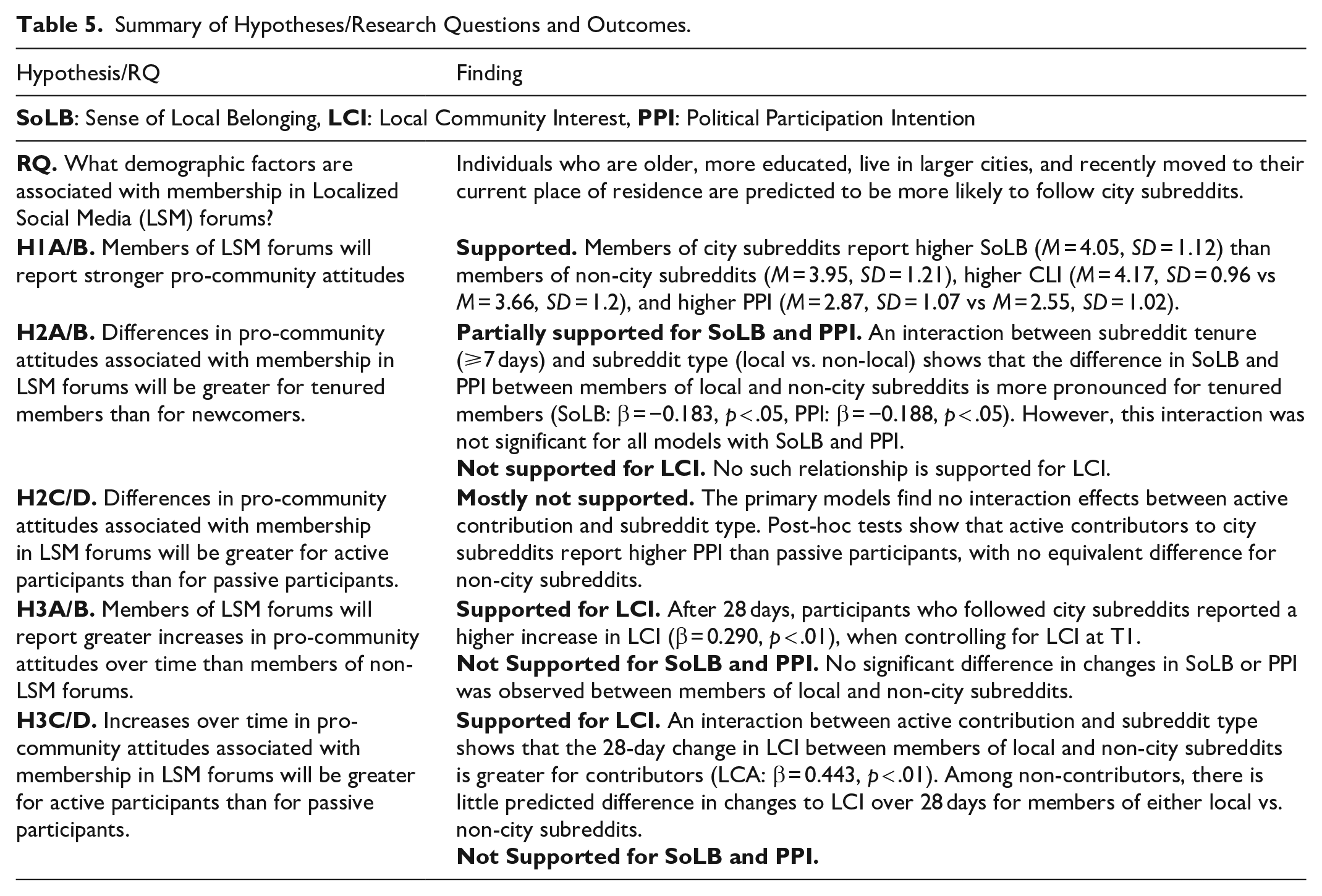
In this section, we present our findings regarding how demographics relate to local subreddit adoption (RQ, Table 2), the relationship between prosocial community attitudes and local subreddit adoption (H1), the relationship between tenure and trace data and local subreddit adoption (H2, Table 3), and the potential for local communities to drive increased prosocial community attitudes over time (H3, Table 4). Finally, Table 5 summarizes all hypotheses and corresponding findings.
Generalized Linear Model That Predicts the Likelihood of Following City Subreddits.

Age, education, and community size are positively and significantly associated with following city subreddits. Notably, length of residence is negatively and significantly associated with following city subreddits.
Significance values are provided in Bold * p < .05; **p < .01; ***p < .001.
Table Shows the Results of Multilevel Linear Models That Predict Sense of Local Belonging (1) and (2), Local Community Interest (3) and (4), and Political Participation (5) and (6).

Note. Models (1), (3), and (5) are baseline models, and Models (2), (4), and (6) are complex models that in addition include trace and demographic data. Following a city subreddit positively and significantly predicts all pro-community attitudes. The interaction term between when a user followed the subreddit and subreddit type is significant in two models.
p < .05; **p < .01; ***p < .001.
Table Shows the Results of Multilevel Linear Models That Predict Change in Sense of Local Belonging (1), (2), Local Community Interest (3), (4), and Change in Political Participation Intention (3), (4).

Models (1), (3), and (5) are baseline models, and Models (2), (4), and (6) are complex models that in addition include trace and demographic data. The model predicts significant differences in over-time local community interest for members that follow and participate in a city-based subreddit vs a non-place-based subreddit.
p < .05; **p < .01; ***p < .001.
Summary of Hypotheses/Research Questions and Outcomes.
Likelihood to be following a city subreddit (RQ)
To assess which demographic variables are associated with following a city subreddit vs. a non-place-based subreddit, we run a GLM to predict likelihood to be following a city subreddit given self-reported demographics. The results are shown in Table 2. Overall, people who are older, more educated, and live in more populated areas are significantly more likely to be following a city subreddit. We do not observe an effect of participant gender on their likelihood to be following a city subreddit. Interestingly, living in an area for less time is highly predictive of following a city subreddit.
Pro-community attitudes for followers of city-based subreddits (H1)
Confirming H1, participants who follow city subreddits report higher pro-community outcomes for SoLB, LCI, and PPI. An independent t-test shows that participants who follow city subreddits (M = 4.05, SD = 1.12) report a significantly higher SoLB than those who follow non-place-based subreddits (M = 3.95, SD = 1.21), t(2422) = −2.3, p < .03, although the difference is small. Independent t-tests show a larger difference between the levels of LCI reported by participants who follow city subreddits (M = 4.17, SD = 0.96) compared with those who follow non-place-based subreddits (M = 3.66, SD = 1.2), t(2302) = −12.09, p < .0001. Similarly, participants who follow city subreddits (M = 2.87, SD = 1.07) report significantly higher levels of PPI than those who follow non-place-based subreddits (M = 2.55, SD = 1.02), t(2470) = −8.03, p < .0001). These findings are visually demonstrated in Figure 2.

Users who follow city subreddits have a significantly higher sense of local belonging (SoLB), local community interest (LCI), and political participation intention (PPI).
Pro-community attitudes for long-term followers of city-based subreddits (H2)
To answer H2, we construct two models to predict each of the pro-community attitudes as a function of (1) subreddit type (city-based vs. non-city-based) and tenure only and (2) these measures along with participant demographics and trace data. Table 3 shows these model results.
Our models largely reinforce a strong relationship between membership in city subreddits and pro-community attitudes. Five of the six models identify a significant direct effect of following a city subreddit (vs. a non-place-based subreddit) on pro-community attitudes. Regarding hypotheses H2A/B, which propose that differences in pro-community attitudes are amplified with longer tenure, we observe significant interactions between subreddit type (city-based vs. non-place-based) and tenure (⩾7 days since joining) in two of the six models. These interactions provide partial support for our hypotheses that the difference in pro-community attitudes between LSM forums and non-LSM forums is greater for tenured members than for newcomers.
Figure 3 visualizes significant interaction effects for tenure with SoLB and PPI in the models (1) and (6). For members who have followed a subreddit for more than 7 days, predicted levels of SoLB and PPI are higher for those in city subreddits than for those in non-place-based subreddits. Based on estimated marginal means, tenured members of city-based subreddits report significantly higher SoLB (M = 4.11, [CI: 3.96, 4.25]) than tenured members of non-place-based subreddits (M = 3.92, [CI: 3.78, 4.06]). In contrast, among recent followers (⩽7 days), the difference between subreddit types is minimal, with members of city subreddits reporting only slightly higher LCA (M = 3.97 [CI: 3.82, 4.11]) than members of non-place-based subreddits (M = 3.96, [CI: 3.84, 4.10]). A similar interaction is present for PPI. Newcomers to city subreddits report slightly higher PPI scores (M = 2.80, [CI: 2.67, 2.93]) than newcomers to non-place-based subreddits (M = 2.61, [CI: 2.48, 2.74]). Among longer-term members, however, the predicted difference in PPI grows, with city-based subreddits reporting significantly higher PPI (M = 2.87, [CI: 2.74, 3.00]) than non-place-based counterparts (M = 2.50, [CI: 2.35, 2.64]).

Figure shows all interaction effects that significantly varied with political participation intention and sense of local belonging at T1. Subfigures (a) and (b) suggest that the predicted difference in sense of local belonging and political participation intention between those who have been following city vs. random subreddits is higher for participants who have been subscribed to the subreddit in question for longer.
Regarding H2C and H2D, we find partial support for the proposed relationship between membership in LSM forums and active vs. passive participation, specifically with respect to PPI. Our main models find no significant associations between any of the trace data variables and pro-community attitudes. However, post hoc tests suggest that active participation in city-based subreddits may play a role in driving PPI. A Welch’s two-sample t-test shows active contributors in city subreddits had higher PPI than passive participants, t(494.9) = −2.87, p < .005. In contrast, no significant difference in PPI was found between active and passive participants in non-place-based subreddits, t(316.4) = −0.96, p = .39.
The main and interaction effects in these models are highly correlated (r > 0.7), which may overinflate standard errors and p-values. Rerunning Model (6) without the main effect of “posted/commented on subreddit (28 days)” reinforces the pattern, in that the interaction between “focal subreddit type (city)” and “posted/commented on subreddit (28 days)” predicts a significant increase in PPI. This same effect is not present for non-place-based subreddits, suggesting that active engagement influences PPI within LSMs. This interaction is visualized in Figure 4, which shows that, while active participation in city subreddits varies with higher PPI, active participation in non-place-based subreddits does not have this effect.
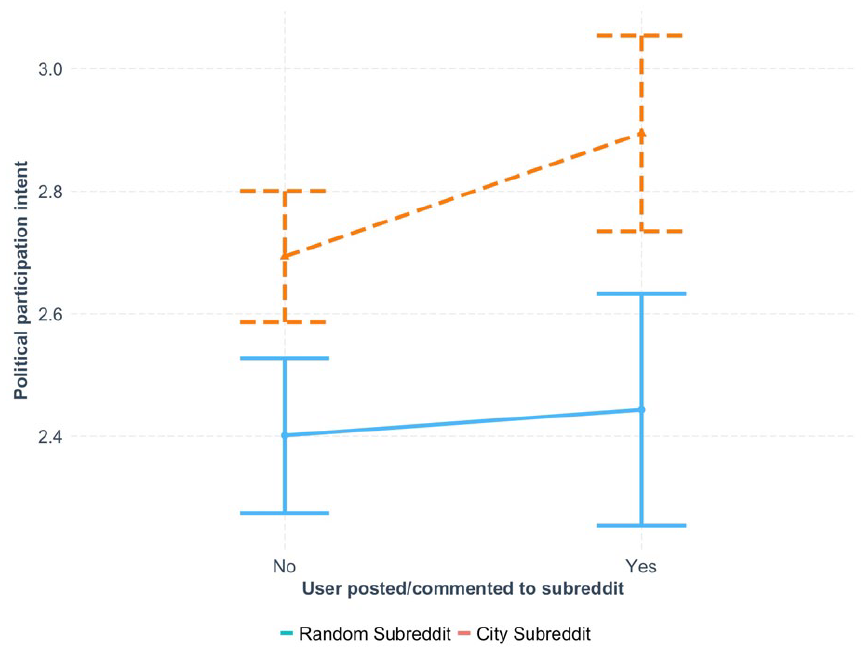
Figure shows the interaction effect between subreddit type and community political participation. Both lines trend slightly positive: the model predicts that participants who have contributed to either subreddit type report higher levels of political participation. This trend is more heavily pronounced for city subreddits.
Over-time changes in pro-community attitudes when following a city-based subreddit (H3)
To address H3A and H3B, we examined changes in community attitudes over a 4-week period for users following city subreddits compared to users following non-place-based subreddits. Specifically, we modeled the difference in self-reported pro-community attitudes between the initial (T1) and the follow-up survey (T2) to assess if city-based subreddit members reported greater increases in pro-community attitudes over time than non-place-based subreddits. We again build a simple and extended model to predict changes in each of the pro-community attitudes, sense of local belonging (ΔSoLB), local community interest (ΔLCI), and political participation intention (ΔPPI). The results of these models are summarized in Table 4.
We find evidence that belonging to and engaging with a city subreddit over time is associated with changes in LCI over time (H3A), but not with changes in the SoLB or political participation intent (H3A, H3B). In the baseline model (3), we observe a significant main effect of following a city subreddit on ΔLCI at T2, β = 0.29, SE = 0.01, p < .01. Model (4) shows a significant interaction effect between subreddit type (city-based vs. non-place-based) and participation level for ΔLCI. Specifically, active participation in city-based subreddits predicts an increase in LCI over time, while active participation in non-place-based subreddits predicts a decrease. As illustrated in Figure 5, among participants who contributed content to a city-based subreddit within the prior 28 days, the predicted increase in LCI (ΔLCI = 0.20 [CI: −0.01, 0.41]) is higher than that of contributors to a non-place-based subreddit (ΔLCI = −0.30, [CI: −0.52, −0.08]). For passive participants of either subreddit type, the predicted changes in LCI are similar, regardless of subreddit type: those in city-based subreddits show a modest predicted increase (ΔLCI = 0.08, [CI: −0.09, 0.25]), similar to those in non-place-based subreddits (ΔLCI = 0.02, [CI: −0.16, 0.20]). We observe no corresponding pattern for changes in SoLB or political participation intent over time.

Figure shows the main significant findings for how engaging with local subreddits over time correlates with local community interest. In the simple model (a), those who follow a city subreddit self-report significantly higher local community interest after 4 weeks. In the complex model (b), contributing content to a random subreddit between T1 and T2 negatively predicts local community interest at T2, and contributing content to a city subreddit between T1 and T2 positively predicts local community interest at T2.
Discussion
In this article, we present one of the first large-scale studies focused on LSMs. We discuss our findings pertaining to LSM user demographics, pro-community attitudes, and participation. We close with a discussion of how findings relate to the wider local media ecology.
The demographics of LSM users
Our study found that LSMs may attract subsets of local populations that historically engage more with local news (RQ). Prior work established that local newspapers are more likely to be read by people who are richer, educated, older, and long-time residents (Freymeyer, 2006; Lorenz et al., 2023). Our study similarly shows that people who are older and more educated are more likely to be members of local subreddits. Such relationships between community socioeconomic status and LSM use have been found in other settings. For example, neighborhoods with higher incomes have been associated with increased likelihoods of Facebook crime watch groups, and more sustainable community-based groups (C. López et al., 2017; Zahnow et al., 2024). Our study corroborates these findings at the individual level, and stands in contrast to views that uphold LSMs as potential avenues to engage younger and more diverse audiences with local issues (Delli Carpini et al., 2018; Duchovnay & Masullo, 2021). Together, these perspectives suggest that while social platform audiences themselves may be younger or more diverse, individual-level engagement with local issues within these platforms is likely to continue to be preferred by older and more educated audiences.
Our findings additionally suggest that LSMs may represent more suitable venues for engaging residents who recently moved to an area. Our models predicted that recent residents in an area were more likely than longer-term residents to be members of a local subreddit. In contrast, prior scholarship on local news audiences found that longer-term residents of an area are more likely to have higher local news use (Freymeyer, 2006; Lorenz et al., 2023). The appeal of local subreddits to more recent residents suggests that these spaces may offer new residents access to local information without the need for pre-existing local contacts or relationships. In addition, this finding may also reflect Reddit’s unique information environment as a mostly anonymous platform that hosts a thriving local information ecosystem. The anonymity afforded to new residents on a local subreddit may allow them to ask sensitive questions more freely. For example, prior work on anonymity and Reddit showed that anonymous users self-disclose sensitive information and solicit community support (Choudhury & De, 2014; Henninger, 2020). Pseudonymous spaces that support such self-disclosure can support the formation of relationships that eventually transition offline (Sheng & Kairam, 2020). The specific combination of anonymity and hyper-locality can ground disinhibition in shared, local context and facilitate commitment and connection (Schlesinger et al., 2017).
The relationship between time-of-residency in an area and the likelihood of membership in local subreddits could also be explained by a pattern in which longer-term residents eventually migrate away from LSMs. These online spaces could represent an introduction to or rite-of-passage for moving to a new area. The tendency for recent residents to follow city subreddits may mean that visitors to a city, or even outsiders with familial ties or interests, find LSMs more accessible than traditional local media. In all, local subreddits may lower the barrier to local information exposure for new residents; and perhaps become unnecessary as people become entrenched in their communities. However, the tendency for newer residents to frequent local subreddits may also have important implications for the quality of community ties and discussion richness within these spaces. For example, a bias toward newer residents within local subreddits may privilege transient, repetitive, or immediate concerns over the longer-term concerns of established communities. This perspective could help to explain why LSM spaces are perceived to be of lower quality than legacy local news (Aubin Le Quéré et al., 2024).
Our study finds that users living in larger cities are more likely to be engaging in their local subreddits. This finding aligns with large-scale analyses of LSMs which consistently find that more heavily populated areas are more likely to have a corresponding and active LSM space (Brown et al., 2024; Herdağdelen et al., 2023; C. López et al., 2017). However, Nah et al. (2021) found that LSMs more closely correlate with civic participation in rural communities. Taken together, these perspectives suggest a paradox at the center of LSM use: while LSMs are more available and engaging in urban communities, their presence may have a greater impact in more rural communities. To maximize the benefits of LSM for community-building, governments and local organizations may need to more actively invest resources to foster LSM spaces in rural communities, where they are less likely to form naturally.
LSM and pro-community attitudes
We find that individuals who join local subreddits report higher pro-community attitudes—specifically SoLB, LCI, and PPI (H1). In the context of local media, prior work established that local news use is linked with these community attitudes (Hoffman & Eveland, 2010; Kasarda & Janowitz, 1974), and emerging work found that LSM use is associated with civic participation specifically (Gil de Zúñiga et al., 2012; Kwon et al., 2021; Nah et al., 2021). Our findings confirm the relationship between LSM use and civic participation, and provide the first evidence that LSM use is correlated with types of community attachment. In addition, this study is the first to demonstrate these relationships using trace data that reflects real user behavior. These findings suggest that local subreddits could be viable forums for engaging local audiences in political action and reaching people who care about their communities.
In our responses, sense of belonging and LCI had poor internal reliability, although they are canonically considered part of one community attachment construct (Austin & Baba, 1990; Goudy, 1990; Kasarda & Janowitz, 1974). Offering a critique of prior approaches, Ryan et al. (2005) argued that community attachment could best be thought of as sentiment-based attachment (e.g., sense of belonging) and interest-based attachment (e.g., LCI). Similarly, in studies of virtual communities, information-seeking and social objectives are often considered distinct motivations for participation (Prinster et al., 2024; Ridings & Gefen, 2004). Our findings corroborate this insight, since the two items behaved differently: while tenured users of local subreddits had a higher sense of belonging, following a local subreddit over time was associated with higher LCI. Generally speaking, while following a local subreddit was correlated with both subtypes of community attachment, there were larger differences for interest-based attachment. Together, these differences suggest that LSMs may have an easier time influencing LCI in the short term than SoLB, which could be slower to change. These findings may also reflect the pattern we observe that more recent residents—those who may have high interest in a community, but low sense of belonging—are more likely to join LSMs. Future studies seeking to link LSM use with changes in pro-community attitudes may wish to consider LCI as a key, and separate, variable of interest.
Our analysis of over-time effects of following a local subreddit found mixed results (H2A/B, H3A/B). There are significant relationships between subreddit type and tenure and pro-community attitudes for all three variables, which signal a potential trend that following local subreddits for longer correlates with pro-community attitudes. However, these are not consistently observable in post hoc tests or across all models, and we find little causal evidence of this phenomenon over time. Similarly, prior work has not been able to establish a causal relationship between local news use and community attachment (Hoffman & Eveland, 2010). The present study corroborates past findings that people with higher levels of community attitudes are more likely to join and remain members of local subreddits. Prior work has indicated that social media may simply make it easier for individuals already engaged in news and politics to participate more, without engaging those with lower motivation (Kalogeropoulos et al., 2017). Effects on pro-community attitudes may differ substantially for individuals with different initial attitudes and different profiles of engagement with these information sources.
Participation in LSM
Our results also provide some evidence that the effects of engaging with city-based subreddits may differ for those who actively contribute vs. passively consume LSM content. We find evidence that actively contributing to local social media forums through comments or posts may be associated with higher PPI, and higher LCI compared with those who contribute to non-place-based subreddits. We extend past work that found null effects of passive local news exposure on individual-level political outcomes (Cronin et al., 2023; Wojcieszak et al., 2022). However, our findings suggest that, for local social media platforms, being actively engaged or contributing to local forums may be both associated with higher political participation, and potentially lead to higher interest-based attachment over time. Similarly, past experiments to engage local audiences in local newspaper coverage through Q&As have led to higher engagement with local news overall (Mellor & Nguyen, 2023).
Encouraging people to actively participate in local conversations online may thus lead to higher pro-community attitudes, and foster community in the long term. Prior research on social media demonstrated that social and pro-community outcomes can vary with the level of active vs. passive participation. Studies of Facebook use indicate that measured declines in affective well-being over time are specific to users who participate in the system only passively (Verduyn et al., 2015). Research on a variety of social media systems illustrated that the level of participation in networked contexts can influence overall attachment and belonging within communities (Cummings et al., 2002; Du et al., 2009; Kairam et al., 2022; W. Wu et al., 2017). Active participation in locally-oriented platforms can also further social connections and general attachment within participants’ offline communities (Hampton & Wellman, 2003).
LSM, platform affordances, and the local information ecology
In our survey, we find evidence that the specific affordances of Reddit influences who participates in LSMs on the platform. Reddit’s simple naming structure (e.g., r/SanFrancisco) makes local subreddits relatively easy to find compared with other types of LSMs, and Reddit results are frequently shown on Google search (Schwartz, 2024). Other LSMs institute barriers to participation, such as keeping the groups private or asking “insider” questions of new members, as is common in local Facebook groups (Herdağdelen et al., 2023), or asking for address validation to participate in Nextdoor neighborhoods. Therefore, our finding that newer residents are more likely to join city subreddits may reflect the challenge of finding easily accessible local information elsewhere, rather than being generalizable to all LSM platforms. Due to these constraints on participation in other LSMs, we may expect that some of the relationships we found between belonging to a city subreddit and pro-community attitudes could be even stronger on other platforms, where only more motivated members of a community can gain access.
In addition, the skewed demographic makeup of our survey respondents indicates that the key demographics of the underlying platforms likely fundamentally skews who participates in localized online spaces. These effects extend beyond Reddit: people using Facebook groups for local interaction may differ significantly from those on local subreddits. Prior work has already demonstrated that LSMs reflect the biases of offline demographic contexts (Brown et al., 2024; Choksi et al., 2024; Lee et al., 2024). Our findings suggest that the choice of platform for local engagement filters audiences in ways that reflect national trends and user demographics, imposing a systematic, non-local influence on local audiences. Future research should therefore consider how platform-specific affordances shape participation and content in LSMs.
These findings provide important implications for key stakeholders in the LSM ecosystem, such as community moderators and administrators. These implications include careful consideration of how widely accessible these spaces should be—making the subreddits easy to find and join can encourage wider participation and diversity of voices; yet moderators may wish to limit these spaces to help foster a sense of deep local community. Prior work explored the experiences of moderated members of LSMs (Masden et al., 2014), and the motivations of community moderators on Reddit (Kairam & Foote, 2024) but not the experiences of moderators of LSMs. Our findings indicate that an important area for future work may be to understand the motivations, challenges, and uses of moderators of LSM platforms specifically, since these spaces harbor the interest of community members who are particularly engaged.
Our findings suggest that local governments can leverage LSM to enhance outreach, foster civic participation, and support community integration. As LSMs attract newer residents more than traditional venues, governments might use LSMs to share critical updates with newer residents, who might not receive these via legacy news channels. The participatory aspects of LSMs could support governments in gathering community input on local issues, transforming these into the kinds of active, networked local public spheres that can enact change (De Cindio & Peraboni, 2011).
Our findings reveal key relationships and areas of tension between local news media and emerging LSMs, and underscore the changing dynamics of local information ecosystems. We find that similar—privileged—audiences are more likely to engage with both, pointing to a potential competition between these media entities, as those who have traditionally most engaged with local news may be most likely to turn to LSM spaces in their stead. Already, surveys suggest that people may rely on LSMs more than local newspapers for local news consumption (Nygren, 2019). Our findings do not allow us to make definitive conclusions about the potential directionality of this effect: are community members turning to LSMs because local newspapers have reduced production and quality (Turkel et al., 2021), or are local newspapers losing funding because their audience is getting local information from other online sources? Alternate local newspapers and hyperlocal news have largely been seen as “filling the gap” left behind by legacy outlets (Nygren et al., 2018), but they may contribute to a feedback effect that cannibalizes the local newspaper audience.
Nonetheless, the participatory nature of LSMs creates opportunities for citizen journalism and mutual benefits to community members and news organizations through a symbiotic relationship. Prior work identified that individuals who use social media for news also engage more actively with news sites themselves (Kalogeropoulos et al., 2017). The micro-level aspects of LSMs (Ball-Rokeach et al., 2001) create an opportunity to surface and amplify hyperlocal content that news outlets might otherwise miss. News organizations could similarly benefit from monitoring and participating in LSMs to better understand the issues that resonate with community members—particularly newcomers. This could help them target content more effectively, build trust, and counteract misinformation. A more collaborative relationship between LSMs and local news media could provide benefits not available from each as a separate venue, in ways that benefit residents and increase connectivity within the community.
Ultimately, our findings highlight the diverging but potentially complementary roles of LSM and traditional local news within local information ecologies. While LSMs have the potential to substitute for certain functions of local newspapers, with overlapping civic-minded local audiences, the sociotechnical environment of LSMs differs fundamentally. Local newspapers serve a critical role in terms of original reporting of news, serving as watchdogs, and retaining a comparatively high level of regard within the local media landscape (Aubin Le Quéré et al., 2024; Nygren, 2019). Our findings support the idea, raised by Nah and Yamamoto (2018), that engaging the public in diverse local media—including both traditional news outlets and LSMs—can support civic attitudes and strengthen local information ecosystems.
Limitations and future work
In this article, we make comparisons between users who follow city-based subreddits and those who follow non-local subreddits; these may represent populations that differ in motivations, interest, and engagement in ways that could influence the outcomes we observe. We account for these differences by including demographic controls in our models, but there may be unobserved factors that influence subreddit participation or pro-community attitudes. Future work could include experimental studies using interventions, such as subreddit recommendation systems, to evaluate the relationships identified in this work. Future work may also wish to include additional variables of the online and physical environment, including controlling for subreddit content or subreddit-level socioeconomic factors. We did not analyze the content or tenor of conversations in these subreddits; future research could explore more deeply what types of local subreddits foster civic dialogue that is more, or less, constructive or civil.
This study includes a longitudinal survey, which carries risks of both self-selection and attrition biases. Over-representing individuals with greater interest in local community topics or those with stronger pro-community attitudes could skew our results. Regarding attrition bias, if participants whose pro-community attitudes increased were less likely to complete the follow-up survey, for example, we would underestimate the positive over-time delta. Our study measures over-time associations, but does not make causal claims, since there may be unmeasured confounding factors. Future studies could mitigate attrition using incentives and integrate additional survey or qualitative methods to understand changes in local communities which could represent unobserved confounders.
These studies were conducted in summer 2023, after a period when several communities on Reddit made changes, such as temporarily restricting access, in response to changes in Reddit’s API policies. While the study was not conducted during the height of these events, the broader discussion about platform policies may have influenced participant behavior and responses, particularly in relation to questions about community belonging or political intention. However, we expect that any such biases would have influenced both the city subreddits and non-local subreddits similarly, thus reducing the likelihood of influencing our results.
Finally, we focused exclusively on city subreddits for this study, which may limit the generalizability of our findings to other types of localities. Subreddits representing larger or smaller geographic constituencies—such as country-level, regional, or neighborhood-specific subreddits—may exhibit different patterns of engagement and community attachment. Future work capturing participation in local subreddits of varying scope could provide a more nuanced understanding of how community size and focus impact LSM dynamics.
Conclusion
This study highlights the evolving role that LSMs can play in shaping community engagement, fostering civic attachment, and supporting a healthy local information environment. By serving as accessible hubs for newcomers, LSM forums, such as city-focused communities on Reddit, can offer unique opportunities to enhance local information exchange and support civic participation. Our findings underscore both the potential and limitations of these platforms in fostering community cohesion, particularly emphasizing that a key to realizing the value of these forums may be engaging community members as active participants and understanding the affordances of the platforms within which they operate.
Looking to the future, platforms, civic institutions, news organizations, and community stakeholders must collaborate to leverage LSMs as a vital component of a healthy local information ecosystem. These platforms have the potential to help local news organizations engage new audiences in different ways, by tapping into the shared motivations for consuming local news and participating in LSMs. Together, these efforts can enhance civic dialogue, strengthen community ties, and ensure that LSM continue to serve as a vital resource for building connected, informed, and resilient communities.
Footnotes
Appendix 1
Acknowledgements
The authors wish to thank Jeremy Foote and Mor Naaman for their helpful comments and engagement with this work. We also thank Reddit for making this research possible, and the individuals at the company who helped advise on this work.

Funding
The author(s) received no financial support for the research, authorship, and/or publication of this article.
conflicting interests
The author(s) declared the following potential conflicts of interest with respect to the research, authorship, and/or publication of this article: At the time of this study, Sanjay R. Kairam was employed by Reddit, Inc., which is the subject of this research. This affiliation may have influenced the research process, findings, and their interpretation.