



Abstract
TikTok and the associated technologies for recording and editing short-form video constitute a large and growing portion of online communication. Previous modalities of social media, including static images and especially text, engendered significant attention to the facticity of the communication: was a statement true or false? Did an event actually take place? For a certain genre of stylized, highly edited short-form video, this is beside the point—which is to produce a compelling video that portrays a prominent figure in a particular light. We conduct an experiment to evaluate whether “edits” of prominent politicians can change voter perceptions. We find that “thirst trap” edits cause an increase in perceptions of politician attractiveness and that “badass” edits improve overall evaluations of Donald Trump (but not Joe Biden). Descriptively, we present a distribution of the evaluations of the attractiveness of Trump, Biden, Bernie Sanders, and Robert F. Kennedy Jr (“RFK”), demonstrating significant variation.
Introduction
TikTok and the associated technologies for recording and editing short-form video constitute a large and growing portion of online political communication (Leppert & Matsa, 2024). Short-form video is a newly prevalent but understudied medium of political communication. The importance of short-form video exploded with the global launch of TikTok in 2018, which is still the most recognizable platform for short-form video. Since the launch of TikTok, the medium has evolved rapidly.
The structural supply-and-demand element of short-form video is detailed in Guinaudeau et al. (2022), but we focus here on a specific kind of content which has emerged as prominent within the TikTok ecosystem. The stereotypical TikToks (including the famous dance videos) are first-person, using original video recorded by (and often of) the person creating the TikTok, facing the camera. This original video is often combined with existing audio samples (“sounds”) to create visual memes, and a significant appeal of the platform is the array of visual filters and editing tools which allow users to customize their original videos.
We focus on a different genre of short-form video: “edits” (perhaps short for “fan edits” or “cam edits”). These types of posts do not use original video; instead, as the name suggests, they are created by editing and combining existing video recorded by others.
The phenomenon of “TikTok Edits” was brought to our attention by media commenter Jules Terpak, in a long-form YouTube video titled “The Power of TikTok Edits” (Terpak, 2024). Although we will describe what TikTok Edits are below, we echo the caution from Guinaudeau et al. (2022): “This verbal description is an intrinsically inefficient way to communicate the experience of watching a TikTok. This is not a coincidence: we argue that the information density of a single TikTok makes the medium difficult to describe in words.” Terpak’s qualitative analysis, encoded as a video which includes many examples of “edits,” is far more comprehensive and informative than any account we could include here.
One of Terpak’s most important observations is that the creators of these “edits” are participating in a kind of political fandom. Rather than engaging in traditional rhetoric with the goal of persuading their audience that a given politician will implement beneficial policies, their goal is immediately aesthetic: they want their favorite politician to look good. Creators of “edits” are, crucially, constrained by the video they have available—in this way, “edits” amplify the importance of existing media coverage, giving an advantage to already famous politicians. More broadly, “edits” are a clear example of what Munger (2024) calls the “social media whirlpool,” where communication is amplified in a positive feedback loop.
Previous modalities of social media, including static images and especially text, engendered significant attention to the facticity of the communication: Was a statement true or false? Did an event actually take place? For TikTok “edits,” facticity is beside the point. A highly edited video, splicing together video from across decades and with a sentimental or bombastic backing track obviously did not “take place.” The point of these “technical images,” following the framework of media theorist Vilém Flusser, is to produce a compelling video that demonstrates the point of view of the creator—to allow the creator to share their point of view with others (Flusser, 2011).
Our approach in this article is exploratory. We seek to answer a question of the following form: “There is a novel digital media phenomenon—what politically relevant effects does it have?” We test, therefore, the effects of two types of edits: thirst trap edits and badass edits.
In the “thirst trap” genre, the edits make the target politician appear attractive, using soft video filters and portraying them in stereotypically attractive activities—since the target politicians were all straight men, this meant playing sports, being surrounded by stereotypically attractive women, being rich, and winking/smiling/making other flirtatious or charming facial expressions. And since these were all older men, the thirst trap edits were used on some video clips when they were younger. The “badass” genre, on the contrary, made the politician look intimidating or impressive, using dark video filters and dramatic audio tracks, intense cuts and visual effects, and portraying them dressed powerfully (in suits) in some official capacity. This often involved giving bombastic speeches and the inclusion of patriotic (e.g. US flags) or military symbols.
These categories emerged inductively in the process of watching a large number of politician edits. We also looked at the comments left on the videos, noticing that in the thirst trap edits, commenters were saying that the politician was attractive and that in the badass edits, they were impressive.
Attempting to bridge the gap between existing research on audiovisual media effects, we focus on two outcomes, one standard and one more specific to the current context. First, we test the extent to which various edits change the feeling thermometer evaluations of focal politicians. For the latter outcome, in keeping with the primary purpose of “thirst trap” edits, we test the extent to which these edits can change how attractive (handsome, good-looking) respondents find the focal politician.
We designed the experiment in spring of 2024, focusing on Donald Trump and Joe Biden as the putative Presidential candidates. 1
Thankfully, we conducted the experiment in June—just before the momentous televised debate between Trump and Biden, widely interpreted as disastrous for Biden and leading to his decision to drop out of the race. So, while the specific results we present may be low in temporal validity, the nomination of a younger woman of color like Kamala Harris only makes the phenomenon of politician “edits” more relevant.
Furthermore, visual appearance should become more important as media technology continues to evolve. Guilbeault et al. (2024) argue that “Each year, people spend less time reading and more time viewing images,” a tendency which TikTok extends to video. Herrmann & Shikano (2021) test the hypothesis that a high prevalence of images increases the importance of politicians’ appearance (in this case, the images are communicated via campaign posters). Edits, in contrast to these official static images, are not intended to be a factual representation of how politicians really look—they offer a synthetic, technological point of view on politics, rather than aiming at verisimilitude.
Our primary analysis simply tests whether the four “edits” were able to change perceptions of candidate favorability and attractiveness. We expected the “badass” edits to have a larger effect on favorability, and the “thirst trap” edits to more strongly improve estimates of attractiveness. Specifically, we pre-registered that the thirst trap edits would improve candidate attractiveness (but that the badass edits would not) and that both types of edits would improve candidate feeling thermometer evaluations. 2
We find evidence for this in three of four cases: both thirst trap edits had a larger effect on attractiveness (although the difference is not significant for Trump), and the Trump badass edit had a larger effect on Trump favorability. However, neither Biden edit had any effect on Biden’s favorability.
Our post hoc (non-pre-registered) explanation for this discrepancy is simply that the Trump edits were higher quality than the Biden edits. As described below, we selected the edit in each category with the highest number of likes—but these four edits were not equally good, either in terms of the number of likes or in our subjective evaluation.
To constrain our analysis, we pre-registered five dimensions of potential effect heterogeneity: along respondent partisanship, age, and TikTok use, for candidate favorability; and along respondent age and gender for candidate attractiveness. We find little consistent evidence of any effect heterogeneity.
Overall, we argue that user-created “edits” of prominent politicians are a politically relevant type of short-form video. In a standard forced-choice media-effect experiment, we find that “thirst trap” edits affect candidate attractiveness and that high-quality edits were able to move the needle on candidate favorability. However, we emphasize that our research design, prioritizing the external validity of the stimuli selection process, did not balance the stimuli on edit quality; the Biden edits were not as high-quality as the Trump edits. We believe that this research design reflects the important reality of unequal supply in the market for political edits.
Short-form video
The first short-form video platform was the short-lived Vine—although influential for launching the careers of a generation of video influencers, the platform came along too soon, before sufficient smartphone penetration, smartphone audiovisual quality, and fast mobile internet. Modern short-form video emerged when TikTok launched globally in 2018 (merging with Musical.ly after the latter was purchased by Bytedance). There was soon competition when Instagram launched Reels in 2020 as a TikTok copycat.
The COVID-19 pandemic accelerated short-form video consumption as people sought novel entertainment during lockdowns—and had the time to experiment in producing content in this format (McClain, 2022). Further competition came when YouTube launched Shorts in 2020, and traditional media and brands increasingly adopted short-form video for marketing and engagement (Stokel-Walker, 2020). With both Meta (Instagram) and Google (YouTube) competing with TikTok in the market for short-form video, there has been considerable innovation in terms of the tools available to creators.
Perhaps the most significant of these new tools is an app called CapCut, developed directly by Bytedance with built-in synergies with TikTok but compatible with both Instagram Reels and YouTube Shorts—as well as with any medium for sending videos on the internet. CapCut allows users to quickly and easily download and edit existing videos from a variety of sources, adding their own visual effects and splicing themselves or their friends into existing videos. The tool was the second-most downloaded app in the United States in 2023 (Osawa, 2024). Terpak’s analysis suggests that CapCut was the “killer app” that led to the popularization of “edits” as a format.
Following the supply-and-demand framework for studying digital media (Guinaudeau et al., 2022; Munger, 2024; Munger & Phillips, 2022), we motivate our study from both the supply and demand sides.
On the former side, “edits” represent an intriguing new hybrid form of political media (Chadwick, 2017). The raw material for the edits comes from videos of politicians. The more video that creators have to work with, the more diverse kinds of edits can be made.
These edits thus amplify the advantage of celebrity politicians, of which Trump is an obvious example (Street, 2019). But the internet affords the possibility of new kinds of celebrity (Abidin, 2018), and individual politicians can opt to follow the lead of other online influencers and embrace the visibility logics of these platforms (Abidin, 2021).
Umansky & Pipal (2023) analyze the use of TikTok by US politicians, focusing on sitting Governors, finding that they tend to lean into the style of the platform in communicating information to the public. In the Peruvian case, Cervi et al. (2023) find that politicians lean even harder into the affordances of the platform, prioritizing “politainment” over discussion of policy positions.
The valuable ethnographic account of some of the forms of communication on TikTok provided by Schellewald (2021) does not extend to the “edits” analyzed in this article, which only began to flourish once CapCut spread beyond China in 2020. This article takes up Schellewald’s (2021) call to continue to document and theorize novel forms of content on TikTok.
Literat & Kligler-Vilenchik (2023) emphasize the protean and “messy” nature of youth political expression on the platform. One analytical limitation of our study of “edits” compared to the more common first-person TikToks using original video recorded by the creator is that we cannot easily infer the identity of these creators. While we cannot verify that we are studying “youth expression,” given that creators of edits are generally more anonymous than TikTok creators who film themselves, the overall community of creators certainly skews quite young (Shearer et al., 2024).
Moffett & Rice (2024) find that posting about politics tends to have effects beyond the platform—that “playful political expression is an important feature for promoting young adult civic engagement.” However, at least some of the creators of these edits approach their task primarily through the lenses of craftsmanship and the incentives of the platform rather than more immediately politically relevant goals like persuasion. At least one of the creators of political edits we encountered made edits of both Biden and Trump, for example. Publicly visible audience feedback metrics structure the experience of social media producers; at least in part, TikTok is a video game, and the point is to get the high score (Munger, 2024).
So we turn to the demand side to understand TikTok audiences. Cheng & Li (2024) produce an excellent analysis of the different forms of content on TikTok and how they are related to the popularity of individual news videos. They find that “second-person” news videos, in which the creator is facing the camera, tend to have higher engagement than videos with other perspectives. Their analysis only goes through 2022, however, before politician “edits” became a prominent phenomenon.
The democratization of the ability to edit and manipulate political videos has led to concerns about ever-more-effective misinformation and “deepfakes.” However, the popularity of the phenomenon of “edits” concords with the conclusion from some of the existing research on deepfakes (Barari et al., 2025; Vaccari & Chadwick, 2020): people are not being misled into believing that a fictitious event really took place. Indeed, high-quality video edits are designed to communicate affect, not facticity.
Faltesek et al. (2023) provide some theoretical heft to the above observation, taking seriously the question of what TikTok “is.” They make the compelling case that treating TikTok primarily as just one more instance of the type “social media.” Especially on the demand side, they argue for thinking of “TikTok as television.” Phenomenologically, the viewer has given up control of their experience; on TikTok, they can swipe to the next video, just as one might surf channels on television. The phenomenon of edits makes this connection particularly clear—most of the source videos come from television. By combining these clips, with additional dramatic visual and audio effects, the producers of edits are condensing and intensifying television for a new generation accustomed to this rapid-fire, bombastic media.
Visual media
Our work connects to a long and growing line of research about the effects of visual media in political communication. Information communicated visually has been shown to operate differently than information communicated textually or verbally. Mendelberg (2001), for example, conducts a deep study of the effects of the infamous “Willie Horton” televised ads during the 1988 Presidential campaign. Racially resentful Whites were more likely to vote for Bush if shown political ads cuing racial fears of violence visually, rather than through explicit verbal appeals. One explanation for the differential role of visual communication is through the mechanism of norms: it is possible to communicate someone’s race implicitly by showing an image of them, while explicit racial appeals in text violate democratic norms.
Valentino et al. (2002) propose an alternative mechanism to explain the differential effect of visual communication: cognitive processing. Implicit visual cues are able to prime respondents’ existing stereotypical beliefs. The effects of these primes on racial attitudes and political candidate preferences are contingent on the presence of complementary textual communication and the cognitive accessibility of the stereotypes. A significant literature has grown from these pioneering studies; see the review article by Dumitrescu (2016). Of particular interest to the current experiment is research on the differential effects of visual communication on attitudes and voting behavior.
In general, the effects of visual communication operate differently on both the producer side (the norms and technology of producing visual vs. verbal communication) and the recipient side (the cognitive processes around information accessibility and storage).
Powell et al. (2015) demonstrate the latter quite clearly. Although the effects are strongest when the text and image are aligned in their frame, they have differential effects on different outcomes depending on the cognitive pathway. The frame carried by the image drives behavioral intentions, while the textual frame has an effect only on opinions. Images, they argue, enhance the salience of information and have greater emotional consequence. Dan & Arendt (2021) extend this line of inquiry, demonstrating the effects of even “subtle backdrop cues” in images on perceptions of the politician’s ideology and vote intention.
These background cues are especially likely to be found in political videos like those on TikTok (Guinaudeau et al., 2022). Hiaeshutter-Rice et al. (2023) find the effects of visual cues of non-political objects and activities in combination with images of candidates can affect perceptions of candidates’ partisanship, but also that these cues only very rarely shift perceptions in the face of clear policy information. In the world of infotainment like that on TikTok (Baym, 2008), these explicit policy cues are unlikely to occur.
As technology has evolved, the study of visual political communication has increasingly revolved around manipulated images. In a recent book on the topic, Veneti et al. (2019) argue that “Visuals have always been manipulated; however, we are now at a stage in the evolution of communication technologies where anyone can produce a fake image and enjoy political influence by doing so.” We turn now to the literature on the effects of digitally manipulated media.
Studying the effects of manipulated media
Political communication scholars have long been using digitally manipulated images as stimuli in experiments about preferences for politicians or other politically relevant actors (McClean & Ono, 2021; Schachter et al., 2021; Valentino et al., 2019). One drawback of this approach is that these boutique-manipulated media are not representative of the actual media encountered by citizens. This represents an issue for external validity (De la Cuesta et al., 2022; Kim, 2023). In particular, these media are unrepresentative in terms of quality—the TikTok edits produced by amateurs are at the cutting edge, often above the capacity of academics manipulating media in a tightly controlled fashion.
Another important design choice for studying media effects is whether to allow respondents to select which media to consume. Arceneaux & Johnson (2013) find, for example, that the effects of political television are overstated in “forced-choice” experiments because the majority of citizens would simply rather watch sports or other entertainment programs.
One way in which TikTok is not television is that there are no fixed, branded channels to which a TikTok user can return. The algorithmic recommendation that is core to TikTok’s functionality makes incidental exposure of the kind used in our design more likely. Furthermore, the style of “politainment” represented by the edits we study is at least designed to appeal to a broader audience than just politics junkies. Still, there are likely people who hate politics who would never have watched the edits in our study.
The role of candidate attractiveness
There is a significant literature demonstrating an effect of candidate appearance on both electoral success and subjective voter evaluations (Hall et al., 2009; Olivola & Todorov, 2010), although the effect is larger for the latter measure (Giacomin & Rule, 2020), which we use in our study. This effect is larger among low-information voters (Stockemer & Praino, 2015) and larger than the effect of audio-based vocal competence (Klofstad, 2017). Laustsen (2014) demonstrates that there are two distinct factors of appearance at play: facial competence and facial attractiveness.
However it is conceptualized and measured, this literature tends to take candidate appearance as more or less fixed. Candidate appearance is a trait, and it is communicated to voters via professional media, most commonly in official (static) photographs. 3 Social media, cameraphones, and technology like CapCut represent an erosion of control of politician appearance.
Edits do not pretend to show politicians as they “are”—the proliferation of technical images of these politicians means an explosion in the points of view from which we might see them. Beyond the necessary step of attracting viewer attention, the goal of these edits is to present a specific point of view: that the politician is attractive, or intimidating, or funny. The importance of candidate attractiveness for voter evaluation grows as the capacity to communicate their attractiveness audiovisually becomes democratized and contested.
Examples
Figure 1 provides a visual preview of the different “edits.” Obviously, these screenshots do not capture the full effect, but they demonstrate some of the variation. Note that the two “thirst trap” videos use archival video clips from when the men were much younger.
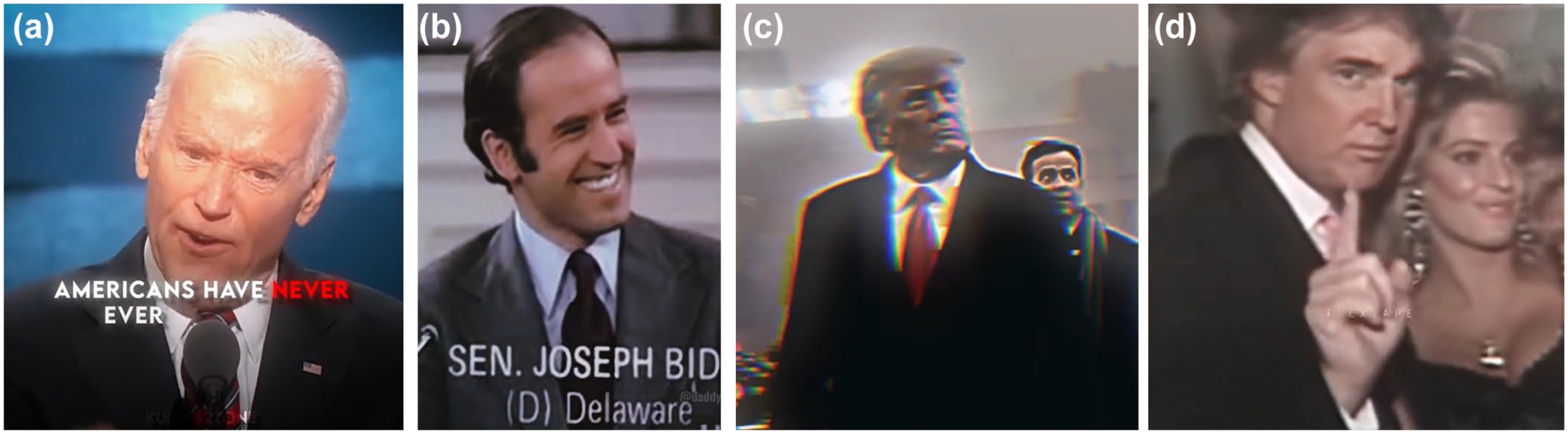
Screenshots from treatment videos. (a) Biden badass. (b) Biden thirst trap. (c) Trump badass. (d) Trump thirst trap.
Research design
We recruited 2807 respondents who completed the survey from the online survey platform Prolific, using their quota sampling to match the US Census in terms of gender, race, and age (categories: 18–24, 25–34, 35–44, 45–54, 55–100). Average subject compensation was $10.26 per hour.
We only analyze the results from subjects who passed three attention checks, removing 18% or 504 respondents, for a vetted final sample of 2303. In addition to two standard checks, we included the audiovisual check developed by Barari et al. (2025) to ensure that respondents could watch and listen to videos.
These checks are relevant in light of recent evidence of decline in levels of subject attentiveness on other popular platforms for running online survey experiments (Ternovski & Orr, 2022). Given the way that we code our outcome variables, it is especially important to avoid inattentive respondents (Westwood et al., 2022).
Demographic characteristics
Before the experimental treatment, respondents were asked a battery of descriptive questions aimed at gauging their demographics, partisanship, and media use. Baseline descriptive characteristics can be found in Table 1.
Sample Descriptive Statistics.

Stimuli selection
Our focal treatments were four: two edits of Biden and two of Trump; one of each badass and the other thirst trap.
A natural question is about how we selected these four videos—and in particular, whether these stimuli are representative. We take a somewhat unusual approach to justifying our stimuli selection procedure. Because we are studying a novel phenomenon, we do not know what the relevant population of edits is from which to sample. Instead, we selected the best edit in each of the four relevant categories, using the number of views on TikTok.
Our procedure involved searching the TikTok hashtag API for “biden edit” and “trump edit” and watching the most popular videos to ascertain the type of edit. One caveat is that, per Guinaudeau et al. (2022), the TikTok hashtag API does not allow for a controlled global search; it returns an unknown mixture of the most popular and the most recent TikToks, possibly weighted to the location of the IP address from which the search was conducted.
So, while we cannot guarantee that we have selected the absolute most popular TikTok in each category, our procedure selected “the best” of each kind of TikTok that we encountered. This more naturalistic stimuli selection strategy does not result in maximum control, however; it is not the case that the four treatment videos are “the same” other than varying the focal candidate and the type of edit. Even the length of the videos varies significantly, from 23 seconds for the “Biden badass” edit, 36 and 37 seconds for the two Trump edits, and 52 seconds for the “Biden thirst trap” edit. As in all experimental design decisions, there are tradeoffs with the use of this procedure.
Indeed, we argue that these uncontrolled comparisons are higher in external validity than comparisons in which only the focal dimension was manipulated. It is certainly conceivable that the exact same video could be edited differently, say with dark filters and bombastic music for a badass edit and soft filters and facetuned figures for a thirst trap edit. In so doing, however, we would be very unlikely to achieve control over what is perhaps the most important audiovisual dimension: the edit quality discussed above.
Experimental procedure
After answering the pre-treatment demographic questions, each subject was randomized into either the treatment condition or the control condition, with a 50% split into each. The control videos were a series of three edits of non-political celebrities. There were two thirst trap edits (one of actress Ana de la Armas, one of soccer player Cristiano Ronaldo) and one badass edit (of actors from 2000s comedy films). The subjects in the control condition (n = 1139) watched these three videos in a randomized order, mirroring the experience of a standard TikTok user not exposed to any political content.
The subjects in the treatment condition (n = 1164) watched three politician edits, in a random order: one Biden edit, one Trump edit, and one Robert F. Kennedy Jr (RFK) edit. As discussed above, we were only able to find one suitable RFK edit (a thirst trap edit, with him lifting weights shirtless), so all of the subjects in that condition watched this video. Each subject in the treatment condition was randomized to watch either the Biden thirst trap (n = 577) or the Biden badass (n = 587) edit; and, in a separate randomization, each treated subject also watched either the Trump thirst trap (n = 579) or the Trump badass (n = 585) edit.
Every subject watched three edits. The subjects in the control condition watched three non-political edits; the subjects in the treated condition watched three politician edits. However, each treated subject watched only one edit of Biden and one of Trump—allowing us to cleanly identify the differential effects of the respective types of edits (thirst trap and badass) on the subjects’ evaluations of the respective politician.
Results
Descriptive results on attractiveness
Figure 2 provides a descriptive overview of the attractiveness of four older, White male politicians: Trump, Biden, RFK, and Bernie Sanders. The latter politician was added to demonstrate further variance in this measure. We present these descriptive results (from the control group only) because this is a novel measure. As Figure 2 demonstrates, there is significant variation across the four men, with RFK receiving the highest average rating and Trump the lowest. There is also evidence that partisanship is at least partially driving these results: the non-normal distribution for Sanders and especially Biden is not what we would expect if subjects were evaluating solely physical attractiveness.

Distribution of attractiveness ratings, control group only. (a) Biden attractiveness. (b) Sanders attractiveness. (c) RFK attractiveness. (d) Trump attractiveness.
We caution against drawing inferences about the absolute levels of politician attractiveness; although the control edits should not bias one politician over another, all of the politicians likely suffered in comparison to edits of famously attractive celebrities.
Table 2 presents the descriptive correlates of subjects’ evaluation of the attractiveness of each candidate. Again using only the subjects in the control conditions, these are not causal results, but they do provide some context that could inform future research.
Descriptive Correlates of Candidate Attractiveness, Control Group Only.

Note. *p < 0.1; **p < 0.05; ***p < 0.01.
Predictably, Republicans rated Trump as more attractive than did Independents (but they also rated RFK as more attractive); Democrats rated Biden and Sanders as more attractive—and Trump less attractive—than did Independents. Older respondents rated all four men as more attractive than did younger respondents, with the largest correlation with Biden. Consonant with our motivation for studying “thirst trap edits,” frequent TikTok users rated all four candidates as more attractive than did less frequent TikTok users, although the relationship was twice as large for Trump and RFK than for the other two.
Perhaps the most surprising correlate of attractiveness is that men rated both Trump and Biden as significantly more attractive than did women, with the relationship nearly twice as strong for Trump. Respondent gender was uncorrelated with the attractiveness of the other two candidates.
Main experimental results
We turn now to the experimental results, presented in Tables 3 and 4. In interpreting these tables, note that each table presents two different specifications of two different regressions—that is, the effects on evaluations of Trump are estimated only based on the Trump-specific treatments, mutatis mutandis Biden. The first regression for each candidate lumps together both types of candidate-specific edit, while the second estimates the effect of each type of edit separately.
Effects of Edits on Candidate Attractiveness.

Note. *p < 0.1; **p < 0.05; ***p < 0.01.
Effects of Edits on Favorability.

Note. *p < 0.1; **p < 0.05; ***p < 0.01.
Table 3 displays the effects on candidate attractiveness. All four treatments caused a significant increase in subjects’ rating of the focal candidate’s attractiveness. In both cases, the point effect was larger for the thirst trap edit, although the difference for Trump is marginal. For Biden, the effect of the thirst trap edit is 250% larger than that of the badass edit.
The treatment effects of the edits on candidate favorability (operationalized with the standard 100-point feeling thermometer) are less pronounced. Neither Biden edit had an effect on Biden’s favorability; indeed, the point estimate of the badass edit is negative. Both Trump edits marginally increased Trump’s favorability, 2 points for the thirst trap edit and 3 points for the badass edit.
Descriptively, we see that older respondents and men rate both candidates higher. The standard (dramatic) effects of partisanship are present. Unexpectedly, there is a strong relationship between TikTok use and candidate support—TikTok users rate both candidates higher, but the coefficient is about 400% larger for Trump.
Pre-registered heterogeneous effects
We pre-registered a small number of interaction effects. Following our Pre-Analysis Plan, we test for the existence of the following effect heterogeneities: for politician favorability, we test for partisanship, age, and TikTok use; for politician attractiveness, we test for gender and age.
There is little evidence for treatment effect heterogeneity in candidate favorability on any of the three pre-registered dimensions. The only exception, when control variables are added, is a moderation variation in the effect of the thirst trap edit, with a somewhat larger effect among younger respondents. Given the number of comparisons, we interpret this result as more or less noise.
The results of the tests for heterogeneous effects on attractiveness by respondent age and gender are similarly weak and inconsistent.
Discussion
This article presents an analysis of the effects of TikTok edits, a relatively novel form of media. We find that “thirst trap” edits cause an increase in perceptions of politician attractiveness, and both types of edits improve overall evaluations of Trump (but not Biden). This is broadly in line with our hypotheses. The badass edits also increased evaluations of candidate attractiveness, in contrast to our expectations, but the effects of the thirst trap edits were larger. Both of the Trump edits improved Trump’s favorability, with the effect of the badass edit 50% larger, but contrary to our expectations, neither Biden edit affected Biden’s favorability. We discuss our post hoc explanation for this divergence below.
In addition to the main analysis, our pre-registered hypotheses were that treatment effects would be heterogeneous in subject age, gender, partisanship, and TikTok use. We find little evidence of any of these heterogeneities. We believe that these null results are particularly striking in terms of respondent gender (for candidate attractiveness) and respondent partisanship (for candidate favorability).
We emphasize our relatively “uncontrolled,” naturalistic strategy for stimuli selection. These four stimuli were, simply, the “best” edits we could find for each of the desired categories; they varied, naturally, along many dimensions that we did not explicitly control. Given that our research explores this novel form of media, we preferred this more ecologically valid form of stimuli selection. Future researchers who wish to investigate the effects of TikTok edits may want to explore the other side of the design space by creating their own edits. This design would allow the researcher to manipulate only the dimensions of interest.
Furthermore, the stimuli we selected were “the best” relevant TikToks only for a specific context and point in time. Digital media is constantly changing (Munger, 2023), and this was an especially eventful moment in American politics.
However, the decision to use uncontrolled stimuli in this manner makes the interpretation of the null effects of the Biden edits on Biden favorability (in contrast to our expectations) more ambiguous. One possibility is that there is a theoretical difference between the appeal of populist, anti-establishment candidates like Trump, and more mainstream candidates like Biden. Alternatively, it is possible that the stimuli themselves differed in terms of quality, and that the explanation is simply that high-quality edits have an effect while low-quality edits do not. Our hunch leans toward the latter, but further research will be needed to disentangle this difference.
While the effects of video-based media effects on candidate attractiveness are, we believe, novel to our experiment, our tests of the effects of TikTok edits on candidate favorability are broadly in line with a long-standing literature on television advertisements. The effects of the Trump edits (and particularly the badass edit) are small but positive and significant, while the effect of the Biden badass edit was actually negative (although not significant). Coppock et al. (2020) review 59 real-time field experiments using the same outcome variable (candidate favorability) and find an average effect of .5 points. Hewitt et al. (2024) use a similar meta-analytic strategy and an even larger data set of experiments on the effectiveness of television advertisements and find an average effect on candidate favorability of 2.6 points in the 2018 US Congressional election and 1.0 points in the 2020 US Presidential election. Combining the Biden and Trump badass edits, the average effect is 1.45 points. While the effect we identify is thus somewhat larger, our experiment is conducted under lab conditions rather than in the field, and with much smaller sample sizes, so we do not conclude that we have identified a larger effect. Rather, we argue that our evidence is consistent with finding that badass TikTok edits are approximately as effective as professionally produced television ads.
We conducted this experiment in June 2024, when the Presidential candidates were still widely expected to be Biden and Trump. The subsequent decision by Biden to recuse himself from the election and the nomination of Kamala Harris only heightens the importance of physical appearance in the campaign. There is a wealth of evidence that women and people of color are scrutinized more heavily than are White men, especially when it comes to physical appearance and self-presentation (Lizotte & Meggers-Wright, 2019).
Furthermore, the literature has found that evaluations of appearance-based traits differ by the gender of the candidate (Ditonto, 2018; Ditonto & Mattes, 2018). Women experience a greater electoral penalty for appearing lower-class than do men (Bahamonde & Sarpila, 2024). For evaluations of leadership potential, women with more feminine facial traits are rated more highly, while men do not face such a penalty (Ditonto, 2018). There is even evidence of this specific to the case of Kamala Harris, from her unsuccessful 2020 US Presidential Primary campaign. Cassidy & Liebenow (2021) find that subjects exposed to an image of Harris that made her appear more feminine rated her more favorably, demonstrating an important pathway for visual manipulation to affect (female) candidate evaluation.
As the pool of political candidates continues to expand beyond older White men, the importance of physical appearance–and the ability of politicians, political activists and regular social media users to manipulate politician appearance–will only increase. Taking a broader perspective on the present study, we argue that the proliferation of the technologies that make “edits” possible represents a significant shift in the practice of democratic politics.
To date, a primary concern around digital media is the proliferation of “misinformation.” Although facticity is an important element of digital media and to democratic politics, we argue that it is more central to textual communication than to images or particularly video. We study a novel form of digital media that is manifestly not about facticity. The purpose of TikTok edits of politicians is best understood in light of the purpose of edits of any type of celebrity or public figure—to make the focal person look a certain way, often but not always in terms of physical attractiveness.
We demonstrate experimentally that these edits are effective in changing viewers’ evaluations of the target politicians. The effect is larger for physical attractiveness and in line with standard professional advertisements for candidate favorability. Given that these candidates were both older White men who had been covered extensively in the media already, we believe that these results represent a lower bound compared to a diversifying population of political candidates. For non-White, female, and less prominent politicians, appearance should play more of a role—and the ability to effectively manipulate appearance will therefore play a larger role in the practice of political campaigning.
We expect this to be a fertile area for future research. In addition to studying user-created edits as in the present study, future researchers could manipulate many features related to the physical appearance of candidates, using the large libraries of videos produced by both professionals and amateurs. More broadly, the scope of the “political” that can be expressed with video edits goes beyond active political campaigns. There are a variety of social and cultural topics displayed in this kind of video, which we expect to play a growing role in many areas of 21st-century communication.
Supplemental Material
sj-pdf-1-sms-10.1177_20563051251329990 – Supplemental material for Thirst Traps and Quick Cuts: The Effects of TikTok “Edits” on Evaluations of Politicians
Supplemental material, sj-pdf-1-sms-10.1177_20563051251329990 for Thirst Traps and Quick Cuts: The Effects of TikTok “Edits” on Evaluations of Politicians by Kevin Munger and Valerie Li in Social Media + Society
Footnotes

Statements and Declarations
Notes
Author biographies
References
Supplementary Material
Please find the following supplemental material available below.
For Open Access articles published under a Creative Commons License, all supplemental material carries the same license as the article it is associated with.
For non-Open Access articles published, all supplemental material carries a non-exclusive license, and permission requests for re-use of supplemental material or any part of supplemental material shall be sent directly to the copyright owner as specified in the copyright notice associated with the article.
