



Abstract
Erving Goffman’s dramaturgical model in The Presentation of Self in Everyday Life (1959) is frequently used to analyze online self-presentations in social media (SoMe) and other social network sites (SNS). The term “self-presentation” seems to be here to stay. We argue that Goffman’s dramaturgical model belongs to another era, and that online self-presentation needs new theoretical approaches and new content. Compared to its predominant usage in SoMe research, our approach involves a perspective shift from what do SoMe users present (e.g., social role, identity/identities, idealized self, authentic self, brand) to how they perform it, concerning the style of acting and dressing, the use of props, makeup, symbols and signs, emotions, and expressions. Since participation on SoMe platforms is largely about how SoMe users present themselves and how they want to be received, theatricality and performing arts theories can inform this how with a new and nuanced conceptual apparatus. Therefore, we create a theory-based typology on the concepts of theatricality, simple and complex acting, not-acting, not-not-me, imagined audience awareness, and absorption. We present six types of theatrical self-presentations and conditions, types suitable for analysis of SoMe performances.
Keywords
Entré
Goffman’s dramaturgical model and the term self-presentation have been dramatically revitalized with the introduction of social network sites and social media (SoMe; Bullingham & Vasconcelos, 2013; Hjetland et al., 2022; Hogan, 2010; Hollenbaugh, 2021; Hong et al., 2020; Kapidzic & Herring, 2014; Meeus et al., 2019; Papacharissi, 2002, 2012; Qi et al., 2018; Rettberg, 2017; Rui & Stefanone, 2013; Uski & Lampinen, 2014; Van Dijck, 2013). We can easily see why. The term self-presentation is theoretically open; it allows several interpretations of “presentation” (as performance, exhibition, creation, etc.) and just as many interpretations of “self” (personality, authentic self, one identity or multiple identities, social role, image, personal, or professional brand).
We argue that Goffman’s dramaturgical model belongs to another era, and that SoMe self-presentation research could benefit from new approaches and new content. To nuance how self-presentation takes place on an ever-increasing number of SoMe platforms today, we believe that a correspondingly nuanced theoretical framework is needed. We find such a framework within theories of theatricality and performing arts studies.
Our approach involves a perspective shift from what do SoMe users present (e.g., a social role, personality, identity, authentic self, brand) to how they perform it, concerning style of acting, dressing, the use of props, makeup, symbols and signs, emotions, and expressions. Since participation on SoMe platforms is largely about how SoMe users present themselves and how they want to be received, theatricality and performing arts theories can inform this how with a new conceptual apparatus. To facilitate our focus on how SoMe users act and perform self-presentation, and in doing so provide a new framing of Goffman’s popular concept of self-presentation, we develop a theory-based theatrical typology of acting and performing styles, as well as new online conditions. Our typology combines concepts from theatricality and performing arts theorists (Féral, 1982; Fried, 1967, 1980; Kirby, 1972; Schechner, 1985, 2003) with SoMe research on self-presentation (e.g., Hollenbaugh, 2021; Marwick & Boyd, 2011; Meeus et al., 2019; O’Leary & Murphy, 2019; Orsatti & Riemer, 2012; Uski & Lampinen, 2014; Van Dijck, 2013).
Michael Kirby’s theory on the continuum of acting and not-acting is applied as a major building block in the typology as it explains different acting and performing styles. A relational approach to theatricality is presented, including the audience (Féral, 1982; Gran & Oatley, 2002) and a distinction between implicit and explicit theatricality. Furthermore, we borrow Richard Schechner’s (1985, 2003) concept of not-not-me and reframe this double negation for a new theatrical self-presentation condition online. Not-not-me is about a condition where SoMe users can neither perform as themselves nor simply act as someone else in the form of a fictional or social role. Michael Fried’s (1967, 1980) concept of “absorption” is linked to the SoMe user’s state of being totally absorbed in a SoMe activity.
We create six types based on these theories and SoMe research: (a) complex acting of roles, multiple identities, and professional brands; (b) simple acting and representation of idealized selves and personal brands; (c) performing the image of authentic self; (d) not-acting as self-conscious performing; (e) not-not-me as a theatrical condition; and (f) the absorbed self as a not-theatrical condition. The first four types are based on Kirby’s acting continuum and theatricality theory, and they are about self-presentation acting styles, while the last two types are inspired by Schechner’s and Fried’s concepts applied to online conditions for SoMe self-presentation.
Although the theatrical self-presentation types themselves are fixed and strictly defined, SoMe users can switch between them. This can be done between different SoMe platforms or on the same platform if the infrastructure allows it. Furthermore, certain SoMe platforms are better suited for specific categories in the typology than others, due to the platforms’ infrastructures and affordances. For example, BeReal is, so to speak, designed for “Performing the image of authentic self,” while, for example, X is better suited for “Complex acting of social roles, multiple identities and professional brands.” At the same time, SoMe users’ self-presentations are not totally determined by the platforms; users have a certain freedom to embrace or oppose the platforms’ infrastructures and affordances. Which theatrical self-presentation types are relevant and applicable on the various platforms will vary, as the SoMe users’ responses to the different platforms will do. Our theatrical typology is intended as a repertoire of analysis tools that researchers can choose from according to their analysis needs.
The article is structured as follows: First, we introduce the holder of the main concept, self-presentation, and Goffman plays the protagonist. A theater historical perspective reveals that his dramaturgical model is rooted in a theater genre that does not suit self-presentation in SoMe very well. Second, we present selected concepts in the field of Goffman’s dramaturgical model applied to SoMe, and the community of SoMe researchers plays the role as the choir of Goffman interpreters. We focus on the interpretation of self-presentation, and the new concepts of context collapse, imagined audience, and time collapse all are terms that we later use to create the theatrical types. Third, we introduce our theatrical building blocks and assemble them into six types for SoMe self-presentations and conditions.
Goffman in a Theater Historical Perspective—Theater Genre Confusions and Limitations
Goffman’s dramaturgical concepts are metaphors or analogies to real-life performance, used as strategic analytical tools. The discourse on performance, drama, and dramaturgy as metaphors is extensive and enlightening (Boyd et al., 2015; Manning, 1991; States, 1996; Võsu, 2010; Walsh-Bowers, 2006), but due to the article format, it is not possible to include it.
Goffman’s dramaturgical model was a child of his time and place, and the theater genre he had in mind when writing the book was the conventional theater of realism and fiction. Actors in fictional theater play the roles and characters as realistically and truly as possible, and the audience must believe in the role/character being played. This acting style was once inspired by the Russian director Konstantin Stanislavski, still used in so-called “method acting” schools today. Actors in this tradition learn to project and use their own feelings and experiences into the characters to give them inner psychological and emotional life. Goffman (1959) explicitly dropped the fiction in his dramaturgical model (in Preface), but he kept the view of the genre of realism and fiction when building his role-play theory.
Furthermore, in the tradition of fictional realism, Goffman strictly distinguished between the role/character and the performer of the role (the Godfather and the actor Robert De Niro). Even when Goffman dropped the fiction, on which social roles in everyday life are not based, he retained an absolute distinction between the performer and the social role. The performer himself should be hidden from public life, only the social role belongs there. Goffman seemed to be familiar with neither theater modernism nor theater theories criticizing the fictional theater. An encounter with Berthold Brecht (1964), either on stage or through his theories, showed that he would have seen it was quite possible for the performer to go in and out of fiction, that actors could leave the role in front of audiences to point out its fictional character (the social role in Goffman’s model). An absolute distinction between performer/actor and the role is too rigid in everyday life today, offline as online. “Falling out of the character,” which is the topic of the chapter on impression management, is only a problem in fictional theater, not in contemporary performing arts genres or in everyday life in SoMe. On platforms such as Facebook and X, for example, a lawyer can both play the professional role with bravura and behave as the person who holds the role of the lawyer. In Brecht’s way, the person can step out of the role of lawyer and, thus, show that it is precisely a professional role.
Goffman’s fiction- and realism-based theater metaphors are actually very different from the rather one-dimensional social roles he used as examples, namely professions in so-called “working situations” (the waiter and servant), associated institutional hierarchies (the army, hospitals, etc.), class society, and the traditional society of Shetland, almost feudal at the time. Goffman was concerned with what is common to the role of a waiter, and what it is that a waiter does that causes him to be perceived as a waiter in the eyes of the public. He was not concerned with the personality or psychology of the actors performing the waiter (to exemplify, not the actor Robert De Niro, but the role of the Godfather). It could be argued that Goffman in many ways chose the wrong theater genre for the role-play theory. His model is more like theater genres based on strong conventions and stereotypical representations of specific types, a caricatured figure, a profession, a known social role as the servant, the lover, and so on, than the realistic acting genre. We find such types of galleries in Commedia dell’ Arte in the Renaissance, partly in Shakespeare’s plays, in French classicism, and in the later genre of melodrama. These are genres based on strong theatrical conventions (about how to perform the role, due to the norms and rules of the time) and technical acting craft of how to perform them. To summarize, there is a kind of mismatch between the realism-based theater genre of role-play and the empirical examples of Goffman’s dramaturgical model. Therefore, we leave Goffman’s model as the foundation for our theatrical self-presentation typology, but we do keep the self-presentation term.
The Choir of Goffman Interpreters
In SoMe research, the interpretation of Goffman’s self-presentation term has moved from a social role approach to the concept of identity, multiple identities, authentic self, and/or brands, depending on the researcher’s theoretical approach. We find both researchers who read Goffman as an essentialist; the content of the presentation is an authentic self, or one identity, and researchers who read Goffman as a defendant of the opposite; role-play enables the content of multiple identities, images, and brands—a diverse and complex self (O’Leary & Murphy, 2019; Orsatti & Riemer, 2012, 2015; Van Dijck, 2013; Wittkower, 2014). Goffman’s focus on self-presentation as role-playing suited the postmodern zeitgeist toward the end of the 20th century where deconstruction of identity/essence was central (inspired by the French philosopher Derrida). The postmodern Goffman reception also matched the self-reflexive identity production that characterizes younger generations. Furthermore, Goffman’s concept suited the marketing-influenced literature on image and brands, and self-presentation entered the discourse on online professional and personal branding (Bagdogan, 2023; Blyth et al., 2024; Brems et al., 2016; Johnson, 2017; Pasquini & Eaton, 2021). In the choice between an essentialist and a non-essentialist Goffman interpretation, we belong to the latter. We interpret Goffman’s performing self, belonging to a huge social role-repertoire, as a non-essentialist position, which is also best suited for a self-presentation typology based on performing arts theories. The concept of social role has been partially displaced by the identity discourse in SoMe research, and we want to bring it forward again.
The terms theatricality, personality, identity, and authenticity are historically conditioned, and the use of the terms today is far from the etymological one, marked as it is by the ravages of time. The concept “identity” has its origins in the Greek word “idem” which means to be the same or identical, and considering this definition, an identity cannot really be theatrical, and etymologically speaking, not multiple either. Considering the shift in SoMe research interpretation of Goffman’s self-presentation from social/professional roles to presenting personality, one identity or personal image can be understood in the light of Richard Sennet’s (1978) The Fall of Public Man. He argued that the ancient theatrical play in public life (guarded by strict social codes, costumes, manners, etc.) during the 19th century is replaced by a new form of interaction in public, where all individual performances are interpreted as expressions of underlying personalities, so to speak the back-staged self. Today’s Western society is strongly characterized by this personality paradigm, probably stronger than ever, and by the importance of behaving consistently and appearing as one unified self. Theatrical communication in the form of explicit role-play has slowly disappeared from modern public life (Gran & Oatley, 2002). Mark Zuckerberg’s famous phrase about Facebook’s new just-one-profile practice, “You have one identity,” both reflects this modern mentality and amplifies it on this platform (Van Dijck, 2013).
There are two major ways of presenting this personality or identity, reflected in the SoMe research literature. One way is to beautify the self-presentation with positive and self-boasting content and self-censor the rest, often referred to as an idealized self or occasionally also as a false self (Mun & Kim, 2021). The second way is to try to appear as real, identical (“the same”), and authentic as possible, including sexual orientation, ethnic origin, and physical and mental handicaps (Audrezet et al., 2020; Bitman, 2022; Choi et al., 2020; Hurley, 2019; Zillich & Riesmeyer, 2021). In our perspective, it can be argued that platforms such as BeReal (no filters etc.) attempt to expel theatricality, the staging of the self, from the platform.
Context Collapse, Imagined Audience, and Time Collapse
There is agreement in the research field that SoMe involves a so-called context collapse, compared to face-to-face interaction where people have control over who is the audience and the opportunity to keep different target groups such as friends and colleagues apart (Hollenbaugh, 2021; Marwick & Boyd, 2011). The term “imagined audience” is often used for this mixed online audience of family, friends, colleagues, and strangers. The imagined audience plays an important role in our creation of both the theatrical not-not-me condition and the state of the absorbed self, and it is a question about to be or not be aware of the imagined audience. In the extension of context collapse, the term “time collapse” is also introduced, which refers to a collapse of past and present time in SoMe (Brandtzaeg & Lüders, 2018). The archive function is important to the argument: the entire archive of self-presentations can be revitalized in the present and then mixed with new posts (Birnholtz & Macapagal, 2021). We argue that there is still a very synchronous moment on SoMe platforms, even on platforms with archive functions, namely the moment when the SoMe user presses “send”—a live moment. This synchronous posting time is integrated into our absorbed self-category.
Building Block 1: Relational Theatricality—Explicit and Implicit
The first theoretical building block is about theatricality, and we will introduce the terms relational theatricality, as well as explicit and implicit theatricality. In everyday life, we use the term “theatrical” when something reminds us of the theater, or is theater-like. The term is used to describe exaggerations in public behavior and drama in politics. Furthermore, what one associate by theatricality is dependent on the historical context; it depends both on the theater genres of the time and on how theater-like the public life was (Burns, 1972; Christian, 1987; Sennett, 1978). We may consider something rather theatrical today, which was once historically understood as ordinary public behavior, for example, the judges’ use of wig in court, still used in the United Kingdom. The wig belonged to public life and not the private one, and public and private spheres belonged to different social regimes.
In addition, and of vital importance in the academic theatricality discourse, is the interpretation of theatricality as a relational phenomenon; it is reliant on someone watching—one spectator or an audience (Féral, 1982; Gran & Oatley, 2002). The important analytical difference in our context is the one between having an audience and not having an audience.
The term “theatricality” also enables us to distinguish between implicit and explicit theatricality, as shown in Figure 1, overall staging principles relevant to self-presentation in SoMe as well.

Explicit and implicit theatricality in different performance genres.
Explicit theatricality is defined as intentional staging and visible theatrical tools, which helps the audience understand what they are watching is staged. We find this kind of theatricality in both conventional fictional performance in theater buildings and in the use of masques and spectacular mise en scène in not-fictional genres such as drag shows and carnivals. Implicit theatricality is defined by intentional staging but hidden theatrical tools. Such genres hide or under-communicate the mise en scène all together to achieve an impression of realism and authenticity. In so-called invisible theater (Boal, 1985), situations are staged in everyday contexts and public arenas, and the audience cannot know that the situation is carefully planned, staged, and acted. In the non-fictional version, such as some experimental theater genres or reality TV, theatrical means (e.g., dramaturgy, typecasting, directing) are under-communicated or hidden. In SoMe, self-presentations can also be staged in explicit and implicit theatrical ways, and theatrical tools can be made visible or hidden from the audience. The more authentic the SoMe user wants to appear, the more important it is to hide the theatrical means involved.
Building Block 2: Acting and Not-Acting in Public
Michael Kirby’s (1972) theory on acting and not-acting is applied as a major building block in the typology, and we follow his basic assumption that “Not all performing is acting” (p. 3), which refers to the fact that not all performing on a theater stage means playing a character. Kirby developed the idea of a continuum between acting a traditional role/character and not-acting as performing oneself in a performance setting. The continuum is about the “amount of acting,” the amount of pretending and personification, but it is not a normative tool: much acting is not better than not-acting and vice versa. In between those extremes, there are several nuances, which we find useful in a SoMe self-presentation context.
In the 1960s, theater genres such as happenings and street theater emerged, and the acting style changed from acting a character from a written play to performers performing without fictional roles (Schechner, 1985; Shank, 1988).
To the right of the continuum in Figure 2, we find the extreme point “complex acting,” which refers to playing a role, whether a complex character (Hamlet, Nora) or a stereotype (the thief, the lover, the queen). This is probably the style that most people in the West associate with acting. Such acting requires extensive use of the actor’s theatrical tools and craft skills, and Kirby, therefore, considers this style as the largest “amount of acting.” Complex acting is still a common acting style on theater stages all over the world, and the dominant one in films and TV series. “Simple acting,” on the other hand, refers to a style where emotions, opinions, and beliefs are theatrically played out to an audience, however not as parts of a specific role or character. The performer exaggerates the use of voice and gestures to underline a motion or an opinion, and even pretends to be angry, engaged, or happy. We find this acting style both in experimental theater genres and in stand up. In everyday life, we can identify simple acting among politicians, influencers, and public persons when they have an audience, offline or online. The “received acting” category describes the phenomenon that any person who appears on a theater stage is considered a part of the performance, even if it is not the case, such as a stage technician who has wandered onto the stage. The audience tends to believe everything happening on stage is staged.

Continuum not-acting—acting in front of an audience (Kirby, 1972, version simplified by the author).
The “symbolization or representation” style is closer to not-acting, and the performer neither acts a role nor acts out emotions or opinions, but s/he only uses symbols or signs to symbolize or represent meaningful connotations to the audience. Symbols and signs are, for example, clothes, props, and physical characteristics such as limping or stuttering. Kirby used cowboy outfit to exemplify this category in the continuum: on a stage, it is enough to use simple props or an article of clothing to represent a group, a stereotype, a minority—the performer does not need to act the cowboy in a complex or simple way. The term “acting” is at this point in the continuum replaced by the term “performing,” and the “amount of acting” is decreasing significantly.
“Not-acting,” the other extreme of the continuum, is a kind of pure performing, where the performer neither acts nor represents anything specific but only performs actions on stage. The performer is aware of the audience, which generates a stage presence, which in turn arouses the audience’s interest. The amount of acting is close to zero, but the theatrical relation between the performers and the audience may still be strong and engaging. Kirby’s examples are new theater genres in the 1960s, and he claims that the development of acting styles moved from complex acting toward more not-acting performing in this period.
Building Block 3: Not-Not-Me
Kirby’s not-acting style in the continuum inspired us to develop this category further concerning the performer’s audience awareness in SoMe. In many ways, SoMe platforms are online stages, and the awareness about an audience out there is strong among many SoMe users. The difference between an onsite visible audience context and an online invisible audience context is significant: the context collapse and the archive function on SoMe platforms create a great risk or drop height for making mistakes in communication with the imagined audience. Furthermore, the screen shot possibility transforms every synchronous SoMe moment into a potential archive object.
To describe this online condition, we turn to performance theorist Richard Schechner and borrow his concept of not-not-me. In his book Between theater and ritual, Schechner (1985) introduced not-not-me as a state that both actors, shamans and clergy, achieve in a performance situation. Stepping into a role as professional actors do is leaving being “me” to become “not-me,” while “me” is also present in the role/character, hence the double the negation “not-not-me.” We use the term in a more secular and everyday way than Schechner, who used it to denote liminal states in rituals and theater performances. In our typology construction, the not-not-me principle is rather about strong audience awareness; an awareness that prevents SoMe users from forgetting themselves and to behave as just “me” as if no one was watching them. And if the SoMe user is complex acting “not-me” as a role or brand, the “me” is still present as appearance, body, and voice and received by the imagined audience as such. We turn the double negation of the liminal not-not-me from Schechner into a constant condition for self-presentation on SoMe platforms.
Building Block 4: The Not-Theatrical Condition of Absorption
We suggest introducing a not-theatrical mode of behaving in SoMe because we argue that not all SoMe behaviors are conscious and strategic self-presentation. Inspired by the art theorist Michael Martin Fried, we call it absorption. In Fried’s (1967, 1980) theory of modern art, absorption is a normative concept: absorption is a good thing and theatricality is bad because theatrical works of art are far too concerned with the audience’s presence (which is bad) instead of being autonomous and absorbed in themselves (which is good). We abandon both the art objects and the normativity of Fried, but we retain the idea of absorption as the opposite of theatricality (understood as a historically situated relation). We introduce “the absorbed self” about the SoMe user who is not aware of the invisible imagined audience in the synchronous posting moment. To be lost in absorption is considered as a not-theatrical condition for SoMe participation.
Presentation of the Theatrical Self-Presentation Types
The time has come to collect the theoretical threads and weave them together into the various theatrical self-presentation types and conditions.
Complex Acting of Roles, Multiple Identities, and Professional Brands
We start with complex acting, the most advanced theatrical style in Kirby’s continuum, which is about playing someone else, acting “not-me.” We are dealing with explicit theatricality because no attempt is made to hide from the audience the fact that theatrical tools are used on stage.
We combine the complex acting style with SoMe research on self-presentation of roles, multiple identities, and professional brands. These have commonalities with roles/characters in Kirby’s model, and even if SoMe users are not professional actors and the roles and multiple identities are not fictional (but anonymous accounts may be fictional as well), they represent the largest “amount of acting” in SoMe self-presentation. Furthermore, we underline that in our Kirby-inspired perspective, SoMe users do act roles and identities consciously, intentionally, and sometimes very strategically, as the actor on the stage does.
Unlike Goffman’s insistence on always keeping the distinction between the social role and the performer, we argue that it is possible for a SoMe user both to act a role, for example, a professional role as a lawyer, and present the person who acts this legal profession on SoMe platforms such as Facebook, Instagram, and X. The performer can point at the social role and make it visible, in a similar way as Brecht suggested in his theater theory. It requires a clear understanding of the role, and that the content posted must be explicitly addressed to the role or to the holder of the role. For several professions, it is important to keep a distance between the role and the person who holds the role, be it a politician, researcher, or lawyer, but there are probably large national differences in the public-private expectations here. For certain occupational groups, for example, journalists who are in principle always at work, this distinction is difficult to maintain, something the industry itself is aware of (Hanusch, 2018).
Among young SoMe users, we find a strong understanding of SoMe contexts and settings, and some of them create profiles on different platforms with various self-presentation strategies (Duffy & Chan, 2019; Zillich & Riesmeyer, 2021). This makes it possible to play several roles on different platforms (to realize multiple identities) and to address different audience groups as well. Although several SoMe platforms enable role-play and multiple identities, it seems that computer games have become the most important arenas for the complex style of acting, while SoMe platforms have, to a greater extent, become stages for acting idealized and authentic selves, something we will return to.
Simple Acting and Representation of Idealized Selves and Personal Brands
Simple acting means acting out statements and emotions. It is about exaggerations and pretending feelings, but without playing a role. Representation or symbolization is about selecting props, makeup, costumes, and scenography that represent or symbolize the content/meaning the SoMe users want to front. We combine simple acting with the use of signs and symbols of specific content, since they are often used together. When we move from complex acting to simple acting and representation, the amount of acting is decreasing significantly, since the role or character is gone. We link this acting style to SoMe research on self-presentation of idealized selves and personal brands (people branding themselves, e.g., as artists and bloggers), since the role of “not-me” is absent from these types of self-presentation as well.
In the article “Women’s emotion work on Facebook: Strategic use of emotions in public discourse,” Sakariassen (2021) shows exactly how female SoMe users communicate emotions strategically to make an argument or trigger empathy. Such “emotion work” is a kind of simple acting.
The self-presentation of idealized selves and personal brands/self-branding are examples of implicit theatricality: the SoMe user wants the idealized self or personal brand to appear as realistic and credible as possible. Emotional textual/oral statements about one’s own excellence are used in this work (simple acting), as well as makeup, props, and scenography such as pictures/videos of, for example, perfect home interiors or summit trips (representation/symbolization of lifestyles). Content that does not fit this profile is censored. If the self-idealization becomes too far from the reality in offline life, the SoMe user may consider it as false, almost as a role “not-me,” which in turn can lead to psychological problems and the experience of an alienated self (Mun & Kim, 2021).
Several idealized selves are somewhat like social roles, especially the main social roles in society, such as gender and parenting: for example, the perfect housewife and mum and the macho man. It can be argued that some so-called idealized selves have less to do with individual selves and more to do with the prevailing social roles in society. The fact that the SoMe users themselves understand their SoMe activity as a way of idealizing the self does not prevent researchers from analytically considering the performance as a societal role-play.
Performing the Image of Authentic Self
In this theatrical self-presentation type, no social roles or multiple identities are acted (complex acting), no strong and loud statements or emotions are acted out either (simple acting), and the style is rather low-key acting and strategic use of sign and symbols to represent what the SoMe user considers as an “authentic self.” Although this is not simple acting in Kirby’s sense because this style has too high “amount of acting” for the authentic self-presentation, this style may sometimes contain a small portion of acting, such as underlining and highlighting important personal characteristics. We call it low-key acting for the occasion. Theatricality is equally implicit: The self must appear as one and authentic, and not as a selected and staged image—theatrical tools must be hidden. Visible theatricality is so to speak the largest enemy of this self-presentation type. In our perspective, what the SoMe audience receives is not someone’s authentic self, but a very selective and performed image (picture/representation) of the authentic self.
Whether this unit is considered as an authentic self, a true personality or a core identity (the concepts reflect different theoretical positions in SoMe research), it must be performed consistently and stably over time to keep the image of an authentic core self. This theatrical self-presentation type is about what the SoMe users consider to be his or her authentic self, whether it is about their personal life in general or more specific about their sexual orientation, handicap, ethnicity, or religion (Bitman, 2022; Talbot et al., 2022). The empirical SoMe research shows that authentic self-presentation is highly valued by young people (Uski & Lampinen, 2014; Zillich & Riesmeyer, 2021), and that they consciously work to stage this (image of) authentic self (Gorea, 2021; Kondakciu et al., 2022; Yang & Brown, 2016; Zillich & Riesmeyer, 2021). In Sennett’s perspective, this authenticity orientation can be seen in the light of the fall of public man and the dominant personality paradigm in modern times. The BeReal platform is so to speak created for such authentic self-presentation: there are no filters to beautify the moment, and SoMe users cannot even decide when to post content themselves because the platform decides for them (Vanhoffelen et al., 2023). Zuckerberg’s “you have one identity” policy for the Facebook platform can be interpreted as another expression of authenticity requirement. Outside the scope of this article, but nevertheless, we ask the question whether complex role-playing in computer games is experienced as a free zone from the explicit or implicit authenticity requirements on several SoMe platforms and in society in general.
Not-Acting as Self-Conscious Performing
The other extreme in Kirby’s acting continuum is not-acting, that is, pure performing without characters/roles, acted statements or emotions, props or signs and symbols. The only “amount of acting” left is the performer-audience interaction, still containing relational theatricality due to the performer’s audience awareness. The performers perform as themselves (using their proper name), but with an audience or a camera lens in front of them, they become self-conscious and sometimes vain. They perform as if they know they are being watched, and the audience awareness may imply a small shift in behavior that only those who know the person privately will be able to observe. We find this form of performing style in such different genres as happenings, art performances, public speeches, and talk shows. This theatrical self-presentation type can be connected to self-conscious studies in SoMe research, which analyses the phenomenon of self-consciousness in different academic traditions (Ahadzadeh et al., 2021; Nezlek et al., 2018). Incidentally, we encounter not-acting such as self-conscious performing in SoMe as more or less vain performances.
Not-Not-Me as Theatrical Condition
We now leave the theatrical acting/performing styles in favor of what we consider as a more profound constant theatrical condition for self-presentation online, inspired by Kirby’s not-acting category and not least Schechner’s concept of not-not-me. We distinguish between audience as one or a few recipients and the much larger imagined audience. In front of the invisible imagined audience, the SoMe user is not only audience aware but also hyper-imagined audience aware, a condition that also contaminates offline life since the imagined audience never sleeps. The double negation of performing not-not-me is a condition in which the hyper-imagined audience awareness, so to speak, burdens the SoMe users non-stop.
Of all acting styles presented earlier, we argue that in front of the imagined audience, SoMe users never perform as just themselves (Schechner’s “me”), but never fully and completely as someone else in roles/multiple identities/professional brands either (Schechner’s “not me”). They rather perform the double negation of not-not-me in front of the always-present imagined audience as opposed to offline face-to-face interaction, from which we have a break, when we physically leave the audience. The active SoMe users never have time off, not even when they are offline.
Even when they are in closed SoMe rooms, their posts may be exposed to screenshots and made visible for the imagined audience both on the same platform and on other platforms. As soon as screenshots became a technological possibility, the imagined audience is just a keystroke away.
It may be worth noting that in Schechner’s theory, not-not-me was a liminal experience, which only lasted for a very limited period (during a theater performance or a ritual), before the performer became “me” again. It was an extraordinary experience, not a 24/7 everyday experience. What costs it has to the individual SoMe user to spend so much time in this double-negation state of not-not-me is an issue outside the scope of this article, but it is still worth asking the question for further research.
The Absorbed Self as Not-Theatrical
After this review of theatrical self-presentations styles, and the not-not-me condition, it feels urgent to ask the following question: Are all online activities audience aware, self-conscious, strategic, and theatrical self-presentation? What is the opposite of theatrical self-presentation? According to Fried, absorption is the opposite of theatricality: to forget the audience completely is not-theatrical behavior. To be able to transfer Fried’s theory to a SoMe context, we need the distinction between an audience in the sense of one or a few recipients and the imagined audience, which is a consequence of the so-called context collapse. We assume that SoMe users are fully aware of the specific recipients they address (one or a few), while it is the awareness of the larger imagined audience that is lacking. The absorbed SoMe user forgets the imagined audience when creating and posting content in synchronous time to one or a few recipients. S/he is absorbed in the activity of arguing, discussion, flirting, and so on and not concerned with theatrical self-presentation at all. This is not-theatrical behavior but a kind of online self-forgetfulness that is not captured by SoMe research focusing on intentional and strategic self-presentation.
Compared to the constant online condition of not-not-me, the absorbed self is a temporary condition, a state of exception. In the moment the SoMe user is lost in absorption, the hyper-imagined-audience awareness disappears.
The SoMe audience can nevertheless perceive or interpret the absorbed behavior as conscious self-presentation, not unlike the received performing in Kirby’s acting continuum. Just as the theater audience believes everything that happens on the theater stage is part of the performance, the imagined audience may perceive everything that takes place on a SoMe platform to be part of a theatrical self-presentation.
Typology Models
When we make models of the different theatrical types and conditions, we need to split them in several parts. The first model, theatrical self-presentation typology of acting and performing in a SoMe context (Figure 3), is based on Kirby’s theory on acting and not-acting, as well as the distinction between explicit and implicit theatricality. The second and third models, The not-not-me and the absorbed self as opposites (Figure 4) and Continuum between low and high imagined-audience awareness in SoMe (Figure 5), are based on relational theatricality theory, Schechner’s not-not-me concept, and Fried’s theory of absorption.
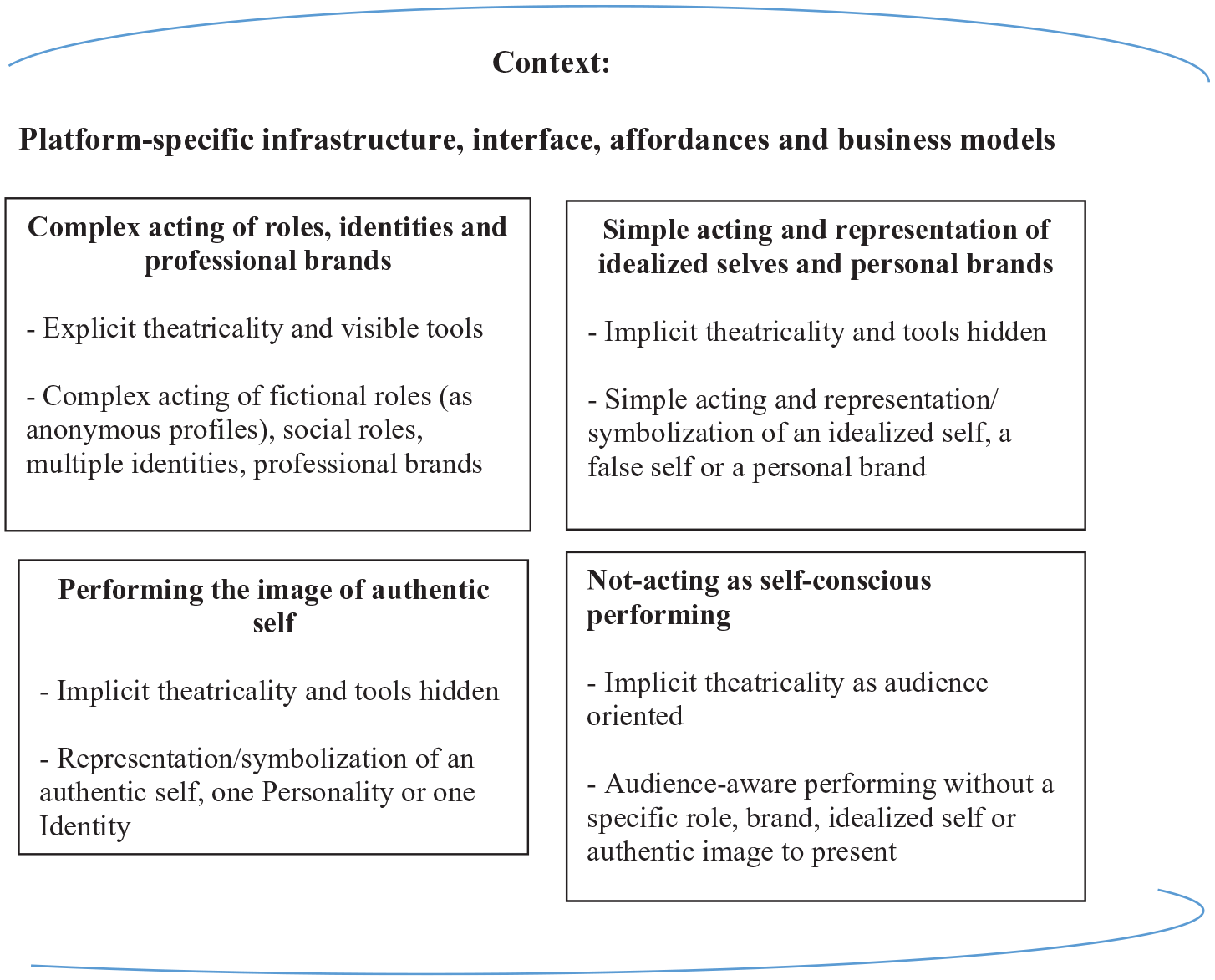
Theatrical self-presentation typology of acting and performing in a social media context.

Not-not-me and the absorbed self as opposites.

Continuum between low and high imagined-audience awareness in social media.
Theatrical self-presentation types take place in SoMe platform–specific contexts with regard to technological infrastructure, interfaces, affordances, and business models, and which types are relevant for and applicable on the individual platform will vary. In Figure 3, we emphasize that SoMe users can switch between these theatrical self-presentation types, either on different platforms or on the same platform if the infrastructure allows it (e.g., whether the platform allows multiple accounts or not). The typology is also suitable for analyzing the relationship between the SoMe user’s self-presentation and the specific platform and its affordances. The users are responding to, resisting, or embracing the self-presentation dictated by the affordances. For example, SoMe users can adapt to BeReal’s demands for authenticity, but it is also possible for users to resist authentic self-presentation and instead play a fictional role (complex acting) every time BeReal requests new content.
Figure 4 presents the conditions of not-not-me and the absorbed self as opposites when it comes to relational theatricality and imagined-audience awareness. Performing the not-not-me is about never forgetting the imagined audience. It is about relational theatricality. The absorbed self is concentrating solely on the SoMe communication with one or a few receivers, while the imagined audience is completely forgotten. It is a not-theatrical online behavior. Not-not-me is a constant underlying condition because of the hyper-awareness of the imagined audience, while the absorbed self is considered as a temporary state of exception from this awareness.
It is also possible to portray the opposites between the absorbed self and not-not-me as a continuum between low and high imagined-audience awareness as shown in Figure 5.
The continuum makes it possible to grade how the imagined-audience awareness affects SoMe users’ self-presentation, and likewise the degree of the burden that hyper-imagined-audience awareness places on the individual.
We hope our theatrical self-presentation types and conditions have renewed and nuanced the notion of self-presentation in SoMe and awakened the curiosity to explore the types in analytical practice.
Sortie—Limitations and Further Research
Hopefully, our theatrical typology used on specific SoMe platforms may be relevant in the broad field of online self-presentation, branding literature, critical infrastructure studies, affordance approaches, and even for the topic of SoMe users’ (lack of) wellbeing in the platform economy.
Our typology and article have some limitations. The typology is primarily applicable for analysis of active SoMe users. It is difficult or impossible to analyze SoMe users who never or rarely post their own content, and the majority are only looking (Gorea, 2021). These are, so to speak, the condition of this typology; it requires many posts of texts, pictures, and videos to be operationalizable. Therefore, it is precisely well suited to study those people who seek the public light online.
The importance of SoMe platforms’ infrastructures and affordances has not received enough attention in this article, due to the article format, and reflecting the platform context is necessary in empirical analyses (Evans et al., 2017). Figure 3 underlines this point. Previous research has shown that the algorithmic self is platform-specific (Bhandari & Bimo, 2022), and that the user’s level of algorithmic awareness may influence online performance (Gran et al., 2021).
There are, moreover, many directions in which theatrical self-presentation research can be developed.
National and Cultural Comparative Studies
It may be interesting to examine the extent to which performing preferences in the typology vary with national and cultural differences in public and private performance and the blurring between them (Papacharissi, 2023). SoMe research on self-presentation is dominated by one (own)-country studies. A hypothesis could be that the more complex the acting, the more defined (albeit not absolute as a binary opposition) the differences are between the public and the private in that society.
Industry-Specific Comparative Studies
The profession and industry affiliation of a SoMe user may have an impact on how to perform self-presentation online. Do some professions require complex acting of roles while others rather expect simple acting of idealized self or performing of true and authentic selves—and with what consequences?
The Importance of Personality Type
It may also be worth investigating whether performing preferences such as complex and simple acting or not-acting are connected to different personality types (e.g., the Big Five). Are some personality types more theatrical, while others prefer more low-key performing styles with a penchant for the anti-theatrical?
SoMe Self-Presentation and Wellbeing
There is a general opinion today (supported by research as well) that extensive SoMe use has an impact on mental health and wellbeing. To what extent do the different acting and performing styles have an impact on wellbeing? Is the not-not-me condition a particularly demanding condition for online communication?
Footnotes
Declaration of Conflicting Interests
The author(s) declared no potential conflicts of interest with respect to the research, authorship, and/or publication of this article.
Funding
The author(s) received no financial support for the research, authorship, and/or publication of this article.
