




Abstract
In May 2020, in the beginning of the Covid-19 pandemic, we set up the transmedia space PanMeMic, and involved our social networks, in a snowball fashion, to exchange observations and reflections on the changes in communication and social interactions ensuing from the restrictions imposed. We adopted a citizen approach towards co-constructing knowledge about semiotic practices, by integrating tenets of social semiotics, ethnography and citizen sociolinguistics. The article reports on the activities and discusses the potentials and limitations of the approach through analysis of the posts and discussions that took place in the PanMeMic Facebook group. It shows results quantitatively and then zooms in to offer a qualitative analysis of one discussion thread, with the aim of illustrating the potential and limitations of PanMeMic as a platform for citizen semiotic research and providing indications for future socially engaged and engaging research.
Keywords
Introduction
How did we make sense of the changes in our communication and interaction practices because of the restrictions imposed during the COVID-19 pandemic?
At the start of the COVID-19 pandemic we set out to investigate how people communicate and co-construct knowledge about semiotic practices through the collaborative transnational research initiative PanMeMic – Pandemic Meaning Making of Interaction and Communication (Adami et al., 2020). Initiated by a group of scholars in multimodality based across all continents and motivated by the immediate need to gather views and observations to understand the changes to our interaction practices prompted by COVID-19 restrictions, PanMeMic operated through a transmedia space. The space revolved around a website connected to social media profiles, pages and groups on Facebook, Instagram, Twitter, YouTube, Weibo and WeChat, in which we involved our personal social networks, and invited both academics and non-academics to involve theirs too, in sharing and discussing the changes in communication and interaction practices that we were observing as a result of the restrictions in force and fears induced by the pandemic. For a year since May 2020, PanMeMic grew to include over 1500 members.
Stemming from Rymes (2021) citizen sociolinguistics, which looks at knowledge co-construction about language outside academia, and considering that discourses and meaning making are multimodal, we broadened the scope of her approach to include ‘everyday acts of socio-semiotic inquiry’ (Adami and Djonov, 2022). Rather than positioning researchers as analysts evaluating certain discursive practices, this approach considers those who participate in such practices as researchers themselves, producing knowledge that is relevant to the spaces in which they participate, and posits the academic researcher as merely one of the many contributing voices. A detailed rationale for the initiative is presented in Adami et al. (2020).
Through an in-depth qualitative analysis of two discussion threads on the PanMeMic Facebook group (Adami and Djonov, 2022), we have shown that people suggest new semiotic practices (e.g., a hug with lower risk of virus transmission), label them, introduce new variants, legitimate their validity through personal experience and authoritative sources, criticise and negotiate them through different evaluations. This opens the possibility for the inclusion of different voices and hence the co-creation of distributed and more nuanced knowledge about specific semiotic practices or representations in a way that would hardly be possible by relying on individual knowledge alone. The use of social media platforms provides opportunities for connecting people transnationally and from diverse backgrounds, and allowing them to contribute by sharing links and artefacts such as memes and videos rather than only through language. This opens possibilities for semiotic knowledge to be co-constructed and practices to be shared and adopted more widely, beyond the limitations of one’s own contacts in physical proximity. Social media platforms also enable the tracking of these discussions, which makes social media particularly suitable for research into semiotic practices.
The goal of this article is to illustrate and evaluate the potential and limitations of PanMeMic, which was implemented ‘on the go’, as a method for citizen sociosemiotic research, through a systematic quantitative analysis of the composition of the PanMeMic Facebook group and its activities and a qualitative analysis of one of the longest exchanges that members of the group engaged in. We will show the usefulness of combining both types of analysis. The quantitative findings provide an overview of the group’s composition and of topics and semiotic practices discussed, identifying trends and patterns in posts that attracted comments, showing the breadth of interests and of the knowledge shared, and providing indications on preferred approaches in posting. The qualitative analysis zooms into the post and comments of a specific thread, showcasing how participants elicit feedback, bring in other voices, evaluate and respond to others’ opinions, and more generally contribute to the topic, thus showing the nuanced and multi-voice character of the knowledge they co-construct. Prior to presenting these analyses, we introduce the key concepts and perspectives that underpinned PanMeMic as an approach to sharing and co-creating knowledge about multimodal meaning-making.
Theoretical and methodological underpinnings
As a transmedia platform, PanMeMic invited anyone to share their views and experiences and expand each other’s knowledge about changes in communication and social interaction during the pandemic. PanMeMic functioned as a collective research initiative that builds on two approaches to studying communication – social semiotics (Kress, 2010; van Leeuwen, 2005) and citizen sociolinguistics (Rymes, 2021). Both echo the ethnomethodological principle that research on communication and other social practices should value all people for ‘having a knowledge of their worlds, intricate and subtle in many ways’ (Hymes 1996,: 14).
Social semiotics (Kress, 2010; van Leeuwen, 2005) views communication as always involving choices from a range of modes (e.g. speech and writing, colour and layout, space, facial expressions and gestures). Following Kress (2010), diverse perspectives and knowledge about communication emerge whenever people make meaning, as they make signs by selecting from available semiotic resources the ones that best reflect their interests in particular contexts. Van Leeuwen (2005) defines social semiotics as a multidisciplinary endeavour in which anyone can engage by studying existing semiotic resources and practices, their history and use in different socio-cultural contexts, and by developing new ones.
Social semiotics is particularly valuable for understanding PanMeMic as a form of research on multimodality due to its focus on practices, and not only semiotic resources and texts. Van Leeuwen (2008: 6) defines social practices as ‘socially regulated ways of doing things’ (e.g. mask wearing or keeping social distance to prevent virus transmission) and offers a model for identifying their key components (social actor/s, actions, performance modes, presentation styles, location/s and time/s) and the eligibility conditions they must meet (e.g. students and teachers must wear masks in the classroom at all times). In our approach we consider semiotic practices, that is, those social practices that can be described as primarily semiotic, in that they function to or influence how we communicate and interact with others and represent knowledge (e.g., communicating happiness or sadness while wearing masks, or expressing more or less intimacy through distance). We follow Van Leeuwen (2008) in distinguishing practices from discourses, that is, ‘ways of knowing [and] representing social practices in texts’ (p. 6). This distinction invites critical studies of how discourses represent and thereby transform practices through the deletion, substitution, rearrangement of their components and the addition of evaluation and legitimation. Moving beyond critical analysis, however, we considered the potential of discussions and representations of practices to offer insights into people’s diverse experiences and understandings of these practices, and to extend our shared knowledge beyond what can be gleaned through direct observation, analysis or even participation in social practices alone.
Before and beyond acknowledging and revealing various perspectives on semiotic practices through discourse analysis, PanMeMic called them to contribute; it mobilised the affordances of social media to stimulate and document the sharing of knowledge and diverse views about communication and interaction during the pandemic and make this knowledge directly and publicly available, without academic censorship. Inspired by Rymes’ (2021) ‘citizen sociolinguistics’, the goal of PanMeMic extends beyond language and includes co-creating knowledge about semiotic practices.
Citizen sociolinguistics is a participatory approach to building knowledge about language that shares the aims of citizen science to ‘(1) reconfigure what counts as expertise, expanding awareness of local nuance, and (2) potentially foment grassroots motivated social action and change’ (Rymes, 2021: 6). It is ‘the study of the world of language and communication by the people who use it and, as such, have devised ways to understand it that may be more relevant than the ways professional sociolinguists have developed’ (Rymes, 2021: 5) and manifests in ‘everyday talk about language’ (Rymes, 2021: xi). For Rymes, participants in a conversation about language are ‘citizen sociolinguists’. They not only, like research participants, share their own experiences and views regarding language repertoires and choices in specific socio-historical and cultural contexts, but also, like researchers, display and enhance their own and others’ knowledge about language in society.
Rymes (2021) distinguishes conversations prompted by ‘wonderment’, or a sense of curiosity, about certain language features or choices, from ‘citizen sociolinguists’ arrests’ (p. 25), which critique language use. She argues that both share the power to ‘make visible otherwise unseen aspects of language and communication, building expanded awareness of language diversity and change, and its role in society’ (Rymes, 2021: 6). Both can reveal ‘important and overlooked language expertise’ (Rymes, 2021: 6) which is:
Multi-voiced, inclusive representation of many perspectives
Local, fine-grained descriptions, often embedded in personal stories
Always changing, dynamic representations of language
Interactionally negotiated indefinitely. (Rymes, 2021: 14)
Talk about language has the power to foster knowledge about language and its role in revealing and celebrating diversity or establishing, reinforcing or challenging social boundaries.
Rather than, like traditional sociolinguistics, directly observing, recording, transcribing and analysing language use in carefully selected contexts and often by collecting vast quantities of data and statistically identifying trends and types, citizen sociolinguistics’ goal is to ‘draw together voices who might otherwise not interact’ (p. 21), and to promote awareness of and deliberation among these voices. This can help ‘remove blind spots we all have when we don’t look beyond our own perspective’ (p. 54) and uncover and encourage action against language stereotypes and standardisation.
One measure of the success of a citizen sociolinguistic inquiry is the number and diversity of voices it brings together. Another is qualitative evidence of whether and how these deliberations contribute to and challenge citizen sociolinguists’ knowledge and inspire grassroots social change.
For researchers, Rymes (2021) proposes that designing and conducting a citizen sociolinguistic inquiry includes four main steps: (1) formulate a question, (2) find or initiate discussion about it bringing together a wide range of perspectives, and ideally make these data publicly available, (3) analyse or interpret the data, and (4) disseminate the findings inviting feedback from others, particularly from voices represented in the data. Rymes underscores that social media offer benefits to citizen sociolinguistic inquiries such as capacity to draw together people from around the world, and the availability of digital mechanisms such as reaction, share and comment functions that facilitate the spreading of local expertise, bolstering its reach and power to trigger grassroots movements. Rymes (2021) cautions, however, that these mechanisms can also hinder citizen sociolinguistic endeavours through algorithm-driven narrowcasting and ‘feedback loops [that] create digital enclaves of like-minded language users [and] reproduce status quo perspectives’ (p. 26).
With PanMeMic, we have both adopted and introduced innovations to Rymes’ approach; besides expanding the focus, from citizen sociolinguistics to citizen sociosemiotics, one key innovation is that we ourselves designed a space for knowledge co-creation, in which we too participated, as we describe next.
Group set up and participation
The PanMeMic Facebook group was set up in May 2020. The project coordinator invited all members of the founding team to invite their own contacts to join the group. The group was set up as public with no pre-moderation of posts and with the founding team members as administrators. The group soon involved over 900 members (a total of 962 members when we collected the data for analysis, in November 2021). Figure 1 shows the distribution of members across countries (relying on their profile information). There is a predominance of members from the UK (219), Italy (173), the USA (164) and Greece (87), followed by Brazil (30), Germany (28), Australia (22), Norway (22), Sweden (19), Spain (16), Argentina (16), Canada (12), Hong Kong (11) and Denmark (10), and then 52 other countries with less than 10 members each. Albeit uneven, and with lower representation of African countries, this distribution reflects the group’s transnational reach, with members from 66 different countries spanning all continents (including countries such as China and Iran, where Facebook is banned and logging in requires external VPNs).
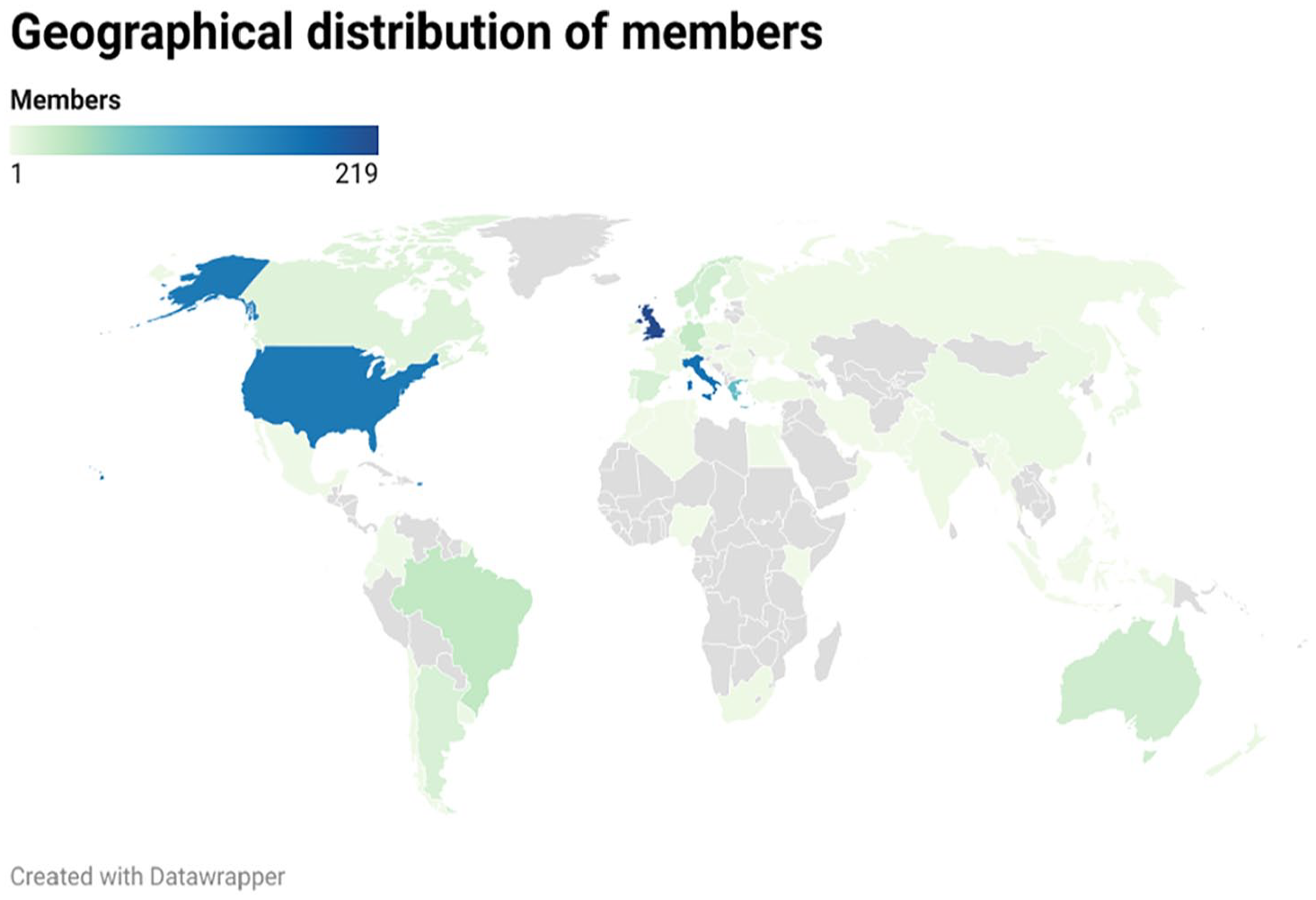
Geographical distribution of members – for an interactive view https://datawrapper.dwcdn.net/gZXC3/1/ .
In terms of gender and age, Figure 2 shows a majority of women over men, with most members in their 30s and 40s. The geographical, gender and age distribution is the outcome of the snowball method of invitations adopted for creating the Facebook group.
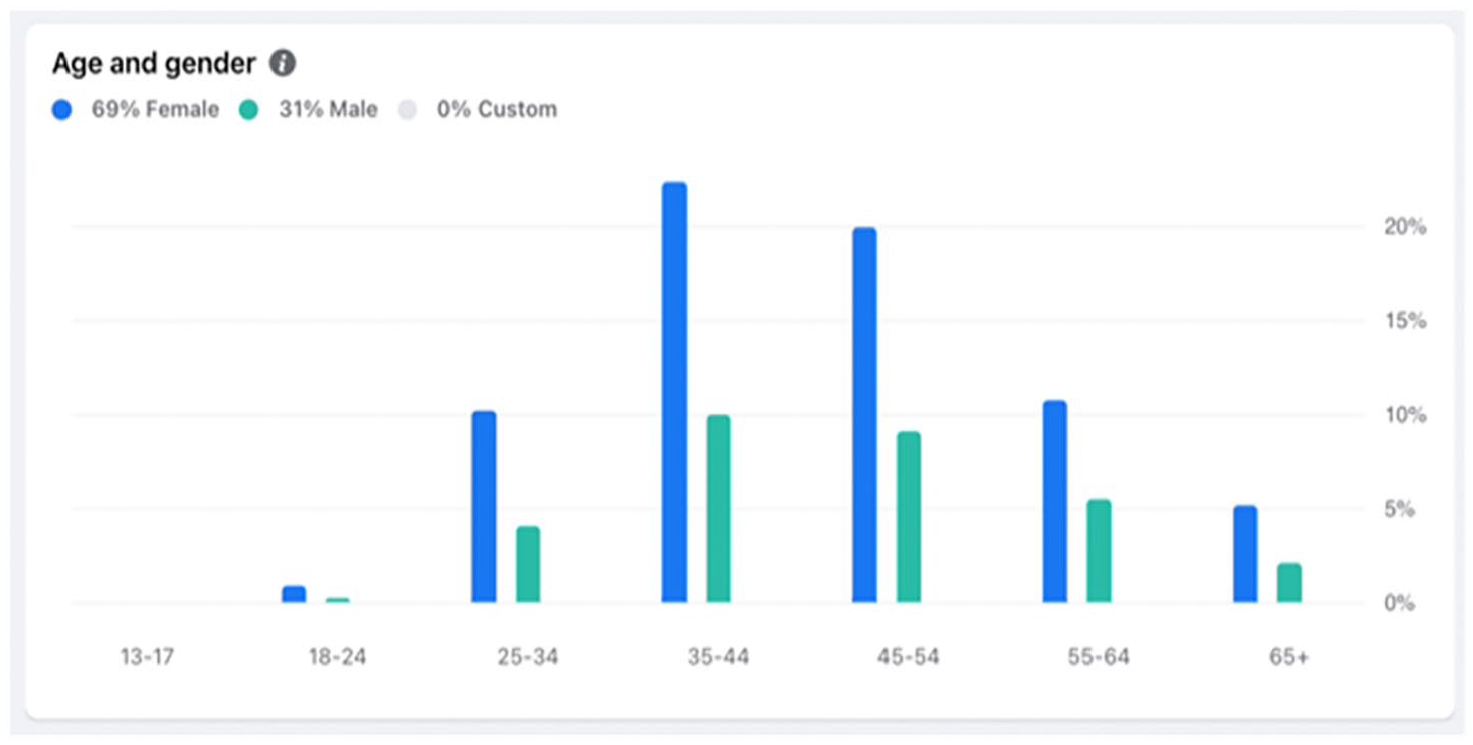
Distribution of members for age and gender (no member profiles selected any of the custom options for gender, which Facebook introduced in 2014).
Figure 3 shows the number of posts, reactions, comments and shares across time. It highlights peaks of engagement in the first five-six months, with a progressive decrease in participation and activities in 2021, the more practices adopted during the pandemic were no longer new and restrictions were being eased in many parts of the world.
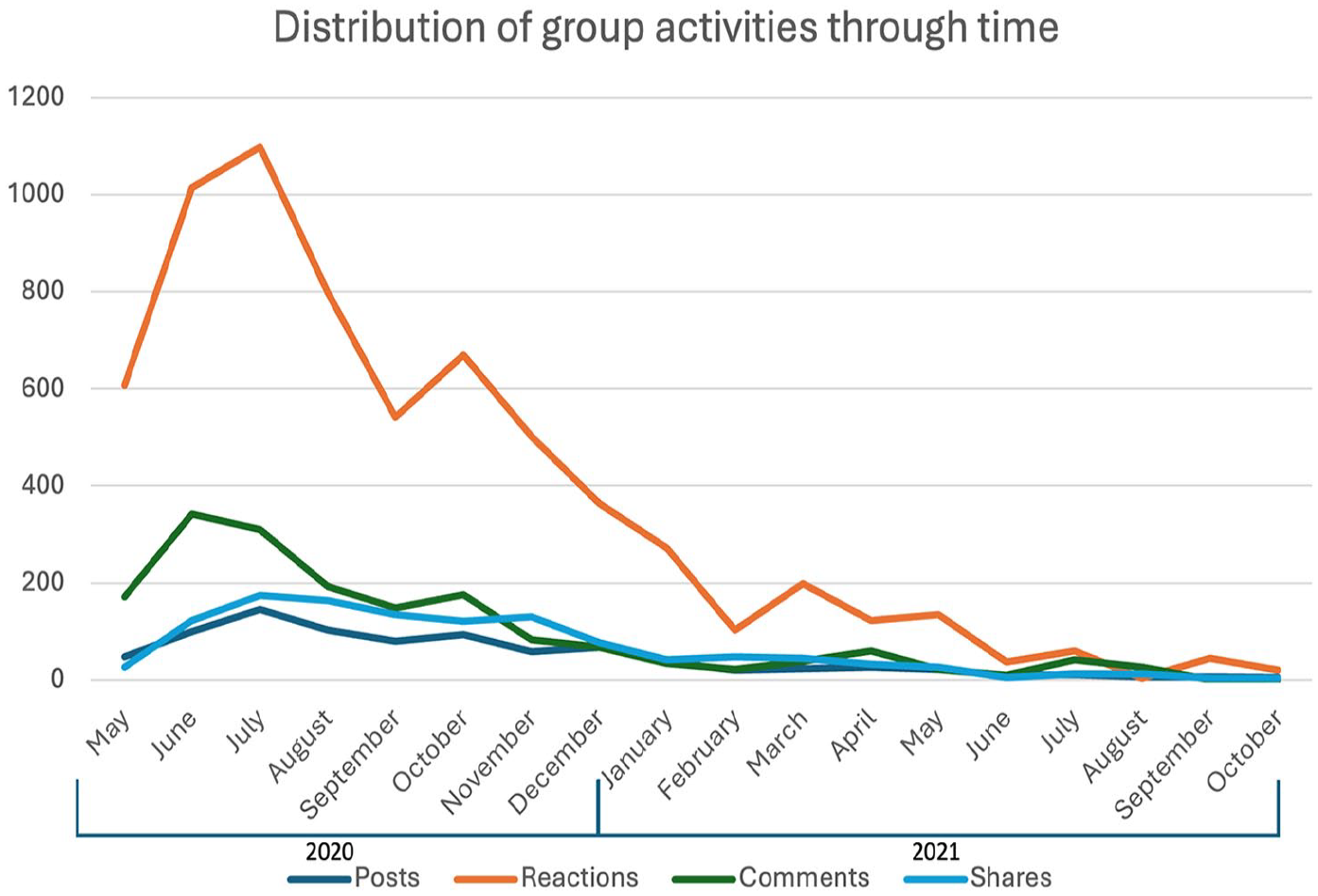
Distribution across time of the Facebook Group activities.
Joining a Facebook group does not automatically imply engagement; 315 members posted and/or commented, with 149 members posting, 258 commenting (including 92 members doing both). Among the active members, we could identify 124 who do not work in universities, 123 academics in disciplines such as linguistics, communication and media, 39 working in universities in other capacities and 29 members with unidentifiable affiliation. For the active members, this suggests even distribution between academics with research expertise related to the group’s topic (communication and interaction practices) and others. The high number of people working in universities results from the snowballing method adopted, reflecting the founding team’s personal and professional networks. The involvement process was mainly dictated by the exceptional conditions in which the project had to operate, the need to start promptly while changes were happening, and the forced immobility due to the pandemic. Given the focus of the project, the professional distribution among group members is rather irrelevant. In the first months of the pandemic everybody had to undergo a re-disciplining process, with habituated practices no longer viable because of the need to keep bodies apart, invent and improvise new ways of interacting with others, and harness the abrupt digitalisation of social activities. These changes were new also to communication experts. Judging from our experience and note-taking at the time, we, as communication scholars, were equally puzzled and eager to ask for advice on how to communicate and interact with others at a time when changes had to be so sudden and pervasive. As our data shows (see also our qualitative analysis below), academics from related fields were contributing at a personal level rather than from a position of expertise. Similarly, Katie, a PanMeMic Facebook group member who is an academic in design studies, wrote to us when commenting on a draft of the paper: I don’t particularly remember being aware that it was a research space, and I interacted with it in the way that I interact with a lot of groups. This made me think about its value as an insight into a broader story about how people share and build knowledge together through social media use, in a similar way to how we might talk through things that are happening around us in an in-person meet up, and share perspectives and insights. (Katie, on Messenger, commenting on a first draft of the analysis, June 2023)
Other citizen sociosemiotic research projects taking place in different conditions might need to carefully consider how to involve citizen researchers 1 to ensure optimal representation of desired demographics.
The level of involvement and acknowledgement of contributors in presenting a citizen socio semiotic project may also vary. In this article, for the posts and comments presented and contributions cited we have kept the names of those who consented to be named. We shared a preliminary draft of the manuscript with all authors of the posts and comments presented in the paper, inviting their feedback. When including this feedback, we do so without commentary, to avoid imposing our own interpretation and achieve a more polyvocal approach to writing. We also acknowledge their contribution by listing them as collaborators in this article.
Emerging trends on group post discussions
We collected the 886 existing posts in November 2021 together with all comments, numbers of reactions and shares, group members’ user ID, and date of posting. 34 had their content no longer available; 8 posts were not related to the pandemic (3 explicitly signalling that, e.g., ‘not covid related but . . .’); 21 posts were about the pandemic (e.g., about the virus, vaccines) but not related to representations, communication and interaction practices. 823 were thus still available and related to the group’s focus.
In terms of multimodal composition, in most instances (85.7%, n = 705), the poster either wrote their own content or framed shared content through some writing. Posts containing only writing (55.7%, n = 458 posts) presented some self-reflection and/or reporting, while shared links and visual artefacts (44.3% of posts, n = 365) enabled the inclusion of external voices, either commented upon or presented as evidence of the poster’s points made in the writing (30% of posts, n = 247). A minority of cases shared other voices without any written framing (14.3%, n = 118 posts), thus sharing content to the group with no explicit stance taken by the poster.
Of posts receiving at least one comment (387 in total), 292 had writing (comprising 41.4% of the 705 posts containing writing) and were evenly distributed between those containing only writing and those also sharing links/artefacts. The rest (n = 95) had no writing, and made 80.5% of the 118 posts without writing, indicating that group members felt open to contribute through comments even when an item was just shared with the group without any framing or positioning.
When we coded the commented posts for acts of wonderment or arrest, a series of methodological issues emerged:
- We identified 26 acts of arrest, but some were paired with acts of wonderment in the same post (Figure 4).
- Some posts shared an external source without presenting an explicit stance towards the shared content and, for example, merely introducing or describing it (Figure 5).
- The wonderment category showed a continuum from expressions of curiosity to positive surprise up to soliciting feedback from the group (Figure 6).
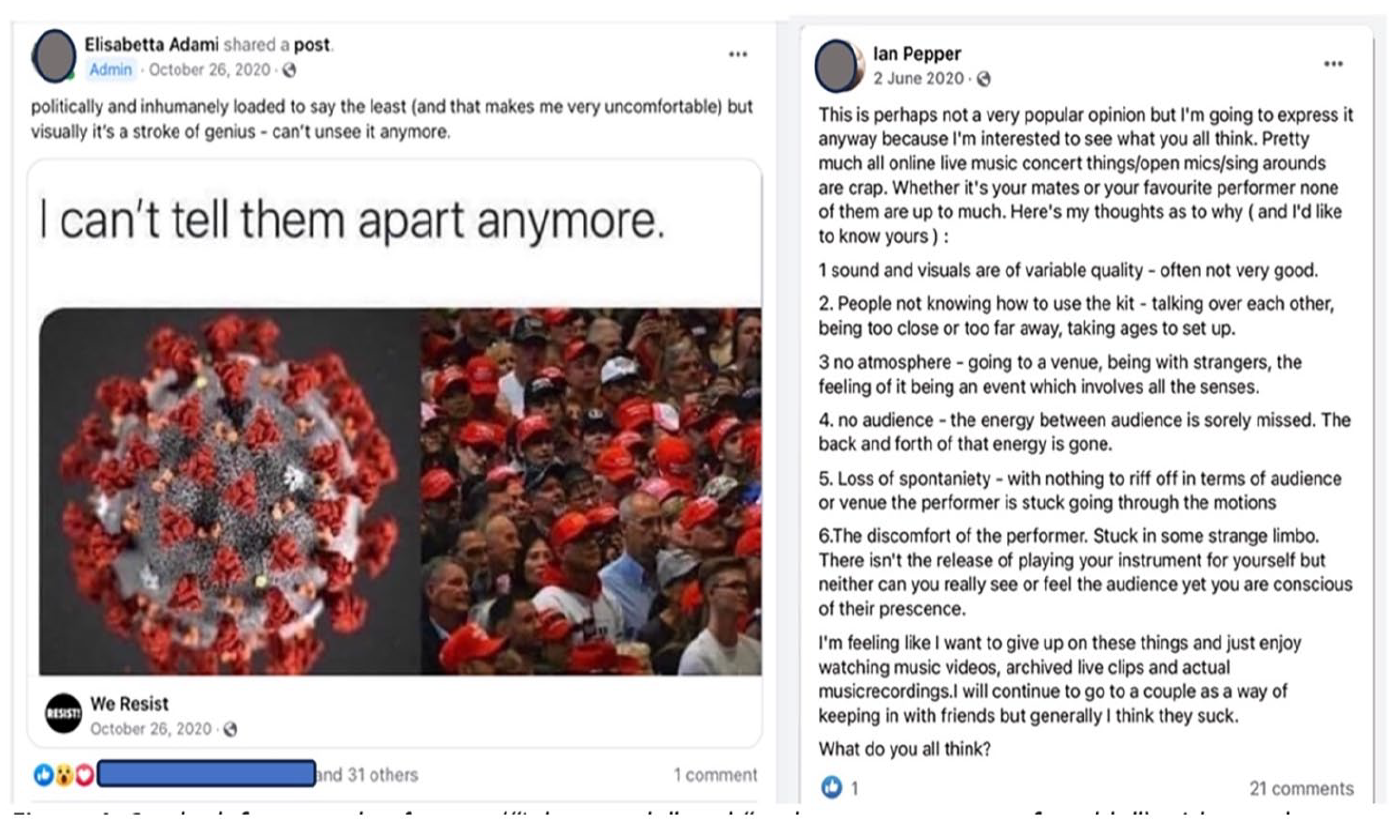
On the left: example of arrest (‘inhumanely’ and ‘makes me very uncomfortable’) with wonderment (‘visually it’s a stroke of genius’); on the right: example of arrest without any wonderment.
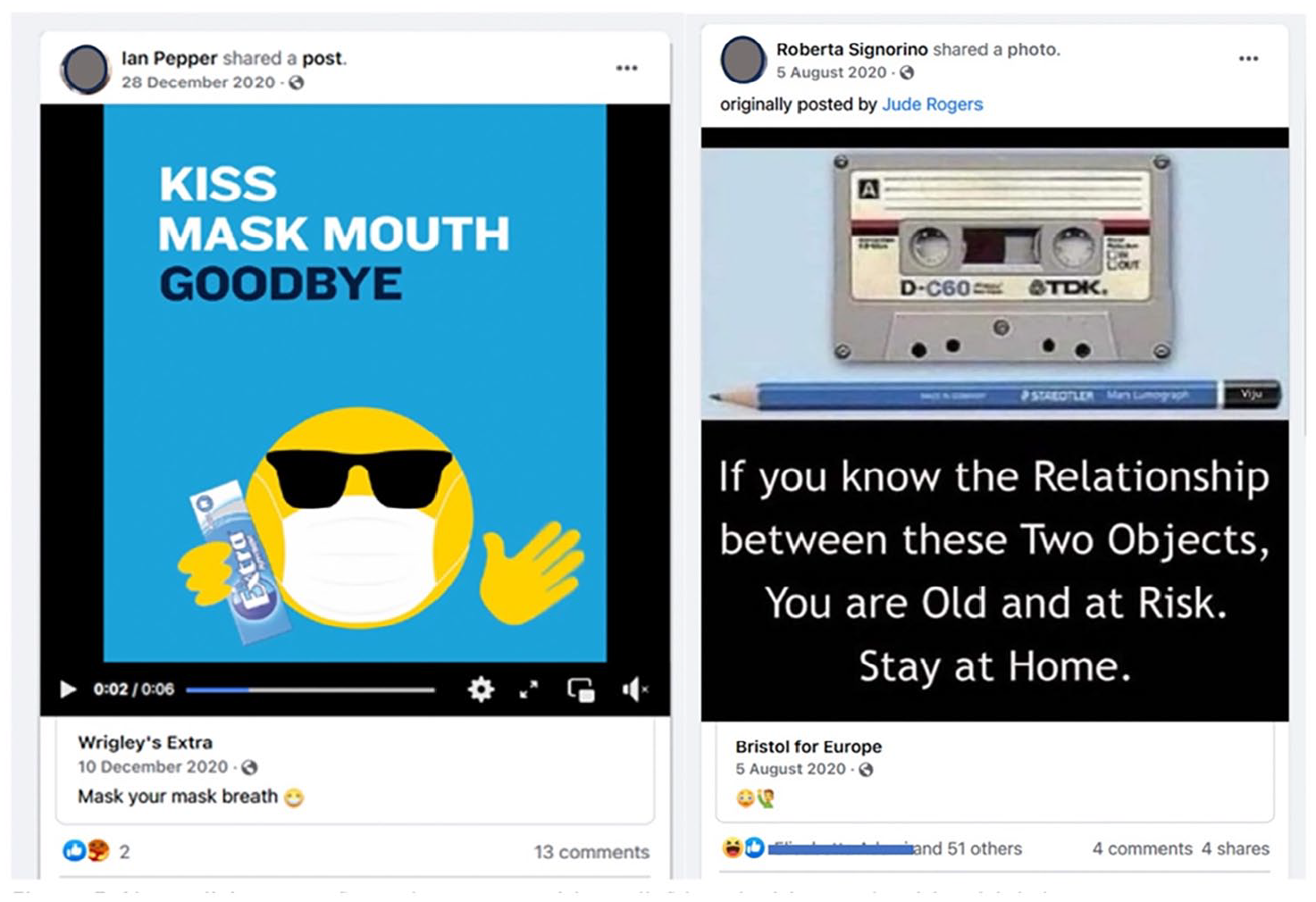
No explicit stance from the poster, without (left) and with typed writing (right)
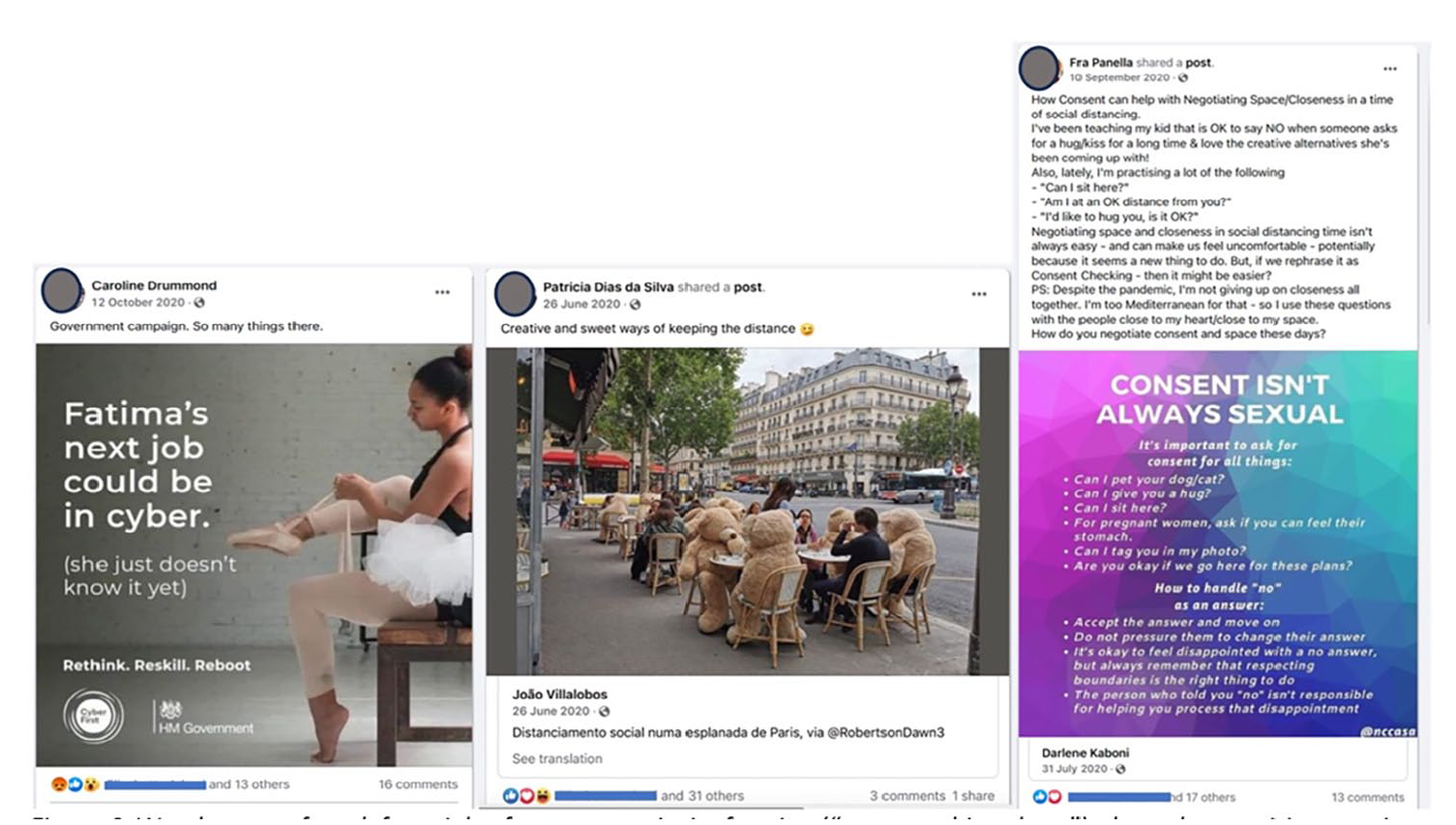
Wonderment, from left to right: from curiosity framing (‘so many things here’), through to positive surprise (‘creative and sweet . . .’) up to explicitly soliciting feedback from viewers (‘how do you negotiate . . . ?’).
We coded posts containing both arrests and wonderment separately, and introduced a third category, labelled ‘non-committal’ to code posts that did not present the poster’s attitude towards the shared content. We also coded if arrests or wonderments solicited feedback. The results are shown in Table 1.
Distribution of comments per type of opening post.
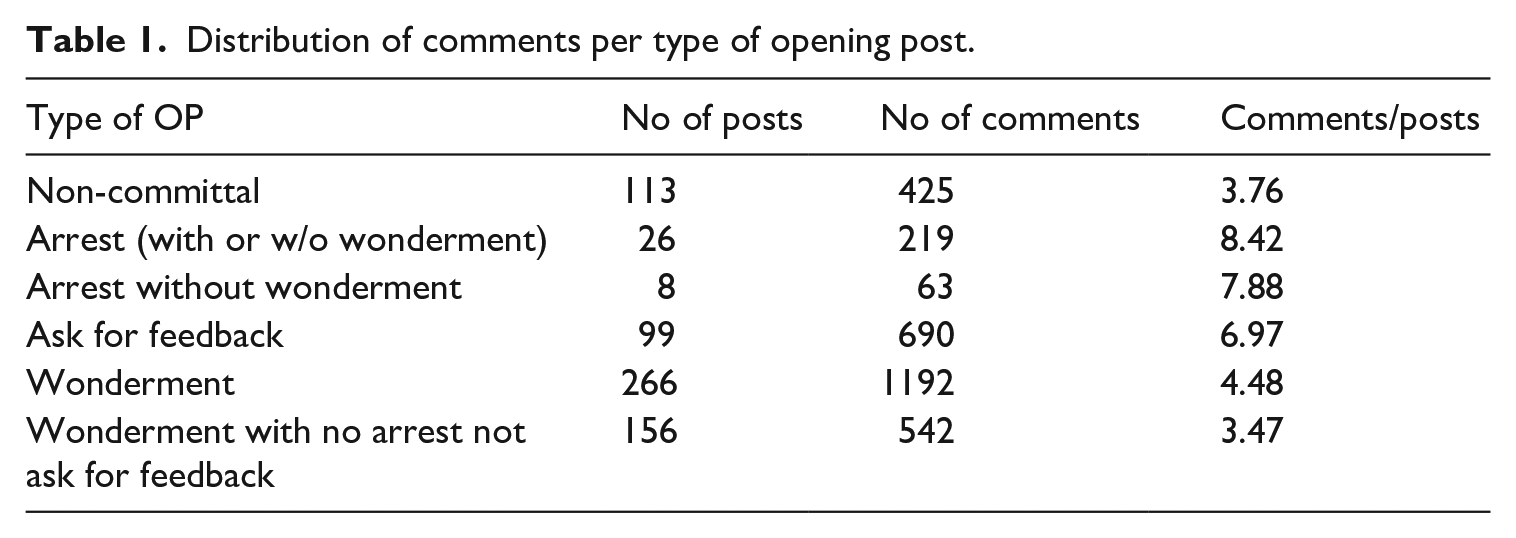
Acts of wonderment occurred the most (266, 68.7% of the commented posts), suggesting that members most frequently expressed curiosity towards, rather than critique against, emerging semiotic practices. One out of three (113, 29%) did not take a stance, although this only captures how the poster framed the posted content explicitly; it does not indicate absence of critical intent in posting the content, as in some cases the poster may have merely withheld their opinion. The ‘government campaign’ post on the left in Figure 6, for example, at least implicitly solicits arrest responses (as Caroline also confirmed later when we checked our interpretation of her post with her), which it received, as comments posted memes representing government ministers being reskilled, and links to sources that exposed the unauthorized use of the photo by the government.
25% of commented posts invited feedback. Interestingly, all 8 arrest-only posts, despite being openly critical, asked group members for their opinion, possibly to mitigate the absolute value of the criticism.
Although members seemed to post more frequently out of curiosity than criticism, judging from the number of comments that each type of opening post received, group members were slightly more likely to comment on posts of arrest and when the post openly asked for feedback. Posts that conveyed mere wonderment, with no criticism nor explicit request for feedback, by contrast, received the least number of comments, even fewer than the non-committal posts.
We then further screened the database for posts with at least two comments (282) as a minimum marker of discussion. We coded whether the post was about a representation or about a practice; indeed, some posts share an artefact (e.g., a meme, cartoon, or advertisement) with the intent of evaluating it as a representation about the pandemic and/or life within it. Figure 7 on the left is an example of a post sharing images used in the ‘test and trace’ app in Italy, which stirred controversy because of its sexist representations of gender roles. Other posts instead share observations about a semiotic practice, rather than about a representation of it, as in the example at the centre in Figure 7, which offers solutions for handing out candies on Halloween while keeping a safe distance. A few posts were about both a semiotic practice and its representation, like the one shown on the right in Figure 7, about the practice of waving in videocalls and the meme that represents it, which is labelled by the poster as ‘evidence’.
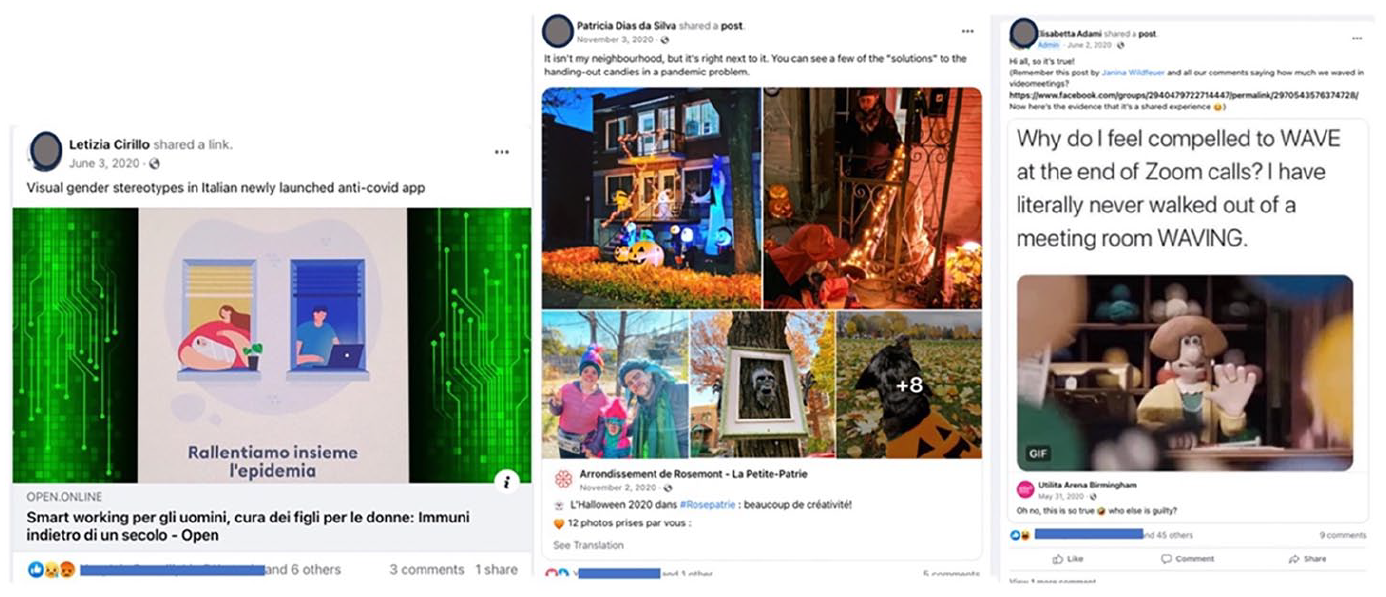
A post about a representation (left) versus one about a semiotic practice (centre) versus one about both (right).
This second round of coding identified 148 posts about representations, 91 about a semiotic practice and 43 about both. A thematic analysis identified their major topics and the specific semiotic practices that the shared content represented or referred to. For example, Figure 8 shows a post that contains a shared news article, the link to this article, and a quote (the words of Flaming Lips lead singer Wayne Coyne) extracted from the original article.
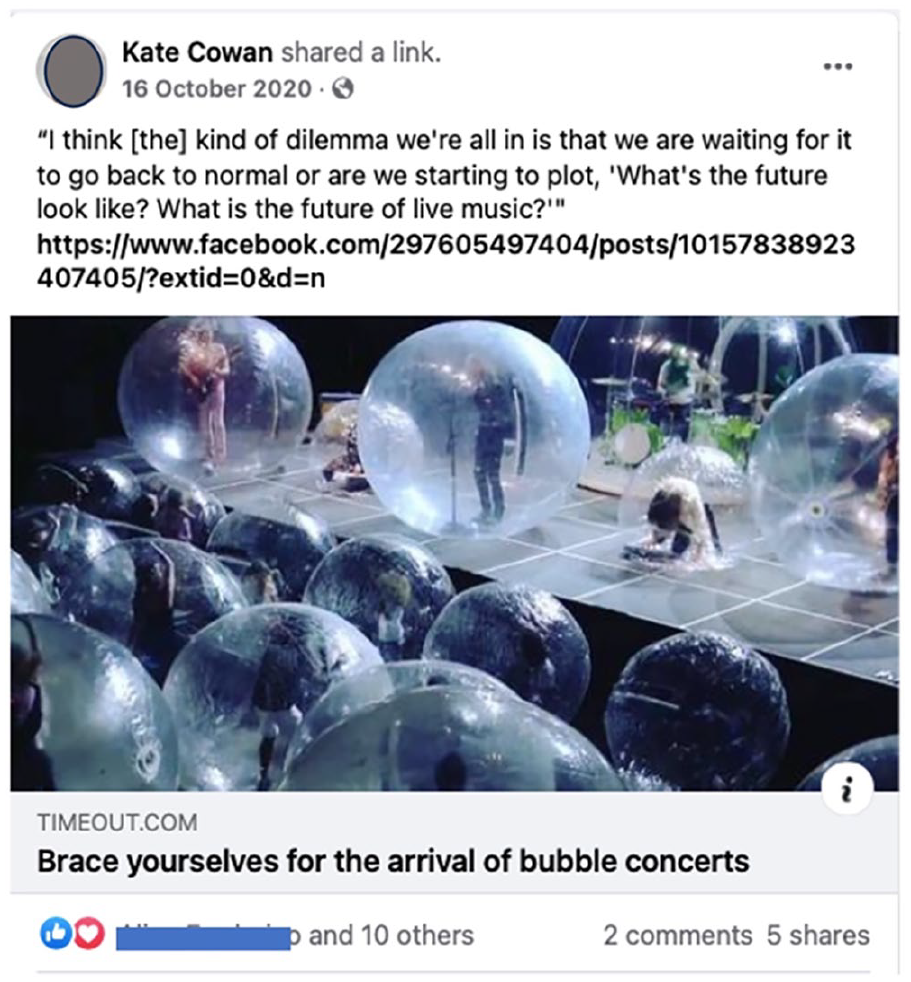
Bubble concerts as an example of keeping social distance.
The article talks about live music during the pandemic reporting on Flaming Lips’ use of inflatable bubbles encasing performers and audience members to prevent contact. Although Kate seems to share this article to invite opinions towards the new form of attending live music, with the inflatable bubbles as an unusual practice enjoying strong salience in both the photo and the headline (‘bubble concerts’), she also uses the quote to highlight how measures of keeping social distance have challenged pre-pandemic lifestyle. We coded this post’s topic as ‘live music during the pandemic’ and labelled the practice it represents as ‘social distance’; in other instances, topic and semiotic practice coincided.
The thematic coding shows 90 different topics and 51 semiotic practices discussed. As the number of topics suggests, the posted contents were highly diverse, with most frequent topics featuring face covering/masks (26 posts), humour during the pandemic (18), language uses (15), signage (11), public campaign (9), social distance (9), mental health (8), video meetings (8), commercialisation (6), and lockdown (5). Most frequent semiotic practices include communication with/without mask (31), social distance (29), spaces and interaction (11), language use (11), visual designs (9), online communication (8) and designs of masks (7).
As in all thematic analyses, the labelling of topics and practices could be subject to different criteria and levels of granularity (we further grouped our thematic coding for the first months of posting in Pedrazzini et al., 2023). Here our quantitative mapping aims mainly to provide some grounds for the qualitative analysis and show the reach, scope and diversity of posts rather than identify generalisable trends. Nevertheless, the broad range of topics and semiotic practices discussed reflects the all-encompassing character of the changes we were undergoing. The prevalence of posts about social distance, masks and online communication underscores the remarkable character of three key changes in interaction practices prompted by COVID-19 restrictions, while the attention to language and signage could be expected from a group with a high representation of linguists.
From the quantitative findings above, we can highlight: the very few posts that are unrelated to the topic and aim of the group, despite a very generic call for sharing ‘changes in communication and interaction practices during the pandemic’; a preference for wonderment over arrest, with a high number of posts in which the poster showed a non-committal stance. So, in some sense the posting activity stayed away from phenomena such as virtue signalling, trolling, and stirring controversies, which are common within the highly polarised context of social media discussions during the pandemic (e.g., Gupta et al., 2023; Klösch et al., 2023; Jain et al., 2022; Jones-Jang and Chung, 2022). This might have been influenced by our explicit framing of the group around a shared research and observational interest in its description and call to members (although this should be verified on larger groups set up with the same criteria in the future). Nevertheless, arrest posts and those asking for feedback were likely to receive more comments than wonderment and non-committal ones. The range of topics and specific semiotic practices was extremely wide and differentiated, while posts prompted reflections about the type of representation posted, the semiotic practice that was talked about, or both in some cases. The quantitative analysis has also enabled a first refinement of Rymes’ categories, illuminating: a less clear-cut distinction between wonderment and arrest, with posts combining both; a varied range within wonderment, from neutral curiosity to positive surprise; the role of explicitly soliciting feedback; and a ‘non-committal’ category, for posts not expressing any explicit stance on the shared content.
Qualitative analysis of a thread
While quantitative analysis can reveal the breadth of activities and topics, and preferences in opening posts in a research collective such as PanMeMic, to appreciate the nuanced dynamics of members’ interactions and knowledge-sharing requires a closer, qualitative perspective. We illustrate this with the analysis of one of the longest threads generated by PanMeMic’s Facebook group. This thread is about a representation, the rainbow symbol, and our analysis examines its multimodal composition, the contributions of PanMeMic founding members and other academics, the development of topics, and the ways knowledge and different perspectives are shared and negotiated. See Adami and Djonov (2022) for a detailed analysis of threads about semiotic practices – one introducing a new way of hugging another person and the other negotiating mask wearing in relation to hearing-impaired people.
The Rainbow thread opens with a post by Ian Pepper inviting others to share their impressions on whether the LGBT+ community 2 feel upset about the re-appropriation of the rainbow symbol during the pandemic (see Figure 9). Its topic was coded as ‘symbols related to the pandemic’ and as focusing on ‘representation’ (rather than social practices). It includes 25 comments from 12 people.
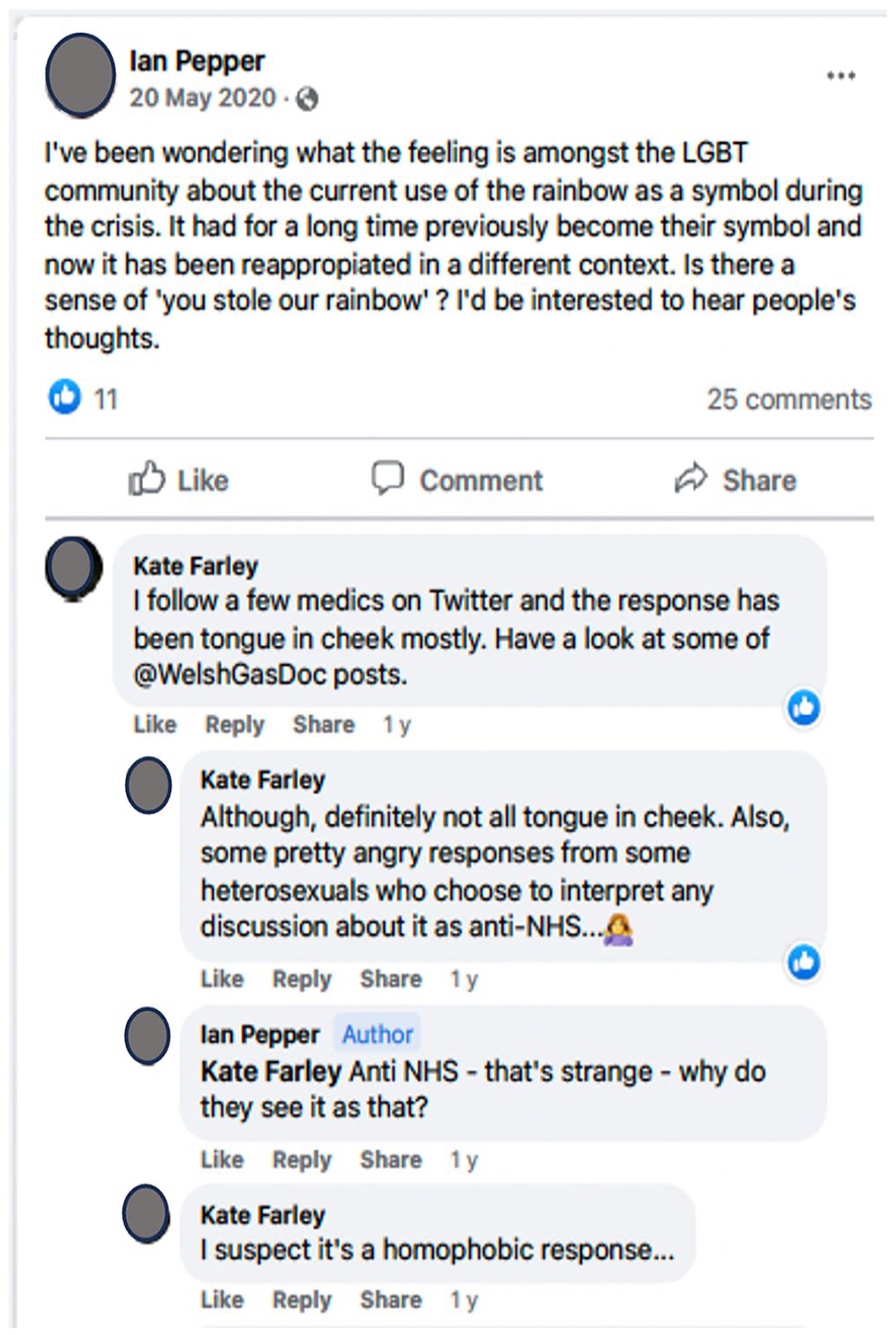
Rainbow thread 1/5 – opening post and first comments.
Contributions to this exchange rely mostly on written language, apart from a hyperlink to a Wikipedia page (which displays an image of the rainbow flag) and three emojis. The language is almost exclusively English, except for two comments in Italian, which evidence the potential of social media to include speakers of different languages in citizen semiotic research.
The author of the opening post (Ian) and three commenters are not academics (Fra, Marie and anon.). The thread also includes comments from three of PanMeMic’s founding members (Elisabetta, Emilia, Janina; see green background in Figure 14), another three researchers in linguistics or communication studies (Kate Nash, Lone and Kate Cowan) and two from other disciplines (Katie from design and Kate Farley from health sciences). Despite most contributors being academics, and half from linguistics or communication, all comments refer only to personal experiences and observations as well as popular information sources such as Wikipedia, and none mentions any academic research.
The founding members, while developing the topic of the exchange, also appraise Ian’s post as interesting, underscoring its value for the group and acceptability as a form of expertise (see Elisabetta’s and Janina’s comments in Figure 10). In one instance, Elisabetta also tries to keep the discussion open by saying ‘everyone interprets it differently’ (see Figure 13). In yet another, she explicitly acknowledges that a comment (Katie’s ‘it was the same here with the PEACE rainbow flag’) has extended her knowledge by stating ‘I didn’t know’ (Figure 10), which reflects the purpose of PanMeMic as a forum for sharing and extending members’ existing knowledge and perspectives.
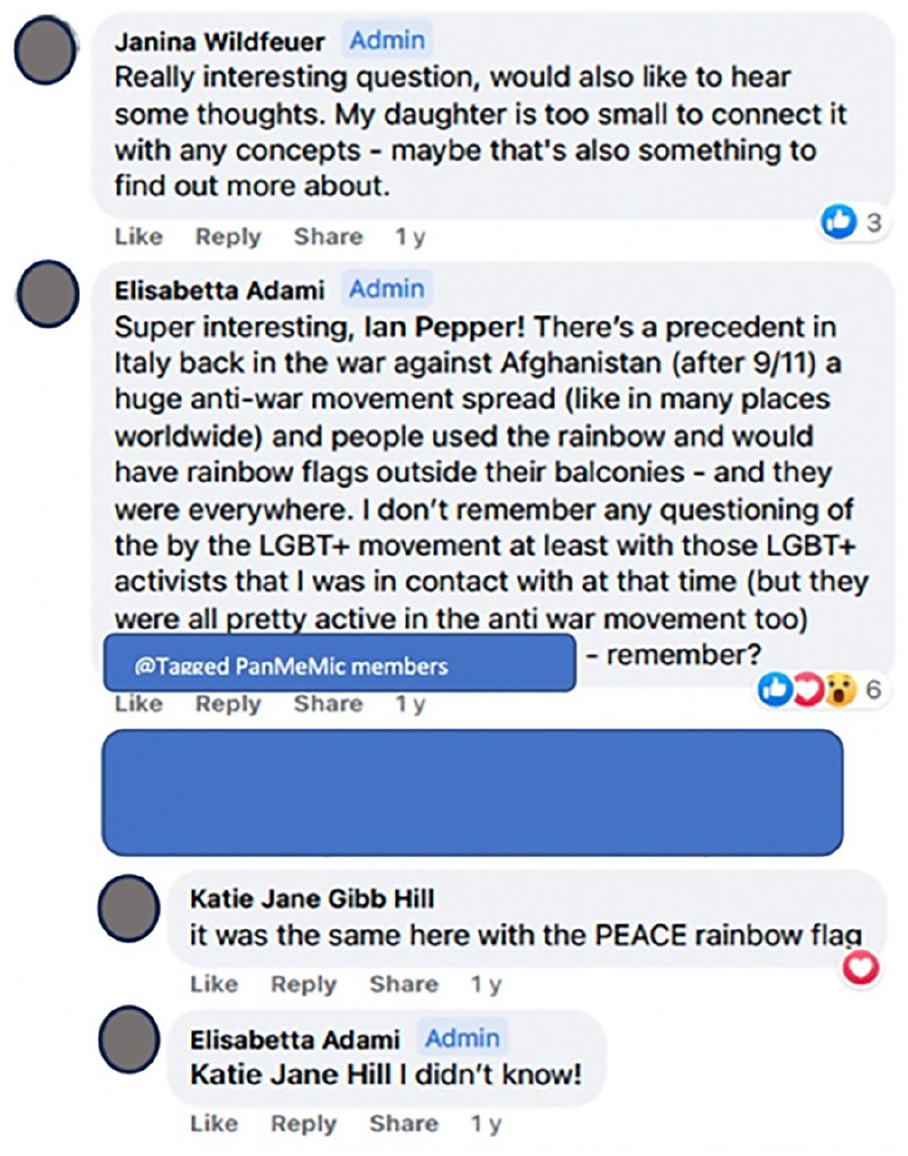
Rainbow thread 2/5 – geo-temporal expansions.
The thread’s topic development (represented in Figure 14) reveals the contributors’ familiarity with different meanings and socio-historical uses of the symbol but also their broader semiotic awareness or willingness to learn more about how symbols work in general. The opening post demonstrates awareness of the rainbow as a symbol of diversity and the icon of the LGBT+ community, on the one hand, and as a signifier of hope in times of crisis, as used by UK’s National Health Service (NHS), on the other. Responses then tend to elaborate on or add to these meanings, introducing examples that demonstrate geographical and historical variation in the symbol’s use and associated attitudes from either the commenters themselves or other voices (e.g. the LGBT+ community, medics, children, anti-war activists and people who have experienced child loss or miscarriage). Elisabetta, for example, remembers that in Italy, during the war in Afghanistan in the early 1990s, the anti-war movement employed the rainbow to symbolise peace, and this was supported by LGBT+ activists (Figure 10). Janina raises the question of how a child would interpret the rainbow’s use now (Figure 10) and Emilia comments on the symbol’s use in children’s songs and media, where it signifies both diversity and hope (Figure 11). In the last comment (Figure 13), Kate Cowan adds that the rainbow also symbolises hope in the term ‘rainbow children’, which refers to children born after miscarriage and baby loss, and further shares that this term has been appropriated to refer to children born or growing up during the pandemic, which is upsetting families who feel its pre-pandemic meaning has been taken away from them.
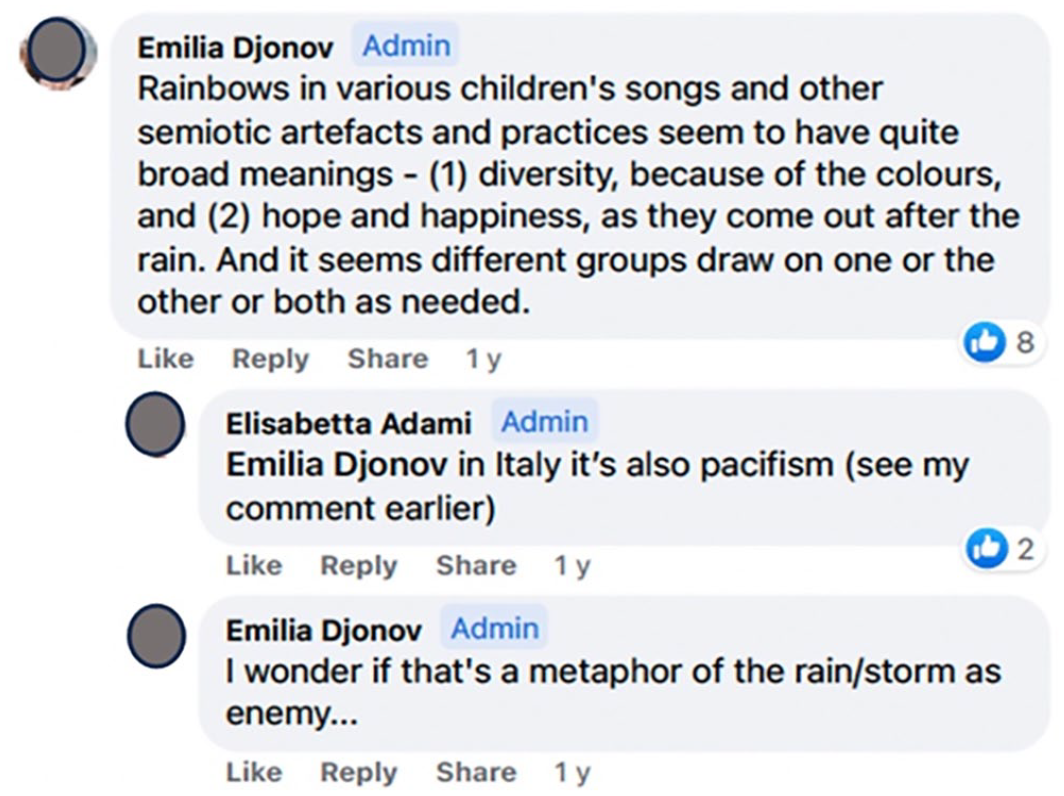
Rainbow thread 3/5 – metaphors – children.
Many comments offer more general statements about how symbols work (see italics in Figure 14). For example, Emilia (Figure 11) wonders if as a peace symbol the rainbow could be related to metaphors of rain/storm as an enemy, which echoes but includes no explicit reference to Lakoff and Johnson’s (1980) theory that metaphors stem from people’s physical experience. When appraising as useful the efforts of other contributors to trace the symbol’s origins, Elisabetta adds that re-signification makes this complex (Figure 12).
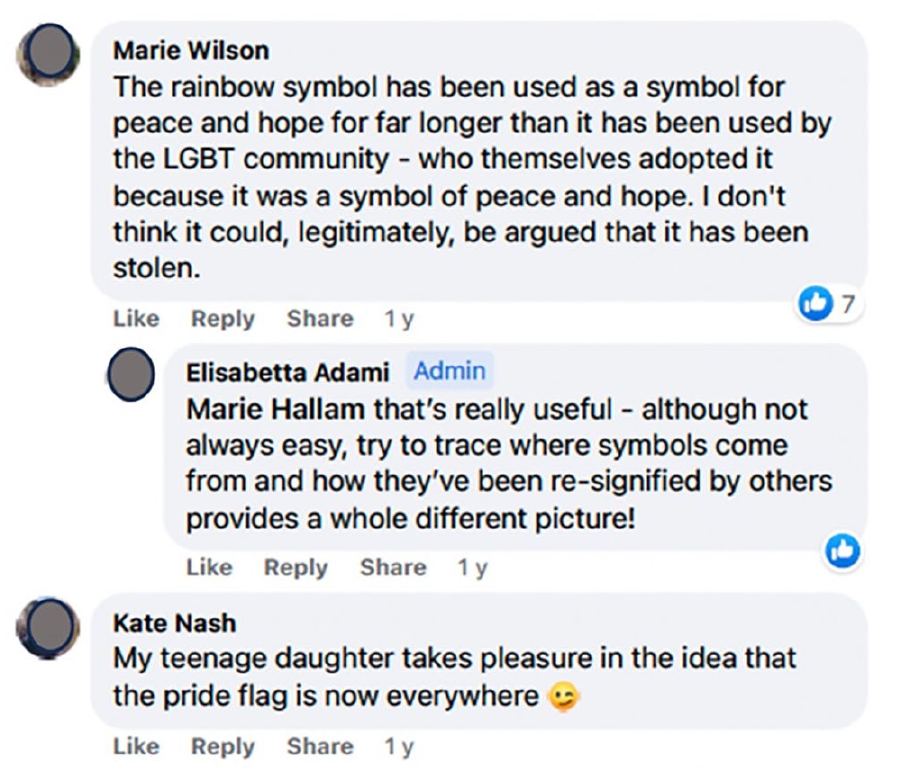
Rainbow thread 4/5 – history of the symbol’s recontextualisation.
To extend the discussion further, Elisabetta and Fra Panella also engage in lay research (see Figure 13). Elisabetta posts a link to and summarises a Wikipedia entry, while Fra Panella shares an interesting find(ing) from her browsing through Facebook pages of LGBT+ people she follows. She has come across a music teacher who, rather than feeling offended by the symbol’s reappropriation during the pandemic, had composed a song about the rainbow interweaving all its meanings.
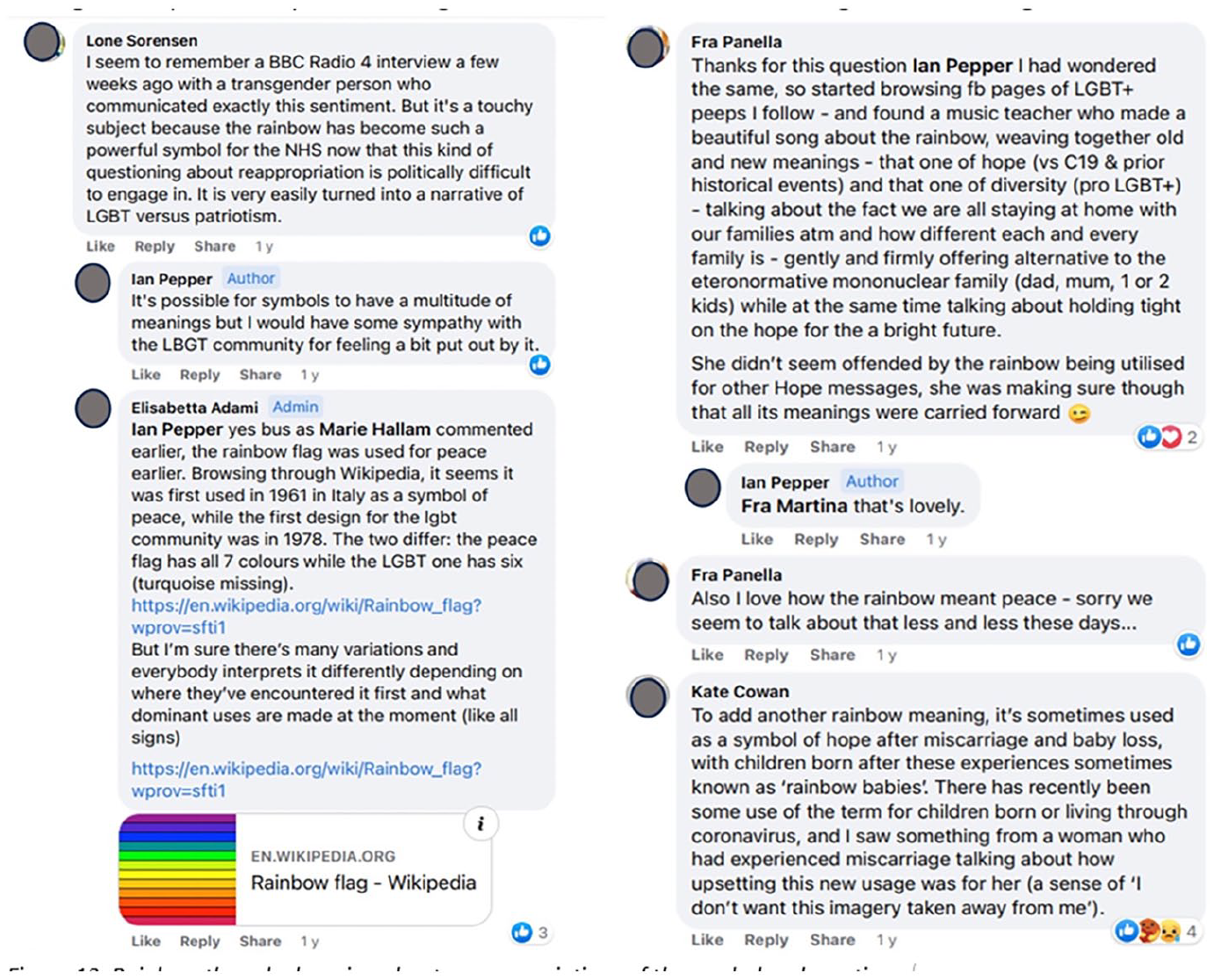
Rainbow thread 5/5 – learning about re-appropriations of the symbol and reactions.
Beyond topic development, and the knowledge participants demonstrate in that process, a qualitative focus offers insight into the dynamics of their interaction – their opinions and the strategies they employ to advance, negotiate and co-construct different perspectives. To describe these strategies in a citizen semiotics exchange on social media, as Adami and Djonov (2022) discuss, we need to examine how opinions are introduced and legitimated, thereby moving beyond simply identifying acts of ‘wonderment’ and ‘arrest’.
The Rainbow thread aptly illustrates the limitations of the binary distinction between ‘wonderment’ and ‘arrest’. While Ian explicitly frames the opening post as ‘wonderment’ (‘I was wondering . . .’), what he wonders about – namely, whether the LGBT+ community are disgruntled about the re-appropriation of the rainbow as a symbol of hope, rather than diversity/pride – can be interpreted as an embedded ‘arrest’. Commenters share observations of various uses of the symbol and the reactions these have received from the LGBT+ and other communities (instead of sharing their own reactions). Consequently, the exchange features very few and predominantly indirect acts of arrest (see red arrows in Figure 14). For example, Marie states that because the rainbow has served as a symbol of peace and hope for a long time before the LGBT+ community adopted it, the argument that it has been stolen from them is not legitimate (Figure 12). Notably, here Marie is opposing an argument, and not Ian’s views (which the opening post does not reveal). An arresting comment more clearly directed at the opening post is Lone’s (Figure 13). She starts by mentioning that a transgender person has expressed a similar sentiment in a BBC 4 interview, thereby validating Ian’s observation that such attitudes exist, but then cautions against ‘this kind of questioning about re-appropriation [as] it is very easily turned into a narrative of LGBT versus patriotism’. This warning is implicitly directed at both Ian and Marie. Interpreting Lone’s comment as ‘arrest’ is supported by Ian’s response to it with a ‘counter-arrest’ – ‘I would have some sympathy with the LGBT+ community’. These examples highlight the value of a more nuanced perspective on negotiation in citizen semiotics discussions. While the quantitative analysis showed that contributions can combine wonderment and (embedded) arrest, a closer, qualitative look at the interactional dynamics highlights how a single act of arrest may be directed at more than one contribution and/or their embedded voices, and may also be reported as coming from a third party (e.g. families who have suffered miscarriage or child loss).
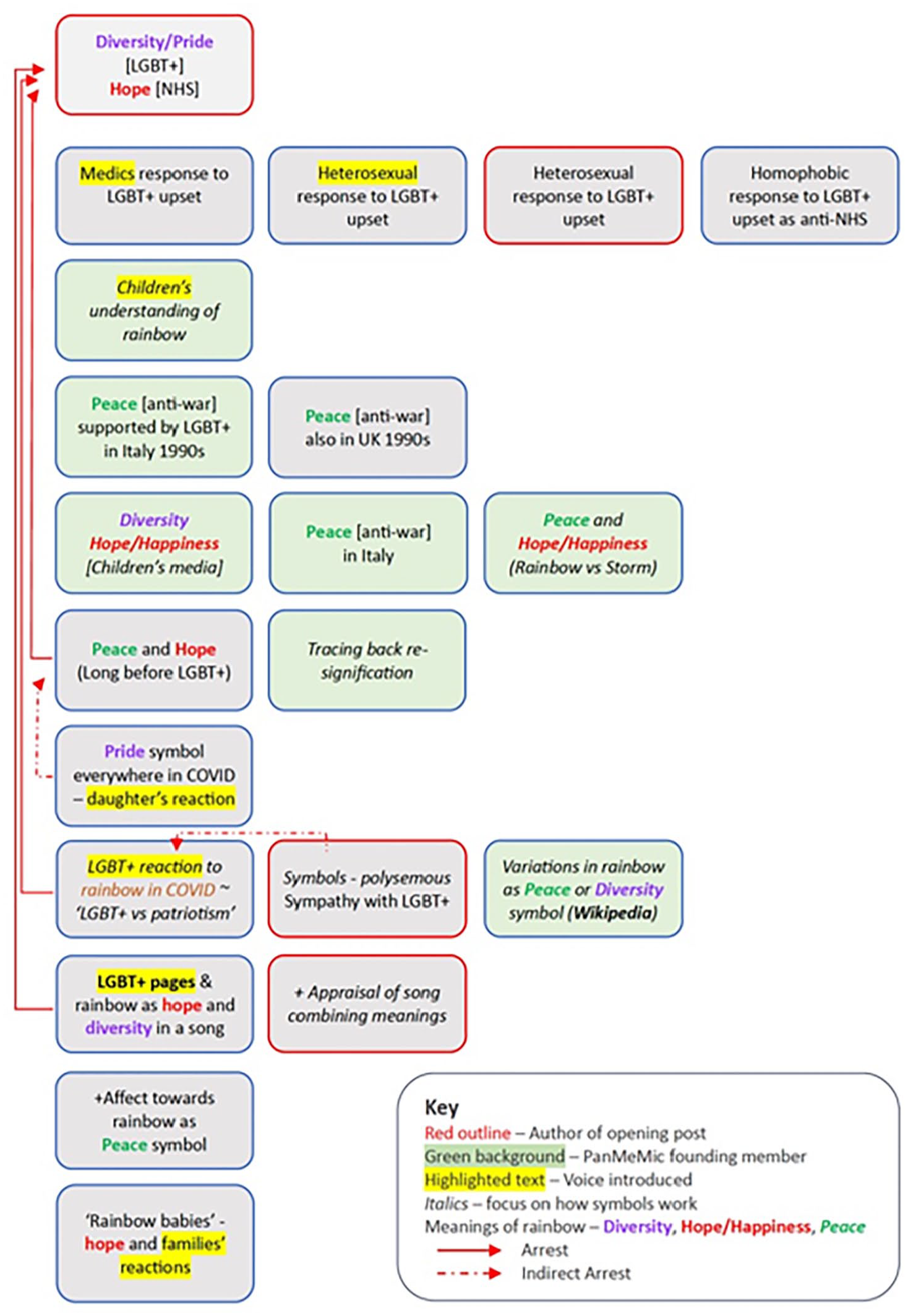
Rainbow thread – topic development, arrest acts, voices.
A closer, qualitative analysis illuminates the roles participants adopt and assign others (e.g. who is arresting whom) as well as how they introduce new voices into the exchange (highlighted in Figure 14) or solicit the perspectives of other members of the group. For example, first to respond to Ian (Figure 9), Kate Farley comments that the reactions of medics she follows have been mostly ‘tongue in cheek’, and refers to @WelshGasDoc, the Twitter account of an ex-medical student and LGBT+ supporter. She also mentions ‘some pretty angry responses from some heterosexuals choosing to interpret any discussion of it [the symbol] as anti-NHS . . . ’. Ian performs a subtle ‘arrest’ to such ‘angry responses’ when questioning, ‘Anti NHS – that’s strange –Why do they see it as that?’, and Kate Farley reinforces the arrest with ‘I suspect it’s a homophobic response . . .’.
Other contributions to the thread include the voices of people close to the participants (e.g. ‘my daughter’), communities with shared experiences (e.g. families of ‘rainbow children’), large social movements from different places and times (e.g. Italy’s anti-war movement during the 1990s), and individuals representing certain communities (e.g. a transgender person in a BBC interview; @WelshGasDoc). Elisabetta also tags and invites other members of PanMeMic (who were part both of the LGBT+ community and of the antiwar movements) to confirm her recollections of how the rainbow was used in the 1990s in Italy. These instances demonstrate the potential of social media exchanges like PanMeMic’s to ‘draw together voices who might otherwise not interact’ (Rymes, 2021: 21). These strategies could both remove blind spots and encourage deliberation about diverse perspectives, beyond participants’ own, which Rymes (2021: 54) views as key to the success of citizen sociolinguistics and its ability to foster grassroots social change.
A deeper reading of comments in the thread reveals participants’ use of a range of the legitimation strategies proposed by Van Leeuwen (2008):
Although no discussion of these legitimation strategies takes place in the Rainbow thread, noticing them might extend the discursive repertoire and expertise of the thread’s contributors as well as readers (as Emma noted in her contribution to our analysis in Adami and Djonov, 2022).
To summarise, a qualitative engagement with citizen semiotic exchanges like those in PanMeMic’s Facebook group can offer insights into the dynamics of knowledge sharing and co-creation and complement those that a quantitative approach affords. Specifically, our analysis of the Rainbow thread reveals: how topics are initiated, proposed and developed; the roles contributors adopt and assign each other; which voices (from within and beyond the group) and perspectives they solicit and include in the discussion, and how; the nuanced and relational character of their positioning, well beyond a crude distinction between wonderment and arrest; and the strategies they (especially the group’s founding members and other academics) employ to encourage deliberation, to discover, share and interpret new information, and to legitimate and evaluate different semiotic practices.
Most importantly, qualitative analyses such as the one presented here show how even a single thread of 25 comments, featuring voices mainly from the UK and Italy, can help co-construct nuanced and layered sociosemiotic knowledge about a representation (or practice), its uses, meanings and evaluations from across varied groups, places and times. This is knowledge constructed collectively from individual contributions by virtue of participants’ specific perspectives, experiences, access to other voices and different research sources. Beyond critical analysis of discourse roles, strategies and structures (e.g., van Leeuwen, 2008) and their relations with knowledge (see van Dijk, 2014), we can examine these discussions for their potential and limitations in supporting the co-construction of shared knowledge and reflect on our roles as academic researchers in creating spaces that gather diverse voices (including ours) which otherwise would not meet.
Discussion: Evaluating PanMeMic as a citizen semiotic approach
The first months of the Covid-19 pandemic saw us all disoriented, trying to find new and safe ways to carry out interactions and other activities within the restrictions imposed to reduce the risk of contagion. Despite being researchers in communication, we too felt confused rather than confident to offer advice to others. Motivated by the need to learn, Elisabetta, the first author, contacted her colleagues and friends, asking them to involve their contacts in their turn, to address the question: What have you all observed of changes in communication and interaction because of the pandemic? This opened a transmedia space that saw people asking related questions in their turn, sharing their views on these questions, and bringing in external voices too. This is common in online forums of all kinds. PanMeMic, however, did it with a focus on communication and interaction, and by involving academics too. It then took us over 2 years to analyse what was produced. In this section we discuss the findings as well as the possibilities and limitations of our approach, which we hope academic and citizen researchers may find useful and adapt to future explorations of communication and interaction.
This article examined how PanMeMic’s Facebook group (as part of the broader transmedia space) was established and evolved as a research collective to include researchers in linguistics and communication alongside other academics and non-academic members. Combining quantitative with qualitative analysis then allowed us to evaluate its success and limitations as a citizen sociosemiotic inquiry. The coding of posts made in the Facebook group from its creation in May 2020 to November 2021 highlighted the group’s ability to attract members from around the globe and across the divides that traditional research contexts typically impose between different disciplines and between academics and non-academics.
The coding also revealed the dominance of writing in the posts. Writing offered contributors a means of succinctly describing and generalising across various experiences and observations, expressing their attitudes towards certain topics, and soliciting further information or feedback, or merely briefly framing other voices shared through links or visual artefacts (present in nearly half the posts). Although legitimation can be performed multimodally (van Leeuwen, 2017; for ‘demonstration’ as a legitimation strategy in videos, see Adami and Djonov, 2022), language remains more readily recognised as a resource for legitimating and evaluating social practices in discourse. Nevertheless, the poster’s explicit written stance was not essential for prompting discussion as most visual-only posts attracted comments.
Another finding of the quantitative analysis is that the group’s discussions examined a wide range of topics and almost all posts were about semiotic practices, representations, or both, that is, relevant to PanMeMic’s overarching focus – showing that interest and expertise on communication and interaction are distributed, and that knowledge and meta-reflections about it are not limited to academic domains and traditional research fields. This relevance and the finding that the vast majority of posts opened with wonderment or non-committal sharing of information, rather than critique, likely reflects the observational aim set in the initial invitation to join the group, the snowballing method employed to build the group, and the role that the founding academic members played in setting the tone when participating in (and often initiating) discussions in PanMeMic’s Facebook group. Among the many discourses on social media fostering controversies, conflicts, and attacks towards others, we take the prevalence of wonderment over arrest in the contributions of the Facebook group as an index of it being shaped and lived by its members as a research space, in the spirit of Plato’s and Aristotle’s famous idea that philosophy starts with wonder.
Our qualitative discourse analysis of the Rainbow thread offered further insight into the capacity of PanMeMic, as an inquiry conducted in part through social media groups, to stimulate and support deliberations. Through these, members contribute and extend their knowledge, represent diverse perspectives, and renegotiate what counts as expertise on communication and interaction through various legitimation strategies. This analysis deepened understanding of a distinctive feature of the research collective – the ways academic researchers in communication encouraged and contributed to these deliberations, so that they too can learn new ways to communicate and interact with others that are suitable for the pandemic period and possibly beyond.
Close coding and analysis of the posts and ensuing discussion revealed not only the validity of expanding Rymes’ (2021) citizen approach from sociolinguistic to sociosemiotic inquiry but also a need to introduce new, more nuanced categories to Rymes’ (2021) ‘wonderment’ and ‘critique’. We identified posts ‘asking for feedback’ and coded as ‘non-committal’ those that shared content without making explicit the poster’s position or intent. We noted, too, that a post can combine wonderment and arrest, and that ‘wonderment’ calls for finer distinctions as it can span from mere curiosity to positive surprise. While very few opening posts contained open acts of arrest, they could nonetheless include embedded ones in reported voices, and a close analysis of the discussion thread revealed highly differentiated arrests and counter-arrests in the comments. The ‘arrest’ category too, then, could benefit from further analytical granularity, to account for various degrees of (in)directness and to identify which voice arrests which other(s). Overall, we believe we have shown the benefits of integrating quantitative and qualitative analysis in offering insights on different aspects of citizen research activities.
PanMeMic complements both studies of communication during and about the pandemic as well as participatory approaches to research. Discourse studies have examined public health communication about COVID-19 (e.g., Price and Harbisher, 2021) and how people represent, relate to and negotiate various changes in life due to the pandemic (e.g., Jones, 2021; Tan and E, 2022; Zappavigna and Dreyfus, 2022). These studies typically aim to establish trends in linguistic and other meaning-making choices, their effectiveness and underlying ideologies. Inspired by Rymes’ (2021) citizen sociolinguistics, PanMeMic instead was designed to invite people to share observations and reflections on the changes in communication and social interactions during the pandemic. Instead of unravelling trends, PanMeMic’s key goal and achievement consists in fostering a rich range of conversations about communication and interaction, many of which included diverse voices. Additionally, in contrast to critical discourse studies, PanMeMic’s aim is not to support one perspective or form of knowledge over another, nor to reveal and critique existing power relations and ideologies – an important endeavour that already plenty of ongoing research pursues. Rather, PanMeMic was established to stimulate new forms of dialogue, openness to new perspectives, and dynamic and relational co-construction of knowledge through the sharing of different positionalities and voices. A sign that this aim was successfully achieved is the near absence of confrontation in the PanMeMic Facebook group discussions.
In participatory research or citizen science approaches (for reviews see Facer and Pahl, 2017; Kullenberg and Kasperowski, 2016; Lewenstein, 2016; Purschke, 2018; Svendsen, 2018), there are tensions between quantitatively-oriented methods such as crowdsourcing, which often relies on strict data collection and coding guidelines and training provided by researchers with academic expertise in a specific subject, and qualitative and ethnographic approaches. In research on multimodality, for example, Kullenberg et al. (2018) employ crowdsourcing, whereas Jewitt et al. (2020) and Potter and Cowan (2020) adopt ethnographic methodologies. Our analysis combined both. Akin to Rymes’, however, our aim was not to establish dominant trends nor to generalise over a broader phenomenon. Instead, we mapped the activities in PanMeMic’s Facebook group to help evaluate its success, that is, whether this socio semiotic inquiry is contingent, contextual and relevant to participants. The trends our coding identified provide an indication that opening a space such as PanMeMic can offer opportunities for diverse discussion that addresses participants’ own research questions. In this, we consider the research ‘proper’, knowledge co-construction and dissemination to consist in the discussions in the Facebook group, as a source of collective learning. The analysis presented in this article is only a form of evaluating those research activities and sharing with the academic community what we have learned through PanMeMic.
Citizen socio semiotic inquiries, like that carried out in PanMeMic’s Facebook group, differ from institutional research. Citizen inquiries draw on different sources of evidence, which include personal experiences and reported accounts. Their methods of observation and data collection can be serendipitous and fleeting, and their validity is determined not through research protocols but through the diversity of contributions and responses a sociosemiotic inquiry attracts. Knowledge production in citizen sociosemiotic inquiries is shaped by the diverse and sometimes divergent interests of a group of contributors, some or all of whom may have never met outside that specific semiotic space. An academic research project into, say, a symbol’s meanings is, by contrast, typically designed to be conducted by a lead researcher or a group of carefully selected collaborators with complementary expertise, research training and professional qualifications. They would be expected to study a symbol’s meanings systematically, and/or aiming at findings with validity beyond the specific case, clearly laying out the method that supports their claims for systematicity and/or validity. This may involve building, coding and comparing text corpora that represent uses of and discourses about the symbol in different socio-cultural and historical periods, with the aim of identifying not only variations but also trends in the symbol’s meanings.
Looking beyond the conventions on presenting academic research and findings with adherence to protocols that demonstrate research validity, however, we believe academic and citizen inquiries in communication often have crossovers. Both may be prompted by personal experience and shaped by contingency, serendipity and the interests of researchers – the discursive practices and genres differ, but the actual interest, motivations and actions are equally socially shaped (as Latour, 1987 revealed about science and scientists).
Alongside extending Rymes’ citizen sociolinguistics approach to multimodality, we innovated on it by offering a dedicated platform, explicitly framed with a broad focus on and need to ask for, share and co-produce knowledge about communication and interaction during the pandemic and beyond, rather than looking for and observing people’s discussions elsewhere. We also engaged in these discussions, rather than adopting the traditional researcher roles of observers and analysts. This might explain the tone of the discussions, the more frequent acts of wonderment and the overall open and very rarely confrontational attitudes, without any need for moderators’ intervention. 3 Not restricting our focus to posts about specific linguistic or other communication features, and instead setting up the group with a broad research question, led us to reveal a wide range of topics and semiotic practices that members contributed to, knew and wanted to learn more about. While a more focused research question (as those used in crowdsourcing projects) would have allowed us to collect data suitable for more standard analysis, leaving the question broad allowed PanMeMic’s members to ask – and find answers to – their own research questions, many of which we could not have anticipated and would otherwise not have learned about.
Facebook offered three advantages for PanMeMic as a citizen research project. First, we were able to create a group, rather than just a social media account that others can follow, as on Twitter or Instagram (where PanMeMic also has profiles). Second, Facebook places fewer constraints on the semiotic resources used in posts and comments and their length (as no character limits apply, and there is no requirement to start by sharing an image or a video). An important third advantage was the ease of contacting members of the group through Facebook Messenger, to check with them and ask them to contribute to the analysis presented here. In line with Rymes’ recommendation, inviting feedback from the people who have contributed to the discussion mitigated the risk associated with coding the data with categories developed by researchers – namely, that this can override, rather than highlight, participants’ own expertise.
Besides checking interpretations of members’ contributions, we collected more general feedback on this article and also about the group. Ian, for example, wrote I found how you deconstructed the ongoing conversation around the rainbow symbol really interesting. I had not thought in that way before about the different types of language used and their functions in conversation/communication. Some of the phrases used were new to me and I loved the phrase ‘acts of wonderment’. It sounds like you got a lot both personally and professionally out of doing the research and I too enjoyed being involved in it.
And Katie mentioned two advantages of PanMeMic using Facebook: I think the format of social media posts and comments does offer different opportunities – it’s easier to add in short comments, where a person in a [face-to-face] group discussion might not be able to ‘chip in’ in the same way, the topic moves on, whereas here it’s there to be added to over time. I think particularly when we were isolated from people and facing a lot of uncertainty, needing information about what was happening in the world, these spaces for interaction felt more precious. Now I don’t spend as much time online I don’t follow these discussions in the same way.
Limitations and future directions
Like any other project, PanMeMic and the analysis presented in this article have limitations that invite further exploration. One possibility, mentioned earlier, is to reconceptualise wonderment and arrest as the ends of a continuum, and to examine the nuances found in acts of arrest more systematically – who arrests whom and whether and how the arrested, who may be third-parties or generic groups (e.g., lecturers; nurses), can or do respond. Another is to invite contributors not only to reflect on and add to the interpretations in academic publications such as this, but to share what they have learned from a given discussion. Another avenue for extending a citizen sociosemiotic inquiry is to investigate whether, why and how it has prompted any grassroots changes or movements towards greater inclusion, diversity and equity in communication (see Adami and Djonov, 2022).
Although we acknowledge the risks of doing citizen sociosemiotics on social media, one of which is excluding those who do not use or cannot access Facebook and similar platforms, we have not examined the impact of features such as Facebook’s algorithms on PanMeMic members’ exchanges on the platform. One key limitation is that new posts in Facebook groups appear more in the feeds of more active members, and may remain hidden from those who do not actively react, comment or post. Another is that one is more likely to be shown contributions from group members who are also one’s Facebook friends. This does not guarantee equal exposure to all new contributions – and hence possibility of participation – for all members of the group. Moreover, this means that the activities of the group self-sustain only if there is a critical mass of active contributors (and/or funding to promote visibility of posts to members).
The analysis presented here highlights the constraints of academic writing, which cannot render our excitement of co-creating PanMeMic, nor our wonder at reading somebody’s insightful comment, nor the learning process each of us engaged in while participating. A research paper cannot capture the dialogical and polyvocal nature of a citizen sociosemiotic inquiry. Admittedly, we would need to be bolder in pushing the boundaries of the academic presentation style to allow for more fragmented and polylogical structuring that would do justice to the learning process and to all contributors. As we did with our earlier paper (Adami and Djonov, 2022), we asked citizen researchers to comment on a draft of this paper too. Despite being eager to contribute comments in the Facebook group, however, very few provided feedback on the draft. 4 This suggests that the challenge might reside in the paper’s academic writing style rather than lack of interest or expertise in the subject or in sharing and co-creating knowledge about it. This may also reflect the distance between earlier stages of the pandemic, when the posts and comments analysed in this paper were created, and the time we completed and shared a draft of this paper with their authors.
As mentioned, PanMeMic started with a general research question, as our aim was to allow participants maximum agency to initiate and develop discussions. For projects seeking to co-create or build deep knowledge about selected aspects of communication, the research questions would admittedly need to be far more specific. Other projects may start with already established online groups that focus on a specific topic related to communication, interaction and/or representation (e.g. cultural appropriation), and employ quantitative and qualitative methods of analysis such as those showcased in this article to examine the co-construction of sociosemiotic knowledge in these groups and its power to inspire grassroots social action. Academics with expertise in communication and semiotics may also join and contribute to such groups.
In sum, academic sociosemiotic research wanting to engage with citizen sociosemiotics can do it in at least two ways:
By researching citizen sociosemiotics: Academics can use their disciplinary research expertise, through observations and desk analyses of instances of citizen acts of sociosemiotic inquiry and knowledge co-construction, to explore its dynamics, and measure and show its potential, its social impact and significance; in this way, academic research can also provide legitimacy, visibility and validity to practices that risk being obscured, ignored or undervalued within elitist discourses that dismiss knowledge produced and circulated on social media (see e.g., memes shared in the PanMeMic group in Figure 15).
By doing citizen sociosemiotics: Academics can venture outside their institutional comfort zone, foster and participate in it, as we did in PanMeMic, through the creation of ad hoc spaces or by joining already existing ones; this could help rethink and reshape the ways in which academics can contribute to the co-construction of knowledge, countering both the power and gatekeeping practices that come with institutional expertise (Turner, 2001) and populist discourses dismissing expertise as part of the establishment.
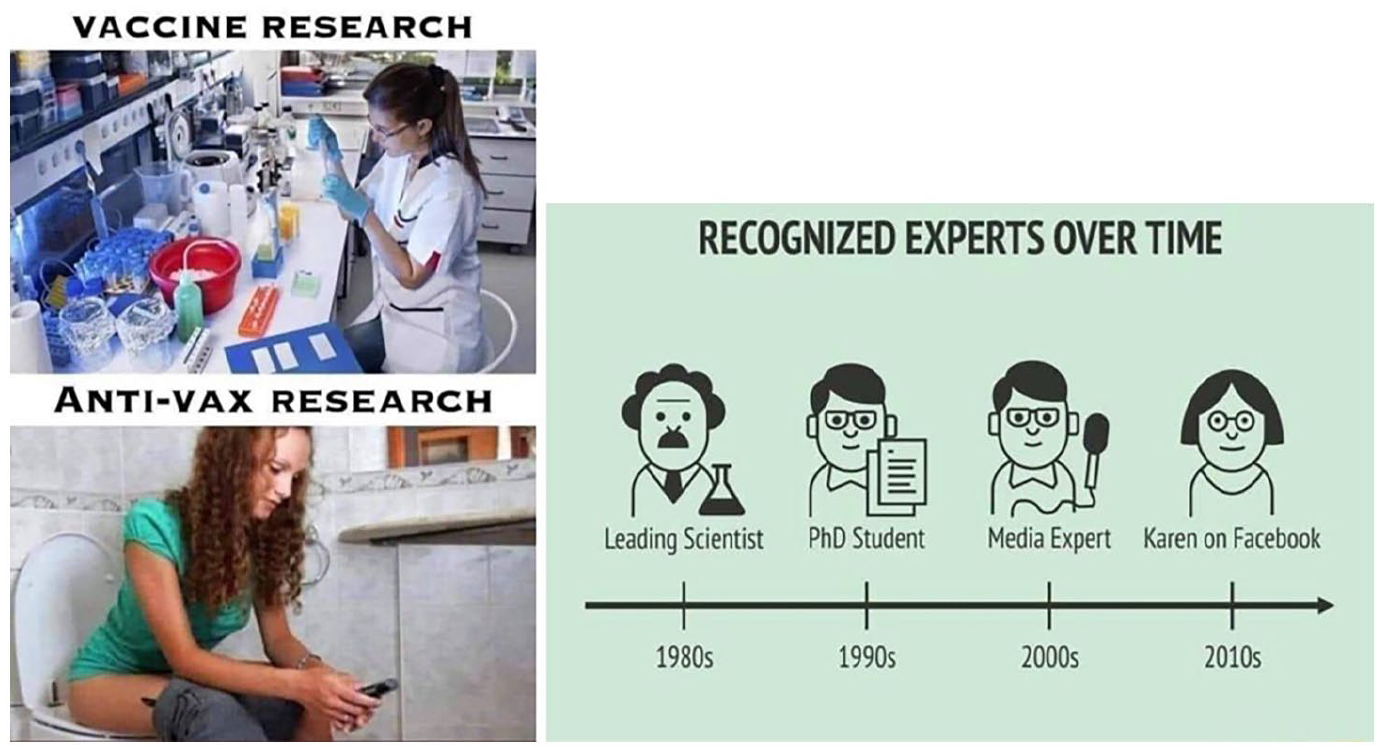
Memes defending institutional expertise and stereotyping social media use (also with sexist implications on expertise, in the meme on the right).
Beyond the many contrasting discourses, there are also the possibilities for grassroots action to influence institutional communication practices. The example of the sexist visuals of the Italian track and trace app shown in Figure 7 earlier, which were changed following protests circulated on social media, is a point in case: it shows the level of critical visual literacy distributed in society and also that citizens’ acts of sociosemiotic critique voiced online can lead to positive change. As academic sociosemioticians we can start first by recognising these citizen acts of sociosemiotic inquiry and then by engaging with them, contributing with our professional and personal expertise to that of others.
Without denying the usefulness of our role as discourse analysts in describing and critically analysing practices that others develop, we can also engage directly with citizen semiotics researchers outside academia to co-develop a more diverse form of expertise. With PanMeMic we used social media mainly out of necessity – because most of the world was in lockdown. Yet, this prompted us to interrogate whether and how digital environments, and social media in particular, can be used to shape collective research spaces that avoid the social media risk of self-reinforcing feedback loops creating echo-chambers – and the role academics can play in this.
We hope that, by raising all these questions, this article and PanMeMic will contribute to methodological innovations regarding the role of the researcher in society in general (beyond labels of ‘impact’ or ‘public engagement’, which dominate evaluation protocols of academic research) and of discourse analysis in particular, as a way to go beyond critique by integrating it with design (Kress, 2010), especially for communication scholars interested in participating in the social dynamics of co-production of semiotic knowledge towards positive social change.
Footnotes
Declaration of conflicting interests
The authors declared no potential conflicts of interest with respect to the research, authorship, and/or publication of this article.
Funding
The authors received no financial support for the research, authorship, and/or publication of this article.