




Abstract
This exploratory study focuses on the public as a listening ensemble that takes part in public diplomacy on Twitter. Here, listening is considered as the receiving component of communication, and responsive behavior as its visible product. The focus is on public communication that followed Russia’s 2022 invasion of Ukraine. A total of 4,392 quote tweets (citing the President of Ukraine Volodymyr Zelensky’s tweets mentioning Ukraine’s possible membership in the European Union) were analyzed using the taxonomy of verbal response modes. Two major modes were identified: responses to the situation by sharing information and persuasion, and responses to Zelensky, Ukrainians, and the public by disclosing feelings and opinions. Interestingly, the different social roles of the public were associated with how much interaction was elicited. The listening public contributes to global deliberativeness; not strictly from an issue-oriented problem-solving perspective, but in the sense that they weave together analytical and social aspects of deliberative reflection.
Keywords
Introduction
New means of communication have significantly increased people’s opportunities for public participation. This development has changed and continues to change international dynamics. In 2022, the world of international relations faced a major disruption when Russia started a war of aggression in Ukraine. This exploratory study examines communication made possible by social media in this stressful international situation. The study operates at the theoretical intersection of listening and public deliberation, in seeking answers to the question of the role of the public in public diplomacy (PD)—a question that intrigues PD scholars year after year (e.g., Tam & Kim, 2019). The focus is on public responses to Ukrainian President Volodymyr Zelensky’s tweets that related to Ukraine’s possible membership in the European Union (EU).
Here, the central idea is that an analytical framework encompassing social interaction and listening allows the investigation of issues related to the public in PD. While listening has recently become an emerging theme in PD research (e.g., Di Martino, 2020; Rikkonen et al., 2023), the main emphasis has largely been on nation states and their representatives as the listeners. Simultaneously, the public has received much less attention. For the nation states, listening in PD means most of all an attentiveness to foreign public opinion (Cull, 2009) and an active engagement in interaction with foreign publics (Di Martino, 2020). Correspondingly, listening means the exact same to the members of public: attentiveness to and engagement in discussions on foreign issues. In its simplest form, listening means receptive behavior in any communication process. Verbal and nonverbal responses are the observable outputs of this behavior. Hence, to study the role of the listening public, the focus needs to be on how the public is responding to the situational exigencies. Here, the focus is on the public’s verbal response modes (VRMs) on Twitter (officially known as X since July 2023 but referred to as Twitter throughout this article).
To put the research into context, the current state of international relations must be taken into account. In February 2022, diplomacy failed. Diplomacy—as communication between states—ended as Russia launched an unprovoked military offensive against its democratic neighbor, Ukraine. Diplomacy failed to prevent the war. However, diplomats cannot be blamed for this failure. In the Russian Federation, they faced an opponent that did not even want to achieve a negotiated result.
The course of events allowed a robust rhetorical persona, that of president Zelensky, to rise into the global framework (e.g., Collinson, 2022; Shuster, 2022). He skillfully utilized social media from the beginning of the war. On Twitter, communicating in both Ukrainian and English, President Zelensky united the people of Ukraine to defend their independence and solidified Ukraine’s place in the hearts and minds of the Western public(s). Regarding state leaders, PD can be largely understood as rhetorical diplomacy through which the state leaders attempt to “influence [. . .] foreign publics, to manage change, and to cultivate legitimacy for political actors and projects” (Rikkonen et al., 2022, p. 1264). This is exactly what President Zelensky did on Twitter from the first days of Russia’s invasion. Crucially, he promoted a vision for Ukraine’s future within the EU. While this future vision possibly gave a major morale boost for the Ukrainians, it was also an international issue on which foreign publics could deliberate. In this way, President Zelensky called a public into existence, which then engaged into public communication through listening. Thus, listening, public communication, and deliberation form the theoretical framework of this study, which is discussed in the next section.
Theoretical Framework
The Listening Public as a Deliberative Entity
This study relies on Mills’ (1954/2008) differentiation between mass communication and public communication, focusing on the latter in social media messaging. Public communication differs significantly from mass communication, in which only the powerful few have access to give opinion through one-way messages. This is also how PD was largely practiced in the past (Cull, 2009; Melissen, 2005). Contrarily, public communication allows people to respond. Practically all participants can speak their mind to impact decisions that affect their lives. In this sense, the very existence of a public is what ties PD at least loosely to public deliberation, “a combination of careful problem analysis and an egalitarian process in which participants have adequate speaking opportunities and engage in attentive listening or dialogue that bridges divergent ways of speaking and knowing” (Burkhalter et al., 2002, p. 398). Paired with deliberation as a normative ideal of democratic public discourse, PD appears as “the diplomacy of the public, that is, the projection in the international arena of the values and ideas of the public” (Castells, 2008, p. 91). The realm of international relations is far from a realm of a deliberative democracy (Dryzek, 2000), but in diplomacy, there has been a trend toward the democratization of the practice (Lisiecka-Zurowska, 2019).
Rather than looking at public deliberation as a complex multidimensional process and comprehensively evaluating all its aspects, this study ties itself to listening as an essential feature of deliberativeness. Perhaps the best argument in favor of focusing on listening, as the counterpart of expression, comes from Goodin’s (2003) conceptualization of democratic deliberation “as something which occurs internally, within each individual’s head, and not exclusively or even primarily in an interpersonal setting” [italics in original] (p. 7). In fact, listening is at the heart of deliberation right in the very first stage, which is the acquisition and careful weighting of information (Burkhalter et al., 2002). With social media, an unforeseen opportunity for global public deliberation has emerged. However, as Nye (2008) asserts, “information is power, and today a [large] part of the world’s population has access to that power” (p. 99), but with the people being overwhelmed with the volume of information, “attention rather than information becomes the scarce resource” (p. 99). Therefore, the crucial question concerning PD is whether anyone is listening.
For diplomacy to be PD in its deliberative sense, the public and its behavior need to be problematized. Otherwise, it would only be diplomacy for the masses. In a Deweyan way, the public consists “of all those who are affected by the indirect consequences of transactions to such an extent that it is deemed necessary to have those consequences systematically cared for” (Dewey, 1927/2016, p. 69). In a certain sense, “a public [can be called] into existence” (Dewey, 1927/2016, p. 157), which can be seen as the critical task of diplomatic rhetors. Nevertheless, words like crowd, audience, people, or group do not adequately capture the idea of a public, and it should ultimately be understood as self-creating and self-organized (Warner, 2002). Importantly, as Stob (2005) emphasizes, “the force, the meaning, of the public is not what it is but what it can do” [italics in original] (p. 237). Furthermore, “the public must be able to use language [in the form of signs and symbols] that bonds its members together to advance its purposes [. . .] in social interaction” (Stob, 2005, p. 237). The public can become a deliberative force through social interaction, and only through social interaction. Dewey’s (1927/2016) central idea was that the public takes action when established institutions are unable to solve problems that have arisen. In addition, the public can also act as a guide for the institutions in detecting the problems.
Ideally, this detection and solving of common problems occur deliberatively through motivated reasoning and logical argumentation. Twitter is unparalleled as a channel for discussions based on the freedom of participation—a crucial precondition to democratic deliberation (Burkhalter et al., 2002)—albeit the discussions there are still somewhat dominated by politicians and journalists (Casero-Ripollés & Ribeiro, 2023). Nevertheless, the opportunities for ordinary people seem to be community-specific, as in some communities, politicians and media are the most influential, while in others, citizens are the most influential group (Casero-Ripollés, 2021). Twitter has significant possibilities for information dissemination, which has made it an intriguing platform for state leaders and diplomats to seek to call international publics into existence. However, lurking threats such as filter bubbles, mis-/dis-information, fake news, hate speech, and bots make Twitter at best a mediocre venue for meaningful public discourse. Therefore, it is questionable whether the public could fulfill its mission to solve local or regional problems, let alone international ones, on the platform.
Despite these distortions, the potentials of Twitter, and social media in general, for global deliberative communication should not be underestimated. Halpern and Gibbs (2013) emphasize that in addition to entertainment and interpersonal purposes, social media are also used for political discussion, and that users may benefit from such discussions. The key is that social media provides a place for developing, testing, and sharing of ideas in social interaction; not in the rigorous scientific way, but in a way that is characteristic to human communities. This idea of interpreting Twitter as a deliberative platform is supported by the type I/type II deliberation dichotomy of Bächtiger et al. (2010). They argue that where type I concerns a process of rational discourse based on the Habermasian ideal, type II includes more flexible forms of communication, such as rhetoric and narratives. The former aims at a rational consensus while the latter aims at unspecified outcomes such as a meta-consensus about differing opinions. Importantly, these distinct types of deliberation are complementary, not mutually exclusive (Bächtiger et al., 2010).
On Twitter, it is impossible to reach conclusive resolutions over matters of public interest as in an ideal deliberative process. Nonetheless, it is a place where deliberative thinking can live and evolve. Thus, the emphasis here should not be on deliberation as a regulated process, but rather on deliberativeness manifested in behavior. According to Waisanen (2014), “being deliberative [means] making broadly informed judgments with an unending openness to others’ communication when evaluating different perspectives and positions oriented toward [public problems]” (p. 301). This unending openness in social interaction provides fertile ground for more rational deliberation. This passage calls for “dialogic virtuosity,” which means that people should “speak so that others can and will listen, and to listen so that others can and will speak” (Pearce & Pearce, 2000, p. 1). Such dialogic virtuosity is in line with Burkhalter et al.’s (2002) definition of deliberation, which considers it as “an egalitarian process with adequate speaking opportunities and attentive listening” (p. 418) and as a “dialogue that bridges differences among participants among participants’ diverse ways of speaking and knowing” (p. 418). Listening and enabling listening are therefore indispensable actions of the public.
With the global public sphere being as complex as it is, listening can also be considered a good concept to describe communication behavior within human capabilities (Crawford, 2009). Yet, it should be noted that “to listen” does not necessarily mean that the listener is processing some sorts of messages and giving them meanings—listening can also be understood simply as anticipation (Lacey, 2013, p. 7). Lacey (2013) argues that listening can be considered a bridge between sensory realm of experience and “the political realm of debate and deliberation” (p. 8) and demonstrates that it is the most suitable metaphor for describing the perceptive communicative mode especially with respect to social media. In addition, she pairs the listening metaphor with the concept of resonance, which is “about responsiveness, but it need not be responsiveness in kind, nor need it be immediate” (Lacey, 2013, pp. 166–167). Perhaps the most crucial take from this conceptual formulation is that of a theoretical shift from a reading public to a listening public. This involves “a shift in thinking about a public as a collective of sovereign individuals to a public constituted intersubjectively” (Lacey, 2013, p. 170). The key to examining this intersubjective public is the observation that the room necessary for dialogue and deliberation can be created through reciprocal listening, which Crawford (2009) defines as “hearing and responding to comments and direct messages” (p. 530).
Listening and VRMs
Listening, as well as reading, has traditionally been defined as the receptive part of communication. However, listening differs from its parallel behavior, reading, in that it encompasses a broader range of aspects of human relations with respect to the persons involved in interaction. The immediate social environment warrants treating receptive behavior within social media as listening, even though the sensory experience of hearing may be absent. Theoretically, cognitive, affective, and behavioral dimensions are given equal weight in listening, and the focus is equally on the listener’s relationship to the content of the message and its source, as well as the situation itself (Bodie, 2018). The listener’s responsive behavior reflects these relationships. Responsiveness is essential in all listening, including listening in masspersonal communication contexts (e.g., French & Bazarova, 2017) such as Twitter. Regarding Twitter diplomacy, Rikkonen et al. (2023) have found that listening is important because diplomats’ responsiveness and relational awareness are positively connected with the achievement of their goals.
To examine the intersubjective listening public(s) in a coherent way, this study utilizes Stiles’ (1978, 1992, 2017) taxonomy of VRMs. The VRM taxonomy concerns what people do when they say something (Stiles, 1992). According to Stiles (1992), VRMs reveal microrelationships—the ways “that a speaker can be related to an other for one utterance” (p. 17)—that contribute to the development of human relationships as they combine with each other and with other attributes. The use of VRMs is related to listening because it shows how listeners pay attention to and understand others.
Noteworthily, although the VRM taxonomy is based solely on the classification of speech acts by analyzing language use, it is a very versatile way of looking at how human experience is revealed in interaction. Stiles (1978) suggests that the VRM taxonomy “describes a contribution of language to the relatedness of two human centers of experience” (p. 699). Importantly, sharing experiences is central to the social process of deliberation (Gastil, 2008): in public discourse, different experiences need to be considered and listened to. Thus, a theoretical perspective focused on interaction, listening, and responsiveness sheds light on the social aspects of the public in PD. The VRM taxonomy is described more closely in the Method section.
Rationale of the Study
Diplomacy scholars have traditionally had different views on what the public in PD is and what it can bring to the table (la Cour, 2018). Nowadays, heads of state regularly use social media such as Twitter for strategic communication: to amplify their rhetorical diplomacy (Rikkonen et al., 2022) and to build strategic narratives (O’Loughlin et al., 2017). This usually occurs one way, which was also true for President Zelensky (@ZelenskyyUa). For example, on 3 March 2022, he had no followees, despite having more than 4.5 million followers. Understandably, interacting with other users was not at the top of his agenda. However, this leaves open the question of the role and the importance of the public in PD.
For Zelensky, Russia’s invasion and the striking growth in international support for Ukraine opened an exceptional rhetorical opportunity. The situation enabled a strong reassertion of Ukraine’s EU aspirations. Ukraine’s Europeanization and integration with the West have been in the works since its independence in 1991. In a recent survey of French, German, Italian, and Polish citizens, 55% of the participants supported Ukraine’s EU membership (New Europe Center, 2020). However, in Germany and France, the support fell below the majority. On 26 February 2022, 2 days after the beginning of Russia’s intense invasion, the world had seen that Ukraine did not collapse in the face of a fundamentally superior enemy but fought with determination. President Zelensky seized the moment and ramped up his rhetorical diplomacy on Twitter to increase public support for Ukraine’s EU membership. He stated that “a crucial moment [had come] to close the long-standing discussion once and for all and decide on Ukraine’s membership in the #EU” (Zelensky, 2022b), and that “Ukraine must become part of the #EU” (Zelensky, 2022a). While this was part of the future vision he offered to Ukrainians amid the raging war, these brief statements in English were clearly addressed to the foreign public(s) to gain support for the Ukrainian cause.
This study aims to investigate the public as a listening ensemble participating in PD. President Zelensky’s tweets right after Russia’s invasion embodied Ukrainian rhetorical diplomacy aimed at further foreign legitimization of Ukraine’s political project of joining the EU. From the perspective of the public, Zelensky operated in an agenda-setting mode, which is an essential part of the public debate dimension of PD (Sevin, 2017). Above all, Zelensky focused on telling the public what to think about: in most of his tweets mentioning EU membership, he simply said that the topic had been discussed with foreign leaders. Twitter public(s) then engaged into communication and advanced (or possibly refrained from) Zelensky’s rhetorical offering through interaction. In this sense, they began to create frames for the interpretation of Zelensky’s rhetorical diplomacy.
To clarify, the purpose of this study is to look at how the public responded, not what the public responded or who the public is. The focus is on speech acts as building blocks of social interaction. More specifically, the study examines the use of VRMs in general and over time during the following months after Russia’s 2022 invasion of Ukraine. VRMs are also examined in association with hashtags (that aggregate Twitter’s macro-level publics) and with Twitter’s interactive features. Thus, the following research questions (RQs) regarding the use of VRMs are presented:
(a) in general,
(b) over time, and
(c) in association with hashtags?
These questions seek answers to what the public did as it communicated on Twitter and how its speech acts were connected to the subsequent interactions. Moreover, examining VRMs also allows examining more complex social roles. The VRM taxonomy exposes three social role dimensions: attentiveness-informativeness, presumptuousness-unassumingness, and acquiescence-directiveness (Stiles, 1992). According to Stiles (1992), these aggregate indexes, based on the use of VRMs, “reflect broad aspects of interpersonal relationships” (p. 55). This study examines the role of the public in PD through these dimensions by presenting the following research questions:
(a) in general,
(b) over time, and
(c) in association with hashtags?
The four research questions are answered by combining VRM coding with a rich Twitter dataset. This combination makes it possible to conduct quantitative analysis on the use of VRMs in association with hashtags and subsequent Twitter interactions. Thus, the analysis focuses on the social deliberative process both on Twitter’s micro level (interpersonal and parasocial communication) and macro level (hashtags).
Through the above set of questions, this explorative study investigates how the public gets involved in the interactional and rhetorical processes of PD, and what social roles the public manifests. The study does not seek to find out what kind of public opinion is generated, and thus focuses on social rather than analytical aspects of deliberation (Gastil, 2008).
Method
Data
Quote tweets (from now on simply referred to as quotes) were selected as the message type to be analyzed because they were considered as the most relevant responses regarding public deliberation in this case. Formerly known as retweets with comments, quotes closely resemble retweets because they are similarly distributed to user’s followers accompanied by the original tweet. However, they also allow users to add their own thoughts and interpretations. This association of interpretations with context gives quotes a deliberative value. They also indicate the existence of a public because they explicitly show the chaining of messages in time (Warner, 2002).
The first 4 months following the Russian invasion of Ukraine in 2022 were chosen as the period under review. Data collection process was conducted in two stages on 2 October 2022. The collection process was implemented with Postman application that allows to make requests to Twitter API. First, tweets posted by user @ZelenskyyUa between 24 February and 30 June 2022 and containing a mention of Ukraine’s possible future membership in the EU were collected. Because the purpose was to study issues related to rhetorical diplomacy aimed at foreign publics, the data collection was focused on tweets in English. Therefore, tweets in Ukrainian were not collected. The first stage resulted 59 tweets, which are referred to here as “root tweets.”
The second stage of data collection involved collecting quotes to the root tweets. For analytical purposes, only quotes written in English were collected. The second stage resulted 4,392 quotes, which form the data analyzed in this study. The collected data included metadata, such as Twitter interaction metrics, and user ids, but no other user data. Next, the research process continued by classifying the content of each quote according to the VRM taxonomy. Twenty quotes (which included ads for cryptocurrencies and tv shows, among others) were omitted because they were judged to be irrelevant to the study.
VRM Taxonomy and Social Role Dimensions
The VRM taxonomy “is a classification of microrelationships—of the momentary relationships that can exist between people in communication” (Stiles, 1992, p. 60). Stiles first utilized VRM coding to study psychotherapeutic therapist-client interaction. However, he soon realized that the coding scheme formed “a general-purpose taxonomy of verbal response modes [. . .] [in which] the principles of classification are based on a theory of the verbal communication of experience” (Stiles, 1978, p. 694), and that it could be used to analyze any verbal communication.
The data are first sorted into analytical units (utterances), which are then coded twice according to the coding scheme: first, for their literal meaning (form), and then for their pragmatic meaning (intent) (Stiles, 1992). Excluding unidentified modes, there are eight pure modes in which form and intent are congruent, and 56 mixed modes in which they are different. For example, “Sit down” (AA) is advisement in both form and intent, whereas “Would you sit down?” (QA) is question in form but advisement in intent, and “I would like you to sit down” (DA) is disclosure in form but advisement in intent. Codes are assigned according to three principles of classification: source of experience (whether the utterance’s topic is information held by the speaker or the other), frame of reference (whether the utterance is expressed from the speaker’s own point of view or from a point of view shared with the other), and presumption of knowledge (whether the speaker presumes knowledge about the other’s experience or frame of reference or not; Stiles, 2017). The principles are dichotomous as they can take the value of the other or the speaker (Table 1).
Taxonomy of Verbal Response Modes.

Source. Adapted from “Describing talk: A taxonomy of verbal response modes” by W. B. Stiles, 1992 (p. 16; p. 63). Sage.
Note. UNCODABLE (U) is used only for incomprehensible utterances.
In here, speaker refers to the person who is responding and other to the person who is responded to. The modes are mutually exclusive because each of them has a unique combination of the speaker/other values. The taxonomy is also exhaustive as “the only residual category [. . .] consists of uncommunicative, incomplete, and incomprehensible utterances” (Stiles, 1978, p. 697). However, while every utterance can be classified, exhaustiveness does not mean that the classification would convey all of the utterance’s meaning (Stiles, 1992, p. 9).
The VRM taxonomy allows the examination of three social role dimensions: attentiveness-informativeness, presumptuousness-unassumingness, and acquiescence-directiveness. These dimensions “correspond to the proportion of speaker versus other values on source of experience, presumption about experience, and frame of reference” (Stiles, 2017, p. 608). Each dimension is simultaneously present in any given utterance (Table 1). Stiles (2017) stresses that in terms of social interaction: attentiveness has to do with manifest interest in the other and attempts to ensure that the other’s thoughts are expressed and considered in the conversation, whereas informativeness has to do with providing information to the other (p. 608), presumptuousness has to do with higher relative status, knowing the other, or assuming that one is important to the other, whereas unassumingness has to do with lower status and deference (p. 608), and acquiescence has to do with acceding to the other’s viewpoint, whereas directiveness measures the degree to which the speaker guides the conversation by using his or her own viewpoint (p. 608).
There are no known examples of the utilization of VRM taxonomy in the study of Twitter. This study thus serves as an important precedent in which the method is applied to the examination of social media. Here, coding was performed by the first author and focuses on utterances contained in the tweet texts of the quotes. Images, videos, emojis, or hyperlinks were not considered in the process. Hashtags were considered only if they were part of sentence structures.
Hashtags
Hashtags that appeared at least 50 times were chosen for closer analysis. There were 13 of them (in parenthesis is the number of quotes in which the hashtag appeared): #ukraine (512), #eu (291), #standwithukraine (221), #stoprussia (90), #russia (70), #putin (64), #standwithukriane (60), #stopputinnow (60), #ukraineunderattack (57), #nato (56), #stopputin (54), #slavaukraini (50), and #zelensky (50).
Twitter Interaction Metrics
Only a few quotes reached the level of hundreds of reactions (retweets, replies, likes, and quotes). In fact, 58.3% did not lead to any interaction at all. To study how VRMs associate with Twitter’s interactive features, a four-point index ranging from 0 (none) to 3 (high) was applied to each feature. First, quotes that did not receive a single reaction of a certain type (e.g., likes) were placed in the Category 0 (none). Next, the top 10% of the remaining quotes were selected into the Category 3 (high). Finally, all remaining quotes were placed into Categories 1 (low) or 2 (medium) depending on whether they ranked below or above the average among themselves, respectfully. The distributions within the index and key figures for each type of interaction are displayed in Table 2.
Descriptives of Twitter Interaction Metrics and the Aggregate Index.

For analytical purposes, an aggregate index variable was formed by summing up the values for each interaction type. Each quote was then assigned into one of four categories based on those values: values between 9 and 12 were assigned into Category 3 (high), values between 5 and 8 into Category 2 (medium), values between 1 and 4 into Category 1 (low), and zeros into Category 0 (none). These categories represent each quote’s ranking among each other in terms of the interaction they brought about.
Results
VRMs in Public Responses
RQ1 enquired about the use of VRMs (a) in general, (b) over time, and (c) in association with hashtags. Overall, pure modes were much more common than mixed modes; 70.5% of the 8,775 VRMs in the whole dataset were pure modes. In general, the share of edifications was highlighted in the dataset (Figure 1). Of all VRMs, 27.4% were pure edifications (EEs). This indicates that around one fourth of the data consisted of pure statements of objective information, whether the information was true or false. Among the other most common VRMs were pure disclosures (DD; 15.0%), pure advisements (AA; 14.8%), edifications with disclosure intent (ED; 7.2%) and with advisement intent (EA; 6.0%), and pure questions (QQ; 5.2%). Edification forms were more frequent than edification intents, while disclosure intents and advisement intents were more common than disclosure forms and advisement forms, respectively. Noteworthily, the lack of reflections in the data underlines the informative nature of quotes on Twitter.
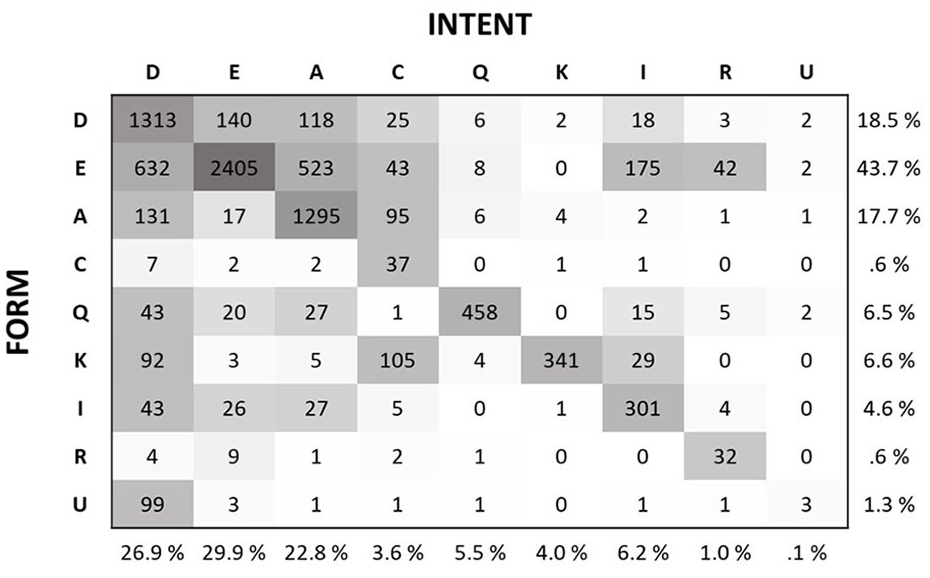
VRM form and intent frequencies, and form distributions (far right column) and intent distributions (bottom row); VRMs = 8,775; quotes = 4,372.
The high proportion of edifications indicate that the public operated largely in information-sharing mode. However, this was more evident for forms than for intents. Nearly equal share of disclosure intents compared to edification intents shows that they also sought to explicitly reveal their own thoughts and feelings. Furthermore, over one fifth of the VRMs had an advisement intent, which shows that the public also tried to steer international actions by telling what should be done.
Monthly analysis revealed subtle variations in the use of the most common VRMs (Figure 2). Between February and June 2022, the proportions of edification forms and intents seemed to remain at the same level. Regarding disclosures and advisements, however, there were noticeable change trends. During the period, the trend regarding disclosures was increasing while the trend regarding advisements was decreasing. This implies that over time, the public became less commanding and demanding. Instead, the talk focused more on the public’s thoughts and feelings.

Percentage distributions of VRM forms and intents per month (February–June 2022).
There were also variations regarding different hashtags (Figures 3–5). For most hashtags, edifications were the most common VRM, at least for forms. There were some exceptions, such as #stoprussia and #stopputin, for which advisements were the most common mode. #Slavaukraini differed from other hashtags with its higher proportion of disclosure intents and lower proportion of questions. Taken together, these findings suggest that hashtags’ verbal mode can control the use of VRMs to some extent.

Percentage distributions of VRM forms and intents depending on hashtag (1/3).

Percentage distributions of VRM forms and intents depending on hashtag (2/3).

Percentage distributions of VRM forms and intents depending on hashtag (3/3).
VRMs and Twitter Interactions
RQ2 enquired about the use of VRMs in association with Twitter’s interactive features. This question is answered using a four-point index (none to high) that sorts the quotes according to subsequent interaction. Compared to quotes that elicited no or very little interaction, quotes that elicited more interaction included more edifications and fewer disclosures, advisements, questions, and interpretations (Figure 6). These differences show that the use of VRMs was connected to how public communication continued in terms of interaction. In this case, the public may have had a great need for information, which was satisfied by edifications. Disclosures, advisements, and questions, on the other hand, may have served other communicative purposes that were probably not considered as important by the majority.

Percentage distributions of VRM forms and intents depending on achieved interaction.
Social Role Manifestations in Public Responses
RQ3 enquired about the public manifestations of the three social roles (a) in general, (b) over time, and (c) in association with hashtags. In general, the public manifested much stronger informativeness (82.2%) than attentiveness (17.8%), and stronger unassumingness (71.2%) than presumptuousness (28.8%). The third role dimension was more even: directiveness (54.7%) was somewhat stronger than acquiescence (45.3%). These distributions show that most of the listening public was informative and unassuming. Instead of demonstrating listening explicitly and showing attentiveness to President Zelensky, that is, by asking questions, acknowledging him, or providing interpretations and reflections, many members of the public served as sources of experience. They were still inclined not to presume knowledge of the other’s—that is, President Zelensky’s and, to some extent, Ukraine’s—experience. However, these are general results derived from the entire dataset. For smaller data segments, the results were mixed.
Just as with the VRMs, temporal analysis revealed noticeable changes in social roles (Figure 7). Directiveness was stronger in March and April (59.5% and 60.5%, respectively) than during other months, which also meant slightly weaker acquiescence. Perhaps at that time, the situation was assessed as more acute, which led the public to take a more directive role. In June, unassumingness (81.0%) was stronger than before: the public made fewer assumptions about Zelensky’s or Ukrainian people’s experiences.

Percentage distributions for each social role dimension per month (February–June 2022).
Variations in social roles show that the public took a different position depending on hashtags (Figure 8). It was more informative in association with hashtags such as #stopputinnow, #standwithukraine, #eu, and #ukraine, than with hashtags such as #ukraineunderattack, #putin, #zelensky, and #slavaukraini. Regarding the presumptuousness-unassumingness dimension, the public showed higher unassumingness when using hashtags #ukraineunderattack, #zelensky, and #ukraine, and higher presumptuous when using hashtags #stopputin, #stoprussia, and #russia. Noteworthily, seemingly similar hashtags #stopputin and #stopputinnow differed from each other with respect to the presumptuousness-unassumingness dimension. Contrarily, the public acted quite similarly in association with #standwithukraine and its misspelled equivalent #standwithukriane.
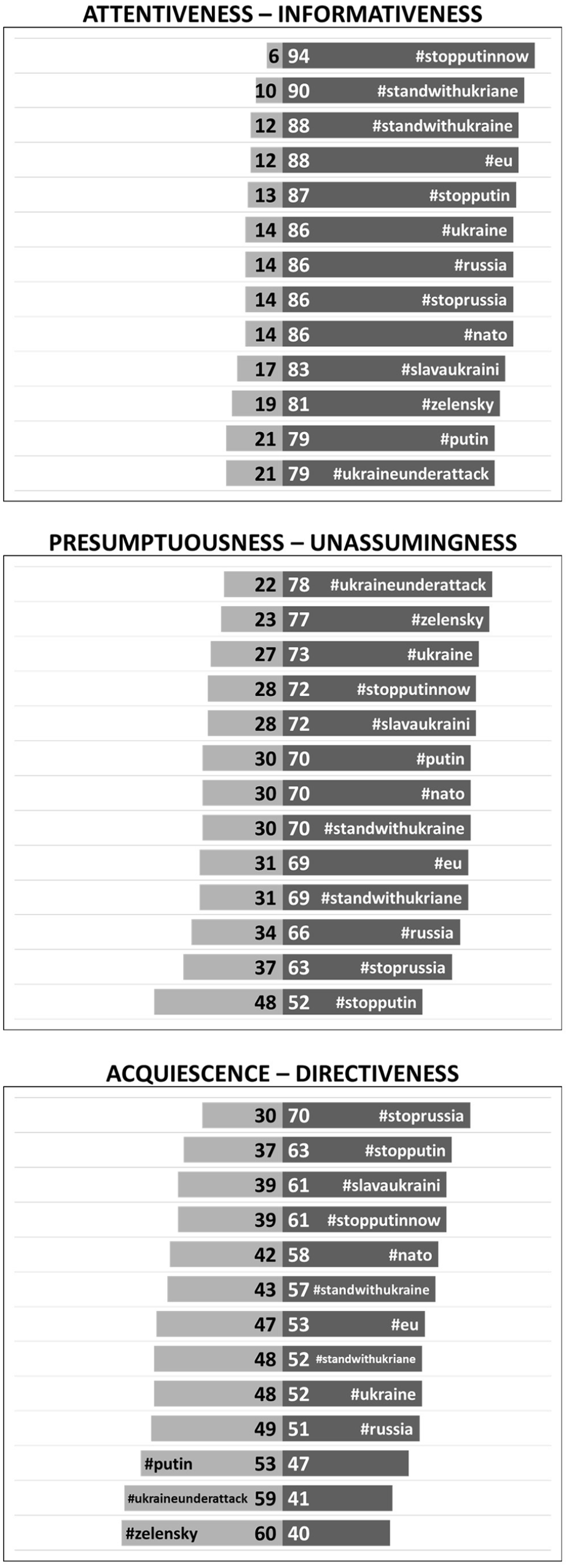
Percentage distributions for each social role dimension depending on hashtag.
Imperative hashtags #stoprussia, #stopputin, and #stopputinnow were associated with more directive roles than hashtags #zelensky, #ukraineunderattack, and #putin. In fact, the public was more acquiescent with the latter, rather labeling hashtags. Taken together, these findings show that different social roles were manifested within different hashtags.
Social Role Manifestations and Twitter Interaction
RQ4 enquired about the public manifestations of the social roles in association with Twitter’s interactive features. As with the VRMs, social role manifestations were associated with how much interaction was elicited. The more informative (and less attentive), unassuming (and less presumptuous), and acquiescent (and less directive) the role, the more subsequent the interaction. The linearity of these relationships (Figure 9) suggests that social role manifestations can affect the flow of communication in such a way that certain roles promote the joining of others in conversations and certain roles do the opposite.

Percentage distributions for each social role dimension depending on achieved interaction (none-high).
This indicates that social role manifestations in the initial responses can guide how deliberation continues. The differences were largest within the acquiescence-directiveness dimension, which suggests that it is probably the most significant one in terms of generating interaction. Overall, this may relate to Twitter’s characteristics as a platform. In this case, much of the directive tweeting was in fact targeted at political leaders in various countries. While these intended targets may well receive the messages, they might not directly interact with the senders. Despite the apparent possibilities of bottom-up communication, a kind of threshold remains between users of different statuses.
Discussion
This explorative study investigated the VRMs in quote tweets citing President Zelensky’s tweets in the months that followed Russia’s 2022 invasion of Ukraine. Regarding PD, the people who sent these quotes constituted one part of the listening public that participated in discussions about Ukraine amid a serious crisis. They can be considered listeners because of their responsive communication behavior. They were part of a global or international public because they responded to rhetorical statements about an international relations issue. Regarding issues, this study focused on responses to tweets that dealt with Ukraine’s potential future membership in the EU.
One of the major findings of this study was that nearly one third of the public’s VRMs had an edification intent. This means that a large part of the listening public operated in information-sharing mode. During uncertain times, information-seeking naturally becomes a significant part of human behavior (Sellnow & Seeger, 2013), and Twitter has been shown to facilitate activities that relate to situational awareness and sharing of information (Stieglitz et al., 2018). Thus, information-sharing was a potential way to serve other users. By responding in an information-sharing mode, the listening public sought to fulfill others’ need for information. Simultaneously, it could show that it was on top of situation.
However, a gradual increase in the disclosure/edification ratio indicated that another major response mode was also present. The disclosure mode was more about expressing feelings explicitly, and it became stronger over time. This behavior feeds the affective dimension of public deliberation; such emotional or even self-interested evaluation criteria are shared broadly, if not universally (Burkhalter et al., 2002) and can thus also increase the sense of community. Importantly, this mode was also about sharing personal opinions; a behavior that fundamentally builds a deliberative foundation for rational debate. Where President Zelensky set the agenda, suggesting what the public should think about, the listening public took on a more complex framing role, suggesting how to think about it.
One possible explanation for the changes in the disclosure/edification ratio is that the developing international situation gradually allowed for a more personal approach. Providing information was important in the beginning, but its importance gradually decreased, and space was created for other communication. Another explanation would be that the composition of the public, that is, the discussants, changed over time. Then the changes would be explained by individual communication styles, preferences, and goals. Different compositions of the public could also explain some of the differences between hashtags. Different segments of the global public may use different hashtags and manifest different social roles. Hashtags also serve different purposes, likely driving different modalities.
Despite being largely descriptive, the findings of this study bring out new and important knowledge about PD and its deliberative aspects. This study has also identified patterns and trends regarding the connections between VRMs and subsequent interactions. Social media has made PD a two-way street, and this study confirms that this street also has multiple lanes. The examined public responses can be roughly divided into two different functional types. For the first type—responses to the situation via Zelensky’s tweets—the key functions were information-sharing and public persuasion. The second type—responses to Zelensky via quotes—functioned as means of social support and expression of feelings. To some extent, this support was probably channeled to the entire Ukrainian nation.
Taken together, these response types contribute to deliberativeness; perhaps not strictly from an issue-oriented problem-solving perspective, but in the sense that they weave together analytical and social aspects of deliberative reflection. It is perhaps too simplifying to say that social media merely enables deliberative conversations around important international topics. The results of this study show that social media—and more specifically, their users—can create opportunities for the formation of deliberative communities. Such communities form through the microrelationships between people and have the potential to grow into international publics based on shared values and situational awareness, a likely requisite for successful rhetorical diplomacy. In this case, President Zelensky succeeded in what Niemeyer (2020) calls “the activation of existing deliberative capacities” (p. 25), which can lead to “the reconfiguration of higher-level in ways that better reflect citizens’ reflexivity” (p. 25). Ukraine’s EU membership will not come true without extensive public support in the current member states, and in democracies, such public support needs to be either secured or declared non-existent through open public debate and a reflexive process by citizens. In terms of democratization of diplomacy, deliberativeness can increase the effectiveness of diplomatic processes and provide necessary reality checks (Lisiecka-Zurowska, 2019). For this dynamic to function properly, the public also needs to understand its role and potential; the findings of this study are one opportunity to further such understanding.
Interestingly, response modes that contributed to directive social role elicited much less interaction than response modes associated with acquiescent social role. In this case, diligent presentation of demands did not demonstrate dialogic virtuosity (Pearce & Pearce, 2000) to the degree that would be desirable in terms of deliberativeness. Although what was seen in terms of interaction was not necessarily a perfect indication of an unending openness (Waisanen, 2014), manifestations of acquiescent social role appeared to be a more likely builder for a stronger foundation for deliberation. In this sense, such mode of listening seems to be a desirable communication enabler in PD (Di Martino, 2020). Directive behavior may be an indication of the potential of social media to empower people, but it seems that it does not help keep the conversation going when it comes to public deliberation within PD. However, results are not generalizable as such, and they only apply to the case in question.
The fact that half of the quotes did not receive any reactions from other users raises the question of reciprocity within this type of social engagement. This finding is consistent with the findings on local-level political communication that the highest levels of influence and digital authority on Twitter are concentrated to a relatively small number of actors (Casero-Ripollés, 2021). Therefore, users who do not create a noticeable interaction with their messages may lack digital authority (Goritz et al., 2022). VRMs appear to relate to this, as informative, unassuming, and acquiescent social role manifestations received more reactions than attentive, presumptuous, and directive role manifestations. This connection between VRMs and digital authority is something that future research should pay attention to. While the lack of reactions reflects a phenomenon Baeza-Yates and Saez-Trumper (2015) describe as a digital desert, “content that [. . .] is never seen by anyone else” (p. 72), many of the quotes that made up this desert were not in vain. In principle, their deliberative significance was perhaps minor, and they could even have been problematic in terms of deliberation, potentially being opinions that were not listened to. However, the numbers do not tell the whole truth. They could well have fulfilled the goals of parasocial interaction set for them. Although many quotes did not elicit any comments, likes, or shares, others can privately receive them and interpret situations and issues based on them. Such behavior just cannot be captured with the research method used in this study.
Overall, methodologically, the VRM taxonomy provides a feasible analytical framework for social media research. The combination of coded data and Twitter metrics provided interesting and consistent results. However, what significantly limited the application of the taxonomy was the fact that the intended recipients of the quotes varied. This may have led above all to a situation where many utterances that were reflections were instead classified as edifications. Clearly, this limitation was not caused by the capabilities of the VRM taxonomy per se. On the contrary, the taxonomy showed its strength as almost all utterances could be assigned into a specific category. In future studies, significant benefits could be achieved if the VRM taxonomy was used in tandem with other methods, such as network analysis. To analyze deliberation more comprehensively, other methods are needed because “the VRM system does not incorporate an evaluative, or positive-negative dimension” (Stiles, 1992, p. 91). The reliability of using the taxonomy to investigate social media should also be developed and evaluated more thoroughly in the future.
Another limitation is that attention was only paid to a fraction of the public’s activities. Only quotes were studied, and even for them, the total number of tweets quoting President Zelensky was significantly higher than the number of quotes that were collected (quotes in English). In addition, each root tweet mentioned Ukraine’s possible EU membership, but they were not solely about that issue. Similarly, the analyzed quotes did not only concern the EU issue. Hence, it is not possible to conclude from the findings what kind of conclusions were drawn on the issue. Nevertheless, examining how public communication takes form through listening behavior is an equally important aspect in terms of deliberation (Burkhalter et al., 2002). Practitioners, whether PD professionals or any other members of the public, can probably find the results useful as they plan, implement, and analyze communication on social media.
To communication and PD researchers, this study facilitates understanding of how an international public comes into being and of the ways in which it operates. For instance, Ercan et al. (2019) of course talk about deliberative democracies as they discuss about the potentials and perils of communicative plenty, but their ideas can be projected toward PD. The term refers to the “increased volume of information, communication and activities [. . .] in contemporary democracies” (Ercan et al., 2019, p. 21). The global public forms the largest imaginable communicative plenty. Deliberation does not come without problems with such a large group of people, but “the solution may [. . .] lie in thinking about where to place spaces and moments of reflection in the deliberative system” (Ercan et al., 2019, p. 30). In terms of international issues, social media greatly contribute the creation of the communicative plenty but also provide necessary spaces and moments. One clear social and democratic implication of the results is that the international (or global) public can operate forcefully in various modes, as it projects its values and ideas on the international arena (Castells, 2008). Not all cross-border social media communication is disinformation or covert foreign influence attempts. The findings of this study show that the public is active and regenerates itself through the chaining of messages (Warner, 2002). In a certain sense, PD research has been too preoccupied with country image and face negotiation. Hence, future studies should take a closer look at international deliberation and the global public’s problem-solving ability.
Footnotes
Declaration of Conflicting Interests
The author(s) declared no potential conflicts of interest with respect to the research, authorship, and/or publication of this article.
Funding
The author(s) received no financial support for the research, authorship, and/or publication of this article.
