



Abstract
Mental health content on social media usually highlights positive emotions, especially hope. This article presents an experimental study on the effects of hopeful social media posts on Instagram. Drawing on appraisal theory and the phenomenon of spillover effects, we developed a 2 × 2 between-subjects post-test experiment, where we manipulated the message type (i.e., hope message vs. control condition) and the level of endorsement (i.e., high vs. low number of likes) of Instagram posts. Following exposure to our media stimuli, we studied the effects on subsequent levels of hope, life satisfaction, mental health stigma, willingness to disclose about mental health, and willingness to provide support on social media among a sample of n = 479 young adults (Mage = 20.97 years, SD = 2.10). Our pre-registered analysis revealed no significant main or interaction effects in the predicted direction. We discuss the findings in the context of health communication, reflect the study’s limitations, and provide suggestions for future research.
Introduction
According to the World Health Organization, mental health can be defined as a state of mental well-being that allows people to cope with the daily stressors of life (World Health Organization, 2022a). Mental health is a broad concept encompassing various aspects, such as mental illness and well-being (Mental Health Literacy, 2023). Overall, mental health is gaining increasing public attention and has been prioritized (World Health Organization, 2022b). As a result, there have been increasing efforts to raise public awareness, also on social media (Klin & Lemish, 2008; Pirkis et al., 2006; Reavley et al., 2016).
Mental health prevention and promotion on social media frequently focus on well-being by sharing wellness practices, inspiring others, and emphasizing recovery through everyday pictures and selfies (N. Lee et al., 2020; Pavlova & Berkers, 2020) while also highlighting positive emotions, such as hope (Carmichael et al., 2019; N. Lee et al., 2020; Lindgren & Johansson, 2023). Prior research revealed that one-third of Instagram posts using the hashtag #depression are characterized by inspiration and hope, focusing on recovery-oriented mental well-being (McCosker & Gerrard, 2021). Moreover, social media platforms actively encourage users to apply an optimistic and hopeful perspective, for example, by using hashtags referring to recovery or awareness (e.g., #mentalhealthrecovery, #mentalhealthtips, #mentalhealthmatters) and banning other hashtags as part of their safety policy (Meta, 2023). Beyond the context of mental health specifically, messages related to hope and inspiration, such as encouragement or overcoming obstacles, are frequently shared on social media (Dale et al., 2020; Oliver, 2022; Rieger & Klimmt, 2019b), and it has been reported that most people come across inspirational and eudaimonic media content daily (Oliver, 2022; Oliver et al., 2021; Rieger & Klimmt, 2019a).
Compared to other emotions, such as fear or humor, little is known about the potential beneficial effects of hope as a persuasive message strategy (Chadwick, 2015), especially with regard to health communication. However, in light of past and ongoing global crises, such as the COVID-19 pandemic and climate change, researchers have developed a heightened interest in studying hope (e.g., Kerret et al., 2020; Nan et al., 2022; Volkman et al., 2022). Thus far, research shows that messages emphasizing hope increase message effectiveness, positively influence health behaviors (Volkman et al., 2022), and enhance hope (Chadwick, 2015). Relatedly, exposure to inspirational media content has been found to elicit increased compassion, prosocial motivations, and feelings of connectedness with others (Oliver, 2022).
Given the prevalence of well-being and hope messages in the context of mental health and beyond, to our knowledge, this study investigates, for the first time, various outcomes following exposure to hopeful social media posts. Specifically, this study aims to enrich the positive communication literature in three ways: First, we test the effectiveness of social media hope messages—providing further knowledge about media effects and emotions, namely hope and well-being. Second, given the prevalence of well-being and hopeful messages in the context of mental health, we broadened our research scope to other concepts relevant to this research area, namely mental health stigma, willingness to disclose one’s mental health issues, and supporting those who reach out for help on social media. Hence, we took a holistic approach by studying emotional (hope, life satisfaction), attitudinal (mental health stigma), and behavioral (disclosure and support) outcomes following exposure to hopeful social media posts. Third, we investigated the role of user engagement (i.e., likes) to account for metrics that are integral to the social media environment. As such, we recognize the unique social media environment for potential message effects. To this end, we conducted a pre-registered between-subject survey experiment by manipulating the message type (i.e., hope message vs. control condition) and user engagement (i.e., high vs. low number of likes) of social media posts about mental health to investigate the effects on levels of hope, life satisfaction, mental health stigma, mental health disclosure, and mental health support.
Hope Messages
Hope has been mainly studied within positive psychology (Fredrickson, 2001b), which focuses on the positive side of the emotional spectrum, including subjective experiences related to hope, inspiration, happiness, and well-being (Myers, 1992; Seligman & Csikszentmihalyi, 2000; Snyder & Lopez, 2001). Gradually, communication scholars also garnered interest in studying positive media effects, including research on eudaimonic media experiences (e.g., Meier & Reinecke, 2023) and positive media psychology (de Leeuw & Buijzen, 2016; Raney et al., 2020).
Hope is defined as a strong desire, wanting something to happen or to be true, and that is actively pursued (Martin, 2011). Hopeful thinking is considered a positive emotion (Chadwick, 2015; Nabi, 2015) and has been correlated with higher levels of life satisfaction, positive affect, overall happiness, and lower negative affect (Pleeging et al., 2021). Hope appeals refer to the persuasive strategy relying on this particular emotion (Chadwick, 2015; Nabi, 2015), and such messages emphasize “that a future outcome (a) is possible, (b) is important, (c) is consistent with the receiver’s goals, and (d) will create a much better future.” (Chadwick, 2015, p. 601).
In the context of health communication, hope appeals were shown to positively influence vaccine-related information-seeking intentions (Nan et al., 2022; Volkman et al., 2022) and intentions for preventive health behavior (Lu & Yuan, 2023; Nabi & Myrick, 2019; Nabi & Prestin, 2016). Relatedly, literature on suicide reporting shows that a focus on hope and healing can have preventive effects among vulnerable groups (Niederkrotenthaler et al., 2022). In science communication, hope appeals have been shown to be a powerful strategy to elicit change, directly and indirectly influencing behavior and behavioral intentions (Feldman & Hart, 2016; Marlon et al., 2019; Ojala, 2012).
More germane to our focus on social media content, previous research found that online exposure to inspiration and meaningfulness elicits positive emotions and increases people’s well-being (Meier et al., 2020; Rieger & Klimmt, 2019). Specifically, eudaimonic and inspirational media content yields outcomes comparable to what is presented (Rieger & Klimmt, 2019a), with hopefulness being one of those responses (Oliver et al., 2021). In sum, the preliminary evidence suggests that exposure to hope messages is a potentially useful strategy to elicit hope, positively influence well-being, and possibly influence behavior intentions among the audience.
This effect can be explained by appraisal theory, which postulates that emotions, in this case, hope, can be extracted from (mediated) events (Scherer et al., 2001). When social media hope messages are perceived as hopeful, they could result in feeling hopeful. In addition, the broaden-and-build theory (Fredrickson, 1998, 2001a; Fredrickson et al., 2003, 2008), rooted in positive psychology, proposes that experiencing positive emotions, such as hope, could not only enhance positive feelings but also transfer to subjective states of well-being, such as life satisfaction. In our case, we assumed that hope messages not only evoke hope but also offer support for those struggling with mental health issues by encouraging that things will improve, ultimately positively impacting their momentary well-being. In addition, for those not experiencing mental health issues, hope messages might serve as a reminder or reassurance that they are doing well. Against the theoretical and empirical background, we expected a positive effect of social media hope messages on individuals’ subsequent levels of hope and well-being.
Emotion Spillover Effects: Hope Messages and Mental Health
In addition to the positive effects of hope and well-being, we assumed a spillover effect on related concepts, namely mental health stigma reduction, increased willingness to disclose own mental health issues, and increased willingness to provide support to those struggling with mental health (Ahluwalia et al., 2001; Raufeisen et al., 2019). Emotion spillover effects occur when information regarding specific attributes in a message also influences beliefs about attributes not explicitly mentioned in that message (Ahluwalia et al., 2001; Raufeisen et al., 2019). Imagine a scenario where a film elicits a strong emotional response. This emotional response can affect the audience’s subsequent preferences for products shown in advertisements (Yegiyan, 2015). Even if the ads themselves do not evoke any emotional response, they benefit from an “emotional spillover” effect generated by the film, shaped by shared mental connections and similar characteristics.
In the context of inspiring media, Oliver and colleagues (2021) postulate that the affective response (in our case, hopefulness) can lead to various affective (e.g., feelings of caring and compassion), cognitive (e.g., prejudice reduction), or conative outcomes (e.g., social sharing, altruism). For example, it has been shown that individuals who respond hopefully to disclosures about mental health are also more likely to share their own experiences with mental health issues (Pavelko & Wang, 2021). Although research on inspirational media is fairly new, studies investigating audience responses to inspiring content provide evidence for this model (Oliver, 2022; Oliver et al., 2015, 2021).
Another explanation for spillover effects can be found in the literature on media priming. In a nutshell, media priming refers to the phenomenon where exposure to media influences subsequent judgments or behaviors (Roskos-Ewoldsen & Roskos-Ewoldsen, 2008). Informed by cognitive psychology, it is assumed that media exposure might activate existing mental networks that are subsequently cognitively more salient or available (i.e., spreading activation). Hope is not only associated with optimism and faith but also resilience (Ong et al., 2023). Our incredible ability to maintain hope in the midst of vulnerability, pain, and loss is a powerful testament to our resilience. As such, we argue that hardship, obstacles, and challenges that need to be overcome become more salient when being exposed to social media hope messages. On the other hand, evidence suggests that current mental health-related content on social media also emphasizes hope, inspiration, and recovery (McCosker & Gerrard, 2021). Hence, we assumed that concepts of mental health issues and stigma should become salient following brief exposure to generic social media hope messages. Finally, the assumed spillover effects could stem from reflective thinking, as shown in the previous research on eudaimonic media entertainment (Bartsch et al., 2014, 2018; Bartsch & Schneider, 2014). Reflective thinking could result in questioning existing thought patterns, including mental health stigma and stereotypes, which in turn possibly result in stigma reduction (Corrigan, 2000; Hecht et al., 2022). Following the rationale presented earlier, we proposed the following hypothesis:
Likes as Endorsement Cues in Social Media
A core feature of social media is its interactivity (Fardouly et al., 2017; Wei & Hindman, 2011; Xu, 2020), allowing users to communicate and react online, such as through comments and likes. From a theoretical perspective, endorsements, such as likes and comments, can serve as heuristic cues for social media users in information processing. Due to the endless feeds of messages and limited motivation to process all messages with high effort, users rely on these heuristic cues (Sundar, 2008). Messages with many likes or comments signify importance and credibility, directing attention and facilitating processing (Luo et al., 2022; Sundar, 2008).
In line with this reasoning, empirical evidence has shown that social media endorsements (i.e., likes) impact brain activity and overall message liking (Sherman et al., 2018). Furthermore, many likes positively influenced users’ behavior change intentions (Kim, 2018; Sherman et al., 2018). However, not all studies could reproduce the amplifying effect of social media endorsements. For example, in the context of body image research, the number of likes did not moderate the effect on mood or body image (Lowe-Calverley & Grieve, 2021). Based on the idea that likes can serve as heuristic cues signifying importance, we assumed the postulated effects of exposure to hope messages would be amplified when combined with a high number of likes. Therefore, the following hypothesis has been formulated:
Figure 1 presents an overview of our proposed hypotheses.

Visual presentation of the hypotheses.
The Current Study
A survey experiment examined the effects of exposure to hope messages on social media on subsequent levels of hope, life satisfaction, mental health stigma, willingness to disclose mental health online, and willingness to provide support online. Furthermore, we tested the moderating role of endorsement cues on these effects (Kim, 2018; Luo et al., 2022; Sherman et al., 2018; Sundar, 2008). For this purpose, we conducted a pre-registered online experiment among emerging adults.
Our focus on emerging adults (18–29 years) was driven by two reasons. First, emerging adulthood is one of the most unstable and stressful periods in life, with many uncertainties and decisions to make in this transitional phase of life (Arnett, 2015). These challenges are underscored by the high prevalence of mental disorders among emerging adults (Kessler et al., 2005). Second, social media, especially Instagram, is extremely popular among emerging adults; 88% of 16- to 24-year-olds and 72% of 25- to 34-year-olds report using Instagram in Belgium, where the study was conducted (Sevenhant et al., 2021). Hence, in order to provide recommendations for future health communication campaigns among this demographic, it needs to be studied first.
Materials and Methods
Open Science
The hypotheses, operationalizations, exclusion criteria, and analysis steps were pre-registered on the Open Science Framework (OSF): https://osf.io/fst2k/?view_only=a586ceedf46b4b978e3299646b2d0f97
The original data set and analysis syntax are available online.
Deviation from Pre-Registration
During the peer-review process, we made the decision to drop one of the hypotheses that we had initially included in our pre-registration. This hypothesis suggested that endorsement cues would have a main effect on our dependent variables. We had included this hypothesis in our pre-registration in an effort to make the pre-registration as accurate as possible. However, upon further consideration, we realized that the effect of endorsement cues is only relevant when studied within the context of the content. In other words, there was no plausible theoretical reason to believe that the mere number of likes would affect subsequent levels of hope, stigma, life satisfaction, self-disclosure, or support without taking the post context into account.
Hypotheses and analyses for life satisfaction were not pre-registered; however, life satisfaction was included during data collection.
Furthermore, we chose not to include education as a control variable due to the fact that 98% of our sample were graduate students. Even when including education as a covariate, our findings did not change in terms of direction or significance levels. We provide the findings for all pre-registered hypotheses and all pre-registered analyses as supplementary material on OSF.
Participants
This study made use of a convenience sample consisting of emerging adults. Following our pre-registered inclusion and exclusion criteria, we included only participants who provided consent to take part in the study and excluded those who (a) fell outside the age range of 18–29 years, (b) had an overall duration below one-third of the sample’s median, (c) who did not finish the online survey until the second to last page, and who (d) did not pass both attention checks prior to analysis. The final sample was n = 479, and 71.4% (n = 342) of them were women, 28.2% (n = 135) men, and 0.4% (n = 2) identified as non-binary or other. The mean age was 20.97 years (SD = 2.10). For further analyses, we collapsed the gender variable into a dummy variable (1 = woman, 0 = men) and removed other genders from the sample due to a lack of statistical power. Almost all participants (99%, n = 478) indicated having a high school degree or higher, and 98% were university students.
Design and Procedure
The university’s ethical board approved the study prior to recruitment and data collection. We conducted an online survey experiment with a 2 × 2 factorial between-subjects design in a convenience sample of n = 479 participants. The first factor was message type (i.e., hope message vs. control condition), and the second was social media endorsement (i.e., high vs. low number of likes), which was manipulated via the number of likes to each Instagram post. Data were collected in Spring 2022 within the context of an undergraduate communication research seminar at KU Leuven, where course participants shared the link to the online experiment in their social network.
Upon informed consent, participants were randomly assigned to one of the four conditions, with n = 126 (26.3%) in the hope message and low endorsement condition, n = 112 (23.4%) in the hope message and high endorsement condition, n = 118 (24.6%) in the control message and a low endorsement condition, and n = 123 (24.7%) in the control message and high endorsement condition. Participants were deceived about the study’s aim. With the help of a cover story, we asked participants to assess the realism and professionalism of 10 Instagram posts by an upcoming digital artist. The posts were presented randomly, and participants could proceed at their own speed. Subsequently, participants were asked to participate in a survey about social media use and personality, where they filled in the survey questions for our dependent, control, and demographical variables.
Materials
Following the typical hopeful mental health posts on social media at the time (N. Lee et al., 2020; Lindgren & Johansson, 2023), we created 10 Instagram posts with positive cartoon-like illustrations combined with a hope-eliciting quote for the hope condition. The stimuli were designed to resemble mental health art on Instagram (Griffith et al., 2021). The quotes were meant to elicit hope by stating that a positive future is possible, important, consistent with one’s goals, and will create a better future (Chadwick, 2015). Specifically, the characteristics of the hope messages are inspirational and imply resilience and hardship: “The best view comes after the hardest climb” and “Grow through what you go through.”
For the control condition, we used mundane quotes and tips, mimicking entertaining posts or lifestyle news, as commonly seen on Instagram, for example, “Six air-cleaning houseplants.” Drawing on empirical research investigating social media endorsement cues (Lowe-Calverley & Grieve, 2021; Luo et al., 2022), we manipulated social media endorsement by either displaying posts with a high number of likes (between 950 and 1,000, e.g., 964 likes) or a low number of likes (between 50 and 100, e.g., 64 likes). Although it can be debated whether this number of likes can be considered high, it was determined to be substantially higher than the usual engagement on social media platforms for regular users. Finally, the experiment had four conditions: control message with a low number of likes, control message with a high number of likes, hope message with a low number of likes, and hope message with a high number of likes, as shown in the Appendix.
Before conducting the study, we sought expert feedback to evaluate our stimulus material. In the initial round, we asked seven peer experts to assess the stimuli and the intended manipulation. After adjusting the stimulus material, we asked four other communication researchers to assess the authenticity of our stimuli. We implemented the stimuli into our study after making minor adjustments based on the expert feedback.
Manipulation Check
As for our manipulation check, we asked participants to rate the Instagram posts on a semantic differential scale with endpoints ranging from hopeless (−3) to hopeful (3) and a neutral middle point (0), which we later recoded to a seven-point scale, ranging from 1 to 7, with higher values indicating higher levels of hope. Participants in the hope condition perceived the Instagram posts as more hopeful (M = 5.61, SD = 1.21) than participants from the control condition (M = 5.05, SD = 1.18), t(477) = −5.16, p < .001. Despite the statistical difference, it should be acknowledged that the difference between groups was rather small.
Measures
Dependent Variables
Hope
Hope was measured using the Adult Hope Scale (Snyder et al., 1991), consisting of 12 items. Participants were asked to answer them on a five-point Likert-type scale ranging from 1 = completely false to 5 = completely true (example item: “I can think of many ways to get out of a jam”; M = 3.72, SD = 0.42, Cronbach’s α = .73). The complete list of all items used in this study can be found on OSF.
Life Satisfaction
We used a five-item measure for life satisfaction (Diener et al., 1985), where participants could indicate their agreement on a five-point scale ranging from 1 = strongly disagree to 5 = strongly agree (example item: “In most ways, my life is close to my ideal”; M = 3.26, SD = 0.66, Cronbach’s α = .73).
Mental Health Stigma
We measured mental health stigma using the stigma scale implemented by Wong et al. (2017), adapted from the works of Hoffner & Cohen (2012) and van ‘t Veer et al. (2006). Participants were asked to indicate their agreement on a five-point Likert-type scale with seven items, ranging from 1 = strongly disagree to 5 = strongly agree (example item: “People with a mental illness are dangerous”; M = 2.28, SD = 0.45, Cronbach’s α = .65).
Disclosure
We measured willingness to disclose mental health on social media with an adapted seven-item scale by Pavlova and Berkers (2020) to make them fit the social media context (example item: “I would talk on social media about my mental health problems”). Participants indicated how likely it would be for them to engage in the described behavior using a five-point Likert-type scale ranging from 1 = very unlikely to 5 = very likely (M = 2.32, SD = 0.79, Cronbach’s α = .87).
Willingness to Provide Support
Based on previous studies (Elhai et al., 2008; Rossetto et al., 2014), we used a self-developed scale to measure willingness to provide support to a person discussing mental health on social media. An example item was “When someone discloses about mental health on social media, how likely is it that you would offer support?” Participants indicated how likely they would engage in the described behavior, ranging from very 1 = very unlikely to 5 = very likely (M = 3.49, SD = 0.83, Cronbach’s α = .89).
Control Variables
We used six items to gauge participants’ degree of affectedness with mental illness. We measured their indirect experience with mental illness by asking participants to indicate whether they have (a) a friend, (b) a family member, or (c) a relative who currently struggles or struggled in the past with mental health issues. We measured immediate experience with three questions, asking whether participants are (a) currently struggling with mental health issues, (b) whether they struggled in the past, and (c) whether they had received a formal diagnosis for a mental disorder in the past. Answer options to all questions were yes, no, or prefer not to answer. Dummy variables were created for immediate (62.42%) and indirect experience (91.86%) with mental illness by summing up the three items and dichotomizing them. These control variables were used to measure respondents’ past and current degree of affectedness with mental health because it might affect the processing of such messages.
Regarding participants’ social media use, we used the 10-item Social Media Use Integration Scale (SMUIS) by Jenkins-Guarnieri et al. (2013). An example item was, “I would love it if everyone used social media to communicate.” Participants indicated their agreement on a five-point scale ranging from 1 = strongly disagree to 5 = strongly agree (M = 2.96, SD = 0.54, Cronbach’s α = .70). We included this variable to rule out familiarity with sharing and discussing content on social media as a confounding factor in our study.
Relatedly, we also asked about participants’ involvement with mental health content on social media (example item: “I follow influencers on social media who sometimes discuss mental health”) with a self-developed eight-item scale. Participants indicated their agreement on a five-point Likert-type scale ranging from 1 = strongly disagree to 5 = strongly agree (M = 2.53, SD = 0.77, Cronbach’s α = .86).
Regarding sociodemographic data, we asked participants about their gender (man, woman, non-binary, other), age, highest educational level, and whether they were studying at a university.
Results
Analytical Strategy
We ran five linear regressions predicting hopefulness, life satisfaction, mental health stigma, willingness to disclose, and willingness to provide support. We created a dummy variable for message type (0 = control, 1 = hope condition). We created three dummy variables for the presence of (a) hope message with a high number of likes (1 = present, 0 = not present), (b) hope message with a low number of likes (1 = present, 0 = not present), and (c) control message with a high number of likes (1 = present, 0 = not present). Here, the condition with the control message and a low number of likes served as a reference condition in the regression analysis. As covariates, we included direct and indirect experience with mental health (dummy-coded), involvement with mental health content on social media, social media use, age, and gender (dummy-coded, 0 = man, 1 = woman). The results did not change when running the analyses without the covariates. The syntax with the analyses can be found on OSF.
Post Hoc Power Analysis, Randomization Check, Preliminary Analyses
A post hoc power analysis was performed using G*Power (Faul et al., 2007) to assess the attained statistical power based on our sample size (n = 479). The analysis indicated a power of 0.68 for small effect sizes (f = 0.15) and 0.99 for medium effect sizes (f = 0.25), which is considered sufficiently powered to detect medium-sized media effects with a cutoff criterion of 0.80.
A randomization check, executed through an ANOVA for age and a chi-square test for gender and degree of affectedness, showed no differences across our four experimental conditions regarding age, F(3, 473) = 0.42, p = .742, gender, χ2(3, N = 477) = 2.49, p = .477, or direct experience with mental illness, χ2(3, N = 479) = 0.98, p = .992. Thus, randomization was successful.
As for the preliminary analyses, the means for the dependent variables were compared for each condition. Table 1 displays the means and standard deviations per condition for hope, life satisfaction, mental health stigma, disclosure, and support. Table 2 displays the zero-order correlations of the dependent variables and control variables.
Means and Standard Deviations for the Dependent Variables per Experimental Condition.

Zero-Order Correlations Among the Dependent Variables and Covariates.

Note. Direct and indirect mental health experience and gender (woman) were dummy-coded.
p < .05; **p < .01.
Testing of Hypotheses
Table 3 provides an overview of our results from the regression analyses. In our first hypothesis (H1), we postulated a main effect of the hope message type (vs. control condition) on our dependent variables. We found no significant effects of message type (hope: b = −.01, CI = [−0.08, 0.07], p = .838; life satisfaction: b = −0.06, CI = [−0.17, 0.05], p = .311; stigma: b = −0.03, CI = [−0.11, 0.05], p = .523; disclosure: b = −0.01, CI = [−0.14, 0.11], p = .827; support: b = 0.01, CI = [−0.14, 0.15], p = .920). Thus, H1 was not supported.
Regression Analyses of Message Type with Hope, Life Satisfaction, and Stigma as Dependent Variables.

Note. *p < .05. **p < .01. ***p < .001.
In our second hypothesis (H2), we expected an interaction effect between hope message (vs. control condition) and endorsement (i.e., high vs. low number of likes) on our dependent variables. Specifically, we expected that in the hope condition, a high number of likes would predict higher levels of hope and life satisfaction, lower levels of stigma, higher willingness for self-disclosure, and provision of online support when compared to those exposed to the low number of likes. The linear regression analyses revealed one significant difference compared to the reference group on participants’ levels of life satisfaction. Participants in the control message and many likes had higher levels of life satisfaction than the reference category (i.e., control message and low number of likes; b = 0.18, CI = [0.02, 0.33], p = .029). We found no further significant results on our dependent variables. The results can be found in Table 4 and in Figures 2-6.
Regression Analyses of Conditions with Hope, Life Satisfaction, and Stigma as Dependent Variables.
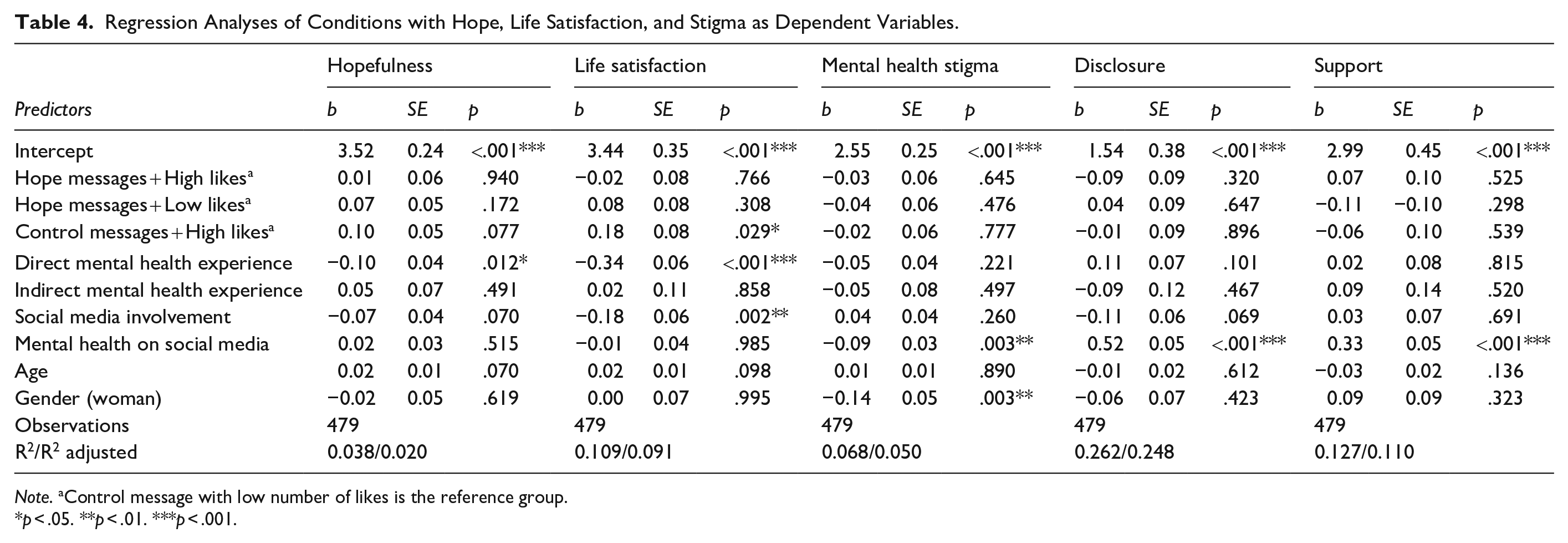
Note. aControl message with low number of likes is the reference group.*p < .05. **p < .01. ***p < .001.

Mean scores for participants’ levels of hope across experimental conditions.

Mean scores for participants’ levels of life satisfaction across experimental conditions.
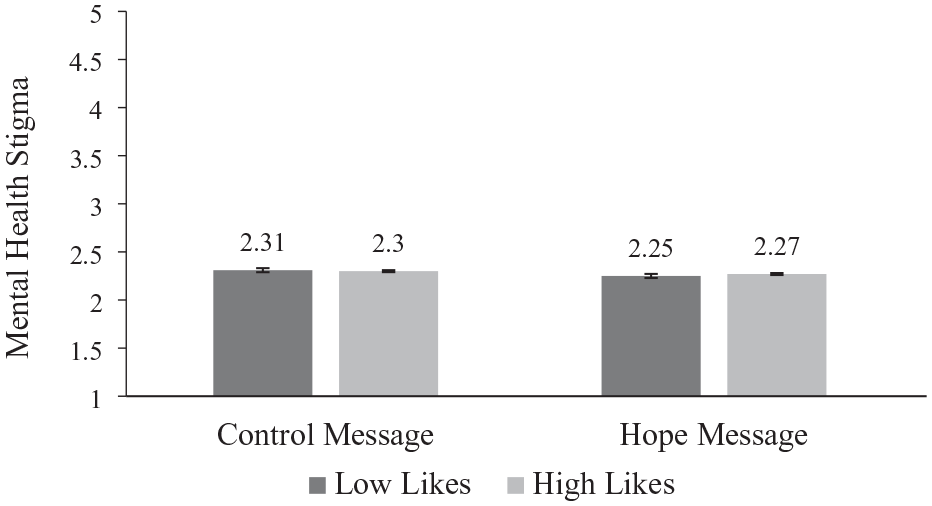
Mean scores for participants’ levels of mental health stigma across experimental conditions.

Mean scores for participants’ levels of disclosure across experimental conditions.

Mean scores for participants’ levels of support across experimental conditions.
Discussion
With this study, we aimed to explore the effects of hope messages and user endorsement on social media posts with a pre-registered survey experiment. Drawing on the theoretical framework of appraisal theory and spillover effects, we expected that exposure to hope messages would positively affect emerging adults’ levels of hope and life satisfaction, resulting in lower levels of mental health stigma as well as higher willingness to disclose mental health online and to provide support online. Furthermore, we assumed that user endorsements, operationalized as a high number of likes, could serve as a moderator and would further amplify these postulated effects. Yet, our study provides no empirical support for our hypotheses. We found one significant interaction effect. Hereinafter, we first discuss the nonsignificant main effects, followed by a discussion of the interaction effect.
Our findings contrast earlier studies, which showed that exposure to meaningful and inspirational content elicited positive emotions (Rieger & Klimmt, 2019a), hopefulness (Oliver et al., 2021), and overall well-being (Meier et al., 2020).
Several explanations could describe the nonsignificant direct effects on hope in our experimental study. It is also possible that due to the abundance of hopeful and inspirational content on social media (e.g., N. Lee et al., 2020; Oliver et al., 2021; Rieger & Klimmt, 2019a), our participants may be accustomed to this kind of material online. Therefore, the stimuli were possibly not strong enough to detect any short-term effects. Thus, by ensuring high external validity and mirroring current well-being and mental health posts on social media (N. Lee et al., 2020; Pavlova & Berkers, 2020), they were possibly too subtle to elicit hope and well-being. Future research could emphasize hope in the stimuli by explicitly using terms like “hope” and “hopefulness” in the post captions or comments. Another option would be to incorporate video material or narrative stories instead of still images to create an even more engaging stimulus.
Furthermore, previous studies showed that exposure to hope messages and inspirational media can elicit prejudice reduction, de-stigmatization, social sharing, and connectedness (Meier et al., 2020; Oliver et al., 2021; Pavelko & Wang, 2021; Rieger & Klimmt, 2019a, 2019b), such spillover effect was not supported in our study. We found no de-stigmatizing effects of hope messages or any other effects on mental health disclosure online or mental health support. Since our stimuli did not evoke hope, the threshold for a spillover effect, in terms of spreading activation (Roskos-Ewoldsen & Roskos-Ewoldsen, 2008), might not have been reached. For media priming to occur, information needs to be activated from memory (Ewoldsen & Rhodes, 2019). Information is stored as nodes where related nodes are connected, and they can be activated only when exceeding a threshold (Arendt, 2015; Ewoldsen & Rhodes, 2019). In other words, the media stimulus needs to be strong enough to exceed the threshold for nodes to be activated (Arendt, 2015; Ewoldsen & Rhodes, 2019). In our case, it is possible that the manipulation did not reach the threshold to yield a priming effect. Therefore, threshold effects in the context of inspirational media need to be investigated further.
In addition, self-efficacy is an important factor in influencing support and helping intentions, and without any references to self-efficacy, individuals might feel powerless to provide meaningful support (Rains & Brunner, 2018; Rossetto et al., 2014; White & Ahern, 2023). Pairing a self-efficacy message with a hope message might lead to different results for the outcome variables (Nabi & Prestin, 2016). Without self-efficacy, it is possible that individuals do not feel capable of supporting or disclosing. Yet further research is needed to substantiate these assumptions.
Regarding willingness to disclose mental health issues online specifically, we can suspect that our sample, which consisted mainly of students, played an important factor in our nonsignificant finding. Prior research showed that college students are reluctant to disclose mental health issues on Instagram because of self-stigma and public stigma (Budenz et al., 2022). In those instances where students disclosed their mental health, they relied on indirect disclosure (e.g., sharing a quote or a song) instead of direct disclosure (e.g., openly discussing mental health issues). In our study, we investigated direct forms of online disclosure. Since our social media posts resemble indirect types of disclosure where mental health was implied through well-being, exposure to such posts might have influenced indirect, but not direct, types of online disclosure. Therefore, a more diverse sample should be studied in future research, and different forms of online disclosure should be employed. For example, direct disclosures about one’s experiences with mental health should be researched as well.
In the case of willingness to provide support, it is possible that our implemented measure did not allow for detecting such possible effects. Although we based our scale on existing measures (Elhai et al., 2008; Rossetto et al., 2014), it remained rather vague. We asked participants whether they would provide emotional support to someone who asks for help related to mental health on social media. We did not specify whether the other person is a close friend, an acquaintance, or an anonymous social media user. There was also no information on whether the support request was sent in a personal message, a support forum, or a public feed. Given that tie strength and publicness play an important role in social media interactions, the support scale should also mention supporting different groups such as friends, family, and acquaintances (Utz, 2015).
We found a significant interaction effect between message type and endorsement on life satisfaction. Participants exposed to the control message with a high number of likes (vs. control message with low likes) reported higher levels of life satisfaction. General positive social media posts may have a greater effect on life satisfaction than hopeful posts, as they do not mention the obstacles or challenges in life that need to be overcome. However, it is worth mentioning that the observed effect was rather small, and thus, albeit significant, the meaningfulness of this finding can be contested. Nevertheless, it is possible that exposure to hopeful and inspirational messages is not as impactful as previous research suggested. The effects of different types of positive messages might vary extensively. Therefore, future research is needed to disentangle various types of positive messages. Specifically, well-being and mental health messages with hope and inspiration should be further investigated because they are overly present on social media.
We also believe that it is important to take a critical stance toward mental health content presented as inspirational well-being content on social media, even though researchers have highlighted the potential to raise awareness (Elmquist & McLaughlin, 2018; N. Lee et al., 2020) and reduce stigma toward mental illnesses (Hecht et al., 2022; Wong et al., 2017). Such type of content is also considered controversial. Given the light-hearted and positive framing and overall focus on inspiration and hope, mental health and well-being recommendations often remain vague and rather superficial (Gilmore et al., 2022). This is considered problematic, as people tend to accept vague descriptions as true for themselves even though they apply to almost everyone (Meehl, 1956). Hence, the heightened awareness of mental health may also cause individuals to misinterpret their symptoms, potentially leading to an increase in (false) self-diagnoses (Foulkes & Andrews, 2023). By blurring the boundaries between mental illness and well-being, such messages also risk trivializing mental illness (Pavelko & Myrick, 2020; Pavlova & Berkers, 2020). The trivialization of mental health by portraying it as desirable, valuable, or ordinary (Lindgren & Johansson, 2023; Pavelko & Myrick, 2016, 2020) might decrease people’s perceptions of its severity and reduce their intention to seek help (Gupta & Ariefdjohan, 2021; Reavley et al., 2022).
Limitations and Directions for Future Research
Some limitations have already been addressed above, yet some need further mentioning. First, given that the study was conducted online, we had no insights into how attentive participants were to the stimuli presented in the online survey experiment. However, we implemented rigid inclusion and exclusion criteria (i.e., time to fill in the survey and attention checks) to improve general data quality.
Second, we acknowledge that our manipulation may have needed to be more powerful to yield significant effects. Due to internal validity, the images in both conditions were kept identical; the only difference between the conditions was the hopeful texts in the hope condition. We deliberately did not change the images across conditions to avoid confounding effects stemming from the posts’ emotional valence rather than the hopefulness alone. However, we recommend that future research should aim to strengthen the manipulation of hope.
Third, although we provided a cover story for our participants, the stimulus presentation was fairly static, as participants clicked through the posts individually. To allow for a more naturalistic experience, future studies should replicate this study in social media simulations or mock social networking sites (Masur et al., 2020; Zarouali et al., 2022). Finally, it should be mentioned that in 2019, Instagram introduced the option to hide the number of likes a post has (Prichard et al., 2021). Nevertheless, investigating likes remains important since hiding likes is not the default but an option users must actively change in their settings. When the study was conducted, the visibility of likes was still ubiquitous on the platform.
Moreover, in a follow-up study, a different measure for stigma should be used since Cronbach’s α was relatively low. For example, the social distancing scale to measure stigma toward people with mental health issues could be used (Yap et al., 2014). Moreover, as mentioned before, it is important to include in the support scale who will be supported: family, friends, or acquaintances because tie strength and publicness play an important role (Meier & Reinecke, 2021).
Moreover, it might be helpful in a follow-up study to include information in the post that evokes self-efficacy and empathy. Empathy is an important factor for stigma reduction (Hecht et al., 2022; Heiss & Rudolph, 2023) and support (Chen & Wang, 2021). Self-efficacy could explain help-seeking intentions (White & Ahern, 2023) and emotional support (Rossetto et al., 2014). Furthermore, both variables are linked to self-disclosures (Y. H. Lee et al., 2021). We suggest investigating empathy and self-efficacy in this line of research.
Conclusion
Although our findings do not provide empirical literature on the beneficial effects of hope messages on hope, well-being, stigma reduction, or behavioral intentions (Nabi et al., 2013; Niederkrotenthaler et al., 2022; Tian et al., 2021), the study provided relevant insights for researchers studying health communication and positive media effects. This study extended the current literature by manipulating hope in inspirational social media content. Although no results were found for the hope messages, we detected a positive effect for generic positive content combined with many likes. This study’s results imply that the focus on hope and inspiration must be sufficiently explicit to result in the intended positive outcomes. Since inspirational and eudaimonic content is common on social media, there is a need to further research media priming and the thresholds for evoking possible effects to get a better understanding of the possible implications of such content.
Further experimental and longitudinal research is needed to better understand the impact of hopeful social media messages across different health topics, platforms, samples, and cultural contexts.
Footnotes
Appendix
Stimuli.


|
Acknowledgements
We want to thank all students from the Quantitative Seminar for their involvement in implementing the study.
Data Availability Statement
See the “Open Science” section of the manuscript for access to anonymized study data, pre-registration, syntaxes, and outputs on OSF.
Declaration of Conflicting Interests
The author(s) declared no potential conflicts of interest with respect to the research, authorship, and/or publication of this article.
Funding
The author(s) received no financial support for the research, authorship, and/or publication of this article.
