




Abstract
This study investigated portrayals of women in STEM on TikTok focusing on their self-presentation of identity and use of platform features to promote audience engagement. This quantitative content analysis examined TikTok posts (N = 400) from a 3-month sample of 100 TikTok accounts by individuals identified as women in STEM. Results for STEM-focused posts showed that these content creators provided positive portrayals of their work as women in STEM and frequent displays of their STEM identity, particularly displays of STEM competence and self-recognition. However, findings also indicated that this TikTok community displayed other social group identities less frequently and used relatively few TikTok platform features that would likely enhance audience engagement. Results suggest that positive portrayals of women in STEM on TikTok are helpful for challenging gender-STEM stereotypes, but the dearth of displays of social group identities highlights a need for more diverse women in STEM role models on TikTok. In addition, the infrequent use of popular platform features appears to be a missed opportunity for broader audience engagement. Implications for social media science influencers, science communicators, and informal STEM outreach professionals are discussed.
Women in STEM (Science, Technology, Engineering, and Mathematics) have become highly visible on the video-sharing, social networking app TikTok, as evidenced by engagement metrics for #WomeninSTEM, which revealed over 836 million views as of March 2023 (Wallace-Tidd, 2023). Social media provide great visibility for women in STEM to voice concerns about systemic gender bias in STEM (Yammine et al., 2018), challenge long-held stereotypes about women’s roles in STEM (Amarasekara & Grant, 2018; Jarreau et al., 2019; Wells, 2023), and serve as role models to inspire girls in STEM (Steinke, Baumel, & Turner, 2024). Widespread, prior public responses to online feminist movements and hashtag activism (Clark, 2016; Konnelly, 2015; Lee & Lee, 2023; Suk et al., 2021) suggest that women in STEM are well positioned as potential change agents on social media. TikTok has emerged as an essential channel for social activism used by marginalized identity groups, including women (Lee & Lee, 2023). While research on women in STEM on social media has become increasingly more prolific (Alkhammash, 2019; Steinke, Baumel, & Turner, 2024; Steinke, Coletti, & Gilbert, 2024; Wells, 2023), fewer studies have focused on portrayals of women in STEM on TikTok (Huber & Baena, 2023), the fastest growing and most used social media platform among adolescents (Coombs, 2023). The current study provides an initial examination of how women in STEM portray their identities on TikTok.
TikTok is the most downloaded app since 2020 (Cheng & Li, 2024), reaching over 755 million users worldwide (Coombs, 2023). TikTok users are increasingly turning to this app to find their communities (e.g., Darvin, 2022; Hiebert & Kortes-Miller, 2023; Milton et al., 2023). While most users are not creating content, they are heavily engaged in the content that the For You Page (FYP) presents to them and actively viewing, liking, and commenting on videos at least a few times per day to a few times per hour (Milton et al., 2023) as well as reposting videos. These engagement actions quickly shape users’ video feeds, as TikTok’s algorithm needs only minimal interest in any given video to offer similar but not identical content to users (B. Smith, 2021). Adolescents are among the most active users of TikTok. As of 2023, 63% of adolescents reported that they use TikTok, and 17%, one in five adolescents, say they use TikTok almost constantly (Anderson et al., 2023). Gen Z users, which includes adolescent users, reported spending 12.4 hours a week on average on TikTok (Coombs, 2023). These statistics imply that content creators who identify as women in STEM have a captive and engaged audience—if they can reach the right users algorithmically and attract attention to their posts through strategic use of TikTok platform features (e.g., stitching, green screen) and viral trends (e.g., popular dance moves, music, sound clips, phrases or slang, memes, and others). TikTok posts that use popular platform features and viral trends that resonate with viewers as well as posts that highlight women in STEM role models of diverse identities are important for both broadening public perceptions of STEM professionals and promoting STEM identity for girls and young women of diverse identities.
Despite more equitable representation in some STEM fields (e.g., biology and chemistry) in more recent years, women remain underrepresented in several other fields (e.g., engineering, physics, computer science; National Center for Science and Engineering Statistics, 2023). As a marginalized identity group, women often experience a “chilly climate” in STEM workplaces, where their contributions and accomplishments are frequently overlooked or minimized (Griffith et al., 2022). Popular media portrayals of women in STEM on television and in films (Flicker, 2003; LaFollette, 1981; Long et al., 2001; Steinke, 2005; Steinke & Long, 1996; Steinke & Tavarez, 2017) often emphasize their underrepresentation and marginalization, further contributing to gender-STEM stereotypes that depict STEM as a masculine default and promote a cultural bias that associates specific characteristics or behaviors with male gender roles (Cheryan & Markus, 2020). However, given the increased presence of individuals who identify as women in STEM on social media, new opportunities have emerged for challenging long-held gender-STEM stereotypes and gender-typed public perceptions of STEM (Jarreau et al., 2019; Wells, 2023). TikTok posts that highlight women in STEM of diverse identities provide a unique opportunity to influence public perceptions of STEM professionals by challenging stereotypes. Posting authentic images of women in STEM is crucial for changing long-held gender-stereotyped beliefs about who can be a scientist. In addition, TikTok posts that feature diverse women in STEM are important for promoting identification and STEM identity development for girls and young women of diverse identities. In order for TikTok posts by women in STEM to have the greatest impact, it is also important to examine the extent to which these content creators use platform features (e.g., viral trends) most likely to attract the attention of viewers.
This study examines self-expression of identity and the use of platform features as engagement strategies by individuals who self-identified as women in STEM on TikTok. The TikTok app provides unique opportunities to examine how self-identity is created, displayed, expressed, and promoted (Bhandari & Bimo, 2022) through hashtags, filters, and emojis (Duguay, 2023). Importantly, identity expression has been found effective in promoting connections with social media audiences (Karizat et al., 2021). This study contributes to a growing area of research on the use of social media for the performance of identity (Darvin, 2022; Steinke, Coletti, & Gilbert, 2024). The TikTok app, compared to all other social media, stands out in its use of platform features and viral trends to encourage imitation of shared experiences and popular trends (Bhandari & Bimo, 2022; Darvin, 2022; Zulli & Zulli, 2022), and the use of these platform features also has been found to foster learning and knowledge gain (Rajan & Ismail, 2022). Thus, this study also expands research on the connection between the use of platform features on TikTok and increased user engagement, such as views, likes, comments, and shares (Cheng & Li, 2024). Using social identity theory as a framework, this study examines how individuals identified as women in STEM on TikTok use identity expression and TikTok platform features as engagement strategies to build their audience to advance their communication goals.
Literature Review
Theoretical Framework: Social Identity Theory
According to social identity theory (Tajfel & Turner, 1986), the groups with which we identify carry substantial meaning to our sense of self. Research differentiates group identity from personal identity; Tajfel and Turner (1986) make the argument that our group identities provide a sense of self-worth and belonging and are central for maintaining a positive sense of self. Subsequently, people may increase their level of involvement with certain groups to strengthen their sense of self, self-esteem, or self-image (Hogg & Turner, 1987) or disassociate from groups that threaten a positive self-identity (Tajfel & Turner, 1979). Social identity theory acknowledges that various identities can coexist, but that some identities are typically more salient than others and vary in importance to our sense of self (Hogg et al., 1995). As such, salient identity groups may shift to best encapsulate both personal importance and the societal importance of different groups over time (Tanti et al., 2011). Research has focused on social identity theory with regard to gender, race, ethnicity, sexuality, political identification, and socioeconomic status, as well as the intersectionality of multiple identity groups (e.g., Black women) (Jacobson & Mustafa, 2019).
Identity is therefore paramount to communities that women associate with and belong to, especially for women in STEM. STEM fields have been historically male-dominated (Rosser, 2012), and research has found that positive outcomes increase for women in STEM when they share community with like-minded others (Van Camp et al., 2019). While women and girls have been found to express less interest in STEM when community is lacking (Wade-Jaimes et al., 2021), mentorship and community can bolster success for women in STEM by increasing the visibility and experiences of underrepresented and marginalized groups in STEM (Armstrong & Jovanovic, 2015). This is true not only of women in general but also of women who identify with multiple identity groups, including BIPOC (Black, Indigenous, People Of Color) women, LGTBQ+ women, Latinx women, Indigenous women, and others. Outcomes have been shown to especially increase when marginalized groups are provided an opportunity to learn among those with shared identities (Quichocho et al., 2020; White et al., 2019). Therefore, group identification can be used as a framework to explore engagement, connection, and positive outcomes to empower women in STEM through increased STEM identity (Szelényi et al., 2016). This capability is especially feasible on social media, where access to community is extremely accessible.
Women in STEM as Social Media Influencers
By allowing for user-generated content, social media has been a boon for social media influencers, or an individual defined as “an active and empowered social media user who is listened to and seen as a trusted source by other social media users” (Agostino et al., 2019, p. 1). TikTok, in particular, has grown exponentially over the past several years and currently is the most popular choice by brands for influencer marketing (Influencer Marketing Hub, 2023). Online influencer marketing is “a strategy in which a firm selects and incentivizes online influencers to engage their followers on social media in an attempt to leverage these influencers’ unique resources to promote the firm’s offerings” (Leung et al., 2022, p. 226). This has driven organizations and individuals alike to consider the most effective practices for communicating with audiences to market their identities for their desired outcomes. While many notable influencers are marketing tangible products for income (Aspire, 2023), there are other potential goals, such as education, inspiration, or advocacy. Women in STEM on TikTok need to consider a marketing perspective and employ practical strategies to attract attention and spur engagement from their audiences even though their goals may be different. As science influencers, defined as “very popular actors on social media whose engaging content centers on science communication” (Chinn et al., 2024, p. 2), women in STEM on TikTok need to determine how to best use platform features to connect with their audiences. Even for women-in-STEM TikTok content creators who may not consider themselves to be influencers, are not considered by others to be influencers, do not have a large number of followers, or post less frequently, it is important to determine which platform features and popular viral trends are most likely to promote engagement for the audiences that they intend to reach.
Enke and Borchers (2019) present a strategic social media influence communication framework for identifying the function of influencers within various communication objectives. Influencers of all types serve various roles, including content creation, multiplication (distribution) and moderation of content, and protagonist, or engaging in offline activities (Enke & Borchers, 2019). In many cases, these activities are done on the behalf of a sponsoring organization (e.g., a brand for whom they are marketing a product), but can also be performed by women in STEM who have a personal interest in sharing their experiences to engage other current scientists, encourage potential future scientists, or advocate for social change. Videos created by women-in-STEM influencers or content creators can have several immediate outcomes, including reach and interactivity, but potentially most important is the outcome of “peer effects” (Enke & Borchers, 2019, p. 263), which focuses on the direct relationship between influencers and their audiences, regardless of organizational involvement.
What is less explored is the influencer’s experience of their role in the process. Hudders et al. (2021) reviewed 154 studies on influencer marketing and found that only a few focused on the influencer perspective, igniting a call to understand the work that influencers do to maintain their presence. Crucial to an influencer’s identity across various spaces are the “ethics of authenticity” (Wellman et al., 2020, p. 68), which calls for influencers to be true to themselves and true to the audience (Wellman et al., 2020), whatever their brand (formally or informally) may be. For instance, gaming streamers on Twitch have to carefully weigh selling a product to their audience with the authentic community engagement they want to build (Woodcock & Johnson, 2019). Likewise, feminist bloggers often blog purposely with their real identities so that they can visibly engage with the networked public in an authentic way (Novoselova & Jenson, 2019), while “mom bloggers” must decide how much their authenticity means revealing their children’s identities as well (Archer, 2019).
Given that influencers—especially women—can face harassment and other negative reactions online (Amarasekara & Grant, 2018; Dalyot et al., 2022; Novoselova & Jenson, 2019), it is worth exploring what motivates STEM women on social media to maintain a public presence. This is not an uncommon experience for minority or marginalized groups, who may turn to social media specifically to find support from other users with whom they identify. Chan (2014) found that a key gratification of using social networking sites is group identity, that is, finding others like oneself. Likewise, Black users seek others with similar identities to build greater collective action (Stamps, 2022). TikTok has become an increasingly important space for a variety of groups, but especially for minoritized and marginalized-identity groups (Civila & Jaramillo-Dent, 2022; Gilmore et al., 2023; Hartung et al., 2023; Hautea et al., 2021; Kaur-Gill, 2023). Therefore, in extending this to minoritized women in STEM, we believe that the need for authentically expressing this identity to a like-minded audience is a key driver for STEM women posting content on TikTok.
STEM ID and Gender-STEM Stereotypes
STEM fields have long been male-dominated, male-centric, and hostile environments that create a “chilly climate” for women (Cyr et al., 2021; Rosser, 2012). Historically, gender-STEM stereotypes have depicted women as lacking competence and skills needed to succeed in STEM, and consequently, women in STEM often have reported feelings of not fitting in or belonging in STEM (Master & Meltzoff, 2020). Popular media portrayals of women in STEM have further reinforced these stereotypes by depicting more men than women as STEM professionals and downplaying the expertise of women STEM professionals (Long et al., 2010; Steinke, 2017). The effects of gender-STEM stereotypes, typically developed early during childhood, become even more pronounced in adolescence (Miller et al., 2018) and persist into adulthood. Gender-STEM stereotypes have been linked to girls’ and women’s decreased STEM participation (O’Brien et al., 2017), weaker STEM identity (Cundiff et al., 2013), and a decreased intent to pursue STEM careers (Cundiff et al., 2013).
STEM identity is defined as a representation of one’s self as a scientist or STEM professional (Carlone & Johnson, 2007; Herrera et al., 2012). Originally conceptualized by Carlone and Johnson (2007), STEM identity consists of three dimensions: recognition, competence, and performance, with a fourth dimension (interest) added in later research (Hazari et al., 2010). While initial conceptualizations mainly considered recognition from others (being recognized as a STEM person by others), research has shown the value of recognizing oneself as a STEM person in an individual’s conceptualization of STEM identity (Herrera et al., 2012; Steinke, Coletti, & Gilbert, 2024). Competence is defined as one’s knowledge and understanding of STEM topics/STEM fields, performance refers to actions that demonstrate one’s knowledge and abilities in STEM, and interest refers to an expressed desire or curiosity for STEM topics (Carlone and Johnson, 2007; Hazari et al., 2010). STEM identity has been shown to be related to a variety of significant STEM-related outcomes, such as interest in STEM, learning and engagement in STEM, persistence in STEM fields, and pursuing STEM careers (Aschbacher et al., 2014; Hazari et al., 2010; Trujillo & Tanner, 2014). Therefore, examining the development of STEM identity and additional factors that contribute to its development is crucial to understanding the embodiment and expression of STEM identity. Research extending the conceptualization of STEM identity has described important impacts from different social contexts (STEM and non-STEM contexts), as well as the interaction of STEM identity with multiple other social identities (e.g., woman, scientist, mother, person of color, etc.; Herrera et al., 2012). This interaction illustrates how multiple identities can support or contradict one another, highlighting the various inequalities and stereotypes that exist in STEM fields (Dou & Cian, 2021; Dou et al., 2019). For example, research examining the interaction between STEM identity and LGBTQ+ identities has shown that queer STEM professionals engage in unique practices of identity negotiation to integrate their multiple identities and navigate those identities in STEM environments (Mattheis et al., 2020).
The influence of gender-STEM stereotypes on STEM identity formation may be a key factor contributing to the continued underrepresentation of women in STEM (National Center for Science and Engineering Statistics, 2023). For example, Cundiff and colleagues (2013) found that even for women undergraduate students who had made an initial commitment to studying science, stronger gender–science stereotypes were associated with both weaker science identification and weaker science career aspirations. Research on stereotype threat (Betz et al., 2013; Steele et al., 2002) provides additional evidence of the negative effects of stereotypes on stigmatized social identity groups (i.e., women in STEM). Research has shown that stereotypes contribute to women’s social distancing in STEM contexts (Chaney, 2022), disidentification with STEM social groups in ways that negatively affect performance (Shapiro & Williams, 2012), interest in STEM (Shapiro & Williams, 2012), and choice of a future STEM career (Deemer et al., 2014). This research underscores the importance of examining portrayals of women in STEM on social media. Thus, the following research questions were posed:
Research Question 1 (RQ1). How do women in STEM on TikTok express dimensions of their self-identity (excluding STEM identity)?
Research Question 2 (RQ2). How do women in STEM on TikTok express dimensions of STEM identity?
Prior recent research has found that women who identified with the #WomeninSTEM on Instagram promoted positive portrayals of women in STEM through the expression of self-recognition (Steinke, Coletti, & Gilbert, 2024). Thus, the following hypothesis was presented:
Hypothesis 1 (H1). Women in STEM on TikTok will post more often about self-recognition than about recognition from others when expressing their STEM identity.
TikTok Platform Features and Audience Engagement
As an increasingly popular social media platform, TikTok’s success has been attributed to the use of unique platform features to drive creative expression by users and virality (Zeng et al., 2021). Platform features are considered to be specific technological features of a particular social media platform that users can employ to engage audiences (Zhao & Abidin, 2023). As opposed to general social media features (e.g., video, photos, captions, etc.), TikTok-specific features utilize easily accessible sound clips, audio templates, and pre-generated visual effects to engage audiences (Zhao & Abidin, 2023; Zulli & Zulli, 2022). TikTok features include a variety of constantly evolving textual, visual, and audio elements (e.g., subtitles, green screen, dueting, stitching, filters, memes, background music, sound bites) intended to be used by content creators to attract viewers’ interest and increase audience engagement (Cheng & Li, 2024; Hautea et al., 2021). In addition, users are specifically encouraged to use these features to increase visibility and engagement (Zhao & Abidin, 2023), thereby feeding in to algorithms that amplify such highly visible and engaged posts (Klug et al., 2021). TikTok users are directed toward particular sound clips and visual effects popularized by others, creating a process of imitation and replication that contributes to the cultural norms of engagement on this platform (Zulli & Zulli, 2022).
TikTok’s unique platform features also contribute to the platform’s affordances—actions relating to how users create content and engage with the platform (Bucher & Helmond, 2018; Papacharissi & Mendelson, 2011). Evans and colleagues (2017) describe platform affordances as an interaction between a technology and the user, allowing for particular behavioral outcomes. For example, the platform feature of a hashtag contributes to the affordances of connection and convergence, allowing users to locate, organize, and contribute information on specific topics (Zulli & Zulli, 2022). Recent studies have just begun to examine the affordances offered by TikTok to promote virality and social sharing. Hautea and colleagues (2021) described how the affordances of visibility, editability, and association promote awareness of social justice issues and activism on TikTok. In addition, the use of multiple hashtags and the FYP allows users to create content that is easily seen and accessed by others, pre-made audiovisual templates allow users to record and edit videos with ease, and the duet and stitch TikTok features allow for separate creators and content to be linked together (Hautea et al., 2021). Other research describes additional affordances of “circumscribed creativity,” where users are limited in their creativity by being “forced” to use specific features to optimize their visibility according to the algorithm (Kaye et al., 2021).
Together, both features and affordances of a social media platform contribute to that platform’s vernacular—a platform’s specific communicative practices, styles, and conventions (Burgess, 2006; Gibbs et al., 2015). A platform’s vernacular describes the “unique combination of styles, grammars, and logics” (Gibbs et al., 2015, p. 257) that contribute to a platform’s communicative culture, based on how individuals utilize features for specific purposes in practice. Zhao and Abidin (2023) describe a platformed activism—called “gesticular activism” (p. 1)—as a vernacular that allows users to employ affordances of visibility and virality to raise awareness and build consciousness about specific social issues. Given the recent rise in popularity of TikTok as a social media platform for STEM professionals, the relationships between platform features and how STEM professionals use them have yet to be examined.
For women-in-STEM influencers, social media platforms provide great potential to increase engagement from audiences, therefore enhancing engagement between audiences and influencers. We define engagement as actions initiated by members of a social media audience (Gluck, 2013), that is, social media users who actively contribute to the content consumption and dissemination process by co-producing and co-creating online content. Engagement is also a multidimensional concept that consists of three-pronged dimensionalities, including behavioral (action), cognitive (thought), and emotional (feeling) aspects (Dessart, 2017). In that sense, not all engagement activities require the same level of efforts and interactions. For example, Khan (2017) typologizes social media engagement in terms of participation (e.g., liking, commenting, sharing) and consumption (e.g., viewing, reading comments). In this study, we particularly focus on behavioral and participatory aspects of audience engagement.
From the perspective of uses and gratifications theory, research has shown individual factors leading to audience engagement on social media, such as information-seeking for sharing, entertainment for liking, and social interaction–oriented motives for commenting (e.g., Khan, 2017). However, the significance of engagement on social media extends well beyond personal boundaries, and different engagement activities may hold varying levels of implications (Heiss et al., 2019). For instance, the act of “liking” a post demands relatively minimal cognitive effort and is often regarded as the simplest form of engagement. In contrast, “sharing” a post necessitates a higher cognitive effort and implies that anything shared on social media becomes visible to one’s network, potentially influencing the sharer’s image. Similarly, “commenting” involves a high level of cognitive effort, as it entails direct engagement through responses to a post, thereby allowing others to view and assess the commentator’s remarks. Scholars note that sharing and commenting enable more self-presentation than liking by increasing the visibility of the original post through inviting it to one’s own network (sharing) and directly expressing one’s opinions (commenting; Bene, 2017). Emergent research has begun to uncover TikTok platform features that best promote user engagement. For example, a study of TikTok news videos found that negative sentiments and more second-person view shots were associated with higher audience engagement (Cheng & Li, 2024).
Prior research suggests that personalized communication and expression on social media are instrumental in advancing counter-narratives to address social injustices (Lee & Lee, 2023) and promote connective action (Bennett & Segerberg, 2012; Suk et al., 2021, 2023). Importantly, personalized communication and expression on social media, when amplified through audience engagement, have the potential to create a collective identity and nurture a sense of community, connecting individuals through emotions and latent ties (Papacharissi, 2010). In the context of women in STEM, social media content requires interactive engagement from the audience to effectively build a collective identity and community to spread relevant messages intended to advance counter-narratives to promote social change. Thus, we propose the following research questions:
Research Question 3 (RQ3). Which TikTok platform features are used most frequently by women in STEM on TikTok?
Research Question 4 (RQ4). Which TikTok platform features were used by women in STEM on TikTok to express STEM identity?
Research Question 5 (RQ5). Which TikTok platform features used by women in STEM on TikTok resulted in higher levels of engagement?
Methods
Sampling Procedures
This quantitative content analysis examined TikTok posts by individuals identified as women in STEM. A list of 100 TikTok accounts of individuals identified as women in STEM 1 was compiled based on search results from (1) keyword searches (i.e., women in STEM, women in science, girls in STEM, girls in science) using the Twitter API V2 (Academic Track) and the Meta-owned social media monitoring platform, CrowdTangle, 2 (2) keyword searches of intersectional identities (i.e., Black women in STEM, indigenous women in STEM, Asian women in STEM, Latina women in STEM, Pride in STEM, out in STEM, Queer in STEM) using the social media–monitoring platform CrowdTangle and the TikTok social media app, 3 (3) keyword searches (i.e., women in STEM on Instagram, women in STEM on TikTok, women in science on YouTube, girls in STEM organizations, IF/THEN Ambassadors) using Google to identify blog posts, news reports, and online articles about individuals identified as women in STEM on social media, and (4) prior knowledge of prominent women “celebrity scientists” featured in traditional and/or social media (i.e., @katethechemist, @thespacegal). Accounts with the most followers were selected for the first 70 accounts. Next, accounts of individuals who self-identified or were identified as women in STEM or science and also identified as Black, Indigenous, Asian, Latina, and/or LGBTQ, regardless of follower counts, were selected for the next 30 accounts to ensure that the sample included diverse women in STEM and their experiences. Thus, this sample included TikTok accounts by women-in-STEM content creators who are considered influencers as well as content creators of diverse identities who may not consider themselves to be influencers, may not be considered by others to be influencers, do not have a large number of followers, or post less frequently. Only TikTok accounts focused on individuals identified or who self-identified as a woman in STEM were included in this analysis; posts created by STEM groups and by STEM outreach organizations were excluded.
A 3-month sample of 2,300 TikTok posts from 12 January 2023 to 12 April 2023 for the 100 selected accounts 4 was obtained through Talkwalker, a social media analytics service. Of these TikTok posts, 400 were randomly selected for this content analysis. This sample size was determined to be appropriate based on previous social media literature that suggested that code saturation, or a lack of new codes or themes appearing, occurs between 360 and 495 posts (Hoare et al., 2022). Prior human content analysis research of TikTok content has utilized a range of sample sizes including 40 (Habibi & Salim, 2021), 100 (Eriksson Krutrök & Åkerlund, 2023; Jacques et al., 2023), 134 (Hautea et al., 2021), 150 (Huber & Baena, 2023), and 300 (Zeng et al., 2021), indicating that a sample size of 400 is sufficiently large.
Coding Procedures and Intercoder Reliabilities
The codebook was based on prior work by several of the co-authors (Steinke, Coletti, & Gilbert, 2024) and expanded to reflect the platform features of TikTok rather than Instagram, for which the codebook was originally applied (see Supplemental Materials for definitions of each code). A think-aloud procedure was utilized in three separate coder training sessions where two coders (co-authors of this study) reviewed a subsample of TikTok posts randomly selected from the final sample and then met together to apply the codes and coding definitions specified in the codebook, discussing and resolving discrepancies related to revising, removing, or adding new codes. The coders then applied the codebook, independently, to another randomly selected subsample of TikTok posts and met again to discuss and resolve any additional discrepancies before making final revisions to the codebook. Once changes to the codebook became minimal (after approximately 3 months of training and discussion), two coders independently coded 10% of the final sample (n = 40) of TikTok posts that had not previously been coded as part of the training sessions (Dimitrova & Strömbäck, 2009; H. Smith et al., 2024), and intercoder reliability was assessed.
To calculate intercoder reliability, in addition to calculating the percentage agreement between the two coders, Scott’s pi (Scott, 1955), a conservative measure of intercoder reliability that takes into account chance agreement, was calculated for all codes. Of the 85 codes included, coders achieved a Scott’s pi of at least .80 for 91% of the codes (n = 77), with only eight codes achieving a reliability between .71 and .79 (see Supplemental Materials). Overall, the coders achieved acceptable levels of reliability, and the two coders then each coded half of the sample independently (Lombard et al., 2002). All data analyses were conducted using IBM’s SPSS 28.0.
Results
Of the 400 TikTok posts included in the final sample, 69% of videos (n = 277) focused on STEM content, while 28% of videos (n = 111) did not include content related to STEM, and 3% of videos (n = 12) were removed from TikTok following inclusion in the final sample but before final coding had begun. It is important to note that content creators identified as women in STEM were not only posting content about science-focused topics; however, posts featuring non-STEM content were not examined in this study. Only TikTok videos that included content related to STEM were coded beyond the variable “STEM content” to address the specific research questions posed for the present study. The results presented below reflect analysis of the 277 TikTok posts by individuals identified as women in STEM that specifically focused on STEM content.
To answer RQ1, how women in STEM on TikTok express dimensions of their self-identity (excluding STEM identity), we conducted frequency counts of non–STEM-identity social identities: gender, race, first-generation college student, relational identity to others (e.g., sister), sexual orientation, mental health, and physical ability (disability). Most content creators did not explicitly mention social group identities. Only 17% (n = 47) of videos included an explicit mention of gender, 14% (n = 38) of videos explicitly mentioned race, and 2.17% (n = 6) of content creators noted relational identities—for example, mother, granddaughter, wife. Fewer than 10 content creators mentioned their sexual orientation (n = 6), mental health (n = 3), or status as a first-generation college student (n = 1).
To answer RQ2, how women in STEM on TikTok express dimensions of STEM identity, we conducted frequency counts of dimensions of STEM identity previously reported in the literature as described earlier, analyzed whether the specific type of STEM field of the content creator was identifiable (e.g., physics, biology), and the presence of scientific symbols (e.g., photos from the James Webb Space Telescope). In 92% of videos (n = 256), at least one STEM identity component was included. The two most common STEM identity components included in the sample were (1) STEM knowledge or competence (61%, n = 169) and (2) self-recognition of being a STEM person (55%, n = 152). Then, in order of magnitude, interest in STEM was present in 39% of videos (n = 109), performance or “doing science” was seen in 24% of the TikTok posts (n = 67), 14% of videos included recognition of being a person in STEM by others in STEM (n = 38), and finally, recognition of being a person in STEM by non-STEM others occurred in 4% of TikTok posts (n = 10). In 87% of videos, the specific type of STEM field was identifiable (n = 241), and computer science/technology (n = 54) was the most often mentioned STEM field (Table 1). A majority of videos included a symbol of STEM (51%, n = 141).
Scientific Field Frequency in Order of Magnitude.

Note. The total number of videos exceeds 277 because some fields were identified using multiple codes. For example, biomedical engineering was coded as biology, medicine, and engineering.
To answer H1, to ascertain whether women in STEM on TikTok post more often about self-recognition than about recognition from others when expressing their STEM identity, we conducted frequency counts. Findings showed that 59% (n = 152) of users who included at least one element of STEM identity also included an element of self-recognition, while only 18% (n = 47) of users included features related to recognition by STEM others and/or non-STEM others, thus supporting the hypothesis.
To answer RQ3, to assess which TikTok platform features were used most frequently by women in STEM on TikTok, we conducted frequency counts of the TikTok platform. The most commonly incorporated post feature (97% of videos) was a video caption (n = 269). The second most commonly included post feature was a human in a photo or video, which was present in 95% of videos (n = 262). Other platform features included the use of the content creator’s own voice (69%, n = 192), commentary, or additional text overlaid on a photo or the video that differed from the vocalizations or music being played (59%, n = 163), subtitles (57%, n = 159), and music (54%, n = 149). Often, the commentary manifested as content creators using text to emphasize certain parts of a video (e.g., “coolest image ever”) or creating a subheading for the content discussed (e.g., “part 2”). Finally, while this post feature was not present in the majority of TikTok posts, 45% of videos (n = 124) incorporated audio (e.g., music or speech) that was searchable as part of a larger sound collection on TikTok. The frequency of all TikTok post features is provided in the Supplemental Materials.
To answer RQ4, which TikTok platform features were used by women in STEM on TikTok to express STEM identity, we conducted a cross-tabulation frequency count comparing each STEM identity component and the features most commonly used in the corresponding videos (Table 2). Across all individual STEM identity components—competence, self-recognition, interest, performance, recognition by STEM others, and recognition by non-STEM others—the feature most often present was a caption (92%–100%), followed by the presence of a human (92%–100%). While there were slight differences in the frequency of other commonly used features, the vast majority of features used by the content creators were the same across the different STEM identity components. In addition to the use of a caption and a human, the majority of videos that included at least one STEM identity component also included verbal or vocal sound from the content creator (64%–83%), textual commentary over a video or images (54%–64%), and music (52%–66%). Subtitles were used in a majority of videos that included at least one STEM identity component, except for content that included recognition by STEM others or recognition by non-STEM others.
Cross-Tabulation of STEM Identity Component by Most Commonly Used Features.
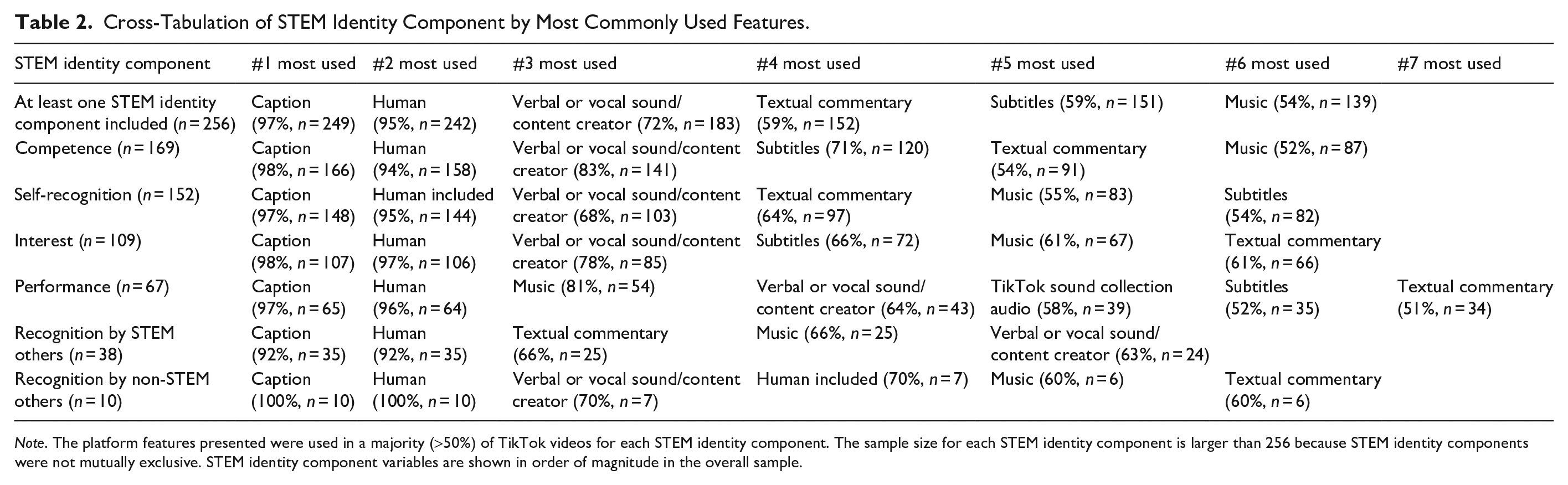
Note. The platform features presented were used in a majority (>50%) of TikTok videos for each STEM identity component. The sample size for each STEM identity component is larger than 256 because STEM identity components were not mutually exclusive. STEM identity component variables are shown in order of magnitude in the overall sample.
To answer RQ5, which TikTok post features used by women in STEM on TikTok resulted in higher levels of engagement, a multilevel negative binomial regression was conducted. A multilevel negative binomial regression analysis was utilized because of the nested structure of the TikTok videos (videos within accounts) and the highly positively skewed nature of the dependent variables (see Suk et al., 2022). Engagement was operationalized as the number of likes, comments, and shares that a TikTok post received; these three variables were considered separately, rather than holistically for the purposes of this analysis. First, each TikTok feature variable was correlated with each of the dependent variables to determine which features to enter into the regression models. Table 3 provides the significant correlations between TikTok features and the engagement variables of number of likes, comments, and shares.
Significant Bivariate Correlations Between TikTok Features and Engagement-Dependent Variables.

p < .05, **p < .01, ***p < .001.
Then, after controlling for follower count as an account-level variable, the feature variables significantly correlated with likes, comments, or shares were entered into the multilevel regression. For engagement via likes, only creators who incorporated hand choreography into their TikTok posts (e.g., synchronized hand movements) had significantly higher likes than those creators who did not, estimate = 2.99, SE = .80, incidence rate ratio = 19.86, p < .001, 95% confidence interval (CI) [4.17–94.57]. For engagement via comments, there were no TikTok features that resulted in significantly higher counts of comments. For engagement via shares, only creators who incorporated memes (e.g., a popular cultural reference) had significantly higher shares than those creators who did not, estimate = 2.36, SE = .90, incidence rate ratio = 10.60, p < .01, 95% CI [1.81–62.17].
Discussion
This study contributes to the growing research on visual representation and portrayals of women in STEM on social media (Huber & Baena, 2023; Steinke, Baumel, & Turner, 2024; Steinke, Coletti, & Gilbert, 2024; Wells, 2023). Specifically, this study investigates portrayals of women in STEM on TikTok focusing on their self-presentation of identity and use of platform features to promote audience engagement. Women-in-STEM TikTok content creators provide positive portrayals of their work as women in STEM asserting their rightful presence in STEM. Displays of STEM identity, particularly displays of STEM competence and self-recognition, suggest intentional efforts to establish and affirm ingroup associations for women in STEM in this virtual space. As predicted by social identity theory, this identification and active promotion of women in STEM as an ingroup would be expected to promote a positive sense of self and build self-esteem for individuals identifying as women in STEM (Hogg & Turner, 1987). Despite frequent displays of STEM identity on TikTok, however, women-in-STEM content creators display other social group identities less frequently and use relatively few TikTok platform features that would likely enhance audience engagement. These findings have important implications for science influencers, science communicators, and informal STEM outreach professionals because recent research has shown that media predict STEM career interest (Chen et al., 2023), and when compared to other factors (school education, informal education, and social support), media have the greatest influence on adolescent female students’ interest in STEM careers (Wang et al., 2023).
This study also finds that individuals identified as women in STEM most often display competence when expressing their STEM identity on TikTok. Prominent displays of STEM competence are exhibited through assertive expressions of STEM expertise and STEM knowledge. Through these displays, women in STEM on TikTok renounce gender-STEM stereotypes that have historically have depicted women as lacking the competence and skills needed to succeed in STEM (Master & Meltzoff, 2020). Posts like these appear to be intentional strategies to both establish their credibility in STEM fields and challenge public perceptions of STEM fields as masculine domains (Cheryan & Markus, 2020). These bold displays of competence in TikTok videos could also be viewed as expressions of online activism used to advance equity in STEM by explicitly challenging stereotypes that have minimized and downplayed women’s contributions in STEM for decades (Cyr et al., 2021; James et al., 2023). Positive depictions of women in STEM like these also have been found for women-in-STEM content creators on other social media platforms (Alkhammash, 2019; Steinke, Baumel, & Turner, 2024; Wells, 2023). For example, a study of Twitter users found that women in STEM posted positive descriptions of women in STEM and their achievements, and their hashtagging and retweeting provided support for this online community (Alkhammash, 2019). Social identity theory (Tajfel, 1981; Tajfel & Turner, 1986) suggests that the practice of posting positive portrayals of women in STEM on social media, as found in the present study and related research, would highlight group successes in ways that would both build self-esteem for ingroup members and promote ingroup association for others considering group membership.
Promoting ingroup connections for potential new group members appears to be another especially important goal behind the portrayals of women in STEM presented on TikTok. The TikTok community identified in the present study may serve as inspirational role models, actively disrupting gender-STEM stereotypes through their frequent posts of positive portrayals of women in STEM on TikTok. Similarly, prior work focused on Instagram portrayals of individuals identified as women in STEM found positive role model portrayals that emphasized competence (Steinke, Baumel, & Turner, 2024), an attribute that adolescent girls previously have identified as important for their identification with women STEM role models (Buck et al., 2008). As posited by social identity theory (Tajfel & Turner, 1986), positive portrayals of women in STEM would be not only identity-affirming to the content creators posting the TikTok videos and other members of the women in STEM community on TikTok but also potentially inspiring to adolescent girls who might come across these videos on TikTok. Social identity theory points out how people are motivated to identify with ingroups perceived to boost self-esteem and self-image (Hogg & Turner, 1987), thus suggesting that positive portrayals are important for promoting ingroup associations for a group that is often perceived as an outgroup because of cultural bias about women in STEM (Cheryan & Markus, 2020). Relatedly, prior research indicates that science influencers use social media to build ingroup solidarity in response to and in defense against influence from skeptical communities (Chinn et al., 2024). It is important to note that many of the TikTok content creators examined in this study were individuals who identified as computer scientists or engineers, which is especially important given the continued underrepresentation of women in these fields (National Center for Science and Engineering Statistics, 2023).
By providing a virtual space to highlight their competence as women in STEM, TikTok may provide important psychological benefits for content creators whose posts display self-recognition as STEM professionals. Findings from the present study reveal that self-recognition was the second-most prevalent STEM identity dimension expressed in TikTok posts by women in STEM. Prior research on individuals who identified with the #WomeninSTEM hashtag on Instagram also found self-recognition for members of this social media community. Prior STEM identity research has highlighted recognition by others as most important for advancing and achieving a STEM identity (Carlone & Johnson, 2007; Rodriguez et al., 2019). However, the present study and related research on self-expression of STEM identity on social media (Steinke, Baumel, & Turner, 2024) suggest recognition by oneself of STEM identity is equally or potentially more important for individuals who identify as women in STEM in these virtual spaces. This finding is an important extension of the extant models of STEM identity described previously. In addition, social identity theory (Tajfel & Turner, 1979) and prior research on feminist social movements on social media (Suk et al., 2021) underscore the possible positive psychological benefits for women when they share community with like-minded others online. Thus, it may be that through self-recognition in these virtual spaces on social media that women in STEM develop or promote a STEM identity, find a supportive STEM community, and experience a sense of belonging in STEM when they are unable to find and experience the same in real-life, male-dominated STEM contexts.
Overall, only a few of the women-in-STEM content creators referred to non-STEM social identities such as gender, race, first-generation college student, relational identity to others, sexual orientation, mental health, and physical ability. The present study’s primary focus on STEM identity provides some explanation for this finding. However, this finding also may suggest a lack of identity integration between a STEM identity and other social identities. Prior research on professional women in STEM (Settles et al., 2009) found identity interference and identity conflict when identifying as a scientist and a woman. On the other hand, the sampling procedures used to identify women in STEM may provide another explanation. While 30% of the posts included in this analysis were allocated to individuals who identify as women in STEM and other intersectional identities (i.e., race, ethnicity, sexual orientation), greater expression of intersectional identities may be evident for a sample specifically focused on women in STEM who identify with other social identity groups. In addition, while TikTok posts that did not contain STEM content were not further coded beyond the initial STEM content determination, it was observed that non-STEM content did contain references to other identities (i.e., sexual orientation), suggesting that there might be some intentional separation between the identities and types of content that women in STEM choose to showcase on TikTok. Mediated visual self-representations have been found to be important tools for identity formation and communication (Tiidenberg & Whelan, 2017), thus suggesting the importance of considering which identities are manifested by women-in-STEM TikTok content creators. In addition to the potential personal psychological benefits of self-representation and self-expression of identity on social media, fostering ingroup connections through social media content also is important. Science influencers have used “group identity language” (Chinn et al., 2024, p. 2) to affirm ingroup identity to build supportive communities and to promote collective group actions (Chinn et al., 2024). Findings from the present study suggest that in addition to language, visuals and social media trends that promote engagement are also influential, especially given the algorithm-centric feature of TikTok in generating and curating content for the user (Bhandari & Bimo, 2022).
This study finds that TikTok design features are fairly uniform in use and represent the most basic platform features provided by TikTok. The most popular platform features are video captions and videos or photographs of a person, frequently the content creator. Video captions may be an effective strategy for calling attention to a key message or key feature of the post content. Videos and photographs of people, including the content creator, also may help establish connections with TikTok users and potentially help build authentic connections with viewers (Wellman et al., 2020). For example, authenticity has been identified as critical for building online audiences. However, it is important to consider the implications of this finding for STEM engagement and STEM outreach. The dearth of platform features appears to be a missed opportunity for audience engagement. This study raises important questions about what social media practices or which platform design features best promote audience engagement, necessary for building a significant following to further promote social media content. In addition, results suggest that while the use of hand choreography significantly increases the number of likes and the use of memes significantly increases the number of shares, the number of women in STEM on TikTok using these features is small: Only seven creators incorporated hand choreography, and four incorporated a meme. As such, while it is noteworthy to examine which TikTok features were predictive of more engagement, caution should be taken in generalizing these results due to the small sample size of creators who utilized that feature. Given that social media platforms, including TikTok, operate by incentivizing highly engaging content, our findings imply that the limited use of platform features effective for engagement represents a missed opportunity for content creators to amplify their messages through algorithmic recommendation, although we acknowledge the black-box nature of how TikTok algorithm operates. However, our content analysis of content creators’ platform feature use and its relationship with engagement can help us understand what the algorithm might help pick up and how it drives engagement with additional audiences.
This quantitative content analysis provides important baseline data about portrayals of women in STEM on TikTok. This study’s focus on STEM identity expression by women-in-STEM social media influencers is a novel and important contribution because STEM identity has been found to be important to contributing to interest in STEM careers (Chen et al., 2023). However, there are several limitations of this study that should be noted. First, although careful consideration and a broad range of sources were consulted to identify women-in-STEM influencers and also to include women in STEM from diverse intersectional identities on TikTok, different sampling procedures might yield different results and provide additional insights about this TikTok community. Relatedly, given how the content creators were identified in this sample, we cannot rule out that other TikTok creators are generating content in a systematically different way from the content creators analyzed in this article. Second, while this study examines content by women STEM influencers and women STEM content creators who identified with other social identity groups, this study did not compare social media content between these two groups. Future quantitative content analyses could apply the codebook to compare these two groups. Third, qualitative analyses could provide more nuanced information about the themes and discourses used by this online community to advance their goals. Relatedly, interviews and focus groups with members of this TikTok community would provide insights into their experiences, motivations, and goals. Fourth, this study focuses on the STEM content presented in TikTok posts by content creators; however, future studies could focus on content they posted about their private lives and interests. Future research should also consider this content because of its potential for providing more authentic connections with audience members. Fifth, future study should consider the potential psychological benefits of posting on TikTok for women in STEM. Finally, and most importantly, while it is beyond the scope of this content analysis, future research should examine the effects of viewing TikTok posts featuring women in STEM on promoting adolescent girls’ STEM interest and STEM identity and challenging public stereotypes of women in STEM.
Conclusions
This study investigated portrayals of women-in-STEM content creators on TikTok to better understand the ways in which they present their STEM identity and other social group identities, as well as their use of platform features to promote audience engagement. Positive portrayals of women in STEM may be crucial for mitigating the effects of the masculine default of STEM (Cheryan & Markus, 2020), challenging stereotyped perceptions of STEM professionals (Bond, 2016; Master & Meltzoff, 2020), and promoting adolescent girls’ interest in STEM (Wang et al., 2023). Visual presentations of women in STEM on TikTok may prove to be crucial for providing alternative images of women in STEM, especially for adolescent girls, many of whom who report frequent use of TikTok (Anderson et al., 2023). The massive increase in popularity of TikTok since its release in 2016 and its focus on “algorithmically driven feeds and algorithmically driven experiences” (Bhandari & Bimo, 2022, p. 2) as a central component of the user experience positions TikTok as a significant force for widespread social change.
While TikTok’s role in promoting social change has been evident for several social issues, findings from the present study point to several important questions that social media content creators, science communicators, and informal STEM educators who create interventions (i.e., museum exhibits, summer camps, out-of-school programs, etc.) should consider to advance their goals through visual media presented on TikTok. How can social media platform features be used to best promote audience engagement? What does it take to become a social media influencer? How does one become an influential change agent on social media? How can social media STEM influencers most effectively shape public perceptions of STEM and STEM professionals? What is the role of social media STEM influencers in providing inclusive content in ways that attract diverse online communities? What attributes of women STEM role models best promote identification for adolescent girls on social media? How can identity language and sentiment as well as identity-affirming images best build audiences and further promote the goals of women-in-STEM content creators on TikTok? How can positive portrayals of women in STEM be presented most effectively and responsibly on TikTok? The answers to these questions are crucial for understanding the use of social media to advance social change for women in STEM. Social media is a popular source of science communication (Brossard & Scheufele, 2013), and social media science influencers hold the potential to shape public perceptions of science (Chinn et al., 2024). Thus, it is important to assess how representation and portrayals of women in STEM on TikTok can make the invisible visible and the undervalued valued in ways that broaden public perceptions of STEM professionals and inspire future generations of girls and women in STEM.
Supplemental Material
sj-docx-1-sms-10.1177_20563051241274675 – Supplemental material for Women in STEM on TikTok: Advancing Visibility and Voice Through STEM Identity Expression
Supplemental material, sj-docx-1-sms-10.1177_20563051241274675 for Women in STEM on TikTok: Advancing Visibility and Voice Through STEM Identity Expression by Jocelyn Steinke, Christine Gilbert, Amanda Coletti, Sara Holland Levin, Jiyoun Suk and Anne Oeldorf-Hirsch in Social Media + Society
Footnotes
Declaration of Conflicting Interests
The author(s) declared no potential conflicts of interest with respect to the research, authorship, and/or publication of this article.
Funding
The author(s) disclosed receipt of the following financial support for the research, authorship, and/or publication of this article: Funding was provided by a Research in Academic Themes grant from the College of Liberal Arts and Sciences (CLAS) at the University of Connecticut, Storrs.

Supplemental material
Supplemental material for this article is available online.
Notes
Author Biographies
References
Supplementary Material
Please find the following supplemental material available below.
For Open Access articles published under a Creative Commons License, all supplemental material carries the same license as the article it is associated with.
For non-Open Access articles published, all supplemental material carries a non-exclusive license, and permission requests for re-use of supplemental material or any part of supplemental material shall be sent directly to the copyright owner as specified in the copyright notice associated with the article.
