




Abstract
Given the growing recognition of corporate social responsibility (CSR) as a strategic initiative, especially tied to major national events like the Olympics, this study explores how corporations’ sponsorship of national teams affects consumer-company identification (CCI) and subsequent positive and negative relational outcomes. Employing the social identity theory, the study examined how national identification can further translate into CCI via identity salience and reduce corporate hypocrisy via in-group bias, moderated by communal engagement on social media. To test the hypothesized relationships, an online survey (N = 755) was conducted via Dynata. Results revealed that communal engagement significantly moderated the positive relationship between national identification and CCI, strengthening this link among highly engaged individuals. Moreover, elevated CCI further reduced corporate hypocrisy perceptions among those with low and moderate engagement, whereas its effect was minimal for highly engaged individuals. Those who strongly identified with companies sponsoring Team USA perceived a strong CCI, which further resulted in increase in positive word-of-mouth intentions. Lastly, the findings uncovered the double-edged role of highly engaged publics, as their heightened scrutiny weakened the mitigating effect of national identification on corporate hypocrisy. This highlighted their potential as both powerful advocates and critical evaluators of corporate actions. The findings offer practical insights into segmenting their audiences based on cause involvement on social media and adjusting CSR strategies accordingly.
Introduction
Given the belief that organizations, as members of the community, have ethical obligations toward society and various stakeholder groups (Kent & Taylor, 2016), corporate social responsibility (CSR) has gained attention as a prevalent business strategy in today’s socially aware market context (Korschun et al., 2014; McWilliams & Siegel, 2001). As launching CSR initiatives provides companies with more “freedom to operate” (p. 61) in the communities, American corporations are increasingly investing resources, expertise, and insights into CSR activities (Kent & Taylor, 2016). In addition to making social and environmental contributions as a part of CSR initiatives, several companies devoted resources in national events, such as the Olympics, to serve national and global responsibility, thereby building meaningful connections with its stakeholders (Habitzreuter & Koenigstorfer, 2021).
During the Paris 2024 Olympics, top French brands, including Louis Vuitton, Air France, and Dior, used this event to bolster their corporate reputation, promoting not just visibility but also a connection with national pride and cultural heritage (Kantar, 2024). For instance, Louis Vuitton, partnered with the French Olympic and Paralympic teams, has offered financial support and created custom-designed medal cases. This partnership is positioned not as a commercial move but as a tribute to French craftsmanship and a commitment to supporting national pride on a global stage (International Olympic Committee, 2024). Similarly, EDF, the official energy partner of Paris 2024, has pledged to power the event with renewable energy, aligning with France’s climate goals demonstrating its dedication to environmental stewardship and national pride (International Olympic Committee, 2024). Another example is the French banking group BPCE, which supports the French national Olympic and Paralympic teams by providing funding, resources, and financial education to athletes. These initiatives to uplift French athletes and contribute to the success of the national team highlights the company’s commitment to national well-being and community support. Such sponsorships extend beyond simple brand exposure. By associating themselves with an event that embodies national pride and unity, these companies aim to evoke emotional resonance with consumers and create a sense of shared identity (Habitz-reuter & Koenigstorfer, 2018; Uhrich et al., 2014). When companies are seen as taking national responsibility, the public often perceives them as part of the social fabric by forming identification and attachment. Despite the prevalence and effectiveness of these initiatives, very few public relations studies (e.g., Do et al., 2023) have delved into CSR especially within the context of sponsorship of sporting events, as the outcomes of these initiatives and the mechanisms driving their effectiveness remain under-explored.
Moreover, contemporary media environments, particularly social media platforms, increasingly facilitate active consumer engagement around national sporting events such as the Olympics. These platforms create participatory cultures by empowering individuals to co-create, share, and amplify messages, thereby transforming consumer attitudes and behaviors (Fernandes & Castro, 2020; Haikel-Elsabeh et al., 2019; Kudeshia & Kumar, 2017). Social media engagement, in particular, manifests a shift from passive consumption of media content to active collaboration and conversation among users (Z. F. Chen et al., 2017). Communal engagement specifically involves real-time discussions enabled by technological features such as chat rooms and interactive forums, exchanges of emotional support, co-creation of shared experiences, and collective efforts to resolve communal challenges (Brodie et al., 2013; Chan & Li, 2010; Lim et al., 2015). Such engagement in social media communities devoted to the Olympics serves as a powerful mechanism that both intensifies national identification and fortifies the defensive bias against negative corporate attributions. Given these dynamics, this study tests the moderating role of communal engagement in affecting how strongly consumers’ national identification translates into positive or negative relational outcomes on Olympic-sponsoring companies.
To further examine how public perceptions of companies’ national responsibility efforts would vary across audience groups according to their levels of national identification and social media engagement, the study adopts the social identity theory (Tajfel, 1981). The theory explains how individuals derive part of their self-concept from their membership in social groups and how this group identification affects their behavior and attitudes (Tajfel, 1981). The theory has been previously adapted in CSR literature to explain how active CSR participation can elevate employees’ organizational identification which subsequently led to higher job satisfaction and commitment (Farooq et al., 2017; Shin et al., 2016). This is because employees are drawn to positively valued group memberships, which contribute to self-esteem and foster a sense of pride and belonging (Ashforth & Mael, 1989; Lythreatis et al., 2019). Drawing on the theory in the context of global sporting events, this study aims to examine if this tendency is applicable to companies taking national responsibility.
As a result, the current study explores how consumers with strong national identification can enhance consumer-company identification with companies that sponsored the national team during the Olympics, particularly among individuals with high communal social media engagement to support the team. When companies engage in CSR initiatives tied to national events, such as sponsoring their country’s Olympic teams, they create an in-group identity that appeals to consumers with strong national identification, thereby affecting relational outcomes to sponsoring companies. Specifically, the study investigates both positive and negative relational outcomes, represented by positive WOM and corporate hypocrisy to further determine whether strengthened identification and identity transfer to sponsoring companies can foster positive relationships while also preventing them from forming negative relationships. This study expands on social identity theory by applying it to corporate communication and broadening the concept of CSR to include national responsibility. Practically, the study provides companies with insights into segmenting their audiences based on national identification and issue involvement and further recommends CSR strategies tailored to different segments, particularly under conditions of heightened social media engagement with Olympics communities. By positioning communal engagement as a core driver of identity-based outcomes and highlighting how participatory communities actively shape corporate–stakeholder relationships, the study reveals the importance of community-centered approaches in theorizing and strategizing CSR communication.
Literature Review
CSR and Olympics
Corporate Social Responsibility (CSR) encompasses a broad spectrum of activities that further societal good beyond legal requirements and corporate self-interest (McWilliams & Siegel, 2001). It is fundamentally about a company’s ethical obligation to positively contribute to communities in which it operates (Sen & Bhattacharya, 2001). CSR activities also serve to capture and manage stakeholder expectations regarding environmental, ethical, and social issues (Andreu et al., 2015). Companies’ motives for launching CSR campaigns include issue management to mitigate organizational risk, promote economic sustainability, improve the company’s relationships with its stakeholders and the public, and enhance the corporate reputation (Mahmood & Bashir, 2020; Saxton et al., 2019). CSR has been empirically found to benefit companies by positively affecting their relationships with their stakeholders (Bhattacharya et al., 2009; Brammer & Millington, 2005), financial performance (Salmones et al., 2005), organizational identity formation (Marin & Ruiz, 2007), and corporate reputation (Dijkmans et al., 2015; Rettab et al., 2009), as well as by alleviating the negative consequences of competence-related crises (Kim & Choi, 2020).
Companies nowadays increasingly incorporate the sponsorship of sporting events into their CSR agenda to build their socially responsible images (Habitzreuter & Koenigstorfer, 2021; Uhrich et al., 2014). Several scholars contended that investing in sports events should be viewed as an integral component of broader CSR initiatives (Plewa & Quester, 2011; Wind-Cowie & Wood, 2012) due to its strategic importance especially targeting external stakeholder (e.g., potential consumers) perceptions (Meenaghan et al., 2013). Sporting events often promote values such as health, well-being, and athletic excellence, which fosters positive perceptions among employees and external stakeholders (Edwards, 2016). Moreover, separating companies’ national identities from their CSR activities is challenging, as these companies operate within broader social structures that inevitably shape their CSR decisions (Campbell, 2007; Ioannou & Serafeim, 2012). Accordingly, recent studies have explored how sporting events affect investor behavior and uncovered those emotions and attention driven by such events exerted effects on stakeholder decision-making (Drake et al., 2016; Edmans et al., 2007). In addition, research that explored sporting events as a CSR strategy largely focused on marketing benefits, such as brand enhancement and customer engagement through sports sponsorships (Habitzreuter & Koenigstorfer, 2021; Ibrahim & Almarshed, 2014; Uhrich et al., 2014). However, although areas such as environmental sustainability, philanthropy, community outreach, and awareness campaigns have received varying degrees of scholarly attention from CSR literature, limited research devoted attention to contextualizing CSR within sports sponsorship (Levermore & Moore, 2015).
In terms of Olympics, one of the largest international sporting events, recent studies further illustrate the diverse impacts of Olympic sponsorship on CSR outcomes. Do et al. (2023) found that firms in Olympic host countries experience a smaller increase in CSR commitments compared to firms in bidder countries, which elicited a counterintuitive finding that stakeholders in host countries require relatively less CSR investment. Ibrahim and Almarshed (2014) demonstrated that CSR visibility at international sporting events affected purchase intentions by discussing unique environment of sporting events for enhancing corporate reputation. Uhrich et al. (2014) further support this by showing how consumer attitudes toward sponsoring brands mediate the effectiveness of CSR initiatives during the Olympics. Sponsoring the Olympics as CSR activities was also found to positively affect organizational pride and discretionary effort (Edwards, 2016) and mitigate negative corporate reputations (Kang & Matsuoka, 2022). However, most existing research on Olympics-focused CSR focuses heavily on marketing benefits and broader Olympism values such as peace, education, and social responsibility (Bayle, 2017), overlooking the unique aspects of Olympic sponsorship tied to national identification and active audience participation.
Social Identity Theory and National Identification
Identity research has been predominantly shaped by two major frameworks: social constructionist perspectives and social identity theory (SIT). Social constructionist approaches conceptualize identity as fluid, context-dependent, and discursively formulated through social interaction, language, and meaning-making (Haslam et al., 2017; Michael, 1997). This perspective examines how identities are negotiated, contested, and reconstructed in situated discourse (Michael, 1997). In other words, constructionist approaches tend to focus on the process of identity construction rather than the psychological functions of identity (Haslam et al., 2017), which makes it less suitable for testing causal mechanisms and boundary-based cognitive processes such as in-group bias and identity salience. Moreover, from the constructionist perspective, an identity is analyzed at the level of networks comprising people, texts, tools, and institutions, whereas the present study requires a framework centered only on individuals as units of analysis, with empirically measurable identification and outcome variables (Michael, 1997). Hence, the present study adopts SIT as its primary theoretical framework, as it offers a psychological account of how social identities operate as cognitive structures that shape perception, evaluation, and behavior.
SIT describes how individuals form their self-concept through group membership and the emotional significance attached to these memberships (Tajfel, 1981). Identity is understood as internalized meanings individuals assign to themselves based on their knowledge of their memberships in social groups (Burke & Stets, 2022; Stets & Serpe, 2013). An essential feature of these identities is self-reflection, as social identities are formed through a cognitive process known as self-categorization which involves observing and classifying themselves according to social groupings or categories (Stets & Burke, 2000). By placing themselves into particular social categories, individuals develop specific identity meanings and commitments, such as perceiving themselves as members of a particular profession, social movement, or nation. Davis et al. (2019) further categorized identities into personal, role-based, and social or group identities, noting that social identities position individuals within larger societal structures based on categorical memberships, such as race, gender, or nationality.
Furthermore, being part of a group confers a sense of in-group affiliation, whereas those perceived to differ become out-groups (Stets & Burke 2000). One core proposition of SIT is that individuals endeavor to develop or maintain a positive social identity, often by favorably comparing their in-group against relevant out-groups (Hogg & Reid, 2006). This is due to the fact that an individual’s self-esteem is intricately linked to group affiliations, thereby compelling individuals to uphold attributes that reflect well on their own group (Abrams & Hogg, 1988). As a result, strong identification with a group sparks strong positive evaluations, loyalty, and increased commitment to that group as a whole, which led to deeper attachment, greater commitment, and less inclination to abandon the group even under unfavorable circumstances (Ellemers et al., 1997; Hogg & Hardie, 1992). In other words, such collective self-esteem demonstrates the psychological mechanism through which group bonds are formed and maintained, as the more an individual perceives the in-group to be distinct and superior, the more it elevates self-worth (Stets & Burke, 2000).
Due to its theoretical versality, SIT has been widely applied across multiple domains and contexts. In the context of political science, SIT effectively explains group cohesion based on political ideologies by distinguishing clear boundaries between political in-groups and out-groups and thus, developing partisan identification (Fowler & Kam, 2007; Huddy et al., 2015). For instance, elevating identification salience via campaign rhetoric were found to affect voting behaviors (Dickson & Scheve, 2006). Studies regarding social movements revealed how activist groups define themselves, mobilize around shared goals, and strengthen group solidarity via forming collective identities (Gamson, 1992; Mattoni, 2016; Polletta & Jasper, 2001). Specifically, Davis et al (2019) examined how the vegan movement reflected not just a dietary choice but a distinct social category and an activist ethos. Corporate communication research shed light on organizational identity by corroborating that perceived CSR initiatives increased employees’ organizational commitment, job satisfaction, and organizational citizenship behaviors (Farooq et al., 2014, 2017; Paruzel et al., 2020; Shin et al., 2016).
Among the many forms of social identification, the current study aims to apply SIT to national identification. National identification encompasses the emotional bonds individuals share with their nation, which further affects attitudes, behaviors, and decision-making processes (Blank & Schmidt, 2003; Tajfel, 1981). Hence, when people strongly identify with their home country, they tend to perceive it as in-group, while positioning foreign nations as out-groups (Shankarmahesh, 2006; Verlegh, 2007). In the contexts of marketing and consumer behavior, this mechanism underlies phenomena such as consumer ethnocentrism, in which individuals exhibit a preference for domestic over foreign products driven by a desire to positively differentiate and promote their national identity, as supporting home-country products bolsters in-group distinctiveness and enhances the group self-esteem (Zeugner-Roth et al., 2015). Although national identification has been explored in marketing literature in relation to guiding consumption choices, its role in shaping perceptions and effectiveness of CSR initiatives have not been researched. Drawing on these insights and addressing the research gap, the current study examines how heightened national identification during prominent international events like the Olympics can induce positive CSR outcomes.
Company-Consumer Identification (CCI)
Company–consumer identification (CCI) refers to a psychological bond between a consumer and a company that arises when consumers perceive an overlap between their own identity and that of a company via feelings of oneness with the company (Bergami & Bagozzi, 2000; Mael & Ashforth, 1992). This overlap is established through a cognitive categorization where individuals actively seek similarities between their self-concept and the company attributes, thereby accepting it as an integral part of their own in-group (Fatima et al., 2023). Extensive research has demonstrated that strong CCI can yield a range of positive outcomes, including enhanced loyalty, greater advocacy on behalf of the company, and increased willingness to engage with and support the firm’s initiatives (Bhattacharyaet al., 2009; Lichtensteinet al., 2004; Sen et al., 2006). Furthermore, when a company’s actions are perceived as socially responsible, consumers attribute desirable traits to the company that resonate deeply with their own self-identity, which eventually heightens their connection and identification with the firm (Lichtenstein et al., 2004). This is more so for CSR initiatives involving socially valued activities, which resonates with consumers’ intrinsic desire for their in-group to maintain or achieve a positive social standing (Stets & Burke, 2000).
Drawing on social identity theory and identity transfer, this study proposes that individuals with stronger national identification are more likely to form higher levels of CCI with companies that actively engage in CSR initiatives linked to national pride, such as sponsoring their country’s Olympic team. Identity transfer refers to the phenomenon where positive sentiments associated with one’s self or group identity extend naturally to other entities perceived as sharing congruent identity traits (Mackie & Smith, 1998; Zeugner-Roth et al., 2015). Since individuals with high national identification maintain emotional connections with their national identity and perceive it as part of their core self, they are likely to transfer these positive associations to companies that explicitly embody shared national values and advance the nation’s interest. This process echoes the argument that people “choose activities congruent with salient aspects of their identities” and support “the institutions embodying those identities” (Ashforth & Mael, 1989, p. 25). If a company is closely tied to national causes, such as sponsoring an Olympic team, consumers with high national identification may view the company as sharing their in-group membership and extensions of their own in-group (Ashforth & Mael, 1989; Crane & Ruebottom, 2011; Polletta & Jasper, 2001). Therefore, the following hypothesis has been proposed:
Corporate Hypocrisy
The current study also examines if the transferred identification from the nation to the company can diminish negative relational outcomes like corporate hypocrisy. The concept of hypocrisy more broadly refers to a discrepancy between stated values or commitments and actual behavior (Stone & Fernandez, 2008). According to Batson (2011), moral hypocrisy is characterized as a subtle form of egoism where people espouse moral principles yet fail to uphold them, which reflects a lack of genuine moral integrity. In the corporate context, corporate hypocrisy arises particularly when stakeholders uncover inconsistencies between a firm’s declared CSR commitments and its actual practices (Chang et al., 2021). A central outcome of corporate hypocrisy perceptions is stakeholder mistrust, often nullifying the positive effects of any well-intentioned initiatives (Arli et al., 2019).
In response to potential accusation of corporate hypocrisy, CCI can serve as an important buffer that mitigates negative perceptions. Those with strong CCI tend to integrate the company into their self-concept, developing a psychological connection that aligns their own identity closely with that of the company (Bhattacharya & Sen, 2003; Hughes & Ahearne, 2010). According to SIT, when identification is activated, individuals exhibit in-group bias where they become positively biased toward entities categorized as members of their in-group (Ashforth & Mael, 1989). In other words, those with high CCI are predisposed to defend their in-group’s positive identity (Ashforth & Mael, 1989; Turner et al., 1979) and are less inclined to label their in-group member (the Olympics-sponsoring company) as hypocritical due to an intrinsic motivation to sustain positive in-group evaluations as well as self-concept linked to the identity group and bolster personal self-esteem (Einwiller et al., 2006; Vieira, Liu, et al., 2023). This has also been substantiated by the prior literature indicating that CSR-based identification can insulate consumers against negative information about a company (Einwiller et al., 2006). Accordingly, the second hypothesis was raised as follows:
Communal Social Media Engagement
Engagement is broadly conceptualized as the connection individuals feel or maintain with an object or activity, characterized by immersion and sustained involvement driven by personal interest (Z. J. Chen et al., 2011). In digital environments, engagement often manifests through participation and involvement on online platforms (O’Brien & Toms, 2008). Specifically, social media engagement refers to individuals’ interactive experiences with content on social media platforms, encompassing both passive content exposure and active participation through activities such as liking, commenting, sharing, or co-creating content (Fernandes & Castro, 2020; Haikel-Elsabeh et al., 2019; Moisescu et al., 2022). Such affordances of social media eventually fostered participatory cultures by allowing social media engagement to partake a critical role in transforming consumer attitudes and behaviors (Z. F. Chen et al., 2017).
Among social media engagement dimensions, communal engagement represents a level of involvement focused on communicating with other community members who share similar interests, thereby strengthening a collective identity (Lim et al., 2015). is characterized by individuals actively participating in online communities to exchange ideas, build relationships with like-minded users, and co-create shared experiences (Lim et al., 2015). Unlike more superficial forms of engagement that may entail mere browsing or “liking” posts, involves users exchanging opinions, comments, and emotions regarding televised events, ultimately building an online community that fosters strong identification with the event, team, or sponsoring company (Lim et al., 2015; O’Brien & Toms, 2008). In this study, we operationalize communal engagement as consumers’ active participation on social media platforms dedicated to endorsing, celebrating, and discussing Team USA during the Olympics. Those with high communal engagement were found to display greater loyalty, advocacy behaviors, and increased interaction with the community (Brodie et al., 2013; Chan & Li, 2010; Lim et al., 2015). Specifically, Lim et al. (2015) found that communal engagement directly correlated with increased channel loyalty and advocacy where community members not only remain devoted viewers or consumers but also proactively defend the brand when it encounters criticism (Lim et al., 2015). Such brand or channel ambassadors often disseminate positive messages online and encourage others to participate, which reflects their strong sense of belonging and identification with the community (Hull & Lewis, 2014; Lim et al., 2015).
Because communal engagement entails both heightened exposure to event-related content and continual interaction with fellow supporters, it can elevate the identity salience (Stryker & Burke, 2000). Social identity theory posits that identity salience is enhanced when a specific group membership becomes both contextually relevant and personally significant (Stets & Burke, 2000). In virtual communities, commitment acts as a key determinant of this salience, as sustained involvement and emotional investment in a collective space by spending more time interacting within a communal platform, their national identity becomes increasingly pivotal to their self-concept (Brenner et al., 2014; Stryker & Serpe, 1994). Identity salience also becomes pronounced due to sustained interaction with like-minded individuals who share similar interests and goals (Davis et al., 2019). For instance, actively engaging in social media discussions surrounding Team USA during the Olympics and pursuing shared goals by co-advocating them enables consumers to perceive a stronger connection with national values and goals, which furthers magnifies their emotional attachment and identification transfer process with companies that support the national team (Hollebeek et al., 2014; Prentice et al., 2019). In other words, by activating identity salience, facilitating group cohesion, and offering real-time interactive platforms for shared experiences, communal engagement can shape the psychological processes underlying consumer–company relationships and CSR perceptions. Additionally, community membership has also been corroborated as a significant moderator of consumer behaviors and perceptions, as length and intensity of involvement indicate a deeper commitment to the brand or organization, thereby shaping consumer attitudes and actions (Prentice et al., 2019). As a result, the following hypothesis to test the moderating role of communal engagement:
Similarly, communal engagement can also heighten the in-group bias that stems from strong CCI and reduce perceived corporate hypocrisy. According to Brewer and Gaertner (2003), in-group biases are primarily driven by attachment to the group rather than animosity toward out-groups. When consumers actively engage within social media communities during national events like the Olympics, their in-group biases become more salient, which compels them to generously assess in-group members’ actions and minimize hypocrisy perceptions. Those with high communal engagement were also found not only remain devoted viewers or consumers but also proactively defend the brand when it encounters criticism (Lim et al., 2015). As individuals actively interact with fellow community members who share their passion for Team USA, they are more inclined to defend or rationalize corporate actions to maintain group cohesion and preserve their positive in-group identity (Focella et al., 2016; Lim et al., 2015). Interactive involvement in communal platforms can lead to greater identification and willingness to protect the in-group (the company) from negative judgments, given the emotional investment and shared experiences. As a result, the following hypothesis on the interaction effect between CCI and communal engagement has been elicited:
Word-of-Mouth (WOM)
Word-of-Mouth (WOM), a positive relational outcome, refers to favorable communication and personal recommendations about a company that consumers voluntarily share with others (Lacey & Kennett-Hensel, 2010). WOM plays a critical role in shaping consumer attitudes, awareness, expectations, behavioral intentions, and actual purchasing behaviors (Ward & Lee, 2000). Positive WOM, in particular, is highly valuable for companies as it amplifies their marketing effectiveness, promotional efforts, and overall business success (Y. Chen & Xie, 2008).
National identification can positively influence WOM behaviors through the process of identity enactment and self-verification. Identity theory suggests individuals actively engage in behaviors that affirm and reinforce their identity by enhancing their self-esteem (Burke & Stets, 2022). This enactment becomes particularly salient in contexts like the Olympics, where achieving explicit outcomes such as winning medals strengthens identification, which raises supporters’ self-worth and spawns further identity-consistent behaviors (Stets & Burke, 2000). Individuals highly identified with their nation during international competitions are more likely to engage in positive WOM behaviors, advocating for teams, events, or associated organizations as a means of self-verification and solidifying group membership (Burke & Stets, 2022; Simpson & Macy, 2004). In addition, strong CCI also encourages consumers to engage in positive WOM behaviors. Consumers who identify with a company become emotionally and psychologically attached, which compels them to take actions supporting, promoting, and positively evaluating the company (Ahearne et al., 2005; Du & Vieira, 2012). Consumers with strong CCI are inclined to engage in extra-role behaviors, such as providing positive recommendations and WOM about the company, as these actions elevate their self-esteem and project desirable ethical and social images (Ahearne et al., 2005; Bhattacharya & Sen, 2003).
The mediating role of CCI on WOM has been empirically confirmed from the past literature, as consumers exhibit positive biases toward the company and engage in positive WOM behaviors, once they integrate the company into their self-concept (Bagozzi et al., 2012; Vieira, Wolter, et al., 2023). This has also been substantiated in the context of CSR (Chang et al., 2021; Fatma et al., 2020; Perera et al., 2023). Thus, based on the theoretical linkage among national identification, CCI, and WOM in addition to previous literature attesting to mediating role of CCI, this study hypothesizes the following mediation effect:
To test these hypothesized paths as a combined model, the following moderated-mediation hypothesis has been formulated:
Method
Participants
To examine the above-mentioned hypotheses, an online survey (N = 755) has been conducted via Dynata, a recruitment platform. Participants who (1) have U.S. citizenship, (2) are 18 years-old or above, and (3) have at least a fourth-grade reading level in English to fully comprehend the vignette (a news article) and all the written questions have been selected. According to the inclusion criteria, Dynata created a target profile from its pre-recruited participant pool. Based on the target profile, a total of 755 participants who conform to the criteria have been recruited.
In terms of the demographic composition of the participants, In terms of education, the majority held a 4-year degree (36.6%), followed by professional degrees (17.7%) and some college experience without a degree (14%). Regarding income, the largest group earned between $50,000 and $69,999 annually (15%), while 9.5% reported earning over $200,000. Ethnically, the sample was predominantly Caucasian (72.2%), with Latino/Hispanic (8.9%) and African (7.9%) participants comprising the next largest groups. With respect to political affiliation, the largest segment identified as centrist (24.2%), with 18.4% leaning slightly liberal and 12.2% moderately conservative. Social media usage was high, with 53.5% using it several times a day and 11.7% engaging hourly. Age-wise, participants were fairly distributed, with 21.6% aged 18 to 24 years, 18.7% aged 35 to 44 years, and 16.7% aged 55 to 64 years.
Procedure
Upon recruitment, participants were directed to complete a 10-min survey on Qualtrics. In the survey questionnaire, participants first read the consent form, detailing their right to withdraw from the survey at any point. Then, they answered pre-screening questions and read a vignette that serves to give an example of companies committed to Olympic sponsorship. The vignette was comprised of a news article on Delta Airlines’ CSR activities for Team USA during the 2024 Paris Olympics. After reading the article, they were asked to complete a questionnaire which gauges control, independent, and dependent variables regarding companies like Delta Airlines that launched CSR campaigns that support the Team USA during the Olympics.
Measures
Following measures have been used to gauge seven main variables with a total of 37 items on a 7-point Likert scale (1 = strongly disagree and 7 = strongly agree): (a) national identification (9 items; Wang, 2017), (b) communal engagement (4 items; Lim & Jiang, 2024), (c) consumer-company identification (CCI; 10 items; Mael & Ashforth, 1992; Pérez & Rodriguez del Bosque, 2015), (d) corporate hypocrisy (5 items; Wagner et al., 2009), and (e) WOM Engagement (5 items; Dinc & Aydemir, 2013; Zeithaml et al., 1996). Although participants’ pre-existing attitudes toward Delta, CSR, and the Olympics were measured, only CSR attitude with a statistically significant effect was controlled. As indicated in Table 1, all measures showed satisfactory reliability (Cronbach’s α > .75) and no evidence of multicollinearity among predictors and the moderator (Variance Inflation Factor <5). Specific items and descriptive information are also provided in Table 1.
Descriptive Statistics for Measurement Items.
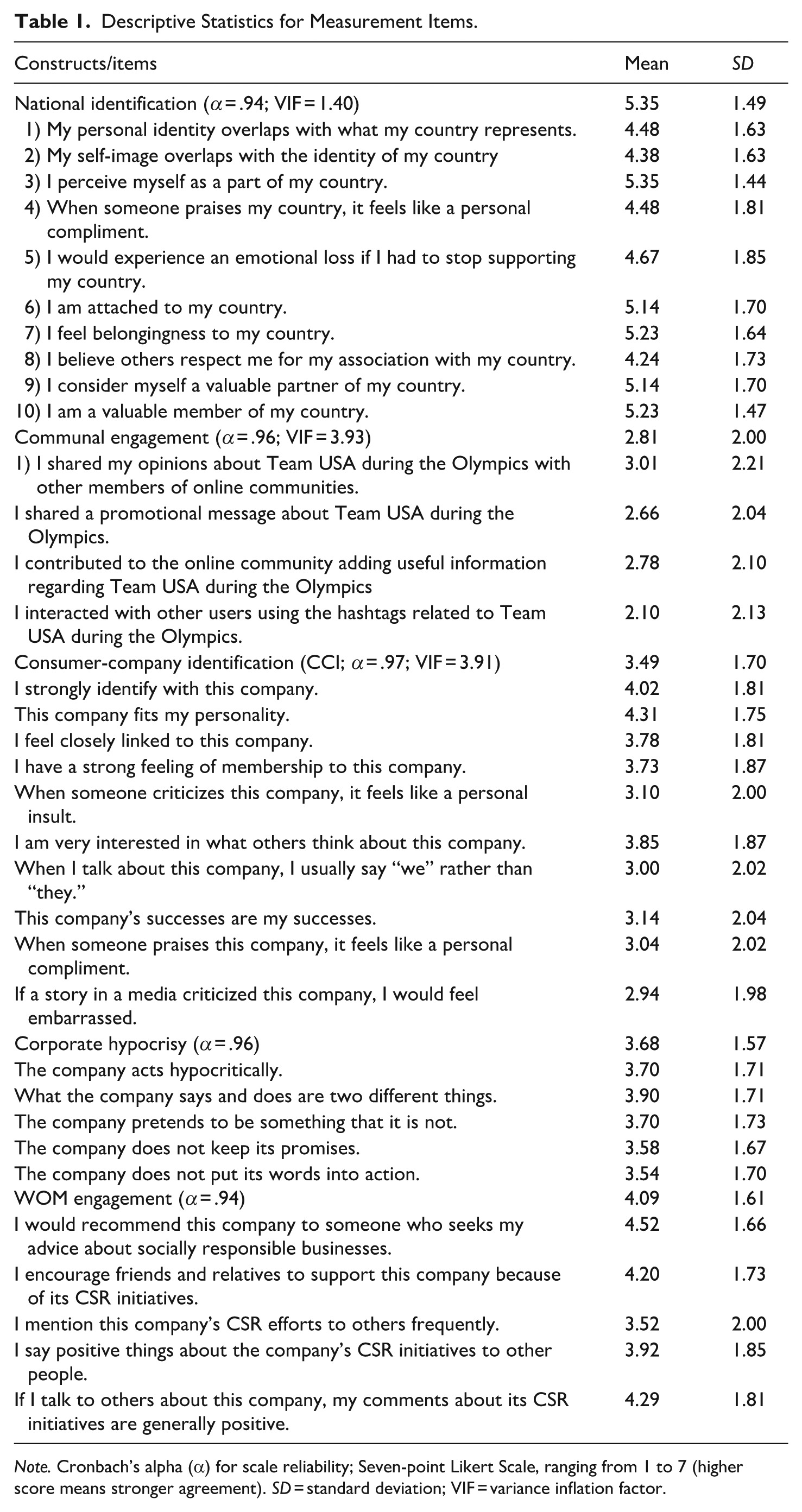
Note. Cronbach’s alpha (α) for scale reliability; Seven-point Likert Scale, ranging from 1 to 7 (higher score means stronger agreement). SD = standard deviation; VIF = variance inflation factor.
Results
To test our hypotheses, we used Hayes’s (2018) PROCESS macro with 5,000 bootstrap samples, including attitude toward CSR as a covariate in all analyses. As the study investigates two outcome variables, corporate hypocrisy and WOM, two moderated-mediation models were tested. Specifically, PROCESS Model 58 was employed to examine the dual moderating effects of communal engagement on the paths from national identification to CCI and from CCI to corporate hypocrisy (see Table 2). Results showed that national identification did not significantly predict CCI when controlling for attitude toward CSR (b = 0.07, SE = 0.05, p = .134), failing to confirm
Moderated Mediation Results.
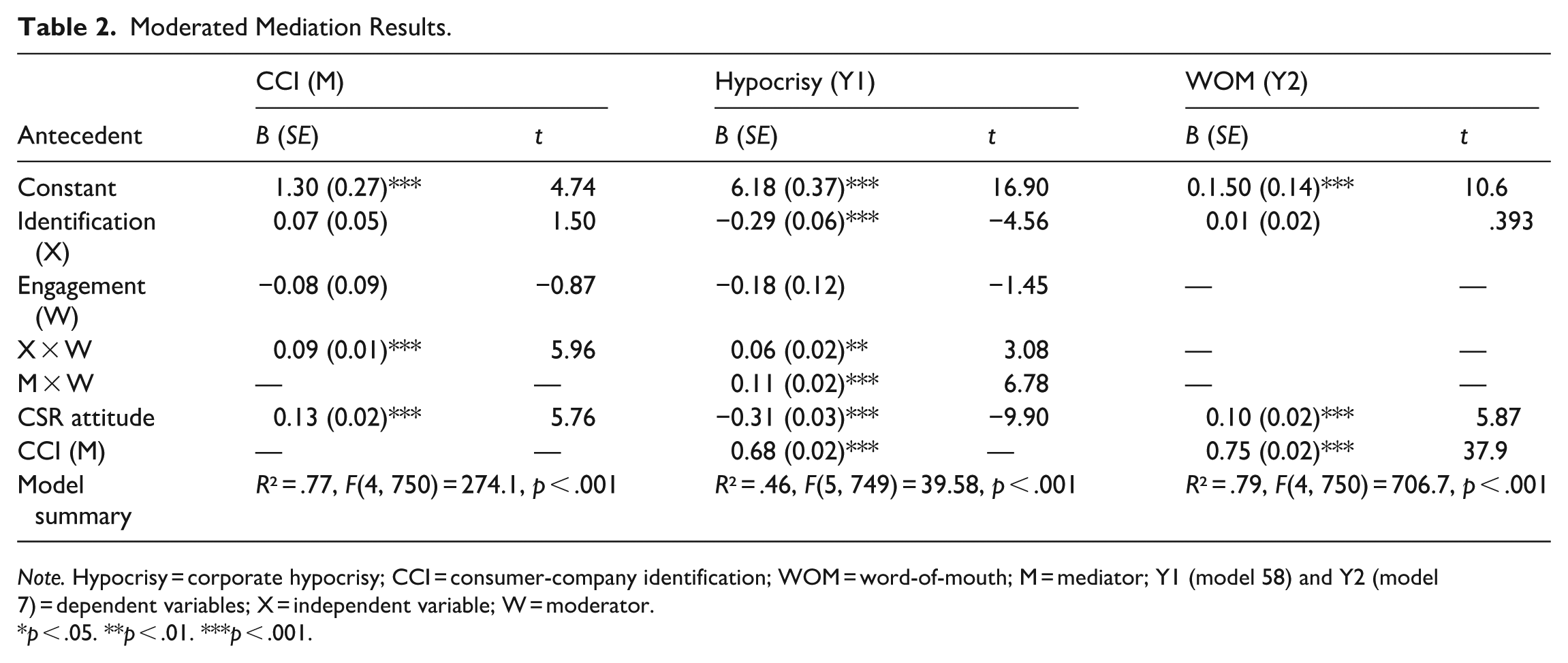
Note. Hypocrisy = corporate hypocrisy; CCI = consumer-company identification; WOM = word-of-mouth; M = mediator; Y1 (model 58) and Y2 (model 7) = dependent variables; X = independent variable; W = moderator.
p < .05. **p < .01. ***p < .001.
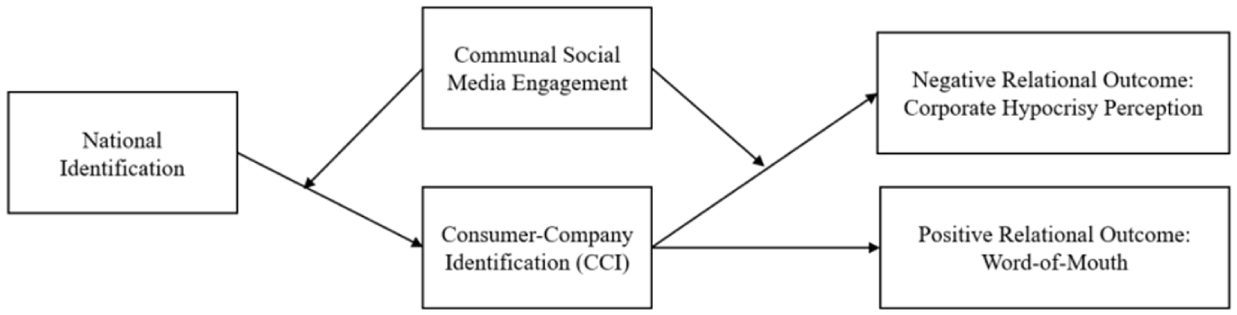
Conceptual model.
Additionally, the interaction effect between communal engagement and CCI on corporate hypocrisy was also significant (b = 0.111, SE = 0.017, p < .001, ΔR² = .049), but in the opposite direction, thereby supporting
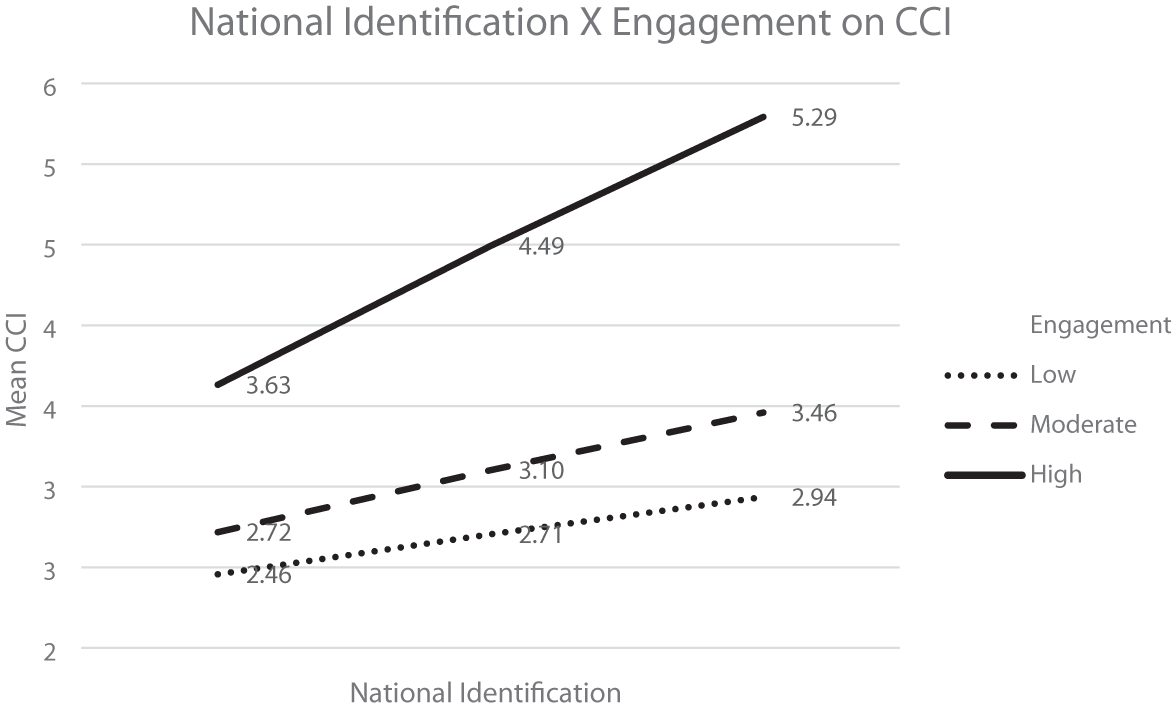
Interaction effect between national identification and engagement on CCI.
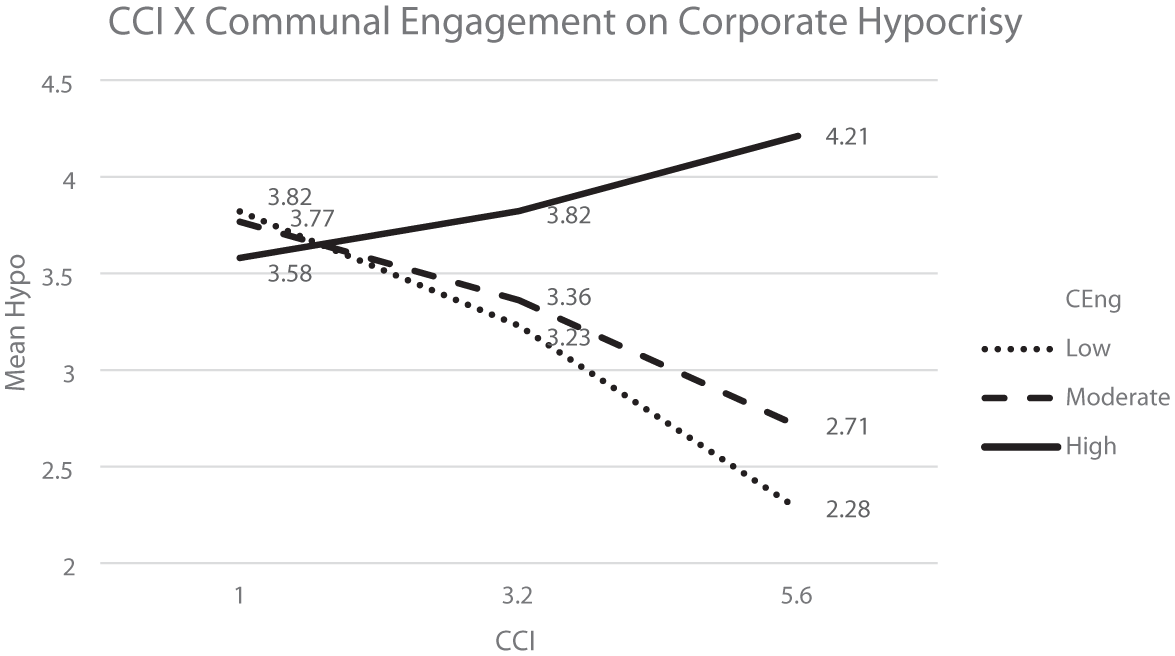
Interaction effect between CCI and engagement on corporate hypocrisy.
To further examine
Discussion
This study explored the role of national identification in shaping CCI, perceptions of corporate hypocrisy, and positive WOM, especially during major national events such as the Olympics. The results indicated that national identification did not positively affect CCI, which deviated from the original proposition and previous studies on identity transfer to companies (Crane & Ruebottom, 2011; Vieira, Wolter, et al., 2023), although it showed a significant interaction effect with communal engagement. This can be explained by the fact that the identification transfer has only occurred among those with high communal engagement on social media regarding the team and the Olympics, whereas CCI of those with low and moderate engagement was not affected by national identification. This implies that the mere existence of national identification might not automatically translate into corporate affiliation unless consumers perceive a clear congruence with their self-concept (Bhattacharya & Sen, 2003; Hughes & Ahearne, 2010). In this case, those who immersed themselves in Olympic-related social media communities were more likely to transfer feelings of in-group pride and cohesion to companies that align themselves with national values or symbols (Zeugner-Roth et al., 2015). Conversely, national identification significantly mitigated corporate hypocrisy, which supports the propositions of social identity theory (Ashforth & Mael, 1989) regarding in-group favoritism.
Hence, this finding extends the understanding of negative relational outcomes such as corporate hypocrisy by demonstrating that national identification can serve as a protective factor, diminishing critical judgments about CSR inconsistencies.
Moreover, the finding that those with high communal engagement on social media intensified the relationship between national identification and CCI. This is because highly engaged individuals were more likely to experience a stronger identity transfer since they have invested time, effort, and emotional energy in a community that aligns closely with their sense of self via participatory affordances of social media including liking, commenting, sharing, and co-creating content via inciting conversations around the team’s performance (Z. F. Chen et al., 2017; Hollebeek et al., 2014; Serpe & Stryker, 2011). Communal engagement eventually elevated the salience of national identity by immersing individuals in a collaborative environment where they not only consumed content but also actively participated in discussions, shared event experiences and worked together with fellow supporters to achieve common goals of supporting their national team’s performance in the Olympics (Lim et al., 2015). Hence, frequent interactions and communal activities can activate and reinforce national identity by building a sense of belonging under a shared purpose and further galvanizing in-group ties (Burnasheva et al., 2019; S. C. Chen & Lin, 2019; Hull & Lewis, 2014). As identities become more salient, consumers may be more susceptible to identity transfer by extending their in-group affinity to corporations that demonstrate national sponsorship and embody shared national values. This finding is consistent with SIT’s theoretical propositions, as the identity salience and pronounced identification transfer from national to company identities have been facilitated by commitment, interactions with liked-minded community members, and pursuit of shared goals (Stets & Burke, 2000). This finding is consistent with prior research adopting SIT, which demonstrated that interactional and affective commitment fostered through social networks and relationships strengthens identity salience (Han et al., 2022; Stryker & Serpe, 1982; Zhang et al., 2022). Likewise, in the present study, communal engagement served as the catalyst that further activates and intensifies these national identities, which ultimately guides consumer behaviors in favor of the company they perceive as part of their extended “team.”
Despite a significant interaction effect between CCI and communal engagement on corporate hypocrisy, the finding deviated from the original hypothesis that assumed those with high engagement will experience the most dramatic decrease in hypocrisy. Conversely, our results indicate that this negative link wanes at high levels of communal engagement. Although hypocrisy has been significantly reduced for those with low and moderate engagement when they demonstrated stronger national identification, the level of hypocrisy remained unaffected regardless of national identification. This can be explained through the elaboration likelihood model (Petty & Cacioppo, 1986) which contends that those with high issue involvement are more strongly motivated to carefully evaluate the message via taking the central route. For example, research drawing on ELM in the corporate communication context revealed that managers with high issue involvement were found to less likely rely on identity-based judgments, as they invest greater effort in scrutinizing message content (Liang et al., 2024).
Applying this to the current study, it can be surmised that those who are highly engaged in Olympic communities on social media might have demonstrated a greater motivation to process sponsorship messages via the central route and therefore, carefully scrutinize the sincerity and consistency of the sponsoring company’s CSR activities. Those with high communal engagement demonstrate a stronger emotional commitment by devoting substantial time and energy to sustain group conversations and maintain ongoing relationships (Prentice et al., 2019), which motivated them to seek substantive evidence supporting a sponsor’s moral standing rather than relying on simplistic cues (e.g., national pride alone). When such evidence does not fully align with their elevated expectations, they may doubt the authenticity of the sponsor’s commitment to national responsibility. Thus, even though high communal engagement might enhance the salience of one’s national identity, it also heightens critical scrutiny of corporate actions, which can temper or even reverse the expected negative relationship between national identification and perceived corporate hypocrisy (Wagner et al., 2009). This resonates with prior research that uncovered that those who perceived a strong issue relevance evaluated a company’s advocacy stance as less altruistic and thus exhibited lower CCI in value-incongruent situations due to more effortful assessment of corporate motives to mitigate cognitive dissonance (You et al., 2023).
Lastly, CCI fully mediated the relationship between national identification and positive WOM, which underlined its primary role in transforming identification into tangible consumer behaviors. This finding is consistent with past literature asserting that strong identification motivates consumers to engage in supportive actions, including positive WOM (Ahearne et al., 2005; Namkoong et al., 2025). This is due to the fact that spreading positive words about the company they identify with can enhance their self-esteem and project a morally responsible and socially desirable image (Aquino & Reed, 2002). As brand identity plays a central role in shaping whether key stakeholders perceive a brand as part of their self-concept (Farhat et al., 2021), individuals often use brands as self-referential symbols to express who they are and to signal group membership to peers and colleagues (Carlson et al., 2009).
The mediation effect also conforms to identity theory (Burke & Stets, 2022), which suggests that individuals enact behaviors consistent with their identity standards to achieve self-verification and enhance self-worth. Thus, when consumers identify with a company aligned with their national identity, they experience psychological affirmation through supportive behaviors such as positive WOM. Furthermore, social identity theory emphasizes that strong identification motivates individuals to actively support and advocate for their in-group, reinforcing their social identity and improving group-related self-esteem (Arnett et al., 2003; Bhattacharya & Sen, 2004). The positive effect of CCI on WOM conform to the previous CSR literature that corroborated individuals’ propensity to engage in behaviors that support and favor the brand launching CSR initiatives, such as advocacy and positive word-of-mouth (Chang et al., 2021; Perera et al., 2023).
The significant moderated mediation suggests that communal engagement on social media create environments where identification processes become more salient and influential, (Lim et al., 2015; Stets & Burke, 2000). Specifically, communal engagement provides repeated interactive experiences, which made the congruence between personal and organizational identities more robust. Such heightened identity salience motivates consumers to actively engage in positive WOM behaviors as a form of identity enactment and group validation, particularly in contexts where national pride and affiliation are pronounced.
Conclusion
These findings extend our theoretical understanding of how social identity processes operate in the contexts of public relations and corporate communication, especially during large-scale national events such as the Olympics. For example, the focus on the interplay between person-nation and person-company identifications advances SIT by operationalizing identification as a dynamic and multi-layered process. Although many studies have concentrated on individual-to-individual or individual-to-community identifications (Prentice et al., 2019), the current findings show how a salient national identity can transfer to corporate identification under supportive social conditions, such as Olympic-themed online communities. By revealing that national identification alone does not uniformly translate into heightened CCI, this study demonstrates the boundary conditions under which identification transfer occurs. Specifically, communal engagement emerges as a key moderator that intensifies national identification, as consumers who are deeply involved in Olympic-related social media communities tend to more readily transfer feelings of national pride and in-group cohesion to sponsoring companies. Furthermore, prior work suggests that group members often respond to ingroup deviance with rejection to preserve both the group’s integrity (Marques et al., 2001) and their own self-concepts (Eidelman & Biernat, 2003). However, the present study uncovers that this tendency differs according to communal engagement levels, as highly identified consumers with less engagement are inclined to protect the collective identity by showing accommodative response to cope with cognitive dissonance when witnessing an ingroup member’s moral transgression. Conversely, highly engaged individuals who take the central processing route, are less swayed by simplistic cues (e.g., national symbols) and instead scrutinize the perceived sincerity and consistency of a company’s actions. As a result, heightened scrutiny among engaged consumers can diminish the otherwise protective effect of national identification against perceptions of corporate hypocrisy. Furthermore, the discovery that CCI fully mediates the link between national identification and positive WOM reinforces identity theory (Burke & Stets, 2022), which corroborated that people seek to enact behaviors consistent with salient identities. These insights collectively extend the literature on social identification as well as CSR literature by testing previous findings on CCI’s effects on both positive and negative CSR outcomes in the contexts of sports sponsorship and social media engagement.
From a practical perspective, PR practitioners should recognize that national symbolism alone is insufficient to build meaningful consumer-company identification when launching CSR initiatives related to sports or national events. Rather than relying on flags or an “official sponsor” badge, practitioners should pair national imagery with concrete narratives and cues that connect the company’s values to stakeholders’ self-concepts. Providing co-creation opportunities related to the event can also allow them to invest effort and emotion, which will eventually reinforce identity transfer. Moreover, the fact communal engagement amplified identity transfer, suggests that companies can strengthen bonds by embedding themselves within communities that celebrate shared national pride. Collaborative CSR activities that make companies active participants rather than distant sponsors can position them as a community partner, not just a commercial actor. In addition, for PR practitioners, the study also highlights the value of mapping stakeholder engagement across communities around specific issues and events. Considering the finding that identity transfer flourished only among users who were deeply involved in social media communities regarding the event, practitioners should encourage communal engagement to convert national pride into affiliation with the company. Creating interactive spaces that encourage user-generated content and real-time conversations encourages consumers develop deeper emotional ties and identity salience, which can strengthen identification with sponsoring companies. However, the study revealed that highly engaged communities also apply thorough scrutiny to sponsorship motives. To pre-empt accusations of hypocrisy, practitioners should foreground consistent CSR track records and engage in transparent messaging. Conversely, as those with less engagement and high national identification may be susceptible to simple patriotic cues, it is essential for companies to segment the target publics and adjust strategies according to the cause involvement on social media and identification levels.
However, there still remain several limitations. First, as the study focused on a single mega-event in one national setting, the findings have limited generalizability. National symbolism, audience engagement, and sponsor reception can vary widely across events such as the FIFA World Cup or regional tournaments and across cultural contexts with different traditions of sports fandom or patriotic expression. This calls for future studies to conduct comparative analyses on multiple events and nations to determine whether the identity transfer is universally robust or culturally contingent. Additional boundary conditions including differences between celebratory patriotism and politicized nationalism on public responses to corporate sponsorship can be further explored. Although communal engagement emerged as a key catalyst that heightened identity salience, we treated it as a unidimensional intensity construct. As social media engagement is inherently multifaceted, ranging from passive consumption, active contribution, co-creation, to advocacy, it is recommended to take different methodological approaches such as network analytics or field experiments to accurately capture how the level or type of engagement differentially activate national pride and channel it toward or away from corporate actors. Furthermore, factors such as sponsor-event fit, CSR history, message quality, and prior brand attitudes can exert effects on hypocrisy perceptions, which raises the need for future studies to examine them as moderators or control their confounding effects. Finally, although our study concentrated exclusively on national identification, consumers might navigate multiple, sometimes competing, identity dimensions. Exploring identity hierarchies or conflicts would advance understanding of when national identity dominates and when other identities override or interact with it in shaping CSR evaluations.
In conclusion, the study empirically reveals that Olympic sponsorship as a CSR strategy can serve as an effective means of fulfilling what might be considered a form of “corporate national responsibility,” by drawing upon a shared sense of national pride and concurrently championing the universal values of the Olympics. However, more importantly, the study revealed that highly engaged publics are
Footnotes

Ethical Considerations
Participants were informed of potential risks associated with participation through an informed consent process. The study received approval from the Institutional Review Board (IRB) on October 15, 2024.
Funding
The authors received no financial support for the research, authorship, and/or publication of this article.
Declaration of Conflicting Interests
The authors declared no potential conflicts of interest with respect to the research, authorship, and/or publication of this article.