




Abstract
We investigate user engagement with politicians’ migration discourses on social media. In particular, we study the effects of message framing and support base attitudes on interactions on Facebook and Twitter in five European countries. Enriching automated analysis of social media content with survey data in a multilevel negative binomial regression approach, findings show that migration-related messages tend to elicit more interactions than other kinds of messages. Furthermore, the presence of a security frame in a migration-related message positively relates to user engagement. However, additional analyses suggest that the relevance of these frames differ between different political parties. In fact, a message gets an even higher number of interactions, when the dimension of the migration issue included in those framed messages is perceived more negatively by a party’s support base. The findings have important implications for communication strategies of political actors and the state of migration discourses on social media.
Keywords
Social network sites (SNS) have become increasingly important tools for political campaigning (Dimitrova and Matthes, 2018; Jungherr, 2016) as they provide an opportunity for political actors to amplify their messages and access audiences beyond the reach of traditional means of political communication (e.g. speeches, press releases, newspaper ads). Political campaigning on social media can increase political participation (e.g. Knoll et al., 2020), affect public opinion (Anstead and O’Loughlin, 2015), and may even positively influence electoral success (Bene, 2018; Bright et al., 2019).
In addition, SNS enable interactivity. On the one hand, users can interact with messages to express their engagement or to share their feelings towards specific content with the people in their personal network. On the other hand, creators of such content can receive direct feedback and see how people might react to different political messages (Eberl et al., 2020). Considering the network character of many platforms, cashing in on interactions on SNS holds even additional benefits for political actors. In fact, whenever a user interacts with a political actor’s message, the ‘friends’ and ‘followers’ connected to this user will not only be notified about the user’s reaction but also about the content that they are reacting to. This way, political actors’ messages get amplified and even reach a ‘second audience’ beyond their direct followership (Vaccari and Valeriani, 2015).
Previous studies linking political actors’ message content and user interactions found that politicians publish content strategically to elicit as many interactions as possible or specific kinds of interactions (e.g. Blassnig and Wirz, 2019; Eberl et al., 2020; Heiss et al., 2019). News value theory (Galtung and Ruge, 1965) and the MAD model of moral contagion (Brady et al., 2020) would suggest that negative and conflict-oriented content increases users’ willingness to engage with online content (see Trilling et al., 2017; Weber, 2013). Hence, the gratification system of political communication on social media possibly leads to a spiral of negativity. While this can be seen as an overall undesirable dynamic, it becomes even more problematic with respect to sensitive topics, such as migration. Here, research has shown that SNS quickly foster a hostile political climate (Ekman, 2019; Nortio et al., 2020; Weber et al., 2020). When it comes to political actors addressing migration on SNS, prior literature is sparse (Eberl et al., 2018; but see Heidenreich et al., 2020; Lee and Nerghes, 2018). Most research trying to connect political messages and user reactions is – at best – only superficially touching upon the topic of migration (e.g. Eberl et al., 2020; Heiss and Matthes, 2020), hence not contributing to a more in-depth understanding how and why migration-related content may foster user interactivity. Migration, however, is a decisive and still ubiquitous topic on political agendas throughout Europe. Therefore, taking a closer look at politicians’ migration-related communication on social media, and how citizens are interacting with it, emerges as an important factor to understand the dynamics of political migration discourses and the formation of public opinion on this crucial political issue.
The present study takes a party communication perspective and investigates the content of and user engagement with European political actors’ migration discourses on social media. In particular, we investigate which content characteristics elicit user interactions with migration-related messages from political actors on Facebook and Twitter in Germany, Poland, the United Kingdom, Spain, and Sweden between 2015 and 2017. We first examine differences in the overall interactivity of these messages between platforms. We then focus on the content characteristics of migration-related messages that might elicit user interactions. For example, we investigate whether messages that highlight one particular dimension of the migration issue instead of another (i.e. issue-specific framing) garner more interactions than other messages. We further argue that the relevance of these dimensions might differ between different political parties. Therefore, we ask whether a message gets an even higher number of interactions, when the dimension of the migration issue included in those messages is perceived more positively or negatively by a particular party’s support base.
The current investigation is important for several reasons. First, the present study contributes to the literature on politicians’ communication strategies that result in increased engagement with and, therefore, visibility of their messages on social media across Europe by considering sender, content, and potential audience factors. Second, it does so by avoiding the arguably naive assumption of universalism of empirical findings from single countries, contexts, or platforms. Instead, we investigate the data from five different countries and across two social media platforms, providing results that are potentially generalizable across the context of specific countries or cases. Third, it focusses on migration-related messages during and in the aftermath of the European refugee movements in 2015, a point in time for which understanding the dynamics of public discourse is important given the political ramifications and consequences.
Political actors’ communication on social network sites
The interactive environment offered by SNS, enabling senders and receivers of a message to actively participate in public discourse, make them an influential part of political communication processes. While ordinary SNS users usually connect and exchange with peers through the platforms, we consider political actors as persons holding a publicly recognized position of political power. Their accounts, frequently marked as ‘verified’, manage or dominate central online spaces for political campaigns. In fact, SNS provide political actors with an additional channel to promote their views and political messages across diverse audiences, making it ideal for campaigning purposes. This unmediated communication provides political actors with the opportunity to avoid journalistic reinterpretation, gatekeeping, fact-checking, or critical commenting as messages can be sent to constituents directly (e.g. Parmelee and Bichard, 2011).
For long, those channels were mainly used as an additional tool to broadcast similar messages as in press releases or billboards (e.g. Oelsner and Heimrich, 2015). However, given that one of the main objectives for politicians to use SNS is to increase their visibility, they started to anticipate the expectations of constituents (Kelm, 2020), prompting them to communicate differently. Hence, some politicians have started to use SNS to interactively communicate and engage with their (potential) constituents (i.e. followers) in the so-called comment sections (e.g. Heiss et al., 2019).
Explaining interactivity and the popularity of political messages
Interactivity is not only a process that connects political actors and users, but is also a measure of a political message’s popularity on SNS (Porten-Chée et al., 2018). Political actors use platforms like Facebook or Twitter to reach out to supporters actively following their accounts. However, given the architecture of SNS, they can easily increase their reach beyond these users. In fact, when the followers of the account of a political actor interact with a post or tweet (i.e. by sharing/retweeting, liking/favouring, or commenting/tweeting), this message gets amplified and distributed across the users’ personal networks on the platform as well (Vaccari and Valeriani, 2015). Research has shown that content resonating with the audience and hence potentially becoming popular is preferred by the sender of a message; audiences, conversely, use popularity as a selection criterion to identify with which messages to interact (Porten-Chée et al., 2018). In fact, political actors may, therefore, actively want to produce content that they expect to be well received by their support base, so that their engagement increases the visibility of the content beyond the partisan network (Kelm, 2020). Given this ‘spiral of popularity’, in order to reach their support base, political actors might prioritize publishing content that is designed to maximize user interactions, so-called popularity cues. On Facebook, these cues consist of comments, shares, or reactions. On Twitter, these cues take the form of answering or retweeting a tweet, as well as marking it as a favourite.
Factors critical for the popularity of political messages on SNS have been a frequent subject of study in political communication research. On the level of the sender of a message (see Bobba, 2019; Heiss et al., 2019; Kruikemeier et al., 2013), research found, for example, the account status (e.g. private, official, or verified) and actor type (i.e. a party, an individual politician, or a party leader) to be relevant. Another influencing factor is the political affiliation of an account. For example, Blassnig et al. (2020) find that leaders of parties categorized as populist are more successful in terms of interactions on Facebook and Twitter.
Moreover, investigating the content of messages on SNS, research has shown that conflict-oriented messages (Trilling et al., 2017), negative tone (Bene, 2017; Eberl et al., 2020; Heiss et al., 2019), and so-called populist communication styles – including but not limited to – exclusionary language and negatively valenced emotional appeals (i.e. anger or fear framing) positively influence user engagement (e.g. Blassnig and Wirz, 2019; Bobba, 2019; Heiss et al., 2019). Finally, due to their inherent characteristics that may increase or decrease their ‘shareworthiness’ (Trilling et al., 2017), individual topics or policy issues addressed in messages on SNS are known to influence user interactions as well (Heiss et al., 2019). For example, if constituents perceive a topic addressed in a message as particularly salient to them, the number of reactions to that message (specifically of ‘Angry’ reactions on Facebook) are increased (Eberl et al., 2020). This also suggests that the relationship between message content and the targeted audience is an important factor. The assumption that engagement with certain political content is indeed connected to and not necessarily independent of the recipients’ attitudes about that content is furthermore supported by Blassnig and Wirz (2019), who show in an experimental setting that users with stronger populist attitudes are more likely to share populist Facebook posts within their network. However, most recent studies still neglect this relationship that connects the supply side and the demand side of political communication and thus ignore this strategic dimension within political actors’ communication on SNS.
Drivers of political migration discourses on SNS
When it comes to migration discourses, research suggests that social media platforms tend to foster negative and exclusionary language in the form of anti-immigration and racist discourse (Ekman, 2019; Nortio et al., 2020; Weber et al., 2020). Among others, this may be due to anti-immigrant parties and groups that have been successful in their strategic use of social media (Benkler et al., 2018; Berry and Sobieraj, 2013). A study of Facebook posts by Austrian politicians furthermore found that messages addressing the policy field of immigration tend to have the most negative sentiment compared to all other policy fields (Eberl et al., 2020).
Following this reasoning, research on negativity bias providing strong evidence that individuals pay more attention and show stronger reactions to negative information (e.g. Baumeister et al., 2001; Soroka, 2002) as well as news value theory portraying negativity as one news factor that triggers cognitive responses and subsequently behaviours of media users (Galtung and Ruge, 1965; Shoemaker and Cohen, 2005), already leads us to expect increased user engagement to migration-related posts. However, other characteristics, inherent to the discourse on migration, may be of relevance as well. This is where the MAD model of moral contagion by Brady et al. (2020) offers additional insight. The model argues that psychological mechanisms, like group-identity-based motivations that are particularly prevalent with migration discourses (e.g. Czymara and Dochow, 2018), explain why emotional content is especially likely to spread online.
All in all, with their strong tendency towards exclusionary language, emotional appeals, and negativity, political actors’ migration discourses on SNS incorporate key characteristics that should result in increased user interactions as compared to messages on other topics.
H1: On average, political actors’ migration-related SNS messages elicit more interactions than non-migration-related SNS messages.
Migration discourses, of course, show variation regarding which aspects of migration are discussed. Hence, migration-related messages can differ in their framing and thus highlight different dimensions of the migration issue. Such frames can be seen as schemes of interpretation that endorse a particular problem definition or causal interpretation of an issue (Entman, 1993). Most frequently studied frames in public discourses about migration are so-called issue-specific frames (Brüggemann and D’Angelo, 2018). They connect migration discourses with other policy fields such as (but not limited to) the economy, the labour market, security issues, and public welfare (e.g. Eberl et al., 2018; Strömbäck et al., 2017). Of these issue-specific migration frames, the security frame, focussing on the security dimension of the migration issue, is the most negatively connotated, frequently addressing arising, perceived, or hypothetical security issues for migrants and host communities (e.g. Eberl and Galyga, 2021).
Contrasting the different issue-specific migration frames, this finding and the theoretical considerations outlined for H1 (i.e. negativity bias, news value theory, and MAD model of moral contagion) provide together good reasons to assume that the particularly negatively connotated security frame is related to even stronger reactions by social media users. Further rationale for this assumption is provided by Zucker’s (1978) obtrusiveness hypothesis. As explained by McLaren et al. (2018), the security issue as ‘key specific issues within the theme of immigration’ (p. 175) can be conceptualized as an unobtrusive issue (i.e. citizens have little direct experience with the security dimension of migration) with rather concrete (i.e. tangible) public outcomes, both characteristics that are likely to be associated with larger media effects (see also Soroka, 2002; Walgrave et al., 2008). Hence, we argue that migration-related messages on SNS which emphasize an unobtrusive but negative and potentially tangible issue like the security frame may be linked to larger reactions on SNS.
We therefore expect:
H2: On average, political actors’ migration-related SNS messages containing the security frame elicit more interactions than migration-related SNS messages containing any other issue-specific migration frame.
The effects that specific migration frames might have on user engagement, however, do not have to be universal. In fact, political actors might want to trigger interactions to increase their reach on the platform by framing migration-related messages in line with (policy) aspects that appeal to their constituents in particular (Wirz, 2018). By that logic, different political actors may expect different benefits from highlighting specific dimensions of the migration issue over others. Differently said, how many interactions an issue-specific migration frame may cue might additionally depend on potential audiences’ pre-existing attitudes towards the policy dimension highlighted in that very frame.
For example, Eberl et al. (2020) found that politicians’ Facebook posts will get a higher number of interactions if the topic addressed in the post is perceived as an important problem by that politicians’ support base. Wojcieszak et al. (2016) demonstrate in a survey-experiment that cueing negative emotions such as anger and anxiety but not positive emotions increase participants’ likelihood of engaging in political actions (such as sharing political posts on social media). However, the authors also find that the extremity of pre-existing attitudes plays a role, irrespective of the valence of that attitude (i.e. positive or negative support base valence). The number of interactions a post receives may thus be inherently linked to that post’s potential audiences’ attitudes and cognitive motives (see Blassnig and Wirz, 2019; Ziegele et al., 2013), which political actors may want to strategically cue in order to increase engagement to their posts (Kelm, 2020; Porten-Ché et al., 2018).
In light of the empirical evidence discussed above, we decide to test two competing hypotheses:
H3a: On average, political actors’ framed migration-related SNS messages addressing a dimension of migration that is viewed particularly negatively by that political actor’s support base (i.e. negative support base valence) will elicit more interactions.
H3b: On average, political actors’ framed migration-related SNS messages addressing a dimension of migration that is viewed particularly positively or negatively by that political actor’s support base (i.e. extreme support base valence) will elicit more interactions.
Data and methods
To test the hypotheses, we examined politicians’ Twitter and Facebook accounts and connected these data sources with survey data. Twitter and Facebook are among the most popular SNS in European countries that are mainly based on textual content (Newman et al., 2018). Our period of analysis spans from 1 June 2015, to the end of 2017. Covering a time of increased refugee immigration to Europe in 2015, our data include the start, height, and aftermath of refugee movements, a pan-European humanitarian but also a political crisis. Choosing this time period, thus, ensures a great bandwidth of political messages related to the issue within our data.
Data
The first and main dataset was created by connecting to the Facebook and Twitter API endpoints and collecting all messages from accounts of politicians, who held a seat in the national parliaments or were members of the government of Germany, Poland, Spain, Sweden, and the United Kingdom as of November 2017. This resulted in a total of n = 695,469 Facebook posts from n = 1147 Facebook accounts and n = 2,521,380 tweets from n = 1245 Twitter accounts. 1 In order to enrich our analysis with key voter information and to test H3a and H3b, we used additional secondary data from the first wave (Fieldwork: December 2017 to January 2018) of the REMINDER Online Panel Study (Meltzer et al., 2020). The quota-sample is representative of the online population in each country based on age, gender, and region for each of the five countries (Germany, n = 3232; Poland, n = 3400; Spain, n = 3230; Sweden, n = 3250; United Kingdom, n = 3237) and is going to be used as a proxy for political accounts’ support base, that is their potential base of online followers (see detailed description below).
User interactions
The dependent variable is user engagement, measured by so-called user interactions. User interactions were downloaded directly during the data gathering process. We define an interaction as every option a user has to react to a message on Facebook and Twitter; with the restriction that it has to be publicly observable and that it can be performed only once per user and message. For Facebook, this includes the possibilities to share a status post or the use of one of the reactions provided (i.e. ‘Like’, and following February 2016 also more detailed reactions with ‘Love’, ‘Haha’, ‘Wow’, ‘Sad’ and ‘Angry’). As for Twitter, this includes the retweet function as well as clicking the heart-shaped button known as ‘Favourite’. For both platforms, we deliberately exclude comments (Facebook) and answers (Twitter) as they can be performed by a single user multiple times and thus might distort the analyses with, for example, few ‘heavy users’.
Migration-related messages
To examine whether SNS communication that includes the topic of migration elicits more interactions (H1) but also to identify the sub-sample for the analyses of hypotheses 2, 3a, and 3b, we first classified all posts and tweets. Using an automated approach to text analysis (see Lind et al., 2019), we pre-identified any messages relating to migration. 2 Out of all messages, n = 22,295 posts and n = 36,551 tweets were migration-related. The topic of migration, overall, is–within the communication of political actors–more visible on Facebook than on Twitter with 3.2%, respectively, 1.5%, of all messages under investigation being related to migration. Comparing the different countries, the topic of migration is most visible in Germany with 5.7% of all posts and 3.1% of all tweets related to migration followed by Sweden (5% on Facebook; 3% on Twitter). With some distance, the United Kingdom (1.7% and 1%) and Poland (1.5% and .5%) follow. The country where migration is least visible across both platforms is Spain (1% and .5%).
Issue-specific frames
Furthermore, we identified relevant frames addressed in each political actors’ migration-related messages on Facebook and Twitter to investigate the influence of the different issue-specific migration frames on user interactions (H2) but also to connect these frames with audiences’ attitudes (H3a and H3b, see below). To do so, we used an automated dictionary approach (Grimmer and Stewart, 2013) to classify each of the migration-related messages on a total of four frequently occurring issue-specific frames known from the literature on public migration discourses, namely the economic, labour market, security, and welfare frame (e.g. Eberl et al., 2018). 3 Thus, we measure issue-specific frames through recurring patterns of certain words (Jacobi et al., 2016).
As the frame measurement tools were developed to be applied to English language texts, we decided to translate all migration-related Facebook posts and tweets using an automated approach and the Google Translate API. Although still error-prone when it comes to the correct translation of grammatical structures, automated translation services have shown to be useful tools when dealing with multilingual data in the social sciences (e.g. De Vries et al., 2018). Relying on machine translation means that we decided in favour of a pragmatic strategy that is reasonably robust (Maier et al., 2021), especially when full document translation is performed (Reber, 2019). Machine translation has been demonstrated to have reached a level where it approaches human translation quality (e.g. Wu et al., 2016) and is widely employed for multilingual automated content analysis (e.g. Courtney et al., 2020; Lind et al., 2021). To gain additional certainty for the translation results obtained for our study, we conducted a separate investigation (see Section A2 in the Appendix). Applying a bag-of-words approach like the frame dictionaries, moreover, we are not interested in text structure but the frequency of certain words indicating the presence of a particular frame. Validated with 2100 text units per frame, the English-language dictionaries used yield satisfactory performance measures. 4
Out of all migration-related messages n = 11,755 posts (52.7%) and n = 9085 tweets (24.9%) included a reference to at least one of these issue-specific frames. While the majority of framed messages included only one frame (25.9%), we also found posts and tweets containing two (6.8%), three (2.2%), or even all four frames (.6%).
As shown in Table 1, most of the time when an issue-specific frame is addressed, it is connected to security concerns related to the topic of migration (13.8%). However, there are obvious country differences revealing that this security dimension is most important in Poland (19.3%), followed by Germany (17.3%), and Spain (13%). In the United Kingdom (9.8%) and Sweden (9.5%), security framing is much less common. The economic and the labour market framing are most used in Poland (16.4% and 15.1%, respectively), while the welfare framing is most salient in Germany (14.7%). Finally, Spain and Sweden stick out with the lowest share of framed messages (23.1% and 27.9%, respectively; compared to 32.9% in the United Kingdom, 40.5% in Germany, and 41.5% in Poland).
Issue-specific migration frames across countries.
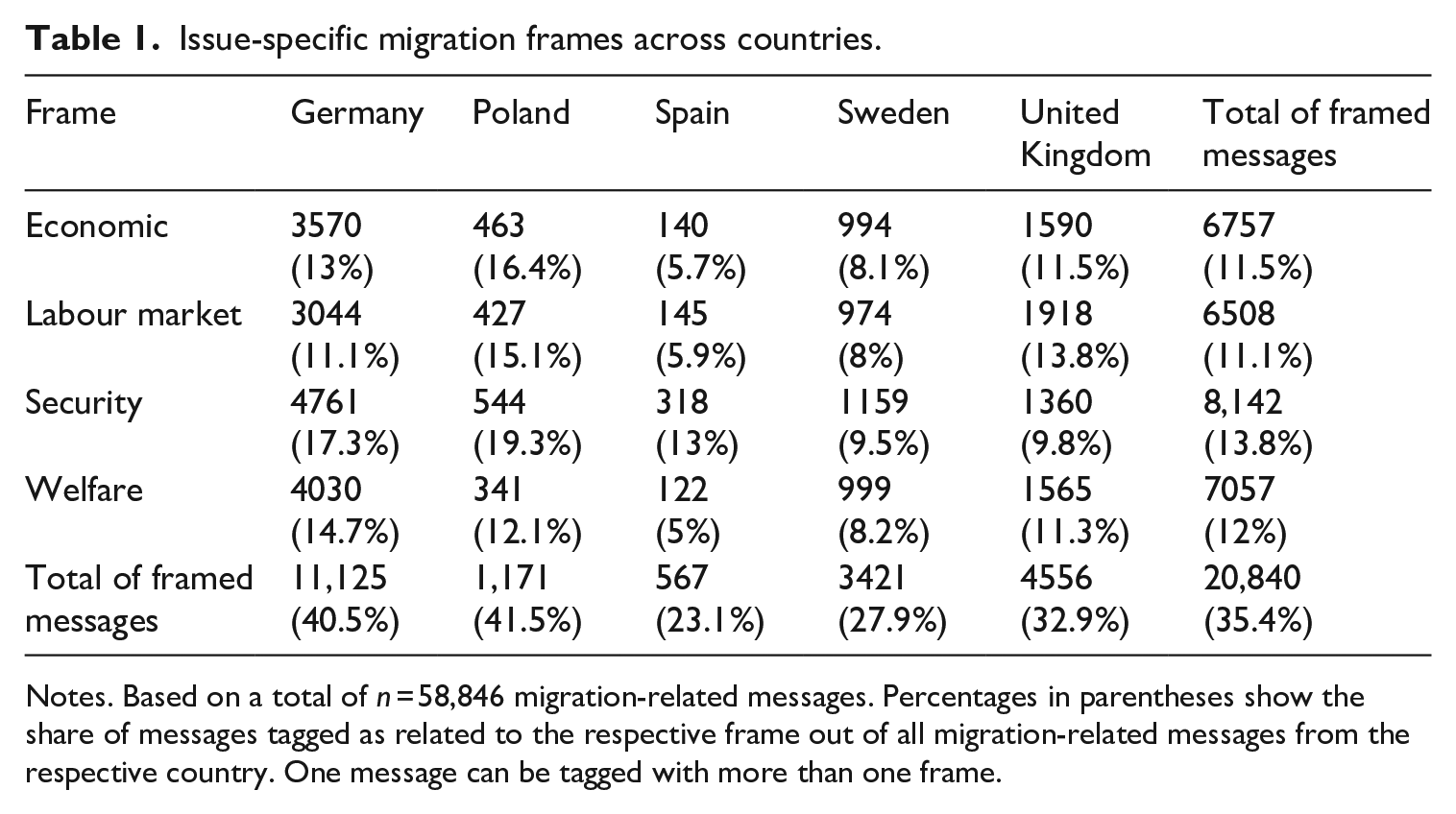
Notes. Based on a total of n = 58,846 migration-related messages. Percentages in parentheses show the share of messages tagged as related to the respective frame out of all migration-related messages from the respective country. One message can be tagged with more than one frame.
Negative and extreme support base valence
Our third and fourth independent variables are based on the content analysis of the individual messages as described above but are then enhanced by context-level information that tells us something about how relevant that content might be for the message’s potential audiences (i.e. the political actor’s support base). These variables will allow us to test hypotheses 3a and 3b.
As research has shown that SNS users tend to follow and interact with candidates and parties that match their own political positions and ideology (Ancu and Cozma, 2009; Macafee, 2013), partisans’ attitudes as surveyed in the REMINDER study (Meltzer et al., 2020) can be seen as an acceptable proxy for the attitudes of the potential online support base (see Eberl et al., 2020, for a similar approach). While these surveyed attitudes will not tell us much about the individual users that interacted with specific messages, it gives us additional contextual information about a message’s theoretical appeal to the sender’s support base.
To measure attitudes within each political actor’s support base that are linked to the identified dimensions of the migration issue highlighted in the framed migration-related SNS messages, respondents in the five countries were first asked to answer four questions (one for each of the issue-specific migration frames) that were originally introduced in the ESS Round 7 module on immigration: (1) Would you say it is generally good or bad for [COUNTRY]’s economy that people come to live here from other countries? (Economic Frame), (2) Would you say that people who come to live here generally take jobs away from workers in [COUNTRY], or generally help to create new jobs? (Labour Market Frame), (3) Is [COUNTRY]’s safety situation made better or worse by people coming to live here from other countries? (Security Frame), and (4) Most people who come to live here work and pay taxes. They also use health and welfare services. On balance, do you think people who come here take out more than they put in or put in more than they take out? (Welfare Frame). For each question, respondents could answer on a scale from 0 (the immigration friendly end of the respective dichotomy) to 10 (the immigration hostile end of the respective dichotomy).
Based on respondents’ propensity to vote, an average negative support base valence (H3a) for each party’s support base was computed. 5 The variable was then centred around zero and now has a theoretical range from -5 (i.e. strongly positive valence) to + 5 (i.e. strongly negative valence). Empirically, the variable negative support base valence ranges from -2.45 (for the UK party Sinn Féin and the economic dimension of migration) to + 3.84 (for the Alternative for Germany party and the security dimension of migration). The second variable is termed extreme support base valence (H3b) and is a squared transformation of negative support base valence that ranges from 0 (i.e. indifferent support base valence) to 5 (i.e. strongly positive or strongly negative support base valence).
Each party’s or candidate’s SNS message was then assigned their partisans’ values on the frame mentioned in the post. If one framed post was classified as highlighting more than a single dimension of the migration issue, the frame with the strongest attitude linked to it (i.e. the one scoring highest on extreme support base valence) and its values were assigned to the post. The variable’s empirical range spans from 0 (for the Spanish Socialist Workers’ Party and the Welfare frame) to 2.95 (for the Alternative for Germany party and the Security frame).
Control variables
Similar to other studies predicting interactions on Facebook, we include two categories of control variables: account- and message-level controls. As account-level controls, we include whether the account corresponding to a given post belongs to a party leader. In addition, as prior research has shown that populist parties tend to be more popular on SNS than other parties (e.g. Blassnig et al., 2020), we also included a dummy variable indicating whether an accounts’ respective party can be classified as a populist party according to the ‘PopuList’ (Rooduijn et al., 2019) or not. Moreover, we control for (right-wing) ideology based on the assessments from the Chapel Hill Expert Survey (Polk et al., 2017), as well as for ideological extremism (see Jost et al., 2020), which, in essence, is the centred and squared transformation of ideology. Message-level covariates include the log-transformed length of the message, and the message type, which was determined via the Facebook and Twitter API and had six different levels: post/tweet, photo, video, link, and event (post/tweet as the reference category – i.e. a text-only message). Note that the message type event only exists on Facebook.
Model specifications
The count data used for the analysis (i.e. the number of user interactions) are assumed to come from an overdispersed Poisson distribution (with the variance being much larger than the mean), so a negative binomial regression was used. The model was estimated using Bayesian methods with flat priors, essentially producing parameter estimates with their mode identical to MLE point estimates (e.g. Gelman et al., 2013). Deploying Stan probabilistic programming language (Carpenter et al., 2017) and the brms R package (Bürkner, 2017), with parameters computed from 4,000 Markov Chain Monte Carlo samples all models were estimated as hierarchical, varying intercepts, negative binomial regressions. Moreover, we clustered (i.e. random effects) the data on two levels, the country level (i.e. accounting for users in some countries being more active and/or responding differently than users in other countries), and the account level (i.e. accounting for some accounts getting much more user interactions with their posts than others due to their different numbers of followers). The models for Facebook and Twitter were run separately. Both converged with Gelman-Rubin convergence never exceeding 1.01 (Gelman and Rubin, 1992), MCMC trace plots can be found in the Online Appendix (see Figure A1 and A2).
Before inclusion to the subsequent models, all independent variables and controls (besides the log length), that were initially not dichotomous, were rescaled to range from 0 to 1 to allow for a more comprehensible interpretation and better comparability of coefficients.
Results
In a first analysis, we are interested in how migration-related messages compare to the rest of the political actors’ messages on social media. In our first set of descriptive analyses, we thus consider the entirety of social media messages that political actors post during our period of analysis. Considering the inherent negativity of public migration discourses, the popularity of SNS messages, and the advantage negative messages seem to have in terms of user engagement, we expected migration messages, on average, to perform better than other kinds of messages (see H1). As can be seen in Figure 1 below, non-migration related SNS messages, indeed, receive much fewer interactions than messages related to migration on Facebook (i.e. 202 vs 413). 6 On Twitter, in turn, differences are close to non-existent (48 vs 54).
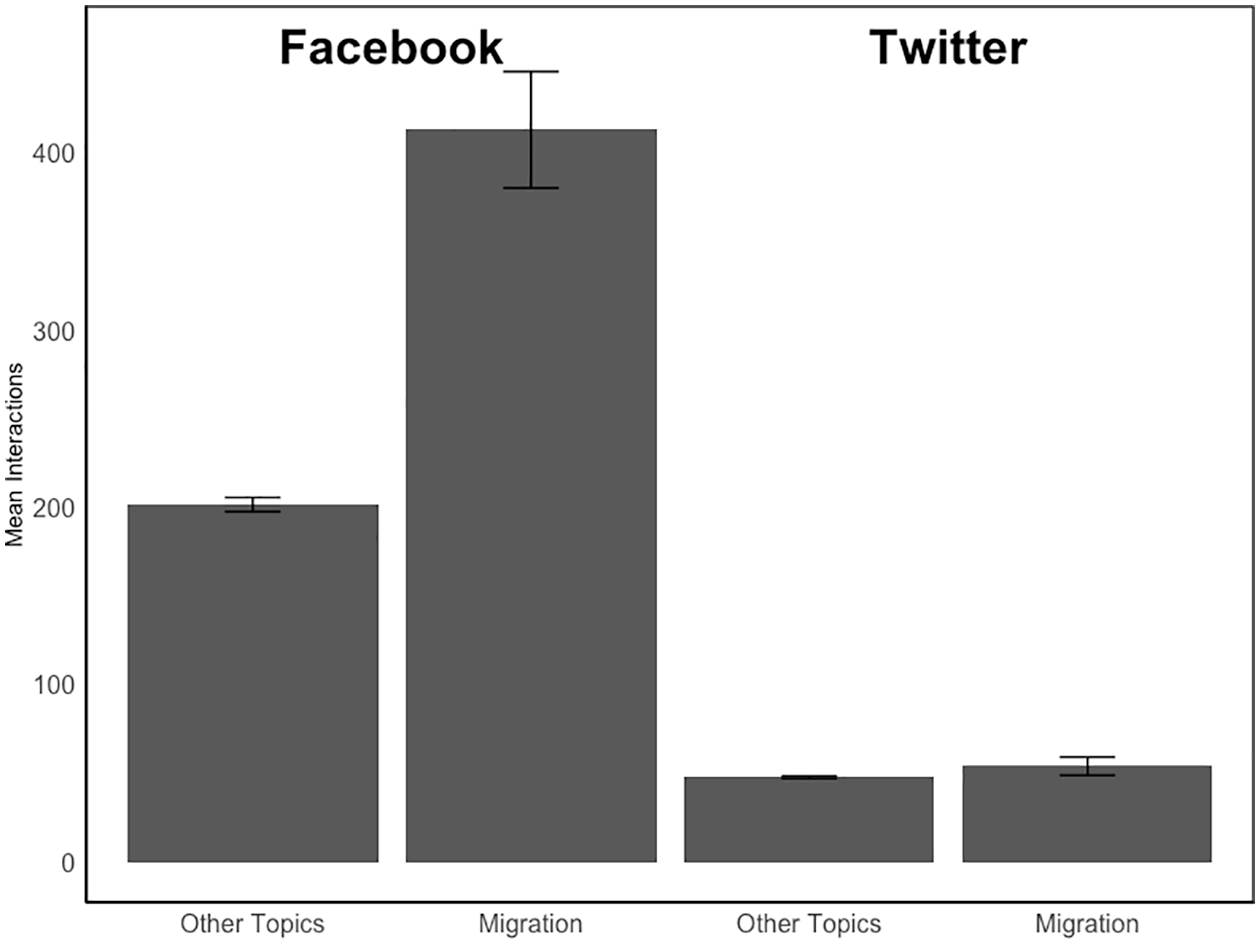
Mean Interactions for migration and non-migration related messages across platforms.
Having first underscored the relevance of migration discourses in political messages on social media by showing that it outperforms other issues in terms of user engagement, for the next steps, we now specifically dive into this subset of migration-related messages only. The following analyses are based on a negative binomial regression approach. Fixed-effects coefficients for the respective models are presented in Figures 2 and 3 below.
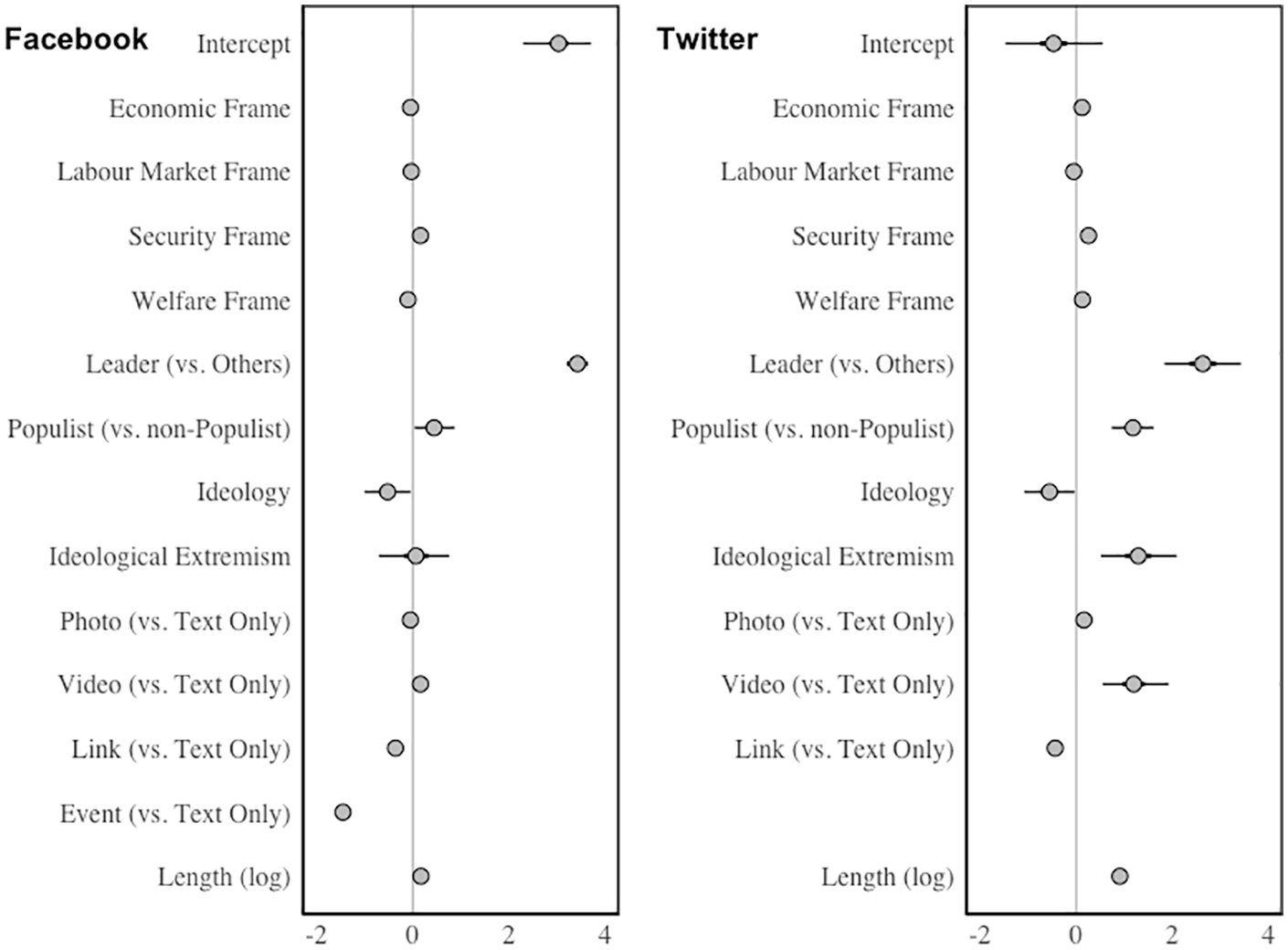
Estimated posterior fixed-effects parameters for Facebook and Twitter.
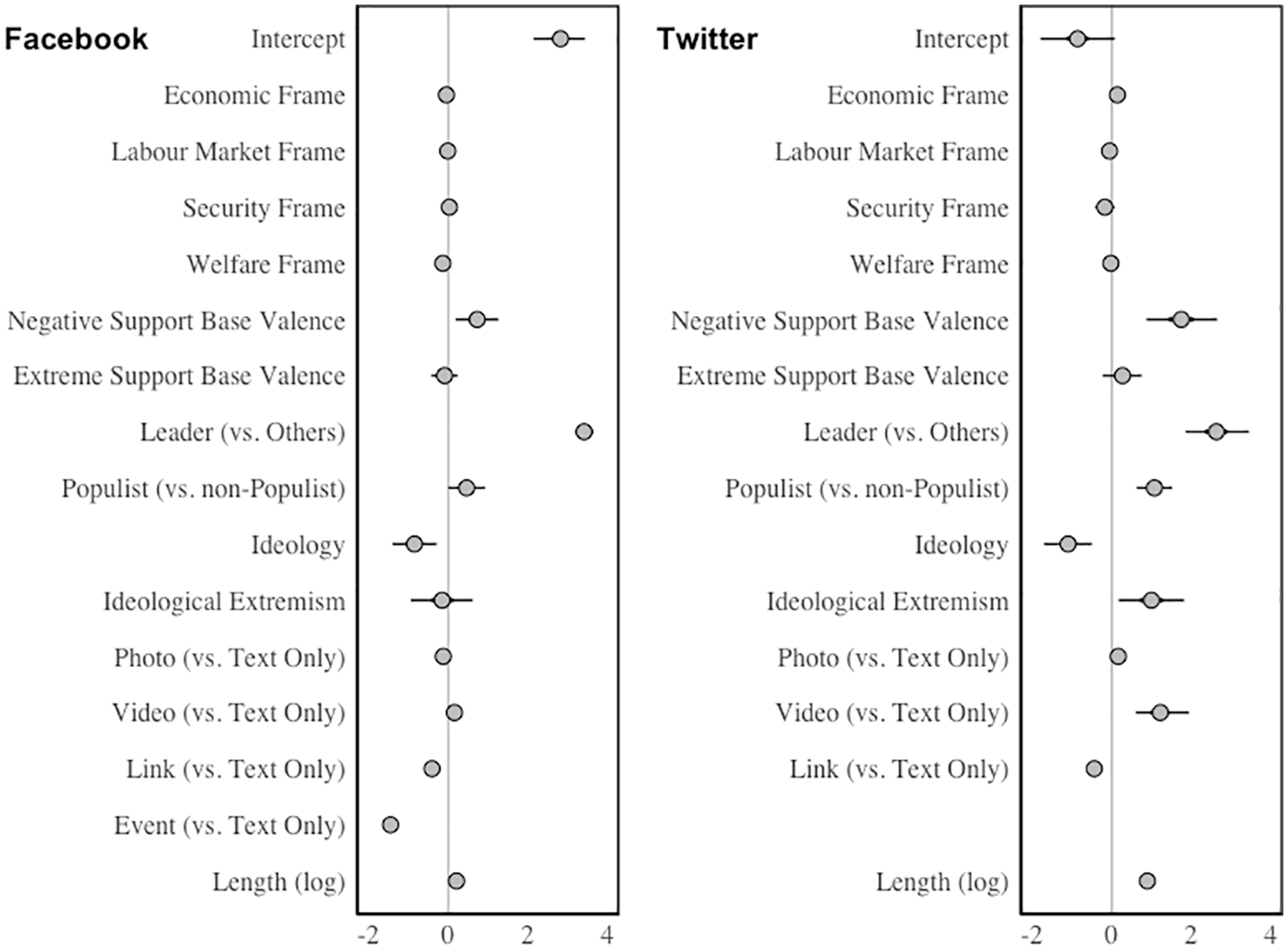
Estimated posterior fixed-effects parameters for Facebook and Twitter: Including survey-based support base valence measures.
We wanted to know whether the fact that specific dimensions of migration are highlighted (i.e. issue-specific framing) may increase the number of interactions with that message as compared to others (H2). Indeed, Figure 2 suggests that, on Facebook, migration-related posts that address security concerns tend to get more interactions than other posts. As can be seen also in Table A3, Model 1, in the Online Appendix, with β = .17, the security frame has the strongest effect. Since coefficients are expressed as the expected log count difference, exponentiated coefficients are treated as multiplicative. Therefore, the coefficient of the security frame on Facebook means that the number of interactions increases by e17. = 1.19, or 19%, when this frame is present. Conversely, none of the other issue-specific frames has a consistent impact on user engagement (i.e. the credible intervals include zero). 7 Similarly, on Twitter, the security frame has the strongest positive impact on user engagement, increasing interactions by 28.4% (β = .25). However, on this platform, the economic and welfare frame also increase the number of interactions a tweet receives by 12.8% (β = .12) and 13.9% (β = .13), respectively; although to a lesser extent than the security frame does (see Figure 2 and Table A3 in the Online Appendix, Model 3). Overall, the size of the coefficients tends to be rather small compared to other factors in our models.
Next, we will include an additional message characteristic into the models, namely the theoretical appeal of a cued migration frame vis-a-vis the message sender’s audience (i.e. the support base valence). As shown in Figure 3 (and Model 2 and 4 in Table A2 in the Online Appendix), we find support for H3a for Facebook and Twitter. If a message addresses a dimension of the migration issue towards which the respective political actors’ support base holds strongly negative attitudes, the number of interactions to such framed migration-related message highlighting that dimension tends to be higher. On Facebook, the coefficient of β = .73 implies an 107.5% increase of interactions as negative support base valence goes one unit up. In addition, backing up the support for H3a, we find that also interactions on Twitter are heavily increased when negative attitudes linked to the respective frame employed are stronger (β = 1.75; 475.5% increase). The coefficients for extreme support base valence, however, reveal no support for H3b in either model.
The control variables tend to behave as expected and largely similarly on both platforms. As suggested in the literature, the status as a party leader does indeed have a strong influence on the popularity of a SNS message on Facebook as well as on Twitter, exhibiting the overall strongest effects on elicited interactions (see also Eberl et al., 2020). Accounts connected to populist parties also tend to get more user engagement, with the effect being somewhat stronger on Twitter than on Facebook (Blassnig et al., 2020). While, on Facebook, left-leaning accounts seem to perform better, on Twitter, ideological extremes also perform well. Note that these findings may be very specific to this subset of messages analysed, namely, migration-related messages. Finally, message type also plays a role. For example, the models show that videos positively influence the number of interactions with a post.
Robustness checks
We now turn to a set of robustness checks which further probes our empirical results. First, as some issue-specific frames, such as the security frame, may be inherently linked to a more negative sentiment than other frames (Eberl et al., 2018), one may wonder whether effects in Figure 2 are driven by the actual frames or, instead, the sentiment attached to posts addressing specific frames. Using the Lexicoder dictionary (Young and Soroka, 2012), we, therefore, annotated the sentiment of each post and tweet and ran the analyses in Figure 2 again, including this new variable (see Table A4 in the Online Appendix). 8 While messages with negative sentiment do receive more interactions on both platforms, the substantial findings reported in the results above are robust to these model specifications. Second, as the analyses in Figure 2 only consider the subset of SNS messages that include at least one issue-specific frame, we decided to re-run these analyses, including messages that do not address any of the studied frames as well. Our results concerning H2 remain robust to these changes (see Table A5 in the Online Appendix). Third, since the selection of frames can not be exhaustive and is, in fact, guided by the availability of the survey data, we ran the analyses with an additional, culture frame, an aspect that is not queried in the survey data used in our approach. Again, results remain robust (see Table A6 in the Appendix). Fourth, we wanted to know whether the findings concerning H3 are similar across all different types of interactions. In fact, results are substantially the same for likes, shares, ‘Angry’ reactions, 9 favourites, and retweets (see Tables A7 and A8 in the Online Appendix). While they are by far the strongest for ‘Angry’ reactions, results do not hold for ‘Love’ reactions. The latter is little surprising since the ‘Love’ reaction is the only unambiguously positively emotionally valenced interaction on Facebook. 10
Conclusion and discussion
In this study, we investigated the sender and content characteristics that increase user engagement to European politicians’ messages on social media. In our first set of analyses, we found that, on average, migration-related posts on Facebook receive distinctly more interactions than posts that do not refer to migration (H1). Since a higher number of interactions can be understood as a measure of attributed relevance to a message (i.e. popularity cues), in a sense, this result underscores the significance of the topic of migration in political discourses on the platform. Moreover, taking a closer look at migration-related messages, we find that, similar to discourses in traditional media, the security frame is the – or among the – most common issue-specific frames addressed in political messages on social media (see Heidenreich T and Eberl J-M, 2021; Eberl et al., 2018). In fact, it is also the only migration frame that consistently increases engagement both on Facebook and on Twitter (H2). On Twitter, not only the security frame but also the economic and the welfare frame seem to increase interactions with a message, although to a lesser extent. This, however, is only the case as long as one does not account for the interconnection between political actors’ support bases and the dimensions of the migration issue highlighted in these frames. In our final set of analyses, we show that – for both Facebook and Twitter – whether a message addresses a specific dimension of the migration issue towards which the respective political actors’ support base holds strongly negative attitudes is a key multiplicative factor (H3a). Addressing a dimension of migration towards which the respective political actors’ support base holds extreme attitudes, irrespective of the valence of these attitudes, in turn, does not increase the number of interactions to the respective posts (H3b). The results support the assumption that appealing to (online) supporters’ discontentment trumps appealing to their euphoria when it comes to drivers of engagement with political actors’ migration-related messages on social media. Findings resonate relatively well with expectations according to the MAD model of moral contagion (Brady et al., 2020) or framing theory (see McLaren et al., 2018). However, evidence seems to be stronger when it comes to Facebook as compared to Twitter.
Taken together, findings may also inform political actors’ strategies to increase engagement with their posts and thus increase message spread (Vaccari and Valeriani, 2015). As most direct effects of issue-specific frames disappeared when the support base valence variables were included in the models, political actors should not merely ask themselves which frame to address in their messages; what is even more important is how they expect their potential audiences to feel about the migration dimension highlighted in this frame (see Kelm, 2020). However, the prevailing positive effect of the economic frame and welfare frame on Twitter may be indicative of the specificity of political discourses on the rather ‘elitist’ platform; at least in the European context (e.g. Ausserhofer and Maireder, 2013; Blank and Lutz, 2017).
The fact that messages, which address dimensions of the migration issue towards which the respective political actors’ support base holds strongly negative attitudes, generate a higher number of interactions may be seen as normatively alarming. Increasing interactions with a post by cueing frames that are tied to discontentment seems to be more profitable than cueing frames that might be tied to more positive attitudes. This mechanism can be seen as an incentive structure for political actors to commit to negative messaging, which, in turn, may have led to detrimental spillover effects in terms of incivility, hostile and anti-immigration discourses on social media during an extraordinary time of increased refugee movements to Europe (Ekman, 2019; Nortio et al., 2020; Weber et al., 2020).
Particularly negative messaging might even be quoted by journalists thus reaching an even broader audience and impacting discourses beyond social media (Metag and Rauchfleisch, 2017). Moreover, political actors’ tendency towards content that their constituents hold negative attitudes against may produce dynamics of polarization (Weeks et al., 2019) and audience fragmentation (Heiberger et al., 2021). With their focus on constituent-specific content, politicians further reinforce an already one-sided information environment that may hinder the normative democratic goal of a reasonably well informed citizenry (Delli Carpini and Keeter, 1996).
There are several limitations to this study. For example, the survey used in our study restricts us in the many possible aspects (i.e. frames) migration-related messages can be studied. While our analysis covers important and central issue-specific frames in the migration discourse, additional frames like a cultural frame or even generic frames and their relation to SNS interactions should be investigated in future studies. Given the diversity of migration discourses, there is ample room for further investigations in this regard. Finally, our creative use of survey data to classify framed migration-related messages on the basis of their potential appeal to a politician’s support base does not come without drawbacks. Although more and more research supports the assumption that the vast number of user interactions are cued by the message content in a supportive way (e.g. addressed issues and emotional appeals) 11 and that supporters generate most interactions (Ancu and Cozma, 2009; Blassnig et al., 2021; Macafee, 2013; Zerback and Wirz, 2021), we cannot entirely rule out that a fraction of interactions may also stem from trolls who monitor ‘the enemy’. While our measures of support base valence help us to assess the potential appeal of a framed migration-related message to a particular senders’ support base, it does not allow us to know how and why specific users have reacted to a specific message. Our model, therefore, may still include some noise that experimental studies with smaller samples should try to filter out, while also allowing for a stronger causal argument.
While our study makes use of the increased salience of the migration issue during and after the 2015 refugee movements, our findings are, by far, not restricted to this specific discourse. We believe that the current study provides valuable insights into the content characteristics of online political communication, political actors’ potential communication strategies, and citizens’ engagement with political actors more generally. Using a complex methodology allowed us to get a better understanding of migration discourses on the basis of several thousand interactions between European political actors and their citizens, on a scale that has not been possible previously. Nevertheless, social media continues to play an important role in political discourse about migration, in particular. It is thus important to understand these mechanisms of message amplification in more detail. This paper is an important step in this direction.
Supplemental Material
sj-docx-1-nms-10.1177_14614448221074648 – Supplemental material for Discontentment trumps Euphoria: Interacting with European Politicians’ migration-related messages on social media
Supplemental material, sj-docx-1-nms-10.1177_14614448221074648 for Discontentment trumps Euphoria: Interacting with European Politicians’ migration-related messages on social media by Tobias Heidenreich, Jakob-Moritz Eberl, Fabienne Lind and Hajo G Boomgaarden in New Media & Society
Footnotes
Acknowledgements
We thank Petro Tolochko and Pablo Jost for their helpful comments.
Author’s Note
Jakob-Moritz Eberl is now affiliated to Ludwig Maximilian University of Munich, Germany.
Funding
The author(s) disclosed receipt of the following financial support for the research, authorship, and/or publication of this article: This work was supported by Horizon 2020 Framework Programme [grant number 727072].

Supplemental material
Supplemental material for this article is available online.
Notes
Author biographies
References
Supplementary Material
Please find the following supplemental material available below.
For Open Access articles published under a Creative Commons License, all supplemental material carries the same license as the article it is associated with.
For non-Open Access articles published, all supplemental material carries a non-exclusive license, and permission requests for re-use of supplemental material or any part of supplemental material shall be sent directly to the copyright owner as specified in the copyright notice associated with the article.
