




Abstract
The purpose of this research is to enhance our understanding of homophilic behaviors—where individuals prefer to associate with others like themselves—on Twitter, particularly focusing on how these behaviors vary across different political affiliations. While a general increase in homophily is a well-documented phenomenon in social networks, its expression within the diverse political contexts on Twitter remains underexplored. This study seeks to understand how political alignment influences homophily and its possible role in reinforcing extreme viewpoints. In particular, the research examines the patterns of interaction within political communities on French Twitter, delineating between right-wing, left-wing, and centrist groups. The findings reveal a significant pattern: right-wing groups demonstrate a marked increase in homophily over time, suggesting a stronger predilection for in-group interaction when compared with their centrist and left-wing counterparts. In addition, the study monitors the evolution of follower networks among these political clusters, providing insights into the shifting popularity of political parties within each group. By analyzing the social connections within these clusters, the study offers a detailed perspective on the dynamics of political homophily on Twitter and how it evolves, informing our understanding of political communication and group behavior in the digital age.
Introduction
Sociologists have been aware for quite some time that individuals with similar socio-demographic traits tend to establish robust connections (McPherson et al., 2001). With the advent of new social media tools, recent years have expanded this insight to encompass the recognition that shared behaviors or ideologies also significantly enhance the likelihood of connection (Conover et al., 2011). Until recently, a substantial portion of research on homophily was done using Twitter data earning Twitter the moniker of a “political observatory” in the scholarly community (Boyadjian, 2014). Across diverse geographical contexts, Twitter data have emerged as compelling evidence, indicating the global rise of political homophily—the tendency for individuals to associate with those who share their political beliefs (Colleoni et al., 2014; Du & Gregory, 2017; Yardi & Boyd, 2010).
In India, this phenomenon found substantiation in its impact on the political discourse surrounding the Citizenship Amendment Act (Hettiachchi et al., 2021). Similarly, in the United States and the United Kingdom, homophily was discerned among political journalists engaging on Twitter during the 2016 and 2017 elections (Fincham, 2019). Notably, during the #ZumaMustFall crisis in South Africa, political leaders’ Twitter accounts exhibited homophily (Mukhudwana, 2020). This trend is not confined to specific regions; Austrian journalists displayed similar homophilic patterns on Twitter (Maares et al., 2021). Correspondingly, Australian journalists were observed to predominantly interact with like-minded individuals on the platform (Hanusch & Nölleke, 2019). Collectively, these studies underscore the pervasive nature of homophily on Twitter, transcending geographical boundaries.
The homophily observed on Twitter can be traced to two different sources. At first, one might suggest that individuals naturally gravitate toward forming connections with others who share similarities, both in real life and in online social interactions. Twitter, as a platform, has merely facilitated this natural inclination by enhancing accessibility for like-minded users to discover one another. Importantly, this inclination toward homophily isn’t unique to political contexts; it has been observed even before the widespread popularity of social media, manifesting in various non-political domains such as dating, work, and friendships (McPherson et al., 2001). The advent of social media platforms has simply made it more conspicuous, exposing and amplifying pre-existing tendencies.
On the contrary, a complementary perspective suggests that Twitter’s algorithms may play a role in influencing user behavior, subtly steering them toward a more homophilic orientation. This second viewpoint introduces the intriguing possibility that technological interventions might contribute to the observed increase in homophily. Although both of these potential explanations warrant dedicated investigations, offering valuable insights into the complex dynamics of social connections in the digital age, this article will concentrate on investigating how different kinds of pre-Twitter political homophilic biases of individuals joining Twitter evolve on Twitter. An inherent challenge in this research is to identify a suitable proxy for measuring individuals’ pre-Twitter political inclinations and then comparing them with their current political leanings.
As said in the previous paragraph, I will not be dealing directly with the measurement of the impact of ranking algorithms on homophily, but it must be noted that Huszár et al. (2022) found that algorithmic biases are more prevalent among right-wing Twitter users compared with those on the left and in the center. Without making any unwarranted claims but if this study demonstrates a greater rise in homophily among right-wing users compared with left and in the center, this article can be helpful in supporting the hypothesis that the impact of algorithmic biases on right wing is different from left and the center.
Review of Literature
In previous research, Twitter has been identified as a significant catalyst for increasing homophily among its user base (Conover et al., 2011; V. R. K. Garimella & Weber, 2017; Yardi & Boyd, 2010). Research by Du and Gregory in 2017 demonstrated that people on Twitter are approximately three to four times more inclined to establish connections within their own political communities rather than bridging gaps between different communities (Du & Gregory, 2017). Even acting as a bridge between two communities on Twitter can be socially penalizing for an individual (K. Garimella et al., 2018). This in-group inclination fosters the formation of echo chambers, reinforcing existing beliefs and intensifying group polarization. Gruzd and Roy’s findings in 2014 indicate that in the short run, especially during significant events like elections, the echo-chamber effect of Twitter gets multiplied, and Twitter usage is likely to further embed partisan loyalties (Gruzd & Roy, 2014). These results are also reflected in longitudinal studies. Long-term analysis conducted by Garimella and Weber in 2017 supports these conclusions, revealing a continual increase in homophily over time on the platform (V. R. K. Garimella & Weber, 2017). This evidence collectively indicates that Twitter may play a role in fostering homophily, which can have significant implications for societal cohesion and discourse.
While the above results indicate a correlation between Twitter usage and the development of in-group tendencies over time, it is important to acknowledge that these findings may be influenced by selection bias stemming from the specific demographics drawn to Twitter for political discussions. Previous panel studies conducted on the Twitter population have consistently revealed a skewed representation, primarily consisting of male users, that are highly educated and are more politically opinionated compared with average people in the United Kingdom (Mellon & Prosser, 2017), France (Boyadjian, 2014), and United States (Mitchell, 2019). It is, therefore, plausible that this user base already possessed in-group tendencies before joining Twitter, and their behavior on the platform merely mirrors their pre-existing attitudes. It is conceivable that Twitter itself had no substantial impact on shaping their homophilic attitudes. To counter this effect in this article, I attempt to use the initial in-group tendency level of each user when they joined Twitter (discussed more in the “Methods” section) and compare it with the final level of in-group tendency.
In addition to observations of homophily on Twitter (which is mainly measured through network analysis), there has also been a notable increase in extremity of opinions (group polarization) measured through textual analysis (Yang et al., 2017). In this context, it becomes imperative to explore the potential relationships between the increase in homophily and the increase in polarization on Twitter as past research in social psychology (Lamm & Myers, 1978; Myers, 1975; Strandberg et al., 2019) has demonstrated that engaging in conversations with like-minded peers on specific issues can result in the adoption of ideas that are either excessively risky or overly cautious, deviating from the average individual’s pre-deliberation opinions. Adoption of extreme versions of one’s initial opinions due to discussion with like-minded people is commonly referred to as the “risky-shift” phenomenon in social psychology (Stoner, 1968). These concerns about social media platforms in general pushing individuals toward more extreme viewpoints have been raised even before Twitter’s popularization (Sunstein, 1999). However, some literature on the group composition and extremity of opinions has contested the above results and shown that group composition is not a reliable predictor of an increase in the extremity of opinions (Bail et al., 2018; Vidmar, 1970).
Overall, when assessing the impact of Twitter on group polarization, the existing literature reveals a spectrum of perspectives. Contrary to some viewpoints, Barberá and Robles posit that exposure to diverse opinions on Twitter has the potential to diminish political extremism and foster dialogue across different political factions (Barberá, 2014). Bruns (2019) challenges the notion of filter bubbles, contending that their existence has been overstated in traditional media. On the contrary, Bail’s research suggests that exposure to opposing views on social media can heighten political polarization (Bail et al., 2018). Gruzd’s observations indicate a nuanced relationship on Twitter, featuring both clustering around shared political views and cross-ideological connections, emphasizing the intricate dynamics between the platform and political polarization (Gruzd & Roy, 2014). These varying perspectives underscore the imperative for further research to gain a deeper understanding of Twitter’s role in shaping political attitudes and behaviors.
In the United States, research by Colleoni et al. demonstrates that American center-left (Democrats) exhibit a stronger inclination toward in-group tendencies compared with center-right (Republicans), using a network-based approach (Colleoni et al., 2014). However, the understanding of Twitter user behaviors outside of the United States through a network approach remains an open question. Studies focusing on hashtags present conflicting findings. Hanna et al. (2013) argue that French hashtags tend to be more polarizing than those in the United States, while Davidson et al. (2019) contend that the French right on Twitter demonstrates significantly lower usage of “propaganda hashtags” compared with American datasets.
Specifics of the French Political Context
To comprehend the dynamics of Twitter user behavior in the French context, it is essential to delve into the intricacies of the country’s political system. France’s political landscape is marked by a distinctive fusion of globalization and a robust state tradition, where the presidency wields considerable power, often relegating the parliament to a subordinate role within the executive domain (Laïdi, 2012). This political framework has faced challenges stemming from globalization, Europeanization, and domestic influences, giving rise to a unique governance structure (Cole, 2008).
The French party system’s evolution has been notably influenced by global forces and European integration, leading to party fragmentation and the emergence of the Front National (Bornschier & Lachat, 2009). In the 5eme Republic, a shift in political dynamics unfolded, with the ascent of centrist politics challenging the traditional left–right paradigm (Hanley, 2018). However, recent years have seen a wane in the appeal of centrist parties, giving rise to a pronounced surge in extreme political factions. While the French left has maintained a robust electoral presence for an extended period, the extreme right has experienced a sharp increase in support. A prominent example of this transition from the fringes of the extreme right to the mainstream is observed in the Front National, now known as Rassemblement National. Rojon contends that the Front National’s appeal has extended beyond urban centers to encompass rural areas, influenced by factors like the agricultural crisis and the rural–urban divide (Rojon, 2013).
The 2017 French presidential elections were marked by significant shifts in the political landscape, with the traditional governing parties being disqualified early on (Durovic, 2019). The campaign saw a departure from the traditional left–right divide, with a focus on the integration–demarcation divide (Lachat & Michel, 2020). This election also saw the rise of Emmanuel Macron, a political outsider, who ultimately won the presidency (Kuhn, 2017). Macron’s victory was seen as a major disruption to French politics, with his pro-EU and pro-globalization stance contrasting with the nationalistic/populist alternative embodied by Marine Le Pen (Evans & Ivaldi, 2018).
Behavioral Distinctions of Right Wing
In this segment of the literature review, we delve into the factors contributing to the heightened susceptibility of right-wing Twitter users to homophily and group polarization, as opposed to their left and center counterparts. While McClosky and Chong (1985) initially posited similarities in the expression of ideas between extreme-left and extreme-right factions, recent investigations into Twitter network dynamics reveal significant disparities. Specifically, studies, such as the one conducted by Huszár et al. (2022), have unearthed distinctive patterns in the Twitter network evolution of right-wing users.
Huszár et al.’s research sheds light on the increased vulnerability of right-wing individuals to algorithmic biases on Twitter, thereby fostering the creation of echo chambers and reinforcing in-group homophily. The discernible impact of algorithmic biases on Twitter users, as identified by Huszár et al. (2022), is notably more pronounced among the right-wing segment when compared with their left and center counterparts. Although this discussion does not directly address the measurement of the impact of ranking algorithms on homophily, it is crucial to acknowledge the prevalence of algorithmic biases highlighted by Huszár et al. among right-wing Twitter users. Without making unwarranted claims, if this study demonstrates a more substantial increase in homophily among right-wing users compared with those on the left and in the center, it lends support to the hypothesis that the influence of algorithmic biases on the right wing is distinct from its effects on the left and center.
Previous research has also shown that there are some fundamental psychological differences between right-wing people and other political leanings. Jost et al. (2003) identified low openness to experience, low uncertainty tolerance, high needs for order, structure, and closure, lower integrative complexity, moderate fear of threat and loss, and slightly lower self-esteem as characteristics of right-wing users. Low uncertainty tolerance and high need of structure could imply a very low tolerance for cognitive dissonance, which means that right-wing users are less likely to add diverse profiles to their news feed as it may lead to contradictory messages in their news feed. However, Greenberg and Jonas (2003) contested this view, arguing that these features are common to both extreme-right and extreme-left groups.
In addition to seemingly subconscious homophily based on behaviors, there is evidence of partisan instructions in certain social groups on Twitter. These instructions appear to subtly guide followers toward others who align with the same political party. Through detailed interviews with Twitter activists during the 2022 presidential elections, Boyadjian and Wojcik (2022) established that in France, such behaviors were more pronounced among right-wing users compared with those on the left and center. While a similar study has not been conducted for the 2017 presidential elections, the consistency of behaviors in communities may provide a reasonable explanation for the growing homophily observed among the right.
While individual socialization, in terms of social connectedness, does not seem to be associated with political leaning (Reilly, 2017), the dynamics of collective communities between right-wing, center, and left-wing groups could play a significant role. The combination of algorithmic biases and psychological characteristics identified in right-wing individuals may contribute to the formation of ideological echo chambers, leading to an increased in-group homophily among right-leaning Twitter users. Further research is needed to delve into the complex interplay between social media algorithms, psychological factors, and political polarization to gain a comprehensive understanding of these dynamics.
Hypothesis 0(H0). Political affiliation will not have any significant connection with level of homophily.
Hypothesis 1(H1). Political right will exhibit a higher level of increase in homophily compared with political center and political left.
Methods
Database
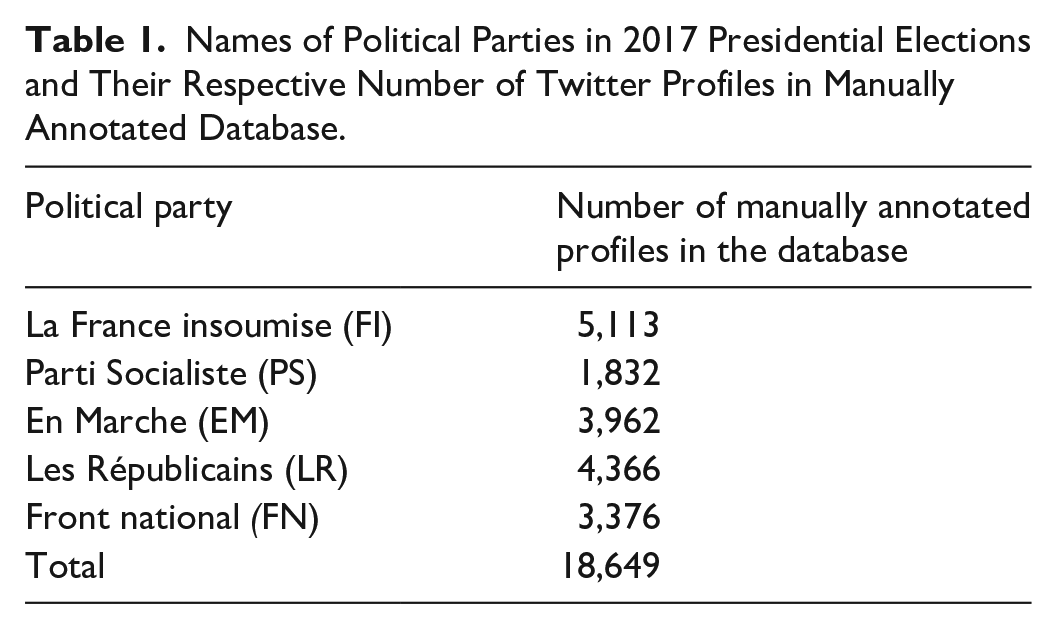
For the initial phase of this project, I will leverage an expanded version of the largest manually annotated Twitter database for political affiliations to date (Fraisier et al., 2017). The original database contained 18,649 manually annotated Twitter profiles. However, I extended it to encompass the Friends (individuals followed by these profiles) of all 18,649 profiles. For simplicity in subsequent sections of the article, I will refer to this comprehensive dataset as database A. This database includes the political affiliations of five major political parties (see Table 1) that had a candidate in the presidential election of 2017 in France. The database was created by manually looking at the self-descriptions or Tweets of profiles by three different annotators.
Names of Political Parties in 2017 Presidential Elections and Their Respective Number of Twitter Profiles in Manually Annotated Database.
A secondary Twitter profile database, designated as database B, was constructed using a targeted crawling approach (Gurchani, 2021a, 2021b), encompassing 1.2 million Twitter profiles. Distinguishing itself from database A, database B extends its scope by not only incorporating the initial set of profiles but also gathering information on all the followers of those profiles. The resultant comprehensive database B contains over 1.2 million Twitter profiles.
Subsequently, database B underwent processing through a community detection algorithm, specifically the Louvain algorithm, to unveil clusters of highly interconnected individuals within the Twitter network. Following cluster identification, I conducted a thorough analysis by retracing the locations of manually annotated profiles within each cluster. This step aimed to unveil the overarching political affiliations characterizing the identified clusters.
The outcomes of this analysis, showcasing the clusters identified through the community detection algorithm, are depicted in Figure 1.

Distribution of manually annotated profiles in communities found through community detection in database B.
From Figure 1, it can be seen that the most political clusters in the database are cluster 2, cluster 4, and cluster 6. Based on the distribution of manually annotated profiles in these clusters, I designated these clusters as follows:

In the rest of this article, the terms “center community,” “left-wing community,” and “right-wing community” refer to the above three clusters.
Exclusivity and Popularity of Elite Profiles on Twitter
To test the hypothesis, we will need to construct the following variables.
Independent variable: Political affiliation (type: ordinal)
Dependent variable: Level of homophily (type: continuous)
Level of Homophily
The level of homophily was assessed using database A with two different indexes. The first index measured the overall popularity of a “friend” profile, while the second index measured the exclusivity of a “friend” profile within a specific party. Overall, the goal of both of these indexes is to get exclusively popular profiles.
Let:
Then, the popularity of friend i in party j (

And the exclusivity of friend i in party j is

In this formulation, the popularity metric
The goal of the above two calculations is to identify “friends” who are exclusively popular among the manually annotated profiles. For example, an exclusively popular profile in party FI would be a “friend” profile that is reasonably popular within FI and is not popular in other parties. These values are obtained by multiplying the popularity and exclusivity scores as shown above.
In real life, an exclusively popular profile in parties like FI would represent a party official who may not be the party leader but holds significant importance within the party. Most party leaders and top-tier party leadership are followed by many people, including opponents of the party. This is why the study chooses to measure exclusive popularity (denoted as

In the above formulation, we can see that the final exclusive popularity value
Top Seven Most Exclusively Popular Profiles Among All Parties.

This table shows the type of profiles that were found among the seed profiles. Note that only few parties (like FI) have the party leader’s profile among the top seven most exclusively popular seed, while in most studies, party leader’s profile is included among the seed profiles for data collection.
What Is “Socio-Political Space”?
The term “political space” in this context is used to describe an imaginary multi-dimensional space where each party represents an axis. A vector in this multi-dimensional space can represent the leaning of the socio-political opinion of an individual. To explain this construct, I will use a two-party system example since it is easy to visualize the methodology through it (see Figure 2). In such, a system a vector can be placed to represent an individual’s politico-social space. The direction of this vector will represent the ratio of socialization for that individual between multiple parties and the length of this vector can represent how embedded an individual is in a certain socio-political space and the direction of the vector would represent his or her inclinations.

Here is “social space” of Twitter users in two dimensions. This user is initially more inclined to Party B (1, 7); however, he later changes his or her affiliation to party A (3, 1).
French political context in the 2017 presidential elections was such that there were five major parties that received over 90% of the votes that were cast. For a Twitter user in the French context, I imagined a five-dimensional party space where that individual’s socio-political preferences were taken as a five-dimensional vector. If over time, only the size of that vector increases, and the direction stays the same we can say that the individual has surrounded himself/herself with more people of the same kind of people as his previous socio-political space. Since the size of the community has been seen to have no effect on the intensity of opinions (Knippenberg, Vries, & Knippenberg, 1990), then it can be claimed that attitude-based polarization is not an effect of political homophily or echo chambers.
If the direction of these socio-political vector’s changes for a significant number of people in all communities over time, it will be necessary to see if the new direction of these vectors is more inclined toward initial party biases. If that is also the case, then it will be a strong indicator not to reject the null hypothesis. Whereas if the direction of this vector changes for a statistically significant number of people in a community (and not for any other community), then it can be taken as a sign that the socio-political space of certain communities is changing, and it will be necessary to reject the null hypothesis since this effect will be noticed on a particular kind of group and not all groups on Twitter.
Operationalizing the Variable “Change in Political Polarity”:
To conceptualize the change in polarity (on Twitter), it is necessary to quantify who a Twitter user follows and what does it mean in terms of information he or she will end up consuming. From previous works, we know that Twitter users prefer to consume data from political actors whom they support to some extent in real life (Barberá, 2015). Once a user starts a Twitter account, he or she is asked to follow some actors on Twitter. Since non-accidental nature of choices to follow political accounts has been demonstrated in the thesis of “Julien Boyadjian” (Boyadjian, 2014). It is a reasonable assumption that this choice of “who to follow” at the very start of a user’s account is driven by pre-inclinations or pre-twitter biases and not from biases developed by Twitter itself. To operationalize this “Pre-Twitter inclination,” I used the first 10 accounts a user followed and quantified what it means in terms of user’s placements in “socio-political space.” To get access to these first 10 accounts that a user followed when he started using Twitter, I took advantage of the fact that when Twitter API returns “friends” they are ordered in a chronological manner. At the time of data collection, I marked this sequence using table indexes. For this part of the analysis, the first 10 accounts were separated from the list of complete “friends” for each user.
There are only a few traces of pre-Twitter inclinations a Twitter user leaves on the site. Measuring this inclination requires using one of these available resources to approximate this value. One possible way would have been to investigate the Tweets of the individual’s right after they joined Twitter. Although this approach has the advantage of providing qualitative details about the individual from the start, after several attempts at this approach, it was found that very few Twitter users Tweet right after they join the platform, and even if they do, it is usually an ideologically uninformative Tweet. An alternative approach that was used was to investigate the network, which in some ways can be more informative than ideological inclinations. It is reasonable to assume that Ideological and interest-based similarities at that time are an important factor in this choice since these choices will lead individuals into a socio-political space where they will experience Twitter-based socialization.
The determination of an individual’s initial orientation in the socio-political realm relies on an analysis of the first 10 accounts they choose to follow on Twitter. This methodological approach is justified by the binary choice presented to users upon joining the platform: They can either follow accounts recommended by Twitter’s recommender system or manually curate their follow list. The platform’s documentation reveals that the recommender system tailors suggestions by incorporating user behavior from third-party apps or personal contacts. Consequently, it is reasonable to posit that this personalized curation may reflect an individual’s biases toward specific political parties or opinions. Hence, it is reasonable to assume that the initial choice of users to follow can mirror political affiliation, if any.
In the scenario where users construct their own network, it may be argued, albeit as an exception rather than the norm, that a politically motivated right-wing user might follow a left-wing leader out of curiosity, aiming to stay updated on the latest debates within the left-wing discourse. However, studies on user intentions behind follow-relationships underscore that ideological congruity significantly influences the selection of Twitter accounts to follow (Wojcieszak et al., 2022). Moreover, research in the field of Twitter analysis often employs a network-based approach, as evidenced by studies such as (Barberá, 2015; V. R. K. Garimella & Weber, 2017), which accurately predict a user’s political affiliation. This suggests that a user’s friend network, represented by the accounts they follow, can indeed reflect their ideological viewpoints at a specific juncture. If this assertion holds, a compelling argument emerges, asserting that the first 10 friends of a user may effectively serve as a proxy for their initial political polarity or inclination.
For each of these 10 accounts, the “exclusivity score”
Like the initial polarity of everyone, the final polarity was calculated for each individual account in all three major political clusters. This final polarity was based on all the accounts individual ended up following until (November–December of 2018). 2 For the final polarity of everyone as well, the exclusivity score of all “friends” of each individual was obtained from the above-mentioned exclusivity table. The average of these scores was then obtained for everyone. Since I am only interested in the directional change of these vectors, I will normalize the mean vector to obtain the sum of scores on each axis to be 1.
For instance, if we consider the given example of profile X following 25 profiles (see Figure 3), to quantify the shift in its political stance, the first step would be to vectorize the initial 10 “friends” or followed accounts. This vectorization involves assigning a numerical value to the political leaning of each friend based on their exclusivity scores. Once these values are obtained, a similar process is also applied to all 25 profiles that profile X follows. By calculating the exclusivity scores for each of these profiles, and subsequently averaging them, we obtain a comprehensive view of profile X’s final political polarity. This final polarity, represented as a normalized mean vector, allows for the comparison of profile X’s initial and final political orientation, with the sum of scores on each axis adjusted to equal one. This normalization is crucial as it facilitates the measurement of the directional change in political leaning, irrespective of the number of parties or the scale of their exclusivity scores.

Here is a list of 25 friends of Twitter user X. The first 10 of the friends will be used to generate an initial polarity vector, whereas all of the 25 friends are vectorized to determine the final polarity. Change in polarity is then calculated using the cosine difference between the two.
Measuring the Change in Polarity
“Cosine similarity” between two vectors measures how close two vectors are to each other using the angles between them. A cosine similarity value of 1 indicates that vectors are similar. It is often used in modern word2vector applications for translation purposes or to check the similarity of documents. In our case, it can be particularly useful to measure the similarity between the initial and final polarity of everyone. If initial and final vectors are highly similar, then it will indicate that Twitter does not change the balance of opinions that individuals have. On the contrary, if there are significant changes in polarity direction, then it can warrant further investigation if these changes in polarity can be attributed to Twitter or not.
I measured cosine similarity between the initial polarity vector and the final polarity vector for a 1% random sample from each of the three major political clusters and obtained the results discussed in the following section.
Results
Change in Polarity
If using Twitter increases homophily as it allows users to follow more of the same type of profiles that they are initially inclined toward and less of the profiles that they dislike, then this phenomenon should impact all three major political communities in the French political context and their final polarity value should be significantly different from their initial polarization values and be directed more toward their initial inclinations. Whereas if only a subset of communities is getting more and more embedded in their socio-political direction, then it must be further investigated as to why a certain community is getting more and more homophilic over time and others are not.
Using Python’s SciPy library, I passed all three of these samples through one-way analysis of variance (ANOVA) to check to see if there is any statistically significant difference between these communities when it comes to changes in the direction of their initial polarity. In other words, do any of these three political communities significantly diverge from their initial social-political space?


While it is still unclear from the above results, where the difference lies but with such a small P value, there must be a significant difference between the initial and the final polarity of at least one of these three groups.
After getting significant ANOVA, it was necessary to distinguish the group that was making the above difference. Using the same Python Library SciPy, I performed a post hoc test to identify the different community. During this test, the T-test was applied on all combination three communities. Table 3 shows the results that were received from this test.
Results of Post Hoc Test Between Two Communities at a Time to Identify the Community That Is Causing the Difference in ANOVA.
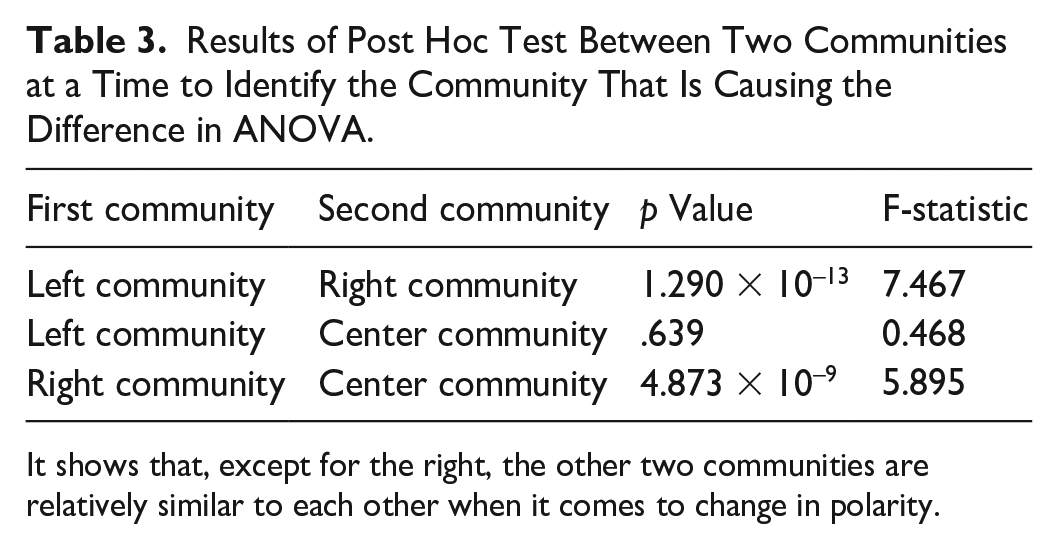
It shows that, except for the right, the other two communities are relatively similar to each other when it comes to change in polarity.
From the above results, there is only one community (right-wing community) that significantly changed the direction of their political socialization. Whereas both other communities do not show any significant change in their initial and final direction, it is surprising to see that even though President Macron’s political party carved a significant political space for itself on Twitter and yet the socio-political direction of his community has not shifted its direction at all. This can be explained by the fact that Macron had previously been working with Parti Socialist and his increase in popularity coincided with the decline of the other two major parties in the center. It is no surprise that supporters of Emmanuel Macron have the same socio-political space as the other two center parties and that it did not shift its direction despite the fact that a new political party emerged victorious in the presidential elections.
Another important observation is about the socio-political direction of the “Left” community. If the null hypothesis is correct and Twitter causes homophily which in turn causes group polarization, this effect should have been visible in the case of the French Left to some extent. However, the F-value between the left community and the center community is 0.46 with a p-value of .639 which shows that there is no significant change socio-political direction of these clusters and this raises a reasonable doubt about the causal connection between Twitter and the rise of Political polarization.
Although this evidence does put the null hypothesis in serious doubt, it is still not enough to reject it. At this point, the need for an alternative hypothesis is abundantly clear. The strength of this new hypothesis will be checked by how well it can explain the primary observation in the data which shows that only a certain cluster (rightist community) changed the direction of its socialization, and as we will see in the next section, it is the only cluster which is becoming increasingly homophilic.
Who Follows Whom Over Time?
As noticed above, there is a noticeable change in polarity over time in the three major clusters. Given this directional shift, a pertinent inquiry emerges: What was the initial inclination of individuals within the right-wing Twitter cluster in France in the five-dimensional political space? Furthermore, how has their inclination evolved over time? I used the three clusters (right, left, and center) in database B to track which political party each of these clusters inclined toward (follow) over time. Figure 4 illustrates the averages of the initial and final polarity values of members in Group 3, shedding light on the trajectory of their political leanings.

Initial and final levels of homophily among right-wing users.
From Figure 4, the major difference between initial and final polarity comes from a significant increase in FN polarity and a big decrease in EM polarity. It shows that over time this group’s initial inclinations which were more biased toward Les Republicain (and to some extent toward FN) have moved significantly in favor of FN. An interesting observation is that LR polarity for this group has not changed significantly in this figure. Since there are many LR members in the center community, it will be interesting to see if the same trend has been observed for them.
Now compare the above result with the change in polarity that happened in the left-wing community.
As seen from Figure 5 above within the left cluster, the popularity of FI increases to some extent over time, but, overall, the balance in the socio-political space remains consistently in the same direction.
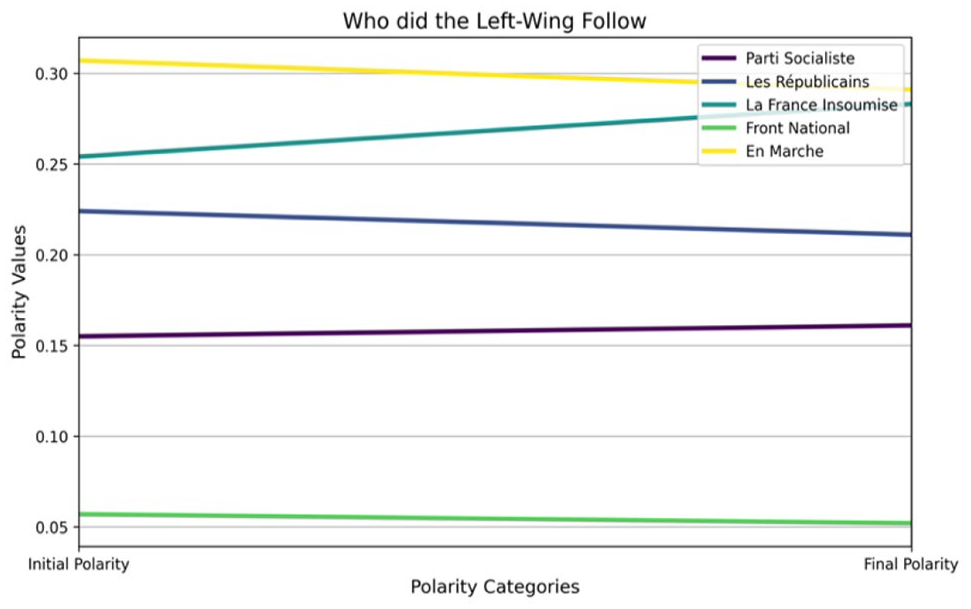
Initial and final levels of homophily among left-wing users.
Figure 6 indicates the changes in polarity in the center cluster from the start of profiles to December 2018. It can be seen the balance of socialization remains consistently in the same direction for the account in this cluster.

Initial and final levels of homophily among center users.
Difference in Initial and Final Socio-Political
To assess which political clusters are diverging over time and which clusters are converging over time, I compared the cosine similarity of each community’s initial and final clusters.
It can be seen in Figure 7 that while all the clusters are diverging over time, the effect on the left and center is very weak compared with the right-wing cluster. This comparison also makes it clear that while left and center clusters had a relatively similar socio-political space from the beginning, the direction of socialization pattern for users in the right-wing cluster is unique as soon as they join Twitter and continues to diverge over time.

How similar are the initial and final social spaces of the center, right, and left?
Concluding Discussion and Directions for Further Research
In this research article, I have explored the dynamics of homophily among different political communities in France, with a particular focus on understanding variations in behavior across three diverse political clusters on French Twitter. Our investigation consistently reveals a common trend: Over time, in-group connections tend to be more prevalent than cross-group associations across all political communities. More interestingly, this inclination is most pronounced within right-wing communities.
Based on these findings, we can infer that the initial bias or political inclination of individuals upon joining an online social media platform can significantly shape their subsequent behavior. Those leaning toward the right wing upon entering Twitter exhibit a distinct trajectory compared with their left and center counterparts. This insight can be crucial in selecting an appropriate theoretical framework for comprehending social media behavior. The outcomes align with a key tenet of field theory, as posited by Martin (2003), asserting that the initial state of an object, coupled with its interaction within a given field, dictates its eventual state. While this study does not currently furnish explicit evidence for this proposition, it is plausible to hypothesize that the initial biases toward the right wing, when interfacing with Twitter’s dynamic field encompassing algorithmic suggestions, heated hashtag-driven political debates involving both adversaries and allies, and popularity contests gauged by metrics such as retweets and likes, prompt right-wing supporters to adopt a more conservative socialization approach compared with their left and center counterparts.
This study raises concerns, particularly considering the positive correlation between homophilous communication ties and political polarization, ultimately fostering the adoption of extreme political positions (Esteve-Del-Valle, 2022). Combining the findings of this article with heightened homophily within right-wing circles beyond the digital realm potentially contributes to increased polarization, the formation of echo chambers, and resistance to diverse perspectives, thereby shaping the socio-political landscape in ways that warrant careful consideration.
An intriguing avenue for future research involves exploring cognitive mechanisms that drive right-wing individuals toward adopting a more homophilic social orientation. Cognitive dissonance theory and the need for orientation may serve as influential factors contributing to increased homophily within right-wing circles. Existing research indicates that individuals with more extreme and conservative views exhibit heightened political homophily, actively seeking like-minded counterparts (Boutyline & Willer, 2017). In addition, the impact of participation in radical online groups is noteworthy, as it contributes to opinion extremism, with both homogeneous and dissimilar offline connections intensifying extremist tendencies (Wojcieszak, 2010). Investigating the underlying cognitive processes and psychological drivers that steer right-wing individuals toward homophilic social attitudes could provide valuable insights into the dynamics of ideological alignment within this political spectrum.
However, we must acknowledge a limitation in our study. Specifically, the initial polarity value may not always align perfectly with an individual’s initial party affiliation. This suggests that relying solely on initial polarity as a proxy for determining a person’s initial political leanings may not always be accurate. Consequently, additional research in this area is essential to refine our understanding of these complex dynamics.
Supplemental Material
sj-docx-1-sms-10.1177_20563051241234689 – Supplemental material for Right-Wing Twitter Users in France Exhibit Growing Homophily Compared With Left and Center Users
Supplemental material, sj-docx-1-sms-10.1177_20563051241234689 for Right-Wing Twitter Users in France Exhibit Growing Homophily Compared With Left and Center Users by Muhammad Umer Gurchani in Social Media + Society
Footnotes
Declaration of Conflicting Interests
The author(s) declared no potential conflicts of interest with respect to the research, authorship, and/or publication of this article.
Funding
The author(s) received no financial support for the research, authorship, and/or publication of this article.

Supplemental Material
Supplemental material for this article is available online.
Notes
Author Biography
References
Supplementary Material
Please find the following supplemental material available below.
For Open Access articles published under a Creative Commons License, all supplemental material carries the same license as the article it is associated with.
For non-Open Access articles published, all supplemental material carries a non-exclusive license, and permission requests for re-use of supplemental material or any part of supplemental material shall be sent directly to the copyright owner as specified in the copyright notice associated with the article.
