



Abstract
Drawing on our 3-year digital ethnography of cross-partisan debates in the context of the 2020 US election and January 6 Capitol insurrection, this essay examines the affective and discursive dimensions of online polarization, contributing new understandings of how genre functions as a system of norms that shapes emotional performance online. Through a cross-disciplinary theoretical framework, we demonstrate melodrama’s role as a fundamental storytelling structure responsible for the production of polarized cross-partisan debate on social media platforms. Our multi-method analysis of 5000 posts from Twitter, Facebook and Gab reveals users’ adherence to melodramatic group identities, enforced through emotional policing and mimetic identification with political influencers. Adopting roles of victim and villain, users channel emotions into archetypal and ritualized narratives of good and evil that in turn polarize political debate. Finally, this essay outlines our innovative methodology of “affective discourse analysis”, a multi-method approach to tracking and coding the social materiality of emotion through digital linguistic practices.
Introduction
Polarization, fueled by strong emotions such as anger, hate, and outrage, is seen as an ever-increasing threat to social cohesion. The Cambridge Analytica scandal and interrelated phenomena such as Trump’s ascendancy and Brexit’s success brought public attention to new modalities of digital propaganda designed to target and exploit emotions in political campaigns (Boler & Davis, 2021; Cadwalladr, 2018; Judge, 2022; Wylie, 2019; Kleinfeld, 2023). Yet, emotions are notoriously difficult to conceptualize and study, and continue to present a perplexing and elusive challenge within social media research. Despite growth in this arena, there is relatively scarce scholarship in political communications that engages multi-methods to understand emotional expression in partisan debate on social media platforms. The predominantly quantitative approaches of sentiment analysis utilized to study “big data” and “affective polarization” tend to measure emotions in reductive binaries, neglecting critically needed qualitative understandings of the interplay of discourse, emotions and identities that drive polarization.
These challenges motivated our 3-year, multi-methods exploration of polarization, emotions and racialized politics in the 2019 Canadian and 2020 United States federal elections as expressed on three social media platforms. 1 This essay focuses on a selection of our findings surrounding the US election and online debates about the January 6 Capitol Insurrection and the Black Lives Matter (BLM) protests sparked by the murder of George Floyd. The project included 8 months of digital ethnography and qualitative coding of 5,000 social media posts from the two elections. A key contribution of our intensive study of emotional expression on Twitter, Facebook, and Gab is an innovative multi-method approach we term “affective discourse analysis,” which enables granular insight into the ways in which discourse and genre animate the affective performance of cross-partisan identities that fuel online polarization. Secondly, we contribute critical insight into the role of melodrama specifically and genre more generally as key to understanding online polarization. Our findings reveal the degree to which melodrama’s archetypal narrative structure guides the performance and policing of emotional expression. Animating and mobilizing affectively charged identities of good and evil victims and villains, melodrama is an overlooked culprit driving politically and economically profitable cross-partisan animosity within social media platforms.
This essay begins by with overview of our theoretical sensitizing concepts, “affective economies” (Ahmed, 2004) and “feeling rules” (Hochschild, 1979), then linking these to social media through theoretical frameworks of “digital affect culture” (Döveling et al., 2018) and “social mediatization” (Giaxoglou and Döveling). 2 We outline conceptualizations of genre and melodrama found missing in digital media studies, leading us further to foreground James Carey’s urging that (American) scholars forego the “transmission view” for the “ritual view” of communication as culture, rather than primarily information (Carey & Adam, 2008). We then briefly sketch our multi-methodological approach, affective discourse analysis. These approaches are integrated in the analysis of our findings regarding melodrama’s role as a fundamental storytelling structure responsible for the production of polarized cross-partisan political debate on social media platforms.
Context and Conceptual Frameworks
Despite the last two decades of the “affective turn” (Clough, 2008; Leys, 2012; Massumi, 1995/2002), widely disparate definitions of emotion and affect are found not only across disciplines but within divergent approaches within political communication. Across the social sciences and humanities, the so-called “affective turn” has brought long-overdue recognition of emotion as not merely the opposing side of reason but as a feature of cultural and political life warranting significant attention (Ahmed, 2014; Boler, 1999; Wetherell, 2012). While this affective turn has been taken up in some areas of political communication, scholars note the need for “empirically grounded research” in studies of social media to “clarify the complex, situated, and social workings of affect/ emotion and move beyond its conceptualization as pre-cognitive and pre-discursive (cf. Massumi, 1995/2002)” (Giaxoglou & Döveling, 2018, p. 2; see also Campbell et al., 2017). They note the absence of “systematic attention to dimensions of the mediatization of emotion and affect in relation to its implications on the individual, groups, and the social body” (Giaxoglou & Döveling, 2018, p. 2, emphasis added). Döveling et al. (2018) further emphasize the need for research on “emotion in areas of politics and populism,” specifically in the context of “digital culture where emotions also serve as constructions of value” (p. 7), a gap directly addressed by our research.
Our study is theoretically sensitized by concepts developed by cultural theorist Sara Ahmed and sociologist Arlie Russell Hochschild; within the field of affect theory, these two scholars can be situated within a tradition of feminist critical studies of emotion (Boler & Davis, 2018; Boler & Zembylas, 2016) which attend to how race, class, gender, and identity shape emotional expression and norms. Ahmed’s (2004, 2014) concept of “affective economies” and Hochschild’s (1979) concept of “feeling rules” understand emotion not as private, interior states but rather as situated in discourse and shaped by power relations. 3
Central to Ahmed’s (2004) theorization is a focus not on what emotions are, 4 but what emotions do, how they circulate and mediate “between the psychic and the social, and between the individual and the collective” (p. 119). Ahmed focuses on emotion’s sociality, on how and when emotions “stick as well as move”: “emotions work by sticking figures together (adherence), a sticking that creates the very effect of a collective (coherence)” (p. 119). In her account of “affective economies,” Ahmed demonstrates how emotions such as hate and fear are “economic,” circulating “between signifiers in relationships of difference and displacement” (p. 119). These concepts shed light on the role emotions play in polarization; affective circulation “produces a differentiation between ‘us’ and ‘them’, whereby ‘they’ are constituted as the cause or the justification of ‘our’ feeling of hate” (p. 124). Emotions’ sticky circulation functions as a glue in the ritual inscription of culture and identities and establishes boundaries fundamental to the melodramatic nature of online polarization.
Hochschild’s (1979) highly influential theorization of “feeling rules” articulates “social guidelines that direct how we want to try to feel” (p. 563). Describing feeling rules as the “underside of ideology” (p. 557) she notes that these “tend to be latent and resistant to formal codification” (p. 566). Feeling rules “reflect patterns of social membership. Some rules may be nearly universal,” while other rules may be “unique to particular social groups” (p. 566). Emotions thus function as a form of governance, identification, and boundary-making, determined and stratified by factors such as gender, race, age, socio-economic status, and occupation. Central to ritualized communications of social media, feeling rules govern what identitarian group members should and should not feel about events aligning partisans with larger sets of truths, values, and communities.
While the works of Ahmed and Hochschild are cited frequently in work engaging “affective turn” approaches in digital media cultures, they are infrequent engaged within mixed- and multi-method studies of social media (with key exceptions, see Bucholtz, 2019; Ganesh, 2020)—a gap addressed by our research. To bridge affective economies and feeling rules with the digital logics and performances of melodrama, we turn to the concepts of “social mediatization” and “digital affect culture.”
Theoretical and Conceptual Frameworks
Digital Affect Cultures
In the 2018 Social Media + Society Special Issue, Döveling and colleagues develop the concept of “digital affect cultures” to describe how online communities are discursively shaped by emotional alignment and consequent feelings of group belonging. Digital affect cultures are characterized by the three core elements of discourse, alignment, and belonging. A related article in the issue describes how digital affect cultures are “discursively constructed in and through emotional interaction chains; participation in such chains creates subject positions whereby emotion constitutes a relational resource for alignment/disalignment which has the potential of producing forms of mediatized emotional resonance.” (Giaxoglou & Döveling, 2018, p. 3)
First, online expression is necessarily founded on discursive exchange. Insofar as discourse encompasses “the ways people build and manage their social worlds using various semiotic systems” (Jones et al., 2015, p. 3), the multimodal nature of online text, video, photographs, and memes are dialogic practices based in explicit negotiation and entextualization rather than embodiment. Döveling et al. (2018) note that “[s]ocial sharing forms an integral component of online discourse” (p. 4), where collective meaning-making builds basic stories and subject positions for users to navigate. These subject positions call for particular emotions from users, driving engagement and connection on the basis of shared affective scripts and identities.
Consequently, the online circulation of discourse is based on the emotional alignment and identification afforded by their subject positions. This process occurs across both in- and out-groups: “When people emotionally, ideologically, culturally, or socially align with similar others, they inevitably also disalign with the contextually unrecognizable other” (p. 4). This sense of dis/alignment is highly performative. The offline identities or ideological stances of individual users are less important than the affective contributions they perform, as users seek recognition on the emotive basis of their comments and interactions: “media users check how well their emotional reactions toward the media correspond to the feelings of their peers” (p. 4). Belonging comes about through “emotional interpellation” as “global flows of emotion condense into pockets of cultural, social, and ideological intelligibility where one emotion makes sense while others necessarily do not” (p. 4).
Like Hochschild’s feeling rules, emotions function in digital affect cultures as a form of governance, identification, and boundary-making. Affiliation with a set of feeling rules aligns users with larger sets of truths, values, and communities. Through diffuse and decentralized online exchange, resultant norms empower users to police emotional expressions of others and impose identitarian boundaries, resulting in the “emergence of divergent, even opposing groups and polarization of emotion” (p. 4).
Social Mediatization
Digital affect culture is conceptualized in relation to “social mediatization,” a concept developed by Giaxoglou and Döveling in the same Special Issue (2018) to theorize how “social media logics permeate the making and sharing of stories, subjectivities, and collectivities online” (Giaxoglou, 2020, p. 5). Social mediatization helpfully captures how “forms and norms of emotional communication and affective flows online” (Giaxoglou & Döveling, 2018, p. 2) reveal logics of connectivity that polarize affects central to partisan identities. The approach echoes earlier work on mediatization, such as that of Couldry and Hepp (2013) and Van Dijck and Poell (2013). Similarly, Harju (2015) outlined social media platforms as “environment[s] built on the very idea of social interaction and sharing of affect” (p. 124): circulation, visibility, virality, exposure, and reach all operate through emotional resonances. While Papacharissi’s (2015) “affective publics” is relevant, her analysis of emotion in social media was solely quantitative, measuring affect in terms of Tweet frequencies. In defining communicative capitalism – “that form of late capitalism in which values heralded as central to democracy take material form in networked communications technologies” (2005, p. 55) – Dean emphasized that social media content is less important than the fact of affective participation represented by likes, shares, and comments that satisfy desires for belonging, approval and connection. Frequently experienced as displays of individual self-expression and freedom, these neoliberal logics guide and govern online communication in accordance with the infrastructures and cultures of social media platforms, structure.
In our efforts to theorize the persistent appearance of melodrama, we encountered a significant gap with respect to genre’s role within social media platform culture. Theorizations of narrative come closest; for example, the framework of “small stories” (Georgakopoulou, 2007) links social media logics with narrative and subjectivities, and emphasizes the “heavily co-constructed” nature of social media discourses. Rather than understand any given narrative as the “property” or “production” of a single teller or user (Georgakopoulou, 2016, p. 183), the multi-authored nature of much online storytelling reveals narrative as an “emergent property, a process of becoming a story through engagement” (p. 183). Her emphasis points to practices consistently revealed in our study of social media discourse: “With narrative stancetaking, users seem to be signaling certain audiences as more included, ratified and suitable than others,” which thereby situates “certain members of the audience in a position to align with the stance in the original posting” and thus to better “amplify and co-author it, on the basis of (shared) knowledge” (Georgakopoulou, 2016, p. 308).
The above sensitizing and theoretical concepts, taken together with our findings on melodrama, bring us to James Carey’s highly influential “ritual view of communication,” an approach largely unrecognized in social media studies, and profoundly ignored in relation to affect. As early as 1975, 5 Carey argued that American communications scholarship should heed the British and continental emergence of cultural studies, urging scholars to forego the “transmission view” for the “ritual view” of communication and in so doing relinquish hold on “obsessive individualism” and overemphasis on psychology and science as paramount worldviews. Instead emphasizing culture and community as central to the function of communication, the “ritual view,” Carey argues, “is directed not toward the extension of messages in space but toward the maintenance of society in time; not the act of imparting information but the representation of shared beliefs” (Carey & Adam, 2008, p. 15). His example of reading a newspaper applies readily to social media engagement: both practices are often less about “sending or gaining information” and more akin to “attending a mass, a situation in which nothing new is learned but in which a particular view of the world is portrayed and confirmed...” (p.16). This framework allows us to understand the melodramatic structure of politically engaged social media as a “ritual act and moreover a dramatic one” portraying “the contending forces in the world” (p. 16). Furthermore, a ritual view situates these symbolic exchanges as projection and embodiment of “community ideals” that serve “to provide not information but confirmation, not to alter attitudes or change minds but to represent an underlying order of things, not to perform functions but to manifest an ongoing and fragile social process” (p. 15). In short, Carey’s approach helps to situate melodramatic performances of online political debate, as ritualized communications that inscribe social order grounded in community ideals.
However, we still encountered a significant gap: namely, a robust theorization of genre as a structuring feature of social media platforms, that would help to shed light on the specific significance of melodrama’s prevalent role in shaping online polarized discourse.
Genre and Melodrama
Oddly, genre has not been widely theorized in digital media studies despite being discussed extensively in all other media contexts: film (Byars, 1991; Campbell, 2005), television (Gripsrud, 1995), and journalism (Anker, 2005). And despite helpful attention to narrative and digital media, such as Georgakopoulou’s (2007) work on “small stories,” digital media studies lack a robust theorization of how genre discursively and symbolically frames emotional performances within the mediatized logics of social media platforms. 6 Genres guide and produce social life through identities-in-interaction. Genre, according to Lomborg (2013), denotes a “‘horizon of expectations’ that manifests itself as a set of textual conventions, guiding media producers and recipients toward alignment and mutual understanding in the communicative process.” (p. 3). Understood as “cognitive tools for organizing everyday life,” genre is “crucial for taking meaningful part in communicative encounters” (Lomborg, 2013, p. 16). It thus operates as a system of norms that aligns socially acceptable and legible identities with particular discourses. Users not only share opinions and facts around political events, but actively reinscribe the very political identities and beliefs that they presuppose according to the norms of a given genre; co-partisans communicate with each other and to opposing groups through storied collective identifications which position actors according to roles scripted by a specific genre (melodrama, tragedy, romance, etc.).
Melodrama is defined as “intense emotional and ethical drama based on the manichaeistic struggle of good and evil” (Brooks, 1976, p. 279), characterized by overwrought “states of emotional urgency, tension, and tribulation” (Singer, 2001, p. 45) that reinscribe reductive and unambiguous perceptions good and evil. The language of psychological and moral absolutes and “rhetorical excess” (Brooks, 1976, p. 27, 36), alongside sensational, predictable plot lines that detail the “triumph of moral virtue over villainy” (Frye, 1957, p. 44) discourage reflection and nuance, ultimately idealizing and reinforcing the moral views that audiences hold, and/or wish to perceive as incontestably true. The moral function of melodrama is akin to the “religious” underpinnings of ritualized communications, which aim not to transmit “intelligent information” but rather to construct and maintain “an ordered, meaningful cultural world that can serve as a control and container for human action” (Carey & Adam, 2008, p. 15).
A hallmark genre of modernity, melodrama potently structures contemporary relationships, identities, and cultures. Melodrama has been interpreted as a “cultural response to the moral insecurity and material vulnerability” (Singer, 2001, p. 11) that developed as the stable pillars of church, monarchy and feudalism eroded. Singer emphasizes that “[c]lassical melodrama filled a psychological need by offering moral certainty through utterly unambiguous designations of virtue and villainy,” and its “paranoid” fixation on the relentless victimization of innocents expressed the inherent anxiety and disarray of the postfeudal, postsacred world of nascent capitalism” (p. 11).
Situated within modern contexts of precarity, local and global destabilization, and increasing distrust of government institutions, one finds a clear and repetitive formulaic script: the initial post proferred by the political influencer crafts a polarized story of good and evil, victim and villain, us and them. In- and out-group members align themselves as legitimate partisans by mirroring the rhetorical, prosodic, and visual elements of influencers’ posts. Any who challenge the established partisan storyline are shamed or silenced, ensuring persistence of polarized partisan identities. In this way, networked melodrama serves as a “sacred ceremony that draws persons together in fellowship and commonality” (Carey & Adam, 2008, p. 13), reinscribing polarized moral righteousness through affective economies and feeling rules.
A recent essay on Lauren Berlant’s theorization of genre notes that studies of digital culture give “short shrift” to questions of genre, which is “centrally involved in all forms of cultural mediation, from identity to politics” (Cefai, 2023, p. 270). Linking genre to affect, Berlant emphasizes how genre organizes the aesthetics which in turn “mediate affect to us” (Cefai, 2023, p. 270). Berlant’s understanding of genre, as Cefai (2023) notes, “reveals affect (theory) to be all about language.” (p. 270) Genre helps us recognize that affect cannot be located in the “viewer’s subjectivity,” nor in the “media example,” but rather “in the cultural formation by which an aesthetic gains internal composition, communicates, and distributes” affect (Cefai, 2023, p. 273). The “implications of what gets said are not a matter of subjective intention,” (p. 273), but an effect of genre, as we see in the analysis of our findings.
Methodology: Affective Discourse Analysis
This theoretical contribution emerges from three years spent conducting multi-method analysis and coding 5,000 social media posts from Twitter, Facebook and Gab, guided centrally by the research question: “How are emotions expressed within online political debate in the context of elections, specifically with respect to narratives of racial and national belonging?” Our methodological approach also seeks to make a novel contribution, which we term affective discourse analysis (ADA).
Determining a methodological approach for our data was challenging, first because tone is notoriously hard to determine within online communication; second, because there exists no robust critical discourse well-suited to coding affect. For example, Saldaña (2013) outlines that “affective coding methods investigate subjective qualities of human experience (e.g., emotions, values, conflicts, judgments) by directly acknowledging and naming those experiences . . . Emotion Coding,” he continues, “quite simply labels the feelings participants may have experienced” (p. 105)—an approach insufficient to the task at hand.
To track the complexities of online emotional expressions in their socio-cultural, political and historical context, we have drawn upon a number of established qualitative coding and analytic strategies: constructivist grounded theory (Charmaz, 2006; see also Goldberg & Allen, 2015), critical discourse analysis (Fairclough, 1989; Van Dijk, 1984), discourse historical analysis (Wodak, 1989), narrative emotions (Kleres, 2011) and in vivo coding (Saldaña, 2013). Like critical discourse analysis (CDA), ADA pays attention to texts, contexts, interactions, power and ideology (Jones et al., 2015; Van Dijk, 2015). Centrally concerned with language as a practice, ADA focuses on “what emotions do” (Ahmed, 2004), which dovetails with CDA’s central concern with how people “do things with words” (Austin, 1976).
However, ADA is distinct from other forms of discourse analysis given our nuanced focus on two layers of coding: (1) emotional expression, reflected in the fixed (or in Ahmed’s parlance, “sticky”) definitions of emotion that constituted our final coding chart, codes developed through grounded theory and open coding; and (2) affective context, which attends to the “underside of ideology” (Hochschild, 1979) and affective economies (Ahmed, 2004) that shape social identities and associated emotional expressions according to polarized ideological dynamics.
Given the significant difficulty interpreting affective tone in text, ADA must juggle multiple and often contradictory layers of meaning. This process includes extensive and iterative coding negotiations focused centrally on how emotions “stick”—the degree and force of the emotional expression as determined by the surrounding text of the post—as well as interpreting the bandwidth of affective movement: how a thread’s content and topics shape affective dimensions.
Our account treads lightly with respect to whether the emotional expressions might be “coded” as if they exist in a fixed, indexed manner within a word or phrase. Indeed, our painstakingly developed methodological approach of affective discourse analysis, complex codebook created through iterative open coding, and numerous code categories sought to track the ever-changing significance and meaning of emotions, their stickiness and ephemerality, understanding affect as “emotion on the move” (Boler & Davis, 2018, p. 81).
In contrast to scholarship that reduces emotion to positive/negative binaries or discrete measurable units, our coding categories were designed to track how emotional meaning and significance change according to political stance and object of emotion, and to recognize compound emotions, wherein multiple emotions are simultaneously expressed by a user. While sentiment analysis, for example, is generally suited primarily to detecting negative versus positive emotion in polarized exchanges, our innovative approach identifies specificities of emotions, how they interact, and similarities and differences between these across the political spectrum (see Figure 4). ADA thus stands apart from machine learning and “big data” approaches that tend to categorize emotions singularly, instead foregrounding the nuanced affectivity of polarization.
Our highly collaborative and iterative procedure began with a 4-month digital ethnography (Pink et al., 2016) in the lead up to and aftermath of each federal election (Canada in 2019 and the United States in 2020), totaling 8 months. This ethnographic fieldwork tracked and recorded debates within far right, conservative, liberal, and left social media communities; each researcher maintained extensive compilations of links, threads, online discussions, and field notes. We held weekly team meetings for 9 months each election year for a total of 18 months, alongside periodic literature reviews. Each ethnography yielded approximately 200 threads from the three platforms, finally selecting 14 threads from Twitter, Facebook, and Gab according to the following criteria: influencer-initiated (as opposed to a journalist or politician); reflecting cross-partisan dialogue; explicit discussion of race; and more than 300 comments/responses.
Following each of the two 4-month digital ethnographies, we engaged constructivist grounded theory (Charmaz, 2006), an intensive open coding process, to home in on questions of what emotions can be identified in a post, how emotions are expressed in social media, and how best to develop this complex coding system. Over three months of weekly meetings, we compared open codings, engaged in extensive debate, and consulted diverse experts about our process, finally settling on six coding categories for the finalized codebook to be applied to each post: (1) user’s political stance, (2) emotions expressed, (3) how emotions are linguistically expressed, (4) rhetorical strategies used to express emotions, (5) objects of emotions, and (6) beliefs about self and others. Each broad coding category encompasses a range of subcodes (Figures 1–5 provide further detail).
To ensure intercoder consistency and reliability, each member of the team coded a shared sample from each thread, allowing us to discuss and adjudicate shared understandings and definitions of codes. After 4 weeks of testing reliability, two researchers independently coded each thread. Using the codebook and the qualitative software Atlas.ti, we coded a total of 2,500 posts for each election. Weekly meetings continued discussion and comparison of codings and research memos to ensure intercoder reliability and consistency. At the end of this final 3-month coding process, the principal investigator spent 4 weeks reading the entire coded data set to adjudicate any discrepancies.
The numeric and thematic saturation that emerged from our coding and frequency and discursive analysis includes evidence of melodrama’s significance. The Frequency Figures in the next section foreground this saturation, followed by our qualitative analysis of posts that illustrate the digital affect culture’s components of discourse, alignment, and belonging at play in our data.
Findings: The Prevalence of Melodrama on Social Media
Discourse
Engaging ADA alongside Doveling et al.’s (2018) framework, our frequency analysis reveals ritualized melodramas of good versus evil according to the ideals, ideologies, values, and beliefs of the storyteller’s in-group. As our study brings to light, emotional expressions (intense judgment, anger/indignance, distrust, disgust, and dismissal directed toward political others) circulate and “stick” within affective economies (Ahmed, 2004), engaging vocabularies of moral absolutes and rhetorical excess to produce polarized ideologies and subjectivities of victim versus villain. The melodramatic scripts surrounding the January 6 Capitol Insurrection cast dynamic characters: both left- and right-leaning storytellers are bound up in the same story structures, but what counts as truth differs according to divergent social identities and perceptions of history. 7
The coding process revealed the always slippery and sticky nature of emotions, reiterating problematic social scientific measurements of emotions as static. A further significant phenomenon ADA reveals is compound emotions: for example, the presence of multiple emotions in one expression evidence complex tangles of derision and fear toward out-groups while expressing love and pride toward in-group members.
In our data, left-leaning discourse communities constructed a story centered on the villainous insurrectionists and police: the police not only allowed the Capitol to be breached, but helped insurrectionists gain access to the building and posed for pictures with them inside. Left-leaning storytellers expressed judgment, anger, and disgust toward a white-supremacist, corrupt, and hypocritical system of policing that consistently victimizes left-leaning activists.
Right-leaning discourse communities, however, directed judgment, anger, and distrust at the villains who “stole the election.” In this narrative, victimization was expressed by either casting BLM/Antifa activists as disguised Trump supporters who stormed the Capitol, or by minimizing in-group members as peaceful and justified victims in contrast to “violent” BLM/Antifa activists who protested the police murder of George Floyd the preceding summer.
In what follows, we illustrate how the frequencies within the coding categories of Beliefs about Self and Others, Object of Emotion, Emotions Expressed, and Linguistic and Rhetorical Markers of Emotional Expression demonstrate the ways in which discourses, alongside genre conventions of melodrama, enforce a dichotomous system of feeling and identification that sustain partisan polarization online.
Our “Beliefs about Self” coding category (Figure 1) reveals the degree to which melodrama dominates social media: the narrator/self is overwhelmingly cast as Victim, who protest their plight as “good people . . . greatly harmed through no fault of their own” (Loseke, 2009, p. 503). For 58% of both left- and right-leaning storytellers who expressed beliefs about self, the primary belief about the in-group is that they are “victimized or oppressed.” The second most frequently expressed belief about the in-group is “justified or innocent” for 23% of left-leaning storytellers and 38% of right-leaning storytellers who expressed beliefs about self.

Beliefs about Self.
Accordingly, the victimized storyteller’s political Other is cast in this role of Villain, “evil incarnate, inhuman monsters who feel no guilt; barbaric Others whose heinous crimes are unintelligible to the Victim” (Loseke, 2009, pp. 507–508). This “Beliefs about Others” coding category (Figure 2) reveals that both left-and right-leaning storytellers characterized the Other as “hypocrite/liar” (28% left, 37% right), “guilty” (35% left, 20% right), and “violent” (25% left, 20% right).
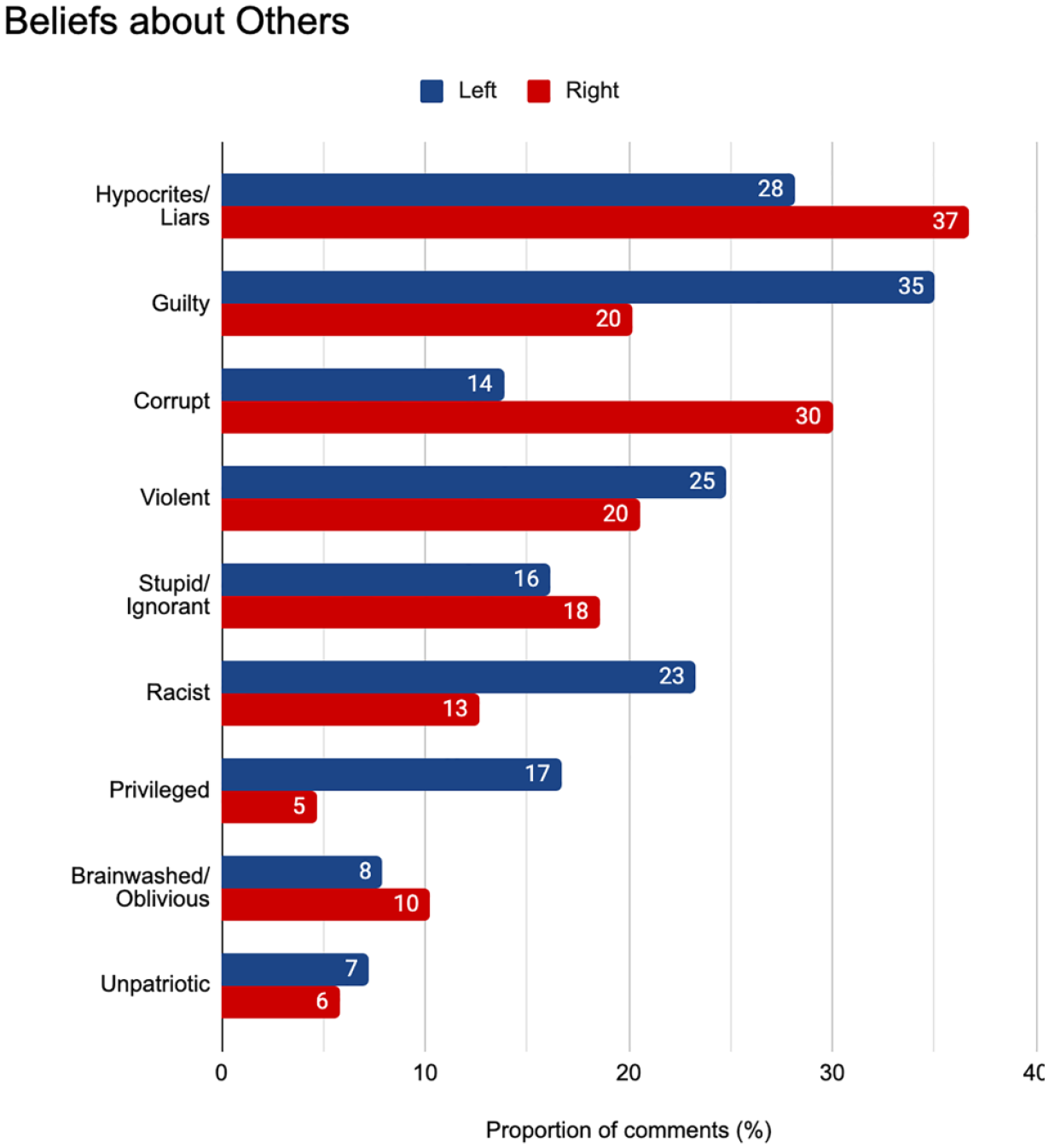
Beliefs about Others.
The “Object of Emotions” coding category (Figure 3) identifies the particular villains for each partisan group. The primary target of left-leaning negative emotions is the criminal justice system (29%), followed closely by the Capitol insurrectionists (26%); White people (15%) and white supremacy (7%); Trump (12%) and his supporters (13%); and Republicans/“the right” (9%). Right-leaning storytellers were primarily upset with Democrats/“the left” (19%) and Biden (7%) more specifically; politicians (4%) and government (4%) more generally; followed by “their pets” BLM (9%) and Antifa (5%) and “their propaganda machine,” the news outlets and social media platforms (12%). Alarmingly, 20% of right-leaning discourse also directed negative emotions toward racialized, Jewish, and Muslim people.

Object of Emotions.
Figure 4 details the “overwrought” (Singer, 2001) melodramatic emotions coded through our “Emotions” category. Negative, compound emotions of judgment, anger/indignance, distrust, disgust, and dismissal are aimed at “Them,” while love and pride bind “Us,” with some minor, but notable, differences between left- and right-leaning storytellers. While both sides appear equally judgmental, left-leaning storytellers tinged their indignance with disgust, and right-leaning storytellers tinged their distrust with anger. Love and/or pride for the in-group was often simultaneously expressed alongside these negative emotions expressed toward political Others, with right-leaning storytellers (16%) expressing these positive in-group emotions more often than left-leaning storytellers (9%). Again, in contrast to much scholarship that reduces measurement of emotion to a positive/negative binary or singular emotion, our study was able to note the prevalence of compound emotions: two or more emotions simultaneously were expressed by a user in 45% of the comments we coded, and three or more emotions were simultaneously expressed by a user in 10% of the comments we coded. In this way, the discursive division of multiple in-group and out-group emotions works alongside the binary beliefs about Self and Others to produce a polarization of identity and affect structured as melodrama.

Emotions expressed.
Our methodology coded rhetorical and linguistic markers of emotional expression, with markers of melodrama predominant (Figure 5)—namely, “rhetorical excess” and a “vocabulary of clear, simple, moral and psychological absolutes” (Brooks, 1976). Rhetorical excess was evidenced by high incidences of prosody (27%), name calling/belittling/mocking (23%), emotion language (22%), sarcasm/satire/irony (20%), visual reactions (13%), juxtaposition (12%) and rhetorical questions (12%). The vocabulary of clear, simple, moral and psychological absolutes was evidenced by high incidences of conflict/threat language (31%), us/them language (30%), blaming (25%), moral claims (24%), dismissing (23%) and accusations of bias and double standards (21%). Right-leaning social media users lean toward rhetorical approaches of dismissal (26%) and sarcasm (25%), while left-leaning social media users lead with blaming (29%) and moral claims (27%). The majority of posts revealed multiple rhetorical markers, further evidencing the intensity of melodramatic emotion in social media platforms. It is notable that the codes of ‘Conspiracy’ and ‘Skepticism: Election’ were discovered only in right-leaning expressions in our data, illustrating key distinctions between political contexts. While most users deploy the same melodramatic conventions, they are simultaneously directed toward divergent identities and discourses. The rhetorical markers thus reflect very particular ideological histories of varying socio-political identities, further illustrating the work of genre as a broad narrative channeling of distinctive contents.

Linguistic and rhetorical markers of emotional expression.
In sum, our intensive coding of the original posts (OPs) and responses within each platform thread and these frequency measures reveal the melodramatic scripts that constitute polarization and conflict, providing a discursively grounded understanding of how emotions and binary morality promote polarization in subjectivity and emotion among cross-partisan users. Again, in contrast to much scholarship that reduces measurement of emotion to a positive/negative binary or singular emotion, our study was able to note the prevalence of compound emotions. Where existing methodologies would only be able to report findings of overwhelmingly negative sentiment in these polarized exchanges, our innovative approach identifies specific emotions, how they interact, and similarities and differences between these across the political spectrum. As such, our contribution of affective discourse analysis enables research to better understand the work of polarization at the affective level.
Exemplars From our Data
These discourses of melodrama in our data allow us to further illustrate Döveling et al.’s (2018) formulation of alignment and belonging within digital affect culture. While melodramatic discourse supplies the basic elements and tools of polarization, the qualitative approach of ADA helps identify how alignment and belonging further entrench polarized communication through circulation and policing respectively.
The next two sections showcase the polarizing processes of affective circulation and control which underlie melodrama, engaging ADA with representative exemplars from our data.
Alignment
We present two threads, one from a far-right Facebook influencer and another from a left Twitter influencer, to illustrate how social mediatization (Giaxoglou & Döveling, 2018) and consequent circulation of emotions ensures alignment with in-groups and disalignment with out-groups, thereby reinforcing polarization. In each thread, alignment becomes visible as commenters mirror the melodramatic style, overwrought emotions, moral beliefs, and binary characters of the original influencer post. These posts reinforce alignment among in-group members and villify outsiders, ensuring that social identities—here, of race and gender—“stick” to partisan groups through moral judgments of belonging. We build on digital affect culture using Ahmed’s approach, noting how melodramatic affects produce “sticky alignment” and “sticky belonging.”
This original post (Figure 6) sets the tone of judgment, anger, and disgust directed toward BLM protestors and supporters. Sarcasm, irony, and juxtaposition are deployed in an attempt to dismiss accusations of right-wing violence and insurrection with counteraccusations of hypocrisy and violence. Fiery images of police property destruction during BLM protests the preceding summer are juxtaposed against accusations of right-wing insurrection to argue that the latter is less violent, while viscerally invoking fear of the violent 8 Other. Sarcastic scare-quotes are used to insinuate BLM activists are not legitimate protestors. The compounded narrative and emotion are further intensified and reiterated in the comments that follow, as judgment, anger, and disgust are directed toward a growing list of associated Villains (MSM, government, “libs,” BLM/Antifa) and charges (corruption, and stupidity/ignorance/mental illness). This alignment “sticks” because of the stylistic echoing of the original post, reiterating discourses of conflict/threat language, sarcasm/satire/irony, and juxtaposition that align the in-group. A sticky alignment is also evident when another user deploys a meme that imitates the precise visual format of the initial/original post (Figure 6), an imitation that clearly resonates with right-leaning storytellers (Figure 7): it is deployed in this exact form five further times in our data set.

Original post by a far-right Facebook influencer.

Popular right-wing “She-Devils” meme.
The compiled meme utilizes the Biblical nature of judgment, associated moral claims, and exaggerated good versus evil narratives present in the melodramatic discourses shown by our graphs above. This repetition, like a ritualized chant (Carey & Adam, 2008), reinforces sticky alignment through the melodramatic performance of affects and associated truth claims, further establishing the alignment of Republicans as victims and BLM protestors and Democrats as villains.
Here, reiterations of indignance, judgment and disgust echo the tone of the original influencer’s post. Four panels repeat the same pattern: an unflattering photo of a prominent female Democrat against a backdrop of a raging fire ostensibly started by BLM protestors. Each of the “she-devils,” as named by several commenters, are captioned with a superimposed “quote” (actually or supposedly) from each of the four women; each “quote” implies that the “she-devil” is inciting violence in the wake of George Floyd’s murder. Furthermore, the incendiary Democratic figures against a flaming background not only align with the original post on aesthetic, rhetorical, and affective levels; by mirroring the melodramatic conventions of the original post, these hysterical, violence-mongering, tyrannical, Democratic villains function as literary foils to the peaceful, law-abiding, freedom-fighting, Republican storytellers constructing themselves as victims in this thread. Right-leaning users agree with and accept this emotional narrative, sharing anger and disgust against these racialized, feminized, Democratic Others. The shared and circulated emotions establish a collective Republican identification that is also white and male. In sum, the discursive symbols and conventions of the two posts encourage polarized and sticky alignment along multiple axes of identity, as the repetition and wide circulation of the meme reinforces the original influencer’s narrative about Republican pain caused by Democrat villainy.
Similar flows of affective alignment are also reflected in left influencer threads, as we now discuss in relation to Figure 8.

Initial post by a left Twitter influencer.
This initial left-leaning Twitter post sets the tone of anger, indignance, fear, judgment, and disgust directed toward state responses to Capitol rioters. The original post engages anger and judgment to contest claims that Capitol police were innocent and “unprepared” for the insurrection, instead emphasizing a narrative of collusion, betrayal, and denial by the government, military and police. The use of “folks” communicates frustration toward fellow liberals or centrists who are “still repeating this phrasing.” The influencer’s heightened use of prosody, noted in their remark “I don’t usually type in all caps,” employs our codes of conflict/threat language, rhetorical questions, and us/them language to forward an affective narrative of the left’s victimization by the state. The use of caps and user’s reflection on this rhetorical style invites affective stickiness that in turn aligns the in-group.
Commenters’ responses to this original post demonstrate the same sticky alignment utilized in right-leaning posts of Figures 6 and 7 analyzed earlier. In Figures 9 and 10, we see polarization again heightened and reinforced by mirroring and further circulating strong emotions (particularly anger, judgment and disgust) expressed by the original post.

Comment #1 in response to Original Post.

Comment #2 in response to Original Post (Figure 9).
These strong emotions depend on repetition of the original post’s rhetorical strategies and beliefs about self and others, all of which ensures alignment and heightened polarization. In response to this original post, one commenter (Figure 10) notes that “[their] whole mood is all caps,” directly reflecting the strong displays of prosody in the initial post via exclamation marks and the attribution of capital letters as qualifiers of intense emotion. The emotional expression of this comment repeats the moral narrative set out by the original post: the state and its right-wing insurrectionists are an irredeemable out-group colluding to victimize the critical left in-group. The second commenter (Figure 10) capitalizes the in-group (“PEACEFUL BLM”) and the out-group (“THEY”); this use of prosody emphatically mirrors the stylistic markers of the original post as well as the specific moral characters established by the left influencer. Again, as with the right influencer exemplar, we see ritualized communication: alignments of style, archetype, and emotion across the exchange of melodramatic stories of violent, illegitimate political others oppressing and victimizing the righteous in-group.
These morally inflected discourses reveal how the affective and structural work of melodrama produces alignments: first, traction takes place via social media logics of connectivity (the repetitions of images and structural/rhetorical discourses that frame melodrama); and second, traction occurs through the resulting subjective identifications which reinforce political and social in-group identities (Victims and Villains linked to good and evil). The emotional, rhetorical, and visual parallels between influencer and commenter fan the flames of melodramatic anger, distrust, and judgment against the violent and hypocritical Other. This process demonstrates the subjective and structural modes of alignment within storytelling communities of digital affect culture. Reinforced narratives of pain and blame, Victim and Villain, become fundamental truth claims and bind partisan (and social) identities, thereby sustaining polarization through the circulation and encouragement of aligned and sticky affects. Melodrama functions as a ritualized communication, social media’s “archetypal case” of a “sacred ceremony that draws persons together in fellowship and commonality” (Carey & Adam, 2008, p. 13).
Belonging
The following example reveals how displays of alignment in turn produce belonging among users through the performance of identities and feelings central to melodrama. The policing of membership boundaries establishes belonging and enforces polarization, reinscribing ideological investments presumed by in-group truth claims. The following examples illuminate contestations of belonging as users on the left (posts in blue) and on the right (posts in red) perform strategies of ostracization, using binary, overwrought emotions of melodrama to police group membership. These dynamics are most evident when a partisan and “affective outsider” dares to intervene in a largely homogeneous thread (Figure 11).

Policing of group boundaries across the political spectrum.
Figure 11 illustrates contestations of belonging within two different threads when affective outsiders overstep group boundaries. The first is a selection from a left thread from Facebook, starting when Right Commenter 1 (RC1) responds to the left original post (LOP). The original post expresses anger and frustration regarding perceived hypocrisy: why were BLM protestors subject to state/police violence, when Capitol rioters are not only spared but supported by the state and police? Most commenters agree with the LOP, pointing to state violence during the 2020 BLM protests as evidence. However, when RC1 dares to disagree, users immediately employ feeling rules, policing the naysayer’s emotional responses to reinforce belonging and “us vs. them” group membership.
In the Left thread, a commenter with a (here redacted) Hispanic last name expresses opposition to much of the left narrative regarding double standards (police supporting Capitol rioters while enacting violence against BLM protestors), and is policed with exclusionary language. The blue posts from the left tell the dissenter that this left space is unequivocally not “where [they] belong.” Retorts range from snide suggestions to return to their “klan (sic) friends,” to nationalistic sneers to “stay in Russia.” User-level policing draws strict boundaries of belonging according to emotion, truth, and discourse: “if you don’t find [the attacks on the Capitol] nauseating” you don’t belong. The test of belonging is whether the user shares feelings of disgust, fear, and anger regarding the double standards of the police state toward the Capitol Rioters and BLM protestors. Commenters who do not share the governing expressions of belonging set out by the original poster must be expelled from the platform.
Further testing belonging, one of the left responses to this affective outlier expresses sentiments typically associated with far-right ideologies. The left-leaning user tells the dissenting commenter with the Hispanic last name that they are “a disgrace to [their] name,” demanding they “go back to wherever [they] should be,” and telling the user you are “not an American if you don’t agree with these values and behavior against our democracy!” Notably, this response equates racial identity with partisanship, suggesting that people perceived to be racialized should necessarily side with BLM. In refusing to accept the narrative of Capitol Riot hypocrisies, this racialized person is deemed a traitor. In this manner, we see how truth is inextricably linked to identity and thus rightful belonging. Evidencing the links between melodrama and belonging, users who do not display the appropriately overwrought emotions against an unquestionably villainous Other are seen as rejecting in-group truth, and thus excluded from all spaces, whether digital or national.
The second thread, from Gab, reflects support of a right influencer’s original post (ROP), which expresses anger at Nikki Haley’s claim that Trump has “let [Republicans] down.” One user (whom we call LC5) dares to express anti-Trump sentiments, pointing to the former president’s role in inciting the January 6 Capitol Insurrection as a legitimate basis of criticism. Other right-leaning users then direct exclusionary messages similar to those seen in our left thread. RC5 responds, “I dislike your truth idiot, which is not the same as ours.” This statement encapsulates the power of belonging by aligning discursive truths with group identities: users who do not express the same feelings toward an event do not share the same truth as an in-group, and thus do not belong. The affectively felt quality of beliefs and truth dictates partisan belonging; those who do not conform must be excluded.
In particular, the emotions of dismissal and disgust achieve this digital enforcement and policing of truth. Through demeaning epithets such as “Twatter” (RC3), “FakeBook” (RC4), “troll” (RC5), users delegitimize those whose truth claims and emotional realities do not conform to those of the in-group. RC6 not only namecalls the naysayer as a “liberal snowflake” but calls into question LC5’s opposing truth: “They take shit out of context an try to turn it around so it fits their narrative. They are so brainwashed by the media and the corrupt politicians and believe only what they are told by them. . ..” (sic) Melodramatic discourses of pain and blame are displayed through overwrought emotions that establish a binary of Victim and Villain, and users comply with these feeling rules (Hochschild, 1979) to enforce group membership and belonging.
No matter their political stripe, in- and out-groups police and govern themselves and one another to ensure ideological compliance and social identities of their respective groups. In this way digital affect culture reveals the degree to which alignment, belonging, and righteous struggles over polarized truths are fundamentally animated by the genre of melodrama. Inescapably propelled into familiar oppositional scripts and performances of pain/blame, victim/villain, good/evil, users reinscribe cross-partisan animosity within social media platforms. Digitally governed melodramatic narratives are not merely literary tales; they are polarizing discourses that exert immense affective appeal and circulatory power, deploying alignment to police truth claims that define identity and belonging.
Conclusion
We have detailed how genre, and specifically melodrama, structures online cross-partisan debate and political identities through affective economies. Our findings have shown how social media platforms function as ritualized performance spaces for the melodramatic staging of identity politics and narratives of nationhood, race, and justice. As “arena[s] of dramatic forces and action” (Carey & Adam, 2008, p. 17), platforms permit users to play victim and villain and to rehearse the ritualized pain and blame of identity politics. Forged through chants of wrath, anger, disgust, and judgment, ritualized affective discourses constitute the basic script for polarization and partisan debate. While the findings we presented here focus on the January 6 Capitol Insurrection and Black Lives Matter protests, we discovered predominantly similar affective performances in the context of the 2019 Canadian election. We hope scholars will explore the ways in which melodrama constructs similarly polarized debates in other local, global and national contexts of conflict, and variations of this genre in contexts beyond North America.
We have introduced our innovative methodological approach of affective discourse analysis, foregrounding the value of multi-methods to bring nuance to studies of emotional expression online. Where existing methodologies would be likely to report findings of positive versus negative sentiment in polarized debate, our approach identifies specific emotions, compound interactions, linguistic and rhetorical contexts, and similarities and differences across the political spectrum, affording the complexity warranted for studies of emotion and affect in political communications. There is extensive room for further multi-method empirical studies of political polarization and emotion, and for experimentation with other qualitative methods to augment quantitative approaches.
Our focus on discourse has rested largely at the micro- and meso-level of analysis, leaving room to account more fully for macro-level contexts of economic, political, and platform-level interests such as communicative capitalism (Dean 2005). Giaxoglou (2020) also urges “critical study of how stories, affect, and identities are mobilized in digital cultures as commodities that can drive audience engagement and increase affective, social, and economic value and visibility” (p. 11, emphasis added). A more encompassing framework will help us to identify the routes of power: how the specificity of users’ particular communications are delimited by the polarized affective regimes of our time and platforms designed to serve interests of neoliberal capital and governmentality (Dean, 2005; Lemke, 2015). To explore these routes of power mapped by digital culture, we see immense promise in future explorations of genre, ritual and the affective dimensions of communicative capitalism. As much as genre may enforce convention, so it also invites new forms of relation; new rituals are created each day. As netizens and as theorists, we have only scratched the surface of the stories to be told about polarization and its discontents.
Footnotes
Declaration of conflicting interests
The author(s) declared no potential conflicts of interest with respect to the research, authorship, and/or publication of this article.
Funding
The author(s) disclosed receipt of the following financial support for the research, authorship, and/or publication of this article: This research was funded by the Canadian Social Science and Humanities Research Council from 2019 to 2023.
