




Abstract
Migration for unaccompanied refugee youth is an emotionally complex process involving mediated experiences and expressions of emotions and affect. This article draws upon social media ethnography conducted with young refugees from African and Middle Eastern countries living in Europe. The participants’ emotional practices were explored through the multimodal analysis of content they shared on Facebook. The findings highlight how the young refugees performed multifaceted yet interconnected emotional practices. These emotional practices potentially assisted their negotiation of emotional losses and gains resulting from migration. The online mediated emotionality, however, cannot be fully comprehended through the reductionist lenses of binary oppositions such as losses and gains, presence and absence, or positive and negative emotions. This article shows that unaccompanied refugee youth’s experience and expression of emotions online are influenced by more than their migration experience, and that their interconnected nature and complexity need to be considered.
Introduction
Atiq’s 1 phone is continuously buzzing during our research interview. Facebook Messenger, Snapchat, and WhatsApp messages keep popping up on the screen. When asked how often he uses his phone, Atiq starts laughing and points towards the phone: ‘You can see that it keeps ringing.’ He is a 17-year-old unaccompanied young refugee from Afghanistan and he is living in an accommodation centre in Sweden. Atiq spent his days at school and at a refugee accommodation centre. Because his status and life conditions were changing so fast, the most constant things in his life seemed to be his smartphone and social media profiles. For Atiq, his smartphone was a lifeline (Alencar et al., 2018); a tool to maintain and create relationships, to seek information, support, and for experiencing and expressing emotions. Digital and social media are often involved in refugees’ complex experiences of migration (Dekker et al., 2018; Gillespie et al., 2016), while permeating their social and emotional lives. This article contributes to the existing research on the relationship between media, migration and emotions. It does so by focusing on unaccompanied refugee minors’ experience and multimodal expression of migration and settling down as it is shared and negotiated on social media.
The term ‘unaccompanied refugee minor’ has mostly been used within policy circles, but since the media outburst around the so-called European refugee crisis in 2015, it has also entered more prominently into the public and scholarly ‘discursive arena’ (Lems et al., 2019: 5). There were more than 200,000 unaccompanied minors among asylum seekers registered in the European Union (EU) during the first three years of what the media dubbed as the ‘refugee crisis’ (Eurostat, 2019). In 2018, 86% of these unaccompanied refugee minors were male, and most of them were 16 or 17 years old (Eurostat, 2019). This article is set within this context as it draws upon a social media ethnography research conducted in 2019 with unaccompanied male minor refugees aged 16 to 18 arriving in Sweden and Italy from Afghanistan, Somalia, Morocco and Egypt. Sweden and Italy were among the top EU countries with the largest share of unaccompanied asylum seekers in Europe at the time of developing the research project (Eurostat, 2019).
The article begins with a discussion of emotional losses and gains associated with migration. We then question what ‘emotional’ means, while leaning against the multifaceted nature of emotions with the use of Scherer’s (2005) conceptualization of emotion and Scheer’s (2012) theory of emotional practice. The socially constructed ideas of unaccompanied refugee youth and a need for youth-centred research conclude the literature review, after which we discuss the social media ethnography and the multimodal analysis in the following methodology section (Kress and van Leeuwen, 2002). Four research themes are identified, explored and illustrated with visuals in the section about social media emotional practices of unaccompanied refugee youth. The article ultimately argues that unaccompanied refugee youth’s experience and expression of emotions, in general, and on social media in particular, should be explored and understood in their complexity.
Experience and expression of migratory emotional losses and gains
Unaccompanied refugee youth experience multiple emotional ‘losses’, such as the loss of significant social relationships, networks and social support systems, the loss of familiar places, food, values, habits, language, and traditions, as well as the loss of memory, self-identity and feelings of belonging (Völkl-Kernstock et al., 2014). Henry et al. (2005) summarize the emotional losses associated with migration by framing them as the loss of the familiar. Derluyn and Broekaert (2007) suggest that the experience of such multiple losses is likely to cause long-term emotional traumas and/or mental health issues. Less has been written about emotional gains, as much of the research on migration focuses on political, economic, and material gains, such as career and educational advancement, higher income, and housing (Wessendorf and Phillimore, 2019). Yet, when focusing on the possible affordances of technology, Diminescu (2008) observes that today’s migrants are constantly ‘connected’: on the move, but digitally connected to their friends and families. Baldassar et al. (2016) also note that the proliferation of information communication technologies (ICTs) is challenging the premise that physical proximity is necessary to maintain relationships. Similarly, Ponzanesi (2019: 5) highlights that migration is also about the possibility of establishing new connections and ‘to construct new imaginaries, new archives, and new narratives’. Our research pays equal attention to refugee youth’s emotional losses and gains connected to their migration and settling-down experience.
To explore unaccompanied refugee youth’s experience and expression of emotional losses and gains on social networking sites in their complexity we draw upon, first, Scherer’s (2005) conceptualization of emotion. The definition and differentiation of ‘emotions’ when compared to other affective states such as feelings, through which we could also decide what counts as emotional losses and gains, has remained marginal in previous studies. Following Scherer (2005), our research approaches feeling as one of emotion’s components and consequently only speaks of emotions without differentiating them from feelings. We focus on utilitarian emotions that facilitate ‘our adaptation to events that have important consequences for our wellbeing . . . such as anger, fear, joy, disgust, sadness, shame, guilt’ (Scherer, 2005: 706). This utilitarian view of emotions seems especially useful in the context of migration as a life-changing event, as well as settling down and adapting, all of which have multifaceted consequences for migrants and refugees’ wellbeing (Handlos et al., 2016).
The utilitarian view on certain emotions, however, does not diminish their multifaceted nature. For instance, Burkitt (2002: 166) sees emotions as ‘complexes that express our whole way of being’ and Hochschild (1983) defines emotion as an interplay between thoughts and feelings that is socially formed and negotiated. To address this complexity, Scherer (2005) suggests that in emotions, diverse bodily systems are coordinated and synchronized. This understanding of emotions is consistent with Scheer’s (2012: 219–20) ‘emotional practice’, which agrees that emotion ‘is an act situated in and composed of interdependent . . . components mixed in varying proportions’. We see this as a holistic and phenomenological view on emotions, which treats mind (including feelings), body, physical space, and social relations as interconnected (not interchangeable) within one’s lived experience.
Holistic and phenomenological approaches have been used and argued over within research investigating children and youth’s media experiences (Woodfall and Zezulková, 2016) as well as migration experiences (Kirova and Emme, 2006). As Marsh (2010) emphasizes, research should recognize the interconnected nature of experience and expression involved in the children’s and youth’s use of digital and social media. Experience (the inner side of emotions) and expression (the outer manifestation of emotions) are considered to be a single phenomenon within the theory of emotional practice. Scheer (2012: 209) argues that ‘an emotion without a medium for experience cannot be described as one’ and subsequently suggests that ‘media use is an extremely important emotional practice’. We therefore find Scheer’s emotional practice particularly useful for this interdisciplinary research on unaccompanied refugee youth’s interconnected experience and expressions of emotions on social media.
Scheer (2012) identifies four categories of emotional practice: (1) mobilizing, (2) naming, (3) communicating, and (4) regulating. These four categories overlap, and all demonstrate the interconnectedness between lived experiences and expressions of emotions. Through the emotional practice of mobilizing, emotions are evoked, realized, explored, maintained and/or adjusted (Scheer, 2012). Social media and digital technologies can play a crucial role in mobilizing emotions as we not only express but also experience emotions online, or, as Tucker (2018: 39) put it, ‘we feel with digital media’. Exploring how emotions are being mobilized with the use of social media can, for instance, contribute to our understanding of the ‘contrasting emotions and feelings such as hope and nostalgia, guilt and ambition, affection and disaffection’ that migration and settling-down experience often embodies (Boccagni and Baldassar, 2015: 73).
The category of emotional practice – naming – is about expressing emotions, for example, with the use of digital and social media. A significant body of research shows that social media are a platform for multimodal expression and complex experience of emotions through written language, videos, photos, selfies, likes, memes, emoticons, gifs, and/or multimodal compositions of these (Ellis, 2018; Ozansoy Çadırcı and Sağkaya Güngör, 2019; Riordan, 2017; Veum and Undrum, 2018). This multimodal and intertextual emotional practice of naming on social media could be seen also as ‘meta-authorship’ of using texts of all kinds to form and negotiate one’s identity (Potter, 2012: xvii). This view then positions the research on emotional practice of unaccompanied refugee youth within studies about creating, recreating and negotiating migrant (Davis, 2010) as well as children and adolescent identities online (boyd, 2014).
Communicating as emotional practice then stresses emotions as means of exchange between people (Scheer, 2012) that forms and maintains their connections on social media (boyd, 2014). This emotional practice is also relevant to the research investigating refugees and migrants’ uses of social media. Alinejad (2019: 1) showed that ‘social media platforms afford not only ambient, fast-paced, background communication . . . but also more direct, immersive, conversational modes of communication’. Furthermore, an increasing body of research suggests that the use of digital and social media helps migrants to establish new connections and maintain bonds with their homelands by blurring the boundaries between absence and presence and creating the sense of co-presence and transnational emotional proximity (Alinejad, 2019; Leurs and Ponzanesi, 2018; Ponzanesi, 2019).
Regulating, as the fourth category of emotional practice, points towards societal, cultural and/or religious rules, norms and expectations influencing how emotions are experienced and expressed. Emotions are not independent of socio-cultural contexts (Boiger and Mesquita, 2012), nor are they objectively experienced, as each emotion can be expressed, understood and approached differently (Döveling et al., 2018). For example, An et al. (2017: 11) discovered that ‘although each basic emotion [sadness, fear, disgust, anger, surprise, and happiness] is universally recognized, they are still experienced differently across several cultures’. Regulating as emotional practice is therefore particularly relevant to this research because the transnational migration that the unaccompanied refugee youth moving from African and Middle Eastern countries to Europe experience entails the changing socio-cultural contexts within which they feel, display and manage their emotions (Boccagni and Baldassar, 2015).
The socio-cultural context also impacts our views on the unaccompanied refugee minors. For instance, from the dominant Eurocentric perspective on childhood as innocent and minors as vulnerable, refugee youth is often awkwardly positioned outside of what is thought to be a ‘normal or ideal childhood’ (Wernesjö, 2012: 504). Yet at the same time they are labelled as dangerous almost-adults threatening European values and ways of life, as they do not always fit with the socially constructed expectations of youth refugees of being poor, dirty, and passive victims (Lems et al., 2019; Leurs and Ponzanesi, 2018). These socioculturally constructed views on refugee minors tend to cloud our understanding of their experiences. However, refugee youth are not a homogeneous group and neither are their lived experiences. Previous studies have shown that migrants’ experiences differ widely (Björkman and Spehar, 2018) based on their expectations, journey, and the realities of the new geographical and cultural location they arrive to. As Chase et al. (2019: 5) elaborate, ‘while there may be similarities in how different young people have lived through forced migration, there are likely to be as many differences’. This once again reminds us of the need to study migrants’ emotional experiences and expressions in their complexity.
It is thus crucial to be wary of the uncritical reproduction of socially constructed ideas of unaccompanied minors and instead focus on researching how the refugee youth themselves experience, make sense of, and navigate social terrains, when on the move and settling down (Lems et al., 2019). Our article follows this aim by presenting the findings of a short-term social media ethnographic research project with refugee youth. As Risam (2018: 58) suggests, digital and social media assist migrants in producing individual and collective agency, and potentially also resistance to ‘the inscription of refugees as objects of knowledge in the digital cultural record’. The aim of the research was – at least partially – to reach into their ‘lifeworlds’ (Lems et al., 2019: 9) while simultaneously studying the complex role of digital and social media in youth refugee’s interconnected experience and expression of emotional losses and gains.
Facebook profiles of refugee youth: a social media ethnographic approach
The empirical research which we will discuss below is part of a larger two-year project that explored how unaccompanied young refugees used social media and digital technology in four different European countries (Sweden, the Netherlands, Italy, the UK). Though this article solely focuses on research gathered in the second ethnographic phase, it is worth mentioning that in the first phase, a total of 56 unaccompanied refugee youth were interviewed using a specially designed board game (Neag, 2019). The second phase consisted of a month-long social media ethnography (Postill and Pink, 2012) of Facebook profiles belonging to 16 unaccompanied young refugees (11 living in Sweden, 5 in Italy; 12 males, 4 females) who agreed to take part in both research phases. The participants were recruited through non-governmental organizations (NGOs) and youth centres. The research focus and scope was presented to the youth at these organizations, giving them the opportunity to ask questions before agreeing to participate. As this is a vulnerable population, it was highlighted that the participation was voluntary and that the social media ethnography would only take one month. Once this period ended, the first author ‘unfriended’ the youth on Facebook (deleted their connection) in order to protect their privacy.
The social media ethnography involved close scrutiny of these young people’s Facebook activity for a period of one month. As Lems et al. (2019: 15) highlight, ‘ethnographic research methods are particularly well suited to cross the bridge between the experiential, subjective ways young people perceive the world, as well as the external forces and power mechanisms impacting upon their movement’. Posts shared by young people were saved for later analysis in an encrypted folder using Bournemouth University’s servers. A total of 42 posts, photos and videos were collected, together with a thorough analysis of the participants’ in these and other social media activities (e.g. groups they belonged to and pages they ‘liked’). Because the participants were reluctant to discuss their Facebook updates during the social media ethnography, and because at the time of the follow-up analysis they were not long involved in the research, we aided our analysis by discussing the posts with academics from the same cultural background as the youth.
Facebook profiles are a form of multimodal communication, as users share updates using texts, videos, and photos. The posts form compositional schemas that are multimodal because they combine different kinds of elements into a multimodal whole (Kress, 2011). We thus applied multimodal data analysis to discover ‘the deeper connections between apparently different multimodal practices’ (van Leeuwen, 2003: 61) that were observable in the use of social media by the young unaccompanied migrants (see Figure 1). As an analytical framework, van Leeuwen’s (2003: 24) aspects of composition – information value, isalience, iframing – were used. Information value refers to how elements are positioned in space, and the meanings that are conveyed by this. Salience refers to how observable (eye-catching, noticeable) specific elements are, in comparison with other elements. Framing is used to explain how elements are separated or connected to each other. The participants’ profile pictures, cover photos, and status updates were chosen as the main focus of our multimodal analysis, because arguably they form together the most directly observable emotional experience and expression within the control of the youth themselves.
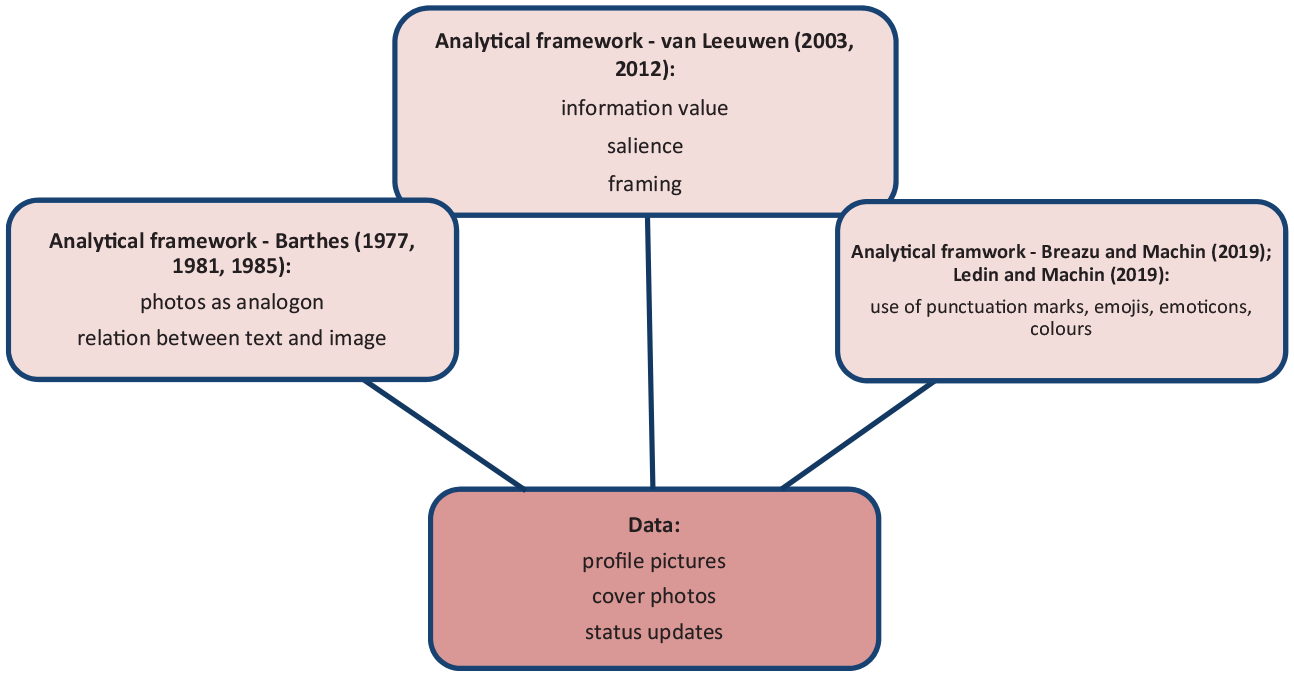
Analytical framework
Status updates are important elements of Facebook as they play a role in obtaining agency-based gratification; thus, they have a role in communicating identity and forming communities (Jung and Sundar, 2018). In contrast to status updates that reflect immediate emotional experience and expression, Facebook profile and cover pictures represent a longer lasting emotional experience and expression of the self. Kress (2010) argues that combining elements shows hierarchies of importance and attention, and he proposed a system network of information value based on where these elements are placed in the composition. In the Facebook template, the profile picture is smaller and placed to the left, while the cover photo is much larger and placed on top. According to Kress (2010), the element on the left in a horizontally polarized composition is showing the ‘given’, and the right element is presenting what is ‘new’. In a similar fashion, the upper element in a vertically polarized composition shows the ‘ideal’, while the ‘lower element’ is for representing the ‘real’ (Kress, 2010). This schema is particularly useful for understanding the self-presentation of people on social media. As Aguirre and Davies (2014: 6) argue, when it comes to social media, it is ‘crucial to keep in mind that as far as presenting the self goes, the reality effect is a product of composing signifying elements together to appear that there is nothing more to what is actually seen’.
In agreement with Barthes (1985: 5), who describes photographs as ‘not the reality, but at least . . . its perfect analogon’, contemporary research shows that young people use Facebook for impression management and photos posted online often influence the way they are perceived by others (U’ren, 2014). Photographs can be used by social media users to ‘present themselves and the values they stand for’ (Kress and van Leeuwen, 2002: 349). They also open up the possibility ‘to speak not just about their individual experiences, but also about the migrant experience in general’ (Cabañes, 2017: 35). Furthermore, colours can be altered, which can further highlight their emotive meanings (Ledin and Machin, 2019). The status updates as well as cover photos or profile pictures are often a combination of picture and text, thus it is also important to look at the text–image relations (van Leeuwen, 2012). Moreover, the use of punctuation marks, emojis, and emoticons is essential to discuss as these are relevant manifestations of feelings online (Breazu and Machin, 2019).
This article uses examples of content posted by Omar (17 years old, from Egypt, living in Italy), Ahmed (17 years old, from Morocco, living in Italy), Atiq (17 years old, from Afghanistan, living in Sweden), Rooble (18 years old, from Somalia, living in Sweden), Mohammad (16 years old, from Afghanistan, living in Sweden) and Abdul (17 years old, from Afghanistan, living in Sweden). During the time of the research, these participants had been living in Europe for between one and two years and they were active social media users, posting at least once a week on Facebook. To ensure the participants’ anonymity, the faces and names have been blurred. With the aim of strengthening the cultural sensitivity of our research and to at least partially address our Eurocentric understanding, native speakers embedded in the given culture were asked to translate the status updates and to consult on our understandings of meanings and emotions conveyed by the multimodal compositions, the analysis of which follows.
Social media emotional practices of unaccompanied refugee youth
Through the multimodal analysis of the unaccompanied refugee youth’s Facebook cover photos, profile pictures, and status updates collected during the social media ethnography, through open coding and thematic analysis we identified four emerging themes relevant to our research on migration and emotions. These are: (1) new places and social connections; (2) purpose lost and found; (3) transition, longing and belonging; and (4) co-presence, support and glocal identity. These interpretations were further supported by a thorough literature review in order to situate the study in the group of research projects done in the field of digital migration studies (Leurs and Prabhakar, 2018).
New places and social connections
The exploration of new places and the establishment of new social connections shared by the participating refugee youth gave a sense of achievement and emotional gains resulting from migration. For example, Omar’s profile photo (see Picture 1) shows him standing and smiling in front of a well-known Western cathedral. This photo is not about the ‘tourist gaze’, which implies a form of consumption (Larsen and Urry, 2011), but rather about the ‘migrant gaze’ that offers agency to those on the move (Ostrowska, 2019). It shows a migrant place-making, saying: this is me, right here, right now. The angle is a frontal one and Omar is looking straight into the camera, which depicts an involvement and emotional connection with the viewer (van Leeuwen, 2003). Kress and van Leeuwen (2002) argue that subjects who look straight into the camera do not want to be seen as just objects of contemplation, but rather want the viewer to take part in their reality. Thus, Omar’s smile in the profile photo emphasizes the positive aspects of his current life situation.
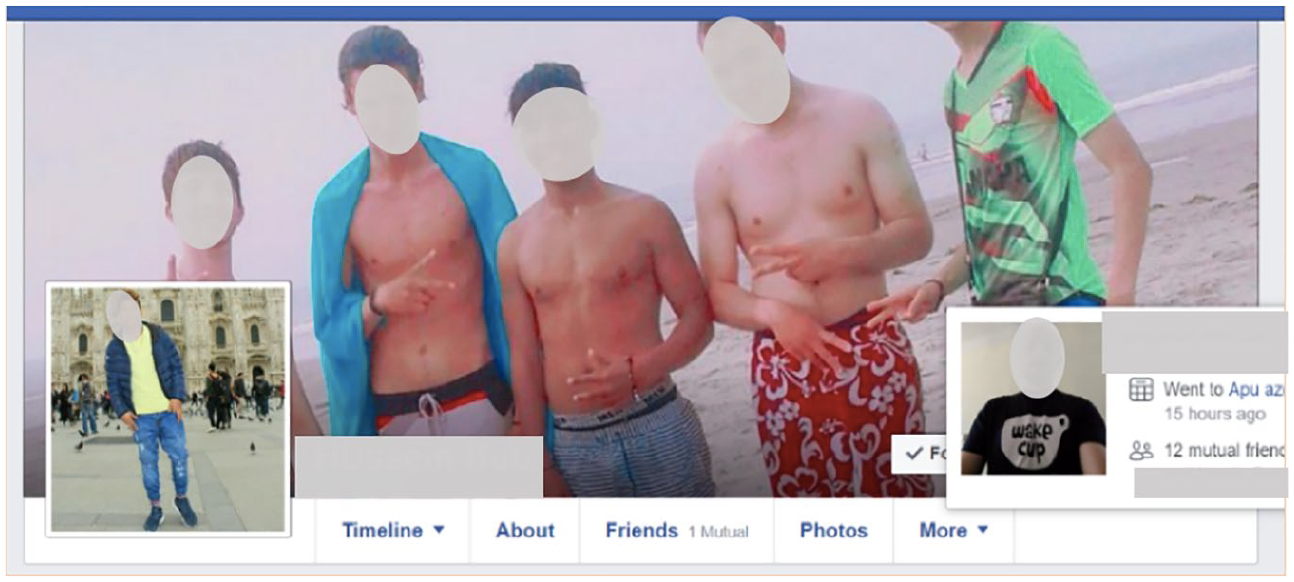
Omar’s profile and cover photo
In terms of the information value of Omar’s cover photo, the upper ‘ideal’ element, speaks about human connections. It portrays him standing on the beach in the middle of a group among his peers. Van Leeuwen (2003: 38) mentions that: ‘no element is ever objectively “Ideal” or “Real”. Elements are treated as Ideal or Real, in a concrete context, whether by prescription, out of habit, or because it is the apt choice for a specific, unique communication situation.’ His cover photo represents what for him possibly was the ‘ideal’. The whole group is smiling and looking at the camera, thus further strengthening the expression of joy and connection with the viewers, as well as with his friends. Previous research shows that social media is essential for youth in enhancing relationships with friends (Chambers, 2013).
Therefore, Omar’s choice of cover photo has to be interpreted not only through the lens of his refugee experience and expression, but also through the emotional practice of strengthening social ties with a group of peers, or what Scheer (2012) calls an emotional practice of communicating emotions. Omar is standing in the middle, which emphasizes the idea of belonging and having support. The boys surrounding Omar are showing the ‘V-sign’. Within contemporary youth culture, the V-sign (originally the peace sign) is globally used on photos shared on SNS as a symbol of happiness or victory. The V-sign was used by more participants on a variety of occasions. For instance, Atiq’s photo taken in front of a Swedish city panorama and posted as a status update (Picture 2). The use of these symbols is also a clear example of the emotional practice termed by Scheer (2012) as naming.
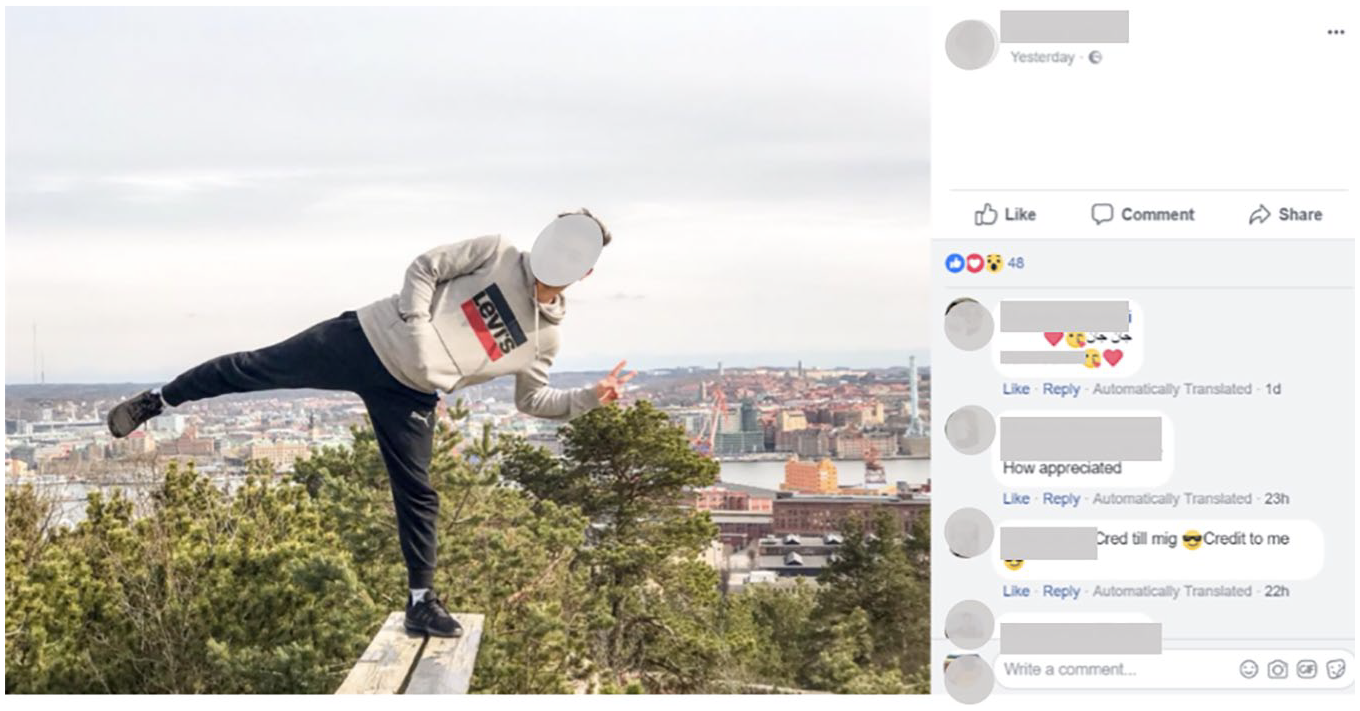
Atiq’s status update
Purpose lost and found
Through the emotional practices on social media the youth involved in the research seemed to experience and express both the loss of purpose and hope for better future. For instance, Ahmed’s profile picture, or the lower element in this composition that reflects the ‘real’, is a black and white selfie taken indoors (Picture 3). Selfies are used for managing one’s virtual impressions (Ozansoy Çadırcı and Sağkaya Güngör, 2019) and have been considered an embodiment of the self that serves as an extension of our body (Lasén and Gómez-Cruz, 2009). Ahmed is looking straight into the camera from a close distance, which produces nearness, and an involvement with the person looking at the picture (Larsen, 2005), and in the case of selfies, also with oneself. Existing research about selfies suggest that they ‘are usually taken while people are enjoying themselves, most of the time with a big smile on their face’ (Ozansoy Çadırcı and Sağkaya Güngör, 2019: 274). However, Ahmed is alone, indoors, and his face is still and rather serious, which might symbolize isolation, boredom, disaffection, and/or sadness, as selfies also imply self-criticality (Saltz, 2014).

Ahmed’s profile and cover photo
The seriousness of the profile picture is further highlighted by the holding of his hand to his chin and by the choice of a black and white photo filter. Loss of purpose and boredom are frequently cited as negative expressions of life as a refugee (Parrish, 2018). Although in Scherer’s (2005) approach the loss of purpose and boredom could maybe be considered as mood rather than emotion, we have included this potential interpretation, because from the emotional practice point of view to take and share this particular picture could be seen as mobilizing (Scheer, 2012). By this we suggest that expressing mood online (visually, verbally, or multimodally) could potentially assist the refugee youth’s self-critical awareness of their own emotions (Saltz, 2014), as well as maintenance of and/or adjustment to emotions accompanying their diverse moods (Scherer, 2005).
In addition, according to van Leeuwen’s (2003) compositional aspects, the upper cover photo which usually depicts the ‘ideal’, is a photo of a white car (Picture 3). The ‘ideal’ is always something one aspires to, a ‘promise’ of something that can be achieved or might be gained (van Leuween, 2012. Aguirre and Davies (2015) noted that houses and cars reflect the comfortable middle-class status. Thus, the car in the space usually occupied for an idealized future might represent Ahmed’s desire and hope for a better life in material and social terms common among migrants (Witteborn, 2019). In a study that looked at South Sudanese unaccompanied refugee minors’ purpose development, acculturation, and identity, Yoon (2019) showed that among several life purposes they deemed as important were ‘being successful’, ‘making money’ and ‘having a good career’. As Folkman (2010) argues, hope is essential for people managing uncertainty and coping with serious and prolonged stress as a result of changing reality. In this particular emotional practice, Ahmed was possibly regulating emotions by using socially constructed expectations and norms as a reference point.
Transition, longing and belonging
The refugee youth’s emotional practice on social media included the use of old, as well as the development of new, archives and narratives in the process of transition between the past and the present and between here and there. The participants’ Facebook profiles evoked and connected with the memories of childhood, homeland, and people left behind, while at the same time they begin to capture and form memories of a new home. A case in point is Mohammad, who used his childhood photo as his cover picture (Picture 4).
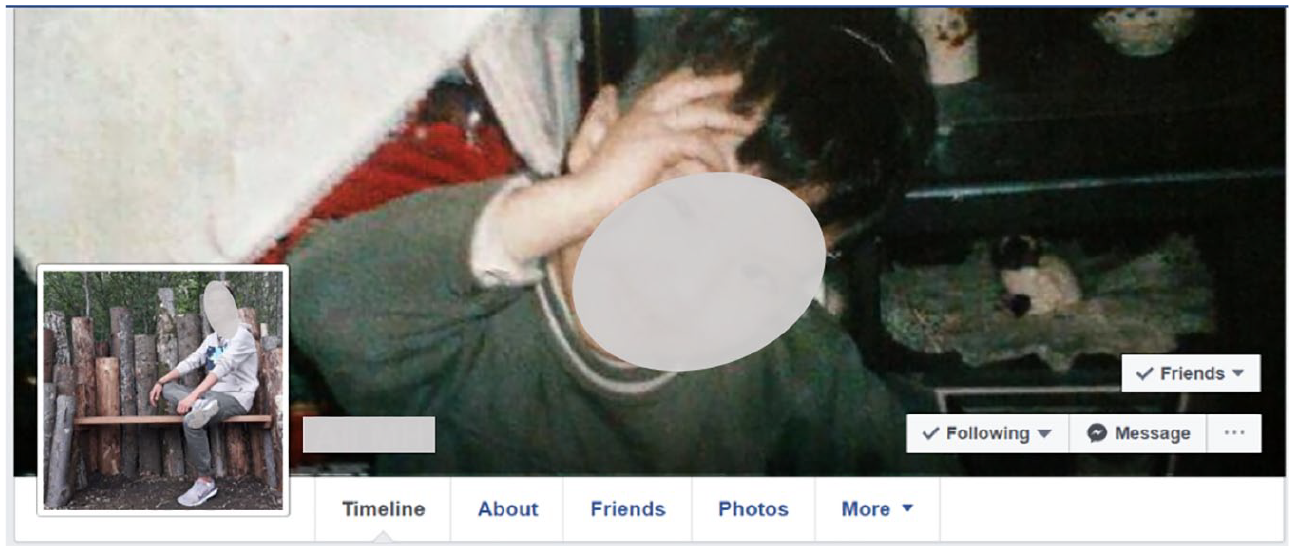
Mohammed’s profile and cover picture
Photographs can be both an aid and a hindrance to how we remember because of their indexicality (Cabañes, 2017), and because they evoke and interfere with our memories (Sturken, 1997). The old photo of Mohammad as a smiling child with his hand covering part of face becomes the punctum, as Barthes (1981) calls it, or that an ‘unpredictable detail in photographs’ (Cabañes, 2017: 35) that catches the viewers’ attention. This is similar to what van Leeuwen (2003) calls the salience of a composition, or the most eye-catching feature of a photo. In addition, the only other recognizable object on the photograph is a toy. The photo as a whole represents an innocent and happy childhood. Mohammad, who had to leave his family and childhood behind in his home country, was therefore possibly yearning for this idealized past.
As several studies confirm, moving to a new geographical and cultural location creates a sense of loss that can result in a grieving and mourning process, which includes idealizing and yearning for the past and lost home (Casado et al., 2010; Henry et al., 2005). Furthermore, migratory mourning and coping with loss includes ‘mixing previous experience with the present reality of loss’ (Henry et al., 2005). Another example of such mixing is Atiq’s status updates that directly spoke about his Facebook profile as an archive of memories and past social connections: When I feel sad, I check my Facebook page. This is only place that I used to connect with my closest and dearest people. There was time that I wrote on this page with my tears and looked at old photos and was crying. Sometimes even seeing a name of person could transform my mood. I have a strange feeling and I open this page to write something but for whom should I write? And why should I write? It is a sad sad situation. (translated from Arabic)
In contrast to his cover photo, Mohammad’s profile picture is a recent photo of him in Sweden (Picture 4). The photograph evokes social distance as it is a medium long shot, Mohammad is not near the photographer, we can see his full figure. Kress and van Leeuwen (1996: 121) argue that the ‘choice of distance can suggest different relations between . . . participants and viewers’. Mohammad is pictured at a ‘far social distance’, which gives a more formal and impersonal character to the interaction (Kress and van Leeuwen, 1996), something reinforced also by the fact that he is not smiling. Although in terms of involvement, the shot is from a frontal angle, meaning that there is direct involvement of the subject, the frame evokes physical and emotional distance. Yet his body language suggests a relaxed attitude, and so does the nature scenery. Rather than using a recognizable landmark, he chose a more intimate and domestic outdoor space, which may point to an act of ‘colonizing space’ beyond well-known touristic locations (Aguirre and Davies, 2015: 9). Mohammad’s profile photo gives a sense of ordinary experience suggesting he is settling down and becoming comfortable in his new reality. As Ponzanesi (2019: 5) argues, ‘[t]hese new archives can turn “longing” into “belonging”’.
Co-presence, support and glocal identity
The participating refugee youth’s emotional practice on Facebook was potentially contributing to the feeling of co-presence and emotional proximity. Their emotional practices seemed to at least partially blur the boundaries between absence and presence, in which support played a crucial role. By remixing local and globalized social media emotional practices related to co-presence and support, the refugee youth could form and perform glocal identity.
An example of this glocal identity is Ahmed’s photo of himself with the Iftar meal during Ramadan (Picture 5). Communal Iftar meals are, for many Muslims, a place for social interaction and celebration (Ibrahim et al., 2019). In this photo, however, we can see Ahmed on his own. The text in Arabic accompanying the photo then gives the post another layer changing the overall meaning of the composition. Ahmed says in his post, ‘you are welcome’ as if inviting those who see the post to join him for the meal in his kitchen. Wernesjö (2012) shows that for unaccompanied minors, a feeling of loneliness and isolation is considered one of the most common problems, but Herz and Lalander (2017: 1067) argue that in many cases loneliness ‘is not something essential he carries within him, rather something created in the marginal situation he experiences and lives in’. Cultural and/or religious celebrations and traditions that can no longer be performed in a way that the person is used to or wishes to could be considered a marginal situation of migratory experience.
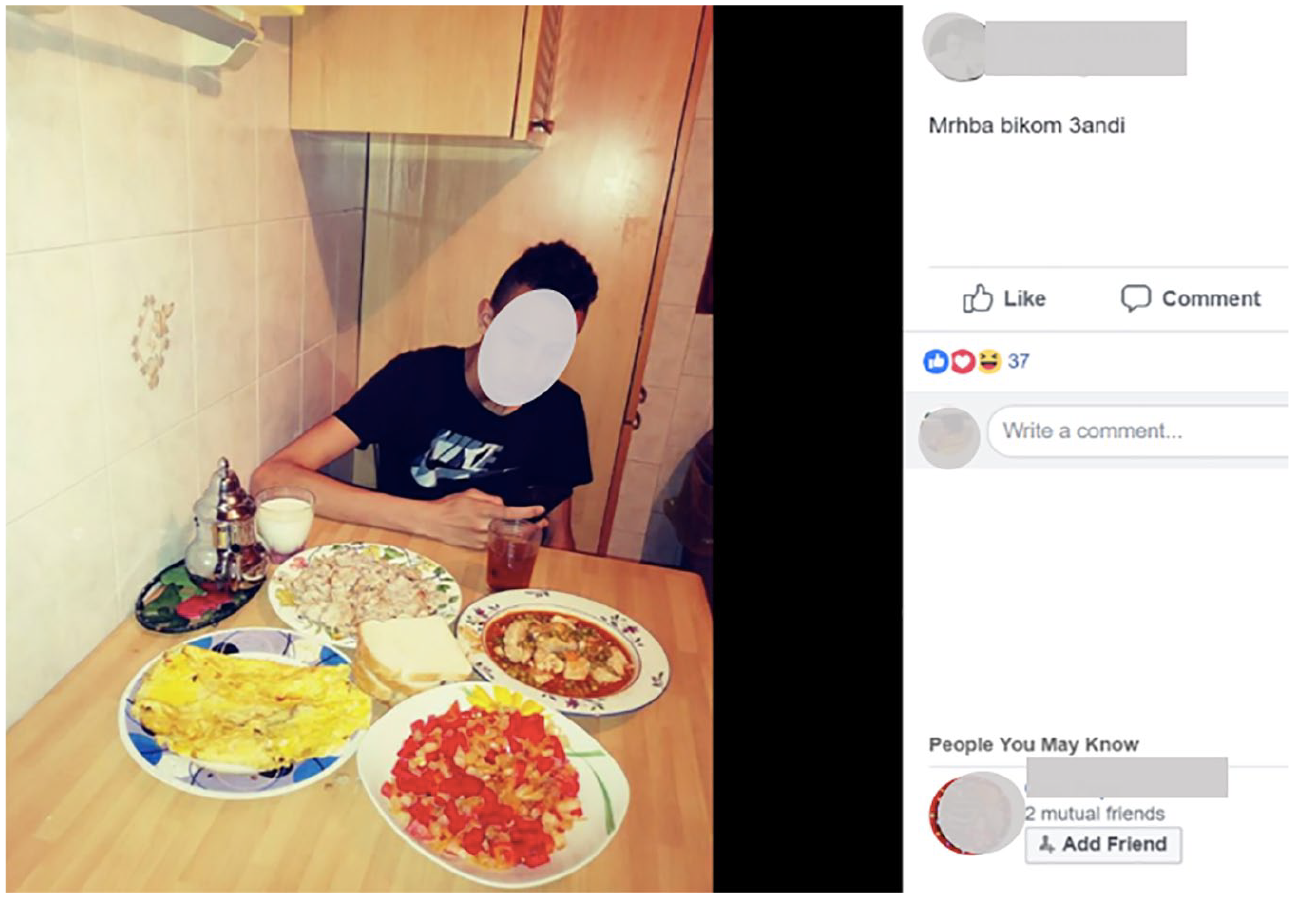
Ahmed’s Iftar meal post
Experiencing and sharing emotions on social media on such occasions could assist the refugee youth in dealing with potential loneliness. The reactions received from Ahmed’s Facebook friends served as a community of support as he received 37 ‘likes’, ‘hearts’ and laughing emojis serving the social and relational purposes and communicating affect (Riordan, 2017). The combination of all four emotional practices are visible in this post: mobilizing (dealing with emotions), naming (expressing them multimodally), communicating (seeking interaction from others), and regulating (linked to Iftar and Ramadan, while at the same time experienced in a mediated way of social media and youth global cultures).
Another example of the combination of all four emotional practices can be observed on post by Rooble from when his sister died, and through the support he gave and received. As part of the mourning process, Rooble sent condolences to his family through a Facebook status update, including a photo and text in Somali and Arabic and with reference to Allah (Picture 6). Culture plays an important part in the experience and expression of grief (Bhugra and Becker, 2005) as immigrants incorporate elements of the native culture, such as language, values and traditions, into their new life structures through the process of mourning (Henry et al., 2005). Consequently ‘the lost culture is not abandoned or divested of its emotional attachment; instead, it takes an essential part in the mourner’s experience’ (Henry et al., 2005: 109). The refugee youth often wrote their Facebook posts in English or the language of the country they were living in and used globalized visual language such as the V-sign on the photographs. However, they mostly wrote in their mother tongue and/or used religious references and symbols in the case of a more intimate emotional practices on social media that were related to their homeland, family and/or religion. This is in line with previous studies that show that language mixing on Facebook is important to create in-group alignment (Pérez-Sabater and Maguelouk Moffo, 2019).
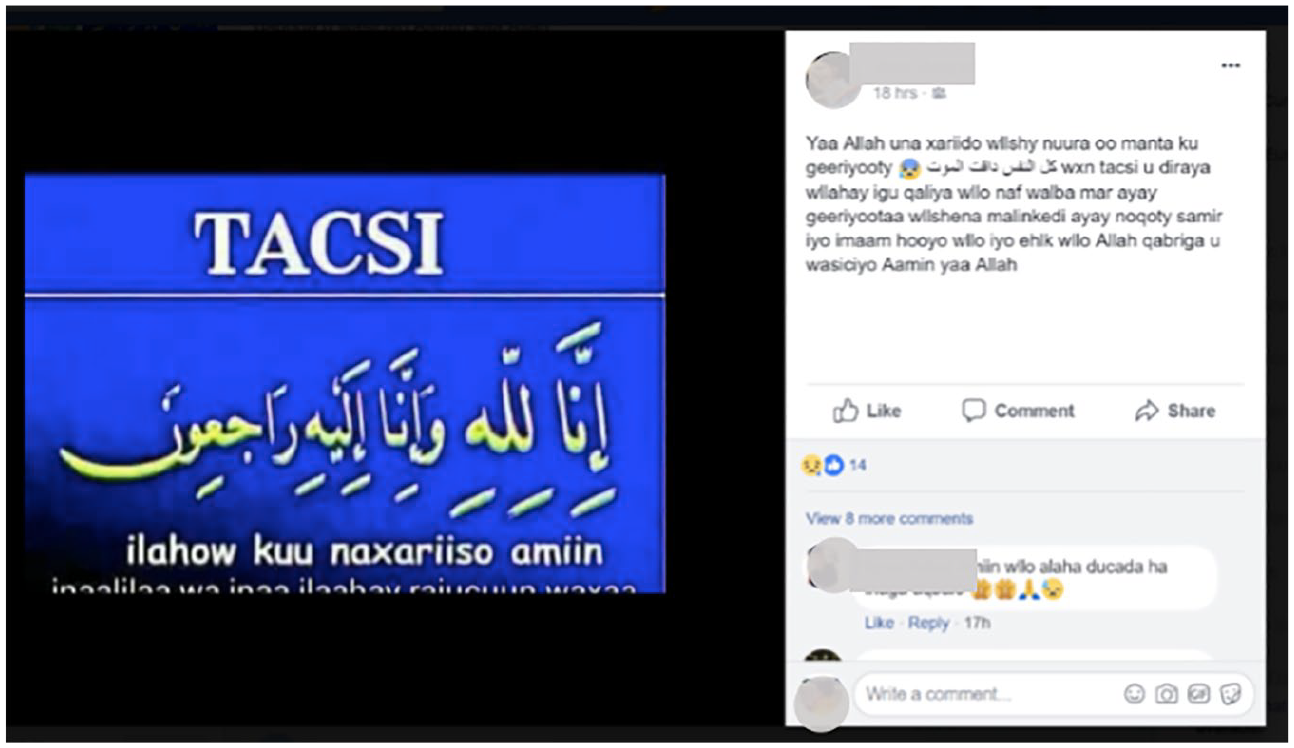
Rooble’s condolence message to his family
On several other occasions the refugee youth combined different languages and used global as well as local symbols. For instance, Abdul on 8 March 2018 posted a drawing of a woman offering shelter to a child using what could be a raincoat, or an abaya, from the rain (Picture 7). The text and the picture together form a whole (Barthes, 1977; Kress, 2010): Abdul writes in Swedish and he uses the heart emoji, which is a global expression of love and/or care. Derks et al. (2008) found that emoticons serve as a tool for altering the affect present in a message. Riordan (2017) highlights the fact that the use of emoticons is part of ‘emotion work’ (Hochschild, 1979): people invest time and energy to use emoticons because it appears worthwhile to maintain social relationships.
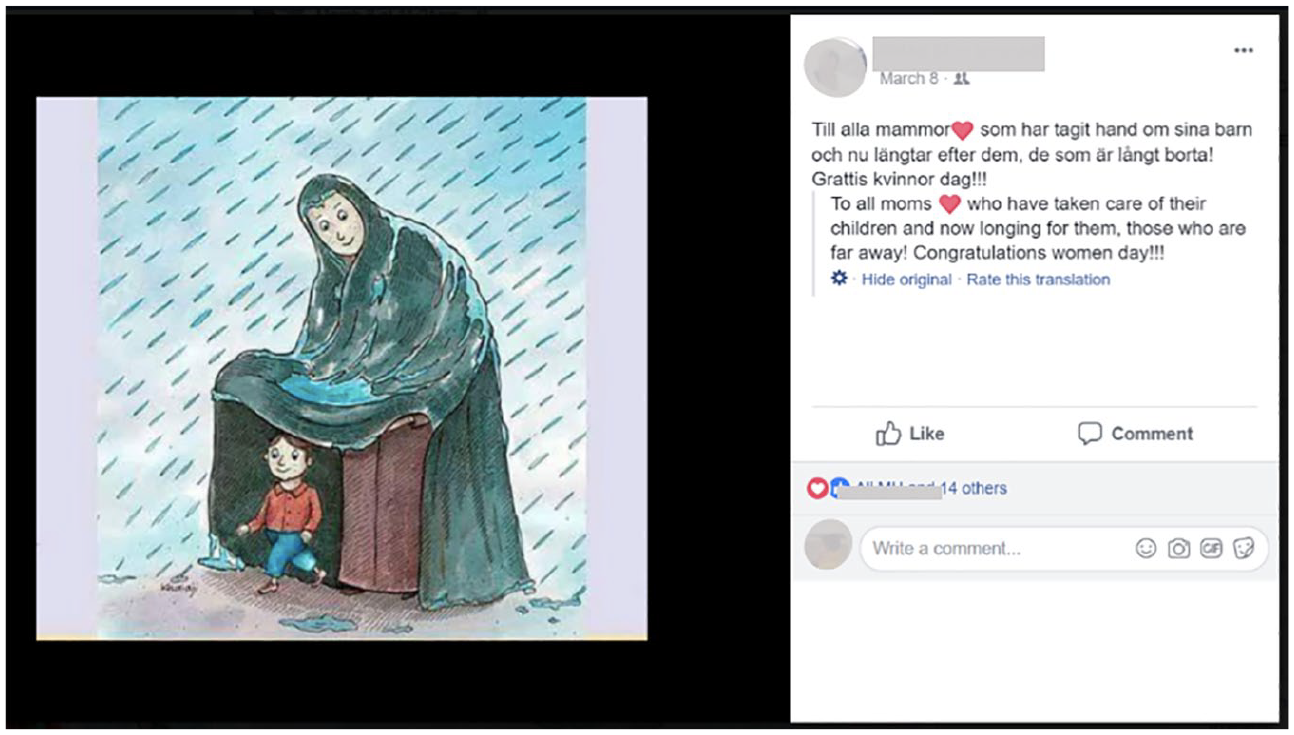
Abdul’s drawing and message for International Women’s Day
In the text, he acknowledges that 8 March is International Women’s Day, but he highlights that for him this day is about mothers, especially about those missing their children. He uses a globally recognized occasion to acknowledge his own experience as a child separated from his mother. Abdul incorporated old and new, global and local, collective and individual experiences and cultural norms to his emotional practice on social media, and by extension to his self-identity and his patterns of being and relating to people (Henry et al., 2005). Each component of this multimodal composition works together to exemplify the interconnectedness of local and global – or ‘glocal’ (Kjeldgaard and Askegaard, 2006: 231) – cultures in the unaccompanied refugee youth’s social media emotional practices.
Discussion and conclusion
While leaning against the theoretical framework of emotional practice and drawing upon empirical research with unaccompanied refugee youth, this article explored, discussed and illustrated the complex and interconnected nature emotional experience and expression of migration and settling down. Through researching how unaccompanied refugee youth from Africa and the Middle East settling down in Europe experienced and expressed emotions online, we arrived at the conclusion, first, that the binary oppositions such as losses and gains, presence and absence, and/or positive and negative emotions are difficult to separate from each other. The multimodal compositions shared online by the youth suggested that these oppositions were closely intertwined in the ‘ongoing and not static’ process of transition (Ponzanesi, 2019: 2). Physical and virtual presences and absences formed together a sense of co-presence, which brought about mixed feelings. As Riediger et al. (2014) suggest, we rarely feel either positive or negative feelings, as we usually experience them simultaneously. He calls this ‘mixed affect’ and through empirical research shows that this is particularly common among adolescents (Riediger et al., 2014: 611). Thus rather than seeing these binaries in opposition, we should consider them as being in a dialogue within the unaccompanied youth refugees’ lived experience.
Second, the multifaceted and intertwined role of four emotional practices – naming, mobilizing, communicating, and regulating – also made it difficult to grasp the unaccompanied refugee youth’s emotional expression and experience on social media through reductionist lenses. Unaccompanied refugee youth’s social media activities could be said to assist their mobilization of emotions by providing them with technological affordances and interactive social environment for emotional realization, reflection, and action. To share emotions online necessarily required naming them; the participating youth curated old (e.g. childhood photos), existing (e.g. drawings) and technologically afforded (e.g. emojis, filtered photos), as well as new (e.g. recent selfies) visual and textual materials within their social media emotional practices. Their emotional practices were inherently affective, as through communicating emotions the youth seemed to maintain and establish new connections and networks of belonging, blurry boundaries between absence and presence, and experience reciprocal support. These emotional practices were continuously shaped and regulated by technological and linguistic possibilities, global youth culture, as well as by social, cultural, and religious rules, norms, and expectations. We therefore ultimately suggest that there is a need for studies that would move beyond a reductionist worldview by applying a more holistic and phenomenological approach to researching migration, social media, emotions and youth, while contributing to a deeper and more complex understanding of their lived experiences.
Moreover, based on our research, we propose that emotional practices on social media might play an important, and potentially positive, role in migratory grief and mourning processes, including reflection and realization of both emotional losses and gains. These emotional practices on social media helped the unaccompanied refugee youth to garner a number of emotional gains; for example, developing further the old and establishing new social connections, providing new support structures and processes, helping to negotiate new purpose, hope, and ambition, maintaining and developing multiple identities, and belonging to diverse cultures, and communities. At the same time, the unaccompanied refugee youth used social media for experiencing and expressing emotional losses, such as loss of social networks, parents, childhood, purpose, and homeland. Lee Casado et al. (2010: 611) call the experiences and expressions of losses resulting from immigration ‘migratory grief’, and Henry et al. (2005) suggest that in order to cope with these emotional losses it might be healthy for refugees and immigrants to undergo a process of mourning.
Moreover, the social media emotional practices of these unaccompanied young refugees spoke not only about their migratory experiences but also about their adolescence, globalized youth culture and their unique past and present experiences. We must keep in mind that ‘the process of migration is only one aspect of their young lives which are simultaneously shaped by many other opportunities, struggles, identity conflicts and interests’ (Chase et al., 2019: 5). It is crucial to be aware of our own ‘assumptions about what young people have been through and how this has impacted their lives’ (Chase et al., 2019: 5). In our research, we aimed to address this limitation by conducting interviews with the participants prior to the social media ethnography, complementing the multimodal analysis with communication over Facebook messaging when possible, seeking assistance from native speakers from the same cultural background as the participants, and by thoroughly applying a theoretical and methodological framework for the data collection, analysis, and interpretation.
Yet future research of unaccompanied young refugees’ emotional practices on social media should be even more attentive to their diverse experiences and multiple identities. As van de Vijver (2018) highlights, what research studies on migration, youth and adolescence have in common is the study of changes in self-identity, yet they are rarely informed by each other’s existing knowledge. To address this gap, young refugees should be involved in research thoroughly and over a longer period of time so we, the outsiders, could further understand their interconnected and multifaceted emotional experiences and expressions online in a more complex way.
Footnotes
Funding
The author(s) disclosed receipt of the following financial support for the research, authorship, and/or publication of this article: The article is methodologically and empirically underpinned by the research project Media Literacy for Unaccompanied Refugee Youth: A Path to Integration (MedLitRefYouth) funded by the EU’s Horizon2020 research and innovation programme under the Marie Sklodowska-Curie grant agreement No. 747083.
Theoretical underpinning was developed with the support of applied social research project TL01000253 Multicultural Life and Learning of Child Prosumers funded by the Technological Agency of the Czech Republic (Supa, 2018–21).