



Abstract
This article analyses the discursive construction of the limits of webcamming in terms of service agreements by BongaCams, LiveJasmin and Chaturbate, three of the world’s most popular webcam sex platforms. Through this analysis, the moderation practices in the webcamming industry are examined. Regulation of sexual platforms and its implications for representations of online sex work are still largely unclear. Through a critical discourse analysis of seven webcam platform terms of service documents, this article scrutinises the norms for camming as dictated by industry leading platforms. This analysis shows that these platforms, for legal and financial reasons, reject the idea of camming as sexually explicit or as (sex) work. Such a construction of camming limits sexual expression online, obstructs online sex workers’ labour rights and perpetuates sex work stigma. This article sheds light on how digital platforms can establish and maintain norms which regulate users’ online expressions, working conditions and representations.
Introduction
Sex work is no longer just policed by national governments and courts, online types of sex work, such as webcamming, are primarily regulated by digital platforms instead. While the legal frameworks on full-service sex work vary greatly among different countries, online work is mostly unregulated (Bleakley, 2014: 901). Only a hand full of countries, such as South-Korea, have actually prohibited it (Lee, 2021). Not national laws on sex work, but platforms and platform legislation have an unexpectedly important role in the governing of online sex work. To understand how this stigmatised line of work is represented in the online context, it is thus crucial to scrutinise how webcam platforms regulate.
This article focusses on one aspect of the governance of sex work in an online context: the regulation of webcamming through webcam platform’s Terms of Service (here: ToS) documents. Webcamming is generally seen as a type of online sex work. Sex work, the work focussed umbrella-term by Carol Leigh, refers to a wide range of sexual labour from stripping, to porn, to street-based work (1997: 225). While this term receives anti-capitalist critiques for its fixation on ‘work’ (babylon and Berg, 2021: 633), it is also generally adapted as a less stigmatising description of various roles within the sex industry. Online sex work then refers to a digitally mediated subset of this work (Campbell et al., 2019: 1555). Camming is an even further specification ‘in which cam models sell interactive computer-mediated sex online’ (Jones, 2020: 1). This article aims to see how camming is constructed in webcam platforms’ ToS documents.
Webcam sex platforms host webcam performers (here: webcammers). 1 After agreeing to a platforms’ ToS and providing identity verification information, webcammers can livestream on these platforms. Webcam sex platforms thus facilitate, aggregate, monetise and govern real time interactions between end-users and webcammers. The governance of three such platforms is examined here: BongaCams, LiveJasmin and Chaturbate. These three platforms are some of the most visited webcam sex platforms. Taking a look at the values represented in their ToS, means examining the moderation of online sex work on some of the most popular sites on the web (Alexa, 2021).
This investigation focusses on camming because of the massive size of this industry and its ambiguous regulation (Henry and Farvid, 2017: 119; Jones, 2020: 1; Sanders et al., 2018: 15). While webcam sex platforms, and the Internet in general, have been praised as spaces for sexual autonomy (e.g. Attwood, 2011; Cover, 2018; Jones, 2020; Paasonen, 2016) the limits to this freedom must be explored. Research on such platforms is especially relevant also because of the contentious regulation of sex work in the offline world (Wagenaar and Altink, 2012), increasing governmental legislation of online sex work (Blunt and Wolf, 2020; Tripp, 2019), and the centrality of sexual content to moderation in general (Stjernfelt and Lauritzen, 2020). Examining the construction of the limits of camming in webcam sex platforms ToS, can further understandings of how sex workers are represented, how their work is regulated online, and what norms about sex are held and enforced by online platforms.
I start this article with a discussion of existing literature on camming, platform legislation, moderation and the role played by ToS documents, in regulating sexual content online. Building on this understanding of platform regulation I present a discourse analysis of the seven ToS documents by BongaCams, Chaturbate and LiveJasmin. Their language use and definitions of obscenity and webcammers are the focus here. This analysis shows that, in general, these ToS documents construct camming in such a way that the connotations with sex, work and sex work are minimised.
Literature review
This article adds to a growing body of literature on webcam sex platforms. The dangers (Jones, 2016), pleasures (Jones, 2019), professionalisation (Bleakley, 2014; Nayar, 2017; Rand, 2019), technologies (Hernández, 2019; Martins, 2019), competition (Van Doorn and Velthuis, 2018), precarity (Vlase and Preoteasa, 2021) of webcamming have had increasing attention. These studies generally focus on webcammers’ experiences, outlining both positive and negative aspects of this industry.
The rise of camming, and research on it, can be seen in the light of increased proliferation of ‘gig’ work in the Global North among previously ‘stably’ employed, privileged populations (Ivancheva and Keating, 2020: 252). Because of the industry’s largely female workforce and its sexual character, camming has been ignored in many analyses of gig labour (Rand, 2019: 122). Yet, webcammers are also gig workers. Like Uber drivers and food couriers, online platforms profit both from these workers’ labour, and their lack of labour-relation (Graham et al., 2017: 140; Wood et al., 2019: 68).
Instead, much camming research focusses on its decreased physical risks, because of its digital nature, and therefore portrays it as a ‘safer’ kind of sex work (e.g. Henry and Farvid, 2017: 120). That camming, in part due to the safety provided by virtuality, allows for pleasurable sexual self-expression has been raised by some researchers and webcammers alike (Jones, 2016, 2019, 2020). Transgender webcammers have, for instance, described camming as an opportunity ‘to discover myself in an accepting environment wherein being transgender was celebrated’ (Mia, 2020: 238; TransEthics, 2015: 238). Camming also allows for the monetisation and exploration of gay desire (Cover, 2018). This echoes sex-positive arguments about pornography’s sexually liberating potential (McNair, 2013; Schorn, 2012). However, the regulation of sexual content online is increasingly stringent (Tiidenberg and Van Der Nagel, 2020). Recent examples reveal how marginalised groups, on, for instance Tumblr, Instagram and YouTube, are less and less able to represent their sexualities online (Are, 2020: 742; Southerton et al., 2020: 4). So, while webcam platforms facilitate online sex workers’ labour and self-representation, it is worthwhile to scrutinise if, like other platforms, these websites also present restrictive boundaries on sexual expressions.
The specifics of content regulation on webcamming platforms are relatively unknown. Anecdotal evidence, as some webcammers have stated that their work is ‘shaped by the regulations imposed by the websites’, does show the influence of these documents (Jones, 2020: 65 & 114). Violations of ToS, some observe, are punished (too) strongly with suspensions and account closures (Jones, 2020: 65; Mia, 2020: 238). Based on these experiences it’s easy to see the importance of ToS. These documents, at least for some, influence experiences of work and access to the platforms on which they make their living.
While webcam platforms dictate rules for users, legal frameworks in turn shape these regulations (Gorwa, 2019: 4). ToS, namely, are primarily designed to help platforms avoid future litigation (Gillespie, 2018: 46). Platforms adhere to national laws in and through their ToS. Generally, platforms stick to US laws, because of this country’s dominant position online and general laissez-faire attitude towards regulation of speech. When it comes to the moderation of camming, various pieces of this legislative framework become salient. Primarily important is section 230 of US communication law, also known as ‘safe harbour’. Not just webcamming platforms, but many platforms in general, settle in the United States to enjoy this law which protects platforms from liability for user-generated content (Grimmelmann, 2015: 103). However, the United States outline some relevant exemptions to ‘safe harbour’ where platform liability does apply, among others, on sexual abuse of minors (child pornography), obscenity, and the facilitation of sex work (Gorwa, 2019: 8; Jones, 2020: 620).
While legislation on the abuse of children is relatively clear, this is much less the case for the other exemptions. For instance, the United States precedent for obscenity set in Miller v. California (1978) relies on whether: ‘the average person applying contemporary community standards’ would find that a work, ‘taken as a whole, appeals to the prurient interest’ or, if it represents patently offensive sexual conduct ‘as defined by applicable state law’, as long as it ‘lacks serious literary, artistic, political, or scientific value’ (Howard, 1975). Thus, what is considered obscene by one court at one time, might not be if different ‘contemporary community standards’ or ‘applicable state law’ are applied. On top of this platforms are given leeway in classifying obscenity even outside this murky precedent. ‘Safe harbour’ also protects platforms from liability when removing content they deem obscene, even if it would have been constitutionally protected (Citron and Wittes, 2018: 457). As for the regulation of sex work online, FOSTA-SESTA, a 2018 US ‘anti-trafficking’ bill, tackles the ‘facilitation’ of sex work by platforms by outlawing sex work advertisements. If platforms host advertisements for sex workers’ services they can be prosecuted based on these laws (Blunt et al., 2020: 8; Campbell et al., 2019: 1557).
These vaguely defined exceptions to ‘safe harbour’ essentially facilitate the strict regulation of sexual content on platforms since ‘safe harbour’ does protect platforms when they regulate too severely but not when platforms fail to police these broad exemptions (Tripp, 2019: 223). Within this legislative context it is then safer for platforms to be overzealous with their regulation of sexual content. Globally, some online and offline sex workers, also not mutually exclusive groups, have described how they have lost access to, for example, private accounts, advertising platforms, payment processors and social support networks because of these regulations (Blunt and Wolf, 2020: 120; Blunt et al., 2020: 19; Jones, 2020: 243; Tripp, 2019: 237). These experiences exemplify how national legislation can influence content moderation on a global scale. Online sex work itself is generally not prohibited by governments, but the rules set out by webcam sex platforms, shaped largely by US policy, are vital in the practical regulation of this work.
Webcam sex platforms, in an effort to avoid litigation (Gillespie, 2018: 46), hold power over the kind of sex work and representation that can occur on their sites. But just like the laws that shape them, platform regulations are vague (Gillespie, 2018: 199). ToS documents are the only insight we get into these practices. These documents are the mandatory terms to which any user or webcammer is made to agree before using webcamming platforms. Generally, on any platform, users do not pay attention to these texts (Obar and Oeldorf-Hirsch, 2020). Yet it is these documents precisely where norms for an online community are articulated (Gillespie, 2018: 46; Grimmelmann, 2015: 61). ToS documents are a space for platforms to articulate their standards (Ruberg, 2020: 2). As such they are ‘texts into which we must peer closely, to see what values they represent’ (Gillespie, 2018: 72). Scholars of platform moderation have undertaken essential work on the low-paid labour involved in content moderation (Roberts, 2019), the specifics of the practice (Grimmelmann, 2015), its relation to legislation (Gorwa, 2019; Grimmelmann, 2015), to power (Gillespie, 2018), and user’s experience of it (Myers West, 2018). Yet, in-depth analysis of platforms’ ToS documents and the regulation of sex remains limited (Ruberg, 2020: 6).
One of the few in-depth analyses of the construction of sexual norms in ToS, by Bo Ruberg, demonstrates the norms reflected in such documents. Their analysis focusses on Twitch, a (non-sexual) livestreaming platform. Ruberg’s (2020: 2) analysis shows that while platforms present definitions in ToS as ‘common sense’ they are constructed and reflect cultural norms about sex and sexuality. Ruberg encourages us to confront the ‘biases that underly regulatory policies’ (Ruberg, 2020: 17). Twitch’s ToS reinforce repressive sexual norms in the streaming industry (Ruberg, 2020: 14) and, in a similar way, webcam platform’s ToS can (re)create standards of online sex work.
As (online) sex work is heavily stigmatised, sexual moralisation and norms impact it a great deal. Social institutions, including media representations, can have a role in either maintaining or re-shaping these sexual norms. Media present a common-sense discourse on sexuality, which provides knowledge about what sex is and how it can be spoken about (Hall, 1997: 30). Generally, mass media have reinforced the heteronormative normalisation of some sex over others (Berlant, 1997: 7; Kumashiro, 1999: 503; Rubin, 1984: 257). As such, the ‘charmed circle’ of acceptable monogamous, straight, vanilla, non-transactional sex is upheld (Rubin, 1984: 278). Sex work violates this form of heteronormativity. But platform moderation, as expressed in ToS, now also plays a role in the formulation and maintenance of various sexual standards. The Internet, for instance, has already created space for more explicit mediated portrayals of sex (Attwood, 2011: 15; Paasonen, 2016; Williams, 2004: 3). Yet, it upholds and creates sexual morals too. The moderation of sexual content still shapes what sexual identities are visible and thus normalised. Dominant online platforms now hold power to moderate what is (and is not) legitimate sexual content (Ruberg, 2020: 5–6).
Methodology
Elements of how webcam sex platforms represent, construct and ultimately regulate camming are observable in these sites’ ToS documents. Considering the thousands of webcam sex platforms currently online (Jones, 2020: 79), it is obvious not even a fraction of these websites can be examined. Instead, I chose to analyse seven ToS documents 2 by three popular platforms: BongaCams, Chaturbate and LiveJasmin. These platforms are industry-dominant, in terms of traffic they outperform competitors in rankings by a long shot (Alexa, 2021). The rules, policies and terminology set out by these platforms are, if not leading, at least the most prominent within the webcam sex industry.
Chaturbate, shown in Image 1, was founded in 2011 and mainly caters to the US market. BongaCams, online since 2012, is considered to be Chaturbate’s European counterpart (Jones, 2020: 79). Both these platforms primarily host ‘free’ shows, in which webcammers stream to large audiences that can ‘tip’ them with tokens. LiveJasmin differs in its approach to camming. Already registered in 2001, this platforms’ primary focus is on private shows (Velthuis and Van Doorn, 2020: 172). As seen in Image 2, LiveJasmin streams are public, but the platform encourages the sales of private shows, for example, by only allowing nudity in private performances (LiveJasmin, 2020b).

Chaturbate’s main interface (images blurred for anonymity).
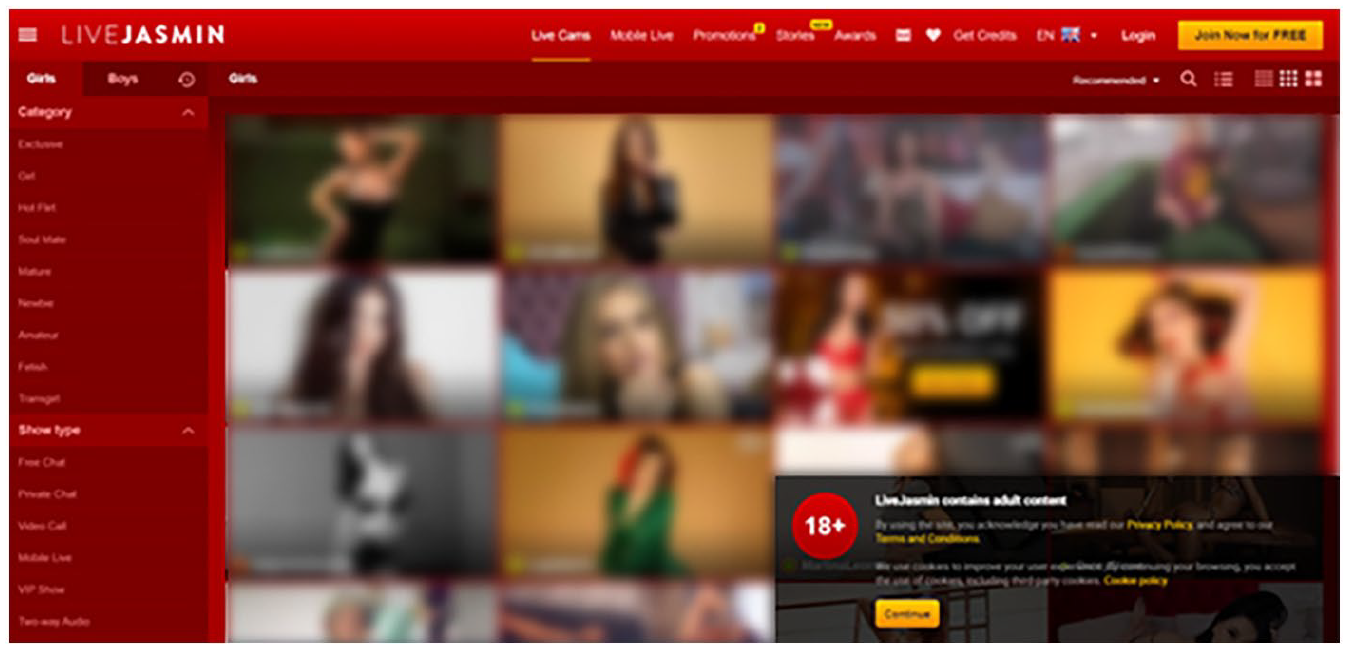
LiveJasmin’s main interface (images blurred for anonymity).
The seven documents analysed here are the policies for webcammers and users of these three platforms. Included for analysis are: LiveJasmin’s and BongaCams’ separate agreements for audience members and webcammers, as well as one regulations appendix by LiveJasmin. Chaturbate only has one ToS document, its ‘Terms and Conditions’ which applies to both webcammers and audience members. This, as well as an appendix, Chaturbate’s ‘Code of Conduct’, are also analysed here. The total sample thus consists of seven documents with similar functions on all three platforms. These documents were all downloaded from their respective platforms in December 2020. Since ToS are subject to changes (Ruberg, 2020: 7) the analysis concerns the documents downloaded at this time. Since this download LiveJasmin has altered its user policy, it is to be expected that platforms will also modify the other documents looked at here in the (near) future.
ToS are all part of a single discursive genre (Fairclough, 2011: 11); that of legal contracts. These documents are split up in clauses, define actors and use abstract and dry language. This applies not just to webcam sex platforms, rather all ToS are written this way (Myers West, 2018: 4369). Potentially because of adherence to this genre, many of the sample documents’ clauses are similar and sometimes even identical. Yet, differences do exist between the seven documents, this analysis attends to precisely the uniformity and distinctness of these documents to tease out dominant and specific norms.
In doing this, I treat these texts not as indisputable contracts, but as discourse. While it is meaningful to be cognisant of ToS’ legal role, especially also since platforms use these documents to protect themselves from costs and prosecution, it is equally important to be attentive to the social meaning of these ‘contracts’. This analysis pays attention specifically to the normative construction of camming by the three platforms both in and out of line with legislation. It draws on queer discourse analysis to examine normative constructions of sexual identities (Motschenbacher and Stegu, 2013: 525). This critical discourse analysis investigates the relation between these discourses and dominant social norms (Fairclough, 2011: 11). While one might see ToS as ‘mere window dressing’, discursively they matter as they reveal platforms’ ideas about what webcamming should (not) be (Gillespie, 2018: 46).
Following Ruberg’s (2020: 8) example I aim for a deep ‘qualitative analysis of these documents’ and where they looked for a ‘functional definition of sexual content’, I look for the characterisation of camming itself. At a practical level, this involved multiple initial readings of each document. After this familiarising period, categories, such as ‘definitions of obscene’, ‘content for sale’, ‘(in-)appropriate material’ and ‘employment’, which emerged on all three platforms were established. Grouping elements of ToS like this allowed me to actively look for similar and different constructions across the various ToS documents. Combined these categories outline what platforms ToS’ do and do not define as camming.
One of the crucial elements of all these platforms’ ToS that emerged in this analysis is left out in this article: the ownership platforms establish over webcammers intellectual property and content in these documents. ToS include page-long clauses in which intellectual property rights over webcammers’ content (from their name and performances to their chat messages) are signed over. While capping, the illegal recording of performances by audience members is one risk of camming (Jones, 2016: 240), platforms themselves reserve the right to ‘cap’ webcammers’ content too, as outlined in their ToS agreements. Future, more law-informed work could scrutinise more thoroughly what content rights webcammers are made to sign over by these platforms, and why.
Since ToS agreements are generally intent on prohibiting behaviours (Gillespie, 2018: 48), my analysis is split up into two sections that specifically attend to what these ToS place outside their definition of camming: namely, the (1) sexual and (2) labour elements of camming.
Not sex work: ToS obscuring sex
Through their language choice regarding sexual acts and obscenity regulations, these three webcam sex platforms conceal some of camming’s sexual acts. Obscuring sex in their ToS is likely a practical consideration for these platforms to avoid litigation and uphold the company reputation, but it also carries implications for how camming is discursively constructed. The visibility of some sexual acts is at stake in these documents.
In BongaCams’, LiveJasmin’s and Chaturbate’s ToS agreements sex is obscured through language choices. In their description of the services and content offered on their platforms sexual terms are omitted. Their ToS define services as ‘online adult entertainment services, more precisely, performing live webcam shows’ (BongaCams, 2020b; LiveJasmin, 2020c, emphasis own) and ‘content which may include, at the providing Community Member’s election, content of an adult nature’ (Chaturbate, 2020b, emphasis own). The key term in the definition of camming by these platforms is adult. Usually, adult and pornographic content are understood to be synonymous (Tibbals, 2014: 130). However, this connection is never made explicit in these documents. Rather than defining camming as sex these platforms only refer to sex when describing forbidden behaviours. In the BongaCams and LiveJasmin ToS documents, the terms ‘sex’, ‘sexual’, ‘genitals’, ‘erotic’, ‘nudity’ and ‘nude’ are only used in relation to prohibitions. It is striking that platforms, that so clearly host sexual content, phrase their documents in such euphemistic ways that they hold almost no explicit reference to sex. The sexual acts involved in camming, such as stripping and autoerotic stimulation (Henry and Farvid, 2017; Weiss, 2018: 732), are omitted in these descriptions.
Since webcam platforms are digital spaces, the explicit sexual nature of camming work can be downplayed in these ToS. If we class the digitally mediated experience of camming, which can indeed be embodied (Jones, 2020: 104), as sex, social definitions of sex would have to expand and become more inclusive (Tiidenberg and Van Der Nagel, 2020: 6). But, it seems, webcam sex platforms replicate definitions of sex dependent on physical contact, precisely by referring to camming as ‘adult content’ rather than referencing sex.
Another way in which sex is not just obscured, but also outlawed in these documents is through definitions of obscenity. These specifications of obscenity demonstrate how regulations put in place to avoid legal issues, since safe harbour does not protect platforms hosting obscene content (Jones, 2020: 63), can carry a lot of social meaning. In line with contextually dependent obscenity laws, the regulations webcam platforms put forward on obscenity in their ToS are ambiguous. ToS emphasise that performers should ‘not violate the local community standard of “obscenity” in my/their area’ (BongaCams, 2020b; LiveJasmin, 2020a) users are expected to be ‘familiar with the standards in your community regarding acceptance of sexually-oriented materials’ (Chaturbate, 2020b). These ‘standards’ are all open for interpretation and shift the responsibility for maintaining an obscenity free platform on to performers. On top of this, the vagueness of these obscenity rules creates a situation where platforms could operationalise these regulations, also in discriminatory ways, to remove content or users at their discretion. ToS definitions of obscenity on all three platforms, legally absolve platforms while discursively depicting webcammers as responsible for sexual ‘morality’ on the site.
However, while these general definitions of obscenity mirror US obscenity legislations, unlike these laws, webcam platforms also point to specific sexual acts as obscene. This is where the power of webcam sex platforms over sexual expression becomes explicit. Where US laws on obscenity take into account sexual content’s reception and purpose, webcam platforms outright ban some sexual behaviours. Although we cannot know for certain, platforms are untransparent about their rules, it is possible that these specific acts are banned to both air on the side of caution in regard to obscenity regulations and to appease conservative payment processors (Jones, 2020: 55; Tripp, 2019: 238). In their efforts of self-protection, these platforms police obscenity restrictively, listing specifically prohibited sexual acts.
Non-outlawed, sometimes considered ‘non-normative’ sexual acts are listed in all three platform’s ToS documents as punishable offences. BongaCams leverages immediate account closures over ‘Urination, defecation, “going to the bathroom”, enema play, breastfeeding, consumption of any bodily waste, vomiting, menstrual bleeding’ (BongaCams, 2020b). LiveJasmin also punishes ‘showing body waste [. . .] showing blood’ with suspension (LiveJasmin, 2020c), and Chaturbate prohibits ‘blood, [. . .] pain, erotic asphyxiation, fisting, [. . .] overly large sex toys’ (Chaturbate, 2020a). These behaviours are not usually considered as illegal. Many of these acts are part of people’s daily life, for some this includes their sexual life (Moskowitz et al., 2008: 197). These prohibitions construct an overly rigorous concept of obscenity which, through platforms enforcement of these rules, renders some ‘non-normative’ sexual behaviours invisible. Webcam sex platforms equate these behaviours with obscenity and other illegal acts in their ToS. The consequence of such an equation is the reinforcement of the charmed circle of sex, without fetishes or sadomasochism (Rubin, 1984: 152–153). Obscenity regulation then becomes a useful tool in constructing what camming should not be, and one thing it should not be is ‘non-normative’.
Not sex work: ToS obscuring work
Besides subduing the sexual nature of camming, ToS for these platforms also minimise certain work elements of camming. Again, as with the concealment of sex, this is evident through both overly strict adherence to US legislation and through language use.
FOSTA-SESTA, for instance, appear to be the basis on which BongaCams, LiveJasmin and Chaturbate downplay some sex work elements of camming. All three platforms explicitly state their service is not ‘prostitution’. These platforms also explicitly prohibit ‘face-to-face’ meetings between customers and webcammers. Or outlaw mentioning: ‘prostitution, escort services, or any type of compensation for meeting type arrangement’ (Chaturbate, 2020a). But these platforms, especially BongaCams and LiveJasmin, do not just outline rules about the use of their platforms but outright prohibit full services work in general: ‘I will not solicit or take part in anything related to escort services or prostitution’ (BongaCams, 2020b; LiveJasmin, 2020c). This denies the reality that substantial amounts of webcammers engage in other types of sex work, including full-service work (Jones, 2020: 243). Notable is also that these documents further de-emphasise work by using less labour focussed terms for sex work such as ‘prostitution’. These prohibitions, their wording, and statements like BongaCams’ (2020a) ‘our models are not prostitutes’, actively distance camming from (full service) sex work.
Subtle changes to ToS since the 2018 implementation of FOSTA-SESTA show how this might be directly related to these US laws. For example, in BongaCams’ user agreement from 2015, they do not yet stipulate that their ‘models are not prostitutes’, yet they do already ban physical meetings (BongaCams, 2015). Similarly, in 2017 Chaturbate does already ban those that ‘discuss or arrange prostitution or escort services’, but does not include its rule about ‘compensation for meeting’ arrangements (Chaturbate, 2017). Over time, likely to comply with FOSTA-SESTA, webcam sex platforms have started to outlaw (full service) sex work on their platforms. Their adherence to US legislation gives platforms a reason to deny camming is sex work. That reason likely being that they want to avoid legal prosecution, and want to stay appealing to payment processors which are known to discriminate against sex workers (Blunt and Wolf, 2020: 55).
These ToS’ strict interpretations of FOSTA-SESTA might also have yet another benefit to webcam platforms. All three platforms also have strict regulations on providing contact information, or ‘advertising other websites or services’ (BongaCams, 2020b; LiveJasmin, 2020c). Or as Chaturbate puts it: ‘You will not advertise commercial websites that offer live webcam streams’ (Chaturbate, 2020b). Such rules, for these websites, can have more benefits besides compliance with FOSTA-SESTA. These platforms also obstruct webcammers’ other (sex) work, to limit competition. If it is forbidden for webcammers to contact end-users outside the platform, these platforms can be sure they can profit from every interaction. As such, actively distancing camming from sex work in their ToS is both legally and financially beneficial for webcam sex platforms, all the while further perpetuating sex work stigma.
But webcam sex platforms do not just conceal that camming is sex work, they also downplay the fact that camming is any kind of work. This too has primarily financial benefits for these platforms. As is common in the gig economy, framing workers as independent contractors allows platforms to forego labour laws and responsibilities (Graham et al., 2017: 140). Specific clauses in webcam sex platforms’ make this (lack of) labour relation explicit. A webcammer is ‘not in any way an employee of the Website Operator’ (BongaCams, 2020b; LiveJasmin, 2020c). Chaturbate achieves a similar effect by referring to webcammers in its agreement as ‘independent broadcasters’ (Chaturbate, 2020b, emphasis own). Where employers hold some obligations to their employees, webcam sex platforms do not. Instead, they re-emphasise that they are not liable ‘for any direct or indirect losses’ or ‘the loss of business profits’ (BongaCams, 2020b) and ‘will not be responsible for any lost profits, revenues [. . .] financial losses’ (Chaturbate, 2020b). In this way, webcam sex platforms do not just claim that webcammers are not (full service) sex workers, they are constructed as not being their workers either.
Not just these clauses, but also ToS’ language use further represents camming as something other than work. Another financial incentive could drive this since, almost paradoxically, representing camming as non-work is profitable. Portraying camming as something other than a job, caters to desires for authenticity (Nayar, 2017: 485). Potentially for this reason Chaturbate defines their Independent Broadcasters as ‘Community Members who are eligible to receive tokens in their account, from other Community Members’ (Chaturbate, 2020b). This falsely equates audience members and webcammers. It completely obscures the (sexual) labour that, in general, needs to be engaged in before tokens would be transferred. The other two platforms construct webcammers, termed Adult Service Providers, as someone ‘who provides shows, chats or interacts with visitors of the site’ (BongaCams, 2020a; LiveJasmin, 2020b). Labour and the exchange of money, crucial for the financial viability of camming for both webcammers and platforms alike, is eschewed in these documents. In fact, LiveJasmin punishes ‘asking for money’ with a month-long suspension (LiveJasmin, 2020c).
But BongaCams and LiveJasmin both employ a different set of ToS agreements for webcammers themselves. In these documents webcammers are called ‘model’ or ‘performer’ interchangeably (BongaCams, 2020b; LiveJasmin, 2020a). The difference in terms used by these platforms in various documents is noteworthy as it might signal a desire to construct webcamming differently to either a webcammer or a user audience. To (potential) webcammers the platforms use the term model/performer, associated with femininity, glamour, and the media (Mears and Connell, 2015: 342). Chaturbate’s Independent Broadcaster also includes this media referencing. Potentially, ToS make use of digital media’s perceived intangibility to further distance their conception of camming from sex work. In this discourse sex work, as a stigmatised profession, is hidden while webcammers are instead described in the terms of media industries. While camming is generally recognised as online sex work (Henry and Farvid, 2017: 119), ToS thus do not construct it in this way. Both for financial and legal reasons, the sex work and general work of camming are minimised by these platforms.
Delimiting camming
This analysis of seven ToS agreements unveils what camming is constructed to not be for these three platforms. Through language use, overzealous adherence to US legislation and platform specific rules Chaturbate’s, BongaCams’ and LiveJasmin’s ToS construct an image of camming as not sex, and not work. On top of this, camming, in these ToS documents, should not be seen as the combination of these two: sex work. Instead, camming is made out to be the provision of ‘adult’ services. This discursive construction of camming impacts how sex, work, and sex work are able to be experienced and represented on webcam sex platforms.
ToS documents limit possibilities for sexual expression and perpetuate sexual norms online. These agreements’ overly strict definitions of obscenity, as well as their efforts to distance camming from sex work, actively depict certain sexual behaviours as unacceptable. This contrasts some ideas of the Internet as more sexually open in its representations (e.g. McNair, 2013; Paasonen, 2016). Of course, the acceptance (some) trans and queer webcammers find on these platforms should be celebrated (Cover, 2018; Mia, 2020). But through these ToS we learn that the dominant webcam platforms might have progressed only a little from the ‘charmed circle’. All three platforms’ general definitions of obscenity allow for subjective moderation, because who is to decide when a ‘community standard’ is violated? As one webcammer observed this ‘is a problem because that means you could be flagged for basically anything’, and vague standards are more easily enforced in discriminatory ways (Jones, 2020: 117). Heteronormativity, which opposes not just gay sex but also various ‘non-normative’ types of nonreproductive straight sex (Berlant, 1997: 18), shapes the enforcement of these ToS regulations. Where rules are explicit on obscenity these webcam platforms generally outlaw more ‘kinky’ sexual behaviours such as the use of ‘blood, [. . .] pain, erotic asphyxiation, fisting, [. . .] overly large sex toys’ (Chaturbate, 2020a). Like traditional media have done before them, camming platforms perpetuate norms of sex, without fetishes or transactions (Rubin, 1984: 152–153).
The fact that these webcam platforms minimise the labour of camming also shows us something about webcamming’s place in the online gig economy. These documents repeatedly stress that webcammers are not (full service) sex workers, or employees. Camming is, as made abundantly clear in these documents, flexible, precarious, and one’s own responsibility – just like other gig work. So far camming has been categorised in the gig economy on the basis of webcammers experiences and theoretical discussions (Jones, 2020; Rand, 2019). However, this analysis also shows that on the basis of webcamming platforms’ own narratives camming is very much part of the online gig economy. Examining ToS agreements, as was done here, gives us another source for deciding what is and is not gig work then. This might allow for the gig labour literature to include more types of display labour which is often precarious, female and devalued (Mears and Connell, 2015: 341). The terminology and conditions set out in webcam sex platforms’ ToS agreements show exactly that, by denying that camming is work, a reliance on gendered display work can be combined with gig employers’ general strategies for evading responsibilities. The autonomy mentioned by webcammers as a positive element of their work (Jones, 2020: 94; Nayar, 2017: 484; Rand, 2019: 123), when described in ToS documents also places webcamming within the precarious gig economy.
Throughout these three platforms’ denial that camming is sex or work, also runs the rejection of the idea that camming is sex work. These ToS frame camming as ‘adult content’ rather than sex, and webcammers as ‘models’ rather than online sex workers. Platforms also actively distance themselves using the more stigmatising term ‘prostitution’ in their documents (Leigh, 1997: 225). Combined with regulations on sex work following FOSTA-SESTA, ToS agreements distance camming from sex work. This is in opposition with webcammers self-identification, analysis of camming itself as online sex work, and the multiple roles of some webcammers as sex workers offline too (Henry and Farvid, 2017; Jones, 2019; Van Doorn and Velthuis, 2018). But that these platforms aim to profit from sex work while attempting to stay clear of its stigma has real-life impacts on the representation and regulation of sex work. Denying that webcammers can be sex workers actually perpetuates sex work stigma as sex workers are denied access to the platforms they use both to make their living, and to represent themselves (Blunt et al., 2020: 24). Furthermore, this element of these three webcam sex platforms’ ToS demonstrates how private companies and US laws impact sex work at a global level. The moderation set out in their ToS allow BongaCams, LiveJasmin and Chaturbate, as private companies, to police the largely ‘unregulated’ industry of online sex work. Through online moderation, generally, US laws and norms are transported globally (Stjernfelt and Lauritzen, 2020: 106). Recognising what ‘laws’ webcam platforms ToS prescribe is essential, since the regulation of sex work and sexual norms differ so strongly among countries (Wagenaar and Altink, 2012). The three platforms analysed here dictate what sexual behaviours can be performed, that camming is not sex work but ‘adult’ service provision and that full-service sex work is prohibited, no matter where a webcammer is streaming from. These global platforms rule out that webcammers are sex workers or could be engaged in other types of sex work, even for their users in countries with less restrictive legislations of sex work.
Webcam ToS delimit what camming is, and this has implications. Sexually ‘normative’ standards are upheld online through intentionally vague yet restrictive regulations on sex and sex work. ToS cement the position of camming in the precarious gig economy through the denial of webcammers’ labour rights. Finally, these platforms further stigmatise sex work, while demonstrating the power of private companies to increasingly regulate the labour of sex workers globally.
Conclusion
While it might be clear to anyone visiting Chaturbate, LiveJasmin or BongaCams that these websites are in the business of online sex work, the ToS documents by these very platforms attempt to paint a drastically different picture. In their ToS they reject conceptions of camming as sexually expressive, or as work. This harms the possibilities for free sexual expression online, maintaining traditional conceptions of acceptable sex. Through their moderation, as expressed in their ToS, these platforms sustain the marginalisation of some types of sexual behaviour. Webcam platform’s limits of camming also harm webcammers labour rights, and further stigmatise sex work. Like other institutions before them, these platforms for instance deny a central claim by some sex work activists, namely that (online) sex work should be seen as work (Leigh, 1997). Besides harms in representation, these regulations also have real financial consequences for online sex workers. While webcam sex platforms financially benefit by eschewing legal costs, limiting competition and steering clear of stigma, webcammers’ wages are affected by bans (Jones, 2020: 117). Not only this, but since ToS firmly place webcammers in the gig economy, their working conditions are unreliable. The policy documents used by the three most popular webcam platforms add, through their denial of camming as (sex) work, to the precarity experienced by webcammers.
It might seem that this analysis just concerns the online experiences of webcammers. However, sex workers, online, are the canary in the coal mine of moderation (Blunt et al., 2020: 72). What this analysis of webcam sex platforms ToS also demonstrates is the possibility for private companies to shape norms, limit free expression, regulate the circumstances of work and police entire industries on a global scale. If we are to have fruitful discussions about what the limits of platform power should be and how online moderation might be organised better, examining the situation of those most intensely moderated online is imperative. By listening to sex workers, and scrutinising the platforms that restrict them, we can learn about the harms of content moderation and how to combat those.
Footnotes
Acknowledgements
The author thanks Olav Velthuis and Thomas Poell for their encouragement and helpful comments on drafts of this article. In addition, the author is very grateful to the participants in the ‘Webcam Sex Platforms’ workshop (Amsterdam, Netherlands), the ARC-GS PhD Club (Amsterdam Institute for Social Science Research) and the Culture Club reading group (Department of Sociology, University of Amsterdam), as well as the three anonymous reviewers for their thoughtful and valuable feedback.
Funding
The author(s) disclosed receipt of the following financial support for the research, authorship and/or publication of this article: This work was supported by the Dutch Research Council (NWO) [grant number 406.DI.19.035].
