



Abstract
Digital skills and digital knowledge are often put forward as a potential solution protecting young people from being misled by mis/disinformation on social media. However, while previous research has repeatedly demonstrated the value of digital skills and digital knowledge for protecting young people from negative outcomes of their internet use, the state of the research regarding risks relating to exposure to online mis/disinformation remains scarce. This study aims to fill this gap by analyzing data from a large-scale survey among 5,482 young people aged 11 to 20 in five European countries: Estonia, Germany, Italy, Poland, and Portugal. The findings indicate the importance of differentiating between different digital skills dimensions. Fostering communication and interaction skills is particularly valuable in limiting mis/disinformation risks. Digital knowledge did not significantly predict mis/disinformation risks. The implications of these findings for future research and for practice are discussed.
Introduction
Since the 2016 presidential election in the United States (Allcott & Gentzkow, 2017), the Brexit campaign in the United Kingdom (Howard, 2020; Marshall & Drieschova, 2018), and more recently during the COVID-19 pandemic (Brennen et al., 2020), there has been increased attention for the adverse outcomes of false and misleading information, or “junk news” (Howard, 2020), that circulates on the internet, generally termed misinformation and disinformation. Mis/disinformation can have a multitude of negative consequences, even when shared without the intention of causing harm or misleading users. Evidence of the real-world, harmful consequences of mis/disinformation is mounting at the individual or societal level: for instance, potential negative effects of mis/disinformation for public health management were illustrated during the COVID-19 pandemic, when consuming false and misleading anti-vaccine conspiracies led to dangerous health behaviors and reduced vaccination intentions (Enders et al., 2020; Lee et al., 2020) and to greater feelings of anxiety and depression among the public (De Coninck et al., 2021). In addition, mis/disinformation relating to climate change has been linked to decreased trust in science (Ranney & Clark, 2016), and trust in journalism (Mayerhöffer et al., 2022; National Literacy Trust, 2018). On the broader societal level, mis/disinformation can be a threat to democratic societies, as it has often been linked to increased polarization, violence against ethnic minorities, and decreased trust in politics (European Commission, 2018c; Farkas & Schou, 2019; Howard et al., 2021).
In this study, we focus on young people’s (i.e., secondary school students) experiences of online risks related to exposure to mis/disinformation. In general, this age group spends much time online, specifically on social media, and it is on these platforms that mis/disinformation is spread on a large scale (Bradshaw & Howard, 2019; Wang et al., 2019). Young people are hence at a high risk of being exposed to and potentially misled by false information or of (unknowingly) engaging in sharing and further spreading mis/disinformation (Howard et al., 2021). Research has shown that young people are aware of the presence of potentially false information on the internet and on social media, and that they regularly encounter online news messages of which they doubt the credibility (Vissenberg & d’Haenens, 2020; Vissenberg, d’Haenens, & Livingstone, 2022). Moreover, young people regularly report feeling concerned about the effects of mis/disinformation on themselves and on society (De Leyn, 2022).
Next to efforts relating to content moderation on social media platforms (Cotter et al., 2022), and legislative initiatives such as the European action plan against disinformation (European Commission, 2018a), and the EU code of practice on disinformation (European Commission, 2018b), experts propose that on the users’ side, digital skills and digital knowledge may be effective tools in arming users against online risks relating to mis/disinformation and to build resilience against potential harmful outcomes (European Regulators Group for Audiovisual Media Services [ERGA], 2021; Vissenberg, Spurava, et al., 2022). Nevertheless, we should be wary of potential adverse effects relating to increased skepticism about mainstream news media and users turning to alternative sources instead. Indeed, studies show that digital skills are valuable in protecting young people from harm after negative online experiences as they allow them to cope with adversity in an effective way (Haddon et al., 2020; Mascheroni et al., 2020), by using proactive coping strategies such as blocking harassers or by seeking social support in their networks (Vandoninck & d’Haenens, 2015; Vissenberg, d’Haenens, & Livingstone, 2022).
However, previous research on the value of digital skills and digital knowledge has mostly focused on risks such as cyberbullying, exposure to pornographic materials, sexting, or meeting strangers online (Cabello-Hutt et al., 2018; Cakir et al., 2016; Rodríguez-de-dios et al., 2018; Sevcikova et al., 2014; Sonck & de Haan, 2013; Teimouri et al., 2018). Knowledge about whether these findings also apply to risks relating to mis/disinformation remains limited. Even though previous studies have extensively described the link between digital skills and online risks, it is unclear whether and how this link is manifested when it comes to online mis/disinformation. On one hand, due to their immersion in digital technologies in general and social media in particular, it is sometimes argued that today’s young people are “digital natives” and that they hence are skilled enough in their use of these platforms to protect themselves against being misled by mis/disinformation. On the other hand, it could be argued that their skills for determining the quality and credibility of online information to protect themselves against being misled may be inhibited due to their relatively limited development and life experience compared to adults (Eastin, 2008; Metzger & Flanagin, 2008; Metzger et al., 2013).
This study aims to contribute to the literature on the link between digital skills and online risks in two ways. First, we ask the question whether digital skills protect young people from exposure to online risks relating to mis/disinformation and potential harmful outcomes of this exposure. As digital skills, or the ability to use digital technologies safely and effectively, are a multi-dimensional concept (Helsper et al., 2020), we will study which specific types of digital skills would be most valuable in protecting young people against exposure to and potential harmful outcomes of online mis/disinformation risks. Second, we will examine whether improving digital knowledge, separately from digital skills, would aid young people in protecting themselves against exposure to and potential harmful outcomes of online mis/disinformation risks.
Literature Review
Misinformation and Disinformation
In this study, we consider the online risk experiences of young people related to mis/disinformation. Both misinformation and disinformation are generally described as false information that could be misleading to users (Wardle, 2019), and are considered to be distinct from other “information disorders” such as conspiracy theories (Wittenberg & Berinsky, 2020) and propaganda (Guess & Lyons, 2020). While misinformation is generally understood as “information that is false, but not created with the intention of causing harm” (Wardle & Derakhshan, 2017, p. 20), disinformation concerns “content that is intentionally false and designed to cause harm” (Wardle, 2019, p. 8). This study specifically focuses on young people encountering mis/disinformation online and on social media, and the potential harmful consequences this exposure to mis/disinformation may have for them, such as making incorrect decisions about their health based on false information they regarded as true, or potentially harmful behaviors such as further sharing false information with their social networks. In this study, we refrain from the term “fake news,” as it has become a biased term over the years and rather than denoting false news stories, it has also been appropriated by politicians to describe news organizations that cover and frame news in ways they do not agree with (Farkas & Schou, 2018).
Digital Skills and Digital Knowledge
Digital skills and digital knowledge are often proposed as a means of protecting individuals against the potential negative consequences of their internet use and safeguarding their well-being (Haddon et al., 2020; Vissenberg, d’Haenens, & Livingstone, 2022). In the literature, digital skills and digital knowledge are often referred to together as “digital literacy” or related literacies such as media literacy and internet literacy (Potter, 2004, 2019). Together, digital skills and digital knowledge allow individuals to engage with digital technologies in a digitally literate, that is, safe and effective, manner, by providing them with the necessary knowledge about these technologies and the ability to operate and engage with these technologies.
Although often considered together as digital literacy, digital skills and digital knowledge ought to be viewed as two related but distinct concepts. Early conceptualizations of digital skills largely described these skills as a one-dimensional construct and mostly related to technical abilities to use a computer, such as installing software. Therefore, such skills were often termed “computer literacy” or “computer knowledge” (Helsper et al., 2020; Robinson & Thoms, 2001). However, as the uses of the internet expanded, such a narrow conceptualization of skills was no longer adequate to capture the abilities that were now required to navigate an increasingly complex online environment and to perform a range of different online activities. Therefore, digital skills are today understood as the ability to use ICTs in ways that help individuals to achieve beneficial, high-quality outcomes in everyday life for themselves and others, now and in an increasingly digital future. They comprise the extent to which one is able to increase the benefits of ICT use and reduce potential harm associated with more negative aspects of digital engagement (International Telecommunication Union, 2018, p. 23)
and they are considered to be multi-dimensional. Generally, five dimensions of digital skills are distinguished (Helsper et al., 2020). Technical and operational skills refer to the ability to operate digital devices. Programming skills concern individuals’ ability to use a programming language. Information navigation and processing skills relate to the ability to find, select, and critically evaluate information. Communication and interaction skills refer to the ability to use digital media to communicate with others and to evaluate the impact of digital communication on others. Finally, content creation and production skills relate to the ability to create digital contents and to understand how such contents are produced and published. Next to digital skills, digital knowledge refers to knowledge and a critical understanding about the production, consumption, and effects of digital contents and digital technologies. Digital skills are hence understood as an application of this digital knowledge.
While it is often assumed that improving digital skills will limit young people’s online risk experiences, research has consistently found that higher digital skill levels are linked to more online risk experiences (Mascheroni et al., 2020). The evidence on the link between digital knowledge and online risk experiences is less clear, as digital knowledge is rarely considered separately from digital skills and the two concepts are instead often studied together as digital literacy. Therefore, it is difficult to distinguish which role digital knowledge specifically plays in young people’s negative online experiences.
The link between digital skills and increased online risk experiences is rather complex: studies have shown that digitally skilled young people generally spend more time online—which allows for further development of their digital skills—and engage in more online activities, taking up more positive opportunities while at the same time also having a higher chance of encountering negative experiences (Cabello-Hutt et al., 2018; Haddon et al., 2020; Livingstone & Helsper, 2010). It is important to note, however, that, while digital skills are linked to more online risks, they are not necessarily linked to more harmful outcomes from these online risks. Indeed, while it is possible that young people report feeling bothered, uncomfortable, or upset after a negative online experience, a recent survey in 19 European countries found that this is not always the case: on average 25% of children and young people across Europe who use the internet indicate having experienced something online that left them feeling bothered or upset (Smahel et al., 2020). This finding indicates that the majority of young people are able to look after themselves online and hence display a certain degree of online resilience to negative outcomes from online risks. This online resilience is generally understood as “being able to deal with a negative experience online: i.e., not remaining passive but displaying problem-solving coping strategies to protect oneself from future harm” (Vandoninck et al., 2013, p. 60). Effective coping behaviors can vary from changing privacy settings or blocking a person to talking with friends or parents or seeking online social support (Vandoninck & d’Haenens, 2015; Vandoninck et al., 2013). A recent review of the literature on online resilience in the face of online risk has concluded that digital literacy can be a valuable protective factor against the harmful outcomes of online risk experiences (Vissenberg, d’Haenens, & Livingstone, 2022).
The Present Study
Although previous research has found that digital skills are linked to increased online risk exposure, digital skills at the same time seem indispensable for protecting young people against actual harmful outcomes of these risks. In this study, we focus on the negative consequences related to being exposed to and potentially misled by false information on the internet. Various studies have focused on digital literacy and digital skills in relation to young people’s online risk experiences, such as exposure to violent content and pornography, sexting, meeting strangers online, or cyberbullying. Although such studies found that technical and operational skills are generally linked to increased exposure to online risks while information navigation skills are most likely associated with positive outcomes (Haddon et al., 2020; Livingstone et al., 2023), insights into the ways in which the digital skills dimensions and digital knowledge relate to mis/disinformation risks and whether they are a protection against actual harmful outcomes in particular are still limited. Previous research into skills that may protect individuals against negative consequences of exposure to mis/disinformation has mainly focused on news literacy, which is more specific than digital literacy as it focuses on news messages and news contents in particular rather than the broader digital environment, which comprises knowledge regarding news production, consumption, and effects, and the skills to apply this knowledge into thoughtful news literacy behaviors (Vraga et al., 2021). Research has shown that news literacy can be very valuable in protecting young people from the negative consequences of being exposed to mis/disinformation (Tamboer et al., 2022, 2023). However, a broader view on the role of digital skills and digital knowledge as safeguards against harmful consequences of mis/disinformation risks, such as making wrong decisions about health based on false information, is lacking from the literature.
Insights into the role of digital skills and digital knowledge may provide valuable input for interventions aimed at preventing young people’s mis/disinformation risk experiences and the potential harmful outcomes of such experiences, as it would provide insights into which skills to develop so as to tackle mis/disinformation risks. In addition, by including a measure of digital knowledge in the analysis alongside digital skills, the findings would gain clarity about whether increasing knowledge about digital technologies in top of digital skills themselves would be valuable in tackling online risks relating to online mis/disinformation.
This study aims to contribute to the literature by examining the link between digital skills and digital knowledge and young people’s online risks relating to mis/disinformation by adopting a multi-dimensional approach and by employing a recent large-scale dataset consisting of young people from five European countries. To this end, we propose the following hypothesis and research questions:
Hypothesis 1 (H1). Digital skills protect young people against harmful outcomes of online mis/disinformation risks.
Research Question 1 (RQ1). Which types of digital skills lower young people’s online mis/disinformation risks?
Research Question 1 (RQ2). Does digital knowledge lower young people’s online mis/disinformation risks?
Methods
Data and Sample
An online school survey was distributed to pupils in five European countries: Estonia, Germany, Italy, Poland, and Portugal, with different positions on the Digital Economy and Society Index (DESI), which summarizes the countries’ digital performance. This survey constitutes the first wave of the three-wave longitudinal study within the H2020 ySKILLS 1 project, which aims to measure both the short- and medium-term impact of ICTs on children’s and young people’s well-being and includes questions relating to well-being, internet use, digital skills, online risks and online activities, and parental mediation. As the COVID-19 pandemic restrictions severely affected the data collection in schools, convenience sampling was used to collect the data from schools in physical classroom settings, hybrid classroom settings, or completely online via video conferencing. Data were collected between April and December 2021. The study was approved by the Ethics Committee of the national universities. As children are a vulnerable group, special attention was paid to ethical considerations. Parental informed consent was obtained before the start of the research. Students were briefed about the research project and its overall aims, as well as on the specific goals of the survey study and about their rights as participants. In addition, students were asked to give their own informed consent for their participation in the research, or they could choose to not participate in the survey. All data were collected and processed anonymously. In total, the sample consisted of 5,482 students. An overview of the final sample for this study is presented in Table 1.
Descriptive Overview of the Sample.

Note. Frequencies (percentages) for gender; mean values (standard deviations) for the remaining variables. SES = socio-economic status; SNS use = social networking site use; T&O = technical and operational skills; P = programming skills; IN&P = information navigation and processing skills; C&I = communication and interaction skills; CC&P = content creation and production skills; DK = digital knowledge; MDI = mis/disinformation risks. Digital skills and knowledge variables are proportions between 0 and 1.
Measures
Digital Skills
We used the youth Digital Skills Indicator (“yDSI”; Helsper et al., 2020) to measure young people’s digital skills. The yDSI was developed within the context of the ySKILLS research project and underwent an extensive cross-national validation process. The yDSI is a scale that allows for the measurement of young people’s digital skills and digital knowledge that can be used for large-scale population research. Respondents were asked to rate 25 items on a five-point scale ranging from (1) not at all true of me to (5) very true of me, with additional answer options for “I do not understand what you mean by this” and “I do not want to answer.” The 25 items represented the five types of digital skills (technical operational skills, programming skills, information navigation skills, communication and interaction skills, and content creation and production skills). Each of these skill dimensions was measured using six items, except for programming skills, which was measured using a single item. Examples of items are “I know how to adjust privacy settings,” “I know how to choose the best keywords for online searches,” and “I know how to edit existing digital images, music, and videos.” The digital skills scores—both overall skills and separate skill types—in this study represent the proportion of skills at a high level. High digital skills levels were calculated by counting the number of items for which the respondent indicated the highest skill level (answer option 5, “very true of me”). This number was divided by the number of items that were answered by the respondent—25 for overall skills and six for each separate skill type. This resulted in a final score between 0 and 1, with 0 indicating no scores of 5 and hence no skills at a high level and 1 indicating all scores of 5 and hence all skills at a high level.
Digital Knowledge
The digital knowledge items in the yDSI (Helsper et al., 2020) were used to measure young people’s digital knowledge. Respondents were presented six statements of which they had to indicate they were (1) definitely not true, (2) definitely true, or (3) I’m not sure, with an additional option for “I do not want to answer.” Examples of the digital knowledge items are “Everyone gets the same information when they search for things online” and “The first post I see on social media is the last thing that was posted by one of my contacts.” Similar to digital skills, the proportion of correct answers was calculated by counting the number of correct answers and dividing this number by 6, arriving at a score between 0 and 1, with 0 indicating that none of the items were answered correctly and 1 indicating that all items were answered correctly.
Mis/disinformation Risks and Potential Harmful Outcomes and Behaviors
To measure to what extent the respondents had experienced online risks relating to mis/disinformation, they were presented three statements and were asked to indicate for each statement how often the described situation had happened in the past year, with answer options ranging from (1) never to (6) daily or almost daily. These statements were “I made incorrect decisions about my health, fitness, or dieting as a consequence of information I’d found on the internet,” “I shared information from a social network without reading the whole article (e.g., I have forwarded a message or a link without having read all through it),” and “I shared information that I later found out to be a hoax.” A factor analysis indicated that the three items loaded on a single component with a Cronbach’s alpha of .62, which is considered acceptable (George & Mallery, 2019). The variable “mis/disinformation risks” was created by calculating the mean score across the three items.
Control Variables
Country, age, gender, socio-economic status (SES), internet use, and social media use (social networking site [SNS] use) were included as control variables in the analyses of the regression models to control for their potential impact on the dependent variable. Internet use was measured by asking the participants how much time they spent on the internet on a regular weekday. The answer options ranged from (1) Little to no time to (9) About 7 hours or more, with higher scores indicating higher levels of internet use per day. SNS use was measured by asking the participants to what extent they have used social networks in the past year, with answer options ranging from (1) Never to (7) Almost all the time. Again, a higher score indicates a higher level of SNS use.
Data Analysis
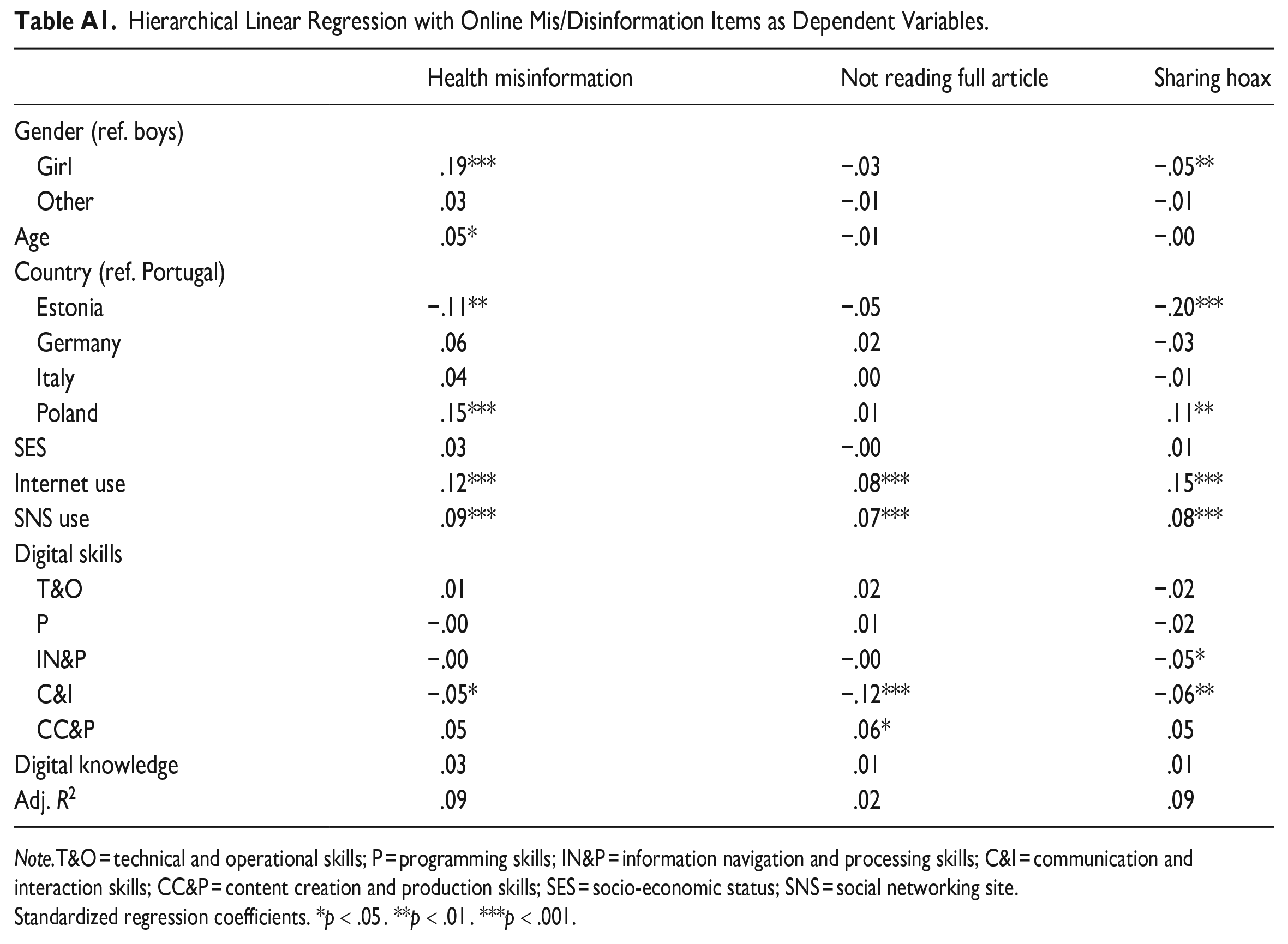
As the data were nested in schools and countries, multilevel modeling (MLM) seemed the most suitable analysis. But, because “nested datasets do not automatically require multilevel modeling. If there is no variation in response variable scores across level-2 units [. . .] the data can be analyzed using OLS multiple regression” (Peugh, 2010, p. 88), we tested whether MLM was required given the current data before proceeding with the analyses. To do so, the intraclass correlation coefficient (ICC), which indicates the proportion of variance in mis/disinformation risks that is attributable to school or country clustering (Hox et al., 2017; Peugh, 2010), was calculated based on the null model and using the method proposed by Davis and Scott (1995). On the school level, we found an ICC of 0.2%, on the country level the ICC was 3.5%, indicating that only a small proportion of variance in mis/disinformation risks was due to the clustering of respondents in schools or countries. In social science research using cross-sectional nested data, ICC values generally range from 5% to 20% (Muthén, 1991, 1994; Peugh, 2010). Given the low ICC values in this study, we concluded that MLM is not the most appropriate analysis to perform on this data. Following Peugh’s (2010) recommendation, we therefore performed linear OLS regression instead. In addition, OLS regression was chosen as an analysis method instead of structural equation modelling (SEM) due to the relatively simple model that was tested, while SEM is more adequate for testing more complex models consisting of multiple hypothesized paths and multiple independent and dependent variables. To strengthen our results, we also conducted three robustness checks. Each time, one of the three items that makes up the mis- and disinformation variable was used as dependent variable. These findings can be found in Table A1 in the Appendix, but yielded no significant differences from the main analyses.
Results
To start, we calculated the Pearson correlation between young people’s overall digital skill levels and online mis/disinformation risks. This correlation emerged as non-significant (r = 0, p = .83), suggesting that young people with higher digital skill levels do not necessarily experience more online mis/disinformation risks. However, when differentiating between the different types of digital skills, there seems to be a link—albeit a weak one—between certain types of skills and online mis/disinformation risks (see Table 2). Communication and interaction skills (r = −.04, p < .001) and content creation and production skills (r = .04, p < .001) are both significantly, but weakly, correlated with online mis/disinformation risks. Young people with higher communication and interaction skills may on average encounter fewer mis/disinformation risks, while young people with better content creation and production skills may encounter significantly more mis/disinformation risks. Concerning digital knowledge (r = .05, p < .001), young people who display a higher level of digital knowledge encounter more mis/disinformation risks, but this correlation was also weak.
Pearson Correlations between Digital Skills, Digital Knowledge, and Mis/Disinformation Risks.

Note. T&O = technical and operational skills; P = programming skills; IN&P = information navigation and processing skills; C&I = communication and interaction skills; CC&P = content creation and production skills; DK = digital knowledge; MDI = mis/disinformation risks.
p < .01. ***p < .001.
To test H1, which predicted that young people with higher digital skill levels would experience less harmful outcomes of online risks related to mis/disinformation, we conducted a hierarchical linear regression analysis with online mis/disinformation risks as the dependent variable, the control variables in Block 1 and the level of overall digital skills in Block 2 as independent variable. The findings from this regression analysis are presented in Table 3. While the bivariate correlation between overall digital skills and mis/disinformation risks did not return as significant, the regression analysis shows that, when controlling for gender, age, country, SES, internet use, and SNS use, overall digital skills were a significant negative predictor of young people’s online mis/disinformation risks (β = −.04, p < .05). This suggests that young people with higher levels of digital skills generally experienced fewer risks related to online mis/disinformation. It should, however, be noted that a regression coefficient of −.04 is weak and that digital skills explain little additional variance in mis/disinformation risks (Adj. R2 = .08, R2 Change = .001, p < .05). As our data did not show a positive link between overall digital skills and mis/disinformation risks, H1 was not supported.
Hierarchical Linear Regression with Mis/Disinformation Risks as the Dependent Variable and Overall Digital Skills as the Independent Variable.

Note. SES = socio-economic status; SNS = social networking site.
Standardized regression coefficients. *p < .05. **p < .01. ***p < .001.
To answer RQ1 and RQ2, which inquired about the roles of the five types of digital skills and digital knowledge as predictors of young people’s online mis/disinformation risks, an additional hierarchical linear regression analysis was conducted with mis/disinformation risks as the dependent variable, the control variables in Block 1, the five types of digital skills in Block 2, and digital knowledge in Block 3. The findings are displayed in Table 4. From the regression model emerged that together, the five types of digital skills added a significant proportion of explained variance in mis/disinformation risks (Adj. R2 = .08, R2 Change = .01, p < .001). However, only content creation and production skills (β = .06, p < .05) and communication and interaction skills (β = −.11, p < .001) emerged as significant predictors of young people’s online mis/disinformation risks. In other words, young people experienced more mis/disinformation risks when reporting lower levels of communication and interaction skills, and higher content creation and production skills. The three remaining skill types—technical and operational skills, information navigation and processing skills, and programming skills—were not significantly linked to mis/disinformation risks. It should, however, be noted that the significant associations were again rather weak and that the proportion of added variance by the five skill types together (Adj. R2 = .08, R2 Change = .01, p < .001) is small.
Hierarchical Linear Regression with Online Mis/Disinformation Risks as Dependent Variable, a Differentiation between Different Types of Digital Skills, and Digital Knowledge.
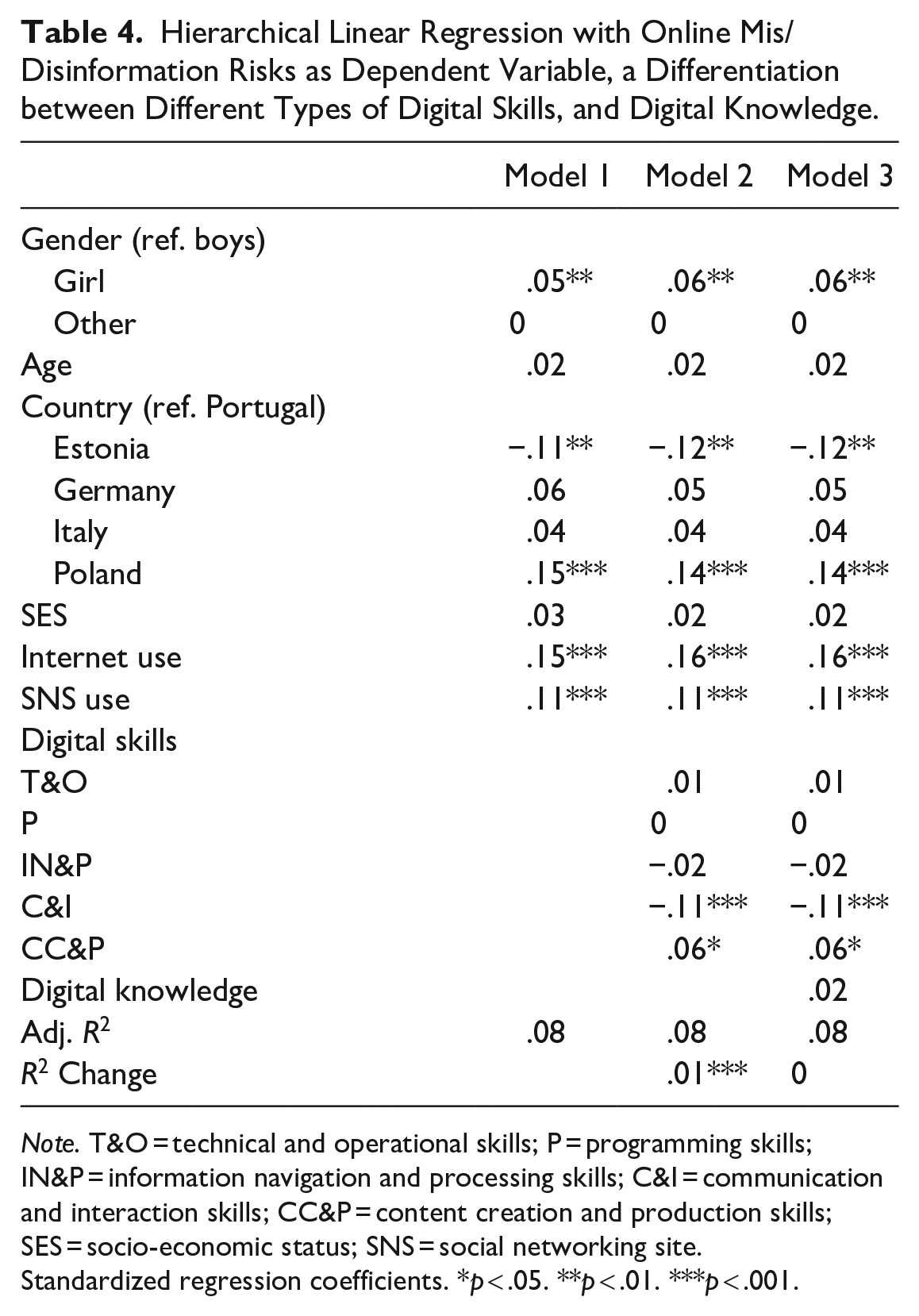
Note. T&O = technical and operational skills; P = programming skills; IN&P = information navigation and processing skills; C&I = communication and interaction skills; CC&P = content creation and production skills; SES = socio-economic status; SNS = social networking site.
Standardized regression coefficients. *p < .05. **p < .01. ***p < .001.
Regarding the link between digital knowledge and mis/disinformation risks, the regression model shows that digital knowledge did not significantly explain an additional proportion of variance in mis/disinformation risks (Adj. R2 = .08, R2 Change = 0, p = .28), and hence did not emerge as a significant predictor of mis/disinformation risks (β = .02, p = .28). Young people with higher levels of digital knowledge do not experience significantly more or less online risks related to mis/disinformation than young people with lower digital knowledge.
Based on Table 4, we can conclude that factors relating to internet and social media use are more strongly linked to mis/disinformation risks than the digital skills dimensions and digital knowledge. Taking into account previous studies that found that time spent online is an important factor in the link between digital skills and online risk experiences (e.g., Livingstone et al., 2017; Livingstone & Helsper, 2010), a follow-up mediation analysis on the role of internet use and SNS use was performed (Table 5). These analyses show that for overall digital skills, for all skill dimensions except for programming skills, and for digital knowledge, internet use and SNS use are indeed mediators in the link between digital skills or digital knowledge and mis/disinformation risks. More specifically, digital skills (except for programming skills) and digital knowledge are positively linked to internet use and SNS use, which in turn positively predict mis/disinformation risks. Young people with higher levels of digital skills indeed report higher levels of internet and SNS use, and this increased time spent online and on social media platforms is a significant predictor of increased exposure to mis/disinformation and potential harmful outcomes. It should, however, be noted that the indirect effect sizes are small and the 95% confidence intervals are closely bordering the significance threshold, indicating that other factors beyond the scope of this study may be at play.
Mediation Analysis of internet Use and SNS Use in the Association between Digital Skills/Digital Knowledge and Mis/Disinformation Risks.

Note. Indirect effect sizes (95% confidence intervals). T&O = technical and operational skills; P = programming skills; IN&P = information navigation and processing skills; C&I = communication and interaction skills; CC&P = content creation and production skills; SNS = social networking site. Controlled for age, gender, and SES.
Discussion
As exposure to mis/disinformation online and on social media can entail different negative outcomes on both the individual and societal level, experts have proposed that digital skills and digital knowledge may be valuable to protect individuals against these risks and particularly against their potential negative real-world, harmful consequences (ERGA, 2021; European Commission, 2018c). Yet, empirical evidence about the value of digital skills and digital knowledge for the youth population remains scarce. Therefore, based on a large-scale survey in five European countries, this study aimed to determine whether and to what extent digital skills and digital knowledge are linked to young people’s online mis/disinformation risk experiences and potential harmful outcomes of these experiences, and hence answer the question whether stimulating such skills would contribute to diminishing their risk of being misled by false information on the internet and on social media.
Based on earlier studies on the link between digital skills and online risks, which repeatedly found that more skills are generally linked to more risks but less harmful outcomes (Cabello-Hutt et al., 2018; Haddon et al., 2020; Rodríguez-de-dios et al., 2018; Sevcikova et al., 2014; Teimouri et al., 2018), we hypothesized that higher digital skill levels would protect young people against potential harmful outcomes of exposure to online mis/disinformation. Our findings show, that digital skills in general were negatively linked to these mis/disinformation risks, albeit rather weakly, indicating that young people with higher digital skill levels in general experienced less online risks relating to mis/disinformation. This finding corroborates earlier research stating that although digital skills are linked to more risk experiences, they protect against potential harmful outcomes (Haddon et al., 2020; Mascheroni et al., 2020).
However, when we differentiated between the five digital skills dimensions proposed by Helsper et al. (2020), the findings looked slightly different. Only communication and interaction skills, and content creation and production skills emerged as significant predictors of young people’s online risk experiences relating to mis/disinformation. Content creation and production skills were positively (but weakly) linked with more mis/disinformation risks, which corroborates earlier findings that higher digital skills levels are linked to more online risk experiences (Cabello-Hutt et al., 2018; Haddon et al., 2020; Rodríguez-de-dios et al., 2018; Sevcikova et al., 2014; Teimouri et al., 2018).
Based on our findings, it seems that especially communication and interaction skills could be valuable in protecting young people from these risks. This finding is again not in line with the online risk literature that suggests that more skills lead to more risk (Cabello-Hutt et al., 2018; Haddon et al., 2020; Rodríguez-de-dios et al., 2018; Sevcikova et al., 2014; Teimouri et al., 2018). However, given that social media are the platforms where mis/disinformation flourish (Bradshaw & Howard, 2019; Wang et al., 2019), the nature of these communication platforms may provide a potential explanation for this finding. As social media are the main sources of news for young people, news is now shared between actors in a space that is inevitably communicative and relational, and this social element has become one of the central characteristics of young people’s news use today (Marchi, 2012; Tamboer et al., 2022). While this social component of news use can hold various valuable implications in terms of an informed citizenship and online engagement (Ekström & Shehata, 2018), it also makes users more vulnerable to believing information that is incorrect because it was shared by a trusted individual (Marwick, 2018). Communication and interaction skills may reduce young people’s risk of being misled by and engaging themselves in the sharing of mis/disinformation thanks to a better understanding of the mechanisms of social media and an increased awareness of the potential negative consequences of this overlapping between news and information and social relationships. In addition, it may be the case that being better at communicating with friends, peers, and others online could serve as a valuable safeguard against risks relating to online mis/disinformation: previous research has shown that seeking social support and communicating with others after a negative online experience is an effective coping strategy (Vandoninck & d’Haenens, 2015; Vandoninck et al., 2013). It is indeed possible that effective online communication with friends and significant others allows young people to collectively debunk online information that is incorrect, for instance, in private group chats or publicly on their social media timelines or profiles. For example, research by Vraga et al. (2020) demonstrates that young people tend to be more influenced by corrections from people they know or who are in their social networks. This finding is quite interesting, as social media use itself predicted more mis/disinformation risks according to our findings, but these platforms could at the same time also serve as a valuable means for young people to use their communication and interaction skills to cope with mis/disinformation risks through communication and social support. In any case, more research is needed to unravel the links between young people’s communication and interaction skills, their online communication practices relating to online mis/disinformation, and their online risk experiences relating to mis/disinformation.
While we initially found a weak positive correlation between digital knowledge and mis/disinformation risks, suggesting that better knowledge was linked to more mis/disinformation risks, this association did not emerge from the regression analyses when digital knowledge was included in the model on top of the digital skills dimensions. Based on this finding, it seems that promoting digital skills, especially communication and interaction skills, among young people may be more effective in limiting their risk experiences relating to mis/disinformation than improving their digital knowledge alone.
It should be noted that the associations that emerged from our analyses are rather weak, and that the fact that some of them emerged as significant is probably due to the large sample size in this study and the low average scores on mis/disinformation risks. It is also possible that associations between digital skills or digital knowledge and young people’s mis/disinformation risk experiences are canceling each other out due to opposing regression coefficients for different profiles of young people based on their internet use. As noted by Haddon et al. (2020) and Mascheroni et al. (2020), various factors relating to personal characteristics, the social context, and the ICT environment are antecedents of young people’s internet uses and their digital skills. The association between digital skills and digital knowledge and online risks relating to mis/disinformation may look different based on these antecedents, which may also be mediators in this relationship, and opposing forces may be canceling each other out, resulting in weak regression coefficients. Informed by the literature that digital skills lead to increased risk exposure due to higher levels of internet use (Livingstone et al., 2017; Livingstone & Helsper, 2010), a follow-up mediation analysis on the role of internet and SNS use in the association between digital skills/digital knowledge and mis/disinformation risks was performed. While both internet and SNS use emerged as significant mediators of these associations, the indirect effect sizes were weak, again suggesting that other factors beyond the scope of this study may be at play. Future research on young people’s digital skills could take factors relating to personal and social characteristics into account by making a distinction between different profiles of internet use, such as heavy users versus those that use the internet and social media not so frequently, or those that predominantly engage in entertainment opportunities versus those that mainly use the internet and social media for communication purposes. In addition, it is possible that factors such as digital skills and digital literacy do not play as big of a role as previously expected in protecting young people against mis/disinformation risks and potential harmful outcomes. It is therefore important that future research takes on a broader, more holistic view of young people as internet and social media users by taking into account other background factors such as personal, social, and cultural characteristics that could be relevant for their internet uses and risk experiences.
Three limitations of the study should be addressed. First, this research is based on cross-sectional data. Even though we defined predictors and dependent variables in the regression model, we cannot draw causal conclusions based on our findings. Future research should use longitudinal or experimental methods to test the causality of the associations proposed in this study. Second, the measures of digital skills and digital knowledge are based on self-reports. It is therefore possible that the scores on digital skills and digital knowledge do not accurately reflect reality, as respondents may have over- or underestimated their skills or knowledge. Instead of self-reports, future research could use performance testing of digital skills instead to avoid potential biases in the digital skills measurement. Third, the data collection took place during the COVID-19 pandemic, and this has severely complicated the data collection, resulting in a mix of physical, hybrid, and virtual data collection activities. It is therefore possible that these circumstances have affected the quality of the data.
Despite the inherent limitations of this study, its findings contribute significantly to the existing literature exploring the relationship between young people’s digital skills, digital knowledge, and their experiences of online risk. While previous research has examined this link in the context of risks such as cyberbullying, sexting, or exposure to harmful content, the understanding of how digital skills and digital knowledge act as potential buffers against risks related to online mis/disinformation has remained scarce. Therefore, this study fills an important gap in the knowledge.
Based on our findings, we conclude that it is important that research differentiates between the different skill dimensions when examining their association with online risks. Furthermore, considering the weak regression coefficients observed, we recommend that future studies examine the link between digital skills and mis/disinformation risks among different profiles of young internet users, for instance, based on their frequency of internet use or the types of opportunities they take up the most. Based on our finding that communication and interaction skills are linked to less risks relating to online mis/disinformation, we advise that media and digital literacy practitioners, teachers, parents, and other relevant stakeholders in young people’s networks who seek to stimulate their resilience to mis/disinformation prioritize communication and interaction skills. Encouraging young people to consult with people they know and trust when confronted with online risks can enhance their ability to effectively deal with mis/disinformation. Therefore, investments in media and information literacy programs are recommended, and continuous support for an independent, pluralistic media ecosystem is crucial.
Footnotes
Appendix
Hierarchical Linear Regression with Online Mis/Disinformation Items as Dependent Variables.
| Health misinformation | Not reading full article | Sharing hoax | |
|---|---|---|---|
| Gender (ref. boys) | |||
| Girl | .19*** | −.03 | −.05** |
| Other | .03 | −.01 | −.01 |
| Age | .05* | −.01 | −.00 |
| Country (ref. Portugal) | |||
| Estonia | −.11** | −.05 | −.20*** |
| Germany | .06 | .02 | −.03 |
| Italy | .04 | .00 | −.01 |
| Poland | .15*** | .01 | .11** |
| SES | .03 | −.00 | .01 |
| Internet use | .12*** | .08*** | .15*** |
| SNS use | .09*** | .07*** | .08*** |
| Digital skills | |||
| T&O | .01 | .02 | −.02 |
| P | −.00 | .01 | −.02 |
| IN&P | −.00 | −.00 | −.05* |
| C&I | −.05* | −.12*** | −.06** |
| CC&P | .05 | .06* | .05 |
| Digital knowledge | .03 | .01 | .01 |
| Adj. R2 | .09 | .02 | .09 |
Note.T&O = technical and operational skills; P = programming skills; IN&P = information navigation and processing skills; C&I = communication and interaction skills; CC&P = content creation and production skills; SES = socio-economic status; SNS = social networking site.
Standardized regression coefficients. *p < .05 . **p < .01 . ***p < .001.
Declaration of Conflicting Interests
The author(s) declared no potential conflicts of interest with respect to the research, authorship, and/or publication of this article.
Funding
The author(s) disclosed receipt of the following financial support for the research, authorship, and/or publication of this article: European Commission > Horizon 2020 Framework Programme 870612.
