



Abstract
Research and policy have invested in the prospect that gaining digital skills enhances children’s and young people’s outcomes. A systematic evidence review of research on digital skills among 12- to 17-year-olds identified 34 studies that used cross-sectional survey methods to examine the association of digital skills with tangible outcomes. Two-thirds concerned the association with online opportunities or other benefits. Another third examined online risks of harm. Findings showed a positive association between digital skills and online opportunities, information benefits, and orientation to technology. Greater digital skills were indirectly linked to greater exposure to online risks, although any link to harm was unclear. While technical skills were linked with mixed or even negative outcomes, information skills were linked with positive outcomes. There was little research on the outcomes of communication or creative digital skills. Future research should examine the dimensions of digital skills separately and encompass a wider range of outcomes.
Keywords
Introduction
The United Nations (UN) agency responsible for global measurement of the adoption of information and communication technologies (ICTs), the International Telecommunication Union (ITU), defines digital skills for the global population in terms of their putative outcomes: ‘the ability to use ICTs in ways that help individuals to achieve beneficial, high-quality outcomes in everyday life for themselves and others’ and that ‘reduce potential harm associated with more negative aspects of digital engagement’ (ITU, 2018: 23). In this, it serves the multiple and diverse interests of its members (most countries and many public and private sector stakeholders) who seek to thrive and compete in the digital age, including delivering the UN’s Sustainable Development Goals (SDGs). Reflecting this emphasis, the European policy agenda regarding the adult population is strongly outcomes focused (European Commission, 2016; Grizzle et al., 2013; Helsper, 2021; Morandini et al., 2020; Van Dijk and Van Deursen, 2014; Vuorikari et al., 2016), but policies around the world vary. Accordingly, researchers are examining whether and how gaining digital skills can help implement e-government initiatives, reskill workers for a changing labour market, promote domestic adoption of digital consumer goods and services and, most recently, support citizens in locating and evaluating trustworthy information (political, health and financial).
At the same time, many hopes are pinned on children and young people as a generation supposedly keen to learn about all things digital, as well as in need of digital skills to succeed in the ‘jobs of the future’ (European Commission, 2021b; Kiss, 2017; Organisation for Economic Co-operation and Development [OECD], 2018). Conveniently, they are also easier to reach with educational interventions than the general population (Cortesi et al., 2020), facilitating gains in digital skills, benefitting real-world outcomes and providing the means to target digital skills interventions on disadvantaged populations. Attention to young people adds some specific questions to the digital skills agenda – encompassing their particular motivations (such as to pursue creative or communicative opportunities; see Vaikutytė-Paškauskė et al., 2018), or the mediating role of parents and schools in the development of resilience to online risks of harm (O’Neill, 2013).
However, notwithstanding governmental and other efforts to embed digital skills and literacies in the school curriculum and promote digital learning at home, it is hard to locate clear expectations or an established evidence base that links children’s digital skills with outcomes (Livingstone et al., 2018) or evaluates whether expectations are met (Bulger and Davison, 2018). Although rarely specified in detail, the outcomes of gaining digital skills are most commonly discussed in relation to anticipated educational or employment-related benefits, as well as online safety, digital citizenship, ‘21st-century skills’ or ‘life skills’ (Buckingham, 2015; Davies and Eynon, 2018; Livingstone et al., 2019; Nascimbeni and Vosloo, 2019; Third et al., 2019; Van Laar et al., 2017).
Theory development is more advanced when it comes to the general population, with a notable focus of attention on the specific and tangible outcomes of gaining digital skills (Helsper et al., 2015; Van Deursen and Helsper, 2018). Conceptualized as the ‘third-level digital divide’, researchers propose that digital inequalities involve more than a binary opposition between those who do or those who do not have access to the Internet (the ‘first-level digital divide’), and also more than the promotion of digital skills (the ‘second-level digital divide’; see Hargittai, 2002). Indeed, promoting access and skills without attention to outcomes can reproduce social inequality and exacerbate prior exclusion (Van Deursen and Van Dijk, 2014). Specifically, whether concerning education, work, health or other areas, what matters is that individuals have the resources to deploy digital skills in ways that bring about tangible outcomes that benefit them (Van Deursen and Helsper, 2018).
By contrast with adults, where the starting point is assumed to be digital ignorance, children and young people are often assumed to be ‘digital natives’, a problematic implication being that young people will ‘pick up’ the digital skills they need spontaneously, without the need for resource-intensive interventions. Researchers had to dismantle this myth by showing that not only might young people lack valuable skills, but also that they may struggle to translate these into tangible outcomes, especially in situations of socioeconomic disadvantage (Helsper and Eynon, 2010). Problematically for those promoting the digital skills agenda, research also found that the more children engage in online activities, gaining digital skills and enjoying the opportunities to benefit, the more they are likely to encounter some risk of harm (Helsper and Smahel, 2020; Livingstone et al., 2017). This raises the pressing question of whether digital skills can play a role in optimizing beneficial outcomes while minimizing rather than amplifying harmful ones (Livingstone et al., 2018).
A recently completed systematic evidence review identified the predictors and outcomes of digital skills among 12- to 17-year-olds (Haddon et al., 2020). This age group was selected due to its key relevance to digital skills curriculum development (European Commission, 2021a; Polizzi, 2020) and to inform forthcoming longitudinal research on children’s digital skills in Europe (Haddon et al., 2020). The evidence review revealed a plethora of approaches to the conception and measurement of digital skills, with some researchers conceiving of multiple dimensions of digital skills while others focused on particular dimensions, such as information literacy or computer programming. Adding to the complexity, these dimensions are inconsistently labelled, mixing digital activities (where the underlying skills are implicit but not measured, as in ‘I do X online’), digital self-efficacy (typically measured as claimed confidence, as in ‘I am good at X online’) and digital skills (typically measured as the self-reported ability to undertake specified digital tasks, as in ‘I know how to do X online’; see Helsper et al., 2021).
This article builds on the systematic evidence review to identify clearly the range of outcomes from gaining digital skills, and to explore the nature of the relationship between digital skills and outcomes. After screening out studies where the definition of digital skills was unclear or inconsistent, we added a new step by coding the dimensions of digital skills measured in each study to discover whether these dimensions are differently linked to particular outcomes. We used the four-dimension classification of digital skills identified in a recent analysis of the wide array of different measures commonly used within the youth literature (Helsper et al., 2021; Van Dijk and Van Deursen, 2014). Distinguished through analyses of skewness and kurtosis, confirmatory factor analysis, difficulty estimation and equivalence testing, and validated through cognitive interviews and pilot surveys, the four dimensions are defined in Table 1. Each dimension encompasses functional subskills and digital knowledge (or critical literacy), and all are important for wellbeing in a digital society (Helsper et al., 2021; Mascheroni et al., 2020). They can also be combined to generate more complex skills – for instance, the skills required for problem-solving online, or to protect one’s privacy or safety online, participate in civic activities or cope with harmful experiences.
The four dimensions of digital skills.
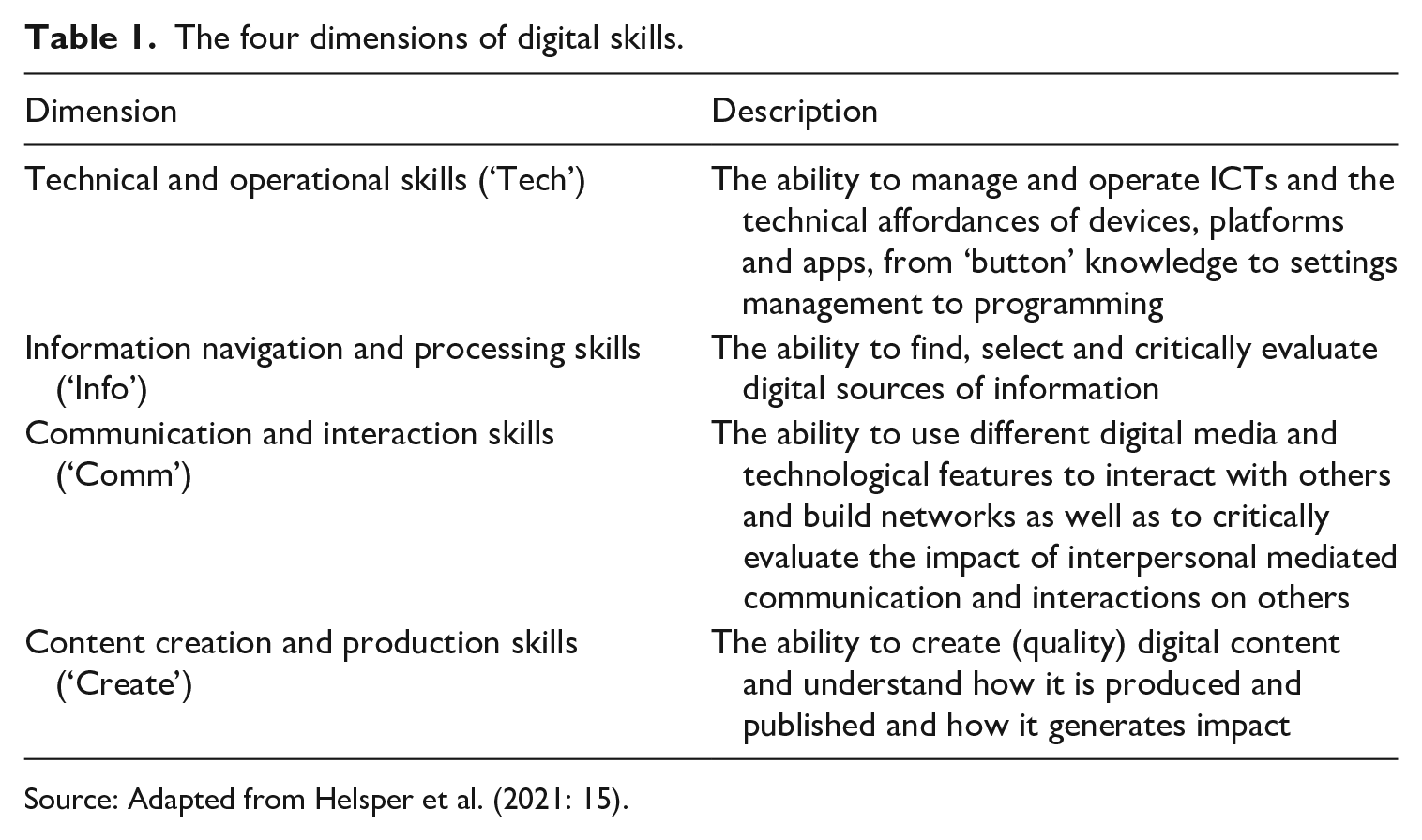
Source: Adapted from Helsper et al. (2021: 15).
We formulated the following three research questions of significance for research and for policy and practice:
RQ1. What are the outcomes of young people’s digital skills?
RQ2. Can the different dimensions of digital skills be linked to distinct outcomes?
RQ3. How does the research literature explain the outcomes of digital skills?
Methods
We conducted a systematic evidence review (Gough et al., 2012; Grant and Booth, 2009; Sutherland, 2004) following the Preferred Reporting Items for Systematic Review and Meta-Analysis Protocol (PRISMA-P) guidelines (Moher et al., 2015). The search protocol was registered on (repository and registration number anonymized) and designed to be comprehensive in its coverage of relevant databases and search terms, consistent in its application of the same search word strings across databases, and efficient in minimizing the number of irrelevant results.
The search involved two international research database aggregators, Web of Science and Scopus, supplemented with six specialized databases: International Bibliography of the Social Sciences, Communication and Mass Media Complete, ERIC, PsychINFO, Embase and SocINDEX. It was applied based on titles, keywords and abstracts to English language publications in the decade from January 2010 to January 2020 (when the search process began).
Four groups of search terms were selected, drawing on consultation with relevant experts and test searches of several databases: (1) child terms (to identify research with children and young people); (2) method terms (to identify empirical studies); (3) technology terms (to ensure relevance to the digital environment); and (4) skill terms (to match the focus of the review). Groups 3 and 4 were searched jointly using all possible combinations (e.g. ‘digital* skill*’, ‘mobile* competen*’, etc.; for a detailed description of the methodology, see Haddon et al., 2020). The final search string took the form: child terms AND methods terms AND a digital skill phrase (digital term + skill term).
The initial 4811 search results (shown as N0 in Figure 1) were screened for duplicates, non-English sources and non-peer-reviewed publications, leaving 2640 studies to be screened for eligibility (N1). Screening for eligibility was based on the article title, abstract and keywords according to four criteria applied in the following order: (1) studies of children’s digital skills, (2) using quantitative methods, (3) with children aged 12–17, and (4) sufficient methodological rigour (e.g. small sample surveys or pilot studies were excluded). This left 351 studies to be read in full, of which full text was available for 301 (N2). A further 99 did not meet the above four criteria based on reading the full text.
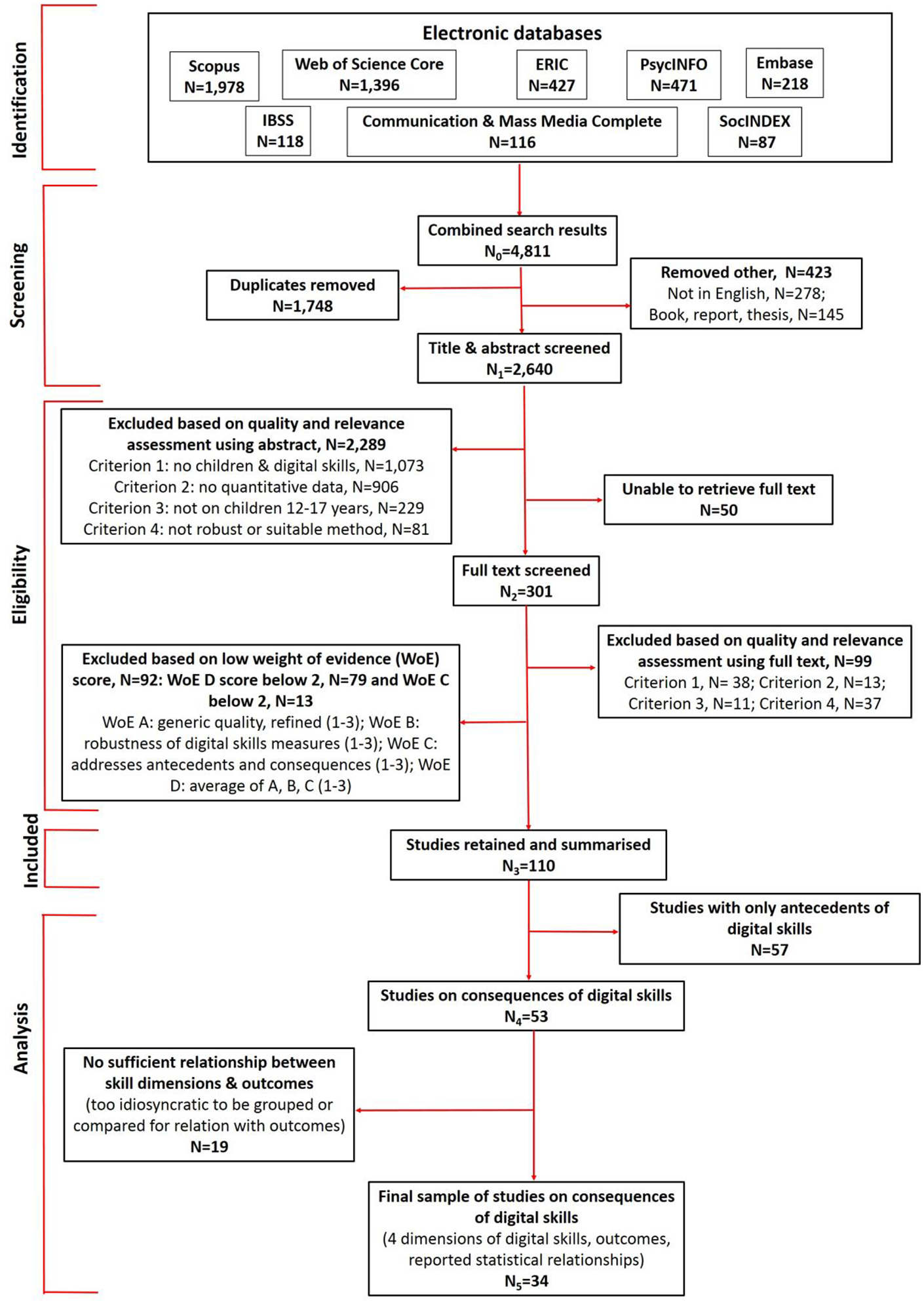
Flow diagram of the screening and quality appraisal process.
The remaining 202 studies were evaluated using a weight of evidence (WoE) framework. This assessed the following:
(a) Quality of the research methods: a global assessment based on such features as controls for confounding associations, randomized representative sampling, longitudinal designs, approach to testing hypotheses and whether reporting distinguishes children from adults or by age group.
(b) Capacity to answer the review question: whether the definition of digital skills distinguished among dimensions (e.g. information, social, technical) and whether each was measured with reliability and validity; whether there is a model which explains how the dimensions fit together.
(c) Relevance for the review question: this was operationalized in relation to how the study specifically generated evidence on the predictors or outcomes of digital skills.
Each study was given a score of 1 = poor, 2 = fair and 3 = good for criteria a, b and c, and then assigned an average score (D) between 1 and 3. This resulted in 92 exclusions (average WoE score below 2), leaving 110 (N3) empirical studies to be coded for evidence regarding the predictors and outcomes of skills.
Of the 110 studies, 53 (N4) included the outcomes of having digital skills (the remainder concerned predictors of digital skills only and are not considered here). These studies were coded according to the dimensions of digital skills measured (technical, information, communication and creation skills) and their relationships with outcome measures. Those studies that did not include clear information about the relation between skills and outcomes were excluded. So, too, were studies that, while they described themselves as concerning digital skills, used a global self-efficacy measure (e.g. Yu et al., 2018), inferred digital skills from a measure of online behaviour (e.g. Khan et al., 2014) or other measures (e.g. treating attending lessons on digital media as a proxy for skills; see Kahne and Bowyer, 2019). Also excluded was one study where the country and not the individual was the level of analysis (Picatoste et al., 2018). This left 34 studies for analysis (N5). These 34 studies were relevant and of high quality, with WoE scores between 2 and 3: 2 (n = 6); 2.33 (n = 9); 2.66 (n = 12) and 3 (n = 8; see Table 2).
The 34 studies on outcomes of youth digital skills.

WoE: weight of evidence.
All studies used self-reported digital skills measures; some also used performance tests.
Note that all 34 studies were based on surveys, although three also included performance (or task-based assessment) tests. This has two consequences. First, digital skills tend to be measured using self-report. Just three studies used performance tests (see Table 2). Social desirability biases can be addressed in part by question phrasing (Helsper et al., 2021 v). It was for this reason that we paid particular attention to the measures used, selecting only the more robust (as explained earlier). Beyond this, we can only observe the preference of researchers in this field for self-report measures over performance tests. Haddon et al. (2020) observe that this is particularly the case in researching outcomes rather than predictors of digital skills, adding that where both methods are used, the results tend to concur except in relation to gender (where boys claim more skills in self-report surveys).
Second, although our focus is on the outcomes of digital skills, with the studies selected based on their authors’ positioning the measured factors as outcomes, caution is required as they do not actually test causal relationships. Rather, all used a cross-sectional research design, reporting correlations that could potentially be interpreted as bidirectional or reversed, or according to plausible but generally untested confounding factors. In what follows, we first examine the associations between measures of digital skills and their claimed outcomes. In interpreting the findings, we paid attention throughout to the specific age groups studied, and the country in which data were collected (shown in Table 2). We could not, however, discern any systematic relationships that might confound the results reported below. We again attend to demographic and other variables when we examine more closely the studies that constructed statistical models from predictors to outcomes, to see whether multivariate analysis can offer further nuance to the understanding of how digital skills relates to outcomes.
Results and discussion
The outcomes of digital skills for children and young people
In answer to RQ1, approximately two-thirds of the studies examined the association between digital skills and online opportunities and other benefits, while another third examined online risks of harm. The results summarized in Table 3 are discussed below.
Types of outcomes of digital skills.
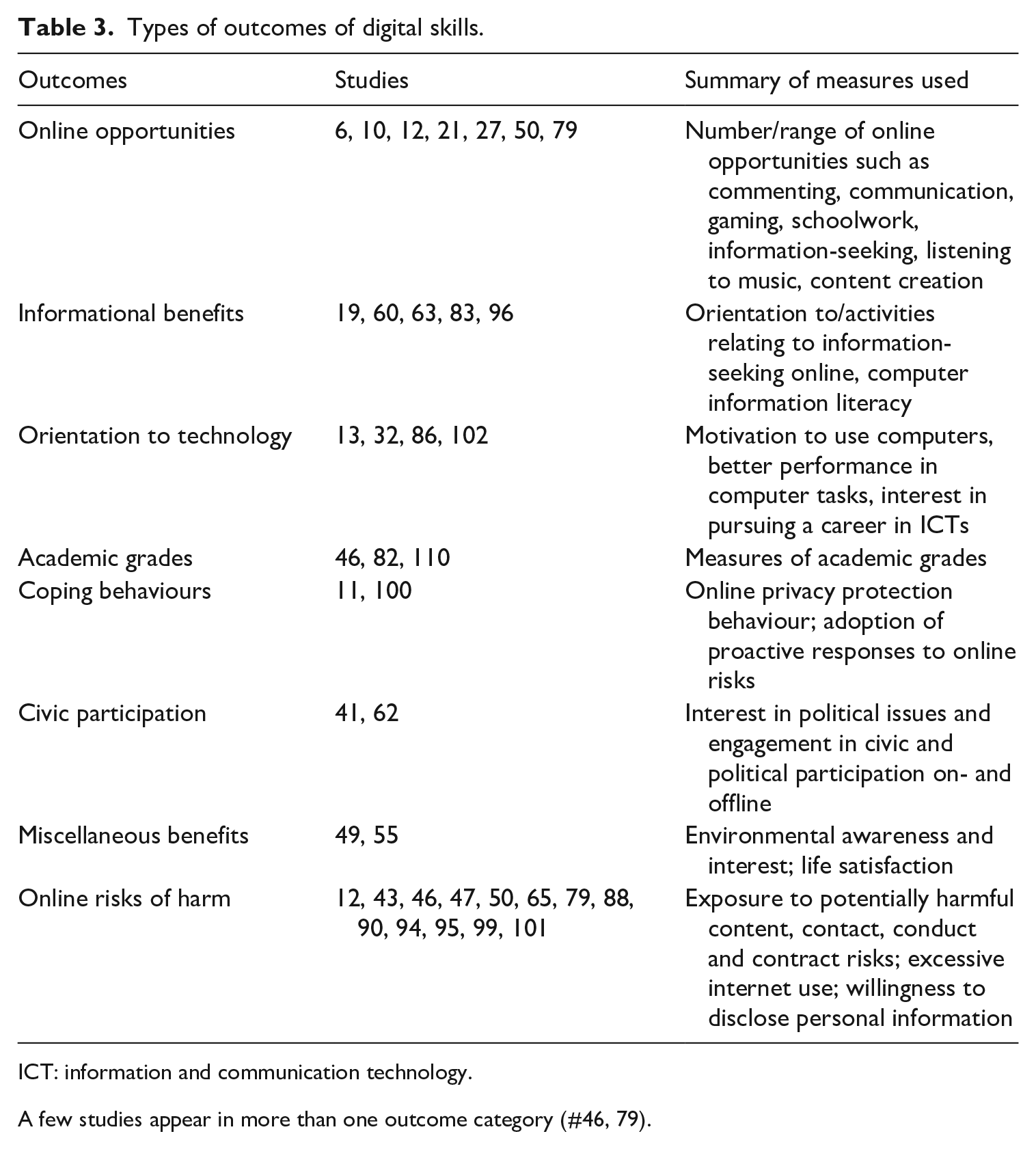
ICT: information and communication technology.
A few studies appear in more than one outcome category (#46, 79).
Online opportunities
The breadth of digital activities is considered an important measure of digital and social inclusion. Some studies measured a broader set of activities (#12, #21, #27, #50, #79) while others took a more specific focus (#6 on social activities, #10 on creative activities). In all studies, the association with digital skills was positive: greater digital skills are associated with more online activities. Since these studies include a diversity of different measures of both skills and opportunities, the absence of null or contradictory findings suggests a consistent and robust result. The evidence offers empirical support for the promotion of digital skills by policy programmes, education curricula and parental investment, all aiming to provide children and young people with the digital skills that support diverse forms of digital engagement, bringing direct benefits and encouraging the development of additional digital and life skills. Previous research has hypothesized that online activities are ranked in terms of accessibility and appeal, such that children first gain basic skills by beginning with everyday activities (e.g. watching videos or playing games online). Then, as they gain skills, they progress up the so-called ladder of online opportunities towards more complex activities, such as creative content creation and civic participation (Livingstone et al., 2019). However, we found a little research examining which activities were mainly linked to gaining digital skills or the order in which they were undertaken.
Informational benefits
Particularly in relation to informational benefits, studies made discernible efforts to match the dimension of digital skill to relevant learning outcomes. For instance, study #19 found that children’s ability to seek information online predicted seeking online information for homework (although not for more everyday life purposes). In study #60, children with better Internet skills were found to think more often about information credibility and, possibly in consequence, more likely to believe that the information they find online is credible. Relatedly, study #96 found that having greater information and evaluation skills benefitted children’s academic performance. The authors also found that information skills are supported by operational information skills, suggesting a learning pathway from access through operational skills to information skills and thence to creativity and improved academic grades. Study #63 focused on seeking health information as an outcome, again finding a positive association with digital skills. Somewhat puzzlingly, since its methods included performance testing, study #83 found no relation between basic or advanced digital skills and a standard educational measure of ‘computer information literacy’.
Orientation to technology
While research has shown that young people with better access to ICTs at home or school, or with more positive attitudes towards ICTs, have greater digital skills (Haddon et al., 2020), fewer studies ask whether greater digital skills are linked to a more positive orientation to technology. Four studies (#13, #32, #86, #102) found that technology skills bring such benefits, albeit in ways that are differentiated by gender. Two of these studies measured digital skills using performance tests: study #13 found that greater digital skills are associated with interest and competence in using computers; study #32 found that ‘the likelihood of students choosing the ICT field increased significantly along with greater competence in both medium-related skills and programming skills’ (Kaarakainen, 2019: 120). In study #86, like most other studies based on a self-reported measure of digital skills, the association found between greater computer skills and ICT-related career aspirations is stronger for girls than boys. The authors suggest that gaining digital skills, including through educational interventions, can partially compensate for gendered socialization practices that tend to dissuade girls from such aspirations. Study #102, relatedly, shows how improving young women’s technical digital skills improves their chance of persisting in computer science and technology-related majors.
Academic grades
A primary rationale for educating children to improve their digital skills is to enhance their learning outcomes. Arguing that digital skills today are akin to reading, writing and arithmetic – the so-called fourth ‘R’ of basic literacy – schools increasingly include digital skills in the curriculum. Therefore, it is surprising that we identified only three studies that addressed the relation between digital skills and learning outcomes (#46, #82, #110). The results were equivocal. In studies #46 and #82, greater digital skills were associated with better academic grades, albeit varying by the dimension of digital skills (as discussed later). One study mainly found negative results, suggesting that greater programming skills can undermine children’s mathematical ability (#110) – here, the authors suggested that adverse outcomes arise when the skills are both time-consuming to learn and unrelated to the desired learning outcome.
Coping behaviours
Given the prevalence of online risks in children’s everyday experience, a few studies inquired into how children and young people cope with actual or potentially harmful experiences (Dodge et al., 2012). Digital skills were positively linked to coping behaviours online (such as privacy behaviour, deleting unwelcome messages, blocking senders – studies #11 and #100). For example, study #100 showed that more digitally literate children were more likely to delete messages and block senders when experiencing cyberbullying or unwelcome sexting. Moreover, children with fewer skills were more upset and less able to cope with sexual images and cyberbullying. Indications that skills can support better coping with risk surely merit further exploration.
Civic participation
Both the policy agenda and academic debate anticipate that Internet use facilitates youth participation in community, civic and political life (Cortesi et al., 2020), even countering young people’s declining political participation (Loader et al., 2016). Two studies (#41, #62) examined this relationship, and the results were complex. In study #41, ‘Internet information literacy’ was significantly and positively associated with measures of alternative participation (such as boycotts, rallies and joining online campaigns) and with political efficacy but was not associated with institutional participation (such as voting, civil complaints or visits to government websites). Furthermore, ‘Internet skills literacy’ measures were unrelated to participation and negatively related to political efficacy. Study #62 reported a positive relationship between digital skills and online civic engagement activities but mediated by interest in the news. Such findings hint at a promising direction for future research, namely, identifying factors (of digital or non-digital nature) mediating between digital skills and participation outcomes.
Miscellaneous benefits
Completing the picture for beneficial outcomes, we note that study #49 found a positive association between digital skills and environmental awareness in Singapore but not in Finland, and study #55 examined the relationship between digital skills and life satisfaction, finding none.
Online risks of harm
Children and young people’s exposure to potentially harmful online content, contact, conduct or contract risks attracts attention from researchers, policymakers and the public alike (Livingstone et al., 2018). Many call for digital skills education to build children’s resilience to mitigate online or offline vulnerability to risks of harm, as well as to encourage their coping behaviours, as discussed earlier. However, does gaining digital skills act as a protective factor, reducing experiences of harm? Thirteen studies addressed this question. As with online opportunities, a standard method is to count how many and how often children have encountered a wide range of different risks. Other studies tend to focus their attention on just one or a few risks.
Taking the former approach, studies #47, #79, #88, #95 and #99 reported a broadly positive association between digital skills and online risks, suggesting that greater digital skills are related to more online risks being encountered, with some qualifications (e.g. study #47, as discussed below). Study #43 also found a positive association, focusing on the perpetration of cyberbullying among secondary school students. In study #88, greater digital skills were linked to a greater willingness to disclose personal information than adopt more self-protective behaviour. The authors suggest that more digitally skilled young people explore more widely online, encountering opportunities that require information disclosure as well as more online risks. Furthermore, the main finding of a positive association between skills and risks may arise because, as discussed earlier, more skills are linked to more online opportunities (as discussed in studies #12 and #50), including risky opportunities (such as looking for new friends online, sending personal information or photos, adding ‘strangers’, pretending to be someone else; see Livingstone, 2008, 2013); as shown by studies #95 and #65.
Study #90 not only found a positive link between digital skills and online risks but also that children with more skills reported less harm after exposure to risks compared with less skilled children. However, this finding disappeared when statistical controls were applied, and the overall variance explained was low even with individual and country factors included in the statistical model. Study #94 pursued the theme of harm, finding that more digitally skilled young people experienced less distress (such as feeling frightened or depressed) after online victimization. The possibility that gaining digital skills might reduce harm while not restricting children’s online experiences needs further testing.
Two studies considered Internet ‘addiction’, with contradictory findings. Study #46 found a complex but broadly positive association, with particular outcomes (preoccupation, withdrawal, loss of control) correlated with particular dimensions of digital skills. Study #101 finds the reverse: greater digital skills reduced the negative consequences of excessive social media use. The authors suggest a link between digital skills and self-regulation in the digital environment, which seems worthy of further investigation.
The relationships between the dimensions of digital skills and outcomes
The outcomes of children’s and young people’s digital skills appear complex, encompassing both positive and negative relationships. While the public expectation is that gaining digital skills enables young people to minimize the risks and optimize the benefits of Internet use, facilitating overall wellbeing (Dienlin, 2020; Ryff, 1989), the evidence suggests that it results in both online opportunities and risks. Given the diversity of digital skills measures employed in the literature, RQ2 asked whether a more nuanced picture could emerge if we examined outcomes according to specific dimensions of digital skills.
This inquiry was impeded by the common practice of combining separate measures into a composite score before statistical analysis. In Table 4, the shaded studies were most useful because they examined either a single dimension of digital skills or the separate associations of multiple skills dimensions.
Outcomes of digital skills, by dimensions of digital skills measured.

ICT: information and communication technology.
Ten studies, including two that used performance tests (#13, #32), examined technical and operational (‘Tech’) skills separately from other skill dimensions. The results are mixed, with as many apparently undesirable as beneficial outcomes. Specifically, these skills were associated with a positive orientation to technology (#13, #32) and online opportunities (#27), but also more online risk (#46, #47). They were unrelated to life satisfaction (#55) or civic participation (#62), even showing a negative link to civic participation (#41), and either a positive (#46) or negative (#110) link to academic grades.
The seven studies examining the distinctive associations of information skills found them to be generally linked with beneficial outcomes. They were linked to more civic participation (#41), online opportunities (#27), higher academic grades (#46, #110) and more information-seeking for homework (although not everyday life information needs; #19); and to reduced online risk (#47) and more privacy-enhancing behaviour online (#11). Finally, they were unrelated to online addiction (#46).
While communication skills appear rarely to be examined separately, the evidence suggests positive outcomes – on online opportunities (especially social engagement; #27) and coping with online risks (#101), although there was no association on academic grades (#110). The results from the few studies of creative skills were mixed: positive associations on online opportunities (especially creative engagement; #47) but also increased online risk (#46, #47) and a null (#46) or negative (#110) association with academic grades.
It is harder to conclude from the studies that construct a composite skill measure, as we cannot know if the different skill dimensions work additively or interact somehow. Two studies grouped information, communication and creative skills into a single measure, finding a positive relationship with civic participation (#62) and no relation to orientation to technology (#32). All other measured combinations included technical skills together with one or more of the others. This decision appears unwise given the mixed profile of outcomes linked to technical skills.
Eight studies combined technical and information skills, finding both a positive association with online opportunities (#12, #21, #50, #63), information benefits (#62) and academic grades (#82), as well as greater online risk (#12, #65, #88). A more consistent and positive pattern is observed from the combination of technical, information and either communication or creative skills – with positive links to online opportunities (#6, #10, #79), information benefits (#83) and civic participation (#62). However, study #79 also shows a link with online risk (possibly for reasons noted earlier).
By contrast, technical skills combined with communication or creative but not information skills have more mixed outcomes. Five studies combined technical and communication skills, finding more online risks (#90, #95) yet less harm associated with risk (#90, #94), better coping with online risk (#100) and information benefits (#96). We cannot be sure, but it is noteworthy that, when tested separately, communication but not technical skills are linked to coping with online risk. Finally, four studies suggested that the combination of technical and creative skills is linked to both a positive orientation to technology (#86, #102) and to more online risk (#99, #43).
Explaining the outcomes of digital skills
Eleven studies tested specific pathways from the predictors of digital skills to their outcomes, using statistical models that vary in complexity, while all relying on cross-sectional survey research methods (see Table 5). The predictors variously include personal attributes (age, gender and personality); social context (socioeconomic status [SES], parental education, parental mediation, teacher or peer support); and ICT environment (diversity of connectivity, availability at home, age of first Internet use). These are usually linked to one or two outcomes, with digital skills positioned in the models as a predictor, mediator or outcome, depending on the authors’ approach. Age, SES, parental education, parental mediation and ICT availability at home are generally strongly associated with digital skills.
Models (ordered by outcomes).
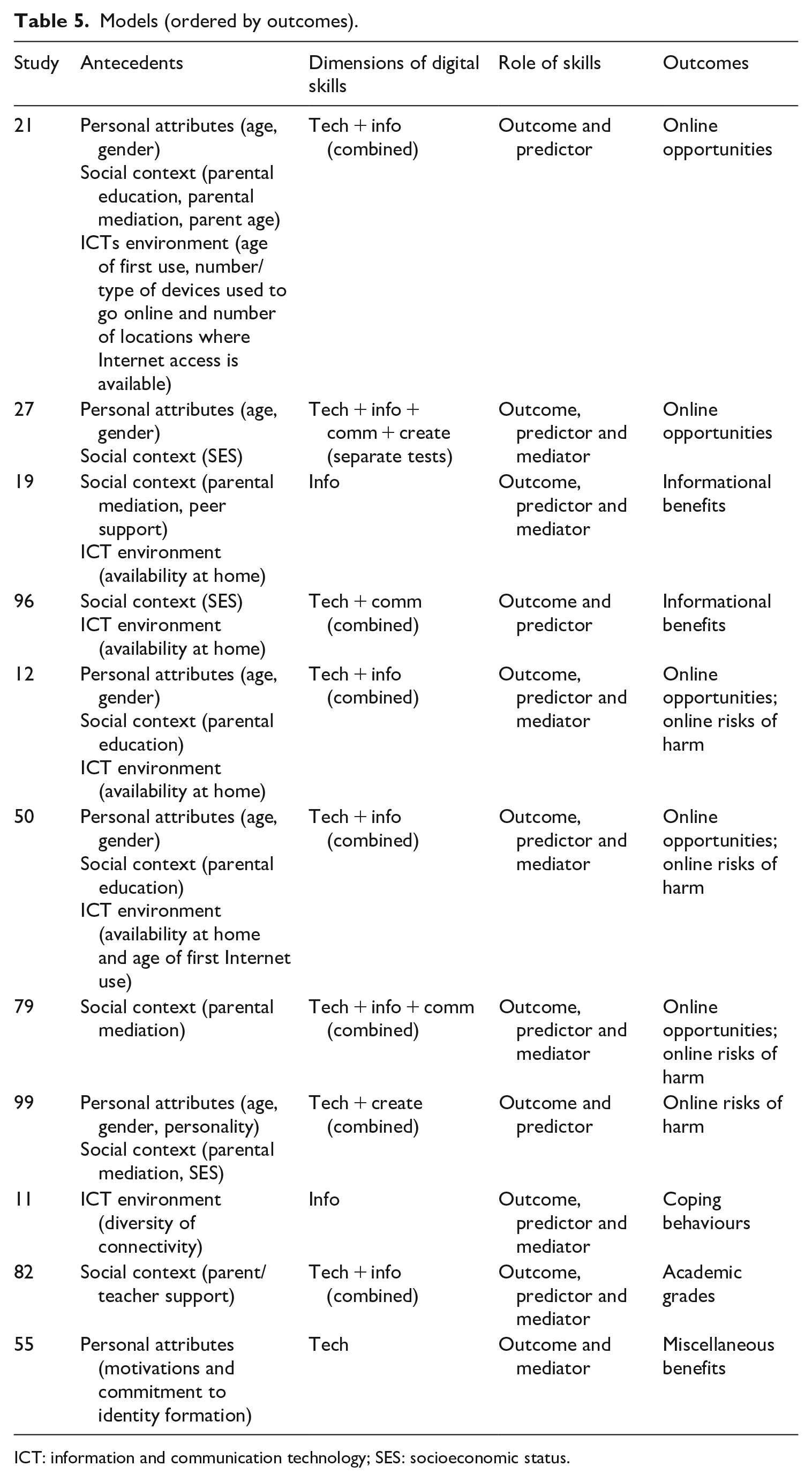
ICT: information and communication technology; SES: socioeconomic status.
Model building reveals important interrelations that studies reliant on univariate statistical analysis can miss (RQ3). For instance, several studies found that age, gender and SES are associated with children’s digital skills and then show how these factors explain online opportunities (#12, #21, #27, #50). Specifically, boys, and those who are older or more advantaged, report greater digital skills and enjoy better online opportunities. While demographic factors themselves offer little prospect of change, they can help target interventions, aiming digital skills education at younger girls and those from economically disadvantaged backgrounds to help compensate for entrenched digital inequalities (Helsper, 2021).
Studies that measure the differential influence of separate dimensions of digital skills on online opportunities (#27, #96) suggest further nuance, with possible relevance for educators teaching digital skills. For example, study #96, which operationalizes digital skills as a progression from basic operational skills to more advanced skills, shows that the role of operational skills and academic outcomes is both direct and indirect (mediated by advanced digital skills). Study #27 reveals variations in how digital skills mediate the influence of sociodemographic factors on different online opportunities, depending on the dimension of digital skills and the type of opportunities examined.
Also promising for policymakers and practitioners are findings that point to malleable predictors of digital skills. Study #79 showed that parental mediation engenders better skills and, thereby, more online opportunities, while study #82 found a similar pathway leading to better academic grades. Studies #12, #21 and #50 found that an ICTs-richer home (variously measured) benefits digital skills and, in turn, online opportunities. As study #50 further shows, the relationship between use and opportunities is indirect, mediated by that between use and skills. In other words, those who use the Internet more and are higher in skills take up more opportunities than those who use it an equivalent amount but are lower in skills. Study #11 also found that better digital access benefits skills, with benefits in turn for children’s online coping. Study #19 confirms both these findings: both parental mediation and ICTs availability at home were linked to informational benefits for children, mediated by information-related digital skills. Since both parental mediation and domestic access to technology can be enhanced through awareness-raising and digital access policies, these studies point the way to improving children’s outcomes by supporting their digital skills. Without such interventions, however, study #96 shows how the digital divide might become more entrenched. It found that higher SES combined with a richer ICTs environment at home leads first to better digital skills and thence to more online information-seeking that, doubtless, brings further academic benefits for the already advantaged.
Study #27 develops a complex model, finding not only a linear path from demographic factors to digital skills and from digital skills to outcomes, but also that inequalities such as the child’s gender and parental education predict changes in outcomes when digital skills are taken into account. Notably, when digital skills were included in the model, some relationships lost strength, but the relationship between SES and online opportunities was unchanged. This suggests that, if ways are found to improve children’s digital skills, they will likely benefit from greater online opportunities, even though structurally, they remain disadvantaged (because there is a direct association of inequality on outcomes unmediated by digital skills). In other words, it may be that the digital divide can be overcome, even if social divisions are harder to change.
Can the models illuminate the generally and, arguably, problematic positive association between online opportunities and online risks? In studies #12 and #50, statistical analysis suggested that digital skills only predict risks indirectly through their direct link to online opportunities. Specifically, study #12 found that the relationship between skills and risks was mediated by online opportunities, while study #50 found that opportunities precede risks – children are online and engage in various activities before they encounter risks. Relatedly, study #79 found that the relationship between skills and risks was weaker than that between skills and opportunities. Study #99 did not include online opportunities as an outcome. Only one study (#50) measures frequency of Internet use and time spent online, finding that both are positively associated with online opportunities, but the link between use and risks is indirect, through opportunities.
However, the present analysis suggests qualification of its finding that multiple predictors (demographics, personality and parental mediation) lead first to better digital skills and then to more online risk.
What of the role of parental mediation? Study #12 found that digital skills mediate between active parental mediation and online opportunities; specifically, active parental mediation in the form of co-use, talk and support has only an indirect relationship with online opportunities through its relationship with digital skills, but it has a direct negative link to exposure to online risks. Conversely, restrictive mediation – rules aimed at limiting the time spent online or prohibiting certain online activities – is negatively correlated with both digital skills and online opportunities but has a weaker negative link to risks. This suggests that not only does restrictive mediation narrow online opportunities; it also appears to be of a little efficacy in reducing exposure to online risks. Parents’ ability to mediate their child’s Internet use effectively is influenced by other factors, including parents’ education, age and own ICT use, thus demonstrating the importance of variables related to the child’s family environment. These findings have implications for parental awareness-raising campaigns which could focus on the benefits of enabling mediation.
Conclusion
Although many studies have examined the outcomes of children’s and young people’s digital skills in recent years, it has proved difficult to draw conclusions because the plethora of definitions and methodologies create challenges in comparing study findings. The first research question inquired into the outcomes of young people’s digital skills. We found that most research on the outcomes of digital skills concerns the range of online opportunities or risks encountered by children and young people, leaving much to be explored regarding specific outcomes such as academic grades. Greater digital skills are linked to more online opportunities and information benefits, with some different findings by gender. For other beneficial outcomes (e.g. orientation to technology, academic grades, coping behaviours and civic participation), the findings are mixed, with too few studies to draw reliable conclusions. However, a fair body of research also suggests that greater digital skills are linked, directly or indirectly, to more exposure to online risks, although the implications for harm remain unclear. Although not examined here, it should also be noted that outcomes in one domain are not necessarily correlated with outcomes in another (Van Deursen et al., 2017), so more research is needed that examines multiple outcomes, and for research designs that can go beyond correlations to examine causal relationships. Note, too, that all the studies measured proximal outcomes, with none that examined longer term outcomes or that used holistic measures of wellbeing (except for one study that found no relationship between digital skills and overall life satisfaction; #55).
Second, we asked whether the different dimensions of digital skills are linked to distinct outcomes. The findings suggest that these dimensions are indeed linked to different outcomes, and not always beneficially. Indeed, teaching or promoting technical skills alone emerges as a problematic strategy. This is particularly worrying given the substantial focus on technical skills in IT education in many countries, especially if coupled with an insufficient emphasis on critical or evaluation aspects of digital skills (see, for example, Polizzi, 2020 for a discussion of the UK curriculum). By contrast, the findings for gaining information skills alone are much more promising, for these are found to be generally linked to beneficial outcomes. Also positive for young people’s outcomes, the review found, are certain combinations of digital skills dimensions, provided that gaining information skills is included in the mix. However, more research is needed to examine the association of specific skills dimensions on different outcomes. Given that different outcomes are linked to different skill dimensions, the future use of composite digital skill measures is not recommended.
Third, we sought to understand how the research literature explains the outcomes of digital skills. On examining the subset of studies that constructed multivariate models linking predictors to digital skills and thence to outcomes, we found no common approach or agreed hypotheses guiding such models. Taken together, the results of these studies show that digital skills play a decisive role in mediating the relation between predictors (generally factors relating to digital and social inequality) and the outcomes discussed earlier. They also suggest ways in which future interventions could seek to enhance and equalize beneficial outcomes for children, notably through enhanced access to ICTs resources at home, and by raising public awareness of enabling parental mediation strategies.
In the light of substantial societal investment in children’s and young people’s access to ICTs and the digital skills (or digital literacy education) to use technologies for present and future benefits, we recommend that future research examining the relationship between children’s digital access, activities and outcomes should include measures of digital skills. In this regard, weak measures of digital skills are a concern, and future research should use stronger measures of digital skills (Helsper et al., 2021), including greater use of performance tests, and measures that differentiate among different dimensions of digital skills. This could guide policy interventions that encompass and look beyond short-term outcomes to address the future needs of an increasingly digital society, while also helping to prevent those in a more disadvantaged position from being ‘systematically more likely to suffer harm due to the digitization of society’ (Helsper, 2021: 179–180). Finally, while this study has concentrated on a fairly narrow age range, future research could usefully disaggregate the digital engagement of children of different ages, to examine the possible learning and other benefits of digital skills in tandem with an account of how digital skills unfold across the full span of child development.
Footnotes
Funding
The author(s) disclosed receipt of the following financial support for the research, authorship and/or publication of this article: The research reported here is part of the project Youth Skills (ySKILLS) and received funding from the European Union’s Horizon 2020 Research & Innovation Programme under Grant Agreement no. 870612.
