



Abstract
This study seeks to understand the roles of social media in the new “Japa” migration trend in Nigeria. As part of this main objective, the study investigates the demographic characteristics of these new migrants—their age, gender, and socioeconomic status classifications. It also explores the challenges experienced by these new migrants before leaving and after arriving at their destination countries and asks if and how social media mitigates these challenges. The participants consist of Nigerians who lived in the United Kingdom (N = 18; 48.6%), Canada (N = 5; 13.5%), the United States (N = 10; 27%), Sweden (N = 1; 2.7%), and France (N = 3; 8.1%). They were aged between 26 and 48 years, with an average age of 32.5. There were 22 (59.5%) men and 15 women (40.5%) in the study. The study finds little to no evidence to support the conclusion of a more direct influence of social media on the migration decision of this Japa migration trend among the cohort interviewed. More conservative social media platforms were preferred to other, more open social networking categories. Also crucially important is the role of trust engendered by offline social network ties (including family kinship and friendship) of online influencers. The display of affluence as a motivating factor could not be conclusively established; other factors like socioeconomic, insecurity, career prospects, and unemployment were mentioned as more important. Social media applications were recognized as information-gathering tools rather than inspirational or motivational sources for the Japa migration enterprise.
Keywords
Introduction
Following the COVID-19 pandemic, developing countries experienced massive socioeconomic challenges that led to a significant increase in migration in search of better opportunities outside their countries. This phenomenon is not new—humans have always migrated from environments with inclement climatic conditions to more temperate terrains. North American and Western European countries are the preferred destinations of this new wave of migrants, although they are not necessarily the only final destinations of choice.
Scholars have attributed the out-migration pattern to several reasons that are chiefly socioeconomic; the impacts of COVID-19 have also been considered, although the reasons for migrating far predate the pandemic (Bhagat et al., 2020; Dustmann & Okatenko, 2014; Lee et al., 2022). Lanre Ikuteyijo suggests that “growing unemployment, the lack of opportunities, the attraction of an idealized West, and the ignorance of the dangers of illegal immigration” explain this massive exodus (Ikuteyijo, 2021). The exotic social prestige that emigration confers on the returnees is identified as contributing to the venture (Adeyanju, 2017). These factors are not arbitrary due to the diverse categories (e.g., age, education, and social status), varied interests, and motivations of the prospective migrants. Social prestige or bragging credits may not be the primary motivation for a senior manager at a bank to leave his job to work as a cleaner outside of the country. Therefore, listing a few factors as explaining variables might be insufficient.
Considering this observation and contrary to Olukemi Adesina’s opinion that prestige and aspiration for social respectability drive the desire by “gainfully” employed Nigerians to emigrate, we think it is essential to ask what constitutes gainful employment in this case (Adesina, 2007). According to a 2018 ILO estimate, 93% of all jobs in Nigeria are informal (International Labor Organization [ILO], 2020). A 2015 World Bank report finds that more than 80% of the population works in non-waged sectors and lacks any social security; three out of four waged workers are informally employed (World Bank Group, 2015). According to the World Poverty Clock (n.d.), in 2021, 33% of Nigeria’s 210 million (about 68.7 million) people lived in extreme poverty.
These grim statistics do not include the workers in the organized labour sector with poor wages, unstable work conditions, constant threats of job loss, and a lack of pension.
Consequently, only a tiny minority of Nigerians can be said to be surely “gainfully” employed. Youths are particularly affected, for they are less likely to secure formal employment even though 70% of the population is under the age of 30 years, and 42% is under the age of 15 years (Ogwo, 2022).
Figure 1 shows the trend statistics of unemployed youths (age 15–24 years) relative to the labour population of selected African Countries (from 1991 to 2021)—South Africa (64.2%), Egypt (23.4%), Nigeria (19.8%), Kenya (13.8%), Ghana (9.6%), and Tanzania (4.6%). All the countries in the chart but Egypt experienced a significant rise in youth unemployment post-2015. Compared with Figure 2, there is some relative association between the rise in youth unemployment and the sharp increase in fatal conflict events in Nigeria.

Unemployment, youth total (% of the total labour force ages 15–24 years) (modelled ILO estimate)—Nigeria, Kenya, South Africa, Ghana, Tanzania, Egypt, Arab Rep. (Ogwo, 2022).
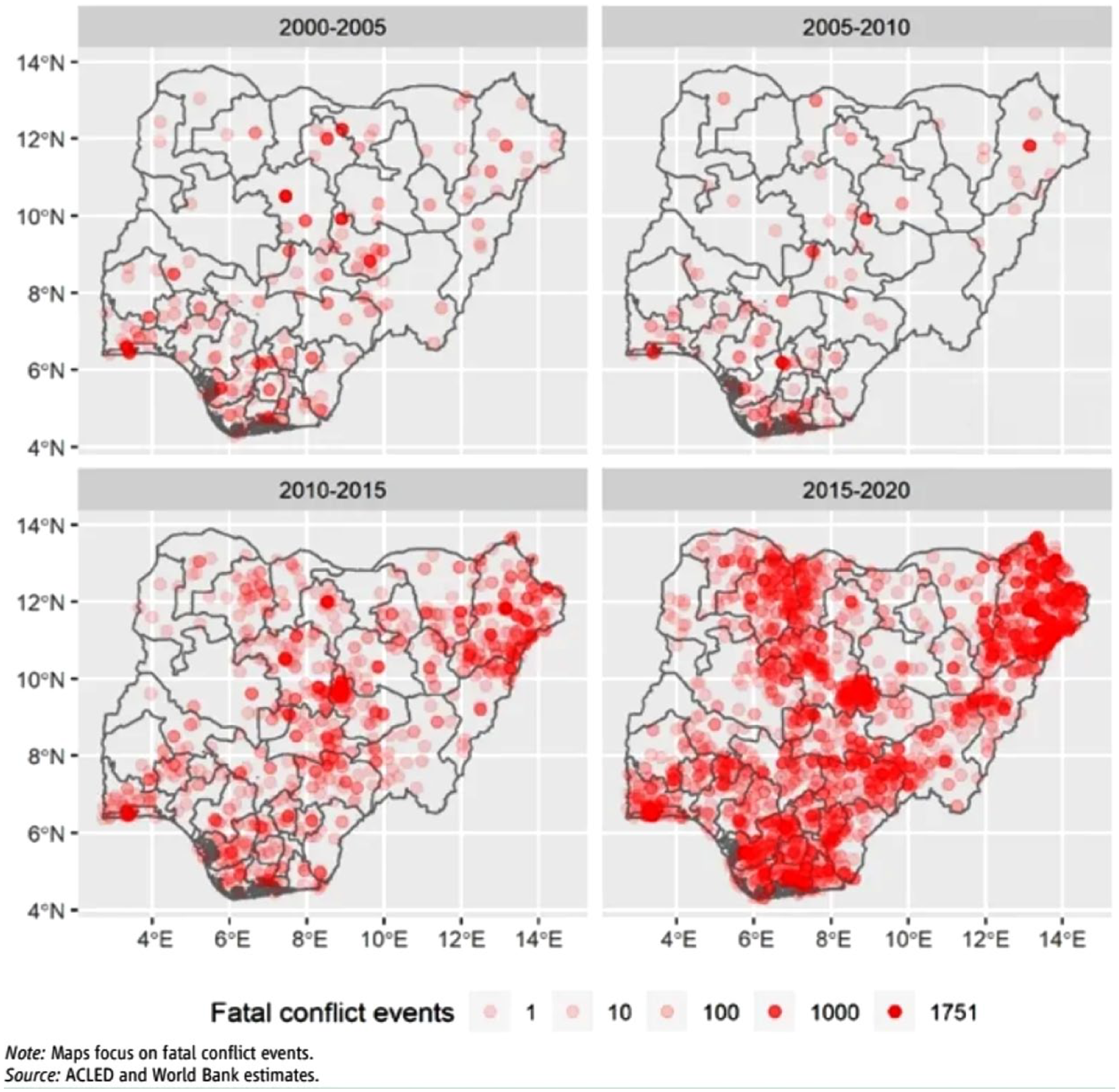
Fatal conflict events in Nigeria (2000–2020).
Unemployment and insecurity are more realistic measurable metrics than social prestige in explaining this migration; this is not to insinuate that the quest for social prestige is not a factor, although it is better considered a latent variable. A perceived increment in social status and reputation will naturally follow when there is a noticeable enhancement in quality of life. Therefore, it is not necessarily the case that upper-middle-class migrants will take the regular migration routes to pick up less desirable employment outside their home country just for a chance to be viewed as prestigious. A crucial point supporting this position is diasporan Nigerians’ remittance statistics. Adhikari et al. (2021) note that “the remittances from Nigerians abroad increased in 2019 to US$ 25 billion, which is 5% of the country’s gross domestic product and four times Nigerian foreign direct investment earnings.” Remittance is a significant pull factor for most Nigerians—especially the young middle and upper middle class. Those who are not in this category take irregular migration routes.
Different factors, circumstances, and motivations have been postulated for migration. The mediating roles of digital technologies, including social media, have also been researched. Several studies suggest that social media facilitates migrants’ intentions by providing information and access to migrant networks in destination countries (Alencar, 2018; Dekker & Engbersen, 2014). Dekker and Engbersen (2014) advance that social media help strengthen family ties, address weak and latent ties, and provide insider discrete and unofficial knowledge (pp. 409-410). According to Chinedu Obi, Fabio Bartolini, and Marijke D’Haese, social media users are more prone to accessing information about destination countries than transit risk (Obi et al., 2020). Olayinka Akanle, Fayehun, and Oyelakin opine that “ICT/social media is central to international migration decision-making, access of migrants and kin to social forces and factors motivating international migration” (Akanle et al., 2021). They also submit that social media is “very important to how migrants and kin maintain and/or weaken relationships and access to remittances and utilization” (p. 1212). Other scholars have amplified this reasoning and maintained that social media motivates out-migration because of the allure of a better life outside Nigeria. The recent spike in emigration among upwardly mobile Nigerian youths has brought this argument to the mainstream.
The internet has influenced the new wave of youth migration, colloquially named Japa—to flee from an unpleasant situation. Social network sites’ features, such as virality and visibility, strengthen this attribution. Pictures and memes on social media in posts made by new emigres depict their newfound status in their destination countries. Some even deliberately post pictures aboard aircraft with their passport conspicuously displayed to show how they have escaped awful situations for a hopeful future in their destination country. To what extent these performances can be described as showing off is subject to further investigations. These Japa migrants cut across different social stratifications—there are those travelling on student visas with their dependents to Europe and America and others who are highly mobile professionals leaving for better opportunities in developed economies. Their unifying characteristic is that they are largely regular migrants because it is very expensive to meet the visa requirements through either route; hence, apart from those who left the country on scholarship, the new Japa migrants consist of relatively middle-class and upper-middle-class Nigerians. Since this new migrant type is not homogeneous, a misleading conclusion might be drawn while arbitrarily extending one category’s online features and behaviours to others.
Japa Out-Migration in Nigeria
Migration, especially international human migration, is an increasingly global phenomenon in the 21st century; this has been made easier in an increasingly globalized world of improved communication technologies and transportation (Wilczek, 2012). Francesco Castelli explained that macro, meso, and micro factors are responsible for people’s decision to migrate and integrate into another country (Castelli, 2018). These include socioeconomic, environmental, and political factors; the meso factors include diaspora kinship affinities, effects of armed banditry due to political destabilization, and, in recent times, digital social media alluring appeals of better opportunities in Western countries; and micro factors such as religion, education, and marital considerations are also responsible for these migration patterns (Castelli, 2018). Migratory behaviours in Africa are linked to the push factors of unemployment, political instability, poverty, infrastructural decay in home countries, economic opportunities, and the pull of enticing promises of better facilities at the destination countries (Nwosu et al., 2022). Recently, a 2014 United Nations Children’s Fund/Global Migration Group report has seen noticeable increases in youth migration, including the search for better means of livelihood, quests for further education, family reunion, gender-based violence, natural disasters, wars, and supra-national crises (UNICEF, 2014).
Of late, Nigeria has been one of the world’s countries with the most emigrants; in 2017, 1.24 million people were reported to have emigrated from the country (Nevin & Omosomi, 2019). This wave of émigrés is dominated by those in the middle class and highly skilled profiles, such as doctors, nurses, technologists, engineers, educators, researchers, and graduate students (Dakuku, 2022). Japa is an urban Yoruba slang used mainly by young Nigerians to describe the recent emigration trends and patterns by those within that demographic category. It conatively means “to quickly flee a difficult situation,” an apt depiction of the attitude of most Nigerians toward perceived bleak socioeconomic uncertainties prevalent in the country. The word itself is an informal expression used mainly by young people from the southwestern states of Nigeria. Japa is popular among millennials and post-millennials. It is a new form of migration distinct from the old patterns. In the past, Nigerian youths have been known to brave perilous terrains (e.g., deserts and oceans) to travel to Europe in search of better opportunities in the global north. Most of these were artisans, low-skilled young people on a quest for survival with a pocket of a few educated migrants, some of whom take the legal routes.
According to an Agence France-Presse (AFP) report, Nigerian emigrants were about 1.7 million, with visas given to l6,000 health and skilled worker recipients since 2021 (Punch Newspapers, 2022). Ikuteyijo (2021) pointed out that the bulk of this demography is youths—the Japa generation. In contrast, those in the Japa category are moderately high net-worth individuals with established roots or highly skilled middle class and within the age categories ranging from 25 to 45 years. The upscale emigration of these people has lately topped media discourses and has constituted a source of worry to the government and policy actors. The most visibly impacted sector is the health sector, where agencies in the United Kingdom and Canada recruit Nigerian health workers in large numbers. Dakuku Peterside explained that migration among Nigerian youths is voluntary and is fuelled majorly by the spate of insecurity in the country, the search for better education, bad governance, and better career opportunities (Dakuku, 2022). The Japa migration cohort is not limited to aspirational youths; it also consists of middle-aged adults who want to avoid the uncertainty of life after retirement and sudden redundancy.
Japa is not essentially illegal or irregular migration; it is suggestive of those with legal means to leave their country with some pawning material possessions to satisfy this desperate wish for a better living outside of the country. This out-migration route requires financial resources that the young adults cannot afford on their own; therefore, the proportions of those leaving are in the middle or middle class and those in mid-level career positions. They usually move with their nuclear families—spouses and children. Costs and expenses associated with this pattern are often outside the means of those in the lower rung of the economic ladder. The most popular routes include postgraduate education and healthcare job opportunities. This trend has led to increasing demands for dollars and British pounds, thereby contributing to the depreciation of the Naira. The loss is not only economic; local hospitals’ loss of health workers leads to further decline of the health sector. Nigerian health worries are beginning to express newer concerns over the massive exodus of doctors, nurses, and other health professionals to overseas countries that draw these workers with better remuneration and infrastructures. Although this concern is not new, the urgency this time is more problematic, especially if the news reports on the subject are considered (Dyer, 2002). Premium Times reported that “while Nigerian hospitals lament insufficient personnel, 13,000 leave for the UK in one year, Nigeria is second only to Indians in the number of visas granted for the ‘Skilled Worker—Health & Care’ with 14 per cent (13,609)” (Okafor, 2022). In 2021, 33,000 doctors left the country amid the COVID-19 pandemic. (Ewepu, 2022) This led to the depletion of the country’s healthcare quality. Other African countries are also battling with this new migration wave. In October 2022, desperate to avert the medical brain drain, the Zimbabwean government reportedly stopped issuing clearance letters to nurses to prevent them from leaving the country for greener pastures (News Central TV, 2022).
Social Media and Japa Migration
In a growingly interconnected world, digital technologies are impacting the decisions of human migrants regarding where, how, and when to migrate. As one of these tools, social media has become a vital means of information distribution channels and a personal communication tool (Dekker & Engbersen, 2014). Social media technologies, innovations, and accessibility have allowed users to easily interact and share content and experiences with other users across the globe. This ease implies that ordinary individuals can share conversations, shape narratives, and influence agendas from their rooms’ confines without professional inhibitions and, very often, without care for the quality of the information shared. Hence, these social media features’ unintended consequences are disinformation, fake news, and incomplete information. Shared interests and mutual aspirations are given platform avenues through private messaging applications and open social media spaces, thereby serving as potential sources of information for intending migrants (Akakpo & Bokpin, 2021).
Nigerians’ preferred information-sharing applications are social media technologies like Twitter and Facebook. They also constitute many video and image-sharing platforms, such as Instagram and Snapchat. These platforms allow users to create, edit, and share content with people worldwide. Their impacts on the behaviour and decisions of youths worldwide include body consciousness, health, fashion, lifestyle, and so on (Best et al., 2014; Pop et al., 2021; Zeeni et al., 2021). The Japa out-migration appeal is primarily bolstered by the affluent lifestyles often displayed by diasporan Nigerians on social media: the well-manicured lawns, clean streets, malls, and, more importantly, constant electricity—an attraction that most Nigerians only see on TV and in movies. Some even have YouTube channels to share their migration stories; their improved status is often veiled as advice to folks back home with complaints about the amount they paid as taxes, rent, bills, and so on. The receivers understand the hidden message being relayed: “I am better than you because I now have bigger problems: I can afford $1000 (the equivalent of the annual salary of an average Nigerian) as monthly rent payment.” Rather than dissuading the prospective immigrant, it enhances the passion for embarking on the journey toward perceived social status transformation. These idealized views of a better quality of life abroad are often exaggerated and framed to elicit envy and respect from relatives and friends back home (Ikuteyijo, 2021). Given the massive emigration of Nigerian youths because of the socioeconomic state of the country, social media has played a pivotal role in stirring up and worsening the desire for greener pastures (Okunade & Bakare, 2020).
The facilitative roles of social media on migration decisions among upwardly mobile Nigerian youths have been researched (Ennaji & Bignami, 2019; Olawale, 2021). Chinyere Opia noted that “In contemporary societies, migration is being enabled by technological advances . . . Social media has shifted sources of information on migration from the real to the virtual world” (Opia, 2021). The assumption associating social media and migration decisions with “highly mobile” Nigerian Youths warrants further investigation, especially considering the new Japa trend. Are they of specific age and socioeconomic categories? Are social media sites and applications influential tools or sources of information for this cohort, and do their demograph(ies) represent specific youth categories frequently associated with social media and migration?
Two theoretical underpinnings describe migration social media decision-making and are somewhat relevant to Nigeria. They are social media engagement theory and social influence theory. The former expresses the conscious embeddedness of social media users who feel connected to other users, contents, and behaviours of these communication platforms (Di Gangi & Wasko, 2016; Dolan et al., 2016). Social influence theory describes the impacts of the thoughts and actions of trusted individuals, including families and friends, on the social media behaviours of users (Snijders & Helms, 2014). This article seeks to understand from interactions with individuals who have embarked on the Japa migration route if, in their experiences, the social media behaviour of others influenced their migration decision, as implied in several literature on the subject.
The positions expressed by scholars above on the influence of social media on migration in Nigeria may not adequately capture the peculiarity and nuances of this new Japa out-migration route. This is especially true because the Japa pathways consist of diverse demography and socioeconomic categories, and as such, extending the social media behaviours of other regular migrations to it might be insufficient or leading, hence the need for this study. The study explores the possible influence of social media on the new Japa migration path in Nigeria. As part of this main objective, the study investigates the defining characteristics of these new migrants—their age, gender, and socioeconomic status classifications. It also explores the challenges experienced by these new migrants before leaving and after arriving at their destination countries and asks if and how social media mitigates these challenges.
Data and Methods
This section describes the methods, procedures, and analysis used to investigate the roles of social media on the new out- migration pattern of Nigerians, also known as Japa migration, to understand the demography involved, their sociology, their motivations, and challenges, and if social media influence their decisions to emigrate. This section includes details on the sampling method, recruitment of interviewees, informed consent, data collection, data analysis, ethical considerations, and study limitations.
Exploring newspaper articles published in Nigeria reveals that Japa emerged in migration discourse around 2019. Hence, the timeline of this study covers 2019 to 2022. Between 2019 and 2021, the number of skilled work and study visas issued by the United Kingdom to Nigerians increased by 210%, from 19,000 to 59,000 (Soaga, 2022). Forty-five interviewees were recruited using snowball sampling through alumni networks, social media groups, and threads dedicated to migrants and their experiences on platforms such as Facebook, Twitter, LinkedIn, and YouTube. This sampling approach was adopted because of social-cultural considerations because most migrants in this category are difficult to reach as they are often unwilling to discuss their plans with strangers. Interviewees were graduates with higher education degree(s). Interviewees were also purposively drawn from anglophone destination countries in Europe and America because of language preference. In the Ultimately, only 37 interviewees met the inclusion criteria and were available for the study. The qualitative interviews were conducted between December 2022 and March 2023.
The interviewees comprised Nigerians who live in the United Kingdom (N = 18; 48.6%), Canada (N = 5; 13.5%), the United States (N = 10; 27%), Sweden (N = 1; 2.7%), and France (N = 3; 8.1%). They are between 26 and 48 years old, with an average age of 32.5. There were 22 (59.5%) men and 15 women (40.5%) in the study. All the interviewees have a minimum of a first-degree university education. Twenty interviewees (54%) have only a university degree (BA, BSc, etc.), 14 (37.8%) have combined master’s degree(s), and three (8.1%) have a doctorate (PhD). Twenty- five interviewees (67.6%) were married, nine were single (24.3%), one was widowed (2.7%), and two were separated (5.4%). Twenty interviewees (64.7%) had full-time employment (as university lecturers, bankers, engineers, private businesses, civil servants, medical doctors, and nurses) before emigrating, eight (21.6%) had contract or part-time employment, and five (13.5%) were unemployed.
The interviews were transcribed verbatim, and the data’s key themes and topic patterns were identified through coding. The coding involved breaking down the text into smaller units of meaning, or codes, and assigning each code a label, a combination of inductive and deductive coding techniques to identify codes. After coding the data, a thematic analysis approach was used to identify common themes across the interviews. Sample quotes from the interviews were used to illustrate each theme, providing insights into the findings’ implications.
Findings
Preferred Social Media and Digital Platforms
In the study, 25 interviewees (67.6%) mentioned Facebook as their social media platform, and 12 (32.4%) used Twitter. On the question of social media platforms for gathering Japa migration information, 15 (40.5%) preferred YouTube Channels, six (16.2%) indicated Nairaland (a Nigerian internet forum), four (10.8%) used WhatsApp, four (10.8%) used Facebook, three (8.1%) preferred Twitter, two (5.4%) used Telegram, and two (5.4%) used videoconferencing (e.g., Zoom and MS Teams).
This is consistent with the findings of other studies that social media use is prevalent among upwardly mobile youths and those considering irregular migration routes in Nigeria (Obi et al., 2020; Okunade & Bakare, 2020). Contrary to the choice of Facebook and Twitter as the platforms of migration decision information by these groups, those of the Japa migration seem to prefer YouTube and internet forums to social networking sites as their trusted platforms of migration information. Facebook and Twitter are considered distractive and demand more time to sieve relevant from irrelevant information. Hundreds of Channels on YouTube offer advice and information, focusing on the experiences surrounding migrating and settling in Europe and America—mostly the United Kingdom, the United States, and Canada. These channels cater mainly to the new Japa out- migration group.
Although I use Facebook, I find YouTube less distractive, unlike the other social networking sites with many trolls and bot marketing selling products. (. . .) I used YouTube for my Japa plans. I also didn’t have to reveal my identity to watch the video clips because I didn’t want people to know my business. With Twitter, one would have to follow the influencers or like their page if they are on Facebook to get information from them. (. . .) I also gathered more information about my Japa migration plans from the viewers’ comments on these channels. (Interviewee 33, male, 45 years, banker, three years in the United Kingdom)
Anonymity and privacy are other reasons for preferring YouTube, internet forums, centralized instant messaging, and voice-over-IP services such as WhatsApp and Telegram for Japa migration information sourcing. Some Japa out-migrants are discreet about their plans for various reasons; hence, posting inquiries about migration plans on social media may not ensure that.
I used YouTube, Nairaland, WhatsApp, and Telegram groups for the sake of privacy and anonymity . . . But my main platform for relating with experienced and trusted was WhatsApp. (. . .) You know, as someone who is employed, you wouldn’t want your employer to see you ask these kinds of questions on social media like Facebook . . . You don’t want your employer to know you are Japaing, leaving the company and travelling abroad. Therefore, I used those platforms a lot to gather information about my plans to leave Nigeria . . . I never had to show my picture, name, and identity while looking for Japa information online. (Interviewee 19, female, 32 years, health care worker, two years in the United Kingdom)
Relatedly, another interviewee emphasized the choice of non-social networking platforms.
For security reasons, you know, in this day and age of kidnapping for ransom in Nigeria, I wouldn’t want to fall victim since people already know it takes millions of Naira to Japa. Some spend as much as 20 million Naira. Therefore, asking people on social media about Japa, merely hinting at it, could expose one to security risks. In addition, families and friends who even see you in Japa social media groups will assume you already have extra money, and they will ask you for financial help . . . all these discouraged my use of Facebook for my Japa plans. I used Telegrams instead. (Interviewee 28, male, doctoral student, one year in Canada)
Although Japa is a neologism, it has assumed newer linguistic characteristics such that words like
Socioeconomic Characteristics of the Group (Japa Cohort)
The study suggests that the Japa migration cohort consists mostly of skilled youths in the middle-class demography. Unlike previous migration clusters, which are irregular and often veering on the edge of survival, the Japa cohort spends millions of Naira to pursue their dreams using regular and legal migration pathways—study, work, and health care visas. They are urban elites seeking social upward mobility not readily available due to economic constraints, casualization, unstable employment conditions, and career ceilings in their work organisations. Some of the interviewees expressed these views in their responses.
In my last workplace, promotions were delayed. Some of my senior colleagues already got to their terminal stage; therefore, I saw the handwriting on the wall. I do not want to waste my life at a job where I am not sure I am going to be promoted after a while . . . The rising cost of living also contributed to my desire to join the Japa thing . . . I gathered all my savings and sold my properties including a car and my land to pursue my dream. (Interviewee 13, female, graduate student, one year in the United Kingdom) I had to japa because for years after leaving school, I couldn’t secure any meaningful jobs. At a point, I worked with an agency that recruit casual call centre staff for an IT firm. We were underpaid and not allowed to unionise.(. . .) Staff were maltreated, and we could not complain. When I saw some of my colleagues who left the country share their accomplishments on social media. I was influenced to also Japa. (. . .) My husband and I took loans from our parents and pull resources together to leave the country. (Interviewee 7, female, health care worker, two years in the United Kingdom)
The common thread in nearly all the interviewees is that they commit resources to pursue this Japa migration route. The socioeconomic characteristics of this group show that although many of them are not on the lowest rung of the economic ladder, some had steady jobs. This economic migration accommodates mostly regular migrants looking for better prospects in more developed and stable countries. This interviewee reflected thus: I was a senior accountant in my company with many managerial responsibilities, and my pay was good. I decided to Japa because of the security situation in the country. I did not see any future in the country [Nigeria], and I do not want my kids to be stranded in a country with no development plan. Japa was my only option . . . I joined a WhatsApp group of ex-staff of my colleague who has Japa-ed to gather information and insights on my plans. This helped me a lot. (Interviewee 3, male, not stated, three years in the United States)
Another interviewee described what motivated her to migrate. For her and a few interviewees, the aspiration for a sustainable standard of living informed their decision. This social and economic factor motivated their embarkment on the out-migration route. They could afford middle-class living in Nigeria in the short term, but the long- term implications of losing that status influenced their migration decision. In her words, My husband and I pull resources together. We sold all our properties to pursue this Japa dream. We had enough in Nigeria, but our standard of living was not sustainable in the long run. If we lose our jobs, there is no assurance of getting other jobs that can help take care of our needs. That was why we decided to Japa. (Interviewee 34, female, not stated, four years in the United Kingdom)
Effects of Social Media on Decision to Migrate Through the Japa Route
There are mixed responses to the issue of the effects of social media on Japa out-migration. Some interviewees emphasize that social media did not influence the decision of the Japa migration cohort to emigrate, whereas others attributed their out-migration to social media influences. Most interviewees in the former group affirm that social and economic considerations play more significant roles in motivating or influencing their migration decision—job satisfaction, security, and career progression were some of the reasons for this decision. To them, social media technologies were tools or infrastructure for information exchange and were not seen as influencing tools for making their decision.
These technologies are seen as passive information-gathering tools to aid decisions already made. As noted earlier, the interviewees prefer one-to-one synchronous communication facilities such as WhatsApp and Skype and one-to-many information platforms which afford anonymity assurance, such as blogs, forums, and YouTube, to social media because of privacy considerations that social media tools may not seriously guarantee. The Japa migration only becomes obvious after they have successfully migrated, not before. Therefore, social media does not necessarily influence their decision. The following interviewees highlighted these points: I avoid social media because I do not want my affairs for the whole world to see. I made my decision to migrate because of insecurity, kidnappings, and the poor nature of the Nigerian economy. After deciding, I then used social media to gather more information, not before. (Interviewee 25, male, not stated, 3 years in Sweden) For me, I prefer Nigerian blogs like Nairaland forum. It has lots of threads on information for potential migrants with lots of useful comments as well. I do not have to reveal my identity before getting the travel information I need. (Interviewee 28, female, nurse, 4 years in the United Kingdom)
Those who hold contrary opinions expressed their views on the influence of social media on their decision. A few are presented below: Seeing images and videos posted on Facebook and Twitter by friends and former colleagues on their social media walls made me rethink my life. I knew these people before they travelled. I was even better than then. But now, they are enjoying good roads and constant electricity. I saw all these on their walls and I decided it was time for me to leave Nigeria. (Interviewee 5, female, banker, three years in the United States) Social media influenced my decision to leave the country. I saw different videos on YouTube and Facebook of the fine lives of my mates. On our school alumni group page on social media and on WhatsApp, I saw people sharing videos of the great life they were living, and I did not want to miss out on all the fun. I decided that I must leave. (Interviewee 15, female, not stated, three years in Canada)
Despite the differences in the perceptions of the roles of social media in Japa out-migration decision among the interviewees, the fact that the technologies play direct or indirect roles in assisting their migration decision is never in doubt. However, the extent of these roles might be difficult to infer from the data.
Contributions of Social Media to the Cohort After Arriving at the Destination Country
Some interviewees identified four thematic social media contributions to their migration after arriving at their destination countries. They are social support, aspirations and opportunities, settlement information, and navigating challenges. Some interviewees reported how social media provided social support after arriving in destination countries. The support networks helped them to settle down well in their new environment. Before arriving in the new country, these supports varied according to countries, individuals, and social ties. Issues include job search, house sourcing, schools for their children, and cultural adaptation. Often, migrants choose countries with large populations of people from their cultural identity. An interviewee expressed this view: I deliberately picked the UK as my destination country for my Japa runs because of the large Nigerian communities in the country. I joined several student groups and communities on WhatsApp and most of the experiences shared on those platforms made me prefer the country so that I can have people from the same ethnic and cultural backgrounds to rely on. (Interviewee 37, female, nurse, four years in the United Kingdom)
Other interviewees corroborated this view: I joined social media groups of Nigerian students. Members of these groups provided vital information while I was trying to settle down in the new country. I got the room I stayed in through a WhatsApp group of Nigerian students. (Interviewee 30, male, student, unstated years in the United States) Apart from job search, several social challenges, such as how to discipline a child, husband-and-wife relationships, and so on and so forth were addressed by those with years of experience in the country through a lot of YouTube channels that I watched. I binged on lots of clips on YouTube to benefit from the experiences of those of my nationality living in my destination country. (Interviewee 29, male, job not stated, three years in Canada).
Experiences by migrants on this route have not been all-around positive; several interviewees complained about perceived racial discrimination and exploitation by unscrupulous agents (house and jobs), mainly from people within their social circles. People were baited with promises of better-paying jobs, mostly in health care jobs, via social media, only to be abandoned as soon as they arrived in the destination country. These promises influenced their decision to embark on the Japa route, but they only realized the scam after arriving in the country. An interviewee expressed this view: The advert by an agent about an easy healthcare work visa to the UK made me sell all that I had and resign from my job at a private company in Lagos to Japa. My regret was that I brought my family—my wife and children. I should have come alone first to see how things are. When we got here, my agent started saying another thing. My hours were not as promised, and the salary could not sustain me in a city like London. Yes, I blame myself for trusting social media. (Interviewee 22, male, nurse, 4 years in the United Kingdom)
In a related but slightly nuanced experience, another interviewee highlighted that although the job adverts baited her, she did not verify the claims by her contacts in the destination country. She ignored all the warnings on the blogs and internet forums. In her words, Despite all the warnings about life abroad not being as shown with all the fine things displayed on Instagram and Facebook by those living there, I fell for the blings. . .I ignored the warnings, and when I saw an advert, I did not check out the claims with my friends because I thought their warnings were attempts to discourage me from also enjoying the life they were enjoying. I paid millions of Naira, japa’ed our of Nigeria. When I got to Canada, I realised that the promises were fake. My visa restrictions prevented me from even working enough hours to pay back the money I spent on the journey. (Interviewee 17, female, job not stated, two years in Canada)
Discussion and Conclusion
Findings from this study present the instrumentality of social media in migration decisions—the technologies are seen as tools used by the Japa category of migrants, but they do not necessarily influence the decision to migrate. Existing literature tends to suggest a causal relationship between social media and migration. Rather than this blanket conclusion, this study reveals that migrants’ information behaviour should not be huddled into a singular causal factor since there are variations by migration types, gender, and age of the migrants. The results from the study show that prospective migrants mainly use Facebook, Twitter, and YouTube as information sources and do not unfalteringly ponder them as veritable tools of influence. However, further research must be done to ascertain this observation beyond the limited population of this study. Youths’ social media usage may differ from how adults utilize the technologies. While youths might be more expressive, those in the Japa category tend to be adults with families in some cases who are more conservative and with more concerns not related to the display of affluence.
The study also finds that neological grammatic terms and tenses such as japa (verb), japa-ed (past tense), japa-ing (third-person singular simple present indicative form), and so on have been invented for code-switching and creative expressions among the cohorts of this out-migration trend.
From the findings in this study, social media are mainly used for information gathering by those in the Japa out-migration cohort, with little evidence to conclude motivation or influence. Given their average age of 32.5 years, they are more driven by socioeconomic considerations, and they are settled in their roles in Nigeria before deciding to emigrate. The reasons ascribed to their migration decisions include future career prospects, better prospects for their children, and security. The display of affluence is not prominent on their list of motivating factors. These are mostly middle- and upper-middle-class professionals already in their careers. They spent millions of Naira to prospect the migration route regularly. Findings also show that they prefer relative privacy, hence the decision to only use asynchronous technologies with one-on-one communication features like WhatsApp, Telegram, etc.. Researchers rarely consider these factors when investigating the impacts of social media on migration.
Migrants’ Experience in the New Wave Migration
It has been brought to attention the experiences of migrants in destination countries. Many migrants have been found to face difficulties such as the integration process, health issues, and cultural barriers (Castelli, 2018). Ikuteyijo (2021) revealed that youths have returned to the country voluntarily or by deportation. This is because most of them do not have valid passports and are not familiar with the processes for legal immigration (Ikuteyijo, 2021). It is also discovered that migrants struggle to access medical care in their destination countries. Ponce-Blandon et al. (2021) explained that migrants who are not documented are vulnerable in terms of their living conditions, social welfare, inaccessible health care, and their health status.
Social media influence on the Japa out-migration route is not easily identifiable from the data in the study because of the difficulty in placing its role in the migration decision process. The socioeconomic characteristics of respondents on this route do not support direct influence as much as other factors. Nevertheless, it is difficult to discount their contribution to the process, even if the technologies are for information gathering. However, there is insufficient evidence to establish causality.
Nearly all the interviewees in this study acknowledge that social media technologies provided social support for them when they arrived in their destination countries. The information offered helped them to easily acculturate. Housing, employment, immigration laws, and access to health care are challenges experienced by new migrants. In Europe, it has been discovered that the inequality between non-migrants and migrants is a major barrier to universal and equal access to health care. In the United Kingdom, during the coronavirus period, it was revealed that international migrants suffered from the disease more than non-migrants due to a lack of access to welfare and health care, limited socioeconomic working conditions and capital, and cultural barriers (Yen et al., 2021).
Research has also shown that living conditions in terms of housing are a major challenge for migrants. For instance, in the United Kingdom, due to the increase in the inflow of migrants, the prices of UK houses have increased, causing 11% of them to live in overcrowded houses (Reino & Vargas-Silva, 2022). They noted that migrants face discrimination in the labour market and when buying or renting an apartment. It was also revealed that migrants from less developed countries and low-skilled migrant workers are even more at risk of discrimination than migrants from developed countries and high-skilled migrant workers. Migrants have gotten their expectations cut off due to poor housing conditions, although they have expressed their satisfaction with it as they do not have any other choice (Spencer et al., 2007). Furthermore, due to the diverse background of cultures across the United Kingdom, migrants are liable to experience discrimination. They added that migrants’ experience at their workplace, which includes long hours of working and low pay, has a huge effect on their lives even outside their workplace.
This study finds that interviewees prefer social media variants such as discussion and community forums, blogs, video sharing, and streaming platforms to social networking sites such as Facebook and Twitter. Privacy, trust, and the conservative culture of the people who dominate the demography might be responsible for these preferences. Existing literature seems to miss these differences as migration social media are seen as a monolithic entity. Since information garnered on social media might be asymmetric, most migrants depend on close social network ties they have established offline. Social media technologies are seen as secondary tools that their trusted relations use to relate with them. Syrian refugees and migrants relied more on friends for their internet information search than other refugees (Dekker et al., 2018). The Japa migrants depict this behaviour as well. Hence, it is too reductionist to adduce their migration decision to people they see displaying affluence on social media.
Summary and Conclusion
In summary, this study investigates the roles of social media in the new Japa out-migration trend in Nigeria. It finds little evidence to support social media’s direct influence on this trend’s migration decision. However, this is not a definitive conclusion, given the limited data from the small sample of interviewees. The display of affluence on social media as a motivating factor also could not be conclusively established; other socioeconomic factors play more defining roles in this new trend.
The study also examines the contributions of social media technologies to the Japa migration decision of the interviewees. In this instance, more conservative social media platforms, for example, Telegram and WhatsApp, were preferred to other more open social networking categories such as Twitter, Instagram, and Facebook. Also crucially important is the preference for information from trusted offline relations, usually from kinships and familiar interactions developed over the years; these sources are more relied upon than online sources unless recommended by their offline social network nodes. The study finds a more functional usage of social media applications as sources of information for the Japa out-migration decisions than as sources of motivation.
Footnotes
Acknowledgements
The author would like to acknowledge and thank Damilola Olayinka Ola-Lawson of the Department of Sociology, University of Ibadan, for her assistance during the planning stage of the article.
Declaration of Conflicting Interests
The author(s) declared no potential conflicts of interest with respect to the research, authorship, and/or publication of this article.
Funding
The author(s) disclosed receipt of the following financial support for the research, authorship, and/or publication of this article: The study received financial support from the Carnegie Corporation of New York and the William and Flora Hewlett Foundation.
