




Abstract
This study undertakes a systematic analysis of media discourse on migration in Sweden from 2012 to 2019. Using a novel data set consisting of mainstream newspapers, Twitter and forum data, the study answers two questions: What do Swedish media actually talk about when they talk about “migration”? And how do they talk about it? Using a combination of computational text analysis tools, I analyze a shift in the media discourse seen as one of the outcomes of the European refugee crisis in 2015 and try to understand the role of social media in this process. The results of the study indicate that messages on social media generally had negative tonality and suggest that some of the media frames can be attributed to a migration-hostile discourse. At the same time, the analysis of framing and sentiment dynamics provides little evidence for the discourse shift and any long-term effects of the European refugee crisis on the Swedish media discourse. Rather, one can hypothesize that the role of the crisis should be viewed in a broader political and historical context.
Introduction
In 2015, Sweden welcomed more than 162,000 asylum seekers into its territory (Migrationsverket, 2020), an unprecedented number in the history of this relatively small Scandinavian nation that can, however, boast of 17% of its population being born abroad (Statistiska Centralbyrån, 2016). Despite a long tradition of welcoming people from all over the world and exceptionally high public support for immigration (Heath & Richards, 2019), the durability of Sweden’s renowned hospitality was put to test. As early as November 2015, the government acknowledged that it could not cope with the inflow of asylum seekers and that the situation had been unsustainable. In 2016, the government introduced changes to Sweden’s generous asylum legislation, which marked a turning point in the history of “Swedish exceptionalism” (Emilsson, 2018).
However, the consequences of the crisis in Sweden are yet to be comprehended. Social scientists argued that changes in the media discourses about the reception of refugees at the end of 2015 were a common phenomenon in Europe (e.g., Chouliaraki et al., 2017; Georgiou & Zaborowski, 2017). At the same time, the importance of media representations of the migration topic cannot be underestimated, since the media have been found to influence public opinion and attitudes to immigration and immigrants (Boomgaarden & Vliegenthart, 2009; Jacobs et al., 2017; Van Klingeren et al., 2015). In Sweden, some researchers also pointed to the shift in the discourse, from a dominating discourse of inclusion and open doors to an acknowledgment of the crisis and inability to handle it, and, finally, to the changes in policy and legislation (Dahlgren, 2016). Others argued that “the end of Swedish exceptionalism” is a result of policy changes in the last 20 years (Dahlstedt & Neergaard, 2019). However, since the latter findings can mostly be attributed to the policy discourse, this study seeks to center around the media discourse specifically and to investigate whether the Swedish media followed the same trajectory as its European counterparts.
One should not overlook the role of online user-generated media, a blessing and a curse at the same time. It has been argued, on the one hand, that social media served as platforms for the development of participatory culture (Jenkins, 2009) and to enable the mobilization of affective publics (Papacharissi, 2016). Others have stressed that social media simply reinforces existing power structures in the media landscape and society (Fuchs, 2013, p. 62), serves as platforms for the articulation of right-wing discourses (Ekman, 2019), or brings about the emergence of echo chambers (Brundidge, 2010; Flaxman et al., 2016). Since Sweden is a digitally advanced country where 95% of the population have home access to the Internet (Statistiska Centralbyrån, 2019), it is also relevant to reflect on the role of social media platforms in the formulation of Swedish media discourse about migration.
The goal of this work is to provide a more systematic overview and comparison of the dynamics of media discourse on migration in Sweden from 2012 to 2019 in three different types of media: Sweden’s largest mainstream newspapers, one of the most popular online forums (Flashback forum) and a social media platform (Twitter). I look at what the media actually talk about when they talk about “migration,” “immigrants,” and “refugees” and how they talk about them. Ultimately, by studying the dynamics of emotional and content-related components of the media discourse, I aim to detect a shift in the media coverage of migration, as proposed by earlier research. Thus, in this study, I aim to answer the following research questions:
Q1: What are the common frames of the migration topic in the Swedish media?
Q2: How did the prevalent frames change after the European refugee crisis of 2015?
Q3: How did the sentiments (or ways of talking) about migration change after 2015?
This study therefore contributes to existing research by trying to systematically review the changes in the Swedish media discourse about migration in the last decade, rather than during the relatively short period of the crisis itself, and by gaining an understanding of the reasons for the discourse shift in the media coverage of the crisis in autumn 2015, as proposed by earlier studies on media discourses in Europe. I also look at the role of social media and contribute to the debate about their democratizing role. To the best of my knowledge, this is the first Swedish study to use big data from several types of media spanning almost a decade and to apply computational text analysis tools to perform the analysis.
Background
The events that were labeled the “European refugee crisis” inevitably became a subject of scientific inquiry. In social and media studies, a substantial part of the research was dedicated to the analysis of media discourses in official newspapers across Europe. Taking a comparative cross-national approach, researchers found similar changes in European media coverage of the refugee crisis in the second half of 2015, which were often associated with the terrorist attacks in Paris in November 2015 and the sexual assaults in Cologne on New Year’s Eve 2015 (e.g., Berry et al., 2016; Fotopoulos & Kaimaklioti, 2016; Georgiou & Zaborowski, 2017). The analysis of the discourse dynamics in Germany and the United Kingdom demonstrated, for instance, that news framing shifted from a humanitarian perspective to threat and securitization dimensions during this period (Chouliaraki et al., 2017; Goodman et al., 2017; Vollmer & Karakayali, 2018).
Likewise, another comparative study of the media coverage of the crisis in five European countries showed that humanitarian and threat narratives were widely used in the mainstream media to contextualize the crisis (Berry et al., 2016). In the German media, it has been argued that the refugee crisis was framed by security, the economy, and gender relations (Holzberg et al., 2018). Similar results have been presented in a study of media discourse in Austria, where criminality, economization, humanitarianism, and securitization frames were identified as most typical (Greussing & Boomgaarden, 2017). Broadly speaking, researchers pointed out that a fragmented and inconsistent media discourse about the refugee crisis was characterized by twofold tendencies of humanitarianism and protectionism, which represented a crisis in itself (Moore et al., 2018, p. 66).
Swedish official media have been found to display the most positive sentiments about migration when compared with other European countries (Berry et al., 2016). An analysis of Swedish newspapers has demonstrated that the migration topic was presented in the context of racism and discrimination and that the humanitarian frame was widely used to refer to the issue (Hovden et al., 2018). The results of topic modeling have defined “human interest” (quite similar to the “humanitarian” frame identified in other studies), “refugee movement,” and “EU refugee policy” as the most salient frames in Swedish newspapers (Heidenreich et al., 2019). Similar results have been reported by Moore et al. (2018), who identified “political response/policy,” “humanitarian,” and “immigration figures/levels” frames in the newspaper articles.
In the meantime, much less attention has been paid to a comparison of mainstream and social media coverage of the refugee crisis, with a few exceptions (Nerghes & Lee, 2019; Pöyhtäri et al., 2019). Generally, migration discourse in social media is reported as being formulated similarly to the mainstream sources. On Twitter, for instance, researchers have identified humanitarian, European Union (EU) relations and security frames, as well as a racist frame formulated by the far-right movement (Siapera et al., 2018). In Sweden, analysis of the representation of Muslims in forum messages has showed that typical discussion topics included religion, multiculturalism, terrorism, sexual violence, and the perception of women (Törnberg & Törnberg, 2016).
The research has demonstrated that the role of social media in the formulation of migration discourse has been rather ambiguous. On the one hand, social media has been named as one of the driving forces in the consolidation of affective publics during the refugee crisis in 2015 (Dahlgren, 2016) and as the driver of government accountability (Ojala et al., 2019). On Twitter, the general tonality of the messages containing refugee-related hashtags has been reported to be mostly positive (Coletto et al., 2016; Nerghes & Lee, 2019). Scientists have also argued that tweets published during 2015 could be characterized by empathy toward refugees that was articulated by social media elites and echoed by peripheral users (Barisione et al., 2019).
On the other hand, another study of sentiments expressed in tweets has revealed a prevalence of negative sentiments in the messages related to the crisis (Ladner et al., 2019). Social media framing of the topic has been found to be dominated by crime and threat narratives (Pöyhtäri et al., 2019), while migrants and refugees have often been perceived as a security threat (Siapera et al., 2018) or as “illegals” and “terrorists” (Gualda & Rebollo, 2016). In Sweden and elsewhere, it has been reported that social media was providing platforms for the articulation of racist and right-wing discourses (Ekman, 2014; Merrill & Åkerlund, 2018; Topinka, 2018).
Central to this analysis is a notion of media framing that allows understanding of what the media are actually referring to when they talk about “migration” or a “refugee crisis.” Is it the EU’s joint response to the crisis? Or the role of schools in the integration of newly arrived children? Or the Swedish Migration Agency’s policies and work on the assessment of asylum cases? Robert Entman, one of the pioneers of framing analysis, defined framing as a process of selecting and compiling a few elements or characteristics of a phenomenon in such a way that it provides a certain interpretation of it (Entman, 2007). In other words, it is proposed that frames can create interpretations simply because they emphasize some of the aspects of the issue above the others (De Vreese, 2005, p. 53). Such problem contextualization leads to readers being encouraged to feel or think in a particular way (Entman, 2007). For that reason, the concept of framing helps us understand how the migration issue is presented and contextualized in the media, and which sides or aspects are given most attention, be it the economic cost, security threat, or humanitarian narratives mentioned above.
However, in addition to putting a particular emphasis on the issue, media frames invoke and attach emotional connotations to the topic in question. Manuel Castells (2013), who devoted his book “Communication power” to the analysis of communication in the digital age, developed this argument further by studying how individuals cognize information obtained from the media and how the media influence the “framing of the public mind” (Castells, 2013, p. 157). In particular, he echoes Entman’s statement that the most emotionally charged frames are most likely to connect with the pre-existing frames in people’s minds and to trigger particular types of emotional response. Thus, media frames catch the public’s attention so that their interpretation of a given event will resemble the one suggested by the frame. Castells gave as an example the case of the United States’ war in Iraq, which was formulated with the help of “patriotism” and “war on terror” frames that brought about fear of death as the main emotional connotation (Castells, 2013, p. 169). I find this quite relevant to the migration topic, which is also an emotionally charged topic. In this study, therefore, I attempt to identify various emotions, such as joy, trust, fear, or anger, attached to, or caused, by various media frames and the migration topic in general (see “Methods” section).
A public discourse approach to news framing (Scheufele & Scheufele, 2009, p. 111) presumes that the news media articulates the frames put forward by particular social agents or groups, which can help us understand why and how each medium chooses particular migration frames. In this sense, social media serves as a transmitter of the frames articulated by a variety of social forces that compete over the dominance of their frames and together formulate public discourse on a given topic. Where social media follows only a one-sided contextualization of the topic that supports only one competing social group or force, the situation is referred to as “content bias” or “framing bias” (Entman, 2007, 2009, p. 334). It needs to be noted, however, that framing is not a one-way process but a recursive one, whereby the audience can react and give feedback on the frames formulated by the media, and where the media and journalists also play a particular role in the formulation of the frames. This statement is especially relevant to social media, where content creators and consumers are the same group of social media users.
As regards the role of social media in discourse formulation, Stephen Cooper (2009) has pointed out that modern blogs not only create frames but can also dispute, reframe, and contextualize already existing mainstream frames (Cooper, 2009, p. 140). I believe that this argument is relevant not only to the blogosphere but also to any type of modern user-generated media. Furthermore, social media can problematize and oppose a mainstream frame, sometimes directly by suggesting an alternative frame where the mainstream frame is considered to be inadequate (Cooper, 2009, p. 141). Social media can thus be viewed as platforms where counter-discourses are shaped and formulated. In terms of the migration agenda, such a counter-discourse can be either supportive or harmful, for instance, advocating for more generous policies on the reception of migrants or, conversely, demanding stricter controls on migration. This study therefore aims to reveal how such a counter-discourse about migration is produced in social media.
Methods
The data were collected between January and March 2020. The choice of data sources was based on their accessibility, diversity, and popularity among users—thus, the six largest official newspapers, the Twitter platform, and the Flashback forum were chosen for the analysis. While official newspapers and Twitter represent typical examples of mainstream as opposed to social media, the Flashback forum is an interesting case of a communication platform that allows users to discuss a variety of topics, from politics and the economy to cooking and fashion. As of June 2020, the forum has more than 1.3 million users (Flashback, n.d.), which makes it one of the biggest discussion platforms in Sweden with its population of approximately 10 million people. Flashback, which provides nominal anonymity to its users and whose motto is “Freedom of speech for real!” [“Yttrandefrihet på riktigt!”], has been called “part of Swedish internet history” (Karlung, 2015). On the other hand, it has been argued that it has been used for attacks on users and the promotion of hatred toward some ethnic groups (Östman & Aschberg, 2015), which makes it a controversial phenomenon in the Swedish media landscape.
The study focuses on documents published between 2012 and 2019 since the refugee crisis of 2015 broke out approximately in the middle of this period. Documents to be included in the final data set from the newspapers and Twitter were identified with the help of keywords, namely, singular, plural, indefinite, and definite forms of words such as “refugee,” “immigrant,” “newcomer,” “immigration.” All documents consisting of fewer than three words and incomplete or duplicate entries were removed from the data set. Data collection and analysis were performed entirely in the R statistical computing environment (R Core Team, 2020).
Newspaper articles from the six biggest official newspapers (Aftonbladet, Dagens Nyheter, Expressen, Göteborgs-Posten, Svenska Dagbladet, and Sydsvenskan) were collected via Mediearkivet, a digital news archive, and its Research API (Retriever, n.d.). Some auxiliary articles, mostly related to cultural events, were identified with the help of keywords and deleted from the data set. The final newspaper corpus consisted of more than 56,000 articles. On the Flashback forum, I downloaded all posts in the “Integration and immigration” section (“Integration och invandring”). Alongside the standard measures outlined above, all quotations and URL addresses in the documents and posts published before 2012 or after 2019 were deleted, which resulted in almost 1.3 million documents. Finally, tweets were downloaded via the official Twitter full-archive API (Twitter, 2020). Retweets, as well as tweets in languages other than Swedish, were excluded from the query. User mentions, URL addresses, and hashtags were removed from the documents, resulting in a final Twitter corpus of approximately 1.09 million documents.
To identify different ways of talking about migration in the documents, I performed lexicon-based sentiment analysis at the document level using the Syuzhet package (Jockers, 2017). The package was chosen because of its support for the Swedish language and the opportunities it gave to identify words with different emotional associations. Syuzhet incorporates the National Research Council Canada Word-Sentiment Association Lexicon, which includes more than 13,000 words in Swedish (Mohammad & Turney, 2010). In the package, document sentiment is calculated as a simple count of all negative and positive words detected by the lexicon (e.g., five negative and four positive words in a document give it a score of −1). However, the idea behind the approach used in Syuzhet is not only to calculate sentiment polarity (positive versus negative) but also to identify the words that invoke different emotional associations divided into four antagonistic pairs: anger and fear, sadness and joy, surprise and anticipation, and trust and disgust (for a more detailed overview of the approach, see, for instance, Hoffmann, 2018). Thus, the package was able to help calculate overall document sentiments and word counts for the eight emotions.
To identify the main migration frames, I used probabilistic topic modeling through the Latent Dirichlet allocation (LDA), a simple but effective unsupervised learning algorithm proposed by David Blei (2012). The assumption behind the LDA is that each document in a corpus belongs to each topic in a given set of topics with some probability. Each document is then assigned to the topic with the highest probability, thereby helping to explain the latent structure of the corpus (Blei, 2012, p. 79). My data pre-processing pipeline for topic modeling included standard measures such as removing punctuation, numbers, URLs, and built-in and customary stop words, as well as word tokenization and subsequent transformation of the tokens object into a document-term matrix. Stemming was not performed since there have been questions of late as to whether it improves the accuracy of analysis (Schofield & Mimno, 2016). LDA modeling was performed using the topicmodels package (Grün & Hornik, 2011).
Given the large-scale format of the data and computationally expensive character of the LDA algorithm, models with 5, 10, 15, and 20 topics were calculated separately for each of the corpora so that an appropriate number of topics could be chosen. While the models with 5 and 20 topics were discarded as they were too general or too specific, the models with 10 and 15 topics seemed to fit the purpose of the study well. While the models with 15 topics gave a more detailed and nuanced account of the discussions in the documents, they increased the total number of topics substantively. However, it has been argued that choosing a model with a smaller number of topics is best research practice (Banks et al., 2018). The models with 10 topics were thus chosen for the subsequent analysis, which allowed for a diversity of topics and kept the models concise and easy to interpret. The frame titles were subsequently formulated based on the top 20 terms in each of the topics.
Results
Q1: Media Framing
The results of topic modeling suggest that the migration frames can be divided approximately into three big groups: these are politically oriented frames (“Swedish politics,” “The European refugee crisis,” “International relations,” “The crisis in the Middle East,” “Illegality and the asylum process,” and “Humanitarian crisis”), economically oriented frames (“The cost of immigration” and “Municipalities and welfare”), and socially oriented frames (“Crime,” “Racism and multiculturalism,” “Religion,” “Begging,” “Families,” ”Migration debate,” “Media,” “Races and ethnic groups,” “Integration,” and “Hate”). Table 1 shows that newspapers were generally more inclined to use the politically oriented frames of the migration issue since half of all the frames identified in the newspaper corpus discuss migration in the context of Swedish, European, or international politics. The social media platforms, on the other hand, primarily utilized the socially oriented frames with 5 out of 10 frames on Twitter and 6 out of 10 frames in the Flashback corpus being dedicated to the discussion of the social effects of migration.
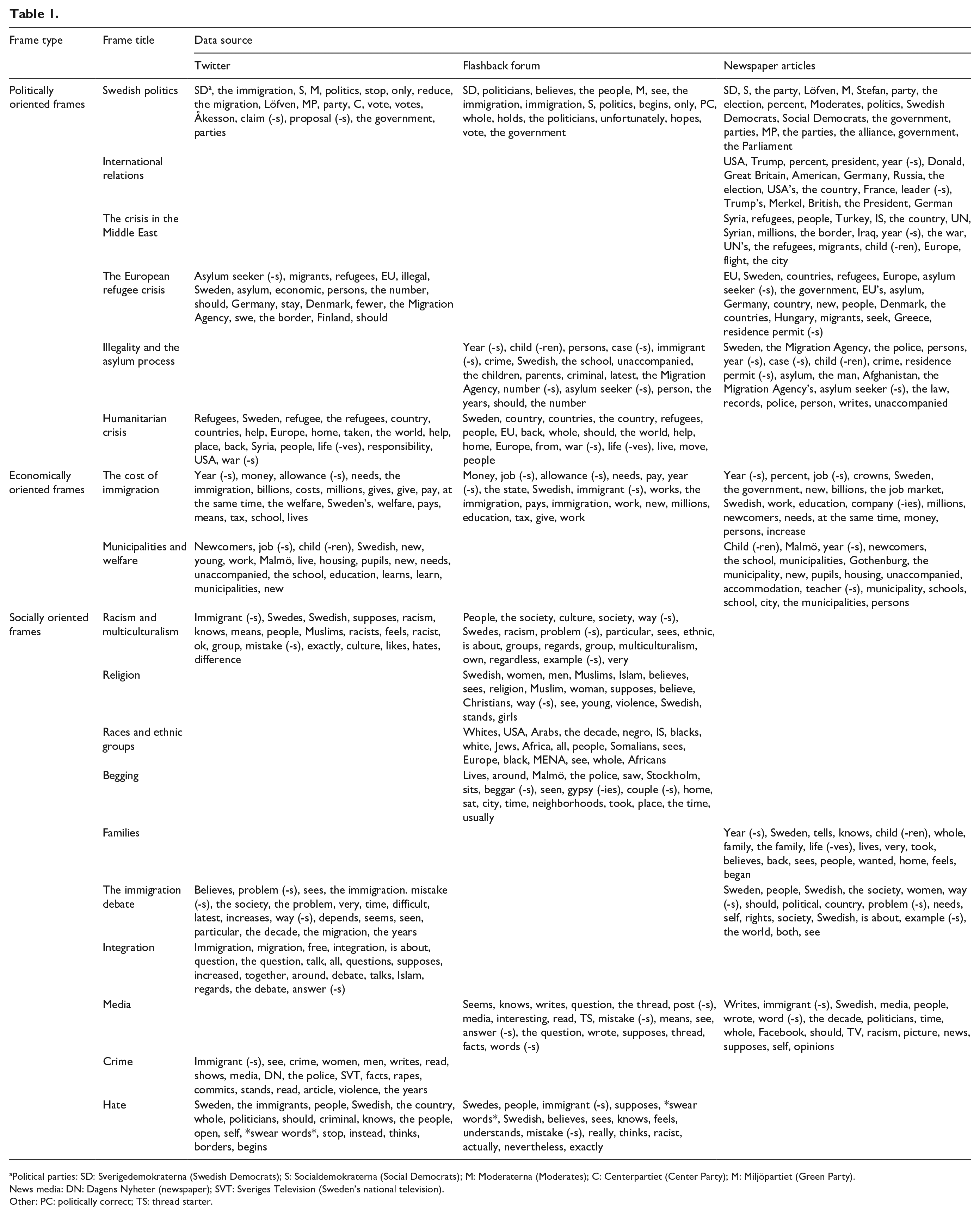
Political parties: SD: Sverigedemokraterna (Swedish Democrats); S: Socialdemokraterna (Social Democrats); M: Moderaterna (Moderates); C: Centerpartiet (Center Party); M: Miljöpartiet (Green Party).
News media: DN: Dagens Nyheter (newspaper); SVT: Sveriges Television (Sweden’s national television).
Other: PC: politically correct; TS: thread starter.
However, the three resources share several ways of framing the migration issue. First, a “Swedish politics” frame discusses migration in the context of national elections and the parties’ political programs and includes such terms as government, politicians, parties, vote, and so on. Second, “The cost of immigration” frame (using terms such as job, millions, allowance, tax, immigration, pay) focuses on the financial and economic aspects of the reception and integration of migrants. Third, some of the frames, such as “The European refugee crisis” and “Illegality and the asylum process,” revolve around the topic of refugee reception and asylum policies in Europe and can be linked to the events of 2015. Judging from the terms identified in the latter frame (asylum seekers, Migration Agency, crime, criminal, police), one might conclude that it discusses forced migration as an illicit and potentially harmful phenomenon.
In social media specifically, I identified a “Humanitarian crisis” frame that discusses migration in the context of human suffering and assistance to refugees, including terms that can be associated with sympathy toward them (refugees, home, help, responsibility, war). At the same time, in the social media data, a variety of frames (“Racism and multiculturalism,” “Races and ethnic groups,” “Religion,” “Hate,” “Crime,” etc.) focus on racial, ethnic, and religious differences between people or present negative aspects of migration. Because some of the identified frames include explicitly racist or negatively loaded terms (Negro, gypsies, criminal, violence, etc.), I suggest that these frames present part of an ethnically prejudiced and hostile discourse. This observation is especially relevant for the forum data, where half of all frames can potentially be attributed to such a discourse.
Q2: Framing Dynamics
The results of topic modeling were also used to analyze the dynamic component of the migration framing. To examine temporal changes in the framing, I calculated monthly proportions of the documents for each of the frames from 2012 to 2019 to account for the fact that the number of documents was unevenly distributed over the months and years (Figure 1). The rationale of this analysis was to study the changes in framing persistence before and after 2015. If there had been a true discourse shift, some of the frames would have become less prominent, while others would have become more prevalent after 2015. For instance, one might speculate that the proportion of documents with the economically oriented and potentially migrant-hostile frames would have increased after autumn 2015, thus providing evidence of a discourse shift.

Monthly number of migration-related documents in 2012–2019.
The results are presented in Figure 2. At first glance, a sharp increase in the proportion of documents with the refugee-related frames (“The European refugee crisis” and “Humanitarian crisis”) is evident in autumn 2015 in all the resources. It is worth noting that the increased usage of the latter frame was extremely short-lived and had already fallen back to pre-crisis levels by January 2016, when the “Illegality and the asylum process” frame started taking its place in the discourse. However, the latter frame also started losing importance after the end of 2017. Finally, one can see that the trend of the “Swedish politics” frame followed electoral cycles in all media (autumn 2014 and 2018), which corresponds logically with growing attention to the political parties’ programs and immigration agendas.

Dynamics of migration framing in 2012–2019. Monthly proportions of documents with the 10 frames.
Contrary to the dynamics of the “Humanitarian crisis” frame, the persistence of the economically oriented frames (“The cost of immigration” and “Municipalities and welfare”) was more stable during the period of the crisis and the first of these two frames remained relatively popular even after 2015. However, it is doubtful that this tendency can be linked solely to the crisis, because the proportion of documents with this frame in social media was gradually rising even before the crisis began. In the meantime, the socially oriented frames showed a variety of tendencies. In some cases, for instance, with the “Racism and multiculturalism,” “Races and ethnic groups,” and “Integration” frames, usage reached its lowest levels during the crisis and subsequently remained relatively low. In other cases (“Religion” and “Migration debate”), however, the frames started to gain popularity after the crisis had ended.
Q3: Sentiment Dynamics
The results of sentiment analysis were used to identify changes in the emotional component of the frames—how migration was talked about in the media. One aspect of the study was to track how the usage of words expressing various emotions, such as anger, joy, or fear, changed over the years, the aim being to assess whether there was denser use of emotionally loaded words in the documents after 2015. The counts for the words expressing the 10 emotions were divided by the total number of words in each of the documents to account for the fact that document lengths varied across the resources, from short entries on Twitter to longer texts in the newspapers. I then calculated mean monthly values for each of the emotions. I expected more frequent use of words expressing fear, anger, or disgust, and negative emotions in general, to serve indirectly as an indicator of the discourse shift. At the same time, one would expect that the use of words expressing joy, trust, and positive emotions in general would decrease after 2015.
In addition, I analyzed how sentiments in each of the frames changed over time. The results of topic modeling do not allow us to identify the sentiments of the frame—for instance, it is not evident whether the documents with “The cost of immigration” frame talk about migration positively or negatively (e.g., migrants as an asset or a burden to the economy). I therefore calculated mean monthly sentiment values for each of the frames to gain insight into sentiment changes over the years of the study. One might expect that a significant decrease in sentiment values during the crisis would indicate that the discourse shift occurred in 2015.
Looking at the tendencies in the word–emotion associations (Figure 3), there was a slight general decrease in the usage of the words denoting disgust, anger, and negative emotions after the end of 2015. At the same time, in social media the values for “fear” rose substantially during the crisis and subsequently remained at a high level. This may indicate that the growing number of newcomers in the country did indeed induce fear. In the meanwhile, the values for positive emotions and joy declined over the years. It is also evident that the newspaper discourse was generally less affected by the refugee crisis and demonstrated more stability than the discourse on the social media platforms.

Dynamics of word–emotion associations in 2012–2019. The counts for the words signifying the 10 emotions in each of the documents were divided by the documents’ lengths (total number of words), and then mean monthly values for each of the emotions were calculated.
Finally, I did not find any strong tendencies in the sentiment dynamics of the frames (Figure 4). However, one can conclude that migration was talked about more negatively on social media than in the mainstream media. On both Twitter and the Flashback forum, 7 out of 10 frames had negative sentiment polarity, in contrast to the newspaper articles, where only one frame (“Illegality and the asylum process”) was found to have negative tonality. The frames that were characterized as potentially hostile in the previous sections (“Religion,” “Hate,” “Races and ethnic groups”) in fact had negative tonality in social media. At the same time, I found that positive sentiments were more common for the economically oriented frames in all the resources. However, it should be noted that this may simply be because the terms included in this frame—for example, “money” and “company”—are marked as positive in the Swedish lexicon included in the Syuzhet package.

Dynamics of the frame sentiments in 2012–2019. Mean monthly sentiments in the 10 frames.
Discussion
To sum up the findings outlined in the previous section, the results of topic modeling reveal that, in the three resources, migration was talked about using economically, politically, and socially oriented frames, including humanitarian and threat narratives, which is in line with the results of previous studies (Berry et al., 2016; Heidenreich et al., 2019; Hovden & Mjelde, 2019). The professional media were more inclined to use the politically oriented frames of the migration issue, which can be associated with the fact that they were found to primarily represent the voices of political elites in the migration debate (Berry et al., 2016; Chouliaraki & Zaborowski, 2017). The participatory media, on the other hand, were more focused on the social effects of migration and were found to incorporate a variety of potentially prejudiced frames, which is consistent with the results of another Swedish topic modeling study (Törnberg & Törnberg, 2016). A factor that unites both types of media is the fact that migration is more often presented as an issue for a recipient country than as an issue for those directly affected by this phenomenon, which is coherent with the observations of other researchers who claimed that migrants were deprived of agency and voice in their mass media representations (Chouliaraki & Zaborowski, 2017). This is something that framing theorists have explained as framing bias or content bias that leads to a one-sided presentation of the problem in question (Entman, 2007, 2009, p. 334).
One can conclude that social media did not necessarily serve as platforms to bring users together to act in the interests of refugees during the crisis. As we saw, although there was a brief rise in the usage of the humanitarian frame during autumn 2015, a far larger proportion of the social media frames could be attributed to a potentially racist interpretation of the migration topic. This finding contradicts statements about the democratizing and consolidating role of social media during the refugee crisis (Nerghes & Lee, 2019; Ojala et al., 2019). Moreover, while I was not able to identify any prevailing emotional component in the media frames, such as fear or trust, the results of the study do suggest that the majority of the migration frames in social media were more likely to trigger negative emotions, in contrast to the official newspapers where positively loaded frames were more common. The results of the study provide some implicit evidence that these frames could serve to articulate hostile and ethnically prejudiced narratives about migrants and refugees, which supports earlier evidence (Ladner et al., 2019; Pöyhtäri et al., 2019; Siapera et al., 2018).
With regard to the interaction between the participatory and professional media, it has been suggested above that social media formulated a counter-discourse that contradicted with the mainstream discourse and could potentially be characterized as more negative. This conclusion agrees with the results of other studies that pointed out that social media can be described as counterpublics that identify themselves through negation and contradiction with mainstream narratives (Törnberg & Wahlström, 2018). This is in line with the theoretical assumptions about the negotiating and re-contextualizing role of social media in frame formulation (see “Background” section). In this sense, Swedish alternative media can be viewed through the prism of anti-systemness, since they serve as polarizing forces that can affect general media discourse and put forward their own interpretations of events in circumstances where the mainstream media are described as lacking credibility and impartiality (Holt, 2018). One might, thus, suggest that social media served as a channel for the communication of counter-frames for migration-skeptic groups who lacked representation in the mainstream discourse. Conversely, the mainstream newspapers largely avoided using these migration-skeptic frames, possibly to distance themselves from right-wing narratives that were attributed to the “sphere of deviance” (Nygaard, 2020).
At the same time, the results of this study provide little evidence for the major discourse change proposed by earlier studies of the media coverage of the crisis in other European countries (Berry et al., 2016; Chouliaraki et al., 2017; Georgiou & Zaborowski, 2017). While some temporal effects of the refugee crisis on the media framing could be observed, especially in 2015 and 2016, most of these trends gradually disappeared. Returning to the research questions, I have not been able to detect any fundamental changes in what was said about migration and how it was said after 2015. Thus, the results of the analysis indicate that the changes in the Swedish media discourse about migration appear to be lacking any fundamental long-term consequences for the media representation of migrants and refugees. With regard to social media, it could be suggested that they simply maintained the migration-skeptic counter-discourse established previously. As with the mainstream discourse, some of the possible explanations for this conclusion can be formulated with reference to the framing theory that focuses on the competition between various social actors to put forward their own frames of the issue in the media (Scheufele & Scheufele, 2009) and predicts that internal media logic and journalistic practices also influence the ways in which the discourse is formulated (Scheufele & Scheufele, 2009).
It has been found that mainstream media discourse about migration in Sweden and elsewhere in Europe has been shaped first and foremost by political elite actors (Berry et al., 2016; Chouliaraki & Zaborowski, 2017) and that their framing of the migration issue was dependent on the actors’ commitments and ideological positions as well as on the overall political competition (Helbling, 2014). One might, therefore, speculate that the mainstream discourse about migration was a product of political conditions that could mitigate the discourse changes, for instance, a sense of “institutional failure” that needed to be addressed “without challenging the dominant Swedish self-image of being generous, ethical and efficient” (Abdelhady, 2020). Furthermore, Swedish media were reported to be historically the most positive in respect of migration across the Nordic countries (Hovden et al., 2018), while migration was a suppressed topic with low salience in the official discourse, at least until recently (Dahlgren, 2016; Rydgren & Van der Meiden, 2019). Migration-critical narratives, therefore, could have been perceived by journalists as being located outside “the boundaries of legitimate debate” (Nygaard, 2020), which could create something of a gap between what could and could not be said in the mainstream newspapers. These observations might explain the more neutral reporting of the topic by Swedish journalists when compared with that of their European colleagues.
Moreover, to make sense of why the discursive shift is so often talked about, the discourse dynamics of migration in Sweden can be seen in broader political, economic, and historical contexts (see, for instance, Dahlstedt & Neergaard, 2019; Schierup & Ålund, 2011). The refugee crisis can be viewed as one of many phenomena and controversies able to shape the discourse about migration. Examples are the emergence and consolidation of a right-wing populist movement anchored by the Swedish Democrats, the entrenchment of the welfare state and the economic crisis in 2008, and the competition between mainstream political coalitions, all of which resulted in a “perfect storm.” One can therefore hypothesize that the crisis brought to the surface the controversies and clashes between a variety of sub-discourses that had been articulated by various groups and pre-existed before it began. These include the discourse of support for democratic and human rights values, on the one hand, and a counter-discourse of dissatisfaction with immigration policy and multicultural society, on the other (Dahlgren, 2016).
While Sweden may be somewhat unique as a host country in respect of its welfare policies and discourse about migration, one still needs to draw a parallel between the case in Sweden, where the crisis actualized the anti-immigrant rhetoric but did not have any long-term consequences on the media framing of the migration topic, and discourse dynamics elsewhere in Europe. While a considerable body of existing studies has focused on the effects of the refugee crisis on media framing and public opinion, the question as to why the discourse changes and the crisis framing came into being in the first place remains open. Taking into account the actor-driven logic of media framing can help us understand how the crisis was formulated and used by elites and interest groups. It has been proposed that the arrival of large numbers of refugees was not a new phenomenon in most European countries (Lucassen, 2018). At the same time, it has been pointed out that the crisis had been exploited by the European right-wing parties (Lucassen, 2018) that had on the whole been experiencing growing public support long before the crisis began (Vieten & Poynting, 2016). In addition, scientists have argued that the crisis was used to legitimize a variety of policy changes and measures undertaken (Krzyżanowski et al., 2018). There is therefore now a need to reconsider the long-term effects of the European refugee crisis on the migration discourse, and to understand how particular events were framed by various social forces and political elites and why 2015 resulted in a turning point for media discourses in European countries.
This study is not without limitations. Given that it involves automatically collected big data, it can be presumed that there is some noise in the data. For instance, one can expect a certain number of off-topic documents in the forum or newspaper corpora that are not related to migration although they include the keywords, such as “migration” or “refugees.” The choice of unsupervised learning methods, namely, LDA topic modeling and lexicon-based sentiment analysis, also limits the quality of the analysis. It is worth noting that the choice of these methods can be explained by the explorative and descriptive character of the study. Thus, this article does not aim to draw a statistical and causal inference. Since this kind of analysis is beyond the scope of one study, further research is needed to test the statistical significance of the sentiment and framing trends and other conclusions drawn in this study.
As regards lexicon-based sentiment analysis in general and the Syuzhet package in particular, the most obvious drawback is their insensitivity to the emotional complexity of naturally occurring language (for instance, the use of sarcasm or emoticons) and inability to handle negations in sentences. Moreover, the validity of sentiment analysis using Syuzhet as a research tool may be called into question because of the limited number of words in the lexicon and their pre-defined categorizations. For instance, positive sentiments in the economically oriented frames can be explained solely by the fact that frequently occurring terms in these frames (for instance, “money”) are classified as positive in the lexicon. At the same time, some popular words in the corpora might be missing from the lexicon altogether, which may also compromise the results. However, while lexicon-based sentiment analysis with Syuzhet is a simple, fast research tool that can be used for texts in Swedish, the choice of this package is a reasonable trade-off between functionality and sensitivity, especially for explorative purposes.
In summary, this article contributes to the growing body of studies about the public discourse on migration in Europe that make use of big data and computational text analysis tools, and also makes a contribution to the debate about the role of social media in the formulation of these discourses. It also suggests an outline of possible directions for future research needed to look in depth at the formulation of media discourses in the European countries and at the role of social media platforms in the formulation of counter-discourses. As mentioned above, it would seem particularly relevant now, in 2020, to re-assess the effects of the crisis on media discourses about migration in the European countries and to examine more closely the media-driven and actor-driven conditions that generated particular media discourses in Europe.
Footnotes
Acknowledgements
The research presented in this article was supported by the Linnaeus University Center for Data Intensive Sciences and Applications, DISA (http://lnu.se/disa). DISA’s High-Performance Computing Centre was used to perform the data collection and analysis. Moreover, the author would like to thank the Retriever company ( ) for the opportunity to use Mediearkivet, a digital news archive, and their Research API.
Declaration of Conflicting Interests
The author(s) declared no potential conflicts of interest with respect to the research, authorship, and/or publication of this article.
Funding
The author(s) received no financial support for the research, authorship, and/or publication of this article.