



Abstract
This article advances research on mediated solidarity, by analyzing the contestation of Islamophobia on the social media platform Twitter, in the context of Brexit, the Christchurch terror attack, and the COVID-19 pandemic. Drawing on a unique longitudinal dataset, gathered over a 5-year period, we elucidate how evolving relations between platforms and trigger events can enable solidarity networks to shift dominant narratives. Taking each event in turn, we demonstrate how on initial analysis these events appear to generate solidarities that fall within a spectrum of solidarity. Brexit produced “expedient solidarities” where Islamophobia was leveraged in support of wider political identities and commitments. The Christchurch terrorist attack engendered “affective solidarities,” wherein expressions of empathy gained visibility but gave way to a long tail of hate. Finally, in relation to the COVID-19 pandemic, we analyze how sustained solidarity networks arose through antagonistic exchanges with nationalist movements that propagated Islamophobic misinformation. Yet our longitudinal and comparative methodology allowed for a more complicated picture to emerge, which troubled existing typologies of digital solidarity. The broader implications of our findings for social media research are therefore twofold. First, we underline the empirical value of mixed methods approaches, as these complex forms of solidarity only became legible through combining computational, qualitative, and quantitative methods. Second, we argue for the theoretical importance of conceiving how the entanglement of platform affordances and events gives rise to multi-dimensional solidarities that offer the potential to sustain counternarrative content over time.
Introduction
There has been significant debate about what solidarity looks like and means in digital contexts (Fenton, 2008; Nikunen, 2019). While mediated solidarity can support coalition-building that works across difference (Bakardjieva, 2020), sustained modes of solidarity often jostle with more ephemeral forms of clicktivism (Stalder, 2013). Likewise, in the case of transnational solidarity work, mediated networks can “catalyse change,” but they can equally “reproduce power relations between West and global South” (Chouliaraki, 2013, p. 267). As a result of these concerns, a number of scholars have conceived of digital solidarity in terms of a spectrum (Jackson, 2020) or created typologies that chart limited to sustained manifestations of solidarity (De Blasio & Selva, 2019).
Intervening in these debates, this article traces expressions of solidarity against Islamophobia, which—on the surface—appeared to fall into discreet categories on a spectrum. Our quantitative and qualitative analysis draws upon a unique Twitter dataset, gathered over a 5-year period, in relation to 3 “trigger events” (Awan & Zempi, 2015)—Brexit, the Christchurch terror attack, and the COVID-19 pandemic—and contextualized in relation to an earlier pilot dataset related to the 2016 Brussels bombing. Trigger events are defined as high-profile incidents that result in Othering and aggression toward Muslims, both online and offline (Awan & Zempi, 2018). Williams and Burnap (2016) not only highlight the importance of such events in generating online extremism but also argue that the varying characteristics of “triggers” can lead to different results. Through analyzing three events, we identify how anti-Islamophobic solidarities that emerged in relation to each trigger appeared to range from limited expressions of clicktivism, to large-scale affective responses, to sustained discursive resistance that disrupted dominant narratives of Othering.
Yet, a closer analysis of our data reveals that it complicates, rather than conforms to, straightforwardly hierarchical conceptions of solidarity. Below, we detail the characteristics of three overlapping manifestations of solidarity in relation to key events in our datasets, which we describe as expedient, affective, and sustained solidarities. While appearing to ascend from superficial to politically meaningful expressions of solidarity, each example was more ambivalent and complex than our first impression. Through a longitudinal and comparative examination of our case studies, we reveal how solidarities that appeared to fall into discreet categories were, in practice, multifaceted. Expressions of solidarity that seemingly adhered to limited clicktivism, for instance, were able to assume different affordances as the relationships between platforms, events, and user practices evolved. Rather than interpreting these findings as weaker forms of solidarity transitioning to stronger ones on a spectrum, we argue that our findings are indicative of the “multidimensional” properties of digital solidarities.
Media Solidarities
Solidarity has been defined in different ways across a range of scholarship; as Littler and Rottenberg (2021) note in the context of feminist solidarity: The nature of the logic of competitive individualism, in academia as well as in contemporary life, might encourage us towards an interpretation of which is “the best.” But we argue that a more fruitful—and indeed solidaristic—approach is to use these texts as resources indicating different dimensions of feminist solidarity. (p. 868)
Extending this principle, in this article, we resist narrow definitions of what constitutes digital solidarity and aim to think beyond hierarchies by instead attempting to understand the different dimensions of digital solidarity. Though definitions are heterogeneous, there is a general consensus that collectivity—informed by a politics of recognition—is central (see Bakardjieva, 2020). Kaarina Nikunen (2019, p. 3), for instance, defines solidarity as “the shared commitment to challenge injustice and social vulnerability.” In this context, she argues, mediation has assumed a pivotal role as “media shapes, circulates and takes part in expressions and representations of solidarity” which may take the form of “media engagements, representations and productions that express or enhance solidarity” (Nikunen, 2019, p. 3).
An emphasis on collectivity should not be interpreted as similarity, as practices of solidarity necessarily operate across difference. It is in this context that the affordances of digital media platforms have emerged as particularly important, in allowing for differential, even “highly dispersed and individualized,” constituents to coalesce (Gerbaudo, 2012, p. 5; see also Bakardjieva, 2020; Dean, 1996; Nikunen, 2019). In particular, the affective and networked dynamics of social media (Papacharissi, 2015), in combination with discursive content and practices, provides a context in which solidarities can be produced through complex socio-technical assemblages (De Blasio & Selva, 2019). More specifically, Passy (2001) argues that humanitarian groups with a focus on immigration and anti-racism have particularly benefited from the affordances of digital media (see also Costanza-Chock, 2014; Jackson et al., 2020).
However, many studies highlight the “weak commitment” of movements oriented around expressions of sympathy (Chouliaraki, 2006; Kleres, 2018; Vis & Goriunova, 2015). Chouliaraki (2013), for example, argues that the dynamics of mediated solidarity can sideline victims, as Anglosphere and Euro-centric projects of self-construction are centered. A key question for digital communication scholars is thus the impact of online solidarities. Historically, Nikunen (2019) argues that the transformation of social structures has been a key measure of “meaningfulness” in social movements. Yet, in what she terms “the paradox of media solidarity” (p. 3), while the presence of suffering in legacy media has increased alongside greater opportunities and calls for public engagement on social media, the structures that support collective solidarity have been undermined. Framing commercial platforms as “impatient media,” Nikunen (2019, p. 13) argues that the political economy of these platforms, with their “commercial sentimentality” and “emphasis on circulation rather than contextualization,” foster fragmented, individualistic expressions of solidarity, creating a challenging context for activism that requires intensive emotional labor.
Recognizing these critiques, Bakardjieva’s (2020, p. 646) analysis of Facebook use during a Canadian campaign to support refugees at the height of the 2015 European refugee “crisis,” elucidates how online discursive acts can still lead to the concerting of solidarity that results in collective political action. Applying Hund and Benford’s (2004) categories of internal and external solidarity (those we identify with versus solidarity with others), Bakardjieva (2020) demonstrates how emotion, cognition, and shared norms provided the motivational framework for action that bridged divides and translated into political action (albeit temporarily). This is not to conceal the considerable frictions that persisted, reflecting the diverse “moral imaginaries” (p. 647) of the participants, but these differences existed alongside the creation of new social bonds, due to the space for mutual recognition offered by Facebook.
De Blasio and Selva’s (2019, p. 25) typology of solidarity offers a route through these debates, by identifying different levels of investment that can animate mediated solidarity (Table 1):
Typology of Solidarity Activities Through Social Media.

Source: From table 2.2 (De Blasio & Selva, 2019, p. 25).
At the lowest level of engagement, there is little investment, risk to the individual, or subsequent social change. While clicktivism often remains an individual performance, this is not to say it is meaningless or empty of genuine emotion, but, at this stage, the collective bonds that can materialize into social action are loosely formed. Through volume, however, these types of activities can gain an intensity that leads to visibility across the media ecology and shift discourses (Poole et al., 2019). At this level, users become “affective publics, networked public formations mobilized and connected or disconnected through the expression of sentiment” (Papacharissi, 2015, p. 125). These, often viral, discursive-formations have been numerous, are often temporary, and rarely result in sustainable commitment to specific causes. As discursive events, nevertheless, they also have a role in widening and diversifying political communication and provide an impetus for social movements while there is public engagement (Rambukanna, 2015).
According to De Blasio and Selva (2019), this engagement constitutes the distinction between “networked connectivity” and “networked collectivity.” Connective publics are connected by an emotional cause but ideologically and organizationally fragmented and are driven by the network’s dynamics. Networked collectivity often stems from existing social movements that are also engaged in “offline” collective action. Technologies are used to support and help structure these movements to move beyond the local organization to “translocal” structures (De Blasio & Selva, 2019, p. 32). Networked solidarity on the other hand involves, “the use of networked technologies that are specifically designed to pursue solidarity goals” (De Blasio & Selva, 2019, p. 32), through the development of purpose-built applications. In accordance with this distinction, emotional shocks have the potential to create networked solidarity, but networked collectivity requires greater investment. Although solidarities are usually invoked in the study of progressive politics, recent studies have focused on the rise of far-right solidarities (Askanius, 2021; Marwick & Lewis, 2017), with some scholars pointing out that conservative movements have more resources to invest in collective infrastructures than progressivist groups (Schradie, 2019).
Following Nikunen’s (2019) lead, in this article, we engage critically with digital solidarity while resisting conceptualizing it in terms of a spectrum or hierarchy. Instead, we elucidate how solidarities identified within our data can be understood as having multidimensional characteristics. Applying theories of media solidarity to a series of case studies related to Islamophobia online, we trace how solidarity that appears to be “weak” and individualistic can develop characteristics that offer more sustained challenges to Islamophobic discourse, as the entanglements between events, platforms, and user activities evolve.
Methods
Recent research has criticized the over-representation of Twitter in academic work, due to the visibility and accessibility with which its content can be accessed (Matamoros-Fernández & Farkas, 2021). While recognizing these criticisms, Twitter’s accessibility is also what makes it an important node in the flows of content between more marginal social media platforms and the mainstream media. In addition, and as we elucidate in this article, important lessons can be learned in examining how the platform’s affordances have shifted over time and in relation to specific socio-historical events.
The overarching question that guided our project was: What are the dynamics of online counternarratives against Islamophobia and what political potentials and/or limitations do they offer for mediated activism? As we progressed, we realized that solidarity was integral in fostering the links between mediated narratives and activism supporting social change, so oriented our analysis to identifying different manifestations of solidarity in our data. In light of wide-ranging, and sometimes conflicting, conceptions of solidarity in general (Littler & Rottenberg, 2021), we decided to adopt a broad conception of digital solidarity to avoid excluding certain user engagements on the basis of predetermined assumptions. As such, our analysis encompasses “clicktivism” (in the form of likes, retweets, and emojis) and expressions of sympathy, as well as coordinated solidarity counternarratives and interventions.
We adopted a multi-method approach in the project, including big data computational methods with quantitative and qualitative content analysis (Cresswell & Clark, 2007). Our first set of tweets was gathered in 2020 when it was still advised to purchase data from Twitter (in the API v1.1 format as JSON files) to ensure a full dataset. We used broad search terms in the request including all Tweets containing, for example, “Brexit and Islam* or Muslim(s) or Moslem(s)or mosque(s) or ‘Religion of Peace” (combining standard spellings with phrases associated with the far right). At the beginning of 2021, Twitter changed the technical process by which it manages Twitter data for research purposes and suggested that all future data collection was via the API v2.0 (with limits set as to how many tweets can be retrieved per month). The files retrieved from this new API were in a different format to those previously purchased, so they had to be converted and combined. We achieved this by creating code (in Python in Jupyter Notebooks) to both reformat the data and then apply a filtering and analytics process that searched for significant characteristics in tweets and bios such as keywords, dates, top retweeted tweets, hashtags, emojis, collocations, and top users.
Files based on this process were created in various formats, such as Excel, csv, images, charts, and so on, some of which were then used for further content and descriptive analysis. We also undertook a network analysis of users who retweeted and quote-tweeted others using bespoke code written for this purpose based on the force-directed graphs application written by Asturiano (2022). The date ranges and resulting sample are shown in Table 2.
Datasets and Sample.
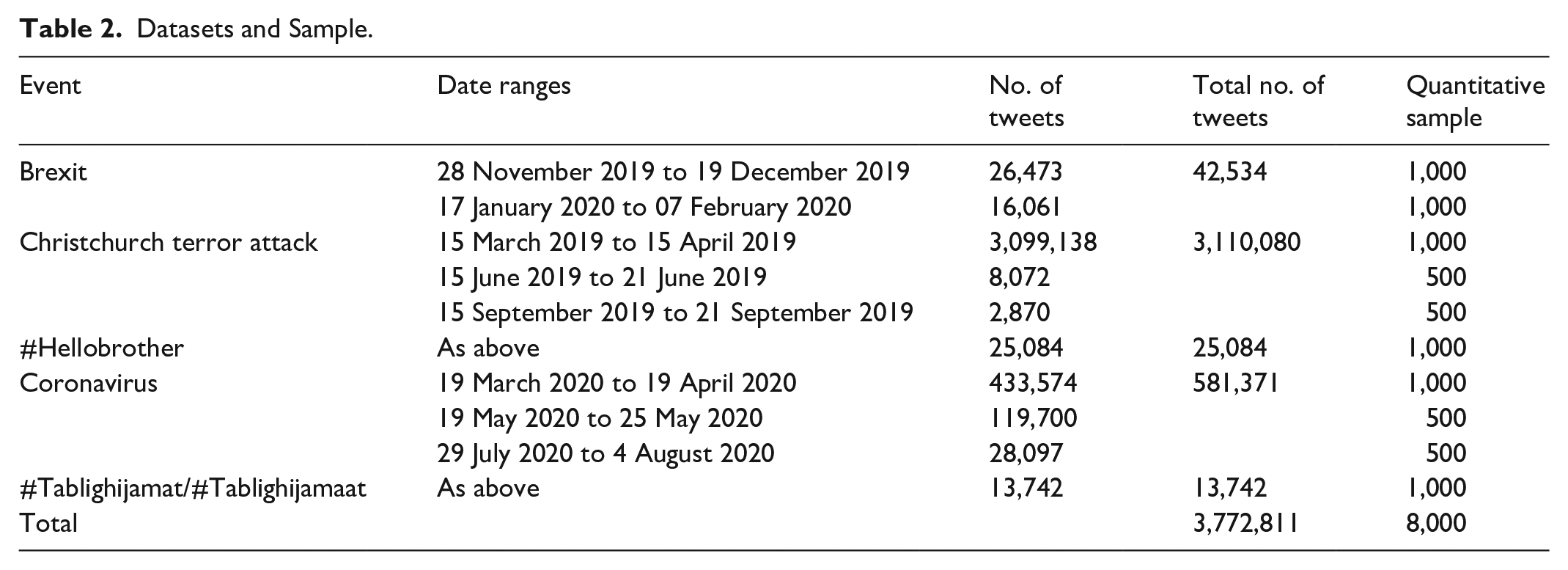
For the Christchurch terror attack, we searched for all tweets using the search terms 1 for a month following the attacks and a week 3 months and 6 months later. For COVID, 2 we selected a month at the height of the pandemic followed by a week around the two Eid festivals in 2020. For Brexit, we chose a 3-week period around the General Election 2019, and the Brexit date, January 2020. Thus, for each event, there were 6 weeks of data. Some of the decisions that were necessary in the selection criteria for the inclusion of Tweets were challenging and demonstrated the necessity for big data studies to be transparent about their methods and research design when reporting their findings. For example, the presence of quote tweets meant that we had to decide whether at least two of the search terms should be in both elements of the tweet or in either; we also had to decide whether tweets that had been originally posted outside our date range but retweeted within it would be included. In our case, we went for the most inclusive approach to gather the widest range of tweets possible and then ran searches which were checked manually for validity.
Big data studies clearly have their advantages in allowing an analysis of large datasets, identifying longitudinal patterns in the development of networks and framing, but have been criticized for a lack of transparency, and assumed accuracy and objectivity in the way the results are gathered and presented (Boyd & Crawford, 2012). Issues around categorization, decontextualization, and therefore reproducibility are multiple (see Giraud et al., in press). For this reason, we triangulated our methods by applying a quantitative and qualitative content analysis to the resulting 10 datasets derived from the different events and date ranges, and by extracting 2 popular hashtags. We then selected the top 1,000 retweeted tweets in each of the large datasets (longer date ranges) and 500 in the shorter date ranges to produce a sample of 8,000 for quantitative content analysis (see Table 2). From these files, we analyzed the top 50 shared tweets qualitatively (500 tweets).
One significant limitation of focusing on highly retweeted content was the prominence of high-profile accounts (celebrities, politicians, and journalists) in our datasets, marginalizing the everyday user and potentially further obscuring the voices of Muslim actors (due to platform affordances that reinforce “non-performative” white privilege, Ahmed, 2004). However, this sample produced the tweets that had the most traction and were therefore most visible in these discursive events, highlighting whose voices are able to gain primacy in solidarity networks that emerge around trigger events.
We measured for 20 variables including time, no of retweets, tweet type, location, affiliation, topic (primary and secondary), use of emojis/URLs and other features, #hashtags (informed by the big data), and whether the account/tweet had subsequently been deleted, tweaking the coding schedule slightly for each event, for example, including a “position on Brexit” variable for the Brexit analysis. We initially adopted a granular approach to analyzing topics with approximately 20 per event but following a first analysis, we recoded these into 5–6 broader topics such as anti-Muslim, anti-left, and global politics to provide an overview of the data that can be cross-referenced to the more detailed categories.
Lengthy discussions were held to define categories and coding (completed by one experienced researcher) was checked regularly by the PI to ensure agreement and consistency. Similarly, three of the research team carried out the qualitative analysis supported by frequent meetings to discuss the analysis and share conclusions across the datasets. Although we recognize the limitations of our methodology, through the scope and range of methods used, and the transparent approach, we can provide some valuable insights into the way Islam and Muslims are discussed on Twitter in relation to our chosen events. Importantly, we adopt a critical data studies approach that seeks to analyze power structures and unequal relations in our dataset while acknowledging the social processes involved in producing them (Dalton et al., 2016). This article draws on all the methods used to present an overview of solidarities present in the datasets as a whole but with more evidence drawn from the quantitative content analysis to enable us to identify overarching patterns.
Media Solidarities With Muslims
Because of the problems associated with sentiment analysis (Ligthart et al., 2021), we did not measure for tone in the big data analysis. Table 3 shows the results from the quantitative content analysis in terms of the proportion of tweets that contested or propagated Islamophobic content.
Solidarities with Muslims.

This dataset was actually mixed, but there was more retweeting of the anti-Muslim content which gave it a negative bias overall (see Table 17).
Ostensibly, Twitter, in this period—post the Capitol riots and pre-Musk, appears to be a more supportive space for Muslims. This suggests that in the Twittersphere (as opposed to legacy media), Muslim allyship is more normative, potentially due to the number of elite actors in our quantitative sample who, seemingly, wished to offer the appearance of supporting equality. Taking each event in turn, we now interrogate our data in more depth to reveal how distinctive entanglements between platforms and events mediate the dominant shape of solidarity.
Brexit: Expedient Solidarities?
To an extent, our Brexit datasets could be classified under the weakest mode of solidarity described by De Blasio and Selva (2019). However, the dynamics we identified—which we describe here as “expedient solidarities”—were ambivalent and complex, ultimately resisting neat classification. Drawing on the quantitative content analysis of tweets that discuss Muslims/Islam and Brexit around the time of the General Election 2019 (from here on, this dataset will be called Brexit 1), there is evidence of a strongly pro-Muslim, anti-Brexit set of tweets. Table 4 shows that 47.8% of these support Muslims compared with 14.7% who are anti-Muslim. These tweets are largely “clicktivist” reactions to racism by the ruling Conservative party or individual responses that leverage allegations of Islamophobia to support wider criticisms of anti-immigration right-wing movements. Table 5 shows how tweets are also more likely to be anti-Brexit, 35.1% compared with 9.1% that are pro-Brexit.
Position on Islam/Muslims.

Position on Brexit.
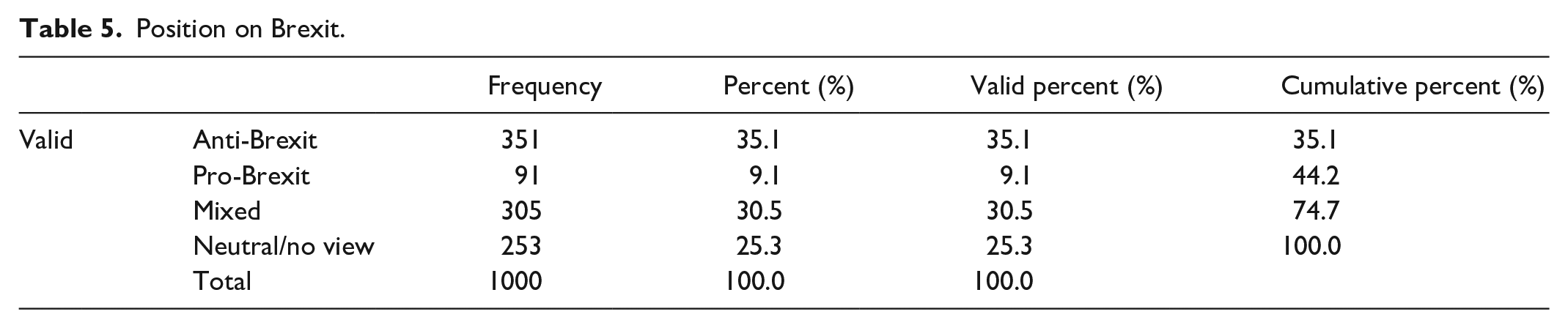
There is also a strong correlation between these positions with a 99.9% significance between the 2 as demonstrated in Table 6.
Position on Islam/Muslims * Position on Brexit Cross-tabulation.

If we take into account how often these tweets have been retweeted, the support for Muslims is amplified with 10,353 tweets supporting Muslims compared with 1,077 that are Islamophobic (Table 7). Most of these appear to be political allies as only 3.5% of accounts identify as Muslim (this could be higher as we only coded those who stated their religion explicitly, to avoid assumptions).
Shared Tweets in Brexit 1.
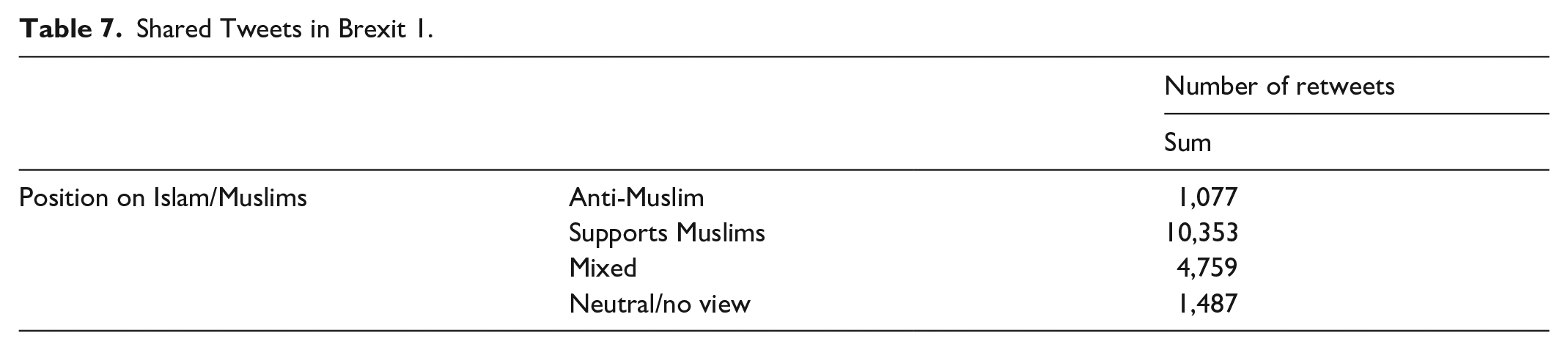
However, if we examine both the topics shared and the qualitative data, expressions of solidarity appear to be politically opportunistic, as a way of attacking political opponents at the time of an election rather than prioritizing anti-Muslim discrimination. Table 8 shows the number of tweets (combined topics) about anti-right agendas (41.6%) compared with pro-Muslim tweets (25.4%).
Topics of Tweets.

An analysis of the more granular categories of topics shows that anti-conservative politics (32.2%) remained the top topic of a tweet followed by pointing out Islamophobia (16.1%), racism in British politics (8.3%), and then anti-far-right politics (6.2%).
Looking at the tweets qualitatively further validated these findings and demonstrated the large number of Labour/left tweeters criticizing the Conservative Party for their Islamophobia. This was particularly apparent following a BBC Leader’s debate in the run-up to the General Election when Boris Johnson was challenged about Islamophobia in the Conservative Party and then accused of deflecting the question with his response—his focus was to “Get Brexit Done.” Out of the 50 most shared tweets, 9 directly respond to the BBC Leaders debate with a further 28 discussing British politics, many of which are clearly a response to the program, attacking Johnson and the Tories using a list of despised characteristics, Islamophobia being one of them. At least 30 tweets are explicitly anti-Islamophobic, but in attacking this as a negative trait of Johnson’s, another 8 are implicitly pro-Muslim. Only seven are explicitly anti-Muslim out of these top retweeted tweets. Nineteen of the tweets overtly mention Islamophobia but, taking as an example, the fourth most shared tweet (1,089 RT, 54 QT, and 2,958 likes) by Sayeeda Warsi (a Conservative peer) (see Figure 1), the replies do not sustain this aspect of the conversation.
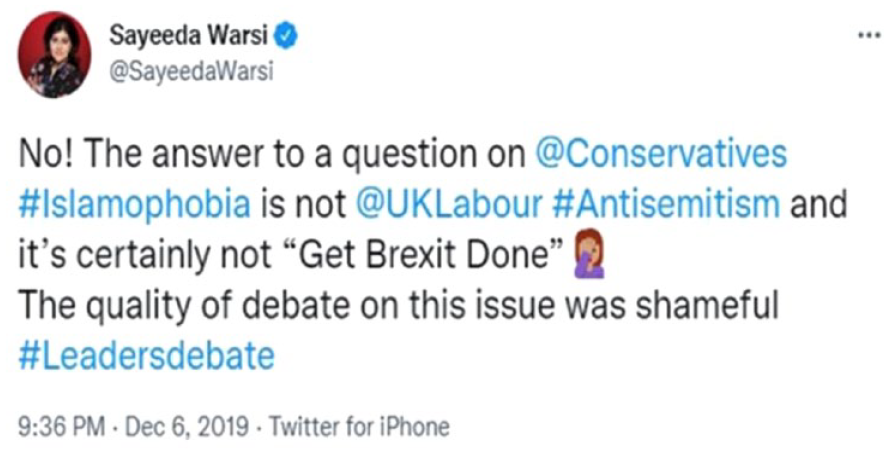
Tweet contesting Islamophobia.
Of the 72 replies, most agree with the sentiment of the tweet but to attack Johnson and the Conservatives. Islamophobia is only mentioned in six to seven 3 of these replies and appears again to be sidelined as one of several bigoted views communicated by Johnson, rather than the principal issue. Of these tweets, some directly accuse the Conservatives of being racist or Islamophobic (and antisemitic) with replies centering on two questions: Why do Muslims vote for the Conservatives and why is Warsi in the party? One tweet explicitly uses the hashtag Toryracism and quotes the rise in hate crime following a high-profile 2018 newspaper article, where Johnson compared Muslim women with letterboxes. There is some also “whataboutery” aimed to direct attention away from Islamophobia to anti-Semitism in the Labour Party. It is notable, moreover, that only a handful of Muslims respond (three to four). The pattern of responses to Warsi’s tweet is repeated throughout the tweets in this dataset.
Overall, this dataset suggests a mostly expedient solidarity with Muslims that—if placed on a spectrum—would align with weaker conceptions of solidarity, such as emotional clicktivism. However, this conclusion is perhaps overly simplistic. Evolvi (2018) describes how Islamophobic Twitter discourse related to Brexit has emerged from, and in turn consolidated, antagonistic collective identity that is grounded in white supremacist values. This shared identity, Evolvi argues, inflamed by moral panics about “Muslim cultural practices” (see Yilmaz, 2012, 2014) has often manifested as a “hegemonic bloc” around imagined “common cultural values” of white, British citizens. Against this backdrop of a collective, antagonistic, anti-Muslim identity, the consistent presence of anti-Islamophobic critique is suggestive of something beyond expedience; if the data are taken as a whole, rather than treating individual tweets in isolation, they illustrate how sustained contestation of Islamophobia has become integrated into counter-hegemonic articulations of “polyvocal” left-wing values (Ruiz, 2014).
The second Brexit dataset, at the time of Britain’s exit from the European Union (31 January 2020), adopts a more predictable pattern, rehearsing common media tropes about Muslims around immigration and Brexit (immigration, grooming gangs, and attacking “liberal media”) (see Evolvi, 2018) with a strong correlation between being pro-Brexit and anti-Muslim, and vice versa (having a 99.9% significance, demonstrated by Table 9). More accounts are deleted in this dataset, 17.6%, and 15% suspended, which is also suggestive of more extreme content. Despite this, there is still a strong anti-Conservative voice in the data, the biggest single story is that of Tory MP Daniel Kawczynski, who was widely criticized for speaking at a conference that included far-right anti-Muslim politicians. Islam is again often a secondary issue used to attack political groups/politics around Brexit.
Position on Islam/Muslims * Position on Brexit Cross-tabulation.

Table 10 shows the dataset has a greater predominance of anti-Muslim tweets (43%) but still with 30.8% that are supportive.
Position on Islam/Muslims.

Similarly, more people are pro-Brexit, 33.6% compared with 28.1% who are anti (Table 11).
Position on Brexit.

With a strong relationship between the two positions, the most prominent topic category further demonstrates how the political agenda dominates the narrative over and above the anti-Muslim discourse and shows how this is being used as a political tool to attack opponents (Table 12).
Top Occurring Topics.

Although the dataset as a whole shows a greater incidence of right-wing anti-Muslim discourse, in the top retweeted tweets (1,000), there is a greater balance between those tweeting their support and attacking Muslims. If these topics are further broken down, anti-conservative politics actually featured most (16.8%), then specific anti-Muslim topics (9.9%), pointing out Islamophobia (8,8%), pro-Conservative politics (8.2%), and right-wing criticism of mainstream media (7.6%) although terrorism and immigration also tend to be discussed in negative terms. This pattern is also evident when we examine the top 50 shared tweets qualitatively with 25 opposing or implicitly opposing Islamophobia and 19 supporting, which equally demonstrates the antagonism surrounding the topic (Brexit). The initial finding that this dataset is predominantly negative is further undermined when we look at the number of retweets that anti-/pro-Muslim tweets receive. Tweets that support Muslims are shared almost double the number of times of those that are Islamophobic (6,478 compared with 3,733; Table 13).
Number of Retweets.

While there appears to be a strong anti-Muslim voice in this second dataset then, again Islamophobia is centralized as a key issue in wider leftist counternarratives and suggests a commitment to maintaining a sense of solidarity.
The Christchurch Terror Attack: Affective Solidarities?
We now move onto our Christchurch datasets, which offer a further illustration of the complex relationships between different articulations of solidarity. As the largest dataset in our sample by far (almost 3 million tweets) the outpouring of condolences and condemnation of Islamophobia in the wake of Christchurch seems to be a clear-cut instance of an affective public (Papacharissi, 2015). Generally conceived of as more ethico-politically significant manifestations of solidarity than individualistic clicktivism due to their collectivity (De Blasio & Selva, 2019), affective publics still hold limitations due to their ephemerality. Initial impressions of our data seemed to map onto these dynamics, which indicated a rapid coming together of a transnational public in opposition to Islamophobia that dissipated equally rapidly. Again, though, closer examination reveals a multidimensional picture of this initial public wherein collective antagonism (that gave rise to a sustained critique of the political establishment and disrupted normative media frames) was juxtaposed with individualistic performances of sympathy.
Unsurprisingly, following such a negative event, the main Christchurch dataset—a month of tweets following the attack—is extremely supportive of Muslims (73% of the top 1,000 retweeted tweets). Politicians, journalists, and other high-profile personalities seek to demonstrate support and show sympathy; these affiliation categories account for 34% of tweets, 46.6% including alternative media/journalists. The most shared tweet is Barack Obama’s; the RT count at the time of capture was 61,153 but, as can be seen in Figure 2, is now significantly higher. The most cited location is the United States in 32.5% of accounts, demonstrating the dominance of the Twittersphere by Anglophone elites. As a case of mediated commemoration (Harju, 2019), it is unsurprising that condolences, tributes, and solidarity are the dominant single topic of tweets (25%), but Islamophobia is a significant secondary topic (16.2%). Criticisms of right-wing politics, whether that be center or far-right, are the subject of 34.4% of tweets with another 8.4% focusing on right-wing terrorism. The lower proportion of deleted accounts (4.3%, 1% suspended) and higher number of self-identified Muslim accounts (13.9%) are also indicative of a more supportive corpus of tweets. The big data supports this; out of 3,099,138 total tweets, Table 14 shows the most tweeted words, with an analysis of the collocations showing that discussion of Trump is largely negative (in driving the politics of hate).

Most retweeted tweet on the Christchurch terror attack.
Most frequently used words in tweets on the Christchurch terror attack: Big data sample.

Given the high number of politicians, celebrities, and other personalities in this dataset, it is, however, questionable how genuine or meaningful this solidarity is. The performance of solidarity on social media has been criticized as an example of networked individualism (De Blasio & Selva, 2019), an easy way of virtue signaling through the click of a button that often does not translate to any further action or debate. This is partly demonstrated by the low level of interaction by original tweeters with their followers (though this is not uncommon among high-profile users). In Sara Ahmed’s (2004, NP) terms, this level of solidarity would be defined as non-performative; “declarative speech-acts” that “do not do what they say,” acknowledging rather than ameliorating structural inequalities.
Yet, due to the dynamics of Twitter as a platform, simplistic or problematic expressions of solidarity are quickly contested by users seeking to disrupt the hegemonic mode of commemoration with critique (see also Richardson et al., in press). An example of this is in Figure 3. The Clinton family’s accounts are already highly contested on social media, given the polarized political landscape in the United States.

Tweet by Chelsea Clinton in response to the Christchurch terror attack.
As well as offering condolences, Clinton politicizes the event, addressing the issue of white nationalism by labeling it as a “white nationalist terrorist attack.” She also demonstrates a level of religious expertise in referring to “Jummah.” This generates over 100 (often emotional) responses and much praise and thanks, but some users accuse Clinton of hypocrisy both in relation to an event that occurred the day before, when she apparently criticized Muslim congresswoman Ilhan Omar, and also as an outright rejection of her condolences due to her familial political connections. One Muslim tweeter directly attacked her family’s role in “murdering” Muslims in the Middle East, for example. This pattern of undermining high-profile accounts, particularly those of politicians who are accused of making political mileage out of the event, is also evident in relation to, for example, Boris Johnson, Imran Khan, and Madeleine Albright. It is also apparent in the number of original tweets that highlight the media’s double standards in the way Muslims are categorized in cases of terrorism (in 7.3% of tweets). Many call out the media for labeling the terrorist as “shooter” or for suggesting Muslims should stay at home increasing their marginalization rather than focusing on the perpetrators of hate. This demonstrates a cycle of communication on Twitter, through responses to disinformation and undermining “experts,” that is part of its political and emotional regime. While it highlights the “non-performativity of anti-racism” pointed out by Ahmed (2004), it does little to transform the structures that reinforce it.
These dynamics lead to a further issue: lack of efficacy in relation to the long tail of racism. As the shock of the event diminishes, the more distant in time the event becomes, the more support evaporates and far-right voices emerge, raising questions over the sustainability of solidarities online in relation to trigger events. This has been demonstrated previously through responses to the Brussels terror attack when, over time, the counternarratives to #stopIslam gave way to ongoing right-wing racism (Poole et al., 2020). We argued that, at the time, this pattern was partly due to the manipulative tactics of tight networks of right-wing actors that had access to a wide range of “evidential” sources to close down progressive voices. There is less evidence of these interventions in this particular case study, due to the nature of the event, and the greater moderation of US right-wing activists online, but it is clear that the event is still appropriated to advance particular agendas, around gun control, for example. Table 15 demonstrates the decline in the pro-Muslim voices as a proportion of each corpus of tweets after the initial attack.
Percentage of Pro- and Anti-Muslim Tweets Over Time.

Rather than an increase in anti-Muslim discourse (3 months after the attack), there is a jump in the number of tweets that do not express a position on Muslims but advance other right-wing agendas such as the censorship of content online (following the prosecution of users for sharing hateful content in New Zealand). These provoke a largely negative response, particularly from US users, as they seek to shore up support for the status quo in the States. The proportion of US users continues to be high in both June (28.8%) and September (30%) and demonstrates the continued appropriation of events by right-wing users for their own causes. Some of these pro-gun lobby accounts share memes that draw on anti-Muslim tropes to further their agenda, illustrated by Figure 4.

Meme shared by an anti-Muslim, pro-gun, pro-American account.
It is evident that trigger events on Twitter can lead to an outpouring of support for the victims of specific events and crimes such as terror attacks. However, many studies have noted this long tail effect in the temporal flow of Twitter seen here (also described as a “solidarity plateau” by Collins, 2004). Given the evidence from the qualitative content analysis, this further reinforces our argument that, when these positive counternarratives decrease, along with visible public commentary and media interest (individual accounts increase from 28% to 59%), the long tail of racism continues (Figure 5). However, the Christchurch terror attack also represents a shift in mainstreaming discussion of attacks by white far-right actors as terrorism inspired by white supremacist ideologies seen also in conventional news (El-Nawawy & Hasan, 2022).

Graph showing the decrease in the number of tweets following the Christchurch terror attack.
The complex picture emerging from these findings, therefore, underlines the multidimensional properties of the solidarities that emerge from affective publics.
Coronavirus: Sustained Solidarities?
Our COVID datasets are perhaps our most complex still, in suggesting how reactive counter-speech can evolve into collective narratives of solidarity that are sustained over time. There is already significant evidence of the increase in online hate, misinformation, and extremism in general following the pandemic but also that aimed at Muslims in particular (Awan et al., 2021, 2022; Bajoria, 2020; Jadhav, 2020; Nagar & Gill, 2020; World Health Organization (WHO), 2020). Minoritized groups in the United Kingdom were disproportionately affected by the pandemic, with Muslim men significantly affected (Public Health England, 2020; Ullah, 2020). Examinations of structural discrimination soon gave way to scapegoating in the British mainstream media (Poole & Williamson, 2021) with a distinct difference in the way stories were racialized between those reporting the death of Muslim health workers compared with issues around social distancing.
It is perhaps unsurprising, therefore, that this dataset provides much stronger Islamophobic sentiment, but this subsides somewhat with time. This is due to negative messaging about social distancing among minoritized people during the pandemic, in particular, Indian users and accounts tweeting negatively about Muslims (37% in date sample 1). In the big data, Sample 1 (of 433,574 tweets), India or Indian is mentioned in the account bios 24,808 times, Hindu 10,650, and nationalist 7,417 times. The evidence points to less rigorous moderating in this context but could also reflect the normative position of moderators in India (see also Ghasiya & Sashara, 2022).
One event received significant coverage on both Twitter and quite extensively in mainstream media (both in India and elsewhere) which can be seen in the prevalence of the hashtag #tablighijamaat (13,742 tweets). The Tablighijamaat’s (a transnational Sunni Islamic movement) annual gathering in Nizamuddin (Delhi, India), received international delegates, many of whom became stranded when lockdown rules were imposed, was accused of being a superspreader event (Aschwanden, 2020) and led to a nationwide search for people who had attended. The event gained significant attention despite the fact there were many other religious gatherings in India at that time (Tierie & Ranjan, 2023). Other studies on Islamophobic content on social media in India have demonstrated how this event, and COVID, more generally, was the subject of a purposeful anti-Muslim campaign promoting Hindutva ideology (cultural nationalism) including a BJP 4 “IT cell,” which resulted in increasingly polarized content in the Indian Twittersphere (Ghasiya & Sashara, 2022; Prasad, 2020).
Tweets provided regular updates on ongoing incidents of delegates being traced and testing positive around the country (see Figure 6). Many tweets suggested that Muslims were trying to evade the authorities, implied criminality, violence, extremism, and even terrorism. Ridicule was also used prejudicially. Other tweets, particularly from news organizations, were not explicitly Islamophobic but casually linked the event to rising infections. Notably, 48.2% of tweets that used this hashtag were anti-Muslim, compared with 21.5% that were positive. A total of 64.1% of the account holders were from India, and the retweets were largely circulated in India, 11,008 times (out of 12,811 total retweets). The tweets that contained the narrative that Muslims were spreading COVID were also more likely to be circulated, 7,794 times. There was, however, considerable contestation in this hashtag with 41% of the top retweeted quote tweets disagreeing with the sentiment of the original quote compared with 31.5% that agreed (although only 22% of the sample are quote tweets, 187 tweets). The Emergency Program Director of the World Health Organization, Mike Ryan criticized the misinformation and unsubstantiated evidence circulating in this campaign (Jain, 2020). Ghasiya and Sashara (2022), in their study of the controversy on Facebook, found similar link-sharing behavior (sharing misinformation) and small but tightly-knit right-wing sharing activist communities which have previously been observed in US Islamophobic campaigns (Poole et al., 2020). 5 These patterns have also been noted by our interviewees, who participated in sharing counternarratives, in the next stage of the research project.

Popular tweet reporting on Tablighjimaat delegates (1,815 RTs at the time of data gathering).
Other Islamophobic propaganda intensified such as the forced conversions of Hindu families in Muslim-majority countries during lockdown, Muslims resisting restrictions on gathering, or encroaching on Hindu land for Muslim burials. The moral panic about Muslims not social distancing was also evident in the United Kingdom, particularly as Eid al Fitr approached in May. The discourse about many ethnic minorities dying from COVID quickly transformed into blaming these groups for their own high infection rates and the spread of COVID (Poole & Williamson, 2021). Samples 2 and 3 were selected around these religious festivals for that reason. The data shows that, despite the negativity in the month at the peak of the initial outbreak of the pandemic in 2020, there were still more supportive tweets than anti-Muslim (Table 16). However, as Table 17 shows, significantly more people engaged with the negative tweets in Sample 1. More surprisingly, given the mainstream discourse about Muslims and social distancing, Samples 2 and 3 were not only more supportive but more people engaged with these tweets. The number of Muslims who engaged in this dataset was generally higher and increased over the period from 23% to 25.8% to 26.6% and will be a factor here. Sample 3 also contains a debate from the United Kingdom where Labour MPs, among others, criticized a Conservative MP for blaming minorities for spreading COVID which generated significant and polarized contestation.
Pro- and Anti-Muslim Discourse in Original Tweets.

Pro and Anti-Muslim Discourse When Factoring in the Retweets of Original Tweets.

What is interesting about this dataset is that the strength of the attack on Muslims in the Indian context appears to have resulted in more active countering and spaces of resistance. Pro-Muslim discourse in Sample 1 tended to be either defensive, circulating counternarratives that show Muslims carrying out positive but potentially undesirable, activities (bearing coffins, offering aid, and burying the dead), tributes to COVID victims, or fact-checking tweets. Specific groups and hashtags were proactive in challenging Islamophobic narratives such as #altrightfactcheck and Documenting Oppression Against Muslims. For some of the Indian Muslim and diasporic Indian Muslim groups challenging these narratives, it is important to occupy the counternarrative space (as well as circulating alternative narratives) and not leave this empty, according to interviewees. Thus, engagement with these negative narratives, which has been criticized by our previous work for amplifying Islamophobia, retained an important function in this dataset, by redefining narratives, and demonstrates the complex entanglement of solidarities online (Figure 7).

Counternarrative tweet.
The positive tweets in Samples 2 and 3, however, tended to be either Eid greetings, often from high-profile figures and politicians (international) such as Narendra Modi, President Erdogan of Turkey, Nigerian politicians, and British MPs, which explains the high level of engagement. Neutral tweets were also more extensive due to the information campaigns by governments and organizations encouraging Muslims to celebrate Eid responsibly (see Figure 8) or by Muslim countries showing Muslims practicing Eid during the lockdown.

UK Government messaging during COVID.
There is still evidence of alt-right US appropriation of events in these samples, using unverified videos to show alleged “Muslims” engaging in communal activities, even “brawls” during lockdown, particularly in the United Kingdom, and accusing the media of censorship.
Despite being a much more negative dataset, reflecting geopolitical flows on Twitter, it also shows the strong solidarity with Muslims in general whether that be non-performative, communal, or activist groups seeking to strategically challenge Islamophobia on Twitter. The rise of Islamophobic social media content from the Indian subcontinent has been noted by numerous studies (Awan & Khan-Williams, 2020; Ghasiya & Sashara, 2022; Rajan & Venkatraman, 2021). It is interesting that the pattern of prejudice is reversed in this dataset where the initial reaction of the far-right leads to intensely negative tweeting which gives way to a more positive “long tail” effect over time. It appears that the serious and sustained negativity generated by the event, particularly in India, has given rise to a more sustained, strategic effort to combat it.
Conclusion
This article demonstrates expressions of solidarity shown with Muslims in relation to three significant trigger events. While elements of these solidarities seem to adhere to a continuum of commitment according to De Blasio and Selva’s (2019) categories, overall the solidarities we identified were cross-cutting and multidimensional: with collective potentials entangled with clicktivism, and affective publics revealing themselves to be more heterogeneous in their narratives than first impression. As a whole, moreover, and as underlined by our COVID datasets in particular, despite the weight of research that shows how Twitter often reinforces Islamophobia, this project also shows how collective contestations of Islamophobia have been sustained, and gathered force, over time.
The potentials we have identified do not negate the continuing racism and Islamophobia that exists on Twitter, despite the growth of moderation during the period of study: from banal racism (Siapera, 2019) in discussions of “social distancing,” to the continued presence of violent content such as the video of the Christchurch terror attack. Solidarity’s limitations are rooted in Twitter’s infrastructure structurally benefiting from Islamophobia, both economically and culturally, which presents a challenge for meaningful change. In addition, Twitter’s logics mean that the platform affords uneven visibility, with the most prominent expressions of solidarity often emerging from celebrities and elites rather than the perspectives of those most affected by Islamophobia.
Yet, while we remain highly critical of some dimensions of the solidarities we identify, our findings shift the analytic and political focus away from wholesale dismissals, or critiques, of ostensibly “weak” solidarity, to questions of how latent potentials could be activated. While social media’s capacity to create structural change is unclear, counternarratives that are sustained over time can emerge from deeply ambivalent articulations of solidarity. These findings underline the value in discursive struggle, in extending voice outwards, shaping narratives, and raising political awareness, as prerequisites for mobilization. These potentials are illustrated in the way that online Islamophobia about COVID has not only driven active mobilization to counter and reframe these narratives but also led to community-based initiatives in the United Kingdom such as the Muslim Charities Forum’s (2021) “campaign for national solidarity” with the hashtag #togetherwecan (Ouassini et al., 2022).
Providing an overview of patterns of solidarities with Muslims skips over the nuances that are contained even within a single tweet, so we accept that the approach taken in this article reduces a multitude of complexities. Focusing largely on the quantitative data can also exclude the negotiations and competing responses from the analysis. At the same time, our findings underline the value of examining trends across a large body of data. Our comparative, longitudinal approach, for instance, enriches conceptions of Twitter as a platform. Existing scholarship foregrounds how Twitter has been exploited by the far right to extend populist narratives and spread xenophobic disinformation (Farkas et al., 2017; Horsti, 2017; Poole et al., 2020; Siapera, 2019). This body of research underlines that, despite brief peaks in expressions of solidarity, Islamophobic narratives associated with trigger events tend to outlast counternarratives (Poole et al., 2019; see also Siapera et al., 2018). In our analysis, however, although some of the findings illustrated similar patterns of solidarity discourse giving way to hate speech (notably Christchurch), in the brief time period between Twitter’s intensified moderation post-Capitol attacks in 2020 and Elon Musk’s acquisition of the platform in 2022, articulations of solidarity were able to shift from a counternarrative to dominant position. The rise of sustained solidarity narratives, we suggest, should not be understood as a wholesale break with clicktivism but speaks to the multidimensional potentials of solidarity, which can emerge as user-platform-event relations evolve.
Footnotes

Declaration of Conflicting Interests
The author(s) declared no potential conflicts of interest with respect to the research, authorship, and/or publication of this article.
Funding
The author(s) disclosed receipt of the following financial support for the research, authorship, and/or publication of this article: This research was supported by an Arts and Humanities Research Council grant AH/T004460/1.
Ethical approval
For the purpose of open access, the author(s) has applied a Creative Commons Attribution (CC BY) license (where permitted by UKRI, “Open Government Licence” or “Creative Commons Attribution No-derivatives [CC BY-ND] licence” may be stated instead) to any Author Accepted Manuscript version arising.