




Abstract
This article intervenes in debates about whether public-facing social media enable the rapid spread of hate speech, or whether these platforms can offer valuable opportunities to contest it. Advancing scholarship on ‘networked counter-publics’ and research emphasising the affective dimensions of digital media, we identify three different modes of counter-public contestation that coalesced on Twitter in the immediate aftermath of the Christchurch terrorist attack. Using a combined keyword and hashtag search, our research project sampled 3,099,138 tweets posted on/about the Christchurch attack and its repercussions, between 15 March 2019 and 15 April 2019. First, we examine two hashtags that trended, approaching these as nodal points for the construction of different affective responses to the terrorist attack. Second, we analyse instances where users quote-tweeted the condolences of politicians, rejecting their sentiments, arguing that the sincerity conditions of the Speech Act (condolence) were not met. Here, we focus on the ways that people invoke a discourse of indignation at either the past actions or current character of the politician, to justify rejecting their statements. Our findings illustrate a need to depart from broad narratives about how the affordances of particular social media platforms lend themselves to the circulation or contestation of hate. Instead, we argue, it is important to develop more situated empirical and conceptual approaches to interrogate how specific relationships between affective publics and structures of feeling enable or constrain political possibilities.
Introduction
On 15 March 2019, New Zealand suffered its most egregious terrorist outrage. An extreme-right, white-supremacist terrorist attacked two mosques in Christchurch, murdering 51 Muslim men, women and children and injuring 40 others. He revealed the depths of his hatred for Muslims, and other minorities, in a document he circulated online, immediately before starting the attack. The first 17 minutes of his crimes were live-streamed on Facebook, until the New Zealand police contacted Facebook and the video was taken down.
The reaction to the attack on Twitter was immediate and vociferous. We sampled over 3 million tweets on or about the terrorist attack and its repercussions between 15 March 2019 and 15 April 2019, and the vast majority of those tweets were written in the first 48 hours. This article mainly focusses on the 1000 most retweeted tweets within this date range, to focus on the most visible tweets posted. A significant portion of these tweets offered condolences for the victims (n = 205) and/or support for the survivors (n = 121), however this wasn’t universally the case. And just looking at those frequencies doesn’t tell us the full picture: how was that support expressed? Were solidarities meaningful or weak? And was that support instrumentalised, or leveraged, to serve a parallel political agenda?
This article draws on data from a longitudinal project on the articulation and contestation of Islamophobia on Twitter, in response to three political ‘trigger events’ (Awan, 2014) between 2018 and 2021: ‘Brexit’, that is, Britain’s exit from the European Union; the start of the COVID-19 pandemic; and the terrorist attack in Christchurch. Whilst only one of these trigger events – the terrorist attack – affected Muslims particularly, the other two events were also discursive flashpoints where narratives of Othering were complicated by articulations of solidarity.
While much of the discussion of the role of social media in the Christchurch terrorist attack has been on the terrorist’s use of live streaming (cf. Ibrahim, 2020), in this article we are interested in examining how the attack is absorbed and understood vis a vis more ‘banal’ Islamophobic discourses (Essed, 1991), or discourse which backgrounds Muslims’ lived experiences of Islamophobia. Part of our wider research project (not examined in this article) analysed symbiotic relations between Twitter and legacy media, and the processes through which (counter-)narratives gain wider visibility in the mainstream media. In the immediate aftermath of the attack, Twitter was often used as a news source in mainstream media reporting, quoting tweets from users, particularly those that provided details of victims and their last words. In these articles, the terrorist was described in incredibly negative ways: as a ‘self-confessed white supremacist’, an ‘evil far-right mass killer’, or a ‘twisted killer’ who shot people ‘mercilessly’, in a ‘horrific’ and ‘sickening’ attack. He was therefore represented as being completely outside of, and contrary to, ‘Our’ values, which in effect denies any contiguities between him, and his beliefs, and Islamophobic tropes reproduced in contemporary social and political discourse. On this point, the Royal Commission of Inquiry into the terrorist attack on Christchurch Mosques quoted a survivor, who stated that the attacks ‘are seen as a culmination of, rather than an exception to, the everyday lives of Muslims’ in New Zealand. 1 Some news articles did raise the question of anti-Muslim racism in New Zealand – for example, a Vicar from New Zealand, was quoted declaring ‘We have to ask some really serious questions around racism and othering and how we welcome immigrants and let them know that they’re not immigrants, they are part of our community’. 2 This is clearly an attempt to express an anti-racist viewpoint and advocate for social change. However, it is slightly derailed by two banal assumptions: first, she positions Muslims in New Zealand as a community of immigrants, who need to be welcomed, despite the fact that 23% of Muslims in New Zealand were born there. 3 Second, the white terrorist appears to have been implicitly included in the category ‘We’ (those who welcome/respond to immigrants), despite actually being an immigrant himself. These slippages point to a political imaginary, of an apparent ally, where Muslim New Zealanders need to be informed ‘they’re not immigrants’, but the non-national status of the white Australian terrorist is elided.
In analysing the emergence, circulation and contestation of anti-Muslim discourses our project seeks to advance an understanding of the tensions that social media create for communities seeking to contest disinformation and racism circulated by anti-Muslim individuals and networks. We hope that focussing on the complex, transnational politics of appropriation that occurs within counter-narratives, will help us to develop more situated empirical and conceptual approaches to interrogate how specific relationships between publics, narratives and structures of feeling enable or constrain political possibilities.
The remainder of this article is structured as follows: first, we provide scholarly context to discourse on Twitter, focussing on academic work that examines the platform’s relations to prejudice, to affective communities and to argumentative engagement. Second, we summarise our data and methods and briefly present some quantitative findings for the first month of tweets in the Christchurch corpus (3.1 million tweets). Third, focussing on the 1000 most retweeted tweets, we present our qualitative analysis of two interpersonal clusters in the data and the affective publics which coalesced around two hashtags that trended. Finally, we examine a particular subset of tweets, where users quote-tweeted and rejected the condolences of politicians, arguing that the politician lacks sincerity. Our examination of these groups of tweets illustrates a need for more a closer, situated empirical analysis of Twitter, instead of broad narratives about how the affordances of this social media platform lend themselves to the circulation or contestation of hate.
Literature review
In the wake of the well-documented rise of extreme-right politics in Europe and North America (Mammone et al., 2012; Wodak, 2020), and the proliferation of extreme content online in particular (Åkerlund, 2020; Froio and Ganesh, 2019; Vidgen et al., 2022), there has been widespread concern about social media being used in ways that normalises xenophobia and propagates disinformation about minority groups (Kreis, 2017; Siapera et al., 2018). Similar patterns, of the far- and extreme-right using online spaces for the dissemination of propaganda, community building and radicalisation, have also been observed beyond the Global North (Udupa, 2018). Leidig and Bayarri (2023) discuss far-right influencers in Brazil and India and show that, in both, there is ‘a proliferating social media community of far-right users, intrinsically linked to the rise of far-right political leaders’ (p. 9). Muslim individuals and groups, specifically, have been targeted, directly and indirectly, by Islamophobic content online (Awan, 2014; Evolvi, 2019; Horsti, 2017). Leidig and Bayarri (2023: 14), again, point to the transnational analogue between politicised Islamophobia in the West and in India, arguing that ‘[l]ike the anti-Islam and anti-Muslim mobilization of the Western far-right, Hindu nationalists seek domination on the basis of civilizational struggle, facing an alleged existential threat to ‘our way of life’ and cultural values’.
This article builds on a previous project which examined representation and contestation on Twitter following the Brussels terrorist attack of March 2016 (Poole, 2018; Poole et al 2019, 2021). They focussed on a hashtag – #StopIslam – that trended on Twitter in the wake of the bombings and the ways that it featured in tweets. The hashtag seemed to reflect longstanding anti-Muslim discourses in mainstream western European media and the ways that anti-Muslim racism is instrumentalised, particularly in right-wing politics. And the hashtag was initially used in that way: to demonise, to spread fear and loathing of Muslims and to demand their exclusion. However, what was notable about the hashtag is that it grew in prominence because those critical of Islamophobia engaged with it – replying to it, quote tweeting it and including it in original tweets – in order to criticise its original sentiment.
Accordingly, the same social media that have enabled the rapid spread of hate speech also offer opportunities to contest it. There is a body of scholarship that shows how platforms such as Twitter can facilitate the emergence of ‘networked counter-publics’ (Jackson and Foucault Welles, 2016) – nebulous and shifting groupings of progressive voices, who are able to move ‘debates about identity politics, inequality, violence and citizenship from the margins to the center’ (Jackson et al., 2020: xxxii). Such groups aim to exploit the affordances of Twitter, including visual and audio-visual content (such as memes and videos), lists, hashtags, automated tweeting and direct messaging, to recruit, mobilise, organise and disseminate information. One of the more successful Twitter-initiated campaigns, #BlackLivesMatter, has helped ‘to center marginalized voices, especially Black voices, [and] increase critical awareness of the damaging impact of racism and prejudice’ (Nartey, 2022: 524; also see Incea et al., 2017)
However, given the growth and prominence of the far-right online, other researchers have reached less optimistic conclusions regarding the longevity and impact of counter-narratives (Siapera et al., 2018) since extreme-right and conservative movements are often more successful at gaining visibility on commercial media platforms (Schradie, 2019). Ganesh and Faggiani (2023: 3) have shown how Russian ‘troll-farms’ have sought to weaponise Islamophobic networks in their broader campaign to ‘sow discord’ in the United States, generating anger and outrage in right-wing groups by claiming that white identities are under threat. As we argue in this article, an important factor that enables and constrains these online (counter-)narratives are their affective dynamics. It is necessary, therefore, to bring research about networked counter-publics into further dialogue with scholarship on the role of affect – and more sustained forms of emotion – in networked politics.
Affect and engagement
Papacharissi (2014) argues that the networked publics present on Twitter ‘are mobilized and connected, identified and potentially disconnected through expressions of sentiment’ (p. 5). These affective communities are characterised by particular emotional positions and opinion-based social identities (Döveling et al., 2018; Evolvi, 2019; Jaber et al., 2021). They coalesce through individuals sharing, and utilising, affective states and, in so doing, ‘develop a sense for their own place within this particular structure of feeling’ (Papacharissi, 2014: 118). A recent online ethnography examining ‘enterprise Hindutva’ as a mediatised form of ‘Hindu nationalism’ (Udupa, 2018: 453) has revealed ‘fun’ as a deep-seated feature of their online right-wing affiliation. Udupa (2019: 3144) found that, for these far-right volunteer-activists, ‘fun is a metapractice – practice of practices – that frames [their] distinct online activities of fact-checking, argumentative confrontations, assembly, and aggression’.
Rhetorical confrontations between networked publics on Twitter presuppose affective engagement (Ahmed, 2004; Milani and Richardson, 2021; Wetherell, 2012). Indeed, the centrality of affective practice is such that, in our analysis that follows, we prefer to conceive of users as affective publics rather than counter publics (De Blasio and Selva, 2019). The central affordances of Twitter – all users can comment on, praise or criticise what others (with unprotected accounts) have tweeted – combined with the disinhibition characteristic of much online discourse (Suler, 2004), the limited length of tweets (eschewing nuance) and limited functionality (users still cannot edit/correct what they have written, despite this being possible on newer platforms, such as Mastodon) work collectively to foment antagonistic political polarisation (Yardi and Boyd, 2010). This was particularly pronounced during the Covid pandemic, when right-wing activists utilised social media to canalise fear of the virus in the service of their political projects (Varanasi et al., 2022). In India, for example, misinformation about Covid was promoted by Hindutva Twitter accounts, particularly in the period following the lockdown, in order to increase communal prejudice against the Muslim minority (Akbar et al., 2021).
A central factor in explaining how xenophobic or racist tweets can gain more visibility is the way that they elicit affective responses and user engagement. Anger and its cognate emotions (outrage, indignation and resentment) are particularly significant affective responses, driving political engagement through directing antagonism against certain groups (Evolvi, 2019). Further, when users receive positive social feedback from their affective community for expressions of outrage, this increases the likelihood of future outrage expressions (Brady et al., 2021). Panda et al. (2020), for example, studied the use of extreme speech and personalised abuse on Twitter and found that Indian political actors are retweeted more frequently when they post uncivil or aggressive tweets. The algorithm Twitter has designed and uses ‘promotes’ tweets that receive engagement from other users, whether as replies, retweets or quote tweets. In this way, provocative or offensive tweets elicit intemperate exchanges between different (opposing) affective communities and, consequently, are given greater visibility. Thus, the communication and management of social and affective relations ‘is shaped by the architectures and affordances of the platform’, encouraging ‘forms of shared emotional alignment and amplification that can mark the polarity of a specific collective group’ (Boccia Artieri et al., 2021: 226). It is through expressing emotions that users ‘produce certain forms of shared alignments, that hold together or bind a collectivity’ and, in turn, allow us ‘to circumscribe the boundaries of an affective community’, or what distinguishes ‘us’ from ‘them’ (Boccia Artieri et al., 2021: 227).
Contestation is therefore fundamental to the fabrication of Twitter, to the manner in which it generates revenue, and central to the ways that users, as members of affective communities, react and interact on the platform.
Data and methods
Our project uses an innovative combination of research methodologies from ‘big data’ computational analysis, media studies and discourse analysis in a staged process. We sampled tweets over several date ranges, using broad content search terms ‘Islam*’, ‘Muslim*’, ‘Moslem*’, ‘Mosque*’ ‘religion of peace’ AND reference to the three news events we are analysing. (Anti-Muslim accounts use the outdated spelling ‘Moslem*’ and the phrase ‘religion of peace’ sarcastically, so we included these terms to capture their Islamophobic tweets.) For each event we sampled 6-weeks of tweets. For the Brexit data, this was split into two sample periods of 3 weeks each to capture two significant mileposts in the development of the story (the 2019 General Election and so-called ‘Brexit Day’ on 31 January 2020). For Christchurch and Covid, there was an initial sample period of a month followed by two subsequent week-long sample periods, to examine the ongoing reporting of the event.
These tweets were first analysed through computational methods, which allowed us to search and quantify significant characteristics in tweets and bios of users, such as keywords, dates, top retweeted tweets, hashtags, emojis, collocations and top users. Next, we triangulated our methods, conducting both quantitative content analysis and rhetorical analysis of the resulting 10 datasets derived from the different events and date ranges. We selected the top 1000 retweeted tweets in each of large datasets (longer date ranges) and 500 in the shorter date ranges to produce a down-sized sample of 8000 tweets for the quantitative content analysis (see Table 1). Finally, from these files, we analysed the top 50 shared tweets qualitatively (500 tweets).
Datasets and samples.
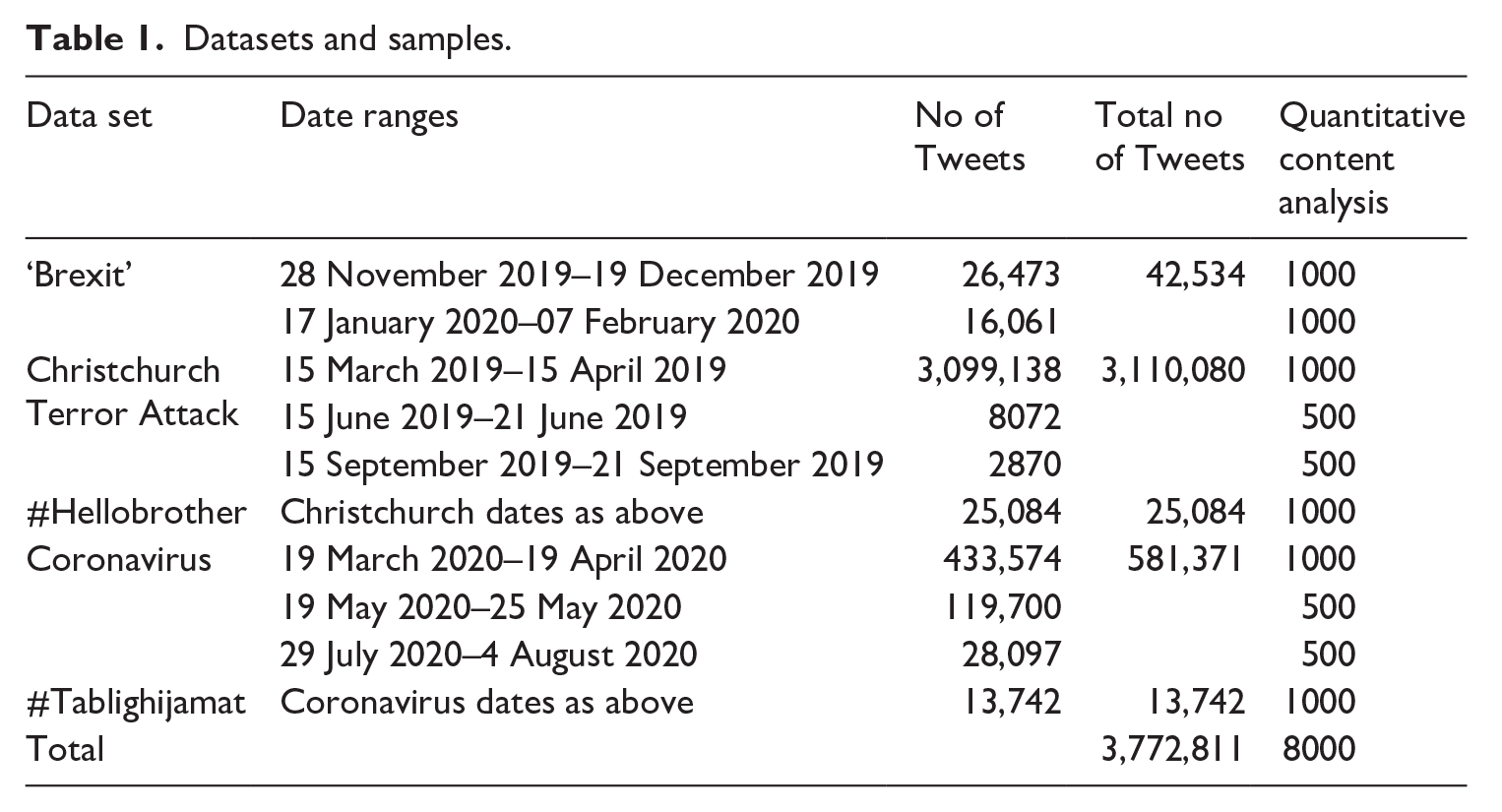
The quantitative content analysis measured 20 variables including time and date of the tweet, the number of retweets, tweet type, location, topic (primary and secondary), use of emojis/URLs and specific hashtags (informed by the big data analysis). Our qualitative analysis of the top 50 most retweeted tweets for each data set orientated to salient ideological and interpersonal patterns in the data, and how users evidenced and substantiated their claims-making. This article predominantly draws upon the qualitative analysis of the first Christchurch corpus (15 Mar 2019–15 Apr 2019), however it may be beneficial to briefly share some of the quantitative findings, for context.
Unsurprisingly, following such a negative event, the content of tweets in the month following the attack was extremely supportive of Muslims – 73% of tweets were coded as supporting Muslims (n = 730), only 4.7% (n = 47) were coded as anti-Muslim and the remainder neutral or mixed. Politicians, journalists and other high-profile personalities sought to demonstrate support and show sympathy, with the most retweeted tweet in the dataset posted by Barack Obama. Condolences and tributes was the most prominent primary topic of tweets (25%) and pointing out Islamophobia was a significant secondary topic (16.2%).
Table 2 lists the top 10 hashtags and the top 10 emojis in the data set, revealing insight into the identity of victims (#ChristchurchMosqueAttack) and possible motivation of the terrorist (#Islamophobia), as well as the affective response to the terrorist attack, with crying, broken hearts and praying.
The top 10 hashtags and the top 10 emojis in the Christchurch1 data set.
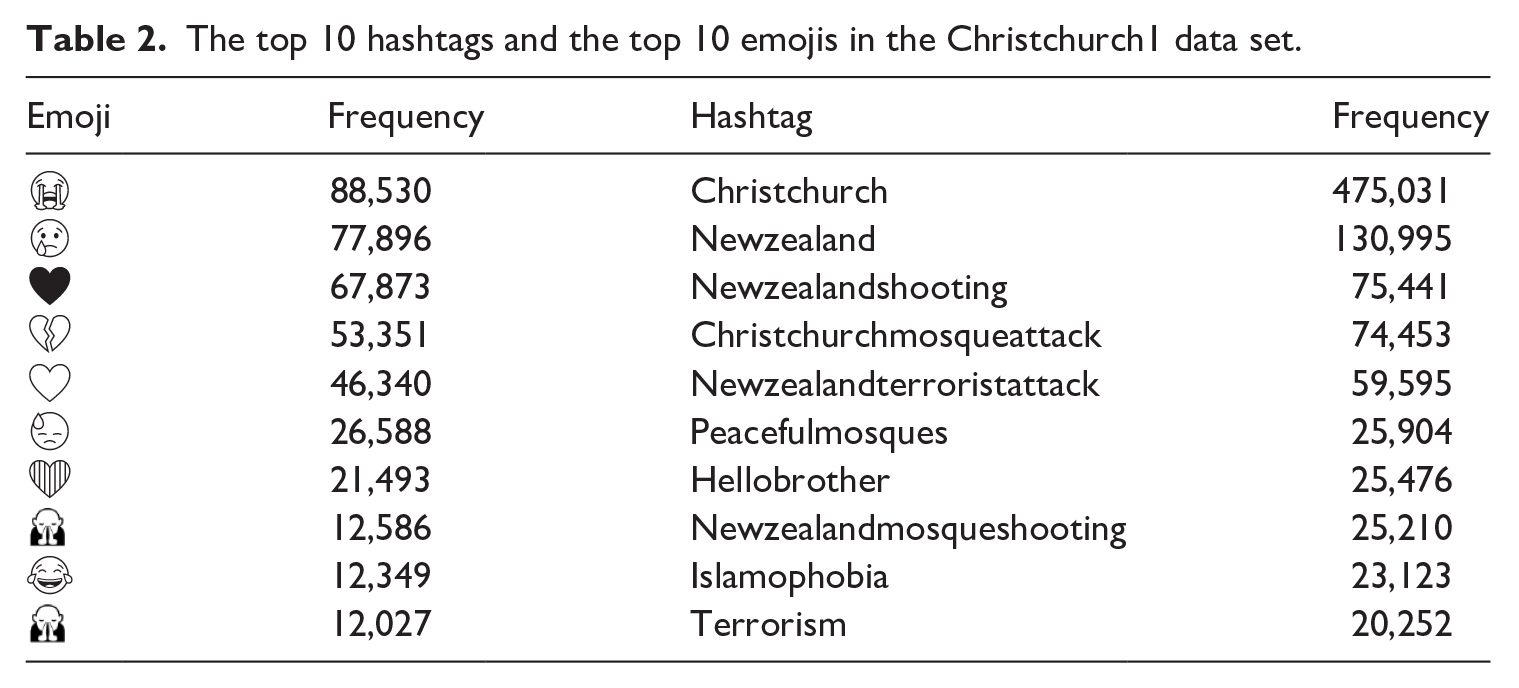
Hashtags have been widely discussed as having the potential ‘to create collective conversations in times of crisis, conflicts, and controversies, they also mark and declare identities in distinction to other groups and opinions’ (Evolvi 2019: 387). Table 2 shows that the sixth most frequently used hashtag was #peacefulmosques (n = 25,904) and the seventh most frequently used was #HelloBrother (n = 25,476). We noted a decline in the use of hashtags across our datasets except for descriptive use (#Christchurch and #NewZealandShooting) so the frequency of these two hashtags is significant and warranted qualitative examination. This article now turns to examine the political-affective work refracted by these two hashtags and the ways they affiliated accounts to different ‘structures of feeling’ (Papacharissi 2014).
#HelloBrother
‘Hello Brother’ were the words spoken to the white supremacist terrorist as he entered the Al Noor Mosque, by the first victim, Haji Daoud Nabi. This hashtag gained traction following a campaign by the Turkish public service broadcaster, TRT World Citizen, to highlight the kindness of Nabi. At the time of our data capture, the most retweeted tweet in the #HelloBrother data set is reproduced below.
Example 1
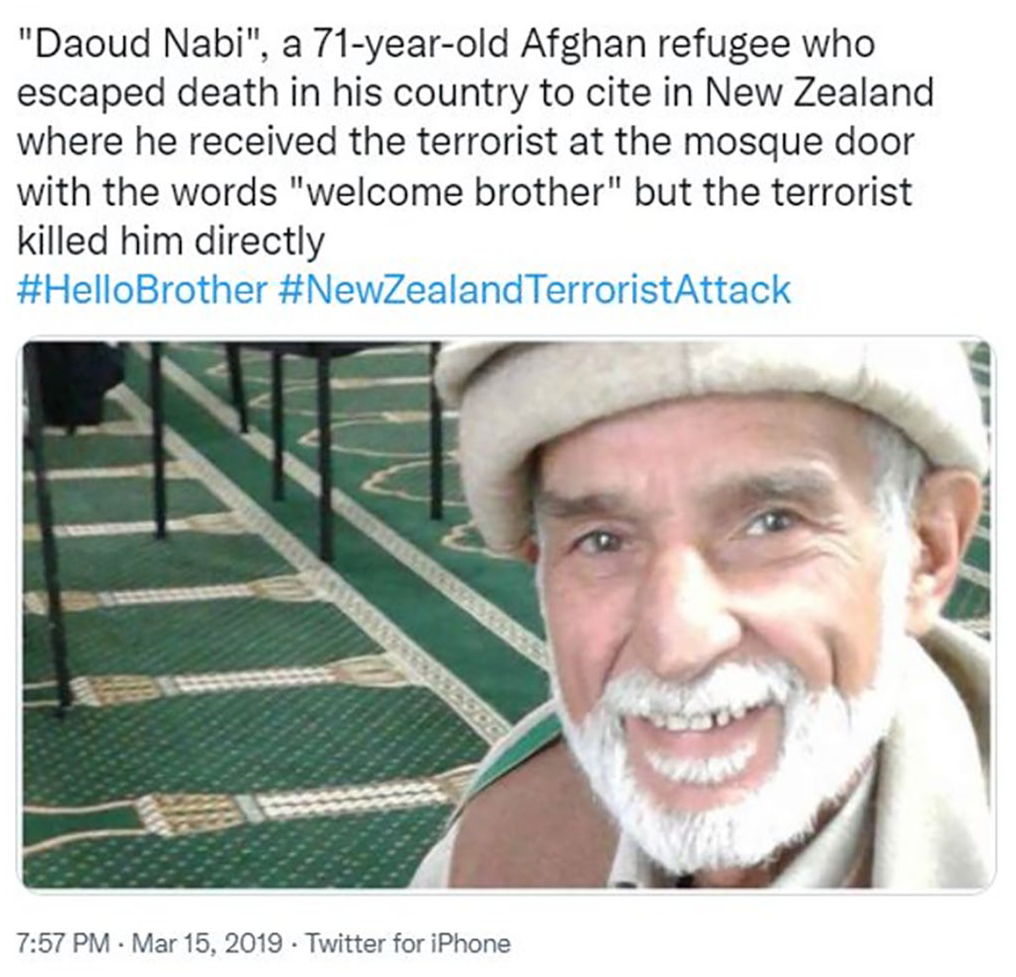
In line with current best practice for online research we will only show the user for verified ‘blue tick’ accounts. Additionally, we would usually summarise the content of tweets from ordinary users, rather than quote them verbatim, but the wording of this tweet was actually plagiarised by other tweets in the top 50, effectively anonymising the account. In total, eight other users simply copy/pasted it into a tweet of their own, rather than retweeting it, indicating that they didn’t only affiliate with the sentiments of the tweet, they also wanted to claim the expression that brought forth that affective response as their own.
The tweet functions as a tribute to Daoud Nabi. It is constructed in order to evoke pathos and it does so in three ways: first, it offers a very brief narrative of Nabi’s life, where he escaped a war only to be killed in what was, until that point, a safe country. The narrative is therefore constructed with a false ending, only to be followed by a tragic true ending. That is, the conventionally ‘happy ending’ of his escaping the war in Afghanistan, and finding safety in New Zealand, is upturned by a shocking narrative twist, of his murder. The tragedy of his murder is heightened by two additional aspects of the tweet which present him as a good person – first, that he welcomed the killer by addressing him as brother. (Oddly, the tweet incorrectly states that Nabi said ‘welcome brother’, but it uses the correct wording, ‘hello brother’, in the hashtag.) This expression of fraternal love is then juxtaposed to the terrorist’s reaction: he immediately killed him. The use of ‘directly’ in the tweet communicates an additional degree of callousness in the act, as if, not even being addressed in that way caused him to pause and think, or reconsider his planned action for a moment.
Finally, the tweet includes the image of Nabi with a broad smile, looking directly at us, holding our gaze. Multimodal discourse analysts refer to this composition as a demand image (Kress and van Leeuwen, 1996), wherein the gaze of the represented subject is ‘directed to the viewer and hence ‘demands’ some kind of response in terms of the viewer entering into some kind of pseudo-interactive relation with [them]’ (Unsworth, 2010: 285). All of our focus is on Nabi, and his smile, forcing us to acknowledge his joy and concede that, with his murder, this has been erased. The composition is deliberate, because this image has actually been cropped; the full image, which was tweeted by other users at this time, shows a young girl stood by his side, identified as his grand-daughter. This smiling man is pictured inside a mosque (perhaps the al Noor mosque where he was killed) and so it creates a filmic scene that we can imagine was comparable to the place of his murder – that this was the smiling face which greeted the terrorist, at the door of the mosque. This is a hospitable man, who has endured great hardship and believes himself to have found sanctuary, smiling as he greets the terrorist with warmth and openness, only to be murdered.
This tweet, and arguably all others that included the hashtag, works to contest the prejudice and dehumanisation inherent in the action of the terrorist. Contrary to the terrorist’s Islamophobic beliefs, this was a good man, a friendly and welcoming man, as demonstrated by the way he greeted even a terrorist, approaching him carrying weapons. Other tweets presented Nabi as a synecdoche – a figure of speech where he (part) was taken to represent the attitude and actions of Muslims as a whole. So here, again contesting the terrorist’s Islamophobic beliefs, Muslims as a whole are constructed as friendly and welcoming people, as evidenced by this one man’s actions. And within this rhetorical construction, the terrorist was also sometimes presented as a part for whole synecdoche, where he was an instance of a wider grouping or problem. For some users he represented hatred, sometimes Islamophobia specifically; for some he was a synecdoche for ‘the West’; and, on one occasion, Christians. In a few of these tweets, the desire to cast this terrorist act as being symptomatic of a wider war against Muslims was so powerful that users chose to amplify white supremacist media content: five tweets in the #hellobrother dataset included clips of the video material recorded by the terrorist. One clip was only three seconds long and stopped immediately after Nabi said ‘hello brother’; one was five seconds long and showed his greeting and then him being killed; a final clip was 45 seconds long and showed not only Nabi being killed, but also the terrorist moving past his dead body, entering the mosque and killing countless others. Orientating to our own affective response (since we, too, are part of Twitter’s ecology), the material in these tweets is revolting to watch. They are also very upsetting, not only because of their depiction of violence, but also because tweeting clips from the livestream video provides the terrorist with the mediated attention he desired and so helps enact ‘terror as a joint enterprise, co-produced through live audience interaction in the sharing economy’ (Ibrahim, 2020: 811).
At time of writing, the tweets including the 5 and 45 second clips of the murders haven’t been taken down, despite being reported to Twitter (by us) several times. Based on what they wrote, and their bios, the people who tweeted these clips seem to be motivated by revulsion at the actions of the terrorist and anger that the full horror of what he did wasn’t being shown. One of these identified the video as ‘One of the tweets that Twitter deleted’, so reposting it suggests that they objected to its removal. Perhaps the reason the tweets still remain online is that the tenor of their words makes it clear that they are disaffiliated from the aims of the terrorist and the violence in the videos. However, writing in the Guardian at the time, the columnist Jason Burke observed that the central point of the Christchurch attack was not just to kill Muslims, ‘but to make a video of someone killing Muslims’. 4 Users that (re)tweeted clips of the video did so for identical reasons: they wanted to share a video of Muslims being killed by a white man because of what they think it reveals – one tweet also included the hashtags #Muslims_Under_Attack and #ChristianTerrorism. For such users, the victims, and Nabi specifically, are reduced to rhetorical grist, and their murders instrumentalised in the service of a parallel political agenda.
#peacefulmosques: Contesting implicit racism
A key trope in Islamophobic discourse is the binary division between ‘good’ and ‘bad’ Muslims. Whilst this can take many forms, given the preoccupation of mainstream political and media discourse with religious extremism and violence, the binary frequently takes the form of moderate versus fundamentalist Muslims, or peaceful versus violent Muslims. The strength of this parochial (mis)representation is such that it is often presupposed even in discourse ostensibly aimed at supporting Muslims or, in this case, the victims of Islamophobic violence more specifically. In the wake of the terrorist atrocity at Christchurch, several mainstream reporters suggested that the violence was especially shocking and unjust because he had attacked ‘peaceful mosques’. Using the noun phrase ‘peaceful mosques’ implies the existence of non-peaceful mosques (which, presumably, would be considered more appropriate targets for white supremacist terrorists?), and so it works up the Islamophobic trope of the acceptable/unacceptable Muslim. One Twitter user identified this tendency in ‘well meaning’ reporting and responded in a subtly satirical way. Coining the hashtag #peacefulmosques he invited Muslims to share mundane stories/observations of what goes on at their mosque: Example 2
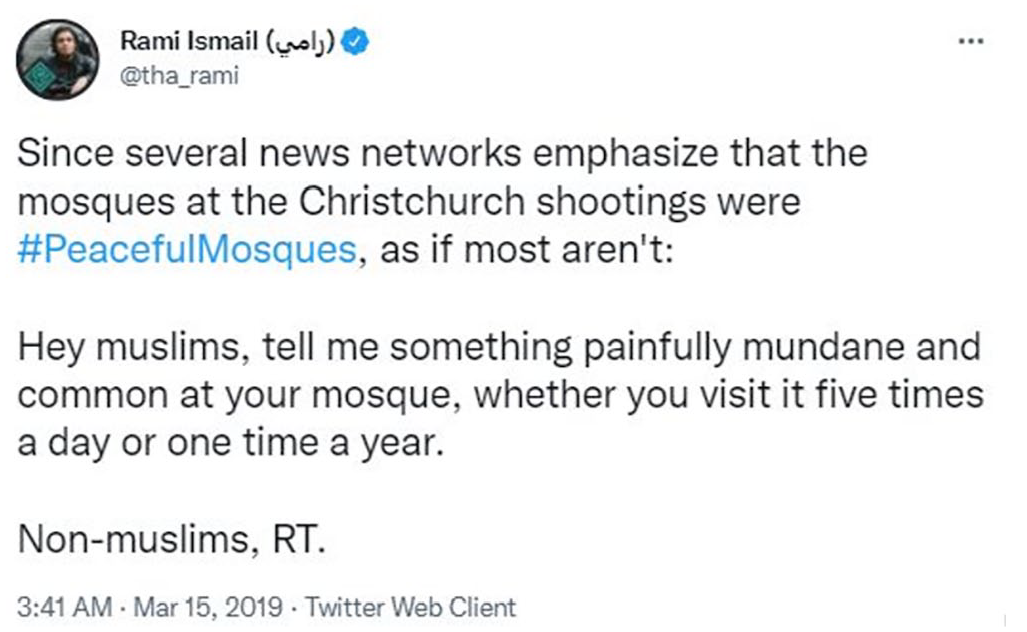
The hashtag was used 25,904 times in the sample, and the vast majority of those tweets were retweets or replies to this initial tweet. The hashtag therefore represents an example of a counter-narrative – a push back against the way that mosques, in general, are represented by some non-Muslims as suspect, closed spaces, which may be fostering threat (to ‘Us’). It is particularly interesting that he didn’t ask for uplifting or inspiring stories, or examples of ‘Muslims making a positive contribution (so perhaps you shouldn’t be scared of us)’, but rather ‘painfully mundane’ stories of everyday life inside mosques.
The thread of replies is very long, running to hundreds of tweets. The observations shared are many and varied, some from verified accounts but the majority are from ordinary Muslims recounting everyday stories of mosque-life. Problems getting parked, people’s tendency to crowd at the entrance to the prayer hall (musallā), so stopping others entering and the bottle-neck of people created when collecting and putting shoes back on, are all mentioned more than once. Other examples are more obviously funny, such as children saying wildly inappropriate things during prayer or pictures of cats that have taken up residence (and signs instructing worshippers to leave them alone!). Other replies are touching reflections of faith and community which underscore diversity, inclusivity and service to others. Replies from non-Muslims tended to be one of two types: those saying that the thread is beautiful and thanking those who contributed to it (sometimes adding that they needed cheering up after reading about the atrocity); or summarising their own religious experiences and saying how similar they are to Muslims’ on the thread. Some replies orientate to the politics of the thread and the Islamophobia that it is subtly countering which, in turn, elicit declarations of solidarity from non-Muslims. For example, one user plaintively asked why Muslims always need to prove their humanity, to which a non-Muslim replied ‘I see you, I hear you and I have love for you’. There was only one anti-Muslim comment, a claim that all global warfare involves Muslim combatants, which was immediately rebutted.
Discourse aimed at opposing Islamophobic tropes can be problematic, since it tends to reproduce the original Islamophobic trope it attempts to contest in either a presupposed or a nested way. Arguing that ‘not all Muslims are terrorists’ reproduces the association between Islam and terrorism; characterising some mosques as peaceful implies the existence of non-peaceful mosques, and so on. Here, this tweet, and the long thread of affiliated replies it prompted, side-step this whole morass by instead insisting on the fundamental ordinariness of Muslims.
Contesting condolences
As stated above, a significant portion of the top 1000 tweets relating to the Christchurch terrorist attack offered condolences for the victims (n = 205) and/or support for the survivors (n = 121). A lot of these tweets were from people in the public eye, or with large numbers of followers, such as politicians, actors, sportspeople and other celebrities. However, a notable number of other users responded by quote-tweeting the condolences of politicians and disputed or rejected their sentiments, often using quite angry or indignant language. As Abdel-Fadil (2019: 15) points out, ‘there is always an imagined or real audience for one’s performance of affect’. We assume that there is a rhetorical difference between a reply and a quote tweet since they presume different audiences: a reply tweet is visible to the protagonist’s (the politician’s) followers, whereas a quote tweet is visible to the antagonist’s followers. This has a rhetorical significance, because it means that – like a great deal of political rhetoric – quote tweets are aimed at convincing an audience rather than the opponent that they’re arguing with. Of course, there are a variety of reasons why people are followed on Twitter, from personal friendships, sources of information through to active opposition and hate following. However, the widely acknowledged existence of echo chambers (where we tend to read and share the views of those that reiterate and reaffirm our own), implies that the core of followers are likeminded people. Accordingly, a quote tweet is intended to be read by an affiliated audience.
The quote tweets contesting the condolences of political figures were structured as follows:
A political figure tweeted condolences
The disputants quote this tweet, arguing that the felicity conditions (Searle, 1969) of the condolence were not met – specifically the sincerity conditions
And, more specifically, we summarise the argument of these quote tweets as following:
3. ‘Your Speech Act [condolence] misfires because [past statement or action] entails that you lack sincerity’.
The essence of their rhetorical argument is therefore an ad hominem attack: the antagonist criticises the politician rather than the content of what they said. There are three variants of the ad hominem fallacy – that is, fallacies that are aimed at the person (Copi and Cohen, 2002). The first is the direct, or abusive, variant, which consists of ‘cutting down one’s opponent by casting doubt on [their] expertise, intelligence, character or good faith’ (van Eemeren and Grootendorst, 1992: 111). The second variant is the indirect or circumstantial personal attack, which consists of suggesting that one’s opponent has a personal interest, or stake, in the matter and is therefore biased towards supporting a particular standpoint. The third variant, the tu quoque fallacy, occurs when someone alleges ‘a contradiction in one’s opponent’s words or between [their] words and [their] deeds’ in order to undermine their credibility (van Eemeren and Grootendorst, 1992: 111). The function of the tu quoque, then, is ‘to question the opponent’s trustworthiness as a source of advice or information on the question at issue’ (Hitchcock, 2006: 118).
In one example in our sample, Madeline Albright tweeted her condolences and stated that those who encourage Islamophobia need to be called out. She was then quote tweeted by someone who stated that they are not interested in hearing her comment on Islamophobia since she supported the sanctions regime against Iraq, which was responsible for the deaths of Iraqi children; they also included a link to a YouTube clip of an interview in the tweet, where she argues the sanctions regime was ‘worth it’, in order to substantiate the accusation.
In this first case, the argumentative move doesn’t argue contrary to Albright’s position that this terrorist attack was horrific, or that people shouldn’t condemn these attacks, or that Islamophobia shouldn’t be opposed. Instead, they attempt to undermine her credibility on this complete issue – they specifically claim that she thought the mass murder of Muslim children was worth it; and because of that past action, she lacks any moral authority when it comes to identifying and opposing Islamophobia now. So, to summarise, the tweet argues: ‘your Speech Act [condolence] misfires because your historic support for sanctions against Saddam Hussein’s Iraq is inconsistent with someone sincerely offering condolences to Muslim victims’. This strikes us as dialectically fallacious; it doesn’t engage with the substance of the condolences (and in fact their support for Muslims suggests that they share these sentiments); instead, it is directed towards silencing Albright.
However, van Eemeren and Grootendorst (1992: 113) suggest that there are cases where a personal attack may be justifiable, for example, where the standpoints under discussion relate to the character of a protagonist and they have presented themselves in a particular way. Here, references to the protagonist’s character are ‘part of the propositional content of the standpoint under discussion’ and so ‘are, in principle, relevant arguments in the discussion. [. . .] How can you show that someone is dishonest if you are not allowed to give examples of [their] dishonesty?’ (p.114).
Below are two tweets, quote tweeting the same message of condolence from the then UK Prime Minister Boris Johnson. Both tweet and quote tweet are from ‘blue tick’ accounts, so we include them in full: Example 3
Example 4
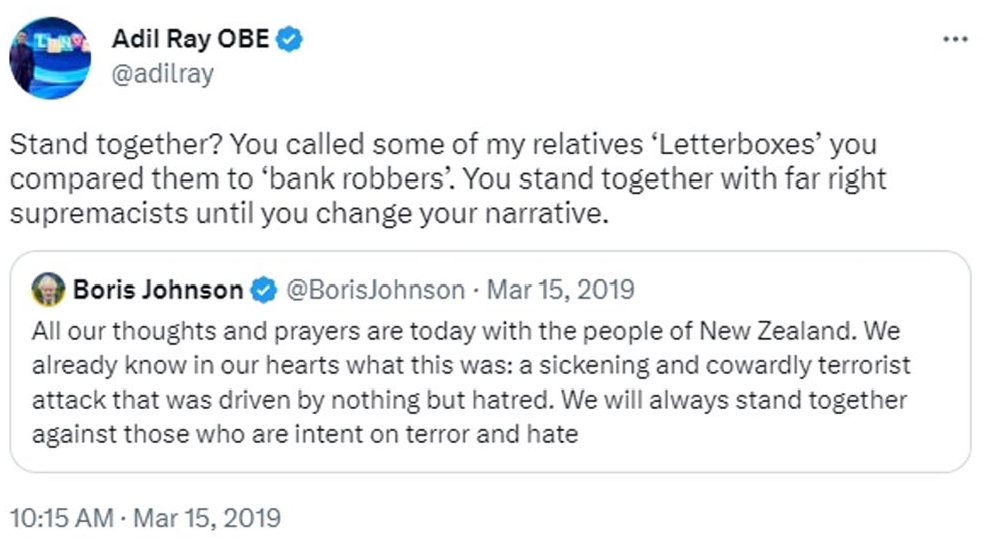
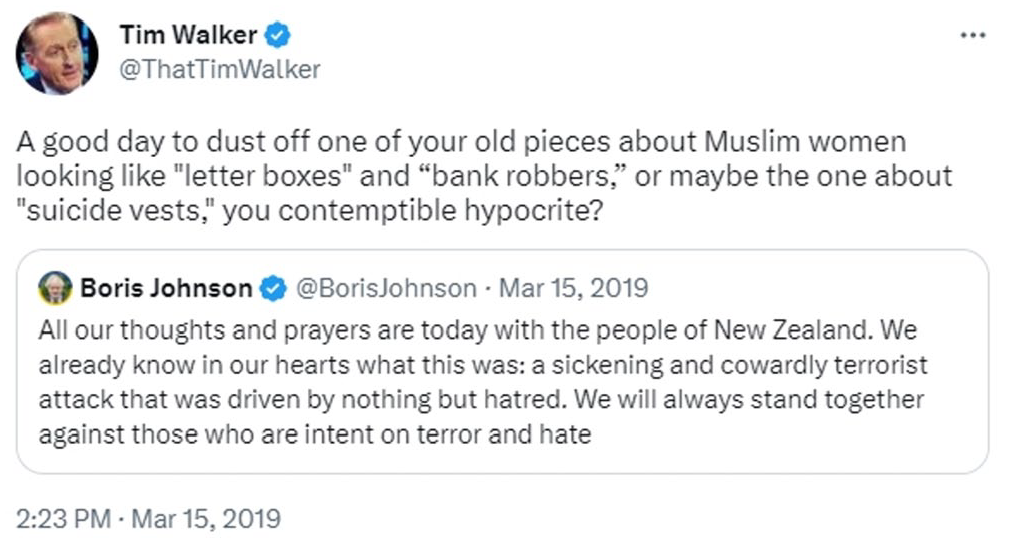
Johnson tweeted ‘our thoughts and prayers are today with the people of New Zealand. [. . .] We will always stand together against those who are intent on terror and hate’. Both of the examples above reject this condolence, stating that Johnson had previously referred to Muslim women as ‘letterboxes’ and ‘bank robbers’ – this is explicit in Example 4 (retweeted 507 times), but needs to be inferred from Example 3 (retweeted 2647 times), based on a contextual understanding that the writer Adil Ray is Muslim. Example 3 twice echoes ‘stand together’ from Johnson’s tweet, to suggest that, contrary to his claimed solidarity, his expressed Islamophobic views mean that he has helped perpetuate a political environment that legitimises Islamophobic discourse.
In a sense, formally, these tweets duplicate the structure of the fallacious example discussed above: the Speech Act misfires because something that he did in the past is inconsistent with someone sincerely offering condolences to Muslim victims. However, they feel very different. Feeling – and specifically the politics of affect, or indignation as affective practice – play a role in both how these two people responded to Johnson and how we can go about analysing their response. Semantically and contextually they are also quite different, and different in ways that keep them from derailing as fallacies.
First, for context, both of the tweets refer to Boris Johnson denigrating Muslim women through name calling. He did so in a column for the Daily Telegraph (5 August 2018), written when he was Foreign Secretary. Specifically, he argued it was ‘absolutely ridiculous’ some Muslim women chose to ‘go around looking like letterboxes’; he also compared them to ‘bank robbers’ in the piece. Though Johnson dismissed criticism of this column as simply ‘confected indignation’, 5 the charity Tell Mama, which records anti-Muslim hate speech, stated that in the week after the column was published, there was a 375% increase in anti-Muslim street attacks; in the month after, ‘42 per cent of the street-based [anti-Muslim] incidents reported to Tell Mama directly referenced Boris Johnson and/or the language used in his column’. 6 So, whilst Johnson’s tweet claimed ‘We will always stand together’ against hate, those quote-tweeting him argued that his words align him, still, with others who incite anti-Muslim hate crimes.
This contextual issue also relates to the semantic content of the quote tweets. In contrast to fallacious tweets, looking at past wrong-doing, the tense of these tweets shifts our focus to the present. Although he wrote the offending column 9 months prior to these tweets being sent, their criticisms of him relate to his character and standing at that point in time – that he is a ‘contemptable hypocrite’ (now) and that he ‘stand[s] together with far right supremacists’, in a present continuous sense, because he hasn’t changed his narrative since writing the column. The fact that Johnson doesn’t refer to Muslim victims in his original tweet (only ‘the people of New Zealand’), or acknowledge that this was specifically anti-Muslim hatred, supports this reading that his antipathy towards Muslims remains unchanged. This, then, is rhetorical critique of Johnson’s ethos, his character and his reactionary political views, and therefore it is relevant for critical discussion in a way that referring simply to past wrong-doing might not be.
The rhetorical critique of Johnson’s character in these two tweets (and several others in our sampled data) is broadly the same and is based on a sense of indignation that he would offer such condolences, being the person that he is. We reconstruct the argument presented in these tweets as follows:
In the past you have written derogatory things about Muslim women 1.1 Contextual knowledge: This generated increased racist harassment of Muslim women
This aligns you with others who incite racism towards Muslims
You haven’t changed your arguments about Muslim women since 3.1 Entailment: You currently hold prejudiced opinions about Muslims
Therefore, your prejudiced opinions about Muslims are inconsistent with you sincerely offering condolences to Muslim victims
Given that Twitter is an affect generating machine, it seems reasonable to assume that the degree to which you are persuaded by these quote tweets – so, the extent to which you agree that Johnson’s condolences are insincere – will depend upon your political-affective identity. If you are appalled by anti-Muslim racism, if you agree what Johnson wrote is odious and, most importantly, believe that his character and political views haven’t changed since that time, then you are very likely to react in a similarly angry or indignant way to his platitudes about the victims of hatred.
Conclusion
This article has examined some of the ways that users question and oppose Islamophobic politics, and Islamophobic discourse, on Twitter. Examining the 1000 most retweeted tweets, posted in response to the white supremacist terrorism in Christchurch March 2019, we focussed on different forms of contestation. First, we examined the way that an affective public, expressing pro-Muslim sentiment, was connected through the hashtag #HelloBrother. Second, we discussed the partly satirical, partly de-Othering, counter-narrative work sparked by and coalesced around, the hashtag #peacefulmosques. We argued that these two hashtags are nodal points for the construction of affective responses to the terrorist attack. They are, therefore, both instantiations of affective communities and the connexion at which these communities coalesced.
Third, we analysed examples where users had responded to condolences from politicians by quote-tweeting them and rejecting their sentiments as insincere or hypocritical. Exploiting a central affordance of Twitter, these users chose to quote tweet their rhetorical argument, thus ensuring that it was visible to their own (affiliated) followers rather than the followers of the politician that provoked them. We suggest that these quote tweets took one of two forms: some users pointed to the past actions of the politician and concluded that this means they lacked sincerity now. Specifically: ‘your Speech Act misfires because something that you did in the past is inconsistent with someone sincerely offering condolences (to Muslim victims)’. This, we argue, is a fallacious argument, an example of the tu quoque ad hominem, since past actions are not in-and-of-themselves relevant to the matter at hand. Second, some users pointed to the current character of the politician and concluded that this meant that they lacked sincerity now. Specifically: ‘your Speech Act misfires because your character now is inconsistent with someone sincerely offering condolences (to Muslim victims)’. This, we argue, is a rhetorical critique of the speaker’s ethos and is therefore dialectically relevant for critical discussion. These tweets invoked a discourse of indignation and are rhetorically persuasive to the degree to which that we, the audience, align with the political-affective opinion of the politician in question.
Our focus on the pro-Muslim solidarity work that coalesced in response to the Christchurch attack shouldn’t be taken as an unqualified celebration of the ways that Muslims are discussed on Twitter. Clearly there is a great deal of racism, still, on Twitter (which we focus on in other outputs from the project). As illustrated by #HelloBrother and appeals to #PeacefulMosques, even well-intended counter-narratives can instrumentalise individual tragedy to further wider political narratives, or perpetuate Othering tropes about ‘good’ Muslims. We argue, therefore, for a need to resist broad narratives about the potentials or limitations of digital media for contesting hate speech. Instead, through combining big data and detailed discursive analysis, we elucidate the need for a more situated approach that traces how affiliations between counter-publics and structures of feeling open up particular political possibilities and foreclose others.
Footnotes
Funding
The author(s) disclosed receipt of the following financial support for the research, authorship, and/or publication of this article: This research was supported by an Arts and Humanities Research Council grant AH/T004460/1.
