



Abstract
Internet search engines boast material features (e.g., Google’s knowledge panels, Featured Snippets) that increase the speed with which users find answers to search queries—while reducing their effort—to create a seamless media experience. Yet, the ability to instantaneously retrieve answers through seamless digital search may come at a metacognitive cost. This experiment examines the effect of digital search fluency on internal (in the “brain”) knowledge confidence. In a question-answering task, participants report higher ratings of internal knowledge confidence accompanying immediate access to Featured Snippets than those with delayed or no access to Featured Snippets. The effects of immediate information access on knowledge confidence not only occur for specific topics for which relevant information has been retrieved but also for topics irrelevant to the retrieved information. When people have immediate access to explanations through features that enhance access to information, external retrieval fluency may serve as a heuristic for internal knowledge confidence. Search engines that contribute to the immediate retrieval of external information may inadvertently strain Internet users’ ability to distinguish between mind and machine as the source of their knowledge.
Information and communication technologies (ICTs) profoundly transform the way people store and retrieve information. It can take hours to find answers among piles of books, whereas a single search query using search engines like Google can return several relevant, although potentially inaccurate, responses in less than a second. Because people often make judgments based on subjective cues that are salient at the time a judgment is made (Alter & Oppenheimer, 2009), the ability to access information more quickly and efficiently than ever inevitably transforms how we aggregate and assess our knowledge. People who are able to rely on Internet search to find answers are more likely to rely on the Internet for answers to questions in the future (Storm et al., 2017), and it can be challenging for those who rely on the Internet to distinguish between what they know and what the Internet “knows” (Fisher et al., 2015; Hamilton & Yao, 2018; Ward, 2013).
The purpose of this research is to draw attention to the unprecedented speed of information delivery afforded by contemporary ICTs and their influence on the ability to accurately assess internal (i.e., in the “brain”) knowledge. Unlike common forms of external (i.e., outside the “brain”) knowledge such as books, tape recorders, and web pages, internal knowledge is not a blind record of sensory inputs. Instead, the human memory system processes and reprocesses information into data structures for representing generic concepts stored in memory (Rumelhart & Ortony, 1977). Because human memory capacity is limited, humans rely on the ability to store and retrieve information outside of their brains to extend the capacity of their human abilities. External knowledge repositories like cave paintings, printed books, and the computer historically have allowed humans to aggregate and interact with information to augment and supplant internal memory. As these external repositories advance, Internet companies play a more significant role in constructing “knowledge” about the world and about one’s self.
The Internet has become faster over time with the rapid development of broadband technologies, such as 3G, 4G, 5G, and fiber broadband (European Commission, 2020). Recently, scientists have set a new world record for Internet speed—178 terabits per second, which allows users to download the entire Netflix library in less than a second (University College London, 2020). Certain material features, such as ranking algorithms (e.g., Choudhary & Burdak, 2012; Singh & Kumar, 2009) featured snippets, and knowledge graphs (e.g., Yang et al., 2017; Zou, 2020), have also been adopted by search engines such as Google to conserve users’ efforts by reducing the amount of time spent to find answers. Google uses the Knowledge Graph, a semantic network with a database of billions of facts about people, places, and things, to extract summaries from existing content (e.g., Wikipedia) and provide direct answers to search queries (Singhal, 2012). Information from Google’s Knowledge Graph is often presented in menus called “knowledge panels” to the right of the search page. Featured Snippets are short summaries of text that appear at the top of a Google search (see Figure 1). Featured snippets are designed to immediately give searchers direct, concise information relevant to the search query.
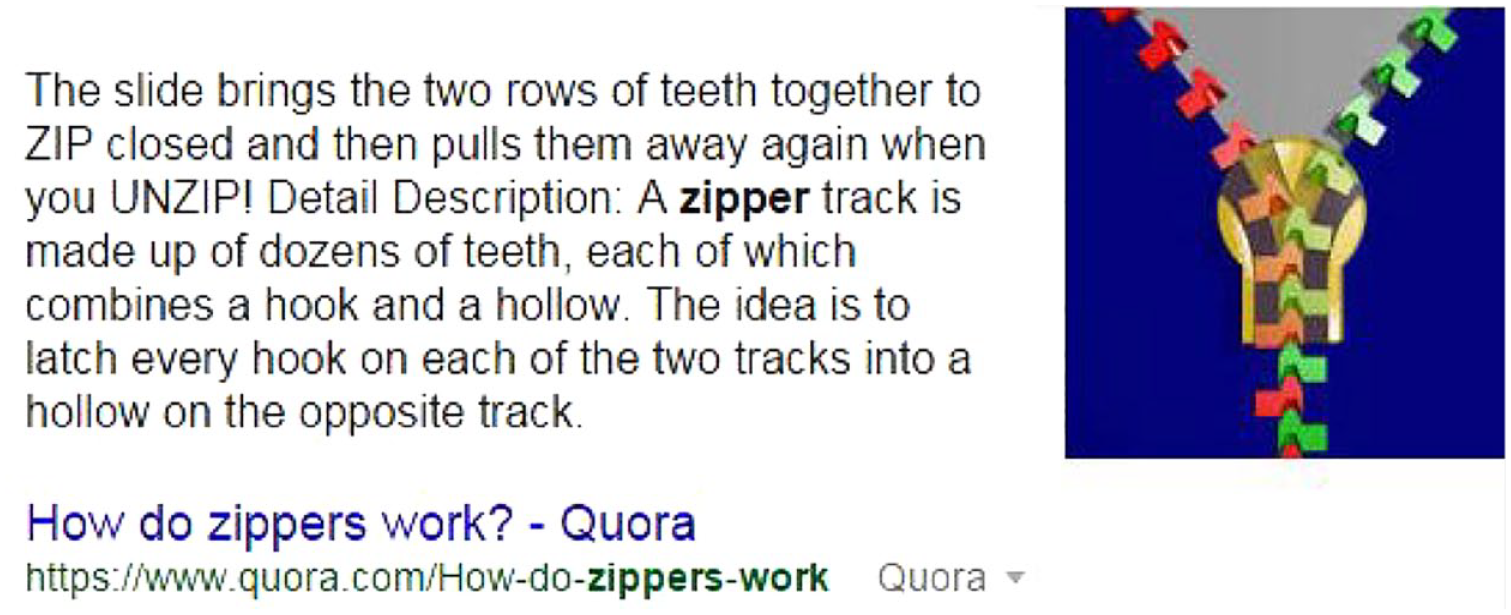
Featured Snippet for the search query, “How does a zipper work?”
Getting content into Featured Snippets is a desirable content optimization strategy as featured snippets increase the likelihood that a Google user does not click on any other search result. These forms of semantic media—technologies that orchestrate and convey “knowledge” about things directly in media products (Iliadis, 2022)—allow users to resolve a query more quickly and easily without having to visit multiple sites to gather information.
Given rapid changes to material features of technology, we do not expect knowledge panels or Featured Snippets to maintain the same content or structure for long. For example, since 2015 machine learning algorithms like RankBrain have been built into Google’s search algorithms, which helps Google to more accurately interpret the searcher’s intent and provide relevant results to search queries beyond the exact search terms entered (Nayak, 2022). Meanwhile, more users have started to use mobile devices and voice assistants to get relevant results in a timely manner (Kinsella, 2022; Olmstead, 2017). Still, we do expect that Google will continue its mission to make the world’s information more accessible (Google, 2023). For this reason, our goal is to understand a factor that broadly underlies digital search—the accessibility of external information. We seek to understand whether immediate access to Featured Snippets displaying Internet search results will make it more difficult for a person to assess the extent to which they rely on the Internet for outsourced knowledge. Feelings of search fluency that accompany platform features like Featured Snippets may lead a person who is inextricably linked to the Internet to lose track of where their internal knowledge ends and the rest of the world’s knowledge begins by mistakenly deeming themselves knowledgeable about unknown facts. Tech firms that strive to deliver solutions that expedite the process of acquiring information may inadvertently contribute to the inability of Internet users to distinguish between mind and machine as the source of their knowledge.
Blurring Boundaries between the Self and the Internet
As an integral part of daily life, the Internet functions as a transactive memory partner. The concept of transactive memory was originally formulated to explain how people negotiate responsibilities for different types of information and develop shared systems for knowledge storage and access in dyads or groups (Wegner, 1987). As human memory is limited, the development of human transactive memory structures makes encoding, storing, and retrieving information more efficient for individuals (Wegner, 1987). Transactive memory systems expand the scope of a person’s knowledge by allowing them to reach target information (e.g., immigration policies) simply by knowing where that information is stored (e.g., a friend who studies immigration law) and how to retrieve that information when it is needed.
Reminiscent of computers are social actors theories (Reeves & Nass, 1996), people readily and naturally form transactive memory systems with technology (e.g., Sparrow et al., 2011; Ward, 2013). People spontaneously think of the Internet when they encounter difficult questions to which they do not know the answers and have better memory for where to find information stored on the Internet than for the information itself (Sparrow et al., 2011; Wang et al., 2017). When people believe that information is reliably saved on digital devices, they offload responsibilities for stored information onto technology and remember new information better (Storm & Stone, 2015). In many ways, humans interact with technology as if they exist together as an extended organism to expand the capacity of human cognitive abilities (Hamilton & Benjamin, 2019).
Although the way we store and retrieve information is constantly changing with the development of ICTs, the way we process and assess information is evolving slowly and is still susceptible to metacognitive failures to accurately monitor information sources (e.g., Hashtroudi et al., 1989; Koriat, 1993). Constant access to the Internet may influence a person’s ability to accurately monitor the extent to which they rely on answers to external sources when evaluating their internal memory. Cognitive research prior to widespread Internet diffusion suggests people tend to evaluate internal knowledge without careful attention to the original information source (Hashtroudi et al., 1989). Considering these fallibilities of general human introspection, it is no surprise that people immersed in human transactive memory networks easily lose track of which memories are stored in their own mind and which are stored elsewhere. Siler et al. (2022) found that individuals exhibit poorer source memory for answers to questions retrieved from a smartphone than for answers individuals initially attempt to retrieve from memory. Likewise, Sloman and Rabb (2016) found that individuals rate their own understanding of natural phenomena as higher when they are told scientists understand the phenomena than when they are told scientists do not yet understand the phenomena. People have a natural tendency to take cognitive credit for others’ knowledge (both nonhuman and human).
Search-Induced Cognitive Overconfidence
People have long been susceptible to illusions of explanatory depth characterized as overconfidence in the personal ability to explain mechanisms of complex phenomena (e.g., Castel et al., 2007; Fernbach et al., 2013; Rozenblit & Keil, 2002). The illusion of explanatory depth may not constitute a new phenomenon in the “digital age,” but shifts in technological features can prompt media researchers to consider more closely the underlying psychological, social, and behavioral mechanisms to which digital media are inextricably linked. Vast amounts of information can now be easily, quickly, and inexpensively stored and retrieved from the Internet. It may be the case that constant and immediate access to the Internet’s answers exacerbates the tendency to feel overconfident in the personal ability to explain complex information without access to the Internet. This ultimately influences the accuracy of our beliefs and downstream decisions. People with unjustified confidence are less likely to change their attitudes in the face of discounting information (Fernbach et al., 2013); thus, overconfidence in one’s own knowledge may shape attitude extremity in political issues, consumer decisions, and self-beliefs.
Several researchers have theorized that the pervasive yet inconspicuous presence of the Internet may tempt people to assimilate attributes of the Internet into self-perceptions, which we call search-induced cognitive overconfidence. Ward (2013, 2021) demonstrated that when people search for online information through a familiar search engine (e.g., Google), they fail to accurately distinguish between knowledge stored in their own memories and knowledge stored on the Internet. People who use Google to answer general-information questions are not only more confident in their ability to access information but also more confident in their own ability to think and remember. Fisher et al. (2015) found that the act of searching drives the tendency to feel overconfident in internal knowledge. Hamilton and Yao (2018) demonstrated that qualities of the device used to access information, such as ownership and device mobility, also influence search-induced overconfidence. Given the swift and enduring influx of new technological products and features that blur boundaries between mind and machine, benefiting from ICTs requires that people cultivate an awareness of how and how often to engage with and through digital devices to accomplish their individual goals. If people overestimate their internal abilities while employing ICTs habitually (i.e., automatically and non-reflectively), they may fail to make appropriate decisions about when to employ ICTs in the future. Thus, it is important for researchers to begin unraveling the general qualities of technology-mediated experience that predict the metacognitive errors that inform our decisions about when to appropriately offload cognitive responsibility to ICTs.
Search Fluency as Predictive of Search-Induced Overconfidence
The Internet has become faster and faster over time with the rapid development of broadband technologies, such as 3G, 4G, 5G, and fiber broadband (European Commission, 2020). From July 2022 to July 2023, the world’s average download speed over mobile increased from 30.80 Mbps to 42.35 Mbps, and the world’s average download speed over fixed broadband has increased from 67.35 Mbps to 83.65 Mbps (Speedtest, 2023). As one of the biggest advantages of the Internet, speedy information delivery has the potential to create a seamless media experience, which may make it more challenging for people to accurately assess the extent to which they rely on the Internet for outsourced knowledge. Material features like Featured Snippets have been adopted by search engines like Google to enhance search fluency—the amount of time spent in finding answers—and conserve users’ effort (e.g., Choudhary & Burdak, 2012; Yang et al., 2017). Google’s Featured Snippets are information boxes that are generated based on Google’s automated ranking systems (Google, 2023). Appearing at the top of the search results page in responses to search queries, Featured Snippets provide an immediate answer to search queries with information such as a title and short summary of the topic; pictures of the searched person, place, or thing; links to social media profiles and official websites; or data from relevant pages that have been semantically marked up. With the help of a Featured Snippet, users can resolve a query more quickly and easily without having to visit multiple sites to gather information.
Given that new material features such as Featured Snippets have transformed the search experience, this study aims to examine how ease of information retrieval from an external, digital source influences users’ confidence in their own (internal) knowledge. Prior research has found that internal retrieval fluency—the ease with which information is retrieved from memory—biases metacognitive judgments as people misattribute the time it takes to mentally generate answers to questions as predictive of the likelihood of future recall (Benjamin et al., 1998). Likewise, Kelley and Lindsay (1993) found that internal retrieval fluency enhances people’s confidence in the accuracy of their answers to general knowledge questions, regardless of whether their answers are correct. Given these blurred boundaries between the self and the Internet as a transactive memory partner, the effects of retrieval fluency on metacognitive judgments of memory may extend beyond the context of one’s own memory to interactions with a digital counterpart.
Our experiment examines how ease of information retrieval via Google-generated Featured Snippets will influence users’ confidence in their internal knowledge. If search fluency serves as a heuristic for knowledge confidence similar to internal retrieval fluency, we should expect immediate access to Featured Snippets to lead to an illusion of explanatory depth that, in turn, inflates users’ confidence in their own knowledge compared to delayed or no access (baseline) to Featured Snippets. Accordingly, we predicted:
H1: Having immediate access to explanatory knowledge via Featured Snippets leads to an increase in knowledge confidence about the searched topic compared to the delayed access and no access conditions.
Such a finding would suggest that the speed with which external information is retrieved plays a consequential role in a person’s interpretation of their internal knowledge. We also examined how search fluency influences internal knowledge confidence for topics irrelevant to the retrieved information. We predicted:
H2: Having immediate access to explanatory knowledge via Featured Snippets leads to an increase in knowledge confidence about topics in unrelated domains compared to the delayed access and no access conditions.
Confirmation of this prediction would suggest that receiving immediate answers from an external source like Google leads to a misattribution of the source of knowledge, not a change in understanding of what counts as internal knowledge.
Method
Participants
Given the effect size of a previous similar experiment (η2 = .20; Fisher et al., 2015), an a priori power analysis indicated that about 81 participants per condition would provide sufficient power (>80%) to detect group differences tested at a false positive rate of 5%. Thus, a total of 257 participants were recruited from the United States through Amazon’s Mechanical Turk (Buhrmester et al., 2011). Twenty-three participants were removed for failing to follow search instructions. The final sample contained 234 individuals.
Procedure and Design
This experiment consisted of three phases: pre-induction, induction, and post-induction. In the pre-induction phase, participants across all three conditions
In the induction phase, participants across all three conditions saw four additional questions beginning with “Why” or “How,” which were randomly selected from six explanatory knowledge questions unrelated to the questions used in the pre- and post-induction phase (see Appendix B for the full set of questions). After reading each question, participants in the Immediate Access condition immediately saw a Featured Snippet with an explanation of the question after they clicked a “search” button displayed on the screen (see Appendix C for the full set of Featured Snippets). Participants in the Delayed Access condition received the same set of instructions as those in the Immediate Access condition but spent 20 s reflecting on the questions by writing their explanations into a text box provided on the screen. After 20 s, participants viewed a Featured Snippet with explanatory content to the question and were instructed to read the entire content carefully. In both the Immediate Access and Delayed Access conditions, participants rated their knowledge confidence in each specific question after viewing a Featured Snippet by answering the question, “How well could you answer this question without using any outside sources?” on a 7-point Likert-type scale (1 = very poorly, 7 = very well). Participants in the No Access condition did not view any Featured Snippets after seeing the questions and were asked to rate their knowledge confidence directly after reading each question.
The post-induction phase was similar to the pre-induction phase as participants evaluated their knowledge confidence, not in specific questions, but in general domains. Like the pre-induction phase, participants saw questions in four of six possible domains (weather, science, American history, food, health, and anatomy and physiology.) Questions were randomly chosen from two of the four domains that were assessed during the pre-induction phase and the remaining two domains that were not yet assessed. The combination of previously assessed and not assessed questions not only alleviates the effects of question repetition but also allows a direct comparison between pre- and post-induction self-assessed knowledge confidence. For a given topic domain, participants saw three questions such as “Why are there more Atlantic hurricanes in August?,” “How do tornadoes form?,” and “Why are cloudy nights warmer?” Then, participants rated their confidence in knowledge by answering the question, “How well could you answer detailed questions about [weather] similar to these?”
Results
Hypothesis 1: Effect of Search Fluency on Knowledge Confidence for Searched Questions
A one-way analysis of variance was conducted to evaluate the effect of search fluency—operationalized as the speed with which participants have access to Featured Snippets with answers to explanatory questions—on knowledge confidence for searched questions during the induction phase. In support of H1, results revealed a significant main effect of search fluency on self-assessed knowledge confidence. Participants in the Immediate Access (M = 5.23, SD = 1.15) condition were more confident in their ability to explain answers to questions in the induction phase without outside sources than participants in the Delayed Access (M = 3.99, SD = 1.25) and No Access (M = 4.48, SD = 1.15) conditions, F(2, 231) = 20.66, p = .006, η2 = .144 (Figure 2). Follow-up analyses further revealed that knowledge confidence was significantly higher in the Immediate Access condition than in the Delayed Access (p < .001) and No Access (p < .001) conditions, which suggests that having immediate (fluent) access to explanatory answers from the Internet can inflate participants’ confidence in their own knowledge of the searched questions from baseline (no access condition). Also, knowledge confidence in the No Access condition was significantly higher than in the Delayed Access condition (p < .05), which suggests that having delayed (disfluent) access to explanatory answers from the Internet can deflate participants’ confidence in their knowledge from baseline. This evidence suggests that qualities of the Internet, in this case the accessibility of answers, determines peoples’ predictions of their own ability to provide answers to questions they search for if they did not have access to the Internet or other external sources.

Mean Knowledge Confidence scores during the induction phase (n = 234; H1). Error bars represent 95% confidence intervals.
H2: Effect of Search Fluency on Knowledge Confidence in Unrelated Topics
A one-way analysis of covariance was conducted to evaluate the effect of search fluency on knowledge confidence for topics irrelevant to the content searched during the induction phase (assessed during the post-induction phase) while controlling for knowledge confidence assessed in the pre-induction phase. Results revealed a significant main effect of search fluency, such that participants in the Immediate Access (M = 4.00, SD = 1.47) condition were more confident in their ability to explain detailed answers to questions about topics displayed in the post-induction phase—which represents topics that are irrelevant to the previously searched content—than participants in the Delayed Access (M = 3.37, SD = 1.34) and No Access (M = 3.78, SD = 1.42) conditions, F(2, 228) = 5.28, p = .006, η2 = .036 (Figure 3). Follow-up analyses further revealed that knowledge confidence in the Immediate Access condition was significantly higher than knowledge confidence in the Delayed Access (p < .01) but only marginally higher than knowledge confidence in the No Access condition (p = .059). There was no significant difference in general overconfidence between the Delayed Access and No Access conditions (p = .518). Thus, H2 was partially supported. These results suggest that the subjective experience of search fluency derived from past search behaviors can have downstream effects on self-assessed knowledge confidence in unrelated domains. More specifically, participants tend to inflate their confidence in their own explanatory abilities for unsearched content when they have immediate access to Featured Snippets than delayed access to Featured Snippets.

Mean Knowledge Confidence scores during the post-induction phase controlling for mean knowledge confidence scores during the pre-induction phase (n = 234; H2). Error bars represent 95% confidence intervals.
Discussion
The process of querying semantic media (i.e., media technologies that primarily orchestrate and convey facts, answers, meanings, and “knowledge”) informs the way we construct perceptions of our internal knowledge. This experiment tests whether immediate access to Featured Snippets with answers to explanatory questions (e.g., “why are there time zones?”) influences self-assessed knowledge confidence. Our findings reveal that people are more likely to overestimate their ability to answer explanatory questions, and new questions in unrelated domains when they have immediate access to explanations via Featured Snippets than when they have delayed or no access to Featured Snippets.
Our experiment employs a study design adapted from Fisher et al. (2015) to study a novel antecedent of search-induced cognitive overconfidence. In a question-answering task, Fisher et al. (2015) found that people report lower self-assessed knowledge confidence when they use links to access answers to explanatory questions than when they actively query a search engine. In our experiment, rather than actively searching the Internet for explanations, participants passively saw Featured Snippets delivered at different rates. Our participants reported higher levels of confidence in their own knowledge when they had immediate access to Featured Snippets than those who had delayed or no access to Featured Snippets. These results extend previous research on transactive memory partners by demonstrating that search fluency—the time it takes to find answers—drives an illusion of explanatory depth.
Ward (2013, 2021) argues that the unobtrusive nature of Internet searches may lead people to misjudge the extent to which their internal knowledge is informed by an external source. Evidence from the present investigation offers insight into why it may be challenging for some users to accurately monitor the bounds of their internal knowledge. People tend to rely on experienced-based cues, such as search fluency and familiarity, to make inferences about their own knowledge (e.g., Koriat, 1993; Koriat & Levy-Sadot, 2001; Reder & Ritter, 1992). When people search the Internet for information, cues such as external retrieval fluency (i.e., the time it takes to find information online) serve as a heuristic for knowledge judgments, similar to internal retrieval fluency (i.e., the time it takes to recall information from memory). In other words, just as the ease with which answers come to mind can enhance individuals’ confidence in the accuracy of their answers to general knowledge questions, regardless of whether the answers are correct or incorrect (Kelley & Lindsay, 1993); the ease with which information is retrieved from the Internet can enhance individuals’ confidence in their knowledge about answering explanatory knowledge questions, regardless of whether they actually know the answer or not. The faster the information retrieval process, the more internal knowledge confidence a person will experience.
This experiment aligns with recent work that indicates search fluency may prevent users from realizing the shallowness of their explanations. Stone and Storm (2021) found that participants misattribute the time it takes to find information online as predictive of the likelihood of actually being able to recall the information from memory. In our experiment, overestimates in one’s own knowledge are nullified when external information is provided at a delay. Individuals who were asked to reflect on the questions before reading the explanations on Featured Snippets reported lower ratings of self-assessed knowledge than individuals who had immediate access or no access to Featured Snippets. This supports the notion that the time it takes to view an answer to a Featured Snippet predicts judgments of one’s internal knowledge.
We do not suspect that Featured Snippets will transform human judgment per se, but rather that Featured Snippets represent one of several material features of modern Internet search that afford the capacity to expedite the querying process. Material features that are implemented to improve users’ search experience and reduce the effort spent on information searches like page ranking algorithms, Feature Snippets, and knowledge panels create ideal circumstances for knowledge misattributions. Nonetheless, while vast amounts of information can be immediately accessed through the Internet, it may still take time and effort for users to find target information through an iterative process that may include skimming multiple sites and assessing the credibility of retrieved information. Therefore, the development of this phenomenon requires sustained comparison across contexts to narrow in on the dynamic antecedents and consequences of search-induced cognitive overconfidence.
The ability to access information more quickly and easily than ever speaks to how new information technologies are changing the way we think and act. The fluent access to digital information not only hinders metacognitive judgments but also tempts users to continue outsourcing responsibilities to devices. Storm et al. (2017) found that using the Internet to find answers to difficult questions makes people more likely to rely on the Internet to access information when they encounter new questions, even when those new questions are relatively easy. Barr et al. (2015) suggest that people tend to offload analytic thinking to their smartphones evidenced by a negative relationship between intuitive thinking and heavy use of smartphone search engines. When answers to search queries can be immediately retrieved from the Internet, people may be more inclined to automatically engage in information-seeking using the Internet rather than searching for information in their mind, which ultimately makes it harder for people to develop expertise and understand the limits of their knowledge.
As media technologies have seamlessly integrated into everyday life, the downstream effects of blurring boundaries between mind and machine deserve attention from educators, information literacy advocates, and Internet companies. Knowing the limits of one’s knowledge is essential for effective learning. As we continue to immerse ourselves in a digital environment, we necessarily will have to make continual assessments and decisions about what information should be consumed next and how it should be consumed, whether that information will be useful to access (internally or externally) in the future, and so on. If aspects of technology inform that decision process in ways that are not obvious to the individual, then it will be more important than ever to teach people the critical patterns of technology use that influence their beliefs and behaviors. We demonstrate that the ease of information retrieval embedded within semantic technologies contributes to inappropriate internal knowledge overconfidence. We suspect this will make it particularly challenging for technology users to make accurate decisions about when and how to use technology in the future. Helping technology users better distinguish between what they know and what their digital counterpart(s) know may be essential to effectively managing one’s learning activities. Information literacy advocates have historically focused on how to improve the technical, cybernetic skills of the population. We argue the strategic skills that cultivate users’ awareness of the often-invisible influence of media technologies (e.g., search engines) will be of equal importance.
This study contributes to a larger vision of the ways that products on the Internet orchestrate the meaning of information and guide behavior. The ability to conduct “no-click” searches (i.e., when an Internet searcher does not click on any of the search results) may align with consumers’ surface-level goals of resolving their queries as quickly and accurately as possible. However, this research demonstrates that the tendency to receive immediate answers may undermine the accurate assessment of the information source. As our searches increasingly end with answers that are curated by companies, we will become less aware of the contribution of our own knowledge to our answers—a contribution that underlies the ability to develop expertise, exercise creativity, and generate new ideas.
The present study does not come without limitations. First, it is impossible to know whether participants in our experiment interpreted the critical measure correctly across conditions. We chose the dependent variable (“How well could you explain the answers to questions similar to these about [topic]?”) because this measure of cognitive overconfidence has been validated in the past. In Experiment 1a-c, Fisher and his colleagues (2015) used this dependent variable to examine whether participants who actively searched for explanations using the Internet reported higher self-assessed knowledge than participants who did not use the Internet to find answers. In Experiment 2a, a new dependent measure replaced those used in the self-assessment phase of Experiment 1 (Fisher et al., 2015). Instead of asking participants to rate how well they could answer questions about topics using a Likert-type scale, participants saw a scale consisting of seven functional magnetic resonance imaging (fMRI) images of varying levels of activation, as illustrated by colored regions of increasing size. Participants were told, “Scientists have shown that increased activity in certain brain regions corresponds with higher quality explanations.” Experiment 2b addressed the possibility of a misinterpretation of the dependent measures even more directly with instructions clarifying that the ratings in the self-assessment phase should reflect the participant’s current knowledge “without any outside sources.” In both experiments, Fisher et al. (2015) observed higher self-assessed knowledge when participants used the Internet to search for answers. We use this as evidence that participants in our experiment solely referred to knowledge in their own head when assessing their knowledge in the post-induction phase; however, this is an empirical question.
Second, while this study reveals that having immediate access to explanatory knowledge can inflate confidence in knowledge both for searched topics and topics irrelevant to the retrieved information, it is unclear how long such effects will persist and how knowledge confidence will change over time with frequent Internet search. Research in this area has focused on unraveling the antecedents of search-induced cognitive overconfidence; however, we still have much to learn about the consequences of this effect. We have yet to understand how search-induced cognitive overconfidence influences downstream information-seeking, decision-making, and identity.
Third, it is unclear how task difficulty will influence the effects of search fluency on knowledge confidence. Ward (2013, 2021) found that people tend to misattribute Internet-related characteristics into self-perceptions when they search the Internet for moderate difficulty questions and there is no such misattribution effect for easy or hard questions. Future research should further investigate whether the findings of this study hold true regardless of task difficulty.
Fourth, it is unclear how credibility assessments of information in Featured Snippets play a role in knowledge judgments in this study. On the one hand, search fluency can also serve as a heuristic in credibility assessment as information retrieved quickly from the Internet may be judged more credible (Robinson et al., 1997). On the other hand, given that Google’s knowledge graph was used as experimental stimuli in this study, individuals may be more likely to trust the content from Featured Snippets by associating Featured Snippets with a familiar, commonly used access point like Google, which may overestimate the effects of search fluency on knowledge confidence compared to other unfamiliar sources. Future research should examine how search fluency or information sources may interact with credibility assessment in impacting metacognitive judgments.
Conclusion
While there are advantages to offloading responsibility for information onto ICTs, the benefits of cognitive offloading rely on a person’s careful ability to assess when and how to offload (Hamilton, 2020). As new technology such as artificial intelligence becomes common in daily life, we will increasingly face situations where semantic media can affect our lives without our awareness. As these new innovations create a need for self-initiated and self-managed learning across a person’s lifespan, it will become more important than ever to teach media users how to strategically override their intuitions and introspections, which are fallible as a guide to how we should manage our own cognitive activities.
Given the remarkable speed of the Internet and other fluency-enhanced technological features, technology often can generate results more quickly and comprehensively than our brain’s ability to recall important facts. Although opportunities to immerse ourselves in new media platforms are presented in ways that idealize their contribution to our personal lives, this research provides a sense of their associated cost. The habitual (i.e., automatic, non-reflective) use of high-speed Internet search affects the ability to accurately assess one’s own knowledge related to the searched content and content in unrelated domains. In this sense, tech organizations that strive to deliver immediate and curated answers may inadvertently contribute to Internet users’ incapacity to distinguish between where their knowledge ends and the rest of the world’s knowledge begins.
Footnotes
Appendix A
Topics and Questions Used in the Pre- and Post-Induction Phases
Consider the following questions about weather:
Consider the following questions about science:
Consider the following questions about American history:
Consider the following questions about food:
Consider the following questions about anatomy and physiology:
Consider the following questions about health issues:
Appendix B
Questions Used in the Induction Phase
Why are there leap years?
How does a zipper work?
Why are there time zones?
Why are there jokers in a deck of cards?
How is glass made?
Why are there dimples on a golf ball?
Appendix C
Featured Snippets Used in the Induction Phase
Declaration of Conflicting Interests
The author(s) declared no potential conflicts of interest with respect to the research, authorship, and/or publication of this article.
Funding
The author(s) disclosed receipt of the following financial support for the research, authorship, and/or publication of this article: The authors are grateful to the Department of Communication at Trinity University, TX for their generous support of the research reported in this article.
