



Abstract
In today’s digital media environment, search engines constitute a significant gateway to news and an important source of traffic for online news outlets worldwide, identifying the significance of top rankings in search results. In this context, search engine optimization (SEO) has entered newsrooms as an essential element of disseminating the content of online media organizations, creating new practices and challenges for media professionals. However, the transition to the Semantic Web (SW) and the development of major search engines in recent years have led to the emergence of Semantic SEO as a new approach to old SEO practices, creating at the same time new challenges for the news media industry. This study investigates the application of Semantic SEO inside newsrooms and its impact on journalism and news media organizations. Drawing upon a series of semi-structured interviews with Greek SEO experts and a systematic review of the notion of semantic search and the corresponding semantic SEO technologies, the objective of this work is to present an analysis of how Semantic SEO affects news media and journalism content as well as to identify some of the technological practices that could contribute to enhancing the discoverability of news content in the changing context of online search.
Introduction
In today’s digital media landscape, a significant percentage of people around the world prefer to access news through alternative channels, rather than directly visiting a news website or app (Newman et al., 2023). According to the latest Digital News Report from the Reuters Institute for the Study of Journalism (Newman et al., 2023), less than a quarter (22%) of people worldwide prefer to start their news journeys with direct access to news media, opting instead to access news and media content through other channels such as search engines and news aggregators, which take on the so-called infomediation process (Smyrnaios & Rebillard, 2019). The latter can be defined as a combination of editing, aggregation, and distribution of third-party content, by technology firms, which connects information supply with information demand (Smyrnaios, 2012; Smyrnaios & Rebillard, 2019). However, if a website is not among the first results of a search engine, it has almost no chance of being viewed; low ranking search results mark low traffic rates which in turn implies less presence online. In this context, search engine optimization (SEO) is today considered to be an essential element of disseminating the content of online media organizations (Giomelakis et al., 2019a; Lopezosa et al., 2020). In brief, SEO can be defined as a collection of practices, both on- and off-page practices, that takes into account the evaluation criteria of search engines, in order to improve a website’s presence and visibility on organic, that is, unpaid, search engines’ results pages (SERPs) (Enge et al., 2015; Giomelakis & Veglis, 2016; Ledford, 2009).
The transition to the Semantic Web (SW) and new media landscapes where data are structurally linked and shared directly in search engine results has created new requirements and challenges for the news media industry and has also lead to a variety of consequences for the way journalism is produced. The SW, a long-standing and ongoing internet project envisioned by Tim Berners-Lee and his team (Berners-Lee et al., 2001), aims to improve data interoperability across the web by standardizing an interconnected group of structured data coding languages and methods (Calaresu & Shiri, 2015). In this framework, data on the web are encoded with SW metadata (which describe what data are “about”) and thus every piece of information transmits its meaning, enabling computer programs to interpret data in the same way that humans do, generating content in an intelligent way and providing useful information, tailored to human needs (Aghaei et al., 2012). As a result, semantic media such as search engines are transforming into media technologies that not only lead users to other sources but also control and often directly convey facts, meanings, answers, and “knowledge” about things in different formats (Iliadis, 2022). Today, many of the technologies and concepts that underpin the SW are already used in web development and digital marketing. This has led to the emergence of Semantic SEO as a new approach to SEO that focuses on creating content that is semantically rich and structured. In short, Semantic SEO can be defined as the process of building more meaning and thematic depth into web content through structured data modeling (Bhan, 2022).
The SW can provide different solutions for data-intensive industries (Perera et al., 2017) like the news media industry, and the search process is one of the areas where journalism (i.e., content-intensive websites) and the SW intersect. Due to their aggregation features, semantic web technologies (SWT) are said to aid in the evolution of journalism (Heravi et al., 2012) and make media professionals search, find, and process any piece of information or facts more quickly and easily through the exploitation of structured data (Gray et al., 2012). As such, leading media organizations around the world are already embracing and incorporating SW technologies into their workflows in a variety of ways, ranging from accelerating research to collecting and cross-referencing data as well as collaborating with technological companies to better understand multimedia or user-generated content (UGC) (Feigenbaum, 2012; Hawkes, 2017; Panagiotidis & Veglis, 2020; Saridou et al., 2018; Underwood, 2019). In this new media environment, different terms describing new journalistic formats and practices have been introduced such as semantic journalism (Panagiotidis & Veglis, 2020), structured journalism (Caswell, 2019), social semantic journalism (SSJ) (Heravi & McGinnis, 2015), semantic blogging (Reynolds et al., 2004), and semantic storytelling (Moreno-Schneider et al., 2017). Yet, few studies have specifically focused on Semantic SEO in the context of journalism and the news media industry. Given the growing need to learn more about how advanced and SWT influence the journalism media industry, this study investigates the application of Semantic SEO inside newsrooms and its impact on journalism and news media organizations. Drawing upon a series of semi-structured interviews with Greek SEO experts and a systematic review of the notion of semantic search, and the corresponding semantic SEO technologies, the objective of this work is to present an analysis of how Semantic SEO affects news media and journalism content. The study is based on grounded theory qualitative research (Glaser & Strauss, 1967), as it utilizes and is grounded in data that have been systematically collected and analyzed to inductively derive new ideas, patterns, and concepts from the perspectives and experiences of others. Finally, key elements of this relationship are discussed and some of the technological practices that could contribute to enhancing the discoverability of news content in the changing context of online search are identified.
Literature Review
Semantic SEO
Search engines have evolved dramatically throughout the years in a constant struggle to become more accurate at navigating the enormous amounts of online data. Web search technology has evolved accordingly to provide users with meaningful search experiences and more helpful responses to their queries (Zimmer, 2008). For example, Google today provides different types of search results such as featured snippets (quick, direct answers at the top of the search results page, also known as “position zero” in the SEO industry) or the Knowledge Graph in the form of infoboxes and knowledge panels next to the search results (Figure 1), which have enabled a shift in search from simple keyword matching to semantic matching to identify information about entities like people, places, and products (Pecánek, 2020b; Singhal, 2012; Sullivan, 2018). In May 2012, the Knowledge Graph was the company’s first attempt to develop the importance of entities and context over strings of keywords in order to significantly enhance the quality of information returned by Google searches. It is a knowledge base that collects data from various sources such as Wikipedia, Wikidata, and the CIA World Factbook (Ford & Graham, 2016; Iliadis, 2022) and helps Google present more accurate and relevant, interconnected (semantic) search results (Barysevich, 2021; Singhal, 2012). However, the company has faced criticism for frequently delivering answers without proper source attribution or citations (Dewey, 2016; Ford & Graham, 2016; Iliadis, 2022). Google is not the only company adopting such technologies; the so-called “Satori” technology is Bing’s version of Google’s Knowledge Graph and repository, which also makes use of entities and relationships to enhance the user search experience (Qian, 2013).

Featured snippet and knowledge panel in Google search results.
In the shift toward what some have called Web 3.0 (Rudman & Bruwer, 2016), semantic search focuses on the meaning behind search queries instead of individual keywords, aiming at a better understanding of natural language and search intent (a human-like, semantic approach) (Pecánek, 2020b). In this context, over the last decade, search engine algorithms have gone through many changes and have altered the way the search engines determine both ranking and relevance (Barysevich, 2018; Donnelly, 2021; Schwartz, 2019b). As such, recent changes, especially at Google, have added values to elements such as quality and semantics. For example, shifting to an SW approach, the introduction of the Google Hummingbird algorithm (late 2013) added contextual search, a way to draw meaning and interpret content by looking at the relationship between terms (Barysevich, 2018; Donnelly, 2021). Two years later, Google confirmed the use of RankBrain, a machine learning artificial intelligence (AI) system that was created in order to help the process and the interpretation of search queries by learning from real-user search behaviors and providing more accurate results (Sullivan, 2016). Finally, the addition of the BERT (Bidirectional Encoder Representations from Transformers) algorithm in 2019, a neural network–based technique for natural language processing (NLP) pre-training, allegedly helped Google better understand the nuances and context of words in search (Schwartz, 2019b). Likewise, Microsoft’s Bing has launched new intelligent search features powered by AI over the last few years, including complete answers with content from multiple sources, comparison answers between two items or topics, and advanced image search features (Bing, 2017). The latest addition was the integration of OpenAI’s technology in order to provide a new search experience with more in-depth and human conversational answers to user questions (Mehdi, 2023).
The increasing interest of major search engine companies in SW and the relevant technologies has significantly impacted the SEO industry (Iliadis et al., 2023). In the past, SEO was mainly about keywords and links in order to make search engines categorize a website as a relevant source of content for a particular set of keywords (Ledford, 2009). Today, away from the traditional keyword-focused approach or the “link building” notion, a need has been identified for a shift toward structured, meaningful, and semantically enhanced web content (Pecánek, 2020b). As a result, Semantic SEO goes beyond traditional SEO principles and refers to the practice of enriching web content by adding more meaning and thematic depth to it (Bhan, 2022). This next step in the evolution of SEO has become increasingly important in recent years due to advancements in NLP and machine learning by major search engines like Google and Bing. The goal is to provide search engines with more context and information, helping them to better understand the meaning and significance of content, which can lead to better rankings and online visibility. A semantic SEO strategy encompasses various techniques and different components but it all centers on providing structured, useful data and semantically relevant content. Elements such as structured data, microdata, SW metadata, and metadata vocabularies are considered crucial for semantic search and they can contribute to enhancing the visibility and understanding of online content by search engines (Iliadis et al., 2023; Pecánek, 2020b).
On a more practical level, structured data constitute a standardized method of providing (organized) information and explicit clues to search bots about a page in a way that search engines can understand, and help classify and organize its content better (Willms & Blackley, 2021). It can be in different formats and encodings such as JSON-LD (JavaScript Object Notation for Linked Data, the one that Google recommends), microdata, and RDFa. In this regard, semantic publishing can be described as the process of publishing content on the web that is accompanied by metadata and well-defined, machine-readable information that allows computers to understand the structure and even the meaning of the content (Shadbolt et al., 2006; Shotton et al., 2009). It should be noted that schema.org 1 is a common taxonomy and a standardized format of such a kind of semantic coding that started in 2011 and offers a coded vocabulary and shared language recognized and supported by all major search engines (i.e., Bing, Google, Yahoo!, and Yandex) (Iliadis et al., 2023; Mika, 2015). Examples of the data organized by structured data can include product details such as name and price, review ratings, recipe instructions, organization contact details, dates, locations, and various other types of structured information that is relevant to the content (see Figure 2).

Structured data (schema markup coding) and rich Google search results.
As officially stated by Google 2 , its search machine uses structured data to enable special search result features and enhancements (e.g., rich results such as carousels, images, Q&A pages, how-to rich results, product review stars, knowledge panels, or other non-textual elements) (Figures 1–3). These search results, enabled by structured data, are deemed more engaging for users and often can lead to an increased organic click-through rate (Southern, 2020). In the context of news media, several Schema.org types3,4 can be used today for marking up different kinds of news and news-related content (and make it more engaging for users in search results), including the Article, NewsArticle, and BlogPosting schemas; the ClaimReview for fact-checks; the VideoObject for video content; the BroadcastEvent for a LIVE badge in a video that is live-streamed; and the LiveBlogPosting for breaking news and real-time coverage of an ongoing event (Figure 3).

Google results and different types of Schema Markup.
From an audience and more editorial perspective, according to SEO experts, the focus should be on writing in-depth, topically relevant content with semantically related words or phrases so that a page will be ranked for many similar keywords as well as creating engaging, multimedia-rich content and assessing search intent (Barysevich, 2021; Bhan, 2022; Pecánek, 2020b). In the same context, Open Graph markup 5 (launched by Facebook in 2010 and used now by different social media platforms) and also Twitter Cards 6 can be used to control how content is displayed when shared on social media. Both are considered an effective way to combine social media and SEO into an overall SEO plan because they can boost engagement, click-through rates, and conversions (and therefore a signal of the content’s relevance and popularity) (Duong, 2019; Pecánek, 2020a). Although social media does not directly contribute to search rankings, social media can allegedly benefit a website’s overall SEO performance (Clement, 2020; Jones, 2021; Traphagen, 2021). Social media can influence SEO and the total organic success of websites in less direct ways, including, among others, creating link opportunities (backlinks are significant for SEO); improving content performance, lifespan, and engagement; and enhancing brand reputation and authority (Clement, 2020; Jones, 2021; Traphagen, 2021). Search engines are continually evolving, their algorithms are becoming more sophisticated and able to perform complex tasks, and in this context, the general principles of Semantic SEO have been adopted by all major search engines. Overall, semantic SEO represents a shift in how SEO is approached, as it requires a greater focus by content producers and developers on helping search engines better understand online content through the use of structured data while also creating helpful and relevant content for users by understanding the intent behind their search queries.
Semantic SEO Practices in the News Media Industry
A number of recent studies have shown that search engines today are an important source of traffic to news organizations (Newman et al., 2022, 2023), highlighting the importance of high rankings in search engine results pages and also creating a significant challenge for the digital media outlets to keep their content at the top of the search rankings. Web search remains a significant gateway to news in many countries around the world, and as reading habits change due to the rapid progress of web technologies, online journalism finds itself having to chase web traffic. In this context, SEO has entered newsrooms around the world, within the last few years as an emerging production norm and practice with many online media outlets adopting an SEO strategy, employing SEO specialists, or training their journalists in an attempt to win greater visibility, position their stories at the top of the search rankings, and ultimately establish their online success (Dick, 2011; Ellis, 2011; Giomelakis et al., 2019a; Giomelakis & Veglis, 2016; Groves & Brown, 2011). For example, through understanding the value of search engine positioning, the British Broadcasting Company (BBC) implemented a dual-headline system for news stories (a short one for the front page and other website indexes, and a longer one on the story page itself and the search engine results) (Asser, 2012; Dick, 2011). Similarly, in the case of the Christian Science Monitor’s online edition, SEO played a significant role in substantially increasing traffic and pageviews (Groves & Brown, 2011). In a changing media landscape and due to the convergence dynamics and the challenges that face journalism in the digital age, many news media outlets, among other things, redirect and redefine the newsmaking process around the clickstream and the SEO concept of news (Spyridou & Veglis, 2012).
Optimization for search engines thus has had a significant impact both on journalism and news media and created new challenges for media professionals. For instance, in a dynamic and competitive media landscape, monitoring online activities and studying data have become more crucial. As such, media outlets worldwide have embraced the use of audience metrics and Web analytics in various degrees to monitor and study online activities (Christin, 2020; Giomelakis et al., 2019b; Petre, 2021). These tools provide valuable information about audience behavior and website traffic, and are increasingly incorporated into many aspects of news production and distribution, often reconfiguring work practices and professional identities (Christin, 2020; Petre, 2021). In this context, many journalists may focus excessively on metrics and often feel pressured to increase their numbers as a result of persistent and increasing economic demands (Petre, 2021). They may also struggle to choose between two evaluation schemes: the “click-based” approach, which prioritizes audience engagement, virality, and short-form content, or the editorial approach, which emphasizes original reporting and long-form writing (Christin, 2020). However, despite the incorporation of SEO and audience metrics, many news publishers still find it difficult to make their content stand out through organic search results and traditional SEO strategies seem to be lacking in a new online search environment. Against this backdrop, implementing a semantic SEO strategy appears to have the potential to benefit news media in terms of enhancing news discoverability (Lopezosa et al., 2018).
Over the years, the rapidly increasing proclivity of media organizations, to employ advanced (semantic) web technologies to manage the day-to-day workload of news content, news production, and publication, has attracted the interest of many academic researchers (Caswell, 2019; Heravi et al., 2012; Heravi & McGinnis, 2015; Panagiotidis & Veglis, 2020). Notwithstanding, scant academic research has been conducted specifically to investigate the impact of Semantic SEO on journalism and news media organizations. On a more practical level, Lopezosa et al. (2018) introduce a semantic SEO framework (ISS) aimed at optimizing content in news and content-intensive websites at a semantic level. The authors present a practical methodological solution for professionals working in the media industry who want to further their skills and delve into the world of Semantic SEO. In this process, News SEO with semantic SEO principles requires the establishment of a prominence hierarchy among news-related entities, emphasizing the context and demonstrating the relationship types between entities (Gübür, 2021).
Research Questions
SEO can be applied to various websites across different industries and for different types of searches, for example, image or video search, local, voice, news or academic search (Beel et al., 2010; Enge et al., 2015; Giomelakis & Veglis, 2016; Lopezosa et al., 2020; Malaga, 2007; Sentance, 2016). In this context, an increasing number of websites, from various business sectors, strive continuously to improve their rankings in organic search results and ensure their own market share (Enge et al., 2015). Despite the fact that SEO is widely used by marketing practitioners and has been studied by scholars, limited academic research has been conducted to examine advanced, Semantic SEO in different industries, let alone the news media industry. Against this background, our study attempts to answer the following research questions:
Methodology
This study investigates the application and impact of Semantic SEO in a segment of the news media industry based on data derived from semi-structured, expert interviews with 15 SEO experts and media professionals working within the broader media industry in Greece. The Greek media market is characterized by digital fragmentation, widespread distrust of news sources, high reliance on social media for news consumption (and digital-born outlets), and high perceptions of undue influence (e.g., political or business influence) (Newman et al., 2022). In this media landscape, journalism in Greece has experienced notable changes in response to technological advancements and economic pressures. Many Greek media professionals have begun to place greater emphasis on addressing the interests of their audience with a shift toward a consumer-centric and audience-focused journalistic culture (Touri et al., 2017). Moreover, relevant studies have shown that media websites in Greece, especially those with high traffic, frequently employ SEO strategies (Giomelakis et al., 2019a; Giomelakis & Veglis, 2016) and, in this regard, the Greek media market seems to be a fertile place to study Semantic SEO.
The participant sample (see Table 1) consisted of persons of different professional profiles such as journalists/editors or SEO practitioners from the news media industry and SEO experts from the fields of consulting and entrepreneurship as well as of various types of media companies. Regarding the experts from the field of consulting, many of them had a journalistic background and previous experience working in news media or working for digital agencies that consult and collaborate with the media industry that is usual in the Greek media industry (e.g., SEO outsourcing with external partners). The interviewees were selected because of their direct knowledge of SEO practices and the main prerequisite was that the respondents had to hold a position of SEO manager/specialist or have experience with SEO practices inside a media company. Individual invitations were sent to potential participants and the experts were recruited via our contact network or personal websites and publicly accessible profiles, for example, on LinkedIn. Participants were also recruited using snowball sampling (Goodman, 1961).
List of Participants—SEO Experts.

Note. SEO = search engine optimization.
Due to COVID-19 safety precautions and in order to overcome a number of other practical constraints (e.g., participants from distant locations, difficulties scheduling an appointment with experts), the interviews were conducted during the last quarter of 2022, using the asynchronous email interview method and following guidelines from previous literature for conducting effective e-mail interviews (see Meho, 2006). The interviews included a set of open-ended questions allowing the participants to answer in their own words (also at their own convenience and pace) in open text format, to better capture their complete knowledge, feeling, and understanding of the topics. Where it was necessary, a follow-up via telephone was carried out in order to make clear the answers or discuss other issues of relevance. The research and development of the questions were based on relevant literature (Codina et al., 2016; Dick, 2011; Giomelakis et al., 2019a; Giomelakis & Veglis, 2016; Richmond, 2008) as well as the specific objectives of this study, which are to present an analysis of how Semantic SEO affects news media and journalism content and to identify specific practices related to Semantic SEO for online news content. The main questions used in the main study were as follows:
Does your company use semantic SEO practices?
What are the main benefits and how does a semantic SEO strategy differ from a simple SEO optimization?
Would you recommend any strategy/practice related to Semantic (news) SEO?
To what extent can semantic SEO practices increase the online (organic) traffic that news media organizations receive?
How much do you think the development of a semantic SEO strategy can benefit a news organization overall?
Do you think the application of Semantic SEO has a positive or negative effect on journalism and news content?
Thematic analysis (TA) was conducted using Braun and Clarke’s (2006) six-phase framework to make sense of the data and ATLAS.ti qualitative data analysis software (Paulus & Lester, 2015) was used for data categorization and management. The analysis focused on examining patterns on the data set and also to explore questions about respondents’ perspectives or factors that influence and shape particular phenomena. More specifically, the following phases of TA (Braun & Clarke, 2006) were implemented to code and analyze the qualitative data: (a) familiarizing with the data by repeatedly reading it, taking notes, and noting initial impressions; (b) organizing and generating initial codes for the data, breaking down large amounts into meaningful smaller chunks (initial codes); (c) searching for repeated patterns or themes by coding each interview separately; (d) reviewing themes, collecting all relevant data, and creating a thematic “map” of the analysis; (e) defining and naming each theme; and (f) producing the report, connecting it with research questions and the relevant literature.
Findings and Analysis
As shown in Table 2, the TA of the expert responses resulted in the following four dominant organizing themes: “differences and perceived benefits of Semantic SEO,” “common Semantic SEO practices,” “impact of Semantic SEO on news media organizations,” and “impact of Semantic SEO on journalism and news content.”
Major Themes Emerged From the Thematic Analysis.
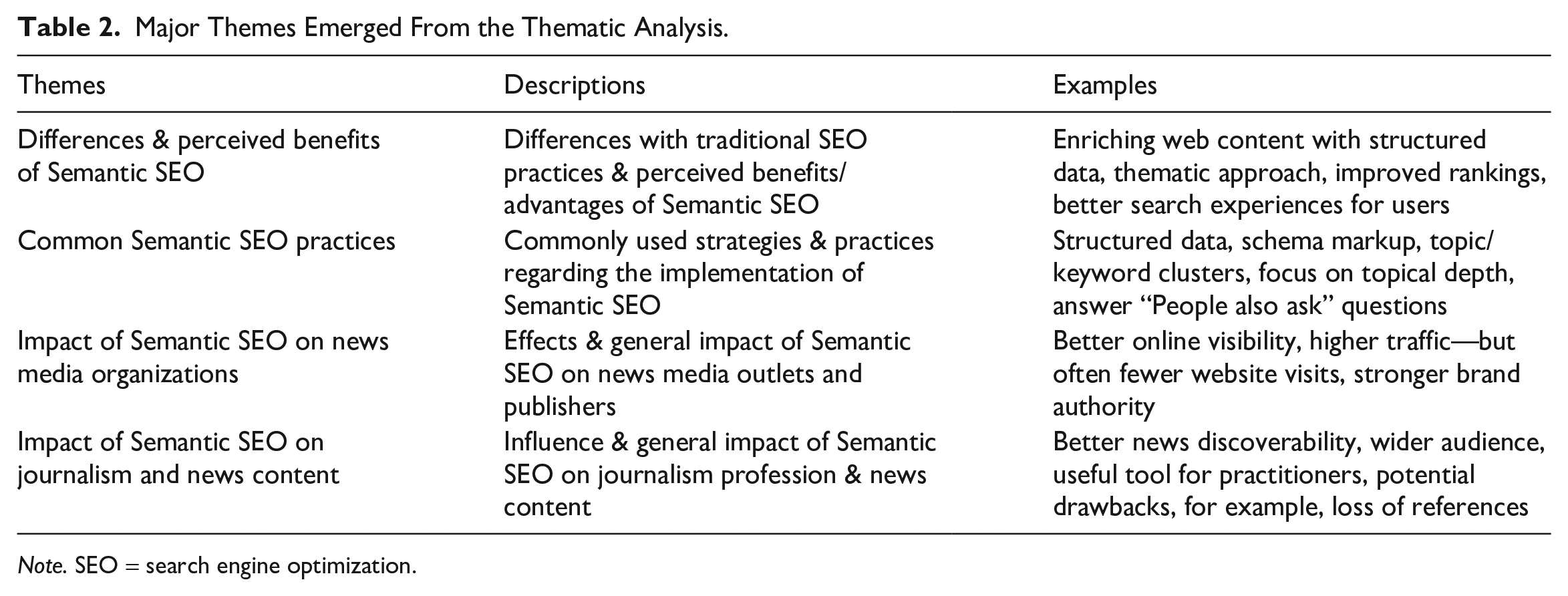
Note. SEO = search engine optimization.
The Semantic Approach and Perceived Benefits of Semantic SEO (RQ1)
All participants were initially asked to discuss the differences between a semantic SEO approach and traditional SEO while also providing insights into the perceived benefits of implementing a semantic SEO strategy. Overall, all the respondents reported that Semantic SEO can be described as the practice of enriching web content with greater meaning and topical depth to improve the discoverability by search engines. Of great importance to this process, according to experts, is the utilization of structured data and schema markup, which distinguish Semantic SEO from traditional SEO practices and are closely connected with the SW. According to an expert from an SEO agency, “Semantic SEO is now the standard process used to optimize for search engines and organic search.” However, another SEO specialist with extensive journalistic experience emphasized that “SEO today is a much more complex procedure with a wide range of factors, including both technical aspects like structured data and other non-technical elements.” Furthermore, the respondents agreed that Semantic SEO also involves adopting a more thematic approach, and therefore from a more editorial perspective, it is the process of creating content around topics rather than a single-keyword approach. In addition, one of the primary distinctions between this type of SEO and traditional SEO practices is content depth, which refers to how thoroughly the content covers a specific topic.
Based on data analysis and according to Greek experts, semantic SEO strategies are perceived to offer a variety of benefits, ranging from improved website rankings to providing users with more helpful, relevant information and better search experiences. Specifically, structured content and SW metadata are believed to assist major search engines in better understanding the content of a website, ultimately leading to enhanced discoverability and improved rankings. From the audience and a more editorial perspective, creating content under a Semantic SEO approach does not appear to seek to answer a single question about a subject but rather aims to answer all the questions that the user may have about the same subject. For example, a search for “. . . what is artificial intelligence?” could provide comprehensive content, including a definition, applications, key principles, and information about machine learning as well as the impact of AI across different industries. In this regard, some experts wanted to abandon the logic of keyword optimization or, worse, keyword stuffing which is the excessive use of certain words in web content, aiming to manipulate search engines’ rankings in favor of content that clearly meets user demands by providing the information the user is looking for. They reported that this is also in line with recent updates and guidelines from major search engines, especially Google. The experts added that SEO has become more user-friendly today, which involves considering search intent, adding more meaning, and providing users with comprehensive information through the creation of helpful and well-written content. In addition, as more search intents are met, other comprehensive and authoritative pages on the same topic are created, and a website that invests in this content strategy gains topical authority and better rankings and is more easily rated for relevant keywords. The above, combined with structured data practices, is believed to potentially lead to long-term high traffic volume and better online visibility. This is the ultimate purpose of SEO and a conclusion highlighted by Greek experts. However, a few experts expressed concern about the potential negative aspects of Semantic SEO, highlighting the possible consequences of its utilization by bad actors, such as misinformation websites. In this way, they commented that the use of Semantic SEO techniques to manipulate search results could lead to the amplification of false or misleading information or contribute to the spread of disinformation campaigns.
Semantic SEO and Optimization Practices (RQ2)
The respondents were also asked to recommend, in general, any strategy or practice regarding the implementation of Semantic (news) SEO. For the most part, a combination of specific strategies, including different on-site elements, was mentioned by the Greek experts. More specifically, the respondents emphasized the importance of developing structured data and schema markup, considering it a fundamental practice for Semantic SEO. They commented that structured data are used to, directly, convey specific information to search engines, helping them interpret the content on a webpage more accurately and efficiently, and present relevant and more attractive search results (see Figures 1–3). Some experts mentioned popular types of schema markup in the context of news media such as the Article/NewsArticle, the BlogPosting, and the BroadcastEvent schemas (Figure 3), while others described structured data practices as more advanced and technical components of Semantic SEO practices. These suggested practices are consistent with the findings of a relevant study, which demonstrated that semantic markup and linked structured data can improve the online visibility (i.e., traffic) of a website (Volpini et al., 2017). Today, Schema.org structured data model is widely adopted by numerous websites and applications, including news organizations, to facilitate information search and retrieval (Adair, 2020; Iliadis et al., 2023). In this context, the findings of a relevant study in art and culture-related online media showed that the integration of the Schema.org structure data was the most significant factor for predicting a website’s popularity (Giannakoulopoulos et al., 2022).
While structured data are an essential component of Semantic SEO, it is worth noting that many professionals also mentioned various content-related strategies that specifically focus on the main content directly seen by site visitors, addressing their needs and search intent. From an editorial perspective, media representatives emphasized the need to optimize in fact to create content for both keyword and topic clusters based on search intent. Keyword clusters refer to groups of keywords that are semantically related, and by optimizing for these clusters (in contrast to the traditional single-keyword approach), administrators can allegedly enhance the visibility of their content for a wider range of keywords while also adding more meaning to it. “. . . a strategy related to Semantic SEO is to look for relevant or secondary keywords for a topic and incorporate them into your text to increase its semantic relevance” noted an expert from a digital media group. For example, a keyword cluster about “Search Engine Optimization (SEO)” would possibly include the following keywords: “SEO best practices,” “on-page SEO techniques,” “off-page SEO techniques,” and “keyword research tools.” Similarly, an SEO topic cluster refers to a group of different but related pieces of content that collectively cover a broad subject area (i.e., topically relevant content). Typically, a topic cluster consists of a pillar topic and its corresponding page along with a series of closely linked articles that provide comprehensive coverage of a specific subject. For instance, a topic like “Digital marketing” would potentially include a pillar content piece titled “Introduction to digital marketing,” along with cluster content articles such as “Search engine optimization techniques,” “Social media marketing strategies,” “Content marketing best practices,” and “Email marketing tips.” An expert with a journalistic background commented, By covering a broad topic through clusters and strong internal linking between these pages, we essentially help the site become an expert on a specific topic, aiming for higher rankings. A website that has developed expertise in a topic will rank higher in search engines for the entire topic, not just a few keywords.
Interestingly, as another way to increase the topical and semantic depth of online content, the experts interviewed consider it essential to answer the most common questions people are asking daily, regarding a primary keyword’s topic. Participants referred to the “People also ask” feature of Google’s search results (see Figure 4) often showing up at the top of the SERPS, a useful feature both for web publishers and for content creators.

The “people also ask” feature in Google search results.
Yet, some experts proposed the creation of longer content (e.g., over 1000 words) in order to offer a more in-depth examination of a subject and thus improve topical depth. As noted by an SEO manager from a digital agency: . . . the simplest strategy related to Semantic SEO is to increase the length of your web content and write longer texts than the competition which will answer all pertinent questions and contain relevant (semantic) keywords.
Longer content is more likely to add further semantic value and several studies have found a strong relationship between longer content and higher rankings on search results (Howells-Barby, 2015; Lincoln, 2015). As Duong points out (2019), content over 1200 words sends a positive signal to Google, while content close to 2000 words sends a signal of high quality to the search engine.
The above findings and the reported strategies (Figure 5) are in agreement with the relevant literature and previous studies referring to the use of Semantic SEO (Barysevich, 2021; Bhan, 2022; Giannakoulopoulos et al., 2022; Lopezosa et al., 2018; Panagiotidis & Veglis, 2020; Volpini et al., 2017). While the specific objectives and goals of content producers may vary, depending on the context and the individual’s needs, the fundamental principles and techniques of a semantic SEO strategy (mainly structured data and schema markup, but also in-depth, comprehensive content and focus on user intent) are common across different types of content creators, including journalists and media professionals (Bhan, 2022; Giannakoulopoulos et al., 2022; Lopezosa et al., 2018; Panagiotidis & Veglis, 2020). A semantic SEO approach allegedly can serve as a useful tool for content producers and developers aiming to enhance the visibility and reach of their content, and this was something that was highlighted by many respondents.

Main semantic SEO practices recommended by Greek SEO experts.
The Impact of Semantic SEO on News Media Organizations (RQ3)
Another topic addressed by interviewees included the general impact of Semantic SEO on news media organizations in the current online media environment. Overall, the vast majority of respondents agreed that a semantic SEO strategy can have a positive impact on news media, mainly by offering an advantage to those who employ such practices in the strong competition for higher traffic numbers and better online visibility inside the media industry. Experts expressed similar opinions, communicating the idea that Semantic SEO can increase content discoverability and boost traffic numbers from search engine results and should be a priority for any website. They also highlighted that it is one of the few content strategies that can benefit news publishers by effectively promoting their content in the evolving online media ecosystem.
In contrast, a few professionals also emphasized that the advancement of search engines and their semantic technologies can sometimes result in reduced traffic and potentially lower ad revenues for news media outlets. For instance, Google’s featured snippets, knowledge panels, and other types of rich search results that offer direct answers can often discourage users from visiting news websites or accessing the original sources directly.
According to most respondents and from a market-oriented perspective, the use of semantic SEO together with other more traditional SEO practices (e.g., image/URL optimization, off-page SEO, and link building) can help news organizations reach larger audiences through search engines and more keyword rankings in organic searches. Better visibility through search engines means more (organic) traffic also resulting in more ads and greater revenue. These perspectives can be deemed unsurprising given that (advertising-backed) news media outlets rely on the ability to convert their accumulated audience into revenue (Benson, 2006). The current state of the online information and media economy is predicated primarily on the monetization of “views” via advertising revenue and this is a condition where being first is frequently preferable to being accurate, even at the expense of verification and overall news quality. As noted by an expert with extensive experience in the news media industry, a semantic SEO strategy can significantly help news organizations, which depend on attracting visitors, in terms of traffic volume both in the short and in the long term. However, it is crucial to strike a balance and avoid compromising the integrity and value of the journalistic content in the pursuit for higher traffic volumes.
Interestingly, one SEO strategist from an SEO agency shared that the semantic approach may have a greater impact on local or more thematic websites, while another expert with a journalistic background commented that Semantic SEO benefits more evergreen content that is not time-sensitive (unlike, for example, breaking news), as it remains relevant to readers and has the potential to generate traffic over an extended period. According to some experts, local news websites, which typically focus on geographically specific topics, can utilize semantic SEO strategies to improve visibility and assist interested users in discovering relevant local news content. Finally, another reported benefit for news media observed from responses, concerns the profile and reputation of news organizations. Greek experts underlined that news media can enhance their online visibility in organic rankings by effectively employing main Semantic SEO techniques such as structured data and schema markup while also creating unique and meaningful content. This, in turn, according to experts, can contribute significantly to establishing a stronger brand authority and driving the growth of news organizations, thereby attracting a larger and more engaged readership.
Impact on News Content and Journalism Profession (RQ4)
The final research question of this study concerned the impact of Semantic SEO on news content and the journalism profession. In general, the vast majority of Greek experts appeared to recognize the impact of a semantic SEO strategy on news media, believing that it could significantly facilitate the discoverability of news content, reaching a wider audience, and ultimately benefit journalistic work. Therefore, they considered advanced SEO as an essential tool for news practitioners, editors, bloggers, and anyone involved in publishing news content, leading to improved indexing and increased visibility among users searching for related topics. A notable comment from an expert working in the broadcast media industry stated that any measures aiding the widespread dissemination of news, such as the utilization of metadata and structured data, would be advantageous for journalism and news-related content. As mentioned previously, Semantic SEO involves shifting from a traditional keyword-focused approach to a more thematic and content-depth approach when creating online content, based on users’ intent. In this context, and from a more editorial perspective, according to Greek professionals, a semantic SEO approach within newsrooms can assist journalists in producing comprehensive and in-depth news content, ultimately enhancing the overall users’ news experience. The comprehensive coverage of a topic requires thorough exploration and analysis, which experts noted could contribute to better journalism. Also, it was remarked that providing readers with all the necessary information in one place, rather than requiring them to search for additional information on different websites, is something that could increase the audience’s engagement with the news content, contributing positively to journalism.
In addition, another expert, an SEO manager in a digital agency, went on to say that Semantic SEO and SEO in general can work both positively and negatively in journalism and news content depending on how an SEO policy is applied inside newsrooms. When used as a useful, additional tool in journalism practice without diminishing traditional journalistic values, it can contribute to the creation of better online content (both for people and for search engines), higher rankings, and improved online visibility for news content. However, he suggested that if there is overemphasis of SEO and also if news media simply focuses on creating texts for search engines and higher rankings, then the results would be negative, resulting in a more standardized and predictable content, compromising the overall quality of journalistic products. In addition, another participant, the Head of SEO in a digital agency, stressed that in today’s fast-paced world, where people have limited time to read news, many prefer to consume it briefly through alternative platforms like search engines and, in this regard, Semantic SEO seems useful in terms of news discoverability. The use of Semantic SEO to extract news and facts from news pages and present them in curated search engine results pages or virtual assistants can reportedly help increase the reach of news content, but this practice, on the contrary, may also have a potential drawback, resulting in original sources losing references, visits, and advertising revenues which highlights a long-running tension between news publishers and search engines, mainly Google (Iliadis et al., 2023, Leswing, 2023; Schwartz, 2019a). It is worth mentioning that in contrast to most of the experts who expressed positive opinions and were in favor of using such practices within newsrooms, there was also a minority of respondents who considered the use of Semantic SEO as less necessary by news media organizations and believed it to be more useful for other types of websites, particularly e-commerce and business websites. They argued that news media should prioritize delivering accurate and timely information rather than excessively focusing on SEO techniques and catering to search engines and algorithms.
Discussion
Semantic SEO can be described as the next generation of SEO techniques and is closely related to SW metadata, structured data, and also semantically relevant content. It is a new approach to content optimization, primarily targeting search engines by directly representing information and facts from web pages in search results through structured data. In addition, according to experts, its goal is to provide relevant and comprehensive content, ultimately enhancing the search experience of the audience. In the context of news media, Semantic SEO allegedly can contribute to news discoverability, helping readers find the news content they are looking for and, according to Greek practitioners, it could also assist in and contribute to better journalism, enabling news media to reach a larger audience and expand the extent of their newsworthy content. In this context, many news organizations and fact-checking initiatives around the world have already employed the Schema.org structured data model to verify misinformation and conduct fact-checking through structured data (Adair, 2020; Lim, 2019; Mantzarlis, 2019). Since 2016, in an effort to combat online conspiracy theories and misinformation, Schema.org has released relevant vocabulary that has been adopted by Google 7 (Figure 3) and Bing, 8 and is displayed in their search results. More specifically, as stated earlier, the term ClaimReview allows developers to tag news articles with fact-checks, which are then highlighted as such in search results (Dudfield & Dodds, 2021; Iliadis et al., 2023). In order to label their articles, fact-checkers and developers enter some details about an article including the URL, the person and claim being checked, and the conclusion (Lim, 2019). However, it is worth mentioning that ClaimReview also has the potential to exacerbate issues related to misinformation or create a misleading sense of credibility. In fact, the labeling of content as “credible” can occur without verifying the validity of the claim, thereby enabling bad actors (for example, misinformation websites) to exploit the metadata vocabulary for superficial fact-checking purposes or deceptive intentions (Iliadis et al., 2023).
The development of digital journalism is accompanied by a growing reliance for news publishers on large technology companies, and in this context, it is important to highlight the symbiotic relationship between search engines and news media outlets in today’s online media ecosystem. More specifically, and in the context of this relationship, the news industry and digital platforms such as Google or Facebook are involved in a state of cooperative competition often referred to as “coopetition” (Belleflamme & Neysen, 2009; Brandenburger & Nalebuff, 1997; Smyrnaios, 2012). First, the collaborative aspect refers to both their mutual interests and dependence on sharing content and traffic. Digital platforms use professional, original media content to attract users, while news publishers benefit from traffic redirected to their websites. The competitive aspect, on the contrary, refers to their direct competition in the advertising market as well as the issue of revenue sharing. In this process of coopetition, the political economy of online news becomes disrupted and unbalanced due to monetization being tied to individual content pieces and revenue being unequally shared with infomediaries (i.e., digital platforms), thus undermining the cross-subsidization system that once supported the production of original news by professional media outlets. It should be noted that this relationship with technology firms, alongside ethical and ideological issues in the media industry, has led to a turbulent situation since 2003, where a number of controversies have occurred in many countries, including the United States, France, and other European countries and an ongoing competition between news organizations and, mainly, Google during the last two decades (Arthur, 2014; Chee, 2022; Cozens, 2005; Smyrnaios, 2012; Vidalon, 2022). Also, today, a trend toward the dominance of infomediaries over news publishers seems to be emerging, with the current arrangement involving “a collusion of interests and a dilution of the media into distribution platforms” (Smyrnaios & Rebillard, 2019). For instance, the use of Schema.org presents a paradoxical situation for web developers and content creators (Iliadis et al., 2023). On one hand, they rely on it to enhance the findability of their content in semantic search and search results; however, this can lead to fewer people visiting their websites and subsequently result in a loss of ad revenue. In this context, they are seen as victims of how search engines present information, such as Google Knowledge panels, which aim to retain traffic on their platforms, monopolize information, and discourage users from accessing primary sources (Iliadis et al., 2023).
From a more editorial perspective, this relationship has a significant impact on journalism and news production practices often causing tension and conflict between journalistic principles, standards, and new digital practices. For this reason, the introduction of SEO strategies (mainly traditional SEO) inside newsrooms has been, and sometimes continues to be, criticized by those who believe they devalue the journalism profession and news work by pressuring journalists to create formulaic, SEO-friendly content written primarily for machines. In addition, using audience metrics and web analytics allows journalists to be more aware and responsive to their audience’s preferences, but it can also affect their editorial autonomy and sometimes result in a shift in editorial priorities and news agenda (Christin, 2020; Dick, 2011; Giomelakis et al., 2019b; Petre, 2021). In this context, the notion of infomediation (Smyrnaios & Rebillard, 2019), as a supplement to the more commonly used idea of platformization (Helmond, 2015; Nieborg & Poell, 2018; Poell et al., 2017), involves a transition from an editorially-driven to a demand-driven process for producing and distributing news, where content is continuously modified and repackaged in response to data-driven user feedback (Poell et al., 2017). However, the extent to which news practitioners simplify their content for SEO purposes is determined solely by their approach and how they choose to use it. Also, according to Greek experts, Semantic SEO has been considered the next phase in SEO practices, involving a new approach to content creation by news media. This approach reportedly aims to make the content discoverable by both search engines and the target audience, optimized for user intent, and valuable to the intended readership.
The world of SEO will be constantly changing with the online search in a state of continuous flux. Semantic technology and AI have already transformed, and will continue to transform, the way search giants such as Google and Microsoft operate their search engines and deliver search results. In February 2023, Microsoft introduced (Mehdi, 2023) the new Bing search engine which is bringing cutting-edge AI capabilities with the addition of a new version of OpenAI’s ChatGPT. The latter, which is an AI chatbot, has quickly managed to capture the internet’s attention for its comprehensive answers on various topics since its release in November of 2022 (OpenAI, 2022). Google also introduced, as a response to ChatGPT, an experimental conversational AI service called Bard during the same period (Pichai, 2023), in an attempt to provide better responses to search queries and distill complex data and different perspectives into easy-to-digest formats. Optimizing content for Semantic Search and, thus, Semantic SEO seems to be crucial, given the ability of such AI tools to better understand context and comprehend the meaning behind search queries. Therefore, implementing semantic SEO practices (e.g., SW metadata, structured data, and schema markup) could contribute to enhancing the visibility of online content in this new generation of AI-powered search engines and AI-driven results.
However, it should be noted that studies have found that AI chatbots are highly likely to produce not only inaccurate or irrelevant responses but also answers that promote conspiracy theories and misinformation (Alba, 2023; Enge, 2023; Hsu & Thompson, 2023). The use of AI raises significant ethical concerns regarding the accuracy and reliability of AI-generated content; this needs to be addressed through appropriate regulation to ensure ethical and responsible practices for the benefit of society (Perlman, 2022; Zorthian, 2023). In addition, the media industry also faces specific challenges and threats in relation to AI, including copyright and intellectual property issues such as the lack of sources or, in some cases, the act of bypassing access restrictions for paid content (paywalls) (Javed, 2023; Lacy, 2023; Zorthian, 2023). The increased use of AI in the search industry is expected to have a significant impact on the future of SEO (Bæk, 2023; SEO Vendor, 2022). In fact, the emergence of different AI-based tools has opened up a wide range of new possibilities in various areas of SEO practices such as content creation and analysis, keyword research, identifying patterns and trends, traffic and ranking growth analysis and voice search (Montti, 2023; SEO Vendor, 2022). Alongside the above, the use of AI in SEO practice can be applied to various activities to improve productivity, efficiency, and workflows but the success of using these tools to improve a company’s ranking on SERPs will be determined over the next few years. On the other hand, these tools could also be used to create biased, spam, or thin content, or solely to manipulate website rankings, which has always been a problem within the SEO industry. As AI becomes more sophisticated, experts need to consider how best to prepare themselves to adapt to this new online environment. Businesses must also consider how they approach SEO to dominate search results and stay ahead of the competition. But in the age of the SW and AI, structured, meaningful, and semantically enhanced web content seems more important than ever. The world of SEO is constantly evolving and therefore, SEO practitioners within newsrooms have to always be up to date on new technologies and developments in the field.
Conclusions and Future Work
This study is an attempt to investigate the role and impact of Semantic SEO in the news media industry using a series of semi-structured interviews with Greek SEO experts. Overall, the results of this study indicated a consensus opinion among Greek experts that Semantic SEO can help news media organizations improve their (online) visibility and rankings in (organic) search results. From a journalistic perspective and according to the respondents’ viewpoints, the advanced, semantic SEO practices allegedly can contribute to better journalism by creating more useful and comprehensive content as well as making news content more discoverable. Finally, several specific practices relating to Semantic SEO for online news content are mentioned. Specifically, the use of structured metadata coding languages and vocabularies and the schema markup are of central importance to Semantic SEO, and from a more editorial perspective, the comprehensive, relevant content and the focus on users’ intent seem to be closely connected with Semantic SEO. Given the increase in online media outlets and the dependence of news organizations on news infomediaries and digital platforms, especially in Google (Smyrnaios & Rebillard, 2019), news publishers are constantly looking for ways to improve the prominence and online visibility of their content in a changing news environment. Equally important, the digital success of news media depends, among other things, on operational changes in the processing and distribution of news. In a rapidly evolving media environment, today more than ever, it has become critical for online publishers to employ meaningful metadata, structured content, and improve the semantically relevant content on their websites in order to maintain and expand their online visibility. This is the point where Semantic (news) SEO and advanced SEO practices step in. However, while the utilization of semantic SEO can present opportunities for publishers to expand their audience reach, it is important to acknowledge that the advancement of search engines and their semantic technologies can also have some negative effects which should be taken into consideration and require study. This includes, among others, the potential loss of references to original sources, reduced traffic, potentially lower ad revenues for news media outlets, as well as occasional increases in online misinformation that can occur when bad actors utilize Semantic SEO.
This work was a preliminary study to assess the impact of Semantic SEO in the context of journalism and news media industry. This study adds to the existing literature on SEO as applied to journalism, search engine positioning and web visibility of the news media. It is, however, not without limitations. First and foremost, as an exploratory study, the sample included only a number of Greek SEO experts and, therefore, it is not claiming to be representative of the industry as a whole. A larger sample size, a wider range of questions, or the inclusion of other media professionals would be likely to produce better results, and surveying experts in other countries may produce different results in relation to the issues addressed here. In this context, studying specific media outlets (or asking about specific practices) and conducting comparative studies with foreign online media would be another research direction. In addition, although different measures were taken to ensure impartiality and avoid bias (such as interviewing a diverse range of experts, using semi-structured interviews, and standardized questions), it is worth noting that the interviewees were SEO experts responsible for SEO strategies; thus, some answers may be biased due to their professional involvement and their personal interests in the field of SEO. There are several important aspects in this area that require additional research, such as those of an economic or sociopolitical nature (concerning the complex relationships between online media and technology firms such as Google) or the impact of different organization backgrounds. In a broader perspective regarding SW, a more detailed examination of the role of semantic technologies in defining new approaches to journalism practice as well as the presentation and analysis of different tools and SW applications for journalists would be other research avenues to pursue for future work.
Footnotes
Declaration of Conflicting Interests
The author(s) declared no potential conflicts of interest with respect to the research, authorship, and/or publication of this article.
Funding
The author(s) received no financial support for the research, authorship, and/or publication of this article.
