



Abstract
This study explores partisan and group heterophily within cross-platform online communities that share alternative news media content in Denmark, Sweden, Germany, and Austria. The analysis is related to the emergence of anti-systemic cross-partisan counter-publics in Europe that have gained momentum with the outbreak of COVID-19 and the subsequent resistance against government restrictions. Comparing two periods (before and after the outbreak of COVID-19), we investigate whether these developments foster cross-partisan information sharing in online communities that form around right-wing, left-wing, and anti-systemic alternative news media content. Drawing on a network-analytical approach, we study networks formed around URL sharing of alternative news content across Facebook, Instagram, Twitter, Reddit, Telegram, TikTok, YouTube, and VKontakte. Data include 30 million social media posts from January 2019 to September 2021. The results show that overall source heterophily in online alternative news networks increases slightly with the COVID-19 pandemic, mainly due to the increased proliferation of anti-system news. This increase is, however, not an expression of a more profound collapse of bi-partisan, left-right cleavages and is contingent on country contexts. Except for the time of the initial outbreak, the overall sharing of COVID-19-related content tends to increase rather than decrease partisan homophily. Finally, the results show that non-bi-partisan, anti-system media have had a significant effect on alternative media information ecosystems during the COVID-19 pandemic.
Keywords
Introduction
The COVID-19 pandemic has exacerbated concerns for movements that express an outspoken distrust and resistance toward public authorities, political elites, and a perceived media mainstream. In the wake of the pandemic, these movements have often formed around broader anti-systemic sentiments rather than clear-cut partisan (left- or right-wing) leanings. Movements such as the Querdenken movement in Germany or the Men in Black movement in Denmark have been able to mobilize protesters across the ideological spectrum against government restrictions and vaccine politics (Gerbaudo, 2020; Jacobsen et al., 2021; Lange & Monscheuer, 2021).
Against this background, the present study investigates whether the emergence of anti-system protest movements and sentiments during COVID-19 has also led to an increased level of cross-partisan information sharing and, thus an increase in source heterophily on digital platforms. Source heterophily versus homophily, that is, exposure to diverse versus similar information within online information-sharing networks, has become of interest in the last decade, with the increased importance of social media for political information exposure (Balsamo et al., 2019; Bessi et al., 2015; Garimella et al., 2018). In online communities with high levels of source homophily, sometimes referred to as echo chambers (Cinelli et al., 2021), users share and become exposed to the same type of information. High levels of source homophily have been related to political polarization as well as the development of biased and misconstrued perceptions and worldviews (Flaxman et al., 2016).
A particular type of digital news source often associated with homogeneous and one-sided news exposure is alternative news media (Holt et al., 2019). Alternative news media are often highly partisan but also set out to challenge mainstream narratives and to provide the public with alternative viewpoints in an anti-hegemonic or even anti-systemic ambition. Although they do not represent general news sharing online, alternative news ecosystems provide a highly relevant and suitable focal point for studying changes in source heterophily that may result from a surge in cross-partisan anti-systemic movements and protests.
Approaching an analysis of source heterophily through the lens of alternative news content, we do not focus on the alternative media outlets or their content per se but instead on the broader digital spaces across various social media platforms on which alternative news and related content are shared. Online users that interact with, (re-)share, or simply view content make up the implicit communities that are shaped both by the content shared by distinct news media outlets as well as by different intermediary actors (e.g., Facebook groups or Telegram channels) that share articles published by alternative media outlets alongside other (hyperlinked) source material.
The analysis is centered on online alternative news environments and homogeneous information exposure before and after the outbreak of the COVID-19 pandemic. It studies how news items (and consequently the users that share them) can be described in terms of their partisanship. It builds on a large-scale quantitative analysis of URLs shared from social media accounts within a network of communities emerging from the mutual sharing of alternative news on social media in four European countries (Denmark, Sweden, Germany, and Austria). We employed network analysis as the primary methodological frame to extract the most salient patterns and compare trends across all four countries. Specifically, the study analyses communities around alternative news media in terms of how much content they share from left-wing, right-wing, and anti-systemic news sources, drawing on the concept of source heterophily (Kitchens et al., 2020) as a guiding mechanism for understanding the networks. In distinguishing between left-wing, right-wing, and anti-systemic alternative news sources, our analysis can account for changes in source heterophily that result from actual cross-partisan information sharing in terms of a blurring of traditional left-right cleavages, as well as changes that result from the increasing relevance of anti-systemic news content without a clear left-right-partisan leaning. Moreover, we consider whether a potential increase in source heterophily can be attributed specifically to the sharing of COVID-19-related content.
We consider the following research questions:
RQ1: How has the level of partisan source heterophily within online alternative news environments changed with the outbreak of the COVID-19 pandemic?
RQ2: Is the level of source heterophily directly related to the sharing of COVID-19-related content?
RQ3: How are these changes related to the sharing of content published by anti-systemic alternative media positioned outside the political left-right spectrum?
Theoretical Framework: Source Heterophily in Online Alternative News-Sharing Communities
The Concept of Online Source Homophily and Heterophily
Source heterophily can be defined as exposure to news that is heavily shared by a political outgroup, as the term is traditionally used in social psychology (Tajfel et al., 1979). The study of homophily or heterophily in exposure to information online has attracted much attention in media research over the last decade (Schmidt et al., 2017; Stroud, 2010), partly because it serves as a frame to explain growing polarization in many Western countries (Peralta et al., 2021) and partly because digital media has provided the public with many new ways of curating information (Thorson & Wells, 2016). Theoretically, being exposed to ideas that have a very narrow outlook on the world can lead to radicalization and unintentionally biased opinions, an effect that is often expressed using the metaphor of an echo chamber (Sunstein, 2017).
Increased information homophily among groups of people is often explained either by social effects (such as confirmation bias) (Knobloch-Westerwick & Kleinman, 2012) or algorithmic filtering (filter bubbles) (Pariser, 2011). However, whether such effects lead to increased information homophily in online communities remains largely inconclusive (Kitchens et al., 2020). For one, it is difficult to ascertain exactly what constitutes an echo chamber (Bechmann & Nielbo, 2018), as they are often highly context-dependent. Several studies have, for example, shown that echo chambers can be found on Facebook but not on Reddit (Cinelli et al., 2021; Morini et al., 2021). Other studies have found high levels of information homophily mostly among the most active users (B. Jiang, Karami, et al., 2021) and in communities that are more politically right-leaning (di Marco et al., 2021). Highly homophilic information environments are also more vulnerable to the spread of extreme opinions (Asatani et al., 2021).
Studies that rely on digital trace data tend to find evidence of information homophily, whereas agent-focused studies of individual news consumption point toward diverse online news diets (Cardenal et al., 2019). A comparison of news exposure on social media with traditional media diets reveals the former to be more diverse (Barberá, 2020). Thus, the echo chamber has been called a poor metaphor for understanding source homophily and heterophily on social media (Bruns, 2019). Consequently, this study does not intend to prove or disprove the existence of echo chambers, nor does it investigate whether social media ultimately promotes partisan homophily or polarization. Rather, we use the concept of source heterophily as a lens through which to observe ideological changes in online news-sharing communities during the pandemic.
One popular approach is to analyze source homophily in online news-sharing networks either in the guise of a specific sender, such as a website domain (Bandy & Diakopoulos, 2021), or through a social media account (Cinelli et al., 2021). However, some studies also consider homophily in terms of the ideological slant of the source, where online communities with high levels of source homophily are defined as those where most members only share news from sources with the same partisan leaning (Bakshy et al., 2012; Barberá, 2015; Hiaeshutter-Rice & Weeks, 2021). A useful concept introduced by Donkers and Ziegler (2021) is the distinction between ideological and epistemic echo chambers. The former describes communities that potentially have a fairly diverse news diet but reject any counter-attitudinal information, whereas the latter denotes communities that are not even exposed to news outside of those being shared in their own group. It is logical that opposing political factions might share many news pieces from either side to make fun of or denigrate the content (Krämer, 2017, p. 1302). However, whether certain groups are even exposed to diverse information in the first place, especially considering the general sharing of information during a health crisis, such as COVID-19, is still important.
This study is framed as an enquiry into the changing news-sharing landscape in terms of growing diversity, that is, source heterophily. We focus on epistemic source heterophily based on the political partisanship of alternative news outlets from which content is shared in online communities across various platforms. Thus, this study does not consider the polarization of political attitudes but rather the potential polarization of information exposure.
Political (Bi-)Partisanship as a Foundation of Source Heterophily
The cleavage between the ideological left and right is the most fundamental division of political spaces in Europe and the United States (Freire & Kivistik, 2013; Ruisch et al., 2021). It relies on ideological differences in political values and worldviews and has been debated widely across political science, political sociology, and social psychology, typically depicted as a spectrum of degrees ranging from far left to far right (Eagleton, 1994; Freeden, 1996; Jost et al., 2003). In a European context, the bi-partisan model was challenged long before the pandemic, as it fails to provide an adequate account of European multi-party systems, the increasing relevance of populist politics, and the rise of new social blocs and competing ideologies (Nilsson et al., 2020). Several research contributions argue that the bi-partisan model fails to grasp the multitude of ideological positions in European democracies and suggests, for example, a tri-partisan model that has the radical populist right as a distinct partisan pole next to the traditional left and right wings (Kriesi et al., 2006; Oesch &Rennwald, 2018).
Recently, academic discussions on a third partisan pole have shifted focus, not least with the surge of protest movements that have emerged in response to government interventions and restrictions due to COVID-19 (Pleyers, 2020). Reflecting on these and other recent political movements, Callison and Slobodian (2021) propose the term diagonalism to describe a political orientation that is essentially anti-system and anti-elite, rather than (bi-)partisan in a conventional sense. Callison and Slobodian argue that diagonalists tend to contest conventional monikers of left and right (while generally arcing towards far-right beliefs), to express ambivalence if not cynicism towards parliamentary politics, and to blend convictions about holism and even spirituality with a dogged discourse of individual liberties. (Callison & Slobodian, 2021)
In Germany, the “Querdenken” movement has mobilized beyond the ideological division of left and right as a melting pot for conspiracy-prone people with skeptical views on government pandemic politics (Edwards, 2018; Nachtwey et al., 2020) and as a mainstreaming of the far right by blurring the boundaries between democratic and racist far-right populist protests (Vieten, 2020).
Some research suggests that COVID-19 has the potential to (partly) overcome partisan divides. Nachtwey et al. (2020) studied the social characteristics of Querdenken supporters and found that the movement spans the entire political spectrum from left to right based on electoral voting patterns. Jungkunz (2021) and Merkley et al. (2020) argue that a shared feeling of emotional distress and cross-party consensus on COVID-19 policies have the potential to decrease bi-partisan affective polarization. The political and societal repercussions of the pandemic may, in turn, foster anti-systemic attitudes: Bartusevičius et al. (2021) show that the psychological burden of COVID-19 increases anti-systemic attitudes among citizens but also that levels of anti-systemic attitudes remain low during the pandemic. Stecula and Pickup (2021) show for the US-American case that populist attitudes foster conspiratorial beliefs about COVID-19 beyond partisanship and that this relationship is indeed particularly strong for people that use partisan (conservative) media. A similar relationship between populist attitudes, low systemic trust, and a higher propensity to believe in COVID-19-related conspiracy theories has also been documented in the Austrian case (Eberl et al., 2021).
Research on online polarization and partisan homophily during the pandemic has so far mostly been conducted in a US context. Rao et al. (2021) point to anti-science attitudes as an important dimension next to political partisanship and political moderacy in studying the degree of polarization in Twitter discussions related to the pandemic. The results show that political bi-partisanship and scientific polarization are strongly correlated, an expression of the “influence of pernicious political divisions on evidence-based discourse during the pandemic” (p. 6). J. Jiang, Ren, and Ferrara (2021) point to the existence of partisan echo chambers in the consumption of COVID-19-related information on Twitter, especially in right-leaning online communities.
Alternative News Environments as an Entry Point to Studying Source Heterophily Online
Our study approaches the question of online source heterophily by focusing on digital news environments that form around alternative news media content (Heft et al., 2020). We draw on a definition of alternative news media as representing “a proclaimed and/or (self-) perceived corrective, opposing the overall tendency of public discourse emanating from what is perceived as the dominant mainstream media in a given system” (Holt et al., 2019). Even though alternative news media are not partisan by definition, many current alternative news media can be described as hyper-partisan media that “depart from journalism’s traditional notions of objectivity, [are] transgressive in style, openly ideological, extremely biased in favor of a political leader and attack the other side’s point of view, often at the expense of facts” (Rae, 2021). Whereas many alternative news media originally grew out of left-wing environments, recent digital-first media are often right-leaning. Despite their frequent partisan leaning, alternative news media are first and foremost characterized by an anti-establishment or even anti-system positioning. In this respect they are akin to populist parties and movements in the political sphere that combine the “thin” ideology of populism, centered around the people-vs-elite dichotomy, with a “thick” political ideology (Heft et al., 2020; Mudde & Kaltwasser, 2017).
The literature on alternative news media thus follows recent developments in the field of political party systems by moving beyond the ideological left-right spectrum in understanding alternative news media as carriers of counter-publics (Holt et al., 2019; Schwarzenegger, 2021). Having studied users of alternative news media in Germany, Schwarzenegger (2021) found that they “pick and choose” fragments from ideologically diverse media rather than committing to media with a specific ideological leaning. More than opposing journalistic conventions or commercial logics, or appealing to a certain audience, what describes alternative news media at a conceptual level is a fundamental dissatisfaction with the social and political order (Capoccia, 2002; Holt, 2018). Although partisan alternative news media can also show signs of outright anti-systemness (Holt, 2018; Mayerhöffer, 2021), the anti-systemic ambition, often combined with conspiratorial thinking or anti-state ideology, takes center stage for a third type of alternative news media we term “anti-system” media. These anti-system media expose no straightforward left- or right-wing leaning but remain alternative due to strong anti-systemic ambitions, oftentimes challenging the metapolitics of the prevailing political order (Zulianello, 2018). Some of these, for example, German radio station KenFm, existed long before the outbreak of COVID-19, whereas others, such as Danish media Free Observer, were founded during the pandemic in the wake of cross-partisan protests against government restrictions.
The digital news ecosystem that forms around this tripolar landscape of alternative news media presents a suitable entry point for studying changes in online source heterophily with the onset of the pandemic. Most alternative news media rely on various online and social media channels as prime platforms for disseminating their content. In studying changes in partisan affinity and source heterophily in online communities that engage with and share alternative news content, our study provides valuable insights into changes in alternative news ecosystems during COVID-19. Published research on alternative news media during COVID-19 is still scarce. Studying German alternative news media on Facebook from January to mid-March 2020, Boberg et al. (2020) find that alternative news output on Facebook was indeed often overly critical or even anti-systemic but also that these media stayed largely true to their ideological foundations. Similarly, Schug et al. (2023) find that alternative news media’s COVID-19-related science and health coverage still largely follows preexisting ideologies. Supporters of the Querdenken movement have been found to be more likely to engage online with alternative news media sources during the pandemic, but their overall use of these sources is still limited (Klawier et al., 2021). Users with counter-hegemonic or even conspiratorial worldviews have generally appeared more likely to resort to alternative news during the pandemic (Frischlich et al., 2023). Theocharis et al. (2021) show that the spread of outright conspiratorial thinking during COVID-19 is highly platform contingent, and that Twitter, in contrast to other social media platforms, provides the least fertile grounds for such beliefs.
Research Design, Data, and Methods
The research design draws on the sharing and redistribution logic of social media (Chadwick, 2017). Thus, the study focuses on the networked relations that are created between actors who share the same bits of information, here unique URLs, predominantly links to news articles, as well as photos, videos, or petitions. Actors are defined as the various entities that can share content using social media accounts, including organizations (e.g., news media outlets), pundits, and other public individual figures, groups of individuals, and private individuals. Due to API restrictions, we collect, however, only public social media posts.
The analysis is framed in terms of source heterophily, which we understand as the tendency for a social media actor to share a diverse range of content. In contrast to previous studies (Bandy & Diakopoulos, 2021), we define a source as the specific URL being shared and not just the domain of the URL. In this research design, source heterophily is based on a simple notion of exposure that does not take into account the sentiment or function associated with the sharing of a source.
In contrast to many online news-sharing studies that focus on a single social media platform (Barberá, 2015; di Marco et al., 2021; Schmidt et al., 2017) or that analyze multiple platforms separately, we consider all included platforms (Twitter, Facebook, Instagram, YouTube, Reddit, Telegram, VKontakte, and TikTok) as part of the same news-sharing network. A distinct advantage of this approach is that it allows us to account for source heterophily that manifests across multiple platforms. URLs that appear only to be shared by, for example, the same three Facebook pages might also be shared by a much more diverse community of users on Twitter.
Country Selection
We analyze cross-platform alternative online news environments in four rather similar Northern and Central European countries (Germany, Austria, Denmark, and Sweden). Despite being multi-party consensus democracies, all four countries traditionally exhibit a left-right cleavage in both party politics and the mass media landscape (Hallin & Mancini, 2004). In all four countries, right-wing populists, in the case of Germany, also left-wing populist parties are represented in national parliaments. However, only in Germany and Sweden can these populist parties (at the time of data collection) be described as nonintegrated into the political system and thus truly anti-systemic (Zulianello, 2020). In contrast to the many studies focusing on online source heterophily in countries with a bi-partisan two-party political landscape, in particular the US (Bakshy et al., 2015; Kitchens et al., 2020), our study thus contributes with knowledge on cross-partisan news sharing in a broader ideological, rather than a party-political sense.
All four countries feature an established and varied digital alternative media landscape, including right-wing, left-wing, and anti-system alternative media, which makes digital alternative news environments a suitable point of departure for an analysis of changes in cross-partisan information sharing. The alternative news environments of Germany and Sweden have, however, been described as more well-established than their Austrian and Danish counterparts (Heft et al., 2020), which might lead to more stable patterns of information sharing and subsequently source heterophily in these countries.
During the COVID-19 pandemic, the severity of government restrictions and the ensuing level of protest and resistance varied between the four countries. Government responses to COVID-19 were more restrictive in Germany and even more so in Austria and relatively more moderate in Denmark and Sweden (Hale et al., 2021). Although government responses in the two Nordic countries were technically comparable in intensity, Swedish responses were predominantly noncoercive and thus perceived as less restrictive (Nielsen & Lindvall, 2021). Despite these differences, all four countries experienced cross-partisan protests against the restrictions, though to varying degrees. In Germany and later Austria, the Querdenken movement managed to mobilize significant offline and online protests, while the Men in Black protests in Denmark and the spurious public protests in Sweden were more limited in size.
Identification of Alternative News Outlets
Building on the operational definitions proposed by Holt et al. (2019) and Heft et al. (2020), we identify a start list of all alternative news media outlets in each of the four countries that (a) regularly publish digital content, (b) self-identify as and feature at least rudimentary features of a news outlet (e.g., an editorial structure), (c) express an explicit oppositional or anti-mainstream ambition in their self-description on their websites or social media profiles, and (d) can be classified as either “left-wing,” “right-wing,” or “anti-system.” To compile the start lists, we departed from existing lists of alternative news media in the four countries (Bachl, 2018; Blach-Ørsten & Mayerhöffer, 2021; Boberg et al., 2020; Freudenthaler & Wessler, 2022; Heft et al., 2020) and expanded these lists through consultations of country experts and additional desktop research. We moreover identified news outlets with a high audience overlap with the already identified outlets, using audience overlap measures provided by Alexa.com. Only news outlets that met criteria (a) to (d) were considered.
We manually classify news outlets as either left-wing or right-wing if their self-description (on any platform) or their website and article keywords and tags contain clear partisan self-positioning. Such positioning can occur through the direct use of right-wing or left-wing markers (such as “conservative,” or “socialist”), or the reference to right-wing or left-wing ideological concepts (such as nationalism, nativism, egalitarianism). We also consider the explicit rejection of ideological concepts (such as “anti-wokism” for the right or “anti-fascism” for the left) as an expression of partisanship. We classify news outlets as anti-system, if they do not exhibit clear bi-partisan positioning but are characterized by an explicit challenging of the existing meta-political order (Holt, 2018; Schwarzenegger, 2021). Such an anti-system stance regularly exceeds an ambition “to do journalism differently” and can also feature outright conspiratorial views. Partisan outlets with an anti-system stance are classified as either left- or right-wing. Classifications have been validated against existing compilations of alternative news media and discussed with country experts independent of the research team. Each news media outlet is assigned to only one country, based on its address, domain, and (for Denmark and Sweden) language profile (see Appendix A for the full start list of 117 alternative news outlets).
Sampling of Social Media Posts and Accounts
We sample social media accounts and posts for two time periods: 1 January 2019 to 1 March 2020 represents the time before the outbreak of the COVID-19 pandemic, 2 March 2020 to 1 September 2021 the time after the outbreak of the pandemic. Social media posts and accounts are sampled through a two-tier data collection process due to differences in platform APIs.
First, on platforms offering a search endpoint (Facebook, Instagram, Twitter, Reddit, and VKontakte), we collect all posts shared by social media accounts that have shared content by the alternative news outlets included in the start list. To do so, we search for all shares of web domains belonging to any of the start list outlets to identify social media accounts that have shared URLs linking to their websites. Furthermore, since some alternative news outlets create content directly to their social media platforms, such as Facebook videos, we also identify all accounts that have shared posts published directly on the official social media accounts of the identified alternative news outlets (all alternative news outlets in the sample predominantly use their social media profiles to publish own content, rather than sharing the content of others).
To analyze the broader information-sharing environments forming around the sharing of alternative news articles, we also examine actors’ connections to other actors based on the sharing of URLs that are not alternative news articles. To keep data volume to a manageable size, we sample the 400 most central 1 actors sharing alternative news articles for each country based on their relative distribution among social media platforms included in the study. Thus, if Twitter is the predominant platform, more Twitter accounts are sampled. From these actors, we extract an additional 30,000 of the most often shared URLs that are not links to alternative news articles, equally distributed across actors in order to avoid the risk of a few popular accounts dominating the sample. We search for occurrences of the extracted URLs across the included platforms to find new accounts that have also shared them. The thresholds were chosen to adequately gauge the broader news-sharing environments (that also include the sharing of information by other sources than alternative news media), while still being centered on the alternative news media in the start list. Since social media activity often follows a power law (Notarmuzi et al., 2022), we keep the thresholds fixed for each country to not exacerbate the tendency inherent within such power law (e.g., German-language accounts tend to have more followers/subscribers; thus more of their posts are likely to get reshared).
Second, on platforms without a search endpoint in their API (Telegram, YouTube, and TikTok), we search for any mentions of accounts from these platforms within all the posts collected in the first tier. We then download all posts from these mentioned accounts and search within these for occurrences of URLs. We moreover add all posts published on the Telegram, YouTube, and TikTok accounts of alternative news media included in the start list—only few alternative news media are, however, directly present with an official account on these platforms. While this sampling procedure is not perfect, we regard it as the most feasible way to extend the analysis of alternative news-sharing networks to platforms without a search endpoint in their API. This strategy is employed to find as many potentially relevant actors as possible; however, they are not blindly added to the data being analyzed. Networks are created based on social media accounts that have some proximity to the start list, which will be explained further in the next sections.
An important objective of the research design was to search broadly across many popular platforms to account for single-platform biases. Nevertheless, over two-thirds of the data are still predominantly sourced from Twitter and Facebook. Appendix B shows the number of posts and unique actors that were collected for each country between January 2019 and September 2021 using the above-mentioned sampling strategy, approximately 30 million posts.
URL Cleaning
URLs are used both to search for actors during data collection and creating relations between actors for the subsequent network analysis. URLs are cleaned using a pragmatic two-step approach. First, a URL is unpacked through an http request in order to bypass URL-shorteners such as bit.ly or other ambiguous URLs, for example, when news outlets change headlines for their articles. Second, all nonvital external URL parameters that do not influence which page a user is directed to are removed from the URL, such as parameters that are used to identify marketing campaigns and conduct web traffic research, for example, “?utm_campaign” and “?utm_medium.” The list of removed parameters can be found in Appendix C.
Creating Networks
For each country, a network was created based on shared URLs. We consider a relationship to exist between two actors if they share the same URL. Since some URLs are shared by thousands of different actors, we represent the relations using a bipartite projection. This means that both actors and unique URLs become nodes in the network. Edges are drawn between the actors and the URLs they share. Networks are “shrunk” to represent ego graphs centered on each of the alternative news media included in the start list with a radius of three. This filtering process ensured that only actors who have in fact shared alternative news content are included while retaining the relationships that exist between these actors based on other sources they might have shared (Figure 1).

Filtering networks centered on start-list actors with a radius of 3.
The circles in Figure 1 show the relations between the actors (blue) and the URLs they share (orange). Deep orange nodes are links to alternative news articles, while light orange nodes denote the implicit relationships between actors that are based on other types of content they might have shared.
Furthermore, we labeled each node according to partisanship. Partisan labels are based on the initial coding in the start list (Appendix A) and then propagated throughout the network. This process is adopted from the propagation algorithm proposed by Rao et al. (2021). After propagation, a node’s partisan affinity is defined, for example, by a right-wing value of 0.6 and a left-wing value of 0.4 representing 60% and 40% affinity toward the right- and left-wing alternative news media, respectively, and 0% toward anti-systemic media. Start list actors retain a fixed partisan affinity based on the manual coding (e.g., right-wing affinity = 1.0 for a right-wing-oriented news outlet). Since not all URLs linking to the websites of the start list outlets are shared by their official social media accounts, a temporary node is created in the network representing the website of the news outlet with a fixed partisan affinity value to propagate partisan affinity to the small fraction of URLs not shared by the official accounts of the alternative news outlets. The results of partisan label propagation are illustrated in Appendix D.
Partisan Affinity
To address changes in the partisan landscape within the news-sharing networks, we employ the concept of partisan affinity, which can be enacted as right-wing, left-wing, and anti-system affinity. We define an actor’s (e.g., right-wing) affinity in the network as the aggregate (e.g., right-wing) affinity of the content shared by that actor based on the partisan leaning of all actors in the network who shared the same content. Partisan affinity provides basic information about an actor’s position in the network relative to the partisan leaning of neighboring communities. The mean partisan affinity for all actors in the network (e.g., right-wing affinity) can be interpreted as the reach of that specific partisan group. Based on partisan affinity scores for individual nodes in the network, it is possible to calculate partisan heterophily scores for actors and communities in news-sharing networks.
Heterophily and Cross-Partisan Metrics
In the context of news-sharing networks, partisan source heterophily estimates whether an actor is embedded in a part of the network in which neighboring nodes have dissimilar (heterophilic) or similar (homophilic) sharing behaviors. The concept of partisan source heterophily is employed via three different metrics: cross-partisanship, neighborhood diversity, and inverse modularity. Documentation for each metric is displayed in Appendix E.
Cross-Partisanship
This metric expresses how evenly distributed an actor’s news-sharing profile is between left- and right-wing sources. If an actor shares an article that is shared by both left- and right-leaning actors, it adds to the actor’s cross-partisan score. Conversely, if an actor shares an article only shared by right-leaning actors, the actor attains a lower cross-partisan score. Cross-partisanship is implemented in two versions: one that measures the distribution of only right- and left-wing affinity (cross-partisanship bi) and one that also includes anti-system affinity (cross-partisanship tri).
Neighborhood Diversity
This metric represents a slightly more sensitive version of cross-partisanship. It draws on a technique often used to calculate homophily in networks where nodes have prelabeled attributes (Newman, 2006). It measures the number of edges within a given cluster that makes connections between nodes of the same partisan leaning. It reduces nodes to a single partisan leaning based on the highest partisan affinity. As with the concept of cross-partisanship, this metric is also implemented in two versions: one for only right- and left-wing (neighborhood diversity bi) and one that includes anti-systemic affinity (neighborhood diversity tri).
Inverse Modularity
This metric measures the degree of modularity in a network graph, that is, how well-defined each subgraph is compared to the whole. It has been used to measure the emergence of echo chambers (Schmidt et al., 2018). A modularity score of ≈ 1.0 corresponds to a network graph where each community is almost perfectly isolated from one another. A similar method can be applied to calculate the modularity score for a subgraph (i.e., community), which is coined conductance (Morini et al., 2021). To represent the heterophily of the network, this metric is denoted as inverse modularity (inverse modularity = 1 − modularity).
Each metric highlights unique features in the network. We have chosen to use inverse modularity as a baseline metric, as it gives an estimate of the level of source heterophily independently of partisanship within network clusters. As such, inverse modularity can be regarded as unspecified source heterophily. Conversely, cross-partisanship gives an indication of heterophily based on the actual partisan affinity of the actor. Even if a group of actors is tightly clustered together (low inverse modularity), the distribution of partisan affinity among the actors can be very mixed, that is, display high cross-partisanship. If actors are interconnected and also share a very high degree of the same partisan affinity, then cross-partisanship is low. Neighborhood diversity is similar to cross-partisanship but necessary for observing sudden changes in network structures within short time periods. To calculate inverse modularity and neighborhood diversity, all nodes are first assigned to a community using the Louvain community detection method (de Meo et al., 2011).
Identification of COVID-19-Related Content
To examine the correlation between the sharing of COVID-19-related content and heterophily in news-sharing communities, we classify posts based on two key variables. One is the URL being shared, and the other is the text accompanying the sharing of the URL, which is common on most platforms such as Facebook and Telegram. We track keywords relating to COVID-19 and pandemic response. For the sake of cross-country comparability, we aimed for a minimal filtering containing five keywords—“corona,” “covid,” “mask.” “pandemic,” and “epidemic”—all translated to German, Swedish, and Danish (see Bruns et al., 2020 for a similar approach).
Results
Changes in Unspecified Heterophily After the Outbreak of the COVID-19 Pandemic
This section first considers changes in heterophily in news-sharing networks in each of the four countries from a general perspective. The inverse modularity metric is employed as a baseline for unspecified source heterophily against which cross-partisanship and neighborhood diversity are subsequently compared.
Table 1 shows the difference in mean inverse modularity score in the comparison of the URL-sharing networks of the two time periods, before (1 January 2019 to 1 March 2020) and after (2 March 2020 to 1 September 2021) the outbreak of the COVID-19 pandemic. A positive inverse modularity score was interpreted as an increase in source heterophily: the clusters of actors and the links they share become increasingly interconnected. This trend can be observed for Austria, Denmark, and Germany, although the effect is largest for Austria. Thus, the different online communities formed around alternative news in these three countries tend to share more links between them. Sweden markedly has news-sharing networks with less nonpartisan source heterophily after the outbreak of COVID-19. This means that in three out of four countries, and more specifically, in the countries that took stricter COVID-19 measures, news-sharing networks became increasingly interconnected. This points toward a blurring of boundaries between some groups in the online news-sharing environments of Austria, Denmark, and Germany. However, this blurring does not yet account for the partisanship of these groups.
Changes in Inverse Modularity Scores After the Outbreak of COVID-19.

Note. COVID-19 = coronavirus disease.
p > .1; *p < .05; **p < .001; ***p < .0001.
Changes in Left- and Right-Wing Clusters After the Outbreak of the COVID-19 Pandemic
This section concerns observations of changes in the partisanship of news-sharing communities before and after the outbreak. Even though source heterophily in three of the countries increased with the pandemic when measured with inverse modularity, the change is not necessarily aligned with partisanship.
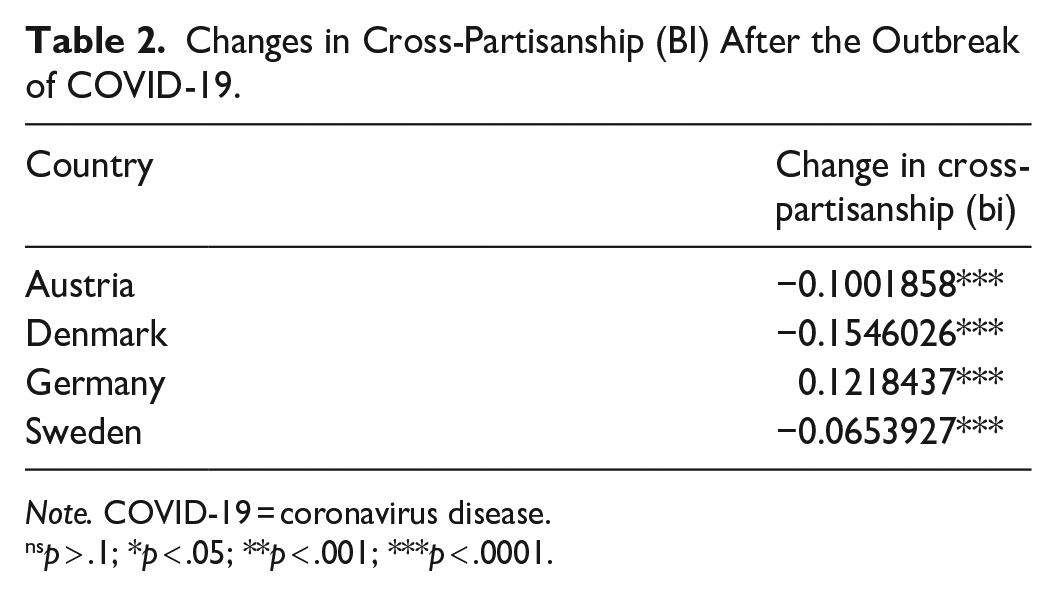
Table 2 shows whether various parts of the network draw on an increasingly heterogeneous mix of right- and left-wing news sources. Here, it is clear that in Austria, Denmark, and Sweden, networks are actually becoming more homogeneous when measuring how much information each community shares from both right- and left-wing sources. Thus, clusters of actors that share predominantly right-wing sources tend to become even more exclusive distributors of right-wing information. In Germany, however, cross-partisanship (bi) is increasing with the pandemic. Similar results appear for the neighborhood diversity metric (Appendix F). Thus, when accounting for left- and right-wing partisan affinity within the networks, there is no blurring of boundaries in three of the four countries. Rather, the heavily skewed right and left-wing parts of the networks tend to become even more homophilic during the pandemic.
Changes in Cross-Partisanship (BI) After the Outbreak of COVID-19.
Note. COVID-19 = coronavirus disease.
p > .1; *p < .05; **p < .001; ***p < .0001.
Measuring Changes When Adding Another Partisan Entity to the Mix
The previous section only concerns how many news pieces various actors share from sources that can be regarded as right- or left-wing, based on label propagation. However, the study also includes anti-system alternative media outlets that cannot be placed on the bipolar partisan spectrum and based on which anti-system affinity scores can be calculated for remaining actors in the network.
Table 3 now accounts not only for changes in source heterophily on the right- and left-wing scales but also for the category of anti-system. For example, an increase in cross-partisanship (TRI) can be caused by a right-wing community sharing more news from left-wing sources or anti-system sources. Here, the results show that news-sharing networks in all countries experienced a rise in source heterophily with the pandemic, although the effect was quite small for Sweden.
Changes in Cross-Partisanship (Tri) After the Outbreak of COVID-19.

Note. COVID-19 = coronavirus disease.
p > .1; *p < .05; **p < .001; ***p < .0001.
Considering that our baseline heterophily metric, inverse modularity, did slightly increase with the onset of the pandemic, any cross-partisan induced increase in source heterophily is thus likely due to mixing between anti-system and other partisan actors rather than a result of bi-partisan source heterophily.
Merging Between Right-Wing and Anti-system Communities in Germany and Austria
To gain a more detailed understanding of the shifts in the partisan news-sharing landscape, we examine the specific changes in partisan affinity for all actors in the network.
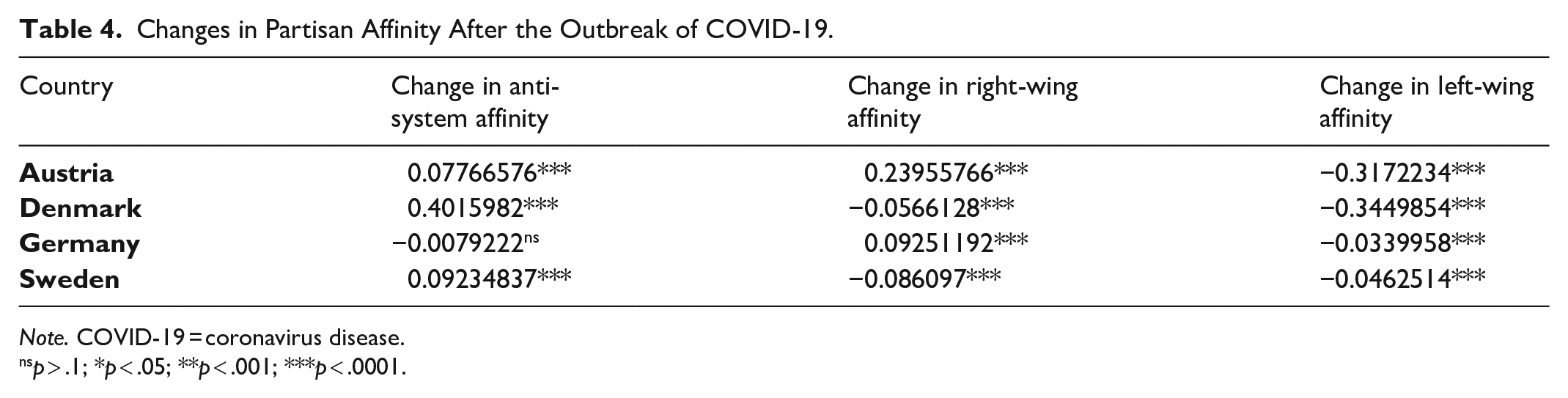
Table 4 displays changes in the mean partisan affinity for all actors in the network after the outbreak of the pandemic. Most notably, there is an increase in anti-system partisan affinity for three of the four countries, whereas all countries see a decrease in left-wing affinity. For Germany and Austria, there is also an increase in right-wing affinity. To further investigate these shifts in the partisan landscape, we examine changes in correlation between right-wing and anti-system affinity from before to after the outbreak of the pandemic. The logic is illustrated in Figure 2, which shows how the positions of actors in the scatterplot can be interpreted as changing relationships between left-, right-, and anti-system affinities.
Changes in Partisan Affinity After the Outbreak of COVID-19.
Note. COVID-19 = coronavirus disease.
p > .1; *p < .05; **p < .001; ***p < .0001.

Correlation between anti-system affinity and right-wing affinity—interpretation logic.
Figure 2 shows the distribution of actors for Denmark on two axes: (1) anti-system affinity and (2) right-wing affinity. Actors in the left bottom corner, which have low mean values for both right-wing and anti-system affinities, can be interpreted as those with high left-wing affinity. Blue and orange dots, respectively, indicate before and after the pandemic. Red arrows indicate changes in anti-system affinity.
The results for all countries are shown in Figure 3. We clearly see how communities with anti-system affinity shift toward the political right in Austria and Germany. In Austria, the movement is simultaneous, as right-wing actors show higher anti-system affinity and anti-system actors show more right-wing affinity. In Germany, anti-system actors move away from the left toward the political right-wing communities. The partisan network shifts in Germany and Austria are in line with previous research showing a greater affinity for anti-system and COVID-19 skeptic views within the political right compared to the left (Borbáth et al., 2021). In Denmark, there is a more even distribution of anti-system affinity among right- and left-wing communities. However, anti-system actors also consolidate themselves in a tight cluster at the far side of Figure 3. Sweden shows a near-perfect overlap between communities with high levels of anti-system affinity and left- and right-wing communities when comparing the two periods, which indicates very little change in the general partisan landscape, consistent with the results in the previous sections.

Correlation between anti-system affinity and right-wing affinity—all countries.
To lend some face validity to the statistical network analysis, we scanned the list of most influential actors in Germany and Austria that have both high levels of right-wing and anti-system affinity. A huge portion of the pages are dedicated to COVID-19 skepticism, such as the Facebook page FREIE PRESSE (not to be confused with German news outlet Freie Presse) and Telegram channel FaktenFriedenFreiheit, and several top accounts representing the anti-system Querdenken movement. In addition, we observe some pages that share well-known conspiracy theories and push general anti-elite agendas, as well as several Alternative Für Deutschland pages.
Sharing News About COVID-19 Does Not Lead to Partisan Source Heterophily
This section considers whether changes in source heterophily are correlated with the sharing of high amounts of COVID-19-related content. Bruns (2019, p. 32) notes how most studies that investigate the potential formation of echo chambers show high levels of source heterophily when centered on general topics of shared concern (a category that fits the pandemic).
For the analysis, we calculate the proportion of COVID-19 content shared by any single actor after the outbreak. In an exemplary fashion, Figure 4 displays the correlation between COVID-19 content and, in this case, cross-partisanship (bi) changes after the outbreak for Austria. These proportions are kept fixed for both the periods before and after. Consequently, correlations are assumed to be insignificant before the outbreak, since the position of any given actor in the network is expected to be unrelated to how much COVID-19-related content they end up sharing in the future. Indeed, the correlations for the period before the outbreak has R-squared values lower than 0.01, which suggests that actors who end up sharing COVID-19-related content after the outbreak are randomly distributed in terms of how cross-partisan they were before the pandemic. After the outbreak, we observe a clear shift toward a negative correlation. This indicates that news-sharing communities in which COVID-19-related content is especially popular display lower levels of source heterophily.
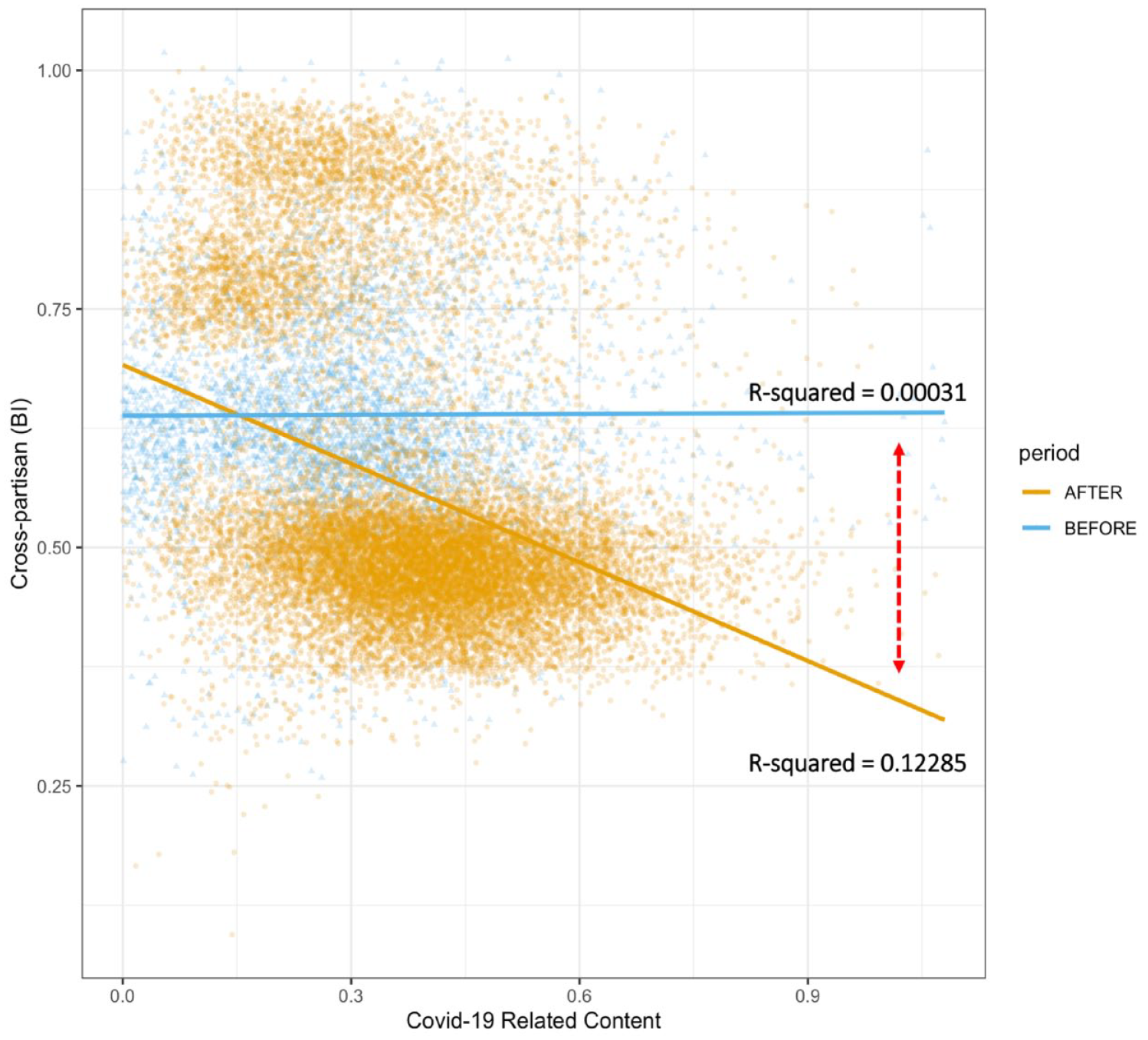
Correlation (Pearson’s) between COVID-19 content and bi-partisan heterophily in Austria before and after the outbreak of COVID-19.
Following the same logic, Table 5 displays changes in correlation for all countries across inverse modularity and cross-partisanship scores. Specifically, the numbers shown in Table 5 correspond to the “after” line in Figure 4. A decrease indicates that the correlation moves toward a negative relationship between the sharing of COVID-19-related content and source heterophily. P-values are available in Appendix G.
Correlation Between Sharing High Amounts of COVID-19 Content and Source Heterophily.

Note. COVID-19 = coronavirus disease.
p > .1; *p < .05; **p < .001; ***p < .0001.
Table 5 shows that the sharing of COVID-19-related content is weakly correlated with inverse modularity for Austria and Denmark. In those two countries, communities that share a lot of COVID-19-related news are characterized by higher levels of general source heterophily. For Sweden, the trend goes in the opposite direction, and for Germany, no real trend is apparent (the estimate is not statistically significant).
When we consider values for cross-partisanship, communities that share COVID-19-related content tend to be less politically heterogeneous, both in terms of cross-partisanship (bi) and cross-partisanship (tri). For Sweden, Denmark, and Austria, both cross-partisanship (bi) and cross-partisanship (tri) are negatively related to the share of COVID-19-related news items in online communities. For Germany, both cross-partisanship scores do show an increase, but only cross-partisanship (TRI) is statistically significant.
This is somewhat surprising since one might expect COVID-19-related information to, at least partly, consist of information from official bodies (statistics, imposed restrictions, etc.) or not be of clearly left/right political nature when expressing skepticism of or outright resistance against imposed measures. The fact that COVID-19-related content is not a driver of cross-partisan source heterophily could indicate that, on average, people in alternative news-sharing communities may have an even greater need to rely on information sources that are in line with their political identity in times of confusion and crisis.
Surge in Source Heterophily at the Height of the Crisis
The before-and-after comparison might ignore sudden, short-lived effects. Thus, as a last item of analysis, we examine the timeline (1 January 2019 to 1 September 2021) at a more granular level. This entails a time series analysis of monthly network snapshots. For individual nodes to retain some information about their previous position in the network, the time series is calculated as a running average with 1-week overlap at the beginning and end of the month. We employ the neighborhood diversity metric in this part of the analysis, as it is ideal for spotting event-sensitive trends. Figure 5 shows the development of the bi-partisan (bi) and tri-partisan (tri) neighborhood diversity metrics, as well as the overall share of COVID-19-related news items, based on the keyword classification introduced previously.

Timeline of COVID-19-related news content being shared in relation to changes in neighborhood diversity of news-sharing communities—all countries.
The metrics included in Figure 5 are displayed as the index for the mean value of any given month, such that all values are between 0 and 1. This was performed to easily compare changes in the mean values over time.
The average share of COVID-19-related alternative news items was highest in March 2020 when all four countries went into their first lockdown and saw its second increase during the second wave in winter 2020/2021. Both neighborhood diversity metrics, and thereby source heterophily, spiked in March 2020. This could be due to an increased propensity to share general statistics about contagion levels, which would be distributed in all parts of the network, contributing to more cross-partisan source heterophily. However, after the summer of 2020, partisan heterophily does not seem to follow the coverage of COVID-19 as closely, especially not neighborhood diversity (bi). Thus, we see some evidence that partisan biases in news-sharing are at least temporarily suspended in response to the emergent crisis.
Discussion
This study investigates whether alternative news-sharing networks across various social media platforms and in different national settings witness changes in source heterophily after the outbreak of COVID-19. Our results show that at the time of the outbreak in March 2020, it is indeed possible to observe a surge in alternative news content being shared across partisan divides. However, these levels of source heterophily quickly dropped, and alternative news-sharing communities became politically more isolated, especially those that share many COVID-19-related news items.
Although we observe a slight tendency for alternative news-sharing communities to generally become more interconnected, this increased source heterophily can be interpreted differently depending on the context. Most importantly, there is no evidence of the collapse of traditional left- and right-wing alternative news-sharing communities; in fact, the opposite seems to be the case. In three of the countries (Sweden, Denmark, and Austria), right- and left-wing communities appear to move further apart. In Germany, bi-partisan cleavages between online communities neither decrease nor increase significantly with the pandemic. However, when also considering anti-systemic news outlets that are not decisively left- or right-wing as a third partisan pole, all countries displayed greater source heterophily after the onset of the pandemic. Anti-systemic news without a clear partisan leaning thus finds its way into left- and right-wing online communities during the pandemic but do not contribute to a more fundamental dissolution of partisan boundaries in online alternative news environments. This is rather emblematic of the idea that online communities evolve and users discover new sources (Guess et al., 2021).
The observed shifts in partisan landscapes play out differently in the different countries under study. Sweden, which experienced the least restrictions and ensuing protests during the pandemic and has a very established alternative news landscape, shows only a few changes in the alternative news-sharing networks before and after the outbreak. In Denmark, where alternative news environments are least solidified, the pandemic has not contributed to a blurring of left- and right-communities but to a newly emerging anti-system news environment that draws in actors from existing left- and right-alternative news environments. In Germany and Austria, anti-system news-sharing communities tend to merge with the political right-wing after the outbreak. Communities in this intersection between right-wing and anti-system affinity are likely driven by groups who have come out strongly against government restrictions singing anti-elitist, anti-science, and anti-systemic tunes (Callison & Slobodian, 2021;J. Jiang, Ren, & Ferrara, 2021). Despite the cross-partisan nature of these general tunes and the specific Querdenken movement, anti-systemic orientations during the COVID-19 pandemic were thus most strongly anchored in right-wing-oriented online communities. For Germany and Austria, the observed overlap between anti-system affinity and right-wing affinity (with no strong overlap with the left-wing) provides additional empirical evidence that attitudes within the less traditional ideological communities have a stronger anchoring in right-wing-oriented communities. Future research on European alternative news-sharing communities should consider further traits of these emerging anti-system communities, with an added focus on topical patterns and sentiment structures. Furthermore, it would be relevant to track the persistence of such new communities in the coming years, not least once we, hopefully, enter a post-COVID-19 stage.
The present study comes with some limitations pertaining to sampling and data collection characteristics for cross-platform studies based on digital trace data. First, data access and affordances vary between platforms. For example, activity from Facebook can only be accessed from public pages and groups, while Twitter allows data from individual users to be collected, bar a few protected ones. This skew is further exacerbated by differences between platform APIs, where only some platforms have a search endpoint that allows researchers to query for the occurrence of specific URLs. Second, some platforms are less geared toward URL-sharing. On Instagram, for example, it is technically possible to share a URL, but there are no integrated hyperlink features within the post, which leads to fewer identified actors and posts, when applying a URL-based sampling strategy. As a consequence, we refrain from directly comparing levels of source heterophily between platforms. Third, resource limitations constrained us to focus on a subset of the most central actors and, most often, shared URLs for assessing the broader news-sharing environment around those who share alternative news on social media.
Overall, the results of this study are testimony to the complexity of estimating source heterophily in news-sharing networks. Rather than arguing for or against the existence of partisan echo chambers (e.g., Cinelli et al., 2021), our study suggests a novel approach to assessing the complexity of source homophily and heterophily in social media networks across platforms, as, for example, called for by Kitchens et al. (2020) and Bruns (2019). The heterophily metrics proposed in the context of cross-platform news-sharing networks can be used to highlight changes in partisan information environments in a more nuanced way, which can be fruitfully applied to other contexts and partisan landscapes.
Footnotes
Appendix A
Start List Actors.

| Actor | Country a | Partisanship | Total URL articles b | Website |
|---|---|---|---|---|
| Alles Roger | Austria | Right | 11 | http://www.allesroger.at/ |
| Alpenschau | Austria | Anti-system | 6,029 | https://alpenschau.com/ |
| Anschläge | Austria | Left | 507 | https://anschlaege.at/ |
| Auf1 | Austria | Anti-system | 6 | https://auf1.tv/ |
| Contra Magazin | Austria | Right | 2,235 | https://www.contra-magazin.com/ |
| Info Direkt | Austria | Right | 2,762 | http://info-direkt.eu/ |
| Kontrast | Austria | Left | 2,649 | https://kontrast.at/ |
| Moment | Austria | Left | 3,916 | https://www.moment.at/ |
| Mosaik Blog | Austria | Left | 878 | https://mosaik-blog.at/ |
| Neue Zeit | Austria | Left | 526 | https://neuezeit.at/ |
| Report 24 | Austria | Right | 2,847 | https://report24.news/ |
| Tagesstimme | Austria | Right | 4,097 | https://www.tagesstimme.com/ |
| Unser Mitteleuropa | Austria | Right | 2,701 | https://unser-mitteleuropa.com/ |
| Unsere Zeitung | Austria | Left | 2,862 | https://www.unsere-zeitung.at/ |
| Unzensuriert | Austria | Right | 10,980 | https://www.unzensuriert.at/ |
| Volksstimme | Austria | Left | 183 | http://volksstimme.at/ |
| Wochenblick | Austria | Right | 5,373 | https://www.wochenblick.at/ |
| Zack Zack | Austria | Left | 9,012 | https://zackzack.at/ |
| Zur Zeit | Austria | Right | 1,497 | http://zurzeit.at |
| 180Grader | Denmark | Right | 5,354 | https://180grader.dk/ |
| 24nyt | Denmark | Right | 11,484 | https://24nyt.dk/ |
| Arbejderen | Denmark | Left | 2,956 | https://arbejderen.dk/ |
| Danmarks Frie Fjernsyn | Denmark | Anti-system | 276 | https://www.danmarksfriefjernsyn.dk |
| Den Korte Avis | Denmark | Right | 3,057 | https://denkorteavis.dk/ |
| Dkdox.tv | Denmark | Anti-system | 810 | https://dkdox.tv/ |
| Folkets Avis | Denmark | Right | 1,242 | https://www.folkets.dk/ |
| Free Observer | Denmark | Anti-system | 185 | https://freeobserver.org/ |
| Frihedens Stemme | Denmark | Right | 955 | https://tv.frihedensstemme.dk/ |
| Indblik | Denmark | Right | 3,170 | https://indblik.dk/ |
| Konfront | Denmark | Left | 540 | https://konfront.dk/ |
| Kontrast | Denmark | Right | 461 | https://kontrast.dk/ |
| NewSpeek.info | Denmark | Right | 1,414 | https://newspeek.info/ |
| Nordfront | Denmark | Right | 5,273 | https://www.nordfront.dk/ |
| Pio Pio | Denmark | Left | 4,335 | https://piopio.dk/ |
| Redox | Denmark | Left | 199 | https://redox.dk/ |
| Respons | Denmark | Left | 81 | https://www.responsmedie.dk/ |
| Sameksistens | Denmark | Left | 306 | https://www.sameksistens.com/ |
| Solidaritet | Denmark | Left | 1,758 | https://solidaritet.dk/ |
| Achse des Guten | Germany | Right | 1,1808 | https://www.achgut.com/ |
| Analyze & Kritik | Germany | Left | 655 | https://www.akweb.de/ |
| Anonymous News | Germany | Right | 1,344 | https://www.anonymousnews.org/ |
| Anti Spiegel | Germany | Right | 2,135 | Anti-spiegel.ru |
| Antifa Infoblatt | Germany | Left | 357 | https://www.antifainfoblatt.de/ |
| Blaue Narzisse | Germany | Right | 567 | https://www.blauenarzisse.de/ |
| Blick Nach Rechts | Germany | Left | 966 | https://www.bnr.de |
| Compact Online | Germany | Right | 1,876 | https://www.compact-online.de/ |
| Der Rechte Rand | Germany | Left | 1,017 | https://www.der-rechte-rand.de/ |
| Die Unbestechlichen | Germany | Right | 31,450 | https://dieunbestechlichen.com/ |
| Direkte Aktion | Germany | Left | 148 | https://direkteaktion.org/ |
| Eigentuemlich frei | Germany | Right | 4,177 | https://ef-magazin.de/ |
| Epochtimes.de | Germany | Right | 305 | https://www.epochtimes.de/ |
| ExtremNews | Germany | Anti-system | 31,382 | https://www.extremnews.com/ |
| Free21 | Germany | Anti-system | 455 | https://free21.org/ |
| Freie Welt | Germany | Right | 1,976 | https://www.freiewelt.net/ |
| Freiheitsliebe | Germany | Left | 2,041 | https://diefreiheitsliebe.de/ |
| Jacobin | Germany | Left | 1,207 | www.jacobin.de |
| Journalistenwatch | Germany | Right | 7,772 | https://www.journalistenwatch.com/ |
| Junge Freiheit | Germany | Right | 8,838 | https://jungefreiheit.de/ |
| Junge Welt | Germany | Left | 12,563 | https://www.jungewelt.de/ |
| Jungle World | Germany | Left | 2,058 | https://jungle.world/ |
| Ken FM | Germany | Anti-system | 1,397 | https://kenfm.de/ |
| Kla.tv | Germany | Anti-system | 2,465 | https://www.kla.tv/de |
| Klasse gegen Klasse | Germany | Left | 1,653 | https://www.klassegegenklasse.org/ |
| Konkret | Germany | Left | 530 | https://www.konkret-magazin.de/ |
| Krautzone | Germany | Right | 1,128 | https://www.kraut-zone.de/ |
| Lotta | Germany | Left | 552 | https://lotta-magazin.de/ |
| Marx 21 | Germany | Left | 800 | https://www.marx21.de/ |
| Missy Magazine | Germany | Left | 1,041 | https://missy-magazine.de/ |
| MMnews | Germany | Right | 6,925 | https://www.mmnews.de/ |
| Multipolar Magazin | Germany | Anti-system | 3,177 | https://multipolar-magazin.de/ |
| NachDenkSeiten | Germany | Anti-system | 8,790 | https://www.nachdenkseiten.de/ |
| Nachrichtenspiegel | Germany | Anti-system | 6,540 | https://www.nachrichtenspiegel.de/ |
| NEOPresse | Germany | Anti-system | 17,717 | https://www.neopresse.com/ |
| Opposition 24 | Germany | Anti-system | 8,425 | https://opposition24.com/ |
| Perspektive | Germany | Left | 5,279 | https://perspektive-online.net |
| Philosophia Perennis | Germany | Right | 4,424 | https://philosophia-perennis.com/ |
| PI News | Germany | Right | 11,575 | https://www.pi-news.net/ |
| Politikstube | Germany | Right | 2,112 | https://politikstube.com/ |
| Pravda TV | Germany | Anti-system | 4,175 | https://www.pravda-tv.com |
| Redglobe | Germany | Left | 1,277 | https://www.redglobe.de/ |
| Reitschuster | Germany | Right | 2,583 | https://www.reitschuster.de |
| Rote Fahne News | Germany | Left | 10,119 | https://www.rf-news.de/ |
| RT Deutschland | Germany | Anti-system | 24,152 | https://de.rt.com/ |
| Rubikon.news | Germany | Anti-system | 2,900 | https://www.rubikon.news |
| Sezession | Germany | Right | 1,623 | https://www.sezession.de |
| Tichys Einblick | Germany | Right | 4,509 | https://www.tichyseinblick.de/ |
| Unsere Zeit | Germany | Left | 5,446 | https://www.unsere-zeit.de/ |
| Wahrheitspresse | Germany | Anti-system | 6 | http://www.truth24.net/ |
| Zaronews | Germany | Anti-system | 35,768 | https://www.zaronews.world/ |
| Zuerst! | Germany | Right | 1,440 | https://www.zuerst.de |
| Aktuellt Fokus | Sweden | Left | 1,342 | https://aktuelltfokus.se/ |
| Arbetaren | Sweden | Left | 3,364 | https://www.arbetaren.se/ |
| Bulletin | Sweden | Right | 2,464 | https://bulletin.nu/ |
| Det Gode Samhallet | Sweden | Right | 9,705 | https://detgodasamhallet.com/ |
| Direkt Aktion | Sweden | Left | 21 | https://direktaktion.nu |
| Epoch Times Sweden | Sweden | Anti-system | 8,695 | https://epochtimes.se/ |
| Exakt24 | Sweden | Right | 1,109 | https://exakt24.se/ |
| Feministisk Perspektiv | Sweden | Left | 1,069 | https://feministisktperspektiv.se/ |
| Flamman | Sweden | Left | 1,255 | http://flamman.se/ |
| Folkungen | Sweden | Right | 193 | https://folkungen.se/ |
| Fria Sidor | Sweden | Anti-system | 6 | http://friasidor.is/ |
| Fria Tider | Sweden | Right | 3,549 | https://www.friatider.se/ |
| Ledarsidorna | Sweden | Right | 3,750 | https://ledarsidorna.se/ |
| Nationalisten | Sweden | Right | 132 | https://www.nationalisten.se/ |
| News Voice | Sweden | Anti-system | 3,918 | https://newsvoice.se/ |
| Nordfront | Sweden | Right | 1,135 | https://nordfront.se/ |
| Nya Dagbladet | Sweden | Anti-system | 3,779 | https://nyadagbladet.se/ |
| Nya Tider | Sweden | Right | 2,092 | https://www.nyatider.nu/ |
| Nyheter Idag | Sweden | Right | 5,649 | https://nyheteridag.se/ |
| Nyhetsbyran | Sweden | Right | 4,542 | https://nyhetsbyran.org/ |
| Proletaren | Sweden | Left | 2,208 | http://proletaren.se/ |
| Radio Svegot | Sweden | Right | 4,129 | https://www.svegot.se/ |
| Riks | Sweden | Right | 1,540 | https://riks.se/ |
| Samhällsnyt | Sweden | Right | 10,279 | https://samnytt.se/ |
| Samtiden | Sweden | Right | 3,669 | https://samtiden.nu/ |
| Syre | Sweden | Left | 5,891 | http://tidningensyre.se/ |
| Vaken.se | Sweden | Anti-system | 4,127 | https://www.vaken.se/ |
Many anti-system media in Germany and Austria have cross-national audiences, which could lead to an underestimation of the role of especially anti-system news content in those countries. We mitigated this risk by adding the German anti-system alternative media as an additional piece of external information when analyzing the Austrian network data.
Count of articles that have been published online by outlet and shared at least once on social media.
Appendix B
Percentages of Posts From Platforms.

| COUNTRY | TWITTER (%) | FACEBOOK (%) | VKONTAKTE (%) | TELEGRAM (%) | OTHER PLATFORMS (%) |
|---|---|---|---|---|---|
|
|
76.37 | 22.17 | 1.31 | 0.03 | 0.13 |
|
|
68.49 | 25.07 | 1.36 | 4.87 | 0.21 |
|
|
73.35 | 21.36 | 1.31 | 3.82 | 0.16 |
|
|
75.97 | 18.58 | 1.3 | 4 | 0.15 |
Appendix C
The following list encompasses URL modifying parameters that were removed during URL cleaning. This includes all of the following terms that were preceded by either a “?” or a “&.”
Appendix D
Appendix E
This appendix provides an explanation of the methods used to calculate the heterophily metrics used in this study.
Equation (1): Cross-partisanship
The calculation of cross-partisanship is given by equation (B1), where A corresponds to a vector representing the partisan affinity of a node in the network. Each element represents either left- to right-wing or anti-system affinity. Cross-partisanship (BI) only includes left- to right-wing values, whereas cross-partisanship (TRI) includes all three.
Equation (2): Neighborhood diversity
In equation (B2), e represents the probability that two nodes with attribute i are connected. Furthermore, a and b represent the probability that an edge has as origin a node with value i, and b is the probability that an edge has as destination a node with value i. Neighborhood Diversity (BI) only includes left- to right-wing values, whereas Neighborhood Diversity (TRI) includes all three.
Equation (3): Inverse modularity
Calculating the modularity of a given network requires partitioning of the given network. The equation above is adopted from Newman (2004).
Appendix F
p Values for the Difference in Mean Values.

| COUNTRY | CHANGE IN INV. MODULARITY SCORE | CHANGE IN CROSS-PARTISANSHIP (BI) | CHANGE IN CROSS-PARTISANSHIP (TRI) | CHANGE IN NEIGHBORHOOD DIVERSITY (BI) | CHANGE IN NEIGHBORHOOD DIVERSITY (TRI) | CHANGE IN ANTI-SYSTEM AFFINITY | CHANGE IN RIGHT-WING AFFINITY | CHANGE IN LEFT-WING AFFINITY |
|---|---|---|---|---|---|---|---|---|
|
|
1.54E−233 | 1.54E−233 | 1.54E−233 | 1.54E−233 | 1.96E−64 | 1.54E−233 | 1.54E−233 | 1.54E−233 |
|
|
3.09E−22 | 1.54E−233 | 1.54E−233 | 1.54E−233 | 8.91E−89 | 1.54E−233 | 1.54E−233 | 1.54E−233 |
|
|
1.54E−233 | 1.54E−233 | 1.54E−233 | 1.54E−233 | 1.54E−233 | 1.90E−187 | 1.54E−233 | 1.54E−233 |
|
|
1.54E−113 | 1.54E−233 | 3.09E−122 | 1.54E−233 | 3.35E−180 | 1.54E−233 | 1.46E−279 | 7.44E−172 |
Note. Table F2 displays the p values for the comparison of mean values between the two periods as they appear in Table F1. The p values are calculated using a standard two-way ANOVA. ANOVA = analysis of variance.
Appendix G
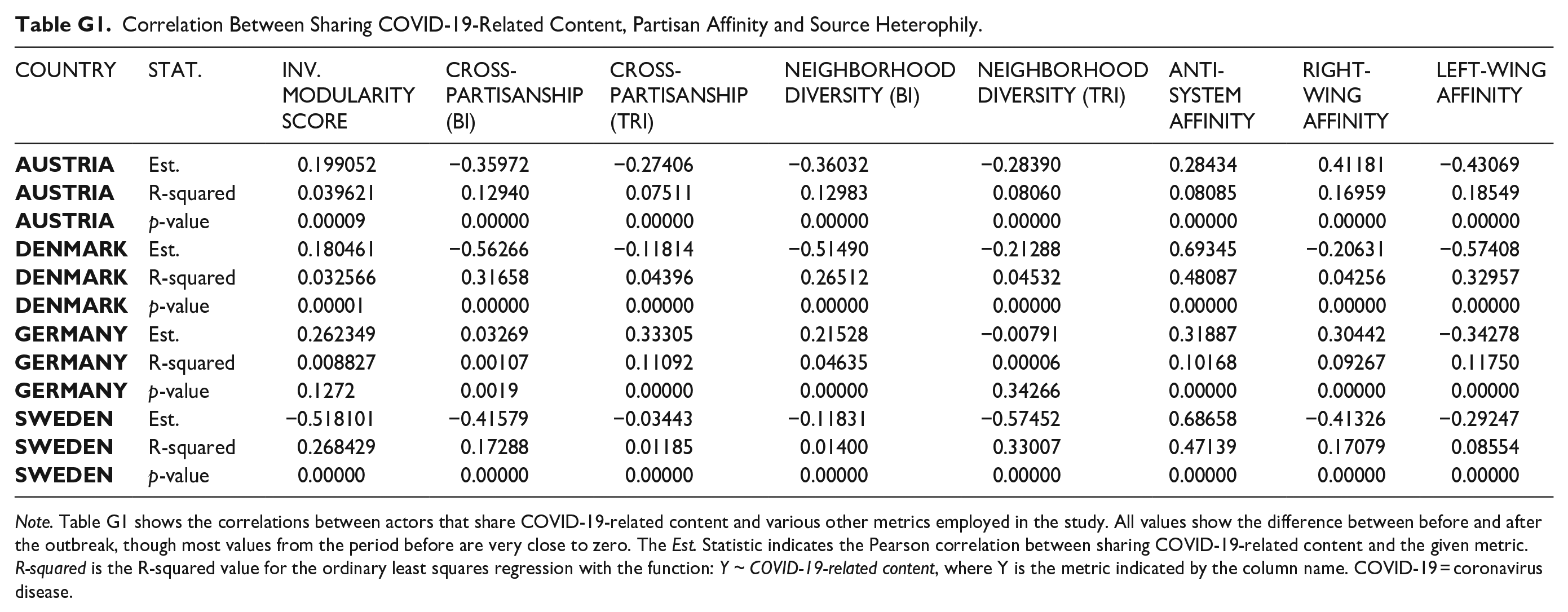
Correlation Between Sharing COVID-19-Related Content, Partisan Affinity and Source Heterophily.
| COUNTRY | STAT. | INV. MODULARITY SCORE | CROSS-PARTISANSHIP (BI) | CROSS-PARTISANSHIP (TRI) | NEIGHBORHOOD DIVERSITY (BI) | NEIGHBORHOOD DIVERSITY (TRI) | ANTI-SYSTEM AFFINITY | RIGHT-WING AFFINITY | LEFT-WING AFFINITY |
|---|---|---|---|---|---|---|---|---|---|
|
|
Est. | 0.199052 | −0.35972 | −0.27406 | −0.36032 | −0.28390 | 0.28434 | 0.41181 | −0.43069 |
|
|
R-squared | 0.039621 | 0.12940 | 0.07511 | 0.12983 | 0.08060 | 0.08085 | 0.16959 | 0.18549 |
|
|
p-value | 0.00009 | 0.00000 | 0.00000 | 0.00000 | 0.00000 | 0.00000 | 0.00000 | 0.00000 |
|
|
Est. | 0.180461 | −0.56266 | −0.11814 | −0.51490 | −0.21288 | 0.69345 | −0.20631 | −0.57408 |
|
|
R-squared | 0.032566 | 0.31658 | 0.04396 | 0.26512 | 0.04532 | 0.48087 | 0.04256 | 0.32957 |
|
|
p-value | 0.00001 | 0.00000 | 0.00000 | 0.00000 | 0.00000 | 0.00000 | 0.00000 | 0.00000 |
|
|
Est. | 0.262349 | 0.03269 | 0.33305 | 0.21528 | −0.00791 | 0.31887 | 0.30442 | −0.34278 |
|
|
R-squared | 0.008827 | 0.00107 | 0.11092 | 0.04635 | 0.00006 | 0.10168 | 0.09267 | 0.11750 |
|
|
p-value | 0.1272 | 0.0019 | 0.00000 | 0.00000 | 0.34266 | 0.00000 | 0.00000 | 0.00000 |
|
|
Est. | −0.518101 | −0.41579 | −0.03443 | −0.11831 | −0.57452 | 0.68658 | −0.41326 | −0.29247 |
|
|
R-squared | 0.268429 | 0.17288 | 0.01185 | 0.01400 | 0.33007 | 0.47139 | 0.17079 | 0.08554 |
|
|
p-value | 0.00000 | 0.00000 | 0.00000 | 0.00000 | 0.00000 | 0.00000 | 0.00000 | 0.00000 |
Note. Table G1 shows the correlations between actors that share COVID-19-related content and various other metrics employed in the study. All values show the difference between before and after the outbreak, though most values from the period before are very close to zero. The Est. Statistic indicates the Pearson correlation between sharing COVID-19-related content and the given metric. R-squared is the R-squared value for the ordinary least squares regression with the function: Y ~ COVID-19-related content, where Y is the metric indicated by the column name. COVID-19 = coronavirus disease.
Declaration of Conflicting Interests
The author(s) declared no potential conflicts of interest with respect to the research, authorship, and/or publication of this article.
Funding
The author(s) disclosed receipt of the following financial support for the research, authorship, and/or publication of this article: The research, authorship and publication of this article have been funded by the Carlsberg Foundation, funding code CF20-0247.
