



Abstract
With the influx of content being shared through social media, mobile apps, and other digital sources—including fake news and misinformation—most news consumers experience some degree of information overload. To combat these feelings of unease associated with the sheer volume of news content, some consumers tailor their news ecosystems and purposefully include or exclude content from specific sources or individuals. This study explores customization on social media and news platforms through a survey (N = 317) of adults regarding their digital news habits. Findings suggest that consumers who diversify their online news streams report lower levels of anxiety related to current events and highlight differences in reported anxiety levels and customization practices across the political spectrum. This study provides important insights into how perceived information overload, anxiety around current events, political affiliations and partisanship, and demographic characteristics may contribute to tailoring practices related to news consumption in social media environments. We discuss these findings in terms of their implications for industry, policy, and theory.
Introduction
In today’s online news environment, people are inundated with news and information across multiple platforms, including social media sites like Facebook, Twitter, and Reddit; messaging platforms like WhatsApp, Facebook Messenger, and Snapchat; and more traditional news websites. This trend of connectedness means consumers must expend more effort determining the trustworthiness and credibility of the information they encounter than previously when the number of news sources was more limited. However, the sheer volume of information available to consumers is vast and can be overwhelming, leading to information overload for many users (Holton & Chyi, 2012). In order to manage this information overload and the saturation of their information channels, consumers may turn to customization tools to better control their information and news sources.
Social and digital media tools make it relatively easy for news consumers to customize and personalize their news environments and information sources. In addition to user customization, digital tools often contain algorithms working underneath the surface, many of which work to show users similar content to their prior engagements and content they are likely to engage with in the future (Oremus, 2016; Puglisi, Parra-Arnau, Forné, & Rebollo-Monedero, 2015). For example, many social media platforms structure their content feeds based on what an algorithm determines to be the “top” or “most relevant” stories. While these tools may help users control their information and news environments—making consumption more manageable and mitigating information overload—it is also possible that these tailoring tools will expose users to redundant information and singular viewpoints (often referred to as “echo chambers”). That is, if a user regularly follows, “likes,” and engages with conservative, right-leaning news content, the algorithm will likely surface more conservative, right-leaning news content. Before long, due to user-initiated customization and algorithmic personalization, their digital news environment will likely be saturated with content that only explores a narrow viewpoint.
An important question to ask, then, is when does this practice become problematic? Research suggests that some digital features—including using social media and search to access news—modestly contribute to ideological segregation (Flaxman, Goel, & Rao, 2016). Other work suggests a relationship between partisan selective exposure and political polarization (Stroud, 2010). One answer is that in an era of fake, hyper-partisan, and sensational news, exposure to diverse information can be beneficial. For example, scholars like Mendelberg (2002) suggest that deliberation, or the reasonable and open exchange of language, leads to a healthier civic life. Others have used the work of political theorists (e.g., Cohen, 1989; Habermas, 1984) to argue that diverse viewpoints are necessary for deliberate debate, which is central to a healthy democracy (Munson, Lee, & Resnick, 2013). In other words, it may be that exposure to a more well-rounded and diverse news and information diet would allow for more moderate conversations between people of differing beliefs, political parties, and backgrounds, and eliminate a climate of divisiveness. Suggesting that exposure to diverse content may have a small but significant effect on how consumers approach polarizing content, a 2018 Pew Research Center study found that 14% of U.S. adults reported changing their opinion about a political or social issue because of something they saw on social media (Bialik, 2018).
The divisive political and social climate in the United States following the 2016 presidential election could be viewed as an anecdote for the ideological segregation fueled by digital news, hyper-partisan content, and site features facilitating news customization. Echo chambers, whether user- or algorithmically created, may not be ideal for balanced knowledge consumption and contribution to a moderate political landscape. That said, information inundation without any curation is also problematic. Oversaturated and untailored news environments—which can lead to anxiety and information overload—do not encourage responsible and reasonable news consumption. However, there may be a balance between the extremes where users can be exposed to a reasonable and manageable amount of information that also covers a wide range of topics and viewpoints.
This study evaluates digital news environment customization practices to better understand the steps consumers take when creating a personal news environment in a socially connected, breaking-news-cycle society. Findings from a survey of news consumers’ digital practices provide useful insights into the steps U.S. adults take to avoid—or engage with—content they disagree with, the role that factors like information overload play in that process, and the characteristics of users who customize their social news feeds to reflect an echo chamber. Furthermore, by measuring participants’ levels of anxiety related to current events, as well as their perceived partisanship and willingness to engage in dissenting discourse, we can better understand how those factors impact their decisions around tailoring (or not tailoring) their news environments.
The present study contributes to the literature in several research areas: information overload, news consumption, anxiety and decision making, customization and personalization of digital environments, politically driven news consumption, and online echo chambers. In addition, the combination of these concepts and factors into a single study serves to add to the literature in a more meaningful way, as there is little research that evaluates these concepts together and includes the examination of a psychological factor like anxiety. Finally, understanding how and why people customize their news environments will allow content publishers to develop features that better serve their readers to give them content spanning a wide range of points of view and provide additional tools to mitigate information overload.
In the following section, we summarize relevant work across the areas of news consumption on digital platforms, information overload, customization and personalization, and echo chambers. We then detail the specific research questions and study design before presenting the findings from an online survey of digital news consumers. The article concludes with a discussion of contributions and considerations for both theory and policy as we look ahead. Specifically, we extend existing research on online news consumption and identify new factors to be considered when evaluating consumers’ decision making around news and information sources online and provide empirical support to ongoing discussions regarding the role of partisanship on online news practices. We also discuss implications for technology and media companies and the need for creation of responsible customization and tailoring features that encourage healthy news consumption, while mitigating feelings of information overload.
Related Work
News Consumption on Digital and Social Media
Social media sites and other digital platforms (e.g., mobile news applications and aggregators) have become popular methods to consume news anytime and anywhere. According to a recent survey by the Pew Research Center, the share of Americans often getting news online—either from news websites, apps, or social media—grew from 38% in 2016 to 43% in September 2017 (Gottfried & Shearer, 2017). A separate Pew report found that 67% of American adults reported getting at least some of their news on social media (Shearer & Gottfried, 2017), with the most popular sites for news being Facebook (45%), YouTube (18%), and Twitter (11%). Sites like Reddit are becoming increasingly popular news sources, with 78% of Reddit users getting news on the site; however, the site is primarily popular among young men and is not yet a major news source across the full adult population (Barthel et al., 2016).
Using digital tools and platforms for news consumption has many benefits including convenience, diversity of source, and widespread access. However, the amount of content across platforms available for consumption may be overwhelming for some, leading to information overload (Bawden & Robinson, 2009), news fatigue (Gottfried & Barthel, 2018), and poor decision making (Malhotra, 1982). Researchers have found that in 2017, 2.5 quintillion bytes of data were created each day (“Data Never Sleeps 5.0,” 2017). Every minute, YouTube users watched four million new videos, Twitter users sent 456,000 tweets, Instagram users posted 46,000 photos, and BuzzFeed users viewed 50,000 videos (“Data Never Sleeps 5.0,” 2017). The vast amount of information available online is literally impossible for humans to process.
Information Overload in the Digital Era
Early work on information load and consumer decision making focused on the fundamental premise of the information-load paradigm, which argued that “consumers have finite limits to absorb and process information during any given unit of time” (Malhotra, 1982, p. 419). When given too much information at one time, overload occurs and leads to poor decision making and performance.
Bawden and Robinson (2009) describe information overload as stemming from there being “too much information, exacerbated by the multiple formats and channels available for its communication” (p. 182). They further describe information overload as hampering an individual’s efficiency in using information, and they suggest that information overload is often paired with a feeling of loss of control over a situation or feelings of being overwhelmed, and in extreme cases can lead to “damage to health,” citing various psychological conditions like continuous partial attention, attention deficit trait, cognitive overload, and technostress (Bawden & Robinson, 2009, p. 183). They also discuss information anxiety (Kennedy, 2001; Wurman, 2001), which is described as a “condition of stress caused by the inability to access, understand or make use of necessary information” (Bawden & Robinson, 2009, p. 185). The authors offer solutions to information overload and information-related problems, which involve users taking control of their information environment in order to avoid feelings of powerlessness. In today’s digital ecosystem, taking control of one’s information environment might be thought of as tailoring, customizing, or personalizing digital environments.
To summarize, studies suggest that attempting to control informational intakes and avoid information overload may result in the customization and tailoring of digital environments in order to stave off information overload. In the next section, we discuss research on news customization practices.
Tailoring Information: Customization and Personalization
In 2009, Nicholas Kristof of the New York Times wrote an article titled “The Daily Me.” In this short op-ed, he suggested that readers do not actually want “good” information. Instead, they want information that confirms pre-existing and long-held prejudices—what other researchers have framed as the “confirmation” or “myside” bias (Nickerson, 1998; Stanovich, West, & Toplak, 2013). This attitude is problematic, Kristof argues, because people already segregate themselves into like-minded communities in their daily lives; this segregation and lack of communication with people who have differing beliefs—on and offline—can lead to polarization and intolerance (Kristof, 2009). Empirical work supports the idea that online news consumption is related to confirmation bias (Garrett & Stroud, 2014; Knobloch-Westerwick, Mothes, Johnson, Westerwick, & Donsbach, 2015), and consumption of pro-attitudinal content contributes to segregation and polarization (Schmidt et al., 2017). The digital landscape has expanded dramatically since Kristof penned his op-ed in 2009, and digital tools like social media sites, news websites, and mobile news applications are more popular than ever with news consumers. But it is worth examining whether the idea of the “Daily Me” has persisted into these expanded digital environments.
How news consumers tailor their digital news experiences is typically framed as either “customization” or “personalization.” For example, Sundar and Marathe (2010) distinguish between “system-initiated personalization” (SIP) and “user-initiated customization” (UIC); they note that much of the literature on personalization (e.g., Blom, 2000) looks at the end result (tailored content) versus the process of tailoring and who is doing the tailoring. They also point to Ho and Tam’s (2005) research describing personalization as adapted content meant to “deliver the right content to the right person in the right format at the right time” (Sundar & Marathe, 2010, p. 300).
Today, personalization can be understood through algorithms, which provide a set of procedures or rules for solving a problem. When users create profiles on mobile applications or social media, algorithms tailor the content for each user based on their implicit (i.e., inferred from data collection) and explicit (i.e., directly from user inputs) preferences (Thurman, 2011, p. 397). One well-known example of a news personalization algorithm is Facebook’s EdgeRank algorithm, which makes prioritization and filtering decisions regarding what content appears—and where it appears—in a user’s Newsfeed (for a discussion of EdgeRank, see Bucher, 2012). Conversely, customization requires active user initiation. Sundar and Marathe (2010) note that user-initiated customizable systems “do not tailor content on their own”, rather they have features that allow users to alter their experience (p. 301). In discussing customization, Kang and Sundar (2016) suggest it allows users to control transactions within a media interface, which leads to a higher sense of interest and involvement with the customization process and impacts cognitive engagement.
Although customization is a well-researched topic, there has been less research exploring the motivating factors that predict tailoring within digital news environments—a gap this study aims to fill. In the next section, we overview the debate on whether social media create echo chambers, and the types of effects these spaces have on news selection and consumption choices.
Debating Whether Social Media Creates Echo Chambers
As previously noted, digital media platforms allow for individually tailored experiences that affect what users see. The concept of echo chambers—where individuals are largely exposed to conforming opinions—is well-debated in the literature, with some scholars disregarding their existence (Bruns, 2017; Garrett, 2009; Nelson & Webster, 2017) while others express fears that echo chambers will create political divides and ideological segregation (Flaxman et al., 2016). Despite the drawbacks of echo chambers, tailoring digital environments and narrowing information inputs may allow users to better handle the volume of information available.
Several scholars suggest that echo chambers simply don’t exist in digital environments. Behavior-tracking research looks at factors that shape individuals’ exposure to online political information. Researchers have found that opinion reinforcement is associated with a significant increase in the likelihood of users looking at a story; that said, opinion-challenging information is only marginally less likely to be selected by the user, and exposure time increases rapidly with opinion-challenging information (Garrett, 2009). In a separate study analyzing comScore data from more than 184 million unique users (with 43 million visiting online news sites), researchers found that the ideological breakdown for the most popular political websites was relatively heterogeneous and consistent with the Internet population (Nelson & Webster, 2017). That is, liberals and conservatives visit the same political news sites. These findings do not support a partisan divide online—at least on news websites. More recent work by Bruns (2017) examined the Australian Twittersphere and found limited evidence of echo chambers, though Bruns acknowledges the existence of clusters of users attached to each other through shared interests and beliefs. His analysis suggests, however, that having similar connections does not indicate the exclusion of other dissimilar users (Bruns, 2017). Other research on Twitter hyperlink sharing has found that core users—defined as the most active and highly followed 1%—do exhibit some evidence of polarization. The average core account shares more politically moderate news compared to the links they see from other accounts in their own feeds (Shore, Baek, & Dellarocas, 2018).
In addition, transnational work that studied news consumers (N = 14,030) in seven nations across Europe and North America suggests that the idea of echo chambers is overly simplistic and does not hold up (Dutton, Reisdorf, Dubois, & Blank, 2017). In their study, less than 20% of respondents reported unfriending or blocking someone because they disagreed with their political views or something they posted. Conversely, 36% of respondents reported reading news they disagree with often or very often, and another 43% said they engaged in such behavior sometimes (Dutton et al., 2017).
In contrast, some researchers argue that customization on digital platforms contributes to political divides. After analyzing 2.3 billion distinct page views and breaking down news consumption channels into four categories (direct, aggregator, social, and search), Flaxman et al. (2016) found that social media and search contribute to ideological segregation. The authors suggest nearly all users exist in so-called echo chambers.
In order to study the diversity of information sources online, Nikolov, Oliveira, Flammini, and Menczer (2015) examined two datasets—18 million search engine queries and 1.3 billion public Twitter posts—in order to examine both “solitary information seeking” and interpersonal communication channels, like social media and email (p. 3). They found a moderately strong correlation between collective entropy and average user entropy, which led the authors to suggest that both collective and individual social bubbles exist online. They also noted that using social media allows people to be exposed to narrower sets of information sources.
From a network perspective, researchers suggest that network homophily—individuals’ tendency to associate and share information with others who are similar to them (Bakshy, Rosenn, Marlow, & Adamic, 2012; McPherson, Smith-Lovin, & Cook, 2001)—is core to examining information spread. In work on network structure and the spread of memes, researchers have suggested that since relationships often form between similar people, communities “trap” information within themselves (Weng, Menczer, & Ahn, 2013). Likewise, when studying Facebook, Bakshy and colleagues (2012) found that friend connections are relatively homogeneous and often two friends visit the same websites and share the same link, independent of each other and without exposure to the other’s linked post. These studies, and others, suggest that online networks are relatively homogeneous, and that homogeneity impacts what information users are exposed to online.
While debate continues among scholars—and highlights the complexities of how social media platforms’ features affect consumers’ beliefs and behaviors—the current study aims to contribute to the understanding of digital news customization, which includes strategies that may create echo chamber-like news environments and how these practices correlate with perceptions of anxiety and information overload. In the following section, we introduce our research questions to further examine news customization practices.
Current Study: Information Overload, Customization Practices, Anxiety, and Partisanship
In this study, we examine news consumers’ customization practices online—specifically, the extent to which they engage in practices that purposefully constrain the content they see in their news streams or, conversely, the extent to which they engage in practices that purposefully expose them to diverse opinions and beliefs from a range of perspectives. The former set of practices are consistent with the concept of an echo chamber, where the voices one hears “echo” each other and reinforce existing beliefs. The latter set of practices directly contradict those of an echo chamber and facilitate exposure to multiple viewpoints, typically with the intent of understanding what other sides are thinking about, what their priorities are, and/or what matters to them. For example, a progressive Democrat may follow FOX News and the Washington Times to get diverse perspectives she would not get from news sources that more closely aligned with her political beliefs.
Beyond examining customization practices, this study examines how consumers’ customization practices interact with a set of other factors that have become especially relevant in recent years. First, we evaluate the role information overload plays, as the sheer quantity of content available online and through our mobile devices today exceeds our cognitive processing capabilities. Second, we explore whether the increasing partisanship and political polarization is correlated with news customization practices; since the 2016 presidential election, discussions around “fake news” and misinformation have dominated the political landscape and may influence news consumption practices. Third, we consider if and how news consumers’ anxiety about current events is related to their customization practices.
Our interest in these factors is driven, in part, by a recent Pew Research Center report finding that 68% of Americans feel worn out by the amount of news, with Republicans feeling more news fatigue than their Democratic counterparts (Gottfried & Barthel, 2018). Earlier work from David Levy (2008) traces the use of the phrase “information overload” throughout history and examines potential causes and consequences of the phenomenon. He notes, “Paradoxical as it may seem, having access to more information may lead us at times to be less well informed, and to make less effective choices” (p. 510). Levy also suggests that people facing information overload may experience a lower sense of accomplishment and a heightened degree of stress. We explore the connection between information overload, customization, and anxiety (or stress) through the following research question:
RQ1. How does an individual’s anxiety about current events impact their news customization practices?
We hypothesize that the more anxiety people experience related to current events, the more they will engage in practices to customize, personalize, and tailor their digital news environments. They may do this in an attempt to avoid dissenting information and opinions. They may also feel a general sense of anxiety regarding the sheer amount of information presented to them within digital news environments.
Levy (2008) also points to prior research showing that people with strongly partisan views unconsciously reject contradictory information. This process happens in a part of their brain associated more with emotional activity than logical reasoning. This idea directly connects information overload, partisanship, and the desire to reject dissenting information—relationships explored in this study through our second research question. Therefore, our second research questions asks as follows:
RQ2. How does an individual’s political affiliation/partisanship impact their news customization practices?
In this case, we hypothesize that higher levels of partisanship (or stronger political affiliations) will correlate with more customization in digital news environments. Users who are hyper-partisan and politically extreme (on both sides of the spectrum) may work to avoid dissenting information and opinions, whereas those who are more moderate (e.g., Independents) may be open to a wider range of opinions.
Method
Respondent data were gathered using an online survey on the research platform Qualtrics. The survey was posted as a Human Intelligence Task (HIT) on Amazon Mechanical Turk (MT). 1 In order for MT workers to accept the HIT, they were presented with pre-screening questions that confirmed the following: (1) they were at least 18 years old, (2) they were U.S. residents, and (3) they actively used at least one digital or social media platform—like Facebook, Twitter, mobile news applications, or news websites—for news consumption, at least once per week. Furthermore, we limited participation to workers with a very high reputation (approval rate greater than 98%) and significant experience on the site (at least 500 HITs approved). MT workers were paid $1 for survey completion.
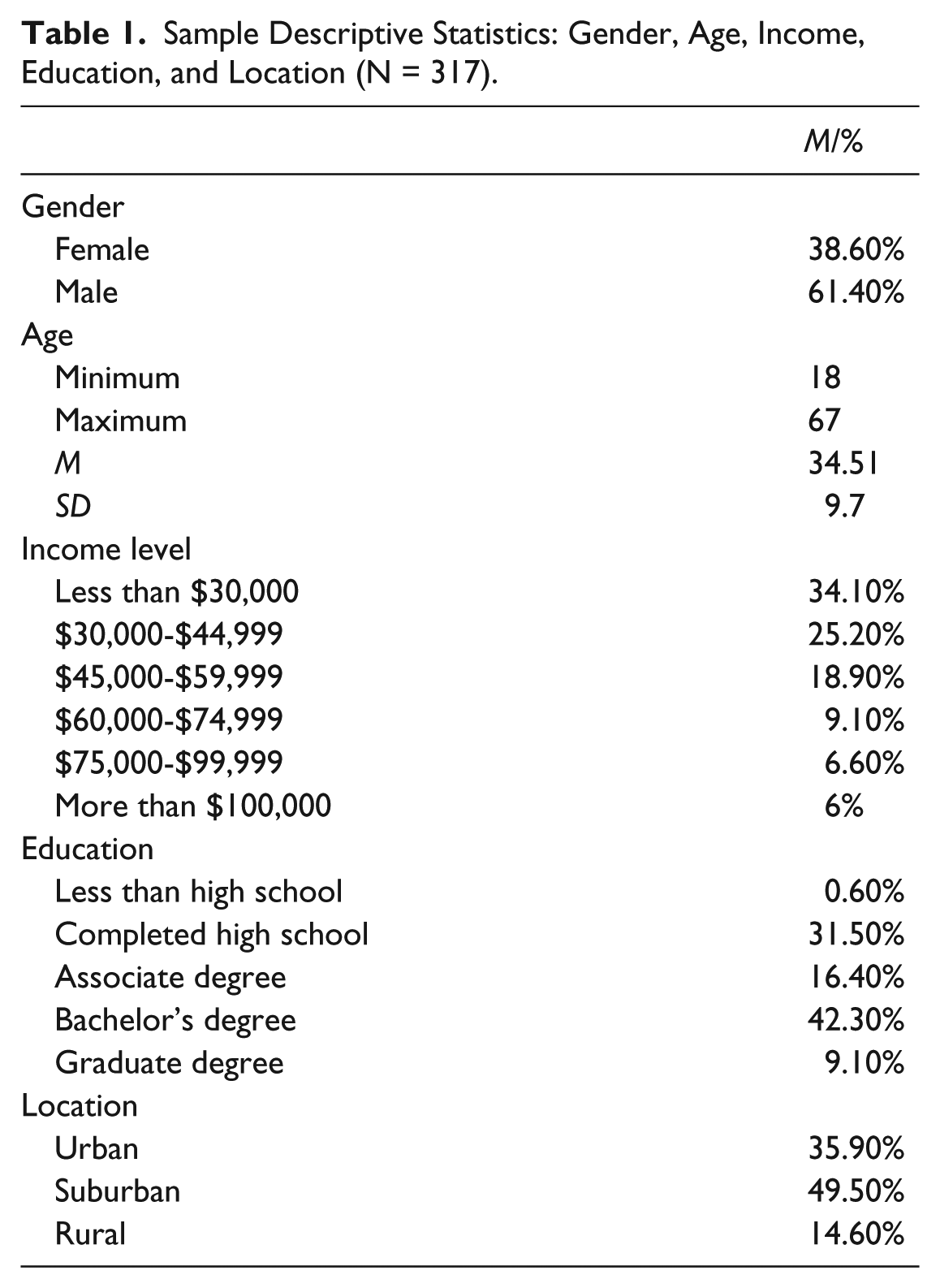
The survey was created using several previously tested scales (see the “Measures” section). The survey sample (N = 317) skewed male (61.4%) and was more liberal leaning (M = 37.25 on a 1-100 scale, where 1 = extremely liberal and 100 = extremely conservative), with 50% of the sample indicating they were registered to vote as Democrats. The majority of the sample (51.4%) had a bachelor’s or master’s degree, while more than one-third of the sample (34.1%) reported an income of under $30,000. See Table 1 for a full breakdown of the sample’s demographics.
Sample Descriptive Statistics: Gender, Age, Income, Education, and Location (N = 317).
Measures
Before describing the measures we used in this study, we first want to define two of the key concepts for this study. First, by digital news environments, we refer to social media sites and mobile news applications (including both aggregators like Apple News and Flipboard, and individual news organizations apps). Second, when we describe current events, we refer to general affairs and present-time news, as opposed to a specific news event or story.
Unless otherwise noted, measures discussed below were developed for the purpose of this study.
News Feed Customization
As no existing validated measures of online news customization exist, a new measure was developed for this survey. First, drawing on related research by the Pew Research Center’s Internet & American Life Project and others (Schmitt, Debbelt, & Schneider, 2018; Williamson & Eaker, 2012), the authors created 16 statements that could be measured along a 5-point Likert-type agreement scale ranging from 1 = strongly disagree to 5 = strongly agree. These items tapped into consumers’ attitudes (e.g., “I follow people on social media because of my relationship with them—not how much we agree on politics”), perceptions (e.g., “The things I see on social media strongly reflect my views on the world”), and practices (“If I see something in my feed that I disagree with, I am likely to unsubscribe or unfriend that account/person”) related to content customization.
Following data collection, all 16 items were entered into an exploratory factor analysis (EFA) model using principal component extraction with Varimax rotation. This initial analysis produced a five-factor solution with significant cross-loadings across factors. Using a standard .60/.40 approach (McCroskey & Young, 1979), any item that did not have a primary loading of at least .60 and/or had cross-loadings at or above .40 was removed, resulting in a two-factor solution containing 10 items and explaining 58.13% of the variance in the model. Items for the two factors, including factor loadings, as well as item means and standard deviations, can be found in Table 2.
Item Loadings, Means, and Standard Deviations for the Two Customization Scales.

Upon further examination, the two factors highlight two distinct aspects of customization. Factor 1 (echo chamber builder, M = 2.21, SD = 0.91, α = .852) includes six items and captures the targeted use of customization strategies to create and bolster news environments focused on collecting and displaying similar viewpoints. People who strongly agreed with these statements find content providers (both people and news sources or other websites) they agree with and follow them; when they come across a person or source they disagree with, that content or user is removed. This differs significantly from Factor 2 (diversity seeker, M = 3.05, SD = 0.84, α = .716), which includes four items and reflects social media users who purposefully seek out a variety of perspectives in their content feeds. These users’ responses suggest they view social media as a way to expand their worldview and engage with unlike others. Importantly, these responses do not provide clear evidence as to why people engage in these strategies, and making those linkages (such as identifying why someone might “hate-read” a publication that directly contradicts their political views) is beyond the scope of this study.
Partisanship Scale
The partisanship scale (M = 2.93, SD = 1.28, α = .869) used a 7-point scale with 1 = strongly disagree and 7 = strongly agree; this measure was designed to gauge the participants’ level of partisanship and the direction of their ideological beliefs, in a way that went beyond political parties. In order to create the items for the partisanship scale, 10 topics were selected that generally prove to be ideologically divisive (e.g., abortion, immigration, climate change, education). Participants were asked to respond with their level of agreement to each statement.
On the 7-point scale, a lower score signals a typically “left” or “liberal” response, whereas a higher score signals a typically “right” or “conservative” response. So while a large majority of our sample identified as Democrats, the mean of the partisanship scale (M = 2.93, SD = 1.28) shows that our overall sample identifies as somewhat moderate, though does skew liberal. See Table 3 for items, means, and standard deviations. For two items (regarding immigration and taxes), mean responses skewed slightly toward more conservative points of view.
Items, Means, and Standard Deviations for the Partisanship/Political Affiliation Scale.

Note. Scale: 1 = strongly disagree, 7 = strongly agree.
Item has been reverse coded.
As a way of evaluating the validity of this measure, we ran a one-way analysis of variance (ANOVA) comparing participants’ partisanship score with their political identity. We only included the three main political groups (Democrats, Republicans, and Independents) to minimize noise in the analysis. Results provide support for the validity of the partisanship measure, with a significant main effect of partisanship on political affiliation, F(2, 283) = 89.31, p < .001. Further examination using Tukey post hoc analyses shows that the partisanship between groups varies as we would expect, with each group differing significantly from the other two: Democrats (M = 2.34, SD = 0.95) are the group most to the left on the spectrum (i.e., most liberal), Republicans (M = 4.34, SD = 1.00) are the most to the right (i.e., most conservative), and Independents (M = 2.89, SD = 1.16) fall in the middle of the two groups. Based on this finding, we use the partisanship scale in our regression analyses, as the continuous variable allows for more granularity than the categorical measure while still capturing the distinctions between the three groups.
Information Overload
The information overload scale (M = 2.38, SD = 0.99, α = .95) was adapted from Williamson and Eaker (2012). The 15-item scale, which used a 5-point scale (1 = strongly disagree, 5 = strongly agree), includes questions about participants’ perception of being overwhelmed by information, including “I regularly feel overwhelmed by too much information these days” and “I sometimes feel numb and incapable of action because of all the information I have to process on a daily basis.”
Anxiety
The Spielberger Anxiety Scale/STAI-6 (State–Trait Anxiety Inventory) scale (Marteau & Bekker, 1992; M = 2.89, SD = 0.93, α = .94) was used to measure participants’ perceived level of anxiety about current events. The six-item scale uses a 5-point response measure (1 = never to 5 = always) and was adapted for this study by adding “When thinking about current events” to the beginning of each phrase. For example, two of the items read as follows: “When thinking about current events, I am worried” and “When thinking about current events, I feel calm.” Although information overload and anxiety are closely related conceptually, they are only moderately correlated in this study (r = .318, p < .001); thus, we treat them as distinct constructs in our analyses.
Data Analysis
After the data were collected from MT, they were exported to SPSS v24 and the data were examined for errors. Due to the nature of MT (i.e., workers may not be paid for not completing tasks), missing data is rarely a problem, and it was not in the case of this dataset, with it constituting less than 1% of any single variable. In the few cases where missing data could be imputed, we used the Expectation-Maximization (EM) algorithm (Schlomer, Bauman, & Card, 2010). Data from five participants—whose completion time was under 2 min—were removed from the sample.
Several control variables were included in analyses. Education was treated as an ordinal-level variable, and responses were condensed into three categories: high school degree or less (n = 102; 32.2%), associates or bachelor’s degree (N = 186; 58.7%), and graduate degree or higher (n = 29; 9.1%). For location, respondents self-selected where they lived as either rural (n = 46; 14.6%), suburban (n = 156; 49.5%), or urban (n = 113; 35.9%). We also note that while the three political groups (Democrats, Republicans, and Independents) in our analyses are different sizes, the test of homogeneity was met using Levene’s test (p > .05).
Findings
Is Consumer Anxiety Correlated With News Customization Practices?
To address our first research question, we looked at factors associated with how anxious respondents reported feeling when engaging with or thinking about current events. Below, we detail initial findings looking at variations in anxiety across customization practices, political affiliation, and social media platform use.
After performing a bivariate correlation, the relationship between the diversity seeker subscale (M = 3.05, SD = 0.84) and anxiety (M = 2.89, SD = 0.93) was statistically significant (r = –.181, p = .001), while the relationship between the echo chamber builder subscale (M = 2.21, SD = 0.91) and anxiety (M = 2.89, SD = 0.93) was not statistically significant (r = −.07, p = .19). In other words, participants who reported actively trying to diversify their online news streams by interacting with people and content espousing different points of view also reported lower levels of anxiety related to current events. However, there were no differences in anxiety between those who more or less actively working to create an online environment where they would be surrounded by similar opinions and viewpoints to their own.
Next, we compared participants’ reported news-related anxiety scores to their political affiliation. For this analysis, we conducted an ANOVA looking at the three main political affiliations reported: Democrats, Independents, and Republicans. Results from an ANOVA indicated a significant difference across groups, F(2, 283) = 5.26, p = .006. Further examination using Tukey post hoc analyses showed that the anxiety levels between Democrats (M = 3.00, SD = 0.92) and Republicans (M = 2.55, SD = 0.91) were significantly different (p = .004); however, anxiety levels for participants identifying as Independents (M = 2.89, SD = 0.96) were not significantly different from either of the main political parties, which we might expect given that Independents often fall somewhere in between the two main parties ideologically. If we think about partisanship along a spectrum, Democrats report feeling significantly more anxiety when consuming news content than Republicans, while Independents’ attitudes are mixed. As these data were collected in late 2017, when the Republicans controlled the White House and both houses of Congress and many more liberal-leaning policies appeared threatened, such findings are unsurprising.
Does Political Partisanship Correlate With News Customization Practices?
We followed a similar analysis process to evaluate RQ2. After performing a bivariate correlation, the relationship between the echo chamber builder subscale (M = 2.21, SD = 0.91) and one’s perceived degree of political partisanship (M = 2.93, SD = 1.28) was statistically significant (r = .171, p = .002). In other words, those who agreed with more conservative views on partisan issues were more likely to have created online news environments that strongly reflected those viewpoints. On the contrary, the relationship between the diversity seeker subscale (M = 3.05, SD = 0.84) and our partisanship measure (M = 2.93, SD = 1.28) was not statically significant (p = .14), suggesting that the likelihood of engaging in practices to expose oneself to new ideas and perspectives is less clear cut.
The results of a one-way ANOVA comparing differences in customization across Republicans, Democrats, and Independents mirror those of the partisanship analyses. First, looking at the echo chamber builder subscale, the ANOVA revealed a significant difference across groups, F(2, 283) = 4.11, p = .02. Tukey post hoc analysis shows that Republicans (M = 2.37, SD = 0.99, N = 64) and Democrats (M = 2.27, SD = 0.93, N = 159) engage in significantly more customization behaviors than Independents (M = 1.94, SD = 0.79, N = 63). It is important to note that the means for all groups are below the midpoint (3), which suggests that none of the groups were engaging in significant amounts of customization. Furthermore, when looking at party differences across the diversity seeker subscale, the ANOVA was non-significant, F(2, 283) = 1.76, p = .18, suggesting no significant differences in news content diversification practices based on political affiliation.
Modeling Factors That Predict News Stream Customization Practices
Finally, in order to better understand predictors of customization behavior, we used multivariate modeling to identify factors associated with customization practices using more robust analyses that control for additional factors. To do this, we conducted two ordinary least squares (OLS) linear regressions, using each of the customization subscales as dependent variables (DVs). We added the independent variables (IV) in two steps, first considering the role of socio-demographic factors, then adding our two main IVs of interest, partisanship and anxiety related to current events.
In Table 4, we report the results of the full regression, including all IVs. First, looking at the model predicting echo chamber customization behaviors, the IVs explained 18.7% of the variance, F(7, 306) = 11.28, p < .001, in the DV. Specifically, age (β = −.167, p = .002), education (β = −.005, p < .05), location (β = −.116, p = .025), 2 level of information overload (β = .355, p < .000), level of partisanship (β = .145, p = .009), and anxiety (β = −.150, p = .01) significantly predicted echo chamber building, or customization, of online news environments. In other words, those who were younger, less educated, experienced greater information overload, identified as conservative, and expressed less anxiety about current events also engaged in more behaviors to customize their online news feeds to better reflect their views of the world.
OLS Regression Analysis, With Two Customization Subscales as DVs.

p ⩽ .05. **p < .01. ***p < .001.
Second, looking at the model predicting the diversity seeking subscale—which captured behaviors related to seeing many different perspectives in their online news feeds—the overall model was not significant (F test), and only one IV was significantly correlated with our DV. In this case, one’s level of anxiety about current events was negatively correlated to their engagement in diversity-seeking news feed behaviors (β = −.169, p < .01) while controlling for other factors. This is the same pattern as found in the echo chamber model. We explore why no other factors were related to the diversity subscale in the “Discussion” section. It should also be noted that one’s gender was unrelated to engagement in either form of customization; in other words, men and women were equally likely to engage in both types of customization behaviors.
Discussion
Present-day news consumption behaviors reflect a strange confluence of technology and partisanship that seemed to explode in the months leading up to and following the 2016 U.S. presidential election. Among the most important features and affordances facilitating the current news environment are the simplicity of sharing content with hundreds or thousands of people through social media platforms; the ability for anyone to become a content creator and, in many ways, for “regular people” to now break major stories before traditional news outlets; and the ease with which misinformation and disinformation can quickly spread through networks via social media’s broadcasting, spreadability, and anonymity affordances (see, for example, boyd, 2010; Evans, Pearce, Vitak, & Treem, 2017).
These factors have created chaos and confusion among those turning to online sources for news and information, and consumers have tried a number of strategies to deal with the onslaught of biased or outright false news. In more extreme cases, users from both major political parties openly vowed to “unfriend” users who posted opposing opinions during the election (Gonzalez, Pulice-Farrow, & Galupo, 2018; Selyukh, 2016). Others committed to “social media blackouts” because of their heightened post-election anxiety (Selyukh, 2016; Swartz, 2016). Still others, unable to disconnect, have employed various tools and platform features to better curate and control the content that comes through their feed. But could over-customization—leading one to only hear a single viewpoint and block out all others—exacerbate the current hyper-partisanship dividing the United States today?
The goal of current study was to better understand the factors that contribute to customization and tailoring of news environments. As noted above, consumers increasingly turn to online channels for their daily news and information about current events and have moved beyond traditional news outlets like newspapers to obtain news more from their social networks on sites like Facebook, Twitter, and Reddit (Shearer & Gottfried, 2017). Our findings suggest that consumers who reported actively trying to diversify their online news streams by interacting with people and content espousing different points of view reported lower levels of anxiety related to current events. This builds on previous research related to information overload on social media and selective exposure (Lee, Lindsey, & Kim, 2017) and provides insights into how users perceive information overload alongside customization behaviors and anxiety and partisanship attitudes. This diminished sense of anxiety is also in line with Bawden and Robinson’s (2009) work suggesting that information overload and information anxiety might be mediated by users taking more control of their digital information environments. As these data are correlational, an alternative interpretation would be that consumers who feel greater anxiety about current events are more motivated to customize their news environment and thus regain some control over both the quantity and content of the information they consume.
Findings from this study also suggest that anxiety levels related to current events significantly differ based on political affiliation, with Democrats experiencing more anxiety than Republicans. By itself, we might attribute this anxiety to the current political environment, with Republicans controlling both the White House and Congress at the time of data collection. But as we explore this relationship more, it appears to be more complex. Republicans and Democrats engage in significantly more customization than people who do not identify with one of the two major political parties. However, respondents with more conservative views on partisan issues were more likely to engage in customizing behaviors that generated echo chambers for their online news consumption than those who identified as more liberal. The findings from our regression analysis also suggest that regardless of the type of customization (diversity seeking or echo chamber building), engaging in any customization behaviors to tailor one’s news environments was associated with lower levels of anxiety regarding current events. This may be the case for both groups because customizing and tailoring news environments (regardless of how) gives users a sense of control over their feeds and information sources (Bawden & Robinson, 2009). People who feel empowered—or who feel like they are being proactive—may perceive their news environment as less overwhelming and be less prone to feelings of information overload, even if the amount of content does not change substantially. These findings help us to understand how and why users tailor their news and information sources.
We acknowledge that significant research has been conducted in the areas of information overload and its impact on news consumption (Lee et al., 2017; Schmitt et al., 2018) and anxiety levels and decision making (Bawden & Robinson, 2009; Kennedy, 2001; Levy, 2008; Malhotra, 1982; Wurman, 2001), as well as on customization and personalization of digital environments (Kang & Sundar, 2016; Sundar & Marathe, 2010), politically driven news consumption (Nelson & Webster, 2017), and the existence of online echo chambers (Flaxman et al., 2016; Garrett, 2009). Importantly, however, little research examines all of these concepts in the single study, a gap this study addresses to provide a more holistic examination of factors that may contribute to news customization practices.
Although causation cannot be determined—that is, it is unknown if users were already highly partisan and customized their digital environments as a result, or if users customize their digital environments and therefore became highly partisan as a result of those customized choices—the relationship between partisanship and customization is an important one that has not yet been studied thoroughly. Similarly, we cannot claim a direct relationship between anxiety and customization. While we found no significant relationship between anxiety and customization, it is possible the nature of users’ news environments does not give them stress—but it is also possible those participants do not find current events anxiety-inducing. Yet, in the era of constant connection and the 24-hr news cycle, the relationship between anxiety about current events and digital news customization is one that needs continued study.
Limitations
It is important to note that this study is limited in its generalizability. First, the study was conducted using a one-time survey of MT workers in fall 2017, which was a time of heightened attention to news and political divisiveness. Future research could involve conducting multiple surveys over time, in order to better evaluate the attitudes and practices of news consumers more fully. Second, MT workers are not representative of American adults as a whole, as they tend to be more technologically savvy than the general population; however, they provide a useful and more diverse method of sampling than many alternatives (e.g., convenience samples of college students), and numerous studies have found data from MT samples to be valid. However, future research should evaluate these findings with a different, more representative sample. Third, we acknowledge that measures that rely on respondent recall suffer from reliability concerns, especially measures that ask respondents to quantify metrics around usage of technology. That said, we believe the way we structured questions to capture customization practices—by focusing on specific practices like muting, blocking, and creating lists—led to more accurate recall because they require additional actions beyond standard usage of a news platform. In addition, we think future studies should consider other factors that might influence customization practices, including frequency or quantity or news consumers. Prior (2013) has argued that the amount of content someone consumes affects the diversity of content they consumer, so it would be useful to study whether quantity or customization has a greater effect on exposure to diverse content. Finally, due to the nature of the data collection, this study can only identify correlations between variables. Our study cannot establish the causal path between factors such as anxiety, partisanship, and customization practices.
Conclusion
While the 2016 U.S. presidential election appears to have been a turning point in how the media and consumers think about the sources and potential bias in the news stories they read, the challenges discussed in this study are not going away. Social media technologies provide consumers with new opportunities to access diverse content and perspectives from around the world, but at the same time they also facilitate extreme forms of customization that create echo chambers, filter bubbles, and facilitate the spread of misinformation. Researchers should continue to explore how the affordances and features of social media and related technologies provide new opportunities and challenges for sharing and interacting with news, with a special focus on ways to reduce the anxiety associated with information overload, as well as ways of bringing disparate viewpoints together for civil conversations without fears of those conversations breaking down into name-calling, harassment, and worse. Researchers should examine how customization features can be both built responsibly by media and technology companies and used responsibly by consumers who are working to combat information overload, while staying informed regarding public affairs. The amount of information available online will only continue to increase in future years, and therefore it will become critical to provide new ways for new consumers to access diverse content from trustworthy sources without becoming overwhelmed, anxious, or reliant on echo chambers for news and information.
Footnotes
Declaration of Conflicting Interests
The author(s) declared no potential conflicts of interest with respect to the research, authorship, and/or publication of this article.
Funding
The author(s) received no financial support for the research, authorship, and/or publication of this article.
