



Abstract
BIPOC scholars have criticized that feminism and feminist activism have often failed to include race, class, and intersectional identities in the feminist agenda. Using theoretical concepts from framing, rhetoric, and cross-platform activism, we examine (a) the discourse in social media posts around white feminism and (b) the platform differences of this content across five different social media platforms: Twitter, Facebook, Instagram, Reddit, and YouTube. The methodology we use is a combination of computational text analysis approaches and content analysis. Our study highlights the voice of those who felt marginalized by the feminist movement including the uprising of #MeToo. We find pockets of conversations on topics such as experiences of People of Color or Women of Color; critique of white feminism, experiences of LGBTQ+ communities, and Black experiences. These posts predominantly used techniques to persuade the audience with reason, facts, and logic. The most common framing technique used was acknowledgment. Moreover, our findings show multiple differences across the five social media platforms.
Keywords
BIPOC scholars have criticized that feminism and feminist activism have often failed to include race, class, and intersectional identities in the feminist agenda (Jackson et al., 2020; Jonsson, 2014, 2016; Zakaria, 2021), leading to a mainstreamization of Western feminism (Phipps, 2020) as the universal norm. Rooted in the Colonialist logic of othering (Daniels, 2015), the dominance of white feminists as the torchbearers of liberal feminism (Daniels, 2021) and the white feminist’s “disregard for Women of Color” in the feminist discourses (McFadden, 2011, p. 7) became a rallying call for intersectional feminist intervention in gender and women studies. Aziz (1997) defined white feminism as “any feminism which comes from a white perspective and universalizes it” (p. 70). It does not mean every feminist issue supported by white women and white feminists should be viewed as white feminism. Instead, it refers to the feminist issues and discourses that structurally ignore intersectional contexts and are white-centric in their ideological presuppositions. In 2013, Mikki Kendall started the hashtag #SolidarityisforWhiteWomen to highlight the failure of sites like Feministing, Jezebel, and Pandagon and white feminist bloggers in acknowledging the racist and sexist behaviors of their contributors. Kendall was accused of starting a “toxic Twitter war” and creating discord among feminists for pointing out the persistence of racism in online spaces. In the context of discourses around #MeToo and the feminist interventions that it gave way to, it is crucial to understand how white femininity became the unmarked category that humanized the subjects and gave credibility to their testimony. As scholars such as Phipps (2020, 2021) and Rafia Zakaria (2021) point out, without acknowledging the white fragility and assertions of victimhood that underlie #MeToo debates, we will not be able to understand the methodological lapses that center stage white femininity as a frame of reference.
Scholars have raised concerns about “white women hijacking a hashtag started by a black woman” and “celebrity whitewashing” (Corrigan, 2019, p. 1) co-optation of ideas and resistance of women of color or the exclusion of violence against LGBTQ people including trans Women of Color and absence of discussions on disability in #MeToo (UN Women, 2020). When #MeToo came to be used in a tweet by Alyssa Milano in 2017, it garnered much social-media attention, but the original healing aspect envisaged by Tarana Burke was lost in the public outing of perpetrators. Despite Milano acknowledging of Tarana Burke as the founder of #MeToo after demands by a group of Black women, including Luvvie Ajayi and Bevy Smith, #MeToo discussions became another instance of a “speaking over” than “speaking out,” leading to “‘Me, Not You’” (Phipps, 2020). The #MeToo movement has not acknowledged the role played by women’s movements globally to mobilize support at the grass root level against sexual violence. This is a huge gap, as it exceptionalizes the moment of social media solidarity as the highpoint of protests, leaving out the larger struggles and mobilizations by feminists worldwide. In a globally unequal digital environment, where affordability to social media is dictated by resources, digital #MeToo protests cannot be separated from the onsite mobilizations against sexual violence. The exclusion of marginalized voices from the discourse is critical (Boe et al., 2021; Trott, 2021), a problem that has been prominent in the much celebrated #MeToo movement. Williams (2021) discussed how “Women of Color are largely left out of the conversation” in the #MeToo movement (p. 1798).
Using theoretical concepts from rhetoric, framing, and cross-platform activism, we examine (a) social media discourses around white feminism and (b) the platform differences of this content across five different social media platforms: Twitter, Facebook, Instagram, Reddit, and YouTube. To do so, we use a combination of computational text analysis and content analysis. Our study attempts to understand the voice of those who felt marginalized by the feminist movement including the uprising of #MeToo. By examining the posts on these social media platforms, we get a glimpse of the conversations that take place in these digital spaces.
White Feminism and Why It Is a Problem
White feminism has been criticized by scholars as a lack of the “structural intersectionality” of gender and race, and a practice of erasing the agency of Women of Color (Moon & Holling, 2020; Zakaria, 2021). McFadden (2011) criticized the racism underlying white feminism that disregards the intersectional differences among women. It is relying on “a white epistemology” that makes (white) feminism problematic (Moon & Holling, 2020, p. 2). Daniels (2021) refers to “gender only” feminism, where binary logics of gender becomes the dividing line, as the root of white feminism (p. 157). Zakaria outlines white feminism as a “set of assumptions and behaviors which have been baked into mainstream Western feminism, rather than describing the racial identity of its subjects.” This leads to a failure to cede space to “feminists of color who have been ignored, erased, or excluded from the feminist movement” (Zakaria, 2021, p. 1). Jonsson (2014) argued white feminists have produced and reproduced racial inequality via three patterns: marginalization, invisibilization, and appropriation of Women of Color.
White feminism frames women as unified and universalized from a white, cisgender, and middle-class perspective, while disregarding intersectional and marginalized groups, silencing Women of Color, LGBTQ groups, women with disabilities, and women in poverty (Feagin, 2020; Jackson & Rao, 2022; Upadhyay, 2021). The white-centric feminist discourses systematically simplify the feminist subjects and overlook the intersectional complexities of identities among women, resulting in a hegemonic white feminist landscape to persist both offline and online. The invisible representation of Women of Color in both mainstream media coverage (Jonsson, 2014) and online hashtag activism (Daniels, 2015) is problematic, and further disunites female solidarity (McFadden, 2011; Moon & Holling, 2020).
Daniels (2015) criticized three cases of toxic white feminism: (a) Sandberg’s middle-class, white feminist perspective of female leadership in her book Lean In; (b) the problematic carceral paradigm of justice as the solution to sexual violence in Eve Ensler’s One Billion Rising; (c) the white-centric elite perspective with an “economically lucrative” purpose in The Future of Online Feminism Report. Lean In peddles liberal feminism in the way it reifies class privilege, whiteness, and heteronormativity by refusing to respond to structural barriers that might have prevented Women of Color from taking up leadership positions. Ensler’s One Billion Rising was accused of cooption and appropriation of indigenous women and their activism. The Future of Online Feminism Report was critiqued for the corporate feminist tokenism of Women of Color as examples of online feminism without including them in the conversations or addressing how race matters in online activism. Each of these sites becomes a verdant site for Daniels (2015) to showcase how the voices of Women of Color are ignored or left out of the conversations. Despite the toxic hegemonic white feminist narratives in the aforementioned cultural productions, some scholars like Daniels (2015) are optimistic about the future of digital feminism because digital platforms, like Twitter, provide an effective approach to challenging the hegemonic status of white feminism (Daniels, 2015; Loza, 2014). However, there is little empirical research examining the conversations around white feminism and the voice of marginalized communities challenging and questioning the hegemonic whiteness of feminist movements on social media platforms. To study this discourse, we first probe into the discussions surrounding white feminism during the recent feminist movement including the period of #MeToo, one of the most prominent digital feminist movements of this decade (Quan-Haase et al., 2021).
The co-authors in this article have intersectional experiences with global feminism, anti-caste activism, and engaging with microhistories of gender. This article also stems from our interest in exploring how dominant narratives on #MeToo peter out into other national contexts, with minimal engagement on race, disability, caste, and other intersections of identities as well as the erasure of the presence of grassroots feminist interventions that pre-dated #MeToo.
#MeToo and White Feminism
The viral #MeToo discourse simultaneously transformed a grassroots initiative by activist Tarana Burke to help survivors of sexual abuse through empathy and community support into a worldwide phenomenon. However, it also garnered critiques by the media, activists, and scholars who criticized the marginalization of the activism surrounding the phrase pre-2017 as well as “whitewashing” the overall campaign (Gieseler, 2019; McCartney, 2018; Ohlheiser, 2017; Scott, 2017). Burke’s (2017) article highlights that the goal of #Me Too was to support “those of People of Color, queer people, disabled people, poor people.” Burke further critiqued that “#Me Too is not just a movement for famous white cisgendered women” (Cook, 2018). Scholars since then have critiqued the #MeToo movement for ignoring the role played by Tarana Burke 10 years earlier in establishing the movement and the failure to recognize the vulnerability of BIPOC women often reflecting “the longstanding marginalization and exclusion that Women of Color experience within the larger feminist movement in U.S. society” (Onwuachi-Willig, 2018, p. 107).
The testimonies following #MeToo and the affective gesture called forth for the urgency in interventions for safety focused on white women as a primary frame of reference. For instance, the allegations that Weinstein publicly refuted were from actors Salma Hayek and Lupita Nyong’o, casting questions over the veracity of their claims (Hamad, 2019). There is a discrepancy between the way white pain is posited as the prism to understand #MeToo, and the dehumanization of the People of Color who are framed as impulsive, unreliable, and stripped of their subjecthood. This is in tune with the colonial stereotyping of Black women (Sharpe, 2016). The ideation of #MeToo started with the program designed by Tarana Burke to support survivors of sexual violence. Burke used a healing-based approach to forge an empathetic connection to get the survivors back on their feet and thereby empower them. This method was rooted in the tradition of feminist consciousness that marked the second wave of feminism.
Hamad (2019) writes that the power dynamics that structure the relationship between white womanhood and Women of Color created a rift among feminists. She calls into question how aware white feminists are of their own role in appropriating the narrative to suit their interests (Hamad, 2019). It is a pertinent question to ponder whether the same sympathy and support that accompanied #MeToo toward the survivors would have been possible if it were BIPOC people who were raising the allegation against their perpetrators. This question is not new, as scholars such as Mohanty (1984) point out the dangers of universalizing tendency in global feminism and the need to move away from the rendering of the “Third world” woman as a singular ahistorical identity.
However, Maule (2020) argues that #MeToo, with the support of digital and social platforms, has “amplified Burke’s strategy of resilience through transformative empathy, reaching vaster and diversified communities of survivors” (p. 1). Chamberlain (2017) further argues that digital communication infrastructure through social media platforms such as Twitter and Facebook has allowed activism to be organized rapidly and efficiently and has allowed feminism to break away from the generational confrontations and the hierarchical distinctions of the previous waves. However, there is a dearth of systematic studies surrounding the feminist movement across platforms. Furthermore, there is a shortage of studies on the BIPOC voices calling out the whitewashing of the digital movement. Hence, our first research question asks:
RQ1. What are the prominent topics in the discussions surrounding white feminism and the discourses by people who felt marginalized by the feminist movement on social media platforms?
Strategic Communication and Feminism on Social Media Platforms
There has been an increasing interest in how activists use social media platforms to persuade their audience including feminists. Keller (2019) argues that feminists “strategically choose how to engage with feminist politics online” (p. 1). Much of this research has examined how feminists have used blogging (Keller, 2016; Shaw, 2012), hashtags (Clark, 2016; Loza, 2014; Rentschler, 2014; Thrift, 2014), or memes (Rentschler & Thrift, 2015; Trakilovic, 2013) to use their voice and discuss issues related to feminism. Scholars have studied how feminists use multiple social media platforms to create content using both text and images (Lawrence & Ringrose, 2018; Retallack et al., 2016). Women often use these social media platforms to share their experiences (Clark, 2016; Rentschler, 2014; Thrift, 2014) and as a result raise awareness of multiple issues such as “gendered violence, street harassment, and other forms of misogyny, including online sexism” (Keller, 2019, p. 4). In the current study, we used theoretical concepts from framing, rhetoric, and cross-platform activism to understand the discourse in multiple social media posts around white feminism. By doing so, we are able to examine the strategies used by women to talk about white feminism.
Moreover, recent research on cross-platform analysis has shown that activists often use different platforms strategically to reach the audience of their choice (Cho, 2018; Comunello et al., 2016; Keller, 2019; Poell & Van Dijck, 2015). The technological affordances of social media platforms may shape how people use and which platforms they choose to use. For example, examining the use of social media platforms such as Twitter, Facebook, and Tumblr by feminist teenage girls, Keller (2019) argues that the distinctive affordances shape the girls’ decisions to use different platforms and they make these strategic choices based on the characteristics of the specific platforms. Cho (2018) showed that queer youth of color preferred Tumblr to express their feelings instead of platforms such as Facebook. Using cyberethnography and interviews, the author argues that social media platforms’ “default publicness” architecture, as in Facebook, is not suitable for queer youth activism. With the help of interviews of Italian activists, Comunello et al. (2016) found that people used social media platforms according “to specific representations of what each platform ‘is,’ and how it works” (p. 515). These perceptions influenced activists’ social media strategies. Similarly, research has shown that during the protests in Tunisia and Egypt activists used Facebook to share reports of the events while Twitter was used for global communication (Lim, 2012). Activists often use different strategies for choosing the content as well as the social media platform. In the current study, we examine these strategies across five social media platforms.
Framing Research and Activism
Framing research is often conceptualized as having two broad foundations—sociological (i.e., Entman, 1991) and psychological (i.e., Shah et al., 1996). Scholars within the sociological area of research examine “words, images, phrases, and presentation styles” (Druckman, 2001, p. 227) in news stories. Although conceptualized to understand how journalists “frame” news coverage, framing research has expanded to various other contexts. For instance, researchers focus on how ordinary citizens discuss political issues, share news, and coordinate online mobilization with “networked framing” via unique functions on social media such as hashtags, retweets, and mentions (i.e., Meraz & Papacharissi, 2013; Papacharissi & de Fatima Oliveira, 2012) or how health organizations (H. Park & Reber, 2010) frame various topics. Scholars have used framing as a theoretical background for understanding activism including hashtag activism (Moscato, 2016), framing devices used in activism (Zoch et al., 2008), and visual frames in online activism (Moore-Gilbert, 2019). In the current study, we examine how users on multiple social media platforms discuss the topic of white feminism and highlight the voices of people who felt marginalized by feminist movements.
To understand the discourse around white feminism on social media platforms we adapt from past research on social movements (i.e., Benford, 1993; Snow & Benford, 1988). Benford and colleagues categorized the main frames as diagnosis, prognosis, and frame resonance. Diagnosis frame identifies a problem, prognosis frame offers a solution by calling for action, and resonance frame highlights shared experiences that may resonate with others. These primary frames can use multiple framing devices or techniques (Gamson & Modigliani, 1989; Zoch et al., 2008). In fact, although there is prolific literature in this area, fewer studies have examined “how these core framing tasks are to be achieved, i.e., what framing techniques should be employed” (Zoch et al., 2008, p. 352). The lack of research is especially glaring in the realm of understanding the discourse of BIPOC women.
We use three framing techniques: “Acknowledgement” (for diagnosis frame), “Call for action” (for prognosis frame), and “Shared experiences” (for frame resonance). Often, people share their personal stories (“shared stories”) and others witness and acknowledge those experiences, which become a network of “acknowledgment” in digital spaces (Suk et al., 2021). Though acknowledging itself does not contain any action motives, it has a potential to be related to “call for action” (Doyle, 2009) and mobilizing efforts (Suk et al., 2021). The sharing of experiences started a “call-out culture” in the case of the #MeToo movement (Mendes et al., 2018, p. 236), and as such these three framing devices are deeply interconnected. Examining these framing devices helps us to understand the discourse around white feminism in depth. Our next research question asks:
RQ2. What are the prominent framing techniques in the discussion around white feminism and the discourses by people who felt marginalized by the feminist movement on social media platforms?
Rhetoric and Activism
Rhetorical techniques have also been often studied as framing devices. In fact, Clair (1993) highlights that “framing devices are rhetorical/discursive practices that define or assign an interpretation to the social event by the actor or actors” (p. 118). Although much of the research on framing theory is from the social scientific orientation, there is interest in framing research drawn from different orientations including rhetoric (Kuypers, 2009). Past research has used rhetoric as a framing strategy (e.g., Edwards, 2009; Kuypers & Cooper, 2005; Ott & Aoki, 2002; Valenzano, 2009). Kuypers (2009) defines rhetoric as “the strategic use of communication, oral or written, to achieve specifiable goals” (p. 288). In this sense, rhetorical techniques can be considered as framing strategies. Hence, in the current study, to examine the strategic communication around white feminism, we used framing devices including rhetorical techniques.
The rhetorical study of social movements has a long and rich history. Enck-Wanzer (2006) argues that a “movement” is a measurement of the discourse surrounding the social movement and it is necessary to study and understand the strategies of persuasion to challenge a dominant social imaginary. The persuasion strategies rely on how the mechanisms embedded in a text can address the audience and impact the way it builds identification. Drawing from Aristotelian rhetoric, we can plot three broad dominant rhetorical patterns (Kennedy, 2007). In positing an argument, ethos offers the authority for the speaker to render validity to the topic. “Ethos” (also called an appeal to ethics) attempts to convince the audience through the credibility of the persuader, who could be a notable figure, expert, or even a popular celebrity whose voice and social posture add to the value of their enunciations. The example of Tarana Burke’s reference is one such narrative strategy that can convince the audience of the relevance of her intervention through the expert value attached to her name. The credibility attached to Burke can impact the way ethos impact how an audience will be able to relate to her and what she says.
The second strategy, “logos” directs the audience to the facts and statistics outlined in the media text by appealing to the logical and rational aspects inherent in the content. There is a progressive logic in the way logos structures the relevance of the content for the audience— in other words, it expounds on why what you say matters. Logos can refer to both the way content is presented, as well to the strategies used to foreground the importance. In this process, individual instances are outlined before the audience to make them draw conclusions as to how these factors cumulatively contribute to the argument being made. Thus, logos allows the audience to come to the conclusions that you set them up for, without having to make a direct relationship. The use of illustrative aspects such as figures serves as a value addition tool to signpost specific presentational styles. The third technique, “pathos” appeals to the emotion and draws the audience’s attention by offering the proposition through an impassioned plea for intervention. The narratorial style is crucial here as the audience are addressed as stakeholders whose active participation can initiate a substantive change in the circumstances for the person seeking help.
Brunner and Partlow-Lefevre (2020) examine the transformation of the discourses following #MeToo into a “rhizomatically networked collective” rhetoric that has the potential to disrupt the “he-said/she-said binary” in platforms such as Twitter and Facebook (pp. 1–2). They consider this as an extension of the wild public networks which brings together an “assemblage of overlapping networks wherein myriad unique users interact in real time across vast distances” (p. 4) to create an affective response. These rhetorical techniques then become pertinent to understanding the discourse against white feminism, so that we can study the persuasion strategies used in the conversations. Next, we ask:
RQ3. What are the prominent rhetorical techniques in the discussion around white feminism and the discourses by people who felt marginalized by the feminist movement on social media platforms?
Cross-Platform Activism
There is a significant body of scholarship on social movements that has established that digital platforms are not neutral media. Gillespie (2010) argues that platforms are inherently imbued with hierarchies of power through which knowledge is inequitably distributed with differential effects. Thus, we examine the inter-platform differences in the discourse surrounding white feminism and that of people who feel marginalized by the current feminist movements. Feminist scholars have in the past speculated about the political possibilities allowed via digital media (Baer, 2016; Rentschler, 2015). The advancement of communication technologies has provided a platform for social movement communication, allowing a large, leaderless, and connective network (Bennett & Segerberg, 2012; Castells, 2012). However, much of the literature examined online activism on a single platform (e.g., Twitter). For example, Jackson et al. (2020) and Suk et al. (2021) studied Twitter while Li (2022) and Molder et al. (2022) focused on Instagram. Focusing on a single social media platform may limit the understanding of how technological affordances of different platforms create unique interactions, norms, networks, and cultures among users for social activism.
Research has categorized social media platforms into different types. For example, Voorveld et al. (2018) proposed four categories of social media: relationship (profile-based platform, e.g., Facebook), self-media (self-centered, e.g., Twitter), creative outlet (photo and video sharing platform, e.g., YouTube, Instagram), and collaboration (e.g., Reddit). All these platforms afford to share time-sensitive information to generate digital mobilization and sustain media interest. For example, Facebook, which remains the most widely used social media platform in the United States (Auxier & Anderson, 2021), allows reciprocal, two-way networks, and a relatively closed circuit such as family and friends (Valenzuela et al., 2018). On the other hand, Twitter is a micro-blogging platform that has become a significant source of news and information for most Americans (Auxier & Anderson, 2021). Twitter has a word limit when creating a post (i.e., “tweet”), no longer than 280 characters. 1 Twitter allows users to organize conversations using searchable user-generated hashtags by bringing together people, ideas, and conversations that might otherwise be lost in the never-ending feed that populates the Twittersphere. The democratic participation that Twitter enables supports horizontal, identity-based movements to address grievances and claims (Tufekci, 2017). In a sense, Facebook and Twitter pose unique advantages and challenges. The retweeting (Twitter) and sharing (Facebook) can draw attention to and endorse the original content by using particular conversational syntax that can engage users to respond to the context discussed (Jackson et al., 2020). In a study on feminist teenage girls’ use of social media, girls reported that they felt more freedom in expressing feminist voices, searching for like-minded others who are outside the local networks, and filtering out anti-feminist views on Twitter, whereas the mutual connectedness with friends and family on Facebook made them selectively post certain contents and negotiate political and social identity (Keller, 2019). In other words, Twitter and Facebook offer different types of “imagined audience” (Marwick & boyd, 2011), providing unique opportunities to connect with others and organize activism.
Instagram and YouTube are platforms that use images and videos as primary modes of communication. Instagram is especially popular among young adults (Auxier & Anderson, 2021), and given the availability of both photos and hashtags, the usage of Instagram is broader than Twitter. For example, a recent analysis shows that the use of #Ferguson on Twitter following the fatal shooting of Michael Brown by police officer Darren Wilson in 2014 was primarily related to events or news directly related to Ferguson, whereas on Instagram, the hashtag was used primarily as a way for people to reference themes and issues such as race and police brutality (Hitlin & Holcomb, 2015). Thus, hashtag activism functions as “repeated resistance” to expand the scope of sharing stories that are otherwise ignored by the traditional media (Jackson et al., 2020). YouTube has also grown in popularity in recent years, with 81% of American adults reporting ever using the site (Auxier & Anderson, 2021). YouTube provides unique opportunities to users to communicate in a compelling and powerful way via videos. Activists have been using videos and films to provide alternative viewpoints to the mainstream news media (McLeod & Hertog, 1999), and YouTube has provided a low-cost means to allow continued access to those resources. Evidence also shows that actors in YouTube are highly clustered and interconnected to one another, compared to Twitter where users form weak-tie networks, therefore suitable for disseminating ideas and promoting solidarity among activists (S. J. Park et al., 2015).
Reddit is also one of the popular “social news aggregation” sites in the United States, where users participate, contribute ideas, and create communities in the form of a “subreddit.” Subreddit’s voting algorithm and content aggregation feature have allowed users to share common interests and topics. For example, a recent linguistic analysis of the #MeToo posts on Twitter and Reddit reveals that Reddit posts generally focused on sharing of personal narratives and stories about sexual assaults while Twitter posts featured efforts to build solidarity with sexual violence survivors and call for collective action to continue the momentum of the #MeToo movement (Manikonda et al., 2018).
Social media affordances provide both possibilities and challenges for digital feminist activism. As outlined above social media spaces afford distinct opportunities for women of color to raise their voices and legitimize their experiences. Competing through “a mediated economy of visibility” (Banet-Weiser, 2018), hashtags and personal narratives are often co-opted, misused, and hijacked by others either intentionally or unintentionally (Linabary et al., 2020). Such social media logic results in personal stories to be simplified and commodified, capitalizing on quantifiable metrics such as engagements, views, and shares (Suk et al., 2023), therefore voices of women of color are rarely amplified while reinforcing existing social hierarchies (Cottom, 2020). Singh (2018) argues that in “raising questions about the platform and its role in structuring intersectional feminist struggle” (p. 7), it is important to highlight the ways in which BIPOC women and women who are queer, trans and/or disabled may use specific strategies in these platforms. She concludes that feminist movements and activism is bound to various iterations of platforms and associated variables. However, there is a dearth of empirical studies testing this assertion. By studying the content across social media platforms, we attempt to understand how people talk about white feminism and about being marginalized by the current feminist movement on these different platforms. Thus, our last research question asks:
RQ4. Are there any differences in topics, framing techniques, and rhetorical strategies across the five social media platforms?
Methodology
This study uses a combination of computational text analysis approaches to analyze “white feminism”-related posts and posts highlighting voices of people who feel marginalized by feminist movements including #MeToo on various social media platforms. Furthermore, we conduct content analysis to understand the topics and the nuances of conversations clustered by computational topic modeling. Finally, we conduct a Chi-square analysis of the content analysis data to understand the associations between platforms, and dominant themes and rhetorical patterns seen therein.
Data Gathering
Our dataset consists of public-facing content from Twitter, Instagram, Reddit, Facebook, and YouTube. We selected relevant keywords by snowball sampling words and hashtags associated with conversations surrounding feminism and race/intersectional descriptors.
A type of convenience sampling, snowball sampling is often applied to find subjects or content which possess certain target characteristics (Naderifar et al., 2017). Snowball sampling, which is also called the “chain method,” is an efficient means to access people and content that is otherwise difficult to find (Polit-O’Hara & Beck, 2020). Following past studies that have used this method for data collection (e.g., Zhao et al., 2020), we started with a list of obvious seed keywords that hinted at race-related discourse within the #MeToo or relevant discourses. 2 Next we manually reviewed the most frequently occurring hashtags and words to discover new relevant keywords and deleted keywords that generated unrelated posts (noise) until no new keywords were found. This sampling process continued for five rounds until no new data were obtained. The seed keywords of this process were ([ OR #metoo] AND (white OR black OR “african american” OR hispanic OR latin* OR asian OR native OR indian)). The final keywords used in this study were “whitefeminism,” “whitefeminist,” “white feminism,” “white feminist,” “ofcolor,” “of color,” “white feminists,” “solidarityisforwhitewomen,” “wocaffirmation,” “intersectionality,” “peopleofcolor,” “personofcolor,” “womenofcolor,” “womanofcolor,” “intersectionalfeminis*,” “intersectional*,” “#poc,” within the #MeToo or relevant discourses. The posts were downloaded from Synthesio, a Social Listening Tool by Ipsos company that provides brands and agencies with social listening tools to track the impact of social and mainstream media conversations from 195 countries in 80 languages (https://www.synthesio.com/products/best-social-listening-tools/). We downloaded data from December 1, 2016, to April 30, 2020. This timeline gave us a broad understanding of the conversations within the larger feminist movement including the rhetoric around the #MeToo movement. We covered a comprehensive period spanning before #MeToo and major accusations during #MeToo so that we can include the major accusations/events, including Kavanaugh confirmation and accusation against Joe Biden (April 2020).
Analytical Approach
Structural Topic Modeling and Community Detection
We examined the thematic structure of the posts on the five social media platforms using structural topic modeling (STM), a widely used computational content-analysis technique (Roberts et al., 2019). The structural topic model (Roberts et al., 2017) is an unsupervised approach to understand latent topics existent in the corpus. It extends latent dirichlet allocation (Blei et al., 2003), a popular topic model that automatically organizes documents using word co-occurrence patterns into hidden topics by allowing incorporation of metadata into the topic model. Researchers can easily conduct hypothesis testing about the associations using the model output. STM also incorporates metadata included by researchers as covariates to estimate the per-document topic distributions (topic prevalence) and per-topic word distributions (topic content) (Roberts et al., 2017). We followed standard data pre-processing steps including data cleaning, retention of only texts in English, removal of stop words, and lemmatizing. We compared models with a broad range of k (2–100) in terms of coherency, exclusivity, residuals, and held-out likelihood to determine the optimal k for the data sets.
Computational communication scholars have been working on inductively incorporating the identification of frames, the popular communication research framework, via semantic and network analysis techniques. Walter and Ophir (2019) argue that topic modeling results can help identify frame elements that can be grouped into frame “packages” using topic network-related community detection techniques. We use spinglass community detection algorithm with cosine similarity (Walter & Ophir, 2019) to identify the frame “packages” that influence the narrative.
Content Analysis
While STM helped generate topics on the basis of word cooccurrence and usage, we wanted to both validate the topics and understand the nuances in the conversation by conducting content analysis of a subset of posts in each topic. We chose content analysis as our strategy to do the same as content analysis is known to be a systematic, replicable technique for studying content categories (Weber, 1990). Holsti (1969) defines content analysis as “any technique for making inferences by objectively and systematically identifying specified characteristics of messages” (p. 14). The content analysis was human coded. Multiple studies in the past have advocated for and used a mixed methods approach by conducting computational unsupervised machine learning as well as human coded analysis of a sample of the data to make the analysis more rigorous (e.g., Ophir et al., 2022; Tripodi & Ma, 2022) Furthermore, while our STM model highlights broad topics in the huge corpus, our human coded content analysis helped us find nuances in the discourse topics, frames, as well as rhetorical patterns.
We generated a preliminary coding scheme to account for sub-discourses in each topic through the open coding of a sample of social media posts. Three of the authors were trained with a sample of the posts before finalizing the codebook. The final coding categories were chosen on the basis of variable prevalence in the sample. The categories that we coded for included three main sets of variables: (1) Topic of the post: LGBTQ+ experiences, Black experiences, Hispanic experiences, Asian experiences, Women of Color/People of Color experiences, Other identities, Anti-feminist rhetoric, US Politics reference, International Politics reference, Hollywood reference, Men’s issues, men’s rights perspectivists reference, Religion reference, Explicitly mentions white feminism/white privilege; (2) Dominant rhetorical technique: Ethos, Logos, Pathos; and (3) Dominant framing techniques: Acknowledgment, Call for action, and Shared experiences.
After coding 620 social media posts that are representative of the latent topic (the first 30 unique posts with the highest theta values associated with relevant English language STM topic clusters), we calculated descriptive statistics using SPSS to summarize and compare the size and associations (chi-square statistic) between topics, platforms, and subtheme of topics. The average intercoder reliability (Pairwise Cohen’s Kappa) was 0.82. Individual intercoder reliability scores are added in Appendix A.
Results
The initial data set for the period consisted of 209,386 posts. After deduplicating and retaining only English language content, we carried out our computational analysis on 146,134 posts (65,420 Twitter posts, 6,672 Facebook posts, 43,699 Instagram posts, 21,517 Reddit posts, and 8,826 YouTube posts) (Figure 1). The plot of the time series of the posts shows that Twitter contained the majority of the conversation in this dataset followed by Instagram and Reddit.
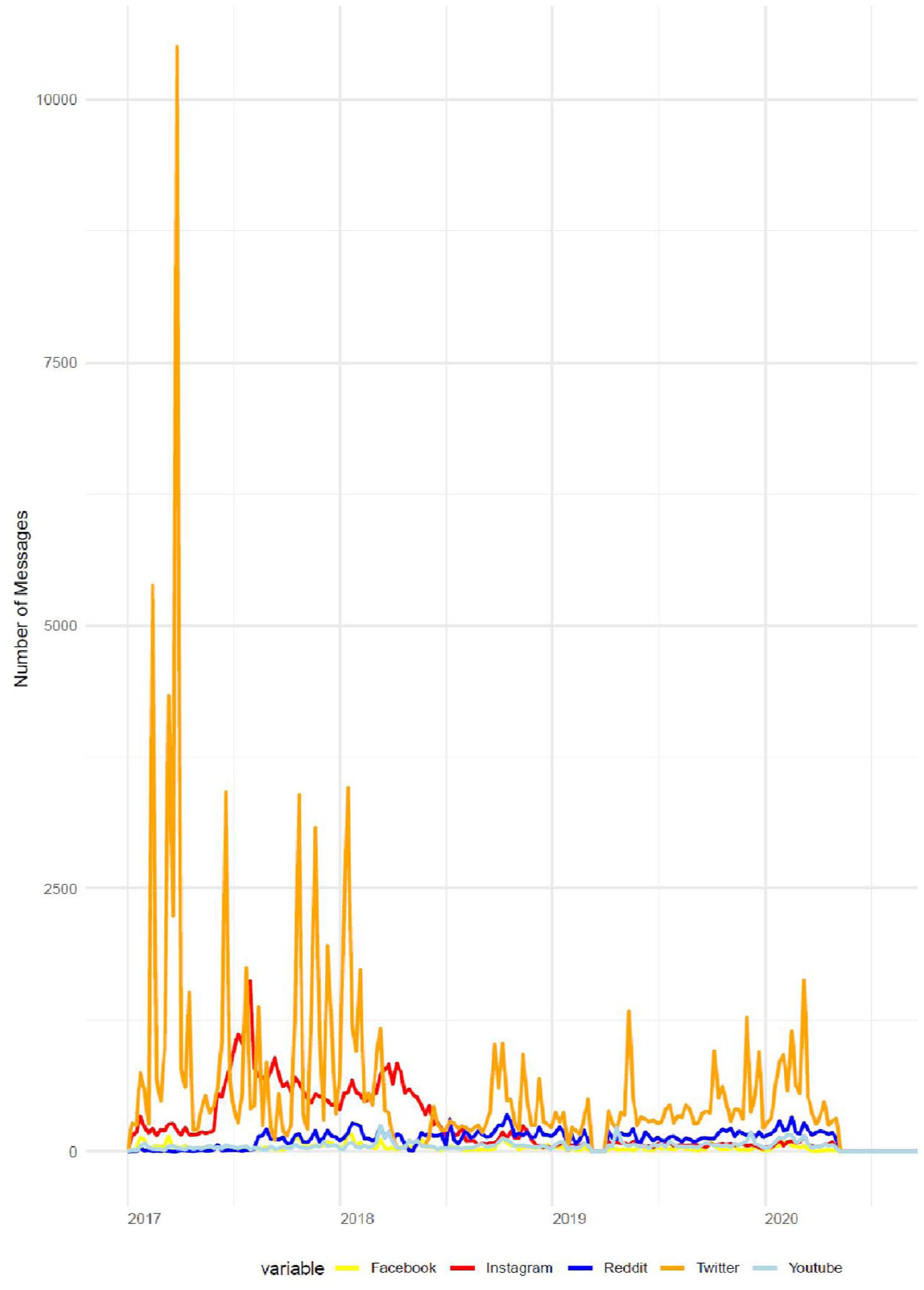
Daily counts of social media posts containing keywords in sample (n = 146,134).
To analyze the prominent topics in the discussion on social media platforms, we first used an unsupervised computational approach of topic modeling. A STM revealed 22 topics (for details about the number of topics [k] selection see Appendix B) and themes covered by social media (for details about topics see Table 1 and their proportions see Figure 2). We used the topic’s top words (highest probability to be included in the topic), top FREX words (top exclusive words for each topic), and representative texts to generate labels for all topics (Roberts et al., 2014). The largest topic by proportion in the dataset is centered around discourses that included hashtags and affirmations (13.6%), followed by conversations on nuances of the associations between race and feminism (12%). The next two biggest topics of conversation parsed out the concept of “white feminism” and often critiqued it (21.6%). People also discussed the different intersections of identities and their association with feminism (12.7%), called for action surrounding issues of their choice (11.6%), and discussed topics that pertained to Hollywood and celebrities and their associations with feminism and feminist movements (6.6%). A small but significant share of people also took to social media to share their personal stories (6.2%).
Structural Topic Model Topic Proportions.

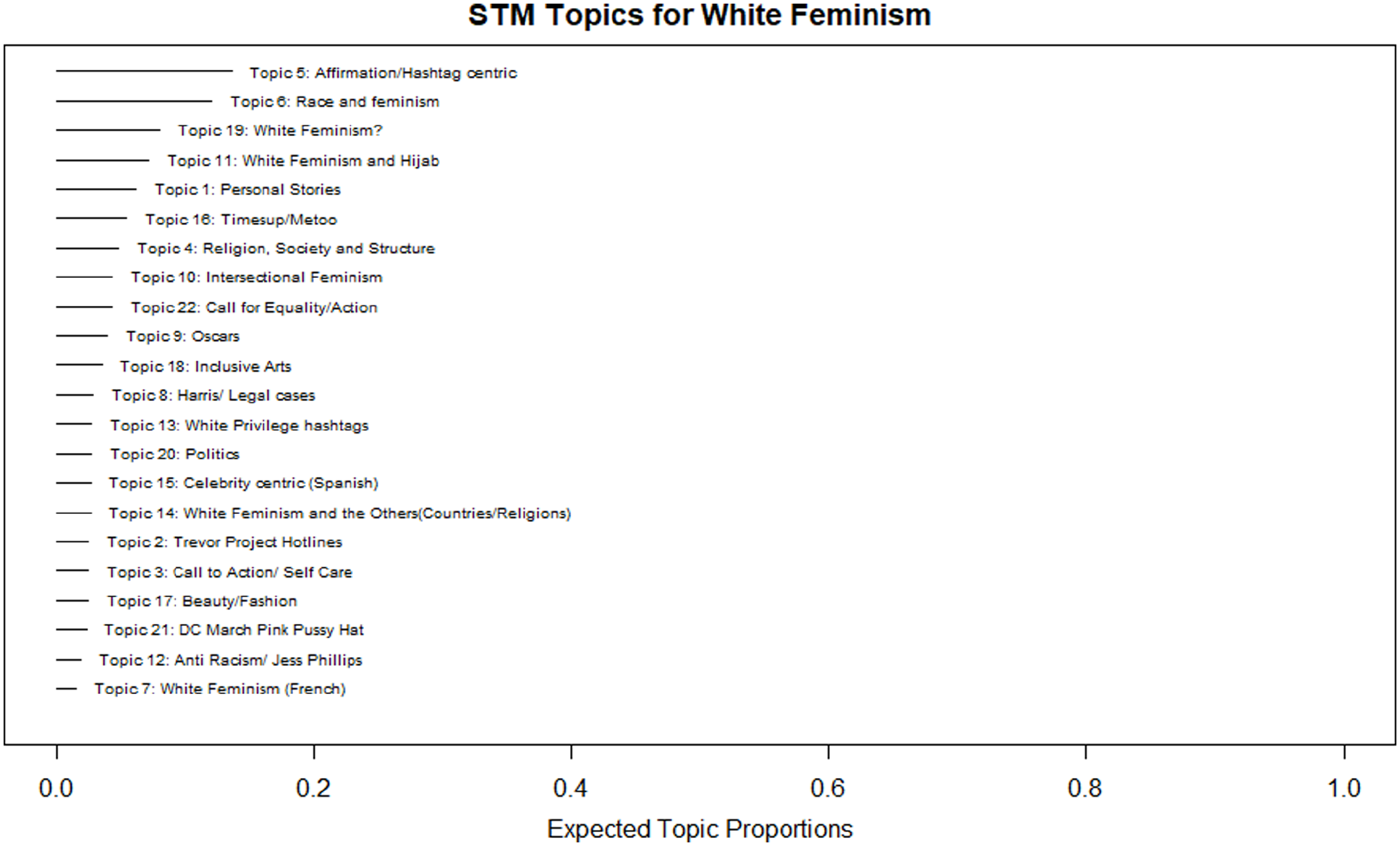
STM topic proportions.
Next, we conducted a content analysis of the full text of 620 social media posts. The content analysis helped us validate our STM topics. It also helped us take a deeper dive into the content, theme, frames, and rhetoric used. While 44% of the posts mentioned People of Color or Women of Color, 27.6% of the posts mentioned white feminism explicitly. The topic of LGBTQ+ communities was seen in 29.7% of the posts. Furthermore, we found differences in the specific mention of topics pertaining to racial minorities. 33.5% of the post documented Black experiences, 9.0% mentioned Hispanic experiences, and 17.6% mentioned Asian experiences. 7.1% mentioned the topic of anti-feminism and 7.4% discussed men’s rights perspectives. Politics accounted for almost a quarter of the discourse with US politics accounting for 24.8% and international politics accounting for 1.6% of the posts. Hollywood-centered posts were present in 25% of the posts and religion was present in 14.2% of the posts and were the two other dominant topics in the posts. Figure 3 shows the relative proportions of coded topics.

Percentage of posts containing major topics coded during content analysis (n = 620).
The second research question examined the prominent framing techniques seen in our corpus across various social media platforms. We answered this question by conducting two separate analyses one based on the STM and the second based on the content analysis conducted on a sample of the corpus (see Figures 4 to 6). Analysis of Topic Model Networks (ANTMN) STM plot algorithm clustering argues that “frame elements could be identified using topic modeling, and that frame elements can then be automatically grouped into frame ‘packages’ using community detection techniques applied to the topic network” (Walter & Ophir, 2019, p. 248). ANTMN Topic Network analysis of the entire corpus shows separate topic packages (communities) with intersectional topics of conversation (violet cluster), and packages, which have celebrity-centric discussion and white feminism (orange and green cluster).
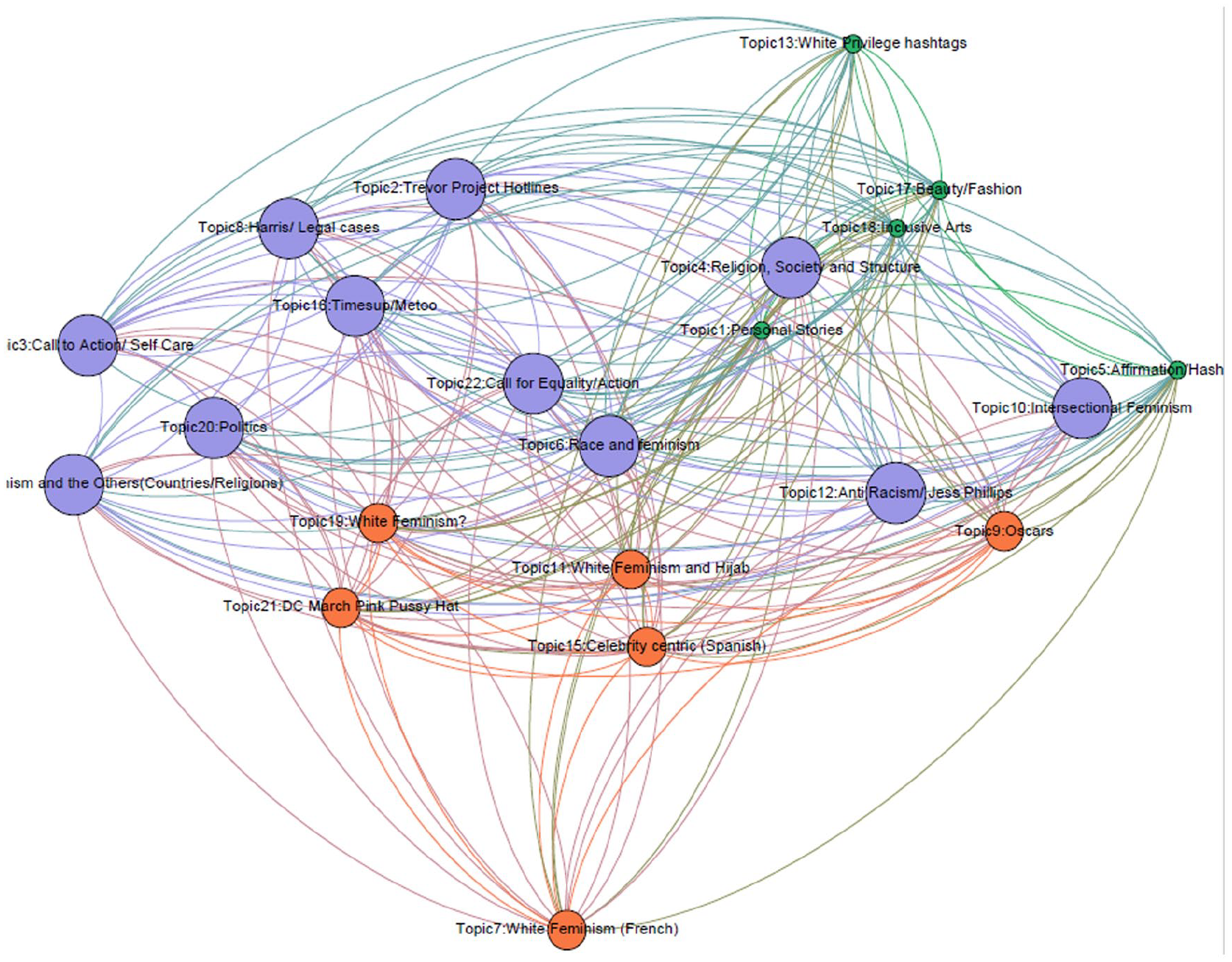
ANTMN STM frame packages plot.
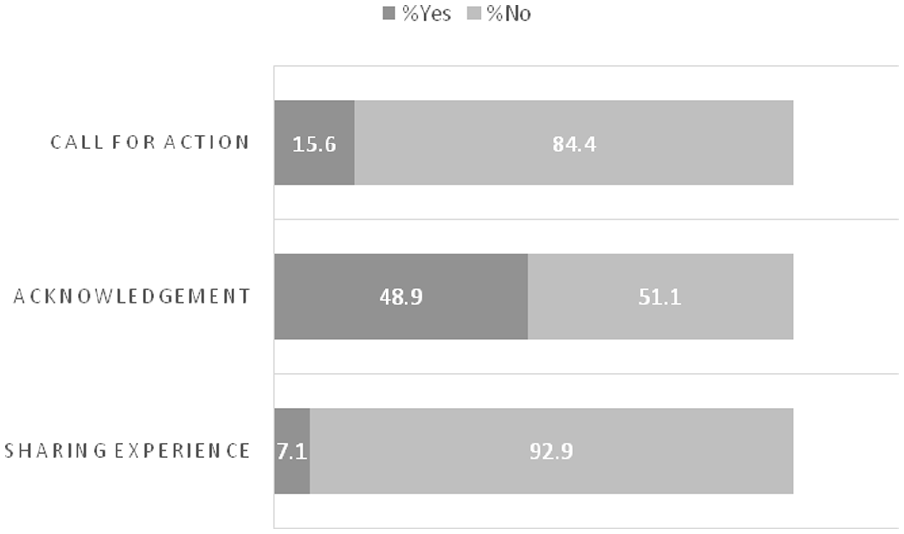
Descriptive statistics: Dominant framing techniques (n = 620).

Percentage of posts containing rhetorical techniques coded during content analysis. (n = 620).
In our content analysis, we were more interested in the differential framing techniques used in the studied posts: “Acknowledgement” (for diagnosis frame), “Call for action” (for prognosis frame), and “Shared experiences” (for frame resonance). Our analysis revealed that the most commonly used framing technique were acknowledgment, indicating diagnosis frame (48.7%), followed by prognosis frame through call for action (15.6%). Frame resonance was used by 7.1% of the posts by expressing shared experiences.
To answer the question about the overall differences in discourse across platforms, we studied both the difference in topics explored during content analysis and STM topic proportions across platforms.
In the overall corpus, Twitter posts formed the majority of the content (n = 65,420). The time series plot of the posts (Figure 1) also shows that Twitter consistently generated a bulk of the conversation surrounding the topic of “white feminism” and discourses by other users who felt marginalized by feminist movements. The content analysis of a sample of the posts (Figure 7a) showed that 51.3% of the posts on the topic of People of Color (χ2 = 140.21, df = 4, p < .001), 50.5% Black experience (χ2 = 126.83, df = 4, p < .001), 87.5% Hispanic experience (χ2 = 27.037, df = 4, p < .001) and 42.2% Asian experience (χ2 = 178.299, df = 4, p < .001) posts were on Twitter. Twitter also hosted the majority of Hollywood centric content (87.1%, χ2 = 95.716, df = 4, p < .001) and religion-related content (50%, χ2 = 242.473, df = 4, p < .001). Finally, 91.8% discussions surrounding white feminism and critique of the same (χ2 = 137.484, df = 4, p < .001) were seen on Twitter.

(a) Share of posts containing major topics per platform (n = 620). (b) Share of posts containing rhetorical techniques per platform (n = 620). (c) Share of posts containing framing techniques per platform (n = 620).
STM’s intraplatform topic prevalence plot results (Appendix A, Figure 2) indicate that despite the length restrictions for the posts published on the medium, Twitter hosts content on a wide range of topics. Twitter hosted the majority of the posts containing “Acknowledgement” (diagnosis frame 73.3%) and “Call for action” (prognosis frame; 51.6%). It contained the second highest “Shared experiences” (frame resonance; 9.1%) (Figure 7c). Furthermore, Twitter posts contained a diverse assortment of rhetorical appeals (Figure 7b). 68.1% of the posts containing the rhetorical technique of ethos were generated on Twitter, 66.5% of those with pathos and 48.7% with logos were from Twitter.
The second largest number of posts in the corpus came from Instagram (n = 43,699). The time series plot of the posts (Figure 1) shows that Instagram usually has a steady trickle of conversation on the topic of “white feminism” and discourse by other users who felt marginalized by feminist movements. However, Instagram had a huge rise in content in 2018 where for a brief period it generated more conversation surrounding the topic than Twitter.
Instagram (Figure 7a) had the most amount of content on LGBTQ+ experiences with the platform hosting 44.6% of the conversation (χ2 = 238.479, df = 4, p < .001). Furthermore, Instagram also had 8.2% of the conversations around white feminism, 29.3% of the conversations around experiences of People of Color and 27.4% of the discussions on Black experiences. Instagram also hosted 12.9% of the discussion surrounding Hollywood and feminism.
The STM’s intraplatform topic prevalence plot results (Appendix A, Figure 2) show that Affirmation/Hashtag centric topics (Topic 1) are more prevalent on Instagram. Similarly, other hashtag centric topics like that highlighting white privilege (Topic 13) were also prevalent in the platform. Furthermore, the platform also hosted content highlighting beauty and fashion and inclusive arts (Topic 17 and 18). Instagram contained the second highest number of the posts containing “Acknowledgement” (diagnosis frame; 23.8%) and “Call for action” (prognosis frame; 45.4%) (Figure 7c). A small proportion of content (.7%) that showed pathos were generated from Instagram. Other than that, Instagram posts lacked much usage of ethos or logos (Figure 7b).
Reddit and YouTube
The third and fourth highest number of posts on the topic came from Reddit (21,517 posts) and YouTube (8,826 posts). Interestingly, both of these platforms hosted similar topic of content (Figure 7a). In the coded sample, YouTube (84.8%) had the most amount of Men’s Rights discourse (χ2 = 481.583, df = 4, p < .001) followed by Reddit (15.2%). Similarly, YouTube had the most amount of Anti-feminist discourse (90.9%) followed by Reddit (9.1%) (χ2 = 533.859, df = 4, p < .001). YouTube also hosted 44.3% of the content that mentioned religion, 20.65% of content on LGBTQ+ related discourse and 34.9% of discourse on Asian experiences. Reddit also contributed to the discussions surrounding People of Color (4.8%), Black experiences (3.4%), Hispanic and Asian experiences, 4.9% LGBTQ+ experiences, and 8.2% of the discussions surrounding, white feminism.
Reddit and YouTube both allow long-form discussions surrounding topics, one through a discussion forum structure and the other through videos. However, the STM results (Appendix A, Figure 2) showed differences in between the form of topics prevalent on the two platforms. While Reddit contained more personal stories, discussions surrounding race and feminism, anti-racism, religion, society, and structure, YouTube contained a more diverse portfolio of topics including more discussions on the concept of white feminism, celebrity-centric topics, Oscars, #MeToo movement, politics as well as call for action. Reddit and YouTube posts (Figure 7b) used the rhetorical technique of logos (3.8%, 20.5% respectively) or pathos (7.2%, 25% respectively). Furthermore, Reddit hosted the majority of the posts (Figure 7c) containing “shared experiences” (frame resonance; 2.3%) as well as small shares of “acknowledgement” (diagnosis frame; 2.1%) and “call for action” (prognosis frame; 51.6%).
The corpus contained only 6,672 Facebook posts. These were public-facing Facebook posts that were mostly hosted by organizations or public-facing individuals. Furthermore, STM’s intraplatform topic prevalence plot results (Appendix A, Figure 2) indicate an abundance of posts on political discussion and discussions surrounding the definition and critique of white feminism on the platform. 30.1% of the posts that had ethos and 27% of the posts that demonstrated logos as a rhetorical technique were from Facebook (Figure 7b). This reflects the differences in the nature of public-facing posts on a platform that hosts both public and private content.
Discussion
Although the feminist movement in the United States received abundant attention with the rise of #MeToo, critics have pointed out problems of inclusivity. One primary criticism is the white-centric feminist discourse. Scholars highlight how feminism is unified and universalized from white perspective, excluding the discussion and stories of BIPOC women (Feagin, 2020; Jackson & Rao, 2022; Upadhyay, 2021). In the current study we use concepts from rhetoric, framing, and cross-platform activism, to understand the discourse around white feminism on five different social media platforms.
Our findings help to understand the criticism against the feminist movement and highlight the voices of BIPOC women and other marginalized groups. Our analysis shows that the majority of the conversation in our dataset was from Twitter followed by Instagram and Reddit. Finding the majority of the posts in Twitter is not a surprise, since the social media hashtag went viral in 2017 when actress Alyssa Milano tweeted #MeToo to encourage victims of sexual violence to speak up. The #MeToo movement was started 10 years ago by Tarana Burke, but it became a “viral rallying cry for millions of women” in 2017 after Milano’s tweet (Brown, 2018).
To understand the conversation against white feminism we first examined the most prominent topics. In line with past research (i.e., Aziz, 1997; Corrigan, 2019; Daniels, 2015; McFadden, 2011), the primary topics show that the criticism focused on critical issues such as race and intersectionality along with Hollywood and personal stories among others. We probe these topics further with the help of a content analysis, which also shows that People of Color or Women of Color, white feminism, LGBTQ+ communities, Black experiences, and Hollywood dominated the conversations on social media platforms.
Examining the prominent framing devices, we find that “Acknowledgement” (for diagnosis frame) was the most prominent, where people posted recognizing the problem of white feminism and acknowledging the stories and experiences by Women of Color. The human coding further highlighted that among the rhetorical framing devices used in the posts, logos was the most prominent rhetorical technique used followed by ethos, and pathos. The criticism against the feminist movement predominantly used techniques to persuade the audience with reason, facts, and logic.
Our findings also show meaningful platform differences, such that acknowledgment and call for action techniques were most often used on Twitter and Instagram. This is probably because of the common feature of using hashtags in both platforms (Auxier & Anderson, 2021; Hitlin & Holcomb, 2015), which makes it easier for users to post, and search relevant content and like-minded others. In general, Twitter has also been the most popular platform for such activism (Brown, 2018). The shared experiences technique, where users described their personal experiences, was most prevalent on Reddit. Reddit allows longer posts than platforms such as Twitter. The ability that users can exchange ideas and form communities based on shared interests further allows Reddit users to elaborate on their experiences and tell the world their personal stories. This is in line with prior research that users often utilized Reddit to share their own stories including in the case of the #MeToo movement (Manikonda et al., 2018).
However, we also find contradictions and challenges that marginalized voices on social media encounter. We find that anti-feminist and men’s rights topics are, in particular, rampant on YouTube and Reddit. This is consistent with previous evidence showing that men are twice as likely to be Reddit users than women in the USA. (Duggan & Smith, 2013) and Reddit has become a platform for populating misogynic content (Buyukozturk et al., 2018). Also, on YouTube, recommendation algorithms have increasingly steered users toward Incel-related videos (Papadamou et al., 2020). In an economy of visibility (Banet-Weiser, 2018), personal stories and narratives are capitalized and monetized through quantifiable metrics and algorithms, therefore erasing voices from marginalized communities and stalling the advancement of social justice. Such platform capitalism further specializes in “predatory inclusion” (Cottom, 2020) where seemingly democratizing spaces ultimately exploit marginalized voices, hijacking the conversations of a more inclusive feminist movement.
When it comes to rhetorical strategies, including logos, pathos, and ethos, we found that across the platforms, Twitter was the most prevalent in using such strategies, which signifies the overall dominance of the platform over others in white feminism and related discourses. Interestingly, Facebook had a relative prevalence of ethos and logos, but not pathos, suggesting that Facebook content focused on the use of facts, reason, and credibility rather than emotional appeals. Given Facebook’s significant role in information dissemination and news releases, it is likely that narrative styles or emotional appeals were unsuitable for such purposes. On the contrary, YouTube had relative dominance in logos and pathos but not ethos. It might be related to the video-oriented nature of the platform, which emphasizes emotions, narratives, and numbers rather than source credibility. Future studies should incorporate various layers of features that social media platforms offer across texts and visuals to build a comprehensive understanding of the patterns.
Our findings show multiple other nuances and differences across platforms. Networked publics bring together people, technology, and practice and are shaped by the distinct affordances that each platform offers (boyd, 2010). These affordances include persistence, replicability, scalability, and searchability. While persistence refers to the way online exchanges become part of the public archive, replicability points to the duplication of content. Alongside the possibility of searching and making visible the content, these features make the platforms accessible for users partaking in information exchange. The majority of the topics were prevalent on Twitter, as that platform was most commonly used by feminists, particularly in terms of #MeToo (Brown, 2018). So, it made sense for Twitter to be the most frequently used platform for criticism against #MeToo and feminist movements. As boyd (2015) points out, persistence, visibility, spreadability, and searchability are factors that impact the way we relate to digital content. For similar reasons, we find Hollywood-centric posts more commonly on Twitter and Instagram. Topics such as white privilege hashtags and inclusive arts are mostly prevalent on Instagram compared to other platforms. Given the visual-sharing nature and its common use of hashtags, Instagram posts have generally focused on raising awareness of white privilege in society using a string of hashtags and promoting arts and exhibitions of artists of color. It has also become a platform where hashtags are used to boost posts as well as communicate with trending topics. Instagram, therefore, has become both the platform with an abundance of messaging surrounding LGBTQ+ issues and topics surrounding race and privilege as well as a platform where the activist hashtag is incorporated in the post to algorithmically boost the posts. Reddit and YouTube both mostly used the rhetorical technique of logos and pathos to communicate long-form discussions surrounding personal experience, voices of the people who feel marginalized by the feminist movements as well as people who actively advocate against the feminist movement.
Our research is not without limitations. We focused on public-facing data across five social media platforms. While it is possible that users engage in social media discussions differently depending on the privacy setting, publicly available content has a greater impact and relevance on social media activism and political consequences. Relatedly, we relied on texts in our analysis. Given the significant video and audio features in platforms like Instagram and YouTube, future studies should incorporate such features into analysis for a comprehensive understanding of cross-platform patterns. Our findings are primarily descriptive, as we were interested in the rhetoric around white feminism on social media platforms. Understanding the users’ motivations behind their posts could help explain the findings better. Future research could add an element to conduct interviews and surveys with social media users to understand their motivations behind their posts. We examine five different social media platforms, which gives us a nuanced understanding of the conversations around white feminism. Future research could also conduct surveys and interviews to understand why people use different social media platforms for activism. The content analysis is based on a subset of the entire social media posts. But our sample is still representative of each topic because we selected the posts that have high theta values for each topic.
Despite some of these limitations, our study is one of the few cross-platform social media analyses of the conversations surrounding white feminism. Despite the importance of the #MeToo movement, criticism against this movement and the feminist movement in general is abundant. One of the primary problems pointed out by scholars is that the feminist movement is not inclusive (Aziz, 1997; Corrigan, 2019; Daniels, 2015; McFadden, 2011). The movement leaves out BIPOC women, LGBTQ+ people, and more. The feminist movement cannot grow unless it is inclusive of all voices. Our study examined this rhetoric surrounding white feminism and attempted to understand the conversations about those who have been left out.
Footnotes
Appendix A
Intercoder Reliability of the Main Posts Content Using Pairwise Cohen’s Kappa.

| Coding categories | Pairwise Cohen’s Kappa | Average pairwise percent agreement |
|---|---|---|
| Topic of post: LGBTQ experiences | .704 | 85.19 |
| Topic of post: Black Experiences | 1 | 100 |
| Topic of post: Hispanic Experiences | .5 | 99.56 |
| Topic of post: Asian Experiences | 1 | 100 |
| Topic of post: Women of Color or People of Color narrative | 0.698 | 88 |
| Topic of post: Anti-feminist | 0.95 | 98.97 |
| Topic of post: US Politics | 0.683 | 91.79 |
| Topic of post: International Politics | 0.691 | 95.18 |
| Topic of post: Hollywood | 0.795 | 92.25 |
| Topic of post: Men’s Rights | 0.904 | 96.78 |
| Topic of post: Religion | 0.865 | 94.88 |
| Topic of post: Mentions White | 0.906 | 95.32 |
| Topic of post: Rhetorical Technique: Ethos | undefined** | 100 |
| Topic of post: Rhetorical Technique: Logos | 0.774 | 91.79 |
| Topic of post: Rhetorical Technique: Pathos | 0.758 | 91.28 |
| Mentions: Call for Action | 0.839 | 96.41 |
| Mentions: Acknowledgement | 0.665 | 82.56 |
| Mentions: Sharing Experiences | 0.958 | 99.49 |
Cohen’s kappa is undefined for this variable due to invariant values.
LGBTQ = Lesbian, gay, bisexual, and transgender.
Appendix B
Acknowledgements
We would like to thank Kruthika Kamath for her help at the initial stages of this project.
Declaration of Conflicting Interests
The author(s) declared no potential conflicts of interest with respect to the research, authorship, and/or publication of this article.
Funding
The author(s) received no financial support for the research, authorship, and/or publication of this article.
