



Abstract
Newspapers in most West European countries have historically had strong ties to specific political parties. While formal bonds have vanished, parallelism in news content might still remain; for instance, in a tendency to report more often and more favorably on parties that align with the political leaning of a newspaper. In this article, we ask whether political parallelism exists in newspapers today, and whether or not it has decreased over the last two decades. These questions are answered using a dataset of 5.4 million newspaper articles from three countries (Denmark, the Netherlands, and the United Kingdom) over 20 years, annotated with the presence of political parties, and the sentiment of party news, at the sentence level. Findings suggest that newspapers pay more attention to the mainstream party with which they share political leaning, but that this pattern of parallelism has weakened over time.
Keywords
Introduction
The once strong and formal ties between newspapers and parties in many European countries gradually disappeared in the last half of the 20th century (Hallin and Mancini 2004: 26–30). This process was in part driven by commercial goals, as the competition for advertising revenues increased, but also by the professionalization of journalism. The political leaning of various newspapers continued to be visible, but news production was increasingly defined by a set of professional norms and values, to which partisan perspectives did not explicitly belong. The status and development of political parallelism in the current century appear more diffuse, given that biases in news content are hard and costly to capture across many countries and years (Lelkes 2019: 580–82). Research has demonstrated that political parallelism matters to democratic politics, for instance by boosting partisanship (Horwitz and Nir 2015) and widening gaps in political trust (Lelkes 2016). However, our knowledge about the actual spread and relevance of partisan biases in contemporary news production is arguably still relatively scarce and uncertain.
We address this gap, building on and seeking to extend various studies of political parallelism over recent decades. We believe this is a timely effort for several reasons. First, much of the extant research covers either a single country, a limited period, or a single aspect of parallelism. Consequently, there is still much ground to be covered in terms of studying parallelism comparatively, over time, and from different perspectives. Second, recent years have witnessed a trend toward polarized democratic debates in many countries, making it ever more relevant to explore the extent to which voters are exposed to partisan information in the news and whether political parallelism continues to decrease or not.
To investigate recent trends of political parallelism in newspapers, we use a dataset containing 5.4 million newspaper articles from Denmark, the Netherlands, and the United Kingdom. It contains sentence-level information on the presence of political parties, as well as the sentiment in each of those sentences, for a right- and a left-leaning newspaper in each country. Based on this dataset, the extent of political parallelism is assessed during the period 2000–2019, controlling for the size and incumbency of political parties. Concretely, the concept of parallelism is defined as a pattern where political alignment between a party and a newspaper means that the newspaper produces more, and more favorable, news about the party. Results point to the existence of a partisan bias in contemporary political journalism, although we see a decreasing trend over time. Parallelism in news content is only consistently supported in terms of a partisan gap in the volume of attention granted to newspaper “favorites,” while signs of (dis)favorable news tone patterns for politically (un)aligned parties are visible only in the UK. In short, left (right) leaning newspapers have paid more attention to the dominant mainstream party on the left (right) than to its competitors in all three countries since the turn of the century. However, the declining time trend means that only the UK qualifies as a parallel media system toward the end of this period.
Theory
Newspapers in most European countries used to have strong ties to specific political parties. This aspect of media systems was originally captured by the concept of press-party parallelism (Seymour-Ure 1974). According to Seymour-Ure, newspapers, and parties were parallel if linked organizationally, ideologically (alignment of news content and party goals), and through the partisanship of readers. In its purest form, parallelism would mean a one-to-one relationship between news organizations and political parties in a media system. However, from around the time that the concept was introduced, the strongest expressions of parallelism gradually disappeared, as the party-press vanished and organizational bonds weakened (Van Kempen 2008: 26).
Accompanying this development, the understanding and definition of parallelism have changed over time. Hallin and Mancini (2004) consider it a core aspect in their influential categorization of media systems. They define political parallelism more broadly, arguing that while strict press/party parallelism might persist in some cases, it has generally shifted more toward parallelism of “general political tendencies” (p. 27). Organizational ties and partisanship of audiences are still part of their definition, but the emphasis is clearly on the extent to which an outlet offers content reflecting a distinct political orientation. Furthermore, parallelism in content is mirrored by parallelism in journalistic role perceptions or practices (Hallin and Mancini 2004: 28–9), which could be understood as the extent to which partisan reasoning interferes with professional journalistic norms.
These norms are usually associated with the broader concept of media logic (Altheide 2013; Altheide and Snow 1979) and in particular professionalism, which occupies an important role in recent discussions of media logic (Esser 2013). Esser and Strömback (2014) for instance, define professionalism as news production according to distinctively journalistic norms and criteria. The latter is often operationalized through so-called news values, such as conflict, negativity, elite involvement, proximity, and impact that signal “newsworthiness.” News value theory in other words provides a framework to understand which events, issues, and actors are deemed newsworthy, and consequently how likely they are to make it through the news selection process (Galtung and Ruge 1965; Harcup and O’Neill 2001, 2017). Overall, journalism has witnessed a development toward a common understanding of what news is and a common understanding of news and journalists as independent. Arguably, this process has contributed to looser ties between newspapers and parties over time (Esser and Umbricht 2014; Patterson and Donsbach 1996). More objective and less partisan styles of reporting have emerged, a trend reflecting the mediatization of politics and the increasing influence of news values and media logic (Esser and Strömbäck 2014).
As noted in the introduction, this does not necessarily mean that parallelism in news is a thing of the past. Since Hallin and Mancini’s adapted perspective, a number of studies have focused on various aspects of political parallelism. Some contributions concentrate on audience partisanship (Van Kempen 2007), but most have explored parallelism in news content. The European Media Systems Survey (EMS) (Popescu et al. 2011) has been a recurring data source in studies that link parallelism with different outcomes in political behavior (e.g., Brüggemann et al. 2014; Lelkes 2016; Van Dalen 2021). It is based on national experts scoring the degree to which newspapers advocate for specific policies or are influenced by specific parties, and shows substantial levels of, as well as variation in, partisan bias across Europe (Popescu et al. 2011: 85).
While the EMS itself is only indirectly based on news content, various other contributions have investigated parallelism in media content. Parts of this research focus primarily on the issue content of news, rather than any explicit partisan or party-related news content. For instance, Brandenburg (2006) points to partisan tendencies in the way that newspapers reinforce the issue agenda of parties that they endorse. This aspect of parallelism has since been documented also in the Netherlands. Studying parallelism from an agenda-setting perspective, Van der Pas et al. (2017) conclude that Dutch newspapers are more likely to prioritize issues that are on the agenda of the parties their readers vote for. This is a valuable contribution to our understanding of political parallelism, employing an implicit or indirect indicator of what “favorable news” can look like. Our approach in this study is however aligned with a more explicit and direct conceptualization of political parallelism, focusing on the presence of parties in news content and on the ways in which parties are covered. In particular, we build on two different lines of inquiry in the literature on political parallelism.
The first is a set of studies that explore explicit partisan or ideological slant in news. For instance, research has found a relationship between newspaper endorsements and their level of critical or negative coverage. Kahn and Kenney (2002) identify a pattern of favorable slant toward endorsed candidates in news coverage of US senatorial campaigns. Similarly, Larcinese et al. (2011) find that American newspapers provide less negative unemployment news when they have endorsed the sitting president. In a European context, Baumgartner and Chaqués Bonafont (2015) identify strong political parallelism in Spanish news, while Brandenburg (2006) shows that British newspapers during the 2005 election campaign covered unendorsed parties much more negatively than endorsed parties.
A second aspect of explicit content parallelism relates to biases in the volume of news attention to specific parties. In this perspective, as indicated by Van Dalen (2021), political parallelism is crucially connected to the concept of partisan-motivated reasoning. A vast literature (see overview in Bullock 2020) has shown the considerable influence that parties have on opinion formation through party cues. Party cues are usually understood as information that links a party to a stand on an issue (Bullock 2011: 497). Nordø (2021: 48) points explicitly to the role of news as an “intermediary condition for the transmission of party cue effects.” There is some evidence indicating that news media serve this role in a way that could provide a platform for motivated reasoning. In a study of election news and party-press releases in Austria, Haselmayer et al. (2017) document a pattern of political parallelism where newspapers are more likely to report messages from parties that their readers identify with. Still, while we know much about the effects of party cues, we know less about their actual spread in the information environment of voters. Studying attention parallelism—comparatively and over time—is thus important, since it can give us more knowledge about whether, where, and when voters encounter different balances of party cues across news outlets.
The concept and study of political parallelism shares a lot of features with research on news bias, partisan media bias, and political balance in news reporting (e.g.,Castro 2021; Shultziner and Stukalin 2021; Soontjens et al. 2023; Hopmann et al. 2017). Not all of this research addresses partisan perspectives, and while parallelism studies concentrate on the country level, studies of media bias focus more on the outlet level. A more coherent approach to media bias nevertheless appears useful, as pointed out by Lelkes (2019), especially when considering how research on parallelism has moved away from a strict press-party parallelism. Given that we focus on whether political alignment translates into biased or unbalanced content, our study draws on perspectives about underlying mechanisms that could be found across all these strongly overlapping literatures.
To summarize, a core aspect of political parallelism is the tendency of partisanship or political leaning to influence news production at the cost of professional, non-partisan news values. To the extent that such a tendency exists, it should be reflected in political news content that is biased. Patterns of such bias might manifest themselves in several ways, of which we focus on the amount of coverage for a political party and the sentiment of news in which the party figures. In a media system where professional journalistic norms have the edge on partisanship or political leaning, news values should dictate how much attention a political party receives, and also whether this attention is positive or negative. This is an ideal-typical representation of a non-partisan, non-parallel media system, that aligns with Cook’s argument (2005: 84) on what makes the news media a political institution: Different news organizations work according to endurable and taken-for-granted practices that produce similar news. In other words, in a stylized version of contemporary political journalism, no substantial differences should in theory exist between outlets. Of course, different media outlets will not produce the exact same content, and “no serious media analyst would argue that journalism anywhere in the world is literally neutral” (Hallin and Mancini 2004: 26). Newspapers vary in ownership, history, profiles, readership, formats and of course staff. In effect, the balance between different news values (e.g., conflict, relevance, and negativity) will vary across outlets, which results in different representations of what the news is (Hagar et al. 2021; Patterson and Donsbach 1996). In other words, although news values are shared across the profession, they will still be emphasized differently by different outlets (and even by different journalists within the same outlets). While all newspapers usually pay more attention to the government than to the opposition, the level of this incumbency bonus varies. One outlet may for instance put a stronger emphasis on conflict than others, which in turn affects the visibility of opposition sources and framing.
However, political parallelism should be understood as a substantively distinct perspective on variation in content between outlets. It does not concern the weighting of various commonly accepted news values. Instead, it reflects a conflict between news values and partisanship or political leaning, where the latter has a noticeable influence on what the news looks like. When outlets differ in the amount and sentiment of attention political parties receive, and the difference can be explained by political leaning, this constitutes an expression of political parallelism. Thus, if we assume that political parallelism in news content is a feature of contemporary political journalism, we should expect to observe the following:
H1: When a party and newspaper are politically aligned, the party receives more news coverage compared to parties that are not aligned.
H2: When a party and newspaper are politically aligned, news in which the party appears will be more positive compared to parties that are not aligned.
A number of developments in both news and politics in recent decades could likely have affected the balance of partisan and professional norms in news reporting, causing the level of observed parallelism to change over time. Based on existing research and knowledge, conflicting arguments could be made with regard to the direction of this change.
On the one hand, the economic crisis in newspaper journalism could arguably have decreased levels of political parallelism. The crisis was brought about by a dramatic decline in advertising and subscription/sales revenues due to the rising competition from online news (Curran 2010). Reduced revenues lead to a decreasing number of journalists being required to do the same work in less time. As a result, the remaining journalists need to rely increasingly on pre-made news agencies and PR content (e.g., Boumans et al. 2018). One of the outcomes of this process could be more homogeneous reporting, as there are fewer resources to develop own stories, and potentially less room to develop coverage on specific political parties.
On the other hand, as noted by Hagar et al. (2021: 4), news outlets try to “capture certain subsets of news readers.” Thus, despite having fewer resources at their disposal, newspapers might invest more effort and resources specifically in selecting and/or developing “own” content, that aligns with the (political) preferences of a specific subset of the audience, as is argued by Mullainathan and Shleifer (2002). This trend is also tentatively visible in the findings of De Vries et al. (2022), who find that despite the newspaper crisis, newspapers do not appear to converge in the content offered over the last two decades. Arguably then, even when journalists increasingly rely on ready-made content they could still sustain, or even strengthen, parallelism through their choice of which press releases and/or PR material to publish about. 1
Low political parallelism is one of the defining features of Hallin and Mancini’s (2004) liberal media system, which they argue will over time become more relevant as other media systems converge toward a more commercial model. However, the previous paragraphs illustrate how the commercial pressures that are central to the liberal media system do not necessarily exclude parallelism, and might even reinforce it. On the other hand journalistic professionalism, another core aspect of the liberal model, suggests adherence to strong norms about journalistic objectivity, at the cost of partisan bias in news production. Hence, a continuing trend toward less parallelism seems likely. Decreasing parallelism is arguably also a fair assumption from the perspective of developments in electoral markets and party competition, where the evidence for long has pointed in the direction of partisan dealignment and mainstream party convergence (Mair et al. 2004; Spoon and Klüver 2019). These trends suggest there is no clear commercial incentive for newspapers to produce politically parallel content. In volatile electoral markets, where mainstream parties are ever closer, newspapers thus might find—in the same way that voters have found—that the threshold for abandoning their historical favorites is lowered. We therefore formulate the following expectations:
H3: The positive effect of political alignment between a newspaper and a party on the amount of coverage the party receives will decrease over time.
H4: The positive effect of political alignment between a newspaper and a party on the sentiment of news in which the party appears will decrease over time.
Country and Newspaper Sample
Examining political parallelism in news content is resource intensive, which is most likely the reason why few contributions do this comparatively and over longer periods and instead rely on surveys of audiences, experts, or journalists (Lelkes 2019: 580–2). However, the increasing availability of digital data along with the development of computational methods and skills in the social sciences, have made it possible to collect and code the necessary data. We base our study on a newspaper corpus that covers three European countries from 2000 to 2018/19: the United Kingdom, Denmark, and the Netherlands. This allows us to explore parallelism over two decades in settings that vary according to political context as well as media systems. 2 Admittedly, this variation is a result of a country selection process influenced by practical considerations, such as funding, available news sources, and research networks. The three countries nevertheless have relevant differences and similarities, both in terms of politics and media. Both proportional and majoritarian electoral systems are represented, which means that we are comparing parallelism in one case where there are de facto only two (at the most three) contenders for office with two cases where the effective number of parties is substantially higher and the policy influence of parties more fragmented. The basic mechanism of parallelism might still be the same, but we should be open to the possibility that patterns could be less straightforward in Denmark and the Netherlands (see results in Appendix, Section 3, described in the robustness section below). Additionally, from the perspective of political context, note that the two PR countries differ with respect to electoral proportionality, party system size, polarization, structure of party competition, and government formation (Lijphart 2012; Mair 2006). To the extent that results from the two countries are similar, this variation increases our confidence in generalizations toward the large but varied group of PR systems in Europe.
In terms of media systems, the liberal media system of the United Kingdom is characterized by a higher level of commercialization, journalistic professionalism, and polarization compared to the democratic corporatist model of the other two countries (Hallin and Mancini 2004). From the perspective of the latter, our results could bear relevance for similar media systems in other West European countries, such as Germany, Sweden, Belgium, Austria, and Switzerland. However, it is important to note that with respect to parallelism, the highly partisan British press means that the UK is an exception to the liberal model which is defined as a non-partisan media system (Hallin and Mancini 2004: 75). Consequently, the core media comparison at play in our study is not really that between liberal and democratic corporatist systems. Rather it is the distinction between an explicitly partisan UK press (Hallin and Mancini 2004: 210–5), where slant and endorsements are the norm, and a more muted and implicit version of parallelism in Denmark and the Netherlands (Hallin and Mancini 2004: 178–83). If anything, this would suggest that our “liberal” case is likely to be the most parallel one, even though this might tell us little about parallelism in other liberal systems (but perhaps something about countries characterized by a strongly partisan and polarized press).
Around 5.4 million newspaper articles from six newspapers in three countries (two newspapers per country) over the period 2000/01–2018 are used for this study. From each country, the leading left-leaning broadsheet and leading right-leaning broadsheet were selected (De Vreese et al. 2017: 11–14). Note that these newspapers are not necessarily the largest in terms of circulation (those are often tabloid newspapers), but that they are the largest newspapers in each country with a left- or right-leaning profile. Other newspapers that have a stronger political profile may be more likely cases for media bias at the outlet level. These are however either smaller in terms of circulation, or not comparable across countries. Considering that we study parallelism across countries and over time, we, therefore, believe that our newspaper sample strikes a good balance between outlet reach (circulation/readership) and comparability. Table 1 shows the selection of newspapers used for each of the three countries under investigation.
Newspaper Sample.
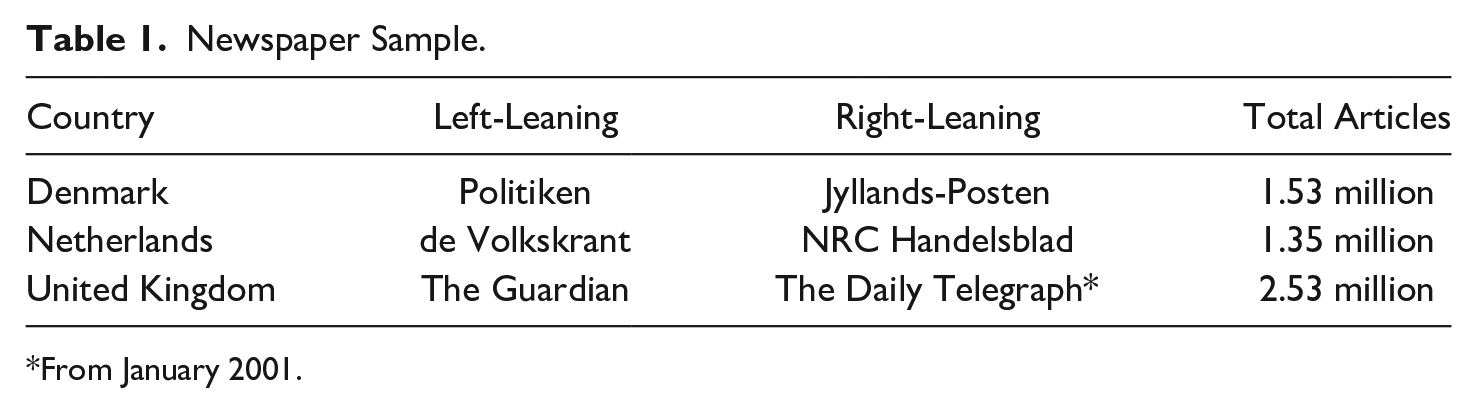
From January 2001.
The raw newspaper articles are processed in a number of steps to obtain the dataset used for the analyses. Figure 1 summarizes these steps schematically. The initial processing in the left column of the chart is described in De Vries (2022).
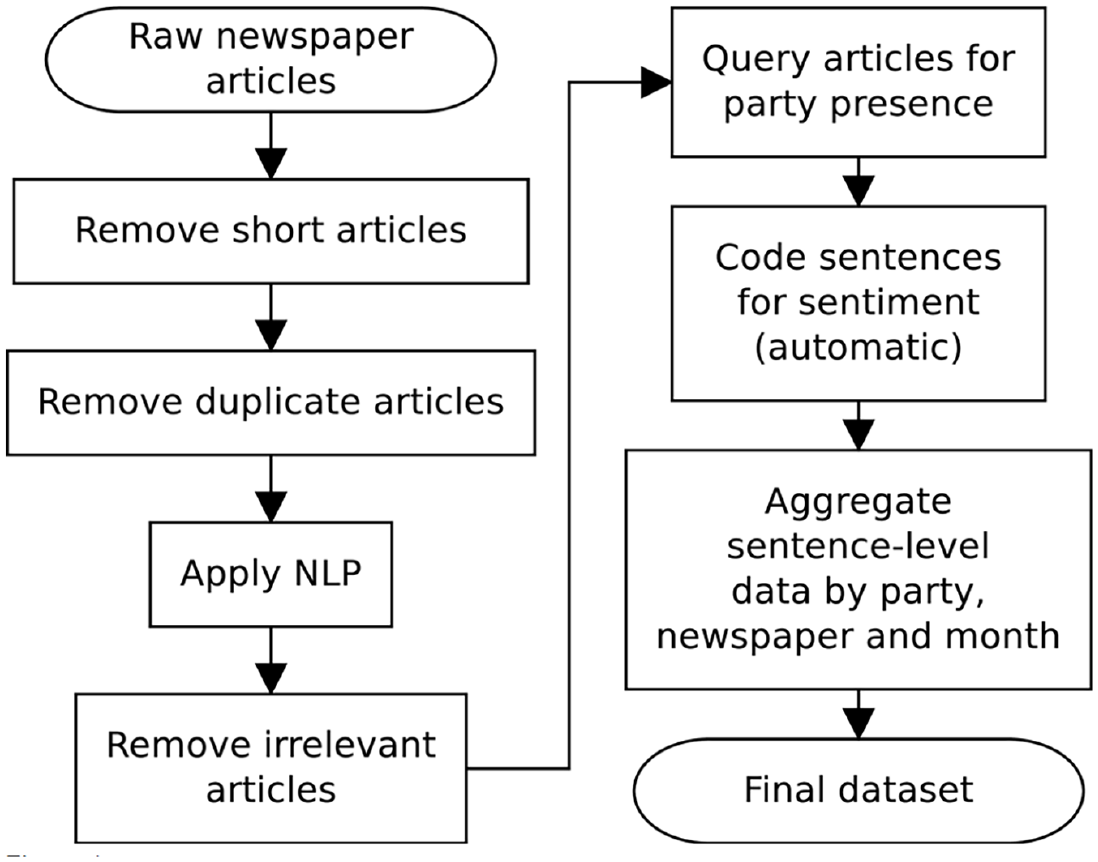
Data flow chart.
Operationalization of the Dependent Variables
In line with our focus in the theory section, the amount and sentiment of news coverage mentioning a specific political party are used as the two main indicators when testing for the presence of political parallelism. To detect the appearances of political parties in the set of relevant articles, case-sensitive queries are used on either the full party name or the most commonly used party abbreviations. When necessary, special characters like opening and closing brackets for the abbreviations (con) and (lab) in the UK, are also taken into account. In Denmark, several of the major political parties have single-letter abbreviations. In these specific cases, regular expression filters are used to filter out common mistakes, like V (the abbreviation for the left-wing party Venstre) as a roman number 5 in the names of monarchs.
The amount of coverage is measured by the number of sentences in which a political party is mentioned on a given day and in a given newspaper. Sentences rather than individual party mentions are counted because a party can be mentioned multiple times in the same sentence. A sentence could for example contain both the full party name and a politician from that party followed by the party abbreviation. In such a case, the sentence is not twice as much about the party as when only the abbreviation or only the full party name would have been present. Sentence counts are aggregated by party and newspaper to get an indicator of the monthly attention each party receives in a newspaper. Because the absolute amount of attention to parties in general differs between newspapers (some newspapers write more about politics than others), a relative measure is used for the amount of attention received by a party. For each newspaper, the number of party sentences is thus divided by the total number of sentences about all parties combined.
To analyze the sentiment of news coverage, we use the sentiment analysis method described in De Vries (2022). The dictionaries that result from this method are domain-specific and are well-suited for the analysis of political party sentiment. Performance is adequate when analyzing sentiment per sentence (macro F1 DK: .62, NL: .64, UK: .61). The dictionaries are used to categorize the sentiment of sentences mentioning one or more political parties as either positive, negative, or neutral. That means the sentiment relates to the sentiment of the sentence as a whole, and not necessarily to the political party being mentioned in the sentence. It can be thought of as the average connotation of words in the sentence. The final sentiment context of a party in a newspaper during a given month is constructed by taking the weighted (by the length of the sentence, in the number of words) mean of all sentences that mention a specific party in that newspaper. When aggregating the sentiment scores of individual sentences in this way, sentences that are incorrectly classified as negative or positive cancel each other out (i.e., a false negative and a false positive sentence aggregate to neutral just as a true negative and true positive sentence would). As the validation results show that the distribution of errors of sentence sentiment classification is roughly normally distributed (see Figure 2 in De Vries 2022), aggregation of individual sentence sentiment scores is likely to lead to a higher performance of the overall classification. This is under the assumption that the errors in the data are also normally distributed.
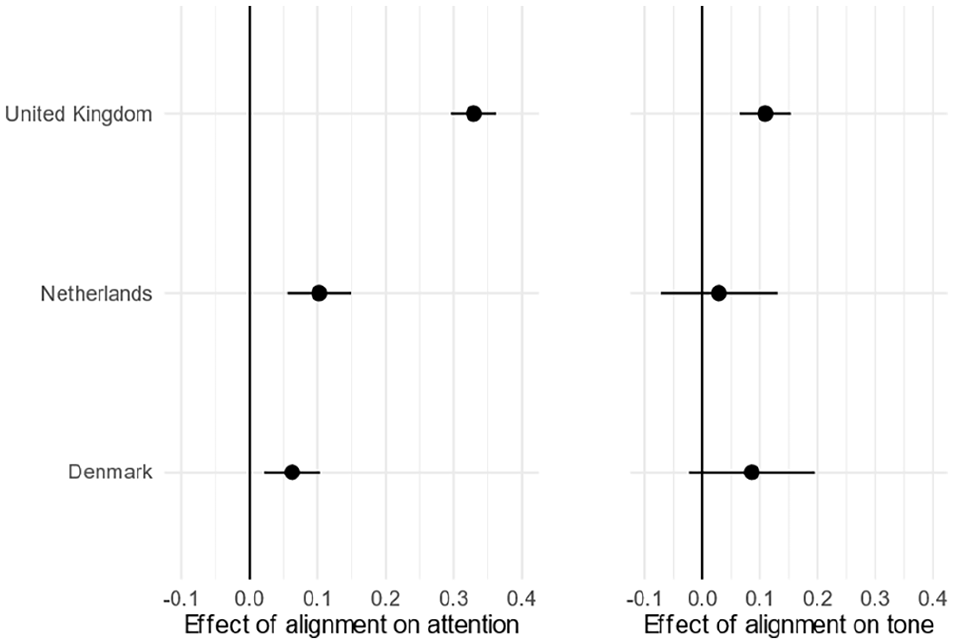
Coefficient plots illustrating the effect of alignment on attention and tone.
Operationalization of the Independent Variable
In accordance with our expectations, if party-newspaper alignment has a positive effect on either the amount or the sentiment of news coverage this would indicate political parallelism. However, party-paper alignment could be measured in multiple ways. Since we do not aim to study historical ties from the party-press era, our primary approach has been to employ a proxy based on the political leaning of each newspaper and the left-right placement of parties (using the Chapel Hill Expert Survey, see Bakker et al. 2015). Two steps lead to the categorization of alignment, listed as party-paper pairs in Table 2. First, we understand newspaper leanings as moderate, meaning that more extreme left and right parties therefore are not considered to be aligned. Second, among the moderate left/right parties, only the traditionally dominant mainstream party of either side is categorized as aligned.
Party-Paper Alignment*.
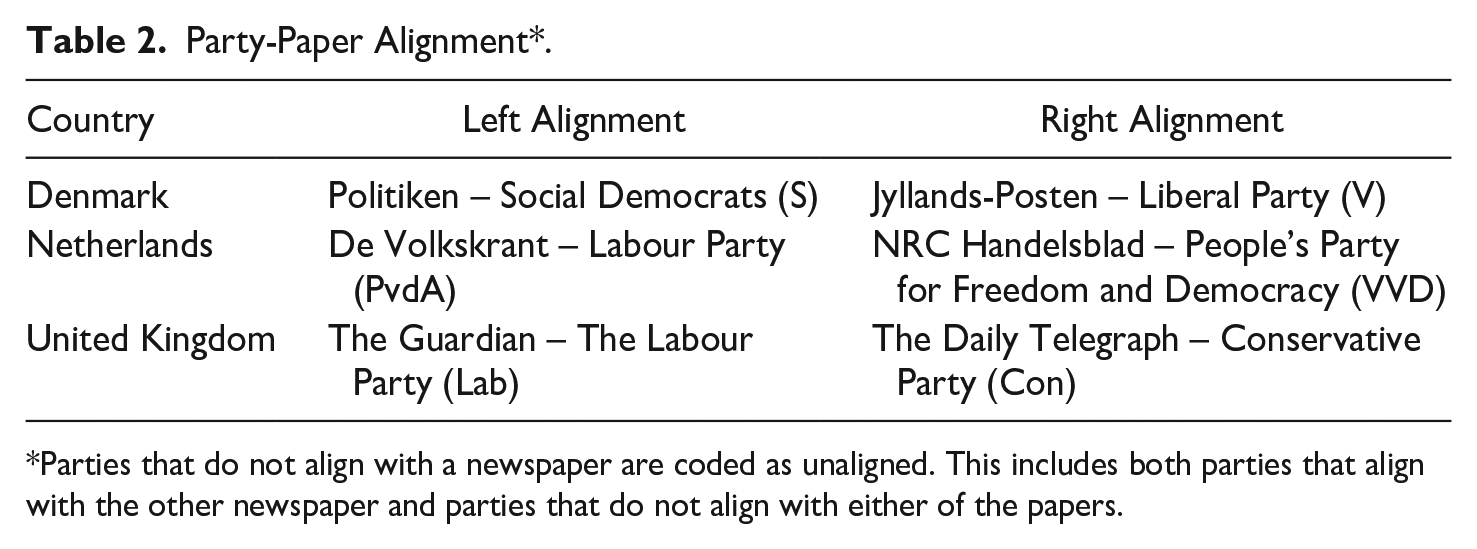
Parties that do not align with a newspaper are coded as unaligned. This includes both parties that align with the other newspaper and parties that do not align with either of the papers.
This results in socialdemocratic/labor and liberal/conservative party-paper pairs that are comparable across countries. In effect, alignment between parties and newspapers is operationalized as a binary variable distinguishing between party-paper pairs that are politically aligned (listed in Table 2) and all other party-paper pairs. The latter group includes parties that are categorized as having no alignment with any of the two newspapers. Note that Online Appendix Sections 2 and 3 test two broader, alternative operationalizations of party-newspaper alignment, where additional parties have been counted as aligned.
Control Variables
In addition to attention, sentiment, and party-newspaper alignment, a handful of control variables at the level of political parties are gathered from the ParlGov dataset (Döring and Manow 2021) and the Jennings-Wlezien vote intention dataset (Jennings and Wlezien 2016). The purpose is to account for news values that might be inherently more present in some parties, at some points in time, than in others. Party support is operationalized through monthly polling figures, which capture the often substantial fluctuations in party popularity within electoral cycles. Additionally, two variables distinguish government parties and the prime minister party. In sum, these three variables are indicative of the “power elite” and “relevance” news values (Harcup and O’Neill 2017: 1482). The latter two indicators have repeatedly been shown to affect the volume of news attention granted to parties in studies of the so-called incumbency bonus (e.g., Green-Pedersen et al. 2017; Hopmann et al. 2011). Finally, the temporal dynamic is captured by adding a running counter of months for the period we study. Since we do not necessarily expect a uniform, linear trend across this long period, we included both a first and second-degree polynomial function of the month counter.
The analyses have been performed on three identical country datasets where our units of analysis are party-newspaper pairs observed across months. The dependent variables, as well as the party support variable (i.e., all non-dummy variables), are standardized in all regression models. Due to the nature of our data, we have applied multilevel regression models, with random intercepts that are allowed to vary across parties. The use of random effects is useful when modeling data that is clustered on the outcome variable because the clustering produces correlated errors that render standard OLS estimates unreliable (Gill and Womack 2013). In the Online Appendix (Section 5), we report the results of an alternative model specification using OLS with party-fixed effects. Note that all alternative models displayed in the Online Appendix are presented briefly at the end of the Results section.
Results
Figure 2 plots the key results of country-specific regression models estimating the effect of party-paper alignment on news attention to parties (H1) and the sentiment of news in which parties appear (H2). The regression table for our first hypothesis (see attention models in Table 1.1, Online Appendix) confirms the attention-booming effects of key news values related to party popularity and incumbency, illustrated by the large coefficients for the poll share, cabinet party, and prime minister party variables. Turning to our key variable of interest in the coefficient plot below, we observe that alignment has a significant and positive effect on party attention (left pane) in all three countries. H1 thus receives consistent support, although there is clearly variation in the strength of observed parallelism across countries. The impact of party-paper alignment appears weak to moderate in Denmark and the Netherlands, in comparison to the aforementioned strong effects of party popularity and incumbency. The standardized difference between news attention for a party that is aligned with a paper and one that is not is .06 (Denmark) and .10 (the Netherlands). The corresponding alignment gap in party attention in the UK is considerably higher at .33.
Moving on, H2 posits that parallelism is reflected in a less negative news sentiment when aligned parties appear in news coverage. Overall, the tone models (Appendix Table 1.1) suggest that news sentiment is more difficult to model than party attention, indicated by substantially lower levels of model fit and no clear patterns with regard to control variables. While the coefficient for the alignment variable again has the expected sign in both Denmark and the Netherlands, suggesting that aligned parties appear in news that is slightly more positive, this result is far from significant. However, as was the case when analyzing H1 above, traces of parallelism are clearly stronger in the UK. The alignment coefficient is significant, and a party that is politically aligned with a newspaper will figure in the news that is on average .11 points more positive. 3
Table 1.2 in the Online Appendix reports the tests of H3 and H4, where we expected the effect of party-paper alignment on party news attention and party news sentiment to decrease over time. These results are neither intuitive nor sufficient to evaluate interaction effects (Brambor et al. 2006), and we therefore plot marginal effects in line with the suggestions from Berry et al. (2012). Concretely, this means that we plot the following for each country: the marginal effect of time on the dependent variable (attention or sentiment) across alignment; and the marginal effect of alignment on the dependent variable across time. In sum, this leaves us with six plots for both H3 and H4, illustrating interaction effects in each country, which we have combined in Figures 3 and 4 per hypothesis.
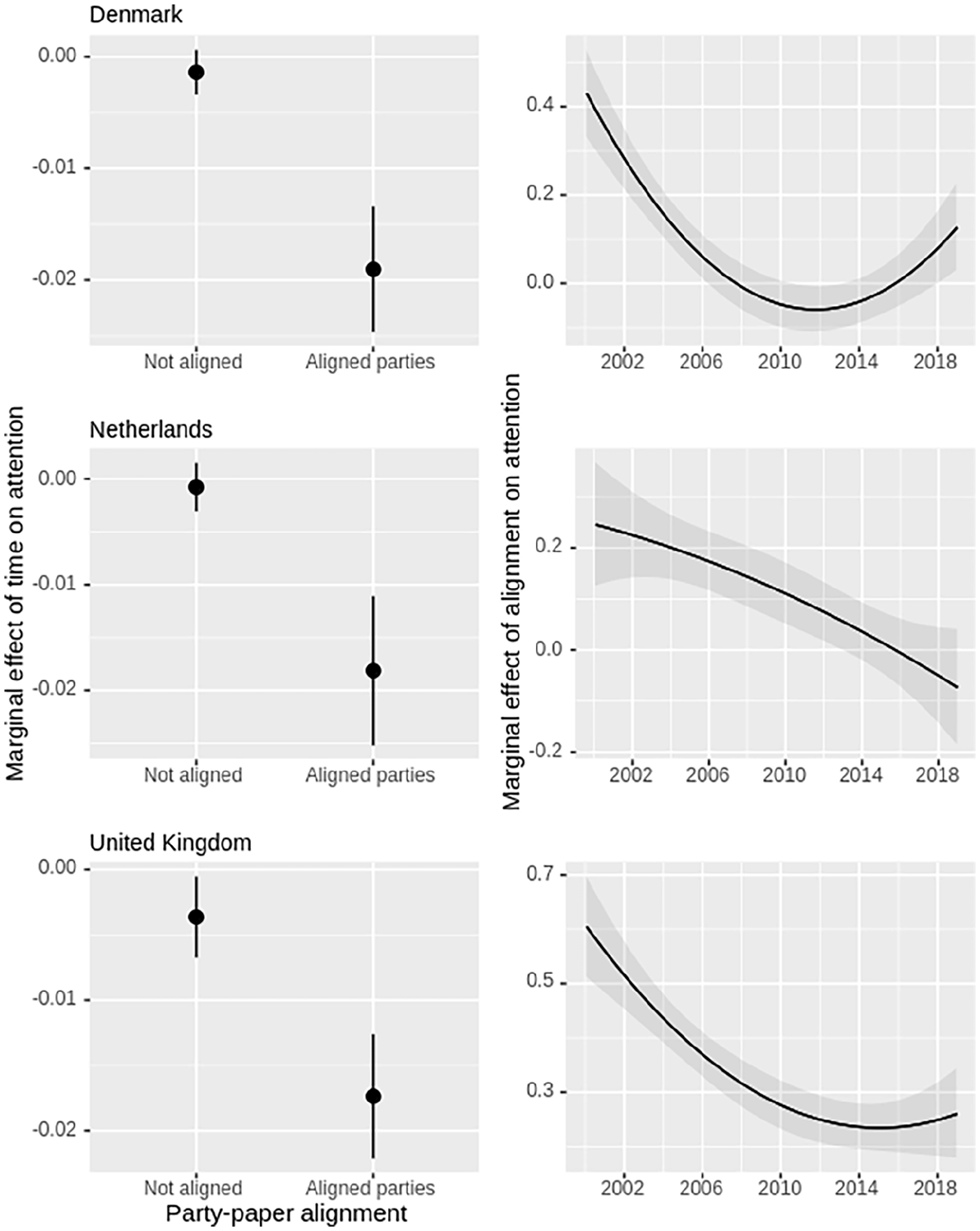
Conditional marginal effects of time (across alignment) and alignment (across time) on party attention. Results based on attention models in Appendix, Table 1.2.
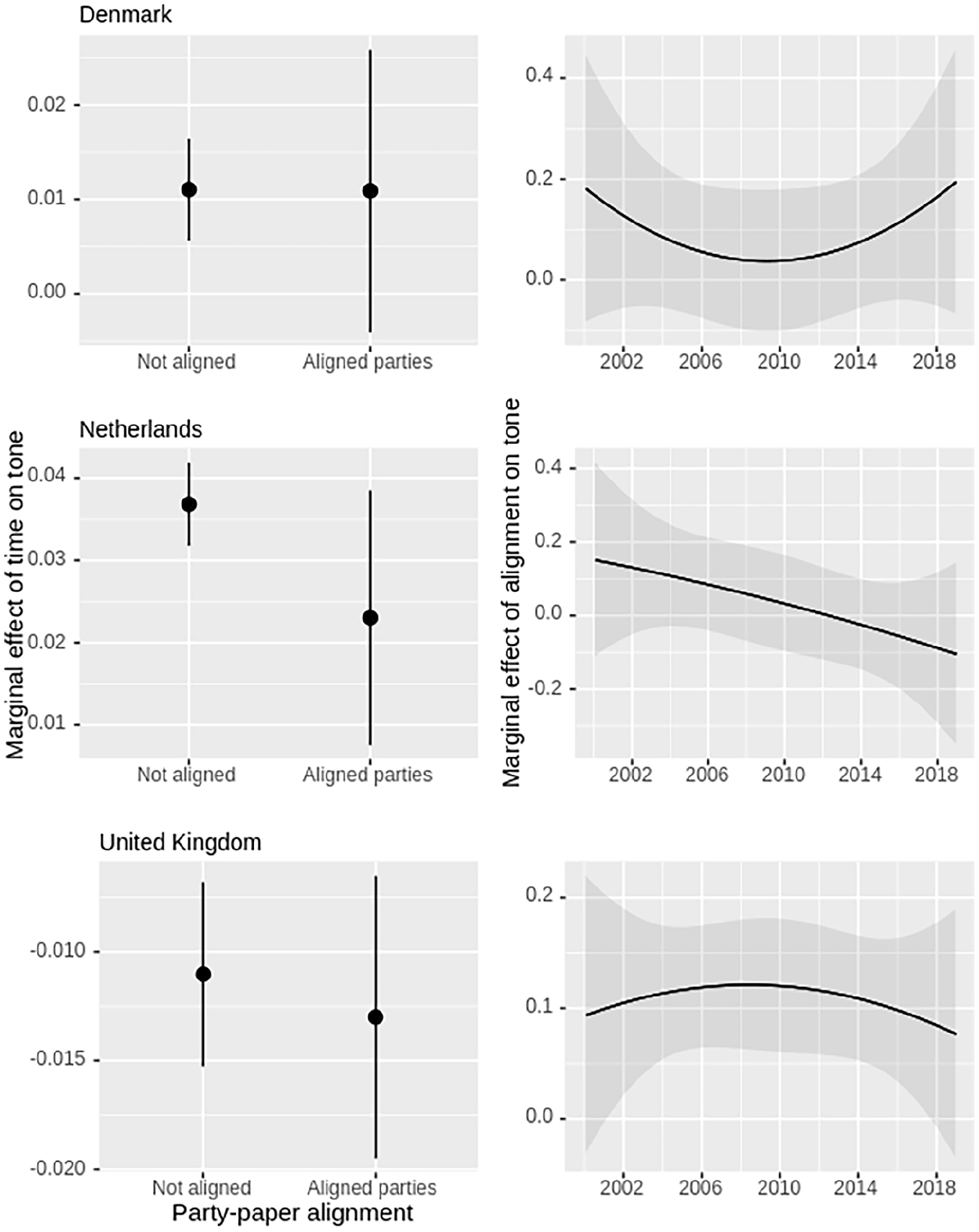
Conditional marginal effects of time (across alignment) and alignment (across time) on sentiment of party news. Results based on tone models in Appendix, Table 1.2.
We start by evaluating H3 about the development of alignment effects on party attention over time, based on the plots in Figure 3. The left-hand column of the figure displays the marginal effect of time, for aligned and unaligned parties, on party attention. The right-hand column illustrates the opposite conditioning, tracing the marginal effect of party-paper alignment across our period of study. A couple of key results stand out from these plots. First, we do find that content parallelism has decreased in all countries. This is evident through a decreasing marginal effect of alignment on party attention across time in the right-hand plots, and a negative marginal effect of time on attention for aligned parties together with an insignificant effect (confidence intervals include zero) for unaligned parties in the left-hand plots. Second, there is still a notable difference between the UK and the two other countries though. In the Netherlands and Denmark, the decreasing trend means that parallelism measured as a party attention bias disappears during this period. In the UK, where parallelism starts out at a higher level, the decrease weakens the party attention bias substantially without eradicating it completely.
Continuing with hypothesis H4 on the development of alignment effects on the tone of party news over time, the plots in Figure 4 follow the same logic as explained in Figure 3. Overall, we reject H4 on the grounds that there is no clear development with respect to the sentiment of news in which parties are covered. This is first of all reflected in the three plots of the right-hand column, where we observe that the marginal effect of alignment on tone is significant and stable throughout (most of) the period in the UK—and insignificant throughout the whole period in Denmark and the Netherlands.
Additional Analyses and Robustness Checks
In the Online Appendix, additional regression results and interaction plots can be found that explore different specifications of the models reported above. These analyses have been grouped into four sets of results, displayed in Sections 2 to 5 of the Appendix. The first two re-estimations (Sections 2 and 3) investigate alternative approaches to parallelism by testing operationalizations of party-paper alignment that differ from the one used for the main results. First, Section 2 (see Tables and Figures in Online Appendix) builds on the categorization applied above (see Table 2) but classifies three additional moderate parties as aligned to address the most problematic cases. For the UK, this means that the Lib-Dems are considered left-aligned based on the fact that the Guardian has sometimes endorsed them (secondary to Labor) in this period. In the Netherlands, our initial categorization is arguably challenged by a complex and dramatically changing political landscape, exemplified by the role of Christian democratic parties and the recent, stark decline of the social democratic PvdA. To account for this, we include the center-right Christen-Democratisch Appèl (CDA) as right-aligned, and the liberal, progressive D66 as left-aligned. 4 Although the resulting coefficients for H1 are somewhat smaller, our conclusions do not change for any of the hypotheses.
Second, the re-estimations in Section 3 approach parallelism more broadly by using two categories of party-paper alignment. In short, we keep the original classification of traditionally dominant left/right parties as left/right aligned but add a second category of “secondary alignment” between all other parties in our sample—apart from the most extreme right/left parties in each country 5 —based on their left-right position. The resulting party-paper operationalization is displayed in Table 3.1 of the Online Appendix. The results corroborate our main findings above but also introduce a couple of interesting nuances to our conclusion. First, the main models in Table 3.2 find that the favorable attention pattern of parallelism appears to extend beyond the historically dominant mainstream left/right parties in the two PR countries, Denmark and the Netherlands. Concretely, this can be observed as a lack of significant difference between this group of parties and the group of secondary aligned parties in Denmark, and as a much smaller difference between secondary aligned parties and aligned parties in the Netherlands (compared to the difference between unaligned and aligned parties). Second, the interactions illustrated in Appendix Figure 3.1, suggest that the overtime decline in parallelism is restricted to the historically dominant left/right parties. In other words, other parties that share a rough left/right leaning with a newspaper have not seen a reduction in their share of attention from aligned newspapers. As for H2 and H4, relating to the tone of coverage, our conclusions do not change, as the only significant effect is still found for the UK and is restricted to the dominant left/right parties.
Finally, the Online Appendix contains two re-estimations that target the model specification rather than the operationalization of the alignment variable. First, the alternative models in Section 4 of the Online Appendix report the result of models including a lagged dependent variable. As could be expected, this absorbs a substantial share of the impact of the key predictor in the model. The alignment coefficients are nevertheless statistically significant for all attention models and the UK tone model in Appendix Table 4.1. Second, Section 5 replaces multilevel models with regular OLS, including party-fixed effects. This produces results that are almost identical to the original ones.
Conclusion
We have investigated political parallelism in news content, focusing on the level of attention to parties and the sentiment of news in which they figure, in the leading left- and right-leaning broadsheet newspapers of three countries over nearly two decades. Findings are mixed, sometimes pointing in different directions and suggesting interesting nuances. For instance, there is only support for the second aspect of content parallelism in the UK, where the slant or tone in party news systematically favors the Conservatives in the Daily Telegraph and the Labour in the Guardian. Still, there is strong evidence to support a couple of general inferences with regard to political parallelism in the 21st century. First, results support a label of attention parallelism, or partisan visibility bias, across all countries. This is reflected in a simple and straightforward way: The leading left (right) leaning broadsheet grants more attention to the dominant mainstream party on the left (right). The tendency is strongest in the UK, which might not be surprising given the clear position-taking and endorsements that still characterize parts of the UK press. Not surprisingly, the UK is therefore also the only country in which we find any parallelism in terms of news tone (H2), as news in the UK tends to be more positive when it contains mentions of one or more aligned parties. However, H1 is supported also in Dutch and Danish broadsheets. In fact, supplementary analyses suggest that parallelism in a PR context could produce more than one newspaper “favorite,” since other parties than the dominant mainstream left/right receive more coverage than unaligned parties from newspapers with a shared leaning. The electoral competition of a majoritarian two-party system is in other words reflected in a simpler and more pronounced parallelism, while the party system fragmentation of PR is reflected in a more complex and less visible parallelism.
Second, while attention parallelism has been a feature of all three countries in this period, the results on overtime developments suggest that it is decreasing. Two aspects of this trend deserve to be highlighted. First, the fact that we identify it across countries that vary on several political and media system variables is interesting in itself, but also relevant from the perspective of generalizations. A larger and more varied pool of cases would always be preferable, but the common time trend is at least suggestive of forces and mechanisms that could be similar across very different systems. Second, looking closer at the decrease in the analyses above, our conclusion is that this shared development somewhat paradoxically leads to system divergence. Because the Netherlands and Denmark start out as “less parallel,” the decreasing trend gradually means that attention parallelism disappears in those two countries but not in the UK. Further substantiating the argument for system divergence is the observation that parallelism in news tone only occurs in the UK and does not change significantly over time.
There are of course limitations related to the design of our study. A long period of time together with a massive volume of data comes at the expense of more country cases. While inferences are strengthened by similar findings across different countries, it is still hard to ascertain their relevance outside a North/West European context. Furthermore, as discussed in the theory and methods sections, we focus only on some dimensions of political parallelism and measure these in a limited number of broadsheets in reliable but still far from ideal ways. This is particularly the case with news sentiment, where we can only pick up the tone of news in which a party appears and not the “slant” specifically directed toward that party. Related to that, we measure content parallelism directly, involving either party mentions or tone in news about parties. More indirect forms of content parallelism, such as disproportionate attention to issues that a political party can benefit from (e.g., through issue ownership), are however likely to also contribute to overall levels of parallelism. These points highlight limitations inherent to many big data and quantitative approaches, which should also remind us that in-depth case studies are indispensable within this field of study (Hallin and Mancini 2017: 165–7).
A final note of caution relates to the fact that we cover a long and volatile period. In all three cases, political and media contexts have changed substantially throughout the two decades. Increasing ownership concentration and newsroom integration might explain decreasing trends of parallelism in the Netherlands and Denmark, while the increasing economic pressures on the still independent newspapers in the UK are likely to have had a similar effect. On the political side, the Dutch dominant mainstream left party, PvdA, suffered enormous electoral losses toward the end of our period. In the UK, the Brexit campaign, vote, and negotiations eventually started to dominate political debates, and while the two newspapers in our sample endorsed “remain” and “leave” respectively, parties were clearly more divided. Denmark meanwhile has experienced substantial variation in support for mainstream parties, in part related to the extreme ups and downs of the radical right Danish People’s Party. Although the implications for political parallelism might be hard to spell out, a general point is that audience partisanship necessarily fluctuates in an era of electoral volatility. Simply put, when electorates are highly volatile, many people change their vote without necessarily changing their newspaper preferences. To the extent that newspapers are influenced by this when producing content, a fixed perspective on party-paper alignment could easily have fallen short when trying to identify and interpret patterns in our period of investigation. Nevertheless, by applying parsimonious theory and operationalizations on a massive amount of data, we have been able to provide meaningful descriptions of political parallelism in the 21st century.
Overall, our results suggest that there is a case to be made that partisan perspectives have systematically interfered with non-partisan news values in news production, also since the turn of the century. But despite cross-country support for the two general conclusions discussed above, there is a twist to the plot as we reach the end of our period. If we were to classify our cases today, the most informed attempt would put only the UK in the category of political parallelism, as newspapers continue to report more—and more positively—about their “favorites.” In the two PR and democratic corporatist media systems, newspapers no longer seem to grant more attention to aligned parties. Our comparative and longitudinal investigation has thus contributed with answers to the question about “what happened to parallelism.” Looking ahead, the question of “why” deserves much more attention in future studies. As pointed out by Lelkes (2019), there are still many open questions relating to the influence of both media system and political system developments. In other words, extending comparisons to more countries will hopefully allow for a better opportunity to understand how political parallelism is affected by media competition, journalistic professionalism, political polarization, and other factors.
Supplemental Material
sj-docx-1-hij-10.1177_19401612251323492 – Supplemental material for Newspaper Favorites? A Comparative Assessment of Political Parallelism Across Two Decades
Supplemental material, sj-docx-1-hij-10.1177_19401612251323492 for Newspaper Favorites? A Comparative Assessment of Political Parallelism Across Two Decades by Erik de Vries and Gunnar Thesen in The International Journal of Press/Politics
Footnotes
Declaration of Conflicting Interests
The author(s) declared no potential conflicts of interest with respect to the research, authorship, and/or publication of this article.
Funding
The author(s) received no financial support for the research, authorship, and/or publication of this article.

Data Availability Statement
Supplemental Material
Supplemental material for this article is available online.
Notes
Author Biographies
References
Supplementary Material
Please find the following supplemental material available below.
For Open Access articles published under a Creative Commons License, all supplemental material carries the same license as the article it is associated with.
For non-Open Access articles published, all supplemental material carries a non-exclusive license, and permission requests for re-use of supplemental material or any part of supplemental material shall be sent directly to the copyright owner as specified in the copyright notice associated with the article.
