



Abstract
This study explores how the expression of feelings and the use of personal pronouns on Twitter are associated with user engagement. Unlike most previous studies which focused on the types of emotions that generate user engagement, it uses the volume-control model, which also considers the social dimension of power. Looking at the usage of pronouns, it examines the balance achieved between popular messages that target larger groups and personalized messages that target smaller groups and individuals. The findings show that there is a significant difference between the motivation to share (retweet) and to reply to a message. Users on Twitter tend to retweet messages with popular characteristics, addressing larger groups with positive feelings. On the other hand, replies were associated with more personalized messages and a greater use of negative feelings. Users with more followers and friends presented a balance between popularization and personalization techniques, as their tweets were associated with higher customization of the messages to specific groups yet avoided negative feelings.
Keywords
Introduction
The expression of feelings is a basic feature of human communication, and perhaps one of the most socially contagious (Le Bon, 1896). People are more likely to adopt the positive and negative feelings of their peers (e.g., Coviello et al., 2015; Goldenberg & Gross, 2020; Peters & Kashima, 2015; Steinert, 2021). In the last decades the practice of sharing feelings has changed with the growing use of social networks. As Goldenberg and Gross (2020) indicate, social media companies such as Meta or Twitter realized the profit behind sharing feelings, and therefore try to maximize user exposure to them. As a result, users are more frequently presented with the feelings of others, are encouraged to share their own feelings, and thus, the contagious effect can potentially scale up to the masses more frequently.
While some studies refer to emotion sharing (Colnerič & Demšar, 2018; Duncombe, 2019; Storey & O’Leary, 2022; Waterloo et al., 2018) others prefer to use the term feelings (Chen & Sakamoto, 2014; Mejova & Lu, 2022). Hansen (2005) distinguished between emotions and feelings and discussed their communication implications. While emotions are more primitive and unconscious, feelings are the more conscious and cognitive perceptions we use to describe our emotions. In a way, feelings are the communicative manifestations of emotions. People use “I feel . . .” to describe and communicate their emotions. Following this observation, rather than emotions, this article adopts the term feelings in the sense of perceived emotions. It studies the content of tweets that contain the words “feel/s” or “feeling/s” and explores the way these tweets provoke further user engagement.
When looking at user engagement on Twitter studies often examine the ability of content to generate retweets and replies, as well as the overall number of followers and friends a user may have. These qualities reflect the power that certain Twitter users possess. To explain what feelings can potentially generate greater user engagement, most studies have focused on common psychological classification of emotions. Yet when studying social engagement and power, the analysis cannot be limited to the classification of emotions alone. It must consider the social context as well as the social implications of the emotions in question.
The aim of the current analysis is to combine these three points in the triangle—feelings, social context, and user engagement on Twitter. To this end, the volume-control model (Segev, 2019) was implemented to study why some tweets that include feelings are associated with greater user engagement than others. The volume-control model assumes that to achieve greater influence and power one should strive to maintain a balance between popular messages that attract large audiences and personalized messages that are relevant to individual addressees. Thus, this study first maps the different topics associated with feelings on Twitter, and then examines more closely the audiences associated with those feelings based on the use of personal pronouns, and ultimately how both, the types of feelings expressed and the audiences addressed, are related to user engagement.
Literature Review
Factors That Determine User Engagement on Twitter
One of the most crucial gratifications on social media is sharing feelings. People expose their own feelings, identify with others, and support each other. It is a particularly appealing practice for social media companies as studies show a strong link between sharing feelings and user engagement (Goldenberg & Gross, 2020; Lee & Oh, 2012). Engagement in social media is conceptualized as the level of connectedness, involvement, and interest of users (Ibrahim et al., 2017). It is often measured by the level of interaction between users through likes/dislikes, comments/replies, and sharing other people messages. These activities, however, differ from each other. Kim and Yang (2017), for instance, studied Facebook messages and found that shares indicate a higher level of engagement than replies and both require much higher engagement than likes. They explain that sharing messages requires more commitment from users than replying to them as it often aims at larger audiences and therefore may impact their self-image much more. An even greater level of commitment is reflected at the user level with the growing number of friends and followers. While friends are perceived as more reciprocal, followers are more of a one-way communication, and users with many followers further enjoy higher social status and influence (Stieglitz & Dang-Xuan, 2013).
In addition, it was found that different messages attract different types of engagement (Kim & Yang, 2017). Messages that include feelings tend to attract more likes, while rational and interactive messages tend to receive more comments or replies. Messages that are either affective or cognitive or a combination of both tend to be shared more often. In particular, Berger and Milkman (2012) show that the level of arousal of both positive and negative emotions is important in engaging online users.
Similarly, studies that focused on Twitter indicated that messages that contain feelings, both positive and negative, provoke user engagement. Users more often reply to and share affective messages (Hansen et al., 2011; Kramer et al., 2014). Stieglitz and Dang-Xuan (2013) who studied more than 165,000 tweets found that emotions are more likely to be retweeted by other users. Goldenberg and Gross (2020) studied about 1.5 million tweets and classified their sentiment. They found that both extreme positive and negative emotions tend to get more likes and more retweets.
While these studies did not identify a significant difference between positive and negative messages, others found that sharing negative feelings can lead to greater online engagement (Schöne et al., 2021). In political messages, Schöne et al. (2021) found that negative messages spread faster than positive ones on Twitter in response to real-world events. Similarly, it was found that negative emotions shared by news organizations on Twitter lead to greater social engagement (Bellovary et al., 2021). Especially during election periods political debates in social media were found highly toxic with users favoring negative content (Ott, 2017; Persily, 2017). When it comes to information related to crises, Chen and Sakamoto (2014) found that negative feelings with high arousal (such as fear) were more likely to be shared on social media.
Other studies, however, showed that positive feelings have more potential to generate user engagement. Gerbaudo, Marogna, and Alzetta (2019) found that political campaigns that include positive messages and promises of social improvement generate greater user engagement. Similarly, Nave, Shifman, and Tenenboim-Weinblatt (2018) showed that political messages that contain humor and self-presentations are more likely to generate user engagement on Facebook. When studying the Twitter discourse around the 2010 Olympic Games, Gruzd, Doiron, and Mai (2011) found that positive tweets were more likely to be retweeted than negative ones. Similarly, Ferrara and Yang (2015) studied a week of Twitter activity among 3,800 users and found that positive emotions are more likely to be adopted by other users.
The inconsistent findings point to the problem with the question itself: It is simply too broad. Some groups tend to spread more positive messages while other negative ones. Some events are more likely to encourage positive content while others negative one. It is well documented in the literature, for instance, that negative messages spread well when it comes to political scandals or negative news (Pfeffer et al., 2014; Soroka et al., 2019). Yet when people share their daily life experiences, talk about sports or music events, studies have rather shown a general positivity bias in different social media platforms (Berger & Milkman, 2012; Kramer et al., 2014; Reinecke & Trepte, 2014; Vermeulen et al., 2018; Waterloo et al., 2018). Still, one of the factors that remained neglected by most studies on feelings and social engagement is the social context, or in other words, the target audiences—the individuals and groups being addressed.
Volume-Control Model and User Engagement
The volume-control model (Segev, 2019) provides a useful framework to study the social context in which emotions are shared on Twitter. In principle, this model focuses on the conditions by which information becomes power. User engagement is one form of power on Twitter as it reflects the level of attention and influence. This is mainly achieved by a greater control over a large volume of information and people. The model essentially describes two competing mechanisms of control: popularization and personalization. While popularization refers to the production of information that is relevant to large audiences, personalization is the process of tailoring information to specific individuals. Ultimately, the volume-control model posits that higher control means greater balance between the two mechanisms of popularization and personalization. As a result, information is often customized to unique groups in the network based on common preferences such as location, age, gender, interests, and user activity.
Figure 1 presents the trade-off between popularization and personalization techniques of controlling large volume of people and information. The volume-control model was previously employed to study the way global corporations such as Google, Meta, and Amazon utilize the information that they collect to translate it into economic power, maintaining a balance between popularization and customization mechanisms (Segev, 2019). It was also used to study patterns in global information flow of news and the acquisition of political power by governments (Kling, 2022; Segev, 2021). In the current study this model will be used to understand the power of generating user engagement and attention in social media.

Trade-off and balance between popularization and personalization as part of the volume-control model.
One straightforward approach to operationalize this framework to the study of Twitter is to look at the social group being addressed in each message. Personal feelings often include the first-person singular pronouns “I,” “me,” or “my” (e.g., “I feel so depressed”), while larger groups of people are addressed with the use of first-person plural pronouns “we” or “our” (e.g., “Any feel for what we are going to hear about TV deal at Media Day?”). The use of second-person pronouns such as “you” and “your” can address both one person (e.g., “@user hope you are feeling better”) and a larger audience (e.g., “When you have a peaceful and tamed mind, life is more pleasant for your friends, spouse, parents, children, and acquaintance”). The use of third-person singular pronouns refers to one person (e.g., “I feel bad for her”), while third-person plural pronouns refer to larger groups (e.g., “Amateurs show up when they feel like it. Professionals show up every day, no matter how they feel.”). Hence, the use of pronouns together with feelings is a particularly useful approach to study the social group being addressed when users share their feelings, and the power implications of this in terms of user engagement.
It is important to note that the volume and control framework does not assume that users intentionally seek to gain power. The use of pronouns can certainly reflect the way users perceive their audiences. Users with more followers might be more likely to use plural pronouns as they address larger audiences. Yet, addressing larger audiences is itself manifestation of power. The use of personal pronouns is therefore particularly important in communication studies as it helps to understand the construction of social identities, social status, and power. It was found that high social status was correlated with greater use of the first-person plural “we” (Tausczik & Pennebaker, 2010).
Pennebaker (2011) further showed that the use of pronouns is correlated with personality traits, emotions, and moods. For example, depression was associated with higher frequencies of the first-person singular “I” (Campbell & Pennebaker, 2003). Still, when analyzing the news media, Sendén, Lindholm, and Sikström (2014) found that first-person pronouns (“I” and “we”) tend to appear in more positive content than third-person pronouns (“he/she” and “they”). The use of “we” was found to be mostly associated with positive content. Similarly, in political advertisements, Gunsch, Brownlow, Haynes, and Mabe (2000) show that first-person references (“I” and “we”) were associated with positive ads, whereas third-person references (“he/she” and “they”) with negative ads.
There are very few studies to-date, however, that focus on the relationship between pronoun use and user engagement in social media, most of which are from the field of marketing. Labrecque, Swani, and Stephen (2020) explored how the use of different pronouns on Facebook is associated with consumer engagement (i.e., likes, comments, shares). They found that for service brands the use of “I” generally discouraged consumer engagement, while the use of “we” encouraged all types of consumer engagement. The use of “you” generally encouraged likes and comments but discouraged shares. Their findings support previous studies (Chang et al., 2019; Cruz et al., 2017; Sela et al., 2012) that similarly found a significant relationship between the use of pronouns (particularly “you” and “we”) and brand attitude.
Consumer engagement essentially means control over a great volume of people and information which generates economic power, and thus the findings of these recent studies could be explained well by the volume-control framework. Yet, apart from a few market-oriented studies the literature that links between user engagement and personal pronouns is scarce. The current study aims to address this gap in the context of emotion exchange by exploring the relationship between feelings, personal pronouns, and user engagement. The main research questions addressed are: What types of feelings are being expressed on Twitter? How they are associated with personal pronouns? and How the different types of feelings and personal pronouns are related to user engagement.
As the relevant literature is currently limited it is not feasible to offer concrete hypotheses at this stage. Still, following previous findings (Cruz et al., 2017; Labrecque et al., 2020; Sela et al., 2012), it is expected that messages addressing larger groups with the use of “we” and to some extent “you” will be associated with higher user engagement. In addition, in line with the volume-control framework, it is expected that a combination of personalized and popularized messages would achieve higher user engagement which will be reflected by the number of friends and followers.
Methods
To study the relationships between feelings, personal pronouns, and user engagement, this study follows three stages. First, it employs semantic network analysis to map the topics associated with feelings on Twitter. Then, it focuses on the relationship between feelings and personal pronouns by examining the frequency pronouns are used together with the main themes identified in the first stage. Finally, it looks at the extent to which different feelings and personal pronouns are associated with different forms of user engagement.
The corpus of this study included tweets that mentioned the words “feel/s” or “feeling/s” and was collected using Twitter API (Application Programming Interface) during July 2022. A minimum threshold of 10 followers per user was used to filter out bots. While previous studies showed that a considerable volume of tweets during 2020 and 2021 was related to COVID-19 (Chen et al., 2020) and included a wide expression of sentiments and emotions (Mathur et al., 2020; Xue et al., 2020), both the news coverage and the attention in social media related to the pandemic dropped dramatically after February 2022 in many parts of the world (Segev et al., 2022). The month of July 2022 was therefore far enough from the latest peak, enabling to study a greater diversity of topics related to feelings in English tweets. The initial sample included 523,250 tweets. After removing duplications, the final sample contained N = 327,555 tweets. Together with the content of tweets, the number of followers and friends of the user who tweeted were collected as well as whether the tweet is a reply or a retweet. These were all parameters of the user engagement.
The advantage of looking at tweets that mention the words “feel/s” or “feeling/s” is that it does not require building or using pre-defined dictionaries of feelings, emotions, or sentiments, but rather discover what users on Twitter associate with these words. This allows to map the associations of feelings with other words and further reveal new domains that were not traditionally associated with feelings in sentiment dictionaries (Colnerič & Demšar, 2018). On the other hand, one limitation of this approach is that people may communicate their feelings and emotions without using the words “feel/s” and “feeling/s.” Moreover, people may use these words when referring to physical illness or even to describe things that do not necessarily convey explicit affections. For example, a tweet such as “I don’t know, suddenly I just feel the need to be quiet” demonstrates the subtle ways in which people can use the word “feel.”
To map more systematically the contexts in which the words “feel/s” and “feeling/s” are used on Twitter, a semantic network was produced. Semantic networks enable to reveal prominent topics related to the words “feel/s” and “feeling/s” on Twitter. A list of word frequencies was generated, removing stop-words and irrelevant words (based on all words that appeared in 500 tweets or more, n = 192. See also Segev, 2022). Each word was then studied in its original context to determine whether it refers mostly to emotional or physical feelings as well as whether it appears in positive or negative context. Based on the frequent words, a network of word pairs appearing in the same tweet was constructed. Betweenness centrality was calculated to identify the most influential words in the discourse, and the Louvain modularity (Blondel et al., 2008) was used to identify clusters of words. Based on previous studies (Segev, 2020) Louvain method, which measures the density of edges inside communities, is particularly useful to identify clusters of words that tend to appear together in the same sentence.
To operationalize the volume-control framework, a smaller semantic network that includes the most central feelings identified earlier together with pronouns was constructed. This approach allows to further explore how personal pronouns are associated with feelings. Since pronouns are mentioned significantly more than other words, they are often considered as stop-words and are removed from the analysis. They tend to dominate the semantic network and prevent researchers from understanding the overall structure of the network and its clusters (Segev, 2022). Still, after locating the most central words in the network and identifying the clusters, it is possible to focus on their associations with pronouns. To achieve this, a weighted semantic network was constructed. Pronouns were divided into five groups, representing different associations of feelings with social groups of different levels, from the personal to the public: I (feelings related to the speaker), you (feelings related to second person/s), he/she (feelings related to third-person singular), they (feelings related to third-person plural), and “we” (feelings related to all). Each group included the most frequent pronouns appearing in the tweets (i.e., I included “me” and “my”; you included “u” and “your”; he/she included “her,” “him,” and “his”; they included “their” and “them”; and we included “us” and “our”). The strength of the links was calculated as the number of tweets mentioning each word with the pronoun group divided by the total number of tweets in which the pronoun group was mentioned. The correlations between the types of feelings identified in the first stage, the pronoun use, and the user engagement level were calculated.
Many Twitter accounts with a high number of followers tend to belong to news media, organizations, and celebrities that have a particular interest in gaining economic and political power using this platform. The final part of the article therefore explores the relationship between pronoun use, feelings, and user types. A sub-sample of the 200 tweets—100 of the most followed users and 100 of the least followed users—was manually coded into four types of users: celebrities (including athletes, actors, singers, or other influencers), media (including news, sports, fashion, and entertainment outlets), other organizations (including political organizations and companies), and individual accounts (including profiles of individuals with the least number of followers). Two coders independently classified the user types into these categories reaching an agreement rate of 94.4%.
Results
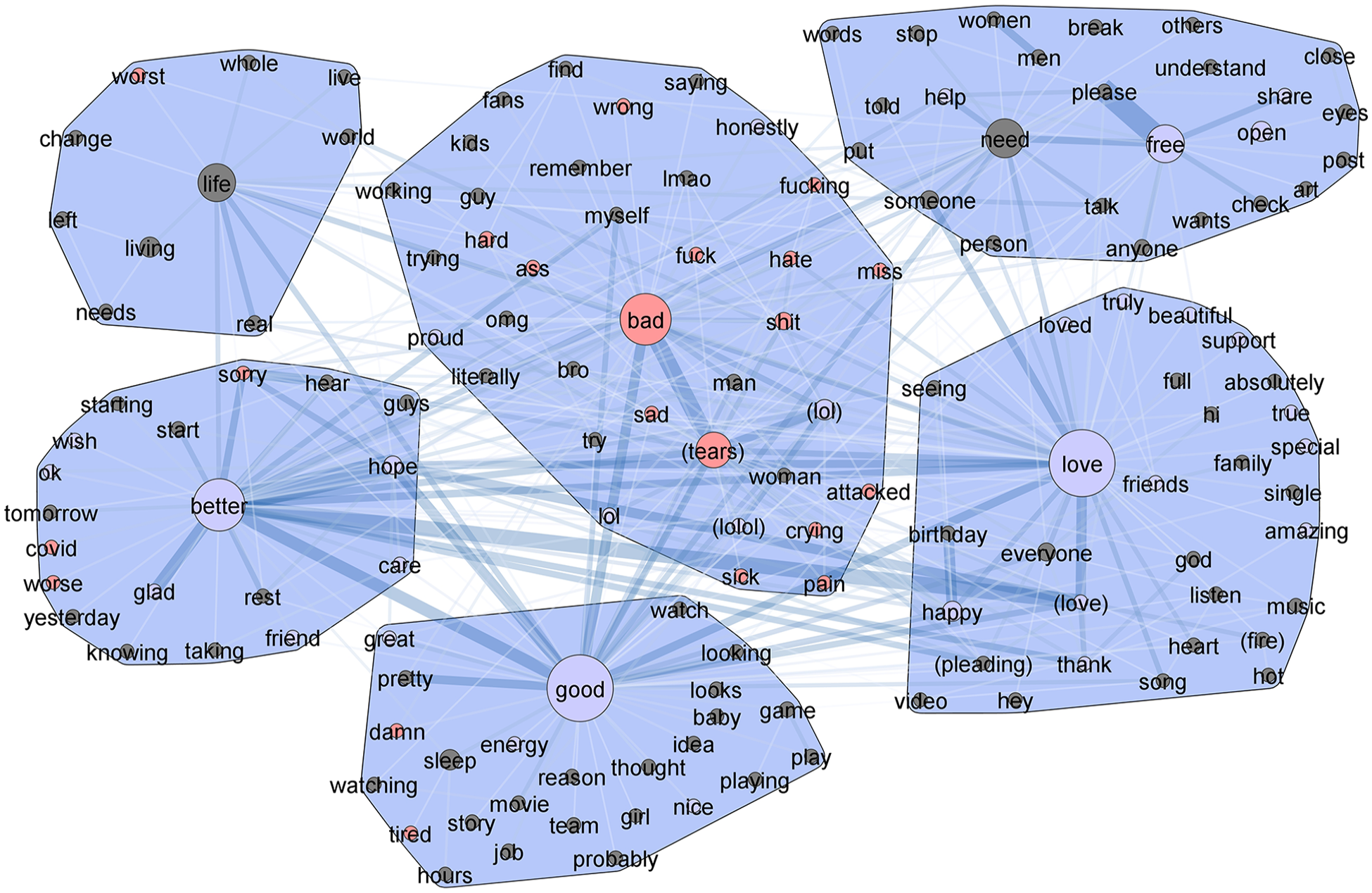
Figure 2 presents the semantic network of frequent words that appeared together in the same tweets mentioning the words “feel/s” or “feeling/s” during July 2022. The words “feel” and “feeling” were removed as they connect to all other words (Segev, 2020, 2022). Among the most frequent words 69.3% referred to emotions while 11.5% referred to physical feelings. Words appearing in positive context are marked in blue, and words appearing in negative context are marked in red. A cluster analysis using Louvain modulation identified six groups of words, representing six distinctive themes in which people tweet in the context of feelings. At the center of the network there is a cluster of words surrounding the central word “bad” with a strong link to the emoji of crying face with tears and words like “sad,” “hate,” “crying,” “pain,” and “wrong.” Generally, there were two types of tweets in this context: one that users share their own bad feelings (e.g., “Im low-key feeling bad because im not posting new content”), and another that reflects feeling bad for others (e.g., “I feel bad for those that have to do the most for ‘friends’ because mine are super solid,” or “I feel bad for her. I hate watching her used this way”). In fact, the combination of “feel bad for” was one of the most frequent 3-grams, indicating that sharing bad feeling in Twitter is mostly related to others.
Semantic network of frequent words related to feelings on Twitter.
On the left a cluster with the central word “better” includes the words “hope,” “start,” “wish,” “glad,” and “care.” This cluster expresses the hope of Twitter users to improve their own or their friends’ bad feelings. Similar to the “bad” cluster, there are typically two types of tweets in the “better” cluster: one is related to the writer’s own feelings (e.g., “when i’m sad i remember i saw satellite’s first ever live performance on album release day and suddenly i feel better” and the other is related to others’ feelings (e.g., “Feel better, James! Get well soon!”). The frequent 3-grams “feel better soon” show once again that sharing feelings in Twitter is perceived as a two-way dialogue rather than a one-way monologue. It is worth noting that although the combination “feel better” may refer to physical feelings rather than strictly emotions, it conveys also emotional aspects. This is supported in this cluster by the strong links between the word “better” and other positive words such as “hope,” “glad,” “wish,” and “care.”
At the bottom, a cluster around the word “good” includes the words movie and game, and related verbs such as watching and playing, respectively. This cluster mainly refers to pleasure activities associated with media engagement. Some tweets that exemplify this theme include, for example, “Just bought my first physical kpop album and it’s also for a good cause! I feel really good today!  ,” or even some reflective thoughts on Twitter use: “i hope one day id wake up not needing to reread all those conversations that made me feel so good back then just to feel it again.”
The cluster on the right evolves around the word “love” and includes the words “friends” and “family” as well as “beautiful,” “true,” and “amazing.” While the “good” cluster is associated with positive feelings people often experience on their own, the “love” cluster is associated mainly with positive feelings that people experience together. Typical tweets in this cluster include, for example, “be around people that see u, that always make u feel like having u in their life is a blessing n your love isnt a burden” or “The crazy thing about meeting people who’ve grown up with a lot of love at home, is that you feel it.”
Next, on the top-right there is a cluster surrounding the word “need.” It includes the words “someone,” “anyone,” as well as the word “please” and verbs such as “help,” “share,” “post,” and “want.” While the “love” cluster refers to the result of good social ties, the “need” cluster reflects the call or wish of users to achieve it. In a way this cluster closes the emotional cycle as people tweeting about their or others’ needs are usually not entirely content and look for users’ support. A typical tweet from this type, for instance, is: “I know this is weird or just I’m weird but I wanted to tell you friends I need a break again. I’m not feeling well.”
Finally, the cluster on the top-left evolves around the word “life” connected with the words “whole,” “world,” and “change.” This cluster of tweets often deals with more general reflections on feelings over time and their broad social or psychological implications. Typical tweets in this cluster, for example, are: “The more you think of missing things in life, the more you feel emptiness,” or “It’s true that when you feel so happy, you’ll be sad later & otherwise. Life is just balance to make you understand & be grateful about.”
The last quote summarizes well the overall insights from the semantic network of tweets on feelings. While sharing negative feelings, which is at the center of the discussion, is perceived by Twitter users as the challenge or problem, the surrounding clusters offer different kinds of positive and optimistic solutions. People may feel better by engaging themselves in entertaining media, playing games, watching television, listening to music, or even tweeting. Yet more than sharing individual experiences, they hope to utilize the social network to help each other and reach “true love.” In short, the meta-narrative around the most central words in the semantic network, such as “bad,” “better,” “good,” “love,” “need,” and “life,” unveils the feelings of Twitter users who look for opportunities to improve their feelings and help each other get better. Returning to the first quote, “feeling bad because im not posting new content” summarizes well the therapeutic process of content generation as perceived by users writing on Twitter.
To understand how individual and group identity is associated with those feelings, Figure 3 portrays a semantic network of pronouns appearing together in the same tweet with the six central words identified above (“bad,” “better,” “good,” “love,” “need,” and “life”). As was mentioned earlier, this network is weighted based on the frequency of each pronoun group (I, you, he/she, they, and we) in the tweets.

Semantic network of pronoun groups and central words related to feelings on Twitter.
As can be seen from the network above there is a relatively stronger association between the word “good” and the first-person group “I.” This means that users on Twitter are happy to share their positive feelings. For example, “Feeling very good and like I can accomplish things and have a good life for myself . . . hope this lasts a while.” As was seen in Figure 2 the word “good” is also associated with personal experiences such as watching movies or playing games. The word “good” is also linked with the second-person pronoun “you.” Yet the word “better” is associated considerably more with second-person pronouns. There are many tweets in which the speaker wishes someone to feel better, for example, the typical tweet: “hope you’ll feel better soon♡.” This provides further support to the previous finding that words from the “better” cluster (in Figure 2) often expressed the hope or wish for the addressee to get better, and to the fact that “feel better soon” was one of the most frequent 3-grams.
The word “bad,” on the other hand, is associated with the third-person pronouns (he/she). This means that out of all the tweets that mentioned words from the pronoun group “he/she” there is a considerable proportion of tweets that also mentioned the word “bad.” Negative feelings thus tend to be more associated with others. Still, the network also shows a strong link between the word “bad” and the first-person group “I.” In fact, many tweets are about the way the speaker feels bad for someone else, for example: “I feel so bad for her” or “I have grown weary of feeling bad for him.” This provides further support to the previous finding that “feel bad for” was one of the most frequent 3-grams.
Finally, the third cluster features the words “need” and “love.” The word “love” is at the center of the network and has strong links to all pronouns, indicating its importance as the higher goal of all Twitter users in all social levels. The word “need,” however, appears to be considerably more prominent in the “we” pronoun group. This means that when users on Twitter talk about a more general social group that includes both the speakers and their audiences, the word “need” is often used, for example, “We don’t need to feel the sorrow” or “We need this country to grow.” It is worth noting that the word “need” is certainly also associated with “I” and “you” on Twitter. Yet when weighing the frequency of co-mentions based on their overall use in each group, it is relatively less prominent.
In short, Figure 3 shows that each cluster contains different pronoun groups and different types of feelings. Twitter users generally share positive feelings. While users tend to share positive feelings about themselves (e.g., “I feel good”), they often share negative feelings about others (e.g., “I feel bad for her”). They project positive feelings on their addressee (e.g., “I hope you feel better”), and ultimately, at the larger social group level, they wish that all will be loved and love others (e.g., “we need to love each other”).
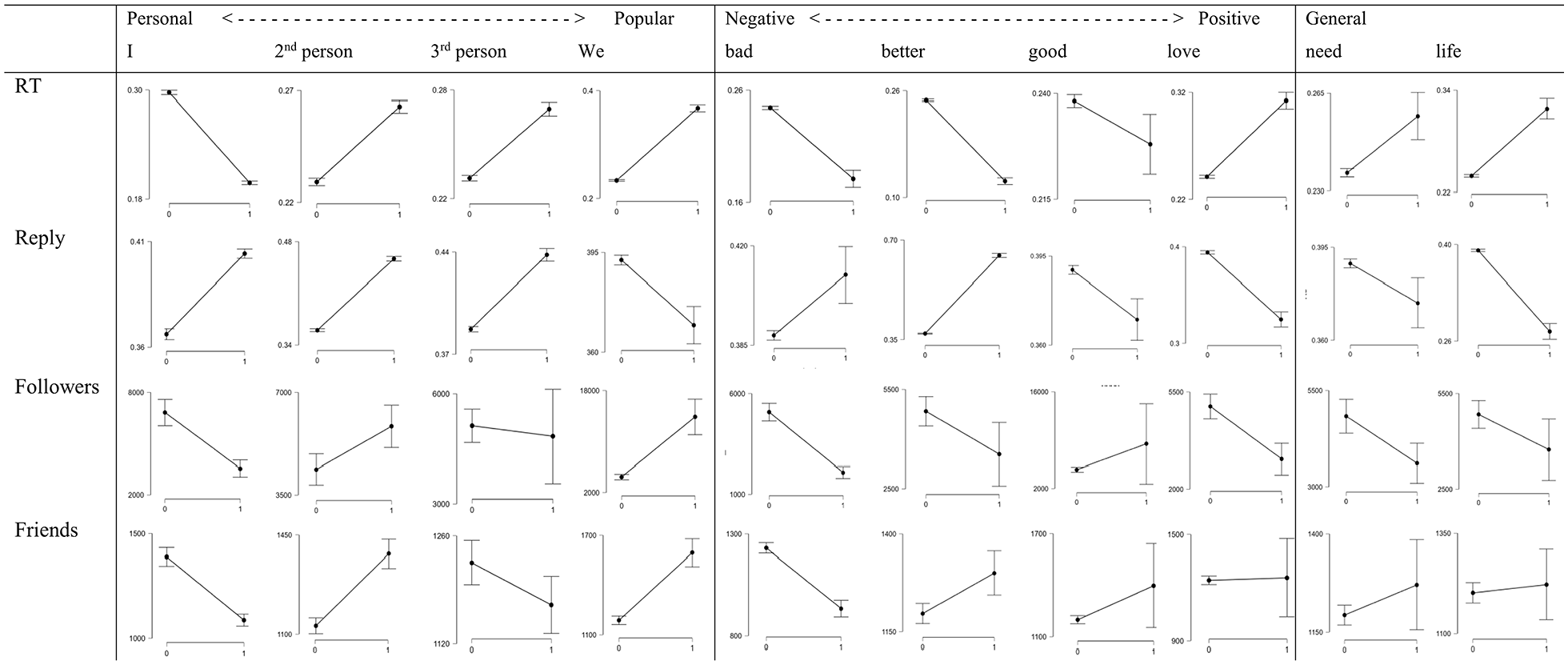
The next part of the article presents the power implications of feeling sharing. It analyzes the association between the use of pronouns and feelings in Twitter and the level of user engagement as measured by retweets and replies at the tweet level as well as the number of followers and friends at the user level. Figure 4 portrays the differences in the proportions of user engagement (retweets, replies, followers, and friends) associated with the use of pronouns (first-, second-, and third-person groups) and the central negative, positive, and general feelings previously identified (bad, better, good, love, need, and life).
Differences in user engagement associated with the use of pronouns and various feelings.
It shows that Twitter users share significantly less tweets (retweets) that contain the pronoun group “I” (X2 [1, N = 327,538] = 4,357.6, p < .001). On the other hand, they tend to share much more tweets that contain the second-person pronoun groups (X2 [1, N = 327,538] = 424.9, p < .001), third-person group (X2 [1, N = 327,538] = 346.6, p < .001), and “we” (X2 [1, N = 327,538] = 1,955.3, p < .001). This means that for a tweet to be shared by others it should not be entirely personal, but rather explicitly refer to others. In fact, the reference to the pronoun group “we” (that includes “us” and “our”) was found to be the most effective in generating retweets. In terms of feelings, negative feelings that include the word “bad” have significantly less chances to be retweeted (X2 [1, N = 327,538] = 205.2, p < .001). This is true also to the more positive ones (“better” or “good”). Only the very positive tweets that contain the word “love” (X2 [1, N = 327,538] = 277.2, p < .001) or the more general tweets that include “need” (X2 [1, N = 327,538] = 23.0, p < .001) and life (X2 [1, N = 327,538] = 199.9, p < .001) have significantly higher chances to be retweeted.
While retweeting a post required the content to address large-scale groups and be highly positive, user engagement that involves replies shows opposite trends. Personal tweets that include the pronoun group “I” have significantly more chances to be replies (X2 [1, N = 327,538] = 482.0, p < .001). This is even more so for tweets that include the second-person pronoun group “you” (X2 [1, N = 327,538] = 2,614.5, p < .001), and to a certain extent also the third-person pronoun group (X2 [1, N = 327,538] = 455.5, p < .001). On the other hand, the pronoun group “we” is less likely to appear in replies (X2 [1, N = 327,538] = 41.8, p < .001). The types of feelings that are more likely to appear in replies are also completely opposite from those that are likely to appear in retweets. In fact, tweets that contain the word “bad” (X2 [1, N = 327,538] = 17.3, p < .001), and to a greater extent those containing the word “better” (X2 [1, N = 327,538] = 4,755.0, p < .001), appear much more frequently in replies. At the same time, the more positive tweets that include the words “good” (X2 [1, N = 327,538] = 20.3, p < .001), “love” (X2 [1, N = 327,538] = 267.0, p < .001), “need” (X2 [1, N = 327,538] = 9.2, p = .002), and “life” (X2 [1, N = 327,538] = 331.2, p < .001) have significantly less chances to appear in replies. In short, retweets are very different from replies both in terms of the addressed social group and the type of feelings users share. While retweets tend to be more positive and address larger audiences, replies are more interpersonal and include negative feelings or express the hope for someone to get better.
The long-term and more indirect power implications can be measured by the number of followers and friends of Twitter users. It appears that users with more followers and more friends tend to send messages that have similar features to those found for retweets. They are less likely to use the pronoun group “I” (M = 6,764.4 followers for users that did not use “I” compared to M = 3,486.6 that did, t[327,536] = 7.3, p < .001, and M = 1,385.0 friends for users that did not use “I” compared to M = 1,083.2 that did, t[325,972] = 11.7, p < .001). Yet users with more followers or friends are more likely to use the second-person pronoun groups “you” (M = 5,851.2 followers for users that used “you” compared to M = 4,383.6 that did not, t[327,536] = −3.0, p = .002, and M = 1,385.9 friends for users that used “you” compared to M = 1,131.8 that did not, t[325,972] = −9.1, p < .001) and to a greater extent the pronoun group “we” (M = 13,586.0 followers for users that used “we” compared to M = 4,217.0 that did not, t[327,536] = −10.4, p < .001, and M = 1,585.9 friends for users that used “we” compared to M = 1,178.9 that did not, t[325,972] = −7.8, p < .001). In other words, it seems that users with more followers or friends tend to tailor their messages to specific groups or audiences. Likewise, both users with more followers and friends avoid negative messages that include the word “bad” (M = 4,888.3 followers for users that did not use “bad” compared to M = 1,905.8 that did, t[327,536] = −2.3, p = .023, and M = 1,212.8 friends for users that did not use “bad” compared to M = 916.1 that did, t[325,972] = 3.9, p < .001). There were no significant differences in the number of followers or friends for users whose tweets included positive or general feelings.
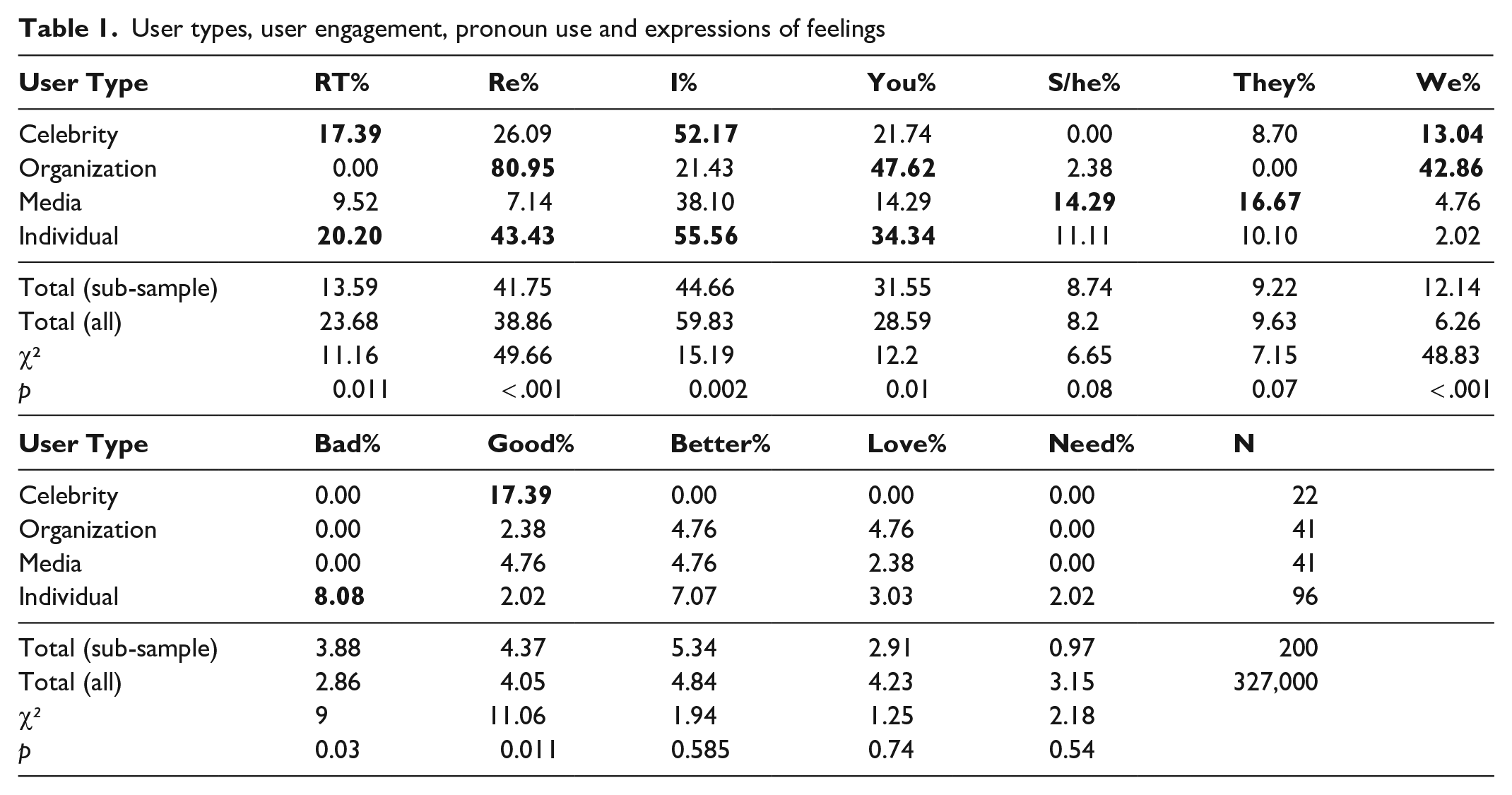
Finally, Table 1 portrays the relationship between user type and the tendency to retweet, reply, use pronouns, and express feelings. In support of the previous findings, it shows in bold-faced figures that celebrities with many followers are relatively more likely to retweet (17.4%), use first-person “I” (52.2%) and “we” (13%), and emphasize positive messages (17.4%). Companies and organizations are more likely to reply (81%) and communicate with their customers using both the first-person “we” (42.9%) and the second-person “you” (47.6%). Media companies are less likely to retweet or reply and tend to use more often references to the third-person pronouns “he/she” (14.3%) and “they” (16.7%). Finally, individuals are more likely to engage in both retweet (20.2%) and reply (43.4%), communicate with their peers using both first-person “I” (55.6%) and second-person “you” (34.3%), and share more than the others negative feelings (8.1%). A chi-square test indicates that those differences are significant in almost all cases.
User types, user engagement, pronoun use and expressions of feelings
A logistic regression was further performed on the entire database to examine the moderation effect of the number of followers on the use of pronouns in retweets and replies. It was found that the number of followers moderated the use of the pronoun “we” in retweets. There was a main effect of the number of followers on retweets (W[1] = 3.97, p = .046), and a main effect of the use of the pronoun “we” on retweets (W[1] = 1,390.22, p < .001). The interaction between the number of followers and the use of the pronoun “we” was statistically significant (Wald test W[1] = 37.89, p < . 001), and the moderated model was a better fit than the non-moderated model (χ2 = 64.96, p < .001). Combining with the other findings outlined above, this means that users with more followers are not only more likely to use the pronoun “we,” but these tweets are also more likely to be retweeted further by users with less followers.
Discussion
As sharing feelings is a fundamental part of human communication, previous studies have attempted to understand how social media have changed this practice (Goldenberg & Gross, 2020), and what feelings attract greater user engagement. While some studies found negativity bias in social media platforms (Pfeffer et al., 2014; Schöne et al., 2021; Soroka et al., 2019), others pointed to the fact that people generally tend to share positive experiences (Kramer et al., 2014; Reinecke & Trepte, 2014; Waterloo et al., 2018). Although, there is no agreement regarding the types of feelings that attract user engagement, most studies do agree that the intensity of emotions is certainly contagious in social media (Steinert, 2021; Stieglitz & Dang-Xuan, 2013).
However, most studies thus far have not considered the social context, which is crucial in understanding the practice of sharing feelings in social media. The current study addressed this gap by showing that personal pronouns are an integral part of sharing feelings, and both are related to user engagement. First, by mapping the discourse around the words “feel/s” and “feeling/s” on Twitter it was found that most of the frequent words were related to the expression of emotions. Using semantic network analysis four layers of social contexts were identified, associated with different personal pronouns. The cluster surrounding the word “good” was mainly associated with positive experiences shared by individuals and included references to first-person pronouns. Users often share positive personal experiences with others as they interact with entertaining media (games, music, and television). A second cluster, surrounding the word “better,” was associated with second-person pronouns and included interpersonal wishes. One of the most frequent 3-grams “feel better soon” indicates that users on Twitter are also in a constant dialogue with their target audience. A third cluster, surrounding the word “bad,” was associated with third-person pronouns “he/she” and included the frequent 3 gram “feel bad for.” Finally, the cluster of words surrounding the words “need” and “love” was associated with global or larger groups of people, mainly the first-person pronouns “we” and “us.” This cluster portrays the more general positive desires of Twitter users for a better future and calls other people to act to obtain desired changes.
Hence, in line with previous observations (Vermeulen et al., 2018; Waterloo et al., 2018), Twitter is not only a platform to share positive feelings but also negative ones. Yet the current study points to the importance of the social context in sharing positive and negative feelings on Twitter. While users share positive feelings about themselves (using first-person pronouns), they feel sorry for the others (third-person pronouns) and invite their audience to feel good too (second-person pronouns). The general message could be summed up into the sentence “I feel good about myself but bad about others, I hope that one day you will join me, and we all reach harmony and love.”
Furthermore, the analysis revealed that personal pronouns are extremely important when trying to assess the level of user engagement associated with feelings. Popular tweets that address larger audiences are generally positive and are more likely to be shared. Interpersonal tweets that address specific individuals are generally negative and are more likely to be replies. At the user level, engagement is measured by the number of followers and friends. Thus, most influential users tend to address larger audiences. Not all of them spread positive messages, but many of them certainly avoid negative messages. These findings support previous observations of the association between the use of “we” and social status (Pennebaker, 2011; Tausczik & Pennebaker, 2010).
When taking into consideration the type of users, it appears that celebrities with many followers are more likely to use first person (both “you” and “I”) and emphasize positive messages. Large companies with many followers employ Twitter as a platform for user engagement, reply more, and use first-person “we” and second-person “you.” Media companies are more likely to use third-person references. Finally, although individual users with the least number of followers exhibit relatively average user engagement in terms of retweets and replies, they share considerably more negative feelings than the average.
These findings support previous insights from marketing-oriented studies. First, in terms of feelings, the general trends found on Twitter are similar to those found in the context of political advertisements (Gunsch et al., 2000) and even the news media (Sendén et al., 2014), where the use of first-person “we” was associated with more positive content. In terms of user engagement, as indicated by Labrecque et al. (2020), the use of the first-person pronoun “we” is particularly effective in generating all types of consumer engagement on Facebook including shares, while the use of “you” is associated with more likes and comments (Cruz et al., 2017; Sela et al., 2012).
The current study contributes by combining the three points in this triangle (feelings, pronouns, and user engagement) and thus offering a few more layers of interpretation. First, it is important to consider the positive and negative sentiments that are associated with personal pronouns. Negative feelings on Twitter are often shared in smaller groups (with the use of “I” and “he/she”), while positive feelings are celebrated on larger scales (with the use of “we”). Second, more than in the field of marketing, when it comes to sharing feelings, the use of first-person singular “I” is particularly crucial in initiating interpersonal interactions. Both are more likely to generate different types of user engagement.
When looking at these results in light of the volume-control framework (Segev, 2019) one can easily see the power implications of the different strategies in addressing different social groups with different types of feelings. Figure 5 shows how the volume-control model can help to explain the links between the various findings of this study.

Volume-control model of feelings, personal pronouns, and user engagement on Twitter.
While all types of messages that include user engagement employ certain levels of popularization and personalization techniques, the choice to address specific social groups with different sets of feelings has implications on the type of user engagement achieved. Thus, typical replies on Twitter are personalized messages, addressing a smaller volume of people with both positive (often directed to second person, e.g., “hope you get better soon”) and negative (often directed to third person, e.g., “feeling bad for her”) messages. Typical retweets and messages from influential users (such as celebrities and organizations with more followers and friends) employ more popularization techniques. They address the larger audiences (often inclusive messages that use general observations, e.g., “we need love”) and avoid expressing negative messages. In short, it seems that the social context is crucial in understanding how people share their emotions in social media and what the power implications of this practice are.
It is worth noting some of the limitations of the current study. First, although the data are large and rich, they are limited to a specific period. Future studies should consider the longitudinal effect and how feelings, personal pronouns, and user engagement in social media correspond to different global events or seasons (such as holidays, pandemic, economic recession, or war). Similarly, the current study focuses the words “feel/s” and “feeling/s” in English. It does not cover the variety of emotional expressions that do not include these words. Future studies should add more words and compare the cultural and national differences in the use of feelings and pronouns.
The current investigation is based on semantic network analysis combined with quantitative methods which fit well to study big data. Although most tweets were found to include positive or negative affective content, there were also some tweets that referred to physical feelings and non-affective content. Future studies should further employ deeper qualitative analysis to get other insights in the context of feelings and other contexts. In particular, the findings unveiled a meta-narrative in which negative feelings are expected to be overcome using different means of personal and social engagement—individual interaction with entertaining media, interpersonal dialogues encouraging to feel better, and finally, a common strive to reach love and happiness among larger social groups. There is a further need to qualitatively explore the interchange between those techniques through discourse analysis and interviews, and particularly to understand how the different intentions of users and their perceptions of themselves, the platform, the audiences, and other users (e.g., third-person effect) can support or rather interfere as they engage with others and attempt to cope with negative feelings such as sadness or loneliness.
Notwithstanding these limitations, the main contribution of the current study is in mapping the various feelings expressed on Twitter and examining for the first time their association with personal pronouns and user engagement. It also offers a novel theoretical framework to explain the power implications of those practices. Overall, one major goal of Twitter users, as much as of any other person in online or offline social networks today, is pursuing happiness. Among smaller interpersonal circles it is common to share negative feelings and interact, while among larger groups it is more common and rewarding to share and spread positive messages. In the long run, as the volume-control model posits, combining personalization and popularization techniques increases social engagement and power. Indeed, users with more friends and followers adapt both “you” and “we” and avoid the use of negative messages. Consciously or not, influential users on Twitter customize their feeling sharing practices to both relevant audiences and the larger population to be heard and get more attention from others.
Footnotes
Acknowledgements
Many thanks to Regula Miesch for her empirical assistant, proofreading, valuable comments, and for coming up with a wonderful title for this article. Thanks to Shir Etgar for her statistical advice and to the anonymous reviewers for their useful suggestions to improve the article.
Declaration of Conflicting Interests
The author(s) declared no potential conflicts of interest with respect to the research, authorship, and/or publication of this article.
Funding
The author(s) received no financial support for the research, authorship, and/or publication of this article.
