



Abstract
As older adult populations rapidly increase worldwide, loneliness among older adults is emerging as a societal burden. Whether social media use can increase or decrease older adults’ loneliness remains debated in the literature. The purpose of this study is to clarify the effect of social media use on loneliness among older adults by examining the moderating role of media literacy on the relationship between social media use and loneliness. Considering that Korea is facing the most rapid population aging among Organisation for Economic Co-operation and Development (OECD) countries and that two-thirds of Korean older adults use social media, Korean data can provide international insights into the impact of social media use on older adults. Responses from 554 Korean respondents aged 60 to 79, extracted from the 2021 Korea Media Panel Survey, were analyzed using the PROCESS Macro Model 1. The results of this study showed that the effect of social media use on loneliness among older adults was moderated by their level of media literacy. As the amount of time spent using social media increased, loneliness increased for respondents with low-to-middle media literacy. This study’s findings emphasize the importance of educational interventions to increase older adults’ digital media literacy and expand scholarly understanding of the impact of social media use in non-Western countries.
Introduction
Loneliness and Social Media Use among Older Adults
The world population is aging rapidly. According to the World Health Organization (2022), older adults’ population (aged 60 years and over) will increase rapidly from 1 billion to 2.1 billion between 2020 and 2050. In particular, South Korea is facing the most population aging among Organisation for Economic Co-operation and Development (OECD) countries (Jones & Beom, 2022). It is expected to have the oldest population among OECD countries in terms of average age in the 2050s (OECD, 2023), causing various societal and economic challenges. Humans go through many changes as they age, and loneliness is one of the most widespread problems faced by older people worldwide (Hsu et al., 2021). Studies reported that 25% to 29% of older people in the U.S. experienced loneliness (Ong et al., 2016), 28.1% in China (Yu et al., 2021), 18.7% to 24.2% in eastern European countries (Surkalim et al., 2022), and 29.1% in South Korea (Kim et al., 2022). The mortality rate of those who suffer from loneliness is 26% higher than the norm (Holt-Lunstad et al., 2015). The loneliness of older adults now transcends the problem of individual emotional pain and is emerging as a social problem (World Health Organization, 2021). Social isolation among older people results in an estimated 6.7 billion dollars in Medicare spending per year (Holt-Lunstad, 2021). Not all socially isolated individuals experience loneliness, and while some individuals may experience loneliness while not being socially isolated, but loneliness is considered perceived social isolation, not objective social isolation (Hawkley & Cacioppo, 2010). Moreover, loneliness may be a threat to public health comparable to well-established risk factors for mortality such as obesity and smoking, and the impact will be greater in the future (Holt-Lunstad et al., 2010, 2015)
In this respect, maintaining social connection is considered a key element of good aging. However, older people have fewer opportunities to engage in social contact than other age groups (Leist, 2013). Moreover, older people have become more isolated as a result of the social distancing required during the COVID-19 pandemic (Berg-Weger & Morley, 2020). One potential solution to overcoming such barriers is social media (American Psychological Association [APA], 2020; Casanova et al., 2021; Silva et al., 2022). APA (2020) has recommended connecting through social media to stay safe, be informed, and relieve stress during the pandemic. Because social media is a computer-mediated communication channel that is not bound by geographic location or time (Hajek & König, 2021), it provides the possibility for older adults to participate in social contacts (Leist, 2013). The percentage of older adults in the United States who reported using at least one social media platform has increased steadily from 3% in 2005, to 7% in 2010, to 27% in 2014, and to 45% in 2021 among those aged 65 or older (Pew Research Center, 2021). According to the Spring 2022 Global Attitudes Survey, 70% of older adults in Korea reported using social media, followed by 69% in Australia, 66% in Israel, 63% in Canada, Singapore, and Sweden, 60% in Japan and the United States, 56% in Greece and Malaysia, 53% in Italy and Spain, 51% in Netherlands, 50% in Belgium, and less than 50% in France, Hungary, Poland, and the United Kingdom (Pew Research Center, 2022). As the use of social media among older adults’ population is increasing, the potential of social media as a source of social connection appears to be particularly important for older adults (Hsu et al., 2021). However, most studies on social media and mental health focus on younger adults (Hsu et al., 2021; Masur, 2021), and there is limited research on the effects of social media use on the loneliness of older adults.
The effect of social media use on the loneliness of older adults has not been clearly determined by previous studies. Several studies have found that social media use is associated with decreased loneliness among older adults (e.g., Bonsaksen et al., 2021; Cotten et al., 2021; Jarvis et al., 2019; Ongun et al., 2016). For example, social loneliness decreased following an increase in the use of various types of social media in Norway, the United Kingdom, the United States, and Australia (Bonsaksen et al., 2021). Time spent on social media sites such as Facebook and WhatsApp was associated with decreased loneliness among older people in Turkey (Ongun et al., 2016). In contrast, other studies have reported that social media use is associated with increased depressive symptoms or is not related to loneliness among older adults (e.g., Aarts et al., 2015; Hofer & Hargittai, 2021; Lewin et al., 2022). In the study by Aarts and colleagues (2015), the frequency of social media use was not related to emotional and social loneliness of older adults in the Netherlands. More recently, active social media use (e.g., posting videos and photos) was found to be positively related to depressive symptoms among older adults in the United States (Lewin et al., 2022). These mixed results on the effects of social media use on loneliness call for more research on the variables that influence the relationship between social media use and loneliness among older adults.
Another gap in knowledge, moreover, is the lack of research on social media use and loneliness in older adults in non-Western countries. Most studies have been conducted in Western countries (e.g., Arts et al., Casanova et al., 2021; Hofer & Hargittai, 2021; Lewin et al., 2022; Ongun et al., 2016; Silva et al., 2022), limiting scholarly understanding of other cultures (Yu et al., 2021). This research responds to the call to conduct research in different cultures by extending the context of this line of research to non-Western countries.
Media Literacy
To bridge the literature gap, this study focused on the potential role of media literacy as a variable that moderates the influence of social media on loneliness. While there is lack of consensus on a single definition of media literacy, it is typically considered to be a skill related to critical thinking by many scholars (Adams & Hamm, 2001; Potter, 2013; Silverblatt & Eliceiri, 1997). Following traditional definitions (Aufderheide & Firestone, 1993; Hobbs, 2001), media literacy in this study is defined as “the ability to use, understand, and create media content in a variety of contexts” (Rasi et al., 2021, p. 37). Media literacy is a core competency for citizens living in today’s digitalized society (Rasi et al., 2021). Few studies have been conducted on media literacy levels and their effects on older population. In a recent review of 40 articles reporting on the results of interventions promoting the media literacy of older people, positive outcomes of media literacy interventions were reported, such as improvement in cognitive ability, increased self-esteem, and reduced loneliness (Rasi et al., 2021). Masur (2021) suggested that digital communication (including social media) might influence psychological well-being in interactions with personal characteristics and presented media literacy as an example of such characteristics. Following his guidance, we attempt to explore the moderating role of media literacy on the relationship between social media use and loneliness of older adults. We expect that the effect of social media use on loneliness would differ by the levels of media literacy of older adults.
The Purpose of the Current Study
The aims of the current study were as follows: (1) to clarify the effect of social media use on loneliness in the daily life of older adults and (2) to examine the moderating role of media literacy in this relationship. The existing literature provides limited but mixed findings regarding the relationship between social media use and loneliness among older adults. Because of the exploratory nature of the present study, a research model (Figure 1) and the following research questions were presented:
RQ1: Will social media use increase or decrease loneliness among older adults?
RQ2: Will the effect of social media use on loneliness differ by the levels of media literacy of older adults?
This academic attempt could bridge the gap in the literature on social media use and loneliness among older adults. The current research is expected to illuminate our understanding of how to utilize social media to support the mental health of older adults. Moreover, the results of this study could provide practical implications for public health practitioners and scholars to develop and implement effective intervention programs for older adults’ mental health. Considering that Korea is facing the fastest population aging among OECD countries (Jones & Beom, 2022) and that about two-thirds of Korean older adults use social media (Pew Research Center, 2022), Korean data can provide international insights into the impact of social media use on older adults, expanding scholarly understating of non-Western countries.

Research model.
Methods
Data Overview and Participants
This study used secondary data extracted from the 2021 Korean Media Panel Survey, which was conducted by the Korea Information Society Development Institute (2022) on a sample representing the Korean population. The survey panel was composed of Korean individuals with diverse sociodemographic characteristics (see the URL for the complete dataset). The cross-sectional panel survey data were collected using stratified quota sampling in 17 cities in South Korea to achieve a nationally representative sample, with an initial sample size of 10,800. Trained interviewers visited households during an approximate 9-week period from June to July 2021 and conducted interviews using the computer-assisted personal interview (CAPI) system. A total of 10,154 complete responses (response rate 94.02%) were collected.
This study focused on individuals aged 60–79 with experience using social media. In the panel survey, participants were asked whether they use social media accounts (yes vs. no). Examples of social media were provided to answer the question: Twitter, Instagram, Facebook, TikTok, Naver Band, Pinterest, Cyworld, Kakaostory, Weibo, Vingle, and Between. We filtered the 10,154 responses from the panel survey for age (Out of 10,154 respondents, 2,583 were aged 60–79) and experience using social media (Out of 2,583 respondents, 554 had used social media). Through this filter criteria, we reached a final sample of 554 responses from 60- to 79-year-old social media users. The sociodemographic composition of the sample is shown in Table 1.
Sociodemographic Characteristics of Respondents.

Measures
Social Media Use
In this study, social media use was defined as the average time per day that older adults use social media such as Twitter, Instagram, Facebook, and TikTok. Social media use was measured with the following questions: “How much do you use social media on average per day?” A higher score represented more time spent on social media. The average daily social media use time was 24.677 min (SD = 29.305).
Loneliness
The 6-item UCLA Loneliness Scale (RULS-6) developed by Wongpakaran et al. (2020) was translated into the Korean language. Loneliness was measured on a 4-point scale (1 = did not feel at all, 4 = felt often) with six items: (1) I feel that I lack companionship with people, (2) I feel alone, (3) I feel no longer close to anyone, (4) I feel left out, (5) I feel that no one really knows me well, and (6) I feel that people are around me but not with me. A score closer to 4 represented a greater frequency of feeling lonely. The mean loneliness of the sample was 1.836 (SD = .550), and Cronbach’s alpha of the loneliness scale was .855. Cronbach’s alpha values of 0.7 or higher generally indicate an acceptable internal consistency (Hair et al., 2016; Nunnally, 1978).
Media Literacy
Media literacy was measured on a 5-point Likert-type scale (1 = do not do it at all, 5 = always do so) with 10 items. Ten items focusing on the subdimension (that is critical comprehension of information) of the media literacy scale by K. H. Kim et al. (2017) 1 were used in the panel survey. Starting with the question “How often do you engage in the following behaviors when accessing information through various media?” the following 10 items were measured: (1) I check whether the information I have been exposed to is true or not, (2) I check the source of the information I have been exposed to, (3) I judge whether the source of the information I have been exposed to is credible, (4) I review the information I have been exposed to for a logical reason, (5) I judge whether the information I have been exposed to has commercial intent, (6) I judge whether the information I have been exposed to has political intent, (7) I judge whether the information I have been exposed to intentionally asserts only one position, (8) I judge if the information I have been exposed to is useful to me, (9) I seek additional information to better understand the circumstances related to the information I have been exposed to, and (10) I look for additional information to explore different perspectives related to the information I have been exposed to. The closer the score is to 5, the higher the ability to critically understand and evaluate information in the media. The mean media literacy of the sample was 2.824 (SD = .795), and Cronbach’s alpha of the measurement items was .937.
Control Variables
This study controls for a set of sociodemographic characteristics that are considered predictors of loneliness in the literature. Studies have shown that loneliness is related to gender and age as well as other sociodemographic characteristics such as education, income, employment status, and marital status (Ferreira-Alves et al., 2014).
Sociodemographic characteristics were categorized into several categories. Gender was divided into male and female. Age was reported numerically by respondents. Education was categorized into five groups (less than elementary school graduation, middle School graduation, high school graduation, university graduation, graduate school or higher). Income was divided into eight groups, and the unit is Korean won (KRW) (no income; less than 500,000; 500,000 to 999,999; 1,000,000 to 1,999,999; 2,000,000 to 2,999,999; 3,000,000 to 3,999,999; 4,000,000 to 4,999,999; 5,000,000 or more). Employment status was sectioned into employed and unemployed. Marital status was divided into those currently unmarried (including single, widowed, and divorced) and those currently married.
Analysis Strategy
To answer RQ1 and RQ2, the collected data were analyzed using SPSS 26.0 and PROCESS Macro 4.1. First, using SPSS, the reliability of measurement items was tested, and frequency and descriptive statistical analysis were conducted to confirm the demographic characteristics of the sample, as well as the level of social media use, loneliness, and media literacy. Next, Model 1 of the PROCESS Macro proposed by Hayes (2017) was employed to investigate the effect of social media use on loneliness and to confirm the moderating role of media literacy. The PROCESS Macro model automatically provides the mean centroid function of independent and moderating variables to eliminate multicollinearity.
Results
Correlation analysis showed a positive relationship between social media use, loneliness, and media literacy. The coefficient values were between .070 and .096, which satisfies the discriminant validity between the variables (see Table 2).
Descriptive Statistics and Correlation Coefficients of Variables.

To test the main effect of social media use and the moderating role of media literacy on the relationship between social media use and loneliness, the relationships between variables were analyzed following the procedure of the PROCESS Macro model 1 proposed by Hayes (2017). Sociodemographic characteristics (gender, age, education, income, employment status, and marital status) were entered into the regression model as control variables.
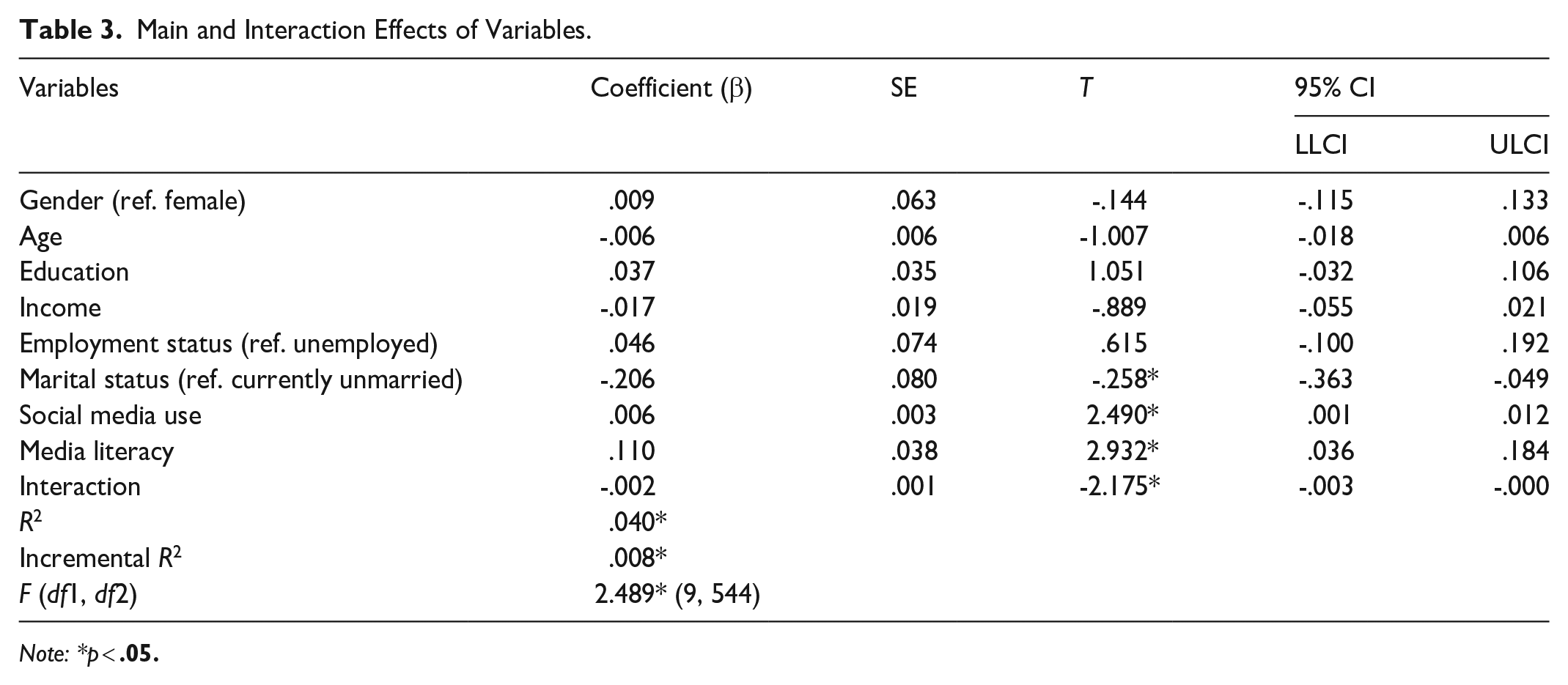
As shown in Table 3, regarding RQ1, social media use was found to have a significant positive effect on loneliness (β = .006, p < .05). Regarding RQ2, the interaction term of social media use and media literacy was found to be statistically significant (β = −.002, p < .05). The amount of change in R2 by the interaction term was also significant (ΔR2 = .008, p < .05), confirming the moderating effect of media literacy. These results indicate that the more people use social media, the more they feel lonely, but this effect differs according to the level of media literacy.
Main and Interaction Effects of Variables.
The significance region of these conditional effects was further examined using the Johnson-Neyman technique. As shown in Figure 2, the score of 2.874 for media literacy was a point of transition between a statistically significant and a nonsignificant effect of social media use on loneliness. When the media literacy level was 2.874 or lower (53.249% of the total sample), as the level of social media use increased, loneliness increased. Conversely, when the media literacy level of older adults exceeded 2.874 (46.751% of the total sample), social media use had no significant effect on loneliness.

The significance region of conditional effects.
Discussion
The effects of social media use on loneliness among older adults are still subject to debate. The existing literature provides a divided picture whether social media use mitigates or exacerbates loneliness among older adults. The current study clarified the relationship between social media use and loneliness among older adults by considering media literacy as a moderator.
Analysis of a total of 554 Korean respondents aged 60–79 years revealed that there was a positive relationship between social media use and loneliness. In other words, loneliness among older people increased as the time spent on social media increased, which aligns with previous studies that found a positive association between social media use and depressive symptoms (e.g., Hofer & Hargittai, 2021). Considering the use of social media in older adults carries the risk of aggravating loneliness, it is necessary to pay more scholastic attention to determine the boundary conditions in this area. One possibility is that the types of behaviors engaged in using social media might influence mental health among older adults. Active social media use, such as posting videos and photos, was positively related to depressive symptoms among older adults (Lewin et al., 2022). More scholars need to explore the mechanism behind potential risks of social media use among older adults (Fang et al., 2019).
As an effort to clarify the relationship between social media use and loneliness, this study examined the moderating role of media literacy. The results of this study revealed that the effect of social media use on loneliness was moderated by their level of media literacy. As the amount of time spent using social media increased, loneliness increased for respondents with low-to-middle media literacy, while the level of loneliness was not related to social media use time among respondents with high media literacy. These findings imply that for older people with lower media literacy, excessive social media use can have negative consequences on their mental health. Furthermore, once individuals reach a certain level of media literacy, they may be better equipped to deal with the potentially negative effects of social media use on mental health outcomes such as loneliness. The findings provide valuable insights into the complex relationship between social media use and loneliness and how media literacy moderates this relationship.
The findings of this study emphasize the importance of educational interventions to increase the digital media literacy of older adults. To decrease the detrimental effects of social media use on older adults, older adults must develop skills to enhance their social capital and satisfy their informational needs using social media. Previous studies (e.g., Blažun et al., 2012; Lee & Kim, 2018) provide evidence that interventions promoting media literacy could reduce loneliness. For example, older adults who participated in a mentoring program in the United States that provided one-on-one technology tutorials showed increased self-efficacy and eHealth literacy and a decrease in loneliness (Lee & Kim, 2018). Nationwide educational programs tailored to the literacy level of older adults could help enhance skills to access, use, analyze, and evaluate social media properly and ultimately contribute to the mental health of older populations.
The current findings have important implications for individuals, mental health practitioners, psychologists, and policy-makers. Individuals who use social media may benefit from media literacy training to help them develop the skills needed to navigate social media in a healthy and constructive manner. Mental health practitioners may find it useful to incorporate media literacy training into their interventions for individuals experiencing loneliness or other negative mental health outcomes related to social media use. Community and educational psychologists should make collaborative efforts to build educational programs that support older populations’ social media use to increase their social connectedness and enhance their physical and mental health. Policy-makers may consider implementing media literacy programs in community settings to help individuals develop the skills needed to navigate social media and other forms of media in a healthy and constructive manner. In addition to educational interventions, policy-makers should take the initial step to make a program filtering fake news or harmful information on social media that might mislead older adults with low media literacy.
Most studies on the relationship between social media use and loneliness among older adults were conducted in Western countries (e.g., Aarts et al., 2015; Casanova et al., 2021; Hofer & Hargittai, 2021; Lewin et al., 2022; Ongun et al., 2016; Silva et al., 2022). The findings of this study expand scholarly understanding of the impact of social media use in non-Western countries. Considering that Korea has the fastest population aging rate and high social media use among adults, this study’s findings provide useful insights for understanding the effects of social media use among older adults in other countries facing similar circumstances.
This study was meaningful as it presented greater clarity of the relationship between social media use and loneliness among older adults by examining the moderating effect of media literacy on the relationship. However, caution is needed in interpreting the results because of the limitations of this study. First, the data were extracted from the 2021 Korea Media Panel Survey. The sample might not be representative of the national population of Korea. There is a possibility that those in the panel might use more social media and might have a higher level of media literacy than those not included in the panel. Second, the mean age of the sample was 63.58 years old. Whether there are differences in the effects of social media on loneliness and other indicators of mental health between relatively younger adults (e.g., individuals aged 60–70 years) and relatively older adults (e.g., individuals aged 70 years and older) needs further investigation. Third, in the panel survey data, social media use was measured considering only the total time spent on social media. Differences might exist depending on which platform they use and how they use it. Future research should consider various types of social media and usage behavior (such as active vs. passive use, informational vs. socio-emotional use) in examining the relationship between social media use and loneliness among older adults. Fourth, in the panel survey data, media literacy was measured with items focusing on critical understanding and evaluation of information obtained through general media, not specific to social media. Items specifically measuring digital media literacy and various aspects of media literacy, such as information access/search abilities and content-creation abilities, should be employed in future research.
Footnotes
Declaration of Conflicting Interests
The author(s) declared no potential conflicts of interest with respect to the research, authorship, and/or publication of this article.
Funding
The author(s) received no financial support for the research, authorship, and/or publication of this article.
