




Abstract
With the emergence of new media technologies, being new media literate and able to critically analyze new media information are important to young adults, a group of individuals that are particularly active on social media. However, since the development of new media literacy, no study to date examined demographic characteristics, personality factors, and social network site (SNS) use related to it. More importantly, no research examined the relationship between new media literacy and perceptions and actions related to controversial issues. These under-explored facets deter practitioners from tailoring future new media literacy curricula and identifying the targeted audience. With a survey of 551 young adults, our study revealed that media literacy practitioners should devote more attention to (a) Caucasian males with low SNS use, (b) non-Caucasian females with low SNS use, and (c) individuals with low Need for Cognition and SNS use. Our study further showed that increasing new media literacy can help reduce misperceptions induced by misinformation that is rampant in the new media environment.
Keywords
Introduction
Social network sites (SNSs), a subset of new media allowing for circulation of user-generated content, self-presentation, and social interaction, have become an integral part of young people’s daily life (Ellison & boyd, 2013). As of 2018, 88% of young adults aged 18 to 29 reported having used some form of SNSs, including Facebook, Instagram, and Twitter; roughly 81% of them used these platforms daily (Rideout & Fox, 2018; Smith & Anderson, 2018). Apart from serving the purpose of socialization, SNS is also considered a critical source for young adults to seek and acquire information (Kim, Sin, & Tsai, 2014). For example, 95.7% of young adults considered SNS (i.e., Facebook) information sources (Kim, Sin, & Yoo-Lee, 2014), 51.6% of young adults used Facebook as the primary source for political information acquisition (Bene, 2017), and 94% of young adults have resorted to online platforms for health information (Rideout & Fox, 2018).
However, the new media environment, SNSs in particular, has become extremely complex due to the unregulated information flow and misinformation propagation (Wang et al., 2019). Indeed, although young people often have adequate functioning literacy (e.g., skills to access and search the internet), they lack critical literacy skills to discern, interpret, critique, and verify the large quantity of complex information on new media (Livingstone et al., 2019). Media literacy scholars also pointed out that with the advent of new media technologies, traditional media literacy is “no longer sufficient for an individual to competently survive in this new media ecology” (Lin et al., 2013, p. 161). Cultivating and improving new media literacy among individuals, especially young adults, is urgent and necessary to ease the “collective anxiety” caused by the influx of misinformation and the unregulated flow of information afforded by new media technologies (Lin et al., 2013, p. 161).
However, since the development of the new media literacy framework (Chen et al., 2011), much remains under-explored in terms of who consumes new media content more wisely and critically. Specifically, among young adults who are deemed conversant in using SNSs, whether demographic differences such as gender, age, and ethnicity play a role in influencing their consumption pattern is unknown. Moreover, the frequent use of media and technology is generally associated with higher media and digital literacy (Alkan & Meinck, 2016; Ye et al., 2018). Nonetheless, in the current media landscape riddled with misinformation and disinformation, whether increased SNS use leads to a greater ability to analyze new media information critically merits further investigation. Previous research also linked personality factors including Need for Cognition (NFC) and Need for Affect (NFA) to media-literate practices (Austin et al., 2016). However, no research has examined the interactive influence of SNS use and personality factors on new media literacy. More importantly, our study further seeks to answer an important question, which serves as the premise for future new media literacy education. That is, what is the relationship between new media literacy and the potential impact derived from misinformation as well as individuals’ willingness to seek more information?
To this end, we surveyed 551 young adults to examine both the separate and interactive influences of demographics, SNS use, and personality factors on their ability to consume new media content critically. We further investigated whether the critical consumption of new media content is associated with individuals’ perceptions and actions regarding a controversial issue—the human papillomavirus (HPV) vaccination. The decision of examining the issue of HPV vaccination was based on two reasons. First, HPV vaccination, as the primary and effective prevention method against the HPV and its related diseases, has been plagued by misinformation including erroneous claims about its ineffectiveness and lethal side effects on social media (e.g., Kotz, 2009; Weiner, 2011). Second, since HPV vaccination is related to sexually transmitted diseases and injections, it has also become intertwined with issues of religion, ethics, and politics that facilitated abundant heated and controversial debates (Dubé et al., 2013; Zucker et al., 2015). Such controversy would inevitably foster more misperceptions and vaccine hesitancy (Chou et al., 2018). Scholars have repetitively appealed that the spread of health-related misinformation severely endangers public health and ameliorating its consequences is a key challenge faced by the entire society (e.g., Chou et al., 2018). Therefore, examining health issues, HPV vaccination in particular, in the context of new media literacy is not only warranted but urgently needed.
New Media Literacy
Literacy conceptualization has undergone a series of evolutions from classic reading and writing literacy to digital and information literacy, most of which are tied to the developments in media technologies with a focus on understanding media messages (Chen et al., 2011; Koltay, 2011). Traditionally, media literacy was defined as the ability to “access, analyze, evaluate, and create” media content and “to create communications in a variety of contexts” (Koltay, 2011, p. 213; Livingstone, 2004, p. 5). However, the media landscape has been radically changed by the emergence of new media (Koc & Barut, 2016). New media differs from traditional media primarily in two aspects: (a) new media’s technical features such as user-generated content and dynamic programming significantly transcend those of traditional media (Butler, 2012), and (b) new media has distinct social-cultural characteristics that it facilitates collaboration in content creation, communicates values and ideological perceptions of creators, and serves multiple purposes ranging from social and political to educational and commercial (Chen et al., 2011).
Clearly, the framework of traditional media literacy no longer suffices to account for the drastic changes in new media. Thus, D. Chen et al. (2011) proposed a new theoretical framework of new media literacy. In their framework, new media literacy was conceptualized on two continuums: (a) from consuming media literacy to prosuming media literacy, and (b) from functional media literacy to critical media literacy (D. Chen et al., 2011). Consuming media literacy pertains to the abilities to synthesize and critique information; prosuming media literacy, involving both content creation and participation, refers to the ability to produce new media content such as creating social media posts (Chen et al., 2011). On the other continuum, functional media literacy concerns with the basic and essential level of media consumption and production such as understanding social media posts at the textual level and being able to use the internet; critical media literacy deals with a more sophisticated and crucial level of consumption and production such as being able to identify social and cultural meanings of new media content and participating in more complicated content creation (Chen et al., 2011). Lin et al. (2013) further refined the new media literacy framework by specifying (a) indicators of understanding and consuming skills in functional consuming literacy; (b) components of evaluation, synthesis, and analysis in critical consuming literacy; (c) elements of production, distribution, and prosuming skills in functional prosuming literacy; and (d) indicators of creation and participation in critical prosuming literacy.
Critical Consuming Literacy
Of the four types of new media literacy, we argue that critical consuming literacy is of particular importance for young people in the current media context in which misinformation is rampant (Bode & Vraga, 2015). Misinformation, also known as factual misperception, refers to the “presence of or belief in objectively incorrect information” (Bode & Vraga, 2015, p. 621). Misperception has been defined as “cases in which people’s beliefs about factual matters are not supported by clear evidence and expert opinion” (Nyhan & Reifler, 2010, p. 305). Misinformation and misperception are often inseparable and interdependent. The spread of misinformation and persistent misperceptions could cause various negative consequences such as public confusion (Barthel et al., 2016) and pose a grave threat to public health (Vogel, 2017).
Critical consuming literacy may help individuals combat the negative influences of misinformation. Identified by analysis, synthesis, and evaluation, critical consuming literacy refers to the ability to discern the true purpose underneath new media messages through an active examination of message construction, fact-checking, and source verification (Koc & Barut, 2016). In other words, through analysis, critical consumers do not mindlessly absorb messages; rather, they recognize the subjectivity and true intent of media messages. Through synthesis, critical consumers do not restrain their attentional resources; rather, they actively compare media content across platforms and integrate their own opinions into message reconstruction. Through evaluation, critical consumers do not simply rely on emotions to make a judgment; rather, they logically assess the reliability and credibility of media messages (Lin et al., 2013).
Thus, critical consuming literacy serves as a defensive shield that protects young individuals from the impact of misinformation and also equips them with the necessary skill set to navigate through the complicated new media environment. Prior literature has also provided preliminary insight into the influence of demographics in the context of new media literacy. For example, women considered themselves less competent with new media technologies compared to the male counterparts (Bidmon & Terlutter, 2015); ethnic minorities were less proficient in consuming new media information compared to Caucasians (Ofcom, 2017). However, due to the novelty of this framework, our understanding of the basic demographic characteristics associated with this particular type of new media literacy is still limited (Koc & Barut, 2016), which would deter media literacy practitioners from identifying potential targets and tailoring educational programs. Therefore, we propose the first research question:
New Media Literacy and SNSs
Prior literature has demonstrated the connection between media use and literacy. For example, in an international survey, Alkan and Meinck (2016) indicated that students who were “communicating with others using messaging or social networks” more frequently exhibited higher literacy in terms of using internet technologies to access, evaluate, and utilize information (p. 14). Similarly, Ye et al. (2018) revealed that increasing individuals’ usage of SNSs such as Twitter and Facebook significantly enhanced their ability to critically compare, evaluate, and assess the reliability and credibility of social media information.
However, some suspected that the younger generation’s heavy reliance on SNSs could reduce the skepticism toward social media information (Ye et al., 2018), which is precisely constructive in helping individuals to critically consume media content and combat misinformation (Vraga & Tully, 2019). Such suspicion found some support in the study by Durak and Saritepeci (2019), in which they found that individuals who used SNSs more frequently had a lower ability to recognize the true purpose of media messages.
In light of the mixed evidence on the relationship between SNS use and media literacy, we propose the following question:
New Media Literacy, SNS, and Demographics
Prior research on SNS use and media literacy has suggested that gender could be an important moderator when examining the influence of SNS use on new media literacy (e.g., Appel, 2012; Bidmon & Terlutter, 2015). For example, although the gender difference regarding internet access becomes minimal, it remains evident in the frequency of SNS use (Kim, Sin, & Tsai, 2014) and preference for specific SNSs (Kim, Sin, & Yoo-Lee, 2014). Moreover, there is a salient gender difference in literacy evaluations between women and men. For instance, by assessing adolescents’ SNS use and information literacy, Appel (2012) found that girls are more likely to report lower literacy scores and have more computer anxiety than their male counterparts. Similarly, Bidmon and Terlutter (2015) also revealed that women perceived themselves as less digitally competent compared to men. Women are also less skeptical about social media content, share more misinformation, and have a higher expectation for integrity in the new media environment (Chen et al., 2015; Warner-Søderholm et al., 2018). An empirical study further demonstrated that only for female students, increasing their SNS use resulted in greater literacy skills, which helped them critically consume online media content (Ye et al., 2018). Thus, it is imperative to investigate the nature and extent of gender differences in the context of SNS use and new media literacy.
Ethnicity may also moderate the relationship between SNS use and new media literacy. First, ethnic differences existed in certain SNS use behaviors. For example, a national survey showed that ethnic minorities used SNSs more frequently than average and were more experienced with activities such as setting up social networking profiles (Media Insight Project, 2015; Ofcom, 2008). Second, ethnic minority individuals were found less critical and careful in consuming online information (Ofcom, 2017). They tend to believe the information accuracy is consistent across online portals and divulge personal details before carefully checking the websites (Ofcom, 2017). Pew documented that ethnic minority groups reported a lower level of preparedness and confidence in consuming and utilizing digital information compared to Caucasians (Horrigan, 2016a). More importantly, a survey revealed that Caucasians had a higher level of media literacy such as controlling privacy settings on social media than ethnic minorities (Media Insight Project, 2015).
As discussed above, prior studies have separately demonstrated the interactive effects between gender and SNS use (e.g., Ye et al., 2018), and between ethnicity and SNS use (Media Insight Project, 2015) on media literacy. However, the lack of studies on the connection between gender, ethnicity, and SNS use presents a unique opportunity for media literacy researchers. Thus, in addition to examining the respective moderating roles of gender and ethnicity on SNS use and critical consuming literacy, we also explore the potential interaction of gender, ethnicity, and SNS use on critical consuming literacy. In light of the reviewed literature, we propose the following questions:
NFC
Conceptualized as an individual’s enjoyment of thinking (Cacioppo & Petty, 1982), NFC is considered a predisposition of mindful processing that helps explain intrinsic motivations for critical consumption of news (Vraga & Tully, 2019). Therefore, NFC-oriented people are likely to process messages via an “analytical approach that is active, conscious, effortful, logical, intentional, and therefore more comprehensive” (Austin et al., 2016, p. 601).
The positive association between NFC and media literacy has been extensively confirmed in previous literature. For instance, Britt and Hatten (2013) found that college students with higher NFC were also likely to be high in media literacy. Nair and Ramnarayan (2000) argued that individuals with higher levels of NFC were more deliberate and efficient in problem-solving and decision-making. Despite its effect on media literacy at large, the effect of NFC on critical consuming literacy is more evident. Heijltjes et al. (2014) found that people with higher levels of NFC also possessed more skills to analyze issues critically. Similarly, Austin et al. (2016) revealed that NFC positively predicted critical thinking about the source of the media. Hence, we propose the following hypothesis:
Although prior studies have investigated the influences of NFC on media literacy in the context of social media (e.g., Vraga & Tully, 2019), the potential effect of SNS use in this particular relationship has not been hitherto examined. Nonetheless, previous research has demonstrated the possibility of probing the relationship between NFC, SNS use, and media literacy. For example, in a series of internet surveys, Tsfati and Cappella (2005) revealed that for individuals with lower NFC, greater media exposure is associated with lower skepticism and analytical evaluations about the media. However, among individuals with higher NFC, the association between media use and skepticism disappears. Thus, we further ask the following question:
NFA
In contrast, NFA refers to the tendency that individuals apply less cognitive efforts but more experientially based strategies when processing information (Austin et al., 2016). NFA-oriented individuals rely more on simple, heuristic, or affective cues for information processing. Compared to the positive effect of NFC on media literacy, the association between NFA and media literacy seems to be somewhat negative (e.g., Austin et al., 2016). Such mechanisms of such negative impact are twofold. First, individuals less likely to process information cognitively usually resort to mental shortcuts, a reliance on heuristic forms of processing, to process information encountered (Sundar, 2008). Second, affect can “bias the logic-based critical thinking necessary for persuasion resistance” (Austin et al., 2016, p. 601). Therefore, we propose the following hypothesis:
Critical Consuming Literacy, Misperceptions, and Information Seeking: HPV Vaccination as a Case Study
With SNSs contributing to the spread of misinformation (Barthel et al., 2016), calls for updating and reexamining media literacy educational programs have surfaced (Bulger & Davison, 2018). Some studies also implied that the ability to critically analyze social media information would promote more skepticism about media content and help individuals carefully examine its quality and credibility (Vraga & Tully, 2019). However, mixed evidence also abounds that media literacy produced little to no effect or resulted in detrimental consequences such as overconfidence (Bulger & Davison, 2018). Thus, prior to developing new media literacy curricula to help protect individuals from misinformation, it is imperative to understand whether a greater ability to critically consuming new media content is indeed associated with fewer misperceptions about controversial issues. To this end, we selected a health issue that is frequently grappled with misinformation—HPV vaccination. Indeed, many controversial issues merit exploration in the context of media literacy such as global warming. However, as previously mentioned, HPV vaccination is not only a pressing public health matter but also an issue with religious, ethical, and political complications (e.g., Dubé et al., 2013). Moreover, the health decision-making, vaccination in particular, is often more proximal, critical, and cognitively centered as it concerns individuals’ immediate health and well-being (Asch et al., 1994; Xiao, 2019). As such, we believe that its distinctiveness, sophistication, and urgency have made it a suitable topic to be examined in the current study.
Since the first licensure of HPV vaccines in 2006, the vaccine has been commended as a breakthrough for preventing HPV-induced infections and diseases such as cervical, penile, throat, and head cancer as well as genital warts (Centers for Disease Control and Prevention [CDC], 2019). With over a decade of monitoring and research, the vaccine has been proved to be safe and effective that it prevents 92% of HPV-related cancers from ever developing (CDC, 2019). However, in recent years, the controversy over the HPV vaccine has emerged in media (Intlekofer et al., 2012) and intensified on social media (e.g., Dunn et al., 2017). For example, some online articles presumptuously linked HPV vaccination to paralysis, mental retardation, and death (e.g., Kotz, 2009; Weiner, 2011), and some social media posts denied the evidence of vaccine efficacy and safety outright (e.g., To Vaccinate or Not to Vaccinate, 2019). Considering 87% of young adults seek health information online (Rideout & Fox, 2018), exposure to such misinformation seems inevitable and extremely worrying. In a study with college students, Rosenbloom and Killian (2014) revealed prevalent misinformed risk perceptions of HPV vaccination such as severe side effects of the vaccine. Research further showed that higher exposure to misinformation not only induced vaccine hesitancy and refusal but also resulted in a lower coverage of vaccination (Dunn et al., 2017; Vogel, 2017).
As such, examining the relationship between critical consuming literacy and misperceptions about the vaccine is important due to two reasons: (a) the issue itself is an urgent public health crisis that awaits prompt attention from media and academia, and (b) it lays the foundation for developing media literacy curricula for scientifically controversial issues.
Finally, to be a critical new media content consumer, one needs to be able to find and compare information across different platforms (Chen et al., 2011; Lin et al., 2013). Prior research indicated that a greater level of media literacy is associated with advanced information behaviors such as information seeking and appraisal (Lin et al., 2013; Rouhany & Mousavi, 2017). We deem information seeking the primary inquiry in the context of HPV vaccination due to a practical reason. That is, the ultimate goal of combating the impact of misinformation and eliminating misperceptions about HPV vaccination is to increase vaccine acceptance and uptake (Bednarczyk et al., 2019). Rather than information appraisal, information seeking has been documented as a critical factor that increases positive health decision-making (Niederdeppe et al., 2008; Shim et al., 2006). Defined as “purposive acquisition of health information from selected sources for determining one’s own health behaviors” (Lee & Kim, 2014, p. 286), information seeking facilitates health knowledge acquisition and positive health behavior enactment (e.g., Go & Yo, 2018). More importantly, prior research found that people with higher levels of media literacy such as using information technology for health purposes are more likely to seek further information about health issues (Britt & Hatten, 2013). Such close connection with media literacy and health decision-making renders information seeking an important variable to be examined. Therefore, we put forth the following hypothesis:
Method
Procedure and Participants
Data were collected with an online survey conducted through Qualtrics at a large public university on the west coast. Participants were college students and were recruited from a college-wide research portal via which they received extra course credits for participation. In total, 565 participants aged 18 and above completed the survey. Fourteen individuals who failed to provide answers to critical variables were excluded from the study. The final sample consisted of 551 individuals, ranging in age from 18 to 55 (M = 20.26, SD = 3.09). Slightly over half were female participants (59.89%), and the majority were Caucasian (71.51%), followed by Asian (11.1%), Hispanic (6.7%), African American (6.6%), Other (3.4%), and Native American (1.3%).
Measures and Analytical Approach
Main measurement scales included the six-item NFC Scale (NCS-6, Likert type; Coelho et al., 2018), the 10-item NFA Questionnaire–Short Form (NAQ-S, Likert type; Appel et al., 2012), the nine-item general SNS Use subscale from Media and Technology Usage and Attitudes Scale (MTUAS, Likert type; Rosen et al., 2013), and the 10-item Critical Consumption subscale in New Media Literacy Scale (NMLS, Likert type; Koc & Barut, 2016). Details of the measurements are listed in Supplemental Appendices A and B.
To analyze the research questions and hypotheses (Figure 1), hierarchical multiple regression (RQ1, RQ2, H1, H2), PROCESS macro Model 1 and Model 3 (RQ3, RQ4), and standard multiple regression (RQ5, H3) were employed. Zero-order Pearson correlations were listed in Supplemental Appendix C.
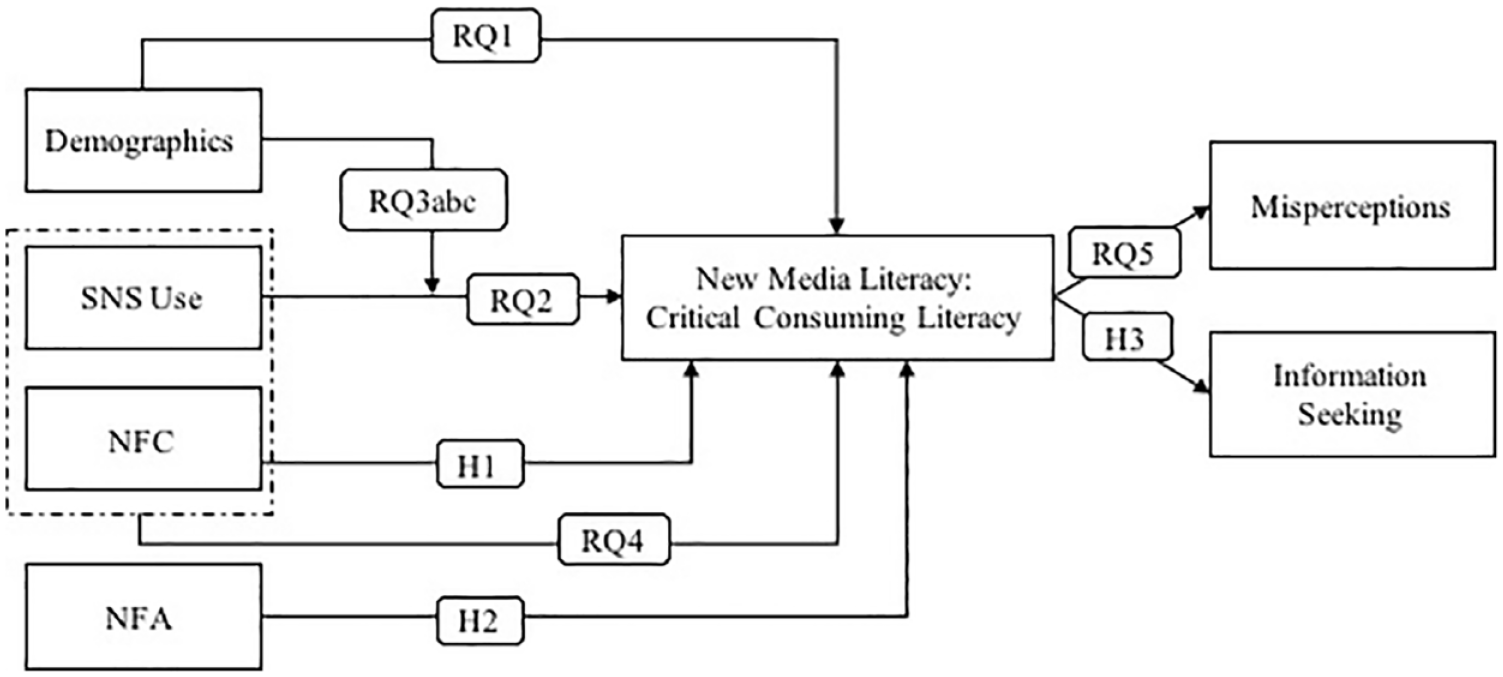
The hypothesized model.
Results
RQ1 examined the relationship between basic demographic details and critical consumption of new media content. As Table 1 shows, ethnicity was negatively associated with critical consumption (b = –.06, SE = .02, p = .002). Specifically, ethnic minority individuals were less likely to consume new media information critically than Caucasians. Moreover, female individuals were more likely to consume new media content critically and logically than male counterparts (b = .11, SE = .06, p = .042).
Hierarchical Regression Model (N = 551).

Note. SE = standard error; SNS = social network site.
p < .05. **p < .01.
RQ2 probed the relationship between SNS use and individuals’ capability to analyze and process new media information critically and logically. As shown in Table 1, beyond age, gender, and ethnicity, individuals who used social media more frequently were more likely to critically consume new media content (b = .07, SE = .02, p < .001). H2 was supported.
RQ3ab inquired about whether gender and ethnicity moderate the relationship between SNS use and critical consuming literacy. To make meaningful interpretations, ethnicity was recoded into a dichotomous variable with “Caucasian” and “non-Caucasian.” As shown in Supplemental Appendix D, no moderating influences emerged from the results (bgender = .03, SE = .04, p = .498; bethnicity = .07, SE = .04, p = .073). RQ3c further asked whether there is an interacting influence among gender, ethnicity, and SNS use on critical consuming literacy. A three-way interaction emerged from the results (b = –.06, SE = .02, p < .01). In short, among Caucasians, female individuals with high SNS use were the most proficient in consuming new media content critically (Figure 2). In contrast, among non-Caucasians, male individuals with high SNS use had the highest level of critical consuming literacy (Figure 3).

Three-way interaction effect of ethnicity, gender, and SNS use on critical consuming literacy among Caucasians.

Three-way interaction effect of ethnicity, gender, and SNS use on critical consuming literacy among non-Caucasians.
H1 hypothesized NFC would be positively associated with critical consuming literacy. As shown in Table 1, beyond age, gender, and ethnicity, individuals with higher NFC were more likely to critically consume new media content (b = .11, SE = .04, p = .01). H1 was supported.
H2 hypothesized that NFA would be negatively associated with critical consuming literacy. The results, however, contradicted our hypothesis. As can be seen in Table 1, individuals with higher NFA were more likely to consume new media content critically and analytically (b = .14, SE = .03, p < .001).
RQ4 further inquired about the potential interacting influences of NFC and SNS use on the critical consumption of new media content. As shown in Figure 4, a significant two-way interaction was observed (b = –.06, SE = .03, p = .032). Among individuals with low NFC, higher SNS use was associated with higher critical consumption of new media content, while as NFC increases, the moderating influence of SNS use on critical consumption became less evident.

Two-way interaction effect of Need for Cognition and SNS use on critical consuming literacy.
RQ5 examined the relationship between critical consuming literacy and misperceptions of HPV vaccination; 121 individuals were excluded from the sample since they had never heard of the HPV vaccines. Standard multiple regression controlling for age, gender, ethnicity, sexual history, and risky sexual behavior was conducted for analysis. Our inclusion of sexual history and risky sexual behavior as covariates was justified by previous research (e.g., Gerend et al., 2013; Jozkowski & Geshnizjani, 2016; Nan, 2012). Following these studies, sexual history was measured by the number of sexual partners of the respondents (M = 6.70, SD = 12.60). Risky sexual behavior was measured by the frequencies the participants used protection during sex (0 = never, 4 = always) (M = 2.27, SD = 1.48). Results revealed that critical consuming literacy was negatively associated with misperceptions about HPV vaccination (b = –.24, SE = .11, p < .05). That is, individuals with higher critical consuming literacy had significantly lower misinformed risk perceptions about HPV vaccination (Table 2).
Standard Multiple Regression Model (n = 430).

Note. SE = standard error.
p < .05. **p < .01.
H3 further posited that individuals with greater ability to consume new media content critically would also be more likely to seek more information about controversial issues such as HPV vaccination. Results showed that after controlling for covariates, critical consuming literacy was positively associated with a higher level of information seeking (b = .34, SE = .12, p = .006), supporting H3 (Table 2).
Discussion
With the advent of new media, SNSs in particular, having traditional media literacy is no longer sufficient for individuals to acquire accurate media information and survive in the new media environment (e.g., Lin et al., 2013). However, since the development of new media literacy, our understanding in terms of who consumes new media content more wisely and who needs to be targeted for further new media literacy education remains limited. Thus, our study bridges this gap by examining (a) demographic characteristics, (b) SNS use, and (c) personality factors associated with new media literacy. More importantly, our study lays the foundation for future new media literacy curricula by examining the relationship between new media literacy and individuals’ perceptions and actions about a controversial issue in the context of misinformation.
Echoed with previous research (e.g., Horrigan, 2016a; Media Insight Project, 2015), we found that ethnicity is associated with critical consuming literacy among young adults, such that the minorities were less likely to consume new media information critically than Caucasians. One possible explanation is based on the differences in media usage habits across ethnic groups. In a report investigating personal learning via digital technology, Horrigan (2016b) found that African Americans and Hispanics were less likely to rely on online media but more on physical institutions such as community centers for intellectual activities. As such, compared to Caucasians, ethnic minority individuals are more likely to critically evaluate information under physical settings rather than online settings like social media platforms. In terms of gender, the results of our study showed that female individuals were more likely to consume new media content critically and logically than their male counterparts. This finding is consistent with previous research, which concluded that female college students were more literate than male students in the context of online media (e.g., Kahne et al., 2012). Previous studies also validated that females used SNSs such as Facebook more often than males (e.g., Nadkarni & Hofmann, 2011). Thus, females may be more habituated and familiarized with the nuances on the platforms, which can trigger their critical evaluation of the information.
Moreover, our study found that individuals who used SNSs more frequently were more likely to consume new media content critically. This aligned with prior research, which suggested that the interactive nature of SNSs may contribute to users’ media literacy (e.g., Alkan & Meinck, 2016). The process of accessing, managing, producing, and exchanging information on interactive platforms helps users become more proficient in critically consuming and evaluating media content. This finding is quite promising for media literacy education, considering 81% of young people frequently use SNSs in the age of digital media (Rideout & Fox, 2018; Smith & Anderson, 2018). We further probed the interacting influences between demographics and SNS use on critical consuming literacy; a significant three-way interaction emerged from the results. Among Caucasians, female individuals with high SNS use had the highest level of critical consuming literacy, which echoes the findings of prior studies (e.g., Kahne et al., 2012; Nadkarni & Hofmann, 2011). Research also revealed that Caucasians are more reliant on online media for activities that required critical evaluation of information (Horrigan, 2016a, 2016b). Interestingly, among non-Caucasians, male individuals with high SNS use had the highest level of critical consuming literacy. We suspect this is possibly due to the greater engagement with SNS use. For example, studies suggested that although females tend to use SNSs more frequently than males, males engage in SNS activities such as commenting, reviewing, and media-sharing more often than females (e.g., Kim, Sin, & Yoo-Lee, 2014; Nadkarni & Hofmann, 2011). Research also found that ethnic minority individuals are more likely to have higher SNS engagement such as posting, liking, and commenting than Caucasians (Media Insight Project, 2015). The engagement with SNS functionalities promotes behaviors that are positively associated with media literacy such as information seeking (Khan, 2017). Therefore, future studies should consider investigating the level of SNS engagement in influencing critical consuming literacy.
Our study further explored the influences of personality factors on critical consuming literacy. In line with previous literature (e.g., Vraga & Tully, 2019), individuals with higher NFC are more likely to analyze and consume new media content critically. However, contradictory to prior studies (Austin et al., 2016), individuals with higher NFA also showed greater ability to process new media information critically. This finding, albeit somewhat counterintuitive, is quite intriguing. Damasio (2005) suggested that experiencing emotions is, in fact, a fundamental element in decision-making, learning, and making a rational judgment. In his studies, when individuals lost the ability to experience emotions, although their intelligence and logical reasoning were unimpaired, they were not able to make rational decisions (Damasio, 2005). As Pinker (1977) puts, “each human emotion mobilizes the mind and body to meet one of the challenges of living and reproducing in the cognitive niche” (p. 373). In other words, from time to time, our cognitive reasoning is driven by emotions. Therefore, approaching emotions or having a higher level of NFA may motivate individuals to consume and analyze information critically. That being said, a more in-depth understanding of NFA’s mechanisms is warranted. We hereby call for further scholarly examinations and empirical explanations of NFA’s role in the context of new media literacy.
In further probing interactions between NFC and SNS use, we found that individuals with low NFC and low SNS use are the least likely to consume new media content critically. This is consistent with prior research, which pointed out that individuals who mindlessly process information and lack new media skills had a lower level of media literacy and were extremely vulnerable to misinformation (Alkan & Meinck, 2016; Vraga & Tully, 2019). As such, new media literacy education is especially critical for this particular group of individuals. Our finding also further contributes to the existing literature by highlighting the interaction between NFC and SNS use in influencing new media literacy skills.
Finally, by examining the issue of HPV vaccination, our findings implied that increasing critical consuming literacy is indeed helpful in decreasing the misperceptions derived from possible exposure to misinformation. More importantly, in line with previous studies (e.g., Lin et al., 2013), increased critical consuming literacy is associated with a higher level of information seeking—a critical behavior that helps acquire more accurate information to correct misperceptions (e.g., Shim et al., 2006). These findings are quite inspiring. On one hand, prior health scholars indicated that combating health misinformation on new media is of primary importance for public health (e.g., Chou et al., 2018). Our results provided robust support that new media literacy has protective effects that may shield individuals from the negative influences of misinformation. On the other, as Austin et al. (2016) suggested, media literacy education can improve health decision-making by decreasing the impact of exposure to adverse media messages. We also observed a strong effect of critical consuming literacy on facilitating positive health behavioral intentions. Thus, implementing new media literacy programs may be especially beneficial in helping young people to navigate through the labyrinth of information and make critical judgments.
In summary, theoretically, our study (a) advanced the understanding of the role personality factors and SNS use played in shaping new media literacy and (b) demonstrated the possibility of using media literacy education to equip young people with the necessary skills to combat the influences of misinformation. Practically, our study suggested that media literacy practitioners should devote more attention to (a) Caucasian males with low SNS use, (b) non-Caucasian females with low SNS use, and (c) individuals with low NFC and SNS use when developing and tailoring education curricula. Specifically, given frequency of SNS use played a key role, it would be beneficial for media educators to encourage their students of different ethnic groups and cultural backgrounds to frequently utilize SNSs, to help them develop a better understanding of the characteristics of information dissemination on SNSs. Besides, media educators could also benefit from incorporating NFC assessments and exercises into their media literacy classes. For instance, questionnaire-based NFC evaluations can be conducted, and in-class workshops can be carried out to systematically improve students’ rational information processing abilities. Finally, media practitioners could consider developing multilingual, gender-friendly social media platforms to fit the specific needs of different groups of consumers.
This study is not without limitations. First, our study only examined critical consuming literacy rather than the comprehensive new media literacy. However, this particular type of literacy is crucial in helping individuals combat misinformation in the current media landscape (Bode & Vraga, 2015; Koc & Barut, 2016; Lin et al., 2013). Future studies could further investigate the effects of other types of new media literacy in assisting individuals in navigating through the new media environment. Second, our study employed a relatively new NFC scale, and the reliability alpha is not ideal. However, the scale was shown to be an adequate alternative to the original 34-item or 18-item NFC scales (Coelho et al., 2018). More empirical testing for this scale is warranted. Third, we did not investigate individuals’ purpose of SNS use, which was suggested to be explanatory of new media literacy (Durak & Saritepeci, 2019). Future research could further explore the interaction effect of SNS use and purpose in predicting new media literacy. Fourth, we only selected one controversial issue—HPV vaccination in our study. To strengthen validity, future research could (a) delve deeper into vaccination-autism or HPV vaccination-paralysis misperceptions or (b) compare multiple issues, including global warming and genetically modified organism (GMO) food products. Moreover, we measured misinformed perceptions of HPV vaccination—an internalization of misinformation, which is a more distal outcome. More proximal reactions to misinformation such as misinformation identification, credibility evaluation, and affordance utilizations should be further studied. Furthermore, we only examined information seeking as an information behavior related to new media literacy. Other information behaviors such as information appraisal (e.g., credibility judgment, message quality evaluation) also merit attention. Fifth, our study is cross-sectional. Our purpose is, therefore, not to make any causal inference but to serve as a premise for future new media literacy curriculum development.
In conclusion, our study takes the first step in examining the relationship between SNS use, personality factors, and critical consuming literacy. We further expand the understanding of the association between media literacy and misinformation. Our findings suggested that developing new media literacy curricula is indeed essential to help combat misperceptions in the current media landscape riddled with misinformation. More importantly, our study shed light on future practices by highlighting certain groups of individuals that deserve more attention in new media literacy education.
Supplemental Material
sj-pdf-1-sms-10.1177_2056305121990635 – Supplemental material for Who Consumes New Media Content More Wisely? Examining Personality Factors, SNS Use, and New Media Literacy in the Era of Misinformation
Supplemental material, sj-pdf-1-sms-10.1177_2056305121990635 for Who Consumes New Media Content More Wisely? Examining Personality Factors, SNS Use, and New Media Literacy in the Era of Misinformation by Xizhu Xiao, Yan Su and Danielle Ka Lai Lee in Social Media + Society
Footnotes
Declaration of Conflicting Interests
The author(s) declared no potential conflicts of interest with respect to the research, authorship, and/or publication of this article.
Funding
The author(s) received no financial support for the research, authorship, and/or publication of this article.

Supplemental Material
Supplemental material for this article is available online.
Author Biographies
References
Supplementary Material
Please find the following supplemental material available below.
For Open Access articles published under a Creative Commons License, all supplemental material carries the same license as the article it is associated with.
For non-Open Access articles published, all supplemental material carries a non-exclusive license, and permission requests for re-use of supplemental material or any part of supplemental material shall be sent directly to the copyright owner as specified in the copyright notice associated with the article.
