



Abstract
There has been a growing interest in the impact of incidental news exposure on audiences as using social media as a source of news is becoming increasingly common practice. This article examines how this may have an impact on the trust in news through an analysis of Facebook news users in three countries—Australia, the United Kingdom, and the United States (n = 1,296). While trust in general news is no different between those who access news intentionally or incidentally, incidental exposure has a negative relationship to the trust in news on social media. This finding is more prominent among those who use social media as their primary source of news. Among social media news users, those who actively access news have a much higher trust in news they find on social media compared with incidental news users. This gap implies that there are a variety of contexts in which a social media user is exposed to news and a nuanced understanding of the context of incidental versus intentional exposure is needed to fully explain how incidental exposure to news may affect audiences’ trust in news.
Introduction
Digital platforms such as search engines, social media, and mobile apps have opened up new opportunities for news audiences to access a diverse range of news as well as to engage with news online (Ha et al., 2018). However, this has also resulted in the growing uncertainty about the reliability and facticity of online information and an increase in the mistrust levels (Coleman et al., 2012). This is amplified by the fact that social media is becoming a major source of news (Newman et al., 2019).
When asked about the sources of information on social media, 64% say they get information from news brands (Park et al., 2020), which implies that people are cognizant of the sources when they encounter news on social media. However, even though people pay attention to news brands, trust in news found on social media platforms is significantly lower than general trust in news (Newman et al., 2019). This invites the question as to why news found on social media are regarded as less trustworthy than news in general.
This lower trust can partly be explained by the prevalence of misinformation that people encounter alongside with news. Those who use social media more frequently are more likely to be exposed to misinformation, which in turn leads to a higher level of informational mistrust. Social media platforms serve as a conduit for cultivating mistrust (Y. J. Park, Chung, & Kim, 2022). However, there is very little empirical evidence as to why the same news people encounter on social media engender lower trust in news.
A possible explanation is the context of information consumption, that when people are on social media platforms, they are there for multiple reasons and may see a diverse range of information that makes them more skeptical of any information they see, including news. Another explanation is the different ways in which people encounter news. In contrast to traditional news consumption, news consumption on social media is often incidental.
Incidental news consumption has been studied in the context of how it can change media practices (Boczkowski et al., 2018), affect political outcomes (Kim et al., 2013; Morris & Morris, 2017), potentially narrow the gap between those who are engaged and those who are not (Heiss & Matthes, 2019; Kim et al., 2013; Valeriani & Vaccari, 2016; Wojcieszak & Mutz, 2009), and how it can develop a sense of “news finds me” perception where people think they are informed without actively seeking news (Gil de Zúñiga et al., 2017; Strauß et al., 2021). These studies mainly focus on the consequences of incidental news exposure. However, less is known about the mechanism that triggers the engagement or disengagement when people encounter news incidentally. From previous studies on news trust, we know that trust in news can be related to audiences’ engagement with the news (Ardevol-Abreu & Gil de Zúñiga, 2017; Swart & Broersma, 2022; Tsfati, 2010; Tsfati & Cappella, 2005).
This study aims to take this one step further to investigate the relationship between the context in which people are exposed to news—incidental versus intentional—and how it can be related to the trust people place in the news. We examine whether the lower trust in news found on social media is related to how people are exposed to news on social media. In particular, we investigate whether incidental news exposure on Facebook—one of the commonly used social media platform for news—have an impact on the trust in news. News trust can be understood in a broader context with multiple factors including the context of news consumption. In this study, we consider these various contexts of news consumption that affects their trust.
Literature Review
Social Media and News Trust
Over the past few decades, there has been concern about a perceived decline in news trust. International surveys have found evidence of significant distrust toward business, government, nongovernmental organizations (NGOs), and the media (Jones, 2018). Digital technologies have increased the opportunities for news and information providers to publish content online, but it has also led to public concerns about the volume and credibility of information online. More than half of news audiences around the world are now accessing news through digital platforms such as social media that employ curation algorithms (Newman et al., 2019). This has resulted in a growing uncertainty about the quality of news, and news audiences are largely left to their own devices to discern the quality of information (Coleman et al., 2012; Park et al., 2020).
A core aspect of trust is the willingness to take a risk based on expected but uncertain positive outcomes (Rousseau et al., 1998). Trust relies heavily on the fact of being vulnerable or assuming some risk associated with the actions that others take. Distrust occurs when the risk and uncertainty are higher than the trust. When news audiences are skeptical of the news source, they often defer the judgment. Fletcher and Nielsen (2019) argue that news consumers are becoming more suspicious and adopting a position of generalized skepticism, particularly toward information found on social media.
Toff et al. (2021) differentiated people who are generally mistrusting, selectively trusting, or generally trusting, based on the relative number of news brands they trust and consume. Their four-country study shows that those who are generally mistrusting are least knowledgeable about journalism, and disengaged with news.
In both economic and political contexts, trust is believed to impact citizens’ behavior. For example, trust leads to economic transactions (Lorenz, 1999). In the political context, trust results in civic engagement (Putnam, 1993). Mistrust or perceived media bias can lead to lower news consumption (Ardevol-Abreu & Gil de Zúñiga, 2017). A culture of distrust is characterized by “a pervasive, generalized climate of suspicion” (Sztompka, 1998, p. 22), leading to alienation and passivism.
Studies have found a link between where people get the information and their trust in news. Tsfati and Ariely’s (2014) study found consuming news on TV and newspapers is positively related to news trust and those who get news online have lower trust. Non-traditional news source is related to low trust (Tsfati et al., 2020), and those who mainly access news on social media tend to have lower trust in news (Newman et al., 2019; Park et al., 2020).
There are possible reasons why trust in news found on digital platforms is lower. The main difference between news accessed via dedicated news websites and social media platforms is that the content curated on social media originates from multiple sources, and includes non-news content. The curation processes used by social media platforms are influenced by both humans and algorithms. An important difference is that atomized content curated by social media platforms comes from multiple sources and are presented alongside different combinations of other atomized content, mainly based on personalized data; whereas content curated by media businesses is intended to remain part of a single news package (Australian Competition & Consumer Commission, 2019), giving audiences a vastly different experience.
Another reason could be due to the varied level of attention people pay to information they encounter. Schudson (1999, 2008) argues that the ideal of a fully informed citizen is unrealistic and instead proposes a pragmatic approach understanding audiences as monitorial citizens. In a society with an overabundance of information, it is hard for most people to follow and understand the wide spectrum of current affairs (see Graber, 2003). However, monitorial citizens can respond to and engage with issues if they find particular news to be relevant to their lives. The key here is that audiences are paying attention to information and news, at different levels of engagement depending on the context. Because trust is related to the way an individual engages with news under certain circumstances (Swart & Broersma, 2022), this has important implications as to how we understand the skepticism and distrust in the digital environment.
Engagement with the content is critical to news trust. Bode’s (2016) study found that preexisting interest in politics or the novelty of the story were not related to recalling of the political news story. Instead, those with higher trust in the information were more likely to recall it. They examined the process of learning political information on social media and the outcomes of the learning. People gain knowledge about politics on social media through exposure, whether it is intentional or not, and whether they have preexisting interest or not. Social media users experience passive learning when they are exposed to political information on social media.
On social media people have little control over the content they see. In this environment, passive learning occurs when users have fewer barriers to absorbing information, indicating the importance of engagement. The context in which audiences are exposed to news on social media may be the key to understanding their engagement with it, therefore, affecting their trust in the news. This leads to the first research question:
RQ1. What are the different levels of trust in news between those who primarily seek news on social media compared with those who do not?
Incidental News Consumption on Social Media
Incidental exposure to news is not a new phenomenon. Headlines that news audiences see on newsstands, or news clips on television screens, have always been a part of everyday news consumption. However, incidental exposure to news online and on social media has become a topic of growing interest in recent years because of its prevalence and potential. A global study of news consumers in 46 countries reveals that 32% of Facebook users see news incidentally (Newman et al., 2021). An Australian study found that people were more likely to come across news about COVID-19 incidentally (45%) than actively looking for it (31%) when using online platforms and social media (S. Park, McCallum, et al., 2022).
Tewksbury et al.’s (2001) study is one of the earlier ones that recognized that people encounter news incidentally while doing other things online. They defined incidental exposure as unintentional encounters with news or public affairs content. There are various terms to describe the phenomenon; incidental news exposure (J. K. Lee & Kim, 2017), accidental news exposure (Valeriani & Vaccari, 2016), and incidental news consumption (Boczkowski et al., 2018). These all refer to a way of encountering news with no intention of doing so, while they are online or on social media.
However, this “no intention of doing so” is questionable as when people are on social media, they may not look for a particular news topic or story, but they may have a general expectation of bumping into news, particularly if the user is following news organizations or journalists. Those who curate a variety of content on their social media feed will expect certain types of information to appear during their social media activity. More importantly, users may have different levels of expectations of encountering news on social media.
Many studies on incidental news exposure focus on how it affects media practices (Boczkowski et al., 2018) or political outcomes (Kim et al., 2013). Some argue that it is an opportunity to narrow the gap in news engagement between those who are interested in political or social issues and those who are not. On the contrary, studies have found that the gap can widen because people pay differential attention to what they are exposed to, and the predispositions create a wider gap. Barnidge and Xenos (2021) label these different views as compensatory versus stratificational effects of social media. Those who argue that the existing knowledge and participatory gap widens, explain this by the predispositions of users and their differential engagement with certain topics. Those who are interested in news and current affairs are more likely to engage with incidental news when they see it (Goyanes, 2020; Kim et al., 2013; Kümpel, 2019; Möller et al., 2020; Stromback et al., 2013). Those who suggest that the gap is narrowed suggest that those who have low interest in news or politics may encounter information that they wouldn’t have otherwise, and thus acquiring a new interest or knowledge (Heiss & Matthes, 2019; Kim et al., 2013; Valeriani & Vaccari, 2016; Wojcieszak & Mutz, 2009).
Some studies have found that the effects are reciprocal (Barnidge, 2023; S. Lee & Xenos, 2022). Engagement can drive incidental exposure and vice versa. Engagement informs the algorithms that categorize individual users based on their interests and can influence what appears in users’ news feeds (Thorson et al., 2021). Those who are already interested in politics and stumble across political news are more likely to pay attention and act upon it. This can end up in a vicious or virtuous cycle.
Perhaps the reason why there are conflicting findings is because there is a wide spectrum of incidental news exposure, and the context of news consumption varies by individuals. Incidental and intentional news consumption often occur together. People follow news outlets or journalists on social media to get news about topics they are interested in. Those who actively follow news may be primed to seeing news while on social media. Those who don’t follow news actively may still encounter news through their social networks but with less expectations. Most users will have a mix of these different elements influencing their social media feeds.
Thorson and Wells (2015) differentiate personal curation—intentional customization of social media, such as following news media—and social curation. Those who intentionally follow news organizations or journalists don’t have control over the actual story that they come across, but they have a higher probability and expectation of encountering news. On the contrary, those who don’t curate news by following professional news, may also encounter news through social curation—their social networks. There is an indirect flow of news through social curation that is filtered (liked or shared) through a user’s social media contacts. Another element that influences the flow of content is algorithms that are based on the users’ history of engagement on the platform.
Similarly, Barnidge (2023) differentiates social and algorithmic curation on social media. Social curation is shaped by a person’s social networks and algorithmic curation is driven by the platforms’ algorithms that attempt to maximize audience engagement and advertising revenue. However, these two are not separate and are often intertwined in the curation process. That is why it is difficult to differentiate between pure incidental exposure and intentional consumption. Exposure to content is a function of the users’ past online behavior, self-curation, and their social networks.
Bergström and Belfrage (2018) conducted a mixed-methods study on young people’s news consumption and concluded that for those who use social media for news, even though it may not be a result of active seeking, exposure to news is deliberate to a certain extent. This phenomenon has been identified as “news finds me” perception (Gil de Zúñiga et al., 2017). Young people, heavy social media users, and those who often encounter news while using social media for other activities are more likely to develop this “news finds me” perception than others (Strauß et al., 2021). Social media users expect to be updated and informed through their social feeds. They may also be aware that if they click on an incidental news link, they will get similar types of links in the future, which also implies a certain level of intention. News consumption on social media is different from that on traditional news media. It is “somewhere between the extremes of selective exposure and incidental exposure” (Bode, 2016, p. 30).
Cardenal et al. (2019) distinguish choice versus algorithmic filtering when people access news online. Voluntary exposure to news is by choice, such as visiting news websites. Involuntary exposure is mainly through algorithmic filtering where users find news by searching or while on social media. Borgesius et al. (2016) refer to choice as “self-selected personalisation” and to algorithmic curation as “pre-selected personalisation.” Self-selected personalisation is when people choose to access views that match their own preferences, and avoid information that differs in their viewpoint, which is what we call selective exposure (Stroud, 2017). Preselected personalization is driven by algorithms often without the user’s intentional input or knowledge and is known to result in filter bubbles (Pariser, 2011).
Mitchelstein et al.’s (2020) study shows that purely incidental news exposure is one extreme on a continuum of incidental and intentional news consumption and must be understood in a broader context of news consumption across multiple platforms. News consumption on social media is very complex because social media platforms are rarely used for a single purpose. Users are on platforms for a number of reasons. Therefore, incidental news exposure must be understood in the context of a wider range of activities on social media platforms. In such an environment where news is mixed with other information, including personal and social posts, people are selective and vigilant about the credibility of the information they see.
We can conclude that incidental news exposure is rarely purely incidental and audiences experience a mix of both incidental and intentional, mainly through curation. The degree of self-curation differs by users; some follow news of their choice, some use social media anticipating a socially curated flow of news, and most people have a combination of both. Based on these different types and levels of curation, people may experience incidental news differently.
Not much is known about how the context of exposure to news influences the trust in the news source. The question is, does the way people encounter news on social media have an impact on trust? If users encounter news incidentally, are they more likely to mistrust the information? This leads to the second research question:
RQ2. Is incidental news exposure to news on Facebook related to audiences’ trust in news?
Engagement With News on Social Media
When exposed to news on social media, people respond in different ways and these responses also vary by situation and context. Haim et al. (2021) argue that to understand how people access and engage with news on digital platforms, we need to distinguish between active and passive modes of news use and develop measures that can differentiate different types of news exposure. This approach would allow us to further research the role of social media in the phenomenon of news engagement through news exposure. Oeldorf-Hirsch’s (2018) study shows that both active seeking of and incidental exposure to news are mediated by news engagement. She concludes that the key function of social media is not the knowledge gained through news exposure but the ability to engage users who are passive receivers of news. The study found that both actively seeking news and incidental exposure to news are positively related to engagement in news content. Even if social media users bump into news, they are as equally likely to interact with the content as if they were actively seeking it. It is also the case that social media use is associated with more online news exposure and it also results in exposure to more sources of news (Scharkow et al., 2020).
However, the contextual nature of incidental exposure makes it difficult to uniformly understand the phenomenon and the potential consequences. Extant research has mainly examined the factors influencing incidental news exposure on Facebook and suggested that engagement with incidental news on Facebook is determined by preexisting interests (Karnowski et al., 2017), prior knowledge about the issues, and other content-related elements (Kumpel, 2019) and visual elements (Vergara et al., 2021).
Research also found some contextual factors involved in incidental news engagement. For example, Boczkowski et al. (2018) conclude that news consumption on social media is often a habit primarily driven by sociability rather than by interest in the content itself. News stories that people come across incidentally online do not get as much attention as news accessed on newspapers or television. The news on social media is also mixed with a variety of other information people see on the platforms, which defies the traditional definition of newsworthiness. This result is in line with Ahmadi and Wohn’s (2018) study that suggests seeking news, such as local information, is not related to incidental news exposure, while seeking salient news and receiving information through weak ties and network diversity were all positively related to incidental news exposure.
Goyanes and Demeter (2022) specifically interviewed those who use social media platforms regularly but not for information and news purposes, limiting the definition of incidental exposure to purely those who accidentally bump into news. Their study found that social media users give far more credit to journalistic selection and to incidental news content based on legacy media production than to algorithm-generated content. This indicates that the source that people recognize on social media is an important factor that determines their engagement with the information rather than how they came across it.
According to these studies, the context of news consumption while on social media is important in determining how much people pay attention to and engage with the news, which may be connected to the trust they place. The third research question is set up as follows:
RQ3. Is the relationship between incidental exposure on Facebook and trust in news different among those who mainly curate news on social media, and those who mainly bump into news?
Methodology
Data Collection
A survey was conducted by YouGov using an online questionnaire at the end of January/beginning of February 2021 as part of the Reuters Institute Digital News Report 2021. We selected a subsample of those who use Facebook for news and who were asked the question about why they use Facebook for news in three countries (n = 1,296; Australia 498, the United Kingdom 394, and the United States 404). All of the respondents in this study are those who use Facebook for news.
Variables
Dependent Variables
Trust in news: Trust in news in general was measured by asking respondents their level of agreement with the following statement: I think you can trust most news most of the time. This was measured on a 5-point Likert-type scale ranging from strongly disagree to strongly agree. The mean score was 2.92 and SD 1.113.
Trust in news found on social media: Similarly, trust in news found on social media was measured on a 5-point Likert-type scale by asking respondents their agreement level with the statement, “I think I can trust news in social media most of the time.” The mean score was 2.32 and SD 1.040. Although single-item measures are often problematic in survey research, it can perform very similarly to multiple-item measures (Cheung & Lucas, 2014). In this study, we used the available variables to estimate audiences’ trust in news.
Independent Variables
Frequency of news consumption: We modified Pew Internet’s measure of media use by giving respondents a choice among 10 options: more than 10 times a day, between 6 and 10 times a day, between 2 and 5 times a day, once a day, 4–6 days a week, 2–3 days a week, once a week, once a month, a few times a year, and never. We converted this into an interval variable ranging from 0 to 9 and reversed the coding. The mean score was 7.08 and SD 2.151.
Interest in news: Interest in news was measured by asking “how interested, if at all, would you say you are in news?” on a 5-point Likert-type scale ranging from not at all interested to extremely interested. We removed “don’t know” responses. The mean score was 3.57 and SD 1.043.
Interest in politics: Interest in politics was measured by asking “How interested, if at all, would you say you are in politics?” on a 5-point Likert-type scale ranging from not at all interested to extremely interested. We removed “don’t know” responses. The mean score was 3.08 and SD 1.226.
Main source of news: We asked respondents if they have accessed news in the past week using social media and whether it was their main source of news. We used this variable as a dummy variable, 1 being use social media as the main source of news and 0 use other media as the main source of news. In the sample, 18% of the respondents used social media as their main source of news. The rest was those whose main source of news is either print (newspapers or magazines), TV, or online (websites or apps of news brands). In the analysis, we use this variable to differentiate those who use social media for curated news and those who encounter news incidentally.
Incidental news exposure to news on Facebook: Research on incidental news exposure has typically focused on Facebook as the most relevant platform on which participants encounter incidental news (Kaiser et al., 2018). In this study we asked participants who used Facebook for news if they mostly see news while they are on Facebook for other reasons. We coded those who selected this option as “1” and all others “0.” Among those who use Facebook for news, about half (49%) encountered news on Facebook incidentally.
Country dummy variables: Dummy variables for the United States and the United Kingdom were created and included in the regression analysis. Australia was used as the reference group. The three countries are similar in news audiences’ incidental exposure to news on Facebook with Australia having the lowest (46%) and the United Kingdom the highest (55.6%) (Table 1).
Incidental Versus Intentional News Exposure on Facebook by Country.

Gender: We used a binary gender variable, with men coded as 1 and women as 0.
Age: A numeric age was asked and used as the age variable.
Results
Social Media as a News Source
We compared those whose main source of news is social media with those who use other platforms—television, print, radio, or online—as their main source of news. Compared with those who rely on other platforms for news, those who rely primarily on social media for news are younger (60% of this group is under the age of 40), have a higher proportion of light news consumers (41% vs 31%), have lower interest in politics (72% vs 63%), and lower trust in news in general (34% vs 46%; Table 2). On the contrary, this group has higher trust in news found on social media (29%) compared with those who use other sources of news (23%; Table 3).
Characteristics of Those Who Mainly Use Social Media for News (%).

Trust by Main Source of News.
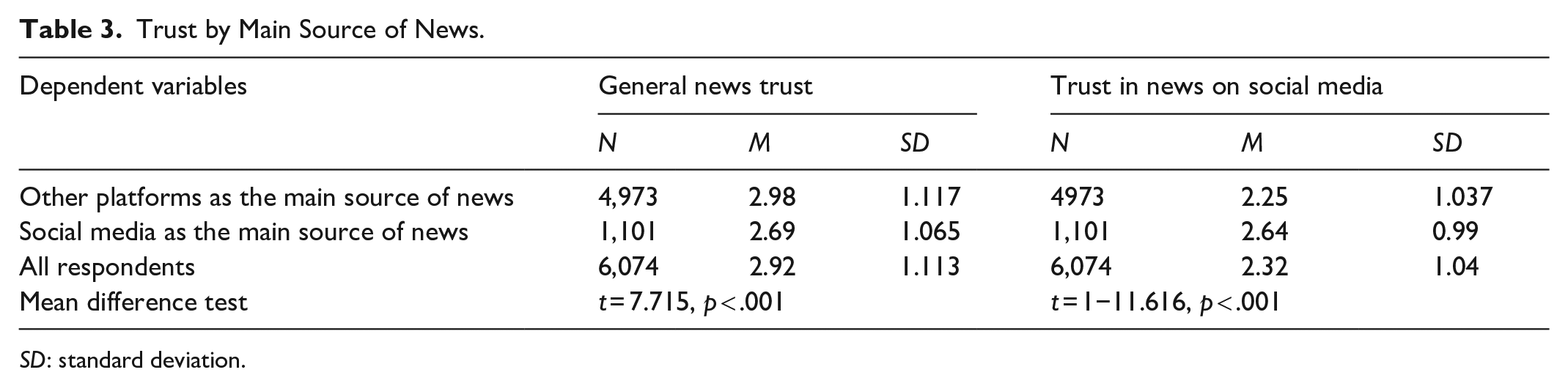
SD: standard deviation.
Differences in Trust Between Those Who Mainly Use Social Media and Other Platforms for News
To answer the first research question, we compared trust in news in general and news on social media between those who mainly use social media and other platforms for news. Overall, the respondents’ trust in news on social media is lower than general trust in news. Trust in news in general (M = 2.92) is significantly higher than trust in news on social media (M = 2.32) (p < .001). However, a different pattern emerges when we compare the trust levels (both general and on social media) by audiences’ main source of news (Table 4). Those who access news mainly on social media are significantly less likely to trust news in general (M = 2.69), but more likely to trust news found on social media (M = 2.64) compared with those who access news via other sources of news (general news trust M = 2.98; trust in news on social media M = 2.25, p < .001).
News Consumption on Facebook by Main Source of News.
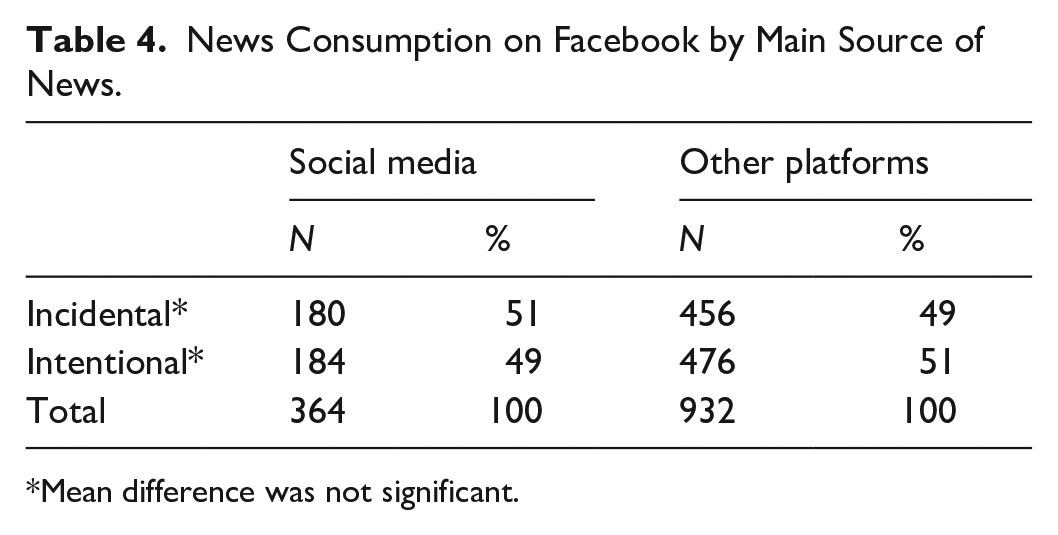
Mean difference was not significant.
On the contrary, those who use platforms other than social media as their main source of news have a much lower trust in news found on social media (M = 2.25) compared with their general trust in news (M = 2.98) (p < .001). These findings imply that those who mainly use social media to get news are possibly those who are more active news consumers on social media through curation (i.e., following), which also implies a higher engagement with news, and therefore higher levels of trust in what they see on social media compared with those who merely bump into news.
The Relationship Between Incidental Exposure on Facebook and Trust in News
We compared those whose main source of news is social media with those who use other platforms (TV, radio, print, or online news) and their type of access to news on Facebook. There is no difference in the proportion of incidental and intentional news users on Facebook between those who mainly use social media for news and those who mainly use other platforms (TV, online, radio, newspaper), where the proportion of intentional versus incidental exposure to news on Facebook is about half and half (Table 4).
To answer the second research question, we ran two ordinary least square (OLS) regressions (Table 5). The dependent variables were (a) trust in news in general and (b) trust in news found on social media. The adjusted R2 was .075 for the first model and .085 for the second model.
Regression Results.

***p < .01.
Interest in news, interest in politics, frequency of news access, incidental news exposure dummy variable, and social media as the main source of news dummy variable were included as independent variables. Demographics as control variables were included (age, gender). We also included country dummy variables (UK, US) using Australia as the reference.
As found in the descriptive analysis, those who use social media as the main source of news have an overall lower trust in news in general (β = −0.078, p < .01) compared with those who use other platforms as their main source. Incidental news exposure did not predict general news trust.
Those who are interested in news have higher news trust (β = 0.28, p < .01). On the contrary, interest in politics had a negative relationship with news trust (β = −0.178, p < .01). Frequency of news access was not related to trust. The age variable was negative and significant meaning older people have higher trust in news (β = −0.093, p < 01). There was no significant difference in gender. UK (β = −0.083, p < .01) and US (β = −0.109, p < .01) audiences are less trusting of news compared with news audiences in Australia.
In contrast to the first regression analysis, incidental exposure to news on Facebook had a negative relationship with trust in news found on social media (β = −0.125, p < .001). Those who encounter news incidentally while on Facebook have a lower trust in news on social media.
The impact of using social media as the main source of news (β = 0.081, p < .01) was positive, which is opposite to the results in the first regression analysis. Those whose main source of news is social media have a higher trust in news found on social media compared with those who use other platforms as their main source.
Those who are interested in news have higher trust in news on social media (β = 0.215, p < .01); however, those who are interested in politics have lower trust (β = −0.163, p < .01), similar to the findings in the first regression. Frequency of news use was not significant. Age and gender variables were not significant. UK (β = −0.189, p < .01) and US (β = −0.12, p < .01) audiences are less trusting of news found on social media compared with respondents in Australia.
Using social media as the main source of news had a different impact on trust in news and trust in news found on social media. To investigate this further, we compared the general news trust and trust in news on social media by incidental news exposure and the main source of news (Figure 1). For those who use Facebook for news intentionally, the level of general news trust and trust in news on social media are not different among those whose main source of news is social media. However, there is a large gap in trust in general news and news found on social media among those whose main sources of news are other platforms.

Trust by main source of news.
More importantly, the difference between incidental and intentional users’ trust in news on social media is greater among those whose main source of news is social media. This may mean that those who curate news on social media and use it as their main source of news, are those actively seeking news on social media and more likely to follow news they trust.
Conclusion
There is a growing concern that trust in news is declining in an environment where audiences are increasingly accessing news on social media platforms. Studies have shown that trust in news in general is lower among those who use social media for news (Newman et al., 2021; Park et al., 2021). This was also the case in our study. Furthermore, our findings indicate that the trust in news found on social media is related to how people are exposed to news. Generally, those who encounter news incidentally on Facebook have a lower trust in news found on social media.
However, a different pattern emerges when we compare those who use social media as their main source of news with those who use other platforms. The way people find news on social media—incidental versus intentional—influences the level of trust among those who say their main source of news is social media. Among those who used Facebook for news, those who rely primarily on social media to get news, there is a large gap in trust between those who bump into news and those who intentionally seek news. The gap can be explained by the differences in how social media users encounter news. Intentional users are possibly those who self-curate news by following various news sources and expecting to see news while they are on social media. In contrast, those who bump into news on social media may be less attentive to the signaling elements of the news posts, including news brands, the person who shared the news, or the journalist who wrote the story that usually influences a person’s trust in news. Vergara et al. (2021) show that most participants in an eye-tracking experimental study paid attention to two or less elements of news posts on Facebook. This is indicative of users having lower levels of engagement with news content and lacking deep cognitive efforts to process the news content. Gil de Zúñiga et al. (2017) found that those who have a higher level of the news finds me perception tend to be less politically knowledgeable. Increased exposure to social media news does not automatically translate into political learning (Goyanes et al., 2023), implying a differential engagement with news content depending on contextual factors.
Consuming news on social media has been a matter of concern for young people, as many of them rely on social media for the majority of news (Shearer, 2018), and rarely engage with traditional news. However, scholars have started to recognize that when audiences actively share and distribute news within their social networks, they are significantly more likely to become engaged with it (Galan et al., 2019; Kwon et al., 2019). This may partially explain why those who actively seek news on social media are much more trusting of news compared with incidental news consumers. They are likely to pay attention and engage with the news, resulting in higher trust.
It is notable that there is little difference between the levels of trust in news in general and news on social media among those who use social media as their main source of news. This may be because those who primarily use social media for news is doing so because they already have low trust in mainstream news (see Toff & Kalogeropoulos, 2020). Our findings confirm the negative relationship between non-mainstream news consumption and trust in general news. While our study does not differentiate motives about why people use social media for news, we can infer that those who say they use social media as their main source of news are those who are dissatisfied with mainstream news, therefore, having a different viewpoint about news on social media.
The relationship between incidental news exposure, trust in news, and news engagement is complex and cannot be explained in a linear way. The extant notion is that trust in news is a strong positive factor of news consumption, which appears to hold for the relationship between incidental news exposure and trust in news on social media. Goyanes’ (2020) study lends support to this notion suggesting that those who trust news on social media are more likely to be exposed to incidental news when on social media. This may mean that those who trust news are more likely to be engaged and therefore getting exposed to more news than those who are not. These trusting social media users may be those who are also curating news on it. The positive relationship between intentional uses of social media for news and trust in news on social media suggest that we found in our study implies that those who use social media as their main source are possibly those who actively seek news on Facebook through self-curation, such as following news organizations or journalists. Sterrett et al. (2019) found that when people encounter news on social media, the level of trust in news is determined less by who created the news and more by those who shared it. In this context, who the users follow and interact with on social media may play an important role in determining how much they trust the news on social media. As researchers noted, we need to further investigate the causal relationship between incidental news consumption and trust in news on social media, as it is not straightforward and requires longitudinal studies (Goyanes, 2020; Strauß et al., 2020).
Our study focused on comparing those who are potentially curating news on social media and bumping into news knowingly and those who are purely incidental news consumers. The habitual practice of engaging with social media (and through this, engaging with news, other people, and wider society) and the social significance of the news in a contemporary society is still under-theorized. For example, we need a refined concept of incidental news exposure that captures both incidental and intentional news exposure to fully understand how social media users engage with news, and how it impacts trust and participation. Depending on the context of news consumption on social media, particularly among young people and those who have established a routine of accessing news via social media platforms, it can improve the users’ political knowledge and engagement with current affairs.
One of the explanations as to why those who curate news on social media may have a higher trust is their different expectations of encountering news. Those who follow various news sources have an expectation to see news while they are on social media, even if they are on it for other reasons. For example, Ahmadi and Wohn (2018) note that incidental exposure to news is embedded within information-seeking processes on social media. While this was not possible to test with the available data, it leaves an important research question to investigate in the future, regarding the diversity of news behaviors on social media that we know very little about. Trust is embedded in all aspects of journalism—news production and consumption—and is shaped by a multitude of actors (Moran & Nechushtai, 2022). How social media impacts on news trust needs to be researched within this broader context.
This study has limits in that we indirectly measured intentional news exposure on social media that may also include curated incidental exposure. However, we need a more nuanced measure in the future to clearly differentiate the various degrees of incidental exposure that ranges from pure incidental exposure to mostly curated incidental exposure. Other methodological limitations include that this study used a single-item measure for most of the variables used in the analysis. While single-item measurements are widely used when survey data is being collected due to its efficiency, our findings should be interpreted with caution. Finally, we measured incidental versus intentional news exposure among Facebook news users. Facebook is only one of many digital platforms audiences use to get news and may be used differently compared with other platforms. In this study, however, we only included those who use Facebook for news and compared those who use social media as their main source of news versus those who use other platforms as their main source. While those who say their main source of news is social media may not necessarily mean they are using Facebook for that purpose, the uses of other social media platforms are much lower 1 compared with Facebook use among those who use mainly social media for news, reducing the possibility of the two variables not aligning. However, further empirical research is needed to confirm the findings from this study. Like most research, this study focused on incidental news exposure on Facebook, and thus the findings of this study may be confined to the behaviors on Facebook. Therefore, future work can expand our understanding by including other social media platforms, such as Twitter and Instagram.
Nevertheless, this study fills an important gap in the literature by deepening the understanding of how the way people are exposed to news—incidental versus active seeking—can affect their evaluation of the news, leading to differential trust. There are a variety of contexts in which a social media user is exposed to news and a nuanced understanding of the context is needed.
Footnotes
Declaration of Conflicting Interests
The author(s) declared no potential conflicts of interest with respect to the research, authorship, and/or publication of this article.
Funding
The author(s) disclosed receipt of the following financial support for the research, authorship, and/or publication of this article: The research presented here is funded by the Australian Research Council Discovery Project (DP210100157) “The rise of mistrust: Digital platforms and trust in news media” (2021–24).
