



Abstract
Some people live in social media “news deserts,” while others are embedded in online networks that are rich in news content. These news deserts represent a new form of digital inequality—distinct from problems of access, resources, or civic skills—that could foreclose one of the ways social media are believed to contribute to informing citizens and engaging them in democratic processes: providing opportunities for incidental news exposure. This study investigates incidental exposure on social media platforms, drawing on an online survey administered just before the 2018 US Midterm Elections (N = 1493). The study finds that even after controlling for key individual-level factors, characteristics of social media discussion networks play a role in explaining variation in incidental exposure. The results are discussed in light of prevailing theory about incidental exposure, public engagement, and digital inequalities.
Keywords
Scholarship has emphasized the capacity for social media platforms to expose their users to news and public affairs content (Hermida et al., 2012). However, some users live in “social media news deserts” (Thorson, 2019)—because of their social networks and/or news curation algorithms, they are not exposed to a high amount of news and political information, thereby curtailing one of the ways social media contribute to informing and engaging citizens. These individuals may be materially or socially disadvantaged when it comes to political engagement as compared with those in information-rich social media networks, and, thus, social media news deserts point to a new form of digital inequality (Robinson et al., 2015) arising from differences in social networks rather than from inequities in access, individual resources, or civic skills.
This study addresses two issues regarding social networks and news exposure on social media platforms. First, the study examines how social media networks create opportunities for incidental exposure. While it is clear that a substantial proportion of users frequently encounter news unintentionally (Fletcher and Nielsen, 2018), our understanding of variation in incidental exposure is less clear. One possibility is that individual characteristics, such as interests and motivations (Kümpel, 2020; Thorson, 2020), frequency of online news use (Ahmadi and Wohn, 2018), or age (Boczkowski et al., 2018), explain such variation. Another possibility is that variation is driven more by characteristics of social media networks, such as size or diversity (Ahmadi and Wohn, 2018; Lee and Kim, 2017). This study seeks to advance this debate by considering the relative explanatory power of each set of factors. In addition, the study fills an important gap in the literature by examining whether network characteristics have direct relationships with incidental exposure, or whether they act as intervening variables.
Second, the study contributes to on an ongoing debate surrounding “compensatory” versus “stratificational” effects of social media. Some scholars have argued that social media platforms have the capacity to engage disinterested individuals through incidental exposure (Feezell, 2018; Karnowski et al., 2017). Research shows that it plays an important role in informing citizens and engaging them in democratic processes (Anspach et al., 2019; Barnidge, 2020; Bode, 2016; Fletcher and Nielsen, 2018; Lu and Lee, 2019; Valeriani and Vaccari, 2016), noting the caveat that exposure may not always produce normatively desirable results (Oeldorf-Hirsch, 2018; Weeks et al., 2017). Other scholars have argued that incidental exposure follows a “rich-get-richer” pattern, in which those who are already engaged with news and public affairs content are more likely to encounter it incidentally on social media. These scholars argue that engaged individuals “attract” more political content to their news feeds (Thorson, 2020), producing a “Matthew Effect” of exposure (Kümpel, 2020). Thus, if social networks help shape news attraction, differences in networks can produce unequal exposure.
This article addresses these issues by focusing on network characteristics as explanatory factors, while considering individual-level factors in the processes by which individuals incidentally encounter political information on social media platforms. As noted by Boczkowski and colleagues (2018), as well as Thorson (2020), while scholars have explicated the concept of incidental exposure and explored its effects, the field is only just beginning to attend to its antecedents. Though some research has explored facets of the models specified in this article, these studies have focused on one aspect without controlling for or otherwise exploring alternative models. For example, in exploring the possibility that network characteristics mediate relationships between interest and incidental exposure, Thorson and colleagues (2021) provide compelling results, yet their model does not account for network diversity, focusing instead on the proportion of networks estimated to regularly share news.
Thus, our study seeks to build a foundation for addressing these issues by identifying the most relevant models and providing a preliminary set of empirical results. As such, the goal of the article is to test competing expectations and provide proof-of-concept for exploring how network properties intervene between background factors and incidental exposure. Drawing on an online survey administered just before the 2018 US Midterm Elections (N = 1493), the study tests three possible models of the role that network characteristics play in processes that lead to incidental exposure on social media platforms, contributing to ongoing conversations about the societal impact of incidental exposure on the inclusiveness of democratic engagement.
Social media networks and incidental exposure
Incidental news exposure occurs when “people encounter current affairs information when they had not been actively seeking it” (Tewksbury et al., 2001: 534), and it has been observed among news audiences for more than six decades (Downs, 1957). While attention to the concept waned in the latter part of the 20th century, scholars have circled back around to it as a key concept undergirding news engagement in the contemporary media environment. Incidental exposure contributes a healthy portion to social media users’ news diets because users may see news posted by others or by external publishers in the process of using social media for other reasons (Antunovic et al., 2018; Fletcher and Nielsen, 2018; Lu and Lee, 2019).
The curated flows framework developed by Thorson and Wells provides a way to understand how social networks create opportunities for incidental exposure on social media platforms. It highlights the fact that, faced with extreme information overload, “the fundamental action of our media environment is curation” (2016: 2, emphasis in original), which is conceptualized as the production, selection, filtering, annotation, and framing of media content, and can be performed not just by media elites and strategic communicators, but also by friends and social contacts, algorithms, and media users themselves. The framework suggests that incidental exposure may be facilitated by multiple, interrelated curation processes on social media platforms, including curation by those in one’s network and algorithmic curation based on inferences about the preferences of individual users drawn from digital traces they leave behind as they engage with different kinds of content (Thorson and Wells, 2016; Thorson et al., 2021).
While not explicitly drawing on the curated flows framework, Bode (2016) illuminates the dynamics of social curation, noting that social media platforms are best understood as partial-choice environments, due to the fact that content exposure results only indirectly from user preference. Rather than selecting content directly, social media users first select other users (social connections) who recommend content through posts, shares, comments, and other interactions. Research suggests that this complex process of translating user preferences into content consumption offers an opening for the resurgence of incidental exposure (Ahmadi and Wohn, 2018; Anspach, 2017; Antunovic et al., 2018; Bergström and Jervelycke Belfrage, 2018; Boczkowski et al., 2018; Bode, 2016; Fletcher and Nielsen, 2018; Karnowski et al., 2017). Considering social curation as a potential driver of incidental exposure leads to the expectation that differences in network composition should be associated with variations in how much news content users encounter in the course of their everyday social media use.
Direct network relationships
Identifying the characteristics of social networks that drive opportunities for incidental encounters with public affairs information on social media platforms offers an important starting place for improving our understanding of contemporary information flows, and this study examines how these characteristics shape opportunities for incidental news exposure above and beyond individual-level factors including age, political interest, and purposeful news use.
Scholarship on discussion networks suggests two such characteristics in particular: network size, or the scale of social networks, and diversity, or the degree to which networks are homogeneous or heterogeneous. Scholarship on how these factors shape information flows goes back at least as far as Granovetter’s (1973) pathbreaking research on the “strength of weak ties,” which illustrates how diversity improves the quality and utility of information one can get from a network, because individuals from different structural positions within a network produce novel contributions. Larger networks tend to contain more weak ties, and are thus more diverse and effective at distributing novel information. Meanwhile, social media platforms are suited to facilitating weak-tie connections, especially when networks are large (Bakshy et al., 2012; Gil de Zúñiga and Valenzuela, 2011). Research on social media network diversity (or heterogeneity) suggests that having a wider array of connections is associated with greater exposure to information (Bakshy et al., 2012; Beam et al., 2018), because network size and diversity also affect algorithmic curation processes. For example, though the precise workings of Facebook’s news algorithm are opaque, prior work reviewing patent applications, Securities Exchange Commission filings, and other company documents suggests that one’s friend relationships are the top consideration in Facebook’s algorithmic curation (DeVito, 2017).
These insights about social curation suggest that the size and the diversity of users’ social media networks are critical factors influencing rates of incidental news exposure on social media platforms. Therefore, network size (H1) and network diversity (H2) are expected to be directly and positively related to incidental news exposure. At a reasonable baseline or average level of use, social media users with larger and more diverse networks should experience more opportunities for incidental exposure to news and public affairs content, by virtue of the fact that there are more people who may inject novel information into users’ feeds. These expectations are formalized in a “direct relationships” model (see Figure 1), in which network characteristics have direct relationships that parallel the influence of individual-level characteristics.
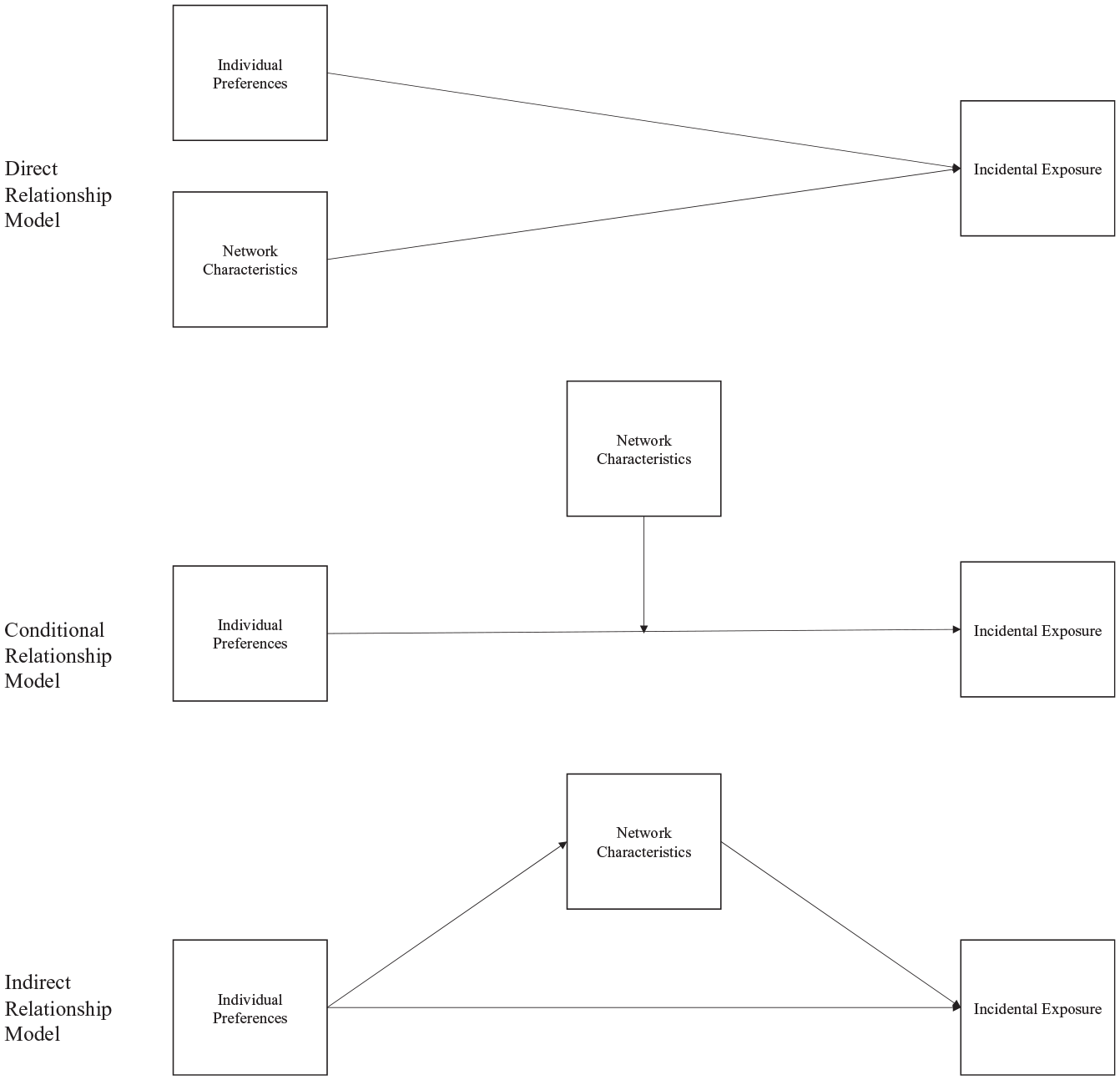
Diagrams illustrating direct-, conditional-, and indirect-effects models.
Compensatory models and network moderation
Theory suggests that information exposure in low- or partial-choice environments could have compensatory effects—that is, it has the potential to engage disinterested individuals with news and public affairs information (e.g. Strömbäck et al., 2013)—and incidental exposure on social media platforms seems to fit this scenario (Bode, 2016). Therefore, social media could provide a potential counter-current to the dynamics uncovered by Prior’s pioneering research, which established that the rise in media choice that resulted from the diffusion of cable television and Internet access in the 1980s and 1990s led to a decline in public engagement with the news among significant proportions of the mass public. Thus, even while the overall amount of news content consumed by the public grew during this time period, the size of the “purposeful” news audience shrank compared with news audiences of the past. The compositional effects of increased media choice on the proportion of individuals attending to and participating in politics and public life observed in the late 20th century and early 21st century have been profound (Prior, 2007).
Not long after the publication of Prior’s Post-Broadcast Democracy, however, dramatic increases in social media use, as well as significant advances in the use of algorithms and other data science tools to target distinct audience segments, began to complicate how individual choice shapes exposure to all kinds of media, including news and public affairs content. In response to these developments, scholars argued that incidental exposure has the potential to engage disinterested individuals with politics and public affairs (Valeriani and Vaccari, 2016). If they encounter the news by accident, people with low-to-moderate interest might learn, develop opinions, and participate in politics. This idea is borne out by recent research, which shows that it is related to news engagement (Karnowski et al., 2017; Kim et al., 2013; Oeldorf-Hirsch, 2018; Weeks et al., 2017; Yamamoto and Morey, 2019), political learning (Bode, 2016; Lee and Kim, 2017; Lu and Lee, 2019; but see Oeldorf-Hirsch, 2018; Shehata and Strömbäck, 2018), and political participation (Kim et al., 2013; Valeriani and Vaccari, 2016).
Pairing the idea of compensatory effects with the insight that characteristics of social networks enhance opportunities for incidental exposure leads to the development of research questions about network moderation. For example, if political interest is negatively related to incidental exposure, as compensatory models of incidental exposure suggest, and if incidental exposure is more likely among people with larger and more diverse social media networks, as outlined in the direct relationships model, the highest levels of incidental exposure should be observed among those with both low interest and large and/or diverse networks. Thus, in addition to being directly related to incidental exposure, characteristics of social networks may also amplify relationships between incidental exposure and individual user characteristics such as interest in politics, purposeful news consumption, and age (Ahmadi and Wohn, 2018; Boczkowski et al., 2018; Kümpel, 2020), leading to the question of whether network characteristics such as size and diversity moderate the relationship between the individual characteristics and incidental news exposure (
Stratificational models and network mediation
Recent scholarship has challenged arguments about the compensatory effects of social media, arguing instead that these platforms may have stratificational effects on news exposure and engagement (e.g. Kümpel, 2020; Thorson, 2020). These scholars downplay the role of social network characteristics, suggesting a greater emphasis on individual user preferences and algorithmic curation. This approach also calls into question the very nature of incidental exposure itself. For example, Thorson (2020) has argued that given the underlying commercial imperatives of social media platforms—and the attendant pull toward prioritizing content algorithmically determined to resonate with users’ preferences—it might be better to think about incidental exposure in terms of “attraction to news” (p. 1073, emphasis in original). Like the present study, this line of scholarship foregrounds inequalities in opportunities for incidental exposure, but it places a more primitive focus on user motivations and predispositions. These individual-level factors affect users’ behavior on social media platforms, and those behaviors are interpreted by curation algorithms in ways that shape the content that appears in users’ feeds. Pairing survey data with digital trace data that participants download from their Facebook accounts and supply to researchers, Thorson et al. (2021) find support for this reasoning, and argue that previous approaches to studying incidental exposure “under-emphasize the role of the individual in shaping content exposure” (p. 12).
Thorson and colleagues theorize that user interest in politics is associated with greater opportunities to see and engage with news and political information, because curation algorithms respond to users’ preferences and create opportunities for them to engage with the content they prefer to see. Thus, exposure to political information is less incidental and more a function of how “attractive” a user appears to algorithms based on trace data that platforms use as a proxy for individual interests (Thorson, 2020). In this light, network characteristics, particularly the cultivation of homophilous networks populated by friends with similar social positioning and political interest, should occupy a mediating role on par with and alongside other trace data that provide grist for algorithmic classification and curation mills. Based on this logic, Kümpel (2020) has argued that social media platforms contribute to a “Matthew Effect,” in which incidental exposure is more likely among those already interested and engaged in politics.
Drawing from these ideas, it is possible to specify an alternative model to those discussed earlier in the context of social curation. Whereas those models point to network characteristics as having direct or conditional relationships with incidental exposure, a model based on the news attraction approach posits a mediating role for social media networks, which facilitate the indirect relationships between individual characteristics such as political interest, purposeful news use, and age, on one hand, and incidental exposure, on the other hand. Such a model would expect that user proclivities toward engaging with news and public affairs content would translate into behaviors that reflect those proclivities, including cultivating larger networks composed of like-minded news junkies, which might, in turn, result in more incidental exposure. Therefore, we ask whether network characteristics mediate the relationship between individual characteristics and incidental exposure (
Methods
Sample and data
The study relies on a cross-sectional online panel survey fielded between 19 and 29 September 2018, 6 weeks before the 2018 US Midterm Elections. The survey was administered by Survey Sampling International (SSI)/Research Now (now called Dynata), which randomly selected subjects from an online panel using quotas for age, gender, race, and census region, which are based on population parameters from the US Census Bureau’s 2016 American Community Survey (ACS). The survey has a sample size of N = 1493 and a cooperation rate of 70% (AAPOR, 2016: CR3), which is an appropriate metric to report for online panel surveys (Callegaro et al., 2014). The sample is reflective of the population of interest (see Online Appendix Table A1). The median age is 49 (as compared with 48 in the ACS), and the majority of respondents are women (51% vs 50.8% in the ACS) and white (76.8% vs 76% in the ACS). The average respondent attended some college or has a 2-year degree (M = 4.4, SD = 1.7, where 1 = some high school and 7 = post-graduate degree), and has an annual household income between US$45,001 and US$75,000 per year (M = 4.8, SD = 2.1, where 1 = less than US$15,000 and 8 = more than US$150,000). The survey overrepresents people with college and graduate degrees, and it underrepresents people with a high school diploma or less. The survey also underrepresents people living in households making less than US$15,000 per year. Therefore, the data were weighted by income and education (see Online Appendix Table A2). Missing data were imputed using a Fully Conditional Specification (FCS) multiple imputation technique using the R package, “mice” (van Buren and Groothuis-Oudshoorn, 2011).
Measures
All measures are based on self-reported survey data, and network characteristics are measured at the individual level rather than the network level. Therefore, several key variables in the study, including measures of news exposure and network characteristics, are best interpreted as perceptions or recollections of behavior and/or network structures.
Incidental news exposure on social media
There are two approaches to measuring incidental exposure in prior literature. The first features wording introduced by Tewksbury and colleagues (2001) asking respondents how often they “encounter or come across” news, which is usually followed up with a phrase such as, “when you may have been going online for a purpose other than to get the news.” The second approach, piloted by Fletcher and Nielsen (2018), uses a two-stage measurement that first asks about news use and then asks how much was incidental. This study’s strategy borrows elements from both of these approaches. It uses the “encounter or come across” wording (see also, Kim et al., 2013), but it also ordered the questionnaire so that purposeful news use was measured just before incidental exposure. Thus, the question order made it clear to respondents that the second set of questions asks about incidental rather than purposeful news use, since they had already been asked about the latter. Using this approach, respondents were asked about incidental exposure in on six types of social media platforms (1 = never, 7 = very often): (1) online message boards or forums or mobile apps (e.g. Reddit or Digg), (2) social networking websites or apps (e.g. Facebook, Google+, MySpace, or LinkedIn), (3) microblogging websites or apps (e.g. Twitter or Tumblr), (4) photo-sharing websites or apps (e.g. Instagram, Flickr, or Pinterest), (5) video-sharing websites or apps (e.g. YouTube, Vimeo, or Periscope), and (6) mobile messaging websites or apps (e.g. Snapchat or WhatsApp). These platforms fit boyd and Ellison’s (2007) definition of social media: they afford users the ability to (1) create a profile, (2) articulate a list of connections, and (3) navigate these connections. Each respondent’s average on these six items was taken as the final variable (Cronbach’s α = .90), which means that each respondent’s scores were added and divided by 6. Figure 2 shows a histogram of the final variable. The variable has a positive skew (skew = 1.09, kurtosis = .27), owing to the relatively high number of respondents (25.87%) who answered “never” for all items (Mode = 1.0). For this reason, the median (1.8) is lower than the mean (M = 2.5, SD = 1.6). Despite the skew, nearly 75% of respondents report at least some incidental exposure, and the mean is statistically different from 1, t(1492) = 35.75, p < .001.
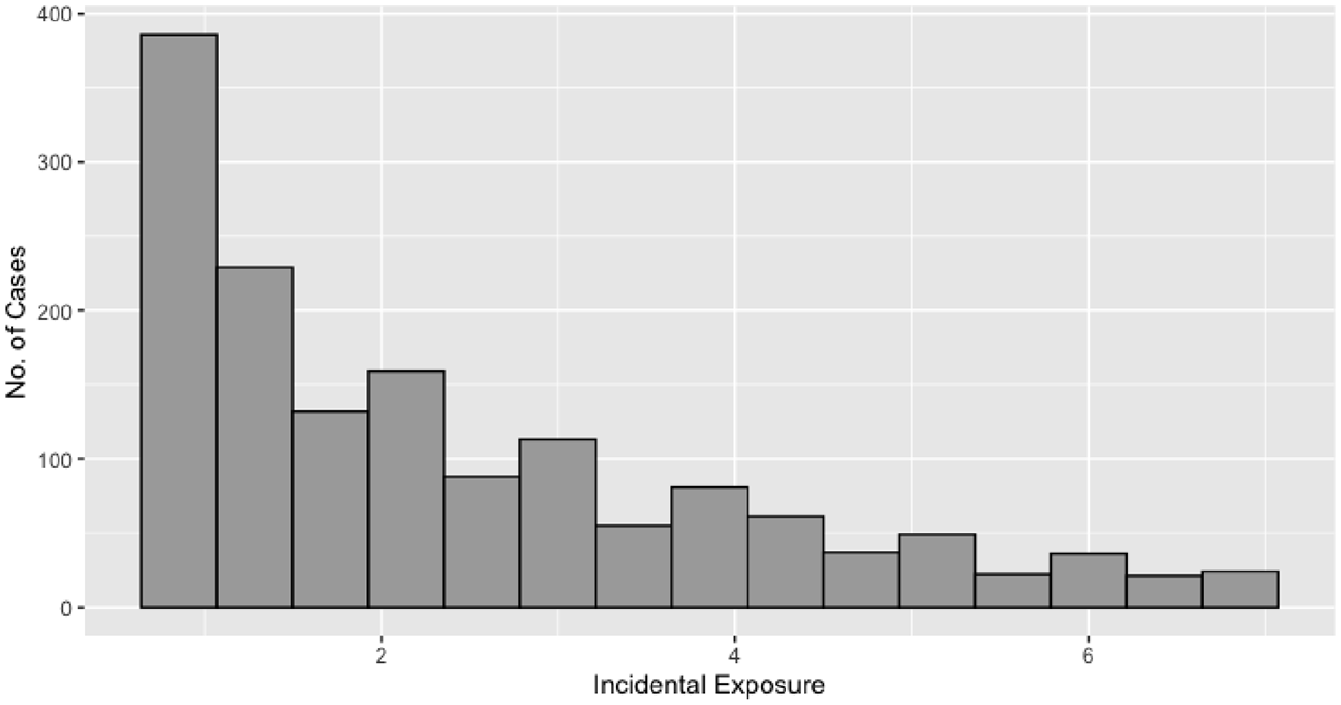
Histogram of incidental exposure.
Network size
The study relies on measures of social media talk networks rather than overall social media networks to capture active connections that are more likely to be made visible by news algorithms. The measures were adapted from prior literature (Eveland and Hively, 2009). Respondents were prompted: “From time to time, people talk with others about government, elections, politics, or the news.” They were then asked how many people they have talked to about “these subjects” on “social media sites (e.g. Facebook, Twitter, YouTube, Instagram)” in the last 12 months. The discussion measures use a relatively long timeframe to capture reasonable variation that includes individuals who may not discuss politics weekly or monthly (Barnidge, 2017; Mutz, 2002). The single item measuring network size was logged to normalize the distribution, and the logged variable has a mean of 1.1 (SD = 1.5).
Network diversity
Respondents were asked how often (1 = never, 7 = very often), in the last 12 months, they talked about those subjects on social media with family members, friends, coworkers or classmates, acquaintances, people on the left, people on the right, people who have very different political views, people who have very similar political views, people of a different nationality, people living in a different city, and people living in a different country. These items were averaged for each respondent (Cronbach’s α = .97, M = 2.4, SD = 1.7).
News use
Based on prior literature (Bakker and De Vreese, 2011), respondents were asked how often (1 = never, 7 = several times a day) they “get news” from national newspapers, local newspapers, national magazines, national television, local television, cable television, talk radio, public radio, online-only sites, online sites for news organizations, podcasts, online message boards, social networking websites or apps, microblogging websites or apps, blogging websites, photo sharing websites or apps, video sharing websites or apps, and mobile messaging websites or apps. These items were averaged for each respondent (M = 2.9, SD = 1.2).
Political interest
Political interest was measured with three items, based on prior literature (Brady et al., 1995), that asked respondents to rate their interest in local or regional politics, national politics, and international politics (1 = not at all, 7 = very). These items were averaged (Cronbach’s α = .89, M = 4.4, SD = 1.7).
Age
Age was measured with a single item. The average respondent is 48.39 years old (SD = 15.8). The youngest was 18 at the time of data collection, and the oldest was 89.
Gender
Gender was measured with a single survey item. The item accounted for non-binary gender by including an “other” category, then asking respondents to specify. Only three respondents identified as non-binary, rendering a three-level factor statistically infeasible. Therefore, we created a binary variable where 1 = not male (51%) and 0 = male (49%). Alternative categorization of non-binary individuals does not substantially alter the results.
Race
Race was measured with a single survey item asking respondents how they would describe their race or ethnicity. Choice categories included American Indian or Alaska Native, Asian, Black or African American, Native Hawaiian or other Pacific Islander, white (including white-identifying Hispanic people), multiple races (specify), and other (specify). These categories were collapsed into a dichotomous variable (1 = person of color, 0 = white). About a quarter (23.2%) of the sample identifies as a person of color.
Socioeconomic status
Based on prior research (DiMaggio et al., 2004), socioeconomic status was constructed using two survey items: education (1 = some high school, 7 = post-graduate degree) and annual household income (1 = less than US$15,000, 8 = more than US$150,000). Because these items were measured on different scales, they were standardized before they were averaged (r = .43, M = 0.0, SD = 0.9).
Analysis and results
Before testing the models in Figure 1, it is worth taking some time to describe the respondents who live in social media news deserts, that is, those who report no incidental exposure. These “desert dwellers” make up about one quarter of the sample (25.9%). To assess which variables make it more likely that a given respondent is a desert dweller, the independent variable was recoded (1 = some incidental exposure, 0 = none) and predicted with logistic regression (logit) models. Results are reported in Appendix B online. Among the demographic variables, only gender and age are significantly related to the outcome. Men are about 1.86 times more likely than women and non-binary individuals to be desert dwellers (see Table B1). Meanwhile, a 45-year-old respondent is ~ 15% less likely and a 70-year-old respondent is ~ 35% less likely than a 20-year-old respondent to report incidental exposure (see Figure B1). Of the independent variables, news use is a strong predictor of incidental exposure, where each 1-unit increase in news use more than doubles the odds of incidental exposure (OR = 2.52). Finally, both network size and diversity are statistically significant predictors. For network size, a 1-unit increase on the logged scale (~2.72 additional discussants) increases the odds of exposure by a factor of 1.25. For diversity, a similar change increases the odds by a factor of 1.31.
Turning now to the models in Figure 1, direct relationships with incidental exposure were tested using two ordinary least squares (OLS) regression models, which are reported in Table 1.1,2 The first model does not include the two intervening variables, namely, network diversity and network size, yielding estimates of direct relationships for (1) news use, (2) political interest, and (3) age before network and size are entered into the model. The strongest relationship is observed for news use, which has a standardized coefficient (b) of .64 (p < .001). Age is also a strong predictor, with a standardized estimate of b = −.29 (p < .001). These relationships are consistent in the second model, which adds network size and diversity, although the coefficients are smaller. In support of H1 and H2, size and diversity are both positively related to incidental exposure, and the standardized effect sizes are moderate (b = .11 for size and b = .14 for diversity, p < .001). This second model explains a good deal of the variance in incidental exposure (adjusted R2 = .66). Taken together, these results suggest some strong direct relationships with incidental exposure. Younger people, people who self-report using news more often, and people who self-report larger 3 and more diverse networks are more likely to incidentally encounter news on social media platforms.
Direct-effects models predicting incidental exposure.
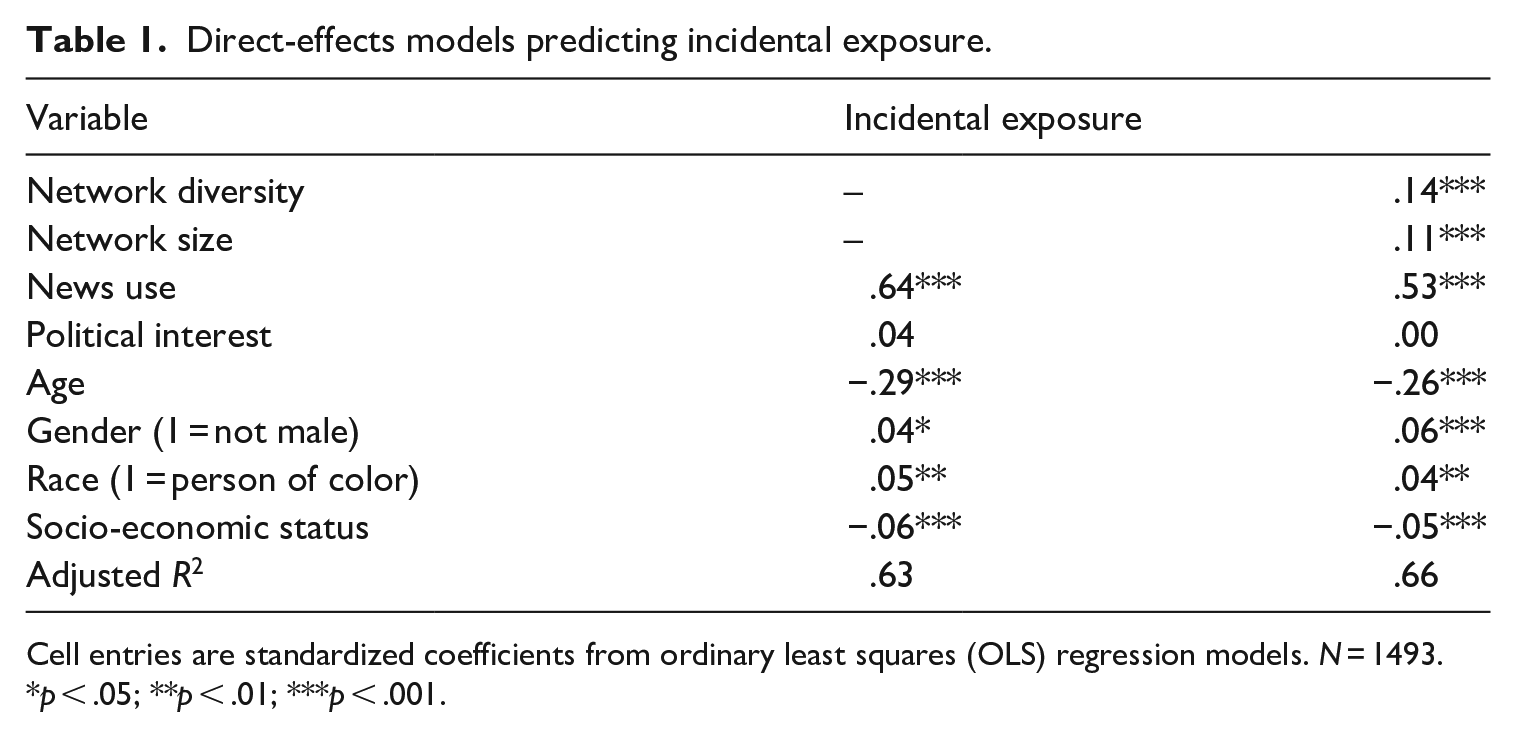
Cell entries are standardized coefficients from ordinary least squares (OLS) regression models. N = 1493.
p < .05; **p < .01; ***p < .001.
Second, conditional “effects” on incidental exposure (RQ1) also were tested using a series of OLS models, which included interaction terms between each of the three independent variables (news use, political interest, and age) and each of the intervening variables (network diversity and network size). Each interaction was tested in a separate model (six in total). Table 2 reports the standardized coefficients for the interaction terms, as well as the R2 change from the “direct-effects” model reported in Table 1 (Model 2).
Key results from conditional-effects models predicting incidental exposure.
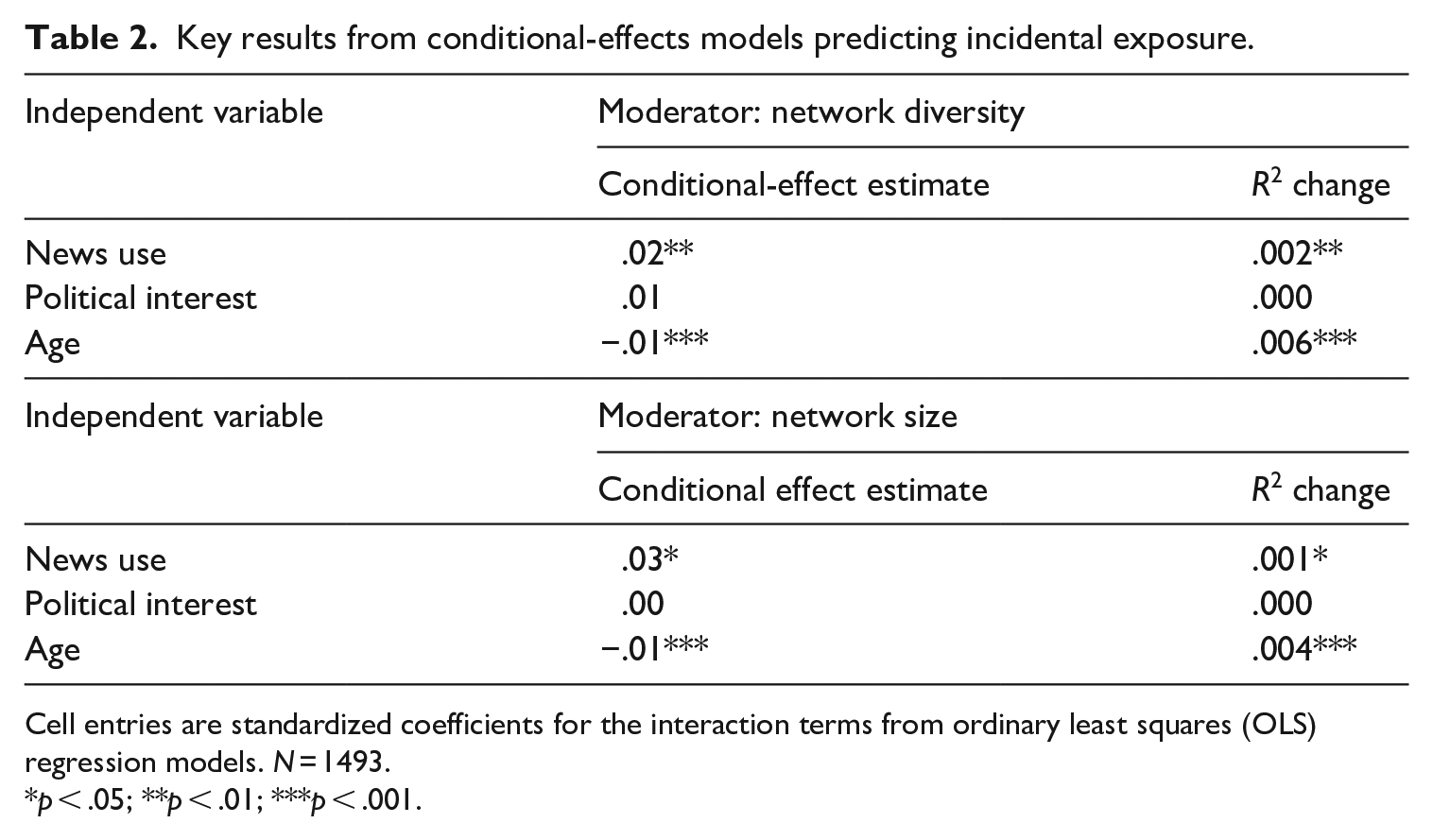
Cell entries are standardized coefficients for the interaction terms from ordinary least squares (OLS) regression models. N = 1493.
p < .05; **p < .01; ***p < .001.
When network diversity is included as a moderator, significant interaction terms are observed for news use (b = .02, p = .005) and age (b = −.01, p < .001). These conditional relationships are visualized in Figures 3 and 4. Figure 3 shows that the relationship between news use and incidental exposure is stronger among respondents with more diverse networks and weaker among respondents with less diverse networks. A Johnson–Neyman test shows an effect size of approximately b = .65 at the lowest levels of diversity and .80 at the highest level, and both of these estimates are statistically significant (p < .001). Figure 4 shows that the negative relationship between age and incidental exposure is strongest where diversity is low, and weakest where diversity is high. Once again, a Johnson–Neyman test shows that all of these slopes are statistically less than zero, with an effect size of b = −.02 at the lowest levels of diversity and b = −.05 at the highest levels (p < .001 for both). Thus, diversity moderates the relationships of news use and age on incidental exposure. Therefore, to a limited extent diversity exacerbates information inequalities based on purposeful news use and age.
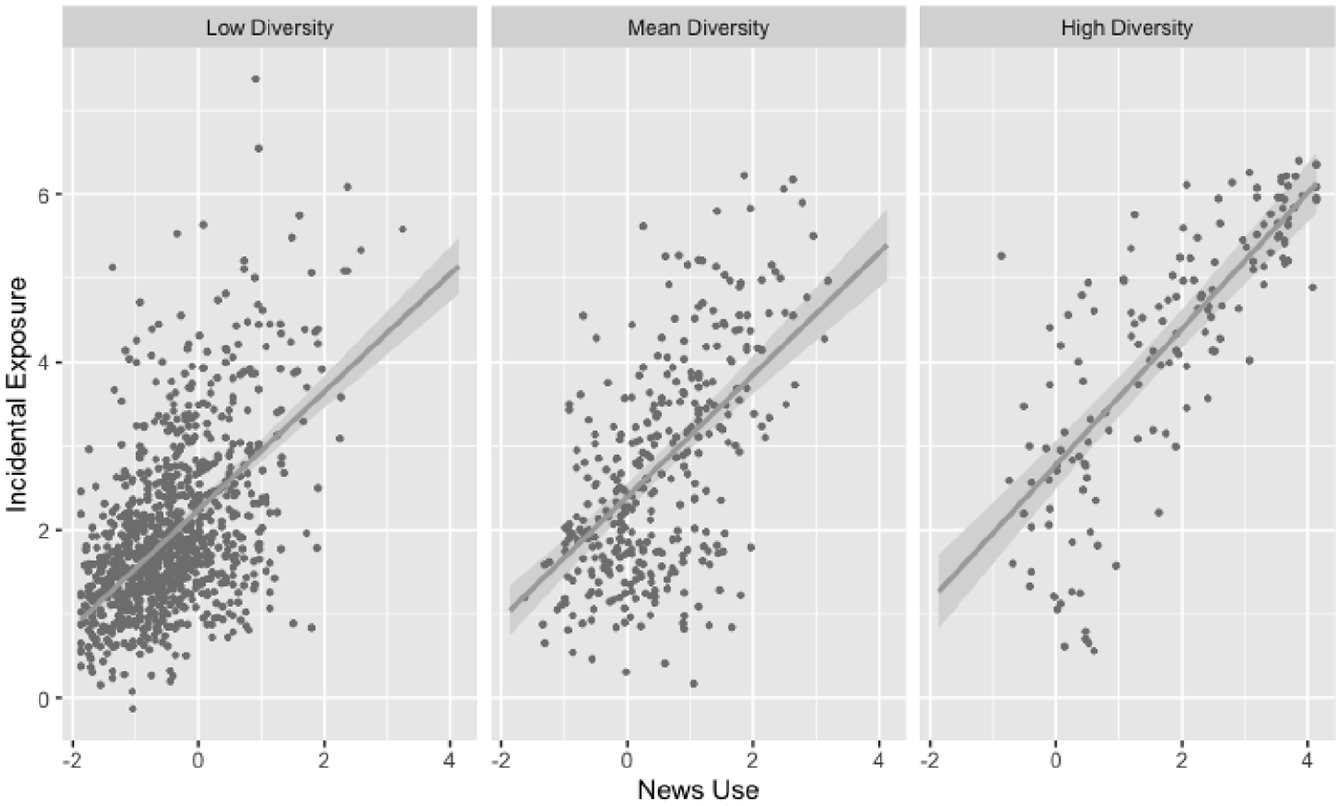
The conditional effects of news use on incidental exposure at various levels of network diversity.
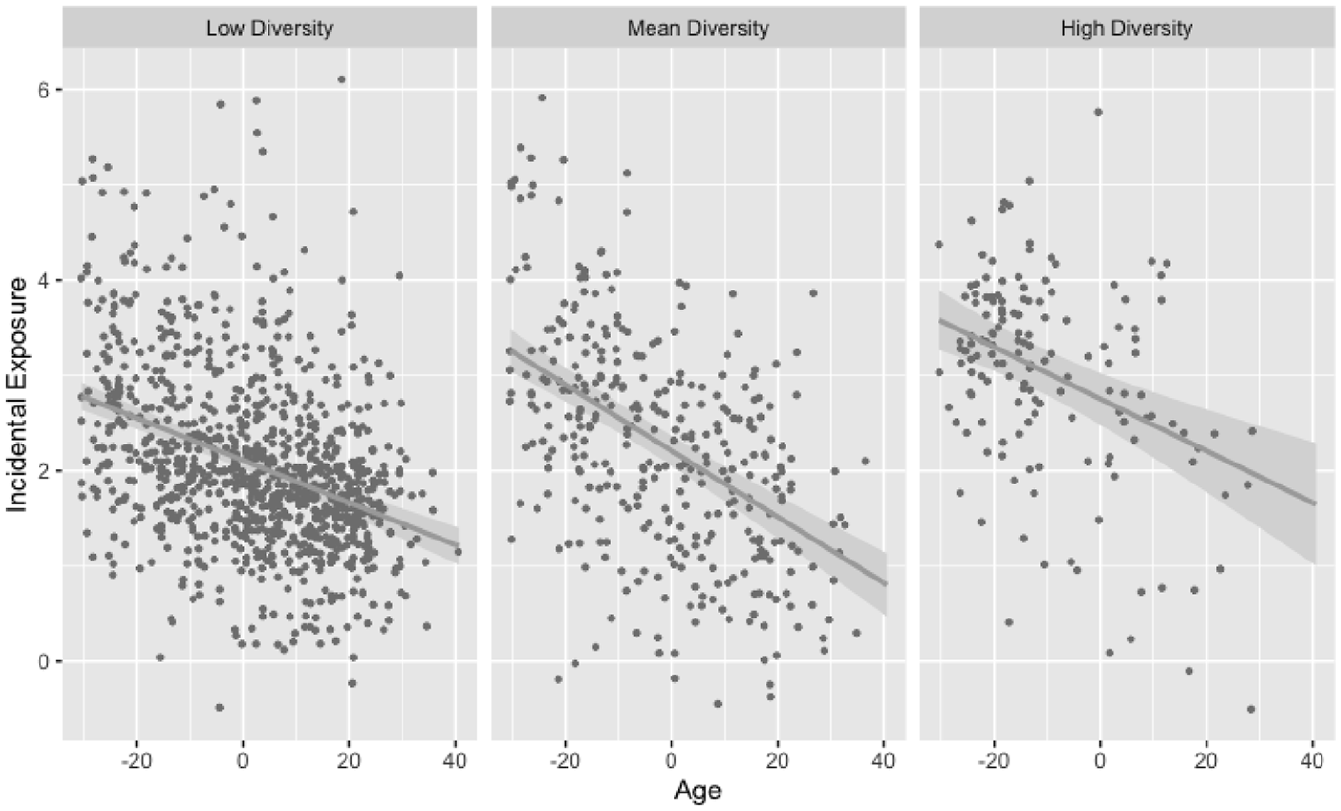
The conditional effects of age on incidental exposure at various levels of network diversity.
A similar pattern is observed when network size is included as a moderator. The positive relationship between news use and incidental exposure is stronger among respondents with larger networks (b = .03, p = .015), as is the negative relationship between age and incidental exposure (b = −.01, p < .001). These relationships are visualized in Figures 5 and 6. A Johnson–Neyman test shows a news use effect size estimate of .67 in small networks and .88 in large networks, and both of these estimates are statistically different from zero (p < .001). Meanwhile, a Johnson–Neyman test shows that the age effect size is approximately −.02 in small networks and −.05 in large networks (p < .001 for both). Therefore, network size also exacerbates information inequalities based on purposeful news use and age, albeit to a limited extent. 4
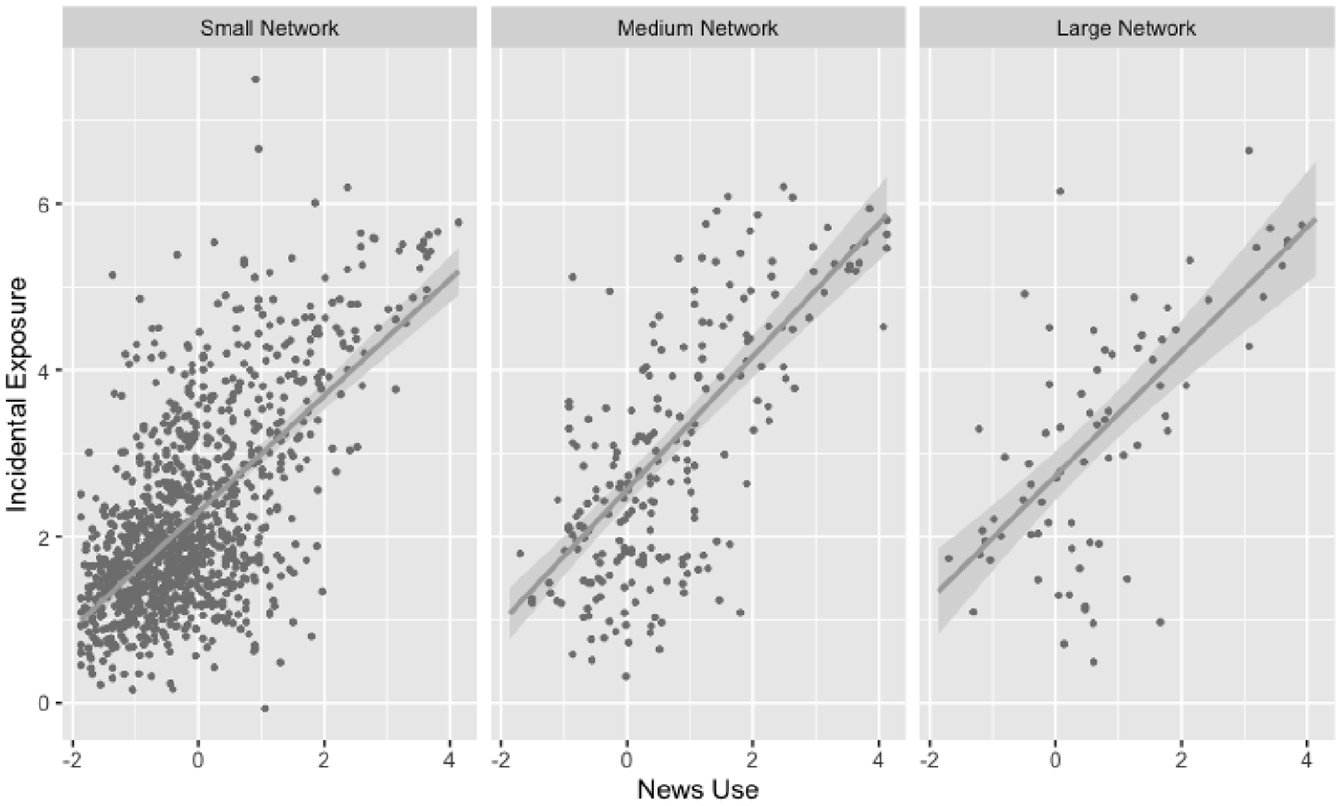
The conditional effects of news use on incidental exposure at various levels of network size.
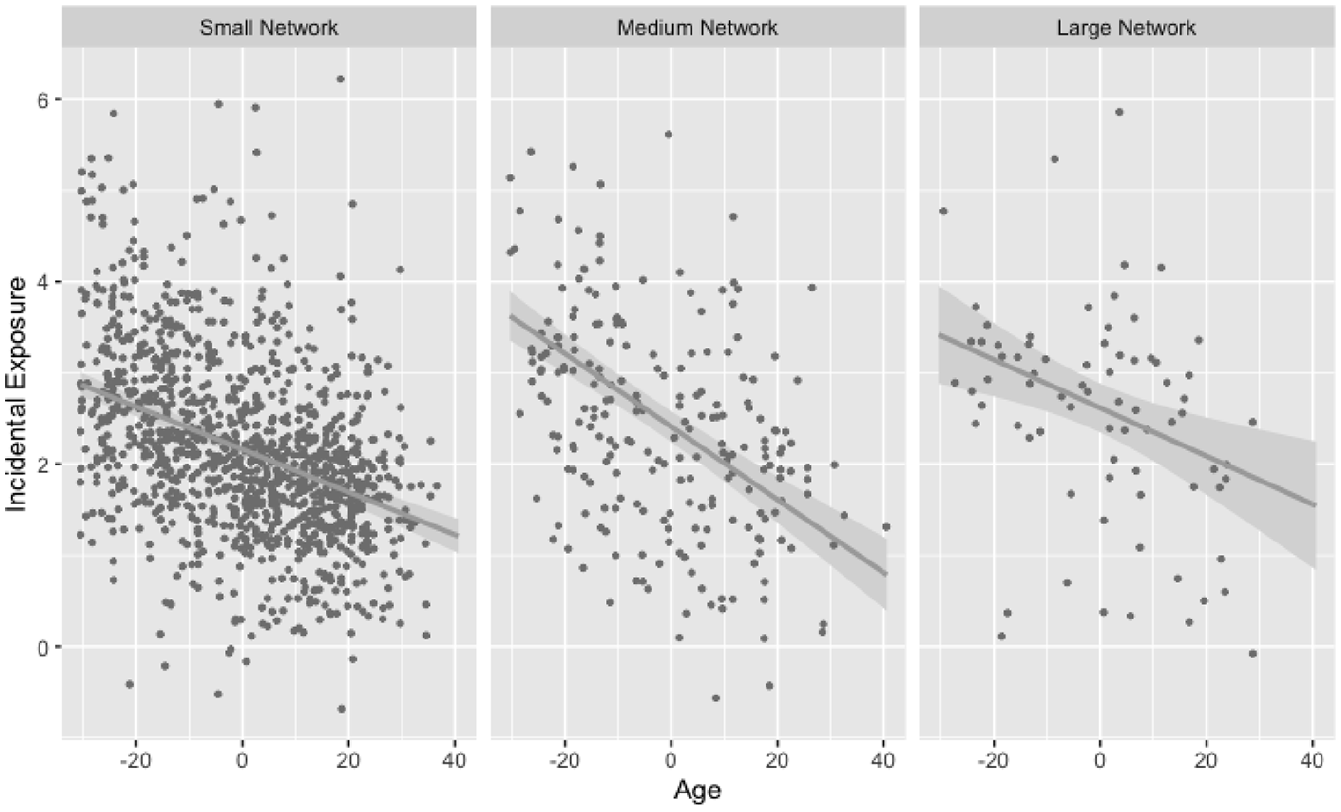
The conditional effects of age on incidental exposure at various levels of network size.
Third, indirect “effects” (RQ2) were estimated using the R package “mediation” (Tingley et al., 2019). This package is similar to PROCESS (Hayes, 2013), 5 but “mediation” can accommodate weighted regression models, whereas PROCESS cannot. Once again, separate models were fit for each combination of dependent variables and intervening variables, resulting in eight mediation models, in total. Key results are reported in Table 3.
Key results from indirect-effects models predicting incidental exposure.
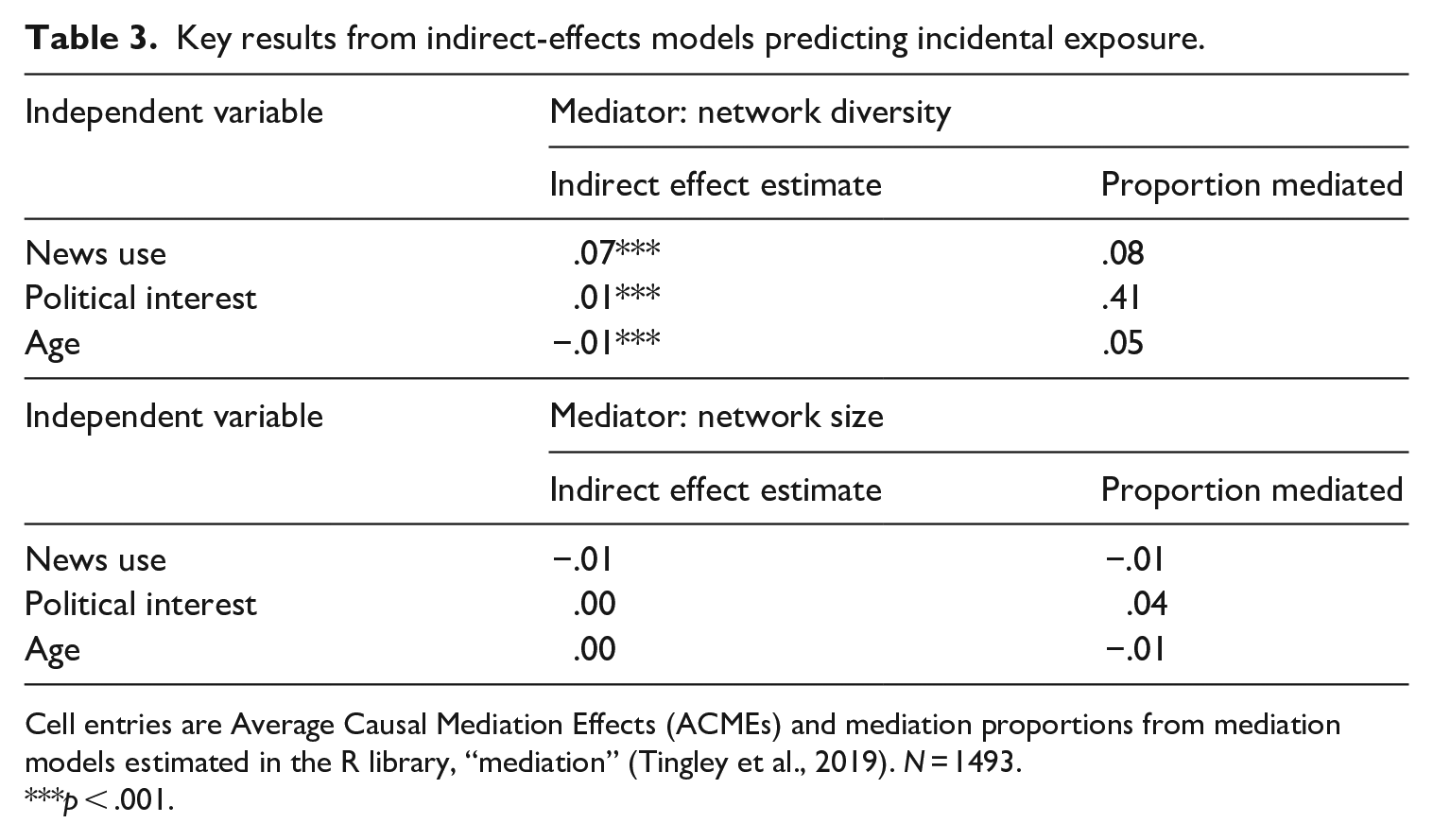
Cell entries are Average Causal Mediation Effects (ACMEs) and mediation proportions from mediation models estimated in the R library, “mediation” (Tingley et al., 2019). N = 1493.
p < .001.
Results show evidence of indirect relationships when network diversity is included as a mediator, but not when network size is included as a mediator. 6 For example, the indirect effect (called the “Average Causal Mediation Effect,” or ACME) of news use on incidental exposure is .07 (p < .001) via diversity, but −.01 (p = .12) via size. A similar pattern is observed for age, which has an ACME of −.01 (p < .001) via diversity, but .00 (p = .48) via size. These results provide evidence of both direct and indirect effects (through diversity) for news use and age.
For political interest, the ACME is b = .01 (p < .001) via diversity, while the direct effect is not statistically significant. Thus, political interest diverges from news use and age in that the evidence supports only indirect effects rather than both direct and indirect effects. All told, the mediation results indicate that network diversity facilitates the positive effects of news use and political interest on incidental exposure, as well as the negative effect of age. However, network size does not act as a mediator for any of the three independent variables.
Discussion
Many individuals today live in what may be considered social media news deserts, and such conditions may be related to all-too-familiar forms of social inequality. While the evidence suggests that “desert dwellers” are more likely than non-dwellers to be men and older individuals, the evidence does point to a related concern that social media news deserts may be considered a form of digital inequality—one that produces unequal exposure to political and public affairs information and disadvantages those in low-information networks. These inequalities are concerning because they may limit the extent to which social media potentially soften the well-known impacts of media choice on the distribution of political information. Exploring these inequalities led to the development of theoretical models that offer formal expectations about how individual preferences and network characteristics shape incidental exposure to news and public affairs information on social media platforms, and thereby sharpen our understanding of how these factors facilitate information flows in the contemporary media environment.
Drawing on a survey data set that reflects the national population, the analyses show network size and diversity are important predictors of incidental exposure. In addition, the findings suggest network characteristics and individual preferences are interrelated. The results provide evidence of both mediated and moderated relationships. In particular, network diversity mediates the influence of all three individual-level variables: purposeful news use, political interest, and age. Moderation models are less consistent, but show both network size and diversity moderate the influence of news use and age. While the analysis doesn’t allow for definitive conclusions regarding the question of whether networks act as mediators or moderators, the findings do lead to the conclusion that incidental exposure results from the confluence of individual-level interests and behaviors, which influence curation algorithms (Thorson et al., 2021), and network diversity, which facilitates the spread of novel information (Granovetter, 1973). Moreover, people who are interested in public affairs tend to construct diverse networks, and therefore, individuals who reside at this confluence are likely to benefit disproportionately to others from social media’s ability to spread information. These dynamics exacerbate information inequalities, producing a “Matthew Effect” of news exposure (Kümpel, 2020). Thus, social media networks have stratificational rather than compensatory effects, as network-based digital inequalities create unequal levels of political information exposure.
It is important to disclose the study’s limitations before discussing its implications for theory. First, the design is cross-sectional, and these data cannot be used to make causal inferences. While the variables are ordered by theoretical expectations, the design does not account for time order and the possibility of spuriousness cannot be eliminated. Future research could employ a longitudinal design that features an appropriate time lag to capture the slow development of discussion networks. In particular, mediation results should be interpreted with caution, as longitudinal data are needed to establish time order in causally mediated relationships. That said, this is a limitation of the data and not theory, as the study has tested several plausible models based on theoretical propositions. Based on these findings, future research should provide additional tests of these models. A second design limitation is that the sample is not a true probability sample, although it does reflect the target population along key criteria.
The study is also limited by the measurement of incidental exposure, which takes a respondent’s average score across various platforms as an indicator of overall exposure. It is possible that a respondent who is heavily exposed on a single platform received the same score as a respondent who is lightly exposed across multiple platforms. Future research could explore alternative measurement strategies. Question wording presents another limitation. While the wording is based on prior literature, subsequent studies have added to the “encountered or come across” wording by including phrases such as “even if you are not looking for news.” Future research could test wording effects and validate measures of incidental news exposure. Other measurement limitations are related to the use of self-reports, which are susceptible to inaccurate recall. For example, the network size item relies on this kind of self-reported measure, and it could be that respondents have over- or under-estimated the size of their actual networks. While this is not ideal, it does not bias estimates so long as error is not systematic. In addition, despite the strong theoretical influence of concepts derived from network analysis, network characteristics are measured at the individual level rather than the network level. We took this approach to maximize the study’s contribution to and comparability within a specific literature that is dominated by individual-level data and analysis. Nonetheless, future studies may benefit from exploring these phenomena using network-level data and analysis.
The analysis is limited in that it did not explore platform-specific results. There are important differences between specific platforms in terms of their affordances and norms, and these differences could shape incidental exposure in unique ways. Finally, future research could build upon this study by testing, for example, three-way interactions or serial mediation models.
Despite these limitations, the findings offer a number of contributions to the literature on incidental exposure, as well as the broader body of scholarship on social media use and political communication. The idea that network characteristics are important for incidental news exposure on social media platforms is not novel (e.g. Anspach, 2017; Bode, 2016). But the current findings are unique in that they arise from tests of the interrelationships between network characteristics and individual preferences, a contribution to the literature that simultaneously addresses arguments related to both social curation and news “attractiveness” (Ahmadi and Wohn, 2018; Thorson, 2020). The latter argument posits that while individuals may not directly choose content, their preferences nonetheless shape news exposure via their influence on curation algorithms and the composition of social networks (Thorson et al., 2021). Interested individuals surround themselves with other interested individuals, and, at the same time, algorithms deliver high volumes of news and political information to their feeds.
The current findings both extend and complicate this narrative. A portion of exposure is not directly related to interests, but rather driven by social networks. Substantial effects are observed for both network size and diversity, even when controlling for individual-level variables. In fact, network diversity has a larger effect size than political interest, which is not statistically significant in the direct relationship model. This finding challenges the notion that the relative impact of social network characteristics is overstated (Thorson, 2020), and suggests that future research should consider both individual-level factors and social network characteristics rather than debate which set of factors is most central to the process. While news exposure on social media platforms results, in part, from intentional-but-indirect choices, it is also shaped by the choices of others who post and share content, which spreads easily through large and diverse social networks (with some differences among platforms). This dynamic produces stratificational effects in news exposure, as people who construct “newsy” social networks receive more political content and public affairs information than those who do not.
The findings also suggest that the prevailing narrative would benefit from rethinking the role of network homogeneity. According to the logic of the news “attractiveness” approach, the indirect relationship between individual preferences and incidental exposure should be facilitated by network homogeneity. But this study finds the opposite—the indirect relationship is facilitated by network heterogeneity. Therefore, the findings suggest an amendment to arguments centered on the primacy of individual characteristics. Based on the current data (and with important caveats about platform differences), interested individuals are, in part, incidentally exposed to news because they have more diverse networks, not less diverse networks, because diversity (and size) aids the spread of information. This conclusion also serves as an important reminder: incidental exposure is as much about exposure to political difference as it is about political learning and engagement (Lu and Lee, 2019). That is, its theoretical and normative importance lies not just in its ability to draw people back into public affairs (Prior, 2007), but also in its tendency to expose people to different points of view (Barnidge, 2020), which occurs because news that is encountered incidentally comes from a more diverse array social contacts who curate content from a range of news sources. 7
In all, the results of this study offer clear pathways for future research on both individual characteristics and social network properties in explaining patterns of incidental news exposure. In particular, fruitful avenues include (1) specifying which individual-level variables are the best predictors of incidental exposure, and (2) testing how these variables are interrelated with network characteristics. To the first point, the findings suggest that news use and age may be stronger predictors than interest, and to the second point, additional research is needed to sort out whether network characteristics act as a mediator or a moderator (or both). Finally, the findings suggest that more thoroughly investigating informational inequalities that arise from social media news deserts is critical to understanding the dynamics of political information flows in the social media era. Improving our understanding of this phenomenon has obvious normative importance in terms of encouraging informed, engaged, and inclusive citizenship.
Supplemental Material
sj-docx-1-nms-10.1177_14614448211059529 – Supplemental material for Social media news deserts: Digital inequalities and incidental news exposure on social media platforms
Supplemental material, sj-docx-1-nms-10.1177_14614448211059529 for Social media news deserts: Digital inequalities and incidental news exposure on social media platforms by Matthew Barnidge and Michael A Xenos in New Media & Society
Footnotes
Funding
The author(s) disclosed receipt of the following financial support for the research, authorship, and/or publication of this article: This work was supported by the Research Grants Committee at the University of Alabama; the Institute for Communication and Information Research at the University of Alabama; and the Department of Journalism & Creative Media at the University of Alabama.

Supplemental material
Supplemental material for this article is available online.
Notes
Author biographies
References
Supplementary Material
Please find the following supplemental material available below.
For Open Access articles published under a Creative Commons License, all supplemental material carries the same license as the article it is associated with.
For non-Open Access articles published, all supplemental material carries a non-exclusive license, and permission requests for re-use of supplemental material or any part of supplemental material shall be sent directly to the copyright owner as specified in the copyright notice associated with the article.
