




Abstract
Social media users incidentally get exposed to news when their networks provide content that they would otherwise not seek out purposefully. We developed a scale of incidental news exposure on social media and conducted a survey to examine its antecedents. We found that information received through weak ties, rather than strong ties, was significantly associated with incidental news exposure. The amount of time spent, frequency of getting news updates, and the frequency clicking on news-related links on social media were correlated with incidental exposure. Our findings suggest that promoting news consumption on social media can be achieved not only through giving users information they want but also by exposing users to information they are not consciously looking for.
Social media is increasingly becoming a major source of news (Gottfried & Shearer, 2016). Users discover news through multiple channels, directed communication with contacts (e.g., receiving a link to an article in a message), and/or viewing posts that their friends share in some form of feed. According to the Pew Research Center, 44% of adults in the United States get news through Facebook (Gottfried & Shearer, 2016). About 63% of Facebook users get news outside the domain of family and friends and from a variety of topics, which enables them to meet their different information needs (Barthel, Shearer, Gottfried, & Mitchell, 2015).
Discovering information through news on social media may happen with the purposeful application of information searching skills and strategies. However, users may also be exposed to news that they would otherwise not actively seek. We refer to this type of exposure as incidental news exposure. In fact, 59% of Facebook users have reported that they incidentally get exposed to news on this platform every day or almost every day (Purcell, Raine, Mitchell, Rosenstiel, & Olmstead, 2010).
Facilitating incidental news exposure on social media might be different from other media because there has been a focus on the personalization of content delivered to users on social media platforms (Pariser, 2011). These platforms use algorithms that determine what content users are exposed to (Bozdag, 2013). Pariser (2011) has argued that focusing only on the users’ past behaviors or preferences on social media may lead to a “personalization bubble” which provides benefits but reduces chances of incidental exposure and may limit personal learning, insight, and creativity.
Incidental news exposure is becoming a common form of news consumption behavior on social media (Purcell et al., 2010) and studies have shown that it plays an important part in how users get access to valuable information and novel ideas and perspectives (Boczkowski, Mitchelstein, & Matassi, 2018; Oeldorf-Hirsch, 2018; Zuckerman, 2011). This highlights the role of algorithms in social media that are used to determine the content that social media users see through their networks. These algorithms may have important impacts on how people consume information and have even more profound effects on shaping people’s sense of reality (Wohn & Bowe, 2014). If there are algorithms that could facilitate or even encourage incidental news exposure, understanding its antecedents and consequences may potentially have major societal impacts.
This study aims to shed light on what factors are associated with incidental news exposure on social media. The theoretical contributions of the study include knowledge about (a) two categories of factors predicting incidental news exposure on social media platforms, namely, information-seeking motivations and network characteristics; (b) the connection between incidental news exposure and the amount of time spent getting news updates, the frequency of getting news updates, and the frequency of clicking on news-related links on social media.
Literature Review
Incidental News Exposure
The prevalence of the Internet has provided new opportunities for incidental news exposure (Yadamsuren & Erdelez, 2010), which happens when individuals acquire news while they are not consciously looking for it. Tewksbury, Weaver, and Maddex (2001) found that Internet users accidentally discover news while engaged with other news-related and non-news-related online activities. Yadamsuren (2009) also found that incidental exposure to news on the Internet create memorable experiences in which individuals find interesting and useful news when they are engaged in different online activities. Yadamsuren and Heinström (2011) conducted an online survey followed by interviews and found that getting exposed to news incidentally can strengthen emotional reactions that people may have to the news. All the studies that were mentioned have highlighted the importance of understanding factors that could facilitate incidental news exposure. However, these discoveries in the context of social media may be of a fundamentally different nature.
Incidental News Exposure on Social Media
Social media platforms create networks and virtual communities that transcend geographic boundaries and support individuals generating various types of information and expression and sharing them with others. Individuals who use these platforms may have a wide range of motivations, which have been of interest to scholars. For instance, by conducting a review of the literature, Nadkarni and Hofmann (2012) found that the need for self-presentation and the need to belong are two primary motives behind the use of Facebook. In literature, scholars have studied motivations by considering individuals as the audience who are actively selecting and using specific media to satisfy particular needs. This approach has enabled these scholars to investigate gratifications that are obtained from the specific media. Over years, the approach has formed a theoretical lens known as the Uses and Gratifications (U&G) framework (Ruggiero, 2000). Whiting and Williams (2013) used the U&G approach and found 10 goals for using social media, namely, social interaction, information seeking, pass time, entertainment, relaxation, expression of opinions, communicatory utility, convenience utility, information sharing, and surveillance/knowledge about others.
Despite evidence for purposeful information seeking and sharing, individuals who use social media for any of the purposes mentioned above may still experience instances of incidental news exposure. In a study using the 2015 Reuters Institute Digital News Report survey, Fletcher and Nielsen (2017) found that individuals who use Facebook, YouTube, and Twitter for non news-related purposes incidentally get exposed to news. For this group of individuals, the authors found a positive correlation between incidental news exposure and their use of online news sources and also that age and interest negatively moderate this correlation. Boczkowski et al. (2018) conducted interviews with 50 Argentinians, to understand how incidental news exposure occurs. These studies, however, did not examine instances in which individuals who use social media to specifically seek information experience incidental news exposure.
In this study, we aim to address this gap by investigating incidental news exposure that occurs when individuals use social media for information-seeking purposes. Information seeking is defined as a conscious attempt to obtain information in response to a knowledge gap or a particular need (Case, 2012). Prior research has shown that information seeking is one of the primary motivations that drive individuals to consume news. Flavián and Gurrea (2006) examined survey data to investigate motivations behind reading newspapers. They found a significant positive relationship between reading online newspapers and the motivation which was linked to seeking breaking and updated news. You, Lee, Lee, and Kang (2013) examined how online users’ motivations affect in-depth reading of news and found information-seeking motivations to be one of the primary motivations. Shim, You, Lee, and Go (2015) studied reasons behind the consumption of news on mobile devices using surveys and found that information-seeking motivations were the factor which determines mobile news usage.
Diddi and LaRose (2006) studied news consumption patterns among undergraduate students in the pre-social media age. They found five different patterns: broadcast news, Internet news, cable news, comedy news, and hometown newspaper. They also found that motivations related to seeking news and in-depth information were among the predictors of news consumption behaviors among all of the patterns. These studies have shown the important role of information-seeking motivations in news consumption of individuals using various news sources and platforms.
While information seeking is defined as goal-directed and purposeful in literature (Wilson, 1999), incidental exposures are mostly linked to browsing (Boyce, Meadow, & Kraft, 1994) which is passive and unintentional. This has made incidental exposures a paradoxical concept with regard to information seeking. However, this study follows the conceptual framework for information encountering by Erdelez (2004) which focuses on incidental exposures embedded within information-seeking processes. Thus, when defining incidental news exposure, we focus on “incidental exposures within information seeking” (McBirnie, 2008), which is different from browsing. This means that individuals may unintentionally get exposed to information they need when they look for different needed information. Thus, purposeful intention to seek information may be positively related to incidental news exposure.
When examining incidental exposures in information seeking, the type of information one is seeking could be relevant to the occurrences of these exposures. For example, reading a general-interest story may lead to other general-interest stories or non-related stories, while reading about a specific topic may be more difficult to lead to other topics. We aim to use U&G approach to examine which information may be related to incidental news exposure:
RQ1. Which motivations for seeking which types of information are significantly associated with incidental news exposure on social media?
In addition to motivations behind incidental news exposure, the characteristics of networks around individuals may also significantly affect the way individuals get exposed to information. An important factor here is the strength of ties around individuals, defined as a “combination of the amount of time, the emotional intensity, the intimacy, and reciprocal services which characterize the tie” (Granovetter, 1973). This concept categorizes ties in social networks into two groups: strong ties as connections to family members and close friends, and weak ties that are formed by the connections to more distant individuals. Strong ties are crucial for emotional bonding, social support, and formation of trust, while weak ties are responsible for the transmission and diffusion of information in social networks and also how these networks are structured and embedded.
Studies examined the correlation between tie strength and incidental exposures. Williamson (1998) found that both incidental exposures and purposeful information seeking took place within both intimate and wider personal networks, while Lee and Kim (2017) found the network heterogeneity was positively related with incidental exposure. Meanwhile, several studies have found that bridging and weak ties which span different clusters within a network are the paths through which members are exposed to novel information (Bakshy, Messing, & Adamic, 2015; Resnick, 2001). Zhao, Wu, and Xu (2010) found that when removing weak ties from the social networks around users on Facebook and YouTube decreases the information coverage sharply, highlighting that weak ties play an importation role in the diffusion of information on social media. In another study with 253 million Facebook users, Bakshy, Rosenn, Marlow, and Adamic (2012) found that while stronger ties tend to be individually more influential, ties that are weak and abundant play a more important role in the propagation of novel information.
The theoretical reasoning behind these findings is that in a social structure, information flows better when there are bridging or weak ties because stronger ties are more likely to have similar information to oneself (Granovetter, 1973) and individuals who are more connected to their weak ties are more likely to get novel and diverse information. Since incidental news exposure is also likely to be novel, we expect that more information from weak ties will be associated with more incidental news exposure:
H1. Receiving information through weak ties on social media is positively related to incidental news exposure.
Another network-related factor which may affect incidental news exposure is the diversity of network around individuals, which is correlated with various positive impacts on physical, mental, and social aspects of individuals’ lives (Cohen, Doyle, Skoner, Rabin, & Gwaltney, 1997; Erickson, 1996; Putnam, 2000). Network diversity also significantly affects individuals getting exposed to novel and heterogeneous sets of information (e.g., job-related information; Granovetter, 1974), opinions, and news sources (McLeod, Sotirovic, & Holbert, 1998).
On social media platforms such as Facebook, the composition of social networks around individuals limits the mix of content that individuals are exposed to as Bakshy et al. (2015) found. In other words, having access to different people in users’ social network will influence what content they see, which may affect their incidental exposures to news:
H2. The diversity of users’ networks on social media is positively related to incidental news exposure.
Method
To examine our research questions and hypotheses, we ran a survey of 250 participants from the United States. These participants were recruited through Mechanical Turk (MTurk), a service by Amazon which allows recruitment of individuals and does not require any close interactions with them. While not a nationally representative sample, users on MTurk are significantly more diverse than a typical American college sample or standard Internet sample demographic (Buhrmester, Kwang, & Gosling, 2011). Each participant was paid US$1.50.
We did not focus on any specific platform to investigate incidental news exposure in a broader sense. We also focused on mobile devices as nowadays 80% of the amount of time that individuals spend on social media is on their mobile devices (Lella & Lipsman, 2016). To ensure that our participants were able to distinguish news from other types of information available on mobile social media, at the beginning of our survey, we provided examples of news content on several existing platforms. In the survey, we also asked the participants to indicate the primary mobile social media that they used for getting news. We then asked the remaining questions with regard to that specific platform. Participants mostly chose Facebook (46%), Twitter (26%), or Reddit (22%) as their primary mobile social media for getting news.
Study Measures
In our U&G approach, we studied information-seeking motivations behind incidental news exposure on social media by using items from prior literature (Leung & Wei, 1998) and also developing original items that addressed contexts that prior scales did not cover. Participants answered these items on 5-point Likert-type scales from “strongly disagree” to “strongly agree” (see Table 1).
Motivations for Getting Micro-News: Principal Component Analysis.

“XXX” refers to the participant’s primary social media.
To investigate different types of information-seeking motivations, these items were subject to a principal component factor analysis using Varimax rotation which explained 67.45% of the available variance. The result of the analysis and exact items are depicted in Table 1 as well. We found three types of information-seeking motivations emerge in the analysis. The first information-seeking type involved items which addressed local information. The second type contained items focusing on salient information seeking, which is about seeking information on the salient aspects of news, namely, topics, headlines, and content. Finally, we found the third type with items focusing on finance-related information.
Thus, we formed the following subscales based on the principal component factor analysis: local topics (M = 3.09, standard deviation [SD] = 0.96, α = .86), salient topics (M = 4.23, SD = 0.62, α = .74), and finance (M = 2.22, SD = 0.99, α = .85).
To examine engagement of users with news on social media, we have three scales asking individuals about the amount of time spent getting news updates, the frequency of getting news updates, and frequency of clicking on news links on social media.
Receiving information through weak ties (M = 2.95, SD = 1.09, α = .81) was a scale adopted from Kobayashi, Boase, Suzuki, and Suzuki (2015) with five items asking participants how often they received information (related to news, health, work, finance, and entertainment) from individuals outside of family, close friends, or coworkers they were close with. Participants answered these items on 5-point Likert-type scales from “not at all” to “more than once a day.”
Network diversity (M = 4.23, SD = 2.33) was a scale adopted from Litt et al. (2014) asking participants about their networks on their primary social media platform with choices that indicated family, school, social, work, and so on. Participants checked all groups that applied, and the total number of groups that each participant chose was considered as the network diversity score for the participant. We understand that this scale did not measure the actual network diversity score for individuals. However, it did represent our participants’ perception of their network diversity on their primary social media platform.
To measure incidental news exposure, we used a 5-point Likert-type scale (M = 3.90, SD = 0.50, α = .72) with items adopted from previous studies (Kim, Chen, & De Zúñiga, 2013; Tewksbury et al., 2001) and also original items developed in this study. Participants could answer the following items from “strongly disagree” to “strongly agree”: (1) I come across missed stories, (2) I find news that I would otherwise not read, (3) I stumble upon new interesting news content, (4) I am sometimes exposed to information that I would normally not seek, (5) I never read news that is outside of my interest (item must be reverse-coded), (6) I unintentionally read things because someone has posted it, and (7) I accidentally read news that was posted by someone else.
Results
Among the 250 participants who completed our online questionnaire, 79.6% were Caucasian and 52% were male (compared to 76.9% and 49.2% in US Census Bureau, 2016, respectively). The participants had the median age of 32 (SD = 10.26) (compared to 37.9 in US Census Bureau, 2017). They had an average network size of 180.91 (SD = 266.42) on the social media that they used primarily. Our participants reported 48.08 min in average (SD = 63.45) getting news updates on social media on a typical day.
We calculated Pearson product-moment correlation coefficients to examine the relationship between the engagement of social media users with news content and incidental news exposure (Table 2). We found significant strong correlations between incidental news exposure and both the frequency of getting news updates and the frequency of clicking on news links on social media. However, the correlation between incidental news exposure and time spent getting news updates on social media was not significantly correlated.
Correlations of Incidental News Exposure, Time Spent, and Frequency Variables.

p < .001
RQ1 inquired into the relationship between motivation-related variables and incidental news exposure on social media. We ran a regression model with information-seeking motivations as independent variables and incidental news exposure as the dependent variable.
The model was statistically significant, F(7, 249) = 13.71, p < .001. Results showed that salient information seeking positively explained incidental news exposure, while finance information-seeking motivations were negatively correlated with incidental news exposure (Table 3, Model 1).
Regression Model Explaining Incidental News Exposure with Information-Seeking Motivations and Network-Related Variables.
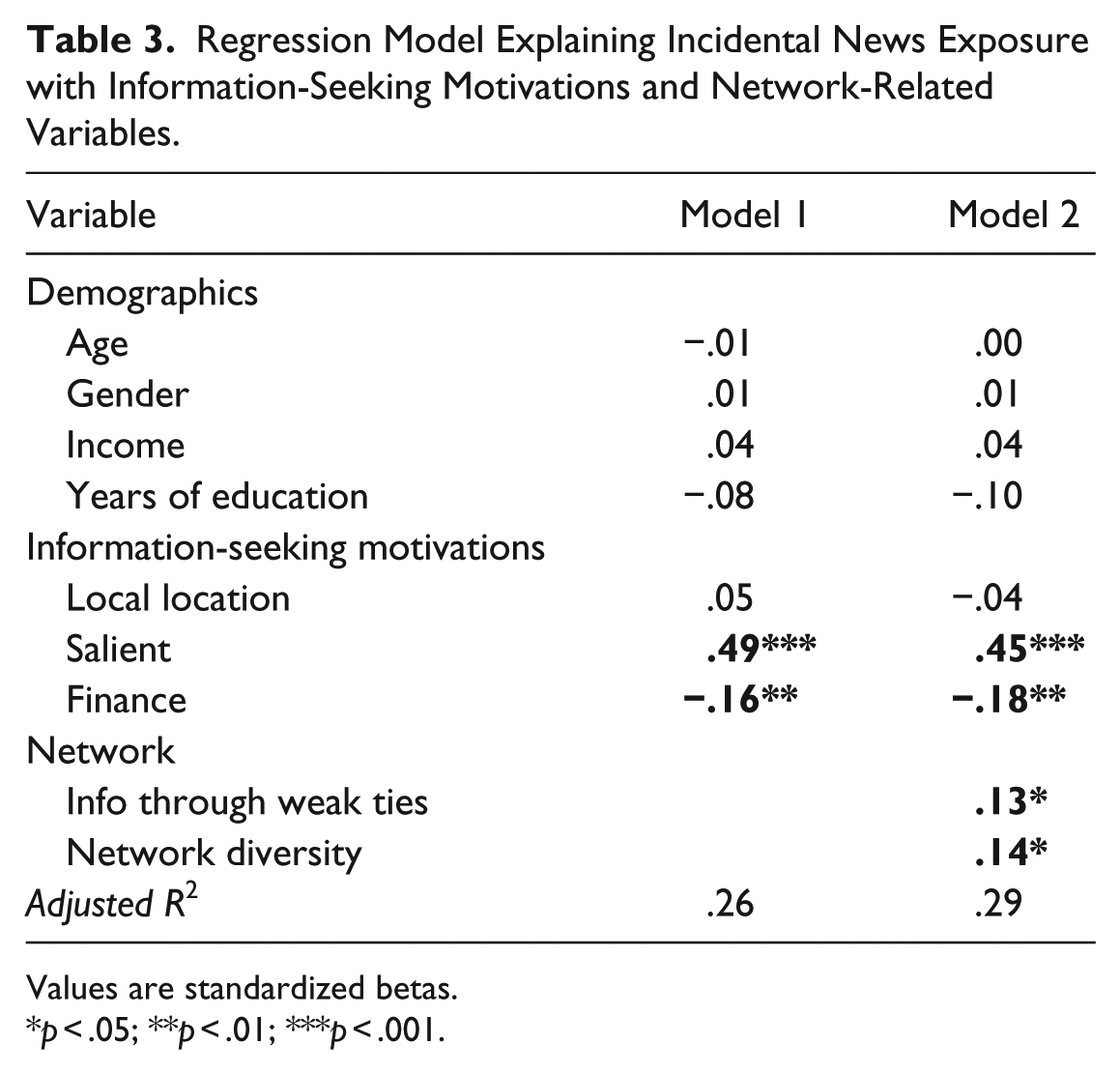
Values are standardized betas.
p < .05; **p < .01; ***p < .001.
H1 and H2 hypothesized positive relationships between network characteristics variables (information through weak ties, network diversity) and incidental news exposure. We ran a second regression model, adding these variables to the previous motivation model. This model was statistically significant as well, F(9, 249) = 12.17, p < .001.
Adding the variables of receiving information through weak ties and network diversity to the model with the information-seeking motivation variables caused significant changes in adjusted R2 (F change = 5.12, p < .01) adding to the overall variance which was explained. This model indicated that salient information-seeking motivations, finance information-seeking motivations, receiving information through weak ties, and network diversity were the four variables explaining incidental news exposure on social media (Table 3, Model 2).
Discussion
This study revealed several factors behind incidental news exposure on social media. We discuss the implications of our findings in the following sections.
The Power of Information Seeking
We found that specific information-seeking motivations, such as wanting to seek salient information were positively related to incidental news exposure while desiring to seek particular information such as financial information was negatively related to incidental news exposure. Desiring local information was not significantly related to incidental news exposure.
Our results indicate that although there might be a form of paradox between information seeking and incidental news exposure concepts, in practice social media users may get exposed to information they need in an unintentional manner through purposeful information seeking. There are levels of unexpectedness even when individuals are actively looking for specific information on social media, which echoes Erdelez’s (2004) work known as information encountering episodes with the elements of noticing, stopping, examining, capturing, and returning.
We found motivations for seeking different types of information and associations with incidental news exposure. People who are more goal-oriented may be annoyed by exposure to information that they do not specifically want to see. On the contrary, the results could also suggest that existing news recommendation algorithms on social media provide more incidental exposure to salient news and less incidental exposure to finance-related news. For example, someone looking for the stock price on Facebook may only see related news about Facebook and other similar companies, thus resulting in low incidental exposure. Further research is required to unpack these information-seeking motivations and understand their effects on incidental exposures.
Is it personality or technology that influences incidental news exposure? Although studies show that people with personality traits such as openness to experience are more receptive to the unexpected (Pickering & Gray, 2001), Heinström (2006) argues that it is still unclear whether incidental exposures require energetic information seeking to occur. This study was cross-sectional and thus, further research will have to be done to understand true causality. Most likely it is some combination of the two, but it also speaks to the control that social media has in its news recommendation algorithms; particularly how the presentation method of news posts on social media may facilitate incidental news exposure. For example, when salient news content is highlighted within a news feed, or there is a different section for salient news in addition to a general news feed, there might be more chances of incidental news exposure. Future studies could also examine whether adding more incidental exposures to finance or topic-specific news could lead to other outcomes, such as diversity in investment portfolios.
Network-Related Antecedents
Network-related factors were weakly but still significantly related to incidental news exposure. Information from weak ties was positively related to incidental news exposure. Social media companies cannot force their users to forge more weak ties. Instead of pushing news posts from weak ties to users in the ever-long, endless Newsfeed, social media platforms can incorporate separate lists containing content or links to news articles from weak ties in a separate section.
Improving the diversity of contacts around users and minimizing homophily in social networks may also lead to more opportunities for incidental news exposure. Most recommendation algorithms suggest forming new connections with people who are similar to current contacts or one degree apart. Tweaking this algorithm also to include some people who are farther apart in degrees of separation could lead to incidental exposures. While our measure of diversity covered family, school, social, and work-related aspects, there are other types of diversity, such as ethnicity, hobbies, background, that could potentially impact the range of topics and perspectives that users are exposed to in social media. For example, studies have found that with global events, people’s understanding of the events as well as their opinions about it were strongly influenced by the ethnic diversity of their social media connections (Wohn & Bowe, 2016).
Social Media and Facilitating Incidental Exposures
We found a correlation between incidental news exposure and engagement of users with news on social media (the frequency of getting news updates and the frequency of clicking on news links), consistent with Oeldorf-Hirsch (2018), who also conducted an online survey. Our findings may indicate that when social media platforms facilitate incidental exposure to news, their users are more likely to engage with news updates that they receive and become more curious about content associated with those news updates. It is important to note that this study was cross-sectional and we did not examine possible causal relationships between variables. Future studies are needed to investigate causal relationships. The possibility of having more engaged news readers may encourage both social media companies and news organizations to support mechanisms that could increase instances of incidental news exposure.
From a societal perspective, our study raises questions about whether or not social media platforms have an obligation to think about domains like increasing incidental exposures. For instance, Facebook does not produce news content per se, because of its rising status as a primary source of news as a referrer. However, it is becoming a de facto agenda-setting vehicle (Wohn & Bowe, 2014) and along with other platforms such as Twitter, it provides networks around individuals which may form awareness and bring them new perspectives (Wohn & Bowe, 2016). This role has been traditionally played by mainstream media, where editors made decisions about what they thought the public should see. However, Facebook still relies on traditional values of news on top of its algorithms to choose and control trending stories (Thielman, 2016). Increasing incidental exposures to news is not exactly the same as the role of a legacy news editor—since each individual have access to different types of information, their exposure will have to be different for each individual.
Limitations
We used Amazon MTurk to recruit our participants for the study. It is likely that compared to the average American, MTurk users have higher technology literacy. This may affect the generalization of the results of the study as our sample is not a representative sample of all social media users. Another limitation of this study is that we only focused on social media platforms that our participants primarily used for getting news updates. Although this enabled us to investigate incidental news exposure that occurs on different social media platforms including Facebook, Twitter, and Reddit, we were unable to investigate significant differences between platforms in how they facilitate incidental news exposure. In this setting, we were also unable to examine instances in which individuals experience incidental exposures using a set of social media platforms for getting news. Our future agenda includes exploring differences in how each social media platform facilitates incidental news exposure and also examining how this type of discoveries happen through interactions with multiple social media platforms as opposed to one primary platform. Finally, we chose to focus on the mobile usage of social media which is more common than getting access to social media using desktop computers. It is likely that there are significant differences between these two forms of usage in how they facilitate incidental news exposure. Future studies should examine these possible differences and also investigate how individuals may experience incidental exposures to news through interactions with both forms of usage.
Conclusion
In this study, we examined the relationship between the variables which may be related to incidental news exposure on social media. The outcomes of this study can be used to suggest the proper design and structure of social media platforms and also the arrangement of important news posts which introduce and provide new ideas and perspectives to users and deliver a wider range of content that they may be not initially willing to consume or are completely ignorant of. Incidental exposure to news was also positively related to how users engage with news content on social media. This could indicate that users’ incidental exposures to news content may increase usage and encourage further engagement with social media news. Therefore, through exposing more users to news content in an incidental fashion, news organizations may attract more social media news consumers and obtain competitive advantage.
Footnotes
Declaration of Conflicting Interests
The author(s) declared no potential conflicts of interest with respect to the research, authorship, and/or publication of this article.
Funding
The author(s) received no financial support for the research, authorship, and/or publication of this article.
