



Abstract
Palestinians have long been using social media as a tool for activism. Each platform provides unique socio-technological affordances that shape users’ communicative practices as networked publics. Focusing on the video-sharing platform TikTok, which has taken a “serious turn” in recent years, this article examines how Palestinian users performed playful acts of resistance during the escalation of violence between Palestinians and Israelis in May 2021. Applying a multimodal analysis to 500 TikTok videos posted during the conflict under #gazaunderattack, we identify three memetic templates (#challenge)—(1) lip-syncing, (2) duets, and (3) point-of-view—that unfold the ways TikTok’s design and its play-based affordances ignite affective streams of audiovisual content that render playful activism in times of conflict. Driven by TikTok’s culture of imitation and competition, playful activism enables the participation of ordinary users in political emerging events with the help of looping meme videos composed of collaborative, dialogic, and communal socio-technical functions. Playful activism transforms users’ ritualized performances into powerful political instruments on TikTok and makes democratic participation more relatable, tangible, and accessible to various audiences.
Introduction
The “TikTok intifada”: This is how media described the Israel-Gaza warfare that occurred in May 2021 (Ward, 2021). The escalation of violence between Palestinians and Israelis was ignited over an Israeli court decision to evict Palestinian families from the East Jerusalem neighborhood of Sheikh Jarrah. This controversial decision led to violent riots beginning on 6 May 2021 and spreading into Israel and the West Bank, eventually culminating in the Israeli military operation “Guardian of the Walls” in Gaza. The conflict resulted in 250 Palestinian and 10 Israeli casualties, and it lasted until the official ceasefire on May 20 (Kingsley, 2021).
Social media have played a central role in mediating the Israeli–Palestinian conflict. Scholars distinguish between two main phases of mediatization: In the first phase, according to Wolfsfeld (1997), mass media were the only source of information until the mid-1990s, leading to curated media frames conveying the narration of the conflict. In the second phase, from the beginning of the 2000s, the rapid adoption of internet blogs and other spaces for citizen journalism and personal expression allowed evasion of state control over the dominant media narrative, thus democratizing the narrative by introducing new voices and perspectives and laying the foundations for a new kind of web-based activism (Monshipouri & Prompichai, 2018). The mediatization of the conflict has now entered the third phase, due to the presence of social media (Monshipouri & Prompichai, 2018). Acknowledging that each platform enables unique socio-technological environments, this article looks at the emergence of TikTok in the mediatization of the conflict and how it is changing and broadening contemporary digital activism practices by encouraging users to immerse in a more playful and creative narrative of resistance.
First, we examine the existing literature about Palestinian digital activism. Second, we focus on TikTok’s specific affordances, disclosing how they favor the emergence of a novel type of activism, “playful activism,” that we define as an affordance-based form of performance empowering the participation of ordinary users in emerging socio-political events through adaptable memetic templates of content creation. Third, we analyze 500 TikTok videos using a multimodal approach and unfold the platform’s vernaculars of play and affect used by Palestinian users to convey their narratives. Finally, we conclude that TikTok’s play-centric affordances and their distinguishable audiovisual vocabularies endorse playful activism by provoking powerful sentiment bonds that connect and allow scattered users to territorialize around a common cause.
The Rise of Digital Activism
Digital activism has been defined as “digital technologies used to expedite change in the political and social realms” (Joyce, 2010, p. 36). Shaped by the penetration of the internet, digital activism marks the beginning of a new era for social movements, providing human agents with opportunities to convey their stories, increase their projection, and transform them into global phenomena (Chen et al., 2021).
Digital activism appears to be closely entwined with social media platforms’ architectural affordances, understood as the “multifaceted relational structure between an object/technology and the user that enables or constrains potential behavioral outcomes in a particular context” (Evans et al., 2017, p. 36). In particular, the access to filmmaking, editing, uploading, and streaming technologies has transformed video into a central tool for social movement activists online (Askanius, 2013).
Digital activism is not entirely subjected to human agency, being circumscribed and developed within proprietary platforms that can “affect the development and success of social movements” (Cammaerts, 2012, p. 119). Activists are forced to accept the rules of use imposed by private platforms, which define how activism circulates online (Nunes De Sousa & Cervi, 2017; Treré, 2015). For example, during the Black Lives Matter protests in the United States in 2020, Black activists’ videos associated with the #BLM hashtag were downplayed by TikTok (Shead, 2020). Another example is the algorithmic censorship of feminist Instagram posts resisting the platform’s nudity policy (Faust, 2017).
Within this platform-user power relation, platforms create or inhibit different openings for collective action. Accordingly, in this study, we unpack the emergence of digital activism on the video-sharing platform TikTok. We claim that conventional practices of online video activism are undergoing rapid transformation, with activists adopting and repurposing the imaginative, affective, and playful elements of TikTok’s video content. However, before delving into the Palestinian multimodal memetic videos on TikTok, we first illuminate the reciprocal presence of platforms, users, and content that encapsulates the performance of Palestinian activism in the online world.
Digital Activism and the Palestinian Cause
Palestinians have used social media since internet access was enabled in the occupied territories during the second intifada (Nabulsi, 2014). Firstly, online mobility has become part of Palestinian users’ alternatives to a physical lack of mobility, allowing the creation of a new “immaterial territory” (Rousselin, 2016, p. 11) of daily participation that connects geographically remote communities and reconnects Palestinian diasporas. Second, this cross-territory configuration of mediated interaction through digital platforms allows Palestinians to reach imagined collectives with whom they engage for civic and political purposes (Papacharissi & de Fatima Oliveira, 2012), contributing to a counter-visual narration of Palestine (Mislán & Shaban, 2019).
Social media platforms have influenced Palestinian activism to such an extent that some scholars consider them the new “war zone” (Li & Prasad, 2018, p. 505) in the Israeli–Palestinian conflict. Adopting videos as their prominent visual grammar online, Palestinian activists have mainly used what Askanius (2013) categorizes as testimonial videos (or citizen journalism/witnessing), offering audiences worldwide a real-time window into the mundane violence and brutality to which they are routinely subjected. Posted on audiovisual platforms, these instantaneous, “caught-by-the-camera” videos convey a sense of authenticity coming from ordinary people, capitalizing on the platform’s affordance for an immediate impression of events that engender an emotional reaction and enhancing solidarity.
This display of raw first-person testimonial videos has become Palestinian activists’ primary communicative response to all significant military offensives. During “Operation Cast Lead,” a massive military assault on the Gaza Strip in 2008, Palestinians collectively conveyed counter-narratives through Facebook and YouTube (Najjar, 2009). In 2014, during “Operation Protective Edge,” tweets related to #gazaunderattack showed livestreams of Palestinians living in conditions of war, enabling real-time experience of a battlefield focusing on strong graphic content (Siapera et al., 2015).
More recently, in 2020, after the killing of a young autistic Palestinian named Eyad al-Hallaq by Israeli Police, the #JusticeForEyad campaign was organized on Instagram. Subsequently, following the US wave of protests by the #BlackLivesMatter movement after the death of George Floyd, Palestinians featured memes in their Instagram’s stories showing pictures of al-Hallaq and Floyd and calling for #PalestinianLivesMatter (Mislán & Shaban, 2019). This communalized force of networked publics is not only adjusting its practices according to specific online environments, but it also adopts the cross-platform nature of affective publics (Papacharissi, 2016, p. 308) as it “assemble[s] around media and platforms that invite affective attunement, support affective investment, and propagate affectively charged expression.”
TikTok and Vernaculars of Playfulness
Since its international launch in 2017, TikTok has become one of the most influential video-sharing platforms worldwide, reaching one billion unique users in 2021 (Silberling, 2021). The platform’s Chinese ownership and relation with the government, together with issues of content moderation, made TikTok subject to heightened scrutiny (Zeng & Kaye, 2022). For example, one report claimed that the platform disseminated state propaganda, whitewashing Beijing’s abuses in Xinjiang (Perper, 2019).
Recent studies (Hautea et al., 2021; Vijay & Gekker, 2021) have shed light on how TikTok became the locus for activism. As Abidin (2020) explains, by mixing the “performativity of YouTube, the scrolling interface of Instagram, and the deeply weird humor usually reserved for platforms like Vine and Tumblr,” TikTok’s complex textures enable users to become activists, politically engaged “in a format that is entertaining, educational, and palatable among their peers” (p. 84).
TikTok is considered an “experimental audiovisual playground” (Klug, 2020, p. 6), where users choose how to shape their self-made videos using various functions. TikTok’s rich set of vernaculars mobilizes users’ participation in many socio-political activities, contextualized in the platform’s playful and humorous cultures. For example, disabled users harness TikTok’s vernacular of collaborative dance routines to resist ableism (Duval et al., 2021), and Jewish users use cynical attitude to counteract hate speech and fight religious stereotypes (Divon & Ebbrecht-Hartmann, 2022).
Building on an interdisciplinary understanding of play and its relationship to the political realm, we explore how TikTok’s affordances and vernaculars, enabled by the technological infrastructure of features, trends and aesthetics, allow playful activism to weave into TikTok’s digital-play architecture. In exploring playful activism, we wish to comprehend how the tension between play and political participation becomes blurred as content on TikTok can be “simultaneously serious, insightful, and amusing for participants” (Tully & Ekdale, 2014, p. 69). This mix is part of the rising “serious TikTok” climate, where users playfully unpack, contextualize, and provide information on socio-political issues using the platform’s trends and dialects (Ebbrect-Hartmann & Divon, 2022).
Play, according to Huizinga (1949/1970), encompasses various human activities which move beyond leisure and are driven by a “ludic attitude” that conveys playfulness (Zimmerman, 2008, p. 161). Play and its seemingly frivolous atmosphere have penetrated various public domains, such as education, politics, and media, while interrupting the rhythm of serious matters (Zou, 2022). In the study of social movements, play has been found to be a popular practice among activists, infusing movements with creativity, and ludic qualities that enrich civic participation (Shepard, 2012). Internet communication technologies provide a plethora of tools that allow activists to explore, experience, and experiment, “playful subversion” (Fróes & Tosca, 2018) or “playful resistance” (Huang & Liu, 2022). The affordances of social network sites extend an invitation to audiences who are conventionally hard to reach to engage in a playful acquaintance with political issues (Cervi et al., 2021). This allows the weaving of activism into unexpected formats like memes and vernaculars of parody and humor, lowering barriers to political participation and eliciting “playful citizenship” (Glas et al., 2019).
Therefore, we examine TikTok’s structuring principles of playfulness, following Songer and Miyata’s (2014) exploration of “playful affordances” in digital platforms, that invite four qualities of users’ play experiences: play as (1) contest–challenge based, (2) seeking exploration–discovery, (3) inviting imagination–creativity, and (4) allowing the feeling of sensation–arousal. On the basis of these four qualities, we claim that playful activism manifests in TikTok’s configurations of the #challenge practice, allowing users to flicker between modes of playful usage (Songer & Miyata, 2014).
Corresponding to the contest–challenge affordance, social media challenges are play-based collaborative tasks governed by a set of performative rules in which users are encouraged to co-opt a competitive creative mission initiated by random users (Klug, 2020). This requires users to dialogue with trending videos featuring mimetic elements (text, movement, and sound) that then circulate as viral performances. Given their potential to travel outside the individual’s social boundaries into the public discourse, challenges are highly politicized on TikTok and used to raise awareness, spread ideologies, and “externalize personal political opinion via an audiovisual act” (Medina-Serrano et al., 2020, p. 264).
Corresponding with the exploration–discovery affordance, the search for challenges on TikTok is enabled by adding hashtags to the caption of any video, not only affording individuals the ability to connect to an audience (Eriksson Krutrök, 2021) but also becoming “vehicles for exploring playful interaction” (Pearce & Pardo, 2009, p. 75) and inviting publics to gather around specific issues. Moreover, hashtags themselves can be seen as play tools for virality, with users experimenting with different combinations as part of their desire to be “algorithmically recognizable” (Gillespie, 2014).
Memetic Templates for Affective Creation
For the imagination-creativity affordance, social media challenges offer templates for content creation. Templates are audiovisual repertoires composed of the platform’s “unique combination of styles, grammars, and logics” (Gibbs et al., 2015, p. 257) that afford an accessible, expressible, and relatable framework within which ordinary users can create. Although templates on TikTok grant users creative autonomy, they are also circumscribed (Kaye et al., 2021), shaped, and compromised by the platform’s recommendation system (Leaver et al., 2020). We recognized three challenge templates on TikTok’s curated content feed (the “for you” page) that are driven by popular trends, features, and aesthetics: (1) lip-syncing, (2) Duet, and (3) point-of-view (POV).
In a lip-syncing challenge, users are summoned to play with potentially infinite music databases organized around audio templates that are available in the “use this sound” feature (Abidin & Kaye, 2021). Users frequently draw upon particular song lyrics, short music excerpts, or informal colloquial expressions, remixing and repurposing while adding “their personal storyline and/or visual narrative” (Zeng & Abidin, 2021, p. 12).
In a Duet challenge, users react (or “reply”) to an original video by juxtaposing videos side-by-side where they can be viewed in tandem and replicating the Duet for comparison or adding commentary as a compliment or critique. The Duet on TikTok can be a playful tool for political engagement because it is centered on the democratic ideals of dialogue while igniting an online public debate among users with communalized purposes (Medina-Serrano et al., 2020).
In a POV challenge, users implement the cinematic aesthetic of point-of-view by impersonating others to vehiculate their perspective on a specific issue. This form of observation establishes a dialogic setting in which the performing user becomes the subject of the viewer’s POV. On TikTok, users harness the POV challenges’ performative dimensions in novel ways, transforming them into political spectacles to raise awareness about and visibility for victims of controversial issues, such as gender and race.
In this context of imagination–creativity, challenge templates on TikTok become memes. As digital units “loaded on various vehicles: images, texts, artifacts or rituals” (Shifman, 2014, p. 366), memes are the outputs of user-generated content that are reproduced by imitation and spread rapidly, often with creative variations. TikTok challenge templates are complex multimodal memes configured by layers of video, text, and sound. Challenges inhabit the platform’s force of mimesis as the common feature of what Zulli and Zulli (2022, p. 7) identify as “imitation publics,” referring to the “collection of people whose digital connectivity is constituted through the shared ritual of content imitation.”
Corresponding to the sensation-arousal affordance, as part of the play on TikTok, challenge templates invite users to perform emotionality as a generator of their virality. Users’ mediatization of emotions can be seen as an affective practice, described by Smith et al. (2018, p. 13) as “human activity where emotions are the specific and principal focus of the practice.” We use this lens to examine how TikTok is designed to modulate and amplify affect, elicited through users’ doings, or, put differently, how users recruit and mobilize their visual and discursive sentiments and feelings to do work for social, cultural, and political goals.
Affective practice is also influenced by the agency of nonhuman forces, such as the architecture of social media platforms (Warfield, 2018). On TikTok, challenge templates become a novel practice for materializing affect on two interconnected levels; the first is the structural level. TikTok’s challenges are actively promoted by the recommendation system and therefore are algorithmically programmed for virality (Klug, 2020). They reinforce users’ affective attachments as they enable them to align with prevailing trends and offer the prospect of exposure in exchange. This dynamics catalysts users to contribute to TikTok’s culture of challenges, which manifests in forceful streams of memetic videos that accumulate affective power with each new loop, reiteration, and dissemination (Ahmed, 2004). The second level is the users’ body. Affect is engendered by the platform’s vernacular of body performativity, in which users enlist their bodies to create successful meme-based challenge videos that will be credited with algorithmic attention. Meaning, users’ mediatized bodies “become both the medium of the meme and its message” (Shifman, 2012, p. 200) as they re-enact the actions of others, allowing their bodies to drive affective resonance through digital spaces and create collective action across topics (Papacharissi, 2015).
Thus, while affect is created in the node between bodies and technology (Paasonen, 2015), as a practice, it flashes TikTok challenges with various modalities, including platformative elements (sound, image, text, filter effects, duration, loop, etc.), and performative elements (hand gestures, body postures, facial expressions, etc.). These modalities serve as ways for users to build affective spaces within a community that can negotiate identity (Jaramillo-Dent et al., 2022) and affiliate with a unique storytelling environment that sparks feelings of belonging (Vizcaíno-Verdú & Abidin, 2022).
Method
Data Collection
Acknowledging that hashtags are valuable frameworks for understanding memetic media (Highfield & Leaver, 2015), we focused on the trending hashtag #gazaunderattack (535.1 million views), previously used on Twitter by Palestinian users (Siapera et al., 2015). To gain familiarity with the hashtag, we applied the walkthrough method (Light et al., 2018), scrolling through TikTok’s hashtag page to delve “into how apps frame users’ self-expression, relationships and interactions” (p. 897). The hashtag page served as a repository of users’ audiovisual engagements throughout the Israeli–Palestinian conflict of May 2021. Aiming to explore the platform’s affordances at multiple levels, the walkthrough method allowed us to create “a step-by-step observation and documentation” of users’ use of “screens, features, and flows of activity,” examining the “technological mechanisms and embedded cultural references to understand how it guides users and shapes their experiences” (Light et al., 2018, p. 882).
Following this method, we focused on the platform’s human and nonhuman actors, learning their symbiotics, seeking to understand how TikTok’s #challenge templates afford user participation in the Palestinian conflict and how users were leveraging different features, practices, and styles to playfully engage with conflict-related content. Accordingly, we manually scrolled through the #gazaunderattack page, looking at videos uploaded from May 1, 2021 (5 days before the Sheik Jarrah riots) to May 30, 2021 (10 days after the ceasefire), creating a repository of 2,000 videos in an external file classified by video ID, date of posting, duration, background music, captioned hashtags, types of features used, comments, views, shares, and likes.
Data Sampling
To build our analysis corpus, we adopted a purposive sampling technique (Sandelowski, 1995), allowing us to “deliberately look for information-rich cases that capture analytically important variations in the target phenomenon” (p. 81). We included videos that had more than 1,000 likes and more than 150 shares, signaling that the video was indeed of interest to users. Moreover, for study convenience, we selected videos that were either in English or decipherable by us, and removed any identifiable users’ details in our screengrab images due to the topic’s vulnerability (Franzke et al., 2020).
Recognizing that TikTok videos convey ambivalent content, “leaving the viewers to derive meaning from their own knowledge” (Hautea et al., 2021, p. 2), we each first assessed prominent descriptive characteristics of the data set, identifying and distinguishing repetitive patterns of multimodal content using the similar vernacular of features, practices, and aesthetics that sparked a memetic reaction (or meme challenge). Then, we compared their content after prolonged discussion, and agreed on the identification of three recurrent challenge videos composing a sample of 500 unique items: (1) the “A’atuna Al Toufoule” lip-syncing challenge (n = 200), (2) the “Stand Up” Duet challenge (n = 200), and (3) the Mariam Afifi POV challenge (n = 100).
Data Analysis
Applying multimodal content analysis (Kress & Van Leeuwen, 2020), we focused on layers of spoken and written language, still and moving images, sound, gesture, body posture, movement, and so on. Our analysis framework is inspired by Shifman’s (2014) idea of memes as interconnected micro-units of knowledge that illuminate macro-narratives of social groups, Zeng and Abidin’s (2021) considerations of TikTok’s “meme categorization,” and Songer and Miyata’s (2014) “playful affordances.” Within this theoretical grid, we analyzed our videos according to three content levels, ranging from descriptive to interpretative: (1) memetic form, (2) communication function, and (3) affective practice.
The memetic form is the first descriptive level at which we analyzed the templates of content and style, through which memes are delivered in each video, according to three aspects: audio feature, visual feature, and performance feature. We paid attention to the user’s unique uses of multifaceted modes of communication integrated into the creation of imitated challenge videos, such as the technical (in-app editing techniques), creative (inventive uses of the medium), and temporal (brevity, looping, or repetition of content) modes. Communicative function refers to the explicit purpose that each challenge video conveys. Within this level, we also scrutinized the metalinguistic (integration of emoticons or emojis), hypertextual (usage of hashtags or intertextual references), and creative (inventive uses of the medium) modes. Finally, to interpret the affective practice (Smith et al., 2018), we focused on the various platformative and performative elements of doing affect on TikTok, intended as platforms and users’ visible ways of eliciting emotions, sensations, and sentiments among dispersed masses of users.
Findings
“A’atuna Al Toufoule”: Performing Activism Through Lip-Syncing and Makeup
The first challenge we identified was a lip-sync challenge to the song “A’atuna Al Toufoule” (“Give Us the Childhood”), a hit song from the 1980s by Palestinian–Lebanese child singer Remi Bendali, re-popularized on YouTube by Sabyan Gambus, an Islamic Indonesian teen music group. On TikTok, this template was first used by an Indonesian who lip-synced the song while recording herself in a close-up shot demonstrating a makeup routine. The video portrays the Indonesian user’s face as a canvas for the recontextualization of the Israeli–Palestinian conflict. After applying her foundation and concealer, quick edits show the user covered with bruises while the “Palestinian Lives Matter” slogan is written in “blood” on the user’s forehead, and the Palestinian flag is drawn with makeup on her cheek (see Figure 1a). Toward the end of the video, using the platform’s effects, her eye turns transparent and displays videos of Palestinian people protesting, against a background of the user’s semi-transparent figure.

Variations of the A’atuna Al Toufoule challenge.
This video generated a memetic flux in which other users harnessed this challenge as their template in various ways. Unpacking this meme form, we identified three main performative variations, all characterized by the same lip-syncing and music: (1) users (mainly female) imitated and reproduced similar music, visual, and performative elements as in the initial video; (2) users kept the same video performance but (re)interpreted the makeup routine using more sophisticated body art techniques, such as substituting bruises with scars or bullet holes and adding theatrical elements like costumes designed to amplify the narrative of victimization; and (3) users kept the same performance but expressed a more diverse range of performative gestures conveyed through distinctive facial expressions while replacing bruises with political visualizations or symbols of the conflict (like stones, maps, and flags), and using images from past wars. In addition, the users painted hashtagged slogans like #stoptheoccupation and #tragedy on their faces.
From the communicative function perspective, the genre of makeup tutorials used in this challenge pivoted from entertainment to the political. Users’ faces became physical templates for politically charged artistic creations, allowing the performance of Palestinian resistance. In online culture, makeup tutorials invite users to creatively experiment, meditate, and play with self-representation using audiovisual components. On TikTok, makeup tutorials frequently become activist acts (Abidin, 2020), where “bodies become both the vehicle for action and the action itself: medium and message” (Calkins, 2014, p. 2). In the case of Muslim female users, body art and makeup are often used as practices of protest. A prominent example occurred in 2019 when 17-year-old human rights activist Feroza Aziz used TikTok to call out violence against Uyghur Muslims in China in a makeup routine that went viral (“TikTok Apologises,” 2019).
Examined within the affective practice, lip-syncing is a performative act rooted in drag culture (Kaminski & Taylor, 2008) in which the musical intensity, together with lip-sync techniques to maximize mouth-to-music matching, has become a popular genre on TikTok. Accompanied by users’ hand gestures, lip-syncing is a “codified way of expressing affect” (Rettberg, 2017, p. 1) where the lips, the lyrics, and the music orchestrate a particular energy, mood, or movement for users to affect each other by playing along. The lip-syncing templates on TikTok share qualities of spreadability and legibility and become powerful memetic media (Abidin & Kaye, 2021), allowing users of this challenge to (re)tell the story of Palestinian suffering using a song interpreted by a children’s choir (and thus infusing it with pathos). This song has become a symbol of the melancholic, war-scarred childhood with which most Palestinians identify.
Lip-syncing and makeup performances are an affordance-dependent evolution of Palestinian testimonial videos, which according to Askanius (2013) are meant to bear witness to injustices. Prior to TikTok, the display of bloodcurdling images of Israeli attacks (bomb explosions, dead bodies, etc.) was Palestinians’ most conspicuous audiovisual language online, enabling audiences to witness and generate empathy for Palestinians’ suffering (Siapera et al., 2015). In TikTok’s playful templates, the Palestinians’ adversity takes on a (self-)performative form. Users supersede crude, real-life images with metaphorical representations of what the Israeli oppression “does” to their bodies. Some substitute images of injured or dead bodies with paintings of bruises on their faces, signaling the violence enforced on the Palestinians (see Figure 1b). Instead of using explicit images of the intifada fighters (i.e., stone throwers), some users gesture toward the existence of those fighters while holding stones in their hands, thus symbolically embodying their videos with resistance (see Figure 1c). The same is true for waving the Palestinian flag, showing pieces of wire fence, or wearing the keffiyeh (see Figure 1c). All are theatrical ways in which “artifacts of performance create the context” (Boyd & Heer, 2006, p. 4) in which users harness various symbols of war to promote an accessible and desirable reading of the conflict.
With their playful use of TikTok’s editing features (quick cuts, effects, and sound), users gradually reveal and express their Palestinian identity in this challenge. Their plain faces, to which they keep adding layers of makeup, evolve, with each body movement being synchronized with the music’s beat and editing cut (see Figure 1d). This choreography not only showcases their artistic choices (i.e., drawn Palestinian flags) but also serves as the foundation for the challenge’s structure of feelings (Papacharissi, 2016) as it fosters affective bonds among peers that lead to the proliferation of imitated and circulated versions of those videos.
Following the challenge’s template, in the second half of the videos, Palestinians’ life under Israeli authority is displayed with the help of TikTok’s transparency effect. Users transform their right eye into a “projector” and screen a curated spectacle of their lived experiences amidst the chaos of war (see Figure 1e). Used as an affective practice for activists to convey their resistance (Gonzalez, 2022), the users’ gaze in this moment of projection matches the viewers’ and facilitates a confrontational relationship with the Israeli authorities, being their presented enemy.
As users “tak[e] control over their own stories and identities” (Gonzalez, 2022, p. 260), they saturate their videos with political imagery that is considered inflammatory (e.g., violent Palestinian arrests or terror attack scenes) while interchangeably playing between the roles of victim, witness, and perpetrator. This challenge’s replicability and mutability demonstrate TikTok’s culture of participatory and memetic performance, leading users to work as a communal force in which their “social identities are drawn together in common pursuit and through their performative roles” (Petrovic, 2022, p. 2).
“Stand Up”: Musical Duets as an Affective Activism Dialogue
The second identified challenge was a Duet meme challenge in response to the video of an Israeli Defense Force (IDF) soldier in which she lip-syncs the song “Stand Up” (see Figure 2a), accumulating 7.3 million views as of October 2021. “Stand Up” is the lead single from the soundtrack of the movie Harriet, depicting the life of US abolitionist and political activist Harriet Tubman, and it is considered an anthem for freedom and human rights. The IDF soldier posted a video of herself lip-syncing this specific extract from the song: And I don’t mind if I lose any blood on the way to salvation And I’ll fight with the strength that I got until I die That’s when I’m gonna stand up Take my people with me Together we are going To a brand new home.
In response, Moe Zein, a Palestinian–Lebanese singer famous for his parodies and mashups of popular songs, responded with a Duet, receiving 24.3 million views as of October 2021. Zein posted a close-up of himself singing along to the same song but changing the lyrics to “Yes please stand up / Take your people with you / Leave the children happy away from all the tragedies,” asking Israel to leave the occupied territories. On the same screen, a window showing videos of Palestinian tragedies (e.g., bombs, airstrikes, and suffering people) appears on the right side (see Figure 2b). Zein’s reply video generated a trend in which other users created Duets with the IDF soldier, where they sang Zein’s version of the song and/or added their own lyrics.
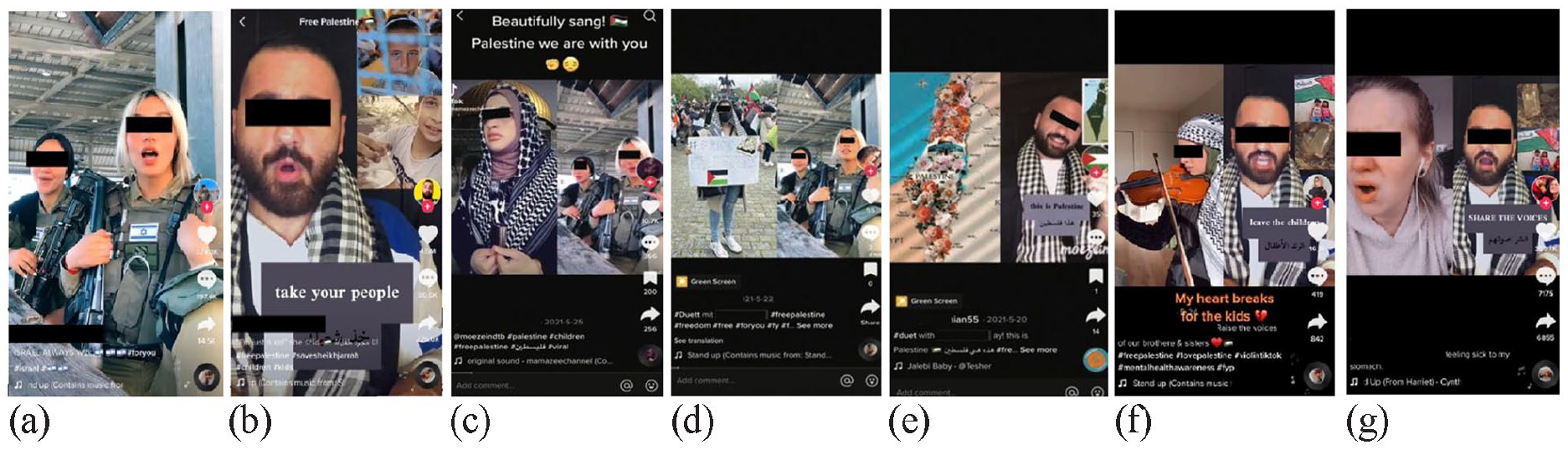
Duets and triplets reacting to the IDF soldier’s video.
Unpacking this meme form, we identified two main variations, characterized by the same feature of sound and genre of Duet but using different derivatives in visuals and performance. In the first variation, users recorded themselves in close-up shots singing beside the IDF soldier using Zein’s version of the song in Duets or “Triplets,” including both the IDF soldier and Zein himself along with the user. The performative value of the videos lies in the theatrical expressions of the users’ reactions. In the second variation, users also displayed political symbols (e.g., keffiyeh, Palestinian flag) while incorporating graphic images (e.g., children dying, people crying). In this case, the performative value lies in the users’ attrezzo (e.g., symbols of Palestinian identity) and the display of suffering.
From the perspective of communicative function, these videos can be paired with what Askanius (2013) defines as political mash-up videos, in which users merge pre-existing materials from multiple sources to construct a political argument. However, the grievance narrative that characterizes Palestinian social media communications, with the help of TikTok’s Duet feature, is being translated into a parodic and satiric “answer” to the Israeli provocation presented in the original video. Parody, a dominant audiovisual dialect of TikTok users (Divon & Ebbrecht-Hartmann, 2022), is a creative work designed to imitate and/or mock its subject by means of satiric or ironic imitation (Tryon, 2008). In this challenge, Zein and many other co-creators not only ironically unmask the contradiction of using the song “Stand Up” as an anthem of freedom to defend a state of occupation, but they also use this trend to expose atrocities and children’s suffering using imagery of victimhood.
This playful form of resistance can be defined as a type of “creative insurgency” (Kraidy, 2016) since words, songs, and images can function as an alternative to actual violence (or act in tandem with actual violence) for the purpose of reaching political goals. In this sense, Zein and others’ creative performances are germane to the kinds of revolutionary actions that have become popular in the Palestinian resistance legacy, such as chanting slogans, spraying graffiti, and building barricades. In addition, this challenge communicates TikTok’s powerful nature of competition. By capitalizing on the platform’s tendency to disseminate and expose videos associated with trending challenges (Klug, 2020), users were calling others to Duet with Zein’s version using the caption section on their videos in an attempt to suppress the IDF soldier’s original video. Downplaying the Israeli version and concealing it from the “algorithmic eye” (Abidin, 2020) amplified the virality of Zein’s “hijacked” version of the challenge, making it more visible to random scrollers on the “For You” page.
Although users made various memetic performances of Zein’s video, as a public, they communicated in one coherent voice. Following the Duet template, users took advantage of TikTok’s play tools like the Green Screen feature to immerse themselves in disputed sites (e.g., the Dome of the Rock in Jerusalem; see Figure 2c), or in sites of struggle (e.g., refugee camps in Gaza; see Figure 2d). Some used the image juxtaposition to resonate with the ongoing and inflammatory geographical debate with Israel by showing a map of Palestine with Jerusalem as its capital, in an attempt to make amends for historical injustice while calling to “fight back for the stolen lands” (see Figure 2e).
From the affective practice perspective, by substituting new words for the original song and by focusing on suffering and struggle, users infused their creations with an emotional resonance that echoed among distant individuals (Mühlhoff, 2015), who reacted with memetic versions. In this sense, the memefied challenge melody sparked an affective dissemination that rapidly connected disorganized crowds “discursively called into being” (Papacharissi, 2015, p. 6). Some users adapted to TikTok’s multimodality of sound and supported Zein’s singing with musical instruments. For example, one user played the violin while displaying popular Palestinian symbols (e.g., the keffiyeh), and accompanying text said, “My heart breaks for the kids” (see Figure 2f). This performative practice expressed the user’s closeness to the Palestinian cause and thereby amplified the emotional volume of victimization. The users’ emotionalization became visible in their own memetic versions, showing a range of facial expressions, such as sadness or acts of crying while listening to Zein’s version (see Figure 2 g).
As social media became the new “war zone” of the Israeli–Palestinian conflict (Li & Prasad, 2018), the various memetic creations of the Duet display the users’ ability to use different affordance-based playful “weapons.” Conveyed with artful tactics of resistance, users’ co-performances forge alternative routes for fighting social injustice without renouncing the need to show cruel realities. Moreover, as accessible templates for activism, these playful performances have a lower participation threshold than traditional protests (Shepard, 2012). They allow users to play with multi-layered dialogic modes and to take an active role in the conflict as they express their feelings of solidarity, indignation, and anger and creatively articulate their political position.
Mariam Afifi’s Smile of Resistance: POV Challenges as Co-Constructed Empathy
The third challenge that we identified is a POV challenge dedicated to Mariam Afifi, a 19-year-old Palestinian activist who became known due to a viral video of her smiling while being beaten and handcuffed by an Israeli soldier in a protest against Israeli authorities (Gill, 2021). Within a matter of hours after her detention by an Israeli soldier, Afifi’s video rapidly achieved viral status, garnering widespread support from hundreds of users who demanded her immediate release from prison. These individuals not only endorsed Afifi’s active participation in the protest, but also helped to amplify a potent and politically charged narrative across a range of social media platforms (see Figure 3a).

Variations on the Mariam Afifi POV challenge.
On TikTok, Palestinians and their supporters transformed her video into a challenge in which they enrolled as re-enactors of the moment of her arrest, using the POV aesthetic and applying various strategies to convey her presence. In the first variation, users wore dark red hijabs, thereby intertextually connecting to Afifi’s hijab in the original footage. Using the platform’s Green Screen function, users immersed themselves in a “protest” and lip-synced Afifi’s words to the Israeli soldier during her arrest, trying to convince the imagined other (“the enemy”) that it was their right to protest. A sudden edit cut shows the re-enacted Afifi with facial “bruises” due to the violent behavior of the unseen enemy.
In a second variation, users are shown kneeling in the position of handcuffed hostages held by the imagined enemy, wearing dark red shirts to connect with Afifi’s hijab, covered with mimicked bruises, and displaying expressions of pain while being treated violently (e.g., they are thrown to the floor and the enemy steps on their necks). In a third variation, users record themselves smiling into a mirror while an overlaid caption states, “You smile when you know Allah is with you” or “ (. . .) when you know justice is with you.” In a fourth variation, TikTok users are physically absent in the videos but convey resistance by showing slideshows of smiling Palestinian activists at various protests.
From a performative perspective, although utilizing different features, all four variations have a similar visual hook, with TikTok’s aesthetic of the POV affording creative remediation of Afifi’s smiling image. The users’ playful role was fostered by performances of makeup, costuming, props, and scenery. This enabled viewers to observe and users to re-enact events as if they were conveyed by Afifi’s eyes and voice. Afifi’s video has undergone a “memetic reproduction” (Rossolatos, 2015) similar to the trajectory of the iconic image of George Floyd that became ubiquitous in #BlackLivesMatter protests. Afifi’s smile also carries the visual value of “meme-worthiness” (Zimmer & Carson, 2018), motivating the intense circulation of controversial content and turning the smile into an available “cultural repertoire of vernacular video” (Burgess, 2008, p. 6).
The communicative intention of this challenge can be seen as an attempt to forefront the story of Afifi’s arrest as a counter-narrative to mainstream media, dominated and described by the hegemonic Israeli narrative of Palestinian resistance as “terrorism” (Najjar, 2009). By playing the role of a victim and integrating photo testimonies that rationalize Afifi’s acts and vehemently disapprove of her arrest “just for defending a girl being beaten by an officer,” users provide global audiences with the chance to transcend the often restrictive framing of the conflict presented by mainstream media outlets (see Figure 3b).
By co-opting Afifi’s challenge and fostering its algorithmic zenith, users carved pathways for activism to weave in and out of TikTok while amplifying marginalized voices and increasing their visibility for mass crowds. The memeification process of Afifi’s smile became a political invitation for users to learn about and observe the brutality enacted against Palestinians and to acknowledge other victims of institutional violence, such as Black people in the United States. Commemorating George Floyd’s tragic death by a White US police officer, some users opened their videos reenacting the iconic facedown position while a knee belonging to an unseen and threatening adversary is being pressed against their neck, portraying a fatal scenario of suffocation (see Figure 3c).
Users were operating TikTok’s features and trends to establish community building (Vizcaíno-Verdú & Abidin, 2022), showing solidarity with other users against Israeli authorities through a “digital allyship praxis” (Clark, 2019). Palestinian and non-Palestinian users linked to each other’s POV videos not only to amplify the trend on the “For You” page but also to broaden the perspective of “both the allies and members of their personal communities” (Clark, 2019, p. 12) about their lives in a constant state violence, and to call them to witness the events (see Figure 3d).
Afifi’s POV challenge promoted a preferred reading of the conflict, in which the Palestinians face discrimination by the Israeli forces in spaces of free protest, with no enacted violence (“she was just sitting there”). The images that circulated of Afifi’s smile and of many other Palestinian protesters who were captured with a smile while being arrested (see Figure 3e) preserve the typical dichotomies of oppressed and oppressor that move beyond the Israeli–Palestinian conflict. Viewers can identify a familiar power dynamic (that uses force) while watching Afifi’s arrest, and they might identify her meme-smile as “defying the normative scripts of the colonial relationship” (Bhungalia, 2020, p. 400), in which one should not smile in the face of military power.
Regarding affective practice, users became fully immersed in an imaginative role-play that required the use of theatrical practices, such as customs, location, the use of artifacts, and exaggerated body and facial gestures to evoke intense emotions. For example, users wore red hijabs and similarly colored dresses, and attempted to recreate the subtle nuances of her facial expressions, to constitute an authentic (self-)performance while trying to merge themselves with the memefied character of Afifi (see Figure 3f). This playful performance embodies a dialogic infrastructure with the character of the victim because it holds the potential to provide an empathetic view of the suffering of others, even without being the primary source of information about the conflict.
The re-enactments, by fostering feelings of compassion toward the human costs of the conflict, can be seen as affective practices because they result in waves of not only co-constructed grief but also co-constructed empathy (Eriksson Krutrök, 2021). Users emit their emotional desire by identifying with Afifi through texts, emojis, hashtags, and other pictorial icons that act as “symbols of solidarity” (Döveling et al., 2018, p. 5; see Figure 3g). Hence the arousal of empathy is derived from the ability of the POV challenge to serve as a multimodal “witnessing text,” positioning the users and the viewers to “bear witness to others’ lives” on and through TikTok (Frosh, 2006, p. 274).
The POV challenge is an open-ended activity that involves imagination and creativity and leaves room for questioning the rigidity of the real world (Huizinga, 1949/1970). Users are encouraged to position themselves as Afifi while creatively renegotiating and imaginatively re-enacting her experiences. In their recollections, users are liberated to play with their “civic imagination” (Jenkins et al., 2016), finding alternatives to their socio-political hardships like the act of smiling instead of being overcome by fear, the possibility to crop out the authority figure from their memes, and even setting Afifi free.
Discussion
Our exploration of the #gazaunderattack on TikTok aligns with previous studies and confirms that although the platform might seem like a “messy and unorganized” environment (Vijay & Gekker, 2021), its affordances make it suited for playful activism. We have shown how the emergence of TikTok in the mediatization of the Israeli–Palestinian conflict is changing common practices of video activism by encouraging playful participation and potentially transforming users into political performers. TikTok’s entertainment attitude (Kaye et al., 2021) is interwoven in users’ creations, as they tackle “hard” topics while appropriating the platform’s vernaculars of playfulness that make activism relatable, tangible, and accessible to broader audiences.
Playful activism is contextualized in the culture of TikTok’s #challenges. Users co-opt challenges as open-access, self-learned templates of creation that enable them not only to join trending conversations but also to creatively express and “disseminate political arguments and ideologies” (Hakoköngäs et al., 2020, p. 2). TikTok’s challenges help normalize the idea that political engagement can be an everyday activity or even a play (Zhao & Abidin, 2021), allowing ordinary users novel forms of dialogue around emerging current events by harnessing memetic templates as their political instruments. Both the potential for virality and the sense of playfulness brought about by the amateur environment of challenges (Cervi & Marín Lladó, 2021) lower the barriers to entry into activism and expand the repertoire of what it means to be politically involved. However, TikTok’s challenges can give rise to the propagation of inflammatory practices of memetic violence beyond the confines of the platform, particularly during times of conflict (Divon, 2022).
Playful activism is fostered by the nature of competition and performance inhabited in TikTok’s challenges. As users strive for their visibility on the “For You” page, they utilize the challenges’ memetic qualities that “set the tone for conversations and bring into words people’s affective sentiments” in exchange for greater algorithmic exposure and engagement (MacDonald, 2021, p. 7). If previous forms of video activism allowed Palestinians to create “bonds of sentiment” (Papacharissi, 2016, p. 308) by showing online the daily cruelty of the conflict, then TikTok’s unique combination of affordances has helped users to propel affective content into visibility through playful practices of activism.
TikTok is playful and affective by design. Its performative (e.g., aesthetics, attitudes, body and facial expressions) and platformative (e.g., audiovisual features, loops, mimesis) layers of content creation are effective binding techniques for expressing, sharing, and disseminating intensity of emotions through “purposeful play” (Hartley, 2010). Therefore, granting that affective processes suffuse online social engagement (Papacharissi, 2015), playful activism can trigger emotional responses, elicit feelings of community, and mobilize affective publics for playful participation.
Since our study’s goal was to explore production practices themselves, this article was unable to go into an in-depth examination of how users perceive these practices. When multimodal content becomes viral and ignites a memetic reaction, it is no longer necessarily affiliated with its original users or their values. Thus, it can potentially remove the context of the actions from a social-media-driven movement (Yoon, 2016). Accordingly, and acknowledging that TikTok’s imitation dynamic inherently mixes production and reception (Cervi, 2021), further research should investigate the reception aspects (e.g., comments, reactions) of playful activism’s ability to mobilize collective action and its effectiveness in the pursuit of socio-political goals.
Footnotes
Authors’ Note
Both authors contributed equally to the conceptualization, writing, and editing of this article.
Declaration of Conflicting Interests
The author(s) declared no potential conflicts of interest with respect to the research, authorship, and/or publication of this article.
Funding
The author received no financial support for the research, authorship, and/or publication of this article.
