



Abstract
TikTok has become a space where playfulness is the dominant lingo for engaging with serious subjects. On the platform, the Holocaust is mediated through meme-based performances like the #POVHolocaustChallenge, a trend that invited users to re-enact fictionalized memories of Holocaust victims. Our analysis of 250 videos identifies 3 types of Holocaust-related memetic narratives—mem(e)ories: (1) Testimonial Mem(e)ory, where “victims” testify from “heaven” as confessional storytelling; (2) Punitive Mem(e)ory, where “victims” choose to be sent back to the Holocaust as punishment; and (3) Escapist Mem(e)ory, where “victims” time travel from the 1940s to the present for a brief escape. Drawing on interviews with 15 creators and 7 Holocaust institution representatives, we argue that #POV challenges re-mediate past events, transform into education, and serve as a means for forging personal connections to the Holocaust. We introduce TikTok’s affordance of playability as a structural condition that governs participation, with users merging performative storytelling with remix culture and inscribing Holocaust (post)memory into their platformed experiences.
Introduction
“Acting like a Holocaust victim—the new TikTok trend!” (BBC News, 2020). In August 2020, a controversial trend emerged on TikTok under the hashtag #POVHolocaustChallenge, accumulating 895.1 million views. The point-of-view (POV) social media challenge is a participatory role-play format where users adopt a first-person perspective to portray specific scenarios, creating memetic templates for others to engage with. In this challenge, short-form video creators were invited to “step into the shoes” of Holocaust victims, re-enacting fictionalized memories via self-documentation and performative storytelling. Utilizing the platform’s features, creators immersed themselves in Holocaust-related stories, sites, symbols, and events, fostering a sense of affective proximity that made historical trauma feel both immediate and personally engaging.
The viral memeification of imagined Holocaust victims’ memories on TikTok quickly became a flashpoint of controversy, sparking criticism from both institutions and social media users (BBC News, 2020). Holocaust memorials distanced themselves from the trend, while online audiences accused creators of being “woefully ignorant” (Froio, 2020). At the center of the backlash were accusations of Holocaust trivialization, with many demanding the videos’ removal. Outraged online audiences condemned creators as “disgusting human beings” (Albert, 2020), while critics warned that the challenge illustrated the risks of misusing Holocaust memory—the gradual dilution of its historical gravity through repeated decontextualization in digital culture (Rosenfeld, 2014). Many participants, who initially viewed their engagement as a form of meaningful interaction rather than offense, quickly expressed remorse, acknowledging their actions as a “major mistake” (Albert, 2020).
This public outcry underscores the friction at the core of this research—the ethical tensions between digital participation, historical remembrance, and the edges of play in shaping collective memory. Ever since, there has been a surprisingly low number of studies examining creators’ engagement with Holocaust-related content on TikTok (Manca et al., 2025), despite the rise of trends like users’ re-enactments of Anne Frank (Lebovic, 2023) and the proliferation of antisemitism on the platform (Hübscher, 2023). To address this research gap and advance understanding of the opportunities emerging at the intersection of social media platforms and Holocaust memory, this study examines how remembrance is translated into TikTok’s memetic ecosystem of play. Within this space, user participation is shaped by the platform’s affordance of playability—such as features, aesthetics, and trends—fostering novel, interactive forms of memory-making.
To unpack the complex relationship between creators and memory work on TikTok, we draw on multiple theoretical perspectives. First, we examine memory work (Van Dijck, 2007) and its adaptation to online spaces, exploring how digital platforms mediate historical engagement. Next, we engage with research on digital remembrance (Ebbrecht-Hartmann and Brenner, 2023), including memes and performativity, to understand how users interact playfully with the past via creative and participatory formats (Berg, 2024; Ebbrecht-Hartmann and Divon, 2022). Finally, we lay out TikTok’s participatory culture, focusing on how the platform’s vernaculars of memory work materialize through the POV challenges (Trillò, 2024). We argue that these elements collectively shape the presentation of traumatic, personal, and collective (post)memory experiences, transforming remembrance into an interactive and affective practice for creators.
In our analysis of 250 #POVHolocaustChallenge videos, we identify how users employed meme-based imaginative narratives to remediate Holocaust-related memory while harnessing what we term the platform’s affordance of playability. As a socio-technical affordance, playability refers to the structured yet elastic modes of interaction enabled by TikTok’s iterative design—its audio templates, visual effects, and remix functions—which support meaning-making through imitation, adaptation, and co-performance. Within the context of Holocaust remembrance, playability enables users to simulate the perspectives of imagined victims, staging acts of memory that entangle empathy, vernacular creativity, and platform-native storytelling. Rather than trivializing memory, we argue that playability mediates it through a participatory grammar, where historical trauma is refracted via the logics of performance, virality, and affective proximity.
Complementing our analysis with insights from interviews with 15 POV Challenge participants and seven educators, we argue that the challenge offered creators a playful entry point into Holocaust remembrance, allowing them to creatively reinterpret established visual conventions of Holocaust representation in media. By embedding Holocaust memory within TikTok’s memetic ecosystem, creators’ work reveals both the potential and the tensions of translating historical trauma into participatory, playful performances. We conclude that the noninstitutional and memetic nature of platforms like TikTok opens new avenues for history education and commemoration, fostering dialogue while integrating Holocaust memory into the everyday social media practices of younger generations.
Doing memory in the digital turn
To explore TikTok’s potential for generational dialogue with Holocaust memory, we approach memory as an open and participatory process continuously shaped through engagement and negotiation. Rather than a static repository of the past, memory is “actively performed, produced, and practiced in the present” (Van Dijck, 2007: 386). The doings of memory highlight its labor-intensive nature—“an intentional, purposeful act of engaging with history” (Kuhn, 2010: 186). This process is never fixed; instead, it is reaffirmed, challenged, or reinterpreted through cultural frames that serve as carriers of its human embedment, enabling individuals to actively construct, contest, and navigate historical meaning within digital spaces.
Throughout the twentieth century, memory work has been irreducibly mediated by various analogue technologies, later transitioning to digital forms with the advent of the Internet in the 1990s. This shift highlights the intergenerational mnemonic potential of technology, shaped by experiential encounters with mass media. Hirsch’s (2001) work on (post)memory as “the response of the second generation to the trauma of the first” (p. 8) explores the potential of photographs to communicate pain across generations and to foster an ethical mode of remembrance. Similarly, Landsberg’s (2004) work on prosthetic memory reveals the potential of films to carry memory across social contexts and groups, creating empathetic relations with the pasts of unknown others.
Various forms of technological mediatization have profoundly impacted contemporary ways of doing Holocaust memory. From video and photographic evidence of Nazi crimes produced in the liberated camps (Hicks, 2012) to post-war newspaper reporting on developments such as the Eichmann trial (Meyers et al., 2014), to fictional movies that began to appear collectively from 1940s (Baron, 2005), different forms of mass media have played a key role in making the public aware of the events of the Holocaust and prompting growing curiosity about memory, history, and different modes of dealing with the traumatic past.
The advent of social media platforms has accelerated Holocaust remembrance, leading to a connective turn (Hoskins, 2017) characterized by the proliferation of digital media, communication networks, and archives, providing unprecedented access to diverse Holocaust narratives and historical information. The culture of social media memory prompts institutions and individuals to adapt to digital platform affordances, referring to the “multi-faceted relational structure between an object/technology and the user that enables or constrains potential behavioral outcomes in a particular context” (Evans et al., 2017: 36). Thus, enabling the past to weave through new vernaculars of features, practices, and aesthetics, platform affordances extend an invitation to diverse audiences to engage with globalized and marginalized Holocaust memories, sometimes through unconventional forms that carry affective and pedagogical resonance.
Vernacular memory: selfies, dances, and memes
Social media platforms allow the emergence of a new memory ecology. According to Hoskins (2017), this ecology evolves through the “current digital environment’s (re)ordering of the past by and through multiple connectivities of times, actors, and events” (p. 5), offering users non-professional commemoration practices that contribute to the notion of doing memory. The connective turn has given rise to “the era of the user” (Hogervorst, 2020), pointing toward mediated memory (Frosh and Pinchevski, 2009) in which the participatory nature of social media enables users to become testimony-producers, creating bottom-up ways of interpreting and witnessing history.
Many types of non-expert memory production using platform vernacular have become increasingly visible in digital spaces. Gibbs et al. (2015) describe platform vernacular as the “genres of communication emerge from the affordances of particular social media platforms and the ways they are appropriated and performed in practice” (p. 257). Maddrell (2012) distinguishes individual acts of commemoration online from institutional acts by utilizing the terminology of the “vernacular memory” as “the local, the indigenous, the homely, the domestic, the informal, or unplanned, everyday-based commemoration” (p. 47). In other words, vernacular memory refers to unpredictable, unauthorized moments of bottom-up commemoration in which users employ platforms’ audiovisual grammar to communicate past-related sites and events.
An example of user-generated content challenging conventional Holocaust remembrance is selfies taken at atrocity sites. Often framed as acts of agency that “expand our capacity to witness” (Frosh, 2019: 13), these selfies are equally criticized as “spoiled, narcissistic, and frivolous” (Magilow, 2020: 168). This tension is especially visible in selfies taken at memorials, which frequently spark claims of trivialization (Margalit, 2014). While some users aim to engage with Holocaust memory on their own terms, such acts often provoke institutional disapproval (Feldman & Musih, 2023). As witnessing tools, selfies rely on making their meanings legible to both local and distant audiences, bridging “old” and “new” media spaces in the process (Mortensen, 2015). This need for translation and cross-platform resonance is also evident in user-generated video (UGV), which similarly challenges established memory norms while circulating in spaces shaped by both institutional heritage practices and everyday media use. Ebbrecht-Hartmann and Henig (2021) identify user-generated selfies as attempts to “inscribe themselves into memory culture” (p. 214) while grappling with emotional complexity. A notable example is Dancing Auschwitz (2009), which features a Holocaust survivor dancing to “I Will Survive” in various locations within a concentration camp. While initially condemned as disrespectful, the video was later reframed as a form of virtual memorial, rooted in an agentic decision that underscores “remembrance as a democratic experience” (Gibson & Jones, 2012: 127).
The tension between institutionally sanctioned memory discourse and grassroots memory practices becomes particularly pronounced in the context of Internet memes. Defined as digital content units that share common features of content, form, and stance (Shifman, 2014), memes enable viral circulation, instant reception, and imitation-based responses in the form of new images, texts, or videos. Their impact spans from political protest (Bayerl and Stoynov, 2016) to gender resistance (Lukacs, 2023) and climate change (Basch et al., 2022), underscoring their role in shaping socio-political participation. In collective memory cultures of tragedies like 9/11, memes have been identified as “vernacular memory actants” (Silvestri, 2018), adding depth and complexity to social remembrance practices. They flourish through accessible, rapid mutations and creative remixing (Nissenbaum & Shifman, 2017), standing in stark contrast to the stability and coherence traditionally valued in collective memory. One notable illustration of this dynamic is the widely recognized Holocaust-related meme “Hitler Finds Out…” or “Hitler Reacts to…,” in which users overlay humorous subtitles onto a dramatic scene from Oliver Hirschbiegel’s Downfall (2004), reframing Hitler’s furious rant as an exaggerated response to mundane or trivial frustrations. This form of memetic recontextualization, as Magilow (2020) observes, allows users to “symbolically humiliate Hitler and establish a moral high ground for American identity vis-à-vis the Third Reich” (p. 665).
Memes reveal the potential of digital media to transmit the past by enabling intertextuality, visibility, and personalization through forms of memory that are “easy to imitate, adapt personally and share broadly with others” (Bennett and Segerberg, 2015: 745). User-generated memetic practices on TikTok have been shown to link historical events with contemporary audiovisual trends (Adriaansen, 2022) and to operate as meta-practices of remembering the remembrance of atrocities (Seet & Tandoc, 2024). In the context of Holocaust-related memes, this dynamic brings both opportunities and challenges, as they raise concerns about trivialization, the circulation of antisemitic imagery (Drakett et al., 2018), and what Rosenfeld (2014) calls the normalization of the Holocaust as “just another historical tragedy” (p. 308), while also exemplifying active forms of memory work. By remixing cultural symbols, users generate emotional responses (Smit et al., 2018), build imagined communities (Enverga, 2019), and forge connections to past atrocities (Trillò and Shifman, 2021). We therefore argue that memes function as affective memory texts (Kuhn, 2010: 299), allowing users to feel a physical and emotional connection to the past while being “sites of construction and negotiation of collective remembrance.”
Playability of memory on TikTok
In examining memory work on TikTok, we highlight how platform affordances shape unorthodox forms of vernacular remembrance. When acts like dancing or taking selfies at Auschwitz become memes, they signal a shifting grammar of commemoration driven by audiovisual trends and participatory cues. These practices are not purely spontaneous but structured via platform socio-technical affordances, which govern how memory is mediated, circulated, and engaged (Hoskins, 2017), ultimately shaping both the possibilities and tensions of digital commemoration.
Continuing Evans et al. (2017), Bucher and Helmond (2018 [2017]) define affordances as the relational dynamics between technology, artifacts, and actors, structured by the potential actions available within digital environments. Building on Gibson’s (1979) ecological perspective, they see affordances as not static platform features but evolving possibilities constantly shaped through the interplay of technological design and user engagement. In the context of social media platforms, boyd (2010) identified key affordances such as persistence, replicability, scalability, and searchability, which shape how content is produced and engaged across platforms by users.
TikTok has been examined for its distinct affordances, particularly the platform’s algorithmic personalization (Schellewald, 2021), affective engagement (Brown et al., 2024), and imitative qualities (Zulli and Zulli, 2022). Building on Cervi and Divon (2023), who introduce the dimension of play to analyze how TikTok’s memetic infrastructures (social media “challenges”) invite users to engage in whimsical yet politically charged acts of resistance, we push the concept further. While their framework treats play primarily as a performative invitation, we introduce playability as a cultivated structural affordance of the platform itself. Rather than functioning merely as a creative prompt, playability constitutes a core logic through which users produce, interpret, and disseminate content. This logic extends beyond entertainment, shaping even deeply affective practices like memory work.
Extending this argument, we suggest that TikTok’s playability is entwined with the platformization of memory (Adriaansen & Smit, 2025). Platformization refers to the process by which dominant platforms shape cultural production, fragmenting content into modular units that are continuously adapted and reshaped through the interplay of user data, algorithmic curation, and feedback (Nieborg & Poell, 2018). In other words, memory on these platforms is not simply stored like a static archive but is continuously reshaped, resurfaced, and recirculated according to platform design (Annabell, 2023). On TikTok, the organizing logic of playability – built into its sounds, visual templates, filtres, and viral trends – structures how people engage with the past. This gives rise to multiplicities of remembering (Smit et al., 2024), in which a range of memory practices allow users to interact with history in ways that are performative, emotionally expressive, and optimized for visibility within the platform’s algorithmic ecosystem.
Our understanding of playability draws from broader cultural theories of play, where play is not merely a frivolous act but a meaningful mode of interaction embedded in everyday life (Sutton-Smith, 1997). Kalliala (2005) describes play as spanning a spectrum between free improvisation and rule-bound behavior; a tension that becomes especially visible on platforms like TikTok. While often celebrated as ageless, voluntary, and imaginative, play is, as Huizinga (1970 [1949]) emphasizes, almost always committed and bounded by socially structured roles, motivational borders, and cultural scripts that tell users where, when, and – as Goffman (1959) might suggest – how to perform the play itself.
This tension between freedom and structure becomes especially pronounced in digital environments, where play is ambivalent – both enabled and constrained by design (Livingstone & Pothong, 2021). Platforms embed playful interaction into their infrastructures through algorithmic incentives that reward specific forms of engagement. On Twitch, for example, play is tightly bound to visibility (Tran, 2024), encouraging users to engage in participatory playbour – where the game becomes a laborious performance, and both the play and the player are rendered as spectacles of attention (Taylor, 2018). To be seen, one must work through play. Similarly, we argue that on TikTok, playability is embedded within the platform’s streams and screens, governing how users are discovered and how they participate. The platform promotes play-based engagement through mechanisms of memetic features, effectively nudging users toward playful performance as the primary route to visibility.
Yet, what counts as “play” in one context may be seen as inappropriate in another, especially when applied to subjects like Holocaust remembrance. This highlights that playability is situated, shaped by both affordances and the cultural norms defining its legitimacy. These tensions intensify on TikTok, where short, shareable, and immersive audiovisual formats appeal to younger users through the platform’s curated For You Page (Balogun-Ibijunle et al., 2024). However, platform affordances not only enable participation but also define its limits, amplifying some engagements while suppressing others (Are et al., 2024). And when play becomes the default mode of interaction and attention, it raises ethical challenges, especially in digital Holocaust memory, where historical weight must contend with a platform logic that prioritizes playful performance.
The #POVchallenge
Playability as a platform affordance reflects how TikTok’s architecture encourages users to perform memory work through structured, participatory play. Evident in the #POVchallenge, with 55.8 billion posts as of April 2024, this trend functions as a role-playing mechanism, positioning users to adopt imagined perspectives on experiences ranging from the mundane to serious topics like sexual abuse, racism, and COVID-19. Although not native to TikTok, POV has become a distinct platform vernacular (Trillò, 2024), with creators adopting storytelling roles and addressing the camera. Rooted in cinema, the POV shot immerses viewers by showing scenes from a character’s eyes (McGlynn, 1973). In digital contexts, POVs often shift between front- and rear-facing shots, particularly in vlogs that capture moments of inner dialogue and self-reflection. This stylistic alternation can cultivate a sense of “healthy narcissism,” fostering empathy by inviting viewers to imagine and connect with the experiences of others (Raun, 2012).
The For You Page often features trending POV videos that merge performative play with socio-political commentary, using historical reenactments to evoke what Jenkins et al. (2016) term “civic imagination.” These narratives frequently center on victimization and injustice – from depictions of sexual abuse and racism to dramatizations of historical tragedies such as 9/11 victim calls or school shooting simulations (Vickery, 2020). Yet the same playability of POV challenges can be weaponized, producing ambiguous forms of play that blur the line between critique and cruelty. This is evident in trends like “Digital Blackvoice,” where manipulated audio is repurposed for racial mockery (Connor, 2020), or in Israeli creators’ “POV: you’re from Gaza crying for food” videos, which re-stage wartime suffering as material for ridicule (Rathore, 2025).
Thus, echoing what Schellewald (2021: 1438) describes as a communicative form on TikTok, POVs transcend “random and short-lived entertainment” and emerge as “complex, cultural artifact[s].” They chart a layered trajectory of the self, where the creator embodies an imagined victim’s perspective. This, we argue, creates a dialogic encounter in which the performing user becomes the focal point of the viewer’s POV, inviting an empathic gaze into a traumatic memory that the viewer has not personally experienced. In doing so, it constructs a multidirectional digital archive of remembrance (Rothberg, 2014), linking past and present through TikTok’s aesthetics and the logic of playability. Within this shared structure, individual videos converge into a dynamic network of user-driven memory practices.
The immersive nature of POV content is most vividly illustrated through social media “challenges.” These challenges provide a template for content creation that serves as an audiovisual repertoire shaped by the platform’s “unique combination of styles, grammars, and logics” (Gibbs et al., 2015: 257). Built on a formulaic structure of text, sound, and movement, the challenge becomes an instance of vernacular creativity (Burgess, 2007), as users rework shared formats through the lens of their own everyday experiences. These adaptations take shape in diverse iterations, ranging from lip-syncing and dance to elaborate reenactments (Klug, 2020). Challenges foster gamified, rule-based engagement and have been shown to mobilize users toward socio-political involvement (Pressgrove et al., 2018, “Ice Bucket Challenge”).
Scholars have examined how TikTok challenges shape users’ self-representation and performances of femininity (Khattab, 2020), function as tools for war-zone activism (Divon & Eriksson Kutork, 2024; 2025), and are even incorporated into educational settings (Warburton, 2024). However, their role in memory work remains understudied. We argue that in an environment driven by continuous imitation, challenges on TikTok evolve into complex, multimodal memes that enable users to express their lived realities via POV narratives, inviting others to engage and merge “pop culture, politics, and participation in unexpected ways” (Shifman, 2014: 4). These challenges require user literacy to rapidly adopt templates, sustained by “imitation publics,” which Zulli and Zulli (2022) describe as “a collection of people whose digital connectivity is constituted through the shared ritual of content imitation and replication” (p. 11).
As a platform that embeds infrastructures of mimesis and play, TikTok’s #POVchallenges adhere to the platformized logic of algorithmic visibility (Jaramillo-Dent et al., 2022), where playability functions as an attention-grabbing affordance, making these challenges discoverable and widely circulated. To gain traction, the #POVchallenges must become intensified performances (Bresnick, 2019), incorporating affective practices such as bodily (self)performance, emotionalization, personalization, and fictionalization—techniques widely recognized in the field of memorialization (Glaser et al., 2009). Thus, while emotions are central to memetic spread (Shifman, 2014), the embodied engagement within #POVchallenges serves as a “beneficial communicative and interactive strategy” (Zulli and Zulli, 2022: 13), enabling users to navigate past-present atrocities and rendering the past “inscribed, enacted, and in constant motion” (Kuhn, 2010: 303).
Against this backdrop, we explore three key questions: (Q1) How does TikTok’s affordance of playability shape user engagement with Holocaust remembrance in the #POVHolocaustChallenge? (Q2) What motivates users to create and participate in this challenge within TikTok’s participatory culture? (Q3) From an educational standpoint, to what extent does the #POVHolocaustChallenge facilitate empathetic dialogue about the Holocaust?
Method
Data collection
To address these questions, we focused on the trending hashtag #POVHolocaustChallenge (895.1M views at the time of data collection). We began by using the hashtag engagement research approach (Omena et al., 2020), according to which researchers trace how a hashtag organizes content, circulates across the platform, and fosters patterns of user participation. Following this approach, we first familiarized ourselves with the challenge and its engagement dynamics, then systematically examined TikTok’s hashtag page as a repository of participatory interactions, paying particular attention to the collaborative affordances that dominated and shaped the form and circulation of user-generated content.
To better understand user motivations and creative processes, we conducted 60-minute Zoom interviews with 15 creators (ages 18–21) from the United States, the United Kingdom, Spain, and the Netherlands who participated in the challenge. Drawing on our expertise in Holocaust commemoration, we selected participants whose content exhibited both significant engagement and a deliberate effort to navigate the tensions between historical memory and platform affordances. Interviewees provided informed consent and were asked about their motivations to take part, their artistic decisions—questions like how they chose the story of the victim, the music, and the site of atrocity—and whether they consciously reflected on these choices or considered how to balance the participatory norms of TikTok with the potential sensitivity of the subject matter. Our questions were shaped by the International Holocaust Remembrance Alliance’s (IHRA) recommendations for digital Holocaust education, ensuring that accuracy and ethical representation remained central (IHRA, 2018).
To explore TikTok’s potential for mobilizing engagement with Holocaust memory, we also conducted interviews with seven representatives from four Holocaust institutions. Interviewees were affiliated with concentration camp memorials in Germany (Neuengamme, Bergen-Belsen, Flossenbürg) and Austria (Mauthausen) and included two tour guides, two social media managers, and three education specialists. Our questions focused on the representatives’ perspectives on the #POVHolocaustChallenge and the extent to which TikTok as a platform could function as a space for institutional Holocaust memory. Specifically, we asked how they assessed this challenge’s alignment with their existing educational frameworks and whether they saw potential in integrating this playful format into official remembrance efforts.
Data sampling
To build the analysis corpus, we adopted a purposive sampling technique (Sandelowski, 1995), and to ensure a meaningful sample, we applied a saturation approach, selecting videos based on their engagement metrics (likes, shares, comments) and thematic relevance. Thus, our selection comprised 250 distinct videos chosen for their popularity, each having garnered at least 50,000 views, or 1000 likes and 150 shares by the end of our data collection and produced in languages we comprehend. Usernames and identifiable details were anonymized, while faces in screenshots were retained as part of the data corpus in line with Internet research standards (Franzke et al., 2020).
We categorized the videos based on recurring narrative structures, identifying three distinct challenge types, which we term mem(e)ory challenges, as they intertwine memory work with memetic practices: (1) Testimonial Mem(e)ory Challenge (n = 83)—where “victims” testify from heaven, offering retrospective reflections on their fate; (2) Punitive Mem(e)ory Challenge (n = 93)—where “prisoners” use the Holocaust as a metaphorical punishment for contemporary wrongdoing; and (3) Escapist Mem(e)ory Challenge (n = 74)—where “victims” time travel from the 1940s to the present, engaging with modern realities. By structuring our dataset around these mem(e)ory categories, we aimed to capture the varied modes of engagement that shape digital Holocaust remembrance within the platform’s play-oriented ecosystem.
We selected interview participants from creators who had engaged in one of the three mem(e)ory challenges analyzed in the study. Out of 26 creators contacted via TikTok DM with full study details, 15 agreed to be interviewed. All identified as women, ranging from casual users to prominent creators. We acknowledge the gender imbalance within the sample, as well as the fact that most interviewees came from Anglo-American contexts shaped by globalized Holocaust discourse and popular culture (Peaceman, 2003). The interview protocol for this group was semi-structured and organized around four thematic blocks: (1) the creative process and inspiration behind the video, (2) personal connections or disconnections to Holocaust memory, (3) platform-specific choices (e.g. sounds, trends, effects), and (4) reflections on audience reactions and potential risks. To reduce potential bias, we avoided leading questions and encouraged elaboration, allowing participants to define their own motivations and boundaries.
The second set of interviews involved Holocaust educators with 2–15 years of experience, who were introduced to TikTok and the challenge variations beforehand. The interview guide covered four main themes: (1) perspectives on digital memory cultures, (2) specific reactions to the challenges, (3) institutional practices and pedagogical responsibilities, and (4) perceived risks and of digital engagement strategies. Questions were open-ended to encourage reflection, with participants assured there were no “correct” answers, and all perspectives were welcome. However, as all interviewees were based in German-speaking institutions, their interpretations may reflect prevailing memorial cultures that emphasize historical accountability and tend to approach identification-based or emotionally immersive practices, such as role-play, with caution—especially under the influence of pedagogical frameworks like the Beutelsbach Consensus (Wagner, 2019).
Data analysis
Following a grounded theory approach, we conducted a thematic analysis of audiovisual artifacts (Altheide and Schneider, 2012), allowing patterns of the #POVchallenge to emerge from the data while remaining attentive to broader memory concepts. Our analysis followed a multimodal framework, examining embodied communicative forms to understand how Holocaust memory is performed, enacted, and shaped within TikTok’s playability-driven environment. To structure this exploration, we first describe each challenge before analyzing how playability operates within these memory engagements, tracing the use of key platform features, trends, and aesthetic conventions.
We operationalized playability as a socio-technical and performative affordance emerging from the interplay between TikTok’s technical features (e.g., green screen, editing tools, filters), architectures of participation (e.g., challenges, POV prompts), and algorithmic cues (e.g., looping formats, recommended sounds, hashtags). Rather than viewing playability as a fixed attribute, we conceptualized it as a dynamic framework that scaffolds creative practices, shaping how users narrate, embody, and circulate historical memory through vernacular forms.
To make playability analytically tractable, we identified five interlinked coding categories: (1) Aesthetic modulation—visual transitions, use of color/filters, and camera framing choices; (2) Temporal structuring—looping, sequencing, or time-travel narrative formats; (3) Affective signaling—facial expressions, body language, and sonic cues of fear, sorrow, hope; (4) Platform-native techniques—green screen overlays, audio-lip syncs, duets, and POV framings; and (5) Engagement architectures—use of hashtags, remixability, sound selection, and interaction with trends. These helped us trace how each of the mem(e)ory challenge types mobilized distinct logics of play, shaping both the narrative form and affective charge of Holocaust-related content under TikTok’s algorithmic conditions.
In analyzing the 250-video dataset, two researchers independently coded the material before comparing interpretations to ensure consistency. Coding focused on memetic structures and performative elements, including emojis, hyper-textuality (hashtags and intertextual references), temporality (brevity or looping), and technical choices (editing tools, music, and platform affordances). Given the close relationship between memory work and affect, we also examined emotionalization and imagination, analyzing how users integrated affective strategies, content narrativization, and aesthetic language into their representations of Holocaust memory. Any discrepancies in interpretation were discussed until a consensus was reached.
For the interview analysis, we applied Clarke and Braun (2017) thematic coding approach, systematically identifying recurring themes across participant responses. Coding was conducted iteratively, with two researchers independently analyzing the transcripts before reconciling interpretations to ensure reliability. The analysis focused on creators’ motivations, artistic decision-making, and reflections on platform affordances, while Holocaust institution representatives were asked about TikTok’s role in digital memory work. These thematic insights were then integrated into our multimodal framework to provide a comprehensive understanding of how historical memory is mediated through TikTok’s participatory structures.
Findings
We begin by presenting our multimodal analysis of the three mem(e)ory challenges, examining how each mobilizes distinct logics of playability shaped by TikTok’s features, aesthetics, and algorithmic incentives. These challenges are contextualized within broader debates in memory scholarship. We then turn to the interviews, drawing on the voices of both creators and institutional actors to explore how digital memory work is negotiated within TikTok’s participatory and performative culture.
Testimony Mem(e)ory Challenge
The first challenge consists of 15- to 30-second memetic videos where creators immerse themselves in the imagined perspective of Holocaust victims. These videos open with a creator appearing on screen in ragged clothing, portraying a victim in a “conversation” with a celestial figure presumed to be God (see Figure 1; A1). The background music, Billie Eilish’s Lovely, adds a haunting, melancholic tone, reinforcing a sense of uncertainty in the victim’s life trajectory. The victim recounts how they arrived in heaven “so early,” reflecting on their life before deportation and their eventual murder by the Nazis (see Figure 1; A2). Each video presents a different imagined victim selected by the creator, whose platform-native technique involves the POV to re-enact the victim’s final moments with affective signaling conveyed via simulated bruises and bloodstains (see Figure 1; A3).
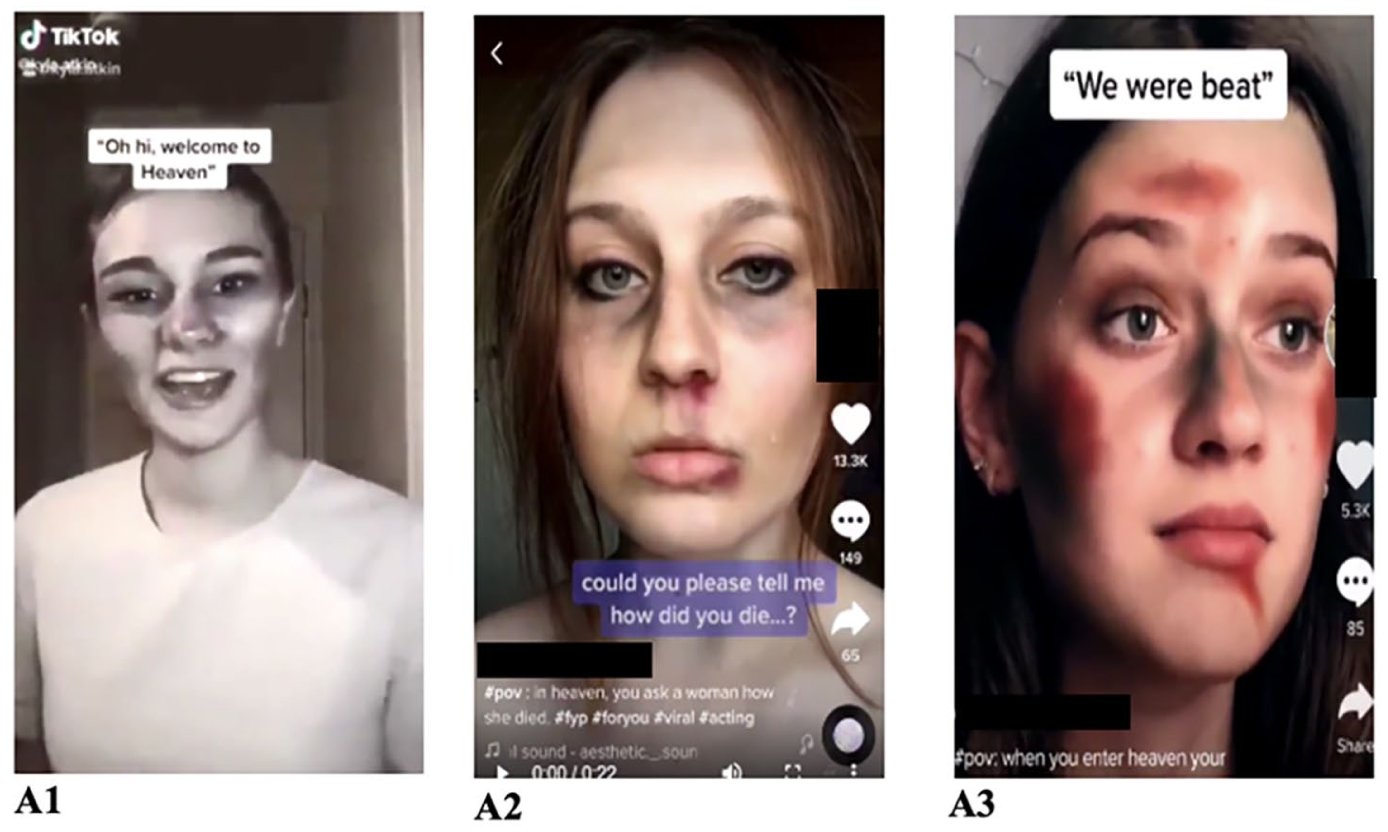
Testimony Mem(e)ory Challenge: creators as “victims” talking to a celestial figure, using visual effects to mimic bruises.
TikTok’s affordance of playability shapes how memory work unfolds in these videos, offering creators structured yet flexible tools to creatively, deliberately, and performatively construct highly stylized, affective narratives. A defining element is the aesthetic modulation of editing choices, especially the use of close-up to medium shots, foregrounding facial expressions as the primary affective signaling device. Speaking directly into the camera with an emotional gaze, creators draw themselves and the viewer into a specific historical moment (“So, I died in the Holocaust, 1941”; see Figure 2; A4).
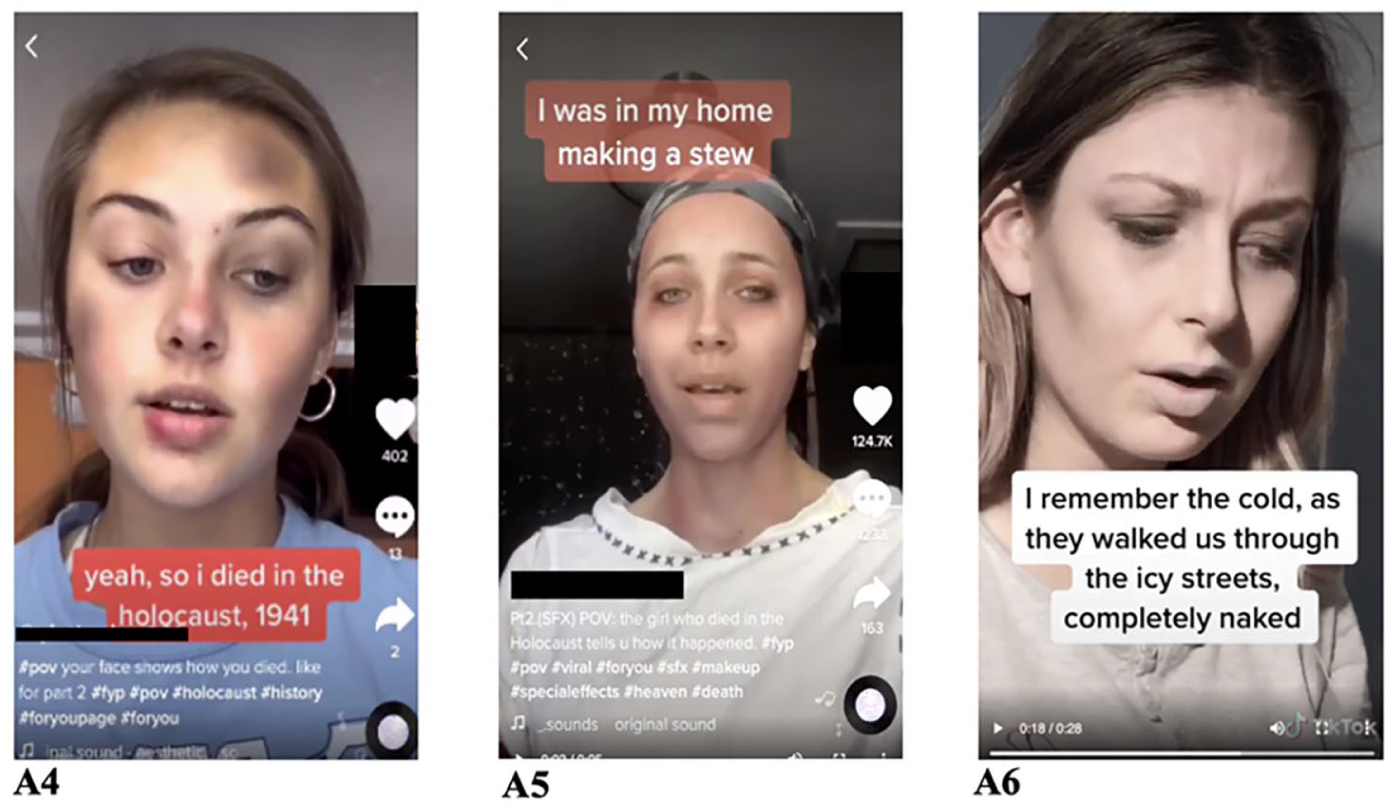
Testimony Mem(e)ory Challenge: creators as “victims” using overlay text highlighting fragmented memories.
Overlay text plays a crucial narrative role, compensating for the fact that many of these challenges rely on lip-synced performances set to background music, often making the spoken story difficult to discern. By providing temporal structuring and narrativized fragments of imagined experiences, overlay text allows creators to construct emotionally resonant storylines. Some reflect on their pre-war life (“We had a pleasant, peaceful life, we didn’t bother anyone”), on the day they were taken (“I was in my home making a stew”; see Figure 2; A5), and on their journey to the camps (“I remember the cold, as they walked us through the icy streets, completely naked”; see Figure 2; A6). Victims recount their deaths to “God,” who reassures them they have entered a comforting domain (“You’re in Heaven, don’t worry!”; see Figure 3; A7).
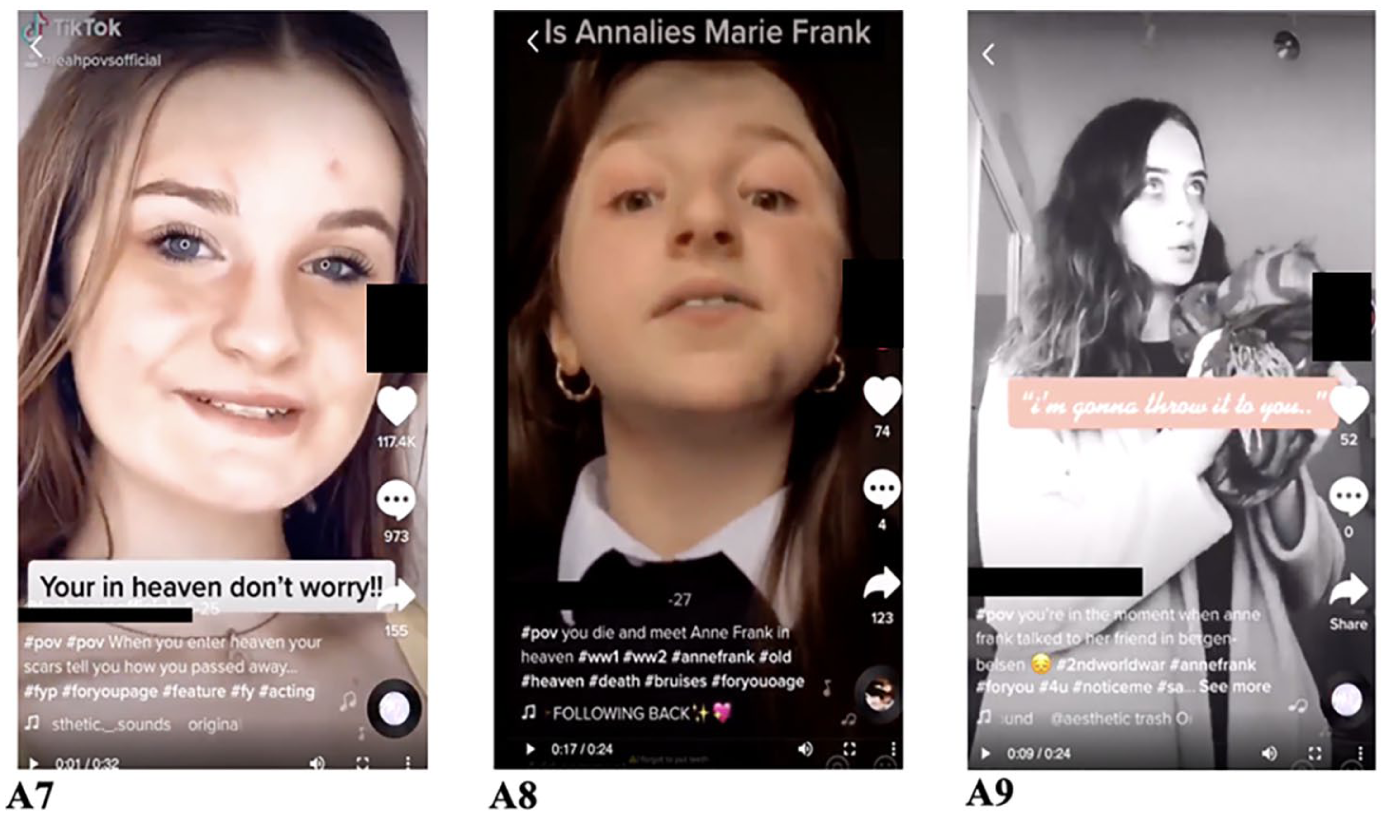
Testimony Mem(e)ory Challenge: creators as “victims” playing with Holocaust symbols, using costumes and characters.
Beyond individual performances, engagement architectures drive the circulation and collective meaning-making of these narratives. Hashtags like #heaven, #trauma, and #history link creators’ videos into an evolving archive of commemorative play, producing and distributing their mediated memories, and tying them into a collective ad hoc context (Bruns and Burgess, 2015). Within this ecosystem, creators engage in what Henig and Ebbrecht-Hartmann (2022: 2282) conceptualize as a social media witnessing mode. By doing so, they constitute a visually responsive space for witnessing atrocities in which they “inscribe themselves into mediated Holocaust memory.”
The play-pretend structure of this challenge reflects common memory practices where users embody roles to perform acts of witnessing (Maddrell, 2012), making the testimonial mem(e)ory challenge the one that most closely mirrors contemporary modes of remembrance. As a digital form of mediation, it corresponds with Frosh and Pinchevski’s (2009: 579) threefold nature of media witnessing as born in, by, and through the media. Creators’ imagined reflections on past events are more than a “singular, unrepeatable irruption in space and time” but inherently “reproducible and rendered communicable” via a multimodal meme that invites remixes and re-creations.
Creators’ interpretative play with Holocaust-related symbols does not stray far from institutional memory frameworks, but does takes shape in a less guarded and more affective environment. This is evident in the visceral nature of their performances, where expressions, body language, and emotional intensity take center stage. Their use of costumes, historical figures (see Figure 3; A8), and imagined narratives inspired by survivor testimonies (such as depicting the act of throwing supplies to Jews over ghetto walls; see Figure 3; A9) transforms their videos into emotionally charged re-enactments. By embodying imagined testimonies, creators produce prosthetic memories that are adopted rather than lived, opening interpretive space for consciousness-raising and negotiating hegemonic remembrance (Landsberg, 2004).
While prosthetic memories cannot be owned exclusively, this challenge invites users not only to witness history, but to breathe life into it through the engagement architectures of the #challenge, which sustain its memetic responses and continual reinterpretation. By participating, creators foster a deeper “empathetic understanding” (Landsberg, 2004) of the past, using their bodies and imagination to generate an “active synthesis of past and present, which results in the creative production of new ways of remembering the past” (Keightley and Pickering, 2012: 53).
Punitive Mem(e)ory Challenge
The second challenge consists of 15- to 30-second videos in which creators portray present-day prisoners who are “chained” and condemned to relive historical tragedies as punishment for their crimes. The videos open with a flickering caption listing catastrophic events—such as 9/11, the sinking of the Titanic, or the Holocaust—establishing a temporal structuring that links contemporary wrongdoing with past trauma (see Figure 4; B1). These narrative setups frame the prisoners’ fate culminating in execution scenes, where creators perform scripted distress in front of a guard, displaying prisoner ID numbers (see Figure 4; B2). Through exaggerated facial expressions and physical gestures—screaming and pleading—they engage in affective signaling, conveying helplessness and fear with visceral intensity (see Figure 4; B3).
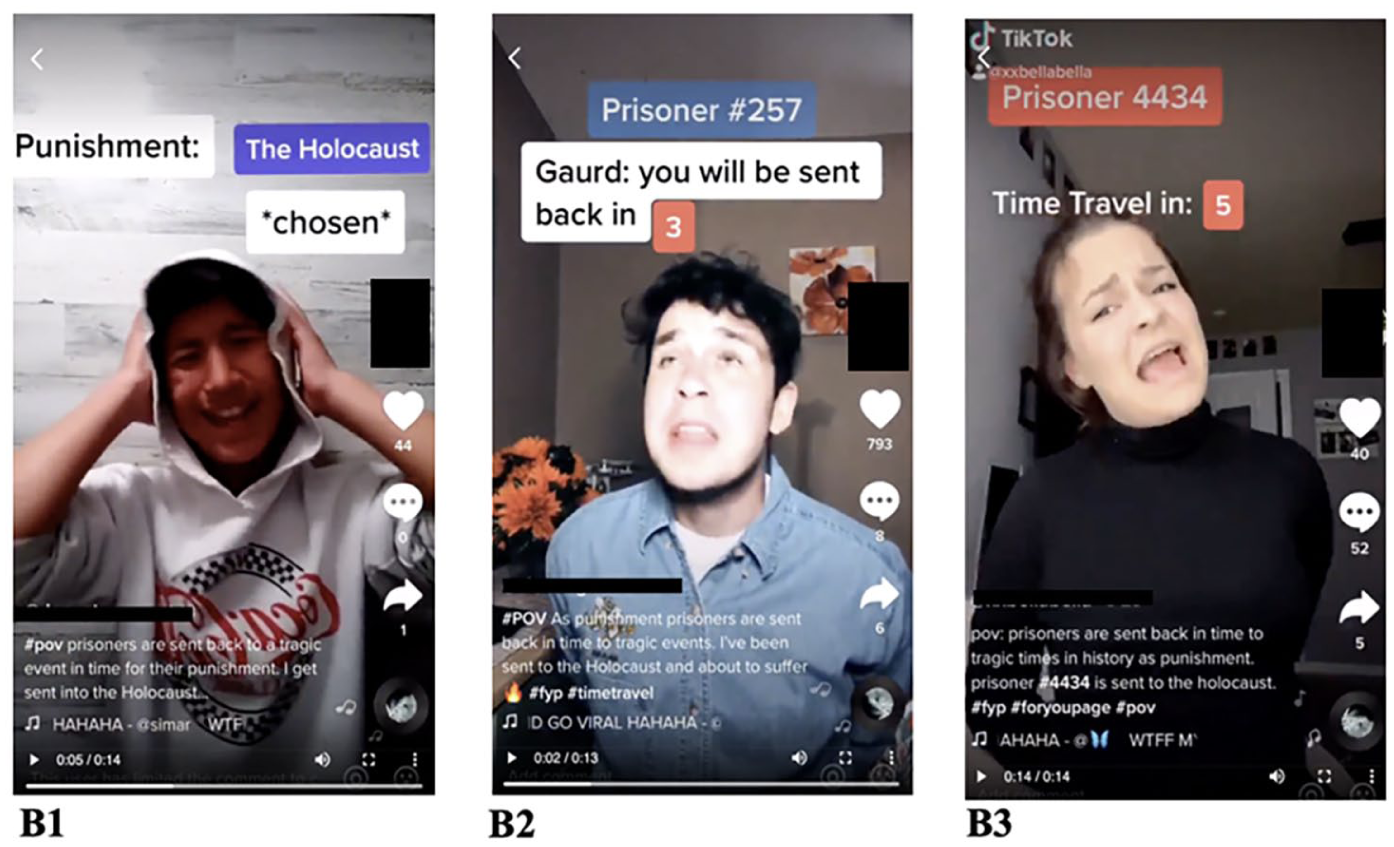
Punitive Mem(e)ory Challenge: creators as “prisoners” being sent back to the Holocaust as their punishment.
Prominently, these performances leverage playability as a socio-technical and performative affordance, using transitional effects to enact rapid aesthetic modulation that transports viewers across temporal realities. In one example, a prisoner is “sent” back to 4 August 1944, the day of Anne Frank’s arrest, where the creator stages a terrified captive waking to Nazi officers invading their hiding place. A blurry, distorted POV aesthetic heightens panic and disorientation, while fragments of officer dialogue layer historical texture (see Figure 5; B4). Here, playability operates as a dynamic framework that scaffolds historical role-play, combining affective signaling with platform-native techniques to embed memory work within TikTok’s memetic culture.
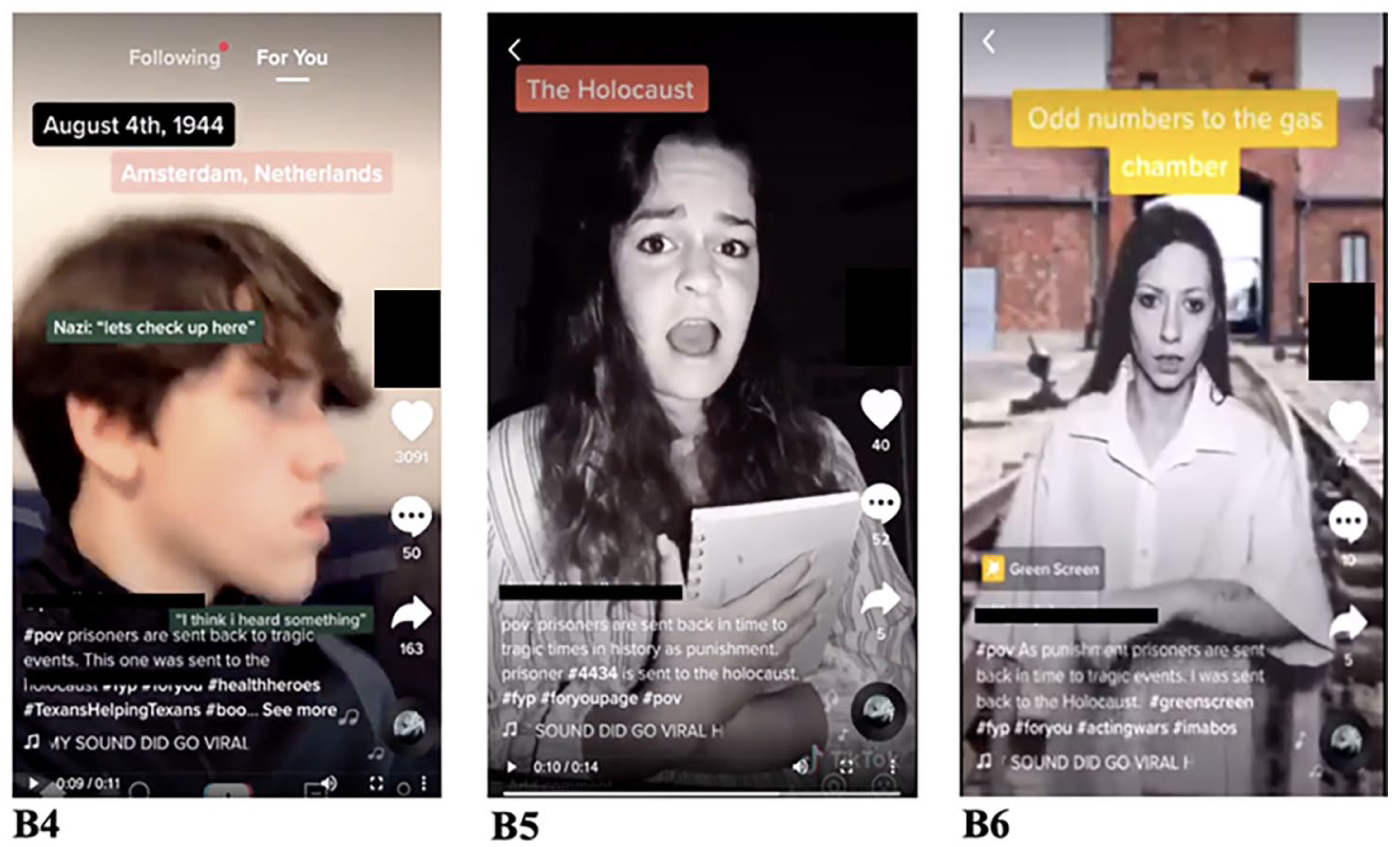
Punitive Mem(e)ory Challenge: creators’ time travel as “prisoners” into iconic Holocaust moments and places.
Beyond the transitional effects, the green screen feature seems to play a key role in creators’ memetic memory performances, enabling background manipulation that inserts creators into emblematic Holocaust-related historical environments. Leveraging the creative latitude afforded by playability – particularly TikTok’s background-switching feature – creators stage themselves within archival scenes, transforming static Holocaust imagery into participatory acts of historical play (Zurné & Adriaansen, 2024). This remediation of cultural knowledge demonstrates how vernacular creativity reinterprets memory through embodied, platform-native performance. In one example, a creator virtually “steps into” the gates of Auschwitz-Birkenau via green screen, raises her arm to display a number tattoo, and holds the frame (see Figure 5; B6) – performing an imagined re-enactment grounded in real historical referents, both inserting herself into history and inviting viewers to inhabit that charged moment.
Another video features prisoner #325, where the creator uses the green screen to inscribe herself into the entrance of a ghetto. Wearing a yellow star, she simulates an imagined conversation, overlaying text that reads: “Hey Jew, get off this street” (see Figure 6; B7), emphasizing the historical reality of movement restrictions imposed on Jews. This portrayal further reflects the systemic processes of mass persecution, as creators tap into forced “selections” (see Figure 6; B8). These re-enactments unfold within referential spaces that evoke past atrocities, embedding creators’ performances within broader narratives of victimization, crime, and trauma.
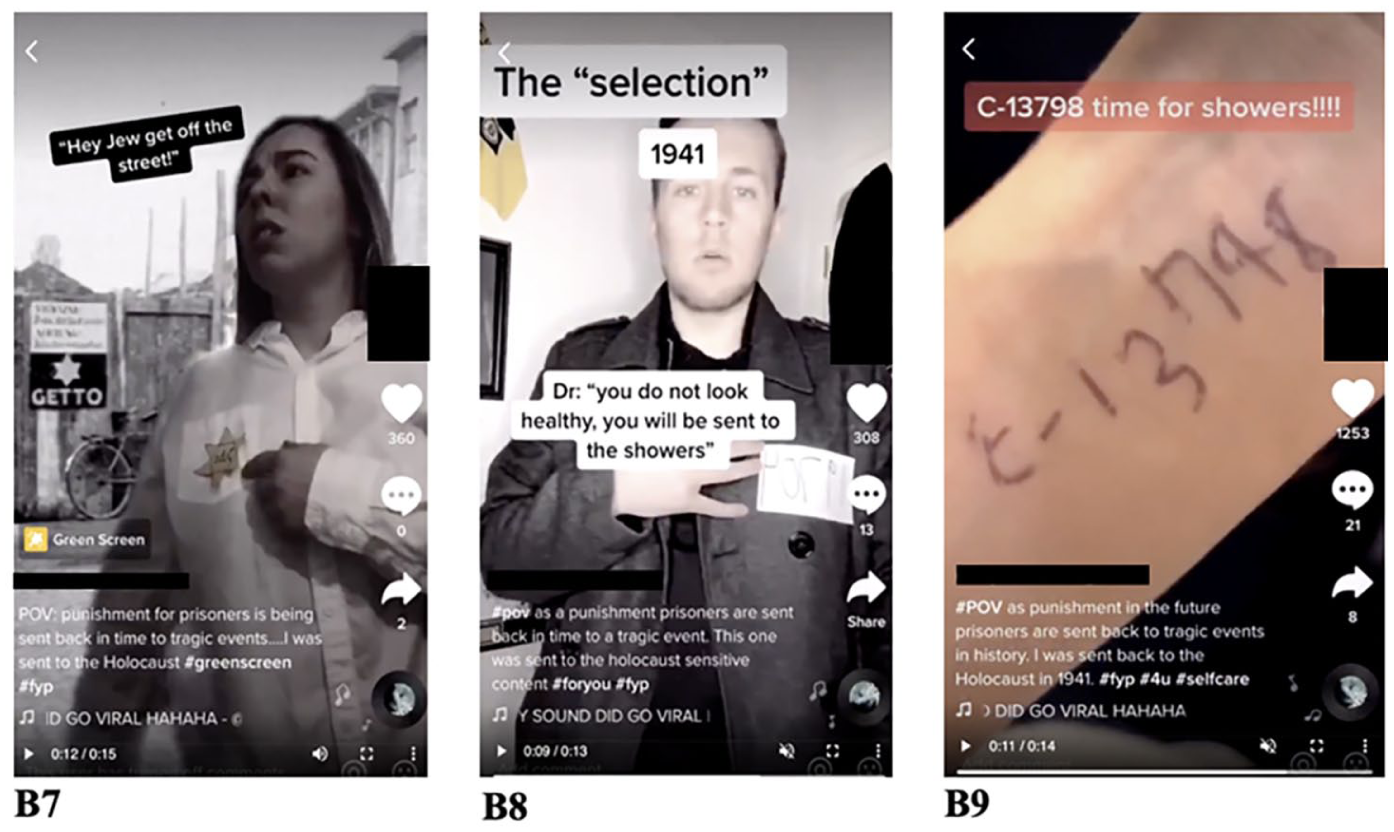
Punitive Mem(e)ory Challenge: creators’ time travel as “prisoners” using Holocaust symbols, scenarios, and events.
Interestingly, creators use the concept of “showers” across videos (see Figure 6; B9) as the prisoners’ “punishment” while re-enacting scenarios that lead the prisoners to this death. One can perceive this as trivializing the use of “popular trauma” (Rothe, 2011: 4), while creators transform “traumatic experiences into entertainment commodities” that might be inspired by corresponding narratives in popular movies such as The Boy in the Striped Pyjamas (UK/USA, 2008) with its controversial shower scene. However, these performances are more than spontaneous glimpses into the past, as they create detailed fictional re-enactments that are narratively linked to past atrocities, immersed in historical facts, and act as resonators of victims’ stories. Thus, with constant concerns over declining Holocaust education among youth (Kansteiner, 2014), this memory work offers insight into how digital participation might sustain their historical awareness.
Escapist mem(e)ory challenge
The third challenge presents a series of 15- to 30-second videos in which creators construct a temporally fluid narrative, shifting between the 1930s/40s and the 2020s in an interplay of past and present. At the start, creators position themselves as Holocaust victims who, for a moment, experience a glimpse of a future they were never meant to see. In these sequences, they are transported from the horrors of the Holocaust into the modern world (2020), only to be abruptly pulled back into their tragic past. The victim’s journey unfolds in a disorienting timeline, beginning in the future (the viewer’s present) after being transmitted from their original Holocaust reality (the viewer’s past).
At first, this nonlinear structure may seem confusing, as the victim appears in their imagined future (the viewer’s present) rather than in the past. However, the challenge’s description text clarifies the intent: “I was dreaming of a normal life but got woken up to my reality of hiding during the Holocaust” (see Figure 7; C1). In these “future,” creators depict their characters in modern attire (see Figure 7; C2) and familiar surroundings, often their personal bedrooms. Their expressions, particularly moments of unguarded joy and excitement (see Figure 7; C3), underscore the bittersweet contrast between the life they briefly experience and the one they are destined to return to. This visual juxtaposition heightens the emotional weight of the challenge, affectively signaling the stark divide between the imagined future and the historical reality of Holocaust victims.
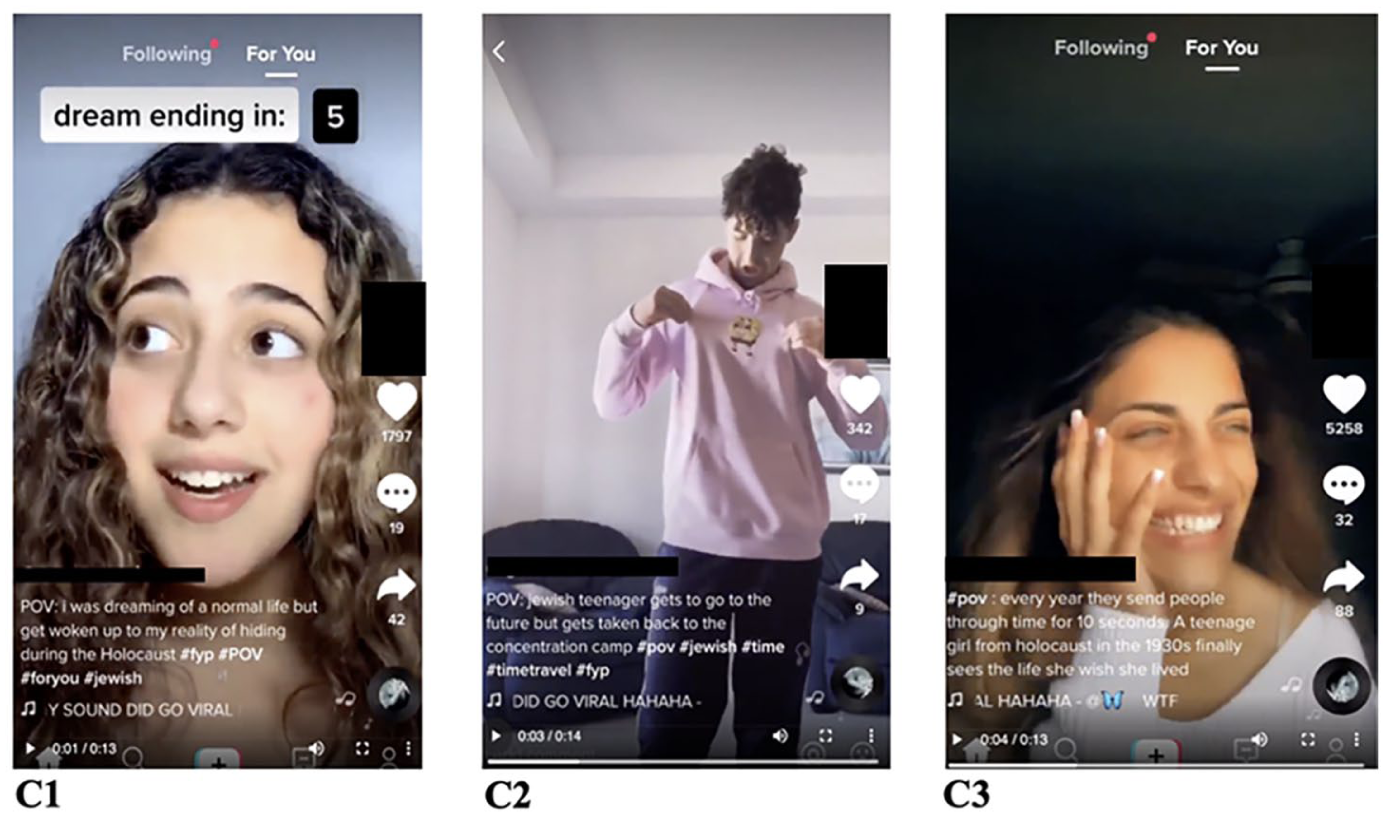
Escapist Mem(e)ory Challenge: creators’ time travel depicting Holocaust “prisoners” briefly experiencing the present.
Midway through the videos, creators “jump” back to their original timeline—the Holocaust—marking a shift from the sense of hope to the reality of persecution. Now dressed in Holocaust-related attire, such as striped uniforms or pajama-style camp clothing (see Figure 8; C4), they signal their forced return to the past. Additional Holocaust-related symbols, including handmade Stars of David and number tags (see Figure 8; C5), further reinforce this transition, as do the recreated settings of hiding places and atrocity sites, immersing the viewer in an historical reference.
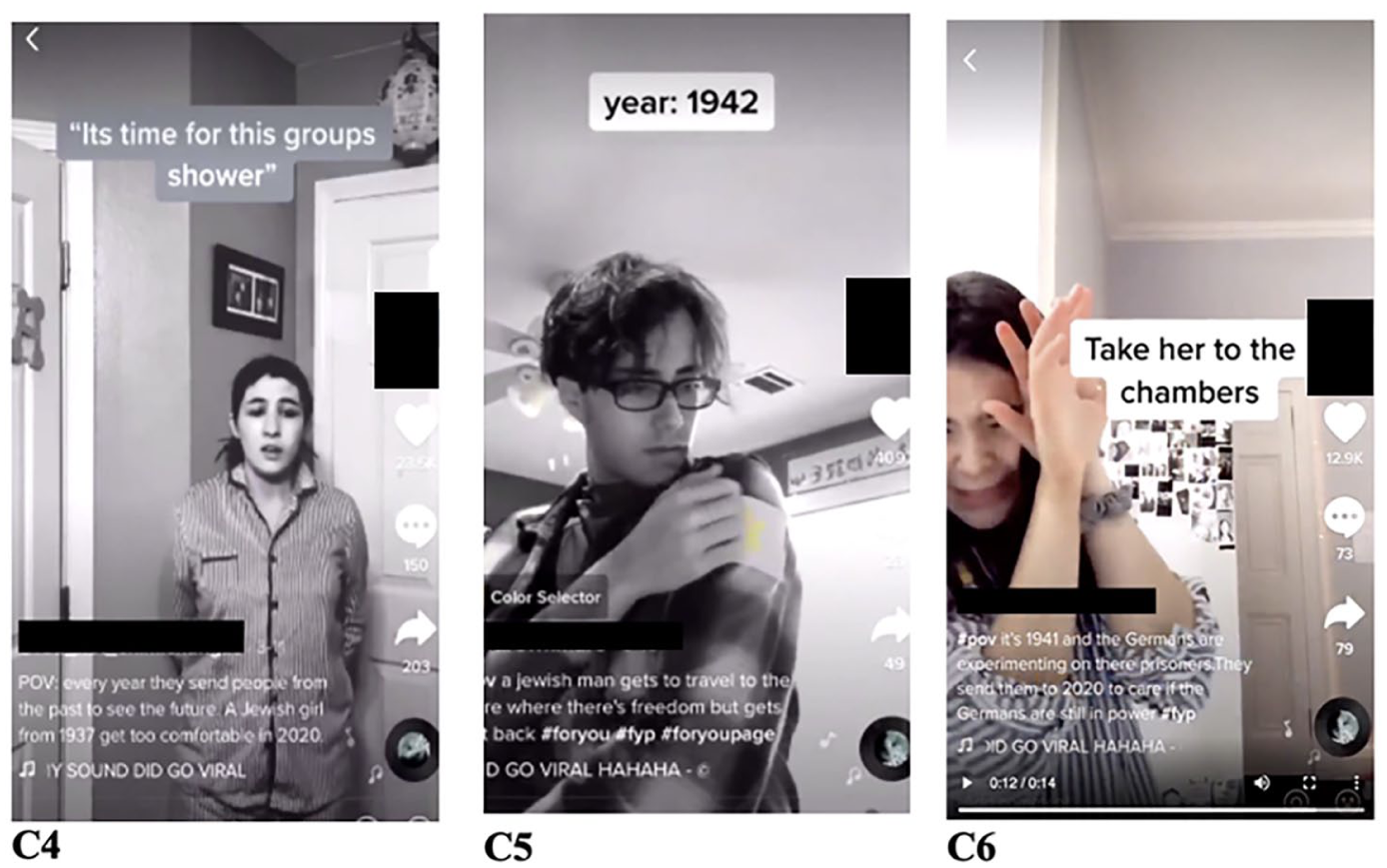
Escapist Mem(e)ory Challenge: creators’ time travel back to the Holocaust depicting “prisoners” with fear and violence.
Playability takes a center role in affording these dramatic shifts, allowing users to experiment with memetic interpretations of this trauma via visual transitions. The use of black-and-white filters heightens the contrast, severing the warmth of the imagined future from the bleakness of their historical fate. This choice evoked the past while reinforcing the oppressive atmosphere of Nazi control, as creators depict victims being herded into gas chambers (see Figure 8; C6). The shift is further embodied in their performances—expressions once filled with excitement contort into fear, their body language marked by helplessness. In many cases, creators raise their hands in a futile attempt at self-protection, mirroring iconic imagery of victims and deepening their emotional weight.
More of TikTok’s unique challenge format is reflected in its memetic structure, which typically omits spoken narration. Instead, creators rely on non-diegetic sound to set the tone, shifting meaning-making away from dialogue to visual and auditory cues. The absence of voice amplifies the role of external music, with the song “Locked out of Heaven” by Bruno Mars heightening the contrast between imagined freedom and inevitable tragedy. Creators rely on vivid visual performance—facial expressions, body language, and stylistic effects—using communicative markers that “index the salience of a certain memory, keeping it alive and acute” (White, 2002: 99).
TikTok’s quick-cut editing tools create the illusion of time travel, enabling seamless shifts between Holocaust-era and contemporary scenes. This temporal interplay is embedded within the platform’s #TimeTravel hashtag (over 150B views), a hub for historical speculation where creators’ engagements with the past are collected, circulated, and remixed. Echoing moments of “civic imagination” (Jenkins et al., 2016), challenges like these allow users to experiment with reinterpreting and manipulating historical events through the platform’s mechanics, as seen in other TikTok-native history trends such as “a world without the murder of” figures like Gandhi or JF kennedy (Schroeder, 2020).
Here, playability becomes central, affording creators to animate, inhabit, and re-stage historical moments through TikTok’s looping, transitional, and background-switching mechanism. In doing so, they temporarily “revive” imagined Holocaust victims, offering brief, speculative departures from their tragic realities. Yet unlike alternate history narratives such as The Man in the High Castle (USA, 2015 -2019), which sustain counterfactual worlds, these memetic videos invariably return their characters to the original timeline. The endless loop reinforces history as the enduring protagonist, unmoved by the creator’s momentary imaginative interventions.
Interviews
POV as a catalyst for immersive historical engagement
Our thematic analysis of the interviews provides a crucial layer of insight into TikTok’s role within contemporary memory culture. The first emerging theme surfaced in both creators’ and institutions’ perspectives, emphasizing the POV format as a means of bringing history to life, constructing first-person testimonial experiences that foster deeper connections. For many of them, the ability to “step into history” transformed memory work from passive remembrance into an embodied, affective encounter, as seen: I have no personal connection to the Holocaust, but the Holocaust can and should be remembered, not only by those who are connected by blood. In school, we hardly talked about it, but I watched movies, so I’m not clueless. Still, just knowing about it from textbooks or movies is not the same as feeling like you are in it. (Interviewee04_creator) Since a successful POV relies on personal experiences, or at least something that feels authentic or imaginable, I knew it wouldn’t engage viewers unless it felt “real.” I wanted people to feel like they were living that moment. I drew inspiration from actual testimonies. I turned to Google, found the USHMM website, and discovered a voice that deeply resonated with me. (Interviewee11_creator)
Acknowledging TikTok’s audiovisual power, memorial representatives noted that the POV format—widely used as a creative template—enables creators to “look into” painful historical moments through immersive memory work. This reflects Mortensen’s (2015) concept of connective witnessing, where platforms facilitate the gathering, production, and circulation of mediated acts of bearing witness to events beyond one’s immediate experience: POV was always a format recognized for its ability to engage audiences by immersing them in someone else’s life. (. . .) here, creators tell a victim’s story without needing to be the victim. It’s not a documentary, but it does create an emotional encounter that otherwise wouldn’t happen in social media. These POVs allow viewers to imagine the suffering of others. They use the POV as a testimonial canvas. (Interviewee01_memorial) I think creators actually amplify atrocity victims by channelling their understanding of historical events into strong narrative expressions. Overall, it’s about bringing history closer, making it feel urgent, even if the format itself is unconventional. It is how TikTok allows relatability, by trends, and this is a dynamic we, as commemorators, strive for in our efforts. (Interviewee06_memorial)
Institutional concerns: historical distortions versus youth play
Interviews with memorial representatives highlighted a tension between historical accuracy and youth reinterpretations of Holocaust memory. They noted that while many POV videos contained factual inaccuracies or dramatized elements, dismissing them outright would mean overlooking the genuine curiosity and engagement that young users display through these digital re-enactments: Those Holocaust POVs are full of moments of distortion. But the fact that young people are engaging with it at all is worth paying attention to, even if their approach differs from traditional methods of commemoration. We are so obsessed with historical accuracy that we forget what’s important, learning about young people’s curiosity. Why do they use the Holocaust as a punishment? For what crimes? Why are some moments inscribed more in their memory than others? Embracing their peculiar acts will allow us to find proper pathways for making the context they miss more accessible. (Interviewee05_ memorial)
As the IHRA (2013) states, distortion involves intent to “minimize, shift blame, or justify the Nazi regime”—none of which appear in the analyzed videos. Manca et al. (2022) similarly define distortion as “excusing, minimizing, or misrepresenting the Holocaust through various media” (p. 25). Yet, as Ebbrecht-Hartmann and Brenner (2023) note, Holocaust distortion is “highly ambiguous,” making its boundaries hard to define, especially on social media, which they see as a “forum for negotiating the relevance of history to the present” (p. 376).
Accordingly, some educators viewed these digital performances as opportunities for engagement rather than instances of distortion, particularly given the challenging media landscape in which young audiences navigate historical content: Yes, it is very tricky to fully understand young users’ motivations in the TikTok Holocaust challenge—is it mostly about the likes, or is it the genuine interest in the Holocaust and history? Either way, it is an indicator of their curiosity. They are using their accumulated knowledge about the Holocaust and the punitive nature of events that took place there. In these hard-to-shine economic attention environments, educational challenges are a great way to get the younger generation’s attention. (Interviewee02_memorial)
Navigating a platform of contradictions: playfulness versus seriousness
For many creators, participating in the #POVHolocaustChallenge was a way to bring historical weight to a platform often dismissed as superficial and whimsical. They saw it as a way to counter TikTok’s reputation for trivial content by using its viral mechanics to amplify meaningful history: I encountered this challenge by surprise. Once I saw how users were making efforts to tell important stories from the Holocaust, I realized this it not just another challenge, as is often the case on TikTok. This was serious; it’s the Holocaust, not something you often see on this silly app. I’m confident users were eager to participate because of the challenge’s historical significance, much like I was. We chose the Holocaust over other punishments we were offered with because this is the most painful one. (Interviewee4_ creator)
However, creators also acknowledged that TikTok’s playful culture, along with its features and aesthetics, naturally gravitates toward playability as the default mode of content creation. They observed that the platform’s algorithmic incentives primarily reward engagement driven by whimsy and light-heartedness, making even the most serious topics susceptible to what Raessens (2014) terms the ludification of culture. This environment can blur the line between commemoration and entertainment, complicating audience perceptions of memory work in digital spaces: The POVHolocaust is what we call a “REAL” challenge; one that requires genuine storytelling because the tone must be strong enough to make users pause. On TikTok, that usually means provoking a reaction, whether it’s cringe or laughter. If I want people to engage with topics like the Holocaust, I have to connect it to a remix or a trend to make it appeal; otherwise, they might just scroll past. (Interviewee_12, creator) TikTok basically tells you be playful, or people will get bored. On TikTok, everything needs to be playful, even the Holocaust! That’s also what makes it so easy for serious content to be taken out of context. But engagement and attention are key if you want the algorithm to work in your favor. I know it sounds like a paradox, but it’s a paradox that works—and it works on TikTok, or other short videos format like REELS. (Interviewee_07, creator) As a creator, my exposure is always in the front. But that does not mean I have no values or good intentions. I know that people outside of TikTok don’t always understand the way content circulates here. Only boomers think we are rallying around empty social media attention. TikTok is a serious place for raising awareness in ways that seem disrespectful to those born on Facebook. I didn’t mean to disrespect anyone, but we are easily judged because it is TikTok, and we are not “qualified” to speak about the Holocaust there and nowhere else. (Interviewee_10, creator)
Creators acknowledged the volatile mix of content gravity, production value, and engagement, often triggering public backlash. Their reliance on TikTok’s playability, with remixable audio, quick-cut transitions, and exaggerated facial expressions and costumes, can be understood as attention hacks, strategically designed to enhance performance within an economy that thrives on the “aesthetics of authenticity” (Funk et al., 2014). By embedding fragmented narratives and symbolic cues such as dates, locations, and Holocaust-related imagery, creators aesthetically authenticate traumatic events, ensuring their videos remain both emotionally resonant and algorithmically visible.
POV as a tool for processing the present
Several creators linked their engagement with the #POVHolocaustChallenge to contemporary struggles, reflecting on how this challenge provided a space for processing personal and collective trauma. Ebbrecht-Hartmann and Brenner (2023) note that “[r]elating the Holocaust to other present or past events is a legitimate practice that helps to clarify differences and define specifics” (p. 376). In this sense, through the #POVHolocaustChallenge, creators positioned themselves within a historical atrocity to draw connections between past and present forms of suffering and injustice: The memory of the Holocaust is not history. It is the present due to our living times. The Holocaust is Something that still echoes today. I am not afraid of compression because you do not need the mass murder of millions to use history as a reflection of what is happening around us. People of different backgrounds are persecuted due to their beliefs and identity worldwide. (Interviewee_09, creator) I feel that the lessons from the Holocaust are useful to understating how Innocent people are being killed nowadays by the police on the streets because of their skin color {referred to the murder of George Floyd}. For me, using the idea of victims from the past was a way to send a clear message about the victims of the present and, in a way, the future if we will not rise against hate. (Interviewee_05, creator)
For some, engaging with Holocaust memory through the POV challenge helped them articulate feelings of vulnerability, fear, and societal collapse that mirrored their lived experiences. This was particularly evident in reflections on the COVID-19 pandemic, where the sense of isolation and helplessness resonated with the imagined perspective of Holocaust victims: Covid brings much anxiety. A lot of us feel like there’s no one we can trust to give answers on how to handle the pandemic, and the death toll is rising out of control in my country. We are just hanging out there with no clear way out of it. Seeing this challenge on TikTok really resonated with my current feelings of being a victim, just like people back then {the Holocaust} who felt unprotected and faced daily death. (Interviewee_02, creator)
Reflecting on creators’ sentiments, the #POVHolocaustChallenge emerged as a narrative tool for mirroring the uncertain socio-political landscape during the 2020 pandemic. In this context, time-travel narratives show how creators link the past to their own present, creating a sense of presentness and emphasizing the need to actualize history. On TikTok, with its affordance for imagining alternate realities (Literat, 2021), the #POVHolocaustChallenge becomes a vehicle for emotional escape. This practice grants creator’s agency over uncertain futures by enabling them to create make-believe, reproducible moments where they can actively reinterpret history.
Discussion
The practice of “playing” with the Holocaust did not originate on TikTok. The tension between traditional, historically accurate representations (e.g. documentaries, testimonies) and more provocative approaches, such as video games, Lego constructions, and other creative mediums, has long challenged the established norms of Holocaust remembrance (Maddrell, 2012). Thus, unlike common beliefs that collective remembrance is embedded in institutional power structures of memory gatekeeping (Kansteiner, 2014), we argue that TikTok’s playability illustrates its potential for Holocaust education and commemoration in ways that subvert common understanding of appropriate Holocaust commemoration. By recognizing the memetic structure of challenges on TikTok, our study unpacks how users creatively commemorate the Holocaust “without adhering to the visual styles, narratives, and online cultures of the past” (Bresnick, 2019: 10), using the #POVHolocaustChallenge.
Addressing RQ1, our findings suggest that TikTok’s affordance of playability stretches the conventional boundaries of generational Holocaust remembrance by embedding memory work within a remixable and performative framework shaped by platform logics. In doing so, it illustrates the platformization of memory, where platforms actively shape the cultural production of remembrance through modularity, algorithmic curation, and user feedback (Nieborg & Poell, 2018; Annabell, 2023). As platform affordances are continuously renegotiated via user engagement (Bucher and Helmond, 2018 [2017]), creators leverage TikTok’s feature-based discoverability and visibility to embed historical events within participatory narratives that align with the platform’s playful climate (Cervi and Divon, 2023); a climate that nudges users to approach serious topics in ways that clash with traditional commemorative expectations. Features such as green screen, time-based transitions, overlay text, and filters exemplify how memory is fragmented into modular, re-usable units that can be endlessly adapted and recirculated. Similarly, challenge-specific hashtags link individual performances into networked commemorative spaces, translating remembrance into the language of trending visibility. Finally, makeup, costumes, and symbols like the yellow star or “prisoner” tattoos heighten the affective dimensions of these performances, reinforcing how memory work on TikTok is optimized for emotional expression, shareability, and algorithmic reach.
Together, these practices position TikTok as a site of connective witnessing (Mortensen, 2015), where users are not merely spectators of historical trauma but active participants in its circulation and transformation. Much like historical re-enactment as “serious play,” where participants negotiate rules to performatively simulate the past (Zurné & Adriaansen, 2024), TikTok creators remix platform conventions and affective performances. Unbound by historical truth, creators’ re-enactments often appear disjointed, as “the lines between documentary material and fictional re-enactment are often blurred in the course of remediation” (Erll, 2008: 394). Yet these practices play a crucial role in preserving the Holocaust’s relevance within youth discourses (Manca et al., 2025). POV videos exemplify this dynamic, as creators draw on a trending TikTok vernacular that demands imagination and intensified performance (Divon & Eriksson Kutork, 2024). In doing so, they become storytellers who ignite compelling acts of remembrance and open pathways for more participatory constructions of memory online. TikTok creators “do not only act as interlocutors but also as co-creators in the process of remediating past memories” (Henig & Ebbrecht-Hartmann, 2022), turning the For You page into a dynamic archive where memetic memory is both fleeting and enduring. Through circulation and indexing, POVchallenges continuously actualize history, linking past and present and making creators active agents in a living, networked archive of collective memory (Hoskins, 2017).
Addressing RQ2, our findings highlight creators’ motivations and positioning of the #POVHolocaustChallenge as part of TikTok’s playful landscape. Many creators saw the challenge as an opportunity to engage with Holocaust memory in a way that felt immersive and personally resonant. As “latent mnemonic communities” (Adriaansen & Smit, 2025) -loosely connected networks bound by shared digital memory practices rather than formal group ties -the POV format functioned as the affiliator (Trillò, 2024), a means of “stepping into history” that made the past feel tangible and relevant. This aligns with Landsberg’s (2004) concept of prosthetic memory, which highlights how mediated encounters with history allow individuals to develop emotional ties to events they did not personally experience. Some creators actively sought out survivor testimonies to ground their performances in recognizable Holocaust narratives, suggesting that participation was not merely about being seen, but about situating themselves within an evolving digital dialogue on historical trauma. The challenge’s structure exposed a tension creators readily recognized on platforms where play is rewarded with visibility (Tran, 2024), but they felt compelled to balance the playfulness needed to capture both human and algorithmic attention with the gravity of addressing such a serious topic.
Creators also reflected that the challenge is a way to process anxieties stemming from contemporary socio-political crises. By positioning themselves in historical victimhood, they drew parallels between past atrocities and their own fears of persecution, systemic violence, and global instability. Whether referencing racial injustice, state violence, or the collective sense of uncertainty brought about by the COVID-19 pandemic, their engagement with Holocaust memory extended beyond historical reflection to function as a framework for articulating present-day concerns. By embodying Holocaust victims, creators participate in digital witnessing, seeing the remediation of (post)memory traumas taking place in, by, and through the platform (Frosh and Pinchevski, 2009). This engagement fosters what the International Holocaust Remembrance Alliance (IHRA, 2018) describes as “historical empathy,” allowing users to playfully process an increasingly distant event via audiovisual storytelling that privileges emotional engagement over strict historical fidelity.
Addressing RQ3, institutional representatives pushed back against the assumption that TikTok challenges engaging with the Holocaust are inherently acts of trivialization. Acknowledging the presence of some inaccuracies, they stressed the need to assess these performances within their media context, warning that outright rejection risks overlooking how youth engage with Holocaust memory through their everyday digital vernacular creativity (Burgess, 2007). In a media landscape where historical narratives compete for visibility, educators and memorial representatives viewed these challenges as valuable entry points into historical discourse, revealing how younger generations internalize and express their understanding of atrocity within TikTok’s participatory structures. Some suggested that rather than resisting these challenges, educators should work toward developing strategies that leverage TikTok’s affordances for more contextually grounded memory work. The platform’s playability, conditioning success through performativity and engagement metrics, complicates traditional forms of commemoration while enabling new forms of historical awareness that resonate with contemporary audiences.
Conclusion
While Holocaust memory professionals strive to construct new ways of engaging with the Holocaust within an “appropriate” context (Walden, 2022), typical users often lack the educational framework to navigate such remediation properly. Thus, when equipped with the educational context, #POVchallenges can enable users to form perpetual contact with the Holocaust, keeping the past visible, tangible, and relatable for generations to come. Nonetheless, as digital cultures open horizons, they also challenge Holocaust remembrance (Manca et al., 2025). Holocaust survivors and several institutions that have recently joined TikTok have expressed concerns about the decontextualization of Holocaust memory within the platform (Ebbrecht-Hartmann and Divon, 2024). Moreover, TikTok’s memetic culture was recognized as an amplifier of hate while perpetuating a racist system reinforced via the platform (Matamoros-Fernández, 2023).
Hence, despite the genuine interest of creators in the #POVHolocaustChallenge, these videos often provide limited reflections on the Holocaust, risking trivialization, especially within TikTok’s playful format, which is susceptible to antisemitic variations (Hübscher, 2023). While our analysis resists blanket condemnation of these practices, it also acknowledges the need to critically examine how Holocaust distortion manifests in algorithmic spaces. As Novis-Deutsch et al. (2023) argue, Holocaust memory online is increasingly shaped by political contestation and shifting antisemitic narratives—raising concerns that some TikTok trends may inadvertently reinforce these dynamics under the guise of engagement.
This study is limited by its focus on a specific user-generated content within TikTok’s English-language ecosystem, which may not capture the full scope of Holocaust-related engagements across linguistic or cultural contexts. We center on content that reached a certain threshold of visibility, overlooking lower-engagement videos with different modes of memory work. Future research could adopt a comparative approach across platforms or longitudinally track evolving trends to understand how vernacular remembrance practices shift over time. Our findings call for the development of new pedagogical frameworks that integrate platform literacy into Holocaust education. Institutions must balance emotional resonance and historical accuracy, engaging youth without diminishing the Holocaust’s gravity. As platform logics continue to grow, institutions should collaborate with creators to co-produce more context-sensitive approaches to digital memory work.
Footnotes
Funding
The author(s) received no financial support for the research, authorship, and/or publication of this article.
