



Abstract
The QAnon movement, which gained a lot of traction in recent years, defies categorization: is it a conspiracy theory, a new mythology, a social movement, a religious cult, or an alternate reality game? How did the posts of a (supposedly) anonymous government insider named Q on an obscure online imageboard in October 2017 instigate a serious conspiracy movement taking part in the storming of the US Capitol in early 2021? Returning to the origins of QAnon on 4chan’s Politically Incorrect board and its initial reception as a potential LARP, we analyze it as an instance of participatory online play that fosters deep engagement above all. Drawing on concepts from play and performance studies, we theorize the dynamics by which QAnon developed into an influential conspiracy narrative as instances of “conspiracy fictioning.” In particular, we revive the notion of hyperstition to make sense of how such conspiracy fictionings work to recursively “bootstrap” their own alternate realities into existence. By thus exploring the participatory and playful engagement mechanisms that drive today’s conspiracy movements, we aim to elucidate the epistemological and socio-political dynamics that mark the growing entanglement of play and politics, fact and fiction in society.
Introduction
Everything has meaning
This is not a game
Learn to play the game
In recent years, QAnon has achieved notoriety for being an extremely elastic super-conspiracy myth (Wu Ming & Cramer, 2020). Yet, the original narrative is quite straightforward, drawing from a variety of conventional (and almost cliché) conspiracy tropes. In an initial phase (2017–2018), QAnon mainly revolved around the messages posted on 4chan’s Politically Incorrect board by the elusive Q, who claimed to be a high security-clearance government insider leaking information about a secret war between Trump and his allies against the deep state (Zadrozny & Collins, 2018). Q announces Hilary Clinton and other high-ranking members of the Democratic party will soon be arrested for their role in a satanic pedophile ring catering to the world’s elites. He links it to a cryptic allusion by then-president Trump at a press conference a few months prior, where the latter talked about the “calm before the storm” (Rothschild, 2021). While none of these predictions came true, this clearly didn’t halt Q’s rise. Whereas in October and November 2017, QAnon lived its mainly obscure life of 4chan and 8chan, it later spread to Reddit and alternative news sites, before jumping to social media platforms and the mainstream news media in July 2018, further advancing its “normiefication” (de Zeeuw et al., 2020).
Similar to Pizzagate, which emerged on 4chan’s /pol/ board as an investigative game but cascaded into a new form of “post-truth protest” (Tuters et al., 2018), QAnon thus materialized within an “inter-linked, pick-and-mix online ecology of information, opinions, facts, narratives, and claims” (Happer et al., 2019, p. 4). As such it speaks to a growing sense that our previously shared social reality is being fragmented and siloed into parallel universes, and that people have become playthings of algorithmically personalized disinformation campaigns. 1
Entering its second phase (2018–2022) QAnon became a full-blown conspiracy movement with growing ties to the US political system (LaFrance, 2020) and receiving support from elected Trump-associated “Maker America Great Again” (MAGA) Republicans like Marjorie Taylor Greene (Kranish et al., 2021). It also fuelled the flames of events leading up to the storming of the US Capitol on 6 January 2021, during which many protesters were seen carrying QAnon flags and protest signs with phrases like #WWG1WGA (“where we go one, we go all”) (Rothschild, 2021).
In the process, QAnon was also instrumentalized by opaque operators waging new forms of (dis)information warfare (Cosentino, 2020, pp. 11–12). Civic media scholar Ethan Zuckerman (2019) has linked QAnon to online disinformation campaigns (particularly in the Russian political sphere) that aim to challenge our perception of reality by exhausting us with complex narratives, which he terms unreality, echoing the unbelief of hyperstitional worldbuilding discussed below. However, rather than being premeditated from the top-down, QAnon represents a new form of bottom-up “ampliganda,” defined as “the shaping of perception through amplification,” which differs from classic propaganda to the extent that “[f]ar from being merely a target, the public has become an active participant in creating and selectively amplifying narratives that shape realities” (DiResta, 2021, n.p.). 2
During this later phase, the newly engaged publics drawn into QAnon (typically Trump-voters on the already conspiratorial edges of the Republican party) were probably unfamiliar with the self-referential and playful media practices characteristic of imageboards like 4chan. As it made its way across platforms, QAnon came to mean many different things to many different people. For this reason we first wish to briefly reflect on QAnon’s origins in what Phillips and Milner (2017) call the “ambivalent internet,” and what happens when something like QAnon escapes the boards and leaks into the non-ambivalent internet.
Whereas classical accounts of conspiracy theories typically assume that users hold these theories to be true, this assumption cannot be transferred to online spaces like 4chan. Due to its affordances of anonymity and ephemerality (Bernstein et al., 2011), the site operates under the ludic jurisdiction of Poe’s Law (Aigin, 2013) which posits that users can never be sure whether an utterance is made in earnest or facetiously. Similarly, the slogan listed at the top of 4chan’s infamous /b/ Random board states that “The stories and information posted here are artistic works of fiction and falsehood. Only a fool would take anything posted here as fact” (4chan, n.d.). This emphasis on fiction and dissimulative play grew out of the cyber-separationist ideals of early web culture, which imagined the web “as a virtual space of play detached and separate from ‘real life’” (de Zeeuw & Tuters, 2020, p. 215), as is also well-documented in the case of trolling (Phillips, 2015). Phillips and Milner (2017) describe these online subcultural practices as ambivalent: polysemic, playful, ironic, transgressive, and anchored in identity play and collective storytelling, as in the case of the Slenderman “creepypasta meme” popularized in the early 2010s (Nichols, 2019).
However, throughout the 2010s, 4chan and Reddit also became significant hubs for the creation and dissemination of conspiracy narratives that subsequently leaked from the vernacular into the mainstream, platformized web. Whereas in the early 2010s these boards had been linked to more seemingly-progressive actors like the Anonymous hacktivist group (Coleman, 2014), in the late 2010s, more explicitly right-wing actors flooded these spaces, converging into the Alt-right in the run up to the 2016 US presidential election. As a result, it becomes difficult to distinguish between users acting in the “lulzy” spirit of chan culture, genuine right-wing actors, or an ambiguous mix of both—the type Andrew Anglin, founder of the neonazi website The Daily Stormer, described as “non-ironic Nazism masquerading as ironic Nazism” (Anglin, 2016, n.p.). QAnon clearly partakes in this weaponization of ludic online subcultures, where play is instrumentalized within non-play contexts, often to troubling effect. Part of QAnon’s success, we will argue, is that it provided a synergetic back-and-forth between playful fictioning and “serious” collective action practices.
This also explains why politicians, academics and journalists alike have struggled to define and frame QAnon: is it a conspiracy theory, a social movement, an instance of dark fandom, a religious cult, or a “psychological warfare tool” gone open access (Kaminska, 2020, n.p.)? Moreover, to what extent do people engaging with QAnon content actually believe in it, or do they instead play at believing? And do these oppositions still hold in a post-truth public sphere where attention has seemingly become the only relevant metric and engagement is king? Remaining, for the time, agnostic to the answer to this last question, we approach QAnon as a boundary object that defies clear-cut categorizations, and is interpreted differently based on the speaker’s relation to it (Star & Griesemer, 1989). Our analysis departs from the play and game-like mechanics attributed to QAnon, especially by external commentators that likened it to an alternate reality game (ARG). However, during the first months of the QAnon movement—from the very first Q thread, in fact—users of 4chan’s /pol/ board also conceived of QAnon in highly gamified terms, namely as a LARP (for Live Action Role-Playing). Doing so they hinted at the facetious nature of those active on the board, who might be just ironically playing at conspiratorial beliefs (Tuters, 2019). Both these etic and emic accounts of QAnon as a game will be discussed in detail below.
Our article takes these accounts as starting points to think about QAnon as an instance of participatory online play that requires and fosters deep engagement above all, whether “real” or “for the lulz.” Specifically, we conceptualize as form of conspiracy fictioning—one that maps the growing entanglement between playful subcultures and “serious” right-wing conspiracy movements online. To explain how fictions become (perceived as) real through practices of fictioning, the concept of hyperstition is key. Originally developed by members of the Cybernetic Culture Research Unit (Ccru) at Warwick University in the late 1990s, hyperstitions are “fictions that make themselves real through collective practice” (Mackay, 2012, n.p.). By fictioning we do not mean that conspiracy myths like QAnon are simply made up, or that they do not correspond to reality, even when this is of course also the case. Rather, in hyperstition: “fiction is not opposed to the real. Rather, reality is understood to be composed of fictions—consistent semiotic terrains that condition perceptual, affective and behavioural responses” (Cybernetic Culture Research Unit, 2004, p. 275). In a nod to radically constructivist and postmodern accounts of reality, hyperstition thus challenges the existence of a world independent of the ways it is collectively imagined and enacted.
Most research on QAnon and similar conspiracy movements has focused on the role of social media platforms in facilitating and amplifying their spread: the rabbit holes created by YouTube’s recommendation algorithms (Lewis, 2020), Facebook’s filter bubbles, and Twitter’s echo chambers (Benkler et al., 2018; Phillips & Milner, 2021). Apart from a notable exception that looks at the gamification of online conspiracism in the case of QAnon (Davies, 2022), what existing research on QAnon and similar conspiracy movements still lacks is an adequate conceptual framework for understanding the participatory, ambivalent, playful and fictional practices that draw people into the conspiratorial fold in a way that is intrinsically rewarding, while simultaneously enabling their recruitment for extremist political causes.
In the next section we outline our theoretical approach to QAnon, mobilizing the key concepts of play, fictioning, and hyperstition. The subsequent sections then bring this framework to bear on various interpretations of QAnon as an ARG by external commentators, as well as a LARP by users of 4chan /pol/ themselves, by close-reading several relevant examples. 3 By leveraging concepts from play and performance studies and applying them to QAnon, we hope to shed light on the growing entanglement of play and politics, fact and fiction in digital culture and society at large.
Bringing Conspiratorial Worlds Into Play
Upon reading the words play and QAnon side-by-side, some readers might experience an understandable reluctance: after all, since when are right-wing conspiracy narratives linked to the Capitol storming in any way playful? Indeed, as noted by Stenros (2019), play tends to be idealized and homogenized, and both scholarly and vernacular accounts tend to emphasize positive aspects of play (enjoyment, personal growth) while ignoring or side-lining the negative ones (frustration, bullying). A common refrain when discussing playful activities is rejecting behaviors and actions deemed inappropriate as “not play,” an argument akin to the No true Scotsman fallacy (Tvtropes, n.d.). Some well-known examples include how football (soccer) hooligans are dismissed by their clubs as not being representative of the game’s spirit, or instances of extreme monetization in video games (e.g., gambling or micro-transactions) are cast out of the “true” videogame domain. Stenros unites such examples under the moniker of “Player-Inappropriate Play” (Stenros, 2019, p. 20) that include unplaying: performing age inappropriate and/or morbid scripts in children’s play; or dirty play, that includes aggressive, harmful and vandalist play. We can extend this to “game-breaking” behaviors online such as trolling or griefing that is now mainly referred to as dark play (Linderoth & Mortensen, 2015). Perceived as harmful when directed against the disenfranchised (Nagle, 2017; Phillips, 2015), similar transgressive play practices have nonetheless been praised when performed by progressive activist and art collectives (Coleman, 2014; Gekker, 2012; Lambert-Beatty, 2009).
These brief considerations on the normative implications of play bear testimony to its inherent ambivalence. An oft quoted observation on puppies from Gregory Bateson states that “[t]he playful nip denotes the bite, but it does not denote what would be denoted by the bite” (Bateson, 1972, p. 186). By its very nature, play is not “real” and therefore actions done in play can be easily disavowed. Yet by its mimetic connection to reality (the nip vs. the bite), it always threatens to become what it only ever sought to enact “as if.” While classic theory relegated play to an external sphere separate from regular activities (Huizinga, 1949), this bifurcation has been questioned and generally refuted ever since (Consalvo, 2009; Frissen et al., 2015). Consequently, definitions and the politics of play and playing also vary drastically within and across disciplines. Masek and Stenros (2021) show this divergence through a large-scale review of various definitions of playfulness (which they equate to play). Examining a total of 429 of journal articles and book chapters, they arrive at six themes of how contemporary researchers conceptualize play. Different as they are, it was found that all six focused on the concept of engagement where “[p]layfulness was widely characterised as a unique method of becoming involved as opposed to creating distance” (Masek & Stenros, 2021, p. 15). Engagement presents a relatively neutral criterion for assessing play’s success and is relevant to otherwise different domains ranging from video games and marketing to politics. Play is polyphonic (Stenros, 2019, p. 25) allowing many different behaviors under its mantle; it might boost civic participation (Gordon & Walter, 2016), tackle complex issues such as gender disparity or colonialism (Mukherjee, 2018) or give meaning to mundane experiences (Sicart, 2014, 2018). Yet play also is a driving force in ugly fan backlashes (Stanfill, 2020), exploitation of free labor (Chia, 2020) or locking users into compulsive manipulative systems (Joseph, 2021). The function of engagement also emphasizes affect, as shown by Reinhard et al. (2022) in analyzing QAnon through the lens of fandom studies. Similar to how Marvel or Disney fans become passionate about their favorite texts through a continuous community engagement, interpretation and transformation, their reasoning goes, so are Q-followers impassioned through fan-like participation in its unfolding story.
The significance of engagement to play and fandom allows us to envision Q-adepts as first and foremost engaged, regardless of whether they believe in the authenticity of Q’s messages. And as “[p]layfulness prioritises engagement over external consequence, realness, or convention” (Masek & Stenros, 2021, p. 23), it becomes clear how central play is to imageboard and—later—social media culture. Engagement is rewarded through these platforms’ participatory affordances, allowing users to interact with content and other users through practices of liking, sharing, upvoting, and so on. QAnon, as seen from this perspective, embodies the possibilities for collaborative storytelling and political mobilizing enabled by the internet. Anons are able to assign magical meaning to cryptic Q drops, in ways that combine new-age spiritualism, paganism and Alt-right sensibilities (Greenwood, 2022), all the while enjoying the plausible deniability of its ambiguous playful character. As such it can be seen as part of an emergent genre of reactionary or dark fandom (Hodson & Gosse, 2022; Stanfill, 2020) where vernacular creativity (Burgess, 2007) and play are mobilized for controversial practices (Linderoth & Mortensen, 2015). Thus, the movement’s ambiguity and virality both contribute to its meteoric growth. The recent purge of QAnon by Twitter, Facebook, and YouTube is ironic, seeing how QAnon perfectly embodies these platforms’ participatory imperatives.
These types of engagement are made all the more impactful by their reliance on digital forms of play. Philosopher and game-designer Miguel Sicart (2018) postulates that play has a central role in remaking contemporary digital life. Drawing on the post-phenomenological theory of technology, he posits that digital devices re-ontologize the world for its users by “applying rules that change agency and the experience of the world” (Sicart, 2018, p. 10). Here, reontologization is understood after the philosopher of technology Luciano Floridi (2013) as a radical form of engineering or design that changes the very nature (essence or ontology) of how others approach the world through it. From this perspective, Q-adepts’ engagement with sites like 4chan, 8chan, and Reddit reinforces their view of the world as computational and “solvable” (Bogost, 2006), further driving them to engage with the fannish mythology and world-building of the content (Reinhard et al., 2022).
Sicart’s re-ontologizing features of play are adjacent to recent discussions on “fictioning” in performance studies and post-structuralist philosophy that involve “the possibility of practices that engender that which does not yet exist, that, precisely, fictions it” (Burrows & O’Sullivan, 2019, p. 18, emphasis added). Following Statiekiwicz’s interpretation of Deleuze (and his Nietzschean inspiration of philosophy as radically creative), they suggest a “fantastic” version of philosophy, one which—unlike the traditional “representational” one—involves “a collapsing of any hierarchical distinction between art and philosophy” (Burrows & Sullivan, 2019, p. 3). Focusing on the cybernetic techniques of looping and nesting, they describe narrative strategies for creating parallel or multiple worlds, allowing the expression of diverging subjectivities, and through them the possibility for counteraction. Burrows and O’Sullivan’s verbing of “fiction” joins a growing number of approaches in science, art, and activism that focus on constructing narratives as a form of (action-)research to affect change in the real world. These include counterfactuals that draw on alternative histories to find solutions for contemporary issues such as climate change (Apperley, 2018; Pargman et al., 2017); or the use of narratives for world-building as an applied design perspective (Coulton et al., 2017). While different, all these approaches incorporate elements of intentional plasticity with the concept of the “real world” to playfully engage with the making of a better one. 4 Reinhard et al. (2022) recognize a similar drive among Q fans to participate in its Alternate Universe (AU)—or Q niverse—either as interpreters of the canon or evangelizing it to the “normies” beyond.
In parallel to discourses on fictioning, then-members of the Ccru Sadie Plant and Nick Land analyzed this logic of “fictions making themselves real” through the speculative concept of hyperstition. In the words of Amy Ireland (2017), hyperstition is essentially about the “production of cause from effect”: a sort of reverse-engineering from an imagined future into present action-potentials (behaving as if said future has already happened). 5 Such self-enacting fictions are supposedly key drivers of macro-historical developments, as in the cases of Christian eschatology, capitalism, and the internet (Carstens, 2009). In all three examples, speculations on possible futures—in the forms of the end times, money, and technology—bring about their own respective realities (or their antecedent conditions). In the words of Nick Land, all three global movements end up “staging the same theatrical production its ‘beliefs’ had anticipated” (cited in Ireland, 2017). Just as any successful myth, hyperstitions tend to obscure and erase their fictional origins as well as the circularity of their operations. Bootstrapping (Bardini, 2000) themselves into existence, the reality these self-forgetful fictions construct are essentially looping narratives that fabulate their own “virtual foundations out of circular operations” (Clarke cited in Davis, 2019, p. 394).
Robin Mackay (2012), who edited a collected work of Land’s earlier publications, explains that hyperstitions are “fictions that make themselves real through collective practice” and as such has been variously adopted by both left- and right-wing accelerationist thinkers to connect an alternative history to a yet-unmade future. Mackay further emphasizes that Ccru members thoroughly understood the “hype” component of hyperstition, 6 addressing the rise of accelerated information sharing practices at a time when continental philosophy rarely acknowledged the cultural and political ramifications of the internet. In a 2017 interview, Land—now an ostracized figure propagating neo-reactionary views on democracy and race—expressed admiration for Pepe the Frog as a model hyperstitional event, which provides a blueprint for catalyzing political action (Bauer & Tomazin, 2017). A similar understanding of the performative and “fictioning” qualities of online discourse is present in the notion of “meme magic” as instrumentalized by users on 4chan /pol/, who claimed to have “memed” Trump into the White house in 2016 (Asprem, 2020; Beran, 2019). 7
As artist and theorist Matt Colquhoun—blogging as Xenogothic—explains, hyperstition corrects the false causality of superstitions. When people are superstitious, they might avoid walking under a ladder out of fear that it will bring bad luck. While in this case a (unsubstantiated) belief translates to actual behavior, hyperstition instead sidesteps the question of belief by building on “unbelief,” or the elevation of second order belief: the ability to fuel belief in others or even in oneself, as preachers might do. For Colquhoun, zealous propagation of a created narrative is more akin to our unpacking of engagement, transcending the question of personal belief by “entertaining belief” (Shaw & Reeves-Evison, 2017, pp. 16–17) or practising “belief beyond belief” (Tuters, 2021). Similar to contemporary invocations of meme magic, such fictionings privilege the “propagative efficiency” of ideas over their “representational adequacy” (Ireland, 2017), and their virality over their veracity (Apter, 2019).
Besides unbelief, O’Sullivan (2017) lists two more key principles of hyperstition as set out by the Ccru: numogram and mythos. Whereas the first refers to the mapping of an “occult abstract cartography” based on esoteric numerological principles, mythos is described as Comprehensive attribution of all signal (discoveries, theories, problems and approaches) to artificial agencies, allegiances, cultures and continentities [sic]. The proliferation of “carriers” (“Who says this?”)—multiplying perspectives and narrative fragments—produces a coherent but inherently disintegrated hyperstitional mythos while effecting a positive destruction of identity, authority and credibility. (p. 14)
After the “creative” element of hyperstition, this last “destructive” moment in mythos is also prominent in QAnon which is as much about the construction of an alternate reality through cascading interpretations as it is about casting doubt on and delegitimizing dominant paradigms. 8
Seen from the perspective of playful engagement, fuelled by fannish “fictioning” practices of those in the know, and aided by the hyperstitional unbelief and mythos of its followers, QAnon is an exercise in building alternate realities while disrupting existing ones: one that is part game, part cult, part interactive choose-your-own-adventure text. 9 As we will show next, the playful and game-like aspects have been incorporated into various accounts of QAnon by external commentators and imageboard users themselves. The next section provides an overview of these accounts read through the conceptual prism of fictioning and hyperstition, to suggest a cohesive framework to tackle the movement’s overall liminality and ambiguity.
QAnon as ARG and LARP
Initially, QAnon seems to meet all the criteria for what Baden and Sharon (2021) call a “Conspiracy Theory Proper” or what Pipes (1997) refers to as a “world conspiracy theory,” revolving around “a political take-over by a malign force with global aspirations” (Knight, 2000, p. 11). Yet because of its epistemological and cognitive focus, the label of “conspiracy theory” fails to capture the specific social and participatory dynamics that increasingly characterize online conspiracy movements. Rather than theories, QAnon is better understood as narrative or as conspiratorial folklore, which demands a different framework better attuned to its neotribal and (secondary) “oral” dynamics (Venturini, 2022). In similar attempts to move beyond QAnon as “theory,” others have conceptualized QAnon as a mythology, a sect or a cult, and a (hyper)religion. 10 Here, however, we want to focus on existing accounts of QAnon as a game.
As part of a broader “gamification” of participatory culture (Davies, 2022), several commentators involved in designing or researching ARGs have pointed out that QAnon shares key tenets with the organizing principles of those games (Berkowitz, 2020; A. Hon, 2020; D. Hon, 2020; Reinhard et al., 2022), as well as with game design and game theory more broadly (Berkowitz, 2021; DeJong & Bustamante de Monti Souza, 2022; Kaminska, 2020). ARGs are online collaborative treasure hunts, often used as marketing campaigns for transmedia properties and popularized by such early 2000s examples as The Beast for Steven Spielberg’s film AI or I Love Bees for the videogame Halo 2. Traditionally, they share a premise of existing in our own reality, yet with minute changes that immerse the players into the game’s fictional contraptions (McGonigal, 2007; Örnebring, 2007). While somewhat reduced in popularity in the last decade, many of ARG’s design principles have become a mainstay for both games and advertising campaigns, particularly as the two drew ever closer together with the advent of social media and participatory fandom (Jenkins, 2006). For instance, the locative game Ingress, developed by Niantic and a precursor to their more-popular Pokemon Go, integrated ARG elements, such as a weekly “news show” detailing the fictional struggle over the Earth it depicted (Apperley & Moore, 2019).
ARGs “construct alternative realities that overlay the players” everyday life and, so-to-speak, charge it with magic’ (Wu Ming & Cramer, 2020). The use of “real-world” objects such as nondescript internet websites, phone numbers and actual physical locations further sustain the life-adjacent fiction. The pleasure here stems from the deliberate suspension of disbelief and the laying of the fantastical over the mundane. Salen and Zimmerman (2004) call such games that transgress into the habitual “invasive games.” In this vein, Wu Ming and Cramer (2020) describe QAnon as “a collective text interpretation game” that might actually be inspired by the novel Q: a book written by the open pseudonym Luther Blissett used by various artists in the 1990s. There has also been quite some speculation about a link between QAnon and Cicada 3301, an ARG that ran between 2012 and 2014 that displays similar game mechanics and might even be the work of the same group of people (Kaminska, 2020, n.p.). It revolved around solving various cryptographic and data security problems by following hints (called “breadcrumbs”) cleverly hidden inside the code of an image file, as with the first challenge posted on 4chan (Lipinski, 2012). The exact origins of the game remain unclear: while for some it bears the signature of a cybersecurity group or secret society, others suggest it was used to recruit agents for various US intelligence and security agencies (Leach, 2013, n.p.).
Combining the amateur ugly aesthetics (Douglas, 2014) of early internet culture with the convoluted yarnwork of the conspiratorial “chart brut” (Biddle, 2014), QAnon borrows from a similar pleasure of interpretation found in ARGs. For example, Figure 1 shows a digital collage of cropped screenshots connected by red arrows and annotations that “prove” Q predicted the death of senator John McCain on Sunday 26 August 2018. The connection is that this date is National Dog Day in the United States, and Q refers to actions taken against “no name” McCain with the phrase “Every dog has its day.” In making these inferences and connecting the dots, Q-anons engage in a form of grassroots inforensics, understood as the collective, bottom-up application of forensic methods and techniques to explore the vast data and information repositories of the internet (Hannah, 2021). This includes interpreting seemingly random numbers and patterns in the flight data of Air Force One, as in Figure 2, or in a flight holding pattern resembling the letter Q, as in Figure 3. These practices resonate with a fictioning technique that Burrows and O’Sullivan (2019, p. 8) call metamodelization, or the practice of producing diagrams that transcend the division between the scientific and the artistic in their description of the world.

A “proof” that Q predicted McCain’s death.

The call-sign for Air Force One interpreted as sign from Q.
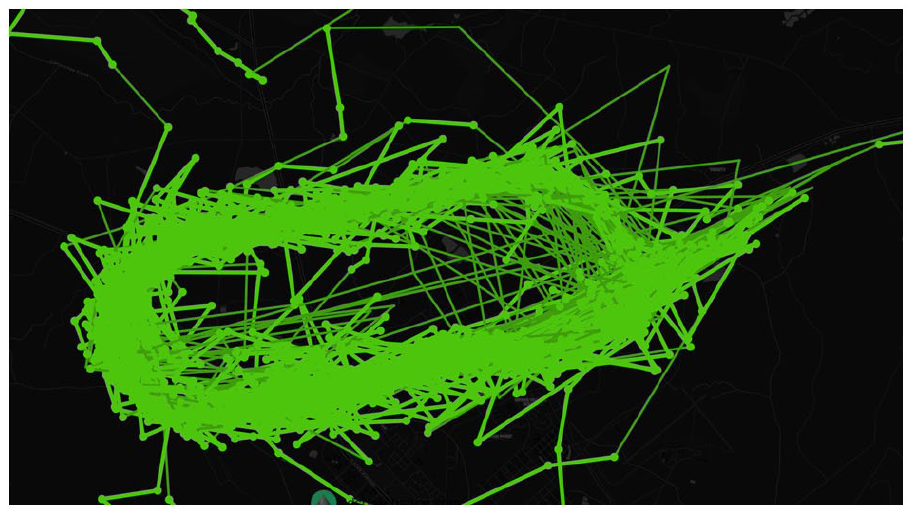
Air Force One holding pattern interpreted as a sign from Q.
As noted by Wu Ming and Cramer (2020), QAnon thrives on the principle of hermetic semiosis: the idea that any text provides an infinity of possible interpretations. 11 Like Pizzagate and other conspiracy fictionings, QAnon decoders forge new connections between seemingly unrelated signs, objects, and events. This kind of semiosis unbound—radically open to new connections yet at the same time also hermetically sealed to alternative readings—seems uniquely facilitated by the internet, as itself a dense web of links that can lead users into an endless maze of information, as per Sicart’s (2018) re-ontontologization claim. The webs of association spun by conspiratorial modes of reasoning, like digital networks, “tend to expand as they gain steam, multiplying correspondences, implications, and patterns of connection” (Davis, 2019, p. 387). Conspiracists invite us to experience the digital sublime, as the vast and ever retreating horizon of the next hyperlink before the last; and by doing so evoke a kind of epistemic vertigo that straddles the line between pleasure and paranoia. As Kathleen Stewart (1999) already noted at the end of the previous millennium, “The internet was made for conspiracy: it is a conspiracy theory” (p. 18). Similarly, what we call conspiracy fictioning refers to the creative technique of navigating and processing what Mark Andrejevic (2013) calls “infoglut.” In parsing the chaotic stream of information disseminated online, users seek to infuse meaning into political action.
Rather than an ARG (predesigned, planned, and directed from the outside), a vernacular understanding of QAnon as a semi-spontaneous and bottom-up LARP was prevalent on 4chan /pol/ from the very start, and even occurs in the thread that contains the first ever Q post (Figure 4). To call something a LARP on 4chan typically means to designate it as a trollish in-joke, a way of making sense of 4chan’s epistemic ambiguity, where all content exists in a suspended state between the “real thing” and its mocking dissimulation, or some twisted entanglement of the two. Like ARGs, then, LARPing can be considered part of the broader genre of pervasive gaming that defy “the usual boundaries of play,” as a result of which “everyday life is becoming interlaced with games” and the boundaries between fact and fiction are blurred (Montola et al., 2009, p. xix).

The first Q post, as documented by QAnon Pub (source: https://QAnon.pub/) in thread no. 146981635 on 28 October 2017 (source: 4plebs https://archive.4plebs.org/pol/thread/146981635/). The same thread already contains a reply that suspects Q to be a LARP.
A few days after Q starts posting the first “breadcrumbs,” a so-called general thread on /pol/ called “Calm Before the Storm #4” contains the first posts to mention both Q and LARP in the same message. In the thread one anon states of the initial Q posts that “it was either a god-tier larp or legit.” 12 In another post within the same thread QAnon is referred to derisively and jokingly as “breadcrumbs guy” and said to be “most likely a hack.” Another refers to QAnon as “breadcrumbs bro” and is said to “look[s] fishy.” According to this last user, Q was certainly not the first to present himself as a high level insider leaking highly classified data to the public. Q’s cryptic style of short, telegram-like messages has been often used by so-called whistleblowers and leakers on 4chan—so much so that these kinds of posts became somewhat of a LARPing subgenre of their own. Earlier examples that are mentioned as part of a larger “LARP war” are MegaAnon, FBIAnon, CIAAnon, and HLIAnon. 13 Q’s cryptic questions thus merely perfected the rhetoric of conspiratorial innuendo and double entendre prefigured by the LARPing genre of supposed leakers or Intelligence insiders on 4chan. Some anons even mockingly celebrate QAnon as a highly successful LARP, in the sense of drawing “naive” believers (seen as normies) into its fictional contraptions.
The pervasiveness of seeing QAnon as a LARP is also confirmed precisely by being constantly contested by other anons, who instead want to give Q the benefit of the doubt. This is done by presenting evidence for Q’s prophecy similar to Figure 1, but with the question: “How did QAnon know? Do you still think Q is a LARP?” (Figure 5). In this post an older statement by Q about the leaking of phone records is later corroborated by Q themself, relying on the conspiratorial axiom of “future proves past.” Finally, alongside both critical denouncements and ironic celebrations of QAnon as a successful LARP, there are also suspicions about it being a PSYOP (an abbreviation for psychological warfare). While some suspect QAnon to be a so-called false flag operation by Jewish conspirators to put “shills” on the wrong path (Figure 6), others blame users from the adjacent /leftypol/ and members of Antifa for getting /pol/ users to take the QAnon bait “for the lulz.” Again others claim, ironically or not, that the very suggestion that QAnon is a LARP is itself a false flag operation to undermine Q’s real message. As one anon writes in response to another post: “It’s real anon. The ‘LARP’ LARP is just something used by shills to make you think twice about the info dumped” (2 November 2017). 14

Screenshot of various posts assembled to convince users on 4chan /pol/ who claim QAnon is a LARP that he is in fact legitimate.

An image parodying another meme popularized within QAnon circles that contained the caption “Calm before the storm.” Instead this one states “Larp before the shoah.” Added in the corner is a badge containing the text: “You’ve just been fucked by psyops. Because physical wounds heal,” including the anti-Semitic happy merchant meme.
Whereas in the early context of 4chan /pol/the question of QAnon’s authenticity remains shrouded in the atmospheric ambiguity characteristic of the board, by the time QAnon reaches Facebook and Instagram its reception and adoption is shaped by very different platform cultures and demographics. Already on 8chan and later 8kun, specialized QAnon research boards assume the baseline authenticity of Q-drops, which in turn become indexed and archived by dedicated websites like qanon.pub for easy future reference. On YouTube and Instagram, right-wing influencers see an opportunity to monetize QAnon content, while on Twitter right-wing pundits come to have a vested political interest in its reality. As a result, the dynamic surrounding QAnon shifts, from potential LARP to conspiratorial dogma, reflecting a qualitative shift in quantity.
This process, whereby a conspiratorial narrative or idea like QAnon transcends its original context in which its fictional qualities (or at least murky origins) can still be acknowledged and contested, to one that treats it as received dogma, is part of what we refer to as its fictioning and hyperstitional dynamics. Crucially, the element of fiction and play does not stop at 4chan but extends through the whole chain of transformations of QAnon as it spreads across the Web. This is essentially the mythos component of the movement, creating an ongoing “proliferation of ‘carriers’” (O’Sullivan, 2017) that fuels the multiple interlocking layers of the conspiracy. We must thus consider how hyperstition acts through cross-platform diffusion as it shifts the types of engagement with QAnon. By this, we mean to designate how certain narratives appreciated as play on 4chan have a very different status in other “conversational contexts” (Krafft & Donovan, 2020). Part of its power lies in the ability to constantly attract new actors who push the fiction forward by adapting it to their needs, yet in a way that is beyond anyone’s control (Shaw & Reeves-Evison, 2017, p. 35). Such travel removes the initial ambiguity and self-referentiality so that “unlike troll communities, QAnon adherents are not doing it ‘for the lulz’ (Phillips, 2015), but rather out of a deep belief in the tenets of Q” (Hodson & Gosse, 2022, p. 49). Through the notion of hyperstition we can understand how this (un)belief is being manifested by propagation and engagement, despite (or rather precisely because of) its origins in those ambiguous communities.
Discussion
Whether playfully or seriously engaged, whether believed or not, Q-adepts continuously decipher global events and media messages in search of hidden meanings and occult truths. Such guesswork fosters playful collaborative engagement that is intrinsically rewarding but also provides the foundations through which new myths are created. This leads to the solidification of the previously imagined world view and adoption of even more complicated diagrams to decipher. If Trump loses the elections, a new conundrum must be solved through Q’s crumbs. New information is added and parsed, where making sense of idiosyncratic QAnon lore becomes a shibboleth for the truly dedicated. The joint effort in sense-making reinforces the comradery of seeking further interpretation. The mythos of the world is thus made and remade recursively, a process we earlier likened to bootstrapping.
The hyperstitional framework adopted here suggests that the adherent’s original belief in Q’s prophecy is ultimately immaterial, as it is not the belief but the participatory involvement that matters. We suggested that this demotion of the question of belief is already assumed by the notion of (social media) engagement as such, as the instrumentation of visibility and attention come to overrule issues of knowledge and truth. In the context of Pagan communities in Italy, Parmigiani (2021, pp. 509, 515) proposes a helpful distinction between “belief in conspiracies” and “conspiracy-believing.” While the former deals with actual belief in conspiracy theories, the latter refers to “an aesthetic (sensory and artistic) practice with performative effects,” similar to how we defined the practice of fictioning. As a “participatory” form of knowing (Greenwood, 2022), QAnon allows for conspiracy-believing to become enacted (and rewarded) through platformized play. Yet the idea of hyperstition further undermines Parmigiani’s distinction, as “belief in conspiracies” can no longer be seen as separate from, or supplemental to, its “fictioning” self-enactment. Similarly, our earlier distinction between “actual” belief, on the one hand, and playful participatory involvement, on the other, collapses when viewed from the perspective of hyperstition’s recursive dynamics.
Ultimately, some QAnon adherents might wholeheartedly believe in Q’s unrealized prophecies. Others find enjoyment in playing along, while snickering at the “normies” who fell for the LARP. Others still see the emerging landscape as a recruiting ground for reactionary ideologies, sidestepping the question of belief altogether. However, hyperstition—through a mythos that can “fabulate” its own ontological foundations and bootstrap itself into existence—does not materialize on an individual level, as if a person can transition from unbelief to belief. Rather, hyperstition always operates on a transindividual level, as similarly assumed by cybernetic notions of complexity in systems. In the case of QAnon, this means hyperstition is an emergent and synergetic property of the system of actors and networks involved in its “fictioning” as a whole. It is as a machinery and a mode of production of the real that QAnon entices and enchants its followers, equally those who are in it for the lulz and those who are in it for (the) real.
We hope our analysis fictioning and play’s roles within online conspiracy movements contributes to a better understanding of these dynamics, advancing current scholarship beyond direct causal explanations of specific platform culpability. Tracing in more empirical detail how QAnon evolved through various cross-platform passages from the ludic to the cultic, and from the playful to the political, provides ample opportunity for further research.
Conclusion
On 24 June 2022, after an 18-month hiatus, Q finally posted a new message on 8kun’s /qresearch/ board (Center on Extremism, 2022). The message contains a single question: “Shall we play a game once more?” For us, at the time finishing this article, it reaffirmed our approach to QAnon as a form of conspiracy fictioning. Driven by the playful affordances of imageboards like 4chan, but quickly migrating to dedicated conspiracy boards on 8chan, 8kun, then YouTube and Reddit, before spreading to more mainstream platforms like Twitter and Facebook, QAnon successfully appropriated the potential for deep engagement inherent to social media. As a boundary object and a hybrid that defies categorization, we analyzed QAnon as the convergence of ludic online subcultures, internet-accelerated conspiracism (where “everything is connected”), and right-wing extremism. By tackling and juxtaposing the conflicting interpretations of QAnon rather than focusing on a single one, we suggest that its ambiguity is what lends it its unique power.
We argued that QAnon represents a process whereby fictions make themselves real through collective and playful engagement online. Focusing on the notion of hyperstition, we showed how conspiratorial metanarratives like QAnon construct an engrossing and immersive communal world for its adherents, cultivating (or strengthening) belief (regardless of original intent) and shaping (political) behaviors. Davies (2022) observed that ARGs typically demand a suspension of disbelief to retain the game’s “as if” reality, for example through the evocation of “This is not a game,” which serves to connote it is a game without undermining the player’s immersion. The hyperstitional dynamics of QAnon, on the other hand, show how creative and playful practices of unbelief can produce a convincing and pervasive unreality for those invested in it. Constantly looping back on themselves and refracting in many directions, conspiracy narratives acquire the power to reshape reality—looping, because this newly established reality comes to anchor the very beliefs it anticipated. Or as Q keeps repeating in his drops as a sort of magic chant: “Future proves past.” From Trump’s original allusion to a “coming storm” which set in motion the QAnon fiction, to the actual storming of the Capitol, Q has run its loop: from Storm to storming, from LARP to historical event. For now, at least.
Footnotes
Correction (April 2023):
This article has been updated with minor grammatical or style corrections since its original publication.
Declaration of Conflicting Interests
The author(s) declared no potential conflicts of interest with respect to the research, authorship, and/or publication of this article.
Funding
The author(s) disclosed receipt of the following financial support for the research, authorship, and/or publication of this article: For this research the first author received financial support from the FWO (Fonds Wetenschappelijk Onderzoek), Grant ID 12ZU322N.
