



Abstract
Research has shown that Black politicians in the Global North contend with higher instances of abusive language on social media platforms. The study investigates how public interactions engage with the intersectional positionalities of nine Black Canadian politicians. We collected all the replies to tweets posted by the politicians from 2006 to 2021. Results from the manual analysis showed that 56% of the tweets had a neutral tone, meaning that even if they contained abusive language, they did not directly address the politician. They were also not complimentary. There were more negative tweets than positive ones; 23% versus 21%. The themes of the tweets with negative tones centered on opposition to the politicians’ discussion of racial inequalities or racism, or their party affiliations, especially affiliation to the Liberal Party or relationship with Prime Minister Trudeau. The manual analysis showed women politicians received higher rates of abuses, while in the sentiment analysis stage that covered the entire data set, men were more trolled with 66.6% of words directed at them being negative, compared to 55.7% for the women.
After the 2021 Federal Canadian election, during which the Green Party was enmeshed in a public and ugly internal conflict, their leader Annamie Paul (2021)—the first Black leader of a Canadian federal party—tweeted, “When I was elected into this role, I broke a glass ceiling. I didn’t realize that when I did, the shards would fall on my head, leaving a trail of broken glass that I would have to crawl over.” Her post encapsulates the difficulties facing Black politicians in Canada and other Western democracies: their presence is celebrated as “proving” that X country has moved beyond racism and yet their treatment—especially when they directly address issues of discrimination—reveals that this is wishful thinking.
Tellingly, in response to her post, a presumably white 1 male user (based on his image) asserted that it was hard to believe her difficulties had anything to do with her being a woman since another woman in the same position, Elizabeth May, had fared much better. Liked 88 times, this response completely ignored the question of race. By concentrating solely on gender, it exemplified that sleight of hand many use to devalue intersectional experiences. As Crenshaw (1989) has revealed in her classic study of intersectionality in which a suit brought against General Motors by five Black women for discrimination was dismissed because GM regularly hired Black men and white women—“Black women,” according to the court, was not a legislative category—single-axis analyses erase the experiences of people whose identity lies at the intersection of multiple categories. They also serve as alibis for further discrimination.
This study furthers intersectional analyses through a mixed-methods approach that offers a multi-dimensional picture of Twitter responses to Black Canadian politicians. Canada is key here because, although it is often praised as a “best-case scenario”—that is, a functioning and officially multicultural democracy—it struggles with historical and current discrimination against Black and Indigenous populations (Fleras, 2014; Flynn, 2014) and Islamophobia (Al-Rawi, Chun & Amer, 2021; Karim & Eid, 2014). This study thus highlights questions and issues relevant to all countries and institutions actively engaging in Equity Diversity and Inclusion (EDI) programs to move beyond token representation toward full democratic engagement. This would involve researching contextual dynamics to inform significant policy and other actions on addressing hate and marginalization in online and offline spaces. The study also enhances the political ecosystem of Canada by systematically filling knowledge gaps about the varying manifestations of acceptance and rejection of racial equality in social media narratives.
We analyze the textual content of Twitter data using an intersectional analytical framework that underscores discriminations against Black federal politicians. This is a unique application of intersectionality to multidimensional facets of their identities and how these variables influence the public’s interactions with them on social media. Indeed, this study contributes to the theoretical development of intersectionality through the complex reality of Black politicians in a sharply divided multicultural setting. We explain intersectionality and how we operationalize it to our investigation in the methods section.
History of Black Canadian Politicians
This article presents a content analysis of Twitter replies to the nine Black Canadian federal politicians with active Twitter accounts in a set period. We study, for example, replies to Wanda Bernard, presently one of only five Black Canadian senators (as of November 2022). She is notably the first African Nova Scotian to hold a tenure track position at Dalhousie University and to be promoted to full professor (Senate of Canada, 2017). Mathew Green is particularly noted for his 2014 historical election as the first Black elected to Hamilton City Council (matthewgreen.ndp.ca, n.d.). As these examples demonstrate, Canada, at this point in its long history with Blacks, is still waddling in the quagmire of first Black pacesetters.
Nonetheless, their history of activism and civic culture is rich. A noteworthy example is Rosemary Sadlier who fought for educational materials and curricula to reflect the histories and contributions of Black Canadians (Sadlier, 2021). Although their presence dates to 1608 (Library and Archives Canada, 2013), the first Black Canadian to win a seat in parliament only occurred over three centuries later, Lincoln Alexander in 1968. Alexander achieved many other notable firsts, including the first Black Cabinet minister and Lieutenant Governor (Alexander, 2010).
Significantly, narratives of key Canadian political figures lack a representative account of contributions from minority communities (Sadlier, 2021). The political structure has a racial hierarchy which systematically disadvantages minority politicians. Discursive practices in academic literature, on social media, and from political platforms, reflect the power differentials that foment the belongingness of white politicians. Contrastingly, Black political identities are grounded in their dynamic positionings as racial minorities, female/male, immigrants, and so on in a system that perpetrates their perceived subordinate status (James, 2019).
Study Context
Racism in Canada
Public discourse about anti-Black racism in Canada wavers between existence, inexistence, and negligible to the point of insignificance (Fleras, 2014). These instances of “Canadiansplaining” 2 (Daigle, 2016) gloss over the intricacies of racism and their detrimental effects. More to the point, it is usually proffered by non-Blacks who have no lived experiences of the discriminations they diminish or dismiss (Soltani, 2017). The increasingly widespread “not racist” tag foisted on even fatal attacks legitimizes and emboldens bigoted offenders. These are purposeful machinations to commandeer a narrowed redefinition of racism to suit the discriminatory beliefs of white supremacists (Lentin, 2018). Systemic racism is pervasive and so naturalized that it exists below the threshold of social awareness. To explicate this, Maynard (2017) traces Canada’s historical construction of state-sanctioned violence through systems, laws, and actions that encourage anti-Black racism. Warner (2005) divulges another element of racial oppression by highlighting the systemic relegation of knowledge from Africa; there are, in fact, very few African publications in one of the biggest academic libraries in Canada. This propagation of the perception that knowledge and its contribution to human progress is the purview of whites entrenches white supremacy. Flynn (2014), in turn, accentuates the racism inherent in the near total erasure of the histories, professional and other experiences, and subjectivities of Black Canadian women in historical archives and feminist scholarship. These works evince the persistence of racism in multiple segments of Canadian society.
The government has repeatedly condemned anti-Black and other forms of racism (Trudeau, 2021), emphasizing, for example, the importance of a diverse population for the economy (Department of Canadian Heritage, 2019). Such pronouncements belie public resistance to challenges to white legitimacy especially in positions of power (Puwar, 2004). Indeed, studies show that racialized parliamentary candidates are usually fielded in areas with overwhelming minority populations. Meanwhile, white candidates contest seats in ridings with both white and racialized majorities (Goodyear-Grant & Tolley, 2015).
Black Politicians and Racism on Social Media
This study situates anti-Black racism through an analysis of public discursive engagement with Black political figures on Twitter. Canada’s expanding uptake of social media platforms presents an opportune setting for delineating users’ perspectives on merit and belongingness in the political arena. Social media has introduced low entry barriers where in some instances even marginalized persons could amplify their voices in political processes. This is exemplified by the Black Lives Matter (BLM) movement’s fight against anti-Black racism. BLM has galvanized grassroots groups under its global umbrella using social media as key communication channels (Ransby, 2018). On the other hand, the possible anonymity and freedom of speech also engenders hostility toward certain groups, such as politicians, a situation which would ordinarily be diminished in physical contexts (Lapidot-Lefler & Barak, 2012).
Essentially, social relations, economic, and other circumstances of the material world are encoded into the sociotechnical ecosystem of digital technologies. This is an important backdrop for understanding how racial and other power configurations are entrenched in social media narratives (Noble & Tynes, 2016). We must appreciate the very technological infrastructure of the Internet as well as its digital practices in the context of the universalization of whiteness as the basis of Internet culture. This reality informs racial violence against ethnic minorities whose uniqueness is perceived to be against the grain of white/“normal” technoculture (Brock, 2020; Matamoros-Fernández & Farkas, 2021). Online trolling thus stems from ingrained traditional value-systems which ascribe to a subordinate positioning of minorities (Puwar, 2004). Blee (2008) similarly explores how the fear of white privilege being toppled entices people’s prejudicial and hate-informed actions against those perpetrating the “disruption,” like Black politicians. Indeed, the affordances of the value-laden social media platforms themselves beget forms of racial and other inequalities. For instance, when one likes or retweets racist narratives, the algorithms recommend similar abusive content, thus amplifying the reach and damage of racism (Matamoros-Fernández, 2017). Noble (2018) correspondingly establishes that embedded biases in Internet algorithms that determine values in the digital environment enhance racial marginalization and misrepresentation. These discriminatory systems are inimical to those marginalized groups at the nexus of social categories like race, class, and gender.
A key aspect of contemporary racial defamation against minority ethnic groups that is particularly detrimental is the permanence of the written word (Waldron, 2010). Lamentably, the widespread visibility and perpetuity of the Internet ensures the continuity of hate speech’s denigration. Furthermore, digital anti-Black racism spreads freely and escapes arbitrarily enforced regulatory measures partly because rhetoric championed by supremacists are many times indistinguishable from “less harmful debates” in everyday racist narratives. Hate against racialized minorities on digital media has indeed become more prevalent than peripheral (Siapera, 2019). The manifold links between minority identities and hate speech underscore the pertinence of intersectionality to our investigation.
Intersectionality as an Analytical Framework
We employ an intersectional analytical framework as a heuristic tool for antiracism and social justice. Intersectionality argues that marginalized persons/groups embody multidimensional identities; hence, their experiences of discrimination are unique to the interweaving of these identities. The concept is cognizant of the dynamics of racial differences and contextual power relations (Crenshaw, 1989). This perspective is germane for examining how online harassment can be particularly challenging for those politicians whose identities traverse multiple social categorizations such as race and gender feminist studies have shown that women, for instance, bear the brunt of abusive attacks on social media. As Mantilla asserts, the reality of online “gendertrolling” imitates offline misogynistic tendencies to abuse women for daring to occupy space in male-dominated positions of power.
Also intrinsic to this study’s intersectional outlook is the dynamism of inequalities (Collins & Bilge, 2020), as even within marginalized social groups, some individuals are more privileged than others (Soltani, 2017). An example is the relationship between sexism and racism online. Dubrofsky and Wood, for instance, highlight the negative treatment that women celebrities of color are subjected to on social media. Compared to white women celebrities, their expression and performance of selfhood is regularly drained of agency, although they are considered complicit in any maltreatment that they face (Dubrofsky & Wood, 2014). People of color, persons with disabilities, transgender, and non-binary individuals are targeted online in a manner that demonstrates a synthesis of motivations for hate (Dhrodia, 2018). We must therefore acknowledge the diverse forms of social differentiation that Black Canadian politicians face in Twitter discourses so as not to imply a false equivalence of experiences solely based on their race or ethnicity (Crenshaw, 1989). Certain topics also significantly foment online harassment. The public sphere of political debates is encoded with hegemonic values, which closes the discursive space for issues particular to minority communities, such as immigration (Gordon, 2019). Unfortunately, virtual abuses have very material repercussions including psychological trauma and self-censoring, some politicians end their careers altogether (Dhrodia, 2018). In the end, intersectionality commits to a social justice that recognizes the complexity of the context and the multidimensional path that this justice must tread (Collins & Bilge, 2020).
The core of intersectionality rejects categorization to avoid presenting people’s realities as disparate experiential categories (Crenshaw, 1989). Bowleg (2008) signals the methodological challenges in quantitative intersectional studies like ours which rely on additive assumptions that compartmentalize segments of identities. An important resolution to this is to ensure that no one aspect is presented as an independent representative of the whole. It is also integral to centralize the discriminations in the analysis rather than the demographic details, as this study does. Notably, we expand on the theory by operationalizing it in a way that makes it applicable to multifaceted scenarios. The present data highlight dimensions of politicians’ identities to decipher how the public dismisses, denigrates, or accentuates the intersection of these dimensions. We privilege a fusion of inter-categorical and intra-categorical analyses (Yuval-Davis, 2011). The former focuses on the variations that exist between people whose identities constitute various marginalized social categories. The latter is more sensitive to the experiences of those in a specific social category, for example, the different experiences of immigrants depending on their ethnicities. A multidimensional approach, rather than a single-axis perspective, is relevant here because of the dynamism of people’s lived realities in time, place, and political climate.
Employing this framework exposes our subjective positionings as minority scholars of different ethnicities and immigration statuses, with lived experiences of the racial and ethnic power differentials in Canada. As digital data researchers, we operate with a nuanced understanding of the computational insights that user-generated data provide based on the sociocultural context of racism, marginalization, and ethnocentrism in which these conversations transpire (Nikunen, 2021).
To fill some of the research gaps highlighted above, this study attempts to answer the following research question (RQ):
RQ: How do Twitter users’ responses to Black Canadian politicians engage with the intersectional dimensions of their identities?
Methods
We used a mixed method to analyze the data (Table 1). We focused on federal politicians because they interact with broad sections of Canadians on social media compared to municipal and other local politicians whose public engagements generally focus on issues and populations that are immediately relevant to their localized mandates. Using the Twitter API v2 Academic license, we retrieved all available tweet replies posted from 23 April 2006 to 29 April 2021, totaling 172,782. These include texts and multimedia components. We, however, centered our analysis on the textual content and only used images and videos to provide supplementary information where necessary. The Black politicians are MPs, senators, and the leader of the Green Party. They constitute six women (n = 58,648 replies) and four men (n = 114,134).
Politicians and Social Media Engagement.

This senator does not have a Twitter account.
For the manual analysis, we created a coding scheme with seven themes: tone (whether positive, negative, or neutral), professional versus personal, race, religion, gender, and original nationality. We identified these deductively by consulting previous literature investigating minority politicians which highlighted the most frequently mentioned components of their identities (Dhrodia, 2018; Gordon, 2019; Puwar, 2004), and inductively through several discussions among three researchers. In developing this original scheme, we used categorical data by assigning numerical values (0 = no, 1 = yes) to the (non)occurrence of our themes in each reply. For example, 1 under tone/positive if the tweet was positive, 1 under race if it applies, and 0 under religion if it is not referenced. This allowed us to make tabulations such as the sum of values under each category. Since the data set was substantial, we limited our manual analysis sample to the 100 most liked replies to each politician. This number was the most effective way to achieve a balance in samples across all politicians as there were only 83 replies to Rosemary Moodie. The total sample was (n = 883). Sampling tweet replies has been used in studies on social media users’ communication content in various contexts (Ruihley et al., 2018). Tweet replies are a direct interaction between the public and the politician. They enable the analysis of a frequency-related narrative phenomenon (positive or negative references to people’s race) as a reflection of public perception (Krippendorff, 2019; Ruihley et al., 2018). Also, selecting the most liked tweets facilitates a measurement of the prevalence of certain sentiments and proffers a snapshot of public opinion based on predominant themes (Zhang et al., 2021). To ensure the validity of our codebook, intercoder reliability between two coders was measured using Krippendorff’s (2019) alpha after examining a sample of 90 tweets (10% sample). In the second attempt, the agreement was acceptable at α ≥ .853.
With the digital analysis, we first used the Vader Python script to analyze the entire data set for sentiments around men and women politicians (Hutto & Gilbert, 2015). Vader assesses the sentiment of each tweet with −1 being extremely negative and +1 being very positive. We also used the QDA Miner 6—WordStat 9 to conduct another sentiment analysis of the same data (Al-Rawi & Rahman, 2020). This ensures that the two automated methods are capturing similar sentiments. Finally, we used the API of Hatebase, the “world’s largest online repository of structured, multilingual, usage-based hate speech” (Silva et al., 2016, p. 3). Words are categorized based on the level of offensiveness, ranging from 0 which is non-offensive to 100 = most offensive.
Results and Discussion
This study is an opportune examination of discriminations through structures and spaces of power as the Canadian society is presently experiencing a deepening awareness of systemic violence and anti-Black racism courtesy of the global BLM movement (Thompson, 2020). Overtime, the socioeconomic status of racialized people has transitioned from slaves, indentured farm laborers, construction workers, and so on to Canadian citizens with attendant rights and privileges (Maynard, 2017). The racial inequalities that this history constructed persist in the present. Hence, the social hierarchy of ethnic groups in Canada maintains white Canadians at the apex, while racialized people are in varying bottom positions. This context of Canada helps to ground our discussion of the data. Although user-generated data on Twitter are publicly and openly accessible, we opted to paraphrase the tweet replies to maintain ethical obligations by preserving users’ anonymity (Leurs, 2017; Linabary & Corple, 2019; Matamoros-Fernández & Farkas, 2021).
Manual Analysis
Tone (Positive vs Negative)
There were, on average, more negative replies to the politicians’ tweets than positive ones. Women were more attacked (108 = 0.2%) compared to men (95 = 0.1%) in the manual analysis samples. Annamie Paul had the most negative replies (n = 45), with only three positive replies (Table 2). They were centered on her criticism of the federal government’s Covid-19 response, and her perceived collaboration with the Conservative Party. One tweet, for instance, called her a disgrace to the Green Party and a pawn to the Conservatives.
Frequency of Different Attributes in the Most Liked Twitter Replies to Black Canadian Politicians.
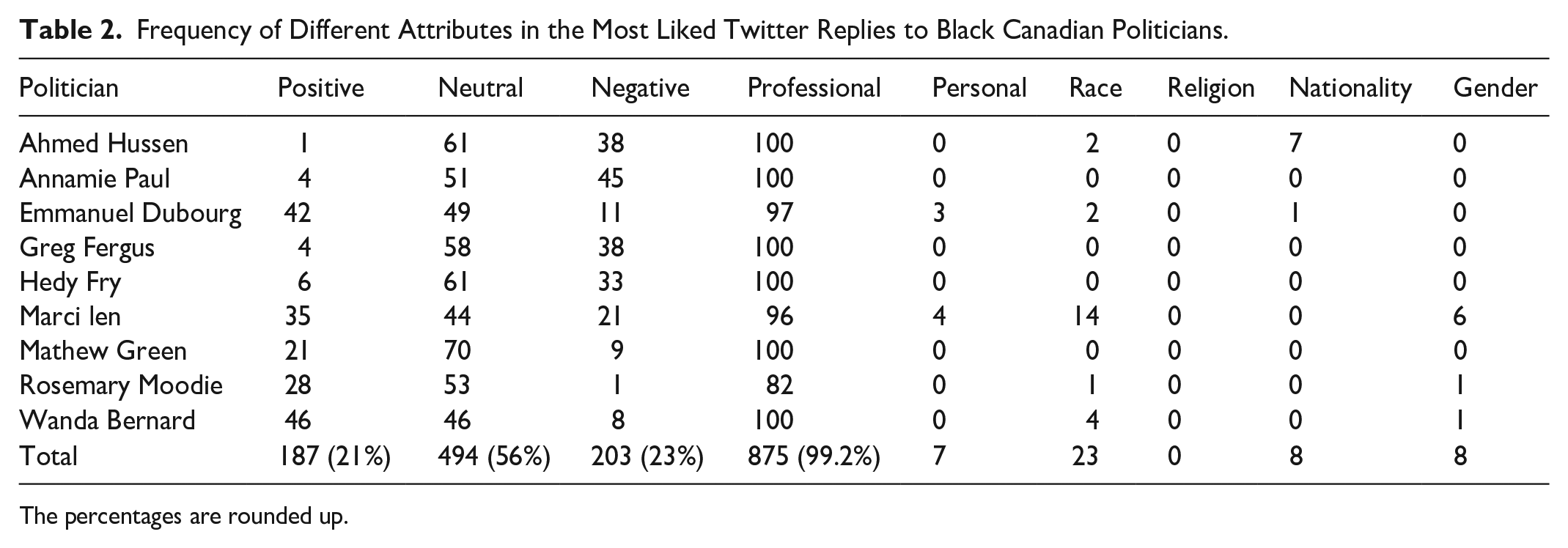
The percentages are rounded up.
Ahmed Hussen is second with (n = 38) negative replies, compared to (n = 1) positive tweet, making him the least praised in our data set. Across the board, most of the negative replies reference either the politicians’ stance on racial inequalities or racism, affiliation to the Liberal Party, or relationship with Prime Minister Trudeau. Contrastingly, except for Paul, the non-Liberal Party members have much fewer attacks. Independent senators Rosemary Moodie and Wanda Bernard have just 1 and 9, respectively, and Mathew Green from the NDP has 9. Marci Ien received (n = 23) negative tweets; however, many of the positive ones give the impression that she is more heavily trolled on social media than our sampled data demonstrate, which is why they are tweeting in support. A user expressed their frustration with these abuses and questioned why Twitter was allowing the racist attacks and threats on Ien.
The expectation that Twitter would intervene accentuates the presumption that the social media platforms themselves would inculcate intolerance for racist and other abuses into the technical affordances and use culture of the platforms. However, what these data demonstrate is a “platform culture” (Matamoros-Fernández, 2017) where free speech is equated with free rein on abuse of minority populations. Even though social media platforms self-project neutrality, their technical functionality and algorithmic properties enable discrimination through the concretization of white superiority. This is exemplified in their lax policies and inaction on harassment of ethnic minorities and blatant racism (Matamoros-Fernández, 2017).
Compared to the negative ones they reference, the supportive replies to Ien got more affirmation on Twitter judging from the higher number of likes they received. They also bolster her positive tweet count as she’s third with (n = 35). Bernard has the most positive replies (n = 46), including congratulatory messages for awards and well wishes for her health. As is common among all the politicians, she also receives negative feedback when she tweets on race. A Twitter user accused her of being racist for talking about racism. They pointed out that if racism existed in Canada, she would not be an MP. Such color-blind rhetoric seeking to deny racism do not magically erase the very real prejudicial experiences that ethnic minorities suffer. Her positive responses, however, outweigh the negative ones. Emmanuel Dubourg has the second highest number of positive replies (n = 42) with wide-ranging themes such as his former students’ experiences with him.
Tone (Neutral)
Altogether, the overriding tone of the most popular replies for all politicians was neutral. These could be disagreements without being abusive. In some cases, even if a tweet were overtly positive or negative, we coded them as neutral because they were not specifically directed at the politician in question. The neutral category contained 56% of all tweets, more than the sum of the positive (21%) and negative (23%) (See Figure 1). In the instances when they are abusive, they are directed at the politicians’ party or someone else with whom they are affiliated. Here too, the highest occurring oppositional tweets are responses to politicians’ statements on race and racism. These include visible minority immigrants, systemic racism, and so on. Racially themed tweets are so prevalent that they make up 24% (118 out of 493) of all the neutral tweets. On the other hand, the second most popular are critiques of PM Trudeau which constitutes 3% (n = 16). Generally, themes covered here are Trudeau’s infamous blackface saga, proclamations of reverse racism, and denials of racism’s existence. These correspond with Bonilla-Silva’s (2022) assertion on the mystery of white people’s insistence on the irrelevance of skin color while thriving in communities with color-coded discriminations against racialized people. The sharp rejection of actions concerning race and minority ethnicities is a passive-aggressive maneuver where people maintain the subterfuge of assertiveness in lieu of abuse because they are not directly targeting the politicians. It also illustrates that the hegemonic coding of public discourses inhibits discussions on ethnic minority concerns (Lentin, 2018), thus underscoring that many spaces on social media are not safe for racialized people (Brock, 2020).

Tone of tweet replies to Black Canadian politicians.
At the beginning of the 2019 elections campaign, Trudeau’s global image was severely dented when the media released images of him wearing brownface and blackface before he became Prime Minister. It contributed significantly to the Liberal Party’s election woes; they became the government with the lowest vote share in Canada’s history (Marland & Nimijean, 2021). The party’s salvaging measures included the Black members publishing statements accepting his apologies. Among the neutral tweets, these supportive statements were used as justification for silencing the politicians’ statements against racism. For example, when Fergus criticized someone for calling Kamala Harris “Trans-racial (a racial fluidity concept that identifies oneself to a particular usefulness),” several replies accused him of hypocrisy; one tweet had a collage of images featuring Trudeau in blackface and brownface.
Accusations of reverse racism against white Canadians usually address politicians’ announcement of government assistance for minorities, such as funding for Black businesses and entrepreneurs. This effort to establish an equivalence of racism exposes attempts to share the spotlight while simultaneously disregarding the inherent racist violence in this narrative (Lentin, 2018). Distinctly, they completely ignore the very real motivations of hatred, fear, and power that advance actual racism. The other common sentiment among these tweets that anti-Black racism does not exist usually opines that politicians commenting on these issues create racial inequalities. One user, for example, emphasized that racism arrived in 2015 when Trudeau became Prime Minister and Liberals started to divide Canadians by talking about racial inequalities. Replies like these seek to silence voices that speak out against racism, and they equate any mention of race with racism to undercut the potency of the original commentary. Paradoxically, they invoke racism as ammunition. Rather than advocating against racial inequality, these users employ the racism tag as a censoring instrument against the oppressed.
The data set bared a popular perspective that racial inequalities do not have a place in political leaders’ discourses, although they would be best placed to address them. This public opinion held even in instances when the politicians talk about their personal experiences, which is an interesting constraining of Black Canadians. The fact of their existence in the political apparatus appears to be enough testament to Canada’s diverse outlook. They do not have the “additional privilege” of participating in certain political discussions by delving into the issues that arise from their own multicultural realities.
Correspondingly, the tweets that oppose discussions on racial marginalization highlight the contradictions in the acceptability of politicians belonging to specific communities. They are attacked when they show their affiliation to minority groups like the Black Caucus or immigrants. This implied need to extract them from their sociocultural context contradicts the incessant practice of their electoral victory depending on representation of minority communities. Overall, these manifestations of color-blind racism reveal obscure nonracial tactics whose intangibility make them powerful tools for maintaining white privilege (Bonilla-Silva, 2022). These proponents only advocate an elision of all allusions to racial inequalities because they are divisive to serve their self-interest and the discomfort to their privileged positions, not because of the sustained racist violence on minorities.
Professional Versus Personal
Next, almost all the replies referenced the professional life of the politicians, which could be due to the original tweets from the politicians focusing on their work (see Figure 2 and Table 2). They engaged with issues like the politicians’ opinions about the Liberal government’s actions or inactions in dealing with the Covid-19 pandemic, and the invasion of the Prime Minister’s residence by an armed man. There were only seven tweets that had personal connotations split between Dubourg (n = 3) and Ien (n = 4) (Table 2). For Dubourg, they include a recommendation to attend a show in Montreal. An example for Ien relates to her dispute of a purported racially motivated traffic stop. A personal tweet therefore addressed her driving.
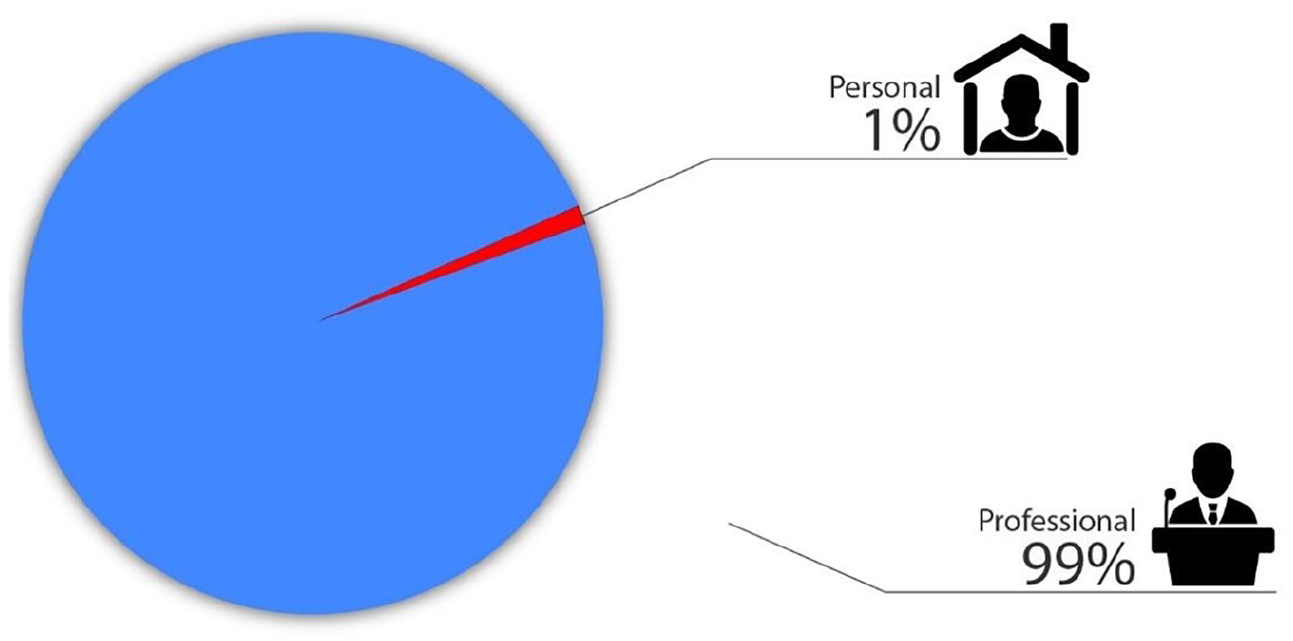
Percentage of professional versus personal tweets’ replies.
Race
There were (n = 23) tweet replies in the race category. A factor that could account for the low number is our focus on unambiguous targeting of the racial identities of the politicians. Thus, although there were several replies with racial themes, we did not code them here. This is because they were not direct references to the politicians’ race. In many cases, the users mentioned their own race to make a point or spoke about someone else’s.
In analyzing the replies, we emphasized the users’ understanding and discursive practices of the various concepts. Racism, for example, was in some cases reconfigured to connote any tension that arises between people placed into opposing ethnic groupings. With this erasure of the context of history and societal power dynamics, racism attains a fluid character which can adapt to suit one’s circumstances, like accusations of reverse racism. The malleability of the term trivializes racism against people of color by turning them into perpetrators. There were very few tweets specifically addressing the politicians’ race. Ien got the most references, 14 out of the 23. Two of these replies were negative in tone, seven were positive, while five were neutral (Table 2). The focus of these was primarily on her defense of a colleague who has written articles with racist undertones, and supportive tweets condemning racist attacks against her.
Other politicians who also had tweets coded under race are Moodie with one positive tweet, Bernard with two negative and two positive tweets, Dubourg received two negative ones, and there was one negative tweet directed at Hussen. The reply for Hussen discredits his political achievements by reducing him to a “Trudeau diversity appointment” who appeared ignorant of the daily gun violence in the Greater Toronto Area, also known as Mogadishu North.
Nationality
The tweet referenced above is similar to another reply to Hussen’s tweet on political leaders’ refusal to condemn racism. It has an image with the text “Minister of Somali Gangs says Canadians are Un-Canadian.” He is, therefore, expected to be silent on issues of anti-Black racism because of some Somalis’ involvement in criminal activities. This attests to the literature’s discussion of certain ethnic groups being identified with crime even when they are underrepresented in criminal activities compared to white Canadians (Maynard, 2017). Specifically, the user normalizes the privilege of whites and Canadian-born citizens through this ready resort to immigrant-blaming. Hussen’s experience of racism is irrelevant because of his Somali origins and immigrant status. He received the most attacks referencing his original nationality, four out of the five. The fifth tweet was directed at Dubourg. These are notably the only Black male immigrant federal politicians. Fry and Moodie are also immigrants but do not have any tweets replies in this category. Another Twitter user called out Bernard for having the nerve to talk about anti-Black racism as a Black immigrant member of parliament. This presumptive tweet (she was born in Canada) effectively emphasizes the perceived subordinate status of Black Canadians by rendering them outsiders who should be submissively grateful for being “welcomed” into Canadian society.
Gender
The replies specifically referencing gender are primarily directed at the female politicians and are mostly positive in tone. The gender narratives comprise the Twitter users’ discussion of the politicians’ activities as women or men. As the analysis below on the data from the digital methods will show, several abusive words to both male and female politicians are feminized to augment the deprecation being projected. It is telling, however, that these forms of abuses were not among the most liked/most boosted replies. Evidently, supportive and neutrally toned messages for the women politicians are more liked than negative ones. The tweets in this category largely allude to the barriers that women of color face in professional and other spaces. Ien received six, five of which highlight her intersectional realities by intertwining her gender with her race. Moodie and Bernard received one tweet reply each in this category, and like Ien, they connected their gender to their racial identities.
Religion
Finally, we did not identify any direct mentions of the politicians’ religion except for general references to Islam, Hinduism, and Christianity (See Figure 3).

Frequency of references to the politicians’ race, religion, gender, and nationality.
Digital Sentiment Analysis
Regarding the digital analysis, we found 3,084 abusive terms in replies to men politicians, constituting 2.7% of the overall data set, while women politicians got 1,290 abusive terms making up 2.1%. To examine the highly abusive content, we extracted the terms that scored over 70/100 per Hatebase metrics. There were 1,532 of such terms used against men politicians (representing 49.7% of the abusive terms in replies to men politicians). On the other hand, there were (n = 635) of highly abusive terms against women politicians (representing 49.2% of the negative terms in replies to women politicians (see Chart 1). To illustrate, the most frequent term used in the men politicians’ data is “idiot” (n = 619) followed by “globalist” (n = 217), “slave” ranks fifth (n = 151). The most frequent term used against women politicians is also “idiot” (n = 191), “slave” (n = 35) comes in sixth, while “bitch” (n = 25) is in 10th place. However, we also find in the men’s sample similar words in the top 50 list including the word “bitch” (n = 34) as well as “pussy” (n = 12) and “cunt” (n = 12). The overt feminization of male politicians indicates a gendered besmirchment that positions femininity with subordination. We find that male politicians are slightly more trolled than the women.
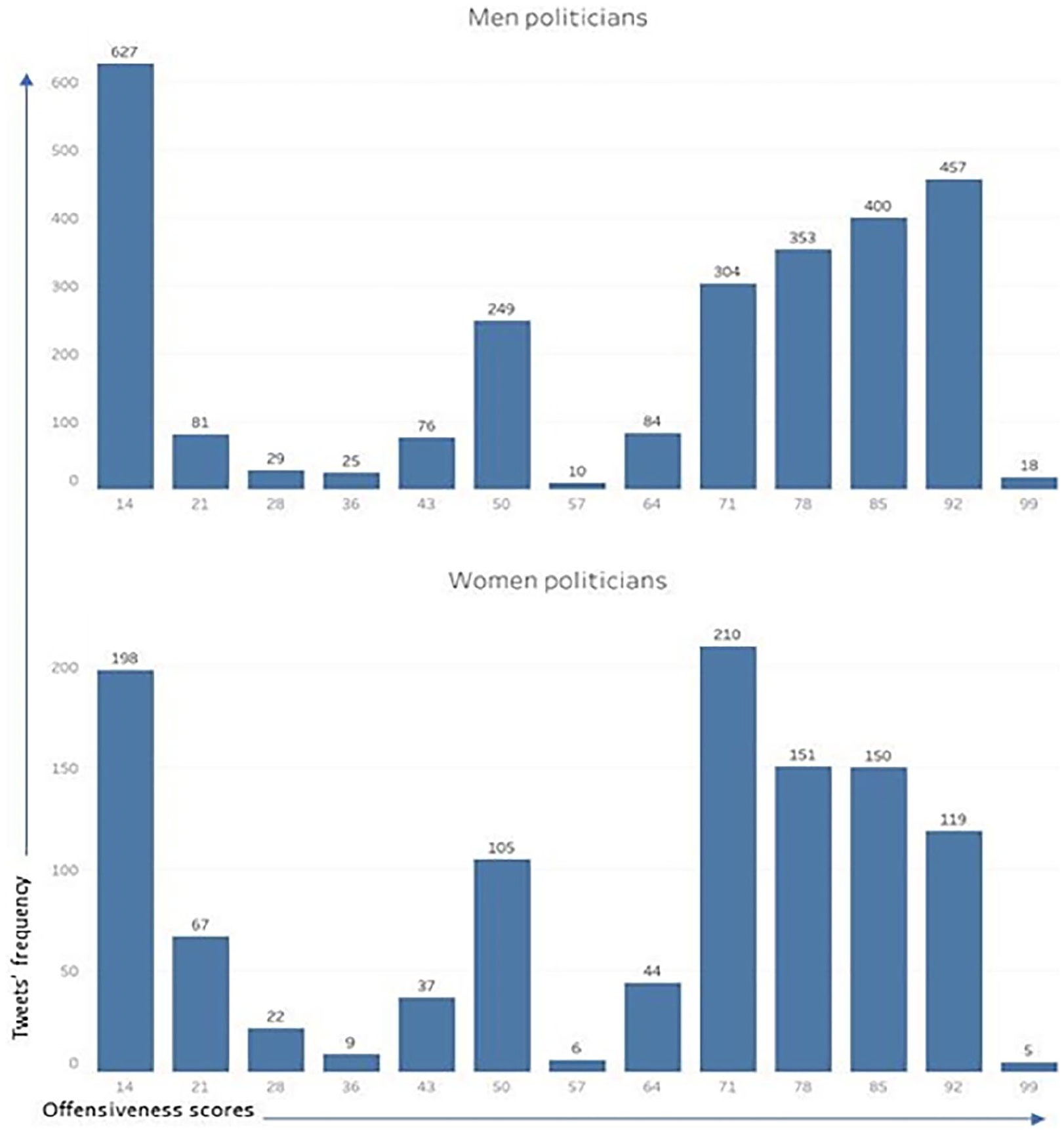
Frequency of tweets and their offensiveness scores against men and women politicians.
Findings from the other digital analyses correspond with the Hatebase analysis; the general sentiments toward men politicians are more negative than those toward women politicians. For example, the Vader analysis of the men’s data was lower 0.041081 (standard deviation of 0.442135 and variance of 0.195484) than that for women politicians (mean is 0.18684, standard deviation of 0.478393 and variance of 0.22886). Similarly, in the QDA Miner’s sentiment analysis, the proportion of negative words directed at the men politicians was 66.6% (n = 169,400), while positive ones were 33.4% (n = 84,980). With respect to the women’s data set, 55.7% of the words processed (n = 65,291) were negative, and 44.3% were positive (n = 51,951).
We computed the positive and abusive sentiments in the tweet replies against the tweet output of each politician to determine any causative links. Beyond the instigative qualities of original racially themed tweets as discussed in earlier sections, we did not deduce a direct relationship between the level of engagement by individual politicians and the trolling to which they are subject or the praise they receive. To illustrate, Ien is the second most active among this subset of politicians with a total of 23,852 tweets. She is, however, the third in terms of the level of engagement she has from users (n = 29,328 replies). She received the fifth highest number of negative tweet replies (n = 21) and fourth highest number of positive replies (n = 35). Paul, who has the most negative tweets (n = 45) is seventh for tweet outputs with a total of 1,918. She ties with Fergus at seventh place for positive feedback (n = 4) and is fifth for the sum of tweet replies from the public (n = 8,900). The final example is Hussen who has the highest number of tweet replies (n = 76,045) but is fourth for tweets put out from his account (n = 14,582). He received the second highest number of negative tweets (n = 38) and as detailed earlier most of these replies address his positioning on immigration and visible minority-related issues. These figures show that the level of engagement from the politicians and the number of replies from the public do not correlate directly with the degree of overt attacks or praise.
Nevertheless, we surmise two factors that could explain the greater number of abusive tweets against men politicians. The first is the larger sum of their followers (128,646) compared to the women (85,664). 3 The bigger audience mean their messages are broadcast more widely, thereby enhancing the probability of inviting more negative feedback. Second, the tweets from the male politicians that the public reacted to had higher instances of those factors which most prompted abusive rhetoric; race/racism/immigration, being Liberals, and association with Trudeau. As outlined above, an attack against Fergus or Hussen’s postulation against racism would refer them to their affiliation to Trudeau who has worn blackface, or the Liberal party’s perceived instigation of racism with their supportive policies for ethnic minorities. It is particularly noteworthy that Hussen was Minister of Immigration, Refugees and Citizenship for 2 years and was therefore deeply embroiled in these trigger issues.
Conclusion
We present an empirically unique operationalization of intersectionality on Black federal politicians in Canada. The intersectional framework applied here emphasizes the discriminations and obstacles they face because of their multidimensional identities. Hence, we foreground the aspects of their identities which are not acknowledged, dismissed, or maligned in the context of their political roles. We recognize that the principles and methods of content analysis are enshrined in normative standards of white academia (Nikunen, 2021). We address this position by employing an intersectional analytical framework which unravels the data through the experiential perspective of the marginalized. We endeavor to portray the uniqueness and diversity of experiences for each politician as, for instance, immigrant/female/Liberal. Accordingly, the findings from the manual analysis show that Twitter audiences reject Black politicians’ race as an integral aspect of their multidimensional identities which informs their opinions and lived experience of racism. They deem politicians wading into issues pertaining to minority communities intolerable. Topics on Blacks suffering racial inequalities were a principal trigger for abusive language. These instances epitomize “Canadian politeness” where people hesitate to appear overtly racist (Fleras, 2014), although they are quick to exclude the worth of visible minority realities from the Canadian experience. Many color-blind users downplay or deny the existence of racism in Canada.
Both adulatory and abusive tweets directed at women acknowledged their intersectional identities more than it did for men. The analyzed tweets used such phrases as “strong black woman,” while gender-specific attacks like “bitch” were among the highest occurring abusive words. The manual analysis also showed that among the most liked tweets, the women politicians had more negative feedback (n = 108 vs n = 96 for the men). Interestingly, they also had more positive replies. The digital analysis of the entire data set, however, revealed a contrasting finding, for there was a higher incidence of negative feedback per proportion of total replies to the men. Notwithstanding, individual female politicians faced incessant attacks; for example, Paul was the most harassed Black politician. Another interesting finding was that the original nationalities of the men were weaponized against them, a phenomenon which the Black women immigrants did not contend with. These issues, thus, highlight the manifold points of contention and comity that politicians who identify with multiple minority social categorizations endure. Overall, public engagement with Black Canadian politicians on Twitter has more negative than positive sentiments.
This study is a foundational contribution to Collins and Bilge’s (2020) argument that intersectional scholarship is evolving and is further enriched by the multifaceted applications of the framework to complex and diverse realities. A novelty that we contribute to the field is the inclusion of less popular facets of people’s identities like nationality. In terms of the analysis, our principal strength is the step beyond the positive/negative polarity of the data to capture the intensity of sentiments expressed in the digital analysis. We did this by distinguishing highly abusive words with scores above 70 per Hatebase metrics. This highlights the proportion of the abusive tweets that are particularly aggressive, 49.7% for men and 49.2% for women. Second, we reduce the risk of false positives which besets automated sentiment analyses with our integration of a manual analysis. It enabled us to tease out such instances as when a tweet might be clearly abusive, but not necessarily aimed at the politician in question. It also facilitated some critical reflections on emerging themes within the quantitative method (Matamoros-Fernández & Farkas, 2021). This step was informed by self-reflection on our positionality as researchers with the privilege of access to the data, and the inferences, analysis, and meanings we draw from it. We recognize the power to make certain claims through our interpretations (Leurs, 2017; Linabary & Corple, 2019); hence, mixed methods of large data sets are vital for a deeper and more contextualized analysis (Nikunen, 2021). Ultimately, our study responds to the need to operationalize big data analysis to elucidate the nuances of intersectional power differentials in the context of race, gender, and other relations (Linabary & Corple, 2019). Indeed, this is a key addition to the literature on applying intersectionality as an analytical tool within the North American context, with a mixed-methods approach.
The study’s limitations are largely in the implementation of the digital sentiment analysis. We did not apply a word-sense disambiguation in classifying various words which have more than one meaning. Not delving into contextual meanings of some words could result in overlooking negative connotations, or in mistakenly categorizing certain words as having negative sentiments. In addition, expanding the sampling method to include not just replies but all tweets that refer to or mention the politicians would have elicited a wider breadth of emerging themes. A final drawback is the inability of content analysis of user-generated social media data to delve into the multiplicity of personhood that users embody beyond the manifest meaning and retrieved data. Related to this, we could not ascertain the representativeness of Canadian society in the data without access to the users’ true demographic information.
This is a content analysis relying on the manifest rather than the latent meaning of users’ replies. We, however, also added interpretive assessments to engage with the emerging themes. Further qualitative studies could use these findings as points of reference to elucidate the sociotechnical context of inclusion in and exclusion from political spaces. We encourage further studies on the treatment of minority politicians using mixed methods involving discourse analysis, and therefore a more interpretative approach, to emphasize connotations and intended meanings based on wider-ranging data.
Footnotes
Declaration of Conflicting Interests
The author(s) declared no potential conflicts of interest with respect to the research, authorship, and/or publication of this article.
Funding
The author(s) disclosed receipt of the following financial support for the research, authorship, and/or publication of this article: This study was funded by a Canada-UK Artificial Intelligence (AI) SSHRC Initiative project entitled “Responsible AI for Inclusive, Democratic Societies: A cross-disciplinary approach to detecting and countering abusive language online” (ES/T012714/1).
